Although Naturalist painting had originated in the countryside among the rural poor, it soon came to record changing times in science. One of the more prominent painters of science and scientists was Léon Lhermitte, now known almost entirely for his rural paintings.
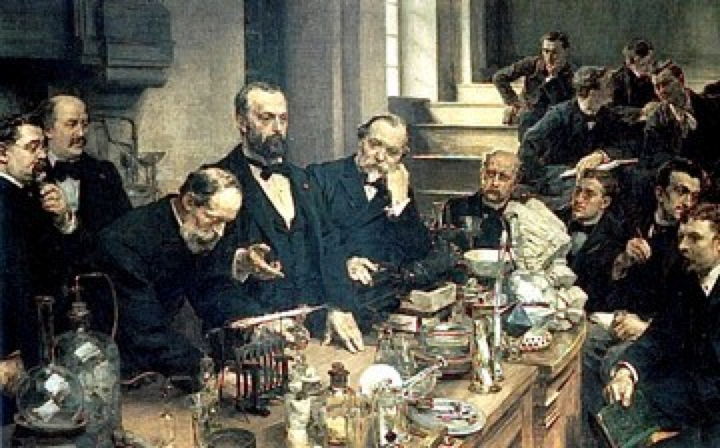
Léon Augustin Lhermitte (1844–1925), Claude Bernard and His Pupils (1889), copy of original by unknown artist, oil on canvas, 86.5 x 112.5 cm, Wellcome Library no. 45530i, London. Courtesy of Wellcome Images, via Wikimedia Commons.
Claude Bernard (1813-1878) was a pioneering physiologist whose writings were of great influence to Naturalists, including Émile Zola. Following Bernard’s death, the Sorbonne (where he had taught) commissioned Lhermitte to paint his portrait in 1886. This is a faithful anonymous copy of Claude Bernard and His Pupils, which was exhibited at the Salon in 1889. This shows Bernard in the midst of performing an experiment on a rabbit, his students discussing its results, and one writing the experimental observations in the laboratory daybook.
Léon Augustin Lhermitte (1844–1925), The Chemist Henri Sainte Claire Deville, Lesson on Aluminium (1890), The Sorbonne, Paris. Wikimedia Commons.
Lhermitte’s painting of The Chemist Henri-Étienne Sainte-Claire Deville, Lesson on Aluminium from the following year was also commissioned by the Sorbonne in Paris; I apologise for the small size of this image. Henri-Étienne Sainte-Claire Deville (1818-1881) was responsible for many significant discoveries in chemistry, the most important being a method for the industrial manufacture of aluminium. He’s shown here surrounded by objects made from this new material, which quickly came to transform manufacturing and to invade every home.
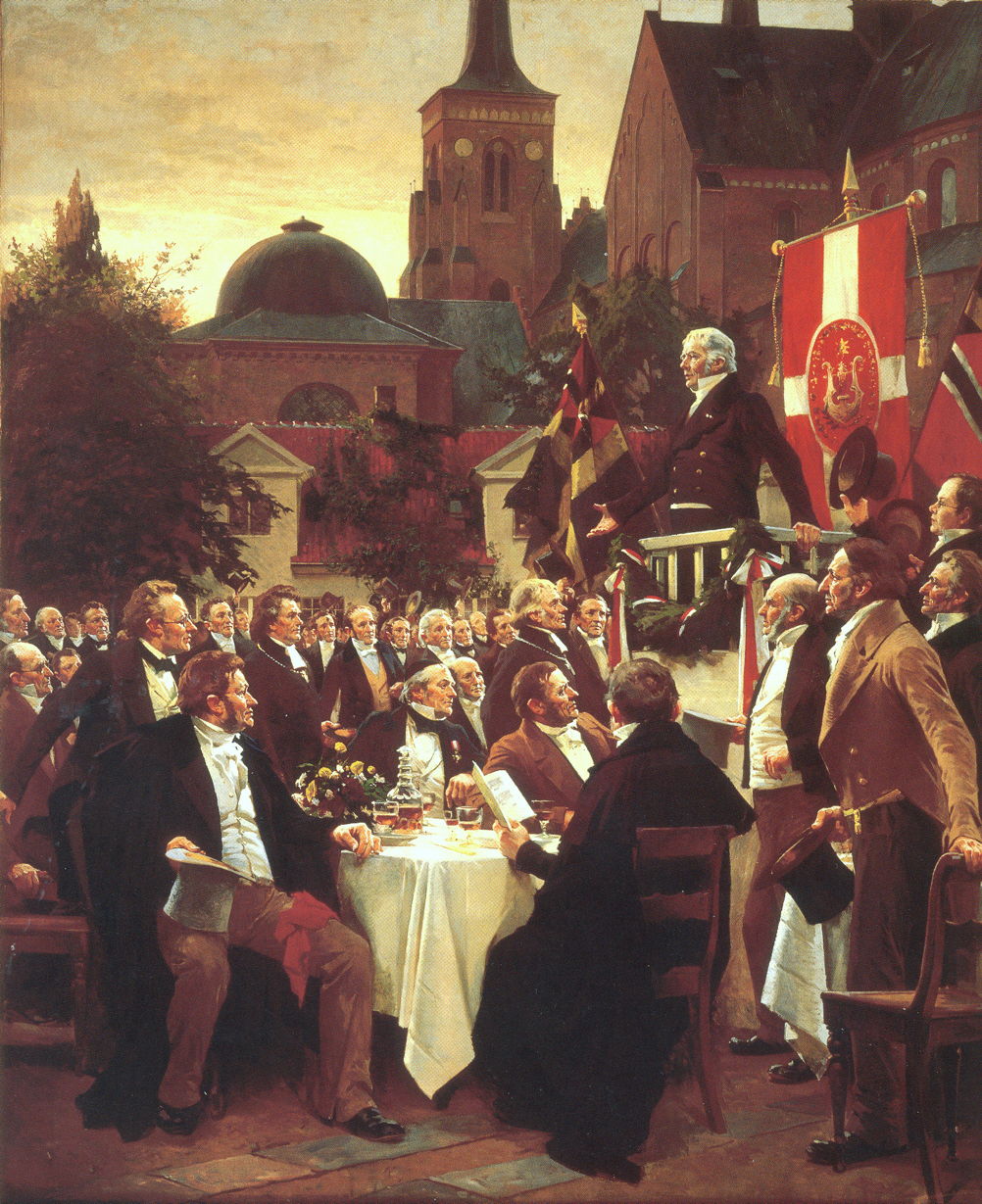
Erik Henningsen (1855–1930), The Nordic Natural Science Research Meeting 14 July 1847 (1895), mural, dimensions not known, Aula, University of Copenhagen, Copenhagen, Denmark. Wikimedia Commons.
Several Naturalist painters were commissioned to paint murals depicting scientific events for universities. Among them is Erik Henningsen’s The Nordic Natural Science Research Meeting 14 July 1847, completed in 1895 for the Aula of the University of Copenhagen. Presiding over this scientific meeting was the great Danish physicist and chemist Hans Christian Ørsted, who was nearly seventy at the time.
Technology was also becoming commonplace at work.
Charles Frederic Ulrich (1858–1908), The Village Printing Shop, Haarlem (1884), oil on panel, 54 × 58.3 cm, Terra Museum of American Art, Chicago, IL. Wikimedia Commons.
Charles Frederic Ulrich painted a young apprentice drinking during a moment’s pause in his work in The Village Printing Shop, Haarlem (1884). In the background is a large and relatively modern printing press.
Jean-Eugène Buland (1852–1926), Un Patron, or The Apprentice’s Lesson (1888), oil on canvas, 102 x 82 cm, Nationalmuseum, Stockholm, Sweden. Image by Erik Cornelius, via Wikimedia Commons.
Another Naturalist artist, Jean-Eugène Buland, in his Un Patron, or The Apprentice’s Lesson from 1888 shows a young boy being trained to make a cogwheel. This was part of the French industrial recovery following its defeat in the Franco-Prussian War.
Louis Muraton (1850–1919), The Photographer (before 1901), further details not known. Wikimedia Commons.
The subject of Louis Muraton’s The Photographer, painted before 1901, is rocking a glass plate in a bath of developer, in his improvised darkroom, another sign of the times.
Major innovations in medical procedures and care were introduced, and duly recorded in Naturalist paintings.
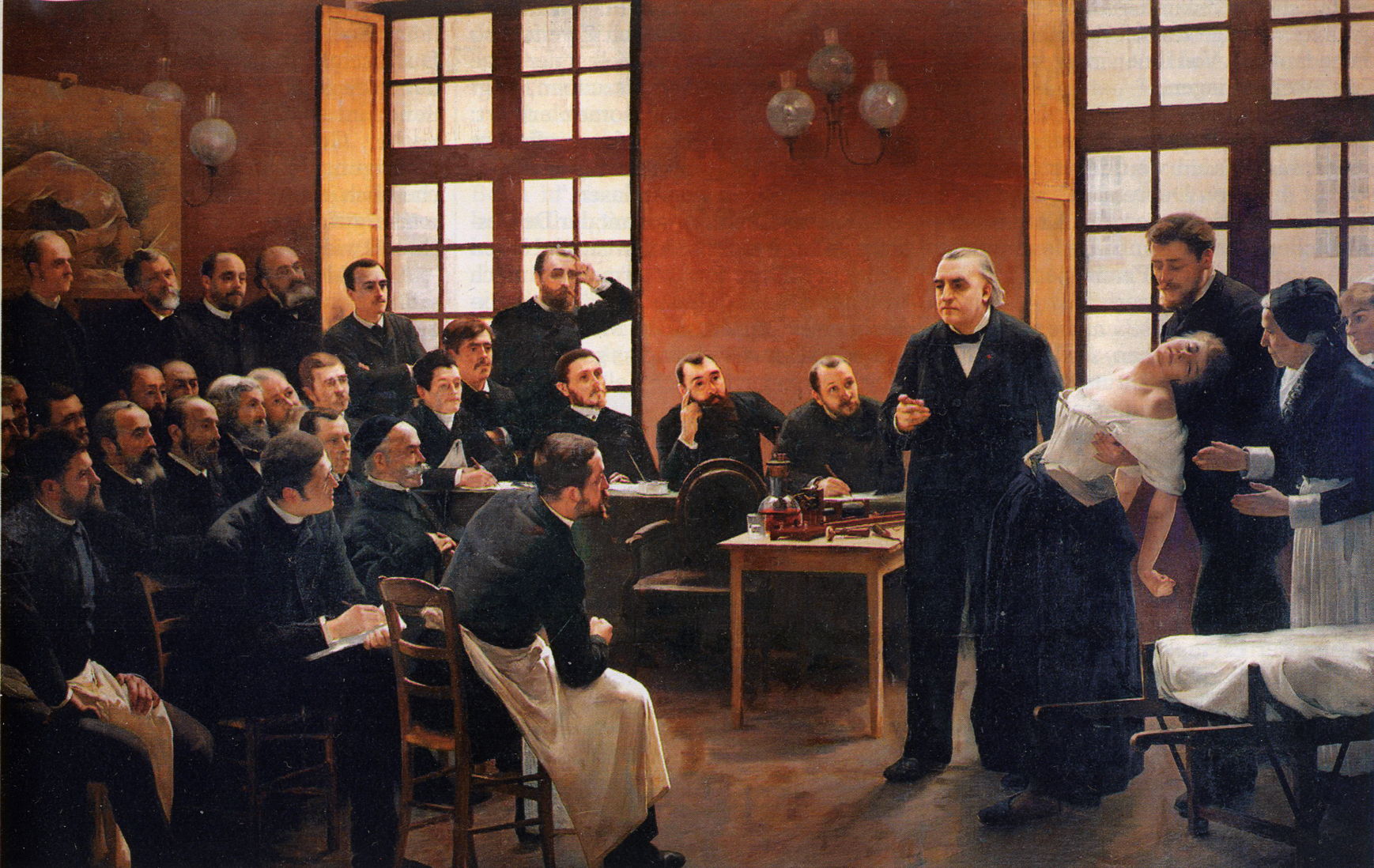
André Brouillet (1857–1914), A Clinical Lesson at The Salpêtrière Hospital (1887), oil, 290 x 430 cm, Paris Descartes University, Paris. Wikimedia Commons.
In André Brouillet’s A Clinical Lesson at the Salpêtrière Hospital (1887), an eminent neurologist Jean-Martin Charcot is demonstrating how he could hypnotise Marie “Blanche” Wittman, the ‘Queen of Hysterics’, into suffering hysterical collapse. Charcot and Wittman were a renowned partnership in this ‘act’, who performed in front of Sigmund Freud when he visited the hospital.
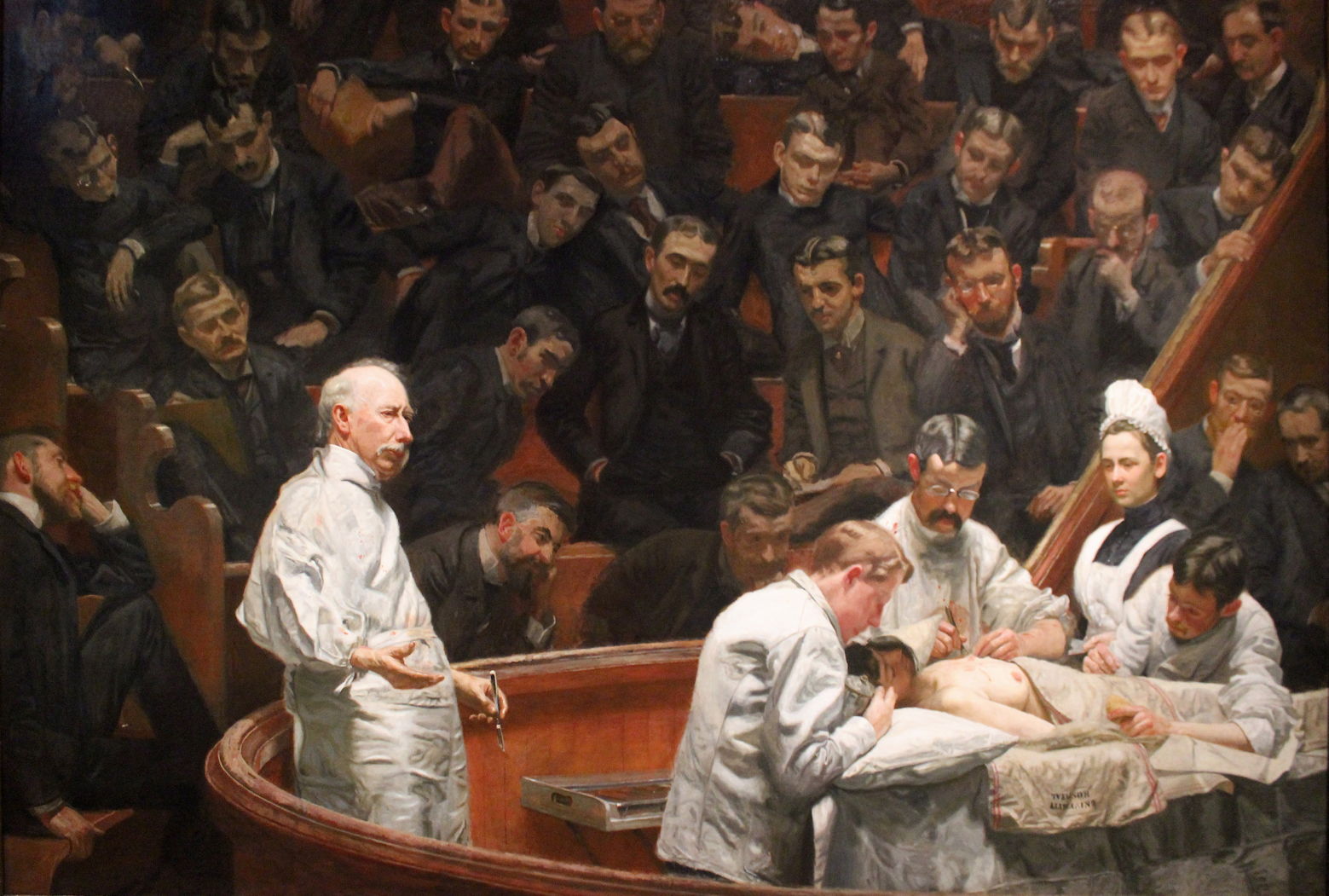
Thomas Eakins (1844–1916), The Agnew Clinic (1889), oil on canvas, 214.2 x 300.1 cm, Philadelphia Museum of Art, Philadelphia, PA. Wikimedia Commons.
In the USA, Thomas Eakins painted the retiring professor of surgery, Dr. David Hayes Agnew, at work in the University of Pennsylvania School of Medicine. The patient is unconscious thanks to a volatile liquid general anaesthetic administered via a mask. Bright surgical lighting puts six figures literally in the limelight, including that of Agnew, holding a scalpel at the left.
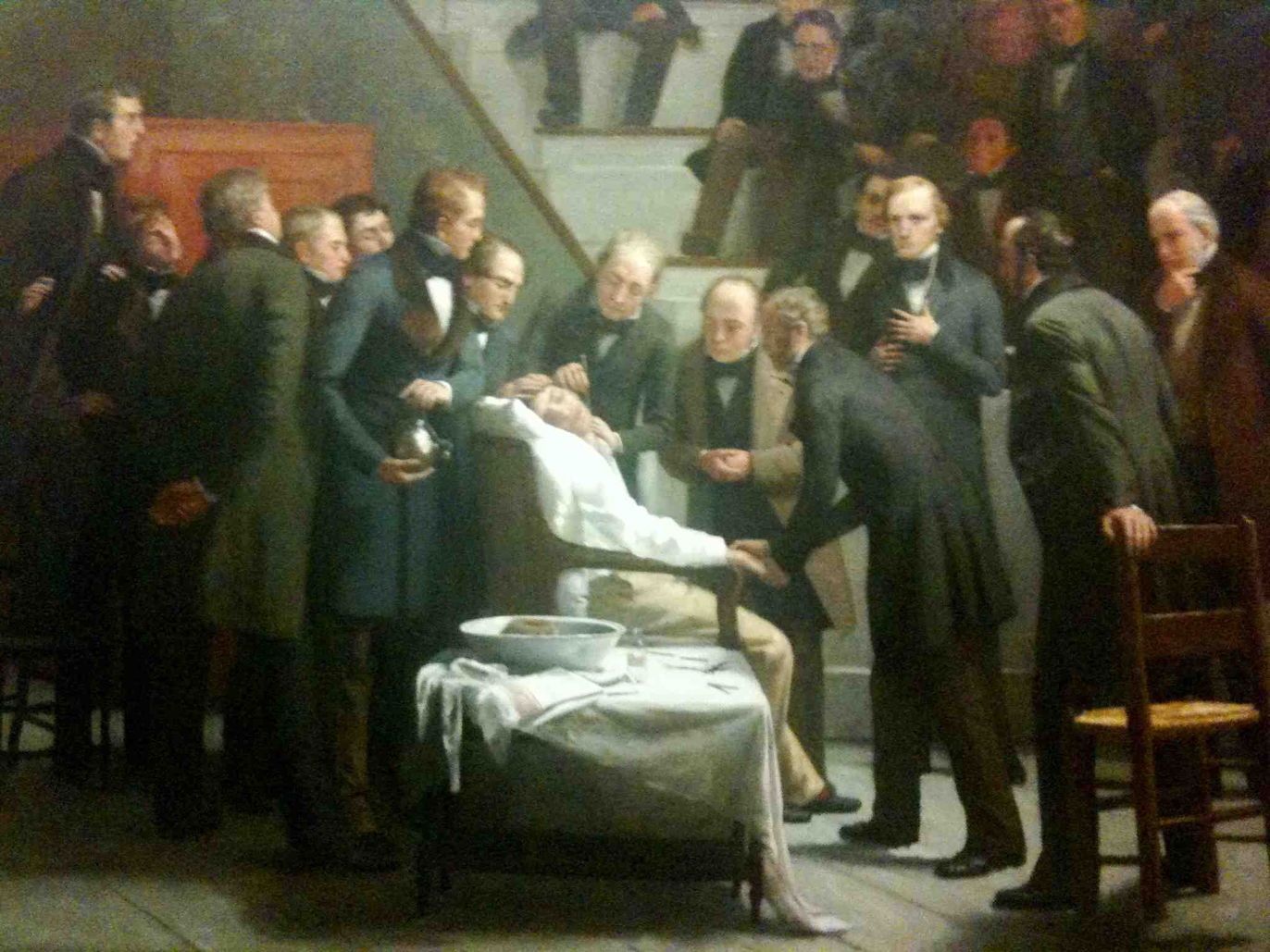
Robert C. Hinckley (1853–1941), Ether Day, or The First Operation with Ether (1882-93), oil on canvas, 243.8 x 292.1 cm, Francis A. Countway Library of Medicine, Harvard University, Cambridge, MA. Wikimedia Commons.
Robert C. Hinckley’s Ether Day, or The First Operation with Ether, painted between 1882-93, recreates the scene on 16 October 1846 in what is now known as the Ether Dome in the Massachusetts General Hospital, Boston, MA. Here John Collins Warren is removing a tumour from the neck of a local printer, Edward G Abbott, who was anaesthetised using ether, in its first recorded use for a general surgical procedure; I apologise for the poor quality of this image.
Anna Sahlstén (1859–1931), Surgery in hospital (c 1893), oil on canvas, dimensions not known, EMMA – Espoon modernin taiteen museo, Espoo, Finland. Wikimedia Commons.
Finally, Anna Sahlstén’s Surgery in Hospital from about 1893 shows the dazzling whiteness of the modern hospital, with a smart professional nurse caring for a child patient in the background. On the wall is a large radiator for the hospital’s modern heating system, which replaced the old stoves seen in so many earlier images of hospital wards.
Several other Naturalist painters achieved acclaim alongside Jules Bastien-Lepage and sustained the movement after his untimely death in 1884. Jean-Eugène Buland (1852–1926) was among them, and continued painting into the twentieth century. He died one hundred years ago today, and this article gives a brief overview of his career with a small selection of his paintings.
Buland trained at the École des Beaux-Arts in Paris under Alexandre Cabanel, and with his teacher’s influence turned first to history painting. In 1878 and 1879 he was second in the contest for the Prix de Rome, but then switched to painting genre scenes of modern life, classical Naturalist motifs inspired by the literary Naturalism of Émile Zola in particular.
His meticulous realism was well-received at the Salon, and after winning a series of medals there, in 1889 he was awarded a silver medal at the Exposition Universelle in Paris.
Buland settled in the village of Charly-sur-Marne, to the east of Paris, and steadfastly refused to become part of the art scene in the capital. He only seems to have ventured into Paris for the annual Salon, and to paint commissions in the Hôtel de Ville (City Hall).
Jean-Eugène Buland (1852–1926), Alms of a Beggar (1880), oil on canvas, 117 × 89 cm, location not known. Wikimedia Commons.
From the outset, Buland took on challenging motifs with equally challenging readings. In Alms of a Beggar (1880), a young woman dressed immaculately in white is sat outside a church seeking charity. Approaching her, a coin in his right hand, is a man who can only be a beggar himself. His clothes are patched on patches, faded and filthy, and he wears battered old wooden shoes, yet he is about to give the young woman what is probably his last coin.
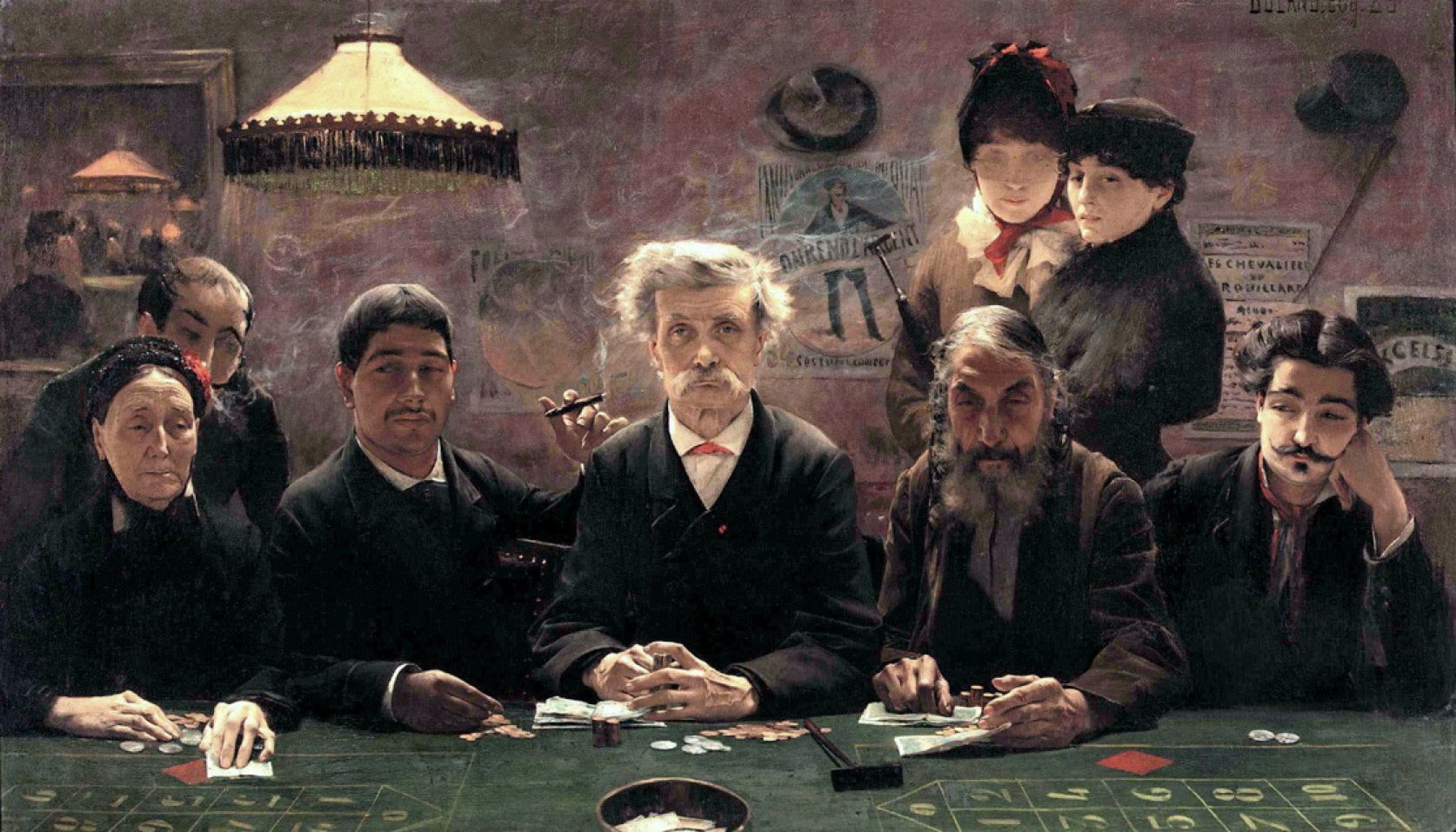
Jean-Eugène Buland (1852–1926), Le Tripot (The Dive) (1883), oil on canvas, 63.5 × 109.2 cm, location not known. Wikimedia Commons.
Le Tripot (The Dive) (1883) is one of my favourite paintings of this period. Set in a seedy, downmarket gambling den, it’s a group portrait of five hardened gamblers at their table. Each is rich in character, and makes you wonder how they came to be there. A little old widow at the left, for example, looks completely out of place, but is resolutely staking her money. Looking over her shoulder is a man, whose face is partially obscured. Is he, perhaps, a son, or a debtor? A young spiv at the far right is down to his last couple of silver coins, and looks about to lose them too. The air is thick with smoke, the walls in need of redecoration, and a pair of young streetwalkers prowl behind them, looking for a winner who will spend some of their cash on them.
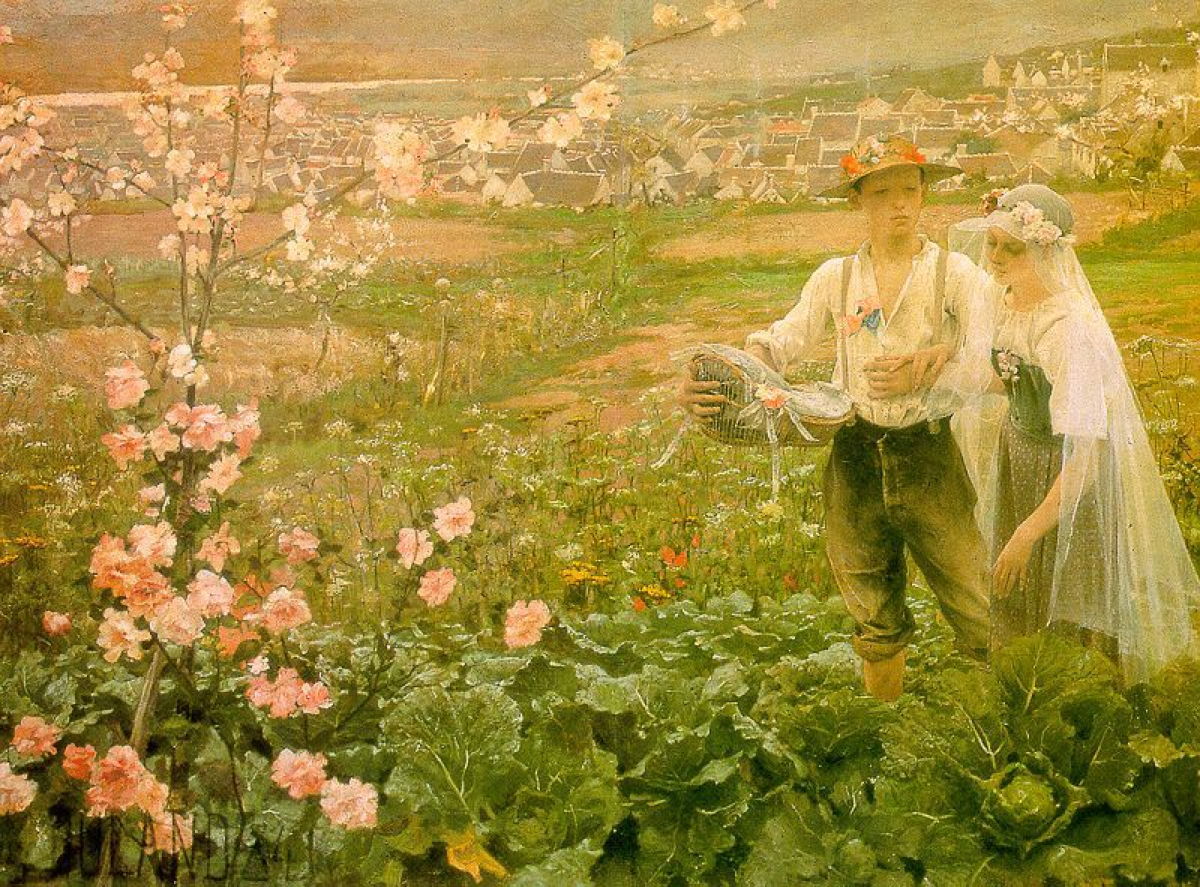
Jean-Eugène Buland (1852–1926), Innocent Wedding (1884), oil on canvas, dimensions not known, Musée des Beaux-Arts de Carcassonne, Carcassonne, France. The Athenaeum.
Buland also seems to have painted some unashamedly populist works, including this idyllic Innocent Wedding (1884). With the distant village, blossom, and a young couple arm in arm, it’s deeply romantic, and a far cry from the works above.
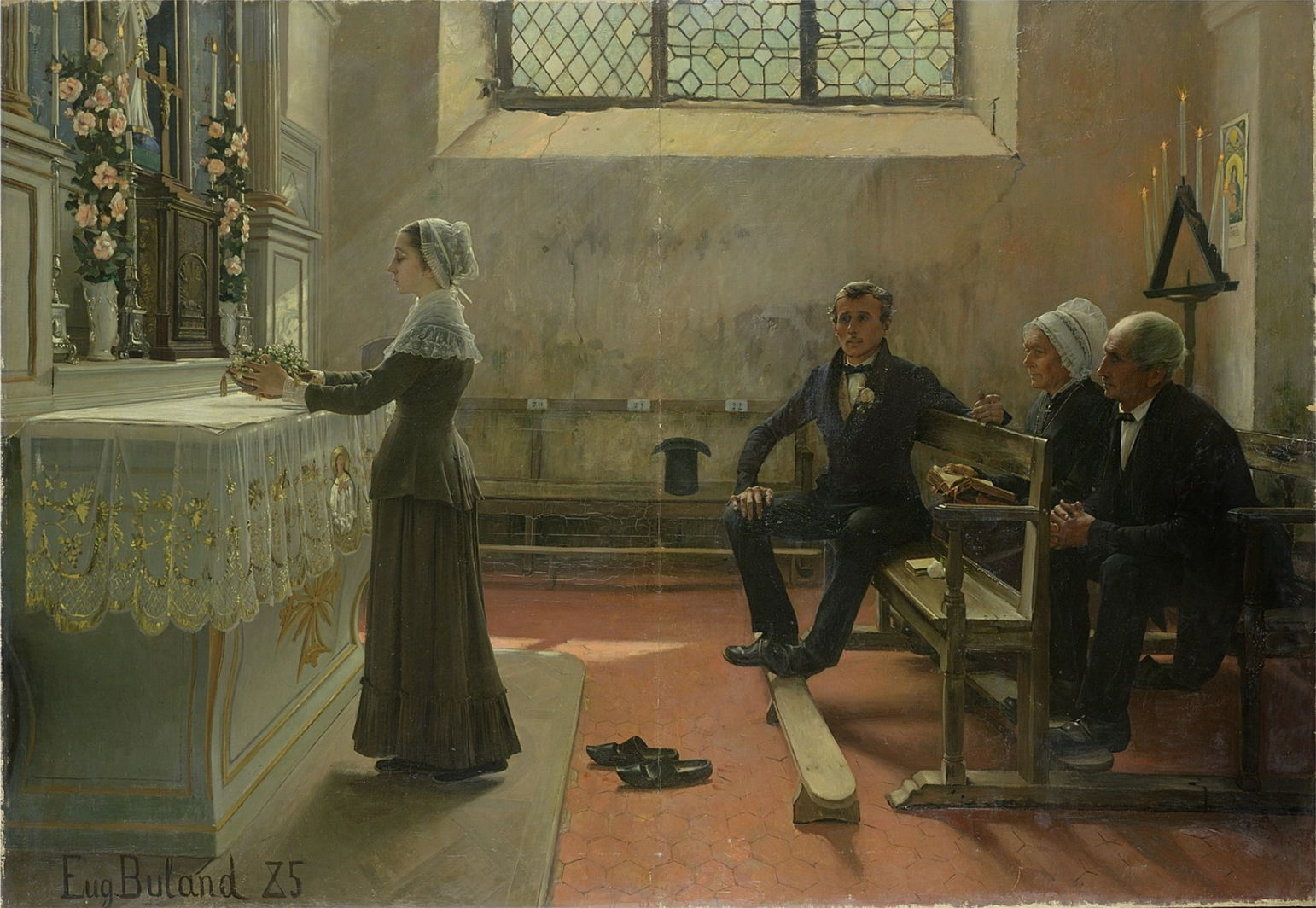
Jean-Eugène Buland (1852–1926), Offering to the Virgin the Day After the Wedding (1885), oil on canvas, 144 × 209 cm, Musée des Beaux-Arts de Caen, Caen, France. Wikimedia Commons.
That led to a series of paintings showing events the day after the wedding, including this of the newlywed bride Offering to the Virgin the Day After the Wedding (1885). There’s a crisp formality in these figures, who appear stilted and posed as they go through the rites and processes of life.
Jean-Eugène Buland (1852–1926), Un Patron, or The Apprentice’s Lesson (1888), oil on canvas, 102 x 82 cm, Nationalmuseum, Stockholm, Sweden. Image by Erik Cornelius, via Wikimedia Commons.
Buland went to the factory for Un Patron, or The Apprentice’s Lesson (1888). A young boy is being trained by his foreman to make a cogwheel, when many might have preferred him still to be at school. Buland used photographs extensively in the preparatory work for this painting, to capture its wealth of detail.
This also marks an overt politicisation in his work: the apprentice was part of the nation’s efforts to advance in industry and manufacturing after the disaster of the Franco-Prussian War.
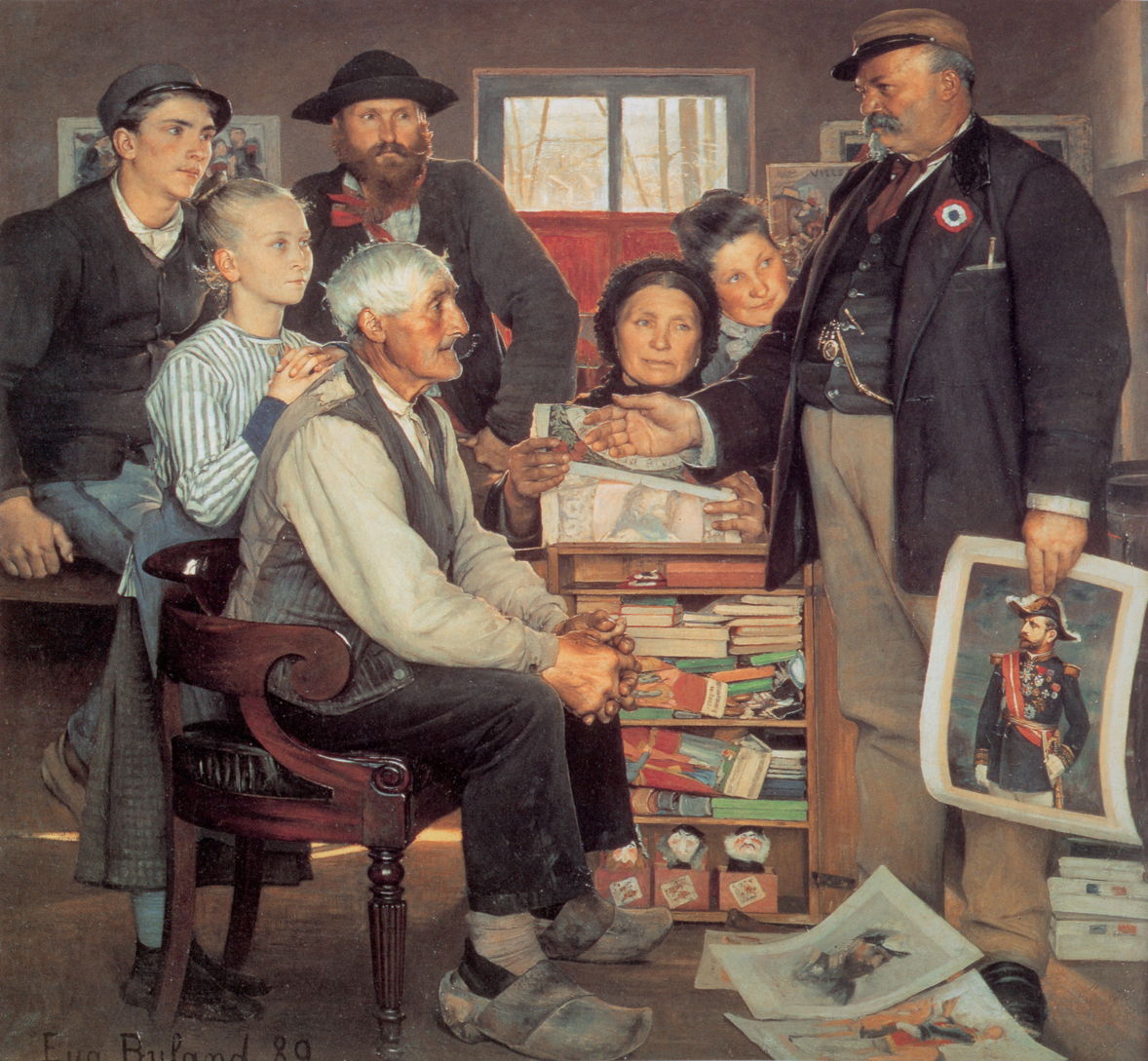
Jean-Eugène Buland (1852–1926), Propaganda Campaign (1889), oil on canvas, 181.8 × 191.4 cm, Musée d’Orsay, Paris. Wikimedia Commons.
Propaganda Campaign (1889) is even more political, and Buland’s stark rendering of its figures makes them pop out, almost like cut-outs. A travelling salesman is in the home of a poor family, selling books and coloured prints to the head of the household. That in his left hand shows the populist politician General Boulanger, and the salesman’s motives combine politics with business. His buttonhole rosette declares his role as a canvasser for the General.
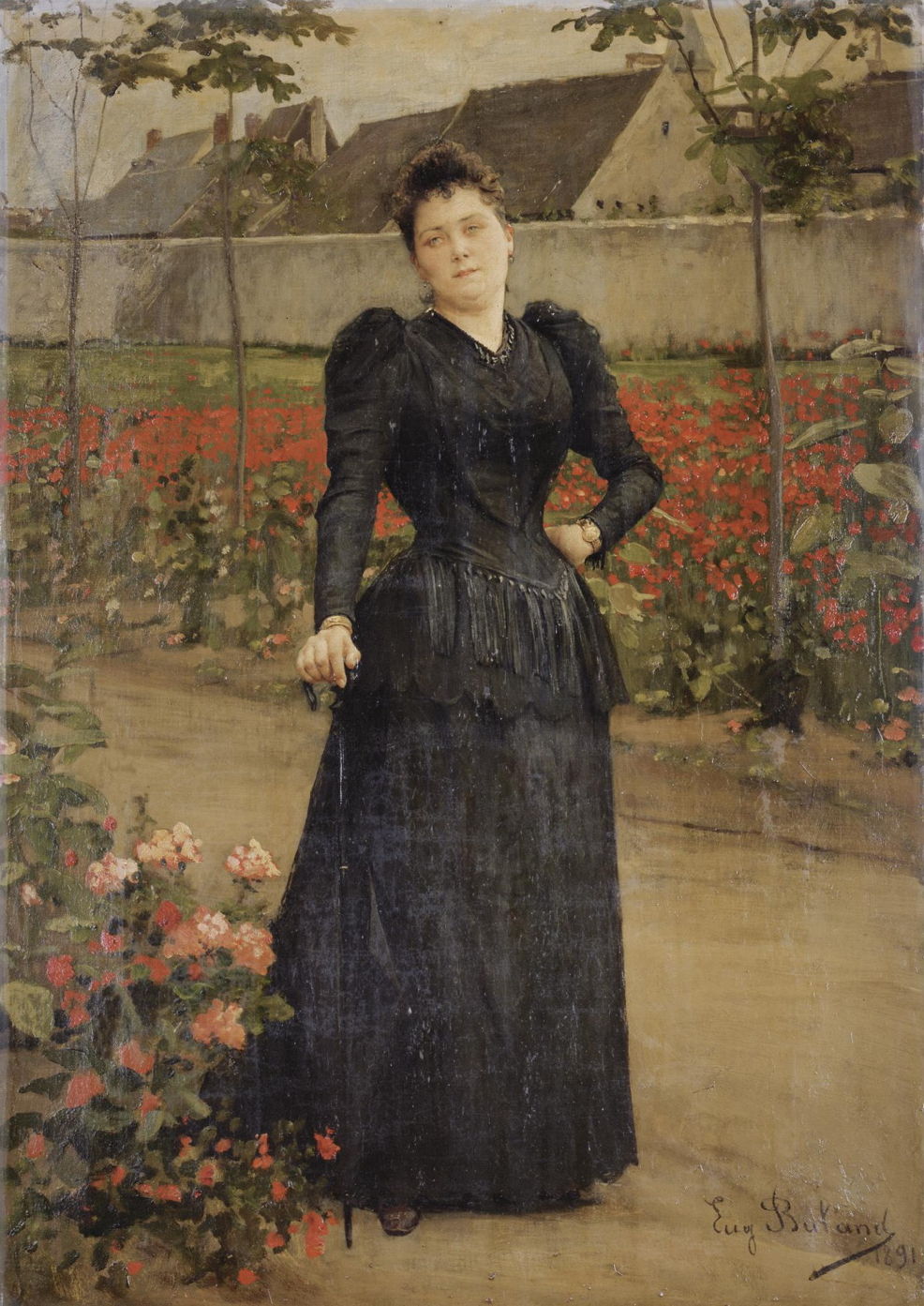
Jean-Eugène Buland (1852–1926), A Stroll in the Park (1891), oil on canvas, 92.5 × 65 cm, location not known. Wikimedia Commons.
A Stroll in the Park (1891) seems a more innocent full-length portrait of a woman, although I have been unable to discover her identity or any reason for the painting.
Jean-Eugène Buland (1852–1926), Municipal Council and Commission of Pierrelaye Organizing a Festival (1891), oil on canvas, 140 × 200 cm, Town Hall, Pierrelaye, France. Wikimedia Commons.
Municipal Council and Commission of Pierrelaye Organizing a Festival (1891) is another fascinating painting with much contemporary relevance, an example of provincial municipal art. It’s a group portrait of the council of this village to the north-west of Paris, clearly commissioned by them to record their great deeds. It has a similar stiff formality to Propaganda Campaign, rather than the more insightful approach of Rembrandt’s group portraits.
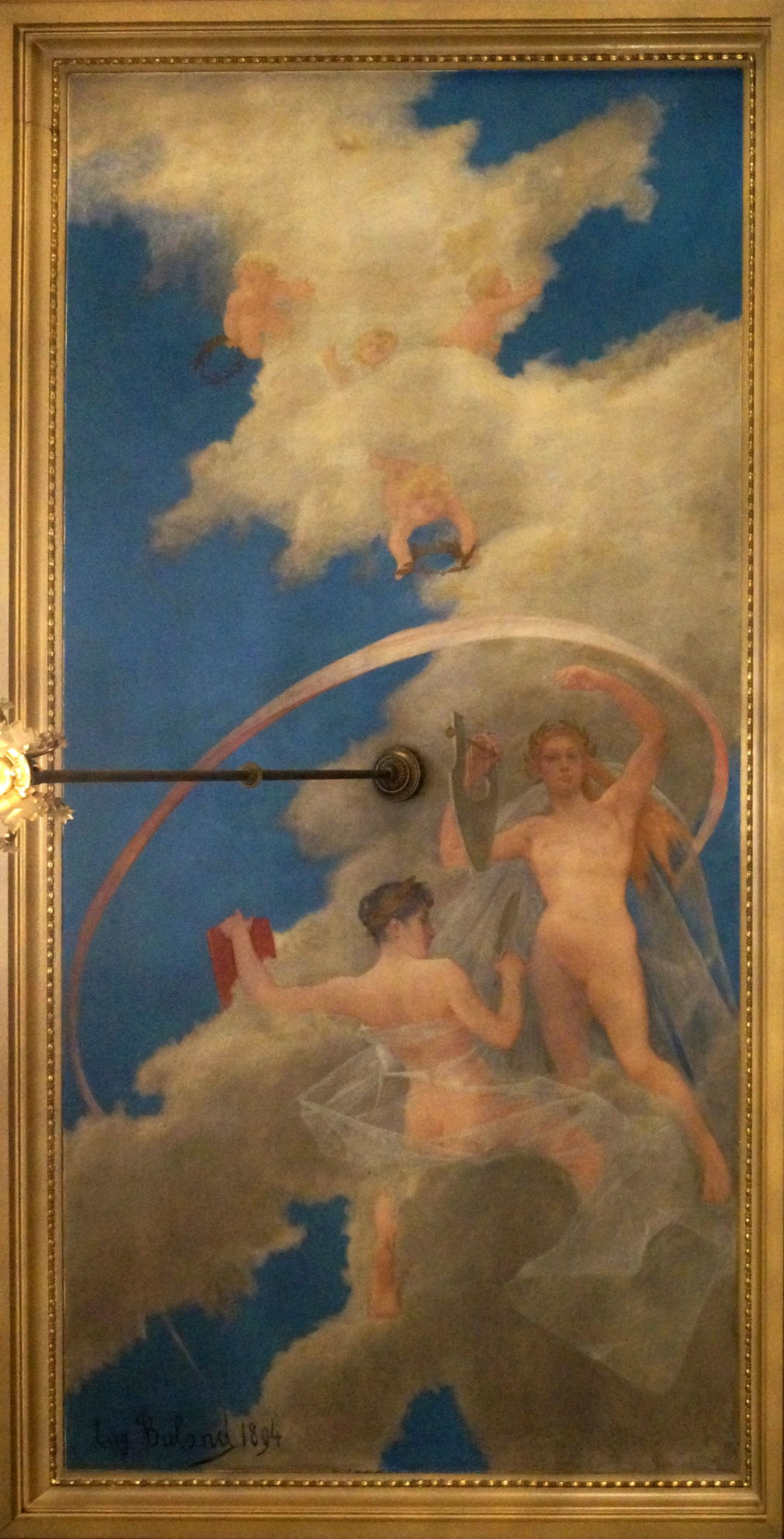
Jean-Eugène Buland (1852–1926), Marriage (date not known), painted ceiling, dimensions and location not known (?Hôtel de Ville, Paris). Image by G.Garitan, via Wikimedia Commons.
I suspect that Buland’s romantically painted ceiling of Marriage was one of his commissions for the rebuilt Hôtel de Ville in Paris, and completed in the 1890s.
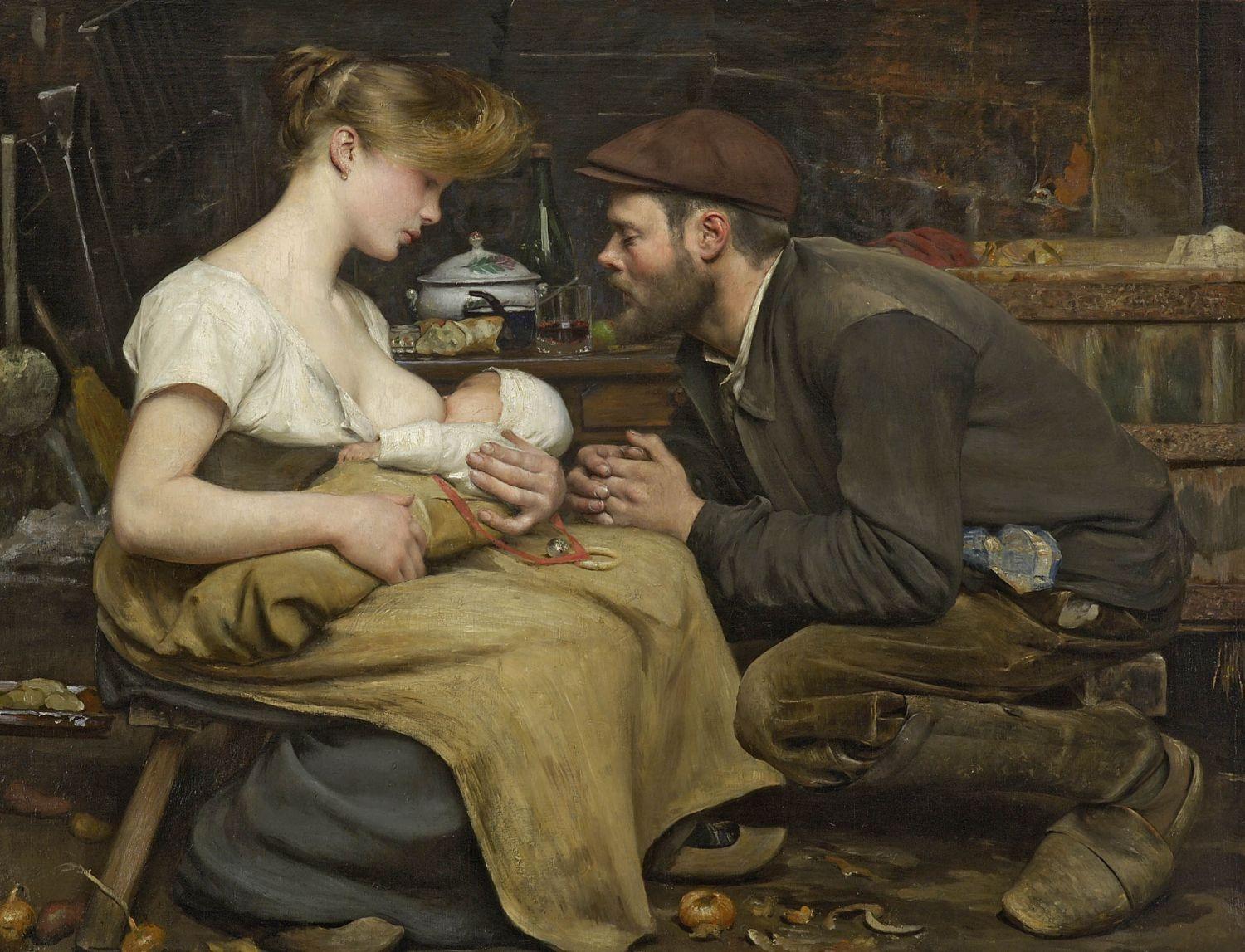
Jean-Eugène Buland (1852–1926), Parental Happiness (1903), oil on canvas, 97.5 × 129 cm, location not known. Wikimedia Commons.
He returned to poor working families in his Parental Happiness from 1903. A young couple are nursing their first baby, and appear to be living in an agricultural outhouse. The floor is strewn with vegetables and their parings, and the husband is dressed as a labourer, with worn working shoes, and his wife in wooden clogs.
Jean-Eugène Buland (1852–1926), The Tinker (1908), oil on canvas, 112.6 × 145 cm, Private collection. Wikimedia Commons.
Buland’s The Tinker (1908) is busy at his cottage industry, repairing damaged pots, pans, and domestic metal objects. The stone wall at the left glistens with the damp.
Jean-Eugène Buland died in his home village of Charly-sur-Marne on 18 March 1926, at the age of 73.
This century has brought something of a revival for Buland. His first solo retrospective exhibition was held at Carcassonne in 2007-08, and his prices at auction are moving steadily upwards. I hope it doesn’t prove too late to conserve and document what remains of his work.
Reference
Richard Thomson (2012) Art of the Actual, Naturalism and Style in Early Third Republic France, 1880-1900, Yale UP. ISBN 978 0 300 17988 0.
There’s a popular and relatively recent myth that European painting in the late nineteenth century consisted almost entirely of Impressionist landscapes and their descendants in Post-Impressionism, or the dying embers of the Academic past. That oversimplification carefully omits many of the innovative artists of the day, who developed the social realism of Jean-François Millet and Gustave Courbet into what became Naturalism. Among its other key influences were Édouard Manet and the novelist and critic Émile Zola (1840-1902), who were also associated with Impressionism.
Impressionism was primarily a revolt against established ideas as to how paintings should be made, and how they should look. Although the term has been extended to other arts, it’s only really meaningful in the context of painting.
Naturalism arose first and became most extensive in literature. Among its great influences was the pioneering French physiologist Claude Bernard (1813-1878), whose writings were read avidly by Naturalists including Zola. Bernard’s approach to science stressed not only the importance of observation, but of experiment, forming the basis for his accounts of the working of the body, and the scientific foundations of medicine. Bernard’s Introduction to the Study of Experimental Medicine, published in 1865, convinced Zola to use an experimental approach to writing his novels. He thus watched people in life and filled notebooks with his observations. He then set characters up in the scenario for a novel, and they behaved according to his observations. He finally documented this imaginary experiment as his next novel.
Naturalist painting made no attempt to follow Zola’s experimental approach, but aimed to document ordinary people going about their normal daily activities in their normal surroundings, with a degree of objectivity rather than sentiment. Its style is a neutral realism showing as much fine detail as necessary for its purpose, and sometimes being almost photographic in quality.
Naturalism and Impressionism were by no means mutually exclusive, but served different purposes. Some of the finest artists of the last thirty years of the nineteenth century were exponents of both. Landscapes were predominantly approached as Impressions, while figurative paintings worked better using Naturalist techniques. Here are some examples from about 1883, when both were at their height.
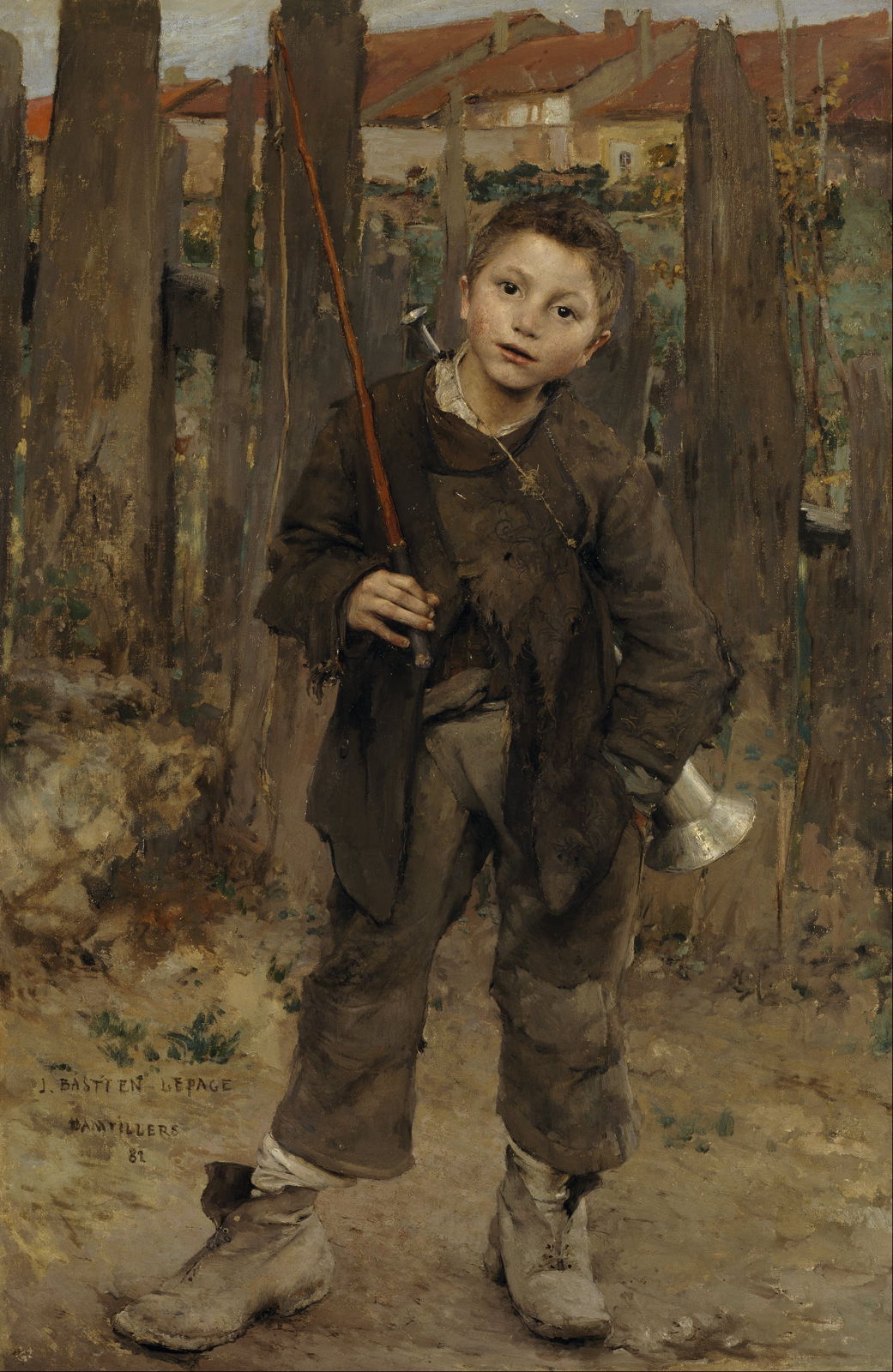
Jules Bastien-Lepage (1848–1884), Pas Mèche (Nothing Doing) (1882), oil on canvas, 132.1 x 89.5 cm, Scottish National Gallery, Edinburgh, Scotland. Wikimedia Commons.
At that time, it was Jules Bastien-Lepage who was having greatest impact at the Salon with his Naturalist portraits of the rural poor. Pas Mèche (Nothing Doing) (1882) catches this cheeky ploughboy equipped with his whip and horn, on his way out to work in the fields. His face is grubby, his clothing frayed, patched, and dirty, and his boots caked in mud and laceless. It has other traits of Bastien’s style, such as its high horizon almost shutting the sky out, and his careful control of detail. The boy’s face is meticulous, but the cottage gardens behind have been sketched in roughly.
Jules Bastien-Lepage (1848–1884), The Little Chimneysweep (Damvillers) (1883), oil on canvas, 102 x 116 cm, location not known. Wikimedia Commons.
Bastien’s Little Chimneysweep (Damvillers) from the following year is unusual as its subject isn’t shown standing, face-on to the viewer, but sits and looks down at the kitten at the lower right. This young boy is also the dirtiest of Bastien’s waifs, his left hand still black with soot from his work. He appears to be living in a hovel, with the embers of a fire at the left edge, once again sketched loosely.
Marie Bashkirtseff (1858–1884), The Umbrella (1883), oil on canvas, 93 × 74 cm, State Russian Museum, Saint Petersburg. Wikimedia Commons.
Bastien’s combination of detailed realism blended with more painterly passages is seen in one of Marie Bashkirtseff best portraits, The Umbrella (1883). This girl’s tenacious stare at the viewer quickly becomes quite unnerving. This earned her an honourable mention in the Salon.
Jean-Eugène Buland (1852–1926), Le Tripot (The Dive) (1883), oil on canvas, 63.5 × 109.2 cm, location not known. Wikimedia Commons.
In the same year, Jean-Eugène Buland’s The Dive is set in a seedy, downmarket gambling den, as a group portrait of five hardened gamblers at their table. Each is rich in character, and makes you wonder how they came to be there. A little old widow at the left, for example, looks completely out of place, but is resolutely staking her money. Looking over her shoulder is a man, whose face is partially obscured. Is he, perhaps, a son, or a debtor? A young spiv at the far right is down to his last couple of silver coins, and looks about to lose them too. The air is thick with smoke, the walls in need of redecoration, and a pair of young streetwalkers prowl behind them, looking for a winner who will spend some of their cash on them.
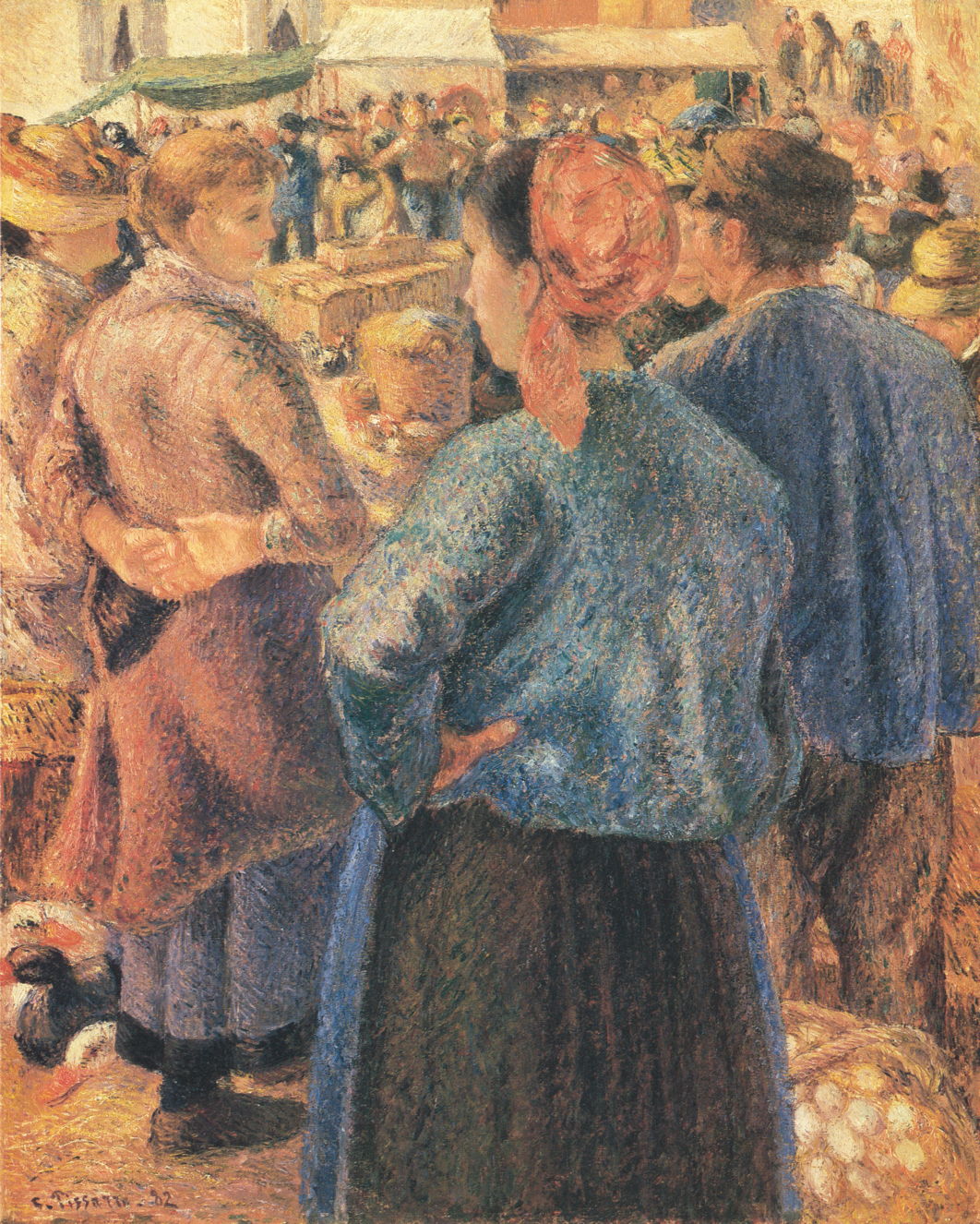
Camille Pissarro (1830–1903), The Poultry Market, Pontoise (1882), oil on canvas, 81 x 65 cm, Norton Simon Museum, Pasadena, CA. Wikimedia Commons.
Camille Pissarro was a fine figurative artist when he wanted, and had a particular liking for markets and fairs, which may seem strange for a landscape painter. He painted this scene from The Poultry Market, Pontoise twice in 1882: once using (glue?) distemper, and here in oils, where his use of tiny marks is evolving, particularly in the fabrics.
Pierre-Auguste Renoir (1841–1919), By the Seashore (1883), oil on canvas, 92.1 x 72.4 cm, Metropolitan Museum of Art, New York, NY. Wikimedia Commons.
For his portrait of his partner Aline Charigot in By the Seashore (1883), Pierre-Auguste Renoir most probably painted her in the studio, and took its background from the Normandy coast near Dieppe. This shows the growing divergence in his paintings during the 1880s, with landscapes becoming increasingly soft and high in chroma, while his figures remained realist and emphasised by his “dry” manner.
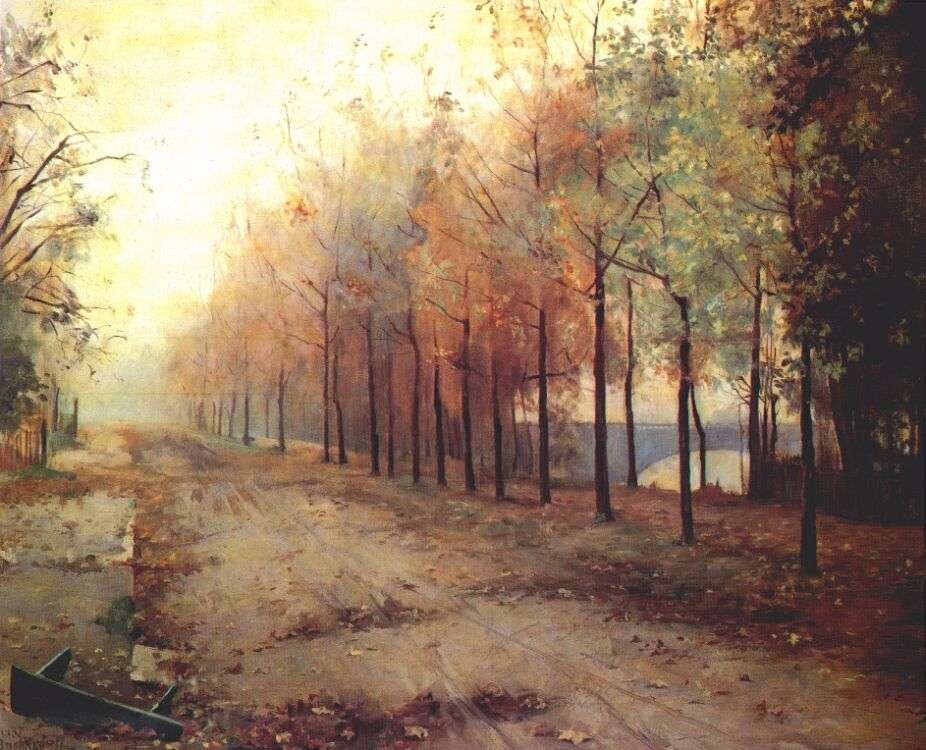
Marie Bashkirtseff (1858–1884), Autumn (1883), oil on canvas, dimensions not known, State Russian Museum, Saint Petersburg. The Athenaeum.
Bashkirtseff’s Autumn (1883) is a thoroughly Impressionist depiction of a row of trees on the bank of the River Seine in the centre of Paris, but is unusual in being devoid of people. The leaf litter, occasional rubbish, and fallen bench strengthen its feeling of desolation in the midst of the bustling city.
Gustave Caillebotte (1848–1894), The Plain at Gennevilliers, A Group of Poplars (1883), oil on canvas, 54.3 x 65 cm, Private collection. WikiArt.
Gustave Caillebotte also painted in both styles, with several of his best-known works being Naturalist. The Plain at Gennevilliers, A Group of Poplars (1883) is more formally Impressionist, although it retains foreground detail and has a relatively high horizon.
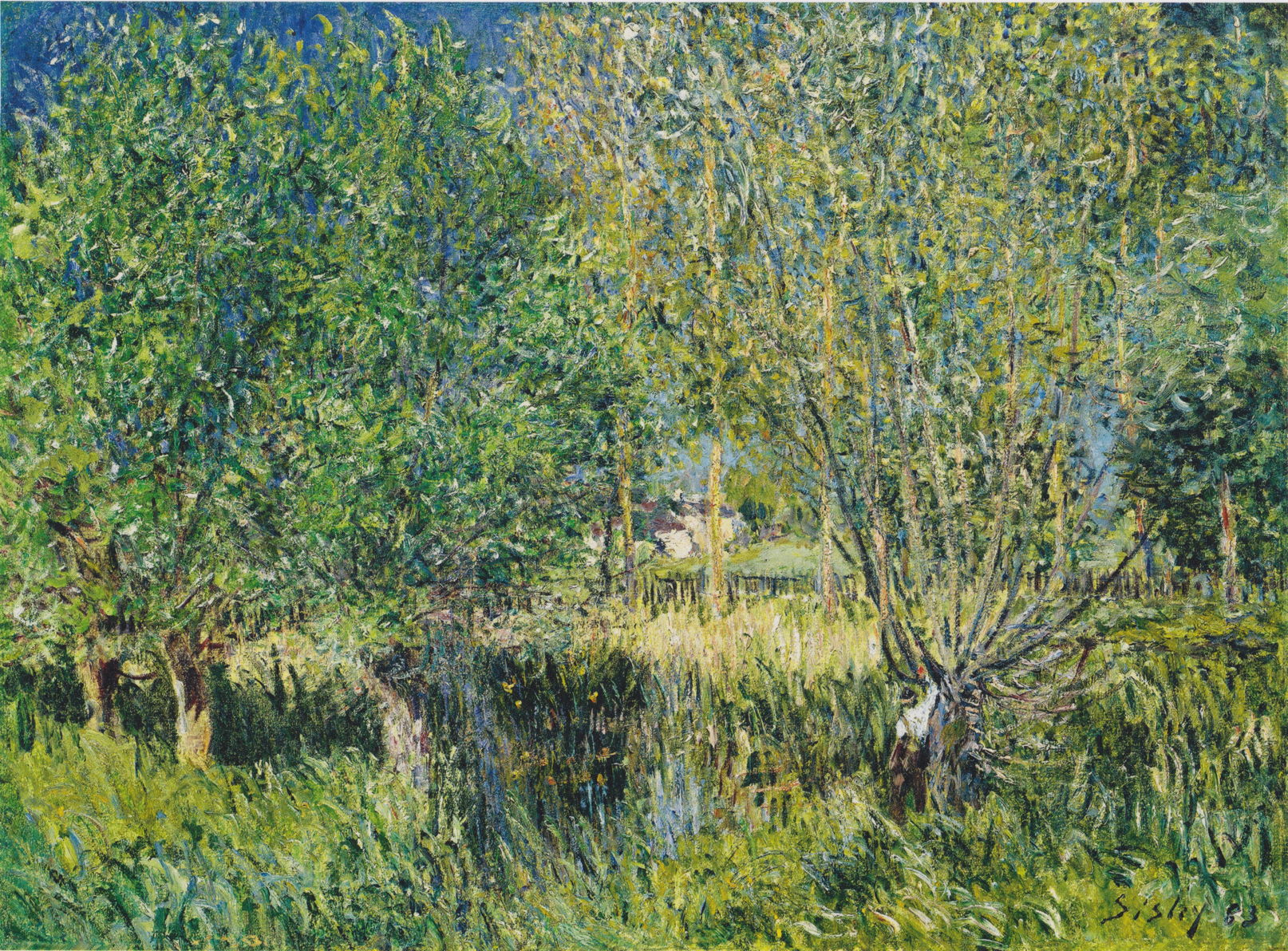
Alfred Sisley (1839–1899), Willows on the Banks of the Orvanne (1883), oil on canvas, 50 x 70 cm, Private collection. Wikimedia Commons.
Alfred Sisley’s Willows on the Banks of the Orvanne (1883) is also more representative of Impressionism. An irregular row of pollarded willows, with well-developed heads, crosses the foreground, behind which there is the river Orvanne, reeds, and a tall stand of poplars. Behind this dense vegetation is a fence, field, and distant buildings, at the midpoint of the painting.
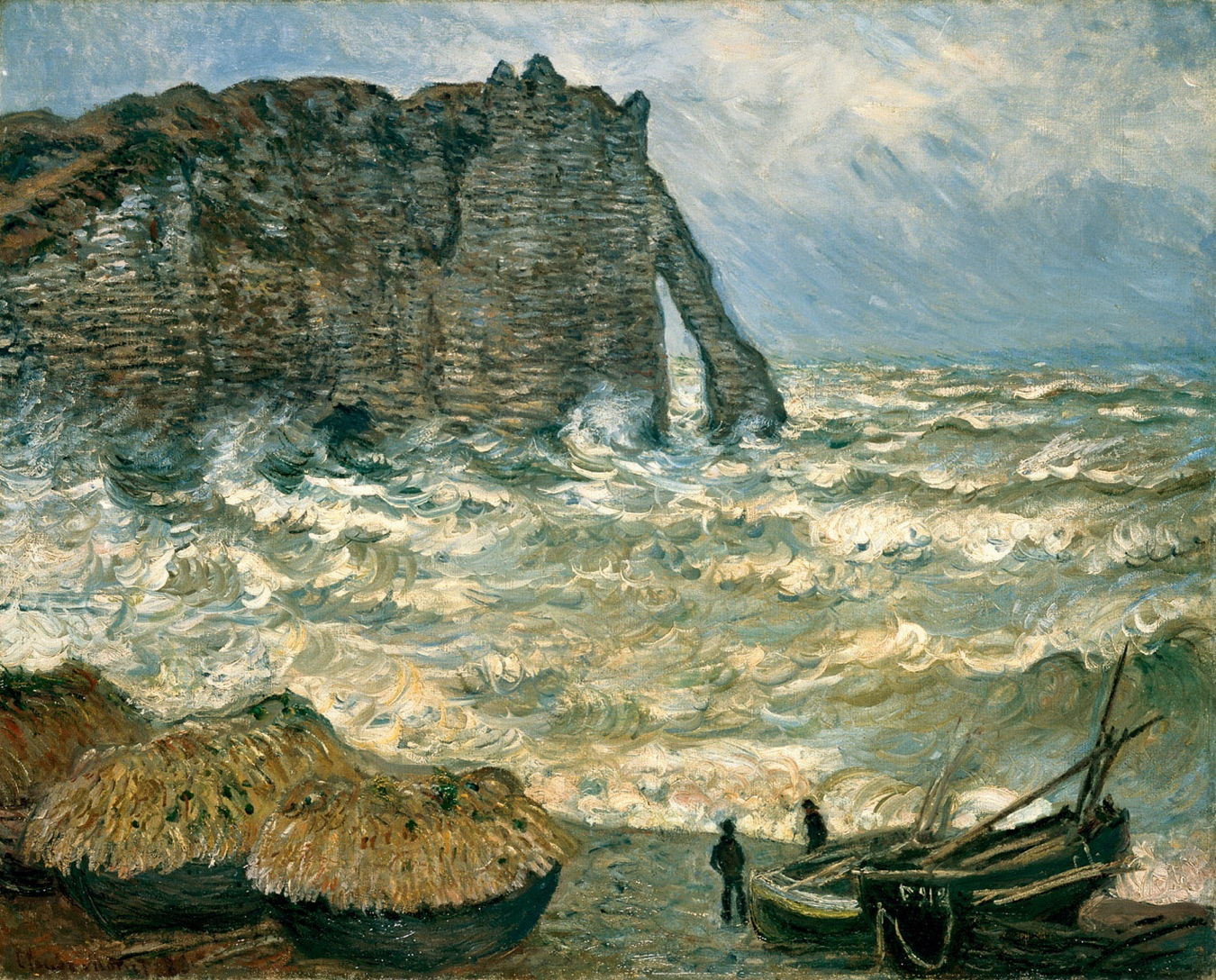
Claude Monet (1840–1926), Stormy Sea in Étretat (1883), oil on canvas, 100 x 81 cm, Musée des Beaux-Arts, Lyon, France. Wikimedia Commons.
At the Impressionist end of the spectrum is Claude Monet’s Stormy Sea at Étretat (1883), painted from the beach directly in front of the the village, and a prototype for a small series.
Pierre-Auguste Renoir (1841–1919), Sunset at Douarnenez (c 1883), oil on canvas, 53.7 x 64.4 cm, location not known. Wikimedia Commons.
For all his realist figures, Renoir’s Sunset at Douarnenez, from around 1883, is a classical Impressionist view looking into the setting sun.
I hope this small collection of paintings demonstrates there was a great deal more to French and European painting in 1883 than Impressionism. In this series I will explore the artists and paintings that accompanied Impressionism, but have now been largely forgotten. I hope you’ll join me.

 Login
Login