
Reading view

There are new articles available, click to refresh the page.

Natural history paintings of Bruno Liljefors 1

When the Swedish artist Bruno Liljefors specialised in natural history painting in the late nineteenth century, he wasn’t the first to depict wild creatures and their surroundings.

Albrecht Dürer, Hare, 1502, watercolour and bodycolour on paper, 25 x 22.5 cm. Albertina, Vienna (WikiArt).
Albrecht Dürer (1471-1528), Hare (1502), watercolour and bodycolour on paper, 25 x 22.5 cm. Albertina, Vienna (WikiArt).

It was probably Albrecht Dürer who pioneered faithful depictions, first in his meticulously rendered watercolour of this Hare in 1502.
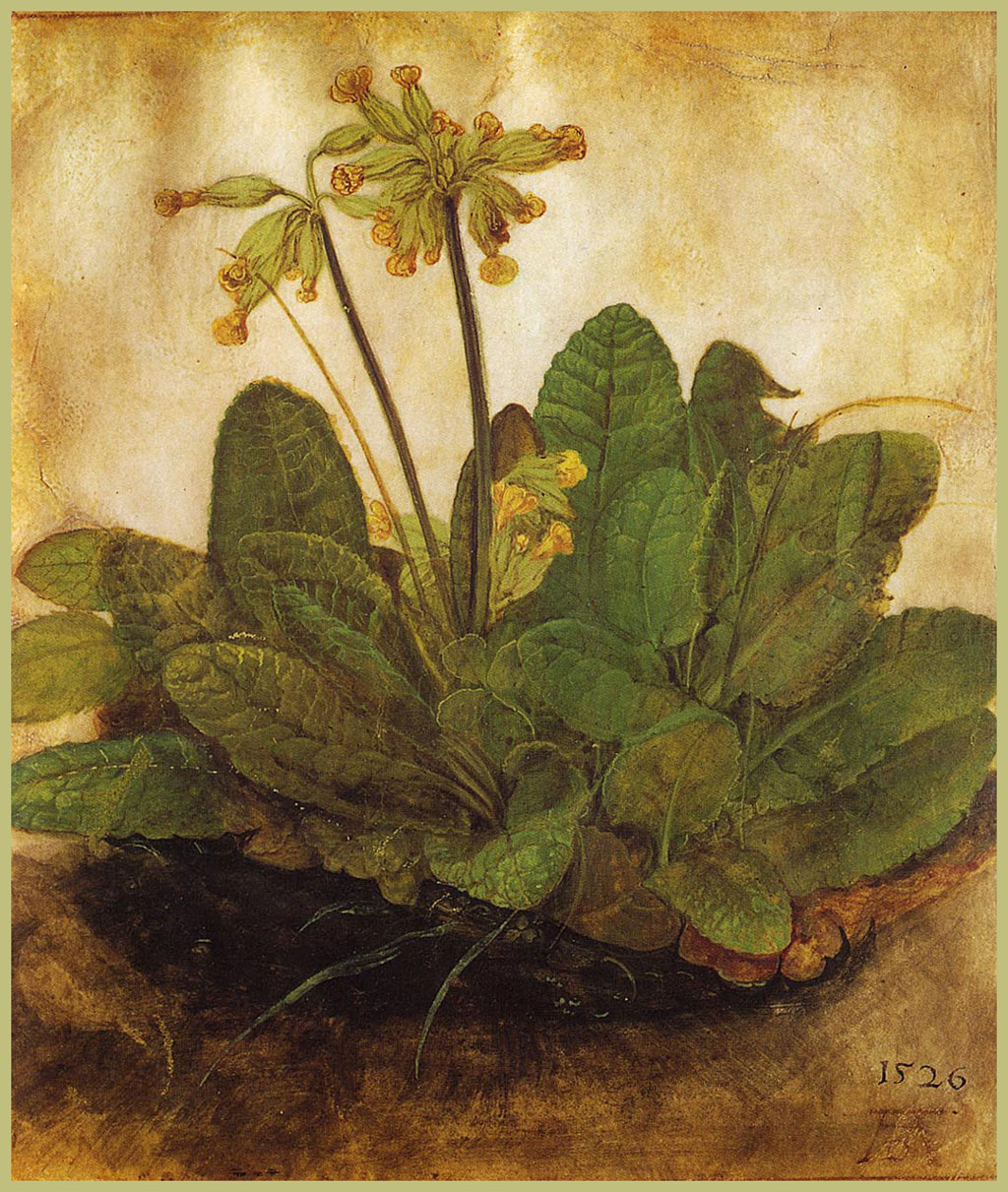
Albrecht Dürer, Primula, 1526, watercolour on paper, 19 x 17 cm. National Gallery of Art, Washington DC (WikiArt).
Albrecht Dürer (1471-1528), Primula (1526), watercolour on paper, 19 x 17 cm. National Gallery of Art, Washington DC (WikiArt).

Dürer followed that with some of the earliest botanical watercolours, such as this Primula from 1526. Despite those, few painters showed any interest in the genre.

eckhoutjabutis
Albert Eckhout (c 1610–1666), Study of Two Brazilian Tortoises (c 1640), tempera and gouache on paper mounted on panel, 30.5 x 51 cm, Koninklijk Kabinet van Schilderijen Mauritshuis, The Hague, The Netherlands. Wikimedia Commons.

Some of the Dutch artists who travelled to the Republic’s colonies were exceptions. This is Albert Eckhout’s Study of Two Brazilian Tortoises believed to have been painted in Brazil in about 1640.
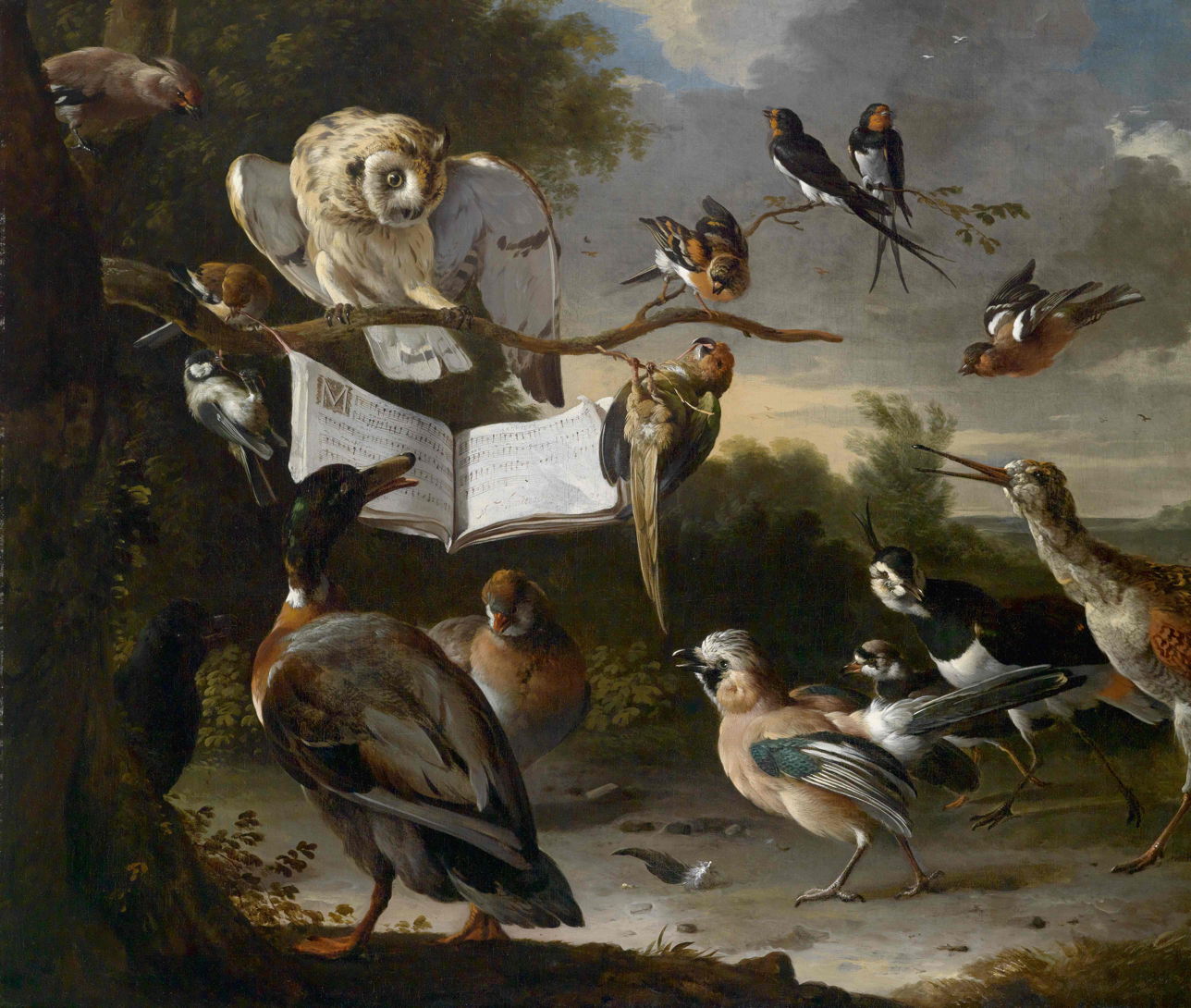
dhondecoeterconcertbirds
Melchior d’Hondecoeter (1636–1695), Concert of the Birds (1670), oil on canvas, 84 x 99 cm, Private collection. Wikimedia Commons.

Other painters of the Golden Age set faithful images of native species in more entertaining surroundings, as in Melchior d’Hondecoeter’s Concert of the Birds from 1670. But at that time, animal paintings were largely confined to domestic species.
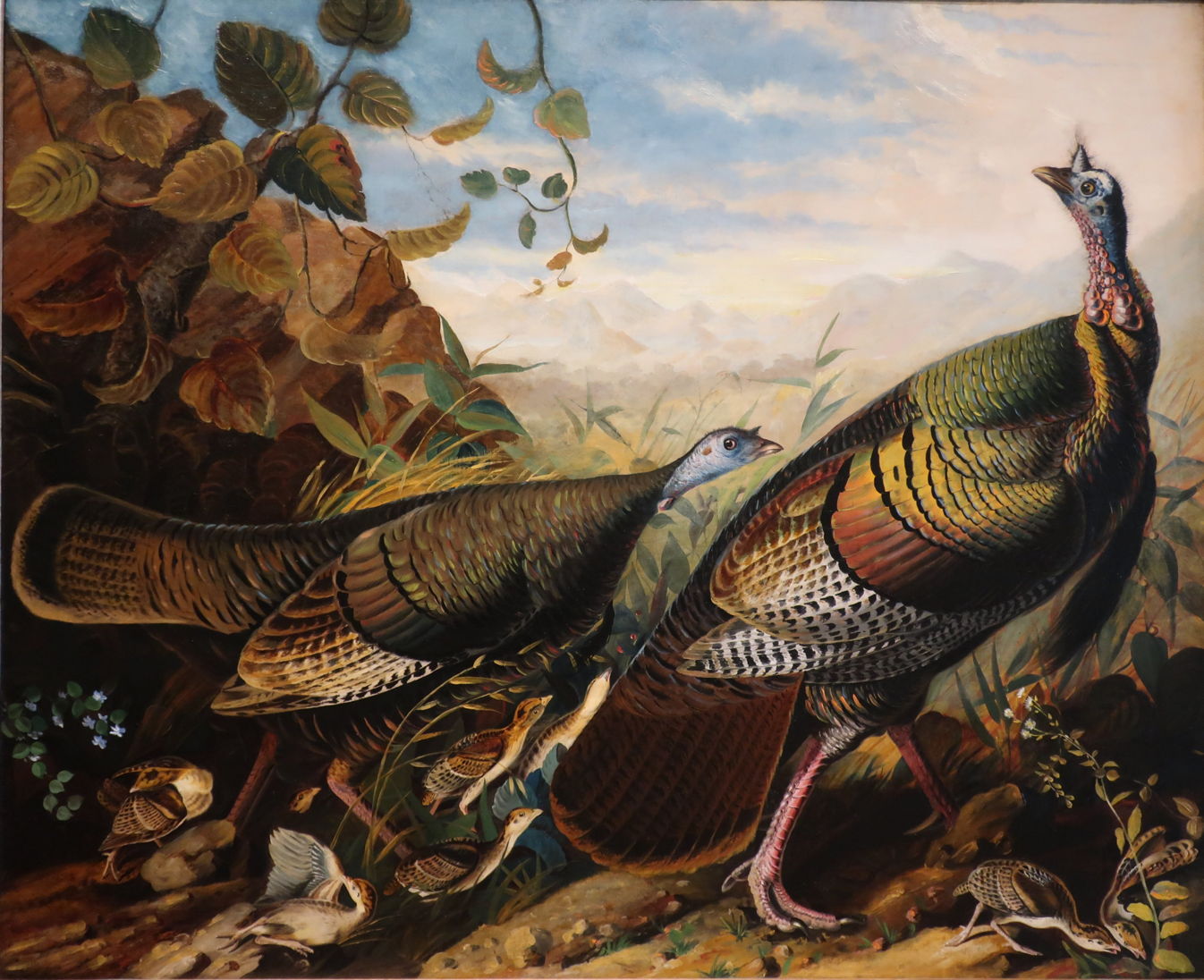
audubonwildturkeycockhen
John James Audubon (1785–1851), Wild Turkey Cock, Hen and Young (1826), oil on linen, 120.7 x 151.1 cm, Crystal Bridges Museum of American Art, Bentonville, AR. Wikimedia Commons.

The most famous of the early natural history specialists is John James Audubon, whose paintings of birds were turned into sets of prints. Among his surviving oil paintings is this of a Wild Turkey Cock, Hen and Young (Meleagris gallopavo) from 1826. Although clearly destined for use as an illustration, the setting is intended to appear more natural.

As the century progressed a new, objective style of painting developed in botanical and ornithological work in particular. Artists like Edward Lear illustrated multi-volume scientific publications classifying and describing different species.

Liljefors is one of the pioneers who painted rather than illustrated wildlife, and is revered today as one of the genre’s most influential figures. In this weekend’s two articles I show examples of his paintings that remain some of the finest artistic depictions of wildlife in the history of art.

Bruno Liljefors was born in Uppsala, in the east of Sweden, in the same year as Anders Zorn. He doesn’t appear to have been as precocious a painter, and started his studies at the Royal Swedish Academy of Arts in Stockholm four years later than Zorn, in 1879. He left the Academy after three years, and went to Dusseldorf to learn to paint animals.

In the early years of his career he travelled to Rome, Naples, and Paris, and was particularly inspired by the artists’ colony at Grez-sur-Loing, then dominated by the ideas and style of Jules Bastien-Lepage. Liljefors perfected his plein air painting technique, and became influenced by the Japanese woodcuts that were so popular at the time. He also aligned himself with the ‘Opponents’, a large group of Swedish artists who effectively seceded against the conservatism of the Academy.

liljeforshawkblackgame
Bruno Liljefors (1860–1939), Hawk and Black Grouse (1884), oil on canvas, 143 x 203 cm, Nationalmuseum, Stockholm, Sweden. Wikimedia Commons.

During the early 1880s, Liljefors started to paint wildlife set in natural surroundings. Hawk and Black Grouse is a good example of these from 1884, showing a hawk attacking the gamebirds in a winter landscape. Although he had a deep affinity with his subjects, Liljefors was also a hunter, and many of his paintings explore the predator-prey relationship, as here. His hunting also provided him with dead specimens to use as models.

liljeforscatyoungbird
Bruno Liljefors (1860–1939), A Cat with a Young Bird in its Mouth (1885), oil on wood, 26.5 x 16.5 cm, Nationalmuseum, Stockholm, Sweden. Wikimedia Commons.

In 1885 he demonstrated his virtuoso skills in what he described as ‘five studies in a single painting’. Above is A Cat with a Young Bird in its Mouth, and below is A Cat and a Chaffinch. These were assembled from observations of living and dead animals and birds, and sketches, to produce composites that photography couldn’t match for decades, even in monochrome.
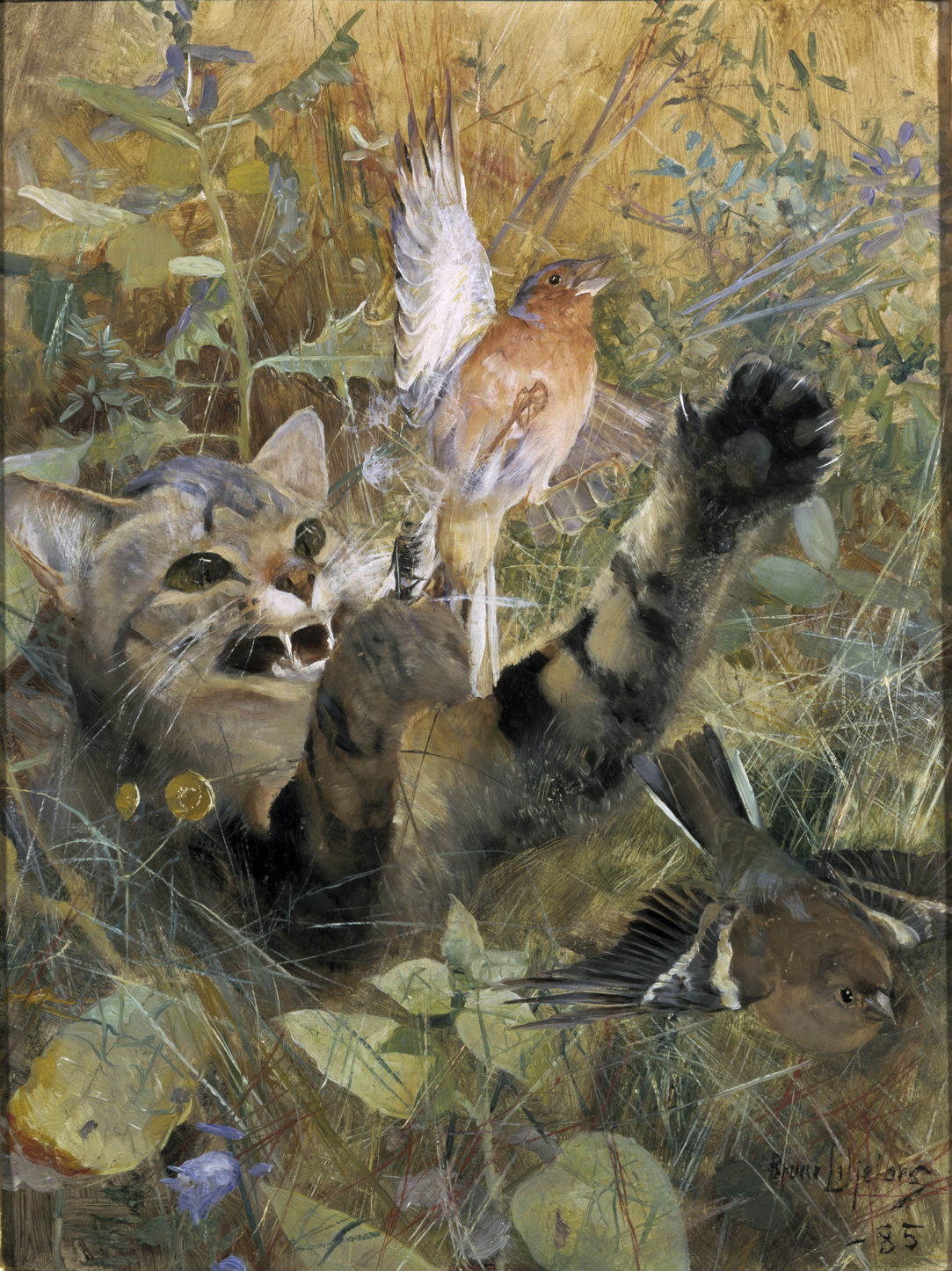
liljeforscatchaffinch
Bruno Liljefors (1860–1939), A Cat and a Chaffinch (1885), oil on wood, 35 x 26.5 cm, Nationalmuseum, Stockholm, Sweden. Wikimedia Commons.
liljeforsharestudies
Bruno Liljefors (1860–1939), Hare Studies (1885), paper, 32 × 24.5 cm, location not known. Wikimedia Commons.

Following the tradition established by Dürer, one of Liljefors’ favourite species was the elusive hare. This page of Hare Studies from 1885 shows a tiny part of the image library he assembled, as well as the spring antics of hares. Liljefors also assembled his own wildlife park, with living and apparently quite tame creatures, including foxes, badgers, hares, squirrels, weasels, an eagle, eagle owl, and others.

liljeforsfoxfamily
Bruno Liljefors (1860–1939), A Fox Family (1886), oil on canvas, 112 x 218 cm, Nationalmuseum, Stockholm, Sweden. Wikimedia Commons.

The fox appears in many of Liljefors’ paintings, here A Fox Family (1886) in their role as predators, as they feast on an unfortunate bird.
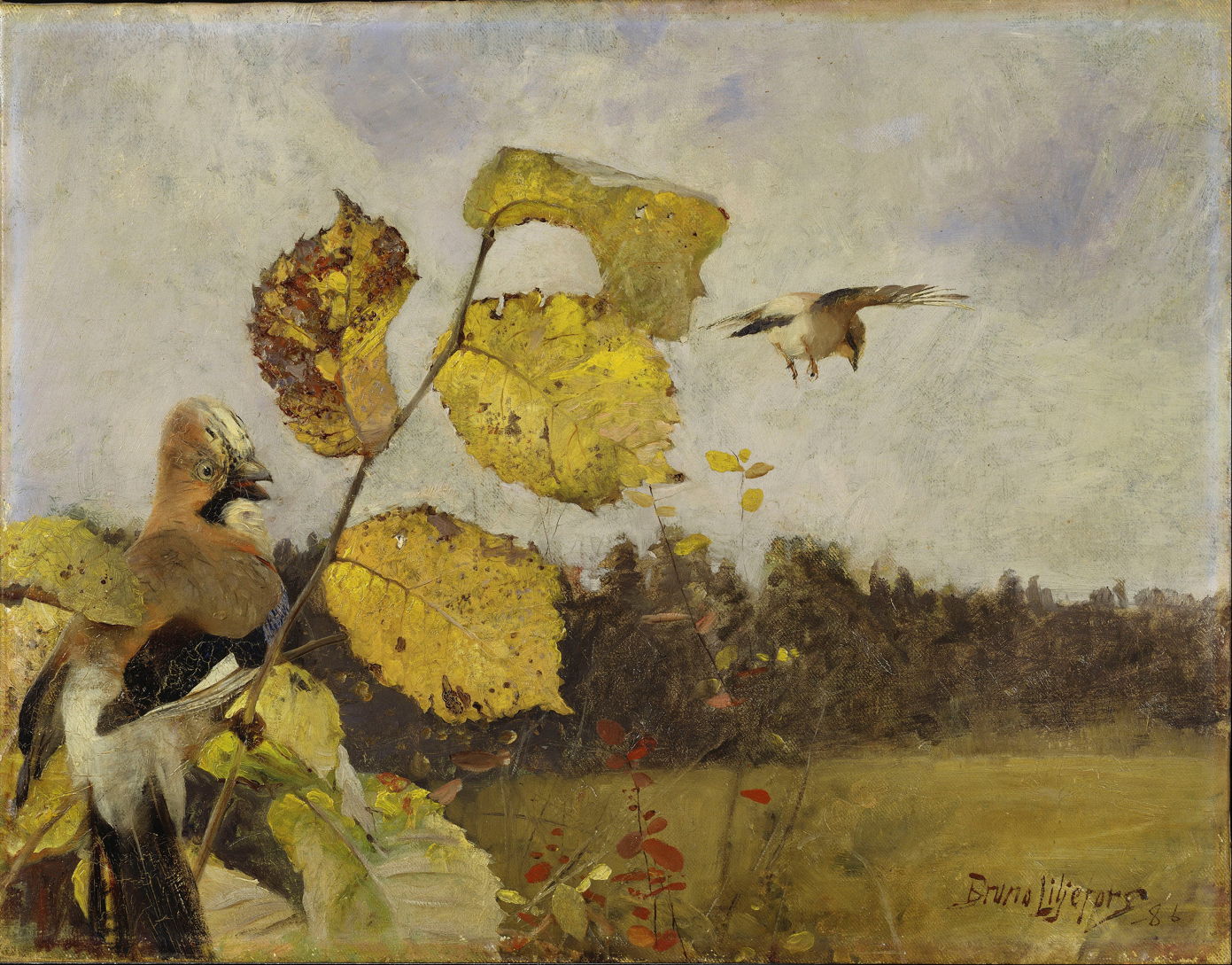
liljeforsjays
Bruno Liljefors (1860–1939), Jays (1886), oil on canvas, 51 x 66 cm, Nationalmuseum, Stockholm, Sweden. Wikimedia Commons.

Liljefors’ paintings are often painterly, such as in Jays (1886) which gives the impression of having been painted en plein air, in front of the birds and landscape.

liljeforscommonswifts
Bruno Liljefors (1860–1939), Common Swifts (1886), oil on canvas, 41 × 56 cm, location not known. Wikimedia Commons.

Even for the modern amateur photographer, the fleeting form of Common Swifts (1886) is a great challenge. Set against a riot of flowers, these birds are the product of field observation, museum specimens, and careful studies, to make them look real.
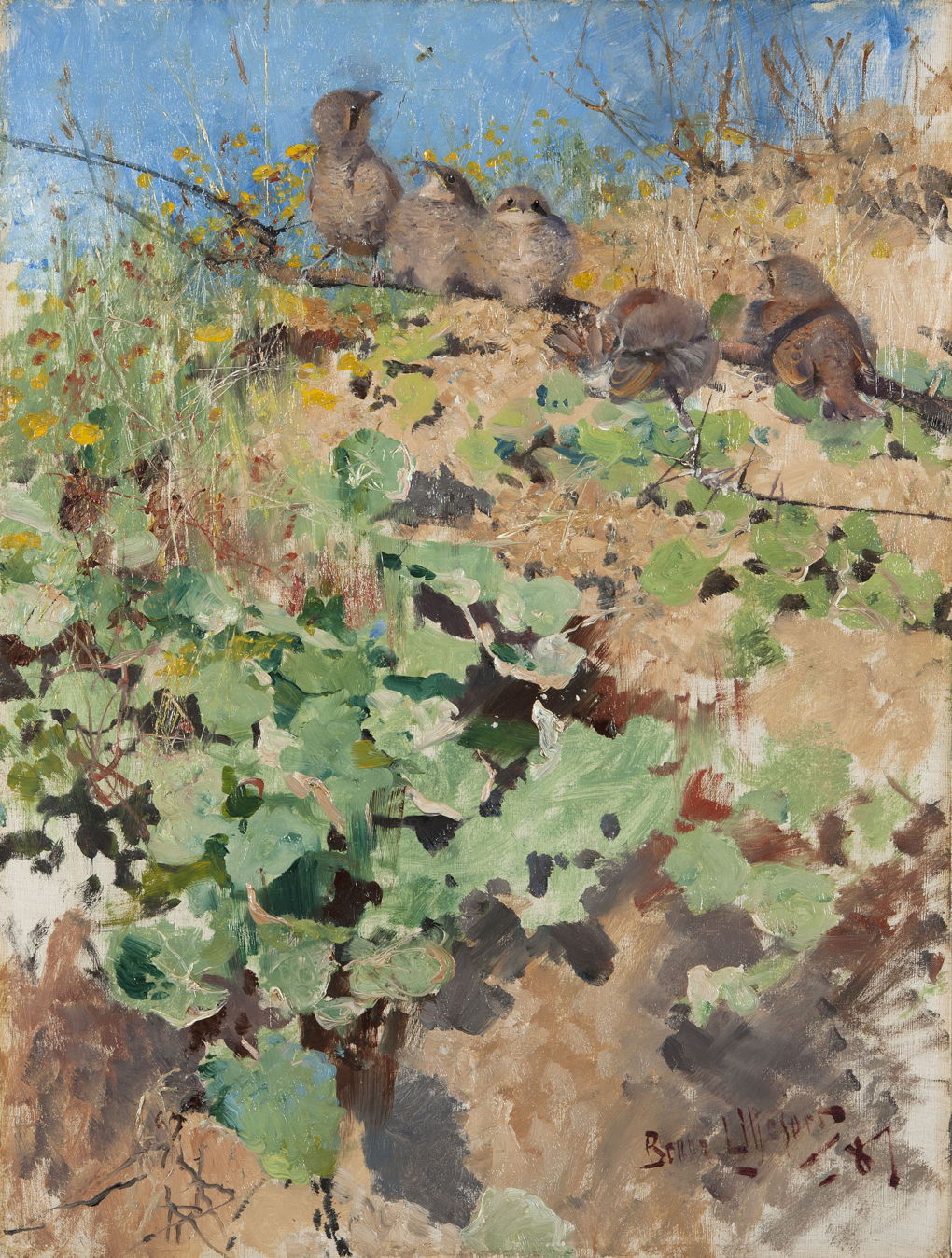
liljeforsnestlingsredbackedshrike
Bruno Liljefors (1860–1939), Red-Backed Shrike Chicks (1887), oil on canvas, dimensions not known, Nationalmuseum, Stockholm, Sweden. Wikimedia Commons.

Liljefors had deep insight into the behaviour of species he painted. The five Red-Backed Shrike Chicks (1887) shown here may not, at first sight, appear in keeping with their popular name, the ‘butcher bird’, but the chick at the left end of the branch is already taking an interest in a passing bee or fly. When a little older, it will catch it and impale the corpse on thorns in its larder.

Reading Visual Art: 247 Woodpecker

There are precious few paintings featuring European woodpeckers, but those few come with unusual stories. Of the three species that are common across the continent, it’s most likely that these refer to what’s now known as the great spotted woodpecker, responsible for the distinctive sound it makes when pecking the trunk of a tree.

audubongreatspottedwoodpecker
John James Audubon (1785–1851), Great Spotted Woodpecker (date not known), media and dimensions not known, Houghton Library, Harvard University, Cambridge, MA. Wikimedia Commons.

When he was in Britain, the great American bird artist John James Audubon painted this fine example of a Great Spotted Woodpecker (Dendrocopos major).

The woodpecker has earned itself a place in ancient Roman legend, as one of the two guardians of the infant Romulus and Remus. They were abandoned shortly after birth, put in a trough to float down the River Tiber to their deaths. When the trough was washed up on a bank, they were adopted and fed by a she-wolf, while the woodpecker kept a close watch over the babies, until they were discovered by the swineherd Faustulus. And the rest is legendary Roman history. For its role in saving the co-founders of Rome, the woodpecker was later considered to be sacred to the god Mars.

carracciromulusremus
Ludovico Carracci (1555–1619) and/or Annibale Carracci (1560–1609), She-Wolf Suckling Romulus and Remus (1589-92), fresco, dimensions not known, Palazzo Magnani, Bologna, Italy. Wikimedia Commons.

One of the frescoes in the Palazzo Magnani, probably painted by Ludovico Carracci and/or Annibale Carracci, shows the She-Wolf Suckling Romulus and Remus (1589-92). The twins are still inside the trough in which they had survived their trip down the river, and on the opposite bank a woodpecker is keeping a close watch. At the far right, a now rather diaphanous figure may be Faustulus, one of Amulius’ swineherds who discovered the twins, and took them to his wife.

rubensromulusremus
Peter Paul Rubens (1577–1640), Romulus and Remus (1615-16), oil on canvas, 213 x 212 cm, Musei Capitolini, Rome, Italy. Wikimedia Commons.

Peter Paul Rubens shows Romulus and Remus being discovered by Faustulus in this painting of 1615-16. Not only is the she-wolf taking care of the twins, but a whole family of woodpeckers are bringing worms and grubs to feed them, and there are empty shells and a small crab on the small beach as additional tasty tidbits.

Several mythical figures seem to have been transformed into woodpeckers for various reasons. The sorceress Circe was also claimed to have turned at least one of her lovers into a woodpecker, a story celebrated by Dosso Dossi.

dossicircelovers
Dosso Dossi (–1542), Circe and her Lovers in a Landscape (c 1514-16), oil on canvas, 100 × 136 cm, National Gallery of Art, Washington, DC. Wikimedia Commons.

Dossi’s Circe and her Lovers in a Landscape (c 1514-16) is a remarkably early and realistic mythological landscape, with deep rustic lanes, trees, and a distant farmhouse. Circe leans, naked, at the foot of a tree as she goes through spells on a large tablet, with a book of magic open at her feet. Around her are some of the men who she took a fancy to and transformed into wild creatures. There’s a spoonbill, a small deer, a couple of dogs, a stag, and up in the trees an owl, and a woodpecker in the upper right corner.

dossimelissa
Dosso Dossi (–1542), Melissa (Circe) (c 1518-1531), oil on canvas, 176 × 174 cm, Galleria Borghese, Rome. Wikimedia Commons.

There’s still dispute as to whether this painting of Dossi’s shows Circe again, or the sorceress Melissa from the epic Orlando Furioso. Painted in about 1518-1531, this sorceress sits inside a magic circle, around which are inscribed cabalistic words. In the upper left corner are small homunculi apparently growing on a tree. On the left is a large dog, and perched on top of a suit of armour is another woodpecker.

Finally, the great spotted woodpecker is one of the birds that can be identified in Hieronymus Bosch’s fantastic menageries.

boschtemptationstanthonyrt
Hieronymus Bosch (c 1450–1516), The Temptation of Saint Anthony (Lisbon) (right wing) (c 1500-10), oil on oak panel, left wing 144.8 x 66.5 cm, central panel 145.1 × 132.8 cm, right wing 144.8 × 66.7 cm, Museu Nacional de Arte Antiga, Lisbon. Wikimedia Commons.

The right panel of Bosch’s Temptation of Saint Anthony, now in Lisbon, shows Saint Anthony seated, with a book open in front of him. He is again surrounded by strange figures and creatures from a vision of temptation. The background shows a prominent windmill and towers, behind which is a wintry landscape with snow on the ground.

Deeper into the painting, behind and to the left of the saint, is a group of figures, daemons, and objects, clustered around the hollow trunk of a dead tree. Inside the hollow, a naked woman peers out. The tree is draped with a scarlet sheet, under and on which are several daemons. At the top, an old person pours liquid from a ewer into the bowl held up by a daemon below. A woodpecker is perched on one of the upper branches.

I leave you to speculate on the significance of that woodpecker.

❌