 Login
LoginChina’s Aiming for the Moon, and NASA Is Looking Over Its Shoulder
The U.S. space agency launched a lunar flyby Wednesday, but Beijing is pursuing its own space program with formidable focus. Here’s what we know about it, in photos and videos.




 BBC
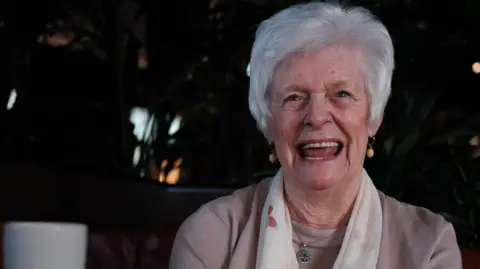
BBCMarie McLaren is a latecomer to the stage - but she's in good company at her comedy class in Glasgow.
The 88-year-old has been learning the ropes of stand-up comedy from professional comedian Viv Gee over the last four weeks.
She is part of a group of over-50s who took part in the sessions, which will end with them taking the stage for live shows at The Social Hub Glasgow.
"The danger of doing comedy as an older person is that people might think you have lost it," Marie says.
"But in my opinion age is only a number."
Marie, from East Kilbride, was nominated for the class by her daughter.
"I've always liked jokes and laughs and make a joke out of anything," she says.
"Nobody's interested in moaners, so it's quite nice to just make people laugh and enjoy life."
Retired journalism lecturer Ronnie Bergman says the class is an opportunity to try something new.
"You kind of disappear when you get older. You get on the bus and people ignore you," says the 74-year-old.
"I was getting too comfortable and in too much of a rut, but this is out of my comfort zone.
"I hate getting my photo taken and I'm disappointed by the sound of my own voice so this is uncomfortable - but I enjoy it."
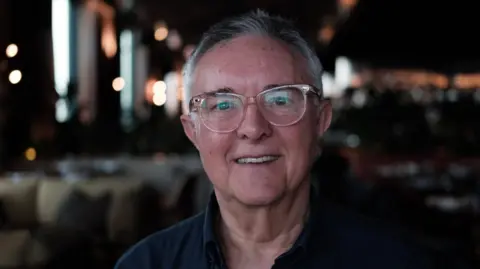
Ronnie says the benefit of being an older comedian is that he has heard a lot more jokes.
As the class wraps up, he says he will be drawing on Billy Connolly as his comedy hero.
"He's an older comedian and he's still funny," Ronnie says.
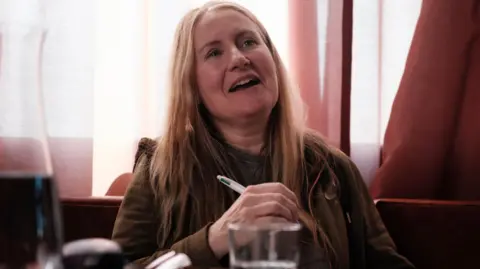
Seventy-year-old Christine MacCormack believes her age helps to give her a difference perspective on comedy.
"We look at life differently because we born in a different time," she says.
"I'm just living my best life and I just want to enjoy the experience and my five minutes in the spotlight."
The group took to the stage at the Social Hub for the first time on Wednesday in a show entitled The Old Ones are the Best, which has been organised in partnership with Age Scotland.
We watched as they ran through their material ahead of their debut performance.
With decades of life experience, the jokes run from the cradle to the grave - including a one-liner about being too old to buy a bag for life.
Health problems, family life and the habits of the younger generation have also provided a wealth of material.
But these are not your typical granddad jokes.
In one routine, 65-year-old Mitch Milmore buzzes around the stage wearing a pair of homemade bug-eyed goggles.
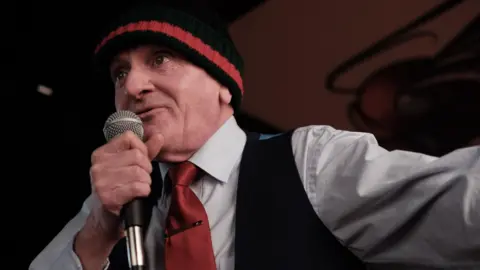
Meanwhile, 67-year-old Andy Burke finds his humour in his hometown.
"I come from a wee fishing village in Glasgow called Springburn," he tells the audience.
"It's got some lovely pubs up there - you go in laughing and come out in stitches."
He then launches into an expletive-laden set for the next five minutes before turning to tutor Viv for feedback.
"The great thing about comedy is anyone can do it," says the Scottish Comedy Awards winner.
"I can't teach them to be funny but I can teach them to be funnier."
 BBC
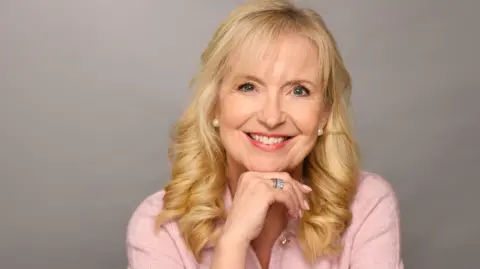
BBCAt 2:45am, much of the country is fast asleep - but for nearly three decades that's when Carol Kirkwood's day has begun.
Now, after leaving the BBC this week, the early alarm is the first thing she's ready to leave behind - it's "well and truly going in the bin".
It marks the end of an era, not just for Kirkwood, but for millions of viewers who have watched her present the weather forecast.
She has been the main weather presenter on BBC Breakfast since 2010, having started her BBC presenting career on the news channel.
Reflecting on her 28 years at the corporation, she tells us the biggest privilege was presenting the weather out in the field because "you meet members of the public who are always so lovely and kind to me".
Although it's "impossible to pinpoint one standout moment", reporting from events such as the Wimbledon tennis championships and Chelsea Flower Show were some of her highlights.
"I've reported from so many beautiful places and visited a lot of the country that I might not otherwise have seen," she adds.
 Getty Images
Kirkwood announced she would be retiring back in February, but now her final few days at the BBC have arrived it's been "really surreal and emotional" to say goodbye.
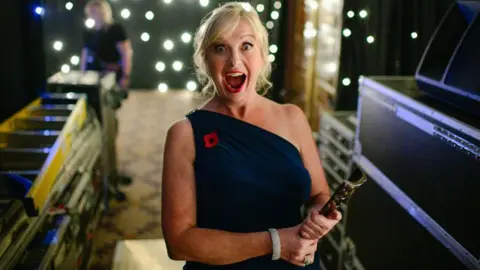
Last week, while she was reporting on the weather at the Tower of London, she was given a special gold poppy that "is incredibly rare and hardly anyone has one".
"I was so surprised by the kindness they showed me," she says. Earlier this week she was "left in tears" after RHS Garden Wisley renamed its weather station in honour of her.
"The thing is you just go to work to do your job - you don't realise how appreciated you are," she says.
"You don't expect people to come and tell you how good you are because you're just doing your job.
"It's fabulous but it makes it even harder to leave."
But the 63-year-old, from Morar on Scotland's west coast, will miss her colleagues above all else.
"I love the weather and I'm fascinated by it but it's undoubtedly the people that make a job and it's so sad saying goodbye to them because I've known so many of them for decades. I know we'll stay in touch but it won't be the same."
On the flip side, without the 2:45am alarm, she "cannot wait to sit in the garden in the summer in the evening or go to the theatre without worrying about the lack of sleep I would get".
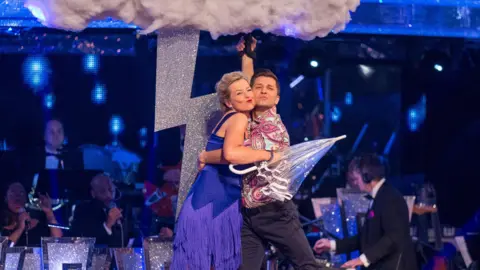
In a glittering career, Kirkwood has also reported for The One Show and competed on Strictly Come Dancing in 2015, reaching week eight with her partner Pasha Kovalev.
She has repeatedly been named best TV weather presenter at the TV and Radio Industries Club Awards.
In 2023, Kirkwood married police officer Steve Randall and one of the main reasons she chose to retire was to spend more time with him.
She'd been considering it for about six months and discussing it regularly with Steve and she explains that they kept coming back to the simple question: what are we waiting for?
"I'm not getting any younger, I'm newly married and we've had some losses in our lives recently."
She didn't elaborate on what losses she had experienced but says it helped her realise "I should get on with my retirement and that's what I'm going to do".
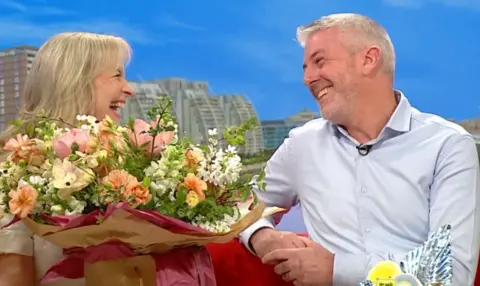
She's most excited to go travelling and has already planned trips to France and Italy.
"The freedom of being able to get in the car, drive and go anywhere we want for as long as we want is really appealing," she adds.
She and Steve love walking and she feels acutely aware she'll be "turning 64 in May and we want to do this while we're fit and healthy".
As for her other hobbies, her sixth romance novel is out in October and she has committed to writing at least two more books after that. She also says she'd love to learn the guitar and get a couple of cats.
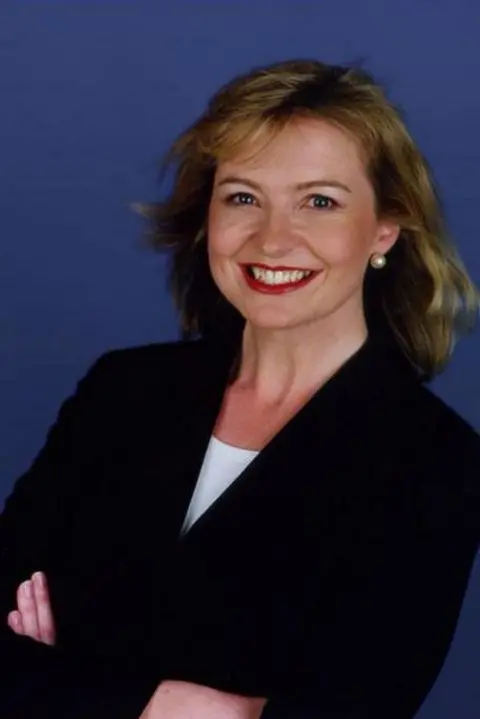
When Kirkwood began forecasting in the 1990s, the job looked very different.
"We had little symbols of a sun and a cloud that would cover a whole area and that would be it," she explains. "Now we have 3D graphics that move across the area which is a lot clearer and easier to understand."
The weather has changed in almost three decades, too. "We used to have four definitive seasons and now they are such a muddle because of climate change."
She might be a pro at presenting the weather but it wasn't quite her dream job growing up, as she admits: "Not in a million years did I think I'd be doing this."
"When I was a child I wrote to Blue Peter producer Biddy Baxter because I wanted to be a presenter on the show as they always looked like they were having such good fun."
Her advice to anyone looking to pursue a similar career to her is to "always follow your dreams and put yourself out there".
"If you followed your dreams and they don't come true then at least you know you would have tried," she says.
Kirkwood's dreams did come true and now her dream retirement "can finally begin".
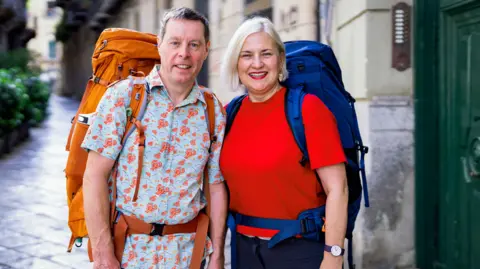 BBC
BBCWhen Margo Oakley, now 59, was introduced to her older sister's new boyfriend her first impressions of the "po-faced" and "judgey" young man were not great.
And for Mark Blythen, 67, his feelings about his girlfriend's "loud and wild" younger sibling were mutual.
But more than 40 years later the pair became the first set of in-laws to compete on Race Across the World - the BBC show that offers a £20,000 cash prize to the first of five duos to reach the finish line without the aid of phones, internet or air travel and with a limited budget.
They told the BBC the decision to enter the intense TV contest together followed the "last wishes" of Mark's wife and Margo's sister Julia, who died from the rare blood cancer myelofibrosis in 2022.
Mark, from London, met Julia, from Liverpool, while they were both students at Huddersfield Polytechnic, even though initially she was dating one of his flatmates.
"She hit him over the head with a brolly and then about three weeks later I went out with her," he said.
Mark revealed the one thing he and Margo agreed on in those early days was that Julia was "out of my league".
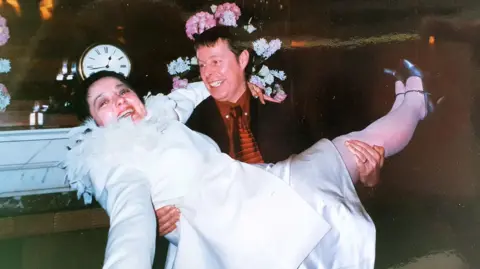 Handout
"It took us 23 years to get married but as soon as I met Julia, she was the person I knew I wanted to be with," Mark said.
"She was gregarious, she was funny and she was just everything I wanted in someone, a partner."
His first introduction to Margo came during a weekend visit to Liverpool.
"He wasn't what I imagined her going out with," Margo said.
"He was quite po-faced about me and my friends. We were young, we were having fun. He seemed judgey."
"I was very judgey," Mark agreed.
The pair said they "rubbed along" over the years since then, with occasional "eruptions".
But Julia was "the glue that held us together", they said.
And one thing Margo never doubted was Mark's commitment to her sister.
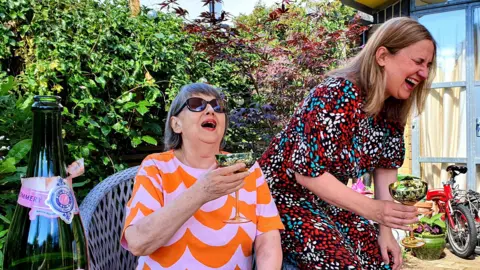 Handout
"I have to say, he was a good husband. He was very, very devoted to her. He couldn't have been more," she said.
"I mean, in a way, and that's part of really the story of the race, in a way he put a lot of who he was aside just because he worshipped her so much."
After decades of not seeing eye-to-eye, Mark and Margo's relationship developed a new dimension in 2019 when Julia became ill.
She had a particularly aggressive form of the disease, and despite undergoing a stem-cell transplant, her condition deteriorated.
As Mark cared for his wife, he said he came to value Margo's visits for the impact they had on her mood.
"One of the things about caring for somebody is that it's very easy to just get lost and focus on caring for someone," he said.
"People that are being cared for, they need to have fun and Margo provided that fun. I think that's what kept Julia going for so long, that Margo would come down and raise her spirits."
Margo said she noticed the toll Julia's illness was taking on Mark.
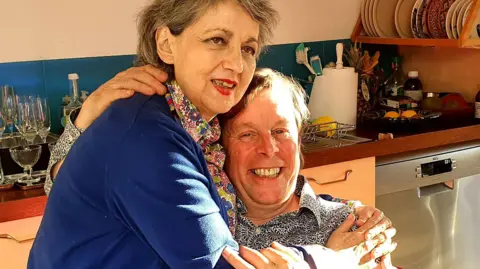 Handout
"When he was caring for Julia, he didn't even know, realise how much it was taking from him," she said.
"We had different roles, but also as well, I knew Mark, like every carer, needed support."
While their relationship had been strengthening anyway, Julia explicitly told them she wanted them to remain close after she was gone.
"It was Julia's last wishes, and it was literally last wishes, that the friendship that Margo and myself had formed continued and we strengthened and we didn't lose it."
Margo said that while her sister had wanted their relationship to continue, how they went about it was an open question.
"You don't really have any blueprint for it, you know, it's an unusual relationship for all those years of friction," she said.
Both Mark and Margo said Julia was a big fan of Race Across the World, but "would never have gone on it" herself.
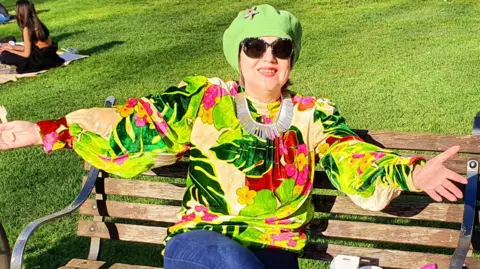 Handout
The inspiration to apply hit Margo suddenly.
"I saw the race advertised and I just thought 'that really speaks to me'. I was looking for adventure because I have a lot on in my life in Liverpool because I care for my mum.
"As soon as I saw the race advertised, just something, I have no idea, spoke to me and said, ask Mark. A voice kind of told me, ask Mark...
"I didn't think twice. And very quickly I asked him and immediately he said 'yes'."
The pair did not want to reveal too much about what went on during filming to avoid spoilers - but said the "magical" journey towards the final destination - Mongolia - featured "real highs and really big lows".
"I don't think that's a spoiler to say, that's the nature of the race. Even the lows, there was absolute magic and alchemy in them," she said.
"Some of the lows, that's where the absolute gold is wasn't it?"
"You find the treasure at the bottom", Mark agreed.
Margo said she believed the excitement and joy in taking part in the race and the sadness of losing Julia would be relatable for people who have experienced loss.
"There's beauty in holding both those things, of sadness and joy of life and honouring her," she said.
The new series of Race Across the World begins at 21:00 BST on Thursday 2 April on BBC One and BBC iPlayer.
Listen to the best of BBC Radio Merseyside on Sounds and follow BBC Merseyside on Facebook, X, and Instagram. You can also send story ideas via Whatsapp to 0808 100 2230.







© Cassandra Klos for The New York Times

© Vincent Alban/The New York Times

© Mark Abramson for The New York Times


© Cassandra Klos for The New York Times

 BBC
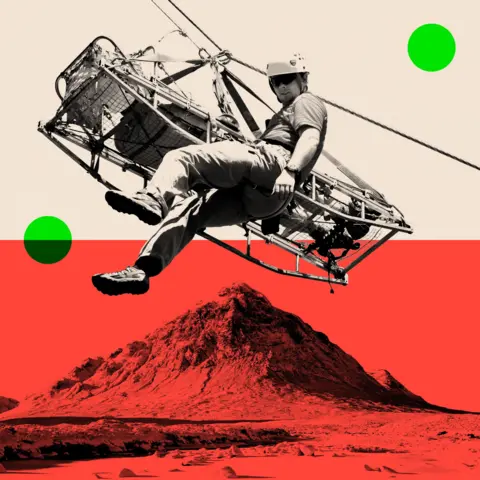
BBCTwo walkers find themselves stranded on a remote hillside as night closes in, hundreds of miles from home, after being inspired out into the wilderness by a TikTok video. It might sound like an unusual emergency - but for Mike Park, CEO of Mountain Rescue England and Wales, it's become a familiar story.
"We had two people stuck on a hill at 8pm, no torches. One was in their early 20s and the other was late 30s. It was their first time on a hill. They'd travelled a long way because they'd seen a TikTok route. They set off on their walk at 2pm - too late - wearing shorts, T‑shirts and carrying only a picnic," he recalls.
"They got off‑route, found themselves in unfamiliar ground – but they did the right thing by calling for help."
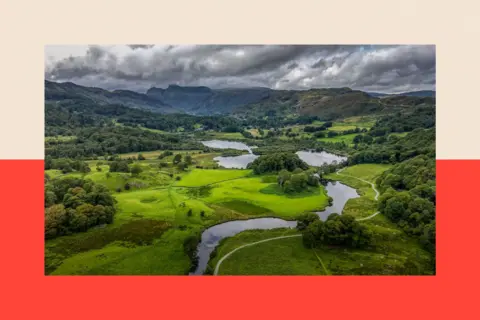
Park says this recent rescue, just a few days ago in the Lake District, is typical of the kind of callouts many colleagues now see.
 Getty Images
His rescue team were able to safely find the pair and walk them off the hill – but the incident perfectly captures some changing behaviours. Their situation was self-inflicted; they weren't prepared and got into trouble, extra layers and some good torches could have seen them rescue themselves - but they were also quick to call for help when they knew something was wrong - a decision Park says saved them from far more severe consequences.
"If we hadn't reached them, they'd have been stuck all night in the dark. By morning, I'm confident they'd be suffering hypothermia - possibly unable to walk."
Over the past few years, mountain rescue teams say there's been a stark rise in the number of people needing to be rescued.
This has ignited a delicate but important debate. Who is responsible for safety on our mountains? And, are increased warning signs and even barriers the answer to saving lives in our most dangerous landscapes, or is risk the price we pay for true adventure?
Mountain rescue callouts have been steadily rising for decades. Sport England figures suggest there's been a particular boom in recent years, with the number of us regularly climbing a hill or mountain rising from 2.8m people in 2018 to 3.6m in 2024.
Living an active lifestyle is something the public body estimates could be saving the NHS billions each year, by reducing the number of people developing chronic conditions.
However, it's also contributed to sharp rises in the number of rescues required by the volunteers who make up the UK's so-called "fourth emergency service".
In England and Wales, the number of callouts rescue teams attend has doubled in the past decade, reaching well over 3,000 a year by 2024, according to Mountain Rescue England and Wales.
So what's changed?
One of the key themes rescue teams pick up on is how incidents featuring younger adventurers, aged 18 to 24, have soared in recent years. Callouts for the age group almost doubled in England and Wales between 2019 and 2024, from 166 to 314.
It now makes them the most rescued age group, overtaking walkers in their 50s who had previously needed the most help.
Mike Park has spent the past 40 years on the hills of the Lake District, rescuing those in danger. He has observed a significant shift among younger people in embracing the outdoors - but says he believes better technology and wider social changes in the past few decades have also fed into the overall rise.
"It doesn't matter what age you are - society is more adventurous, more reliant on help, less outdoor‑aware, and less prepared," he says.
"When I first started our team did 10-15 callouts a year. We average around 100 now. The rise hasn't been steady - it's steepened sharply, especially in the last 10 years and after Covid-19."
Park believes part of what makes the mountains of the UK so attractive is that most can be easily accessed for a day-trip - at worst a short weekend break. They are on our doorstep, via the same motorways and service stations we might stop at on our way to a theme park or music gig.
This can breed a sense of overfamiliarity - with some misjudging just how alien and dangerous these environments can be, he suggests.
 Corbis via Getty Images
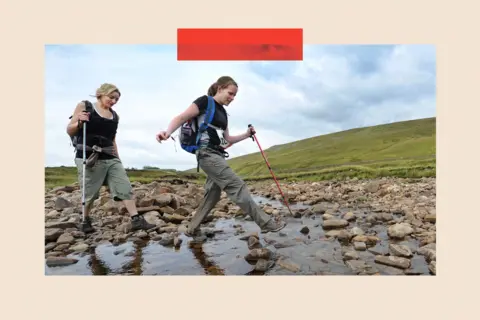
Park says decades ago, many people who went into the UK's mountains would have it as their sole major pastime, they were "hillwalkers or mountaineers, that was it". Now, outdoor adventures are easy to pick up alongside the many other work and leisure activities people juggle.
"There's so much to do now, we don't concentrate on any one thing. People might do the outdoor environment one week, swimming the next, holiday the week after," he says.
Rescuers say it should be seen as only good news that millions of people are now inspired each year to venture into the outdoors themselves, encouraged by stories of the physical and mental health benefits - and beautiful images spread across social media.
But the reality of having so many novices is also starting to take its toll on some of the UK's busiest rescue teams, who are increasingly grappling with exhaustion and stretched staffing.
It's important to note that no rescue team we spoke to begrudge doing these kinds of rescues - they are grateful they can help those who need it and avoid the situation getting any worse. It doesn't matter how you got there, just that they can help you get down safely.
But according to Park, the fact people are seemingly more willing to take risks in the first place - and then more willing to pick up the phone when things go wrong - has fundamentally changed what kind of rescues his teams do.
"Ten years ago, 70% of callouts were because someone physically couldn't get off a hill," he says.
"Now, most people haven't physically injured themselves - it's that they're mentally unable to get down, because they weren't prepared for the environment."
In other words, people's bodies are capable of getting them off the mountains, but they lack the experience, confidence or equipment to do it safely.
Many mountain rescuers believe the increase in online influencers is playing a role. There are pictures and videos across sites like TikTok and Instagram encouraging people to venture out to beautiful plateaus and waterfalls.
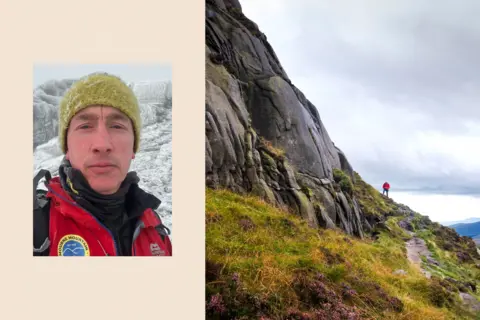
Seeing people influenced by social media "used to be rare, but now it's constant," explains Martin McMullan, from the Mourne Mountain Rescue Team in Northern Ireland.
"People search out iconic locations made popular by influencers. Some go just to experience it - others are trying to create their own content for their platforms."
 BBC/ Getty Images
In some rare cases, McMullan says influencers may even be attempting to get rescued - to create more interesting content for their channels. He became suspicious of one case a few years ago, when his team was called to Northern Ireland's highest peak in "very serious" sub-zero winter conditions.
At the summit McMullan says they found a group of young people who they escorted part of the way down, before calling in a helicopter to evacuate them to safety. It was only days later, when a friend alerted him to it, that McMullan realised the whole thing had been filmed by the group, clutching onto their phones as they were rescued.
"They'd been livestreaming parts of it - even when things became dangerous. We were oblivious to it at the time. They probably thought it made great social media content."
McMullen says although being far from the first time he'd had a rescue filmed by members of the public keen to capture the drama of the job, it was the first time his team suspected a group had gone out with the idea of getting rescued, something they denied.
The vast majority of mountain rescue teams, thankfully, rarely find themselves called out to a death. But the spread is far from even and there are certainly hotspots.
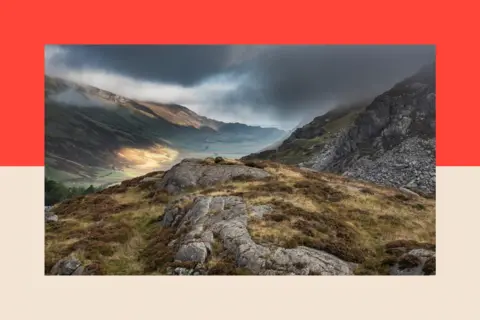
The rescue team covering Yr Wydffa, Snowdon, is far and away the busiest in the UK. The team is often called to fatal incidents and has seen a rise in deaths. Across north Wales, there were 14 fatalities in the mountains back in 2015. Last year there were 23.
 Getty Images
So-called body recovery callouts can have a significant impact on the rescuers, with a growing importance being placed on welfare checks and support for the teams who regularly battle the elements to retrieve bodies so they can be returned to their loved ones.
There have been suggestions that putting up physical warning signs, or even fencing, on some of the UK's most dangerous ridges and waterfalls could potentially save lives. The National Trust and conservation project, Fix the Fells, recently decided signs were needed to prevent accidents on England's highest mountain, Scafell Pike.
Over eight years, four people died and more than 40 were rescued from the treacherous ravine known as Piers Gill, before a sign and large rocks were placed on the nearby route to encourage people away from the area.
In mid-Wales, one assistant coroner has recommended multiple times that signs be put up around some of the region's impressive waterfalls. Five people have died at the beauty spots in the past few years, which has prompted the assistant coroner for south Wales central, Rachel Knight, to write three Prevention of Future Death Reports - recommending improvements.
In the most recent one, she argued clearer warning signs were needed for walkers who risked falling from the paths above the waterfalls – suggesting without them, many would fail to understand "the significant risks they face" in the area and more people were likely to die.
So could putting up signs work in other remote areas?
Andy Buchan is due to take over Mike Park's role at Mountain Rescue England and Wales in May.
In some of the most extreme areas, like Crib Goch, a notorious knife edge ridge in north Wales with annual fatalities, Buchan says some ideas should be considered.
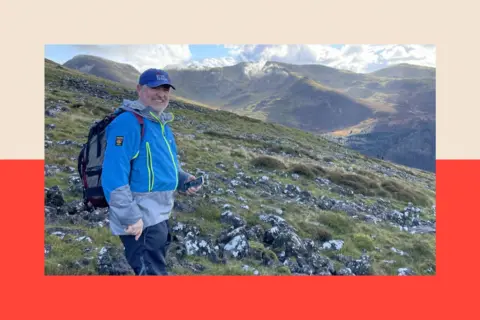
"I won't call it signposting in terms of actually putting signs up on the mountain, but certainly signposting towards more information could really help."
Buchan suggests that in rescue hotspots such as Crib Goch, which does already have some warnings placed on the route, more could be done to help walkers access weather forecasts and safety information before they get to an area - potentially by placing additional signs or QR codes in car parks hikers are likely to use before heading out.
However, what Buchan and others I speak to really don't want to see - despite some potential benefits - is the same widespread canvassing of signs and fencing witnessed in other countries.
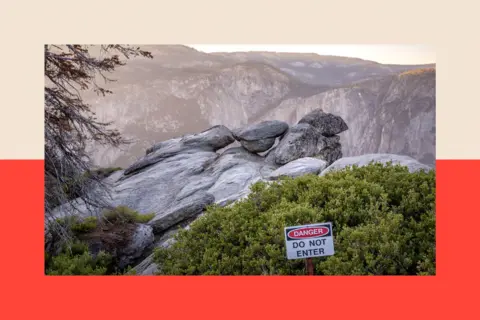
"There are other parts of the world that I've travelled, like the US, where you can get to remote places and then all of a sudden, when you want to go and have a look at the view over the cliff, there's a big metal barrier around and there's concrete being put in place and it kind of destroys the remoteness of the location that you're in," Buchan explains.
In preparing for the role, Buchan has had plenty of time to think about the current challenges, but is overwhelmingly positive about seeing more people out on the hills.
"We encourage people to get outside for their physical and mental wellbeing," he says. "People recognise the countryside is a cost‑effective way to have great experiences. It's great - but it does come with risk."
 Universal Images Group via Getty Images
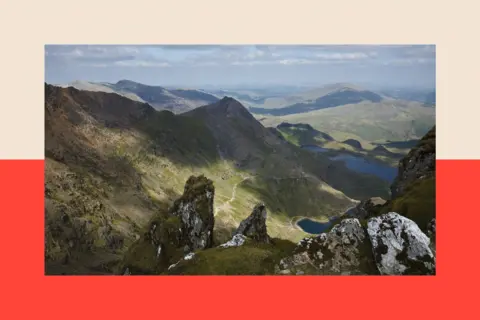
The story of Jack Carne is testament to that. Jack and his two best friends had travelled a few hours from their hometown of Barnsley to reach the mountains of Eryri, also known as Snowdonia, in north Wales. Inspired, after the Covid-19 lockdowns, by the freedom the mountains offered them, the trio in their 20s had been out hiking at every possible opportunity. They were committed, fit and experienced - but on this occasion, just "10 metres from the top" of Glyder Fawr, a peak thousands of feet up, everything went wrong.
A rock Jack had grabbed hold of broke away in his hands. His friends could do nothing as they watched him fall. In just an instant he was gone - disappearing out of sight beneath them. Three friends went up the mountain that day. Only two came back.
It was the starkest reminder possible about the unpredictability and the dangers lurking just beneath the surface of the UK's most picturesque landscapes – even for those who come prepared.
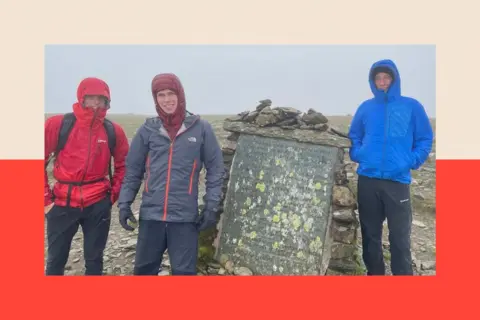
At the inquest into Jack's death, the coroner remarked how the young men were all well-equipped and experienced enough for the route they'd chosen.
"It was a scramble - nothing harder than anything we'd done before," Matty Belcher, one of those three friends, told me. "In fact it was easier than a lot of stuff we'd done," added the 27-year-old.
"Mountain Rescue said the boulder that actually took Jack was a freak accident," adds Brandan Smith, 25, the group's third member.
"That rock could have gone in a week's time, a year's time."
One week after Jack's death, Brandan and Matty were back at the same peak - this time making it the additional 10m to the summit, where they had time to reflect alongside Jack's dad, who they'd brought with them.
"Jack's dad wanted to see it - put his mind at ease, instead of guessing what happened," explains Matty.
For Brandan and Matty, it was a key moment - that inspired them to keep adventuring and not give up on the beauty of our landscape, despite the risks.
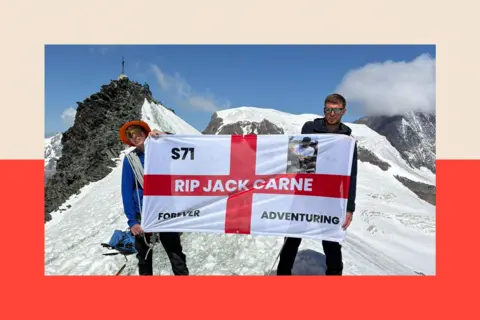
"Jack was the one who absolutely loved it the most out of us," says Brandan. "He was probably the best of us at climbing - he was brilliant - he always pushed me, believed I could do it even when I didn't.
"If we'd stopped going out after he died, Jack would've kicked us for it."
The key thing, both men say, is for those looking to adventure, to always be aware of the risks.
"For us, if someone isn't feeling safe, we turn back. No question. There's always another day," says Brandan. "It's always going to be there - the mountain isn't going anywhere."
Top picture credit: Getty Images

BBC InDepth is the home on the website and app for the best analysis, with fresh perspectives that challenge assumptions and deep reporting on the biggest issues of the day. Emma Barnett and John Simpson bring their pick of the most thought-provoking deep reads and analysis, every Saturday. Sign up for the newsletter here
 PA Media
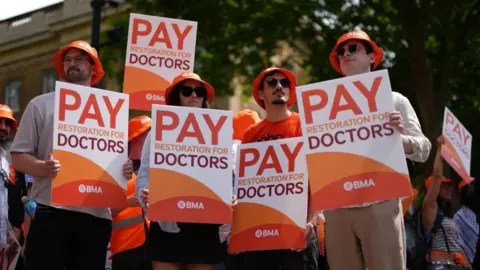
The government has withdrawn an offer of creating 1,000 more doctor training posts in England after the British Medical Association (BMA) refused to call off a six-day strike next week.
The extra posts were part of a wider package of measures put forward by ministers earlier this year to resolve the long-running dispute with resident doctors, previously known as junior doctors.
Prime Minister Sir Keir Starmer set a 48-hour deadline on Tuesday evening for the walkout to be cancelled if the union wanted to keep them.
The strike was called last week when talks between the two sides over pay and job shortages broke down.
A Department of Health and Social Care spokesman said doctors had been offered a "generous deal", but said it was now not possible to give the go-ahead on the training posts.
"These posts would have gone live this month, but as systems now need to prepare for strikes and more uncertainty, it simply won't be operationally or financially possible to launch these posts in time to recruit for this year."
The government said the move would not impact the overall number of doctors in the NHS as the posts were going to be created from existing short-term posts. Resident doctors fill these when they cannot get official training posts.
Dr Jack Fletcher, BMA resident doctor committee chair, said the announcement was "extremely disappointing".
"It is genuinely disheartening to be at this point after what had been constructive talks up until a few weeks ago when the government moved the goalposts.
"It is simply wrong that the development of the doctors of the future is being used as a pawn like this.
"We have consistently maintained that we are willing to postpone industrial action should a genuinely credible offer be provided."
Alongside the extra training posts, the government had offered to cover some out-of-pocket expenses such as exam fees as well as ensuring faster pay progression.
But the BMA ended the talks saying the deal - and in particular its pay progression element - had been watered-down at the last minute.
It also coincided with the government accepting the recommendations of the independent pay review body that all doctors, including resident doctors, should get a 3.5% pay rise from this month.
The BMA called it a "crushing blow", pointing out that inflation was set to rise because of the Iran war.
While the pay rise means resident doctor pay has risen by a third over the past four years, the BMA argues it is still a fifth lower than it was in 2008 once inflation is taken into account.
The union uses a measure of inflation - RPI - that is higher than others. It says it does this because the government uses that measure of inflation when adding interest to student loans.
The training posts that were offered are the ones doctors move into after the first two years of training. This is the point at which they specialise in areas such as general practice or surgery.
Last summer there were 30,000 applicants for around 10,000 jobs, although some of those were doctors applying from abroad.
Next week's walkout, which begins at 07:00 BST on Tuesday, will be the joint longest since the dispute began - only once before have resident doctors taken part in a six-day walkout.
It's the 15th walkout since the long-running dispute started in March 2023.
Resident doctors make up nearly half of medics working in the NHS - two thirds of them are BMA members.
 Getty Images
New laws will make it easier to cancel subscriptions and get refunds for unwanted auto-renewals, the government has said.
A crackdown on "subscription traps" could save the average person nearly £170 a year, according to the Department for Business and Trade (DBT).
Consumers will no longer have to make "endless phone calls" to cancel a subscription, and they will be given a 14-day cooling off period after the end of a trial period, or when an annual subscription automatically renews.
The changes are expected to come in to force in spring 2027.
The laws will enable people to cancel subscriptions "with the click of a button", the DBT said.
Companies will be forced to give clear information upfront to prevent consumers from being "silently rolled onto expensive contracts", it added.
Firms will also have to give customers reminders when a free or discounted trial is about to end, or when contracts that are a year or longer are about to be renewed.
The 14-day cooling off period will allow people to get a "full or proportionate refund" if they forget to cancel after a free trial, or the subscription auto-renews.
The changes could save the public a total of £400m a year, the DBT said.
Kim Biggs from Lincolnshire told BBC News she has been "caught out" by annual subscription fees that renew automatically.
Kim was notified that her free trial of AVG, the anti-virus software was about to end..she said trying to cancel the subscription was "exasperating".
"It took quite a lot of time to wade through all the pages, all the information that was presented when you first clicked onto the 'unsubscribe' part on the website.
"Eventually I clicked on the right options to get an online form to request a refund. I completed this but did not receive my refund."
Kim said the phone number for AVG 's support centre was not easy to find online.
When she did speak to a support agent Kim said she was told "the form that I'd sent in is basically disregarded by them, that you have to speak to them through the support centre to get your refund, which was really annoying".
"I had to keep repeating that I just wanted a refund, as she was very persistent in pushing the products available, trying to get me to change my mind."
The BBC has asked AVG for a comment.
Sue Davies, the head of consumer rights policy at Which?, said subscription traps can "wreak havoc on finances".
"These new rules will help put consumers in the driving seat with proper transparency and protection," she said.
Certain memberships for charitable, cultural and heritage organisations will be excluded from the new rules.
The DBT estimates that there are 10 million unwanted, active subscriptions across the UK.
It said that more than 3.5 million people are being "quietly rolled from free or discounted trials into fully costed contracts", while another 1.3 million are caught out by unexpected auto-renewals.
 Keron Day
Motability drivers under the age of 30 say they are "horrified" by rule changes that mean their vehicles will be fitted with compulsory black boxes.
The boxes will monitor driving habits, such as speed and braking, and will provide a weekly rating.
More than four red ratings over a 12-month period could see drivers removed from the Motability scheme, which allows eligible disabled people to lease a new car using part of their benefit payments.
Critics say the change will affect disabled people's freedom and ability to work, but Motability says it is about "keeping prices down and keeping people safe". It says it has removed 300 drivers since its September launch in Northern Ireland.
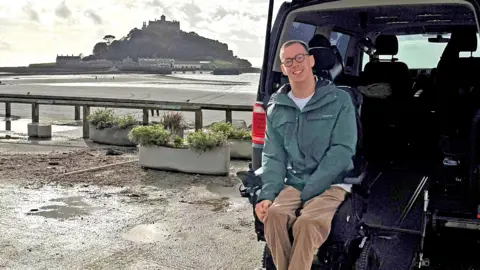
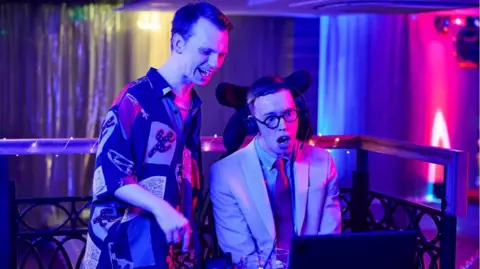
Actor Keron Day, 25, who starred in the hit Netflix show Sex Education, has cerebral palsy and uses a specially adapted wheelchair accessible vehicle (WAV). The car has a steering aid and indicators on the floor, as well as buttons for lights, wipers, gears and the handbrake.
Day says the car is an "amazing piece of technology", but feels angry at having to have a black box fitted and his driving assessed when his access requirements mean he "can't simply jump into another vehicle" or use public transport easily.
"Disabled people need to have the choice, just like everybody else," he says.
"If I passed [my driving test] aged 17, I would have 13 years of a mandatory black box. None of my non-disabled peers would have that.
"We all have to pass the exact same driving tests that everybody else does, so it's not a point about our safety."
Black box car insurance has become a popular option for young drivers, who are often deemed to be more high-risk, as it offers lower insurance premiums.
Motability enables disabled people who have issues getting around to exchange their higher-rate mobility allowance for a new car. Although "premium" vehicles such as BMWs and Mercedes were removed from the scheme at the end of last year.
During last year's Budget, the government removed its tax break on insurance and it must now cover 12% on each insurance premium. It must also now pay VAT on some vehicles meaning the scheme will need to pay out an additional £300m from 1 July.
Nigel Fletcher, CEO of the Motability Foundation, said that would be the equivalent of a price rise of £1,100 for every driver on the scheme.
"A lot of disabled people won't be able to afford that, so we're now having to try and work out how can we make changes to the scheme that protects pricing as much as we possibly can," said Fletcher.
He added that black box was about "keeping prices down and keeping people safe" and its data had also found younger drivers to be the highest risk.
He said, of the 300 drivers removed from the scheme, one had driven 117mph in a 30mph zone.
"This a serious safety issue, not just for that individual, but everyone else in that community.
"They will get lots of warnings before they get taken off the scheme. And then if they are taken off the scheme, we will need to start looking at what our policies are around allowing them back onto the scheme in the future."
Motability has also decided that every vehicle with a named driver aged 30 or under will have the device fitted - which could include family, friends and personal assistants (PAs) who drive the vehicle.
"As a disabled person, my independence could be taken away as a result of a non-disabled person's actions," Day says.
"I'm experienced enough with PAs to know that not all PAs are amazing drivers. And that's just a reality of life. I find the consequences horrifying."
Motability will start to bring in the changes on new leases from 13 April for the first 15% of its 930,000 customer base. Then it will "review and analyse" whether to introduce it across the board.
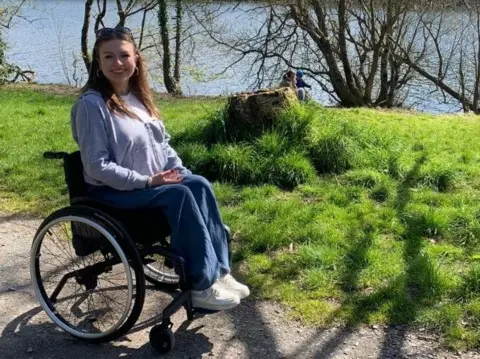
Eva Hanna, 21, has a car with hand controls and says she is happy to have a black box, but feels the amber and red reports she has received for jerky driving is a direct result of her adaptations and thinks the scheme needs to be looked at.
"The braking and acceleration can be a bit more sensitive, because obviously it's not the same as using your feet," she says.
"You have to pull on the brake a little, or you have to pull on the accelerator to get it going. So I've found that during my journey I might have braked too hard or accelerated too harshly."
 Eva Hanna
She says she has received amber ratings when commuting to Belfast for work and a red score when she had to brake sharply on a country road.
In comparison, when her parents have driven the vehicle manually, they received green scores.
"I know I'm not a dangerous driver, but there is a difference whenever I drive. I'll always get knocked down a bit on the smoothness," she says.
"I worry because the scheme is so great. For people to be kicked off just because of small things that aren't their fault, it would be such a big let-down to a lot of disabled people."
Fletcher says this was not something Motability was aware of, but it would look into and would continue to gather information over the coming months.
As well as the black box, Motability has introduced recommendations that drivers take a break every hour and aim not to do more than six journeys a day. If that is exceeded, the driver will receive a red score, but it will not impact their lease.
It has also halved the number of miles drivers can make each year before they pay an excess.
Drivers will now be able to drive 10,000 miles before paying 25p on any miles travelled over that limit. Previously, the mileage was 20,000 with an excess of 5p a mile.
Motability says its average drives clock up 7,500 miles a year and Scotland's version of the scheme was still considering the cap.
But for Day, the recommendations are frustrating and impede his independence.
"I live in rural Cornwall, everything is an hour away," he says.
"If I wanted to go to London, which is where the majority of my work is, and I had to stop every hour, I couldn't get to work. It's just madness."
Even so, he is excited for the "freedom and access to the world" his new vehicle on the scheme will give him.
"I wouldn't be able to go to work without mine," he says. "I wouldn't be able to have a social life."

 Getty Images
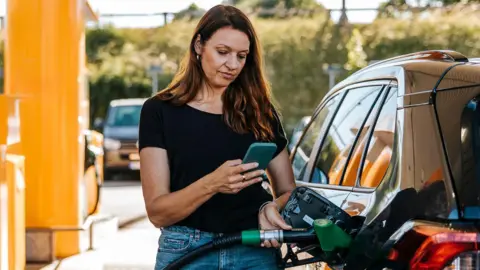
The jump in the price of oil triggered by the conflict in the Middle East has raised the possibility of higher fuel costs for motorists.
Following the attacks by the US and Israel on Iran, the price of oil leapt by 10% and gas prices also surged.
The reason for the jump is that Iran has warned vessels not to pass through the Strait of Hormuz, a crucial waterway in the south of the country through which about 20% of the world's oil and gas is shipped.
If these restrictions persist and oil prices remain high for some time, the worry is this will have knock-on effects on prices of a number of goods.
However, there remains a huge amount of uncertainty at this stage as to whether the conflict will have a lasting effect on the price of oil, gas and wider energy costs.
Crude oil is a key ingredient in petrol and diesel, meaning higher oil prices could eventually drive up prices at the pumps.
The AA motoring group says that over the next few weeks fuel costs could return to where they were at the start of the year.
That would be a change to the general trajectory of fuel prices, which have been falling on UK forecourts over the past few weeks.
Further rises will depend on the magnitude and duration of the conflict, the AA said.
Currently, the average price for petrol is 132.6p a litre and 142.3p for diesel, according to AA data.
Simon Williams, from rival motoring group the RAC, said: "If oil were to climb to and stay at the $80 a barrel mark, then drivers could expect to pay an average of 136p for petrol.
"At $90, we'd be looking at over 140p a litre and $100 would take us nearer to 150p, but it's all too soon to know."
As well as affecting prices at the pump, if higher fuel costs persist they could have further knock-on effects on the prices of goods on the shelf.
More expensive petrol and diesel will increase the transport costs of those businesses moving food and other goods around the country.
These increased costs might then be passed on by shops and supermarkets to the consumer. As a result, the cost of living goes up.
There might also be a more direct impact on food. "Some elements of crude oil are used in fertiliser, and so there could be a cost implication in terms of food prices," Benjamin Goodwin, partner at banking advisory firm PRISM Strategic Intelligence told the BBC.
However, if the disruption is short lived then it is unlikely to result in an immediate increase in food prices, he said.
In the short-term, millions of UK householders' domestic gas and electricity bills are shielded from any impact on wholesale costs paid by suppliers.
People whose energy bills are governed by the price cap already know what their unit prices are now, and will be for the three months from April. They have already been set.
However, the impacts of the conflict could potentially be seen on domestic variable energy tariffs from the subsequent price cap, for the three months from July.
UK inflation, which measures the pace of price rises, has eased relative to the heights reached immediately after Russia launched its full-scale invasion of Ukraine four years ago.
It has meant that the Bank of England has been able to cut interest six times since August 2024 to 3.75%.
The Bank recently said further cuts to borrowing costs are likely this year with another cut widely expected later this month, but if the oil price continues to rise is this now less likely?
Much depends on how long crude prices remain elevated, according to Subitha Subramaniam, chief economist and head of investment strategy at Sarasin & Partners.
If they do, she said: "It will start to cascade into other prices such as food, agriculture, industrial commodities and that's just going to really bleed into inflation."
The Bank's rate-setting committee next meets in a couple of weeks' time which really isn't enough time to assess the impact of higher oil prices on inflation.
So, in the short-term, Subramaniam said: "I would say the prudent course for the Bank of England would be to remain on hold."

© Eric Lee for The New York Times


,_jugoslawische_Schiffe.jpg)

_male.jpg)
.jpg)
.jpg)

