Reading view

There are new articles available, click to refresh the page.

Naturalists: Origins

The new style of Naturalism took the Paris Salon by storm in 1883. As a complement rather than competitor to Impressionism, it found more favour among the establishment, critics and public who attended the Salon, and had roots going back to the genre paintings of the Dutch Golden Age.

Jan Miense Molenaer (c 1610–1668), The Dentist (1630), oil on panel, 66 x 81 cm, Herzog Anton Ulrich-Museum, Braunschweig, Germany. Wikimedia Commons.

The Dentist, painted in 1630, declares Jan Miense Molenaer’s interest in everyday life. A small crowd has gathered outside a church, where a fashionably dressed man is pulling a tooth from a local. The victim is dressed in tatters, with large holes at both his knees and worn-out shoes. These are ordinary, common people depicted objectively in their normal surroundings.

terborchboydog
Gerard ter Borch (1617–1681), A Boy with his Dog (The Flea-Catcher) (after 1666), oil on canvas mounted on wood, 35 x 28 cm, Alte Pinakothek, Munich, Germany. Wikimedia Commons.

Gerard ter Borch’s late painting of A Boy with his Dog, also known as The Flea-Catcher (after 1666), shows this boy checking for and removing fleas from his pet in fairly barren surroundings.

Another strand of development was the controversial, even politicised, contemporary event. Géricault’s monumental painting of The Raft of the Medusa made in 1818-19 is perhaps the most important example.

gericaultraftofmedusa
Jean Louis Théodore Géricault (1791–1824), The Raft of the Medusa (1818-19), oil on canvas, 491 x 716 cm, Musée du Louvre, Paris. Wikimedia Commons.

This shows a well-known and scandalous story of the day, when over 130 people on board the French frigate Méduse died after they had abandoned ship onto a makeshift raft. Just fifteen of the 147 people on that raft survived thirteen days before being rescued, and gave harrowing stories of drowning, dehydration, and cannibalism.

Although Géricault undoubtedly painted what was in his mind’s eye, he undertook considerable research, interviewing survivors and making studies of material from the morgue in his efforts to make this as objective as he could. This quest for objectivity was a major theme of the nineteenth century, spilling over from the sciences into creative arts, underlying many of the changes seen in painting.
courbetstonebreakers
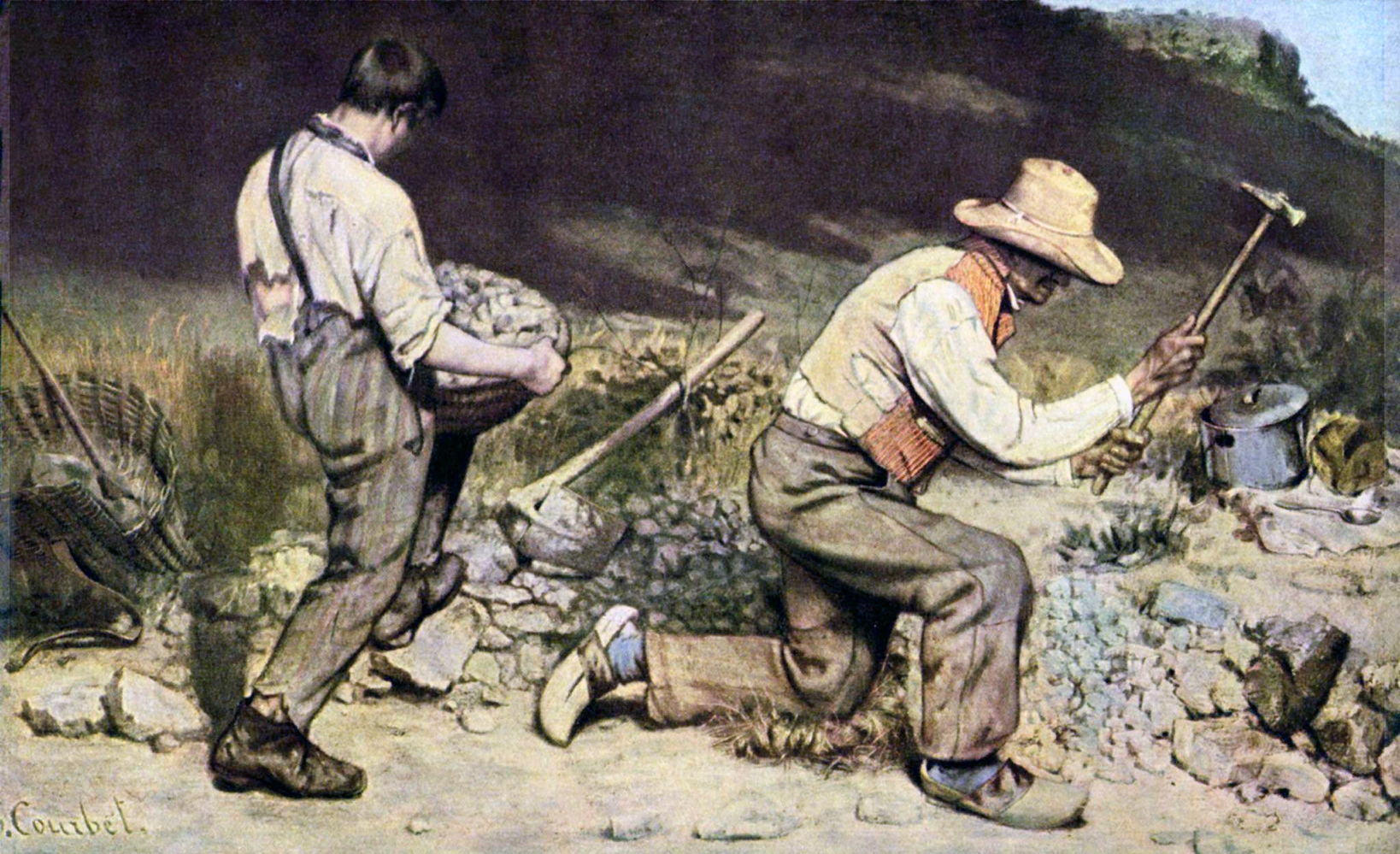
Gustave Courbet (1819–1877), The Stone Breakers (1849), oil on canvas, 165 x 257 cm, Galerie Neue Meister, Dresden, Germany, destroyed by fire 1945. Wikimedia Commons.

Gustave Courbet took it up in the middle of the century, most notably in The Stone Breakers (1849), which was later destroyed by fire during the Allied bombing of Dresden in 1945. This painting was exhibited at the Salon in 1850, and established him as the great-grandfather of Naturalism.

courbetburialatornans
Gustave Courbet (1819–1877), A Burial at Ornans (1849-50), oil on canvas, 315 x 668 cm, Musée d’Orsay, Paris. Wikimedia Commons.

Shown in the same year was his monumental A Burial at Ornans (1849-50), a huge depiction in unemotional and objective terms of the funeral of the artist’s great uncle in the small provincial town of Ornans. The event had taken place in September 1848, but this painting gives the impression that it is a faithful record.

Courbet actually painted the work entirely in the studio, using those who were present as models. It shows a moment which could only have existed in the artist’s memory: like Géricault’s Raft of the Medusa, it doesn’t necessarily represent an image which ever existed in reality. But it has been carefully researched, imagined, composed, and painted to give the impression of accuracy and objectivity, rather than some Romantic fantasy.

At the same time, social realism was arriving on the farms of France, thanks to the paintings of Jean-François Millet.

milletsower1850
Jean-François Millet (1814–1875), The Sower (1850), oil on canvas, 101.6 x 82.6 cm, Museum of Fine Arts, Boston, MA. Wikimedia Commons.

Millet’s The Sower was completed in 1850 and shown at the Salon that year; it has since been recognised as his first real masterpiece. This farmworker is striding across a field, sowing seed for the summer’s crop. In the distance to the right, caught in the sunlight, is another worker ploughing with a pair of oxen.

milletgleaners
Jean-François Millet (1814–1875), The Gleaners (1857), oil on canvas, 83.5 × 110 cm, Musée d’Orsay, Paris. Wikimedia Commons.

Millet’s The Gleaners of 1857 is sparse, concentrating on just three figures. There are no distractions: it is about the rural poor, who made ends meet by salvaging scraps after the harvest had been cut. This is unavoidably about poverty, and the sector of the population who only just managed to survive each winter. At the time it smacked of socialism, and got the thumbs-down from the rich and middle classes when they saw it in the Salon that year.

milletangelus
Jean-François Millet (1814–1875), L’Angélus (The Angelus) (1857-59), oil on canvas, 55 x 66 cm, Musée d’Orsay, Paris. Wikimedia Commons.

Millet followed that with The Angelus, completed around 1857-59. This had been commissioned by the American collector Thomas Gold Appleton, as Prayer for the Potato Crop, but underwent modification before Millet gave it its present title. At some stage, it’s thought to have included a child’s coffin, but that was overpainted. It shows a couple, praying the Angelus devotion normally recited at six o’clock in the evening, over the potatoes they have been harvesting. It is dusk, and as the last light of the day fades, the bell in the distant church is ringing to mark the end of work, and the start of the evening.

Next to the man is his fork, which he has been using to lift potatoes from the poor, stony soil; his wife has been collecting them in a wicker basket, which now rests at her feet. Behind them is a primitive wheelbarrow with a couple of sacks of potatoes on it. In the gathering dark, viewers often misread the barrow and think that it contains a small child.

With the hostile reception of The Gleaners, Millet didn’t exhibit this painting until 1865, although he had sold it in 1860 for a meagre 1,000 francs. When sold in 1890, its price reached 750,000 francs.

bretongleaners1854
Jules Breton (1827–1906), The Gleaners (1854), oil on canvas, 93 × 138 cm, The National Gallery of Ireland/Gailearaí Náisiúnta na hÉireann, Dublin, Ireland. The Athenaeum.

Jules Breton was also important, more in his compositional devices than in any social realism. His Gleaners from 1854, which was highly successful at the Salon of 1855, is a marvellous painting, although hardly the story of people who spent most of their lives on the edge of survival. But its foreground detail, high horizon and widescreen effect were to be used very successfully by Jules Bastien-Lepage and others.

Another important artist in the late gestation of Naturalism was Édouard Manet, long considered to be a precursor of Impressionism, but who was thoroughly realist.
manetolympia
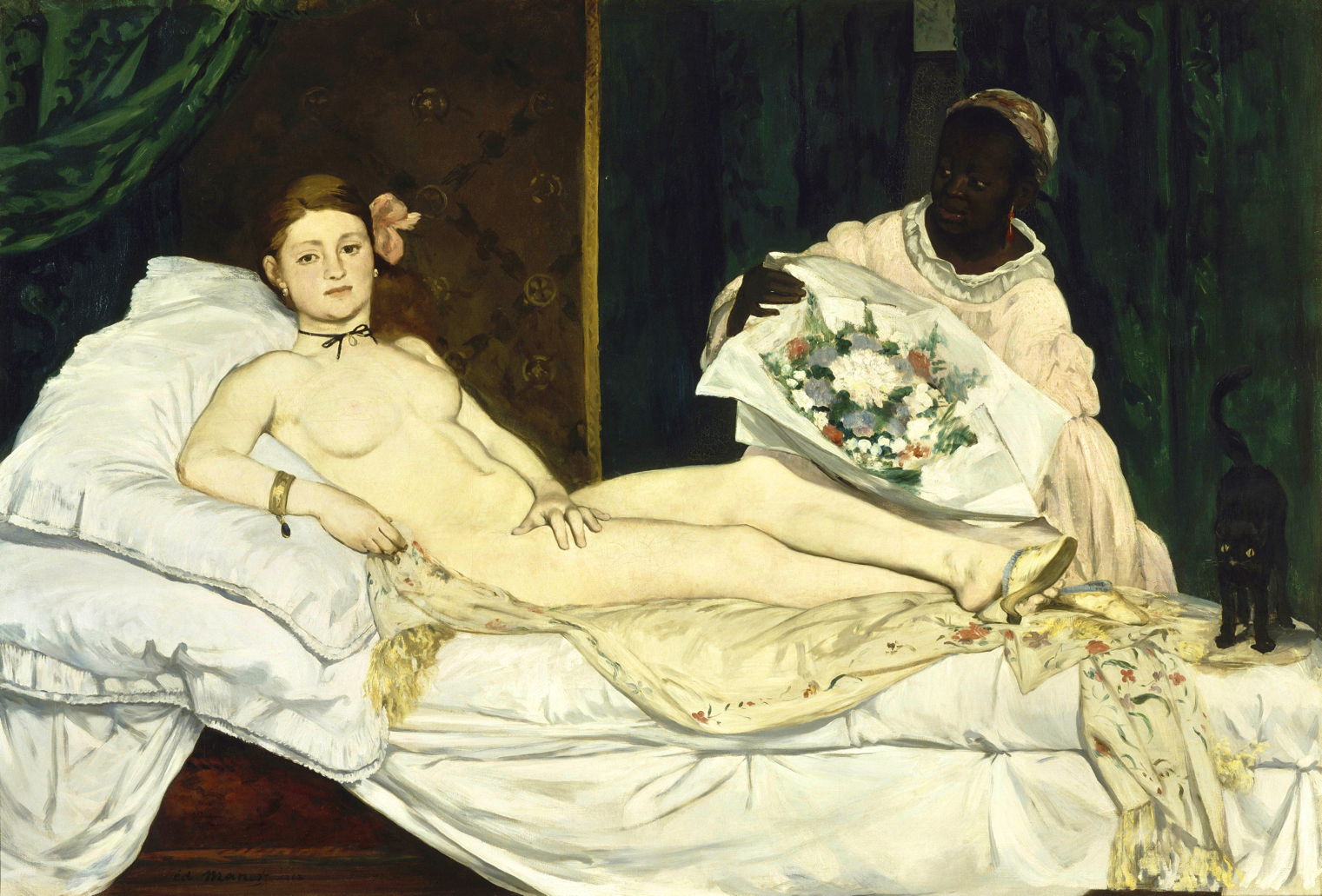
Édouard Manet (1832–1883), Olympia (1863), oil on canvas, 130 x 190 cm, Musée d’Orsay, Paris. Wikimedia Commons.

Manet’s Olympia (1863) shocked those seeing it at the 1865 Salon because here was an ordinary person, a ‘common prostitute’ indeed, seen in a role normally assigned to a mythical goddess such as Venus. And she was very much at her place of work, staring straight at the viewer.
manetrailway
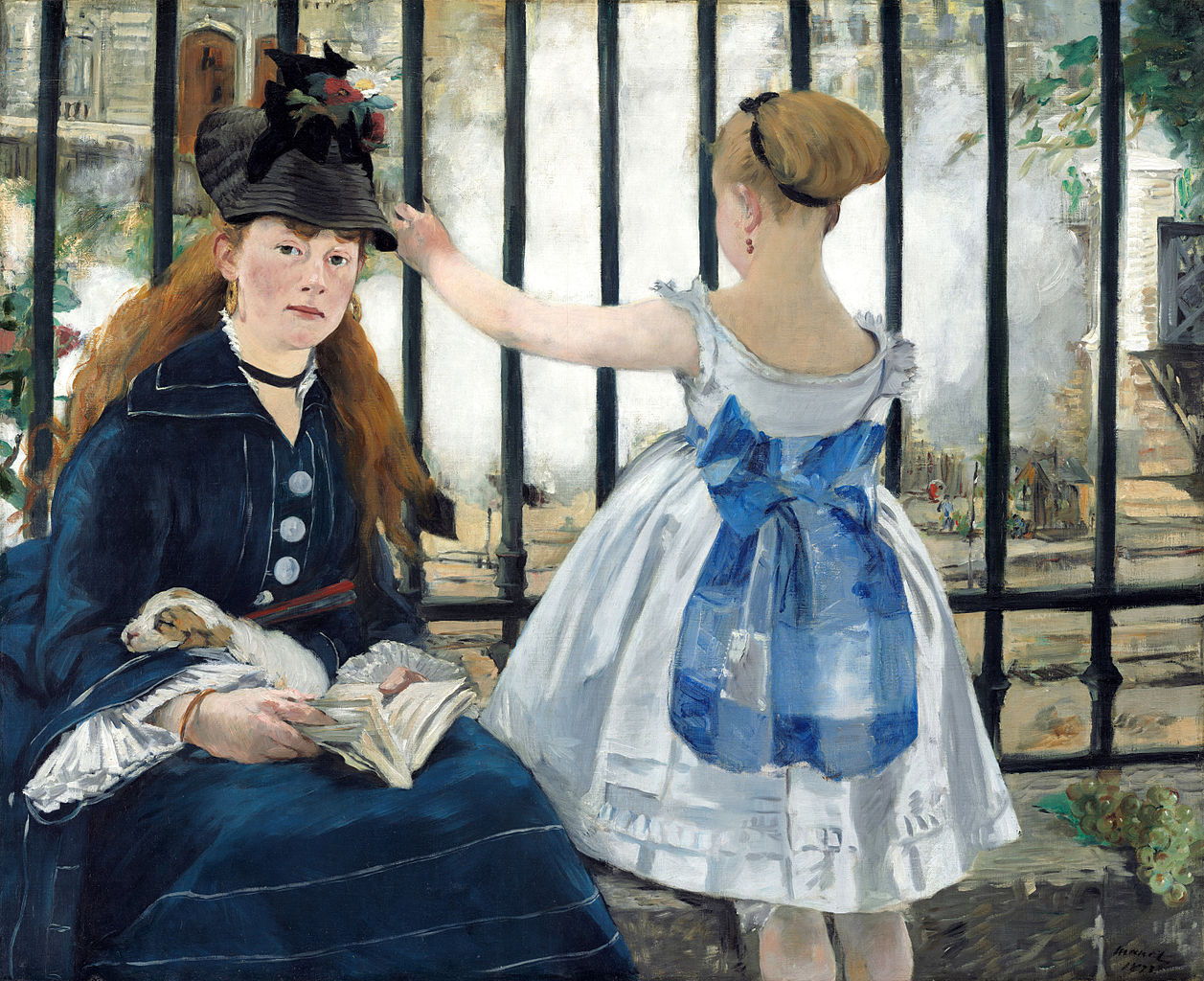
Édouard Manet (1832–1883), The Railway (1873), oil on canvas, 93.3 x 111.5 cm, The National Gallery of Art, Washington, DC. Wikimedia Commons.

A decade later, Manet painted the same model, Victorine Meurent, in The Railway (popularly known as Gare Saint-Lazare) (1873). A genre symbol of modernity, it brought modern technology and urban life to what was at the time a largely unappreciative public.

The most immediate precursors to the Naturalist paintings of 1883 weren’t the early works of Jules Bastien-Lepage, but the paintings of the rural poor by Léon Augustin Lhermitte.

lhermitteprocessionploumanach
Léon Augustin Lhermitte (1844–1925), Procession near Ploumanac’h (1879), oil on canvas, dimensions not known, Private collection. Wikimedia Commons.

Lhermitte’s sketchy Procession near Ploumanac’h from 1879 shows a religious festival in Brittany, with a small stream of locals making their way along a track on the open hillside towards the church. Its unemotional bleakness is completely different from the dense processions being painted by Jules Breton.

lhermittepayharvesters
Léon Augustin Lhermitte (1844–1925), The Harvesters’ Pay (1882), oil on canvas, 215 x 272 cm, Musée d’Orsay, Paris. Wikimedia Commons.

Lhermitte’s founding masterpiece of Naturalism is The Harvesters’ Pay from 1882, which looks objectively at the economic and social aspects of the harvest. Four of the harvesters, bearing their heavy-duty scythes, await payment by the farmer’s factor, who holds a bag of coins for the purpose. In the centre of the painting, one of the workers is counting out his pay in front of his wife, who is feeding a young infant at her breast. To their left, another worker just sits and stares blankly into the distance, dead-beat tired and wondering whether his pittance was worth all that effort.

Most importantly, Lhermitte painted these in the early years of the Third Republic, a time when social concerns were sweeping across much of Europe.

The Dutch Golden Age: How did it happen?

The Golden Age of the Dutch Republic developed as a result of a combination of circumstances, some of which are made clear in previous articles in this series. This summary brings those together with a small selection of works to illustrate them.

The Northern Renaissance, that had started in the Flemish countries to the south in the 1420s, had flourished in centres such as Antwerp and Brussels during the sixteenth century. As it matured into the Baroque during the early decades of the Golden Age, it was led by Peter Paul Rubens. This gained from the early adoption and development of oil painting on canvas using realist techniques to depict increasingly secular themes, which became centred in the workshops of Antwerp.

Flanders and Brabant in the south remained part of the Habsburg empire ruled from Spain, with intolerance towards Protestant movements leading to religious conflict. Some artists who trained in those countries migrated to the north, where they accelerated the growth of Dutch Golden Age painting.

peetersmesa
Clara Peeters (c 1594-1640), Mesa (Table) (c 1611), oil on panel, 55 x 73 cm, Museo Nacional del Prado, Madrid. Wikimedia Commons.

Among them was Clara Peeters, who seems to have trained in Antwerp before painting innovative still lifes in the Dutch Republic. By about 1611, when she painted Mesa (Table) above, she was selling her paintings to the Spanish royal family. Some of her works ended up in the Spanish Royal Collection, and today remain in the Prado in Madrid as a result. Dutch painters developed her themes, and settings for meals, particularly that of breakfast, later became a sub-genre.

As a secular confederation of provinces, art in the republic wasn’t dominated by religious themes or the patronage of a royal dynasty. Commissions seldom came from religious organisations, but from guilds and other non-religious groups that were flourishing in the growing cities. Most popular among those were group portraits of occupational guilds.

vanmiereveltanatomylesson
Michiel Jansz. van Mierevelt (1566–1641) and Pieter van Mierevelt (1596–1623), The Anatomy Lesson of Dr. Willem van der Meer (1617), oil on canvas, 146.5 x 202 cm, Museum Prinsenhof Delft, Delft, The Netherlands. Wikimedia Commons.

Although guilds had been an important part of Renaissance society, few if any appear to have commissioned group portraits, which were largely confined to noble families. In 1617, Michiel van Mierevelt and his son Pieter, specialists in portraiture, painted The Anatomy Lesson of Dr. Willem van der Meer, one of the earliest portraits of a social group from the Dutch Golden Age. These are thought to be members of the Surgeons’ Guild of the city of Delft, who commissioned this work.

Frans Hals (1582/1583–1666), Militia Company of District XI under the Command of Captain Reynier Reael (1633-37), oil on canvas, 209 x 429 cm, Rijksmuseum, Amsterdam, The Netherlands.

Among the groups responsible for many of these portrait commissions was the civil militia. Frans Hals’ Militia Company of District XI under the Command of Captain Reynier Reael (1633-37) shows a group known as the Meagre Company. He was commissioned to paint this in 1633, but three years later it remained unfinished, and the commission was transferred to Codde to complete the right side of the canvas and many of the hands and faces a year later.

Migration and international trade transformed cities like Amsterdam, which rapidly became multicultural at a time when much of Europe was still oppressing minority groups such as Jews.

hobbemahaarlemlock
Meindert Hobbema (1638–1709), The Haarlem Lock, Amsterdam (1663-65), oil on canvas, 77 x 98 cm, The National Gallery, London. Wikimedia Commons.

Meindert Hobbema’s view of The Haarlem Lock, Amsterdam from 1663-65 shows one of the city’s working locks with a raising bridge, with the masts of many ships in the harbour beyond.

avercampwinterlandscapeskaters1608
Hendrick Avercamp (1585–1634), Winter Landscape with Skaters (1608), oil on panel, 77.3 x 131.9 cm, Rijksmuseum Amsterdam, Amsterdam, The Netherlands. Wikimedia Commons.

Avercamp’s Winter Landscape with Skaters from 1608 shows the many who have spilled out from the warmth of buildings to take to the ice.

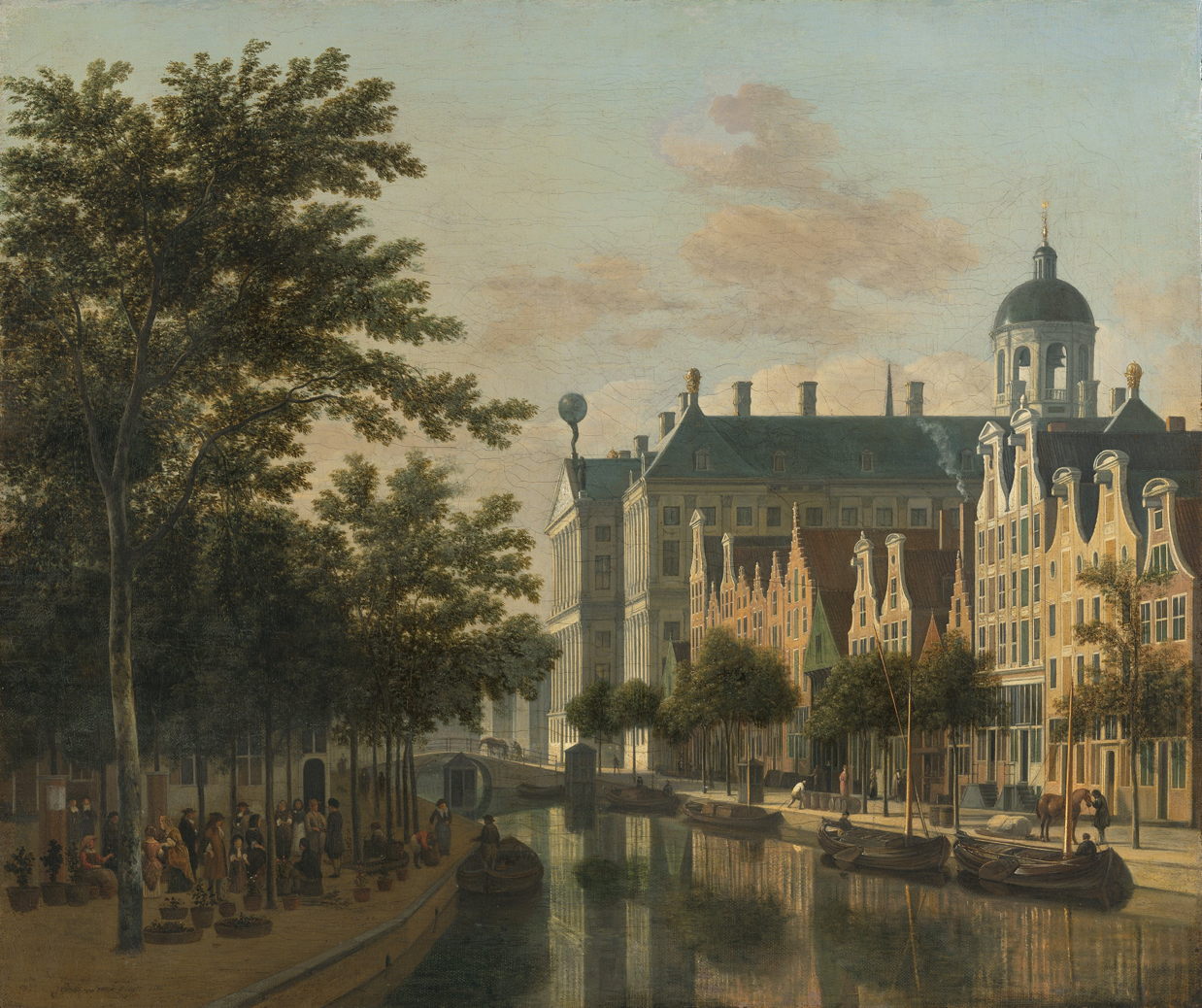
Gerrit Adriaenszoon Berckheyde (1638–1698), The Nieuwezijds Voorburgswal, Amsterdam (1686), oil on canvas, 54 x 64 cm, Museo Nacional Thyssen-Bornemisza, Madrid, Spain. Wikimedia Commons.

Berckheyde’s The Nieuwezijds Voorburgswal, Amsterdam from 1686 shows the canal running at the rear of Amsterdam’s City Hall, built between 1648-65, and featuring the octagonal tower seen at the right. By this time the population of Amsterdam had risen to more than 220,000, many of them immigrants.

With the growth of trade came increasing prosperity, and urban populations who became avid collectors. For some it was household linen or clothing, for others Delft tiles, and for the many who wanted to decorate the walls of their houses, paintings were ideal. Those artists who had achieved recognition could sell through art dealers, some of whom were painters themselves. For smaller and more everyday works, art fairs were held, and collectors flocked to attend them in search of bargains.

Jacob Mathieusen, and his wife, in the background the fleet in the roads of Batavia, by Aelbert Cuyp
Aelbert Cuyp (1620–1691), A Senior Merchant of the Dutch East India Company (1650-59), oil on canvas, 138 x 208 cm, Rijksmuseum Amsterdam, Amsterdam, The Netherlands. Wikimedia Commons.

A Senior Merchant of the Dutch East India Company, painted during 1650-59, is thought to show Jacob Mathieusen and his wife, against a background of the company fleet in Batavia roads. This city in what was then the Dutch East Indies is now the site of Jakarta in Indonesia.

As more secular genres became popular, painters specialised in sub-genres in an effort to appeal to new markets.

beerstraatenoldtownhallamsterdam
Jan Abrahamsz Beerstraaten (1622–1666), The Old Town Hall of Amsterdam on Fire, 7 July 1652 (1652-55), oil on panel, 89 x 121.8 cm, Amsterdam Museum, Amsterdam, The Netherlands. Wikimedia Commons.

In mid 1652, Jan Abrahamsz Beerstraaten seems to have witnessed the destruction by fire of part of the centre of Amsterdam, shown in his studio painting of The Old Town Hall of Amsterdam on Fire, 7 July 1652 (1652-55).

molenaersmell
Jan Miense Molenaer (c 1610–1668), Smell (1637), oil on panel, 19.5 x 24.3 cm, Koninklijk Kabinet van Schilderijen Mauritshuis, The Hague, The Netherlands. Wikimedia Commons.

The sense of Smell, from 1637, is the best of Jan Miense Molenaer visual jokes, a thoroughly secular if not irreverent scene from everyday life.

vanwijnenwitchessabbath
Domenicus van Wijnen (1661–1698), The Witches’ Sabbath by Moonlight (date not known), oil on canvas, 73 x 57.5 cm, location not known. Wikimedia Commons.

The theme of witchcraft was explored in Domenicus van Wijnen’s Witches’ Sabbath by Moonlight, set in a moonlit Italian landscape. This combines many of the now-classical symbols associated with the Dark Arts, and is taking place at an outdoor altar set up at the foot of the gallows, on which a dead body hangs.

With the driving force in painting being removed from a royal family, and professional power resting with local guilds of Saint Luke, the republic avoided adopting a privileged academy system. Painters trained first as apprentices before demonstrating the skills expected of a master, so gaining admission to the guild. These too had originated in Flanders, with the foundation of Antwerp’s by 1382. Amsterdam led in 1579, and several other cities in the Dutch Republic followed from 1609.

Taken together, the main driving forces of Dutch Golden Age painting were a rich diversity in both society and painted themes, and the popularity of paintings among the republic’s citizens. As a result, visual art thrived.

❌