Reading view

There are new articles available, click to refresh the page.

The Dutch Golden Age: How did it happen?

The Golden Age of the Dutch Republic developed as a result of a combination of circumstances, some of which are made clear in previous articles in this series. This summary brings those together with a small selection of works to illustrate them.

The Northern Renaissance, that had started in the Flemish countries to the south in the 1420s, had flourished in centres such as Antwerp and Brussels during the sixteenth century. As it matured into the Baroque during the early decades of the Golden Age, it was led by Peter Paul Rubens. This gained from the early adoption and development of oil painting on canvas using realist techniques to depict increasingly secular themes, which became centred in the workshops of Antwerp.

Flanders and Brabant in the south remained part of the Habsburg empire ruled from Spain, with intolerance towards Protestant movements leading to religious conflict. Some artists who trained in those countries migrated to the north, where they accelerated the growth of Dutch Golden Age painting.

peetersmesa
Clara Peeters (c 1594-1640), Mesa (Table) (c 1611), oil on panel, 55 x 73 cm, Museo Nacional del Prado, Madrid. Wikimedia Commons.

Among them was Clara Peeters, who seems to have trained in Antwerp before painting innovative still lifes in the Dutch Republic. By about 1611, when she painted Mesa (Table) above, she was selling her paintings to the Spanish royal family. Some of her works ended up in the Spanish Royal Collection, and today remain in the Prado in Madrid as a result. Dutch painters developed her themes, and settings for meals, particularly that of breakfast, later became a sub-genre.

As a secular confederation of provinces, art in the republic wasn’t dominated by religious themes or the patronage of a royal dynasty. Commissions seldom came from religious organisations, but from guilds and other non-religious groups that were flourishing in the growing cities. Most popular among those were group portraits of occupational guilds.

vanmiereveltanatomylesson
Michiel Jansz. van Mierevelt (1566–1641) and Pieter van Mierevelt (1596–1623), The Anatomy Lesson of Dr. Willem van der Meer (1617), oil on canvas, 146.5 x 202 cm, Museum Prinsenhof Delft, Delft, The Netherlands. Wikimedia Commons.

Although guilds had been an important part of Renaissance society, few if any appear to have commissioned group portraits, which were largely confined to noble families. In 1617, Michiel van Mierevelt and his son Pieter, specialists in portraiture, painted The Anatomy Lesson of Dr. Willem van der Meer, one of the earliest portraits of a social group from the Dutch Golden Age. These are thought to be members of the Surgeons’ Guild of the city of Delft, who commissioned this work.

Frans Hals (1582/1583–1666), Militia Company of District XI under the Command of Captain Reynier Reael (1633-37), oil on canvas, 209 x 429 cm, Rijksmuseum, Amsterdam, The Netherlands.

Among the groups responsible for many of these portrait commissions was the civil militia. Frans Hals’ Militia Company of District XI under the Command of Captain Reynier Reael (1633-37) shows a group known as the Meagre Company. He was commissioned to paint this in 1633, but three years later it remained unfinished, and the commission was transferred to Codde to complete the right side of the canvas and many of the hands and faces a year later.

Migration and international trade transformed cities like Amsterdam, which rapidly became multicultural at a time when much of Europe was still oppressing minority groups such as Jews.

hobbemahaarlemlock
Meindert Hobbema (1638–1709), The Haarlem Lock, Amsterdam (1663-65), oil on canvas, 77 x 98 cm, The National Gallery, London. Wikimedia Commons.

Meindert Hobbema’s view of The Haarlem Lock, Amsterdam from 1663-65 shows one of the city’s working locks with a raising bridge, with the masts of many ships in the harbour beyond.

avercampwinterlandscapeskaters1608
Hendrick Avercamp (1585–1634), Winter Landscape with Skaters (1608), oil on panel, 77.3 x 131.9 cm, Rijksmuseum Amsterdam, Amsterdam, The Netherlands. Wikimedia Commons.

Avercamp’s Winter Landscape with Skaters from 1608 shows the many who have spilled out from the warmth of buildings to take to the ice.
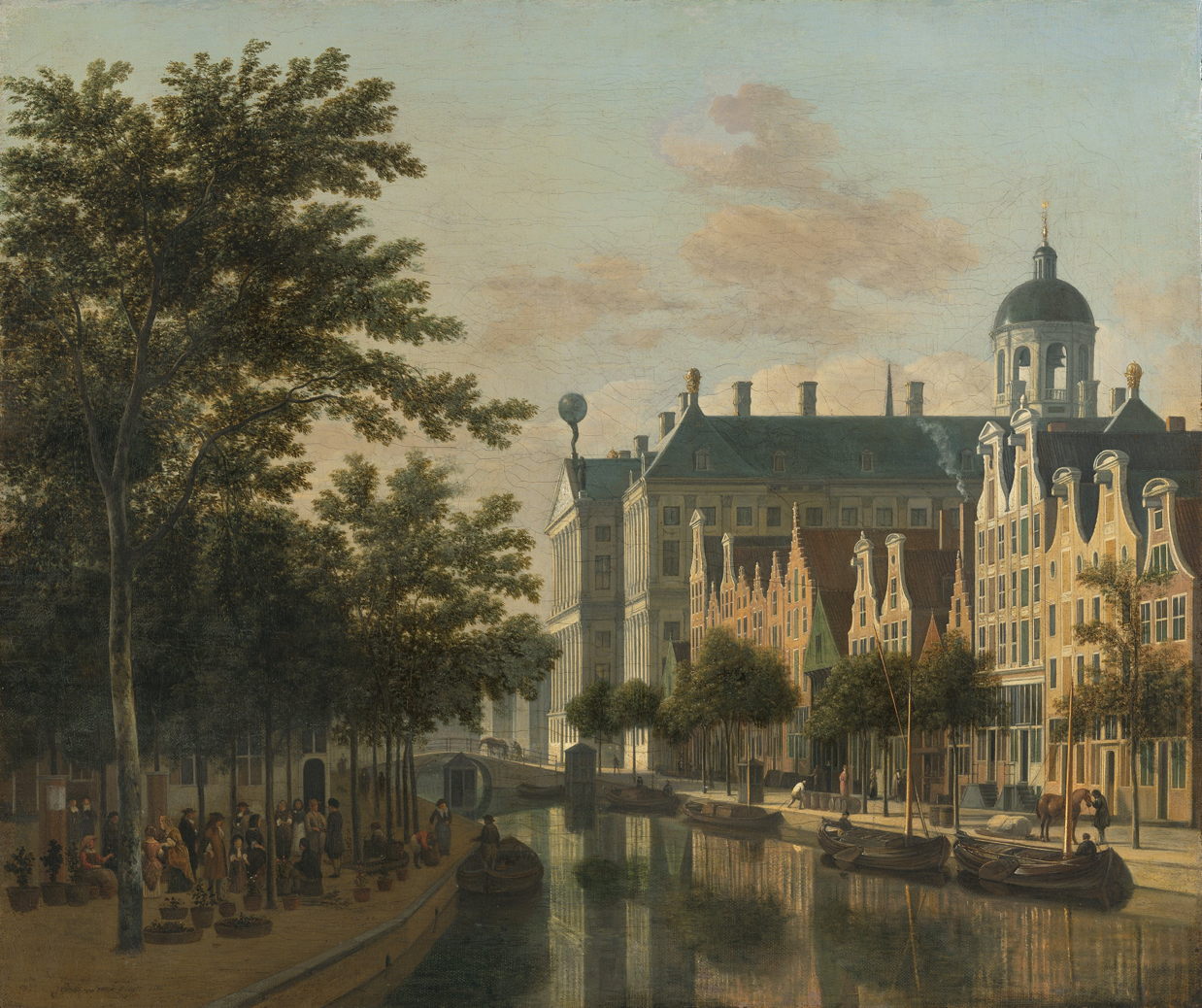
Gerrit Adriaenszoon Berckheyde (1638–1698), The Nieuwezijds Voorburgswal, Amsterdam (1686), oil on canvas, 54 x 64 cm, Museo Nacional Thyssen-Bornemisza, Madrid, Spain. Wikimedia Commons.

Berckheyde’s The Nieuwezijds Voorburgswal, Amsterdam from 1686 shows the canal running at the rear of Amsterdam’s City Hall, built between 1648-65, and featuring the octagonal tower seen at the right. By this time the population of Amsterdam had risen to more than 220,000, many of them immigrants.

With the growth of trade came increasing prosperity, and urban populations who became avid collectors. For some it was household linen or clothing, for others Delft tiles, and for the many who wanted to decorate the walls of their houses, paintings were ideal. Those artists who had achieved recognition could sell through art dealers, some of whom were painters themselves. For smaller and more everyday works, art fairs were held, and collectors flocked to attend them in search of bargains.

Jacob Mathieusen, and his wife, in the background the fleet in the roads of Batavia, by Aelbert Cuyp
Aelbert Cuyp (1620–1691), A Senior Merchant of the Dutch East India Company (1650-59), oil on canvas, 138 x 208 cm, Rijksmuseum Amsterdam, Amsterdam, The Netherlands. Wikimedia Commons.

A Senior Merchant of the Dutch East India Company, painted during 1650-59, is thought to show Jacob Mathieusen and his wife, against a background of the company fleet in Batavia roads. This city in what was then the Dutch East Indies is now the site of Jakarta in Indonesia.

As more secular genres became popular, painters specialised in sub-genres in an effort to appeal to new markets.

beerstraatenoldtownhallamsterdam
Jan Abrahamsz Beerstraaten (1622–1666), The Old Town Hall of Amsterdam on Fire, 7 July 1652 (1652-55), oil on panel, 89 x 121.8 cm, Amsterdam Museum, Amsterdam, The Netherlands. Wikimedia Commons.

In mid 1652, Jan Abrahamsz Beerstraaten seems to have witnessed the destruction by fire of part of the centre of Amsterdam, shown in his studio painting of The Old Town Hall of Amsterdam on Fire, 7 July 1652 (1652-55).

molenaersmell
Jan Miense Molenaer (c 1610–1668), Smell (1637), oil on panel, 19.5 x 24.3 cm, Koninklijk Kabinet van Schilderijen Mauritshuis, The Hague, The Netherlands. Wikimedia Commons.

The sense of Smell, from 1637, is the best of Jan Miense Molenaer visual jokes, a thoroughly secular if not irreverent scene from everyday life.

vanwijnenwitchessabbath
Domenicus van Wijnen (1661–1698), The Witches’ Sabbath by Moonlight (date not known), oil on canvas, 73 x 57.5 cm, location not known. Wikimedia Commons.

The theme of witchcraft was explored in Domenicus van Wijnen’s Witches’ Sabbath by Moonlight, set in a moonlit Italian landscape. This combines many of the now-classical symbols associated with the Dark Arts, and is taking place at an outdoor altar set up at the foot of the gallows, on which a dead body hangs.

With the driving force in painting being removed from a royal family, and professional power resting with local guilds of Saint Luke, the republic avoided adopting a privileged academy system. Painters trained first as apprentices before demonstrating the skills expected of a master, so gaining admission to the guild. These too had originated in Flanders, with the foundation of Antwerp’s by 1382. Amsterdam led in 1579, and several other cities in the Dutch Republic followed from 1609.

Taken together, the main driving forces of Dutch Golden Age painting were a rich diversity in both society and painted themes, and the popularity of paintings among the republic’s citizens. As a result, visual art thrived.

The Dutch Golden Age: Historical context 1565-1643

This article and its sequel tomorrow try to set some of the finest paintings of the Golden Age in the context of major events in the history of the Dutch Republic.

Fresheneesz, Map of the Low Countries, 1556-1648 (2006). Image by Fresheneesz, via Wikimedia Commons.

Constituents of the Dutch Republic are shown in red, orange and yellow in this map. Its centres of art included The Hague, its de facto capital, Utrecht, Leiden, Delft, Harlem, and Amsterdam. To the south were the lands composing the Spanish Netherlands, notably Flanders and Brabant, including the cities of Antwerp and Brussels.

1565-1599

1568 Start of the Eighty Years’ War with Habsburg Spain.
1575 Leiden University founded by Prince William.
1579 The Union of Utrecht laid the foundation for the Dutch Republic.
1585 The city of Antwerp in Brabant was taken by Habsburg forces; to the north, Holland and Zealand started accepting migrants from southern areas under Habsburg control.

bruegelharvesters
Pieter Bruegel the Elder (c 1525–1569), The Harvesters (1565), oil on panel, 119 x 162 cm, Metropolitan Museum of Art, New York, NY. Wikimedia Commons.

One of the driving forces behind Dutch Golden Age painting was the art flourishing in Brabant to the south. Two of Pieter Bruegel the Elder’s major paintings from 1565 were formative influences on what was to come: The Harvesters above is a complete account of the grain harvest in the Low Countries, and Winter Landscape with Skaters and Bird Trap below is a pure landscape.

bruegelwinterlandscapeskaters
Pieter Brueghel the Elder (1526/1530–1569), Winter Landscape with Skaters and Bird Trap (1565), oil on panel, 37 x 55.5 cm, Royal Museums of Fine Arts of Belgium, Brussels. Wikimedia Commons.

1600-1619

1602 The United East India Company (in Dutch, the VOC) was founded as a chartered trading company in Amsterdam, to profit from the spice trade.
1609-21 Twelve Years’ Truce.
1612 The first synagogue was built in Amsterdam.
1618 The first newspaper, the Courante uyt Italien, Duytslandt, &c., was published as a weekly broadsheet in Amsterdam.
1619 Batavia (now Jakarta, Indonesia) was made the Asian headquarters of the United East India Company.

Hendrick Avercamp (1585–1634), Winter Scene on a Canal (c 1615), oil on panel, 49.9 x 95.6 cm, Toledo Museum of Art, Toledo, OH. Wikimedia Commons.

Hendrick Avercamp’s Winter Scene on a Canal from about 1615 follows on from Brueghel with its rich detail. In the right of the painting are two tents with flags flying. These are popular koek-en-zopie, literally ‘cake and eggnog’ cafés, selling handheld snacks like cake and pancakes, together with alcoholic drinks such as beer laced with home-made rum.

peeterscheesesalmondspretzels
Clara Peeters (fl 1607-1621), Still Life with Cheeses, Almonds and Pretzels (c 1615), oil on panel, 34.5 x 49.5 cm, Koninklijk Kabinet van Schilderijen Mauritshuis, The Hague, The Netherlands. Wikimedia Commons.

Clara Peeters trained in Antwerp, then painted an outstanding series of still lifes in the Dutch Republic. Among those is her still life with Cheeses, Almonds and Pretzels from about 1615, a celebration of the sensuous pleasures of food.

vanmiereveltanatomylesson
Michiel Jansz. van Mierevelt (1566–1641) and Pieter van Mierevelt (1596–1623), The Anatomy Lesson of Dr. Willem van der Meer (1617), oil on canvas, 146.5 x 202 cm, Museum Prinsenhof Delft, Delft, The Netherlands. Wikimedia Commons.

In 1617, Michiel van Mierevelt and his son Pieter, specialists in portraiture, painted The Anatomy Lesson of Dr. Willem van der Meer, one of the earliest portraits of a social group from the Golden Age. These are thought to be members of the Surgeons’ Guild of the city of Delft, who commissioned this work.

1620-1629

1620 The Pilgrim Fathers, English families from Nottinghamshire who had fled to Leiden in 1607-08, set sail from Delfshaven for America.
1621 The Chartered West India Company was founded as a trading company in Amsterdam, to profit from a trade monopoly in the Dutch West Indies, including participation in the Atlantic slave trade.
1625 A fort was built at New Amsterdam, the southern tip of Manhattan Island, New York, to protect the West India Company’s fur trade.

vanhonthorstsoldiergirl
Gerard van Honthorst (1592–1656), The Soldier and the Girl (c 1621), oil on canvas, 82.6 x 66 cm, Herzog Anton Ulrich-Museum, Braunschweig, Germany. Wikimedia Commons.

Gerard van Honthorst’s The Soldier and the Girl from about 1621 is a good example of markedly secular painting and the early influence of Caravaggio. This young woman is lighting her candle from a burning coal.

1630-42

1630 Dutch commercial colonies were established in Brazil.
1635 The Dutch Republic made a treaty with France against Habsburg Spain, leading to the Franco-Spanish War.
1637 The speculative bubble of Tulip mania, which had gathered pace from 1634, collapsed dramatically.
1639 The United East India Company became Japan’s exclusive Western trading partner.
1642 Abel Tasman discovered Tasmania and New Zealand.

rembrandtanatomylesson
Rembrandt Harmenszoon van Rijn (1606–1669), The Anatomy Lesson of Dr. Nicolaes Tulp (1632), oil on canvas, 169.5 x 216.5 cm, Koninklijk Kabinet van Schilderijen Mauritshuis, The Hague, The Netherlands. Wikimedia Commons.

In 1631 the young Rembrandt moved his studio to Amsterdam, the centre of trade and business for the Dutch Republic, and growing rapidly from a population of about 50,000 in 1600 to exceed 200,000 in the 1660s. Among his early commissions there is this Anatomy Lesson of Dr. Nicolaes Tulp from 1632, a group portrait of distinguished members of the Surgeons’ Guild in their working environment.

rembrandtbelshazzarsfeasta
Rembrandt Harmenszoon van Rijn (1606-1669), Belshazzar’s Feast (c 1635-1638), oil on canvas, 167.6 x 209.2 cm, The National Gallery, London. Wikimedia Commons.

Rembrandt’s outstanding painting of Belshazzar’s Feast was made in about 1635-38, when he was developing his distinctive techniques of depicting decorative metals.

eckhoutjabutis
Albert Eckhout (c 1610–1666), Study of Two Brazilian Tortoises (c 1640), tempera and gouache on paper mounted on panel, 30.5 x 51 cm, Koninklijk Kabinet van Schilderijen Mauritshuis, The Hague, The Netherlands. Wikimedia Commons.

Artists such as Albert Eckhout accompanied expeditions overseas, and it’s thought that he painted this Study of Two Brazilian Tortoises in about 1640 when in Brazil.

rembrandtnightwatch
Rembrandt Harmenszoon van Rijn (1606–1669), The Night Watch (1642), oil on canvas, 363 x 437 cm, Rijksmuseum Amsterdam, Amsterdam, The Netherlands. Wikimedia Commons.

Rembrandt’s vast group portrait of The Night Watch (1642) is perhaps the most famous of all those of militia in the Dutch Republic. It’s more correctly titled Militia Company of District II under the Command of Captain Frans Banninck Cocq, and features the commander and seventeen members of his civic guard company in Amsterdam, and took the artist three years to complete from his first commission to its display in the guards’ great hall.

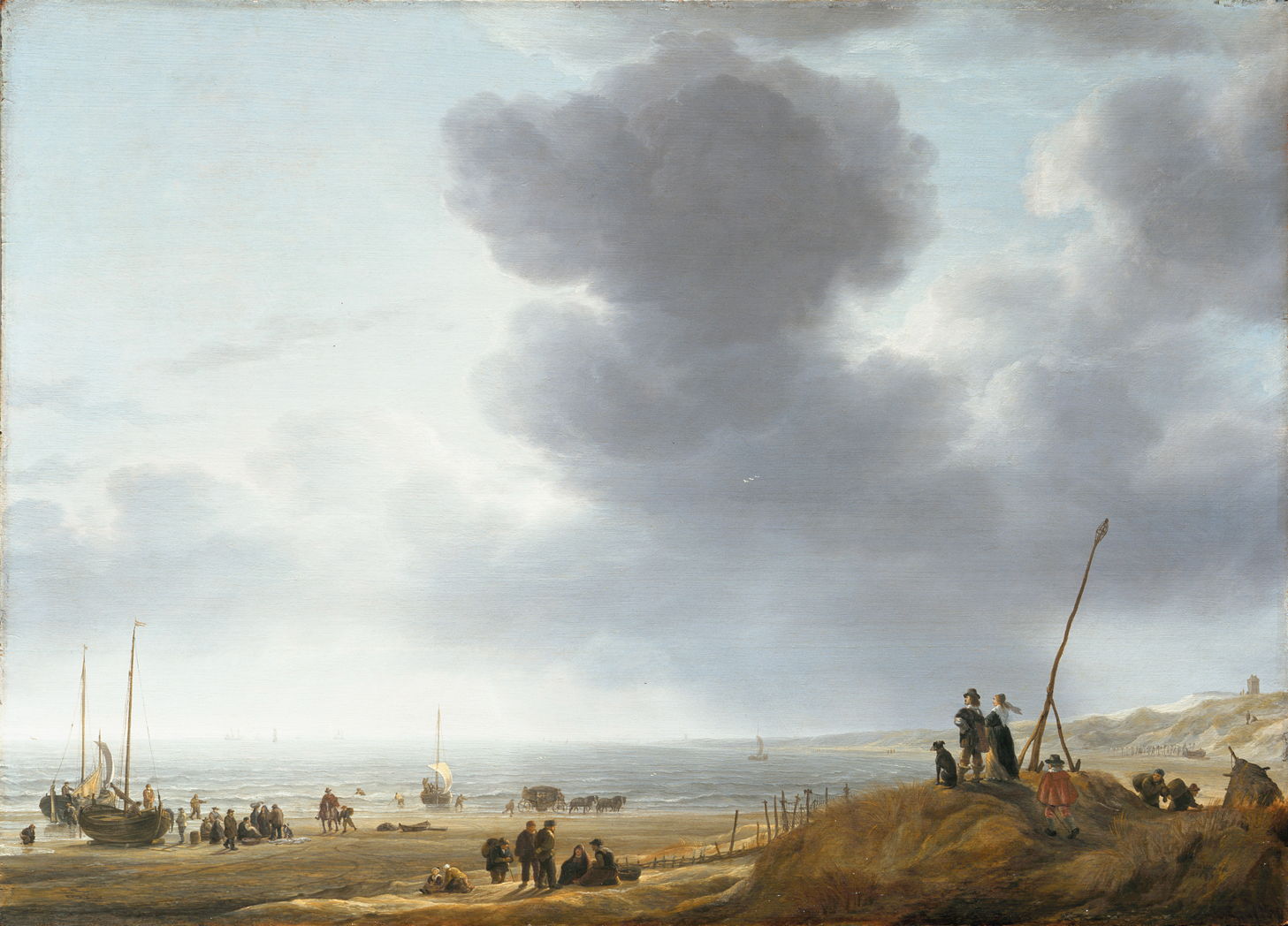
devliegerbeachview
Simon de Vlieger (c 1600/1601–1653), Beach View (1643), oil on panel, 60.6 x 83.5 cm, Koninklijk Kabinet van Schilderijen Mauritshuis, The Hague, The Netherlands. Wikimedia Commons.

Simon de Vlieger was born in Rotterdam, and painted in Delft and Amsterdam, where he was best known for his landscapes. His Beach View from 1643 uses boats, many figures, and careful composition to swell the land over the bottom of its panel. It shows well, though, how important is the sky, marvellously rendered here, with a small group of white birds shown against the grey of the clouds.

❌