Login
LoginMedium and Message: Gilding
Before the Renaissance paintings were often decorated with precious metals, most commonly gold leaf in the process of gilding. Although this practice largely died out by 1500, it was revived in the nineteenth century and reached new heights in Gustav Klimt’s Golden Phase, shortly before the First World War.

Earliest European examples of egg tempera, such as Margarito d’Arezzo’s The Virgin and Child Enthroned, with Scenes of the Nativity and the Lives of the Saints from the middle of the thirteenth century, often incorporate extensive gilding, although today they might appear ‘primitive’.

One of the most exquisitely worked examples of gilding was crafted by an unknown artist, most probably in France towards the end of the fourteenth century. Known as The Wilton Diptych it’s one of the greatest masterpieces in London’s National Gallery.
This painting was a luxury object intended from the outset for the personal devotions of a monarch, or someone of close rank and stature. Its interior shows on the left, King Richard II (its most probable owner) kneeling as he is presented by three saints, Saint John the Baptist (carrying the Lamb of God), Saint Edward the Confessor (holding the ring he gave to Saint John the Evangelist), and Saint Edmund (holding an arrow from his martyrdom). On the right is the Virgin Mary holding the Christ Child with a throng of eleven angels, one of whom bears the standard of the Cross of Saint John.
It was painted on two small panels of oak wood using egg tempera, in a workshop clearly experienced at making such works. Each panel is made of one wider board and a narrower strip. The two parts of a panel were joined by a craftsman using simple butt joints and were glued together with such care that the joins are almost invisible. They started off about 2.5 cm (1 inch) thick, and were then carved down to form an integral frame with a recessed painting surface. The two panels are hinged together using gilded iron fittings, so that the completed diptych could be folded shut for portability.
To prepare the panels for painting, the bare wood was first covered with a thin layer of parchment, and over that a single layer of gesso was applied. This was composed, as was traditional, of natural chalk and animal-derived glue. The gesso extended over the frame mouldings to prepare them for gilding.
Much of the surface of the panels was then to be gilded. Those areas were first marked out with incisions into the gesso ground, then covered with a thin layer of red bole (clay) containing animal-derived glue. The gold leaf was then applied with dilute glue in water, and after a couple of hours the leaf was burnished into place. These gilded areas were then patterned using a range of different punches. The resulting effect is of a jewelled surface, with intricate reflected patterns from different sections of the gilding.

Some details used a different technique known as mordant gilding, in which a binding medium is applied to give low relief, and the gold leaf applied onto that without burnishing. The optical properties of unburnished and burnished gold generate additional surface effects.


Every figure in Masaccio’s early Triptych of San Giovenale from 1422 has been awarded a halo of gold leaf. Its central panel shows the Virgin Mary and infant Christ, with two angels in attendance. As is traditional, Mary is shown wearing a deep ultramarine blue cloak. The left panel shows Saints Bartholomew and Blaise, and the right panel Saints Juvenal (patron of the commissioning church) and Anthony Abbot.
Gilding had no role in the realism that came with the Renaissance, and it wasn’t until the middle of the nineteenth century that some artists revived the technique.

Jules Bastien-Lepage’s early Annunciation to the Shepherds from 1875 builds on tradition, complete with its gilded angel, who could have stepped out from an early Renaissance work. That combines with the rural realism of the shepherds, with their bare and filthy feet in a timeless image.

At about the same time, Edward Burne-Jones was applying silver and gold leaf to the summary inscription for his series on the myths of Perseus. Below the Latin words, he shows Perseus with the three Graiae (or Graeae). He has just intercepted and seized their single, shared eye, which he holds in his right hand, in order to force them to take him to the sea nymphs or Hesperides, to obtain the kibisis to contain Medusa’s head.
In Austria, Gustav Klimt had trained and worked not just as an artist, but as a craftsman too, and worked with other craftsmen to present his paintings in his distinctive style.

His painting of Pallas Athena (1898) is one of his first incorporating gold. Despite her modern appearance, Klimt remains true to tradition by showing her attributes, including the aegis of Medusa’s head over her upper chest, a spear and helmet.

His empowering portraits of women increasingly used gilding to great effect. In Judith I (1901), he portrays a woman of power, whose pleasure results from her successful manipulation of the enemy general, Holofernes, and her subsequent beheading of him, a popular theme in the art of women such as Artemisia Gentileschi. Klimt leaves the ambiguity of her ecstasy, playing on the developing link between eroticism and death.

In 1902, the fourteenth exhibition of the Vienna Secession centred on Max Klinger’s Beethoven Sculpture. To raise funds to retain it in Vienna, members of the Secession contributed works to exhibit there. Klimt’s was a frieze of 24 metres in length, the Beethoven Frieze. The section shown above is that of The Hostile Powers, unusually painted using casein paints onto mortar, with added stucco, gold leaf, and other materials.

Inspired by the early Byzantine mosaic showing the Empress Theodora, in the Basilica San Vitale in Ravenna, Italy, the peak of Klimt’s Golden Phase is unique in art. Much of the surface of his first Portrait of Adele Bloch-Bauer is encrusted with gold and silver, and decorated with symbols of eyes, flowers, whorls, ellipses divided into halves, and rich textures worked into the gold leaf. To accomplish this involved a great deal of craftsmanship, using the same techniques as those for the Wilton Diptych, and took long days handling delicate leaves of precious metal.
Although seldom if ever used by others of the Pre-Raphaelite movement, Eleanor Fortescue-Brickdale, the last of them, is unusual for combining it with watercolour.
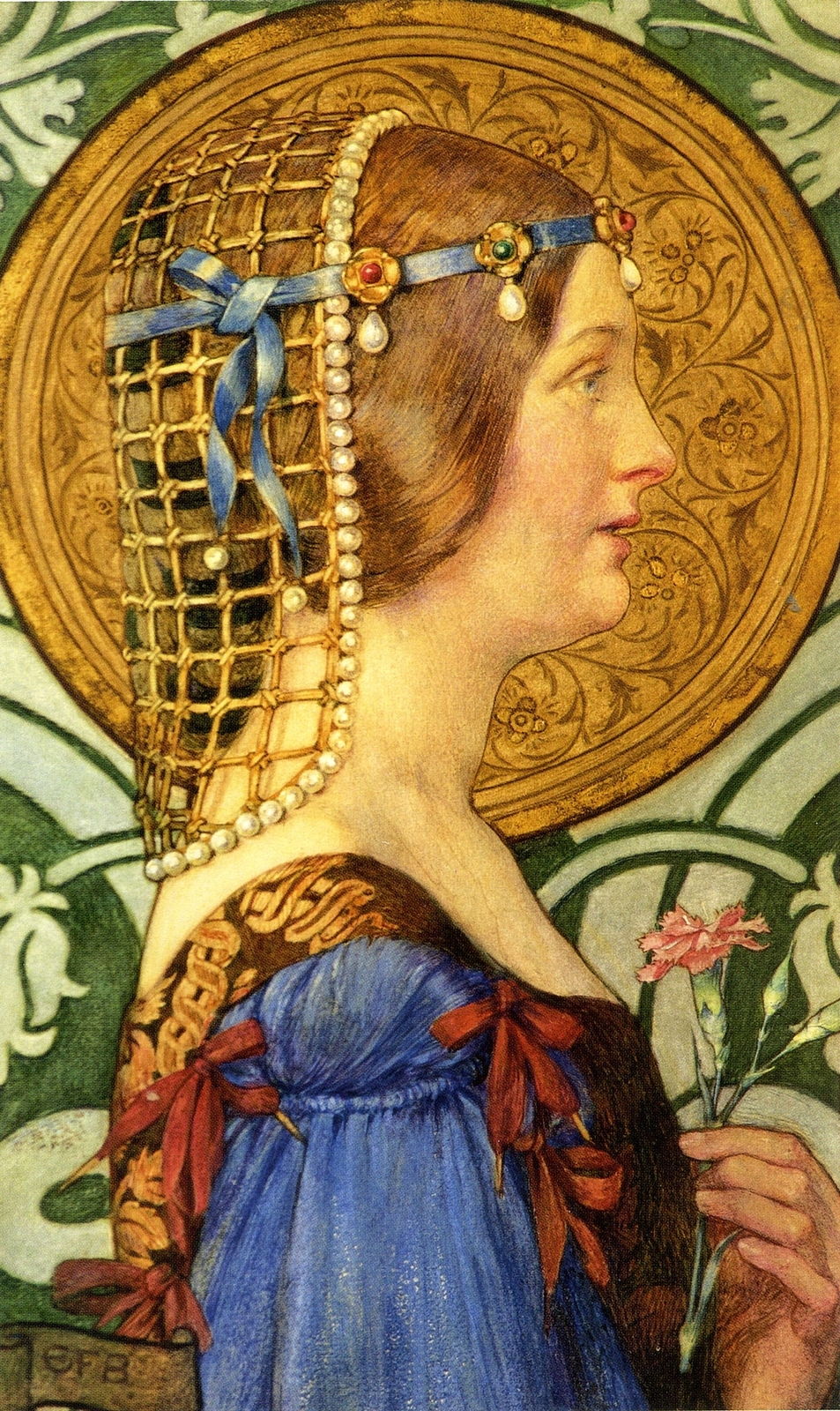
Fortescue-Brickdale’s If One Could Have That Little Head of Hers from 1910 also has a curious title that appears to be a quotation. The woman shown is presumably a saint, judging by her large gold halo, but is in early Renaissance dress.