Gov. Gavin Newsom of California, a potential 2028 presidential candidate, is attracting criticism for social media posts taunting his opponents by suggesting they are gay.
In India, China and several other nations, Novo Nordisk is on the verge of losing patent protection for its blockbuster weight loss drug, opening the door for cheaper competing versions.
Four years after the Russian invasion of Ukraine sent energy prices soaring, the war in Iran is posing another challenge to efforts to revive European factories.
Chancellor Friedrich Merz laid out his complaints in a frank message to his hosts on a trip to Beijing that China had designed to showcase their relationship.
Federal prosecutors quietly dropped their case against the officer, but a Police Department investigation based on the charges led to his firing, the suit says.
It’s time to head off for a weekend away from the January gloom in Granada, Andalusia, southern Spain, where we’ll visit the Alhambra. It’s one of the oldest, grandest, most fascinating and beautiful palaces in Europe.
It started as one of many hill forts used by the Romans in a series of campaigns to control a succession of tribal revolts, and stamp the Empire’s presence close to North Africa. It was rebuilt in 889 CE, but nothing palatial became of it until around 1250, when the ruling Nasrid emir started to turn it into something much grander.
At that time, much of the south of the Iberian peninsula wasn’t ruled by people from Europe to the north, but by Muslim dynasties who had swept up from the south. The Emirate of Granada was the last substantial part of Iberia to remain under Muslim rule, and in 1333 the Sultan of Granada, Yusuf I, decided to transform the Alhambra into a royal palace. In doing so, he and his successors built one of the most exquisite expressions of Arabic Muslim art and architecture along a ridge about half a mile (0.7 km) long overlooking the city of Granada.
This plan from Openstreetmap and its contributors shows the modern site, as of 2013.
Constantin Uhde (1836–1905), Plan of the Nasrid Palaces, Alhambra (1892), illustration, further details not known. Wikimedia Commons.
Constantin Uhde’s plan of 1892 shows the layout of the Nasrid palaces:
Red is the site of the Palace of Comares and the Palaces of the Ambassadors.
Green is the Palace of the Lions.
Yellow is the Mexuar.
Blue is the Garden of Lindajar and later quarters of the Emir.
This article shows a selection of views of the palace up to 1883, and tomorrow’s sequel brings that up to the start of the First World War in 1914.
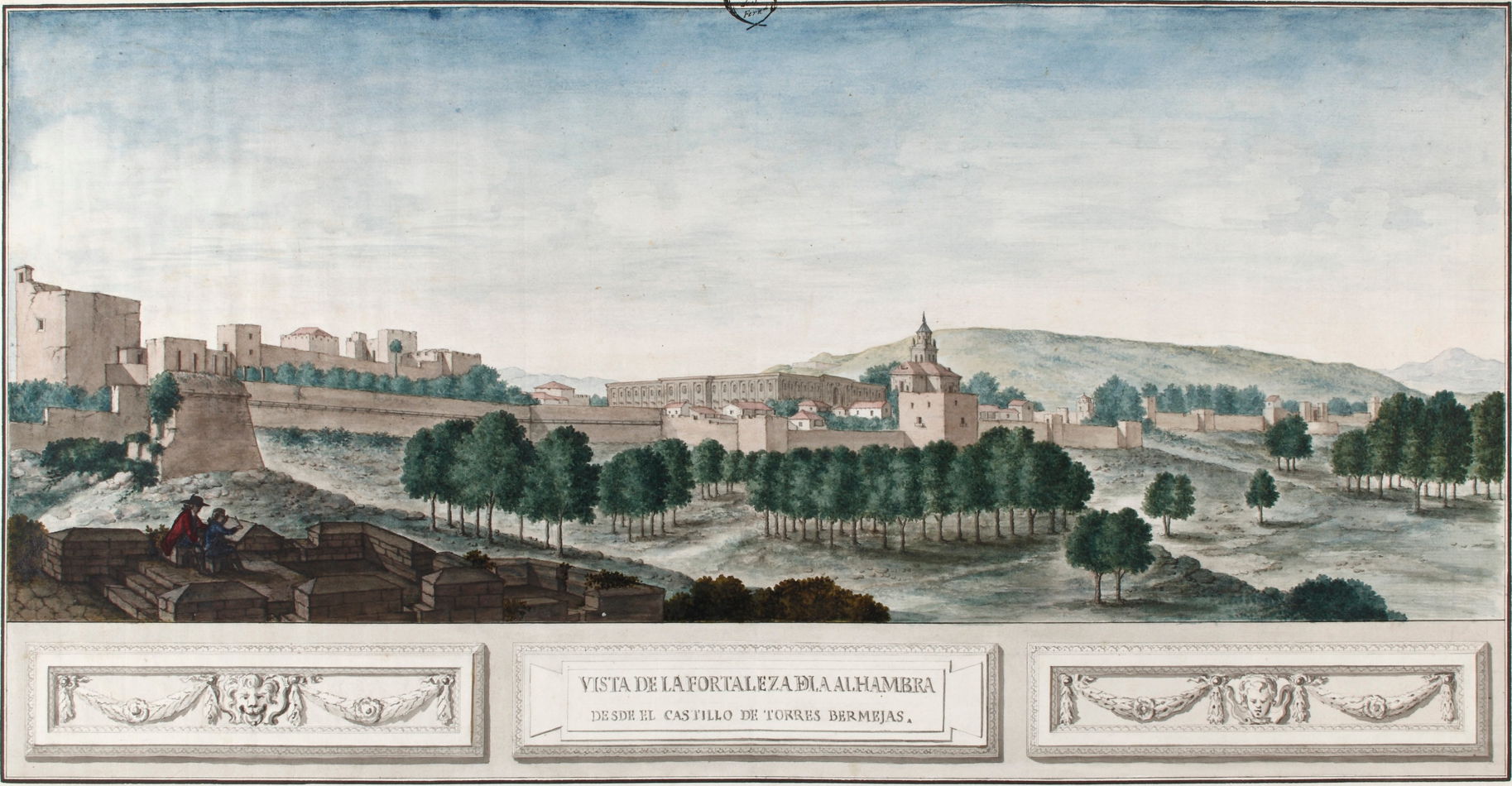
José de Hermosilla (1715-1776), View of the Alhambra from the Torres Bermejas Castle (1767), watercolour, dimensions not known, Real Academia de Bellas Artes de San Fernando, Madrid, Spain. Wikimedia Commons.
Early paintings of the Alhambra were mainly topographic views, painted in watercolour during the eighteenth century, such as José de Hermosilla’s View of the Alhambra from the Torres Bermejas Castle of 1767. These are similar to views of landmarks being produced in Britain at the time.
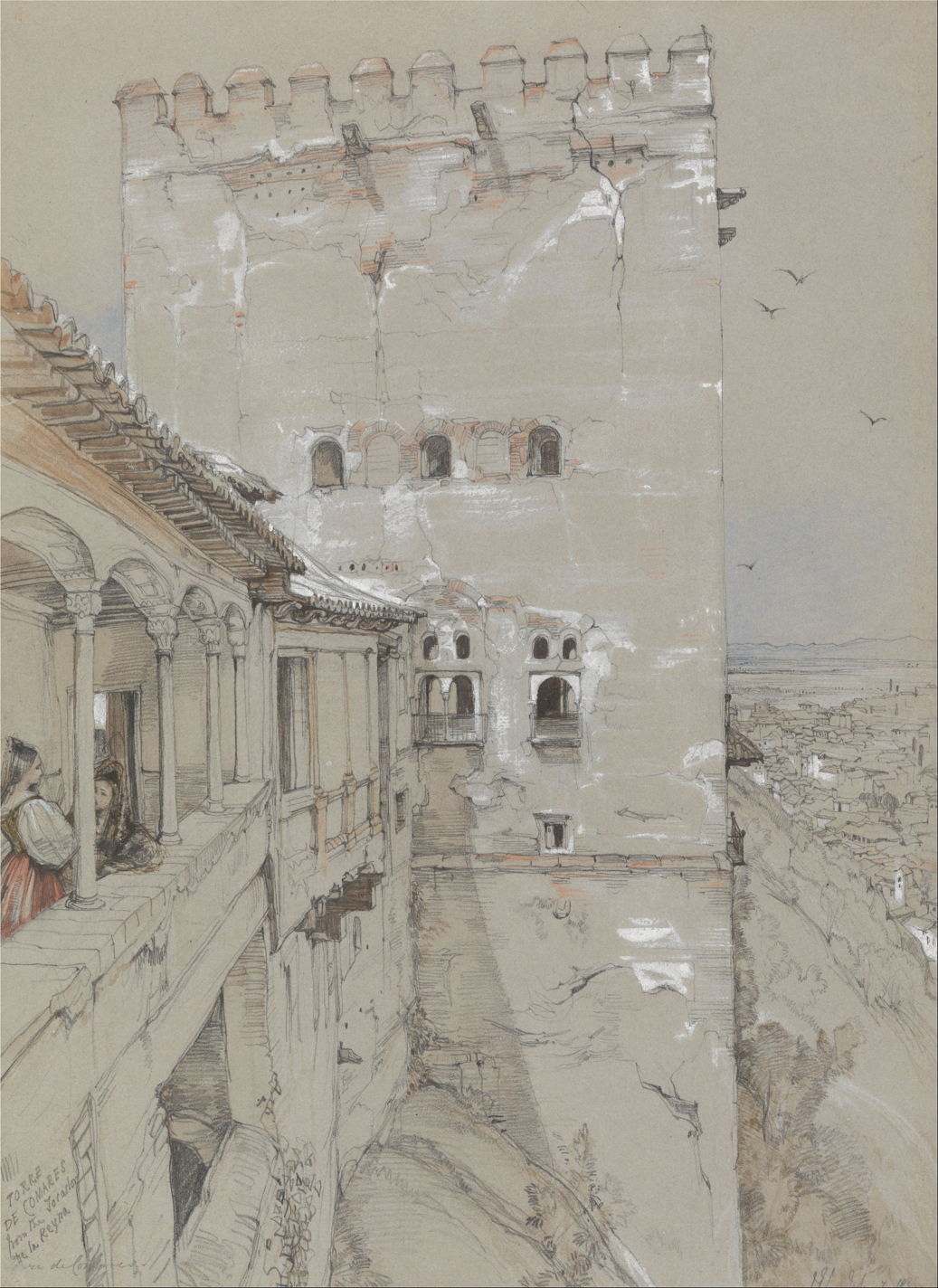
John Frederick Lewis (1805–1876), The Torre de Comares, Alhambra (1835), graphite, watercolour, white gouache and scratching out on medium, slightly textured, gray wove paper, 37.1 x 27 cm, Yale Center for British Art, New Haven, CT. Wikimedia Commons.
Others, like John Frederick Lewis in 1835, came to record details of the remains of the Alhambra’s buildings, as in The Torre de Comares, Alhambra, drawn carefully in graphite and only slightly highlighted and coloured with watercolour and gouache.
While every seriously aspiring landscape painter was flocking to paint en plein air in the Roman Campagna in the early nineteenth century, the Alhambra seems not to have been included in the circuit.
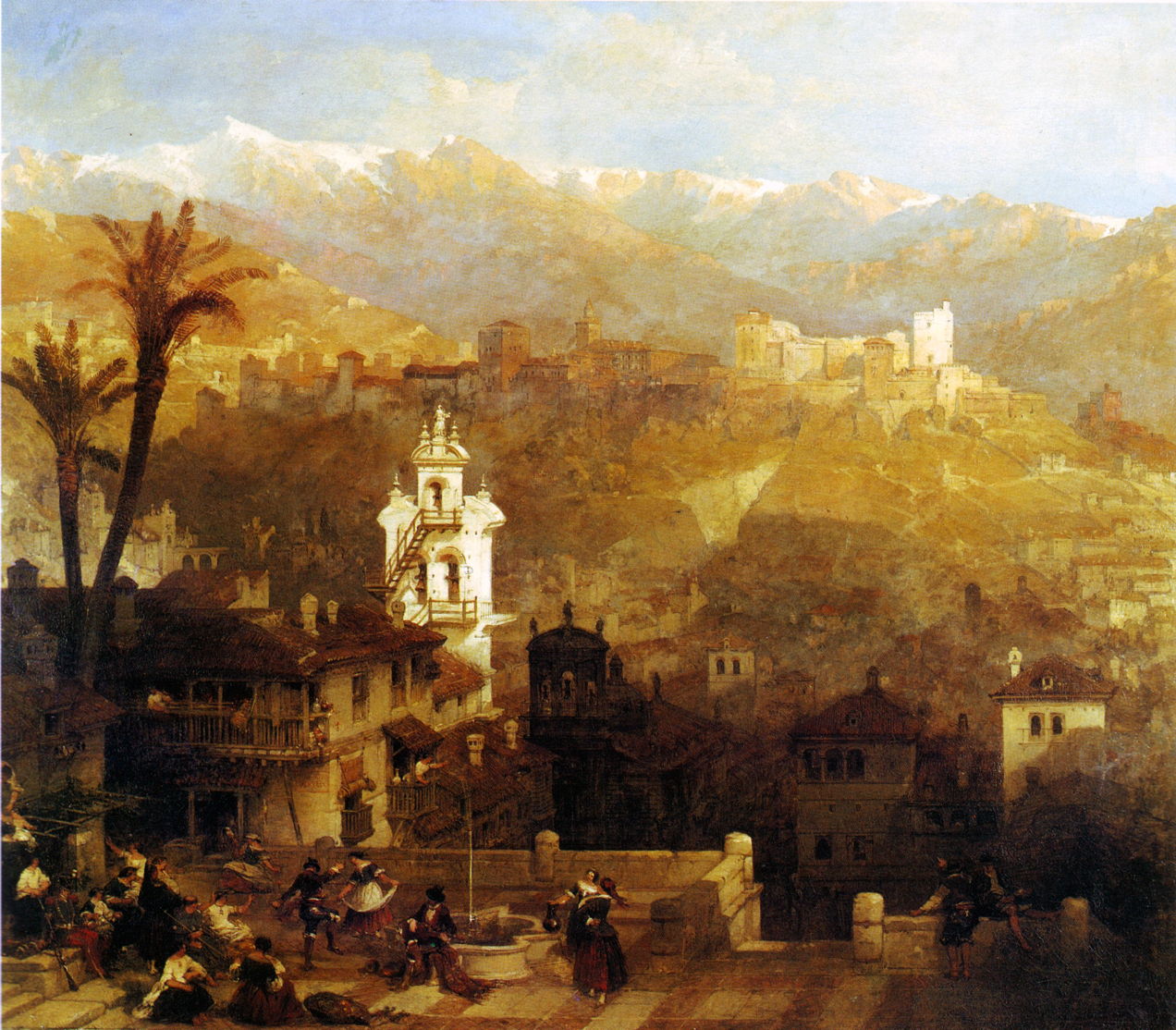
David Roberts (1796–1864), Alhambra and Albaicin (date not known), further details not known. Wikimedia Commons.
It was the vogue for Orientalist views in the middle of the nineteenth century that first attracted artists to paint the Alhambra in oils. This is David Roberts’ undated view of Alhambra and Albaicin. Roberts is much better-known for his sketches turned into prints from multiple tours of Egypt and the ‘near east’ made between 1838-40. This work probably originated in sketches made when he visited Spain in 1832, and would have then been painted in this form back in Britain after about 1833, and turned into a print by 1837.
Achille Zo (1826–1901), Patio in the Alhambra (1860), media and dimensions not known, Musée des beaux-arts de Pau, Pau, France. Wikimedia Commons.
Achille Zo was a Basque painter who specialised in views of Spain during the 1860s, such as this Patio in the Alhambra from 1860. These were well received at the Salon in Paris, earning him a gold medal in 1868, following which he too turned to Orientalism.
Franz von Lenbach (1836–1904), The Alhambra in Granada (1868), oil on canvas, 72.1 × 91.5 cm, Sammlung Schack, Bayerische Staatsgemäldesammlungen, Munich, Germany. Wikimedia Commons.
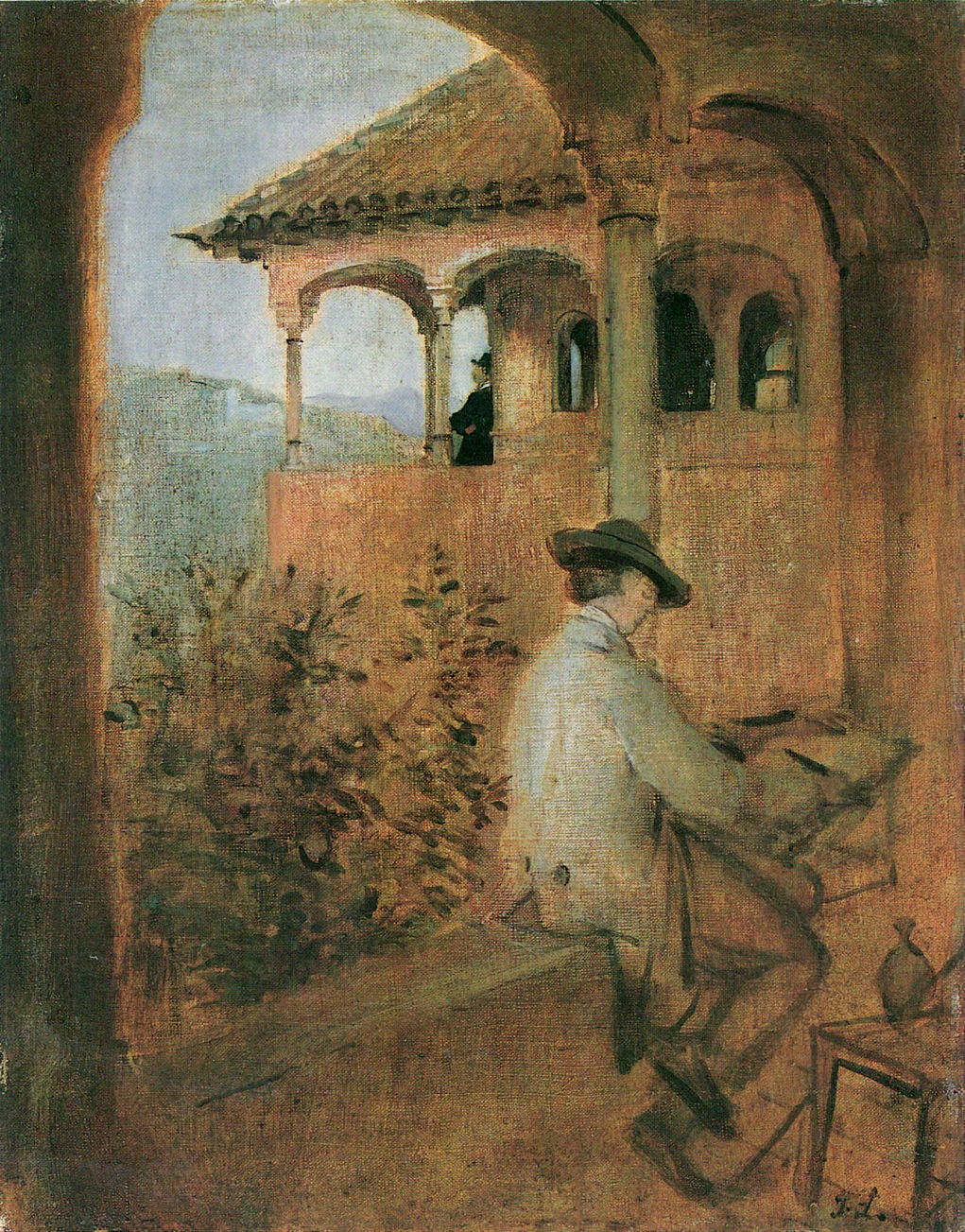
It was the fine collection of paintings of the Prado in Madrid that attracted many great artists to Spain. In 1867, Franz von Lenbach and a student of his travelled to Madrid to copy the masters there for his patron Baron Adolf von Schack. The following year, he painted two works in Granada: The Alhambra in Granada (1868) is a magnificent sketch including the backdrop of the distant mountains, and appears to have been painted in front of the motif.
Franz von Lenbach (1836–1904), Tocador de la Reina (Queen’s Dressing Room) in the Alhambra (1868), oil on canvas, 33.1 × 26.2 cm, Sammlung Schack, Bayerische Staatsgemäldesammlungen, Munich, Germany. Wikimedia Commons.
Von Lenbach’s Tocador de la Reina shows the exterior of the Queen’s Dressing Room in the palaces, with his student sketching.
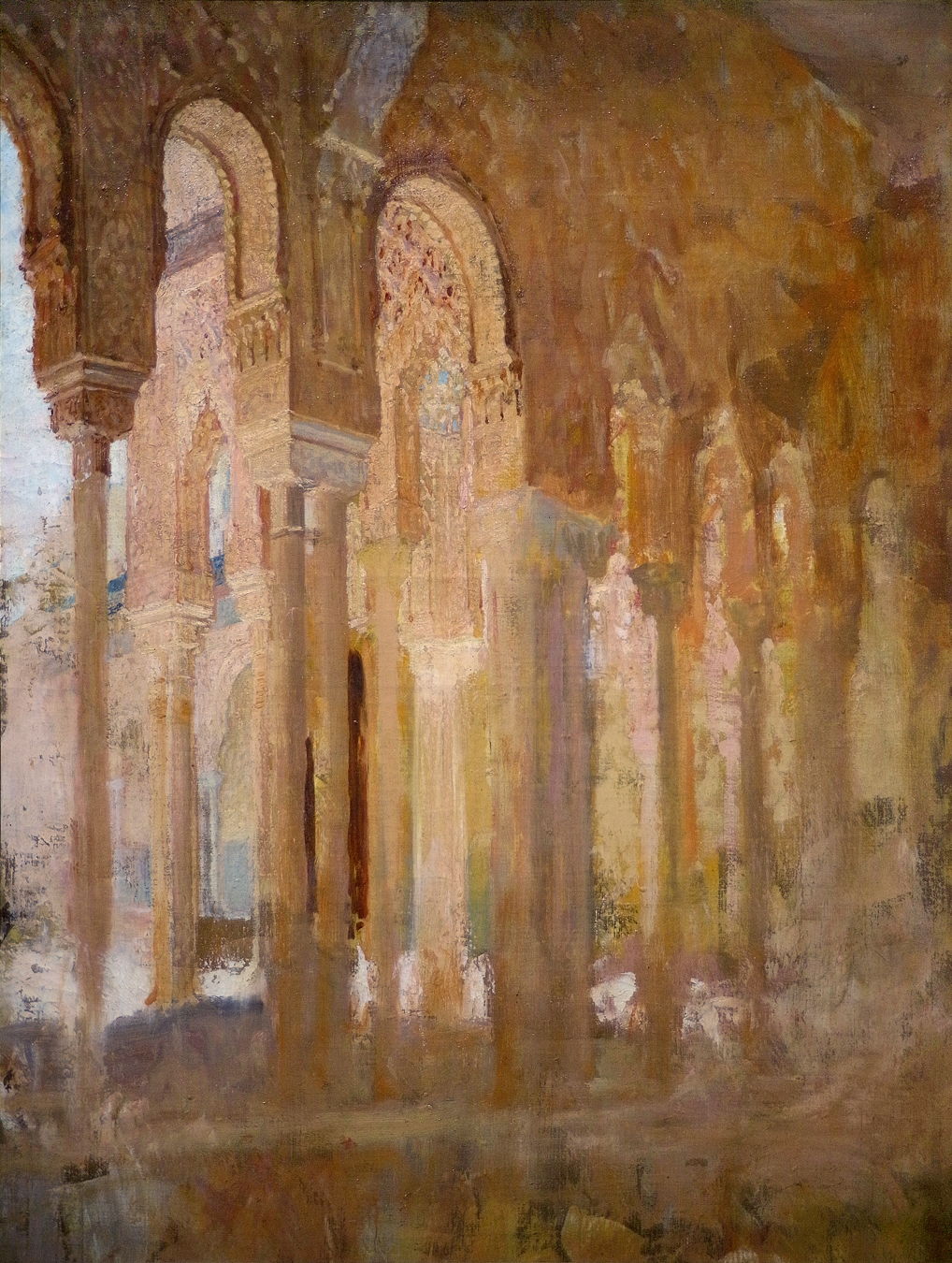
Henri Regnault (1843–1871), Colonnade of the Court of the Lions at the Alhambra (1869), oil on canvas, dimensions not known, Musée des Augustins de Toulouse, Toulouse, France. Wikimedia Commons.
Just two years before he was killed in the Franco-Prussian War, Henri Regnault toured Spain, and when he was in Granada he painted this view of the Colonnade of the Court of the Lions at the Alhambra (1869). I suspect this is unfinished, and he intended to complete the detail in its lower half.
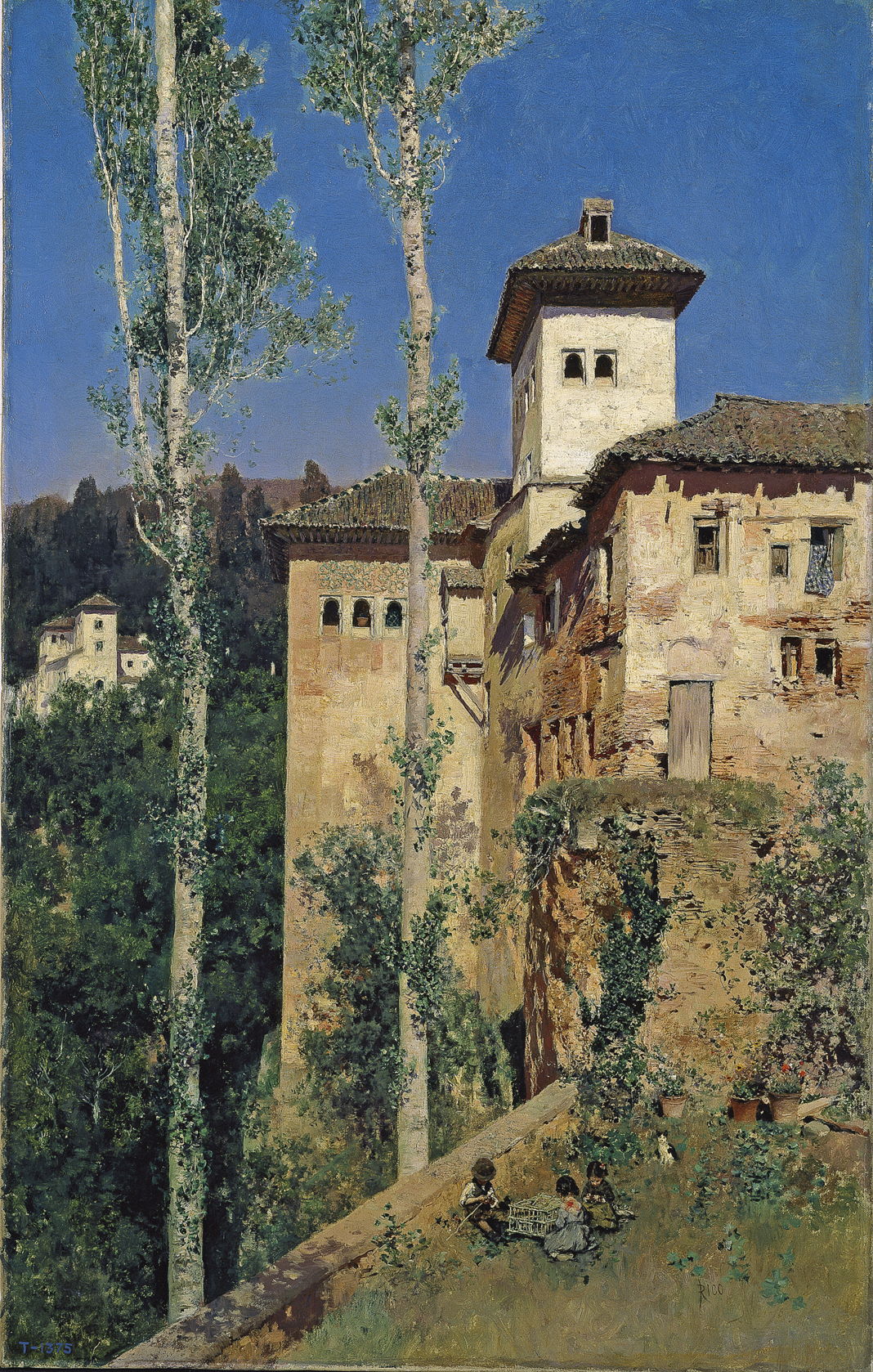
Martín Rico y Ortega (1833–1908), La Torre de las Damas en la Alhambra de Granada (The Tower of the Ladies in the Alhambra) (1871-72), oil on canvas, 62.5 x 39 cm, Museo Nacional del Prado, Madrid, Spain. Wikimedia Commons.
Martín Rico was one of the most important painters in Spain at this time. Influenced mainly by the Barbizon school, he painted this finely-detailed view of The Tower of the Ladies in the Alhambra in 1871-72. It captures the dilapidation the Alhambra had fallen into before more recent work to restore it to its former glory.
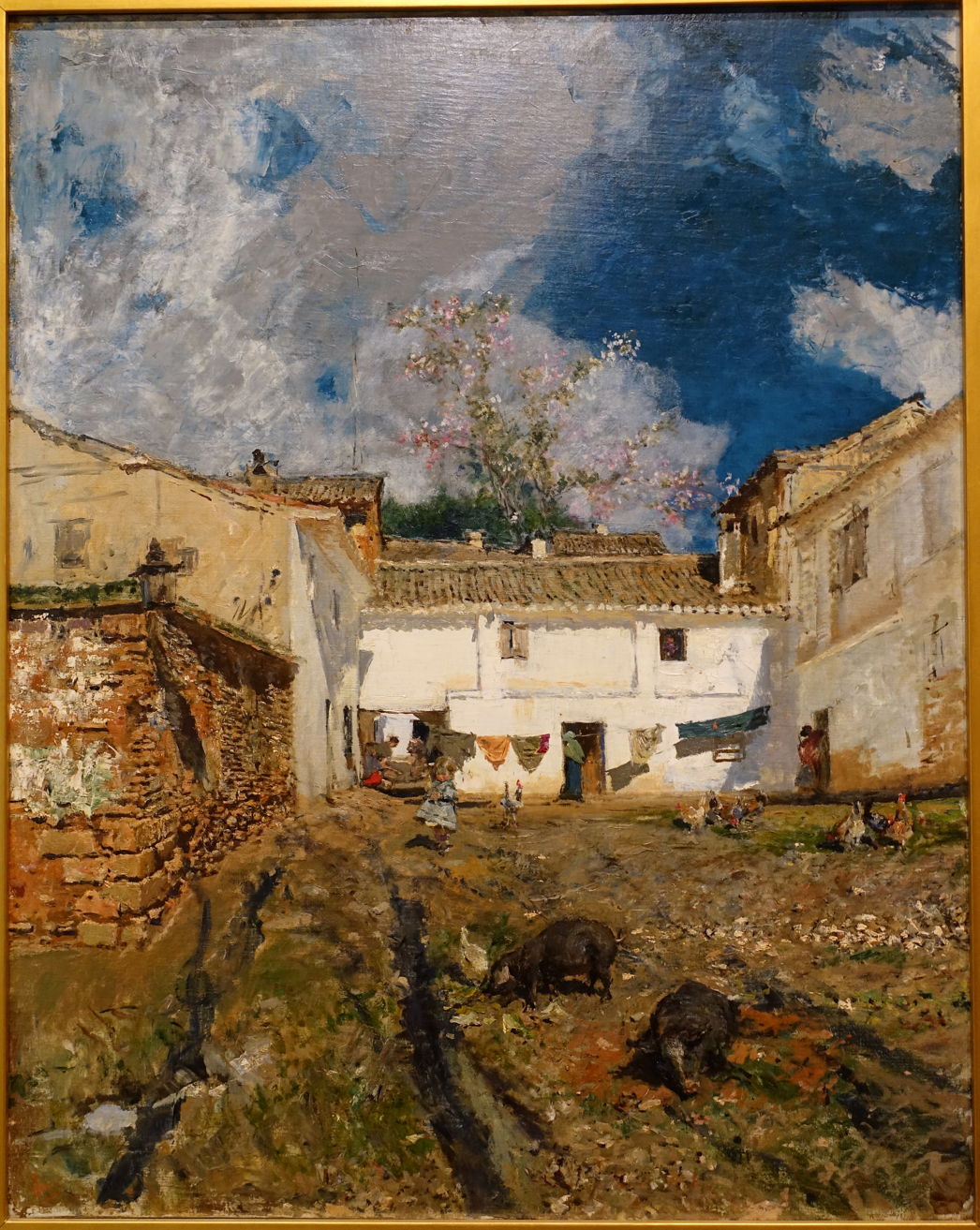
Marià Fortuny (1838–1874), Courtyard at Alhambra (Patio in Granada) (1873), oil on canvas, 111.4 x 88.9 cm, The Fogg Art Museum, Harvard University, Cambridge, MA. Wikimedia Commons.
If Marià Fortuny’s more Impressionist view of a Courtyard at Alhambra (Patio in Granada) from 1873 is to be believed, some parts of the Alhambra had been turned into smallholdings, with free-ranging chickens.
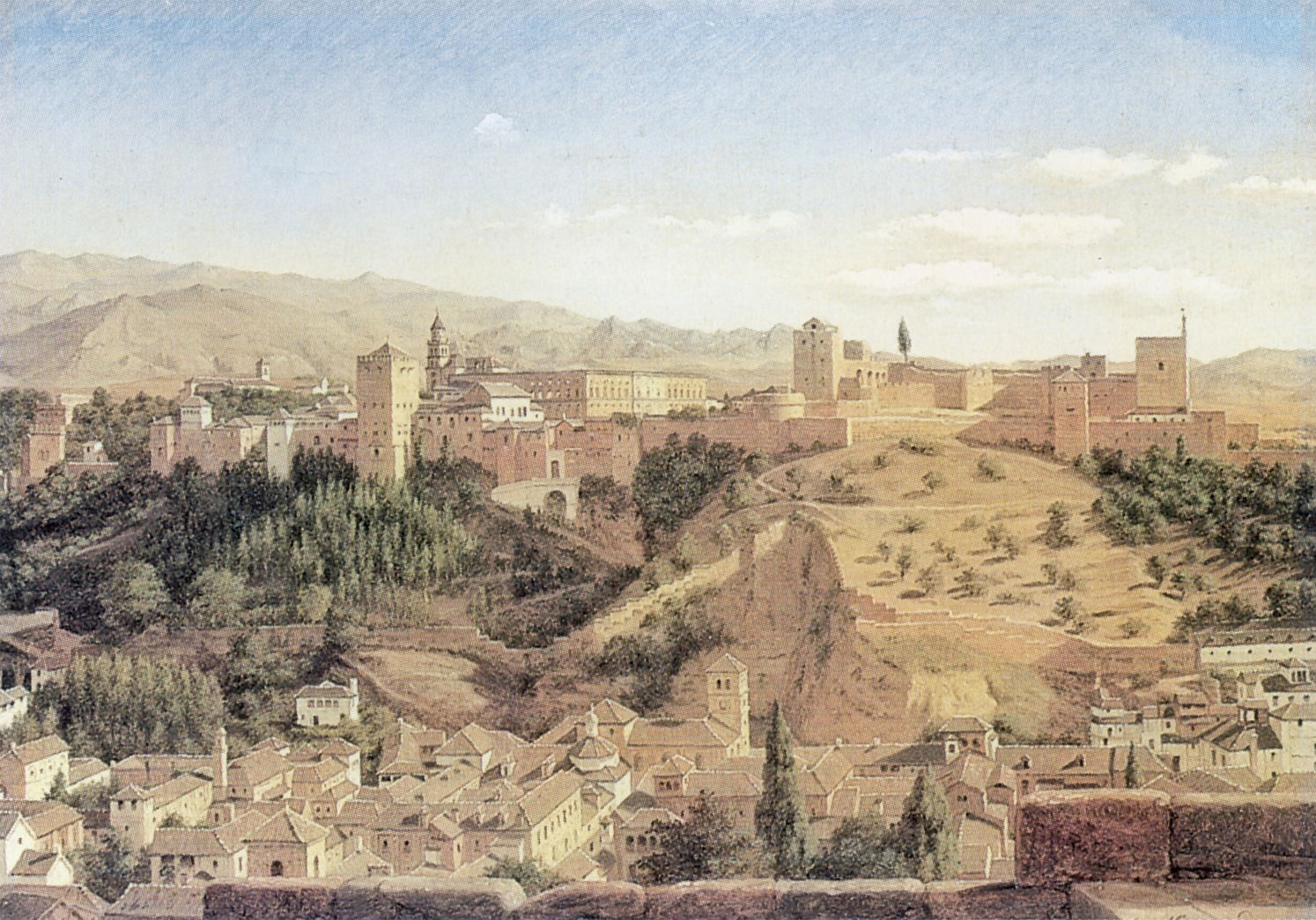
Heinrich Hansen (1821-1890), Granada with the Alhambra in the Nineteenth Century (date not known), further details not known. Image by Sir Gawain, via Wikimedia Commons.
More distant views of the ridge, such as Heinrich Hansen’s undated painting of Granada with the Alhambra in the Nineteenth Century, show its imposing grandeur.
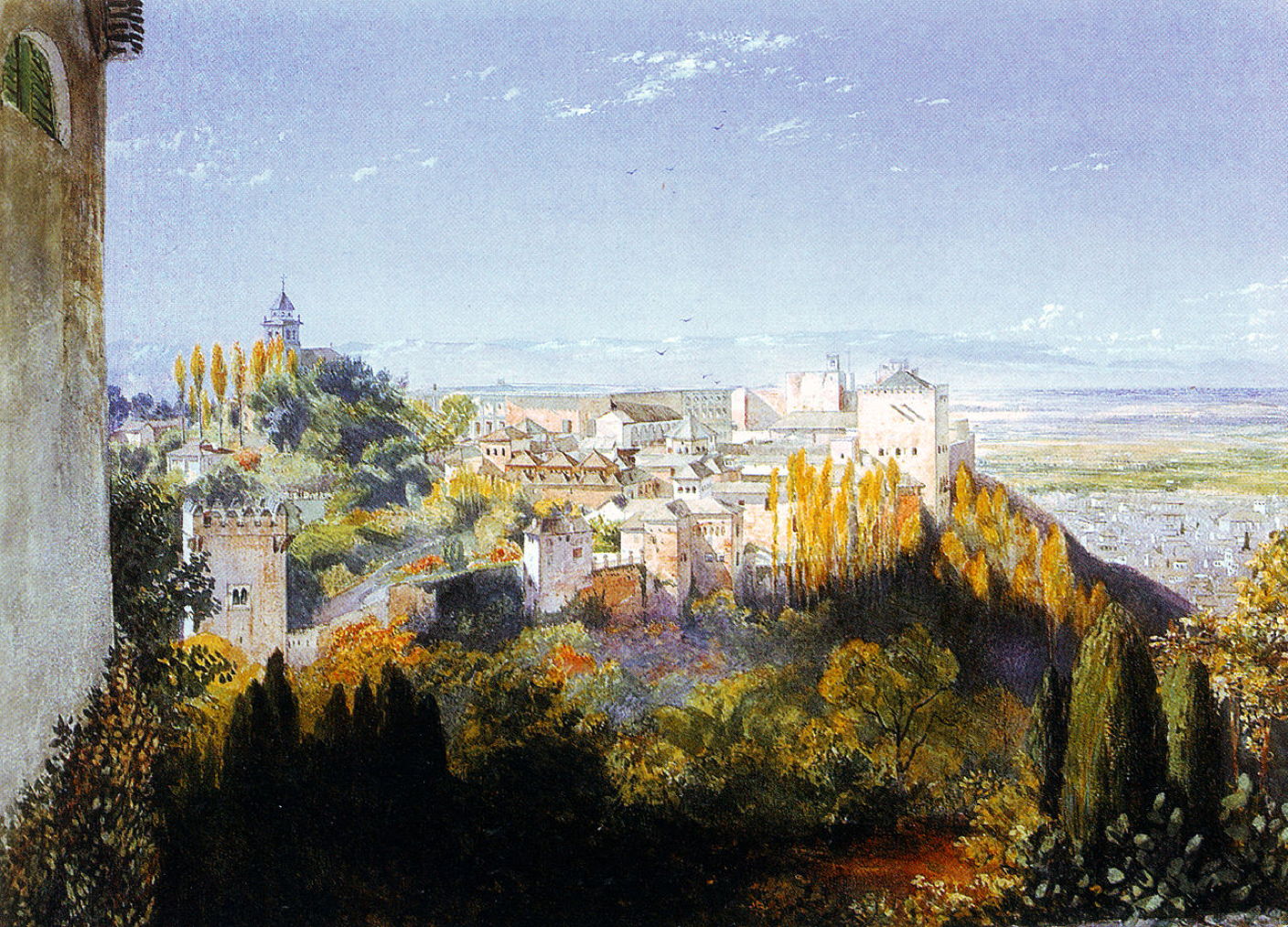
John Haynes Williams (1836-1908), Albaicin from the Alhambra (date not known), further details not known. Wikimedia Commons.
John Haynes Williams (or Haynes-Williams) recognised the merits of views painted from the Alhambra as a high point, in his undated Albaicin from the Alhambra.
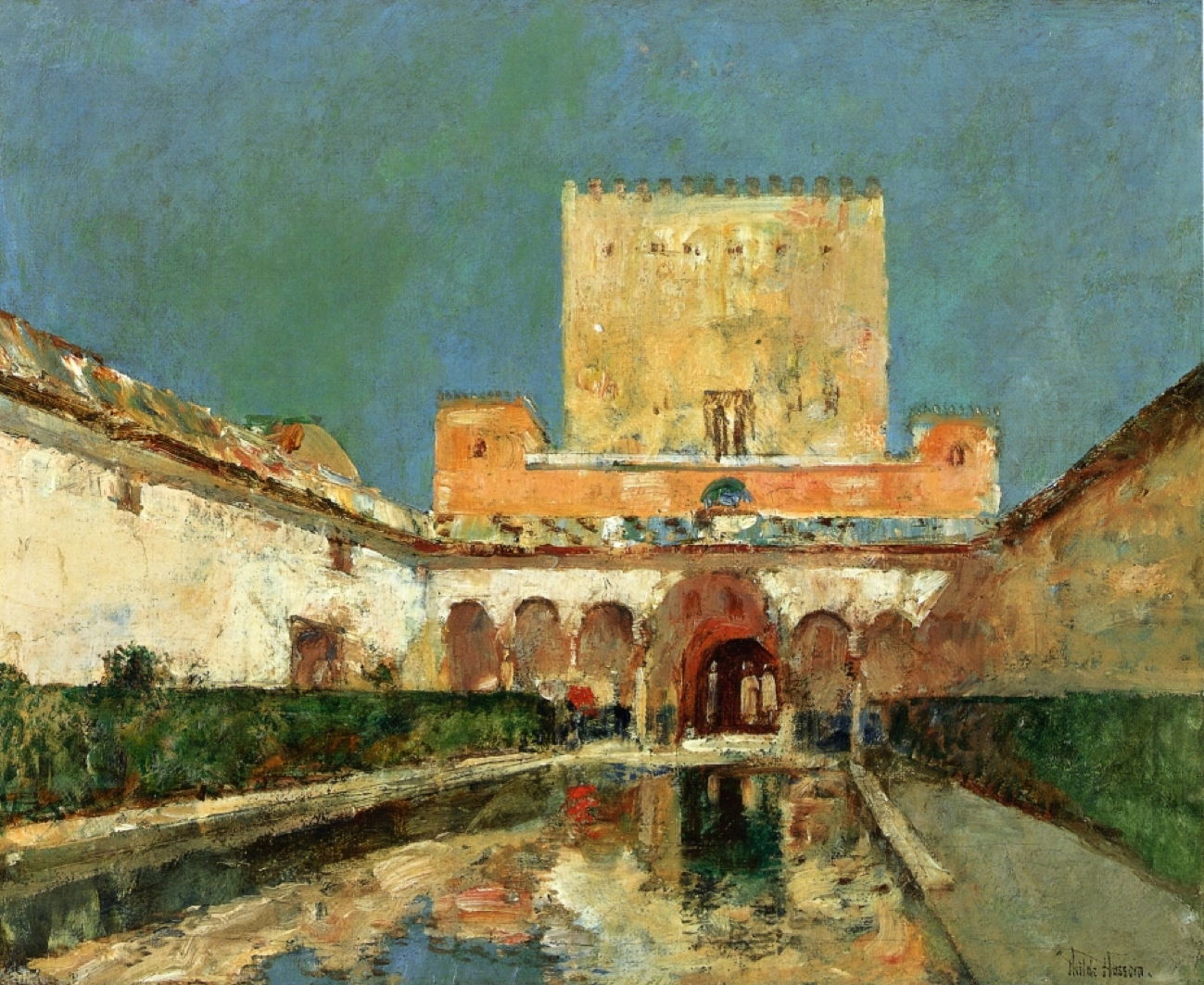
Childe Hassam (1859–1935), The Alhambra (1883), oil on canvas, 33 x 40.6 cm, Private Collection. Wikimedia Commons.
The late nineteenth century saw new visitors to copy masters at the Prado: those Americans who came to study painting in France and Germany. Among then, Childe Hassam visited during the summer of 1883, with his friend Edmund H Garrett, and sketch this view of The Alhambra then. This shows the Palace of the Ambassadors, and remains one of the most frequently painted parts of the site.
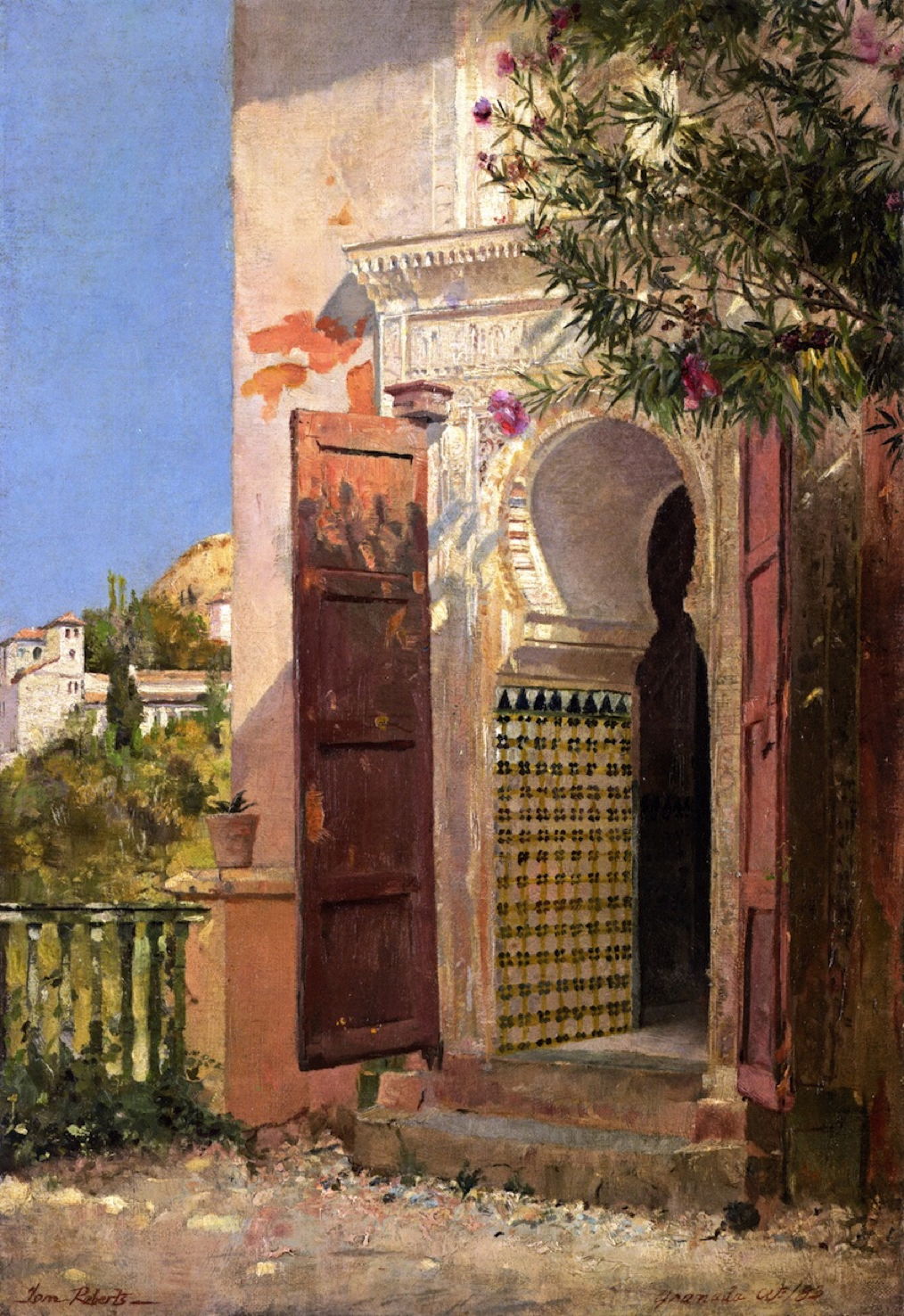
Tom Roberts (1856–1931), A Moorish Doorway, Alhambra (1883), further details not known. Wikimedia Commons.
From even further afield, the Anglo-Australian Tom Roberts visited Granada when he was in Spain in 1883, when he painted this detailed realist view of A Moorish Doorway, Alhambra. Roberts had migrated with his family in 1869, returned to Britain to study at the Royal Academy Schools from 1881, then went to Spain with the Australian John Peter Russell. He returned to Australia in 1884, becoming one of the early Australian Impressionists.
这也是现当代艺术作品常常被人诟病的原因之一,因为那些作品浓缩了大量的思考和抽象提炼,但表现形式上,其实并没有比传统艺术更复杂,或更需要技艺和体力上的付出。也就是说,作为当代艺术最核心的「观念」,在完全不需要理解的情况下,一个外行的人或者一个数据量管够的 AI 就可以模仿出「看上去像那么回事」的东西。这种模棱两可的状态,恰恰是江湖神棍和 AIGC 擅长处理的对象。
这里说的「糊弄」「神棍」并非贬义,而是借着世俗的话语体系来表达,这样的「生成作品」并不需要 AI 具备「意识」和「创意」也可以轻松地实现。
我的意思并不是让 AI 画手绘图,这仅仅是一种表现方式。但是,这是一种不需要追求精确的表达方式,很适合 AI 用「抽卡」的方式来快速堆想法。除了这种,当然也可以让它生成上面剃须刀那样的图,但同样的,目的不在于出方案,而是借助 AI 的海量数据库,快速地堆出一批发散性思维的「胡编乱造」的混杂图像来。
人类的视野有限,但 AI 看得一定比人类个体的平均值多。
工业设计不是天马行空地想象,它是一种「劳作」。
从初期的构思,从草图推延到模型和效果图,再从设计方案导入结构设计和工艺、制程,这意味着工业设计不是一项纯脑力劳动,不是一种只运行在计算机里的行为。它包含的体力劳作同样是设计的一部份,甚至可以说,是更关键的那部份。这种体力劳作,不仅仅是肌肉和工具的配合,更是人脑对环境、事件、社会群体、物质的反应和处理,设计师的动作意味着这个人对世界的认知。这种程度的认知,对于只运行在计算机内,仍然缺少复杂的传感器和理解过程的 AI 而言,暂时还是无法实现的。
One of the talks is at the Asia Society on March 1 and has to do with concepts of hell and the afterlife in China–especially how this played out after the Communist Party tried to destroy most values. Details here.
The second, and more relevant talk to my new book is on the idea of Civil Religion in China. I took a stab at this in early 2023 at a talk at Fordham University and will do so in a more systematic way in March at the Wissenschaftskolleg zu Berlin, aka Germany’s Institute for Advanced Studies.
I’ll be on a podium with Franciscus Verellen, a distinguished historian of religious life in middle-period China (and along with Kristofer Schipper the editor of one of the great recent works of sinological study, The Taoist Canon, which is a magically written and illustrated two-volume companion to the canon, which is essentially an encyclopedia of Taoist thought).
Prof. Verellen will talk about state and religion in classical China and I’ll talk about the concept in the country today, especially as the Communist Party uses it to cement legitimacy.
You can see details of both talks on this site’s “Talks and Media Appearances” page. The German talk will be in German. Both will be posted to YouTube, and I think the German talk will have subtitles.
If you get a chance to hear these and have feedback, please do send me an email at ij@ian-johnson.com I’d appreciate any feedback.

 Login
Login






 尾注
尾注