Reading view

There are new articles available, click to refresh the page.

Jerusalem Delivered: 6 Erminia flees

The seductive ‘pagan’ sorceress Armida has just told Godfrey of Bouillon, leader of the First Crusade’s siege on the city of Jerusalem, a long sob story, leading to her request for ten of his best knights to go and sort her problems out.

Godfrey predictably turns her down, in view of his mission to deliver the city. Armida plays on emotion, and weeps. She has won over the young knight Eustace, who asserts that helping all ladies is chief among the duties of a knight. The others around Godfrey concur, and their leader is forced to acquiesce. Armida then plays the field with great skill and success, winning over the hearts of all the knights, in her bid to take away more than just the ten that she asked for.

Canto five continues in the camp of the crusaders, with Armida’s influence eating away at their resolve to fight. Godfrey’s next problem is to select a knight to replace the dead Dudon, who in turn can choose the ten to go with Armida. This sows dissent, with Prince Gernando wanting to lead the army of ‘Adventurers’. This brings him into direct conflict with Rinaldo, who accuses Gernando of being a liar.

The two knights must settle this immediately in combat, and Rinaldo quickly kills Gernando. Godfrey goes straight there, and on hearing what happened, condemns Rinaldo to death for breaking the crusaders’ laws. Tancred speaks in favour of Rinaldo, then Raymond too. Tancred rides off to Rinaldo’s tent, where the latter makes clear that he has no intention of staying around in prison awaiting his trial. Rinaldo dons his armour and rides off.

Guelph goes to Godfrey to plead Rinaldo’s case, but the leader stands firm. Next, Godfrey has to face Armida, who goes to him with two of her ladies and two knights in attendance. With Godfrey’s single-minded determination for his mission, she finds him much less malleable than his knights. Armida finally gets her way, and is allowed to take her ten knights.

With dozens of knights clamouring to accompany Armida, it’s decided to draw names from an urn. Tasso lists: Count of Pembroke Artemidorus, Gerard, Wenceslaus, Guasco, Rudolph, Olderic, William of Roncillon, Bavarian Eberard, French Henri, and Rambaldo. Those who were unsuccessful are left seething in envy, and many leave the following night to follow Armida as she leads her squad of ten away. This further divides the crusaders.

Back in camp, Godfrey hears that an Egyptian navy is at sea to prevent supply ships from reaching the coast, and that a convoy of supplies en route to the crusaders from one of the ports has been ambushed and lost. The leader has to comfort his men by affirming that God will look after them, but inwardly worries how he will feed his army.

The sixth canto opens inside the besieged city of Jerusalem, where its occupants are better-fed than those laying siege to it, because they have been able to bring in supplies by night. Work had been undertaken to strengthen its fortifications, particularly on the north, where there were also war machines stationed.

Argante urges Aladine to fight the enemy rather than sit waiting for starvation, but the ruler reveals that Soliman of Nicaea, who seeks vengeance for his own loss earlier in the Crusade, is gathering a force to attack by night. This angers Argante, who is an old rival of Soliman, and he asks permission to go out to meet a crusader in combat. Aladine gives his consent.

Argante then issues a challenge to Godfrey for one-to-one combat, which the latter cannot refuse.

Inside the city, Aladine instructs Clorinda to take a force of a thousand to ensure Argante’s safe passage. Godfrey feels unable to choose Argante’s opponent, but the consensus calls on Tancred, who is approved by Godfrey.

As Tancred makes his way to the field where they will fight, he sees Clorinda, who is sitting on her horse with her visor raised. This delays him, and Otto has already rushed forward to take on the Circassian in the arena. Otto is in full charge before Tancred realises what is happening. Otto and Argante make contact: although Otto strikes the Circassian’s helmet, the latter knocks Otto from his horse, cleaving his shield and breastplate.

Argante tells Otto to concede, but the crusader refuses. Argante charges at Otto, who manages to wound his enemy and draw blood, but insufficient to do anything more than anger him further. Argante then turns his horse, fells Otto, and his horse tramples him, in a cowardly act breaching the code of chivalry.

At this, Tancred calls out Argante’s cowardice and the two charge at one another. Their lances shatter, making their horses collapse from under them. They draw their swords to fight on foot. Tancred is the first to draw blood, and Argante is so stunned that he is too slow to return the strike, and takes another heavy blow to his shoulder. Argante’s rage then overcomes his injuries, and he rains blows on Tancred. Both are now wounded, their armour pierced in many places. At this point, heralds are put in to bring the vicious fight to a halt for the night.

Erminia, in Jerusalem behind them, has suffered this battle badly. When Antioch fell, it was Prince Tancred who had protected her, and honoured her as a queen. For this, she had fallen in love with him. As she had watched Tancred in combat, she felt every blow that Argante had laid on him. With her skills in preparing healing potions, she is torn between using them to nurse her love, or Argante who would surely then be able to finish the crusader off.

She had spent long hours with Clorinda, and decides to dress up in her armour so she can leave the city and give aid to Tancred in the crusaders’ camp. She engages the help of a trusty squire and her maid, although she doesn’t tell them where she is going. Erminia then plays the part of Clorinda, and commands the city gate is opened on the authority of its king.

Once near the camp, she realises her plan has one problem: being recognised as Clorinda, woman warrior of Aladine’s forces, probably won’t give her a good reception among those laying siege to the city. She therefore sends her squire on to locate the injured Tancred. As she waits for his return, she is spotted by a platoon who are there to intercept attempts to smuggle supplies into the city. The father of one of its leaders, Polyphernes, had been killed by Clorinda, so throws his spear at her, and misses.

Erminia and her maid flee in panic, followed later by her squire. When Tancred hears of this, he rides off in pursuit of the woman warrior identified to him as Clorinda.

At the start of the seventh canto, it’s still night as Erminia enters dark woods and continues her flight, even though those pursuing her have now given up and returned to camp. The following day, she continues to wander, lost until she reaches the River Jordan, where she is completely exhausted, so lies down to sleep.

When she wakes at the next dawn, she sees a small shepherds’ hut, and weeps, only to hear the sound of shepherds singing and playing their pipes. She gets up and walks towards the group consisting of a grey-bearded man and three youths. As she is still wearing Clorinda’s armour, they are fearful of her at first, but she explains what’s going on nearby, and asks how they can remain there in peace.

The old man explains that he had been the keeper of the grounds and member of the royal court at Memphis, but had left for a more peaceful life with his three sons in the country. He consoles her, and takes her to his elderly wife, who dresses her in country clothes.
domenichinoerminiashepherds
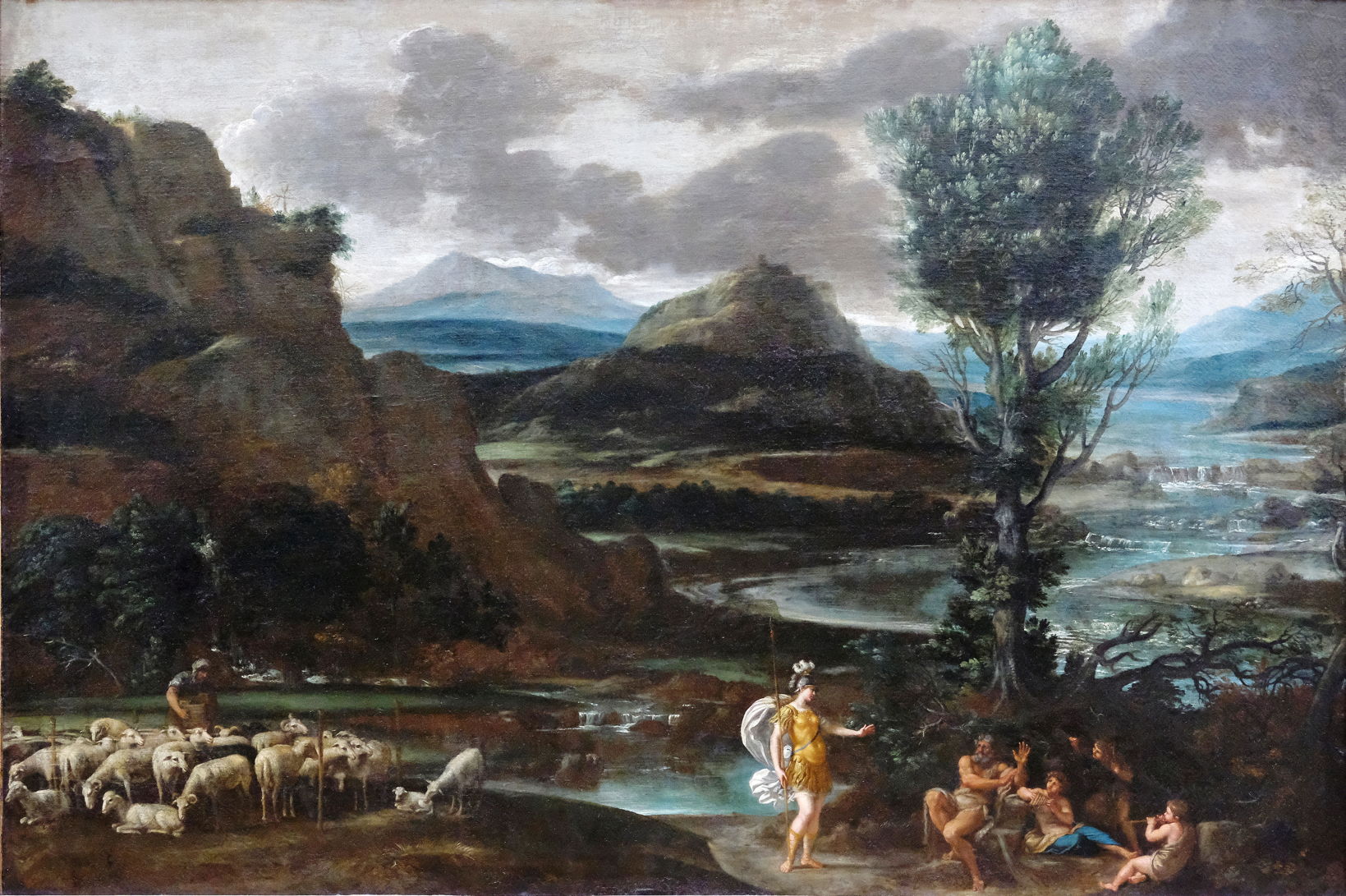
Domenichino (1581–1641), Erminia and the Shepherds (1622-25), oil on canvas, 124 x 181 cm, Musée du Louvre, Paris. Image by Mbzt, via Wikimedia Commons.

Domenichino appears to have been one of the earliest major painters to capture this scene, in his Erminia and the Shepherds, painted between 1622-25. He recasts the story in classical times, with Erminia appearing more Roman than Syrian, and the shepherds are straight out of an Ovidian myth (detail below). This is all set in a wonderfully imaginative riparian landscape.

domenichinoerminiashepherdsd1
Domenichino (1581–1641), Erminia and the Shepherds (detail) (1622-25), oil on canvas, 124 x 181 cm, Musée du Louvre, Paris. Image by Mbzt, via Wikimedia Commons.
guardierminiashepherds
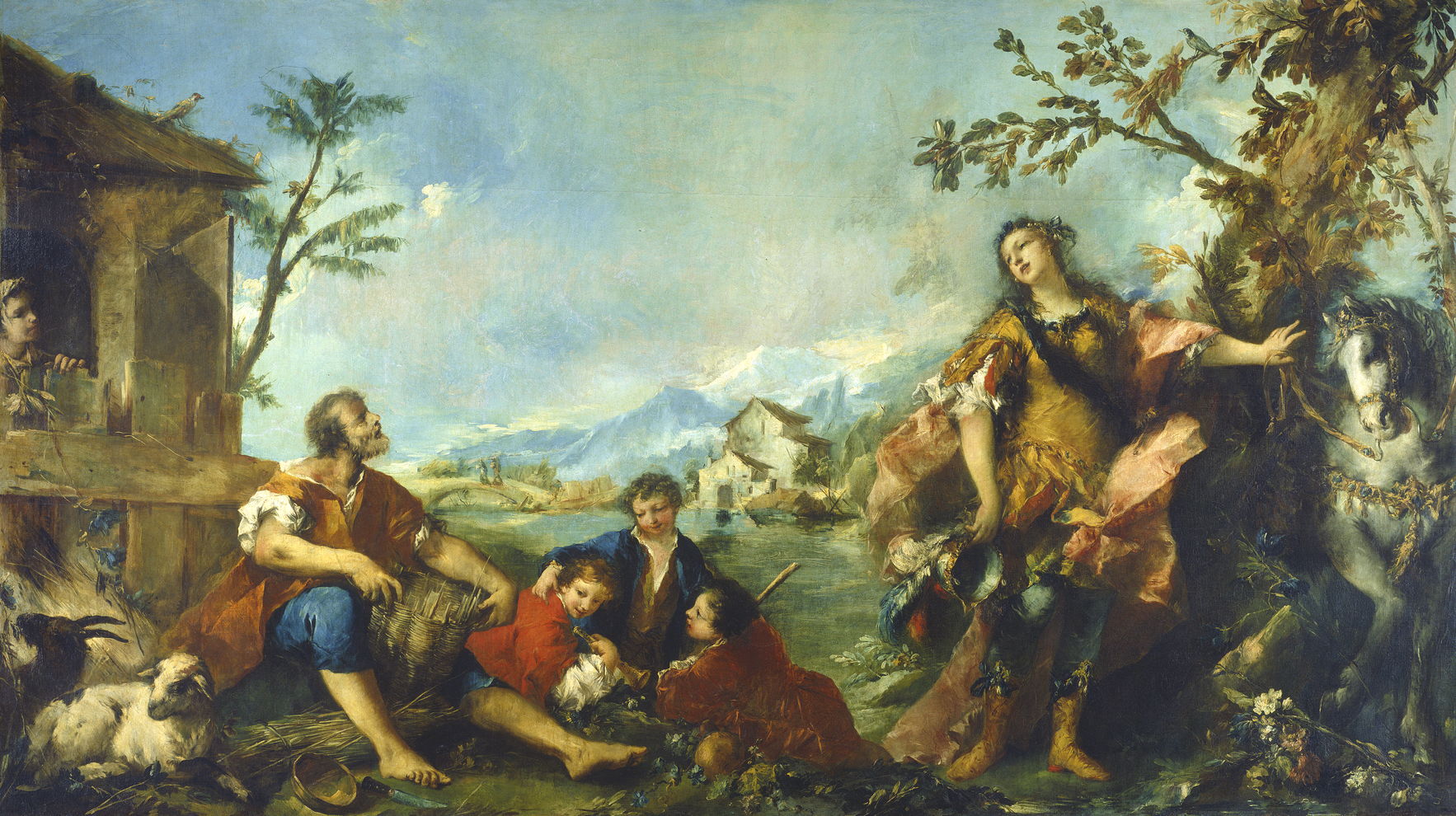
Giovanni Antonio Guardi (1699–1760), Erminia and the Shepherds (1750-55), oil on canvas, 251.5 x 442.2 cm, The National Gallery of Art, Washington, DC. Wikimedia Commons.

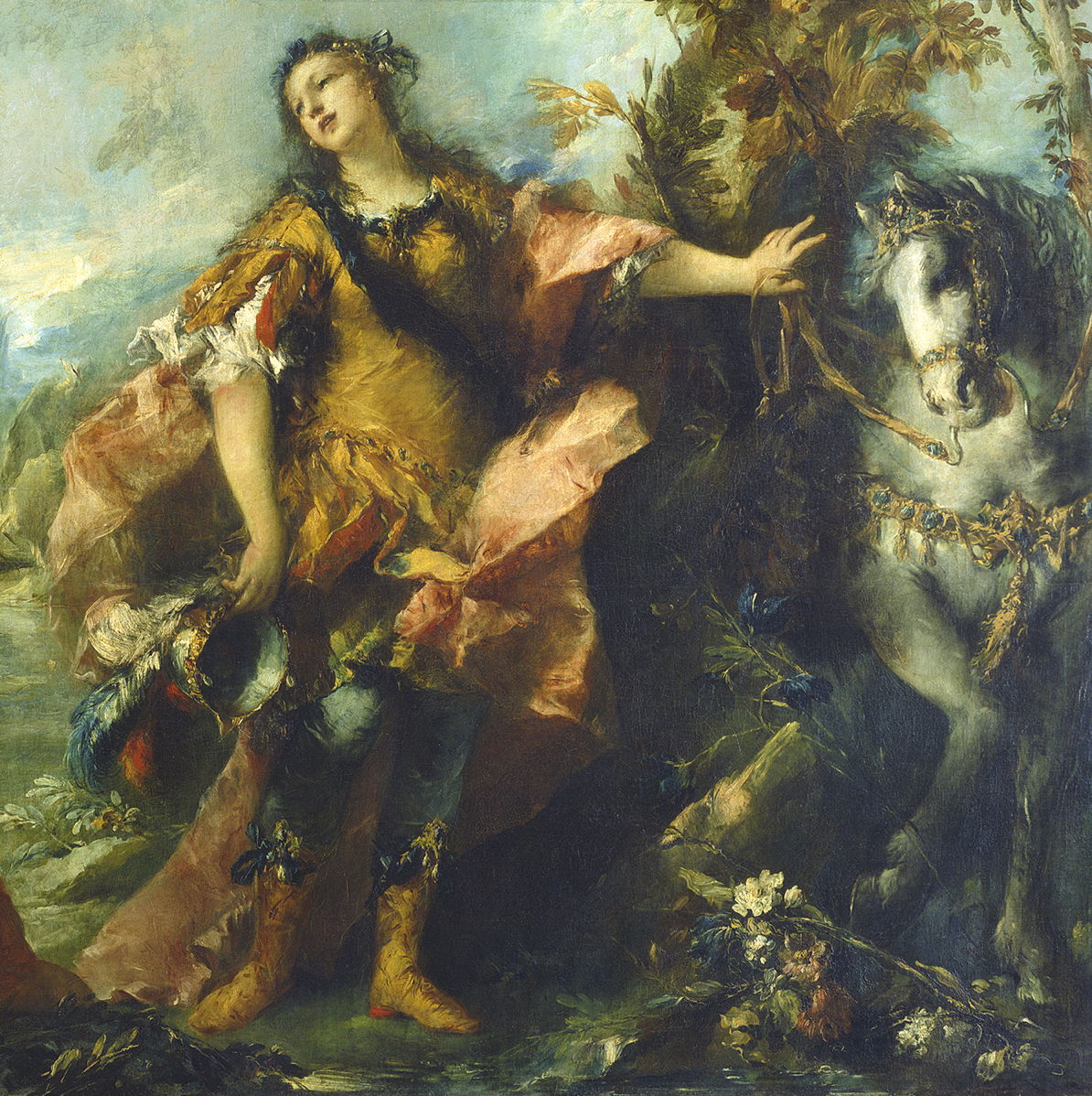
This sub-plot remained popular through the eighteenth century, when Giovanni Antonio Guardi painted his interpretation of Erminia and the Shepherds (1750-55). Erminia has by now changed out of Clorinda’s armour into the fetching outfit of an Alpine shepherdess. She stands holding the reins of her white horse, and Clorinda’s helmet (below).
guardierminiashepherdsd1
Giovanni Antonio Guardi (1699–1760), Erminia and the Shepherds (detail) (1750-55), oil on canvas, 251.5 x 442.2 cm, The National Gallery of Art, Washington, DC. Wikimedia Commons.
suveeerminiashepherds
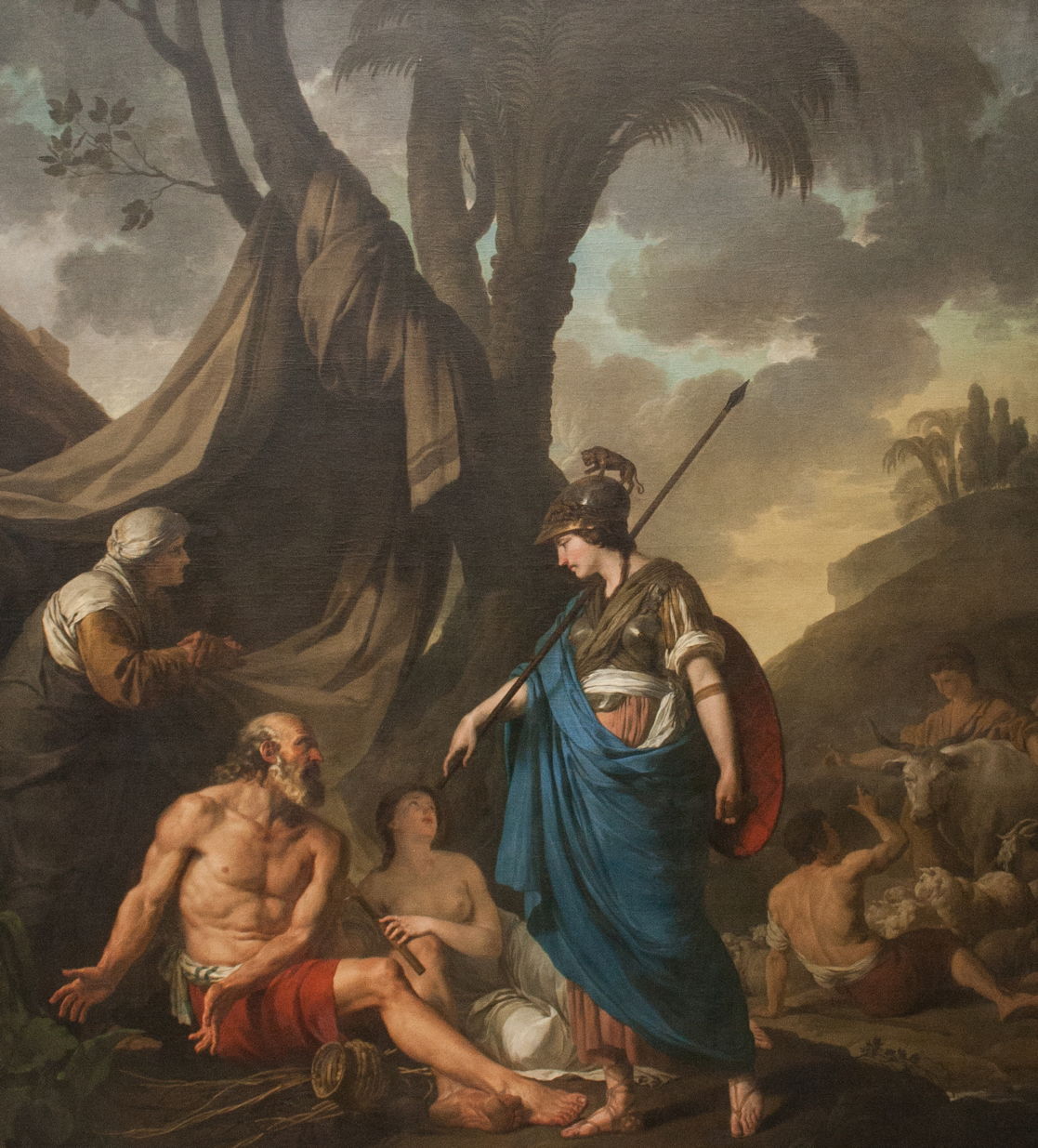
Joseph-Benoît Suvée (1743–1807), Erminia and the Shepherds (1776), oil on canvas, dimensions not known, Museum voor Schone Kunsten, Ghent, Belgium. Wikimedia Commons.

Joseph-Benoît Suvée’s Erminia and the Shepherds from 1776 is more basic and a little less literal. Her horse is nowhere to be seen, and the semi-naked young woman sat next to the old shepherd is a bit of a surprise. The setting is more Palestinian, though, with some palm trees.
delacroixerminiashepherds
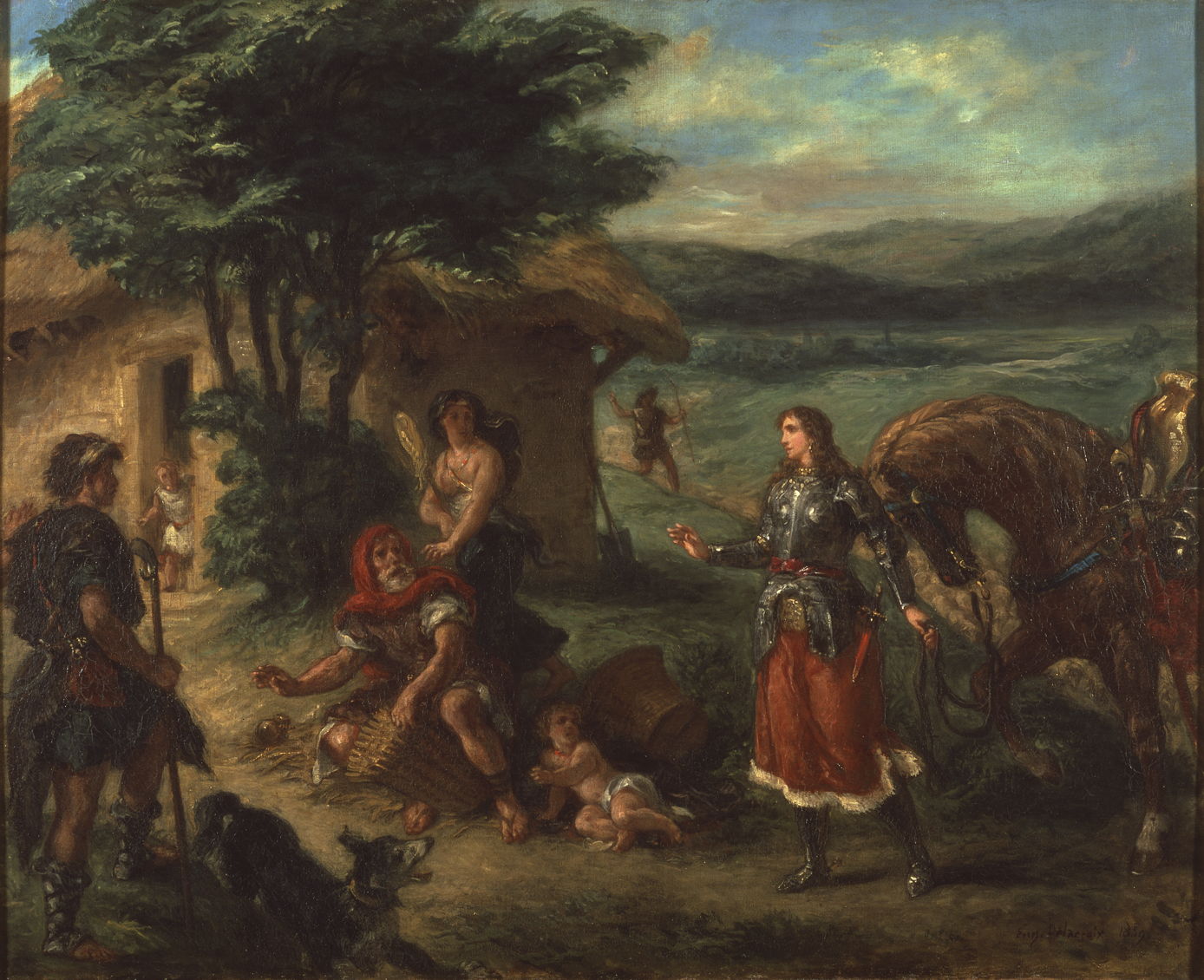
Eugène Delacroix (1798–1863), Erminia and the Shepherds (1859), oil on canvas, 82 x 104.5 cm, Nationalmuseum, Stockholm, Sweden. Wikimedia Commons.

It’s Eugène Delacroix who renders this most faithfully, in his Erminia and the Shepherds of 1859. Erminia is still dressed as the warrior Clorinda, and her charger is convincing too (below). The farming family are taken aback, and their dog has rushed out to bark at the visitor. In the distance, behind the small farmhouse, is a figure who might be pursuing Erminia.

delacroixerminiashepherdsd1
Eugène Delacroix (1798–1863), Erminia and the Shepherds (detail) (1859), oil on canvas, 82 x 104.5 cm, Nationalmuseum, Stockholm, Sweden. Wikimedia Commons.

Although Tancred had also strayed, he’s still in pursuit of the warrior he mistakenly thinks is Clorinda.

References

Wikipedia on Jerusalem Delivered.
Wikipedia on Torquato Tasso.

Project Gutenberg (free) English translation (Fairfax 1600).

Librivox audiobook of the Fairfax (1600) English translation (free).

Thomas Asbridge (2004) The First Crusade, A New History, Free Press, ISBN 978 0 7432 2084 2.
Anthony M Esolen, translator (2000) Torquato Tasso, Jerusalem Delivered, Gerusalemme Liberata, Johns Hopkins UP. ISBN 978 0 801 863233. A superb modern translation into English verse.
John France (1994) Victory in the East, a Military History of the First Crusade, Cambridge UP. ISBN 978 0 521 589871.
Joanthan Riley-Smith, ed (1995) The Oxford Illustrated History of the Crusades, Oxford UP. ISBN 978 0 192 854285.
Jonathan Riley-Smith (2014) The Crusades, A History, 3rd edn., Bloomsbury. ISBN 978 1 4725 1351 9.
Johathan Unglaub (2006) Poussin and the Poetics of Painting, Pictorial Narrative and the Legacy of Tasso, Cambridge UP. ISBN 978 0 521 833677.

Jerusalem Delivered: 4 Advance to Emmaus

My previous articles in this series provided a short summary of the First Crusade, setting the context for Torquato Tasso’s epic Jerusalem Delivered, which opens with a conventional dedication to the muse, and homage to his patron, Alfonso II of Este.

Tasso’s narrative starts with events six years after the Pope’s call to crusade (actually in late 1095), and briefly mentions the capture of Nicaea and Antioch, to set the opening scene in the following winter (1098-99), with the crusaders in their quarters at ‘Tortosa’. That is now known as Tartus in Syria, a port on the Mediterranean coast well to the south of Antioch.

Tasso gives an overview of the main figures of the First Crusade through the eyes of God:

  • Godfrey of Bouillon, whom he praises as a hero;
  • Baldwin, with his ‘vain ambition’;
  • Tancred, who is suffering the pangs of love;
  • Bohemond, who is bringing law and order to Antioch as its ruler;
  • Rinaldo, the courageous and restless warrior.
blondeltancred
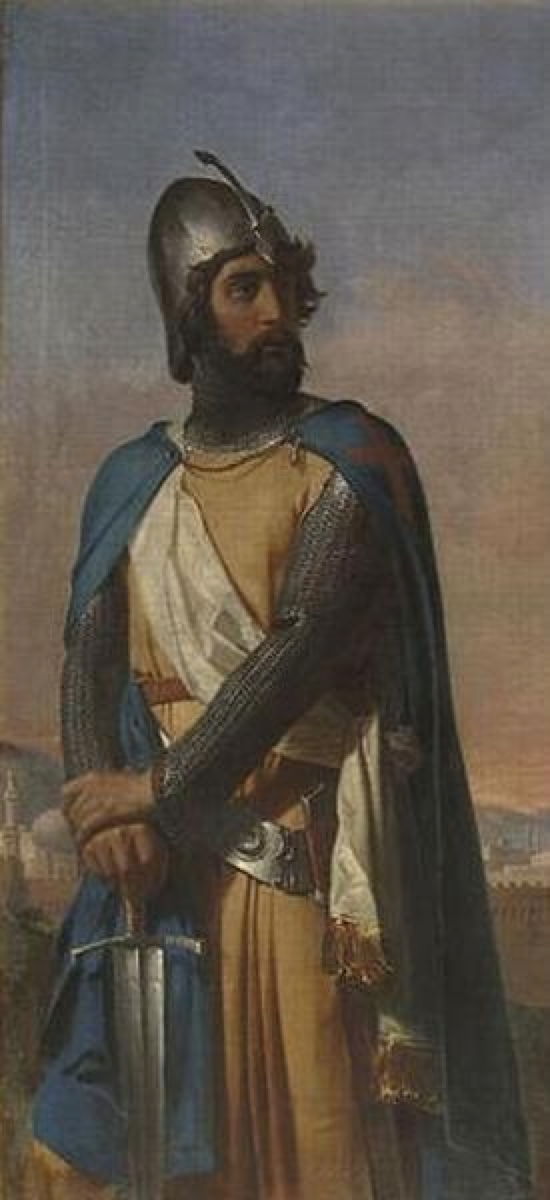
Merry-Joseph Blondel (1781–1853), Tancred of Hauteville, Prince of Galilee (1840), oil on canvas, 167 x 78 cm, Château de Versailles, Versailles, France. Wikimedia Commons.

Three of these figures are well-known, and appear in various paintings, but Tasso reinvents those of Tancred and Rinaldo, the heroes of his epic. Merry-Joseph Blondel’s painting of Tancred of Hauteville, Prince of Galilee from 1840 shows Tancred rather later during the Crusade, looking suitably grand.

God therefore sends down the Archangel Gabriel to spur Godfrey to lead the Crusaders onwards to free Jerusalem, which the archangel does just as Godfrey is at his morning prayers.

overbeckarchangelgabrielgodfrey
Johann Friedrich Overbeck (1789-1869), The Archangel Gabriel Appears to Godfrey of Bouillon (1819-27), fresco, dimensions not known, Casa Massimo, Rome, Italy. Image by Sailko, via Wikimedia Commons.

In this section of Johann Friedrich Overbeck’s magnificent frescoes in the Casa Massimo, in Rome, The Archangel Gabriel Appears to Godfrey of Bouillon. His companions are still asleep as Gabriel speaks to Godfrey, clutching what most would now recognise as a flag of the Cross of Saint George, in red on a white background.

guardigodfreyboulogne
Francesco Guardi (1712–1793), Godfrey of Boulogne Summons His Chiefs to Council (c 1755), oil on canvas, 250.2 x 109.9 cm, Norton Simon Museum, Pasadena, CA. Wikimedia Commons.

Francesco Guardi shows a slightly later moment, as the archangel flies away from the scene, and Godfrey of Boulogne Summons His Chiefs to Council (c 1755).

All the leaders except Bohemond attend this meeting, at which Godfrey reminds them of their primary mission, to deliver the Holy City of Jerusalem, and the need to make haste towards it. Peter the Hermit then speaks in support, castigating the individual leaders for their in-fighting and rivalry. The leaders agree to Godfrey being in overall command.

The following morning, their troops parade as they prepare to set off to travel south along the coast. This provides Tasso with the opportunity to enumerate them:

  • French, from the Île de France, formerly led by Hugh, now by Clothar, one thousand;
  • Norman cavalry under Robert, one thousand;
  • former priests from the Low Countries under Bishops William and Ademar, totalling eight hundred;
  • forces of Godfrey and his brother Baldwin, with the Count of Chartres too, 1600 in all;
  • Germans from between the Danube and the Rhine, under Guelph, less than two thousand;
  • Dutch and Flemish, under another Robert, two thousand total;
  • English, under William, the son of the king, slightly more than two (or one?) thousand;
  • Irish, no leader or number given;
  • from Campania, under Tancred, eight hundred;
  • Greece, led by Tatin, just two hundred;
  • ‘adventurers’, or unattached and mercenaries, led by Dudin of Contz, no number given;
  • men from the Pyrenees, under Raymond of Toulouse, four thousand;
  • men from Blois and Tours, under Stephen of Ambois, five thousand;
  • Swiss, under Alcasto, six thousand;
  • Italians, under Camillus, seven thousand.

Tasso gives a grand total of around thirty-five thousand, which is probably more than double the number of surviving crusaders at this stage.

In his remarks about Tancred, Tasso tells the story of him falling in love at first sight with a young girl clad in armour, during a battle in which Persians were put to flight. Tancred had gone to a brook to cool off afterwards, when this ‘pagan’ arrived for the same purpose. She then left, donning her helmet, without Tasso even revealing her name at this stage.

The army’s departure is made the more urgent as Godfrey has heard the ruler of Egypt with his army is on his way to his fortress at Gaza, which could be used to attack the crusaders as they approach Jerusalem. Godfrey then sends his trusty messenger by boat to Greece, to obtain reinforcements promised by the king.

The next day they depart to the sound of trumpets and drums. Godfrey sends lightly-armoured knights to scout in advance and ensure the main army isn’t ambushed, and field engineers to ensure their route of march is free from obstacles. The crusaders meet little opposition as they make their way south: even the King of Tripoli capitulates and welcomes them into his well-defended city.

As they march down the coast, they receive ships from several of their supporting countries bringing them provisions.

Word of their progress reaches Aladine, ruler of Jerusalem, who, being newly in charge of the city, already has other concerns. He had raised taxes on the Christian minority in Jerusalem, and harbours ideas of killing them all. He doesn’t attempt that, but burns their harvest, demolishes their huts, and poisons their wells, while strengthening the city’s fortifications.

The second Canto starts with Aladine in Jerusalem. A former Christian soothsayer, Ismen, warns the ruler to prepare for the arrival of the crusaders, but predicts that Aladine will be triumphant. Ismen then asks for a sacred icon of the Virgin Mary to be secretly stolen and hidden away to protect the ruler.

Aladine has this done, but the theft is noticed by a guard, who reports it to the ruler. The latter then claims that it must have been stolen by a Christian, and has the city searched. He decrees that the thief will die, but if no thief is found, it provides him with an excuse for killing all the Christians. He incites a mob, calling for them to “burn and kill”.

A young Christian woman named Sophronia, who is in love with the Christian Olindo, then comes forward and tells Aladine that it was she, and she alone, who stole the icon. When the ruler asks her where it is hidden she responds that she burned it. Sophronia is condemned to death by being burned at the stake.

As the crowds are gathering to watch her die, Olindo arrives, and insists that she is not the thief. Although he gives Aladine an account of how he accomplished this, the ruler of course knows that neither did. But he cannot back down, and sentences Olindo to die at the same stake, tied with his back to his love, so they cannot see one another as they die.

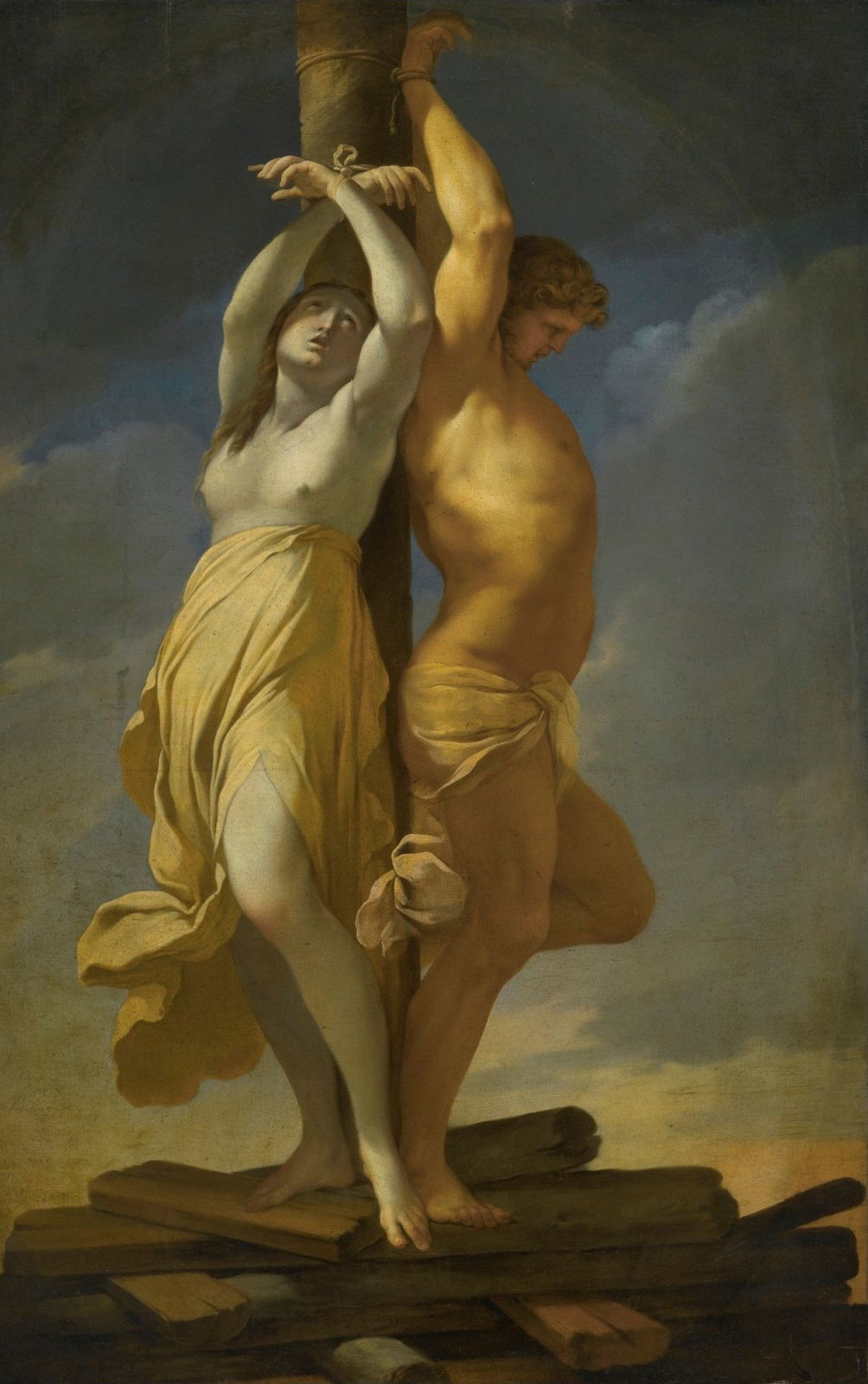
bauginolindosofroniapyre
Lubin Baugin (1612–1663), Olindo and Sophronia on the Pyre (c 1645), oil on canvas, 157.5 × 111.8 cm, location not known. Wikimedia Commons.

Lubin Baugin’s dramatically simple painting from about 1645 shows Olindo and Sophronia on the Pyre.

Just as Aladine’s men are about to light the kindling and kill the Christian couple, who are making their farewell speeches, a warrior rides up. This is Clorinda, a beautiful young woman, who is moved by the sight of the two lovers about to die together. When a bystander explains what is happening, she instructs the executioners to stop their preparations as she speaks to Aladine.

Clorinda introduces herself to Aladine, and offers her services. In return, she asks that he frees Sophronia and Olindo, on the grounds that no Christian would have stolen such a holy icon. This has proved a popular scene with a succession of artists, from shortly after the publication of Tasso’s epic up to the middle of the nineteenth century.

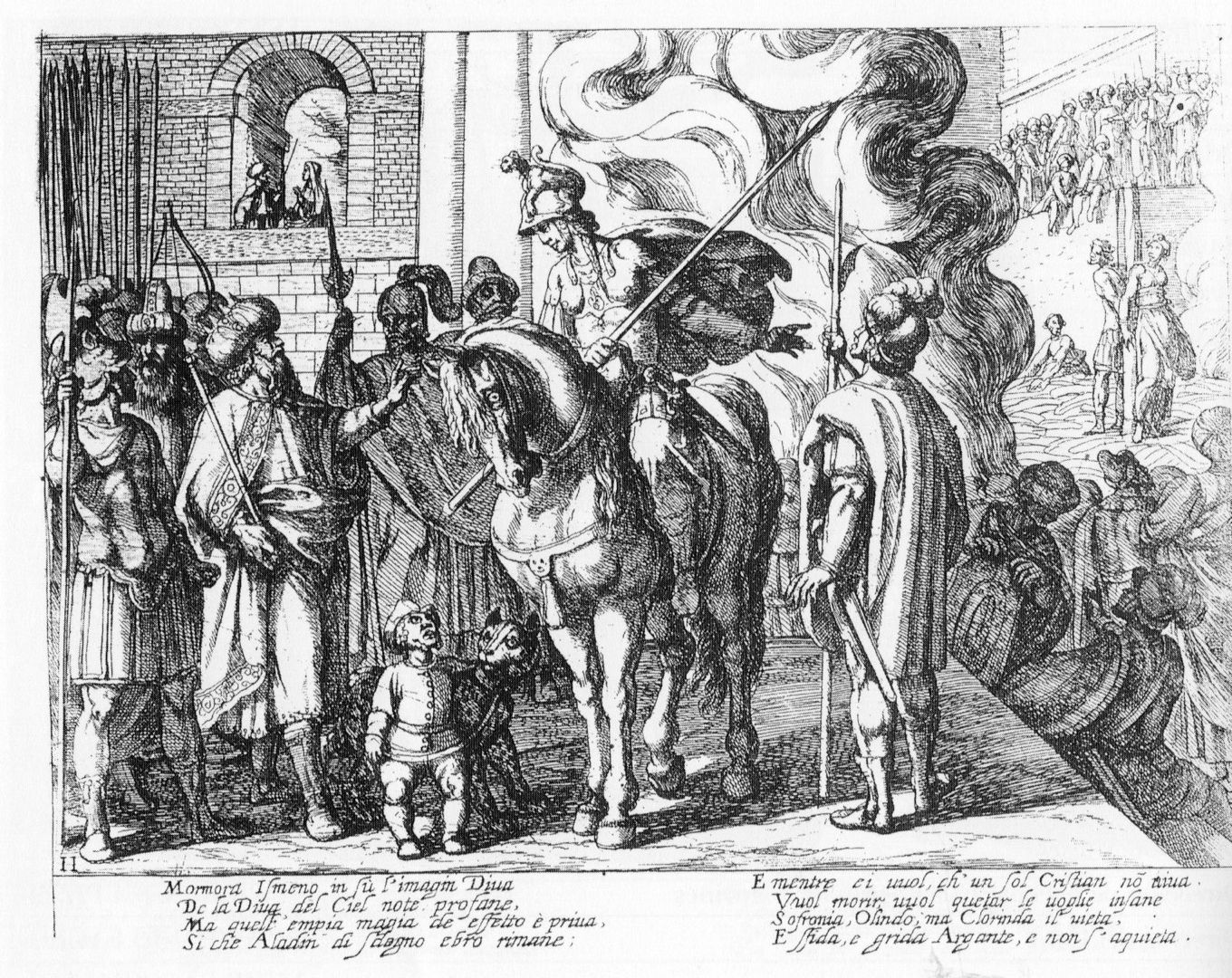
tempestaolindosofronia
Antonio Tempesta (1555–1630), illustration from Tasso’s ‘Gerusalemme Liberata’ (c 1597), engraving, further details not known. Wikimedia Commons.

Antonio Tempesta’s engraved illustration from about 1597 puts Clorinda in the centre foreground, as she talks to Aladine at the left. The couple are shown at a stake to the far right, in the background.

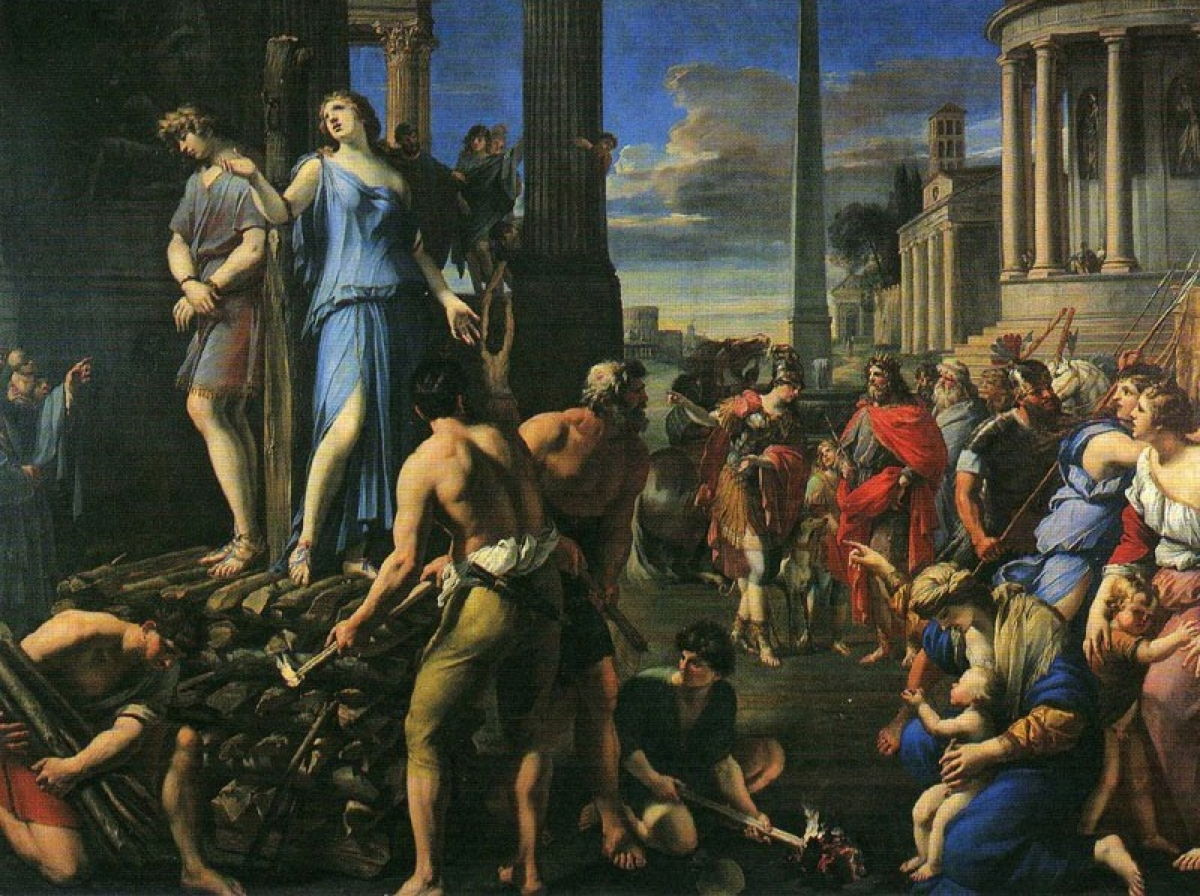
perrierolindosofronia
François Perrier (1594–1649), Olindo and Sophronia (c 1639), media and dimensions not known, Musée des beaux-arts de Reims, Reims, France. Wikimedia Commons.

François Perrier’s Olindo and Sophronia from about 1639 reverses this, with Clorinda and Aladine in the distance at the right, and the young couple standing as their executioners prepare the pile of wood for burning.

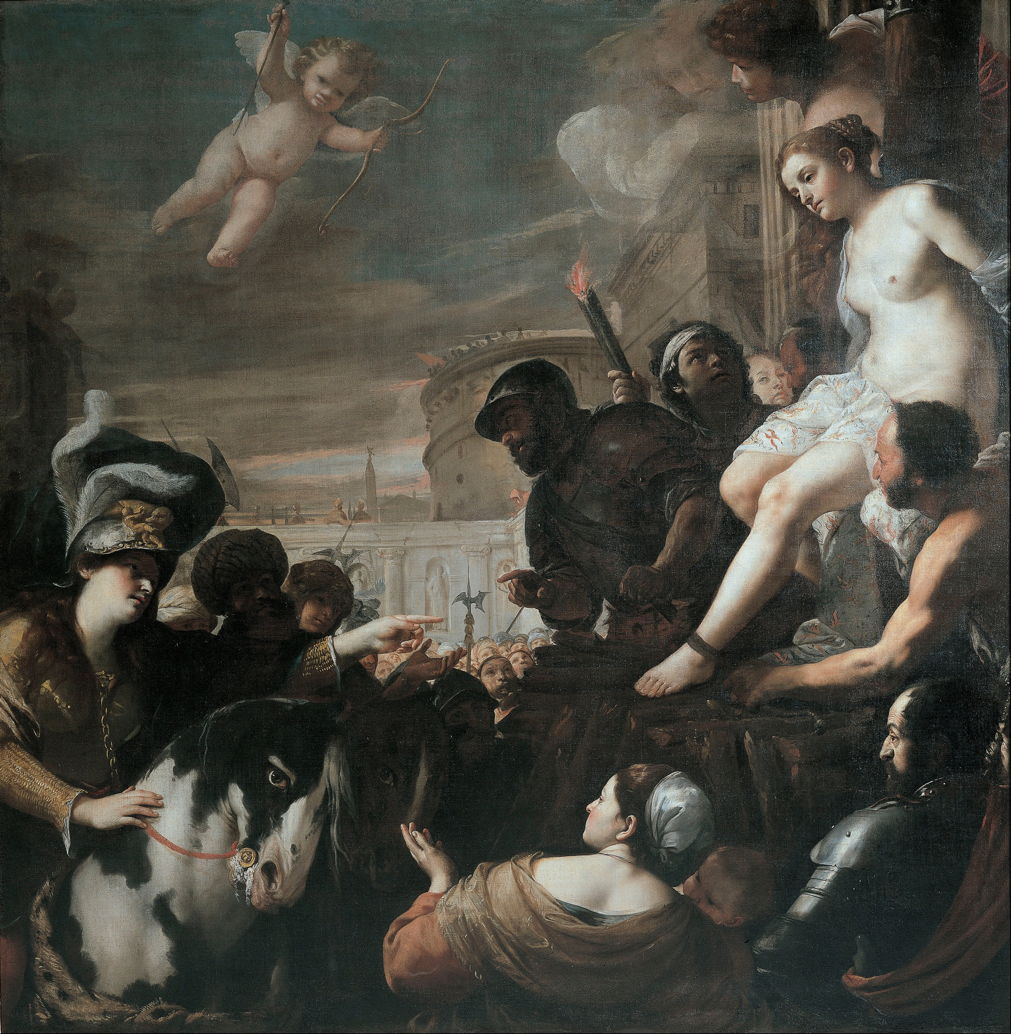
preticlorindarescuesolindo
Mattia Preti (1613–1699), Clorinda rescues Olindo and Sophronia (1646), media not known, 248 x 245 cm, Musei di Strada Nuova, Genoa, Italy. Wikimedia Commons.

Mattia Preti brings them all together in Clorinda Rescues Olindo and Sophronia from 1646, with a man stood behind Aladine bearing a burning brand. In the sky is a Cupid, and Sophronia is almost unclad.

vanpoelenburghclorindasavingolindo
Cornelius van Poelenburgh (1594/95–1667), Clorinda Saving Olindo and Sophronia from the Stake (date not known), further details not known. Wikimedia Commons.

Cornelius van Poelenburgh’s undated Clorinda Saving Olindo and Sophronia from the Stake is less structured and more expansive. Clorinda is on her horse at the right, and a naked Sophronia stands at the stake in the centre.

overbecksofroniaolindosaved
Johann Friedrich Overbeck (1789-1869), Sophronia and Olindo Saved by Clorinda (1819-27), fresco, dimensions not known, Casa Massimo, Rome, Italy. Image by Sailko, via Wikimedia Commons.

Although painted almost two centuries later, Overbeck’s fresco of Sophronia and Olindo Saved by Clorinda (1819-27) is less cluttered and easier to read. Unusually, Clorinda is shown riding a white charger, and with golden rather than black armour.

delacroixclorindafreesolindo
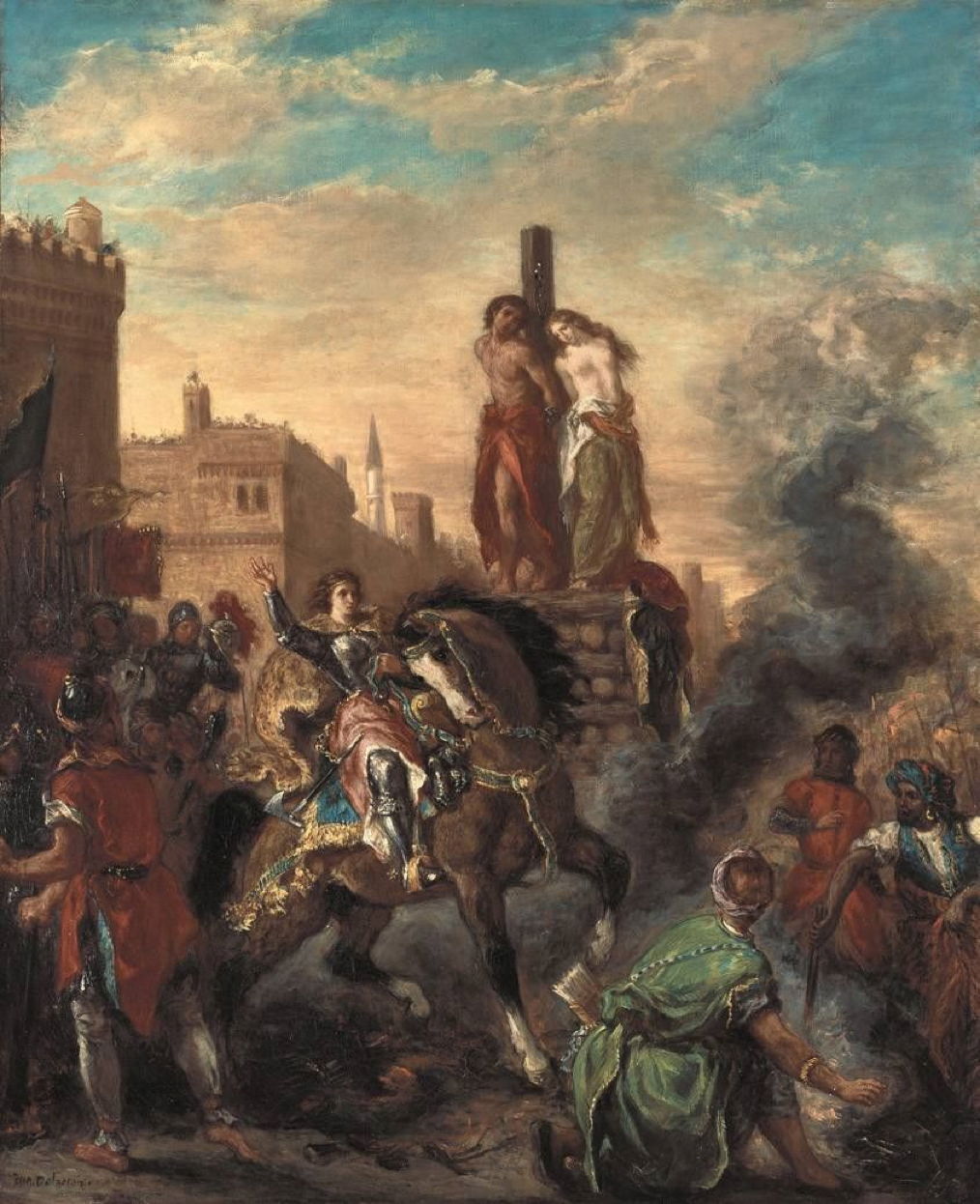
Eugène Delacroix (1798–1863), Clorinda Rescues Olindo and Sophronia (1856), oil on canvas, 101 x 82 cm, Neue Pinakothek, Munich, Germany. Wikimedia Commons.

Eugène Delacroix’s Clorinda Rescues Olindo and Sophronia from 1856 is a minor masterpiece. Clorinda has just arrived, wearing her more conventional black armour, as one of the enemies of the crusaders, and holds up her right hand to tell the executioners to stay as they are. The stake is raised high, putting the couple in full view, although Aladine is nowhere to be seen.

Aladine cannot refuse Clorinda, nor refute her reasoning, so he decrees that the couple be freed. However, he imposes the condition that they are banished from Jerusalem, and must live outside Palestine. He also banishes all other able-bodied Christians, who could pose a threat when the crusaders arrive. They mostly find their way to the town of Emmaus, which the crusaders have just reached.

References

Wikipedia on Jerusalem Delivered.
Wikipedia on Torquato Tasso.

Project Gutenberg (free) English translation (Fairfax 1600).

Librivox audiobook of the Fairfax (1600) English translation (free).

Thomas Asbridge (2004) The First Crusade, A New History, Free Press, ISBN 978 0 7432 2084 2.
Anthony M Esolen, translator (2000) Torquato Tasso, Jerusalem Delivered, Gerusalemme Liberata, Johns Hopkins UP. ISBN 978 0 801 863233. A superb modern translation into English verse.
John France (1994) Victory in the East, a Military History of the First Crusade, Cambridge UP. ISBN 978 0 521 589871.
Joanthan Riley-Smith, ed (1995) The Oxford Illustrated History of the Crusades, Oxford UP. ISBN 978 0 192 854285.
Jonathan Riley-Smith (2014) The Crusades, A History, 3rd edn., Bloomsbury. ISBN 978 1 4725 1351 9.
Johathan Unglaub (2006) Poussin and the Poetics of Painting, Pictorial Narrative and the Legacy of Tasso, Cambridge UP. ISBN 978 0 521 833677.

Jerusalem Delivered: 3 Capture of Jerusalem

In early 1099, the main body of ‘armed pilgrims’ who had obeyed Pope Urban II’s call to Holy War, left the city of Antioch and started their long march to Jerusalem. They leave Prince Bohemond I behind, ruling another of the new Crusader territories.

dorepeterbarthelemyordeal
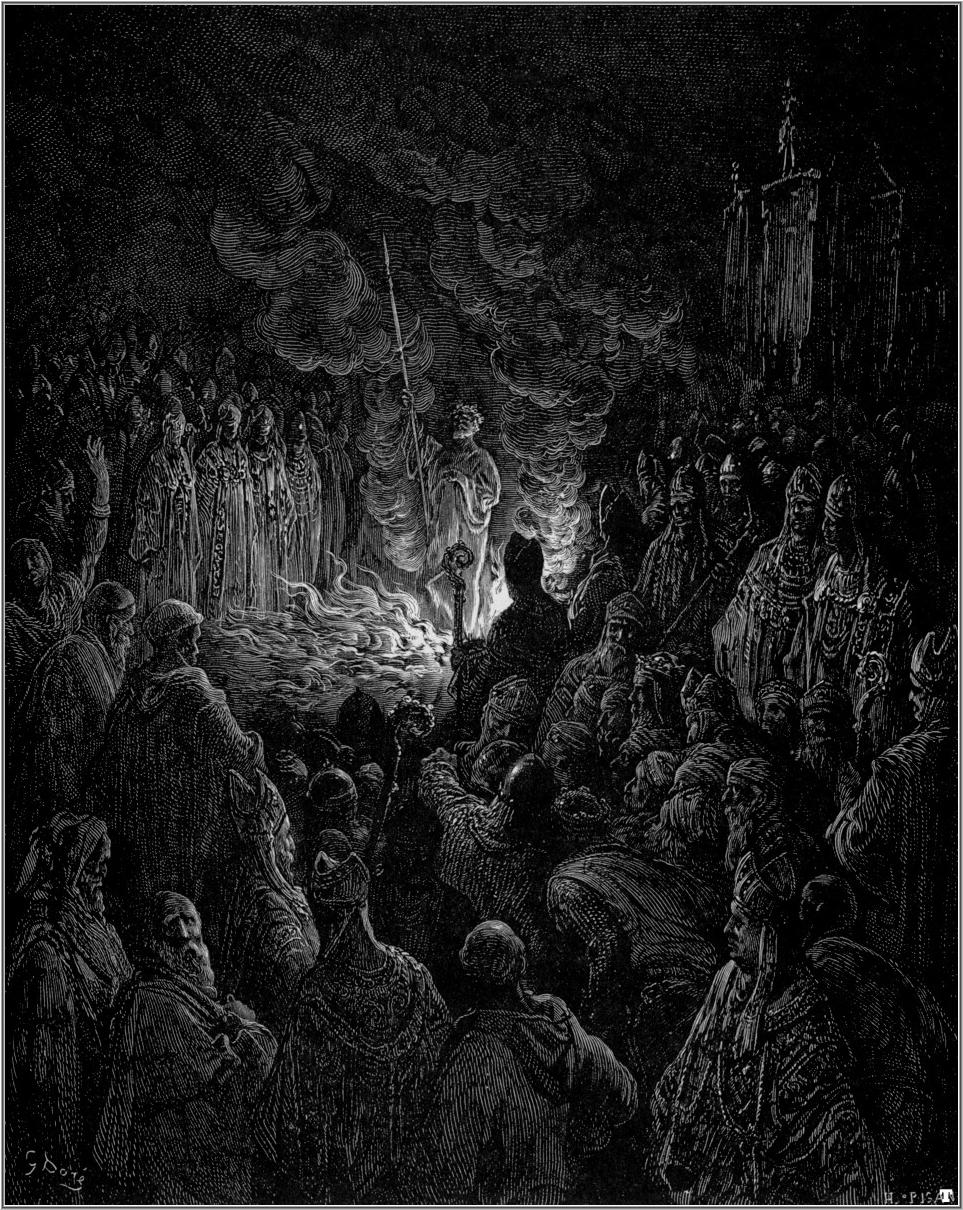
Gustave Doré (1832–1883), Peter Barthelemy Undergoing Ordeal by Fire (1877), illustration for Joseph François Michaud’s ‘History of the Crusades’, further details not known. Wikimedia Commons.

On the march, the mystic Peter Bartholomew (or Barthelemy), who had discovered the Holy Lance in Antioch, continues to have visions. Faced with growing scepticism from others, he volunteers to undergo ordeal by fire to prove his veracity. Gustave Doré captures this dramatic event in his Peter Barthelemy Undergoing Ordeal by Fire. Although initially claimed that he survives the ordeal unscathed, he dies less than two weeks later from the severe burns he sustained.

This march takes the crusaders southward along the Mediterranean coast, in parts on quite a narrow coastal corniche. They have local assistance, and most of the towns and cities that they pass capitulate peacefully, enabling them to move quite quickly. They take Beirut on 19 May, Tyre on 23 May, and Caesarea on 26 May.

News has already reached Jerusalem of their intentions; there, the city’s governor expels all its Christians, who had previously been living peaceably and were hardly oppressed. This is to ensure that no one would betray the city to the Crusaders. He also has most of the local wells poisoned, to frustrate any attempts at siege.

A total of about 1,250 knights and twelve thousand other armed men arrive and start putting the city of Jerusalem under siege on 7 June. Despite the greatly diminished size of this army, it’s split into factions which co-ordinate poorly. Tancred has already left to respond to calls of help from Bethlehem, which he then seizes before returning to the siege.

Following consultations with a hermit on the Mount of Olives, the Crusaders attack the city near its Damascus Gate on 13 June, but are repulsed from its inner walls, and retreat quickly. Then on 17 June, Genoese sailors arrive in the port of Jaffa, bringing with them their engineering skills and some timber; wood is also obtained from Nablus to the north.

guardigodfreyboulogne
Francesco Guardi (1712–1793), Godfrey of Boulogne Summons His Chiefs to Council (c 1755), oil on canvas, 250.2 x 109.9 cm, Norton Simon Museum, Pasadena, CA. Wikimedia Commons.

Francesco Guardi’s romantic fantasy showing Godfrey of Boulogne Summons His Chiefs to Council from about 1755 most probably shows this noble preparing to attend one of the many military Council meetings held during the siege. Other than his capture of Bethlehem, Godfrey’s achievements had been limited, but his reputation is growing.

Two great wooden siege towers are constructed, one under the command of Count Raymond of Toulouse and funded from his own wealth, the other by the Crusaders from the north of France, paid for from common funds. Visions reported by a priest, Peter Desiderius, inspire the Crusaders to process around the city walls on 8 July, reminiscent of the story of Joshua during the siege of Jericho. On this occasion, the walls don’t come tumbling down, but have to wait until the siege towers are ready for use a few days later.

On 13 July, those towers are moved into place and assault starts on the city’s defences. After two days, the outer rampart has fallen, and the inner rampart is then captured. The defenders panic, and at long last Crusaders enter the city.

lucibellocapturejerusalem
Ignazio Lucibello (1904-1970), The Speech of Roger II of Sicily to the People of Amalfi (left) and The Capture of Jerusalem (right) (date not known), fresco, dimensions not known, Palazzo Castriota, Amalfi, Italy. Wikimedia Commons.

In the right of Ignazio Lucibello’s two frescoes, he shows The Capture of Jerusalem, with the monastic soldier in the foreground displaying the distinctive cross of Saint John on his shield. This was associated with the later Knights of the Order of Saint John, which survives as an order of chivalry and continues today to provide aid in many countries, including medical support to Palestinians in Gaza.

In the north of the city, Tancred and his forces pursue the city’s defenders to the Temple Mount, where they start massacring them. Tancred calls a halt to this, allowing them a safe refuge in the Al-Aqsa Mosque. In the south, the commander of the garrison agrees to surrender the citadel to Count Raymond in return for safe passage from Jerusalem to Ascalon.

Notwithstanding those efforts to control it, Crusaders continued to massacre the population of Jerusalem. Even Jews who had sought safety in their synagogue were killed when it was burned to the ground, and eye-witness accounts refer to parts of the city becoming knee-deep in blood. The few citizens who survive either fled early, or are held as prisoners for ransom.

signoltakingjerusalem
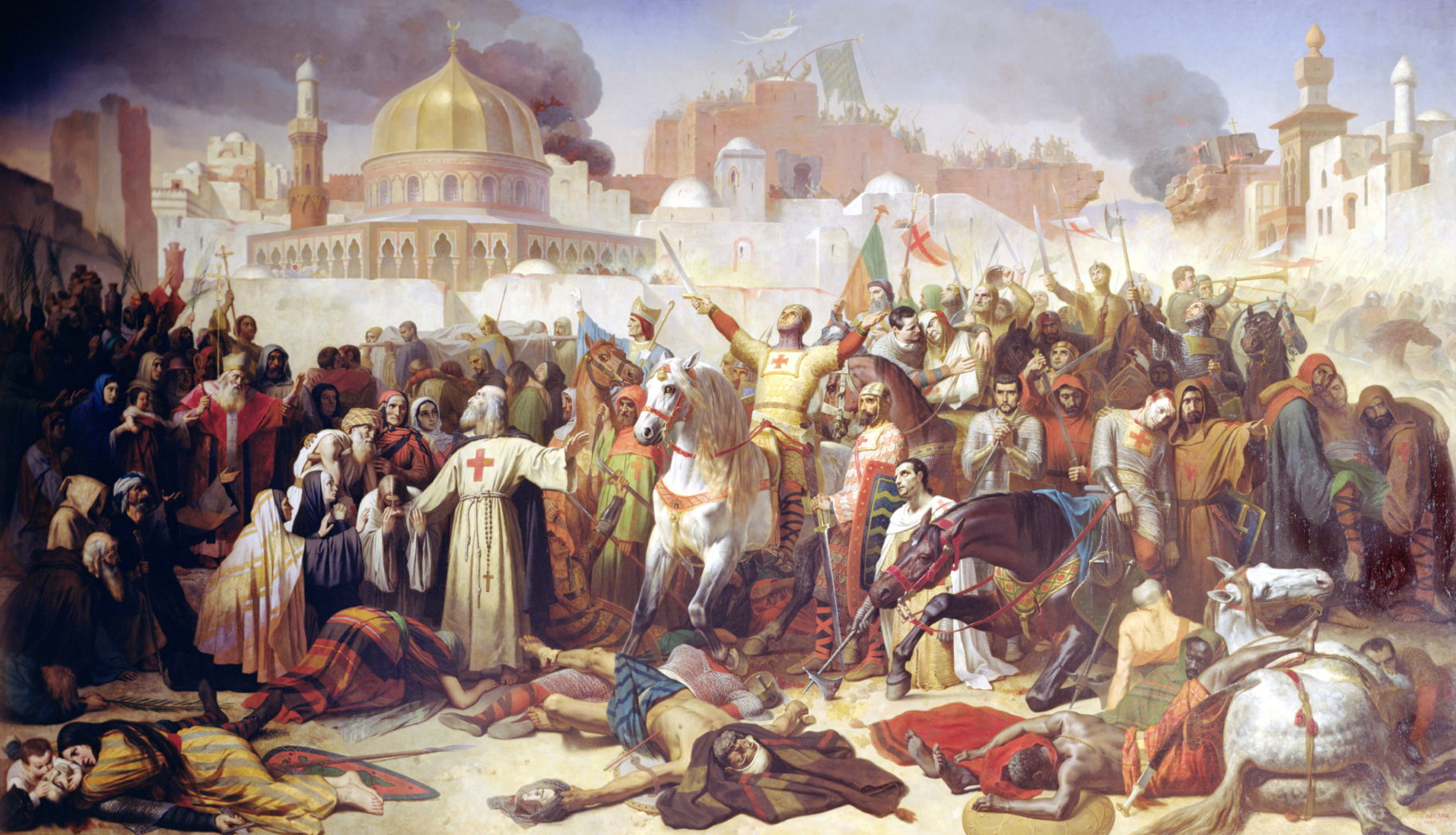
Émile Signol (1804–1892), Taking of Jerusalem by the Crusaders, 15th July 1099 (1847), oil on canvas, dimensions not known, Château de Versailles, Versailles, France. Wikimedia Commons.

Émile Signol’s Taking of Jerusalem by the Crusaders, 15th July 1099 from 1847 shows an idealised and expurgated version of what must have been carnage. At its centre, the knight on a white charger might be Godfrey of Bouillon, with a priest, perhaps Peter Desiderius, to the left. There are bodies littering the ground, and that in the centre is holding the severed head of a woman, and there is the smoke of a burning building, perhaps the synagogue. But there are also many figures apparently giving thanks to their ‘saviours’ for delivering the Holy City from occupation.

dorediscoverytruecross
Gustave Doré (1832–1883), The Discovery of the True Cross (1877), illustration for Joseph François Michaud’s ‘History of the Crusades’, further details not known. Wikimedia Commons.

Following the ‘delivery’ of Jerusalem, one subsidiary mission is to locate a relic, a fragment of wood claimed to be from the cross on which Christ had been crucified. This had been hidden by Eastern Orthodox priests following the destruction of the Church of the Holy Sepulchre in 1009. Soon after the city had been taken by the Crusaders, Arnulf of Chocques was made Latin Patriarch of Jerusalem, and sets about finding the precious relic.

Arnulf is reputed to have tortured the Orthodox priests who had hidden the True Cross until they revealed its location. Doré shows this with uncharacteristically wild exaggeration in The Discovery of the True Cross. The relic was actually just a small piece of wood set in a larger cross of gold, and has now been returned to the rebuilt Church of the Holy Sepulchre.

When Count Raymond of Toulouse initially refuses to become king of the new Crusader city of Jerusalem, Godfrey of Bouillon is chosen to be its leader, and Raymond storms off in anger with his troops.

The military action is still not complete, for on 10 August Godfrey leads his remaining troops to Ascalon, where on 12 August in a short battle they put a much larger Fatimid army to flight. Following that, most of the Crusaders return to Jerusalem, from where many, but by no means all, set off on their long journey back to Europe.

Godfrey of Bouillon dies the following year (1100) in Jerusalem, by which time he had already become the folk hero of the ‘armed pilgrims’ who responded to Pope Urban II’s call. He is succeeded by his brother Baldwin, who becomes King Baldwin I of Jerusalem.

blondelbaldwinjerusalem
Merry-Joseph Blondel (1781–1853), Baldwin I of Jerusalem (1844), oil on canvas, 167 x 112 cm, Château de Versailles, Versailles, France. Wikimedia Commons.

Merry-Joseph Blondel’s portrait of Baldwin I of Jerusalem from 1844 shows a surprisingly effete figure. The younger brother of Godfrey of Bouillon, he enjoyed substantial military success during his reign, dying in 1118. Like many others in the First Crusade, he never returned home.

lessingreturncrusader
Carl Friedrich Lessing (1808–1880), The Return of the Crusader (1835), oil on canvas, 66 × 64 cm, LVR-LandesMuseum Bonn, Rheinisches Landesmuseum für Archäologie, Kunst- und Kulturgeschichte, Bonn, Germany. Wikimedia Commons.

For those who did leave Jerusalem and try to make their way back to Europe, their experience was very different from that shown in Carl Friedrich Lessing’s romantic Return of the Crusader from 1835. Many were killed before they even got to Constantinople, or died from the harsh environment or disease. Those who did survive were, not surprisingly, welcomed as major heroes.

References

Wikpedia.

Thomas Asbridge (2004) The First Crusade, A New History, Free Press, ISBN 978 0 7432 2084 2.
John France (1994) Victory in the East, a Military History of the First Crusade, Cambridge UP. ISBN 978 0 521 589871.
Joanthan Riley-Smith, ed (1995) The Oxford Illustrated History of the Crusades, Oxford UP. ISBN 978 0 192 854285.
Jonathan Riley-Smith (2014) The Crusades, A History, 3rd edn., Bloomsbury. ISBN 978 1 4725 1351 9.

❌