Reading view

There are new articles available, click to refresh the page.

Jerusalem Delivered: 5 First skirmish and a sorceress

Those able-bodied Christians who were banished from the city of Jerusalem, together with Sophronia and Olindo, are gathering at the nearby town of Emmaus, where the crusaders have just arrived on their way to lay siege to the city.

As the crusaders are camping there at dusk, two ambassadors arrive from the king of Egypt: Alete, and Argante the Circassian. They are taken to meet Godfrey, and Tasso devotes the remainder of the second canto to their discussions. Alete courteously and diplomatically invites Godfrey to call a halt to the crusade before he attacks Jerusalem. He warns that continuing on his current course could bring the king of Egypt against him, and when united with Persian and Turkish forces, he would be heavily outnumbered. In return for stopping short of Jerusalem, Alete offers a truce and free passage to safety.

Godfrey politely rejects the offer, stressing how it is God’s hand that directs the crusaders. Argante is brief and blunt, and tells Godfrey that his rejection means war. When they leave, Alete returns to Egypt, and Argante to Jerusalem. That night, Godfrey and his army cannot sleep.

The third canto opens at dawn on the following day, as the crusaders march onward, and get their first sight of Jerusalem the Holy City. Within its walls, a sentinel sees the approaching army, first from the cloud of dust it throws up as it draws closer. He calls the citizens to defend their city; the old, young, and those unable to help in the defence go and shelter in its mosques.

Jerusalem’s ruler Aladine does his rounds of the defences, and calls for the company of Erminia, daughter of the dead former king of Antioch, who managed to flee to safety in Jerusalem when her father’s city fell to the crusaders.

pretierminia
Mattia Preti (1613–1699), Erminia, Princess of Antioch (date not known), oil on canvas, 98 x 73 cm, location not known. Wikimedia Commons.

Mattia Preti’s Erminia, Princess of Antioch, painted in the middle of the seventeenth century, shows her exuding nobility, with shoulder-length hair. She is reading an unintelligible inscription on a tree.

Clorinda leads the city’s troops out to attack the French crusaders, with Argante the Circassian holding himself in reserve in a secret gate in the city’s wall. She heads an attack on an advance party of crusaders who have been sent on to scavenge for livestock and crops to feed the army.

The captain of the city’s defenders is quickly knocked to the ground, but Clorinda weighs in and forces the French into retreat. They regroup on a hill, just as Godfrey sends Tancred and his troops to support them. Aladine is watching this with Erminia alongside him, and asks her to identify Prince Tancred from her experience at Antioch. Erminia cannot reply, as she chokes back tears, but finally tells Aladine of her desire to make him captive for her “sweet revenge”.

On the battlefield in front of them, Clorinda and Tancred charge at one another. Their lances strike the other’s visor and shatter, but Tancred’s blow knocks Clorinda’s helmet off, unfurling her long, golden hair. Tancred is thunderstruck by this revelation.

She charges at him a second time, but he turns away and attacks others with his sword. She chases after him, brandishing her sword and calling for him to turn and fight her. He refuses to respond to the blows from her sword, but calls on her to settle the matter away from the main battle. He then asks her to agree the terms on which she will fight. He proposes that she should remove his heart, drops his weapon, and bares his chest to her.

finogliajerusalem
Paolo Domenico Finoglia (1590–1645), Tancred Faces Clorinda (1640-45), media and dimensions not known, Palazzo Acquaviva, Conversano, Italy. Wikimedia Commons.

Paolo Domenico Finoglia’s painting of Tancred Faces Clorinda from 1640-45 shows this tense moment, when Tancred, his sword held low and away from Clorinda (who surprisingly has dark brown hair), makes clear his love for her. The battle rages on behind them.

Elsewhere, the crusaders are getting the better of Jerusalem’s forces, and the latter are starting to retreat to the city. One of the crusaders prepares to strike Clorinda from behind with his sword, but Tancred parries it away. It still strikes her neck a glancing blow, and blood from a small wound starts to colour her blonde hair. Clorinda seizes the opportunity to run back to her troops and join their retreat.

As the city troops reach the walls, they stop and wheel round to attack the rear of their pursuers. At the same time, Argante sends a small team out to attack their front. Argante leads them, and he and Clorinda start to gain victims from among overreaching crusaders. These are from Dudon’s ‘Adventurers’, with Rinaldo in the lead. Erminia tells Aladine about Rinaldo’s great skills in battle, and then points out their leader Dudon, and Gernando, brother of the king of Norway, and a married couple, Edward and Gildippe, who always fight side by side.

overbeckarganterinaldoclorinda
Johann Friedrich Overbeck (1789-1869), Argante, Rinaldo and Clorinda in Battle (1819-27), fresco, dimensions not known, Casa Massimo, Rome, Italy. Image by Sailko, via Wikimedia Commons.

Johann Friedrich Overbeck’s fresco of Argante, Rinaldo and Clorinda in Battle (1819-27), in the Casa Massimo in Rome, may show another scene from this battle, although here it would make more sense if the unhelmeted Clorinda were with Tancred rather than Rinaldo. Another puzzle is the white smock bearing the red cross of a crusader, being worn by Clorinda.

Rinaldo and Tancred now break through, and Rinaldo strikes Argante so hard he can barely get up again. Rinaldo’s horse is then struck, and he’s forced to pause while he extracts his foot from underneath it. The remaining city troops make the safety of the walls, leaving Argante and Clorinda to guard their rear. Dudon presses on, killing four of Argante’s men and threatening Argante himself, who manages to sink the blade of his sword deep into Dudon’s body.

Argante doesn’t hang around, but gets back to the wall, as the citizens start hurling rocks and loosing arrows at the crusaders. Rinaldo, free at last from his horse, is fired by the death of Dudon, and charges at the city troops despite the hail of rocks and arrows. He and the other crusaders pull up short, and they too turn away from the fight, recovering the body of Dudon on the way.

Godfrey has taken the opportunity to study the city and its defences, and notes that its approach is difficult on three of its four sides, but easiest from the north, where it’s most strongly fortified.

As he is weighing up where best to pitch camp, Erminia points him out to Aladine, who recognises him from a meeting when he was an Egyptian diplomat to the court of France. Also identified, standing next to Godfrey, is his brother Baldwin, and on his other side Raymond, William son of the king of England, and Guelph, but Bohemond (who killed Erminia’s family) is nowhere to be seen.

Godfrey decides that, as he has insufficient troops to encircle the city, he will station them at all its points of entry, and that they will dig in using ditches to prevent surprise attacks. He then goes off to join those mourning the death of Dudon in the dark night.

Overnight, Godfrey makes further plans. Recognising the strength of the city’s walls, he tries to work out where he can acquire timber to build siege towers. At first light, he joins Dudon’s funeral. After that, he has a Syrian take him to the only woods in the area, where he sets men to work felling those trees in preparation. That ends the third canto.

The fourth canto opens with a long and florid account of pagan visions of the underworld conjured up in Aladine’s mind, and an accompanying speech by Satan to inspire the “pagans” of Jerusalem to defeat the crusaders. This leads to the introduction of Hydrotes, a “magician” who rules Damascus and its neighbouring cities, whose niece is the beautiful sorceress Armida.
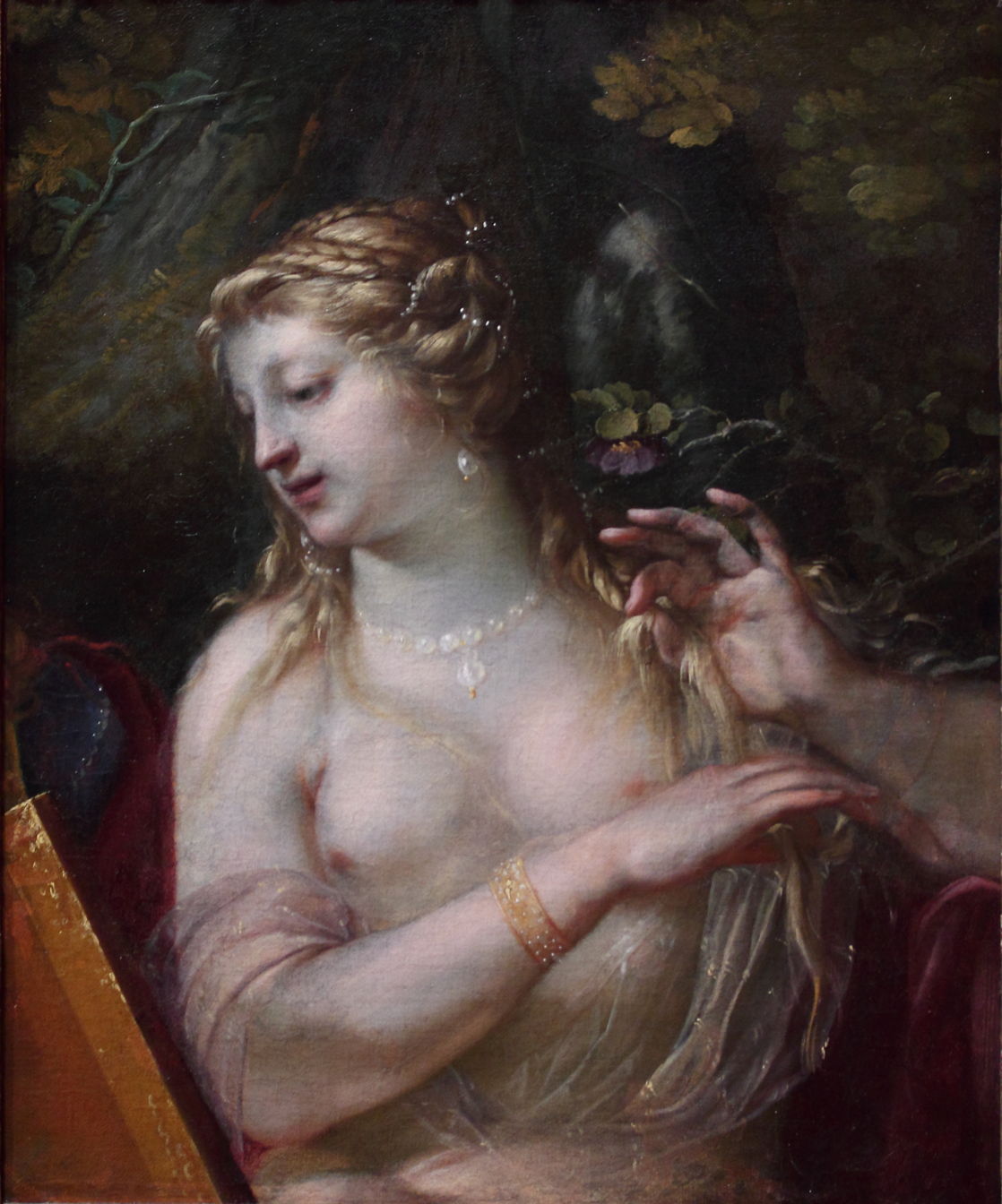
blanchardarmide
Jacques Blanchard (1600–1638), Armida (date not known), oil on canvas, dimensions not known, Musée de Beaux-Art de Rennes, Rennes, France. Image by Caroline Léna Becker, via Wikimedia Commons.

Jacques Blanchard’s undated portrait of Armida, probably from around 1630, shows her dangerously alluring like Circe.

Hydrotes sees Armida as central to his grand plan to defeat the crusaders, and directs her to the enemy camp, to win the warriors over, and make Godfrey infatuated with her. Armida rises to the challenge, and travels through the night to enter the crusaders’ camp. She quickly beguiles the men there, and can twist them around her little finger.

Armida spins the crusaders a story of how she has fallen on bad times, and calls on Godfrey to shelter her. She bumps into his brother, and in no time is speaking with Godfrey himself.

teniersarmidabeforegodfrey
David Teniers the Younger (1610–1690), Armida before Godfrey of Bouillon (1628-30), oil on copper, 27 x 39 cm, Museo Nacional del Prado, Madrid, Spain. Wikimedia Commons.

David Teniers the Younger shows this scene in this wonderful painting in oil on copper of Armida before Godfrey of Bouillon, from 1628-30. The sorceress is seen with a small lapdog and a couple of young maids, as might befit a contemporary woman of her standing. Next to the young Godfrey is Peter the Hermit, with his long white beard.

After introductory flattery, Armida proceeds to tell Godfrey a long sob story, from the death of her mother just prior to her birth, to the threat of torture and death for her and her friends because she was alleged to have conspired to poison a tyrant. All she needs are ten of Godfrey’s best knights to go and sort that king out.

Godfrey sat and thought about her request.

References

Wikipedia on Jerusalem Delivered.
Wikipedia on Torquato Tasso.

Project Gutenberg (free) English translation (Fairfax 1600).

Librivox audiobook of the Fairfax (1600) English translation (free).

Thomas Asbridge (2004) The First Crusade, A New History, Free Press, ISBN 978 0 7432 2084 2.
Anthony M Esolen, translator (2000) Torquato Tasso, Jerusalem Delivered, Gerusalemme Liberata, Johns Hopkins UP. ISBN 978 0 801 863233. A superb modern translation into English verse.
John France (1994) Victory in the East, a Military History of the First Crusade, Cambridge UP. ISBN 978 0 521 589871.
Joanthan Riley-Smith, ed (1995) The Oxford Illustrated History of the Crusades, Oxford UP. ISBN 978 0 192 854285.
Jonathan Riley-Smith (2014) The Crusades, A History, 3rd edn., Bloomsbury. ISBN 978 1 4725 1351 9.
Johathan Unglaub (2006) Poussin and the Poetics of Painting, Pictorial Narrative and the Legacy of Tasso, Cambridge UP. ISBN 978 0 521 833677.

Jerusalem Delivered: 4 Advance to Emmaus

My previous articles in this series provided a short summary of the First Crusade, setting the context for Torquato Tasso’s epic Jerusalem Delivered, which opens with a conventional dedication to the muse, and homage to his patron, Alfonso II of Este.

Tasso’s narrative starts with events six years after the Pope’s call to crusade (actually in late 1095), and briefly mentions the capture of Nicaea and Antioch, to set the opening scene in the following winter (1098-99), with the crusaders in their quarters at ‘Tortosa’. That is now known as Tartus in Syria, a port on the Mediterranean coast well to the south of Antioch.

Tasso gives an overview of the main figures of the First Crusade through the eyes of God:

  • Godfrey of Bouillon, whom he praises as a hero;
  • Baldwin, with his ‘vain ambition’;
  • Tancred, who is suffering the pangs of love;
  • Bohemond, who is bringing law and order to Antioch as its ruler;
  • Rinaldo, the courageous and restless warrior.
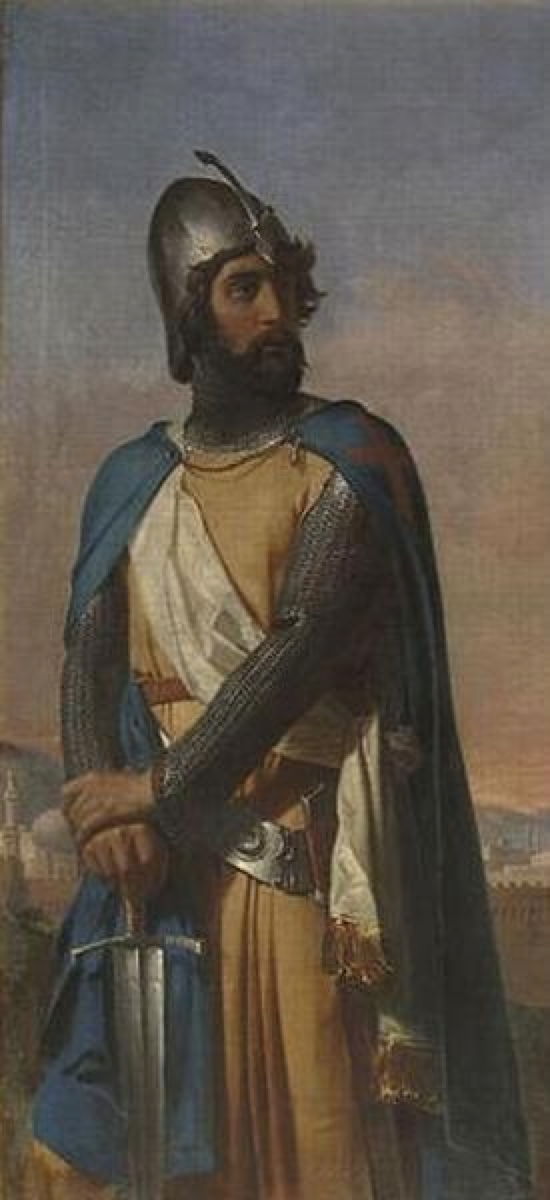
blondeltancred
Merry-Joseph Blondel (1781–1853), Tancred of Hauteville, Prince of Galilee (1840), oil on canvas, 167 x 78 cm, Château de Versailles, Versailles, France. Wikimedia Commons.

Three of these figures are well-known, and appear in various paintings, but Tasso reinvents those of Tancred and Rinaldo, the heroes of his epic. Merry-Joseph Blondel’s painting of Tancred of Hauteville, Prince of Galilee from 1840 shows Tancred rather later during the Crusade, looking suitably grand.

God therefore sends down the Archangel Gabriel to spur Godfrey to lead the Crusaders onwards to free Jerusalem, which the archangel does just as Godfrey is at his morning prayers.

overbeckarchangelgabrielgodfrey
Johann Friedrich Overbeck (1789-1869), The Archangel Gabriel Appears to Godfrey of Bouillon (1819-27), fresco, dimensions not known, Casa Massimo, Rome, Italy. Image by Sailko, via Wikimedia Commons.

In this section of Johann Friedrich Overbeck’s magnificent frescoes in the Casa Massimo, in Rome, The Archangel Gabriel Appears to Godfrey of Bouillon. His companions are still asleep as Gabriel speaks to Godfrey, clutching what most would now recognise as a flag of the Cross of Saint George, in red on a white background.

guardigodfreyboulogne
Francesco Guardi (1712–1793), Godfrey of Boulogne Summons His Chiefs to Council (c 1755), oil on canvas, 250.2 x 109.9 cm, Norton Simon Museum, Pasadena, CA. Wikimedia Commons.

Francesco Guardi shows a slightly later moment, as the archangel flies away from the scene, and Godfrey of Boulogne Summons His Chiefs to Council (c 1755).

All the leaders except Bohemond attend this meeting, at which Godfrey reminds them of their primary mission, to deliver the Holy City of Jerusalem, and the need to make haste towards it. Peter the Hermit then speaks in support, castigating the individual leaders for their in-fighting and rivalry. The leaders agree to Godfrey being in overall command.

The following morning, their troops parade as they prepare to set off to travel south along the coast. This provides Tasso with the opportunity to enumerate them:

  • French, from the Île de France, formerly led by Hugh, now by Clothar, one thousand;
  • Norman cavalry under Robert, one thousand;
  • former priests from the Low Countries under Bishops William and Ademar, totalling eight hundred;
  • forces of Godfrey and his brother Baldwin, with the Count of Chartres too, 1600 in all;
  • Germans from between the Danube and the Rhine, under Guelph, less than two thousand;
  • Dutch and Flemish, under another Robert, two thousand total;
  • English, under William, the son of the king, slightly more than two (or one?) thousand;
  • Irish, no leader or number given;
  • from Campania, under Tancred, eight hundred;
  • Greece, led by Tatin, just two hundred;
  • ‘adventurers’, or unattached and mercenaries, led by Dudin of Contz, no number given;
  • men from the Pyrenees, under Raymond of Toulouse, four thousand;
  • men from Blois and Tours, under Stephen of Ambois, five thousand;
  • Swiss, under Alcasto, six thousand;
  • Italians, under Camillus, seven thousand.

Tasso gives a grand total of around thirty-five thousand, which is probably more than double the number of surviving crusaders at this stage.

In his remarks about Tancred, Tasso tells the story of him falling in love at first sight with a young girl clad in armour, during a battle in which Persians were put to flight. Tancred had gone to a brook to cool off afterwards, when this ‘pagan’ arrived for the same purpose. She then left, donning her helmet, without Tasso even revealing her name at this stage.

The army’s departure is made the more urgent as Godfrey has heard the ruler of Egypt with his army is on his way to his fortress at Gaza, which could be used to attack the crusaders as they approach Jerusalem. Godfrey then sends his trusty messenger by boat to Greece, to obtain reinforcements promised by the king.

The next day they depart to the sound of trumpets and drums. Godfrey sends lightly-armoured knights to scout in advance and ensure the main army isn’t ambushed, and field engineers to ensure their route of march is free from obstacles. The crusaders meet little opposition as they make their way south: even the King of Tripoli capitulates and welcomes them into his well-defended city.

As they march down the coast, they receive ships from several of their supporting countries bringing them provisions.

Word of their progress reaches Aladine, ruler of Jerusalem, who, being newly in charge of the city, already has other concerns. He had raised taxes on the Christian minority in Jerusalem, and harbours ideas of killing them all. He doesn’t attempt that, but burns their harvest, demolishes their huts, and poisons their wells, while strengthening the city’s fortifications.

The second Canto starts with Aladine in Jerusalem. A former Christian soothsayer, Ismen, warns the ruler to prepare for the arrival of the crusaders, but predicts that Aladine will be triumphant. Ismen then asks for a sacred icon of the Virgin Mary to be secretly stolen and hidden away to protect the ruler.

Aladine has this done, but the theft is noticed by a guard, who reports it to the ruler. The latter then claims that it must have been stolen by a Christian, and has the city searched. He decrees that the thief will die, but if no thief is found, it provides him with an excuse for killing all the Christians. He incites a mob, calling for them to “burn and kill”.

A young Christian woman named Sophronia, who is in love with the Christian Olindo, then comes forward and tells Aladine that it was she, and she alone, who stole the icon. When the ruler asks her where it is hidden she responds that she burned it. Sophronia is condemned to death by being burned at the stake.

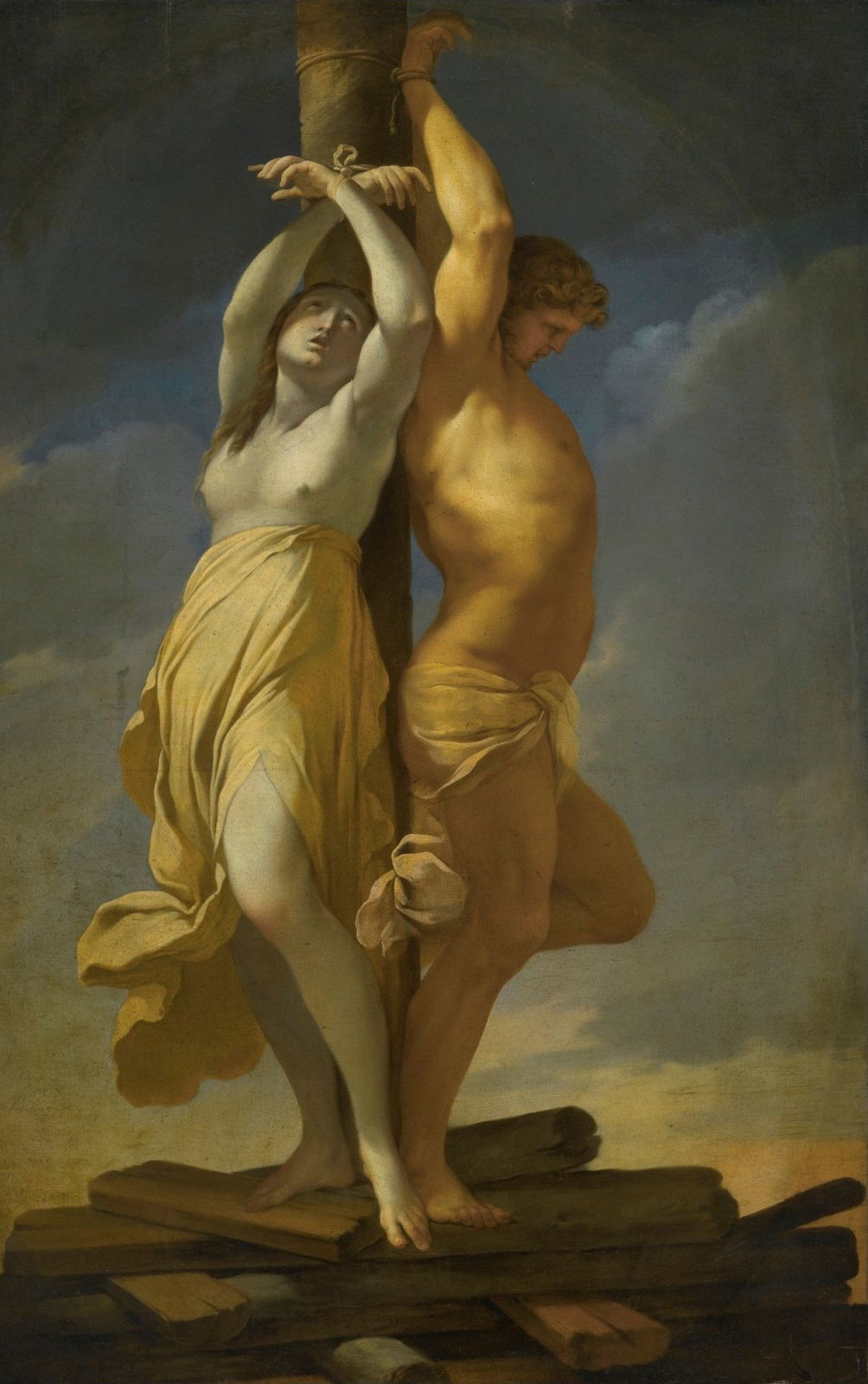
As the crowds are gathering to watch her die, Olindo arrives, and insists that she is not the thief. Although he gives Aladine an account of how he accomplished this, the ruler of course knows that neither did. But he cannot back down, and sentences Olindo to die at the same stake, tied with his back to his love, so they cannot see one another as they die.

bauginolindosofroniapyre
Lubin Baugin (1612–1663), Olindo and Sophronia on the Pyre (c 1645), oil on canvas, 157.5 × 111.8 cm, location not known. Wikimedia Commons.

Lubin Baugin’s dramatically simple painting from about 1645 shows Olindo and Sophronia on the Pyre.

Just as Aladine’s men are about to light the kindling and kill the Christian couple, who are making their farewell speeches, a warrior rides up. This is Clorinda, a beautiful young woman, who is moved by the sight of the two lovers about to die together. When a bystander explains what is happening, she instructs the executioners to stop their preparations as she speaks to Aladine.

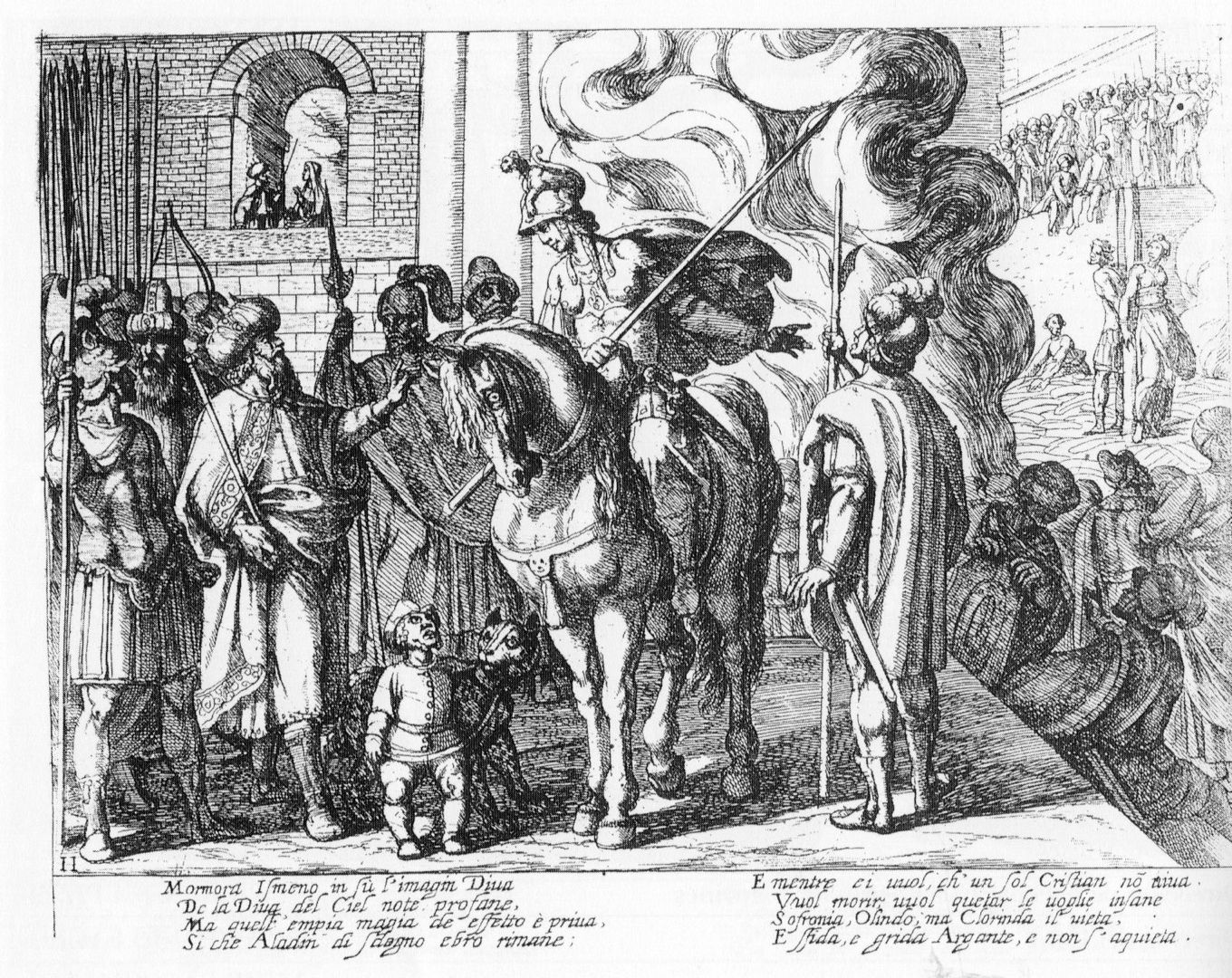
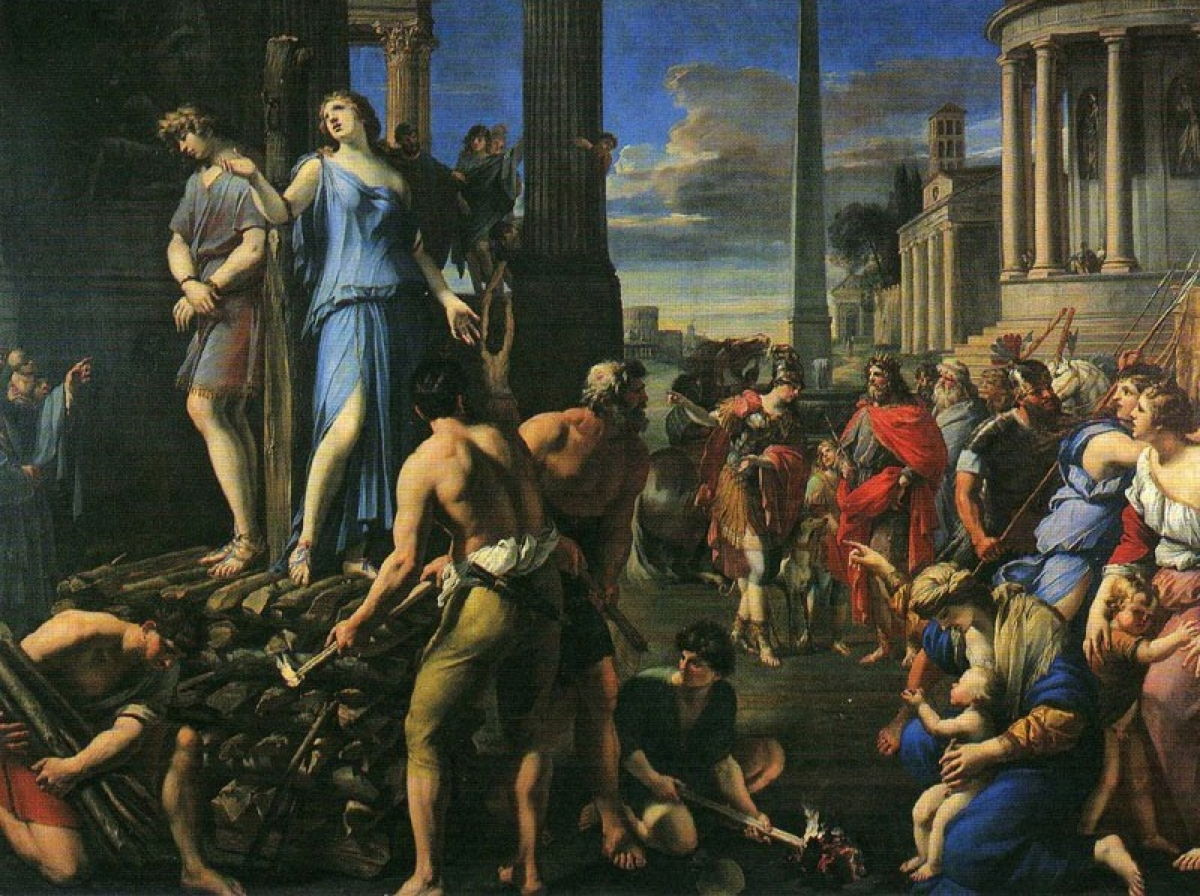
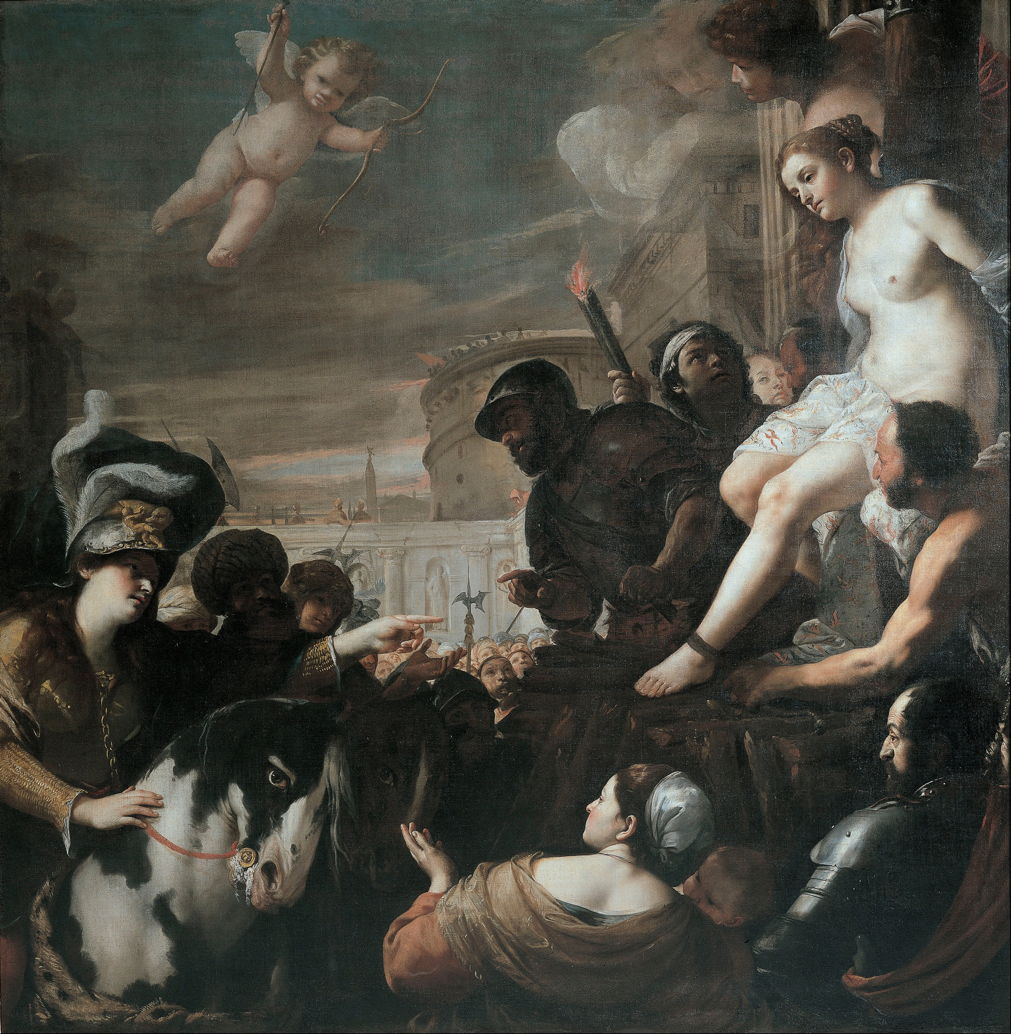
Clorinda introduces herself to Aladine, and offers her services. In return, she asks that he frees Sophronia and Olindo, on the grounds that no Christian would have stolen such a holy icon. This has proved a popular scene with a succession of artists, from shortly after the publication of Tasso’s epic up to the middle of the nineteenth century.

tempestaolindosofronia
Antonio Tempesta (1555–1630), illustration from Tasso’s ‘Gerusalemme Liberata’ (c 1597), engraving, further details not known. Wikimedia Commons.

Antonio Tempesta’s engraved illustration from about 1597 puts Clorinda in the centre foreground, as she talks to Aladine at the left. The couple are shown at a stake to the far right, in the background.

perrierolindosofronia
François Perrier (1594–1649), Olindo and Sophronia (c 1639), media and dimensions not known, Musée des beaux-arts de Reims, Reims, France. Wikimedia Commons.

François Perrier’s Olindo and Sophronia from about 1639 reverses this, with Clorinda and Aladine in the distance at the right, and the young couple standing as their executioners prepare the pile of wood for burning.

preticlorindarescuesolindo
Mattia Preti (1613–1699), Clorinda rescues Olindo and Sophronia (1646), media not known, 248 x 245 cm, Musei di Strada Nuova, Genoa, Italy. Wikimedia Commons.

Mattia Preti brings them all together in Clorinda Rescues Olindo and Sophronia from 1646, with a man stood behind Aladine bearing a burning brand. In the sky is a Cupid, and Sophronia is almost unclad.

vanpoelenburghclorindasavingolindo
Cornelius van Poelenburgh (1594/95–1667), Clorinda Saving Olindo and Sophronia from the Stake (date not known), further details not known. Wikimedia Commons.

Cornelius van Poelenburgh’s undated Clorinda Saving Olindo and Sophronia from the Stake is less structured and more expansive. Clorinda is on her horse at the right, and a naked Sophronia stands at the stake in the centre.

overbecksofroniaolindosaved
Johann Friedrich Overbeck (1789-1869), Sophronia and Olindo Saved by Clorinda (1819-27), fresco, dimensions not known, Casa Massimo, Rome, Italy. Image by Sailko, via Wikimedia Commons.

Although painted almost two centuries later, Overbeck’s fresco of Sophronia and Olindo Saved by Clorinda (1819-27) is less cluttered and easier to read. Unusually, Clorinda is shown riding a white charger, and with golden rather than black armour.

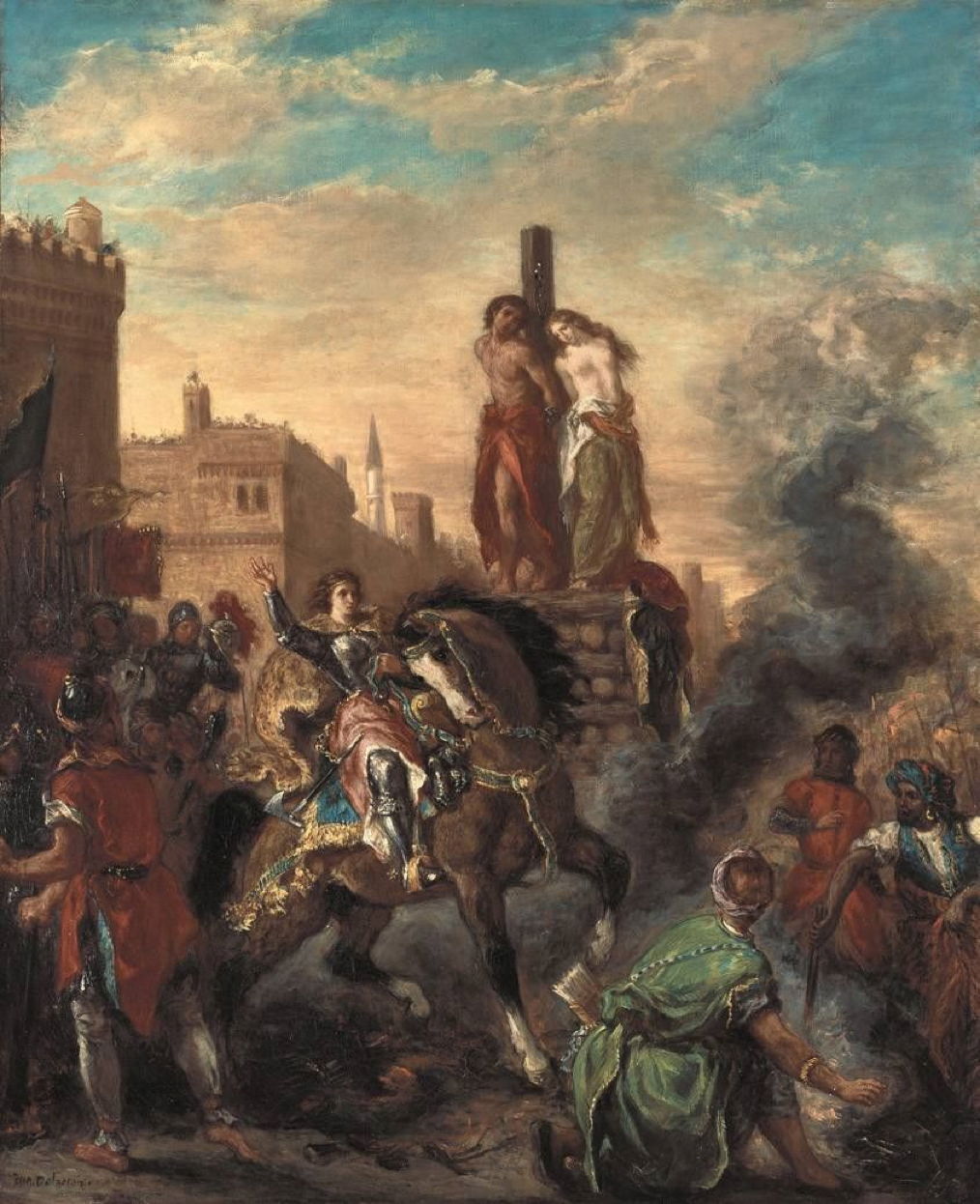
delacroixclorindafreesolindo
Eugène Delacroix (1798–1863), Clorinda Rescues Olindo and Sophronia (1856), oil on canvas, 101 x 82 cm, Neue Pinakothek, Munich, Germany. Wikimedia Commons.

Eugène Delacroix’s Clorinda Rescues Olindo and Sophronia from 1856 is a minor masterpiece. Clorinda has just arrived, wearing her more conventional black armour, as one of the enemies of the crusaders, and holds up her right hand to tell the executioners to stay as they are. The stake is raised high, putting the couple in full view, although Aladine is nowhere to be seen.

Aladine cannot refuse Clorinda, nor refute her reasoning, so he decrees that the couple be freed. However, he imposes the condition that they are banished from Jerusalem, and must live outside Palestine. He also banishes all other able-bodied Christians, who could pose a threat when the crusaders arrive. They mostly find their way to the town of Emmaus, which the crusaders have just reached.

References

Wikipedia on Jerusalem Delivered.
Wikipedia on Torquato Tasso.

Project Gutenberg (free) English translation (Fairfax 1600).

Librivox audiobook of the Fairfax (1600) English translation (free).

Thomas Asbridge (2004) The First Crusade, A New History, Free Press, ISBN 978 0 7432 2084 2.
Anthony M Esolen, translator (2000) Torquato Tasso, Jerusalem Delivered, Gerusalemme Liberata, Johns Hopkins UP. ISBN 978 0 801 863233. A superb modern translation into English verse.
John France (1994) Victory in the East, a Military History of the First Crusade, Cambridge UP. ISBN 978 0 521 589871.
Joanthan Riley-Smith, ed (1995) The Oxford Illustrated History of the Crusades, Oxford UP. ISBN 978 0 192 854285.
Jonathan Riley-Smith (2014) The Crusades, A History, 3rd edn., Bloomsbury. ISBN 978 1 4725 1351 9.
Johathan Unglaub (2006) Poussin and the Poetics of Painting, Pictorial Narrative and the Legacy of Tasso, Cambridge UP. ISBN 978 0 521 833677.

❌