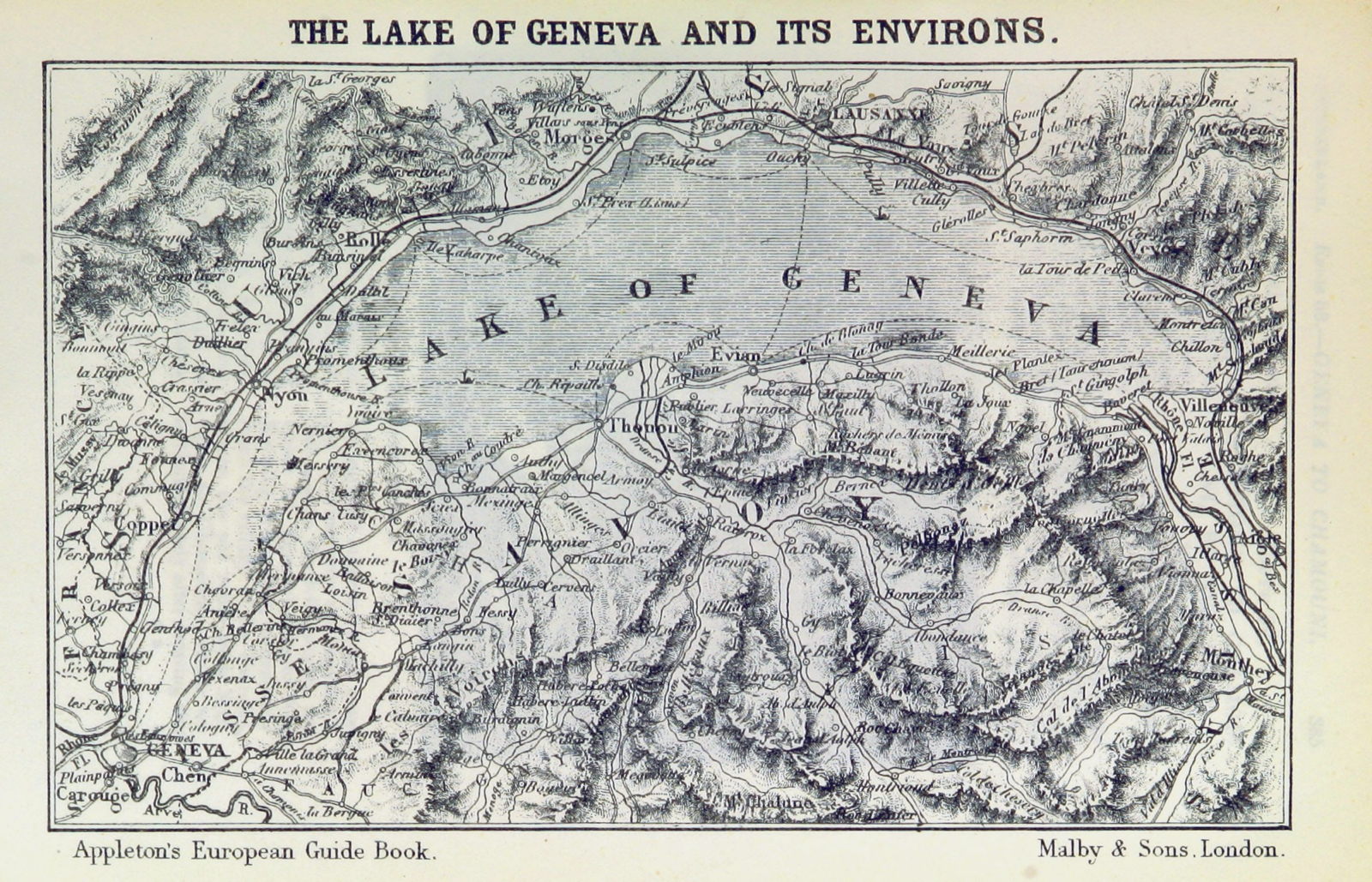
This weekend we’re off to visit Lake Geneva, also known by its French name of Lac Léman, the largest in Switzerland. It’s located in the far south-west of the country, where it forms much of its border with France. It makes a broad arc running north-east from the capital city of Geneva, with some of the highest peaks of the Alps to its south.
Daniel Appleton et al., Map of Lake Geneva (1877), p 521 in Appleton’s European Guide Book illustrated, 10th edition, D. Appleton & Co, New York. The British Library, London. Wikimedia Commons.
Today I start with a selection of paintings almost exclusively from the nineteenth century, when Switzerland was on the itinerary of the Grand Tour undertaken by aspiring young men of the upper class in both Europe and the Americas.
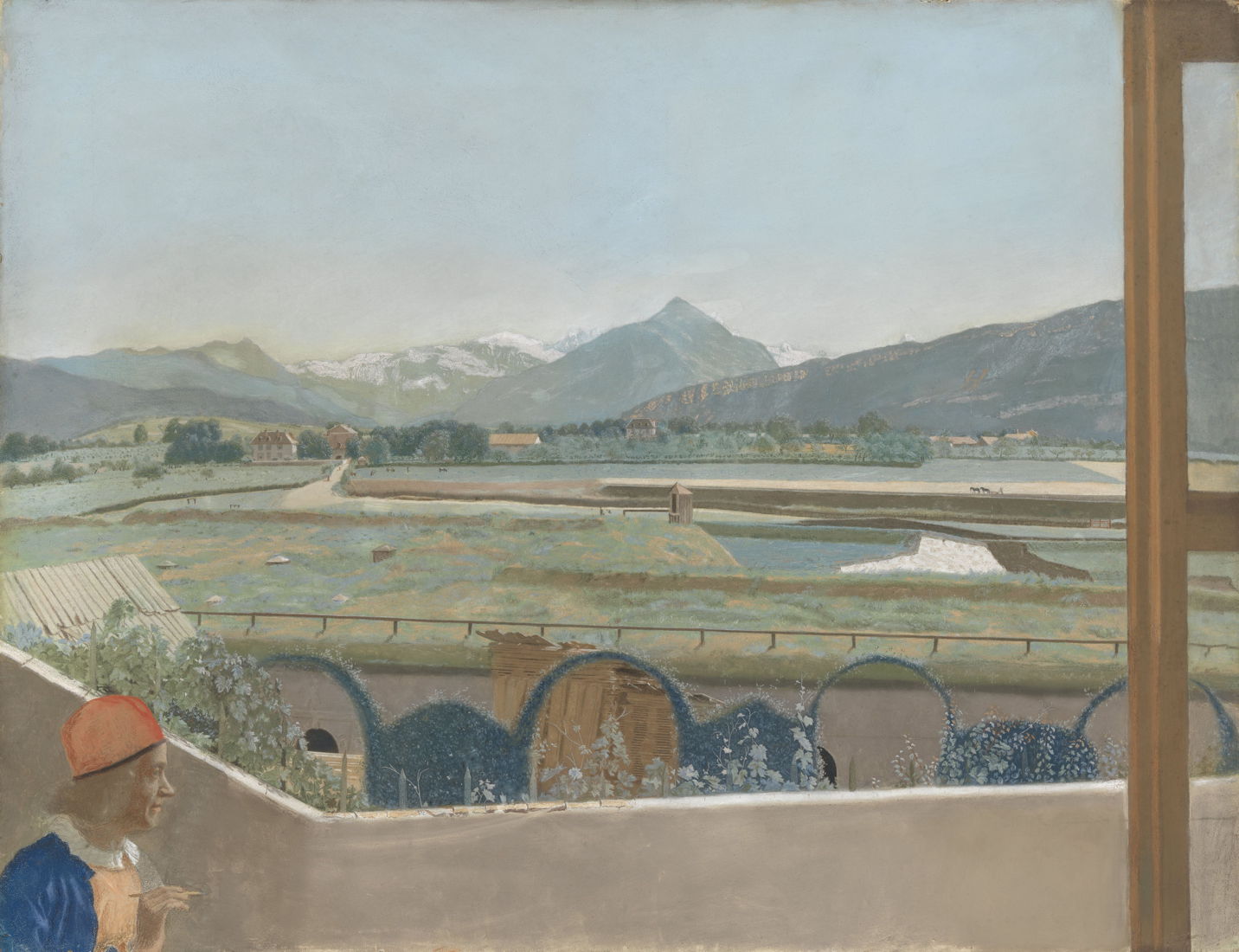
Jean-Étienne Liotard (1702-1789), View of the Mont Blanc Massif from the Artist’s Studio (1765-70), pastel on parchment, 46 x 59.7 cm, location not known. Wikimedia Commons.
The city of Geneva has long attracted artists, and it was here the eccentric pastellist Jean-Étienne Liotard was born and later kept his studio, and where he eventually retired. His View of the Mont Blanc Massif from the Artist’s Studio from 1765-70 reveals only a little of the southern extreme of the lake, with a cameo self-portrait.
Joseph Mallord William Turner (1775–1851), Lake Geneva and Mount Blanc (1802-05), watercolour, 90.5 x 128.6 cm, Yale Center for British Art, New Haven, CT. Wikimedia Commons.
JMW Turner was by no means the first to paint the lake, but his watercolour of Lake Geneva and Mount Blanc from 1802-05 is one of its earliest depictions by a major artist. This view looks south-east over the city of Geneva towards the Mont Blanc massif in the far distance.
Alexandre Calame (1810–1864), View of Bouveret (1833), oil on panel, 35 x 47.5 cm, location not known. Wikimedia Commons.
Alexandre Calame’s View of Bouveret from 1833 shows a grey heron fishing on the shore at the southern end of the lake, close to the border with France.
Alexandre Calame (1810–1864), View of Lake Geneva (Lac Léman) (1849), oil on wood, 67 x 86 cm, Villa Vauban, Musée d’art de la ville de Luxembourg, Luxembourg. Wikimedia Commons.
While Turner had toured the Alps once travel from England had become possible again in the early nineteenth century, Calame pioneered the painting of views like this of the lake, completed in his studio in 1849. It includes some of the distinctive sailing boats of the Swiss lakes, and a small bird in the shallows, but not a heron here.
John Ferguson Weir (1841-1926), Lake Leman (Lake Geneva), Switzerland (1869), oil on paper, 20.3 x 33 cm, Private collection. Wikimedia Commons.
In the middle of the nineteenth century, several major American artists visited Switzerland to develop their skills painting mountain views. Despite its finish, John Ferguson Weir’s Lake Leman (Lake Geneva), Switzerland may have been painted in front of the motif, on 11 June 1869.
Following Gustave Courbet’s release from prison for his involvement in the Paris Commune and destruction of the Vendôme Column in 1871, he was forced to flee to the safety of Switzerland, where he lived his remaining years there, unable to return to France.
Gustave Courbet (1819–1877), Sunset over Lac Leman (1874), oil on canvas, 55 x 65 cm, Musée Jenisch, Vevey, Switzerland. Image by Volpato, via Wikimedia Commons.
Courbet painted some of the finest landscapes of his career during his exile in Switzerland, like this Sunset over Lac Léman from 1874, the year of the First Impressionist Exhibition in Paris.
Gustave Courbet (1819–1877), Chillon Castle (1875), oil on canvas, dimensions not known, Private collection. Wikimedia Commons.
He became particularly obsessed with the island château at the extreme eastern end of Lake Geneva, Chillon Castle, here in 1875. This picturesque château dates back to a Roman outpost, and for much of its recorded history from about 1050 has controlled the road from Burgundy to the Great Saint Bernard Pass, a point of strategic significance. It has since been extensively restored, and is now one of the most visited mediaeval castles in Europe.
Gustave Courbet (1819–1877), Chillon Castle (1874-77), oil on canvas, 73 x 92 cm, location not known. Wikimedia Commons.
Chillon Castle from 1874-77 is another of the views he painted of the castle on the lake.
Gustave Courbet (1819–1877), Sunset on Lake Geneva (c 1876), oil on canvas, 74 x 100 cm, Kunstmuseum St. Gallen, St. Gallen, Switzerland. Wikimedia Commons.
Sunset on Lake Geneva from about 1876 is reminiscent of Courbet’s earlier seascapes with breaking waves, but now the water is calm once more.
In May 1877, the French government informed Courbet that the cost of rebuilding the Vendôme Column would be over 300,000 Francs, which he could pay in instalments of 10,000 Francs each year, starting on 1 January 1878. Courbet died in Switzerland the day before, on 31 December 1877, at the age of only 58.
Most figurative art, both painting and sculpture, is the product of a partnership between the artist and their model. This weekend I celebrate the contributions made by the latter, always seen but never credited. The partnership often extends beyond art into their personal lives, but is seldom acknowledged by either party. Ironically, we come to know the faces and bodies of those models far better than those of the artist, so at least the long-suffering model achieves some kind of immortality.
In many circumstances, models are called on to hold certain postures for uncomfortably long times.
But they are momentary in comparison with marathons spread over several months, as required by Ellen Altfest‘s highly detailed realism. In order to achieve this, she enforces a five minute break every thirty minutes of posing, but even then models may have to drop out because of the number of days required posing for each of her paintings.
Some artists have pondered their relationship with their models visually,
Jean-Léon Gérôme (1824–1904), The Artist’s Model (1895), oil on canvas, 50.8 x 39.6 cm, Dahesh Museum of Art, New York, NY. Wikimedia Commons.
Jean-Léon Gérôme’s The Artist’s Model (1895) is one of a series of works considering the artist – here, Gérôme in the role of a sculptor – the model, and the art work. Behind his model Emma Dupont is a completed polychrome statue of her putting her head through a hoop.
Like so many others, Emma Dupont arrived in Paris with her lover at the age of seventeen, only to be abandoned by him. Penniless, she was introduced to modelling by Alfred Stevens, and it was Fernand Cormon who first persuaded her to pose nude. She worked for several other artists before catching Gérôme’s eye, and quickly became his favourite. Over a period of about twenty years, she was frequently to be found naked in Gérôme’s studio, from which she made a comfortable living. No one knows if she had any closer relationship with him, or with any other artist.
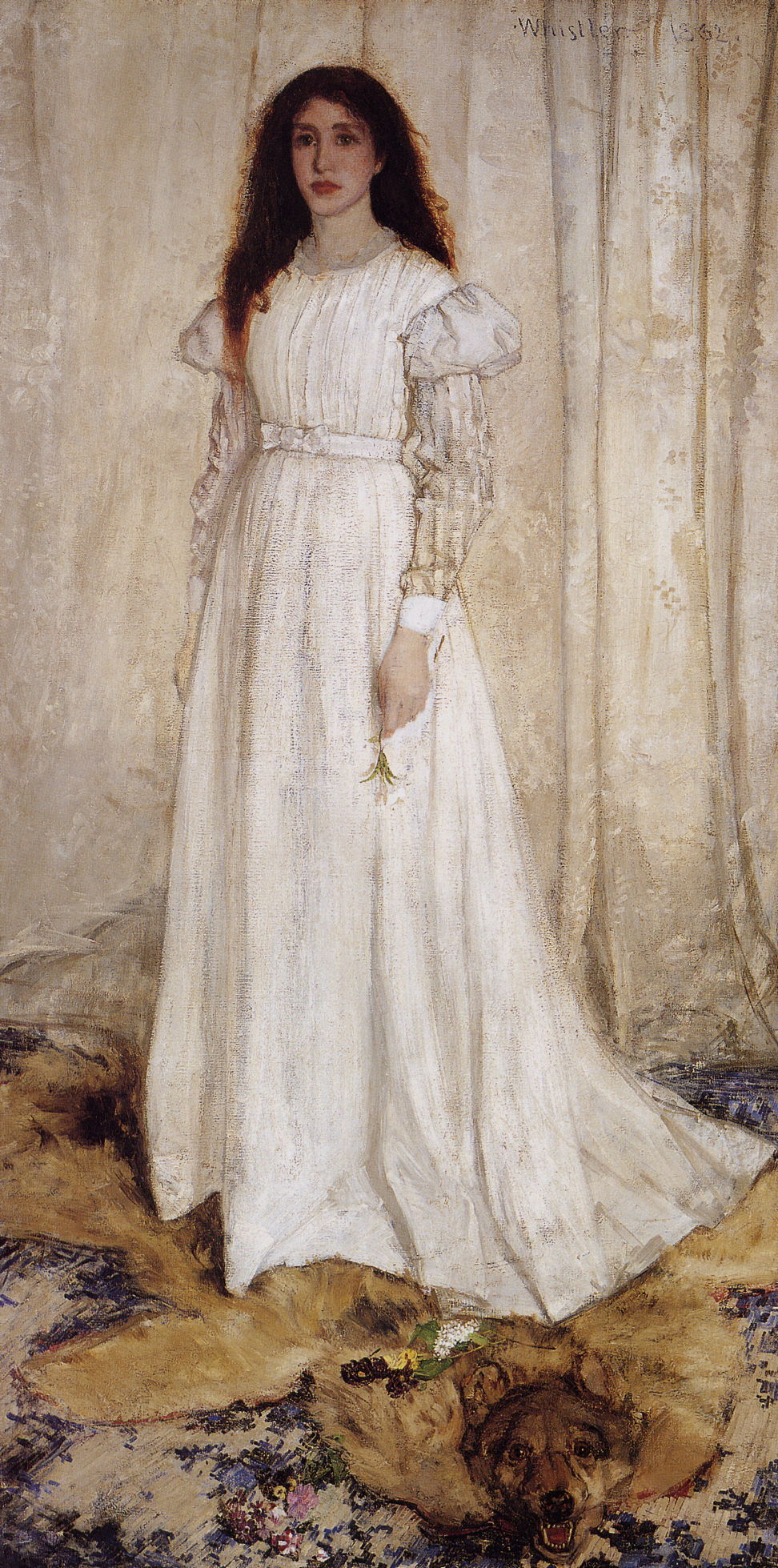
One of the most famous of all artists’ models was a young Irish woman, Joanna Hiffernan, who appears in some of Whistler’s and Courbet’s paintings, and was a lover to both. Hiffernan seems to have been born in about 1843, and first met Whistler in 1860. She travelled with him to France in 1861, and posed there in a studio in Boulevard des Batignolles for one of his greatest paintings.
James Abbott McNeill Whistler (1834–1903), Symphony in White no 1: The White Girl – Portrait of Joanna Hiffernan (1862), oil on canvas, 214.6 × 108 cm, The National Gallery of Art, Washington, DC. Wikimedia Commons.
Whistler’s remarkable Symphony in White no 1: The White Girl (1862) shows her great beauty. But there was more to her than her looks: those who knew her remarked on her intelligence, the sympathy that she gave people, and the companionship that she provided the artist.
Attitudes towards artists’ models at the time weren’t even ambivalent: they were seen as little more than common prostitutes. When Whistler’s mother visited in 1864, Hiffernan had to be secreted away from her sight. At some time around 1865-66, she met Gustave Courbet, and when Whistler went off to Valparaiso for seven months in 1866, she returned to Paris and posed for Courbet.
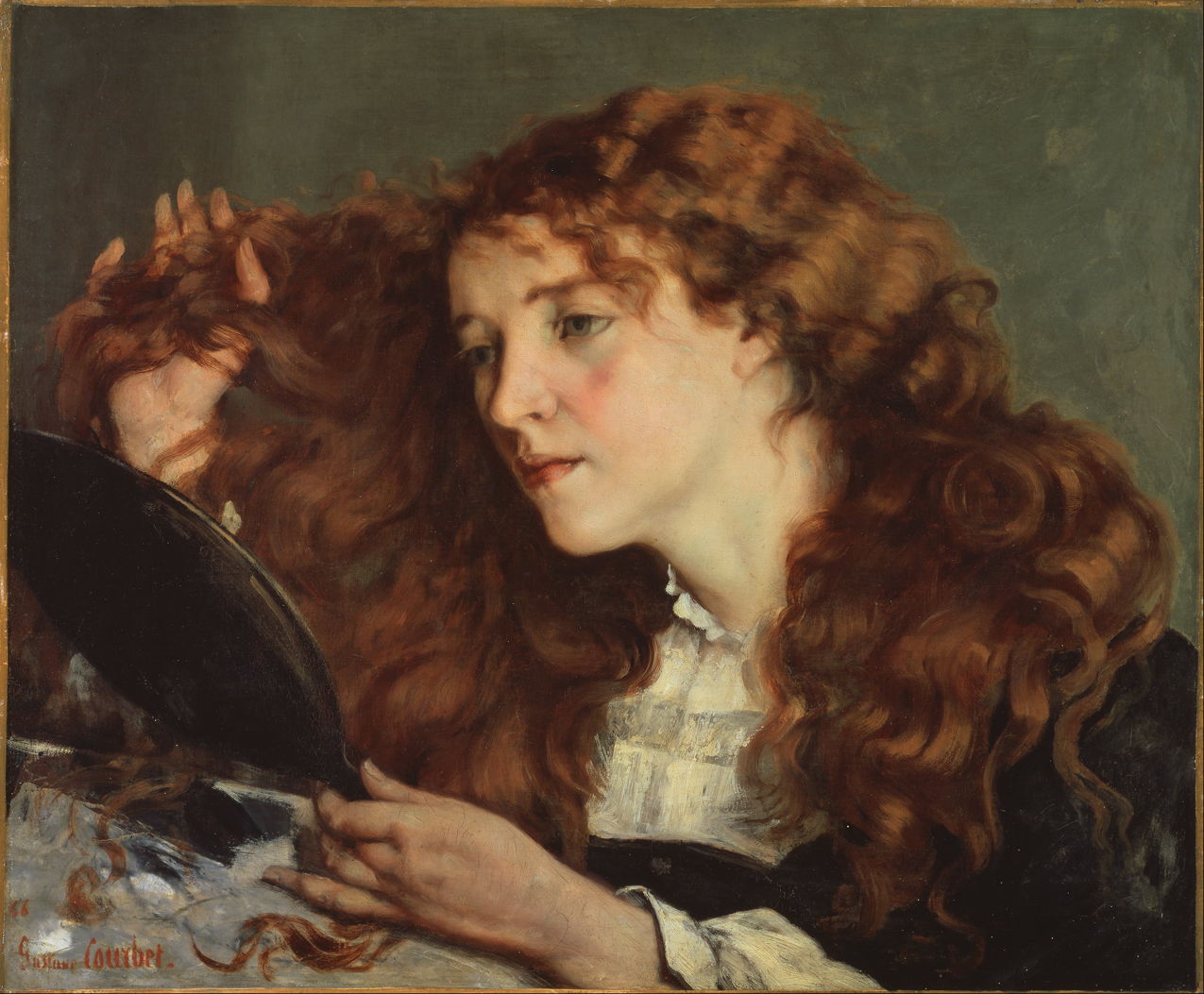
Gustave Courbet (1819–1877), Jo, the Beautiful Irish Girl (1866), oil on canvas, 54 x 65 cm, Nationalmuseum, Stockholm, Sweden. Wikimedia Commons.
Courbet’s initial modest portrait of Jo, the Beautiful Irish Girl (1866) was a harbinger of more to come.
Gustave Courbet (1819–1877), Woman with a Parrot (1866), oil on canvas, 129.5 x 195.6 cm, The Metropolitan Museum of Art, New York, NY. Wikimedia Commons.
Next she is the erotically-charged nude in Courbet’s Woman with a Parrot (1866), then in a lesbian embrace in The Sleepers (1866), and possibly even the explicit headless nude of The Origin of the World (1866). After they had separated, Hiffernan raised Whistler’s illegitimate son by another lover, and re-appeared to pay her last respects at Whistler’s funeral in 1903.
Less known but as well-featured is Lise Tréhot, born in 1848, who moved as a child to Paris, as the daughter of a shopkeeper selling lemonade and tobacco. An older sister became the lover of a now-forgotten artist Jules Le Coeur, who in turn introduced Lise to the young painter Pierre-Auguste Renoir in 1865, when he was twenty-four, and she was only seventeen.
Pierre-Auguste Renoir (1841–1919), Diana as Huntress (1867), oil on canvas, 197 × 132 cm, The National Gallery of Art, Washington, DC. Wikimedia Commons.
Renoir started painting Lise the following year, when she had just turned eighteen. Within another year, she posed nude for Renoir’s Diana as Huntress (1867), which was rejected by that year’s Salon. Over the next five years, she modelled for at least twenty paintings, and was in effect his only model for female figures during this formative period in his career. She also appears in two of Frédéric Bazille’s paintings.
Pierre-Auguste Renoir (1841–1919), In the Summer (The Bohemian) (1868), oil on canvas, 85 x 59 cm, Alte Nationalgalerie, Berlin, Germany. Wikimedia Commons.
One of Renoir’s best portraits of Tréhot is In the Summer (The Bohemian), painted in 1868 when she would have been twenty.
Pierre-Auguste Renoir (1841–1919), Odalisque (1870), oil on canvas, 69.2 × 122.6 cm, The National Gallery of Art, Washington, DC. Wikimedia Commons.
Later, Renoir posed her in an imaginary Algerian harem in his Odalisque (1870), another of those popular faux-Orientalist paintings.
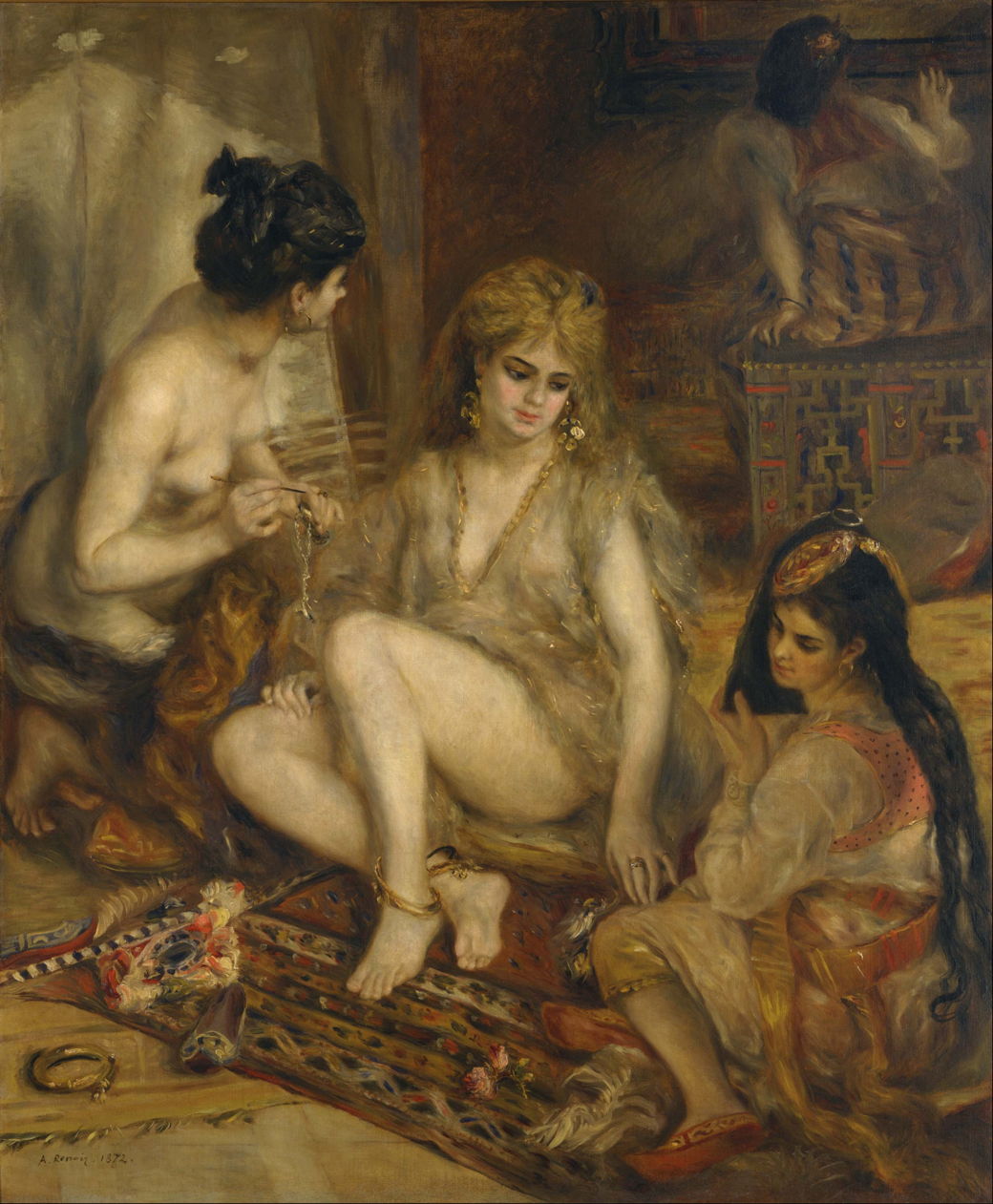
Pierre-Auguste Renoir (1841–1919), Parisiennes in Algerian Costume, or Harem (1872), oil on canvas, 156 x 128.8 cm, National Museum of Western Art 国立西洋美術館 (Kokuritsu seiyō bijutsukan), Tokyo, Japan. Wikimedia Commons.
Probably the last of Renoir’s works to feature Tréhot is his Parisiennes in Algerian Costume, or Harem from 1872, where she appears as the woman at the right.
Renoir never mentioned her in any recorded source, but she’s thought to have given birth to their son at the end of 1868, and is recorded as having their daughter in the summer of 1870. Renoir supported her financially throughout the rest of his life, and Ambroise Vollard his dealer continued to do so after his death.
Renoir and Tréhot seem to have separated suddenly in 1872, and it’s thought they never met or spoke again after that. She married in 1883, raised her own family with her architect husband, and died in Paris in 1922.
The new style of Naturalism took the Paris Salon by storm in 1883. As a complement rather than competitor to Impressionism, it found more favour among the establishment, critics and public who attended the Salon, and had roots going back to the genre paintings of the Dutch Golden Age.
Jan Miense Molenaer (c 1610–1668), The Dentist (1630), oil on panel, 66 x 81 cm, Herzog Anton Ulrich-Museum, Braunschweig, Germany. Wikimedia Commons.
The Dentist, painted in 1630, declares Jan Miense Molenaer’s interest in everyday life. A small crowd has gathered outside a church, where a fashionably dressed man is pulling a tooth from a local. The victim is dressed in tatters, with large holes at both his knees and worn-out shoes. These are ordinary, common people depicted objectively in their normal surroundings.
Gerard ter Borch (1617–1681), A Boy with his Dog (The Flea-Catcher) (after 1666), oil on canvas mounted on wood, 35 x 28 cm, Alte Pinakothek, Munich, Germany. Wikimedia Commons.
Gerard ter Borch’s late painting of A Boy with his Dog, also known as The Flea-Catcher (after 1666), shows this boy checking for and removing fleas from his pet in fairly barren surroundings.
Another strand of development was the controversial, even politicised, contemporary event. Géricault’s monumental painting of The Raft of the Medusa made in 1818-19 is perhaps the most important example.
Jean Louis Théodore Géricault (1791–1824), The Raft of the Medusa (1818-19), oil on canvas, 491 x 716 cm, Musée du Louvre, Paris. Wikimedia Commons.
This shows a well-known and scandalous story of the day, when over 130 people on board the French frigate Méduse died after they had abandoned ship onto a makeshift raft. Just fifteen of the 147 people on that raft survived thirteen days before being rescued, and gave harrowing stories of drowning, dehydration, and cannibalism.
Although Géricault undoubtedly painted what was in his mind’s eye, he undertook considerable research, interviewing survivors and making studies of material from the morgue in his efforts to make this as objective as he could. This quest for objectivity was a major theme of the nineteenth century, spilling over from the sciences into creative arts, underlying many of the changes seen in painting.
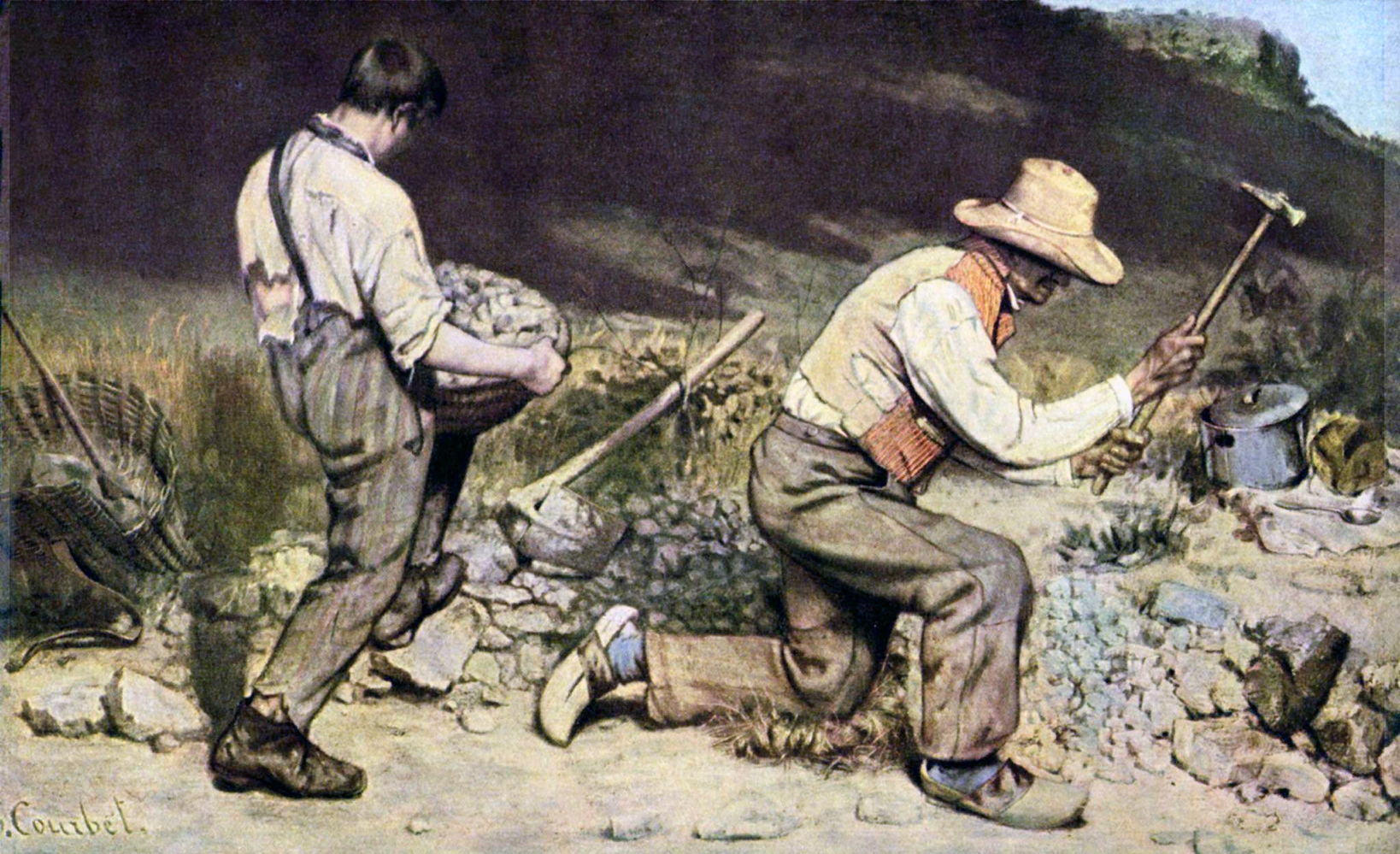
Gustave Courbet (1819–1877), The Stone Breakers (1849), oil on canvas, 165 x 257 cm, Galerie Neue Meister, Dresden, Germany, destroyed by fire 1945. Wikimedia Commons.
Gustave Courbet took it up in the middle of the century, most notably in The Stone Breakers (1849), which was later destroyed by fire during the Allied bombing of Dresden in 1945. This painting was exhibited at the Salon in 1850, and established him as the great-grandfather of Naturalism.
Gustave Courbet (1819–1877), A Burial at Ornans (1849-50), oil on canvas, 315 x 668 cm, Musée d’Orsay, Paris. Wikimedia Commons.
Shown in the same year was his monumental A Burial at Ornans (1849-50), a huge depiction in unemotional and objective terms of the funeral of the artist’s great uncle in the small provincial town of Ornans. The event had taken place in September 1848, but this painting gives the impression that it is a faithful record.
Courbet actually painted the work entirely in the studio, using those who were present as models. It shows a moment which could only have existed in the artist’s memory: like Géricault’s Raft of the Medusa, it doesn’t necessarily represent an image which ever existed in reality. But it has been carefully researched, imagined, composed, and painted to give the impression of accuracy and objectivity, rather than some Romantic fantasy.
At the same time, social realism was arriving on the farms of France, thanks to the paintings of Jean-François Millet.
Jean-François Millet (1814–1875), The Sower (1850), oil on canvas, 101.6 x 82.6 cm, Museum of Fine Arts, Boston, MA. Wikimedia Commons.
Millet’s The Sower was completed in 1850 and shown at the Salon that year; it has since been recognised as his first real masterpiece. This farmworker is striding across a field, sowing seed for the summer’s crop. In the distance to the right, caught in the sunlight, is another worker ploughing with a pair of oxen.
Jean-François Millet (1814–1875), The Gleaners (1857), oil on canvas, 83.5 × 110 cm, Musée d’Orsay, Paris. Wikimedia Commons.
Millet’s The Gleaners of 1857 is sparse, concentrating on just three figures. There are no distractions: it is about the rural poor, who made ends meet by salvaging scraps after the harvest had been cut. This is unavoidably about poverty, and the sector of the population who only just managed to survive each winter. At the time it smacked of socialism, and got the thumbs-down from the rich and middle classes when they saw it in the Salon that year.
Jean-François Millet (1814–1875), L’Angélus (The Angelus) (1857-59), oil on canvas, 55 x 66 cm, Musée d’Orsay, Paris. Wikimedia Commons.
Millet followed that with The Angelus, completed around 1857-59. This had been commissioned by the American collector Thomas Gold Appleton, as Prayer for the Potato Crop, but underwent modification before Millet gave it its present title. At some stage, it’s thought to have included a child’s coffin, but that was overpainted. It shows a couple, praying the Angelus devotion normally recited at six o’clock in the evening, over the potatoes they have been harvesting. It is dusk, and as the last light of the day fades, the bell in the distant church is ringing to mark the end of work, and the start of the evening.
Next to the man is his fork, which he has been using to lift potatoes from the poor, stony soil; his wife has been collecting them in a wicker basket, which now rests at her feet. Behind them is a primitive wheelbarrow with a couple of sacks of potatoes on it. In the gathering dark, viewers often misread the barrow and think that it contains a small child.
With the hostile reception of The Gleaners, Millet didn’t exhibit this painting until 1865, although he had sold it in 1860 for a meagre 1,000 francs. When sold in 1890, its price reached 750,000 francs.
Jules Breton (1827–1906), The Gleaners (1854), oil on canvas, 93 × 138 cm, The National Gallery of Ireland/Gailearaí Náisiúnta na hÉireann, Dublin, Ireland. The Athenaeum.
Jules Breton was also important, more in his compositional devices than in any social realism. His Gleaners from 1854, which was highly successful at the Salon of 1855, is a marvellous painting, although hardly the story of people who spent most of their lives on the edge of survival. But its foreground detail, high horizon and widescreen effect were to be used very successfully by Jules Bastien-Lepage and others.
Another important artist in the late gestation of Naturalism was Édouard Manet, long considered to be a precursor of Impressionism, but who was thoroughly realist.
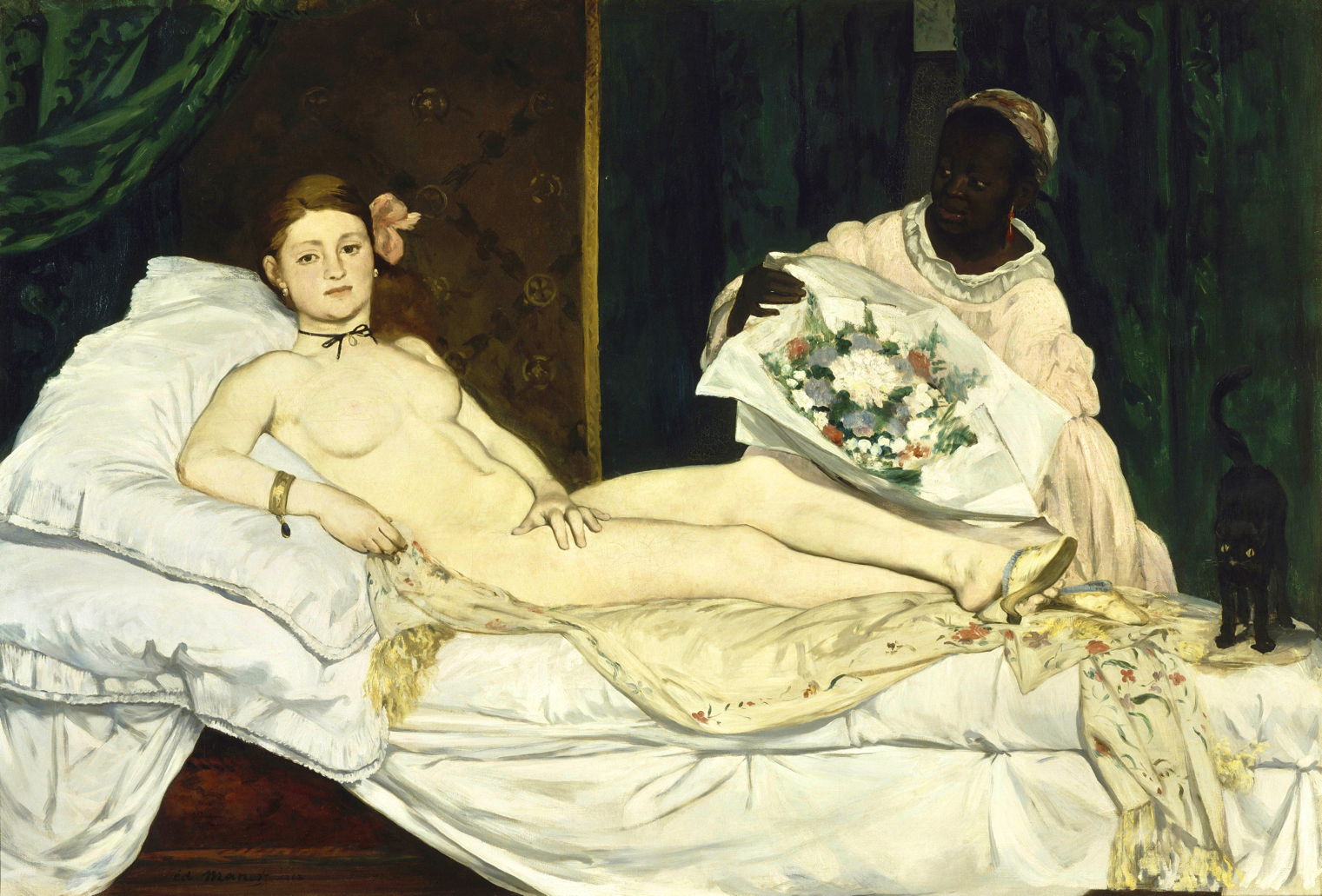
Édouard Manet (1832–1883), Olympia (1863), oil on canvas, 130 x 190 cm, Musée d’Orsay, Paris. Wikimedia Commons.
Manet’s Olympia (1863) shocked those seeing it at the 1865 Salon because here was an ordinary person, a ‘common prostitute’ indeed, seen in a role normally assigned to a mythical goddess such as Venus. And she was very much at her place of work, staring straight at the viewer.
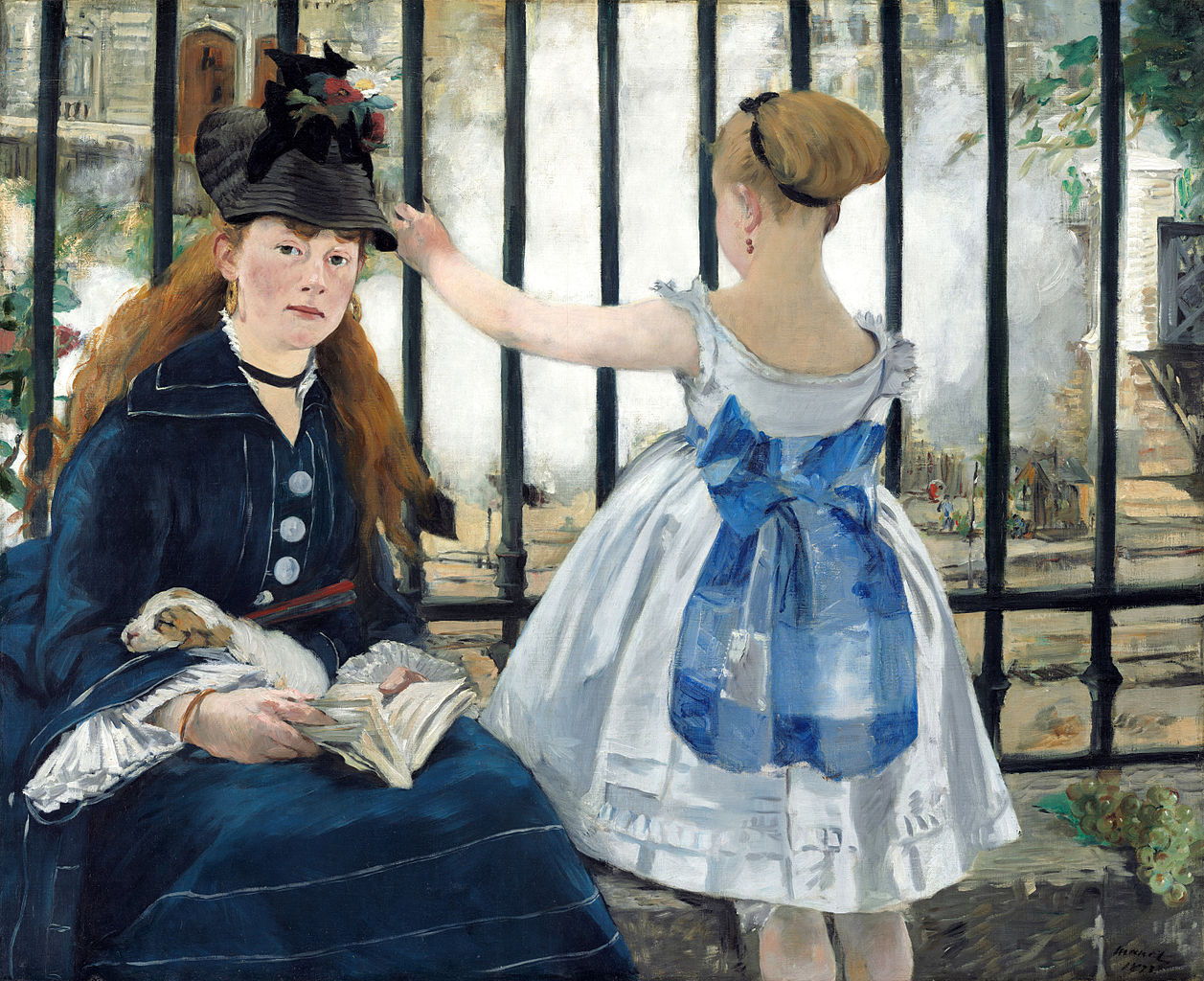
Édouard Manet (1832–1883), The Railway (1873), oil on canvas, 93.3 x 111.5 cm, The National Gallery of Art, Washington, DC. Wikimedia Commons.
A decade later, Manet painted the same model, Victorine Meurent, in The Railway (popularly known as Gare Saint-Lazare) (1873). A genre symbol of modernity, it brought modern technology and urban life to what was at the time a largely unappreciative public.
The most immediate precursors to the Naturalist paintings of 1883 weren’t the early works of Jules Bastien-Lepage, but the paintings of the rural poor by Léon Augustin Lhermitte.
Léon Augustin Lhermitte (1844–1925), Procession near Ploumanac’h (1879), oil on canvas, dimensions not known, Private collection. Wikimedia Commons.
Lhermitte’s sketchy Procession near Ploumanac’h from 1879 shows a religious festival in Brittany, with a small stream of locals making their way along a track on the open hillside towards the church. Its unemotional bleakness is completely different from the dense processions being painted by Jules Breton.
Léon Augustin Lhermitte (1844–1925), The Harvesters’ Pay (1882), oil on canvas, 215 x 272 cm, Musée d’Orsay, Paris. Wikimedia Commons.
Lhermitte’s founding masterpiece of Naturalism is The Harvesters’ Pay from 1882, which looks objectively at the economic and social aspects of the harvest. Four of the harvesters, bearing their heavy-duty scythes, await payment by the farmer’s factor, who holds a bag of coins for the purpose. In the centre of the painting, one of the workers is counting out his pay in front of his wife, who is feeding a young infant at her breast. To their left, another worker just sits and stares blankly into the distance, dead-beat tired and wondering whether his pittance was worth all that effort.
Most importantly, Lhermitte painted these in the early years of the Third Republic, a time when social concerns were sweeping across much of Europe.
Until the middle of the nineteenth century almost every painter painted at least one reflection, that of their own face in a self-portrait. There’s even a gallery specialising in its unique collection, the Uffizi in Florence, Italy, where they go back six hundred years to Taddeo Gaddi in 1440-50 and Filippino Lippi in 1485. This article looks at a few of the more unusual ones that didn’t make it to the Uffizi.
Gustave Courbet (1819–1877), The Desperate Man (c 1843), oil on canvas, 45 x 54 cm, Private collection. Wikimedia Commons.
The most radical and impressive of Gustave Courbet’s early paintings is The Desperate Man from about 1843, in which the artist grimaces wildly at his own canvas. Augmented by his signature in bright red, it might as well have been his manifesto.
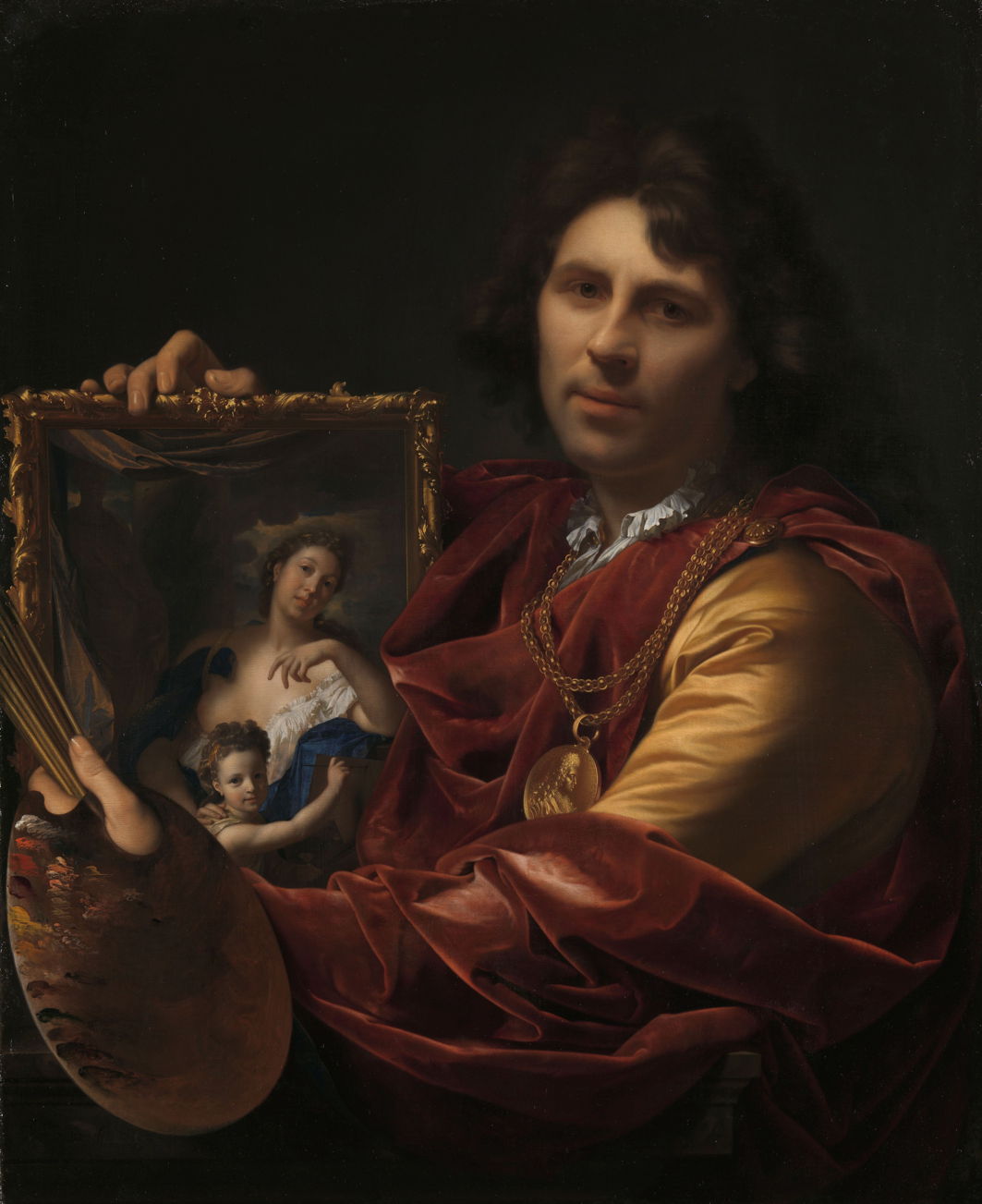
Adriaen van der Werff (1659–1722), Self-portrait with the Portrait of his Wife, Margaretha van Rees, and their Daughter Maria (1699), oil on canvas, 81 x 65.5 cm, Rijksmuseum, Amsterdam, The Netherlands. Wikimedia Commons.
Adriaen van der Werff’s Self-portrait with the Portrait of his Wife, Margaretha van Rees, and their Daughter Maria from 1699 is an ingenious family portrait. He holds his palette and brushes with his left hand, and around his neck is a medallion awarded by his patron, the Elector Palatine. His right hand supports a portrait of his wife Margaretha van Rees (1669-1732) and their daughter Maria (1692-1731).
Lovis Corinth (1858–1925), Last Self-Portrait (1925), oil on canvas, 80.5 × 60.5 cm, Kunsthaus Zürich, Zürich. Wikimedia Commons.
Lovis Corinth’s Last Self-Portrait, painted just two months before his death, is unusual in showing him with his reflection in a mirror. He is balding rapidly, his cheeks sunken, and his eyes are bloodshot and tired.
Pierre Bonnard (1867-1947), Interior (c 1905), oil on canvas, 49.8 x 37.8 cm, Private collection. The Athenaeum.
Pierre Bonnard’s unusual composition in this Interior from about 1905 doesn’t show the woman’s back in the mirror, but a chair placed deliberately in front of the mirror and Bonnard himself, not painting but sat at a table.
Artemisia Gentileschi (c 1593-1656), Allegory of Painting (c 1638-9), oil on canvas, 98.6 x 75.2 cm, The Queen’s Collection, England. Wikimedia Commons.
There’s more uncertainty as to whether Artemisia Gentileschi’s brilliant painting of the Allegory of Painting (c 1638-9) is a self-portrait. This striking angle of view can be accounted for if this was a self-portrait composed using two mirrors, one placed above and on the left of the painter, the other directly in front of her, where she is gazing so intently. If so, it was particularly ingenious because the reflection in the second mirror would have normal chirality (left and right would not be reversed).
However, it has been suggested that this isn’t a self-portrait, in which case her choice of view would have been most unusual. It’s believed to have been painted during her stay in London, possibly for King Charles I, as it appears to have passed straight into the Royal Collection, where it has remained ever since.
Clara Peeters (fl 1607-1621), Still Life with Flowers and Gold Cups of Honour (1612), oil on oak, 59.5 x 49 cm, Staatliche Kunsthalle Karlsruhe, Karlsruhe, Germany. Wikimedia Commons.
Clara Peeters’ still life with Flowers and Gold Cups of Honour from 1612 reveals multiple miniature self-portraits reflected in the gold cup at the right. These are shown more clearly in the detail below. To project the image of herself correctly for each of the facets I suspect she must have set up a convex mirror in the same alignment as that facet on the cup.
Clara Peeters (fl 1607-1621), Still Life with Flowers and Gold Cups of Honour (detail) (1612), oil on oak, 59.5 x 49 cm, Staatliche Kunsthalle Karlsruhe, Karlsruhe, Germany. Wikimedia Commons.
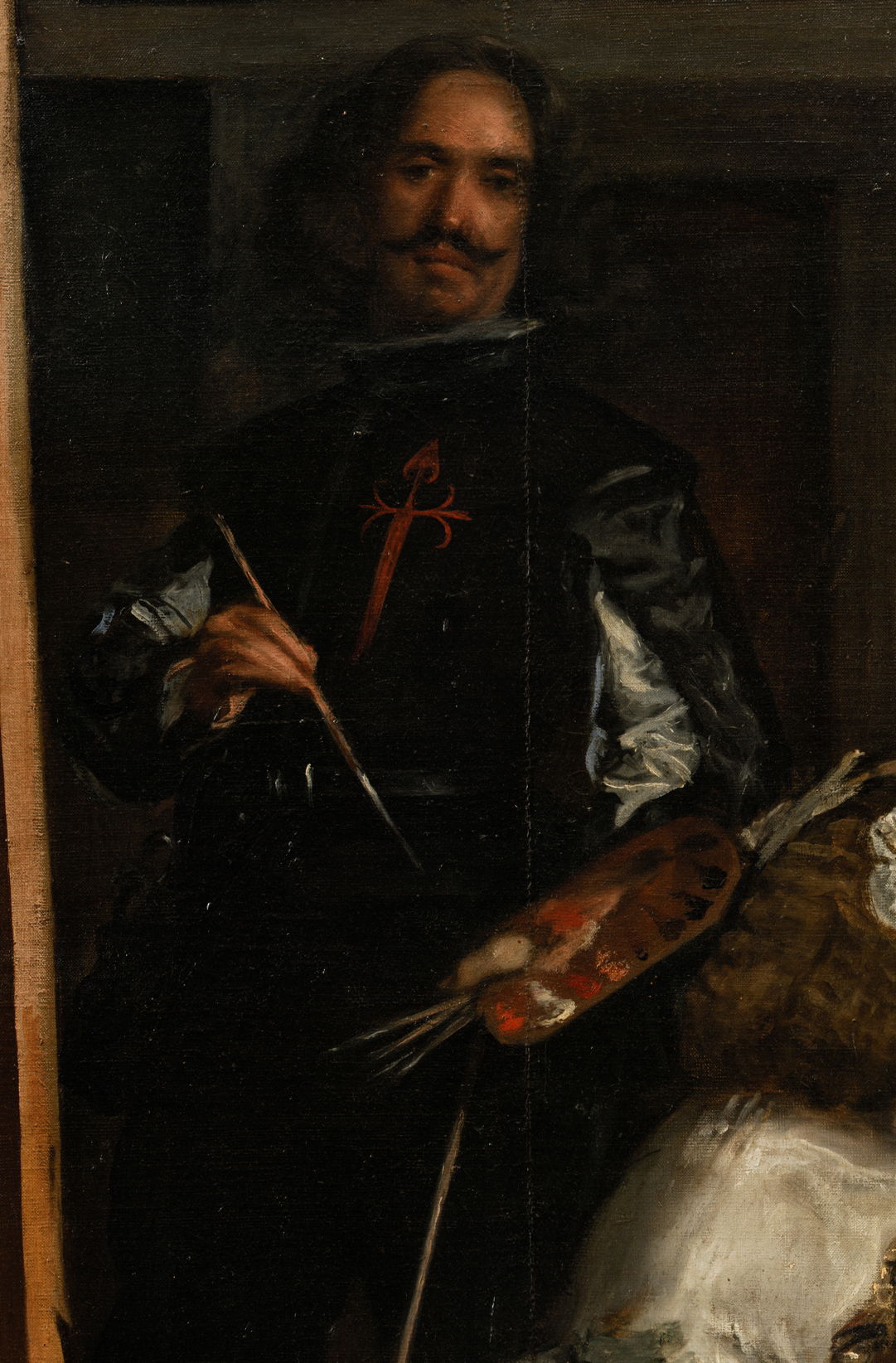
The most famous of all these elaborate self-portraits is surely that of Diego Velázquez in Las Meninas from about 1656-57.
Diego Velázquez (1599–1660), Las Meninas (The Maids of Honour, Velázquez and the Royal Family) (c 1656-57) [119], oil on canvas, 318 x 276 cm, Museo Nacional del Prado, Madrid, Spain. Wikimedia Commons.
Like many of his mature works, this is a portrait, but unlike any of the others it’s a group portrait of eleven people and a dog in a room in the Alcázar Palace, which is depicted faithfully, according to palace inventories of the time.
Diego Velázquez (1599–1660), Las Meninas (The Maids of Honour, Velázquez and the Royal Family) (detail) (c 1656-57) [119], oil on canvas, 318 x 276 cm, Museo Nacional del Prado, Madrid, Spain. Wikimedia Commons.
The largest figure, although out of the limelight and over to the left, is that of Velázquez himself. He looks towards the viewer, with a neutral face of concentration. His right hand holds a brush with his paint laid out on a wooden palette held by his left hand, which also clutches a bundle of other brushes. He is at work on the three metre (ten foot) high canvas in front him, which happens to be the same size as that on which he painted this work.
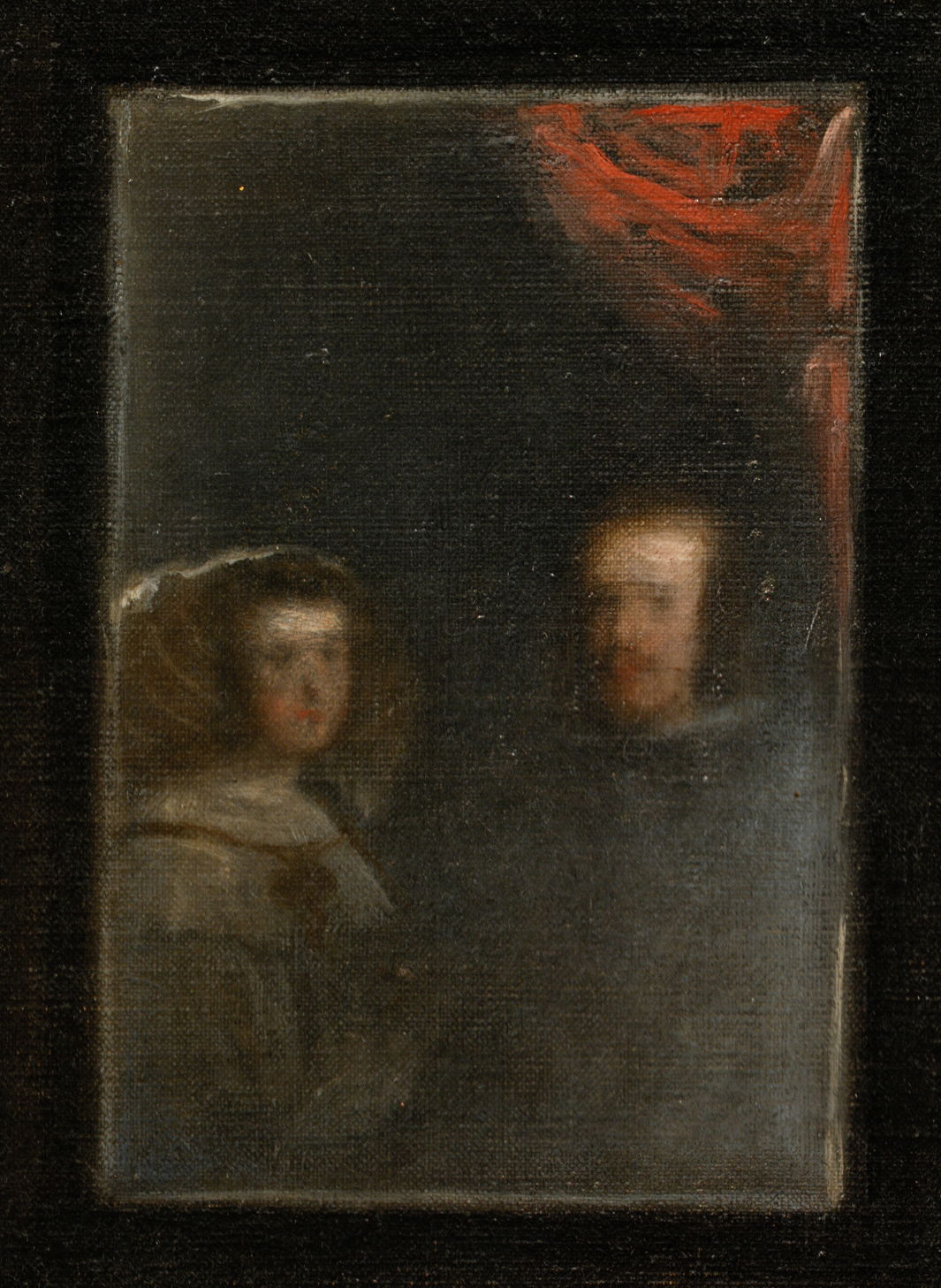
Diego Velázquez (1599–1660), Las Meninas (The Maids of Honour, Velázquez and the Royal Family) (detail) (c 1656-57) [119], oil on canvas, 318 x 276 cm, Museo Nacional del Prado, Madrid, Spain. Wikimedia Commons.
Two figures given a prominent and unusual place are the King and Queen, who are shown reflected in a rectangular plane mirror on the far wall. There has been dispute over whether the reflection shows the couple stood where the viewer is, or the mirror is reflecting their painted images on Velázquez’s canvas.
As the mirror is to the left of the centreline of the painting, it’s hard to see that its image of the royal couple could show them standing where the viewer is, and more likely that what appears there is part of Velázquez’s painting. However, the artist had previously been ‘creative’ in his use of reflections in the Rokeby Venus, and at least part of his body should here be obstructing a clear line of sight between what is on his canvas and the surface of the mirror.
Sculptors and painters are kindred spirits. Although their tools and skills differ, they are all visual artists, and many have mastered both means of expressing their art. In today’s selection of paintings I include depictions of sculptors at work, rather than those merely showing the fruit of their labour in the form of sculpture.
The best-known sculptor in classical mythology is Pygmalion, whose quest for the perfect woman was only satisfied by the statue he made of her.
Edward Burne-Jones (1833–1898), Pygmalion and the Image – The Hand Refrains (1878), oil on canvas, 98.7 x 76.3 cm, Birmingham Museum and Art Gallery, Birmingham, England. Wikimedia Commons.
The Hand Refrainsis one of Edward Burne-Jones’s series telling this myth. Pygmalion stands back, his tools still in his hands and scattered at the foot of his work. Too scared to touch the statue now, he looks longingly at it, as if falling in love, which he did when it came to life.
Jean-Léon Gérôme (1824–1904), Pygmalion and Galatea (study) (1890), oil on canvas, 94 x 74 cm, Private collection. Wikimedia Commons.
Jean-Léon Gérôme’s study for Pygmalion and Galatea from 1890 was an early attempt at its composition, where the sculptor’s future bride is still a marble statue at her feet, but very much flesh and blood from the waist up. That visual device was perfect, but Gérôme recognised his painting could be shunned because of its full-frontal nudity, so reversed the view.
Jean-Léon Gérôme (1824–1904), Pygmalion and Galatea (c 1890), oil on canvas, 88.9 x 68.6 cm, Metropolitan Museum of Art, New York, NY. Wikimedia Commons.
His finished Pygmalion and Galatea (c 1890) extends the marble effect a little higher, and by showing Galatea’s buttocks and back and concealing the kiss, it stays on the right side of contemporary standards of decency. His attention to detail is delightful, with two masks against the wall at the right, Cupid ready with his bow and arrow, an Aegis bearing the head of Medusa, and a couple of statues about looking and seeing. For Gérôme recognised other stories about sculpture and seeing that could be brought in to enrich Ovid’s original narrative.
Lawrence Alma-Tadema (1836–1912), Phidias Showing the Frieze of the Parthenon to his Friends (1868), oil on canvas, 72 × 110.5 cm, Birmingham Museum and Art Gallery, Birmingham, England. Wikimedia Commons.
Lawrence Alma-Tadema imagined ancient Greeks admiring this painted frieze as it neared completion in his beautiful painting of its sculptor Phidias Showing the Frieze of the Parthenon to his Friends (1868). The admiring figures include Pericles (at the right), Aspasia, Alcibiades and Socrates.
Thomas Eakins (1844–1916), William Rush Carving His Allegorical Figure of the Schuylkill River (1876-77), oil on canvas mounted on Masonite, 51.2 x 66.4 cm, Philadelphia Museum of Art, Philadelphia, PA. Wikimedia Commons.
William Rush Carving His Allegorical Figure of the Schuylkill River (1876-77) is the first of three paintings by Thomas Eakins showing William Rush, a wood sculptor, carving his Water Nymph and Bittern for a fountain in Philadelphia’s waterworks, in 1808. The water nymph is an allegory of the Schuylkill River, the city’s primary source of water at that time.
Rush had been a founder of the Pennsylvania Academy of the Fine Arts, and an enthusiast for the use of nude models in art, as was Eakins. This painting was therefore, at least in part, an attempt to promote Rush’s name, and the practice of working from nude models. Rush prepared thoroughly, as usual, in carving wax studies, and making a series of drawings and oil sketches.
Seated at the right of the model is a chaperone, more interested in her knitting. The model’s complicated clothing is hung and scattered in the light, as if to emphasise her total nudity (apart from a hair-band!), and the sculptor is working in the gloom at the left. Eakins anachronistically included several later works by Rush, as if to provide a resumé of his output. Unfortunately, the scattered garments didn’t go down well, and were deemed scandalous at the time.
Jean-Léon Gérôme (1824–1904), Michelangelo (1849), oil on canvas, 51.4 x 37.5 cm, Dahesh Museum of Art, New York, NY. The Athenaeum.
Gérôme’s relatively small and simple painting of Michelangelo from 1849 shows Michelangelo in his dotage, hunched over and blind, being led by a young boy whose dress would have aroused his master’s homoerotic desires. The broken sculpture is the Belvedere Torso, a huge fragment of marble statuary so loved by the sculptor that it was nicknamed the School of Michelangelo. The young boy is leading his master’s hands to stroke and caress the marble, now that he was unable to enjoy looking at its classical and very male form.
This is perhaps the first step in his developing theme of sight, and the role of vision in establishing truth. In his blindness, Michelangelo can only feel what we can see, and cannot see the figure of the young boy. This is particularly appropriate to Gérôme, who later in his career became a successful sculptor himself, and whose later paintings referred to his sculptures and the act of creating them.
Jean-Léon Gérôme (1824–1904), The End of the Pose (1886), oil on canvas, 48.3 x 40.6 cm, Private collection. Wikimedia Commons.
The End of the Pose (1886) is the first of Gérôme’s series of unusual compound paintings, at the same time self-portraits of the artist as a sculptor, studies in the relationship between a model and their sculpted double, and forays into issues of what is seen, visual revelation, and truth. Here, while Gérôme cleans up, his model is seen covering up her sculpted double with sheets, as she remains naked. Apart from various diversionary entertainments, including a couple of stuffed birds and a model boat, there is a single red rose on the wooden platform on which the model and statue stand. Presumably this is a symbol of thanks from the artist to his model.
Jean-Léon Gérôme (1824–1904), The Artist’s Model (1895), oil on canvas, 50.8 x 39.6 cm, Dahesh Museum of Art, New York, NY. Wikimedia Commons.
In The Artist’s Model (1895), Gérôme paints himself at work on his marble figure of Tanagra (1890), currently in the Musée d’Orsay, already included among the figurines in his painting Sculpturae Vitam Insufflat Pictura. He thus painted himself making a sculpture that he had previously painted in a painting as a sculpture. Not only that, but his model is his favourite Emma Dupont, who over a period of twenty years posed for many of his best-known Orientalist and other works.
Scattered in the image are reminders of gladiatorial armour and other props used for his paintings, one of his paintings of Pygmalion and Galatea, together with one of his polychrome sculptures of a woman with a hoop, at the right edge. In this single image, Gérôme has captured much of his professional career.
Lovis Corinth (1858–1925), Portrait of the Sculptor Nikolaus Friedrich (1912), oil on canvas, 101.7 × 81 cm, Private collection. Wikimedia Commons.
This wonderful Portrait of the Sculptor Nikolaus Friedrich (1912) at work wasn’t the first to be painted by Lovis Corinth, who had made a previous portrait in 1904, when the sculptor was young and muscular. Eight years later he’s seen in the midst of a broad and representative range of his work. Friedrich died two years later, when he was only 48.
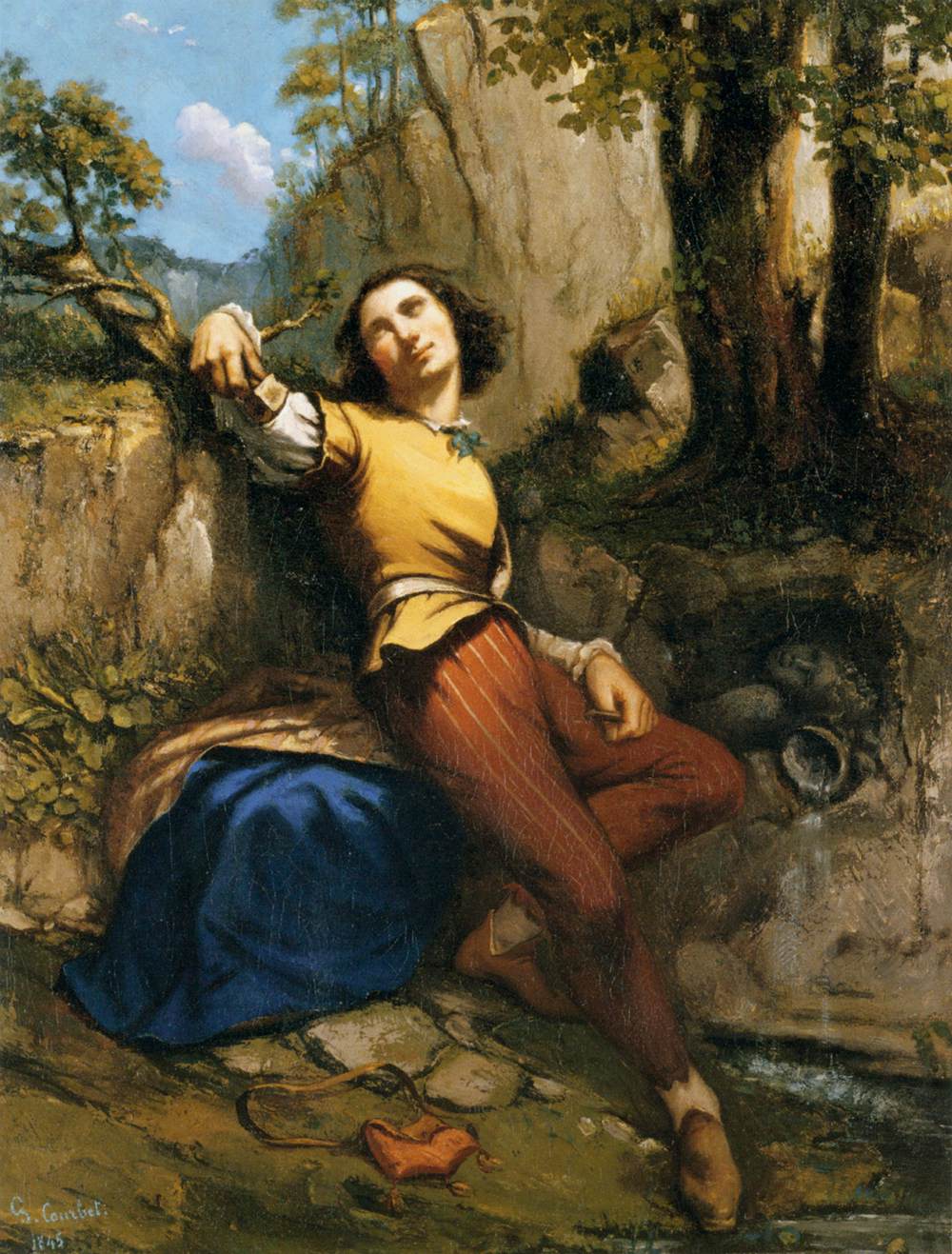
Gustave Courbet (1819–1877), The Sculptor (1845), oil on canvas, 55 x 41 cm, Private collection. Wikimedia Commons.
Early in his career, Gustave Courbet planted a gaudily-dressed figure at the foot of some cliffs near his home town of Ornans, put a small mallet in his right hand and a chisel in the other, and painted The Sculptor (1845). The subject of this sculptor’s inattention is the emerging form of a woman in the rock just above his left knee, over a small pipe from which water is pouring into the stream.
Antoine Watteau (1684–1721), The Monkey Sculptor (c 1710), oil on canvas tondo, 22 × 21 cm, Musée des Beaux-Arts, Orléans, Loiret, France. Wikimedia Commons.
Antoine Watteau’s tondo of The Monkey Sculptor from about 1710 is a singerie set in the sculptor’s studio, as if to say that even a monkey can be a good sculptor.

 Login
Login