By 1910 the streets of Berlin were becoming increasingly crowded with motor taxis, and the Post-Impressionist artist Lesser Ury (1861–1931) was still in search of his perfect motif on those streets.
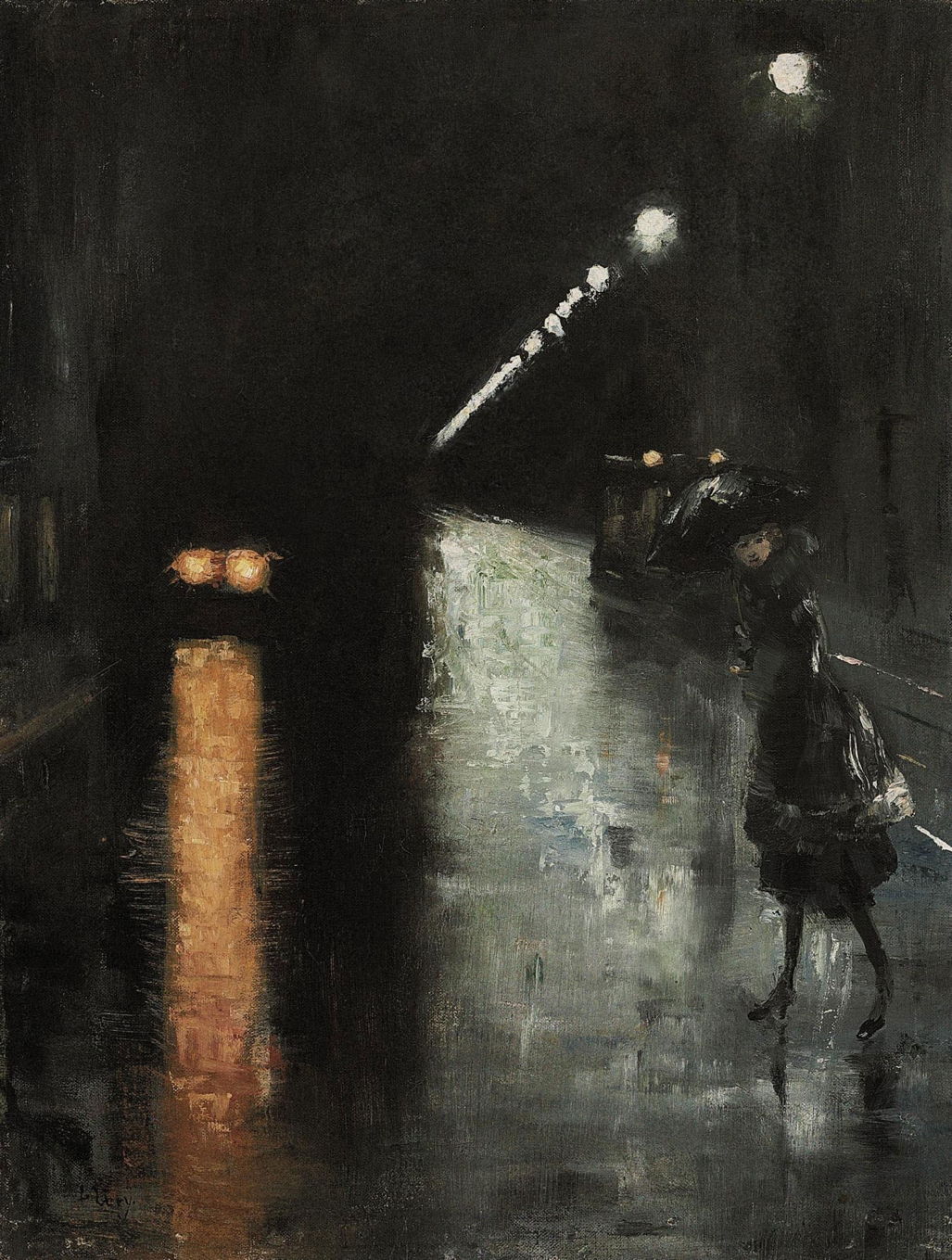
Lesser Ury (1861–1931), Street Scene at Night, Berlin (Leipziger Straße?) (c 1920), oil on canvas, 78.5 x 60.5 cm, location not known. Wikimedia Commons.
In about 1920, Ury struck gold in this Street Scene at Night, Berlin, believed to show Leipziger Straße. Its nighttime setting brings simplification of the motif by the dark, and it has lost the symmetry that had made his paintings of avenues too formal.
In 1922, there was a major exhibition of Ury’s works in Berlin, but following that he became increasingly reclusive.
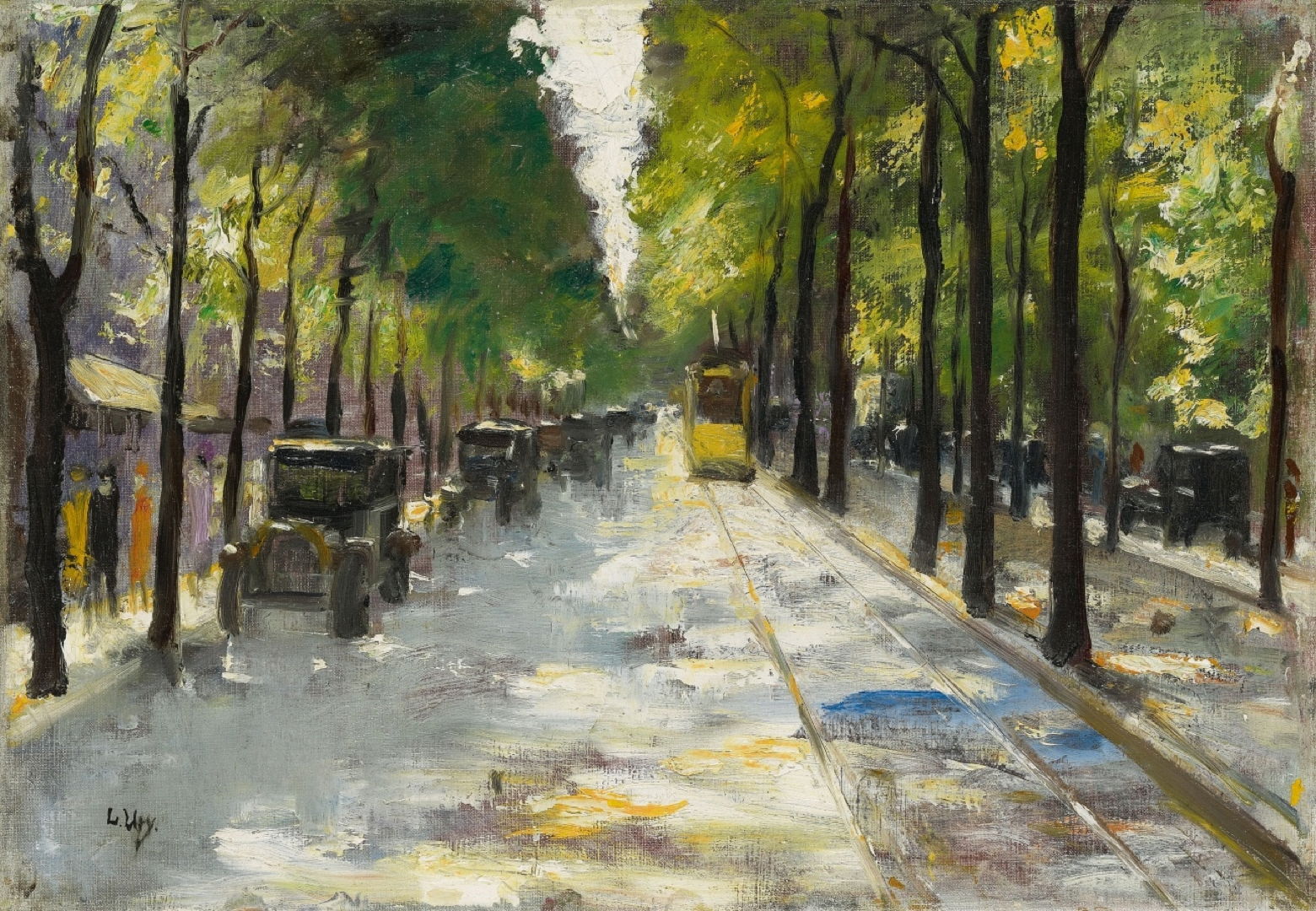
Lesser Ury (1861–1931), Berlin Street in Sunshine (1920s), oil on canvas, 36 x 51 cm, location not known. Wikimedia Commons.
In the 1920s, when he painted this view of a Berlin Street in Sunshine, motor taxis and trams had taken the streets over. Berlin had started operating the first electric trams in the world in 1881, and its first elevated lines were opened in 1902, by which time most of the city’s tram network was powered by overhead electric lines. Here Ury introduces patches of unexpected colour in the splashes and pools of yellows and blues on the street.
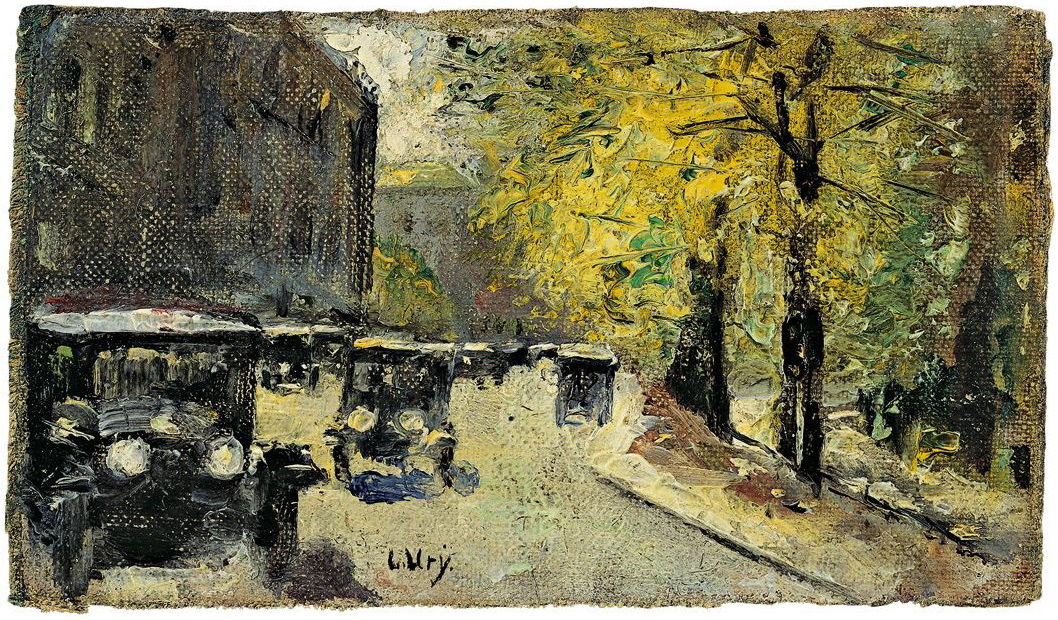
Lesser Ury (1861–1931), Street in Tiergarten (c 1920s), oil on canvas, 9.2 x 16 cm, Private collection. Wikimedia Commons.
Street in Tiergarten shows the roads becoming crowded with the new motor taxis, in this tiny plein air oil sketch.
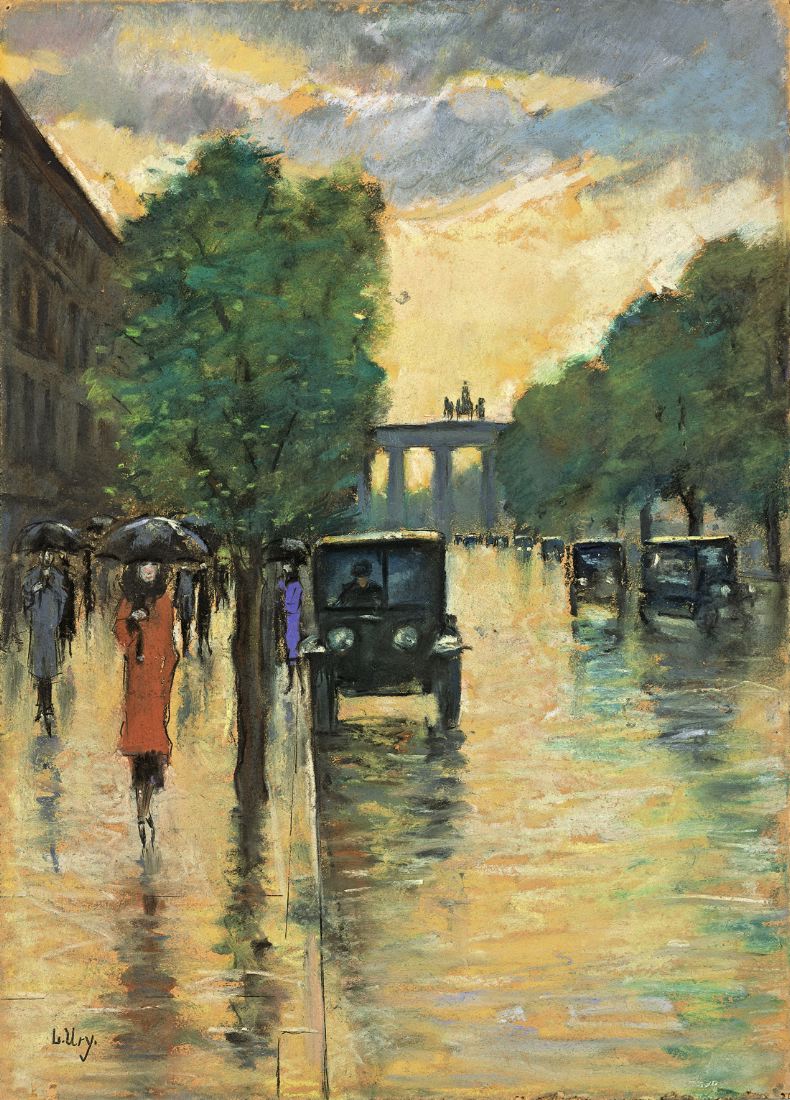
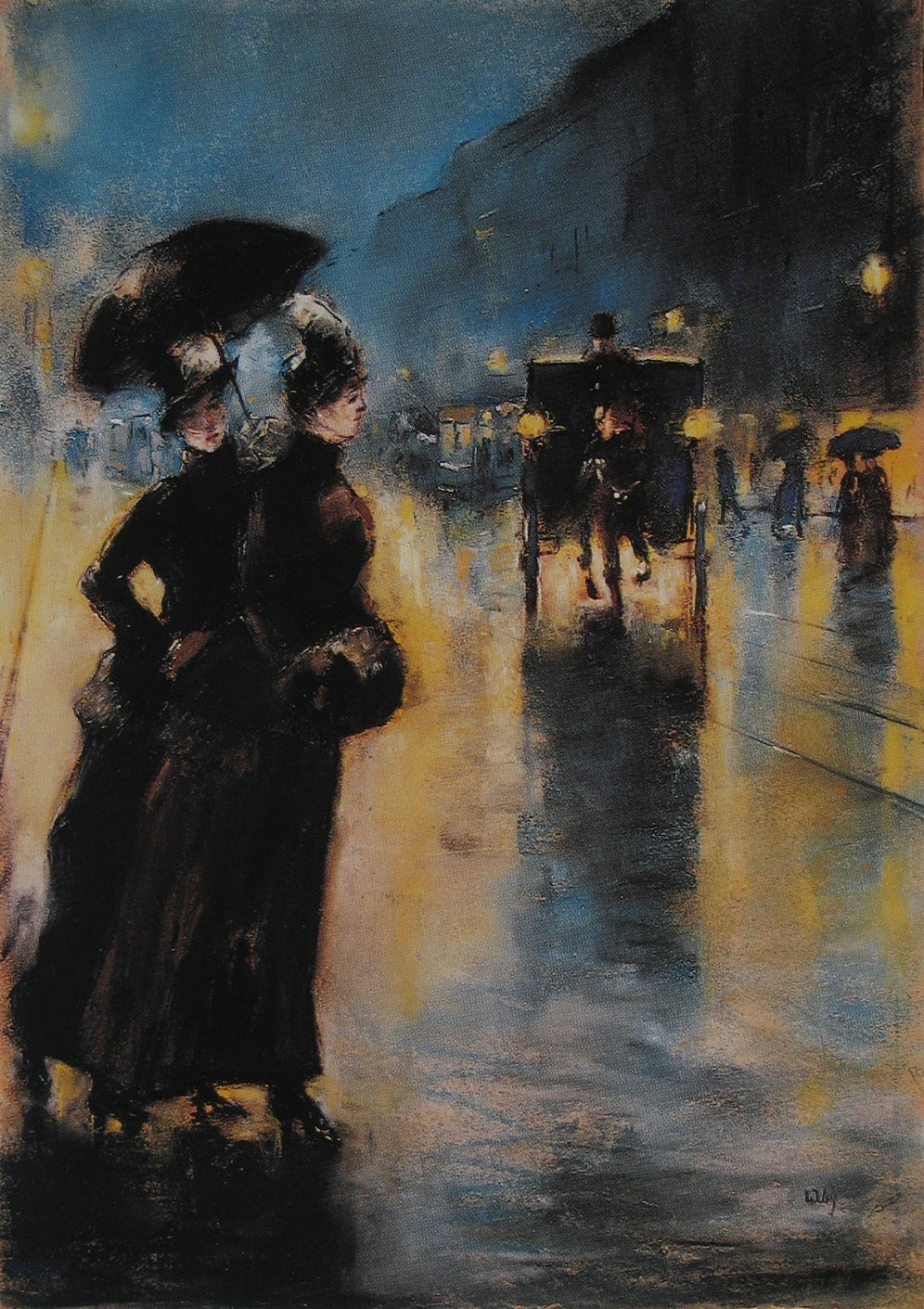
Lesser Ury (1861–1931), Unter den Linden with View of The Brandenburger Gate (c 1920s), pastel on paper, 49.5 x 35.3 cm, Private collection. Wikimedia Commons.
These new motor vehicles were more readily simplified almost to silhouettes, as seen in this pastel of Unter den Linden with View of The Brandenburger Gate from the 1920s. This is at the western end of Unter den Linden and shows the edge of the Tiergarten on the far side of the Gate.
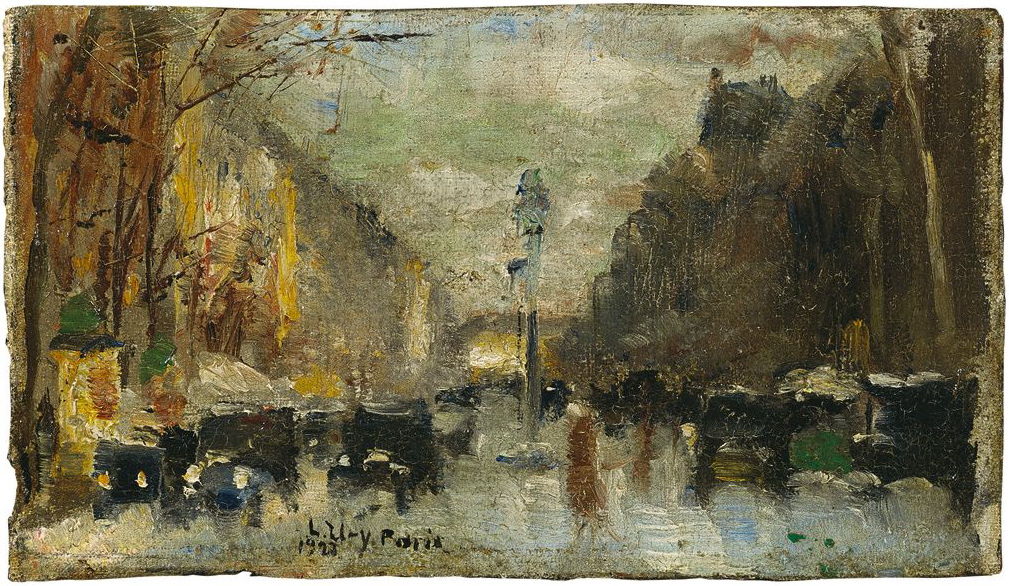
Lesser Ury (1861–1931), Boulevard in Paris (1923), oil on canvas, 9 x 15.8 cm, Private collection. Wikimedia Commons.
Boulevard in Paris (1923) is a small oil sketch painted during one of Ury’s visits to France, with even more gestural depiction of its motor taxis.
Lesser Ury (1861–1931), Nollendorfplatz Station at Night (1925), media and dimensions not known, Märkisches Museum, Berlin, Germany. Image by anagoria, via Wikimedia Commons.
Nollendorfplatz Station at Night from 1925 is a masterly oil sketch of this busy railway station to the south of the Tiergarten, in another of Berlin’s shopping districts.
Lesser Ury (1861–1931), London in Fog (1926), oil on canvas, 67 x 97 cm, location not known. Wikimedia Commons.
In this view of London in Fog from 1926, Ury looks across the River Thames with the street lights lit on its multiple bridges. I suspect that this looks south to the Elephant and Castle from the Embankment, on the northern bank of the river.
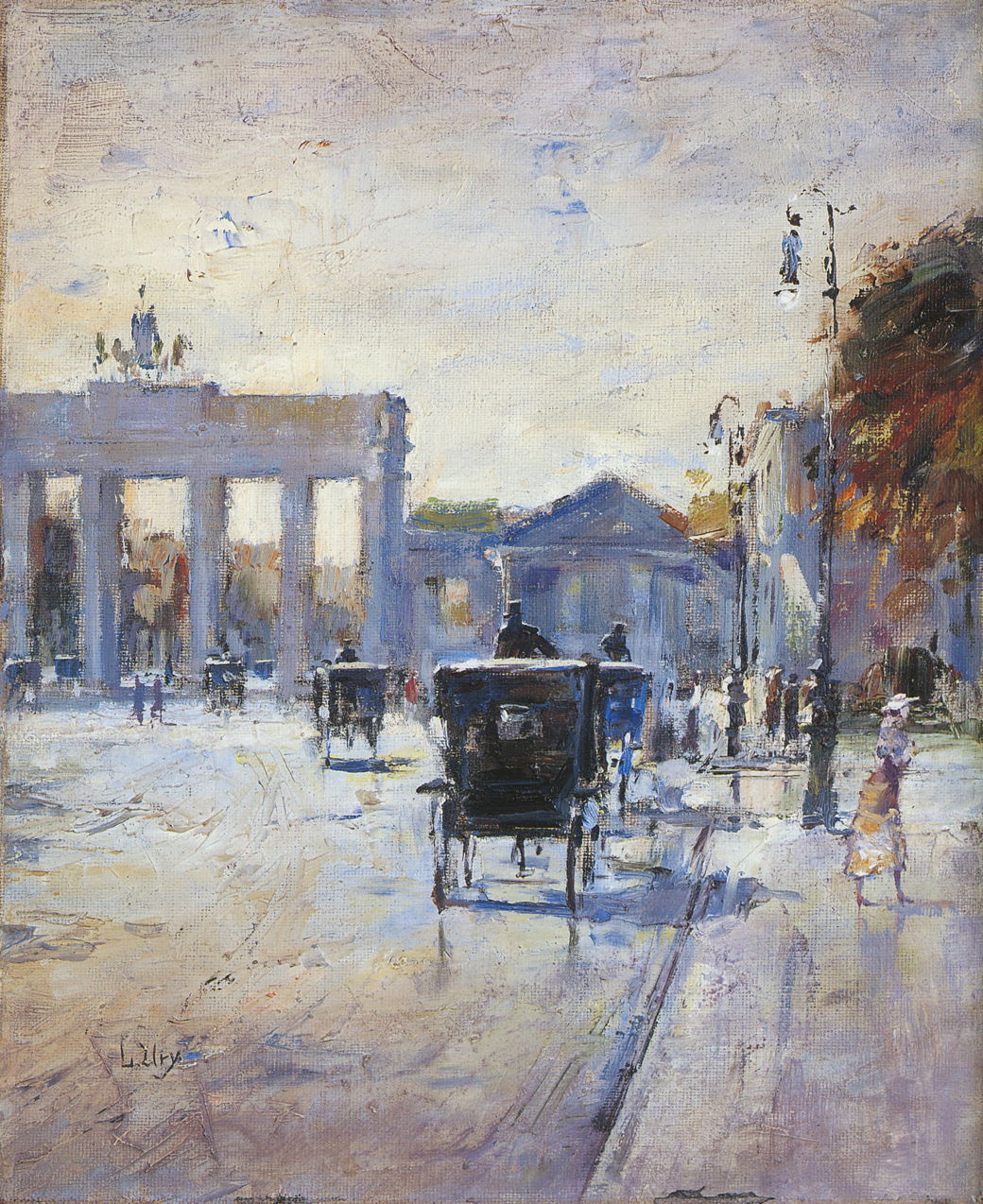
Lesser Ury (1861–1931), Pariser Platz (c 1930), oil on canvas, 29 x 23 cm, Private collection. Wikimedia Commons.
Among the last of his city views is this of Pariser Platz in Berlin, from about 1930. This is by the Brandenburger Tor at the western end of Unter den Linden, just as the leaves on its lime trees start to turn golden brown with the arrival of autumn.
Lesser Ury died in Berlin on 18 October 1931. Given the rise of Nazism followed by the Second World War, it’s remarkable that any of his paintings have survived.
The turn of the nineteenth to twentieth centuries brought a great change to many cities, as horse-drawn cabs were replaced by motor vehicles. In Stuttgart, Germany, for example, the first motorised taxi was licensed in 1897, electric vehicles followed shortly, and in the 1920s small motorcycle cabs known as a Motax were all the rage in Berlin. This weekend I celebrate this revolution with the oil sketches made on the streets by the German Post-Impressionist Lesser Ury (1861–1931).
Ury was born in what was then Birnbaum in Prussia, and is now Międzychód near Poznań in Poland. He was eleven when his father died and his family moved to Berlin. When he was eighteen, he gained a place at the Academy of Art in Düsseldorf, then travelled around Europe before returning to Berlin in 1887.
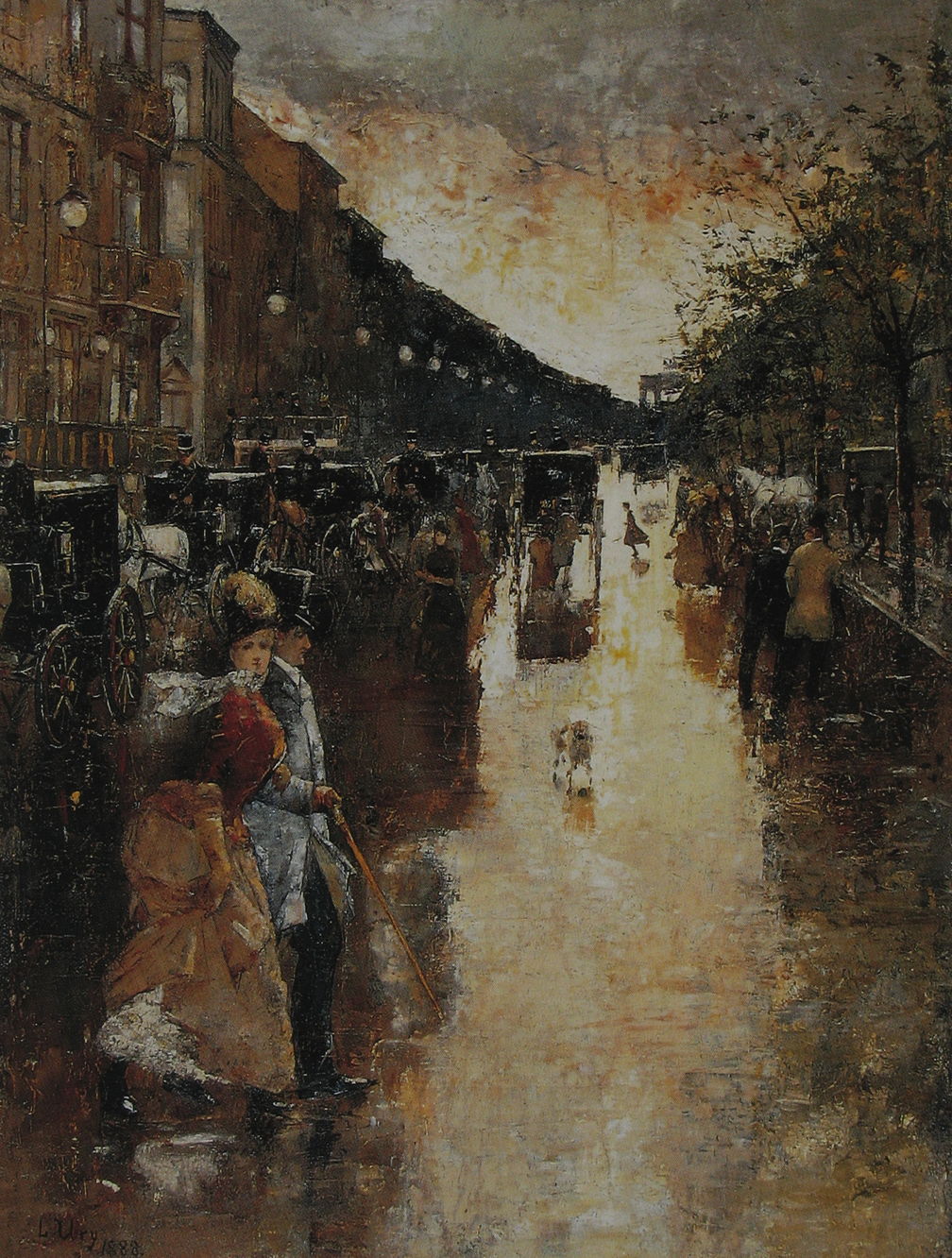
Lesser Ury (1861–1931), Unter den Linden After the Rain (1888), further details not known. Wikimedia Commons.
Early in his career, he discovered the theme that was later to bring him fame. In 1888, he painted this work showing Unter den Linden After the Rain. This avenue, lined with lime or linden trees, is probably the most famous street in the heart of Berlin. Ury shows that brown half-light so common in wet autumn weather, with a solid rank of horse-drawn cabs running down the left, to a glimpse of the Brandenburger Tor just above the vanishing point.
Lesser Ury (1861–1931), Leipziger Straße (1889), oil on canvas, dimensions not known, Berlinische Galerie, Berlin, Germany. Wikimedia Commons.
In Leipziger Straße, painted the following year, he tried a similar scene from a nearby street in Berlin, this time at night. The columnar reflections of lights are highly effective, but once again his style and formula didn’t quite reach the sweet spot.
Lesser Ury (1861–1931), Night Lighting (1889), further details not known. Wikimedia Commons.
He tried a different approach that same year in Night Lighting. This finely fractured image has been simplified and eased into more consistent areas of colour. He has dropped much of the detail, bringing strength to the image, but it still isn’t quite right.
Lesser Ury (1861–1931), Tiergarten in Winter (1892), pastel on paper, 50.7 x 35.7 cm, location not known. Wikimedia Commons.
Ury tried some more conventional motifs, such as this beautiful pastel of Tiergarten in Winter from 1892. This shows the large park to the west of the Brandenburger Tor, with its river frozen over and a good covering of snow.
In 1893, he joined the Munich Secession, then in 1901, when he returned to Berlin he joined its Secession.
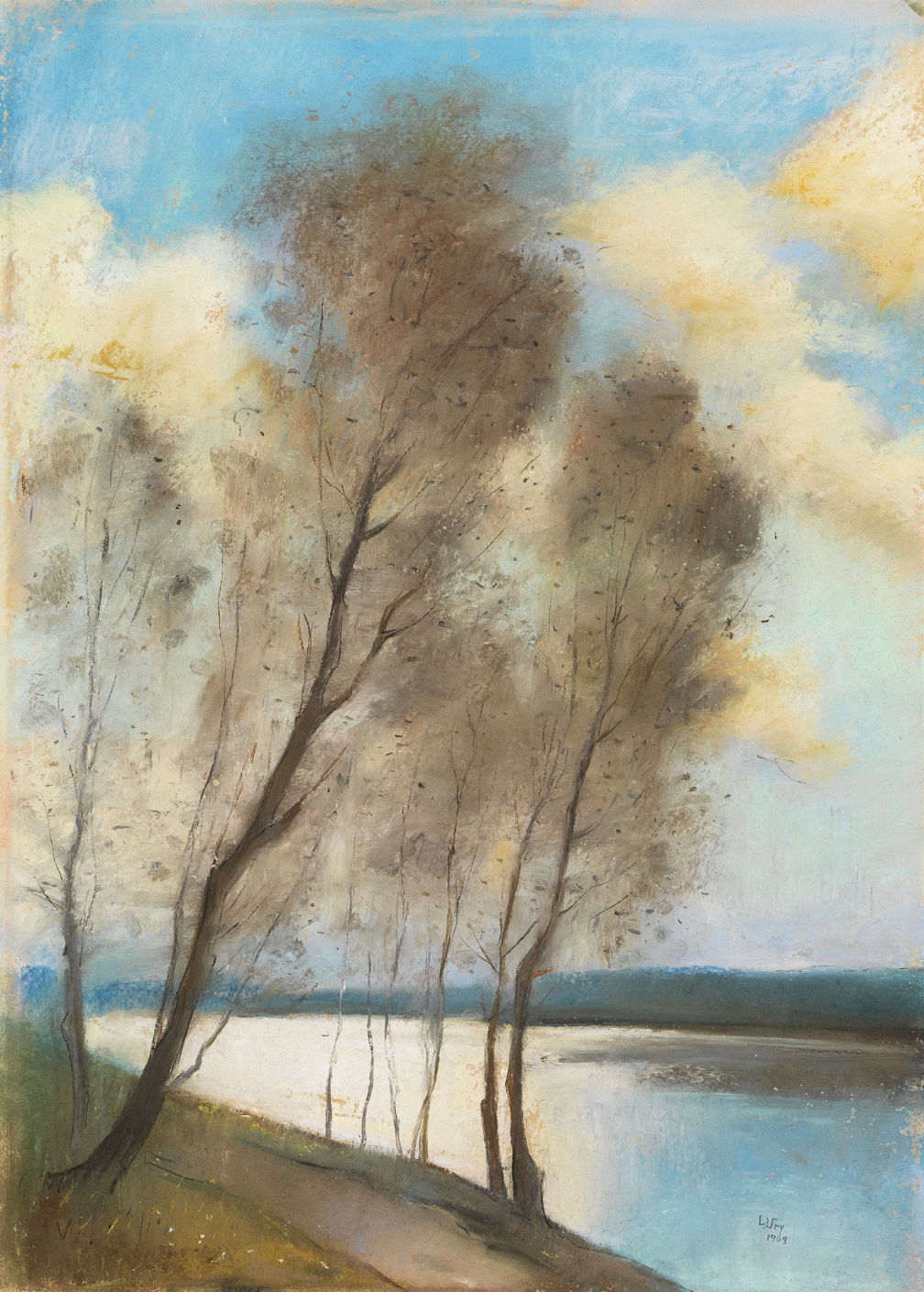
Lesser Ury (1861–1931), Spring (1903), pastel on cardboard, 51.5 cm x 37 cm, Private collection. Wikimedia Commons.
He continued to paint landscapes, including this fine pastel of Spring from 1903, and his reputation grew steadily, but it wasn’t until he took to the streets again that he found form.
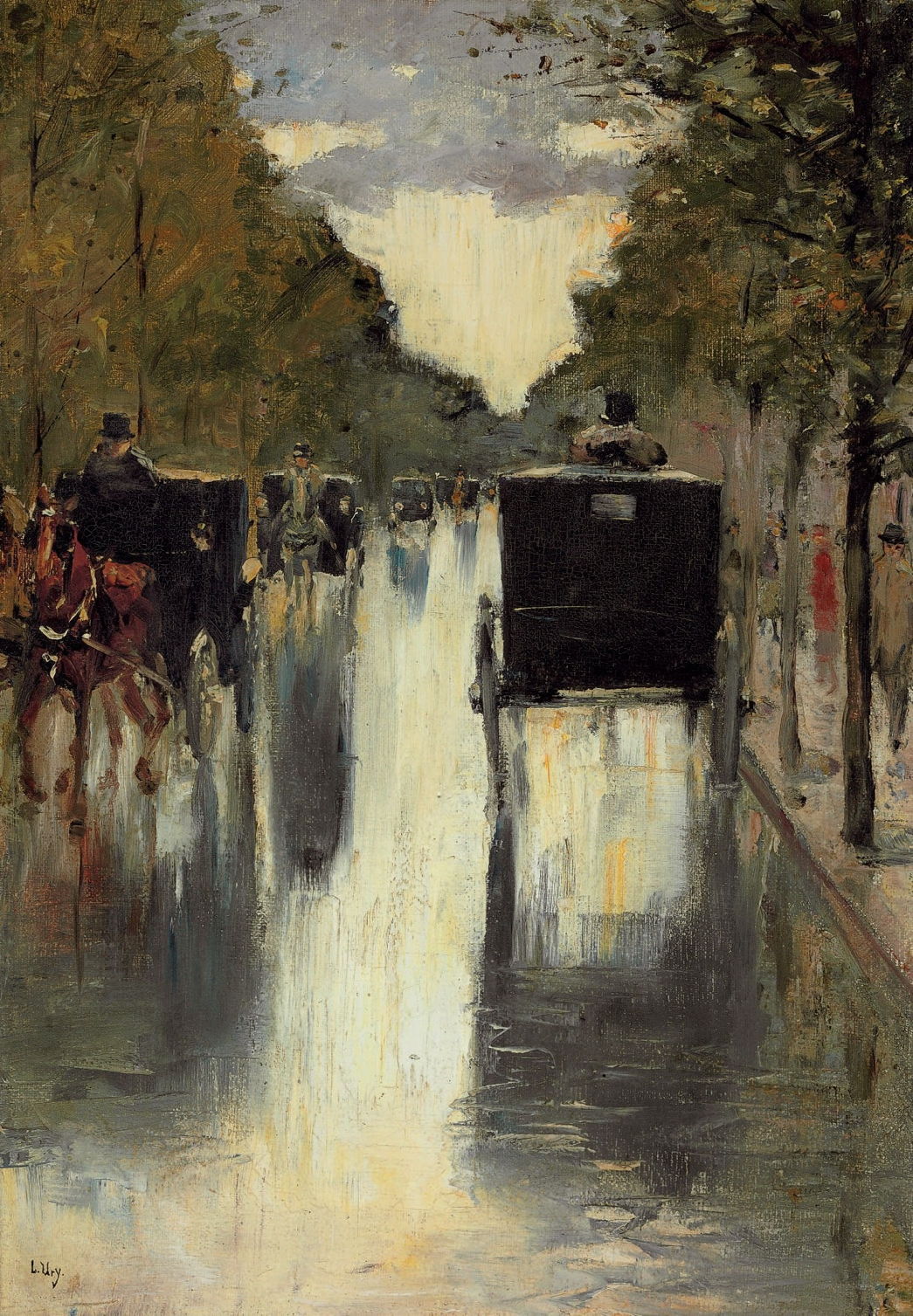
Lesser Ury (1861–1931), Berlin Street Scene with Horse-Drawn Cabs (1900-10), oil on canvas, 50.8 x 35.6 cm, location not known. Wikimedia Commons.
Painted sometime during the first decade of the twentieth century, Ury’s Berlin Street Scene with Horse-Drawn Cabs closes in on his formula for success. Although he retains considerable detail in the trees and horse-drawn cabs, the wet road now looks like a real water surface, with its reflections perfect. The dull daylight makes it hard to simplify the image any further, though.
Lesser Ury (1861–1931), Evening at a Lake with a Pine Forest (Grunewaldsee?) (1909), oil on canvas, 75.5 x 106.5 cm, location not known. Wikimedia Commons.
His other landscapes of this period were also becoming more distinctive and memorable. Evening at a Lake with a Pine Forest is thought to have been painted at the Grunewaldsee in 1909, and is one of his most highly chromatic works.
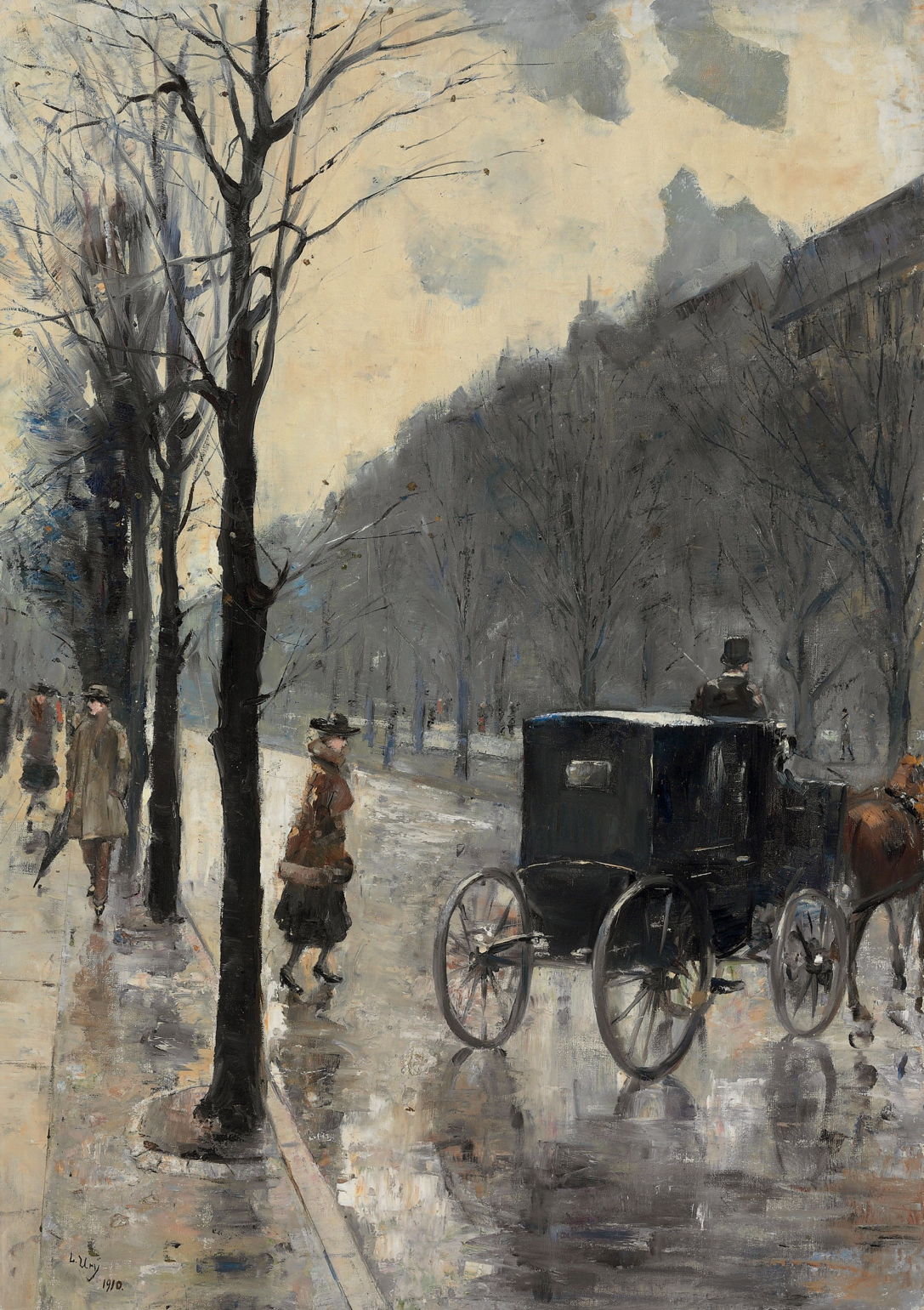
Lesser Ury (1861–1931), Kurfürstendamm (1910), oil on canvas, 101 x 70.5 cm, location not known. Wikimedia Commons.
Kurfürstendamm, also from 1910, shows what is probably Berlin’s most famous avenue of shops, on the western side of the Tiergarten. It’s a wet winter day, and for once the street is relatively deserted, with just one of the old horse-drawn carriages, and no motor taxis at all.
By the outbreak of the Franco-Prussian War in 1870, the city of Amsterdam had a population of almost 280,000, and was growing even more rapidly than it had at the height of the Dutch Golden Age.
Claude Monet (1840–1926), Canal at Zaandam (1871), oil on canvas, dimensions not known, High Museum of Art, Atlanta, GA. Wikimedia Commons.
When Claude Monet moved to the Netherlands in 1871 after sheltering in England for the Franco-Prussian War, there were still boats active in the Canal at Zaandam, on the northern outskirts of Amsterdam.
Claude Monet (1840–1926), The Windmill on the Onbekende Gracht, Amsterdam (1874), oil on canvas, 54 x 64.1 cm, Museum of Fine Arts, Houston, TX. Wikimedia Commons.
Monet’s second visit to the Netherlands in 1874 ensured that The Windmill on the Onbekende Gracht, Amsterdam (1874) became part of the history of Impressionism. This shows a windmill known as Het Land van Beloften, De Eendracht or De Binnen Tuchthuismolen, which was built in the late seventeenth century, and was moved to Utrecht just a couple of years after Monet painted it on the banks of the River Amstel.
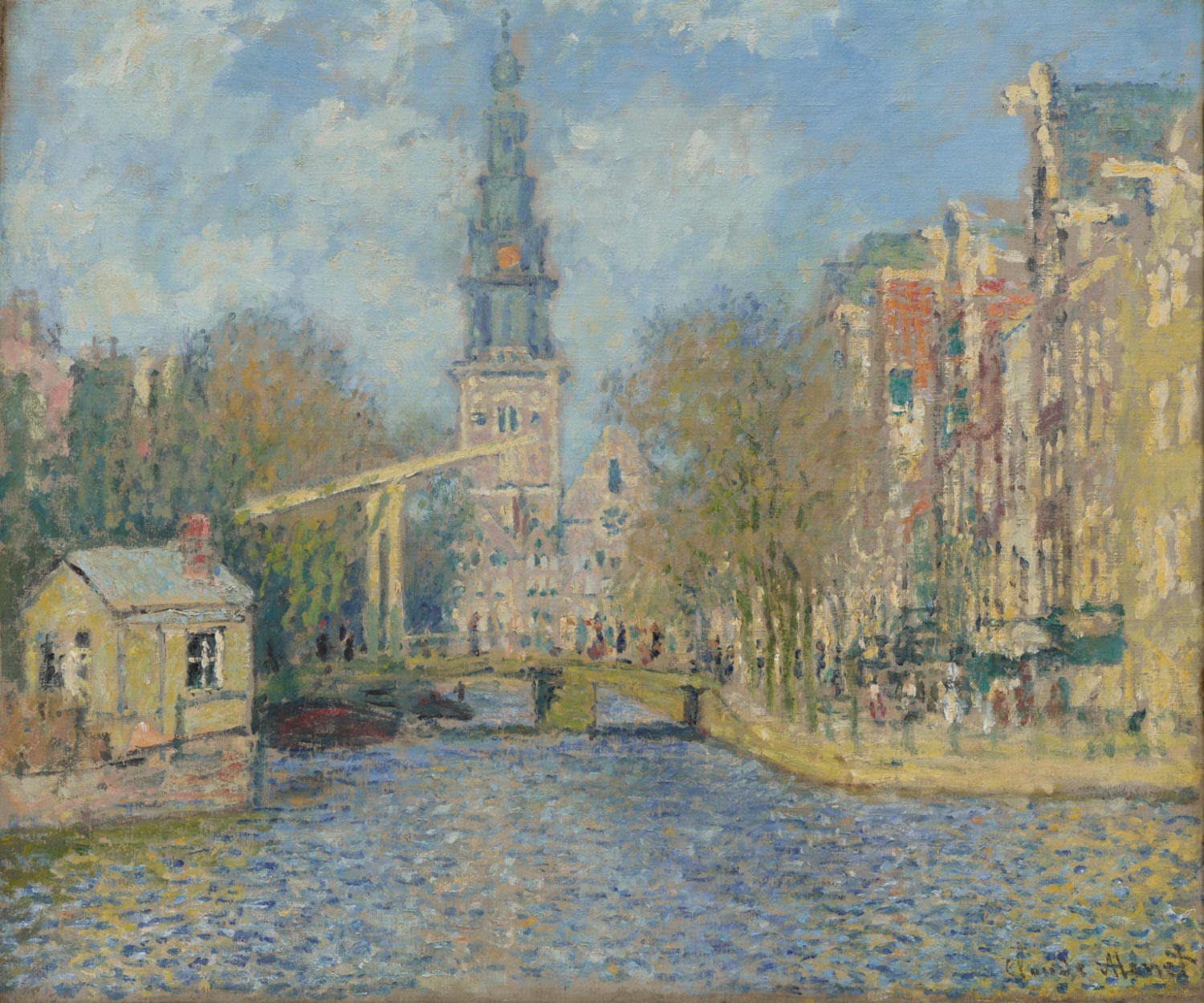
Claude Monet (1840–1926), The Zuiderkerk, Amsterdam (Looking up the Groenburgwal) (1874), oil on canvas, 54.5 x 65.4 cm, Philadelphia Art Museum, Philadelphia, PA. Wikimedia Commons.
Another of Monet’s dozen views painted during that visit shows The Zuiderkerk, Amsterdam (Looking up the Groenburgwal) (1874). This was the first church built in the city specifically for Protestant services, between 1603-11. Rembrandt lived close by, and three of his children were buried here.
In the late nineteenth and early twentieth centuries, George Hendrik Breitner (1857–1923) was a well-known artist in the Netherlands. He painted with Vincent van Gogh, was an early adopter of photography as an aid to his painting, and an innovative photographer in his own right. Although at first associated with the Hague School of landscape art, he drew away from that and today is normally termed an Amsterdam Impressionist, alongside Isaac Israëls, Jan Toorop and others.
George Hendrik Breitner (1857–1923), Ground Porters with Carts (date not known), watercolour on paper, 67.5 × 93.4 cm, Rijksmuseum Amsterdam, Amsterdam, The Netherlands. Wikimedia Commons.
This undated Ground Porters with Carts is one of Breitner’s watercolours showing the rough side of life in the city. He appears to have been influenced at this time by the Naturalist literature of Émile Zola, and was inspired to depict the common people and their lives.
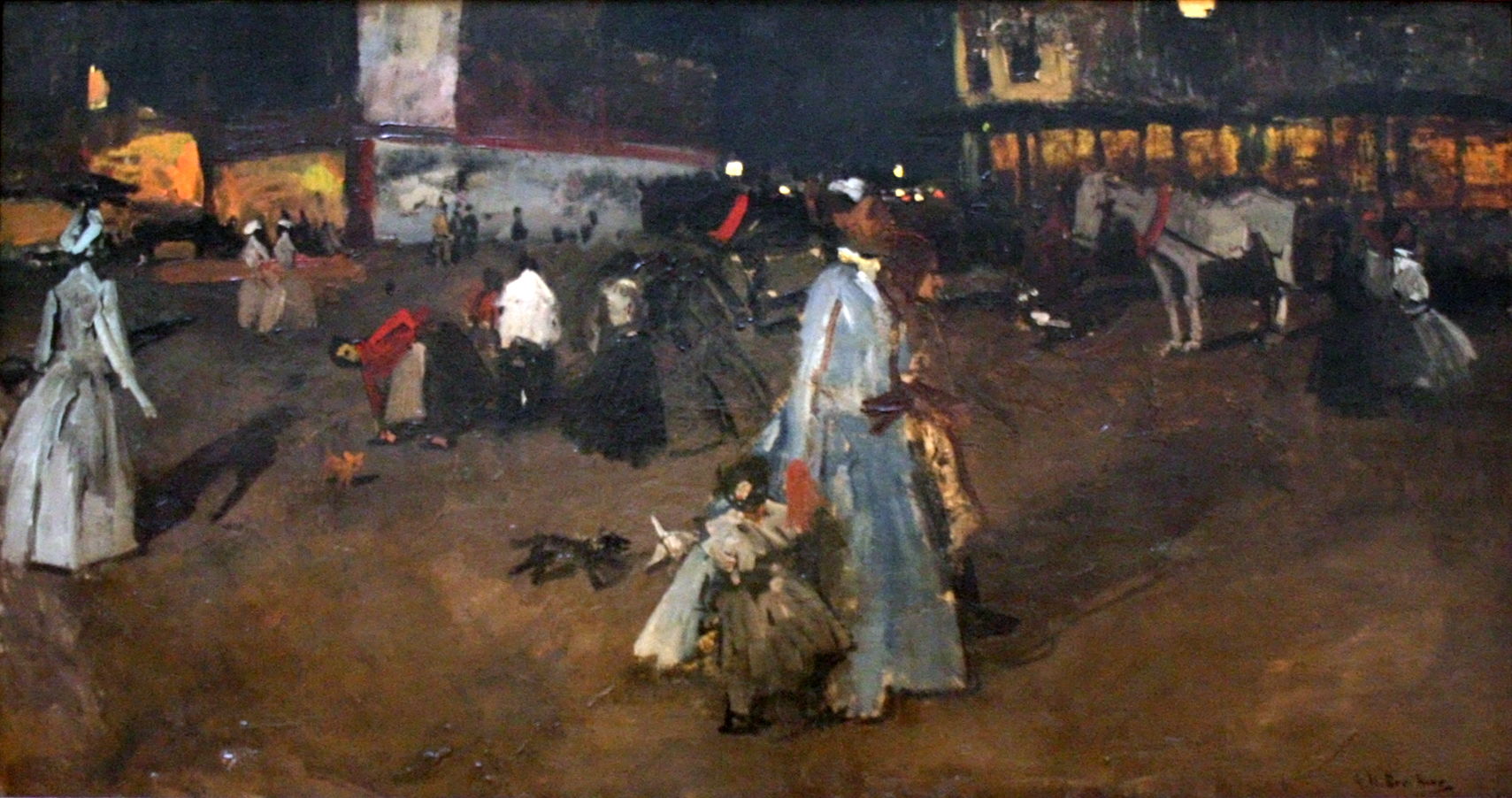
George Hendrik Breitner (1857–1923), An Evening on the Dam in Amsterdam (c 1890), oil on canvas, 96.3 × 180 cm, Koninklijk Museum voor Schone Kunsten Antwerpen, Antwerp, Belgium. Wikimedia Commons.
Breitner entered the Rijksakademie in Amsterdam in 1886, but by that time had progressed well beyond anything it could offer him. He went out onto the streets of Amsterdam sketching discreetly, as shown in An Evening on the Dam in Amsterdam (c 1890). The Dam is the city’s central square flanked by the Royal Palace, originally its City Hall, and Nieuwe Kerk.
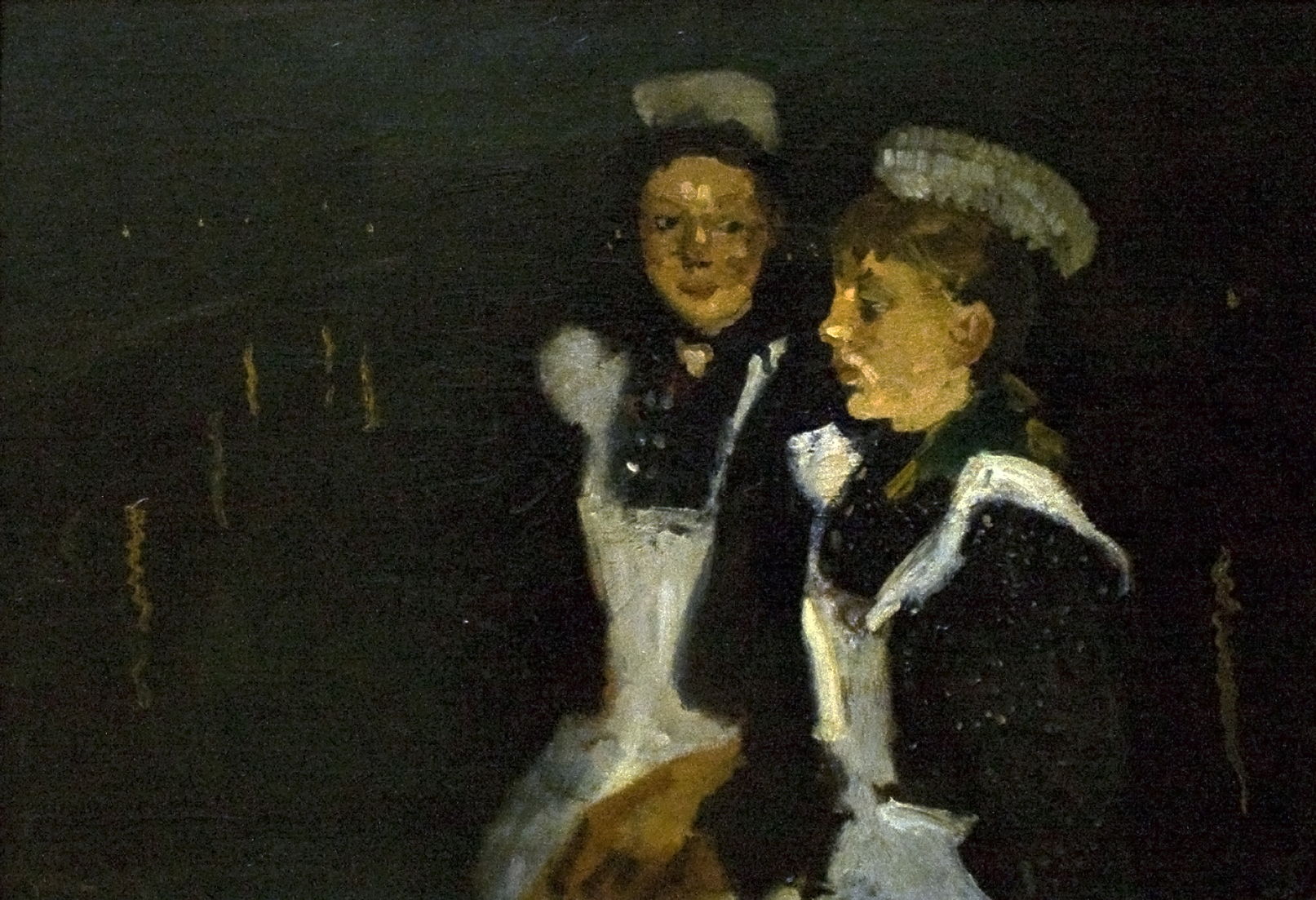
George Hendrik Breitner (1857–1923), Two Servants on an Amsterdam Bridge at Night (1890), oil on canvas, dimensions not known, Teylers Museum, Haarlem, The Netherlands. Image by Szilas, via Wikimedia Commons.
Two Servants on an Amsterdam Bridge at Night (1890) is another nocturne showing some of the people Breitner met on the streets.
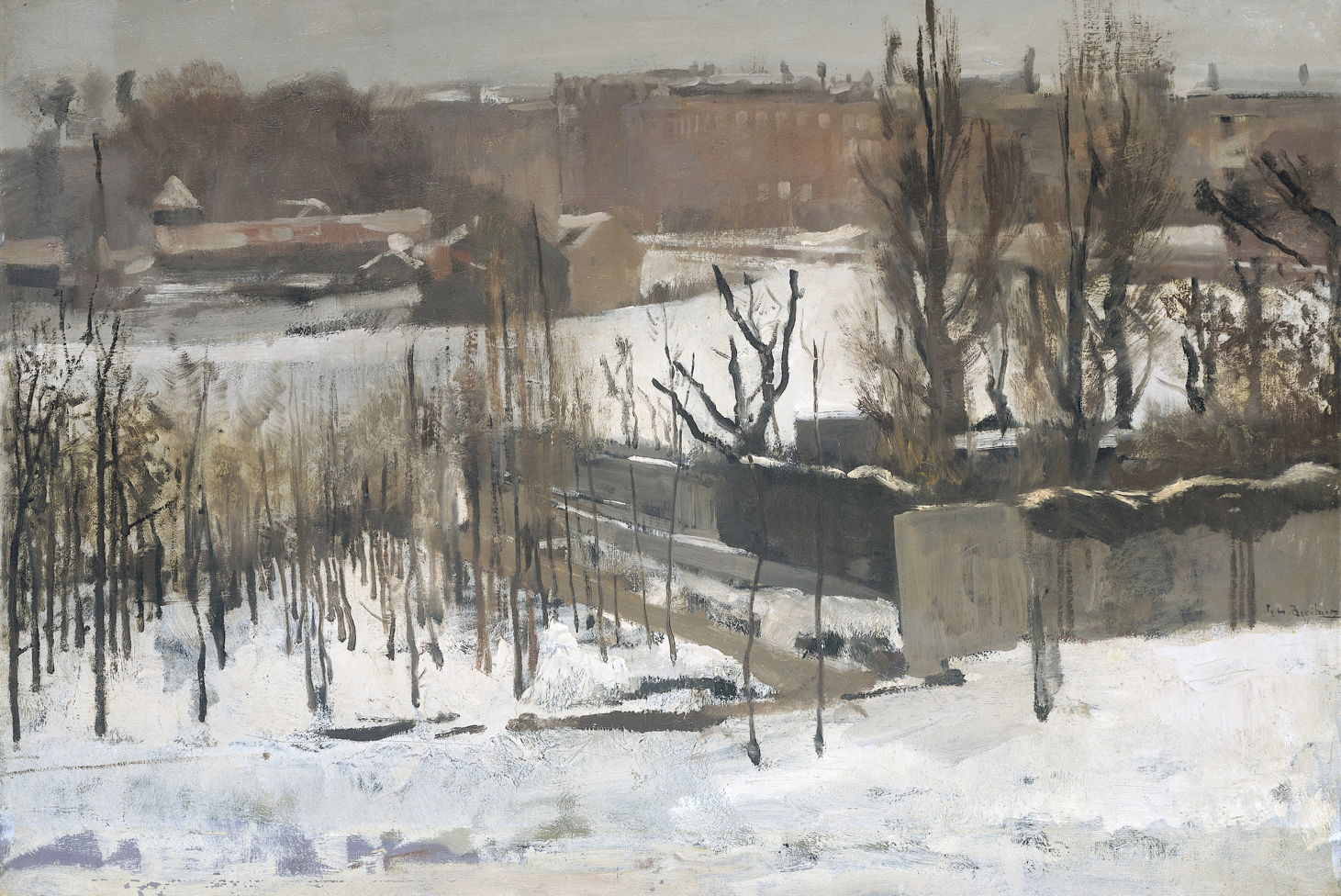
George Hendrik Breitner (1857–1923), View of the Oosterpark in Amsterdam in the Snow (1892), oil on canvas, 70 × 122 cm, Rijksmuseum Amsterdam, Amsterdam, The Netherlands. Wikimedia Commons.
Through the 1890s, Breitner established his reputation with those atmospheric oil sketches, and some larger studio paintings such as this View of the Oosterpark in Amsterdam in the Snow from 1892. This is a relatively modern urban park that now contains a monument to commemorate the abolition of slavery in 1863.
George Hendrik Breitner (1857–1923), Building Site in Amsterdam (after 1880), oil on canvas, 52 × 91 cm, Rijksmuseum Amsterdam, Amsterdam, The Netherlands. Wikimedia Commons.
Breitner continued his paintings of the common people, including those working on this Building Site in Amsterdam. His plein air sketching wasn’t confined to fine and sunny weather. One of the reasons that many of his paintings appear muted in colour is that so many were made outdoors when the sky was overcast. It has also been suggested that the sepias and dull colours used in contemporary monochrome photography were another influence.
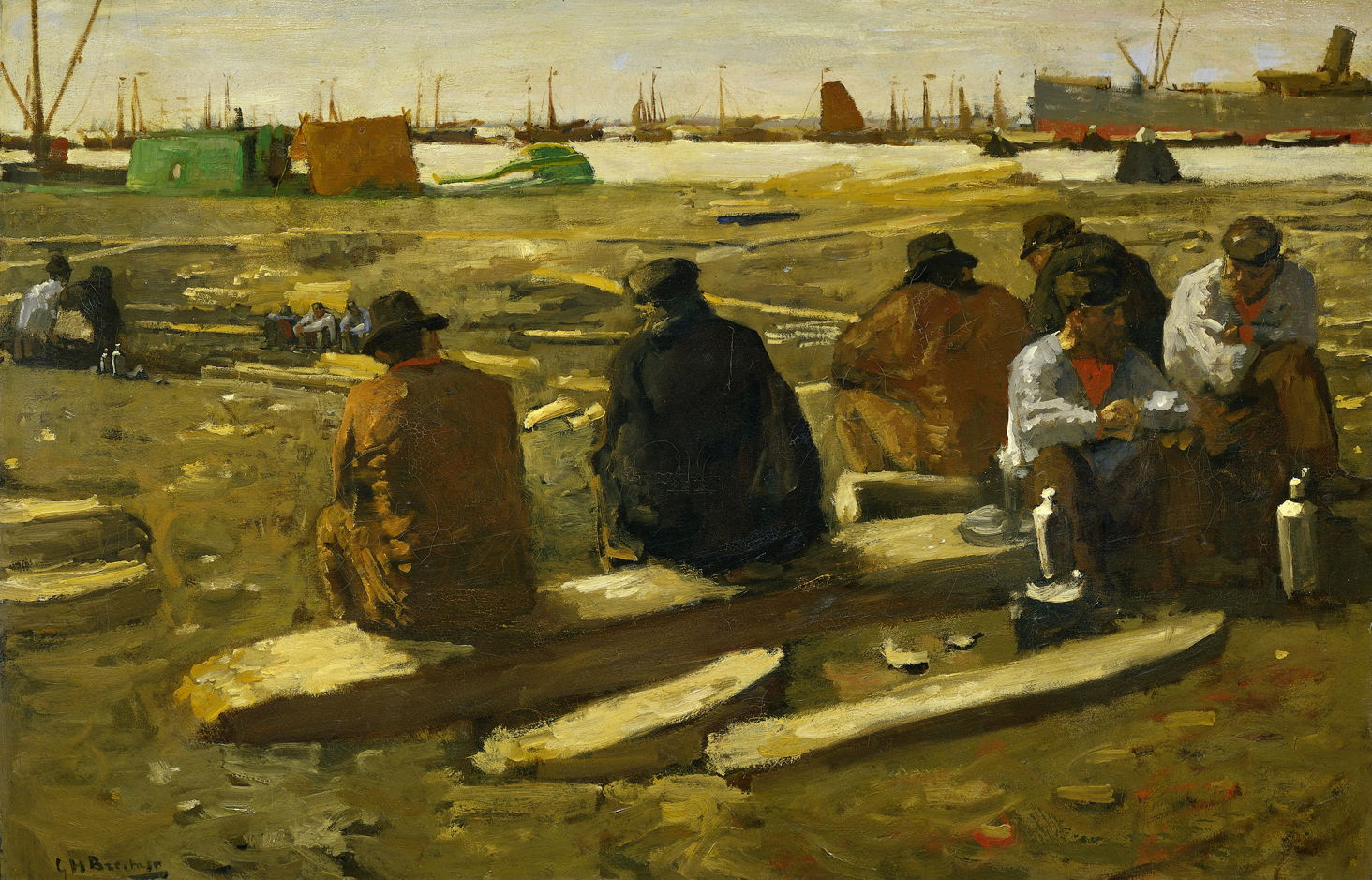
George Hendrik Breitner (1857–1923), Lunch Break at the Building Site in the Van Diemenstraat in Amsterdam (1896-1900), oil on canvas, 78 × 115 cm, Rijksmuseum Amsterdam, Amsterdam, The Netherlands. Wikimedia Commons.
Lunch Break at the Building Site in the Van Diemenstraat in Amsterdam (1896-1900) seems to have been painted on a brighter day, as construction workers sat outside during their brief lunchtime.
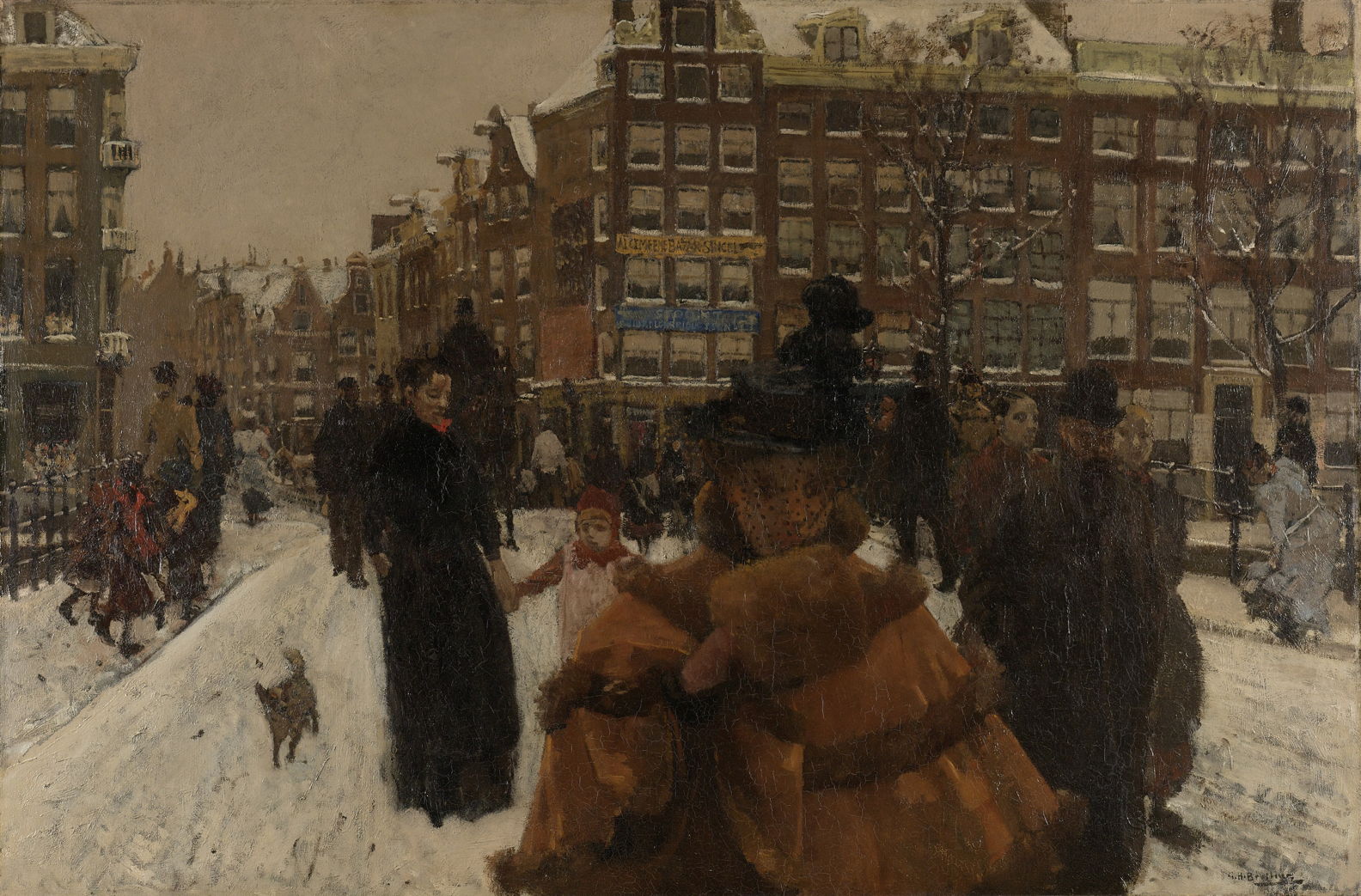
George Hendrik Breitner (1857–1923), The Singelbrug Near the Paleisstraat in Amsterdam (c 1897), media and dimensions not known, Rijksmuseum Amsterdam, Amsterdam, The Netherlands. Wikimedia Commons.
Breitner took hundreds if not thousands of photos of street scenes in Amsterdam, and made many paintings of them too. Among the best-known is The Singelbrug Near the Paleisstraat in Amsterdam from about 1897, which has the look of a photo, with those passing by frozen in their motion.
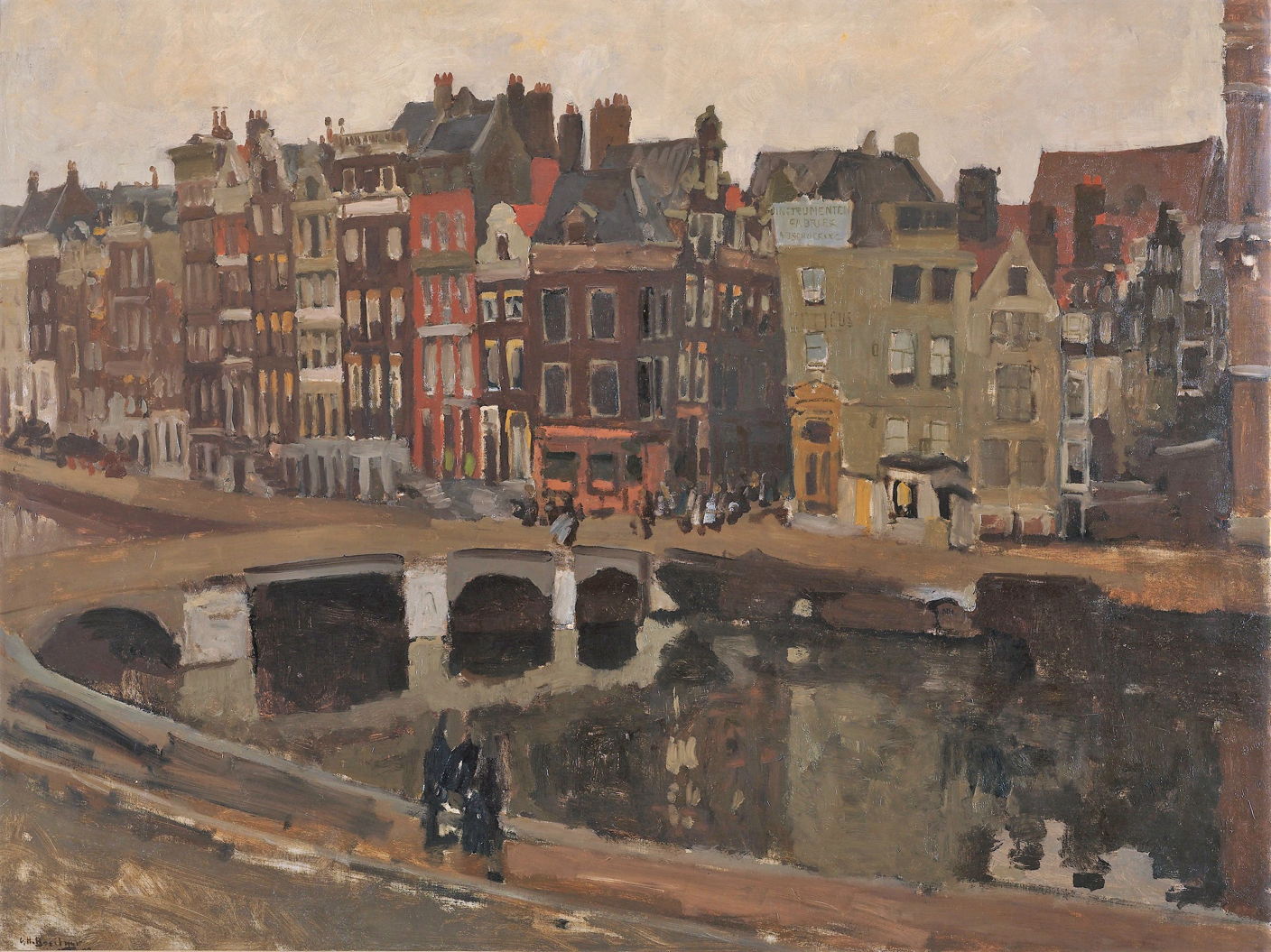
George Hendrik Breitner (1857–1923), The Rokin in Amsterdam (1897), oil on canvas, 97 × 127 cm, Rijksmuseum Amsterdam, Amsterdam, The Netherlands. Wikimedia Commons.
The Rokin in Amsterdam (1897) is a canal and street in the centre of the city that was a particular favourite of Breitner. Originally a stretch of the River Amstel, its section near the Dam was filled in 1936, to turn it into a street.
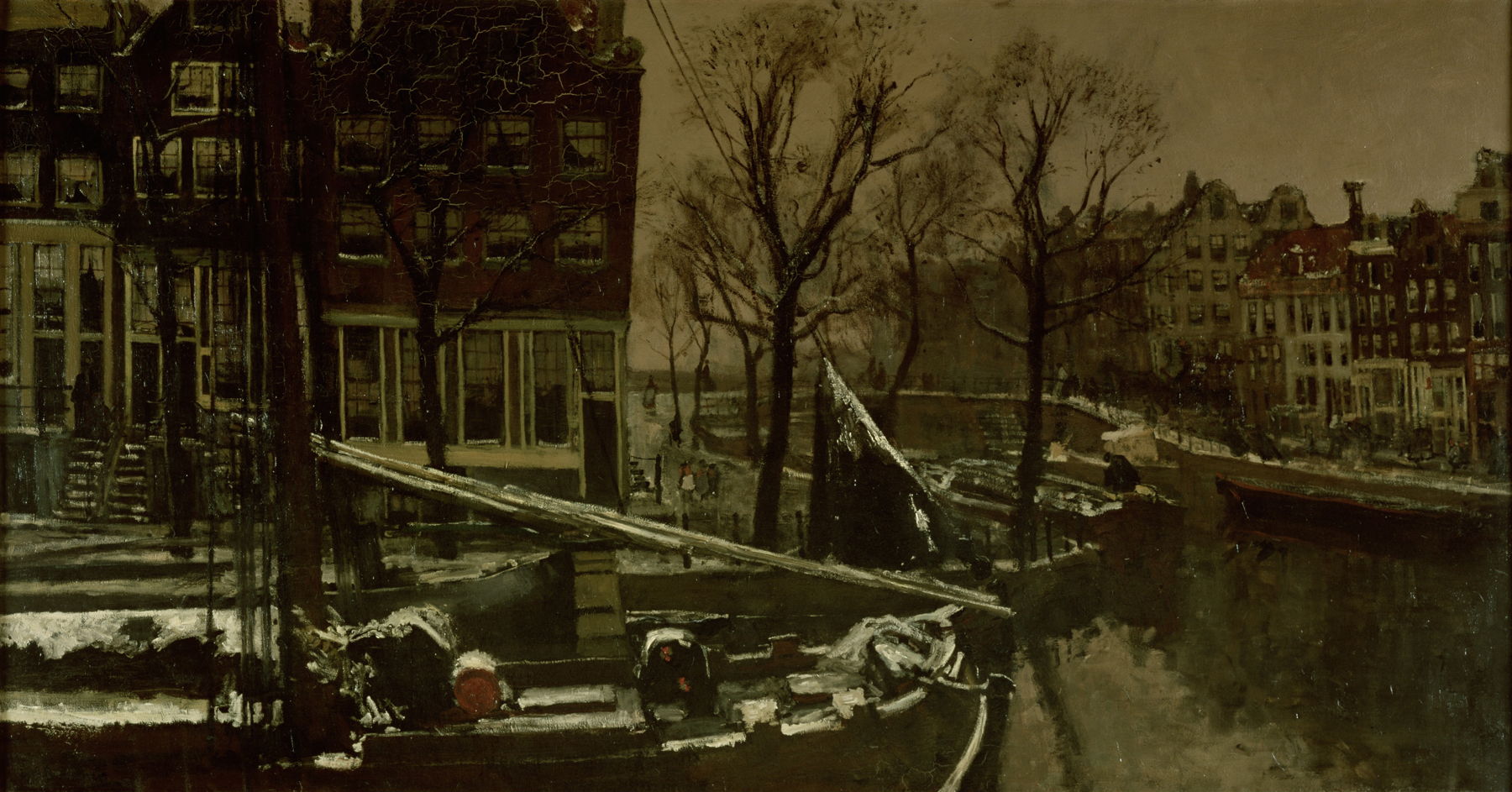
George Hendrik Breitner (1857–1923), Winter in Amsterdam (c 1900-01), oil on canvas, 95 x 192 cm, Rijksmuseum Amsterdam, Amsterdam, The Netherlands. Wikimedia Commons.
His Winter in Amsterdam (c 1900-01) is quite dark, as it would be on a typical overcast day during the middle of winter, but his snow highlights on the boat in the foreground give it an unusual effect of eerie stillness.
By this time, Amsterdam’s population exceeded half a million, and was still growing strongly.
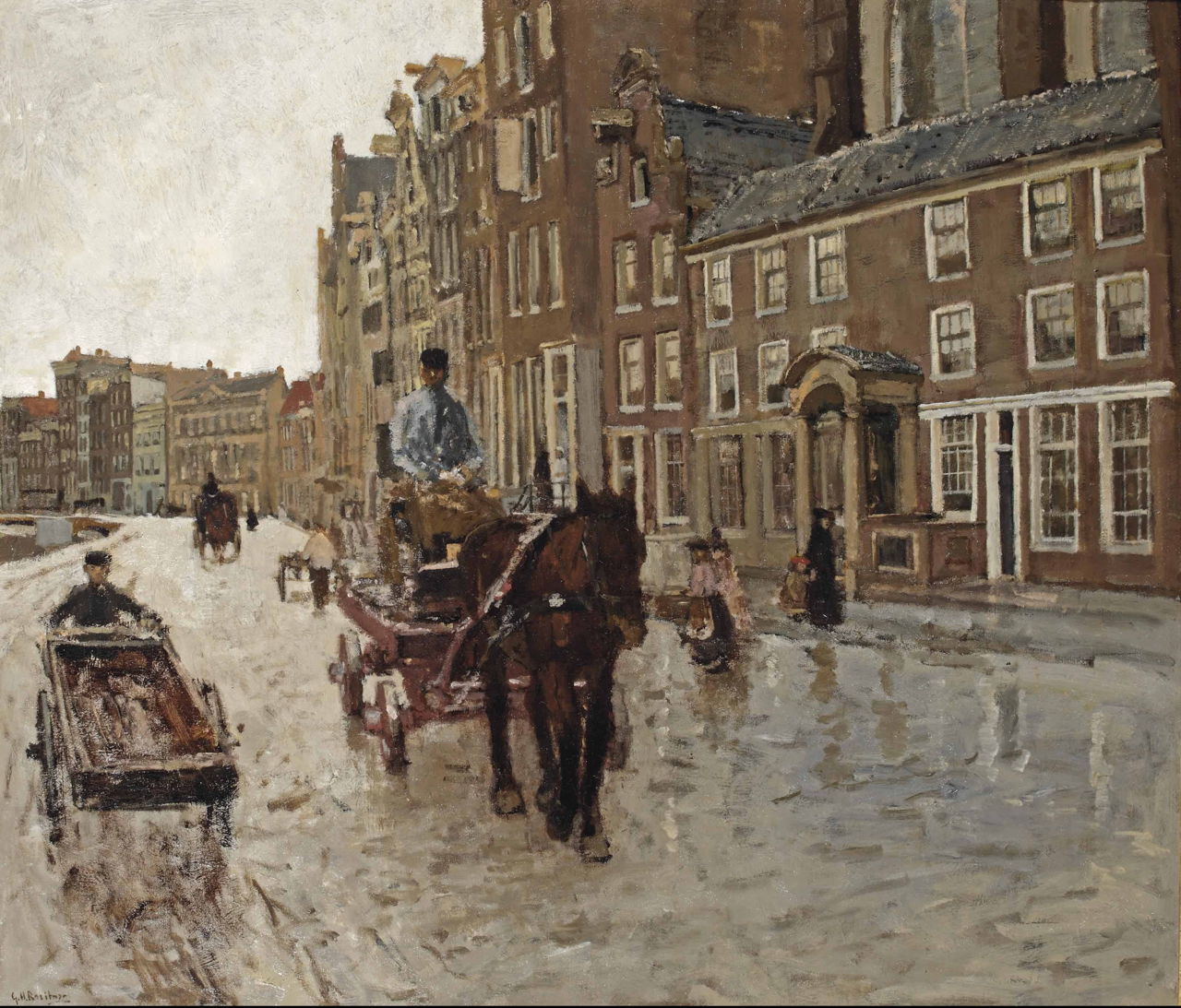
George Hendrik Breitner (1857–1923), The Rokin with the Nieuwezijdskapel, Amsterdam (c 1904), oil on canvas, 81 x 70.5 cm, Private collection. Wikimedia Commons.
Breitner relied quite heavily on photography when painting the city in rain and wet conditions, as in The Rokin with the Nieuwezijdskapel, Amsterdam from about 1904.
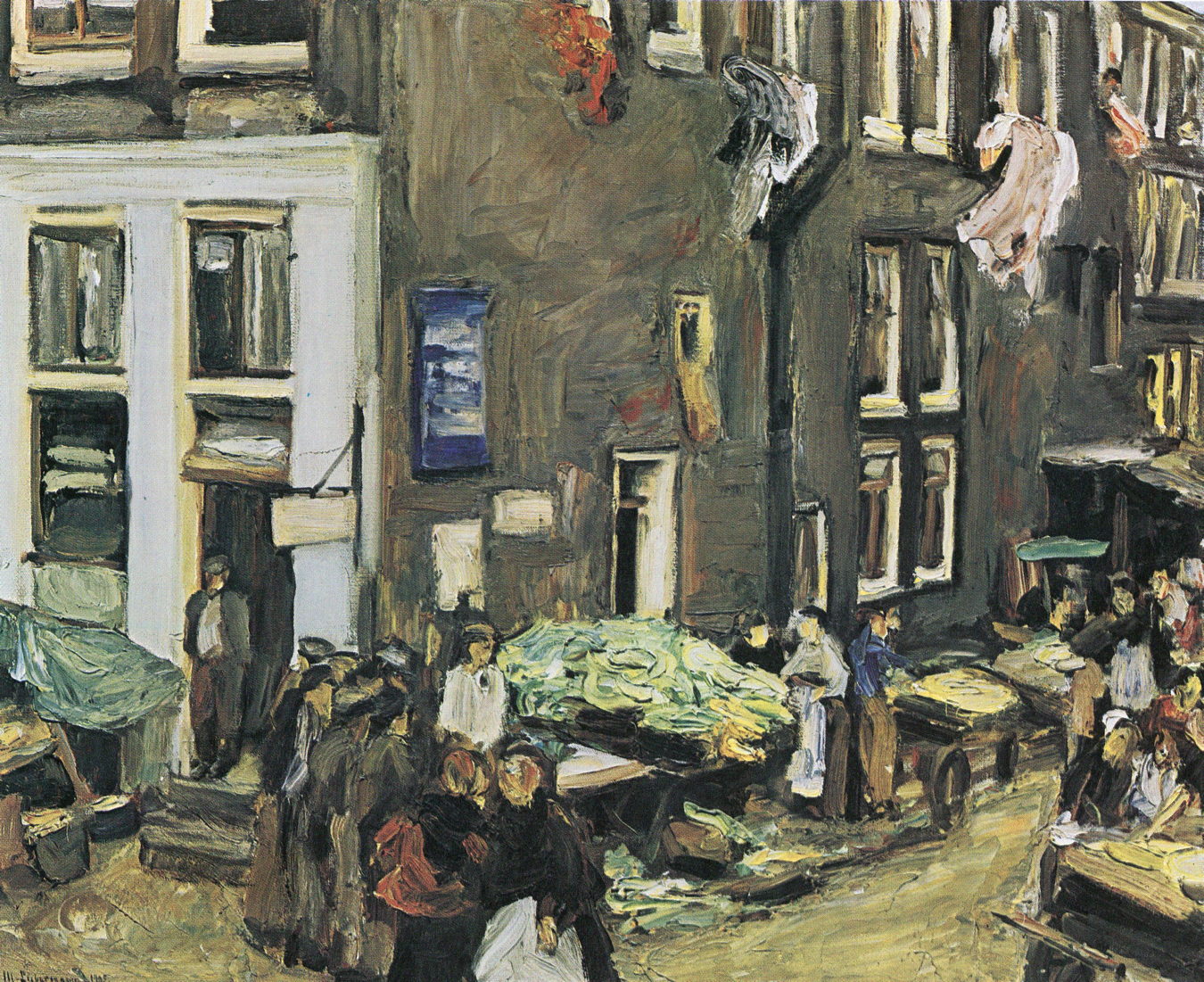
Max Liebermann (1847–1935), Judengasse in Amsterdam (1905), oil on canvas, 59 x 73 cm, Wallraf-Richartz-Museum & Fondation Corboud, Cologne, Germany. Wikimedia Commons.
The German artist Max Liebermann painted extensively in the city’s historic Jewish quarter, referred to as Judengasse, meaning Jewish alley, during this period. Among his paintings is Judengasse in Amsterdam from 1905 showing a market squeezed into this narrow street.
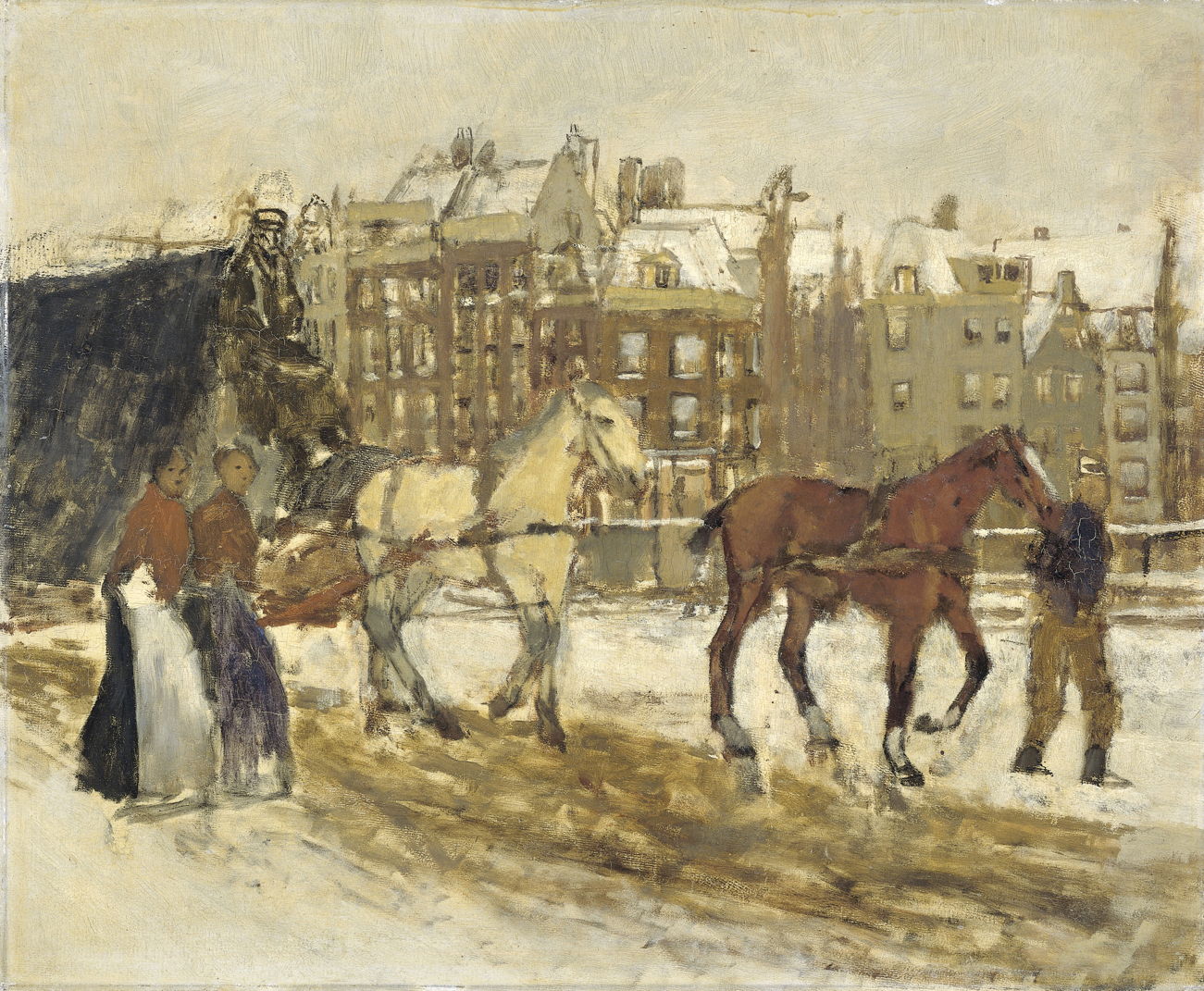
George Hendrik Breitner (1857–1923), The Rokin in Amsterdam (1923), oil on panel, 38 × 46 cm, Rijksmuseum Amsterdam, Amsterdam, The Netherlands. Wikimedia Commons.
Breitner painted The Rokin in Amsterdam in early 1923, probably one of his last works, as he died in the city on 5 June that year. Many of his photographs weren’t discovered until 1996, when it became clear how talented and innovative a photographer he had been. Most appropriately, his name has entered the Dutch language, at least among those in Amsterdam, who still refer to dull and overcast weather as weer typisch Breitner Weer, typical Breitner weather again.
This weekend, as my series on painting in the Dutch Golden Age draws to a close, it’s time to pay a visit to the city of Amsterdam, centre of trade and commerce, and one of the most multicultural cities in Europe since the seventeenth century. At the start of this selection of paintings of its canals and buildings, its population was around 170,000, and by the end of tomorrow’s sequel that had reached over 650,000.
Egbert van der Poel (1621–1664), The Fire in the Nieuwe Kerk, Amsterdam, in 1645 (c 1645), brush and gray wash and black wash with touches of pen and brown ink, 12.5 × 19.4 cm, location not known. Wikimedia Commons.
Egbert van der Poel established his reputation painting major fires in the Dutch Republic. Although it has been claimed that these were seldom based on his personal observations, this sketch of The Fire in the Nieuwe Kerk, Amsterdam, in 1645, was made in front of the motif using washes with touches of pen and brown ink. Perhaps he was the first ‘ambulance chaser’ who travelled out to sketch fires, from which he painted his famous brandjes in the studio.
Aert van der Neer (c 1604–1677), Fire in Amsterdam by Night (date not known), oil on canvas, 58.8 x 71.7 cm, Statens Museum for Kunst (Den Kongelige Malerisamling), Copenhagen, Denmark. Wikimedia Commons.
At some stage, Aert van der Neer also started painting destructive fires, including this undated Fire in Amsterdam by Night. This shows one of the broader canals in the city, with residents already taking to boats in case they needed to evacuate.
Jan Abrahamsz Beerstraaten (1622–1666), The Old Town Hall of Amsterdam on Fire, 7 July 1652 (1652-55), oil on panel, 89 x 121.8 cm, Amsterdam Museum, Amsterdam, The Netherlands. Wikimedia Commons.
In the summer of 1652, Jan Abrahamsz Beerstraaten seems to have witnessed the destruction by fire of part of the centre of Amsterdam, which formed the basis of his studio painting of The Old Town Hall of Amsterdam on Fire, 7 July 1652 (1652-55). Local inhabitants are walking in orderly queues to boats, in which they escape from the scene.
Gabriel Metsu (1629–1667), The Vegetable Market in Amsterdam (c 1660-61), oil on canvas, 97 x 84 cm, Musée du Louvre, Paris. Image by Shonagon, via Wikimedia Commons.
Gabriel Metsu followed the subjects of his genre paintings beyond the home, here into The Vegetable Market in Amsterdam in about 1660-61. The mistress stands with a metal pail on her arm, detached from the housekeeper to the left of centre, who is bargaining with one of the vendors. Other figures are drawn from a broad range of classes, and there’s produce ranging from cauliflowers to chickens.
Meindert Hobbema (1638–1709), The Haarlem Lock, Amsterdam (1663-65), oil on canvas, 77 x 98 cm, The National Gallery, London. Wikimedia Commons.
Meindert Hobbema’s view of The Haarlem Lock, Amsterdam from 1663-65 shows a working lock with a raising bridge, and the masts of many ships in the harbour beyond. This lock may form the entrance to the Haarlemmertrekvaart, a canal dug in 1631 to facilitate transit by boat between Amsterdam and the city of Haarlem to its east.
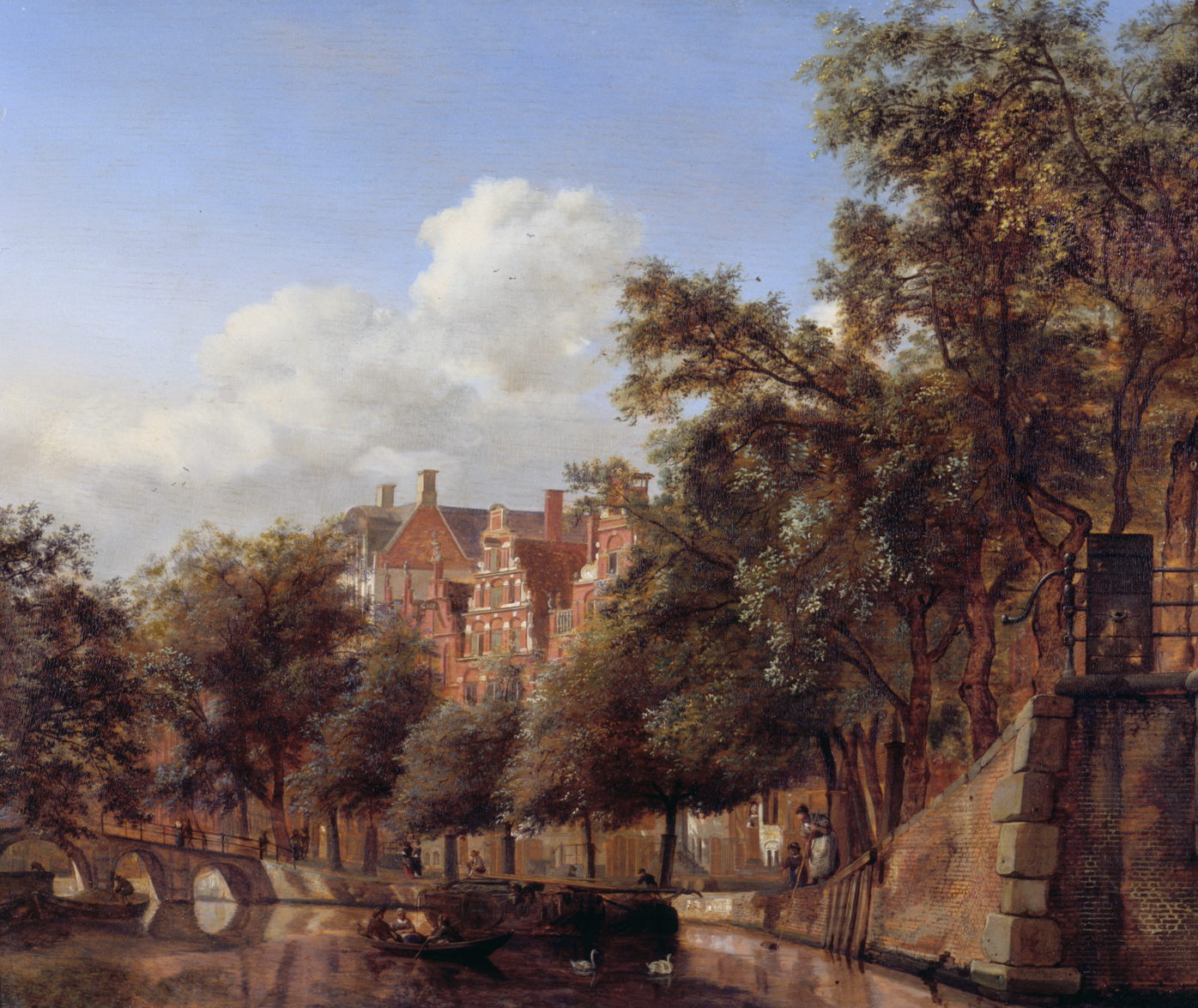
Jan van der Heyden (1637–1712), View of the Herengracht, Amsterdam (c 1670), oil on canvas, 33.5 x 39.7 cm, Private collection. Wikimedia Commons.
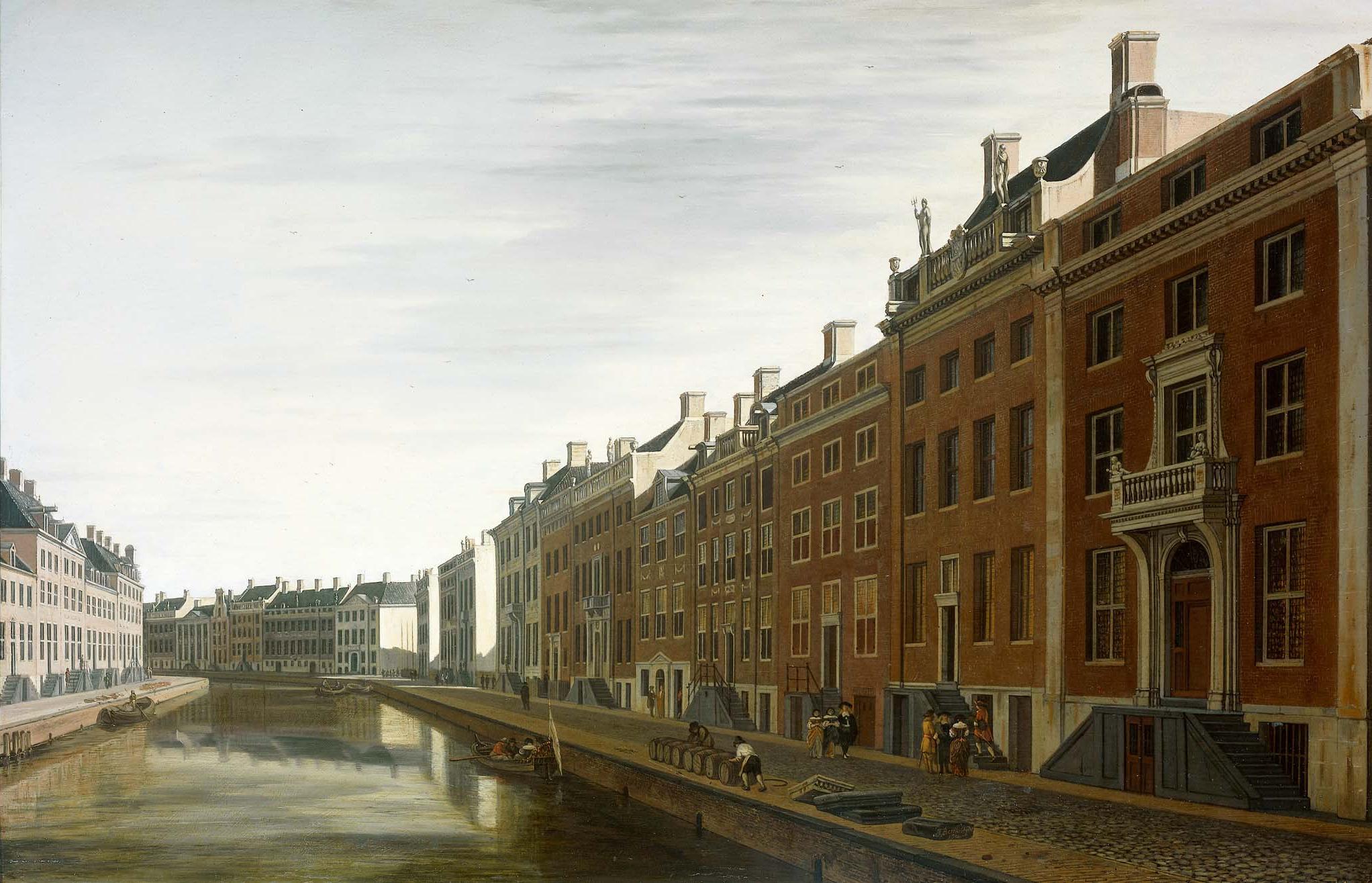
Jan van der Heyden’s View of the Herengracht, Amsterdam from about 1670 shows this canal that has become famous for its large and elegant houses. These were built from 1612, and are finest along this section known as the Golden Bend. Below is a contrasting view from 1672, in Gerrit Adriaensz Berckheyde’s The Bend in the Herengracht near the Nieuwe Spiegelstraat in Amsterdam.
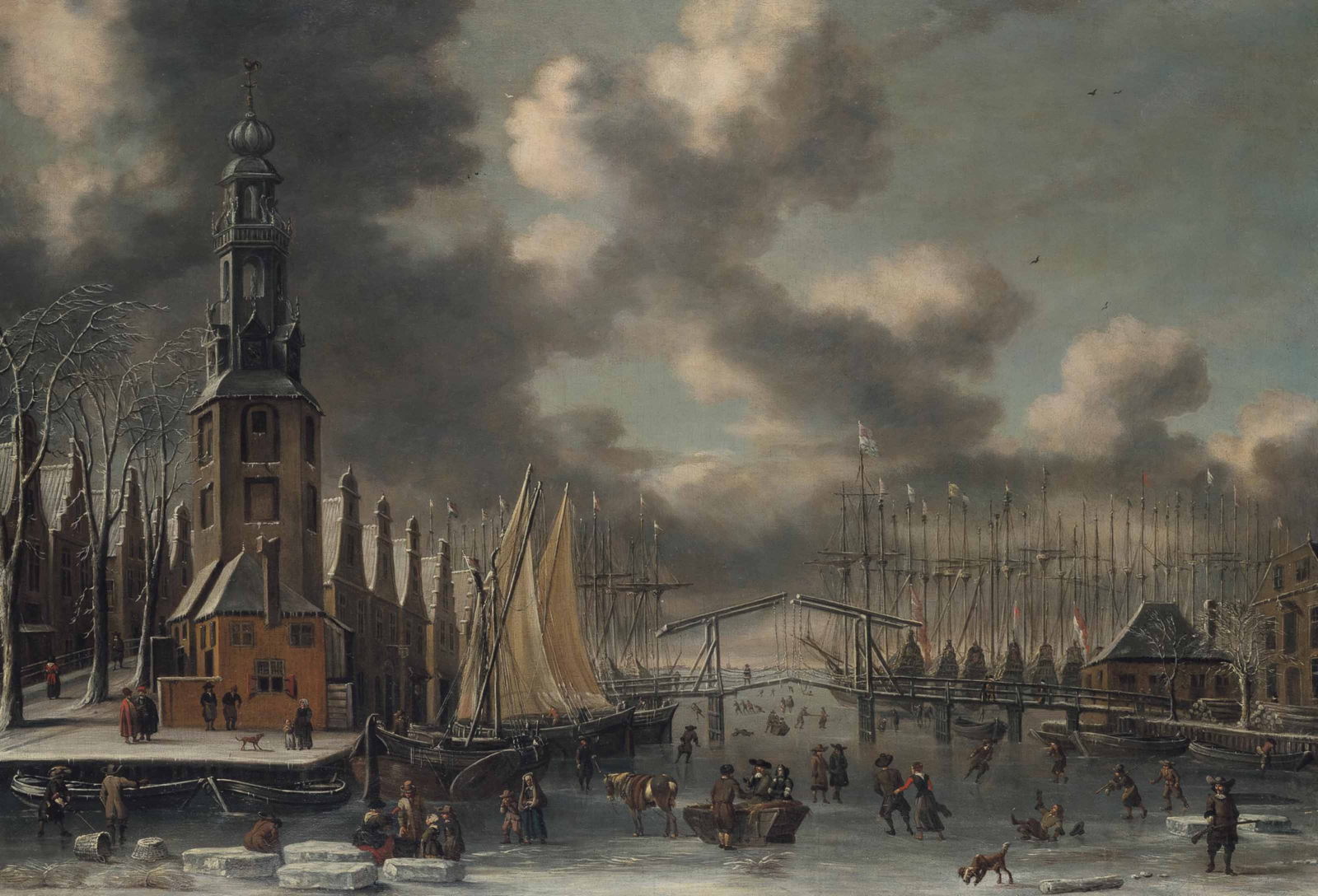
Gerrit Adriaensz Berckheyde (1638–1698), The Bend in the Herengracht near the Nieuwe Spiegelstraat in Amsterdam (1672), oil on panel, 40.5 x 63 cm, Rijksmuseum, Amsterdam. Wikimedia Commons.Thomas Heeremans (1641–1694) and Abraham Storck (1644-1708), Winter Landscape with the Montelbaanstoren, Amsterdam (1676), oil on canvas, 76 x 108.5 cm, Private collection. Wikimedia Commons.
In 1676, Thomas Heeremans and Abraham Storck joined forces to paint this Winter Landscape with the Montelbaanstoren, Amsterdam. The Montelbaanstoren is the prominent tower in the left foreground, and the canal seen is the Oudeschans. The tower was built in 1516 as part of the city’s defences, and its upper section was extended in 1606, bringing it to a height of 48 metres (almost 160 feet).
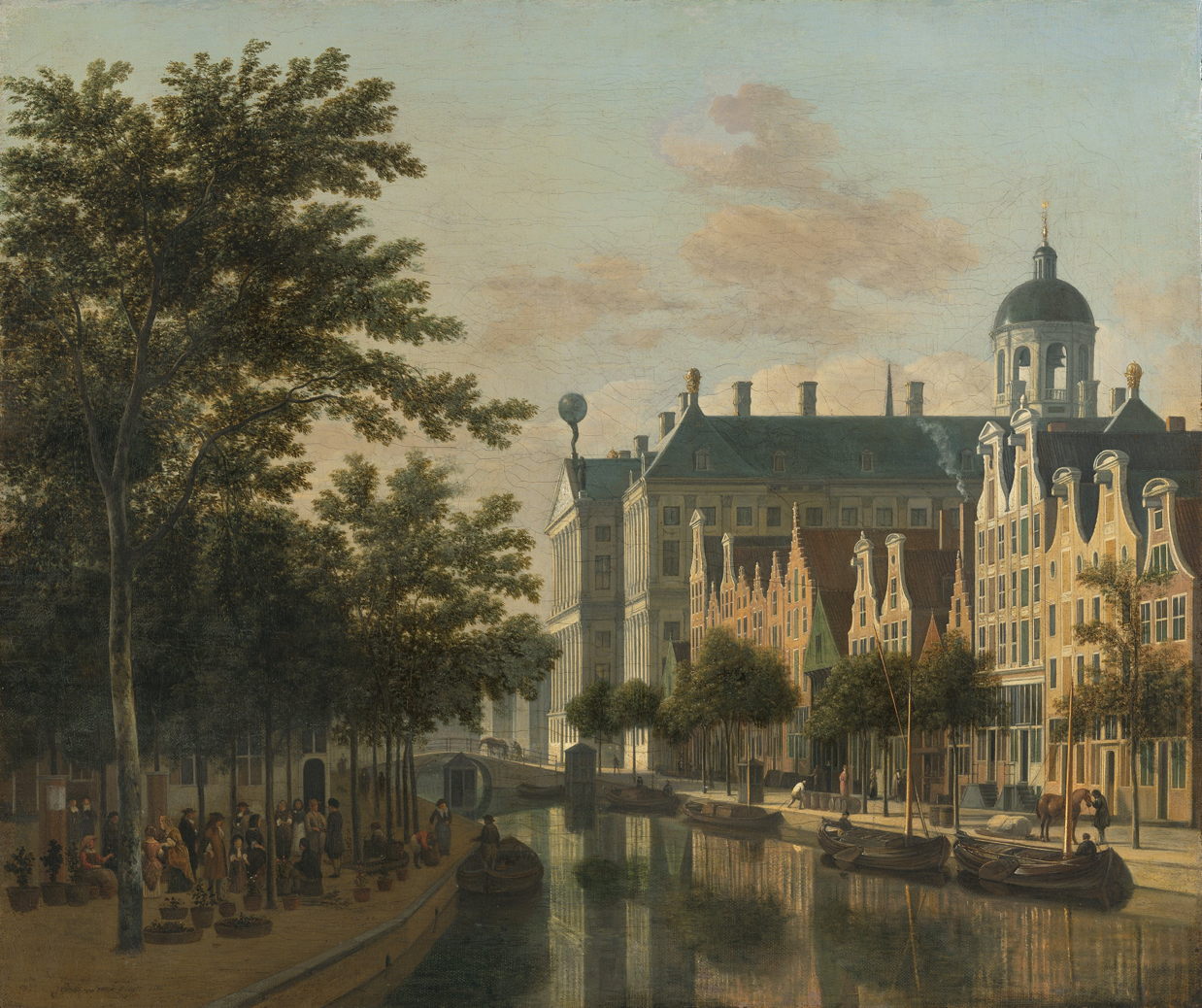
Gerrit Adriaenszoon Berckheyde (1638–1698), The Nieuwezijds Voorburgswal, Amsterdam (1686), oil on canvas, 54 x 64 cm, Museo Nacional Thyssen-Bornemisza, Madrid, Spain. Wikimedia Commons.
Berckheyde’s The Nieuwezijds Voorburgswal, Amsterdam from 1686 shows the canal running at the rear of the City Hall that was covered over two centuries later in 1884 to create a street. The City Hall was built between 1648-65, and features an octagonal tower seen here at the right. Mounted on its roof, at the centre of the painting, is a sculpture by Artus Quellinus of Atlas supporting a celestial sphere. On the opposite bank is a small flower market. By this time the population of Amsterdam had risen to more than 220,000, many of them immigrants.
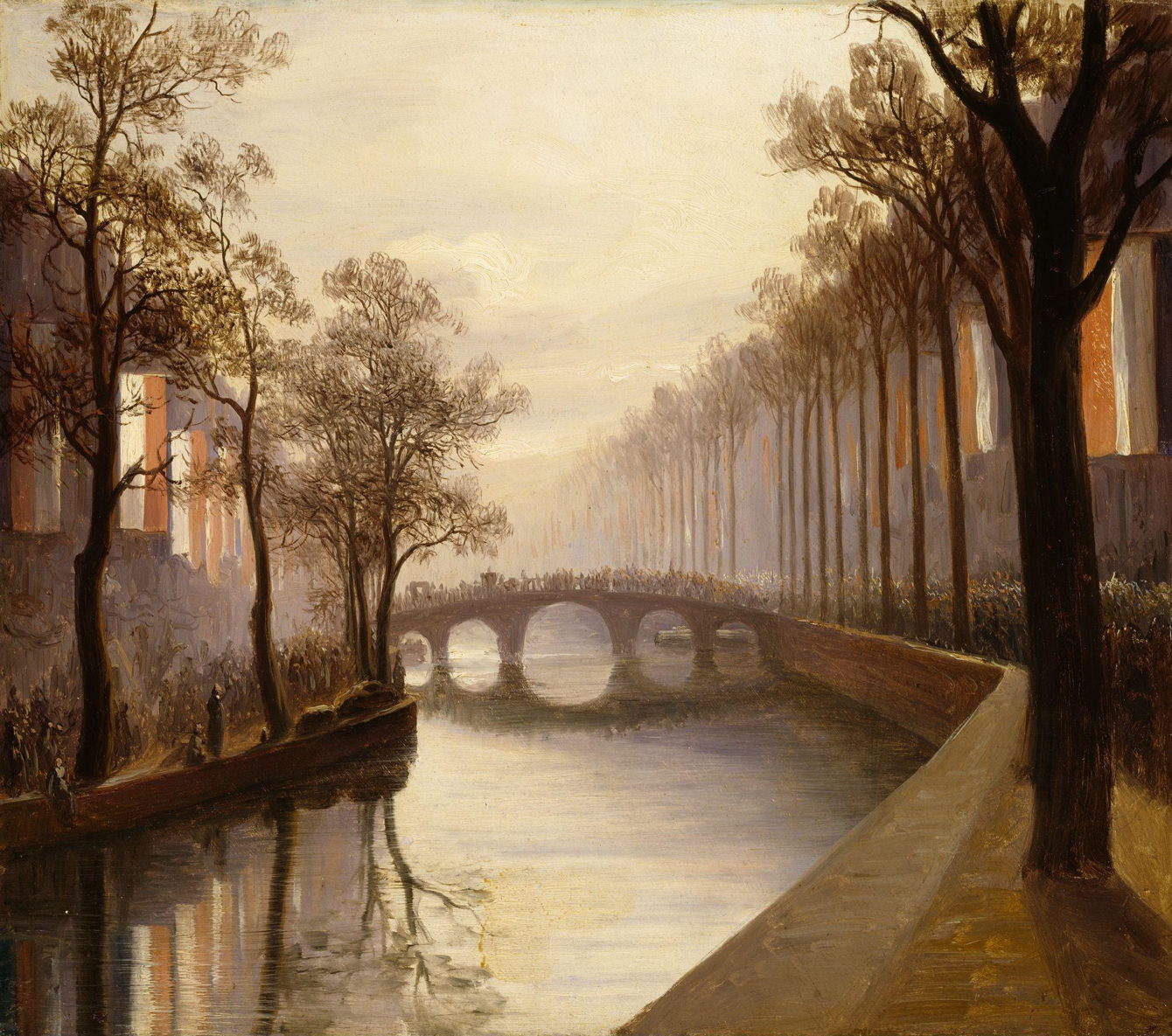
Thomas Fearnley (1802–1842), King William II’s Ceremonial Procession in Amsterdam, 27 November 1840 (1840), oil on paper, 38.5 x 43 cm, Nasjonalmuseet for kunst, arkitektur og design, Oslo, Norway. Wikimedia Commons.
The Norwegian landscape artist Thomas Fearnley appears to have visited the city late in 1840, when he painted King William II’s Ceremonial Procession in Amsterdam, 27 November 1840 in oils on paper. Neither the artist nor the king survived long after this grand event: Fearnley succumbed to typhoid in 1842, and King William II died suddenly in 1849.
Charles Leickert (1816–1907), Urban Landscape (1856), oil on canvas, 87 x 119 cm, Hermitage Museum Государственный Эрмитаж, Saint Petersburg, Russia. Wikimedia Commons.
Charles Leickert is better known for his winter landscapes of frozen waterways in the Netherlands, but his Urban Landscape from 1856 shows active trading taking place beside a canal most probably in Amsterdam, where he was a member of the Royal Academy at the time.
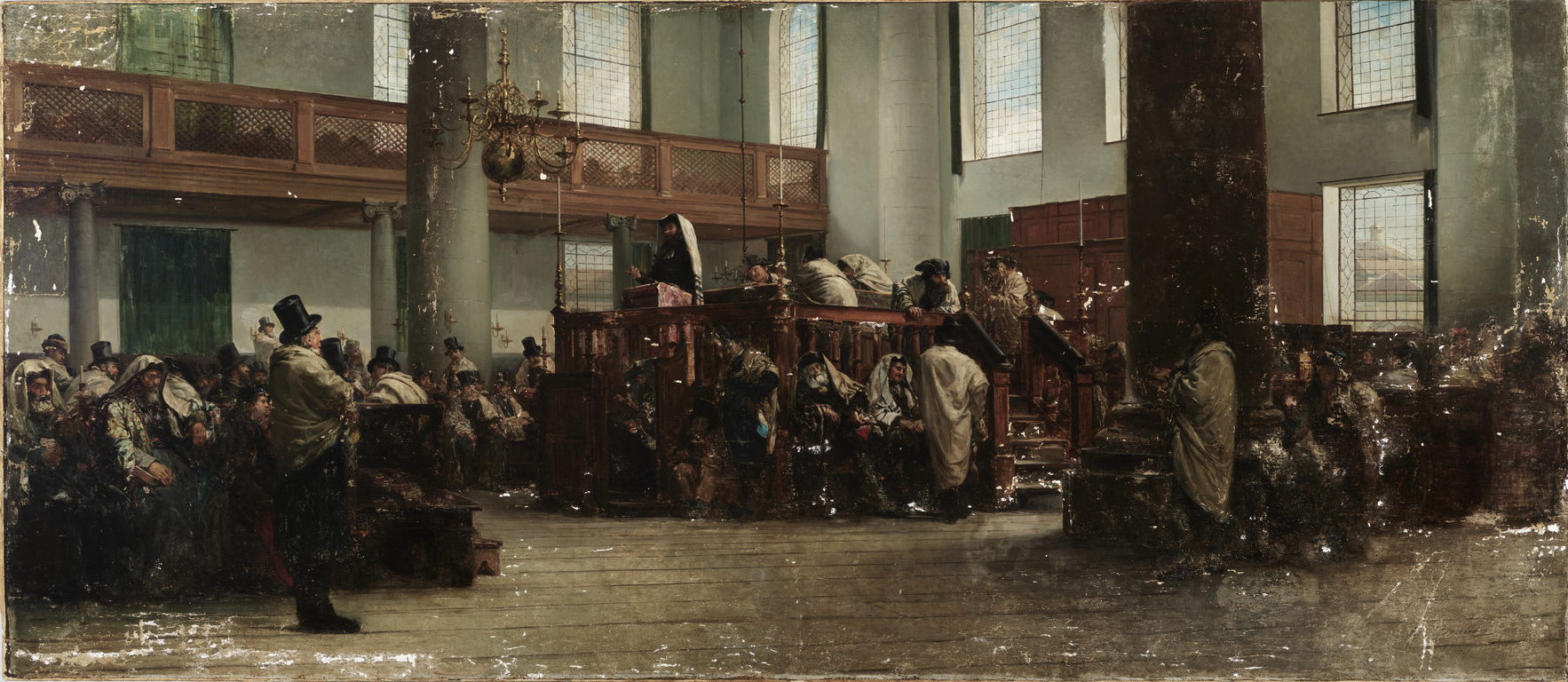
Jacob-Emile-Edouard Brandon (1831-1897), Portuguese Synagogue at Amsterdam 22 July 1866 (1867), oil on canvas, 75.5 x 174.3 cm, Walters Art Museum, Baltimore, MD. Courtesy of Walters Art Museum.
Jacob-Emile-Edouard Brandon is one of the forgotten artists who exhibited at the First Impressionist Exhibition in 1874. One of his few surviving paintings is this Portuguese Synagogue at Amsterdam 22 July 1866 from 1867, which was awarded a medal at the Salon of that year. This was probably Europe’s most famous and picturesque synagogue at the time. The sermon was being delivered by the distinguished Talmudist David de Jahacob Lopez Cardozo (1808-1890), who was appointed ab bet din there in 1839.

 Login
Login