Reading view

There are new articles available, click to refresh the page.

Reading Visual Art: 245 Scissors

Scissors, including shears, are hand tools use for cutting by bringing two cutting edges to bear on the sheet or object being cut. Originally they were all shears, effectively hinged at the end further from the blades, when open like a V. They have been largely replaced by scissors that rotate around a pivot between their handles and blades, when open like an X. However, in normal usage terminology is inconsistent, with heavyweight X-based scissors used in gardening and horticulture being referred to as shears. Scissors weren’t made in large numbers until the later half of the eighteenth century, since when they have become widely used.

In this article I will ignore farming and industrial uses of shears, for example to harvest wool from sheep or cut sheet metal (also known as snips), and concentrate more on domestic uses of lightweight shears and scissors. These are most strongly associated with cutting fabrics, yarn and threads, and all forms of fibre craft.

In classical myth, they appear in the weaving contest between Arachne and the goddess Minerva.
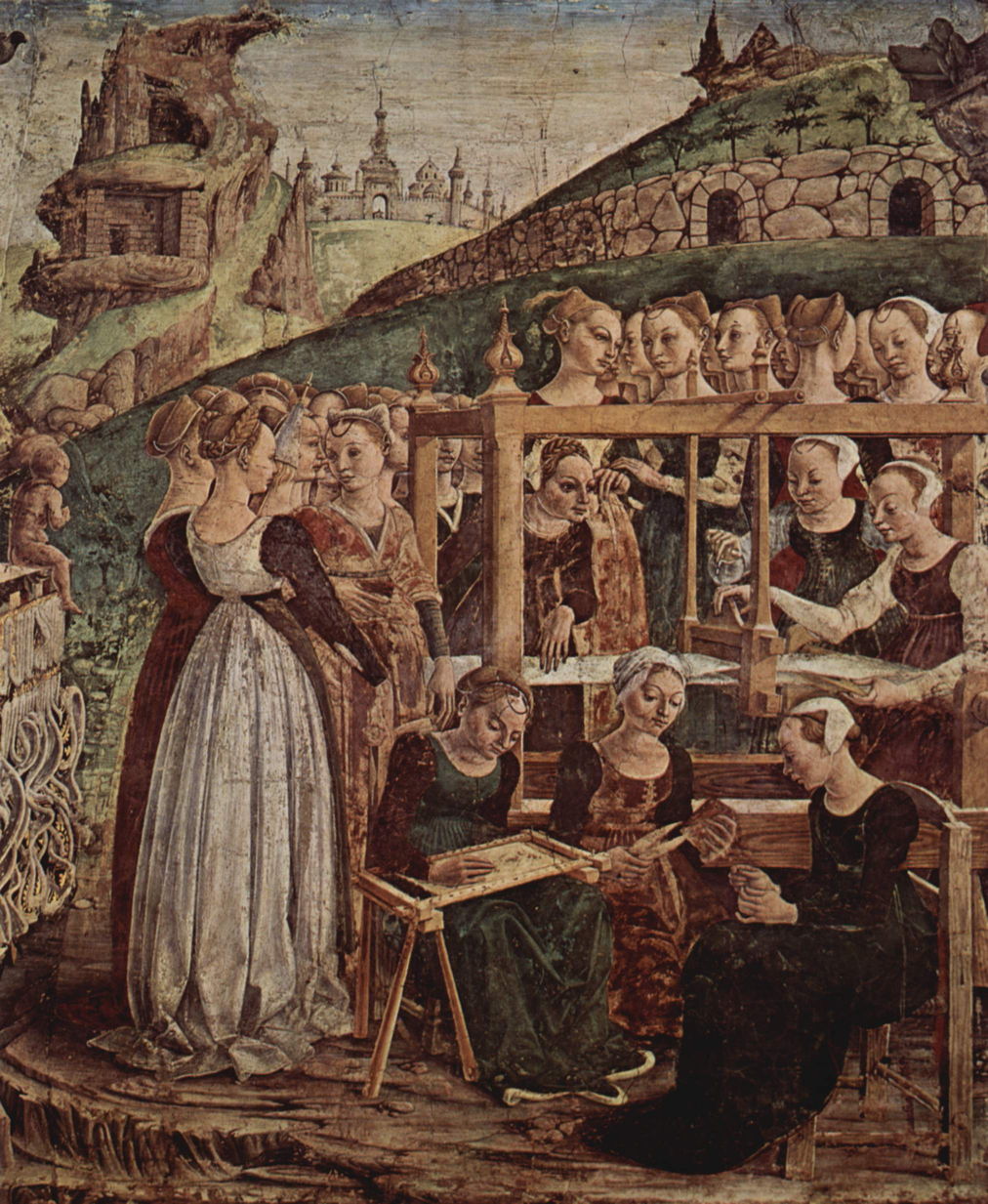
delcossatriumphminerva
Francesco del Cossa (1436–1487), The Triumph of Minerva, March (1467-70), fresco in the Room of the Months, Palazzo Schifanoia, Ferrara, Italy. Wikimedia Commons.

Several of the surviving paintings of this myth show Arachne and Minerva at their looms, weaving like fury. Francesco del Cossa’s The Triumph of Minerva (1467-70) was chosen for the month of March in his fresco for the Room of the Months in the Palazzo Schifanoia in Ferrara, Italy. The trio of women in the foreground are engaged in allied crafts, including embroidery and sewing, and the middle one is using a pair of shears to cut some fabric. Behind them are the two weavers working at what is shown as a single loom, the traditional boxwood shuttle just being inserted by the left hand of the woman at the right.

The three Fates are often depicted with one of them, traditionally Atropos, cutting the thread of life using shears.

burnejonesfeastpeleus
Edward Burne-Jones (1833–1898), The Feast of Peleus (1872-81), oil on canvas, 36.9 x 109.9 cm, Birmingham Museum and Art Gallery, Birmingham, England. Wikimedia Commons.

Edward Burne-Jones’ painting of The Feast of Peleus from 1872-81 uses a composition based on classical representations of the Last Supper. Every head has turned towards Eris (Discord) as she brings her golden apple, apart from that of the centaur behind her right wing. Even the three Fates, seen in the left foreground with the nude Atropos wielding her shears, have for once paused momentarily in their work.

thumannthreefates
Paul Thumann (1834–1908), The Three Fates (c 1880), oil on canvas, dimensions not known, location not known. Wikimedia Commons.

This Salon-style depiction of the Fates by Paul Thumann from about 1880 became extremely popular throughout Europe, and was often reproduced on mass-produced porcelain. It’s unusual for drawing such marked distinctions between the women: Atropos, on the left, is shown as a morose older woman armed with her shears; Clotho stands to weave, and is young, very pretty, and bare down to the waist; Lachesis is modestly dressed and holding sprigs of vegetation, at the right.

cranebridgelife
Walter Crane (1845–1915), The Bridge of Life (1884), oil on canvas, dimensions not known, Private collection. Wikimedia Commons.

This transferred into Walter Crane’s unique allegorical narrative The Bridge of Life from 1884. Below the right end of the bridge, Atropos is seen as she is just about to cut the thread of life, so bringing death.

The Old Testament story of Samson depends on him losing his prodigious strength when his hair is cut off by the seductress Delilah.

blakesamsonsubdued
William Blake (1757–1827), Samson Subdued (c 1800), pen and ink and watercolour over graphite on paper, 39.1 x 35.2 cm, Philadelphia Museum of Art (Gift of Mrs. William Thomas Tonner, 1964), Pennsylvania, PA. Courtesy of Philadelphia Museum of Art.

William Blake’s Samson Subdued is one of the large series of biblical watercolours he painted for Thomas Butts in around 1800-03. It shows the naked figure of Delilah holding a pair of modern scissors in her left hand, having apparently cut Samson’s hair off with them to destroy his strength.

Although by no means universal, they are also used as a sign of the Virgin Mary’s domestic activity at the time of the Annunciation, where X-based scissors might also be a symbol of the Crucifixion to come.

murashkoannunciation
Oleksandr Murashko (1875–1919), Annunciation (1907-08), oil on canvas, 198 x 169 cm, National Art Museum of Ukraine Національний художній музей України, Kyiv, Ukraine. Wikimedia Commons.

Oleksandr Murashko’s breathtaking Annunciation, painted probably in 1907-08 or 1909, captures her at work on a tapestry, with a pair of scissors and thread on the carpet in the right foreground.

malczewskiannunciation
Jacek Malczewski (1854–1929), Annunciation (1923), oil on plywood, 61 x 79 cm, Muzeum Narodowe w Warszawie, Warsaw, Poland. Wikimedia Commons.

Jacek Malczewski’s Mary (right) is a modern young woman of 1923, whose thimble and scissors rest on a bare wooden table behind. Gabriel is in the midst of breaking the news to her, his hands held together as he speaks.

Many other paintings include scissors as a reference to their domestic use.
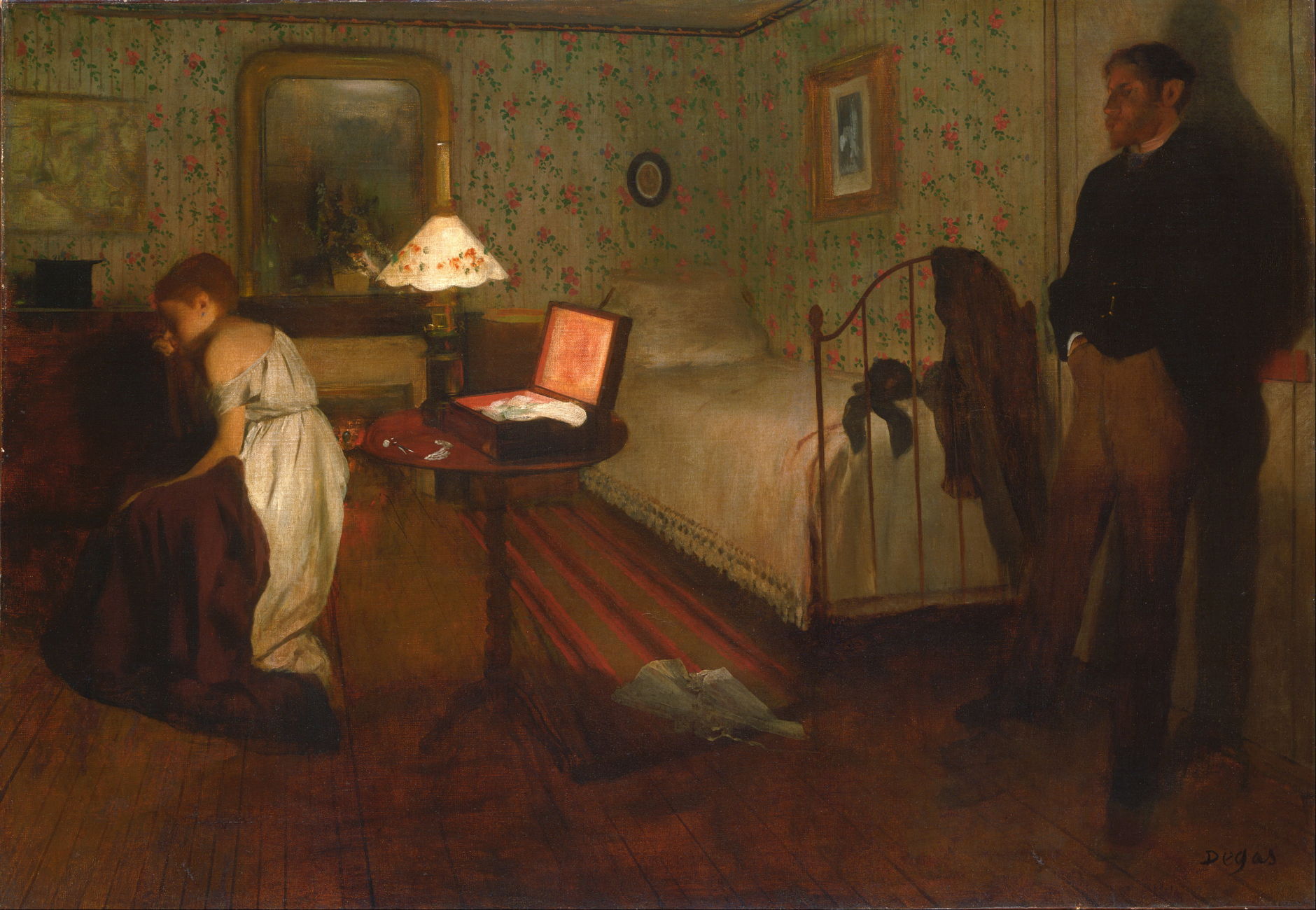
degasinterior
Edgar Degas (1834–1917), Interior (‘The Rape’) (1868-9), oil on canvas, 81.3 x 114.3 cm, Philadelphia Museum of Art, Philadelphia, PA. Wikimedia Commons.

In Edgar Degas’ Interior (1868-9), also known as The Interior and even The Rape, they may be one of the clues to its reading. Between the man and woman, and just behind her, is a small occasional table, on which there’s a table-lamp and a small open suitcase. Some of the contents of the suitcase rest over its edge. In front of it, on the table top, is a pair of scissors and other items that appear to be from a clothing repair kit or ‘housewife’, indicating she has travelled away from her home to this meeting.

tissotfarewell
James Tissot (1836–1902), The Farewells (1871), oil on canvas, 100.3 x 62 cm, Bristol Museums and Art Gallery, Bristol, England. Wikimedia Commons.

James Tissot painted The Farewells soon after his flight to London in the summer of 1871. This couple, separated by the iron rails of a closed gate, are in late eighteenth century dress. The man stares intently at the woman, his gloved left hand resting on the spikes along the top of the gate, and his ungloved right hand grasps her left. She plays idly with her clothing with her other hand, and looks down, towards their hands. She is plainly dressed with a pair of scissors suspended by string on her left side, implying she may be a governess.

signacmilliners127
Paul Signac (1863-1935), Les Modistes (Two Milliners in the Rue du Caire, Paris) (Op 127) (1885-86), oil on canvas, 111.8 x 89 cm, Private collection. Wikimedia Commons.

These two young milliners in Paul Signac’s Les Modistes (Two Milliners in the Rue du Caire, Paris), from 1885-86, are busy making fashionable hats. The nearer of the two women is bent down retrieving her scissors as a symbol of her craft.

krohgtired
Christian Krohg (1852–1925), Tired (1885), oil on canvas, 79.5 x 61.5 cm, Nasjonalgalleriet, Oslo, Norway. Wikimedia Commons.

The Norwegian artist Christian Krohg’s Tired from 1885 shows an exhausted seamstress, one of the many thousands working at home at that time, toiling for long hours by lamplight for a pittance. On the table in front of her is a small pair of scissors.

stifternewdress
Moritz Stifter (1857–1905), The New Dress (1889), oil on panel, 30.5 x 40 cm, location not known. Wikimedia Commons.

Moritz Stifter’s The New Dress from 1889 shows a scene set in the dressmaker’s, with a pair of scissors resting between fabric on the table at the right.

Kit's Writing Lesson 1852 by Robert Braithwaite Martineau 1826-1869
Robert Braithwaite Martineau (1826–1869), Kit’s Writing Lesson (1852), oil on canvas, 52.1 x 70.5 cm, The Tate Gallery (Presented by Mrs Phyllis Tillyard 1955), London. Photographic Rights © Tate 2016, CC-BY-NC-ND 3.0 (Unported), http://www.tate.org.uk/art/artworks/martineau-kits-writing-lesson-t00011

My last pair of scissors appears as part of the sewing kit on the table of Robert Braithwaite Martineau’s painting of Kit’s Writing Lesson (1852), showing a less than memorable scene from Charles Dickens’ The Old Curiosity Shop, with its elaborately detailed interior.

Reading Visual Art: 243 Dryads and Hamadryads

Most mythologies have tree spirits, although those in Asia tend to be expressed in sculpture rather than painted images. In European art, these are most usually termed Dryads or Hamadryads, drawing from classical Greek and Roman myth.

Strictly speaking, a Dryad is the spirit of a specific oak tree, although the term is normally used more broadly for the nymph associated with any specific tree, of whatever type, or a wood nymph. A Hamadryad is a Dryad who is irreversibly bonded to and in a tree, such that the death of the tree brings about the death of the Hamadryad. The term also seems to be used for a Dryad associated with a specific species of tree, such as Balanos for the oak. However, I suspect the terms are used interchangeably in the titles of most paintings.

Paintings of classical myths were most frequent and popular during and after the Renaissance, but at that time, few if any depicted tree spirits or Dryads.

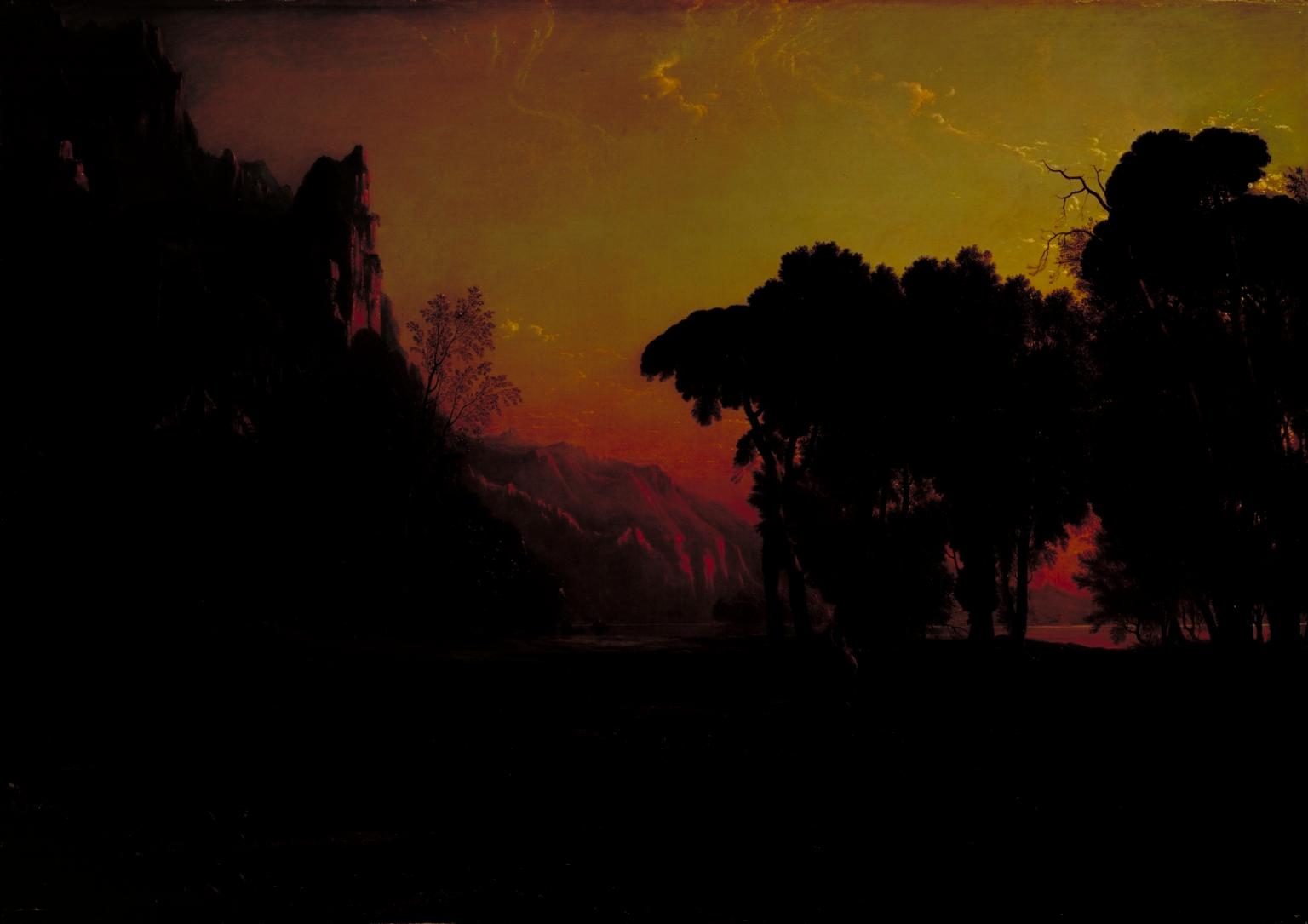
The Wood Nymph's Hymn to the Rising Sun 1845 by Francis Danby 1793-1861
Francis Danby (1793–1861), The Wood Nymph’s Hymn to the Rising Sun (1845), oil on canvas, 107.3 x 152.4 cm, The Tate Gallery (Presented by the Friends of the Tate Gallery 1969), London. © The Tate Gallery and Photographic Rights © Tate (2016), CC-BY-NC-ND 3.0 (Unported), http://www.tate.org.uk/art/artworks/danby-the-wood-nymphs-hymn-to-the-rising-sun-t01132

They became more popular in the nineteenth century, in association with the growing interest in ‘faerie’ paintings and the like. Francis Danby, a contemporary of JWM Turner, painted this magnificent view of The Wood Nymph’s Hymn to the Rising Sun (1845), in which the Dryads are all but invisible, I think.

binhamadryad
Émile Bin (1825–1897), The Hamadryad (1870), oil on canvas, Musée Thomas-Henry, Cherbourg-Octeville, France. Wikimedia Commons.

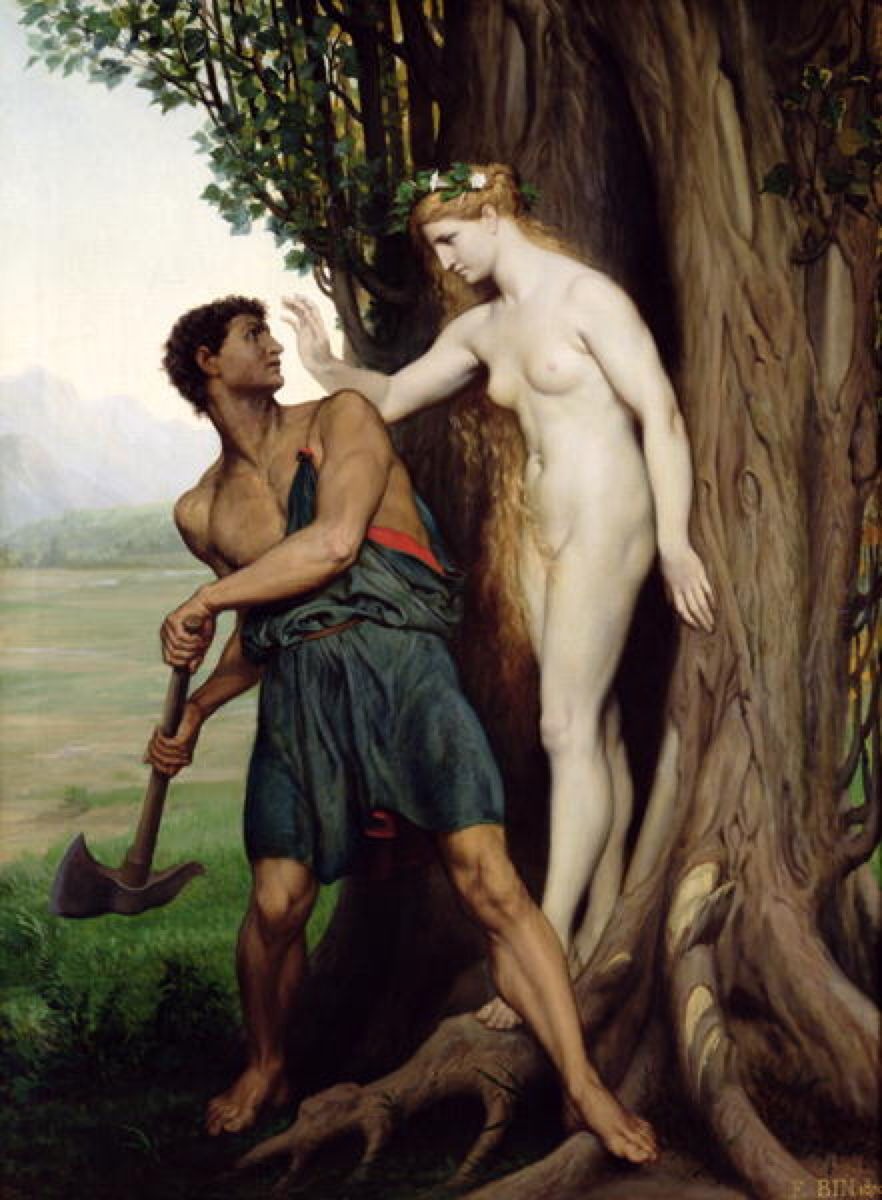
Their first clear expression seems to have been in Émile Bin’s The Hamadryad in 1870. Being nymphs, of course, they must be shown nude. When I first saw this painting, I thought it was a depiction of Erysichthon chopping down Ceres’ sacred oak, from Book 8 of Ovid’s Metamorphoses. However, the man is far too young to have an adult daughter, and this tree doesn’t appear to be an oak, nor is it in a sacred grove.

demorgandryad
Evelyn De Morgan (1855–1919), The Dryad (1884-85), oil on panel, 107.8 × 43.8 cm, The De Morgan Centre, London. Wikimedia Commons.

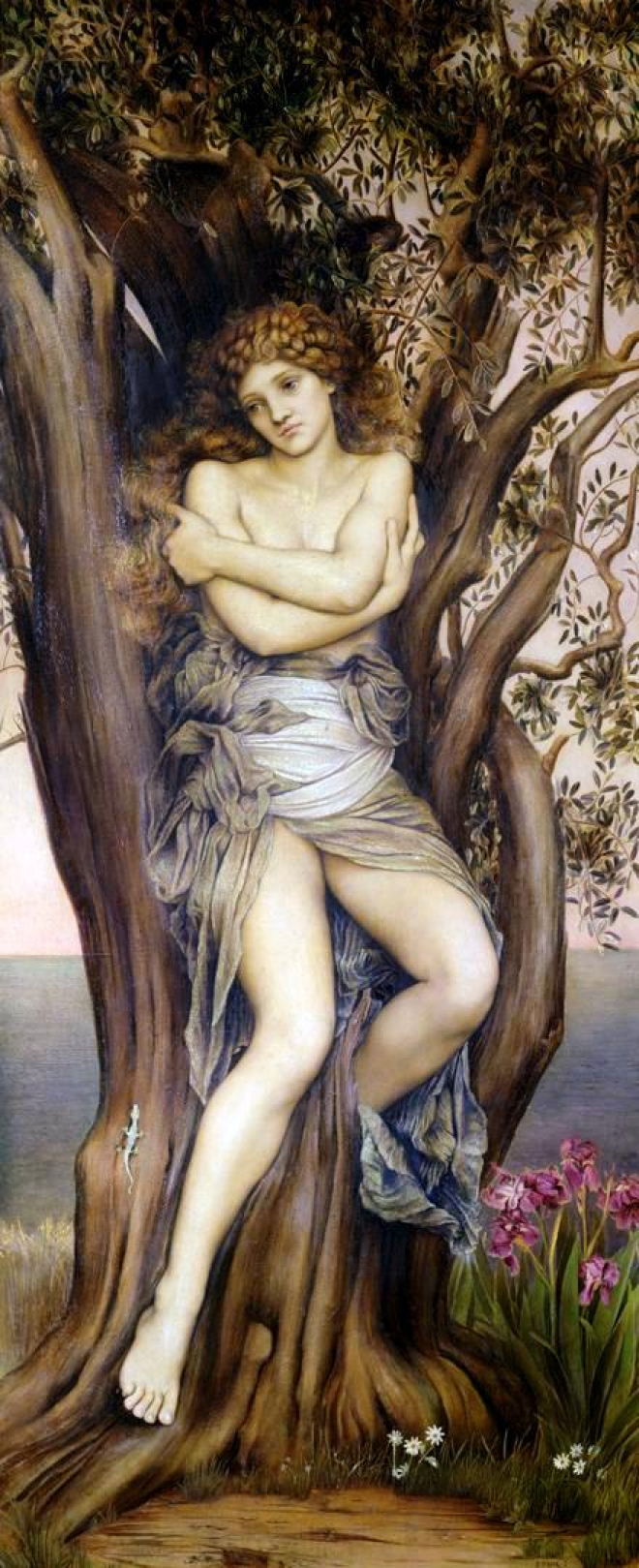
Evelyn De Morgan’s The Dryad (1884-85) looks worryingly sad and lonely as she stares into the distance from within the trunk of her ancient ash. There are delightful details too: the flowers at the foot of the tree, a cat and a bird in its branches, and a pale lizard beside the Dryad’s right leg.

ropshamadryad
Félicien Rops (1833-1898), Hamadryad (c 1885), gouache, watercolour, ink wash, crayon, pen and ink, grattage, dimensions not known, Montreal Museum of Fine Arts, Montreal, Canada. Image by Daderot, via Wikimedia Commons.

Even the renegade and often sacrilegious Félicien Rops seems to have taken his Hamadryad (c 1885) quite seriously. But, as usual with Rops, nothing is quite as straightforward as it seems.

The nude woman is seen embracing the trunk of a tree, and is definitely not a part of it. In her left arm, she holds a blue cape, and scattered around the foot of the tree are white garments or pieces of fabric. There’s a green furled umbrella on the ground, with a woman’s hat on top. Around the base of the tree, and decorating the woman’s hair, are scarlet flowers. Rops has written at the top of the sheet about ‘Le Grand Pan’ singing, and at the lower left about travels to the countries of the ‘vieux dieux’, or old gods. Perhaps the woman has come to visit her lover the Hamadryad, and has undressed ready to make love?

cranenyadsdryads
Walter Crane (1845–1915), Nyads and Dryads (date not known), watercolour on paper, 23.5 × 16.5 cm, location not known. Wikimedia Commons.

Walter Crane’s more illustrative watercolour of Nyads and Dryads, probably painted between 1880-1900, is less enigmatic. He melds the Dryads in with their trees, puts the Naiads or water nymphs in the water, and has a river god watch from the reeds in the distance.

guaylastdryad
Gabriel Guay (1848–1923) The Last Dryad (date not known), oil on canvas, 272 x 136 cm, Musée des Augustins de Toulouse, Toulouse, France. Wikimedia Commons.

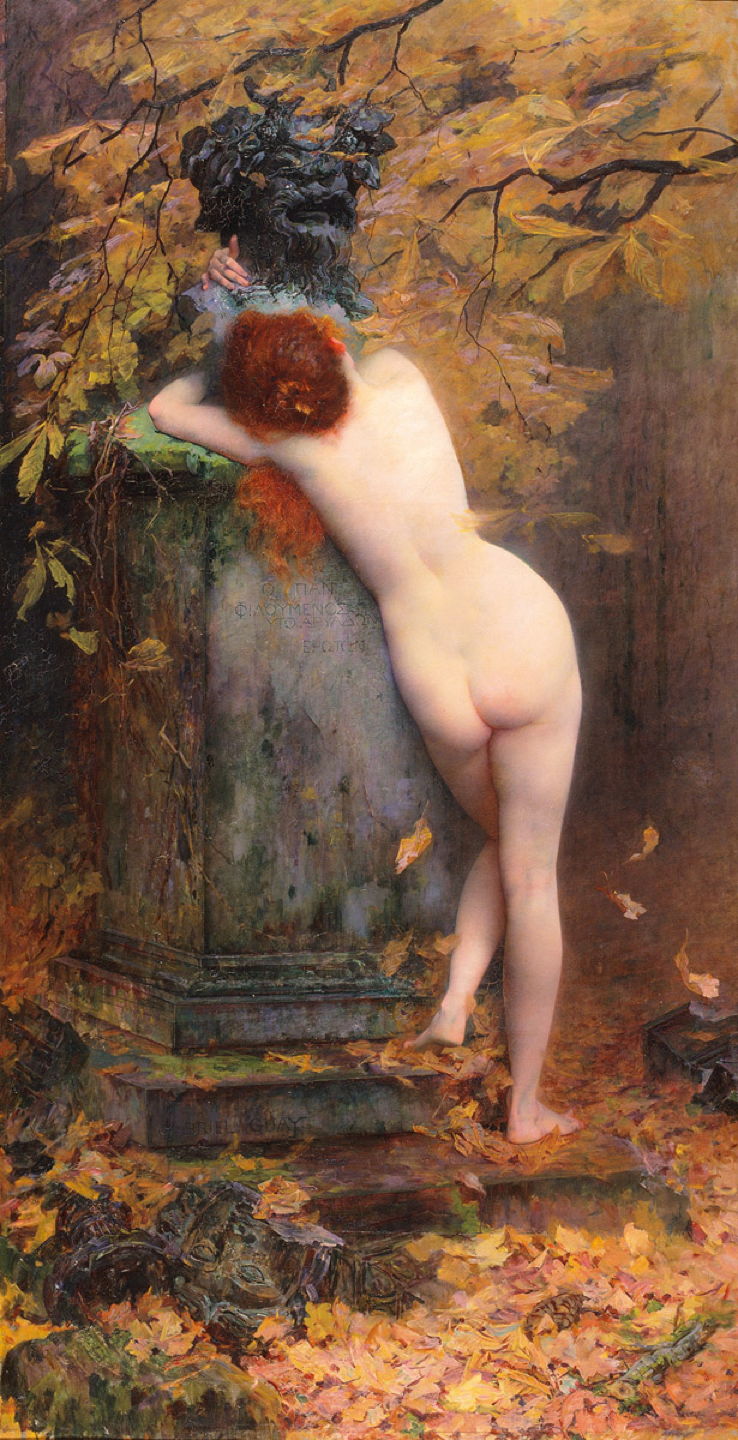
Painted at about the same time, Gabriel Guay’s autumnal vision of The Last Dryad has her embracing a herm or term (a bust of a god on a rectangular pillar). Her deep copper hair matches the paler yellows and browns of the leaves falling around her.

waterhousehamadryad
John William Waterhouse (1849–1917), Hamadryad (1893-95), oil on canvas, 158 × 59.5 cm, Plymouth City Museum and Art Gallery, Plymouth, England. Wikimedia Commons.

John William Waterhouse’s Hamadryad from 1893-95 is watching a young faun, perhaps Pan himself, playing reed pipes. At his feet is a thyrsus tipped with a pine cone, referring to Maenads or Bacchantes.

stockdryad
Henry John Stock (1853–1930), The Dryad (1913), oil on canvas, 62.3 × 39.4 cm, location not known. Wikimedia Commons.

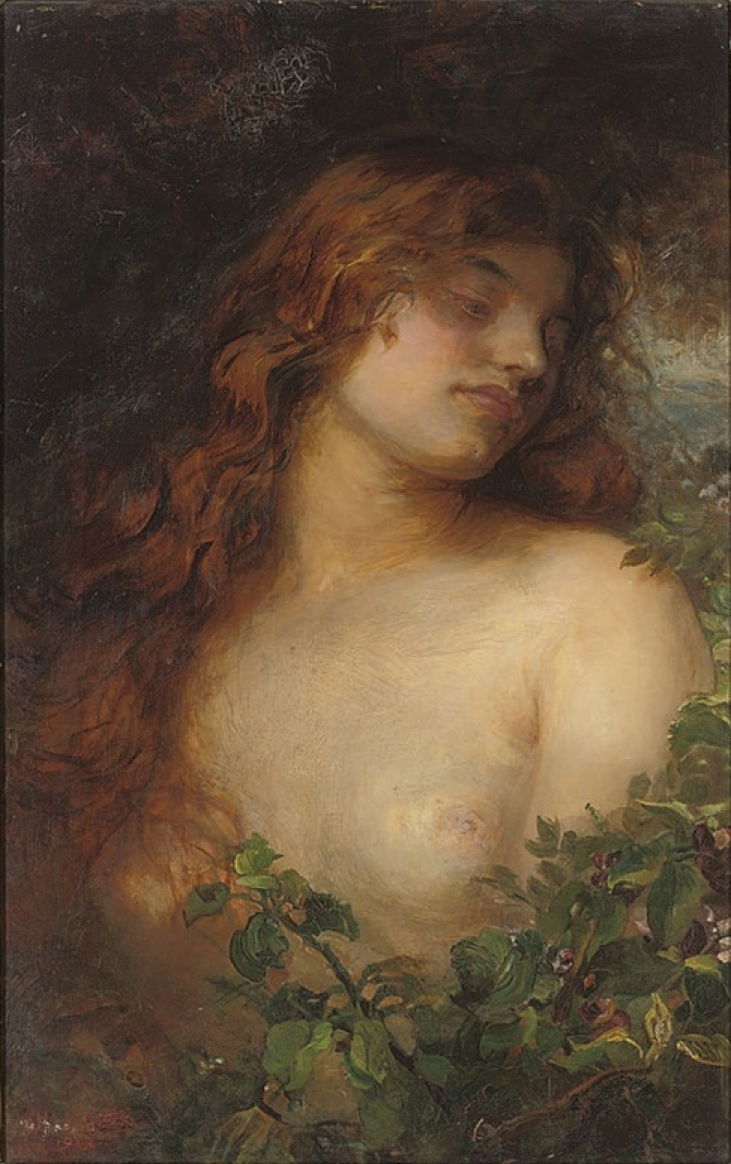
Henry John Stock’s painterly portrait of The Dryad from 1913 skilfully blends her hair and torso with the tree. Almost forgotten today, Stock trained in the Royal Academy Schools in London, and made a living painting portraits. However, he also had a leaning towards painting more imaginative and narrative works, influenced by William Blake and George Frederic Watts. Stock’s paintings are starting to become popular again, and now fetch substantial prices at auction.

The other great tradition of visual art which features tree spirits as motifs is Japanese painting.

ogatagekkoihonhanazue
Ogata Gekkō (1859–1920), Nihon hana zue (1896), pigments on mulberry paper, 36 × 24 cm, Walters Art Museum, Baltimore, MD. Wikimedia Commons.

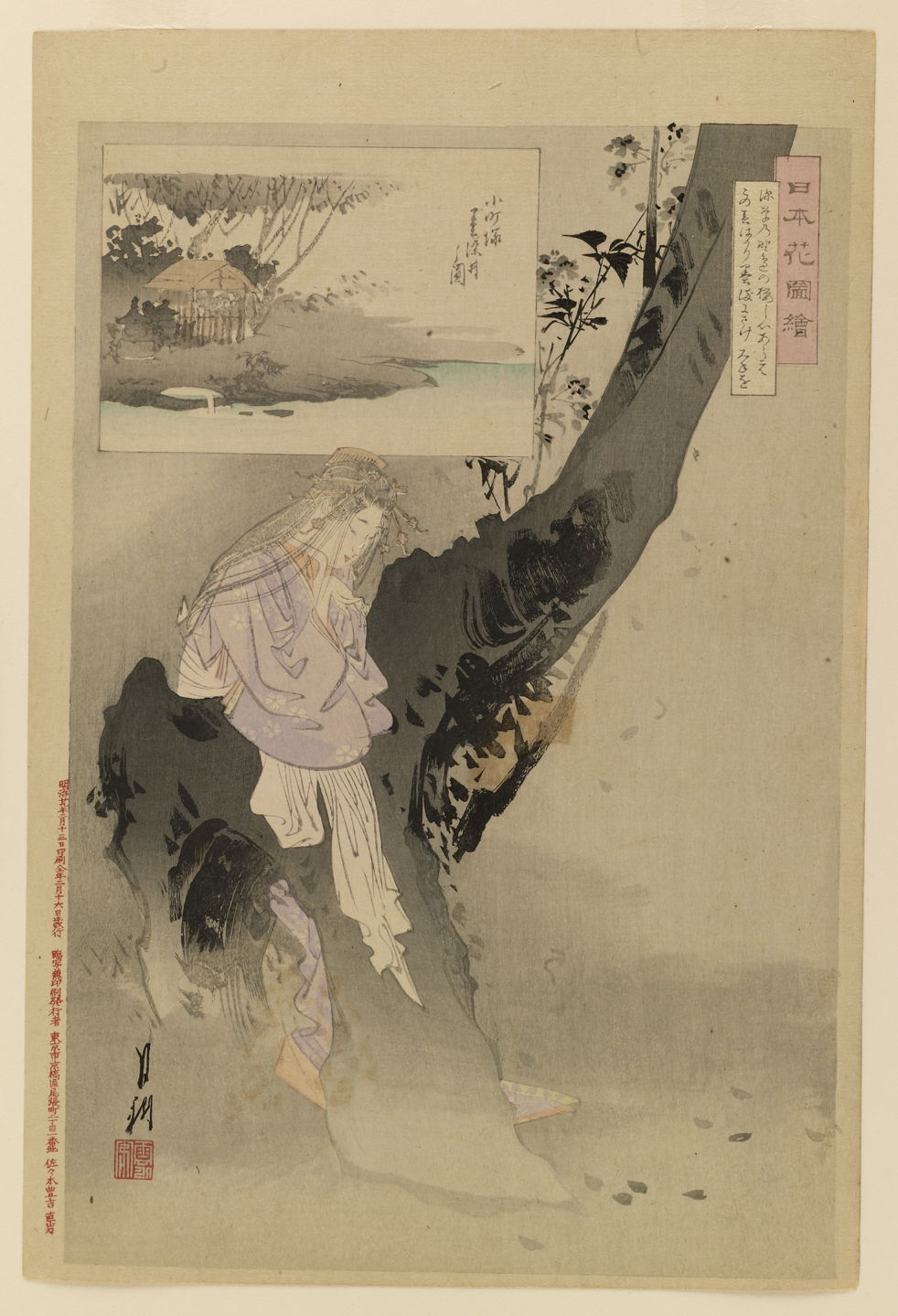
Ogata Gekkō painted his Nihon hana zue (which may just mean In Japan!) in 1896, using pigments on mulberry paper, and this was apparently published by Sasaki Toyokichi. The painting refers to a play Love Story at the Snow-covered Barrier, with a story similar to that of Erysichthon in Ceres’ sacred grove. Its villain wants to cut down a huge black cherry tree in full blossom. Just as he is about to swing his axe, the spirit of the tree appears as a courtesan, and freezes the villain’s hands. The spirit of the tree then overcomes him, and the tree is left unscathed.

I would have loved to show paintings of tree spirits from other mythologies. One I find particularly interesting is the Gille Dubh or Ghillie Dhu of Scottish (Gaelic) mythology, who is a solitary male faerie devoted to children. In addition to stories about him in the birch woods near Gairloch, in the Highlands, his name has become associated with the camouflage suit worn by military snipers, known as a Ghillie Suit. These were originally developed by Scottish gamekeepers for camouflage when hunting, and were then used by the Lovat Scouts, a Highland regiment of the British Army, during the second Boer War.

Painting the spirits of water: gods and Naiads

Narrative painting of classical myths has many conventions that can appear confusing. This weekend I look at those associated with river gods and their associated nymphs Naiads, and tomorrow more recent relatives Ondines.

In Greek, and subsequently Roman, mythology, the river gods or Potamoi (Greek for rivers) are three thousand sons of Oceanus, the great river encircling the earth, and Tethys, his Titan sister and wife. A river god is both that river and a distinct deity: Achelous is the god of the River Achelous, the largest in Greece, who wrestled unsuccessfully with Hercules for the right to marry Deianira.

Associated with sources and bodies of fresh water are also water nymphs, Naiads or Potamides, often stated to be the daughters of the river gods. In ancient times, there was a weaker distinction between fresh and salt waters, so although nymphs associated with the sea are usually termed Nereids when in Mediterranean waters, or Oceanids, Naiads can also be encountered in what we would consider to be sea.

dititoheliades
Santi di Tito (1536–1603) The Sisters of Phaethon Transformed into Poplars (c 1570), fresco, dimensions not known, Palazzo Vecchio, Musei Civici Fiorentini, Florence. Wikimedia Commons.

The standard depiction for any river god in a classical story is that of an older bearded man lounging by a large earthenware pot from which water pours forth into the river. This is shown well in Santi di Tito’s fresco of The Sisters of Phaethon Transformed into Poplars, from about 1570. Although this story tells how the sisters of Phaeton grieve for him after his death, and are transformed into poplar trees, as it shows a river, there must still be a god of that river.

rubensromulusremus
Peter Paul Rubens (1577–1640), Romulus and Remus (1615-16), oil on canvas, 213 x 212 cm, Musei Capitolini, Rome, Italy. Wikimedia Commons.

Rubens’ delightful painting of Romulus and Remus being discovered by Faustulus, from 1615-16, shows both the river god Tiberinus and his daughter nymph, at the left with the god’s pot.

poussincephalusaurora
Nicolas Poussin (1594–1665), Cephalus and Aurora (1630), oil on canvas, 96.9 x 131.3 cm, The National Gallery, London. Wikimedia Commons.

In Nicolas Poussin’s Cephalus and Aurora from 1630, the river god is again at the left, and looks tired of the whole business, with a mere trickle of water emerging from his pot.

garzialpheusarethusa
Luigi Garzi (attr) (1638–1721), Alpheus and Arethusa (c 1690), oil on canvas, 120.7 x 171.5 cm, location not known. Wikimedia Commons.

This beautiful painting attributed to Luigi Garzi, of Alpheus and Arethusa from around 1690, shows one river god and two nymphs. The god leans on his pot, and in his left hand holds a small spade, another attribute sometimes seen with them.

coypelalpheuschasingarethusa
Antoine Coypel (1661–1722), Alpheus Chasing Arethusa (c 1710), oil on canvas, dimensions and location not known. Wikimedia Commons.

Antoine Coypel’s version of the same Ovidian myth, Alpheus Chasing Arethusa from about 1710, places the river god at the lower left, and two Naiads separately on the right.

boucherpansyrinx
François Boucher (1703–1770), Pan and Syrinx (1743), oil on canvas, 101 × 133 cm, Private collection. Wikimedia Commons.

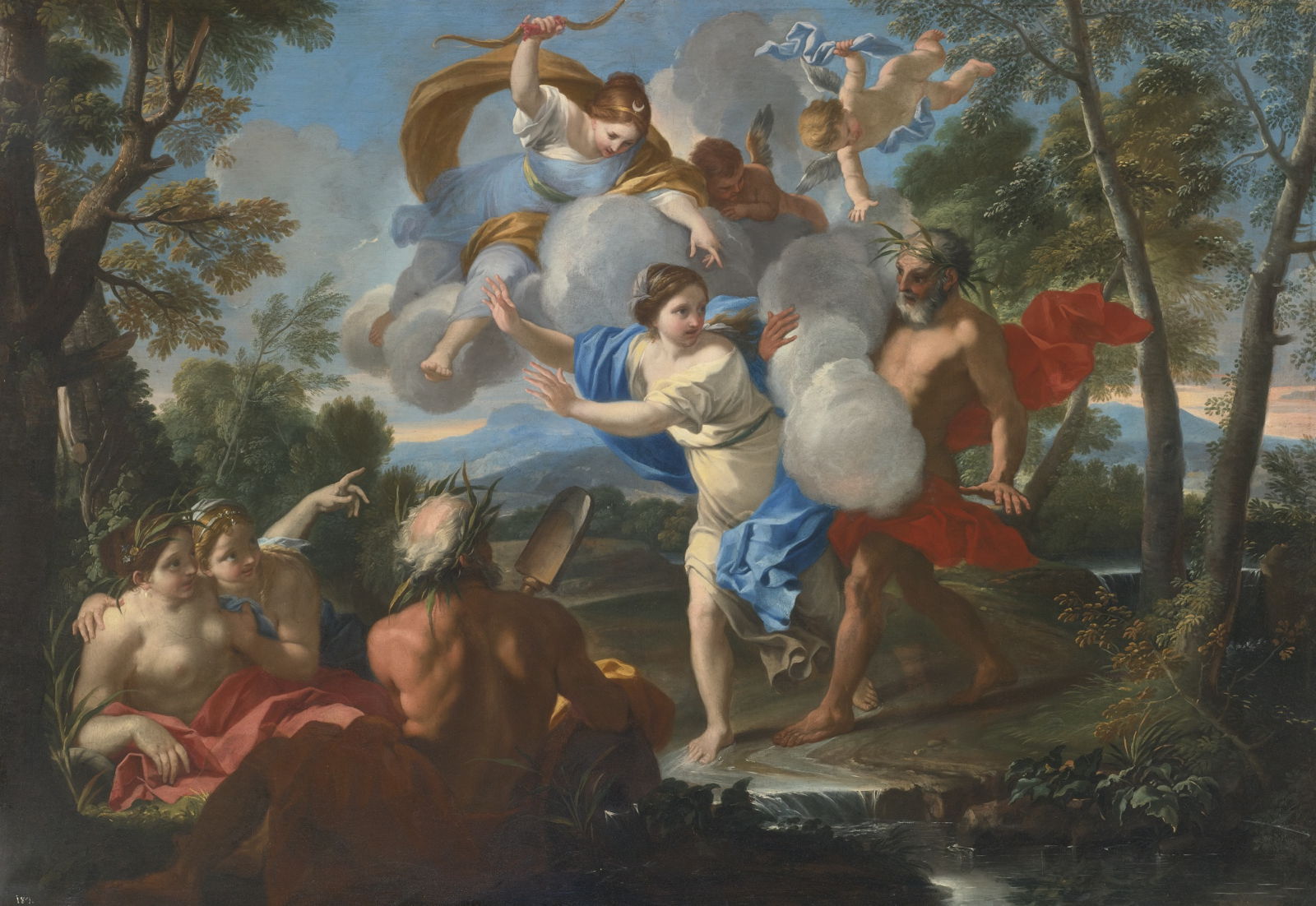
So far, the river deities have enjoyed a rather passive life in paintings, but this wasn’t a requirement. In François Boucher’s Pan and Syrinx from 1743, the nymph Syrinx is seeking the help of the river god and Naiad, as she attempts to evade Pan’s attentions. The god’s pot is almost hidden beneath luxuriant red fabric, under his right hand.

tiepoloapollodaphne
Giovanni Battista Tiepolo (1696–1770), Apollo and Daphne (c 1744-45), oil on canvas, 96 x 79 cm, Musée du Louvre, Paris. Wikimedia Commons.

In Tiepolo’s Apollo and Daphne (c 1744-45), the river god is given much of the foreground and lower section of the painting, and holds an oar or paddle, a more unusual but distinctive attribute.

mengsapollomnemosyne
Anton Raphael Mengs (1728–1779), Apollo, Mnemosyne, and the Nine Muses (1761), fresco, 313 × 580 cm, Gallery of the Villa Albani-Torlonia, Rome. Wikimedia Commons.

Sometimes, artists conceal the river god as if challenging the viewer to locate him. This is the case in Anton Raphael Mengs’ fresco of Apollo, Mnemosyne, and the Nine Muses (1761), in which the god’s bearded and hoary figure is tucked away behind Apollo’s legs. There’s also an Orphic tradition in which the River Mnemosyne is the source of water to bring inspiration, and this perhaps alludes to that obscure sub-narrative.

brenetaethrashowingtheseus
Nicolas-Guy Brenet (1728–1792), Aethra Showing her Son Theseus the Place Where his Father had Hidden his Arms (1768), oil on canvas, 50.2 × 59.7 cm, Los Angeles County Museum of Art, Los Angeles, CA. Wikimedia Commons.

In some paintings, river gods seem to be included even when their river is nowhere to be seen. Nicolas-Guy Brenet’s painting of Aethra Showing her Son Theseus the Place Where his Father had Hidden his Arms (1768) tucks this extra into the lower left corner again.

schmidtdanaides
Martin Johann Schmidt (1718–1801), The Labour of the Danaides (1785), oil on copper plate, 54.5 × 77 cm, Narodna galerija Slovenije, Ljubljana, Slovenia. Wikimedia Commons.

Martin Johann Schmidt’s Labour of the Danaides (1785) informs us that the Danaïds were also water-nymphs by placing a river god at the left. They were condemned to keep trying to fill this leaky container with water as their penance in the underworld.

cranenyadsdryads
Walter Crane (1845–1915), Nyads and Dryads (date not known), watercolour on paper, 23.5 × 16.5 cm, location not known. Wikimedia Commons.

Walter Crane shows the association between Naiads and other nymphs in his watercolour of Nyads and Dryads, probably painted between 1880-1900. He melds the Dryads in with their trees, puts the ‘Nyads’ or Naiads in the water, and has a river god watching from the reeds in the distance.

waterhousenaiad
John William Waterhouse (1849–1917), A Naiad, or Hylas with a Nymph (1893), oil on canvas, 66 x 127 cm, Private collection. Wikimedia Commons.

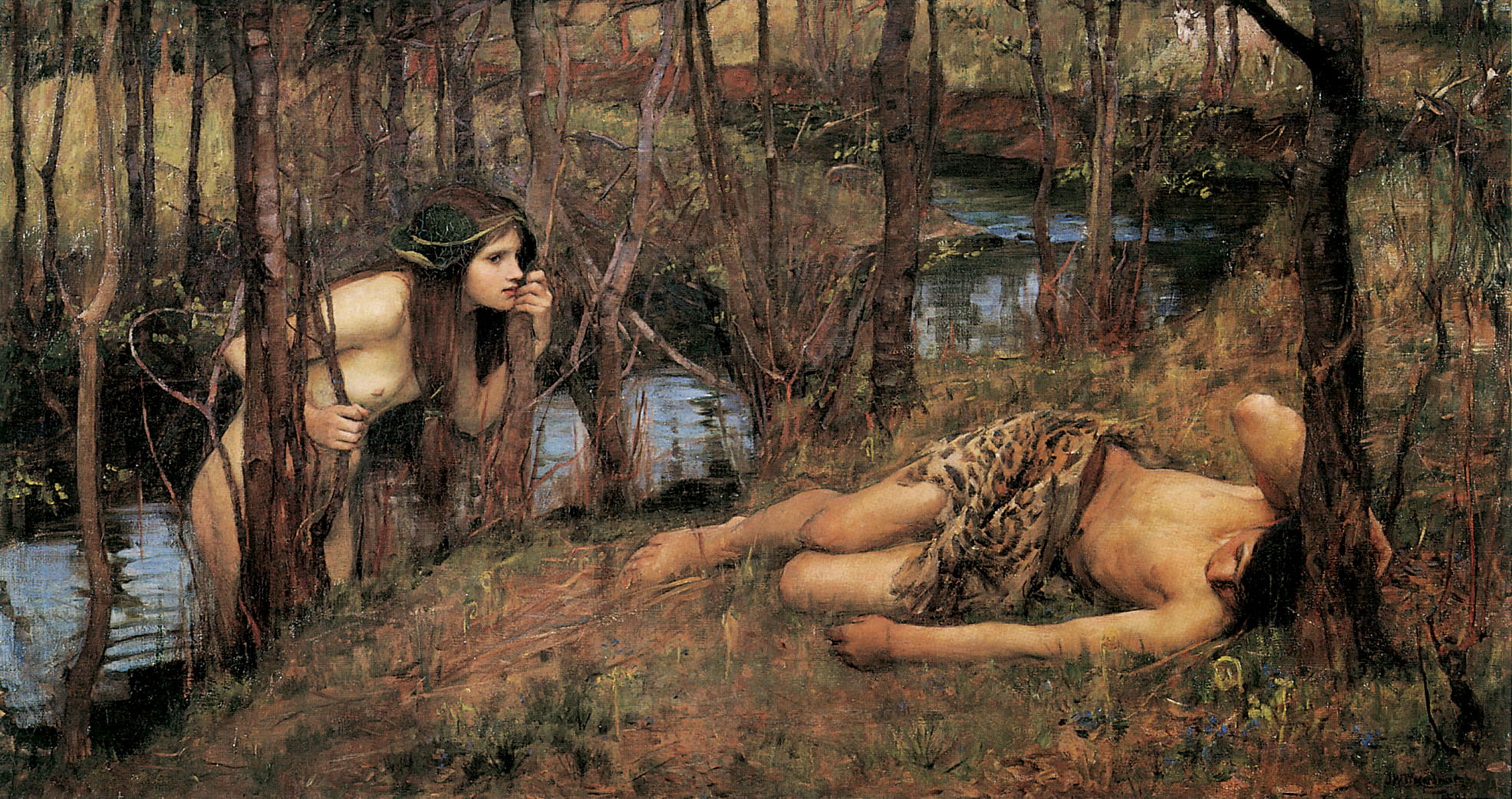
By the end of the nineteenth century, enthusiasm for the tradition of showing river gods was waning, and nude, cavorting Naiads came to the fore. One of their greatest exponents was John William Waterhouse, who led with this first tentative retelling of the myth of Hylas in 1893, in A Naiad, or Hylas with a Nymph.

Hylas was companion and servant to Heracles (Hercules), who accompanied the hero on Jason’s ship Argo. When the Argonauts were ashore in modern Turkey, Hylas approached the spring of Pegae, where the Naiads fell in love with and kidnapped him. He vanished without trace, leading Heracles and Polyphemus to search for him at length. They were delayed in this so long that the Argo sailed without them.

This first version shows one of the Naiads discovering the sleeping Hylas by a small river. There’s no sign of any river god, but there are some goats on the right side of the painting.

waterhousehylasnymphs
John William Waterhouse (1849–1917), Hylas and the Nymphs (1896), oil on canvas, 132.1 x 197.5 cm, Manchester Art Gallery, Manchester, England. Wikimedia Commons.

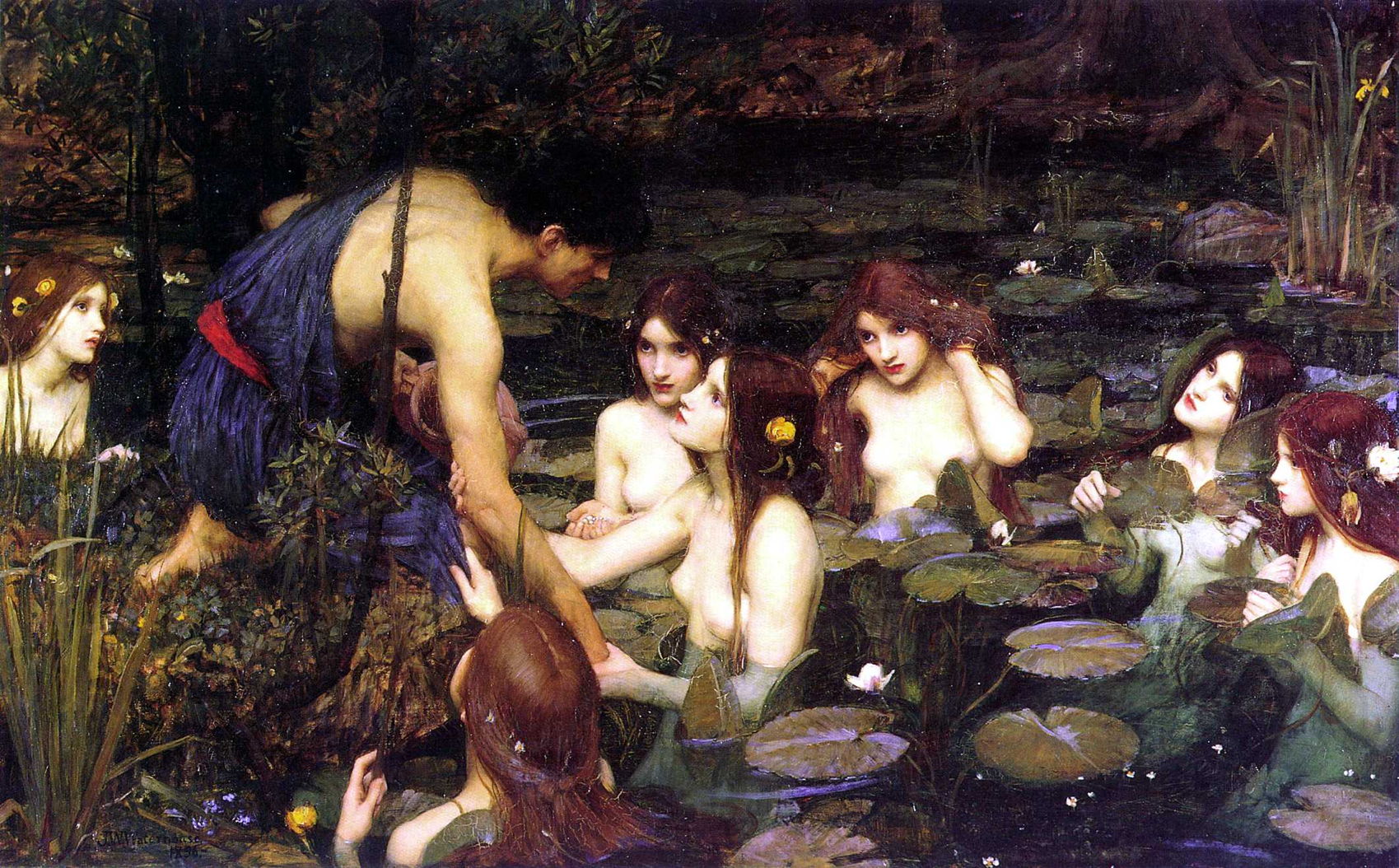
Three years later, Waterhouse’s Hylas and the Nymphs (1896) stays closer to the myth. Hylas holds an earthenware pot, almost as if he were about to become the river god.

In January 2018, this well-known painting was removed from exhibition in Manchester, England, and replaced by a notice which explained that a temporary space had been left “to prompt conversations about how we display and interpret artworks in Manchester’s public collection”. The painting soon returned after protests. It’s surprising that more than a century after it was first exhibited, it was still capable of causing such controversy.

raehylaswaternymphs
Henrietta Rae (1859–1928), Hylas and the Water Nymphs (c 1909), oil on canvas, 142.3 × 222.8 cm, Private collection. Wikimedia Commons.

Waterhouse is not the only artist to have courted controversy with this story. Henrietta Rae’s Hylas and the Water Nymphs from about 1909 was exhibited at the Royal Academy in 1910, and is no less fleshly than Waterhouse’s version. Rae was a pioneer in her painting of nudes, at a time when most of society still considered that women shouldn’t be allowed to attend classes learning to draw or paint nude models.

poyntercaveofstormnymphs
Edward Poynter (1836–1919), Cave of the Storm Nymphs (1903), oil on canvas, 145.9 × 110.4 cm, Private collection. Wikimedia Commons.

Edward Poynter’s Cave of the Storm Nymphs (1903) might appear to be still more exploitative of the male appeal of the female nude, but there’s a more complex narrative behind this scene. Its literary reference is most probably to the Naiads of Homer’s Odyssey, book 13, who live in a sea cave, updated to encompass more contemporary references to Wreckers, who lured ships onto the rocks in order to steal their precious cargos: sirens without the socially unacceptable habit of cannibalism.

❌