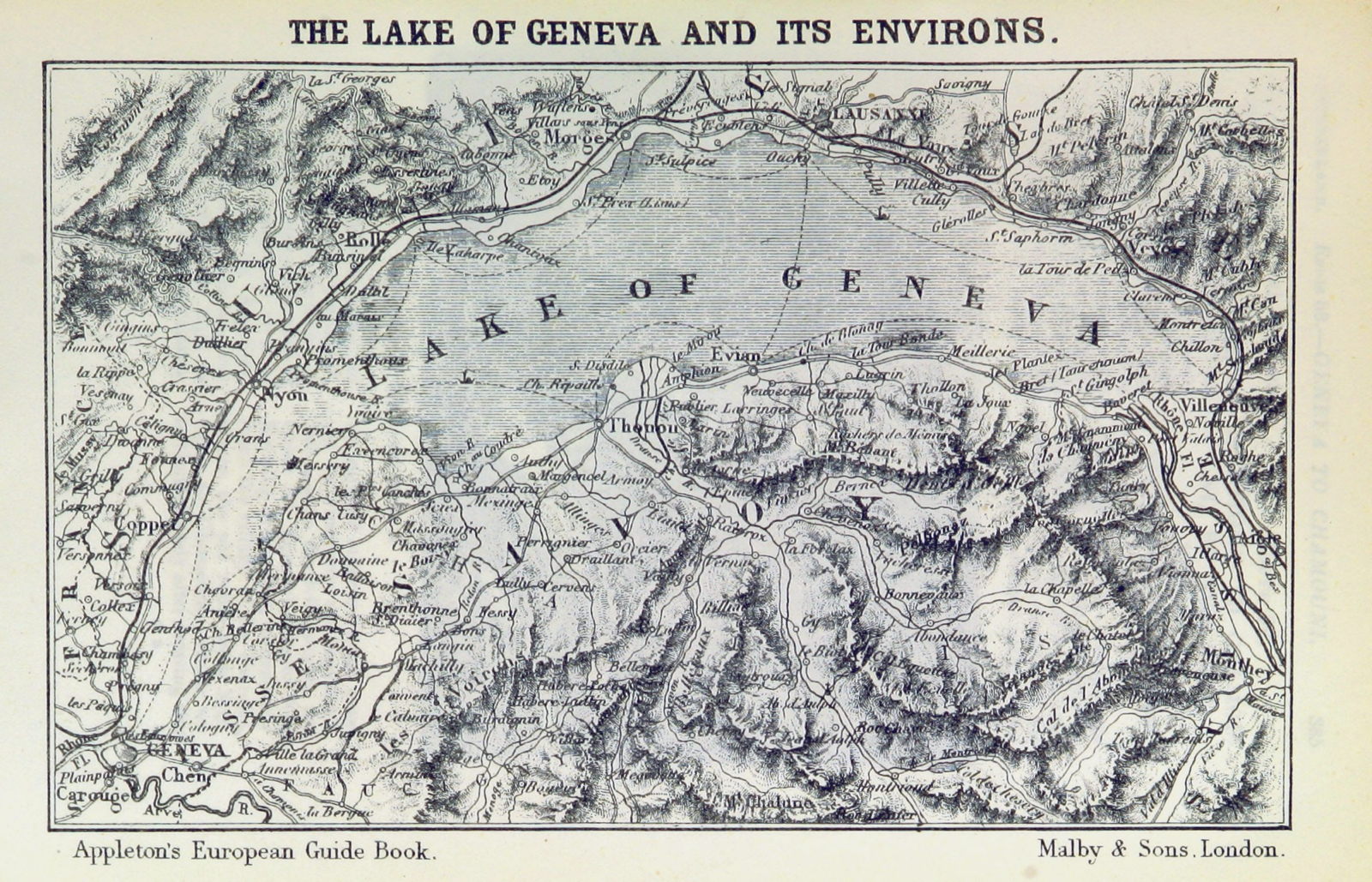
This weekend we’re off to visit Lake Geneva, also known by its French name of Lac Léman, the largest in Switzerland. It’s located in the far south-west of the country, where it forms much of its border with France. It makes a broad arc running north-east from the capital city of Geneva, with some of the highest peaks of the Alps to its south.
Daniel Appleton et al., Map of Lake Geneva (1877), p 521 in Appleton’s European Guide Book illustrated, 10th edition, D. Appleton & Co, New York. The British Library, London. Wikimedia Commons.
Today I start with a selection of paintings almost exclusively from the nineteenth century, when Switzerland was on the itinerary of the Grand Tour undertaken by aspiring young men of the upper class in both Europe and the Americas.
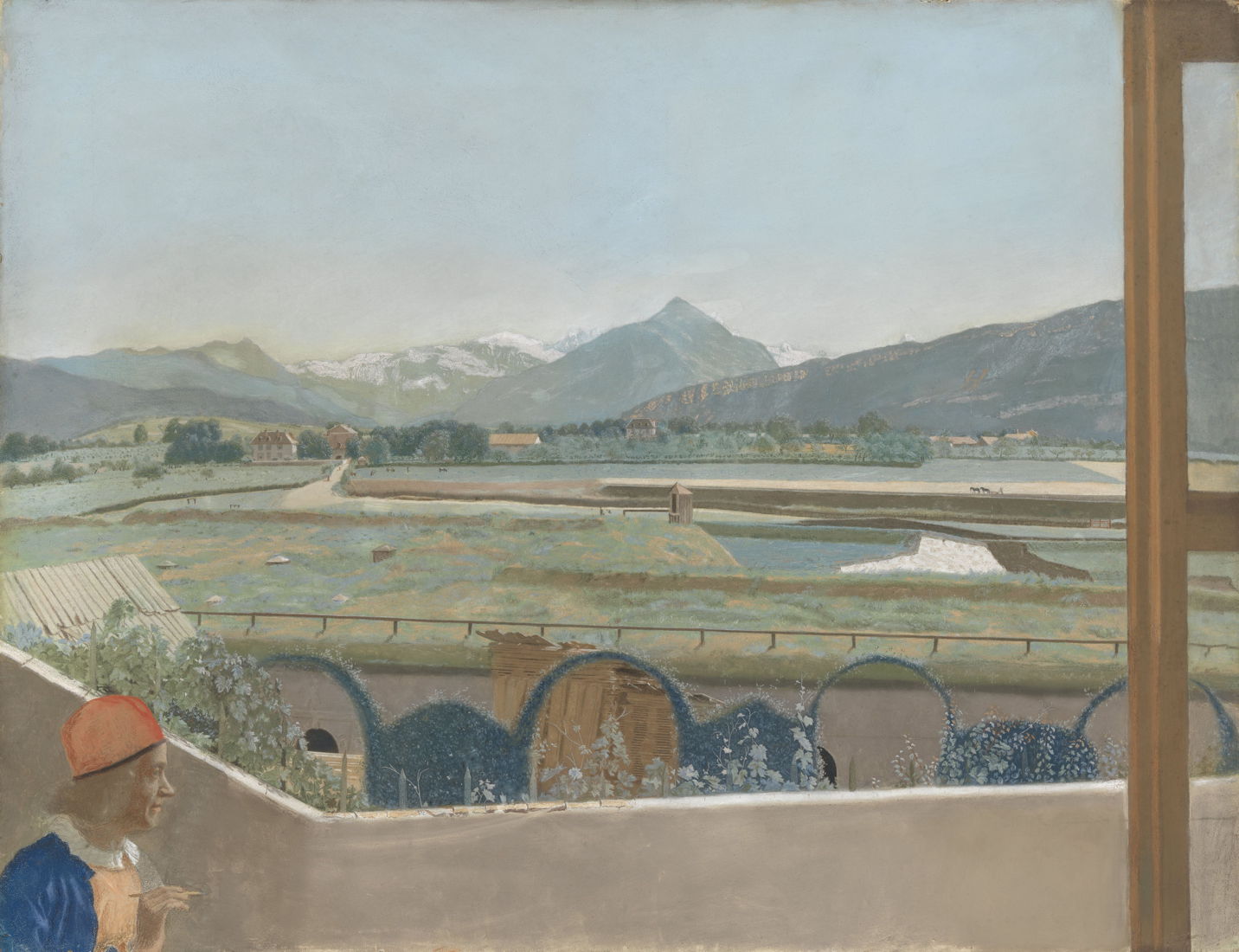
Jean-Étienne Liotard (1702-1789), View of the Mont Blanc Massif from the Artist’s Studio (1765-70), pastel on parchment, 46 x 59.7 cm, location not known. Wikimedia Commons.
The city of Geneva has long attracted artists, and it was here the eccentric pastellist Jean-Étienne Liotard was born and later kept his studio, and where he eventually retired. His View of the Mont Blanc Massif from the Artist’s Studio from 1765-70 reveals only a little of the southern extreme of the lake, with a cameo self-portrait.
Joseph Mallord William Turner (1775–1851), Lake Geneva and Mount Blanc (1802-05), watercolour, 90.5 x 128.6 cm, Yale Center for British Art, New Haven, CT. Wikimedia Commons.
JMW Turner was by no means the first to paint the lake, but his watercolour of Lake Geneva and Mount Blanc from 1802-05 is one of its earliest depictions by a major artist. This view looks south-east over the city of Geneva towards the Mont Blanc massif in the far distance.
Alexandre Calame (1810–1864), View of Bouveret (1833), oil on panel, 35 x 47.5 cm, location not known. Wikimedia Commons.
Alexandre Calame’s View of Bouveret from 1833 shows a grey heron fishing on the shore at the southern end of the lake, close to the border with France.
Alexandre Calame (1810–1864), View of Lake Geneva (Lac Léman) (1849), oil on wood, 67 x 86 cm, Villa Vauban, Musée d’art de la ville de Luxembourg, Luxembourg. Wikimedia Commons.
While Turner had toured the Alps once travel from England had become possible again in the early nineteenth century, Calame pioneered the painting of views like this of the lake, completed in his studio in 1849. It includes some of the distinctive sailing boats of the Swiss lakes, and a small bird in the shallows, but not a heron here.
John Ferguson Weir (1841-1926), Lake Leman (Lake Geneva), Switzerland (1869), oil on paper, 20.3 x 33 cm, Private collection. Wikimedia Commons.
In the middle of the nineteenth century, several major American artists visited Switzerland to develop their skills painting mountain views. Despite its finish, John Ferguson Weir’s Lake Leman (Lake Geneva), Switzerland may have been painted in front of the motif, on 11 June 1869.
Following Gustave Courbet’s release from prison for his involvement in the Paris Commune and destruction of the Vendôme Column in 1871, he was forced to flee to the safety of Switzerland, where he lived his remaining years there, unable to return to France.
Gustave Courbet (1819–1877), Sunset over Lac Leman (1874), oil on canvas, 55 x 65 cm, Musée Jenisch, Vevey, Switzerland. Image by Volpato, via Wikimedia Commons.
Courbet painted some of the finest landscapes of his career during his exile in Switzerland, like this Sunset over Lac Léman from 1874, the year of the First Impressionist Exhibition in Paris.
Gustave Courbet (1819–1877), Chillon Castle (1875), oil on canvas, dimensions not known, Private collection. Wikimedia Commons.
He became particularly obsessed with the island château at the extreme eastern end of Lake Geneva, Chillon Castle, here in 1875. This picturesque château dates back to a Roman outpost, and for much of its recorded history from about 1050 has controlled the road from Burgundy to the Great Saint Bernard Pass, a point of strategic significance. It has since been extensively restored, and is now one of the most visited mediaeval castles in Europe.
Gustave Courbet (1819–1877), Chillon Castle (1874-77), oil on canvas, 73 x 92 cm, location not known. Wikimedia Commons.
Chillon Castle from 1874-77 is another of the views he painted of the castle on the lake.
Gustave Courbet (1819–1877), Sunset on Lake Geneva (c 1876), oil on canvas, 74 x 100 cm, Kunstmuseum St. Gallen, St. Gallen, Switzerland. Wikimedia Commons.
Sunset on Lake Geneva from about 1876 is reminiscent of Courbet’s earlier seascapes with breaking waves, but now the water is calm once more.
In May 1877, the French government informed Courbet that the cost of rebuilding the Vendôme Column would be over 300,000 Francs, which he could pay in instalments of 10,000 Francs each year, starting on 1 January 1878. Courbet died in Switzerland the day before, on 31 December 1877, at the age of only 58.
As landscape painters increasingly came to rely on studies made in front of the motif, and their views came closer to reality, faithful depictions of reflections on water increased. But the fundamental challenges of painting accurate reflections remained. Both John Constable and JMW Turner started their careers drawing, trained in the Royal Academy Schools, and should have had a thorough grounding in 3D projection and reflections, as well as ample experience recording what they saw.
Several of Constable’s major works include reflected passages, painted slowly in the studio following extensive studies made of the motif.
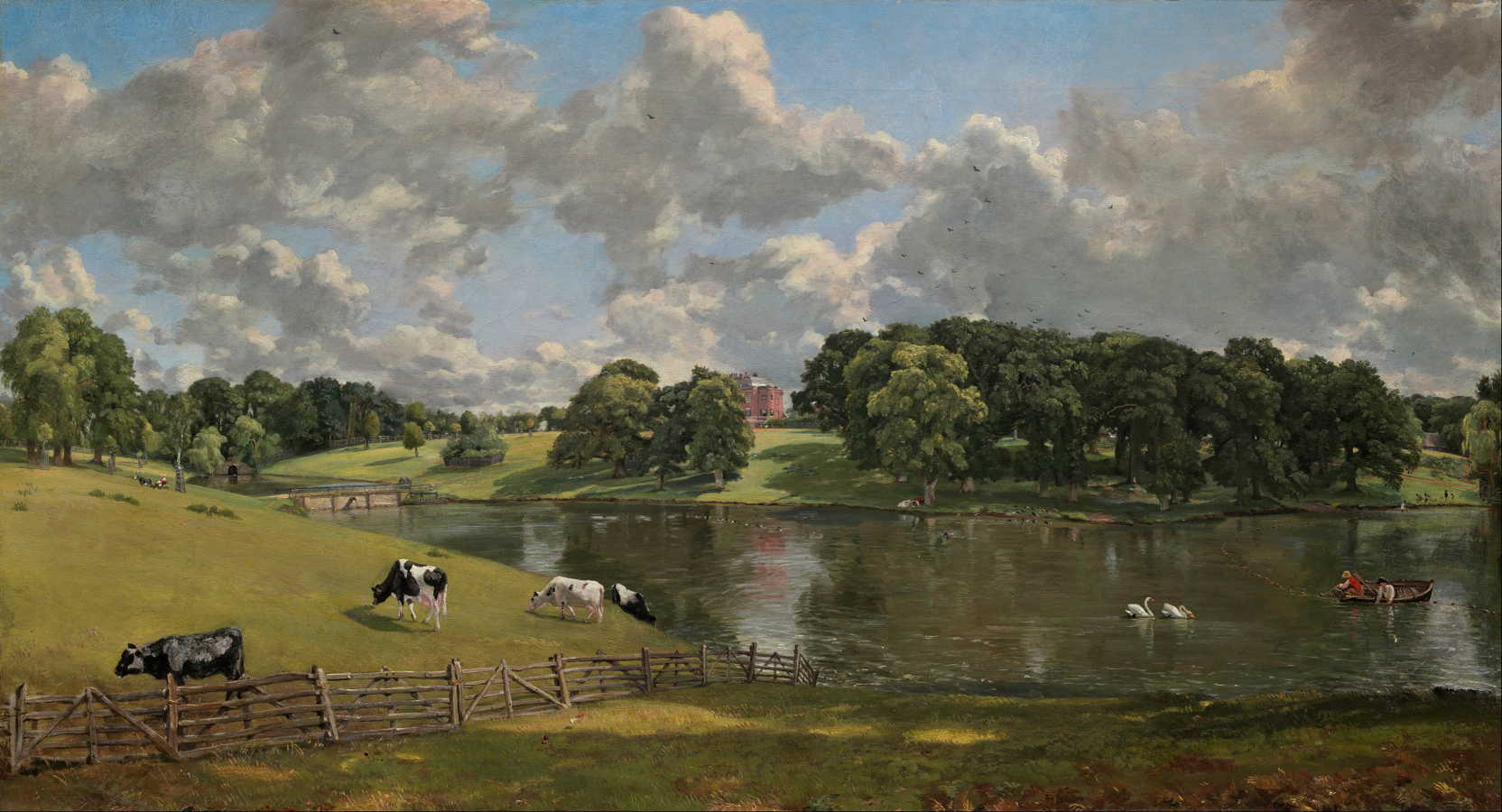
John Constable (1776–1837), Wivenhoe Park, Essex (1816), oil on canvas, 56.1 x 101.2 cm, The National Gallery of Art, Washington, DC. Wikimedia Commons.
Constable’s commissioned painting of the house and estate at Wivenhoe Park, Essex from 1816 is an oddly distant view of Major-General Francis Slater-Rebow’s country seat. Given the expanse of mirror-like lake, he might have been expected to include meticulous reflections. There are obvious anomalies, such as the brick-red reflection of the modest section of the house visible through a break in the trees in the centre of the canvas. The house is sufficiently distant that little or none of it would have been visible in reflection, let alone the two large areas of brick red stretching well over half way across the water. That was in all probability painted for effect.
John Constable (1776–1837), Wivenhoe Park, Essex (detail with reflection) (1816), oil on canvas, 56.1 x 101.2 cm, The National Gallery of Art, Washington, DC. Wikimedia Commons.
Reflections of the pair of swans and boatmen are also out of kilter. Constable may well have neither seen nor sketched them from life, and then struggled to envision their reflections in the studio.
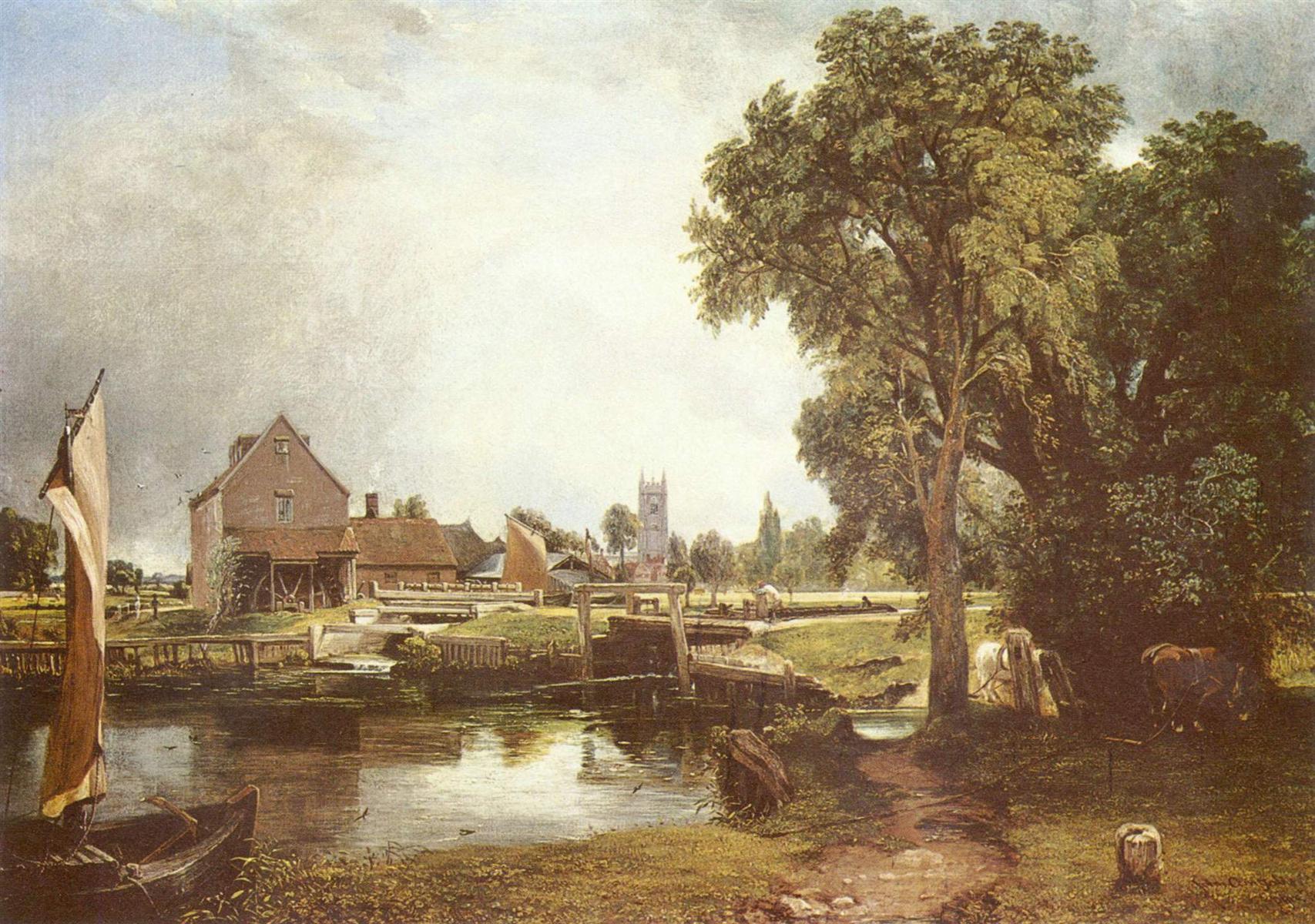
John Constable (1776–1837), Dedham Lock and Mill, 1820, oil on canvas, 53.7 x 76.2 cm, Victoria and Albert Museum, London. WikiArt.
Four years later, this painting of Dedham Lock and Mill (1820) is more familiar territory from the artist’s home ground. His family owned this lock on the River Stour, and he would have worshipped in the village church of Dedham seen in the distance. His reflections here appear accurate throughout.
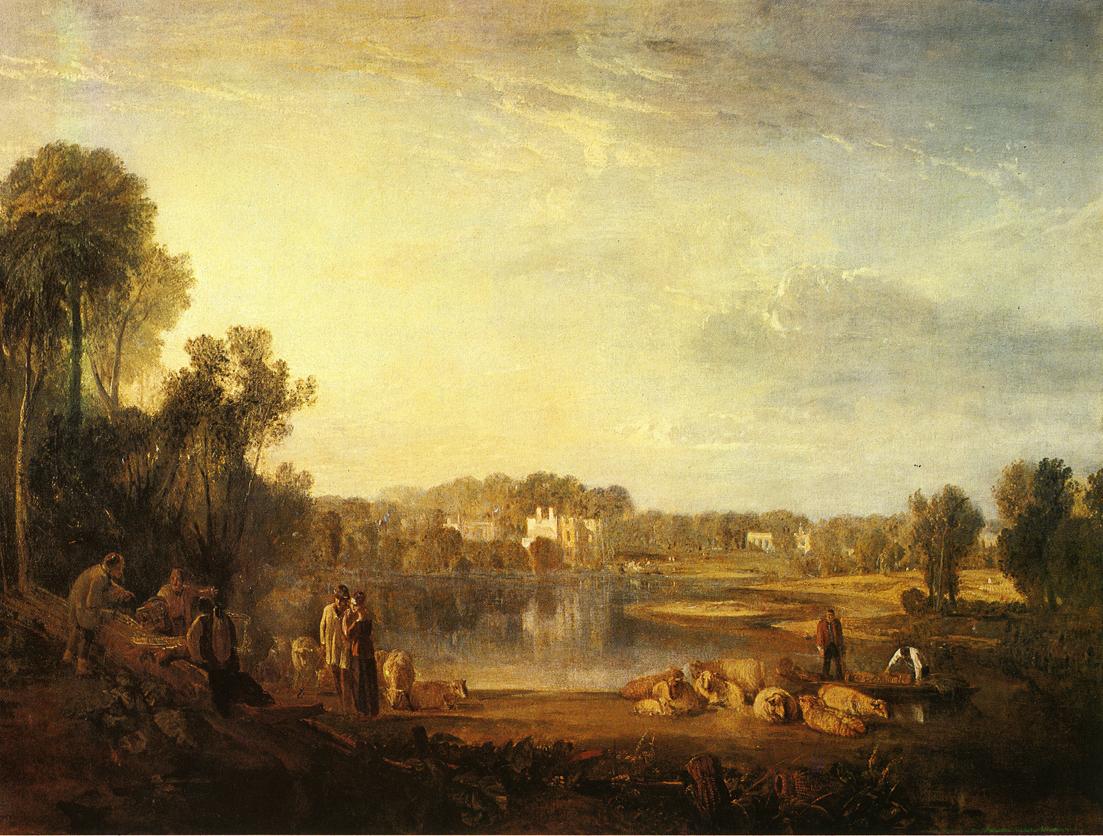
Joseph Mallord William Turner (1775–1851), Pope’s Villa, at Twickenham (1808), oil on canvas, 120.6 x 92.5 cm, Private Collection. WikiArt.
Turner’s approach to reflections changed over the course of his career. In Pope’s Villa, at Twickenham from 1808, he depicted complex and intricate reflections in careful detail.
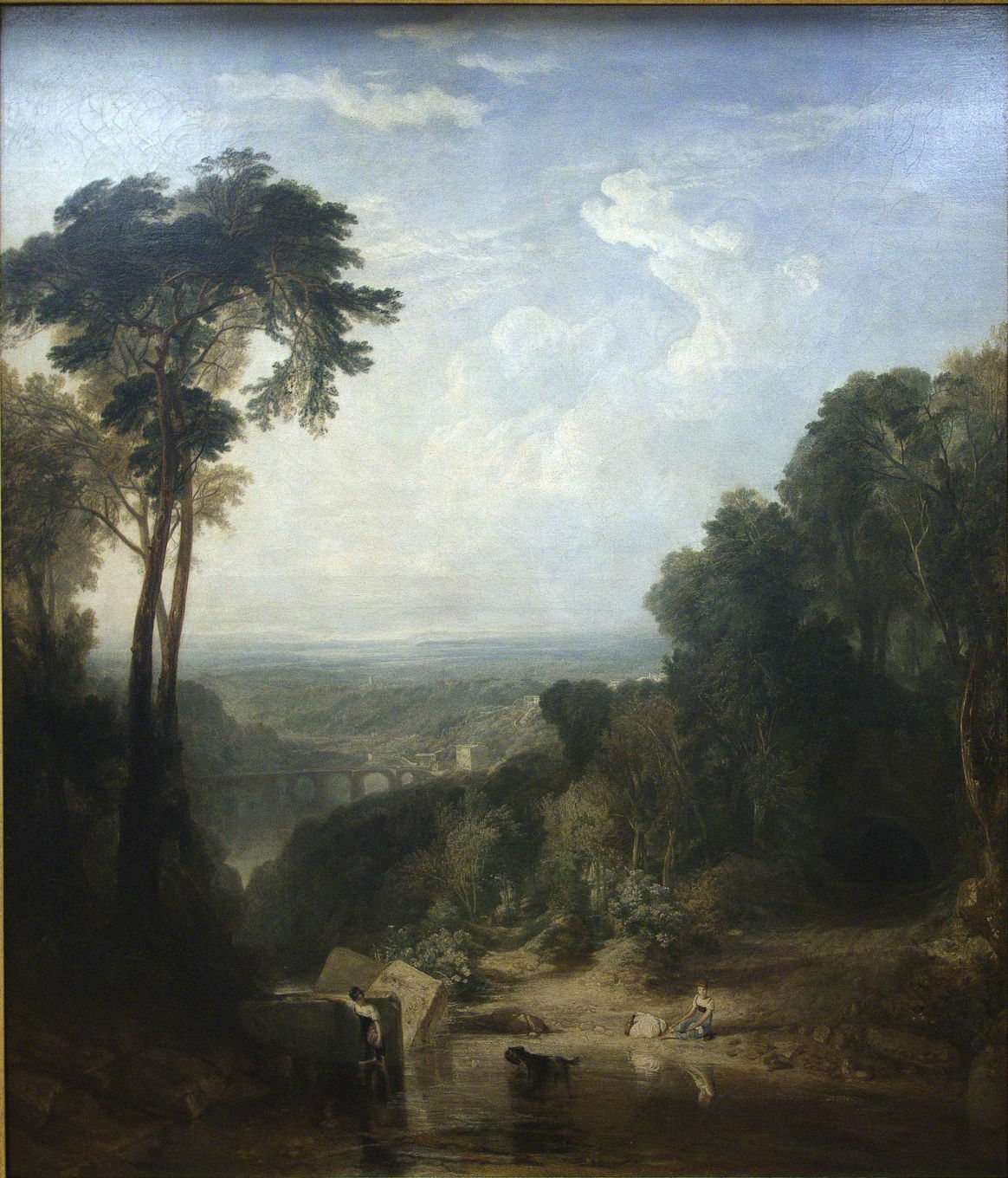
I’ve previously considered the relatively small anomalies in another of his early oil paintings, Crossing the Brook from 1815.
Joseph Mallord William Turner (1775-1851), Crossing the Brook (1815), oil on canvas, 193 x 165.1 cm, Tate Britain, London (N00497). EHN & DIJ Oakley.
These could be accounted for by the figures being staffage added in the studio without the benefit of plein air studies.
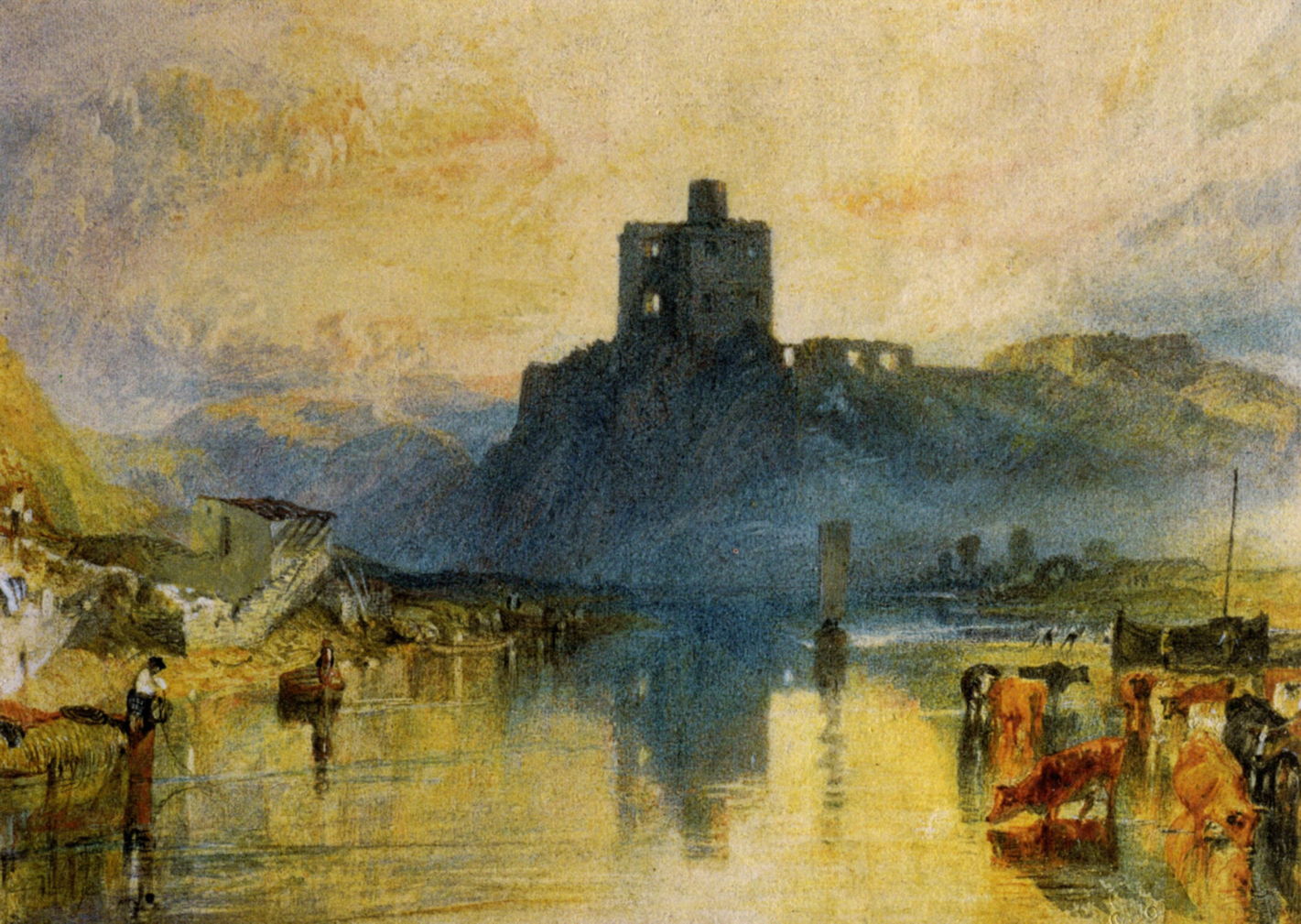
Joseph Mallord William Turner (1775–1851), Norham Castle, on the River Tweed (1823), watercolour on paper, 15.6 x 21.6 cm, British Museum, London. WikiArt.
Some of his later watercolours, such as Norham Castle, on the River Tweed (1823), have obvious quirks in their reflections: here the reflection appears to show another high point at the left edge of the castle that isn’t matched by an equivalent high point in the real castle.
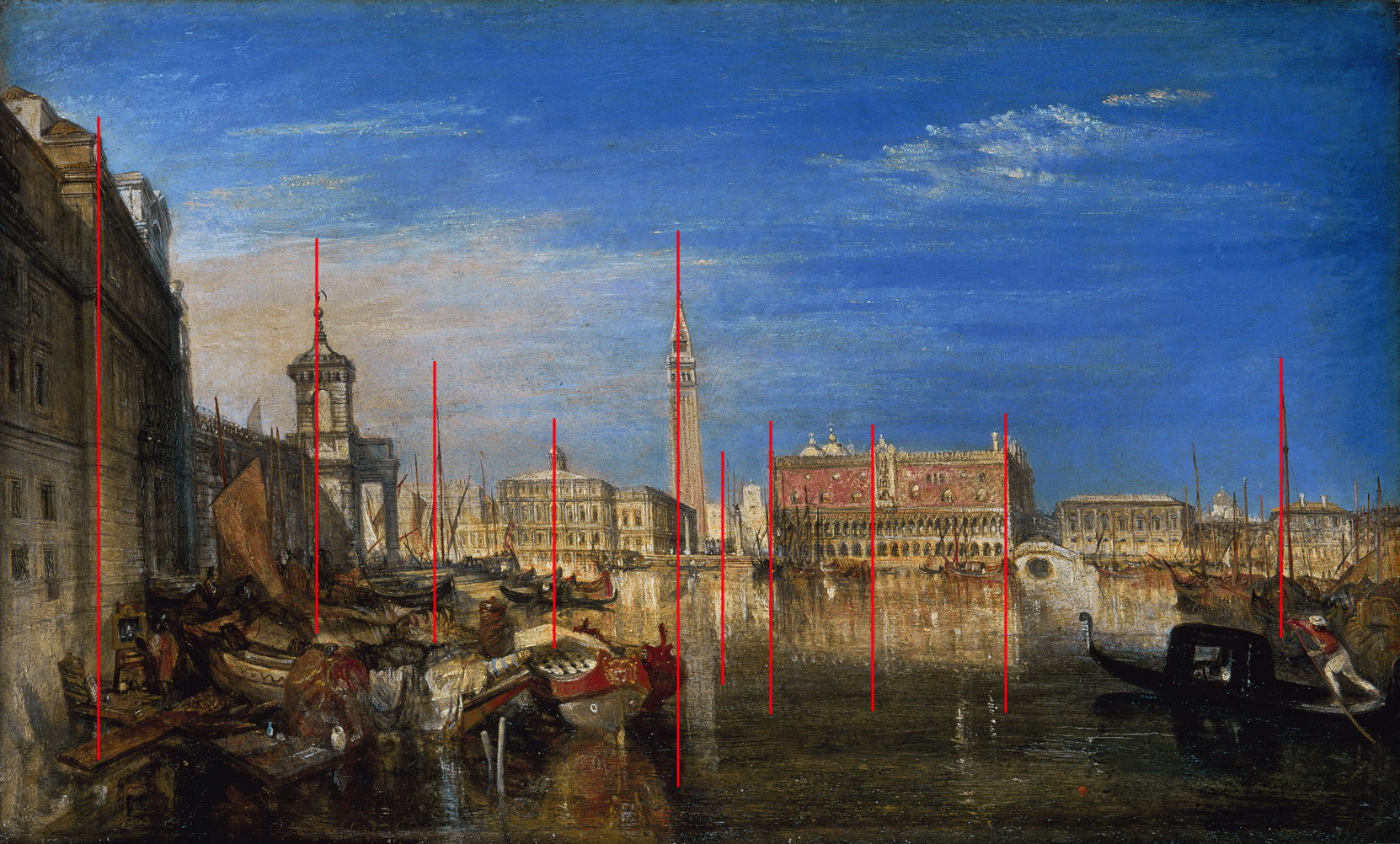
Joseph Mallord William Turner (1775–1851), Bridge of Sighs, Ducal Palace and Custom-House, Venice: Canaletti Painting (1833), oil on mahogany, 51.1 x 81.6 cm, Tate Britain, London (N00370). Wikimedia Commons. Perpendiculars have been superimposed to show failure in vertical alignment of the unreflected and reflected images.
Some of his paintings show other optical oddities. His Bridge of Sighs, Ducal Palace and Custom-House, Venice: Canaletti Painting (1833), his first oil painting of Venice, places all the buildings leaning to the left, with their reflections leaning in the opposite direction. Had this painting been on a canvas support, there might have been distortion applied by its stretching or subsequent treatment, but unusually Turner painted this on a mahogany panel. I have checked this image matches those from other sources, to ensure this isn’t a photographic artefact.
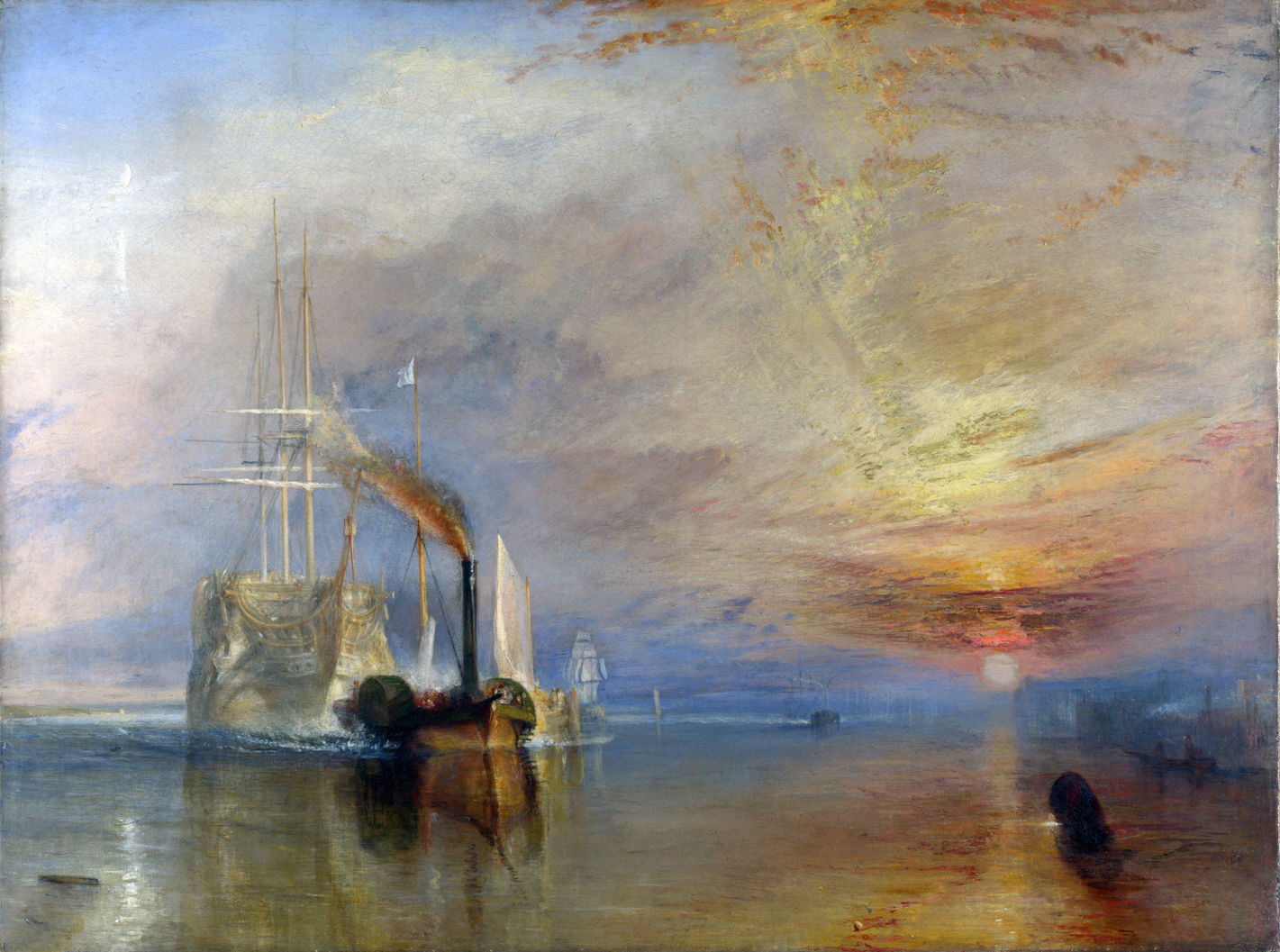
Joseph Mallord William Turner (1775–1851), The Fighting Temeraire tugged to her last Berth to be broken up (1839), oil on canvas, 90.7 × 121.6 cm, The National Gallery, London. Wikimedia Commons.
Turner’s famous Fighting Temeraire from 1839 breaks most of the optical rules of reflections, most obviously in the extraordinary reflected image of the tug’s prow. The tip of the bowsprit isn’t vertically aligned between original and reflection, and there’s gross vertical exaggeration, as there is in the ghostly reflection of the Temeraire under tow.
Joseph Mallord William Turner (1775–1851), Campo Santo, Venice (1842), oil on canvas, 62.2 x 92.7 cm, Toledo Museum of Art, Toledo. WikiArt.
Several of Turner’s later paintings appear founded in sound optical principles, then exaggerated for artistic effect. While many of the reflections in his Campo Santo, Venice from 1842 appear faithful, he has grossly exaggerated the vertical axis of the reflections of the white sails to the left of centre. But the effect is wonderful.
The Dogano, San Giorgio, Citella, from the Steps of the Europa, from the same year, takes a few gentle liberties with optics without becoming too obviously inaccurate. Again this is mainly in vertical scaling, and Turner has been careful to ensure good vertical alignment throughout.
Joseph Mallord William Turner (1775–1851), War. The Exile and the Rock Limpet (1842), oil on canvas, 79.4 x 79.4 cm, Tate Britain, London (N00529). WikiArt.
I have already pointed out some of the apparently deliberate optical anomalies seen in the reflections in Turner’s late oil painting War. The Exile and the Rock Limpet (1842).
Given Turner’s experience and record, I don’t think those discrepancies are errors, but are devices he has successfully used for their effect.
Understanding the optical principles involved in reflections is important for recognising when artists deviate from them, as in many cases that’s intentional. These can readily become complicated when considering mirrors that can be orientated at will, and are at their simplest when the reflecting surface is horizontal with respect to the earth, as with reflections on water.
Basic optics
The fundamental optical principles underlying reflections on water surfaces are:
light travels in a straight line when passing through a medium of constant refractive index;
when light reaches the interface between two media of different refractive indexes, some will be reflected from the boundary, and some will be refracted through that boundary;
the angle of reflection of a ray of light from a boundary surface is equal to the angle of incidence of that light on that boundary;
a water surface with air above it presents a suitable boundary at which reflection and refraction occur;
still water surfaces are horizontal planes that act as horizontal planar mirrors as far as incident light rays are concerned.
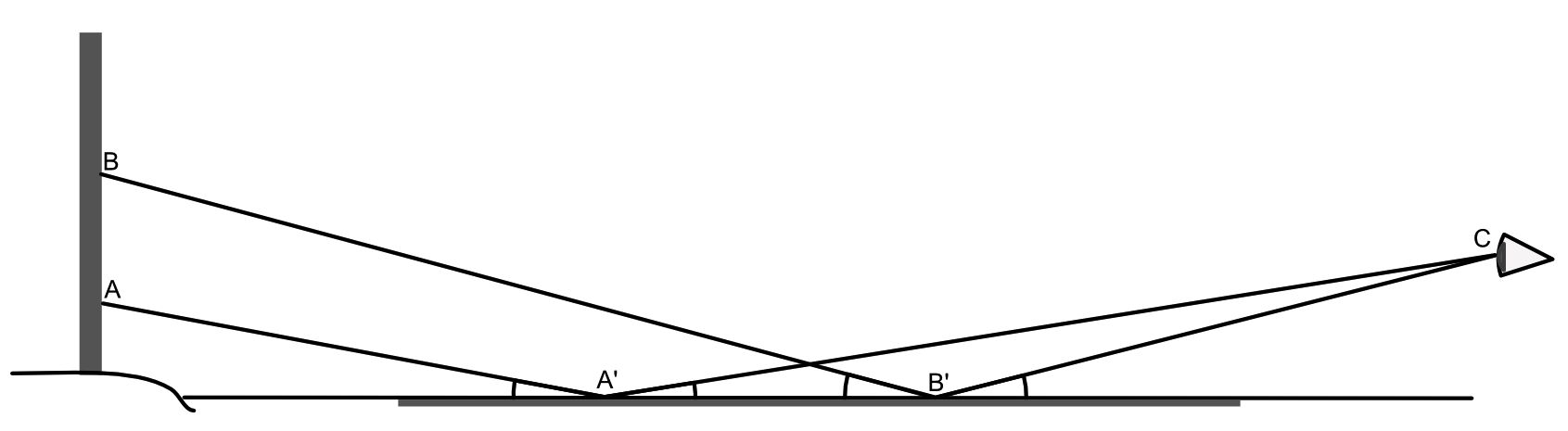
Basic diagram showing the geometry of reflections on water. EHN & DIJ Oakley.
Here a post (with marks A and B), on the left of the diagram, is on the bank of a completely flat lake, with the observer on the opposite side of the lake at C, looking over the lake towards the post. A ray of light scattered from point A on the post passes over the lake to point A’. There, in passing from air to water, it reaches a boundary between media of different refractive indexes, and most of that light will then be reflected towards the observer at C.
Measured at the point of reflection A’ on the lake, the angle of incidence (between the ray and the horizontal water surface) equals the angle of reflection (between the ray and the water surface). The same process of reflection occurs to light scattered from point B on the post, with respect to its reflection at point B’ and the observer’s eye at C, although the angles at point A’ are less than those at point B’.
The relationship between heights above the water plane and the distances from the reflection on the water are a matter of simple geometry. Taking first the right-angled triangle formed by the points B, B’, and the base of the post, the perpendicular height of B above the water (H) and the distance from the base of the post to the point of reflection B’ (D) is the tangent of the angle of incidence of the light ray at B’, as H/D.
As the angle of reflection at B’ must be the same as the angle of incidence (point 3 above), the ratios of the heights at B and C to the distances along the water surface from the base of the post to the point of reflection, and the point of reflection to the observer, must be equal. Hence if three of the four variables are known, the fourth can be calculated, e.g. H = H’.D/D’.
This may seem complex and confuddling, but it’s worth taking the time to understand these basic principles, as they make everything else clearer and more logical.
Putting it together
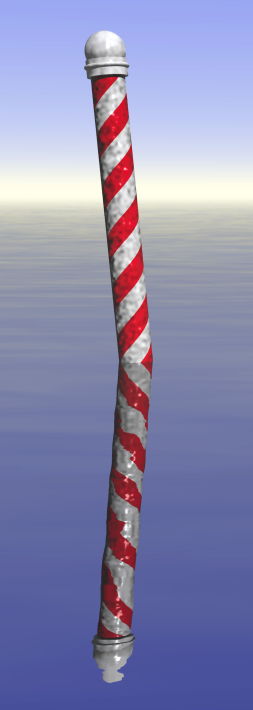
Ray-traced reflections of a barber’s pole. EHN & DIJ Oakley.
Repeating this simple tracing of light rays enables visualisation of more complex examples of reflection, such as that shown above. It quickly becomes tedious for humans to trace individual light rays in a three-dimensional model, but computers excel at the task of ray-tracing. The resulting image makes it clear that corresponding points in a reflection on water are vertically below their originals, although the slight waves seen here can result in limited lateral shift in the reflected points.
As is well known from real life, the reflected image in a horizontal mirror is effectively reflected on a local horizontal plane, so the left of the original remains on the left of the reflection, but the reflected image is inverted, where the top of the reflection shows the lowest part of the original; that’s unlike reflections in a mirror positioned vertically, such as those in which we inspect our face, shave, or apply make-up, which fortuitously remain uninverted. Whether a mirror is vertical or horizontal, the left of the reflected image shows the left of the real image, and similarly for the right.
The patterning and slant of the pole illustrates the differences between such a reflected image and one that has simply been rotated through 180˚, as might be achieved by a painter rotating the canvas on an easel. In the latter case the chirality (handedness) of the transformed image is opposite, the post would lean the opposite way, and its red spiral pattern would differ too. Surprisingly, rotating the canvas through 180˚ has often been recommended as an aid to painting faithful reflections, when all it can do is further confuse.
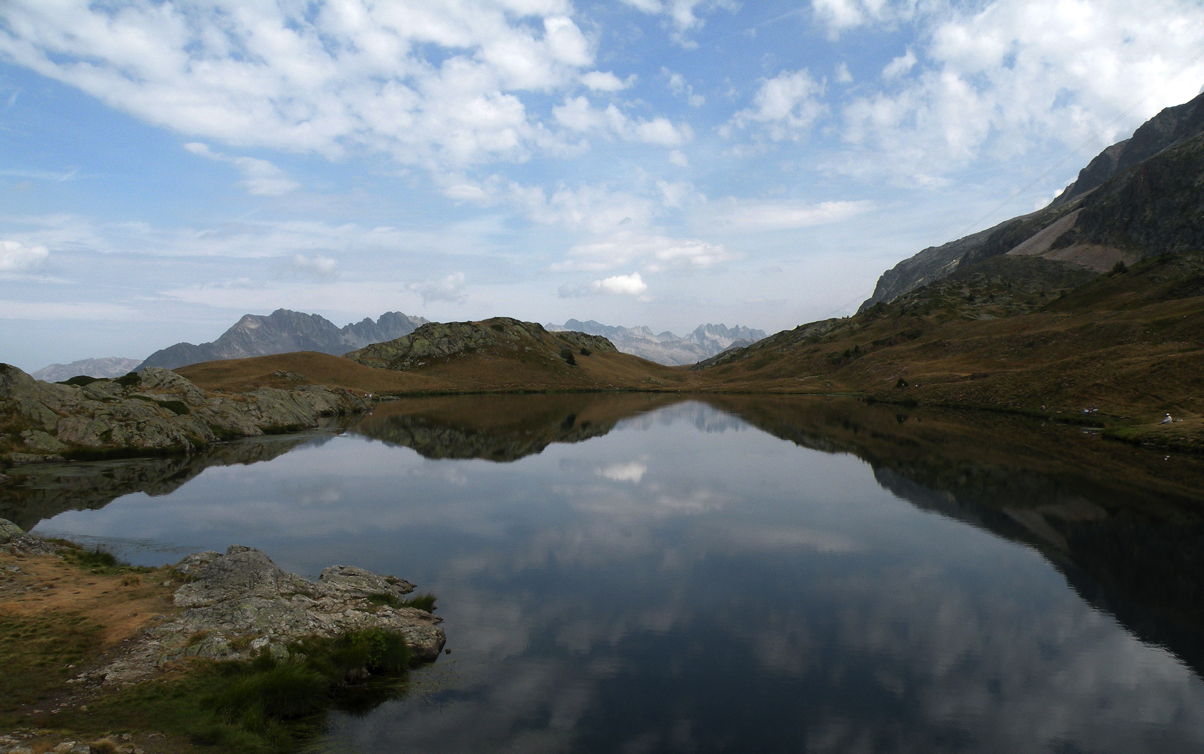
Photograph of extensive reflections on water, Lac Besson, Alpe d’Huez. EHN & DIJ Oakley.
Real world reflections can become complex, as the photo above demonstrates. One method I use to check for discrepancies between the unreflected and reflected images is to un-reflect the reflected image by reflecting it a second time, and align it above the unreflected image. It’s then easy to check the alignment and representation of objects shown in the reflection.
Composite image of extensive reflections on water, Lac Besson, Alpe d’Huez. EHN & DIJ Oakley.
JMW Turner, Crossing the Brook
In the summer of 1811, JMW Turner toured the west of England, where he made studies of the River Tamar, marking the boundary between Devon and Cornwall. The second major painting he exhibited in the summer of 1815 had been developed from one of those plein air studies of the river: Crossing the Brook.
Joseph Mallord William Turner (1775-1851), Crossing the Brook (1815), oil on canvas, 193 x 165.1 cm, Tate Britain, London (N00497). EHN & DIJ Oakley.
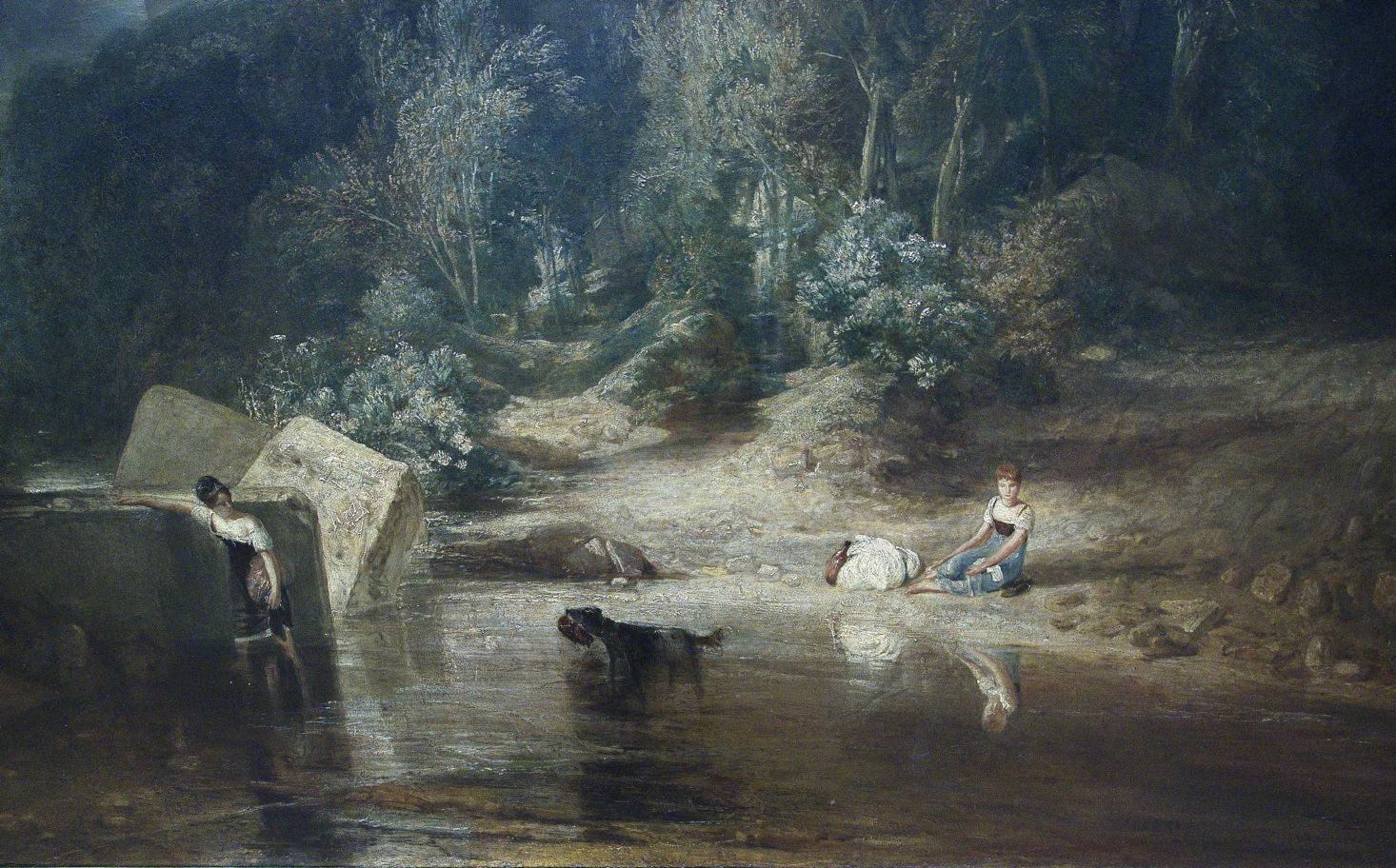
It was inspired by Claude Lorrain, but is more conventional, revealing its influence from the landscape tradition, including the British line tracing back to Richard Wilson (1714-1782). In the light of Turner’s later and more overtly experimental paintings, Crossing the Brook may today seem tame and conservative. It shows two women at a ford across the brook, one (left of centre) wading in the river by some massive stone blocks, and in company with a black dog, seen with a large fish in its mouth. The other sits on the far bank, beside a large bundle wrapped in white cloth, with her shoes removed.
The ford is in an opening within a large wooded area, with tall trees providing repoussoir at both sides of the painting. This drops away to a long bridge with multiple arches in the middle distance, and the river (as it is by then) meanders through rolling and wooded countryside until it reaches the sea at Plymouth in the far distance.
Joseph Mallord William Turner (1775-1851), Crossing the Brook (detail) (1815), oil on canvas, 193 x 165.1 cm, Tate Britain, London (N00497). EHN & DIJ Oakley.
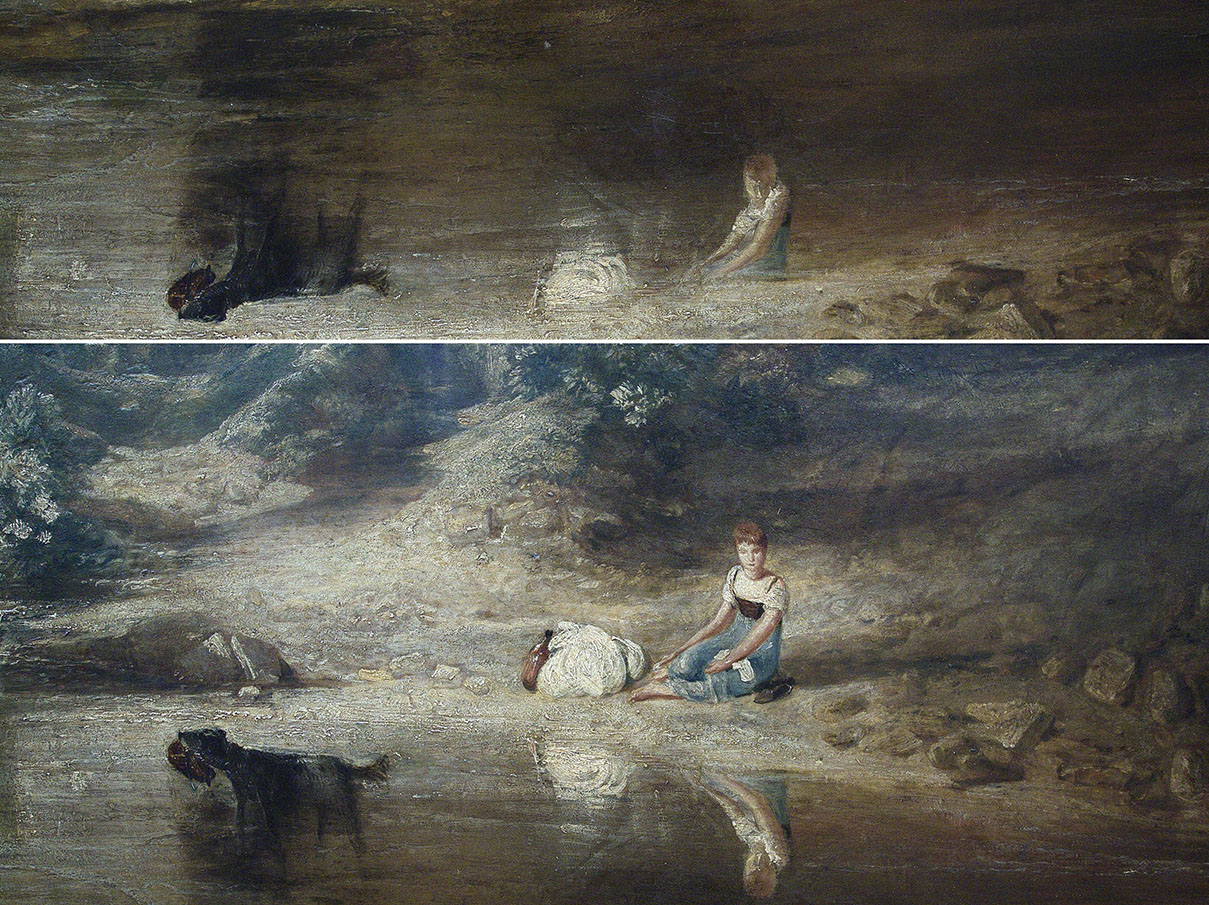
One of the most remarkable features of this painting is Turner’s depiction of the reflections in the water, because there are marked discrepancies between the unreflected image of the woman sat on the bank, and her reflection. Those are shown clearly in the composite detail below.
Joseph Mallord William Turner (1775-1851), Crossing the Brook (detail) (1815), oil on canvas, 193 x 165.1 cm, Tate Britain, London (N00497). EHN & DIJ Oakley. Shown as a composite view, to highlight the discrepancies between the original and reflected images.
Throughout his career, and most particularly in his later more radical works, Turner took liberties with optics. One of the best examples of this is in his late oil painting War. The Exile and the Rock Limpet, painted over twenty-five years later, in 1842.
Joseph Mallord William Turner (1775-1851), War. The Exile and the Rock Limpet (1842), oil on canvas, 79.4 x 79.4 cm, Tate Britain, London (N00529). WikiArt.
The left, more distant, figure (of the guard to Napoleon) shouldn’t have appeared in reflection at all, let alone been vertically aligned with Napoleon’s reflection. However, strict adherence to optics would have significantly detracted from the effect of this painting. Turner has also omitted shadows that would have been cast by the figures, presumably for the same reason.
3D scenes
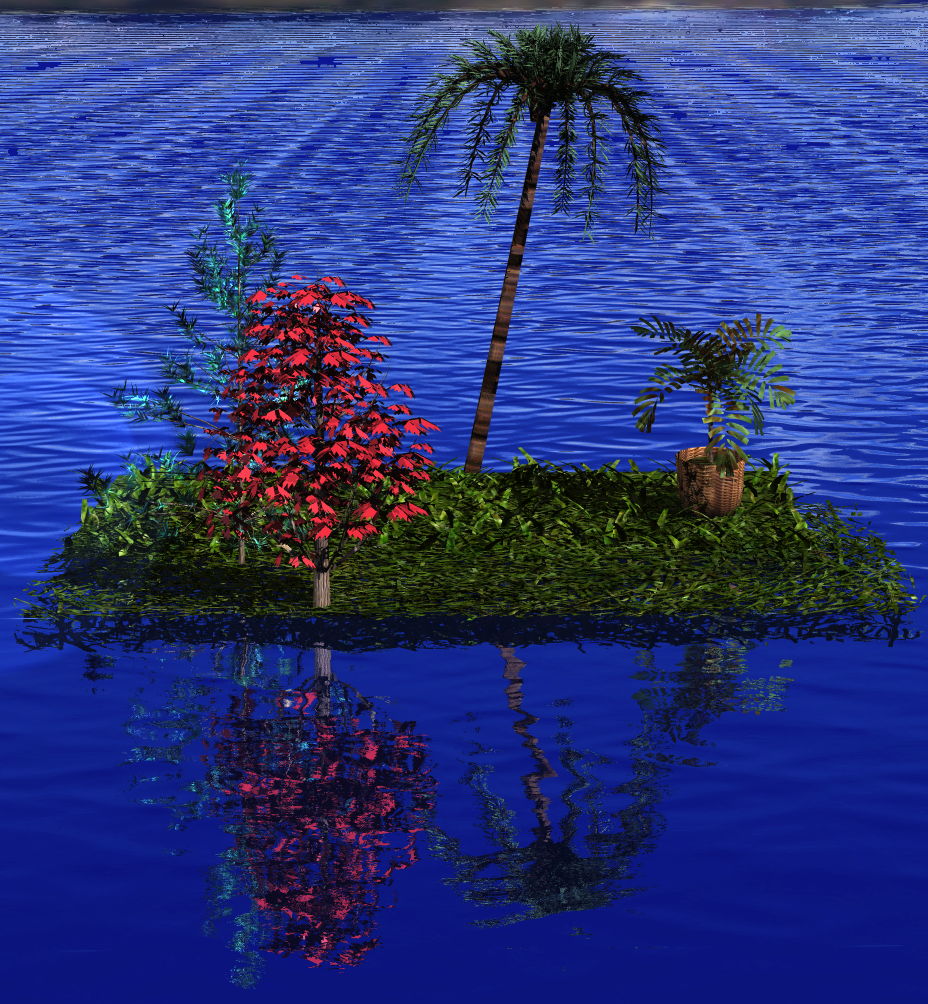
Ray-traced image showing a more complex 3D scene. A rectangular island consisting of a low bank of rough grass is situated in a lake, whose surface is highly reflective but has small, slight waves. On the island are three trees and a potted plant, of various heights and positioned at various distances from the edge of the bank. EHN & DIJ Oakley.
Reflections in a more complex 3D scene, above, show slight alteration in vertical dimensions, but remain strictly aligned with the original. Although the slight waves produce very small lateral displacements in the reflection, every point in the reflection corresponding to a point in the original remains in alignment across the width of the image.
Those objects at the front of the original remain at the front of the reflection: for example, the tree with red leaves retains its position relative to the green conifer tree behind it. The further back from the water’s edge that an object is situated, the more truncated is its reflection; truncation appears as if it occurred at the base of the original.
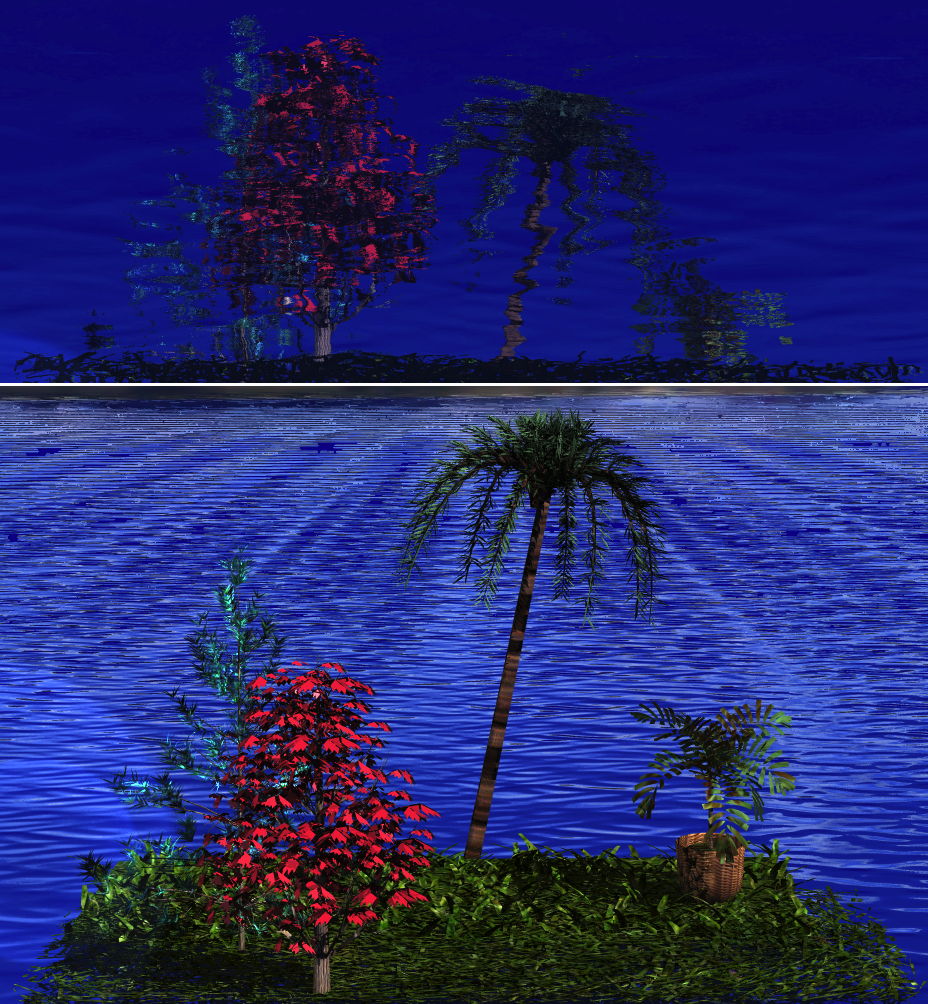
Composite image of ray-tracing of more complex 3D scene. EHN & DIJ Oakley.
One useful rule of thumb sometimes given to gauge the effect of truncation is to imagine that the water extends right back to the base of the original, then construct the reflection on that imaginary water surface, and to erase the reflection on the water where it doesn’t actually exist.
There are complex differences between the original and its reflection with respect to the position of details, tones and highlights. Although highlights are seen on the red leaves, their pattern isn’t the same, because the original leaves are seen direct, but those in the reflection are viewed as if from below and in front of the tree (from their points of reflection on the water).
This makes it impossible to create a completely accurate representation of a reflection unless you can see that reflection; even using modern ray-tracing software on a computer it is extremely difficult to construct or reconstruct a reflection from real life. Any painter who paints the original en plein air and later attempts to paint its reflection in the studio is only going to be able to guess its form and appearance, and will be unable to get tones and highlights correct with respect to those seen in nature.
Composite image of extensive reflections on water, Lac Besson, Alpe d’Huez. EHN & DIJ Oakley.
The difficulties encountered in extensive reflections on water in the real world are illustrated in the composite image above. Note how the distant mountains almost disappear from the reflection with the change in vertical dimensions, but rigorous vertical alignment is maintained across the entire image. Painting reflections in images such as this is an incredibly difficult task without the complete view in front of the painter at the time.
Practical principles
Any faithful depiction of reflections on water will therefore show the following features:
a line joining any point on the original with its equivalent on the reflection will be strictly vertical, allowing slight lateral shift resulting from the effects of small waves;
an object which is behind another object in the original will also remain behind that object in the reflection, as reflections preserve depth order;
the further back that an original object is from the water’s edge, the more its reflection will be cropped vertically;
vertical cropping loses the lower section of the original from the reflection, and the upper section remains in the reflection;
when the water surface is smooth, the position of reflections can be determined by simple geometry relating the height above the water surface to the distance between the point of reflection on the water and the perpendicular projection down onto the water plane (the tangent of the angle or incidence or reflection being equal to height/distance);
the view of each part of the original seen in the reflection will be that as seen from the points of reflection, those being lower than the observer and closer to the original;
what is seen on the (observer’s) left of the original appears on the left of the reflection, and what is seen on the right remains on the right of the reflection;
because the reflection is vertically inverted, what is seen at the top of the original appears at the bottom of the reflection;
the more the water surface departs from being a flat and smooth mirror, the more distortion will be introduced into the reflection, until eventually its form is lost in a series of vague areas of broken colour.
References
Brook Taylor (1719) New Principles of Linear Perspective, or the Art of Designing on a Plane the Representations of All Sorts of Objects, in a more General and Simple Method than has been done before, London. (Not available online, and later editions omit much of the material on reflections.)
Cole, Rex Vicat (1921) Perspective, Seeley, Service and Co, London. (Available in various reprints, and Archive.org.)
de Piles, Roger (1708) Cours de Peinture par Principes, Paris. (Available at Archive.org.)
de Valenciennes P-H (1820) Élémens de Perspective Pratique à l’usage des artistes, 2nd edn., Paris.
In post-classical European art the great majority of paintings are close to being square, with an aspect ratio (given as width to height) of between 0.75:1 and 1.5:1. Although there’s no generally agreed cut-off for what constitutes a panorama, those with an aspect ratio of 2:1 or greater should qualify.
Anonymous, Flotilla Fresco (before c 1627 BC), fresco, Thera (Santorini, Greece). By pano by smial; modified by Luxo, Wikimedia Commons.
Ancient and classical paintings are different, though, and what’s probably the oldest landscape painting (excluding those in caves) is far broader than it is high. This Flotilla Fresco painted at Thera on the island of Santorini in Greece must have been completed before a catastrophic volcanic explosion in about 1627 BCE destroyed the local civilisation.
Paul Bril (c 1553/4–1626), View of Bracciano (c 1622), oil on canvas, 74.5 x 163.6 cm, Art Gallery of South Australia, Adelaide, South Australia. Wikimedia Commons.
Paul Bril was exceptional in this panoramic View of Bracciano painted in about 1622 with an aspect ratio of 2.2:1. Although strongly Italianate, it’s a painting ahead of its time in other respects, as a fairly accurate depiction of a real place, with all sorts of fascinating little scenes within it, like the young boy doffing his hat to the passing dignitary in his coach with armed guard.
Bartholomeus van der Helst (1613–1670) and Jan Vos (1610–1667), The Celebration of the Peace of Münster, 18 June 1648, in the Headquarters of the Crossbowmen’s Civic Guard (St George Guard), Amsterdam (1648), oil on canvas, 232 x 547 cm, Rijksmuseum, Amsterdam, The Netherlands.
Just over twenty-five years later, the Dutch painters Bartholomeus van der Helst and Jan Vos used a panoramic canvas to accommodate all those in The Celebration of the Peace of Münster, 18 June 1648, in the Headquarters of the Crossbowmen’s Civic Guard (St George Guard), Amsterdam. This has an aspect ratio of 2.4:1, even greater than Bril’s.
Caspar Wolf (1735–1783), Panorama of Grindelwald with the Wetterhorn, Mettenberg and Eiger (1774), oil on canvas, 82 x 226 cm, Kunsthaus Zürich, Zürich, Switzerland. Wikimedia Commons.
The Swiss painter Caspar Wolf was another early exponent in his Panorama of Grindelwald with the Wetterhorn, Mettenberg and Eiger painted in 1774, although this couldn’t have been called a panorama at the time. This shows the distortion needed to include the whole of this view on a single canvas, with its remarkably high aspect ratio of 2.75:1. Today we’d envisage this as being painted through a wide-angle lens, although it was a century before such camera lenses came into use.
It’s generally accepted that the idea of a panorama was first formalised in British patent number 1612 of 1787 awarded to Robert Barker, where he coined the word, and the word’s first appearance in print occurred four years later.
Giovanni Battista Lusieri (1755-1821), A View of the Bay of Naples, Looking Southwest from the Pizzofalcone Toward Capo di Posilippo (1791), Watercolor, gouache, graphite, and pen and ink on six sheets of paper, 101.8 x 271.9 cm, The J. Paul Getty Museum, CA. Wikimedia Commons.
A little later, Giovanni Battista Lusieri attained high aspect ratios of around 2.7:1 by assembling multiple supports, in his case sheets of paper, as he worked in watercolour on this View of the Bay of Naples, Looking Southwest from the Pizzofalcone Toward Capo di Posilippo in 1791.
Robert Barker’s panorama wasn’t artistic in the slightest, but pure spectacle and entertainment. His original painting of Edinburgh was on a large roll of paper, and first exhibited in Leicester Square, London, an area now known for its leading movie theatres. Baker either stuck the painted roll on the inside of a large cylinder for rotation about the viewer (also known as a cyclorama), or later he scrolled the roll past the viewers’ eyes.
JMW Turner (1775-1851), Petworth Park: Tillington Church in the Distance (c 1828), oil on canvas, 60 x 145.7 cm, The Tate Gallery, London. Wikimedia Commons.
Many paintings in JMW Turner’s huge output are panoramic in nature if not in form. This example, Petworth Park: Tillington Church in the Distance (c 1828), is viewed from a higher level even though its content has little vertical extent, to emphasise its long cast shadows. It has a high aspect ratio of 2.4:1, and the odd arc of the path in the foreground enhances its wide-angle effect.
Théodore Rousseau (1812-67), Vue panoramique sur l’Île-de-France (Panoramic View of the Ile-de-France) (c 1830), oil on canvas, 22.1 x 75.9 cm, The National Gallery of Art, Washington, DC. Courtesy National Gallery of Art, via Wikimedia Commons.
In about 1830, Théodore Rousseau’s Panoramic View of the Ile-de-France attained the highest aspect ratio yet, of just over 3.7:1, which may have been driven by the growing popularity of panoramas as entertainment. He’s also more conventional in placing the viewer at the level of the rooftops, looking over foreground buildings. The angles of lines of trees and other objects in the foreground appear to show wide-angle lens distortion, although the earliest known photograph wasn’t made until 1838. One possible explanation is that Rousseau used a camera obscura to draw in the view, although I’m not aware of any evidence of that.
Jean-Baptiste-Camille Corot (1796-1875), Avignon from the West (1836), oil on canvas, 34 x 73.2 cm, The National Gallery, London. WikiArt.
Just a few years later, Jean-Baptiste-Camille Corot painted panoramic views en plein air and in his studio. This example of Avignon from the West (1836) shows how well he transferred the skills that he had learned when in the Roman Campagna to the French countryside. Its aspect ratio is more modest at 2.2:1, similar to that of Paul Bril two centuries earlier.
Frederic Edwin Church (1826-1900), Niagara (1857), oil on canvas, 101.6 x 229.9 cm, National Gallery of Art, Washington, DC. Wikimedia Commons.
Many of Frederic Edwin Church’s epic landscapes were painted far south beyond the US border, but this early panoramic view of Niagara made in 1857 remains one of his most important works, with its aspect ratio of 2.3:1.
Henri Harpignies (1819–1916), View of the Seine at Rouen (date not known), watercolour over black chalk, on heavy watercolour paper, 24.7 x 54.5 cm, The Morgan Library & Museum, New York, NY. Wikimedia Commons.
I don’t have a date for Henri Harpignies’ magnificent watercolour panorama of View of the Seine at Rouen, which I believe shows the view from Bonsecours, to the south-east of the city, looking north-west into the summer sunset, with an aspect ratio of 2.2:1.
By the end of the nineteenth century panoramas were attaining aspect ratios over 4:1, requiring custom supports, either being painted on the interior walls of a cylindrical building or rotunda, or on rolls like Robert Barker’s.
Hendrik Willem Mesdag (1831-1915), Panorama Mesdag (1880-81), media not known, 1400 x 12000 cm, Panorama Mesdag, Den Haag. Wikimedia Commons.
Hendrik Willem Mesdag’s staggering Panorama Mesdag from 1880-81 was commissioned as a view of the village of Scheveningen, the Netherlands, from its coastal dunes. It’s 14 metres high and 120 metres long, giving it an aspect ratio of 6.8:1. When tastes changed towards the end of the nineteenth century, the company exhibiting the panorama as an entertainment went bankrupt; Mesdag bought it back, and it remains housed in its dedicated building, an appropriately extreme memorial to this long-lasting fascination.
Over the following decades other huge panoramas were painted to commemorate wars and national history. I show here just two examples.
Paul Dominique Philippoteaux (1846–1923), Gettysburg Cyclorama (1883), oil on canvas panorama, overall 820 x 10940 cm. Gettysburg Museum and Visitor Center, Gettysburg, PA. Wikimedia Commons.
Paul Dominique Philippoteaux’s vast Gettysburg Cyclorama opened to public acclaim just twenty years after the battle, in 1883, and continues to draw attention at the battlefield’s visitor centre. It was commissioned by a group of Chicago investors, rather than anyone interested in its art, and has the highest aspect ratio of 13.3:1.
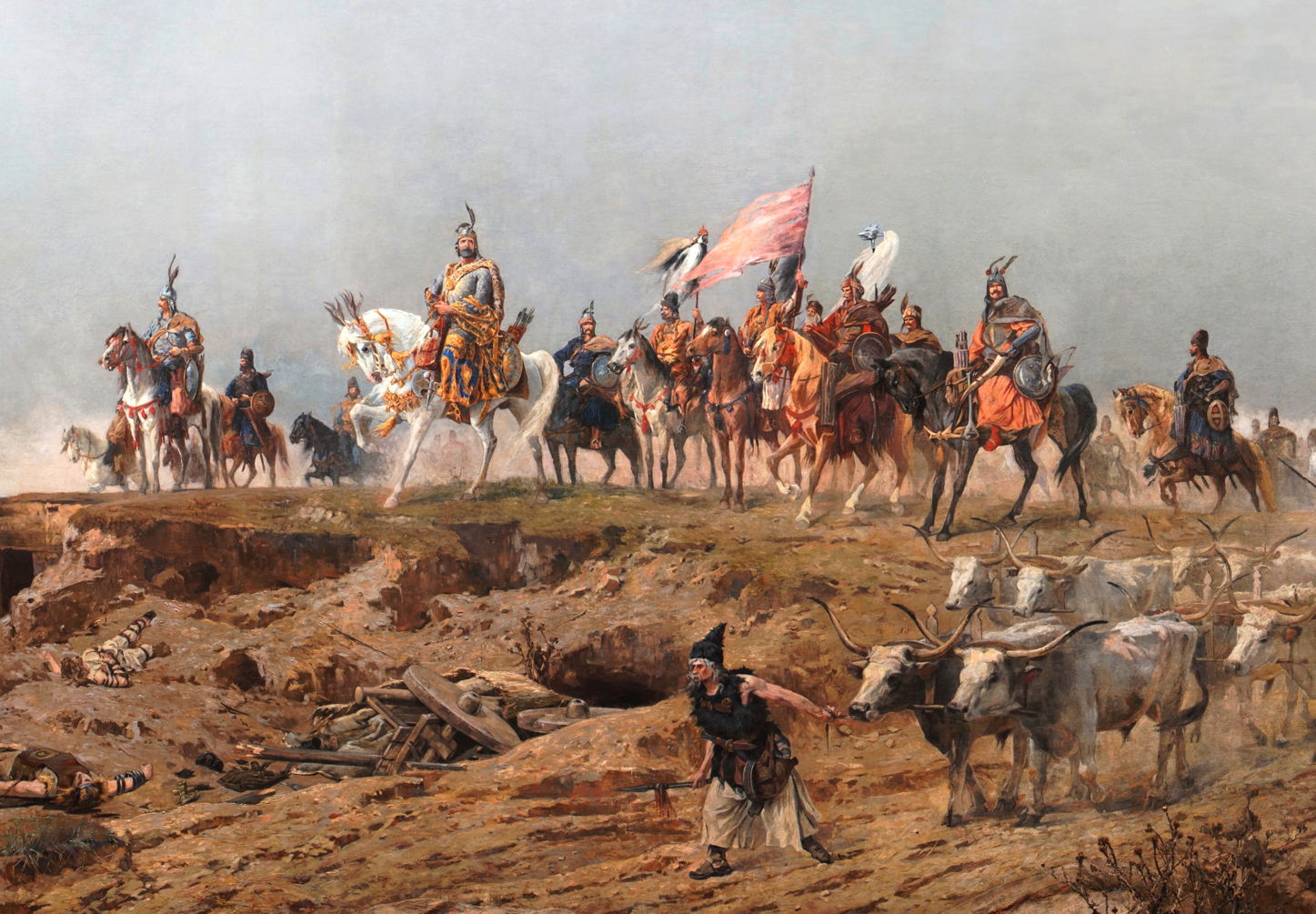
Árpád Feszty (1856–1914), Arrival of the Hungarians (Feszty Panorama) (detail) (1892-4), oil on canvas cyclorama, 1500 x 12000 cm, Ópusztaszer National Heritage Park, Ópusztaszer, Hungary. Wikimedia Commons.
As their popularity was waning at the end of the century, Árpád Feszty and a hoard of assistants depicted the narrative scenes they imagined of a millennium earlier, as the first Hungarians arrived to settle their country. Their whole panorama has an aspect ratio of 8:1.
Not content with Naiads and other water nymphs, the alchemist and proto-scientist Paracelsus (1493-1541) invented his own elemental beings associated with water, Undines or Ondines. He also elaborated their nature: although they cunningly resemble beautiful young women, they aren’t human, so lack a soul. The only way they can enjoy an afterlife is thus to marry a human.
Although that might appear a beguiling option for both, any man who is unfaithful to their Ondine wife will die as a result. The children of a union between a man and an Ondine are humans, having a soul, but also have a trait linked to water, known as a watermark. This might be some anatomical abnormality that periodically has to be bathed in water, for example.
By the nineteenth century, this amalgam of classical Naiads and alchemical elements was becoming popular in artistic creation. In 1842, the year after his death from tuberculosis, Aloysius Bertrand’s (1807-1841) collection of prose poems Gaspard de la Nuit was published, featuring the poem Ondine. The collection inspired Maurice Ravel’s brilliant piano suite of the same name, of which the first piece is the ferociously difficult Ondine.
Undine, a novella by Friedrich de la Motte Fouqué (1777-1843), was published in 1811, and has since influenced a slightly different tradition. It gave rise to Hans Christian Andersen’s story of The Little Mermaid in 1837, which became extremely popular throughout Europe and North America.
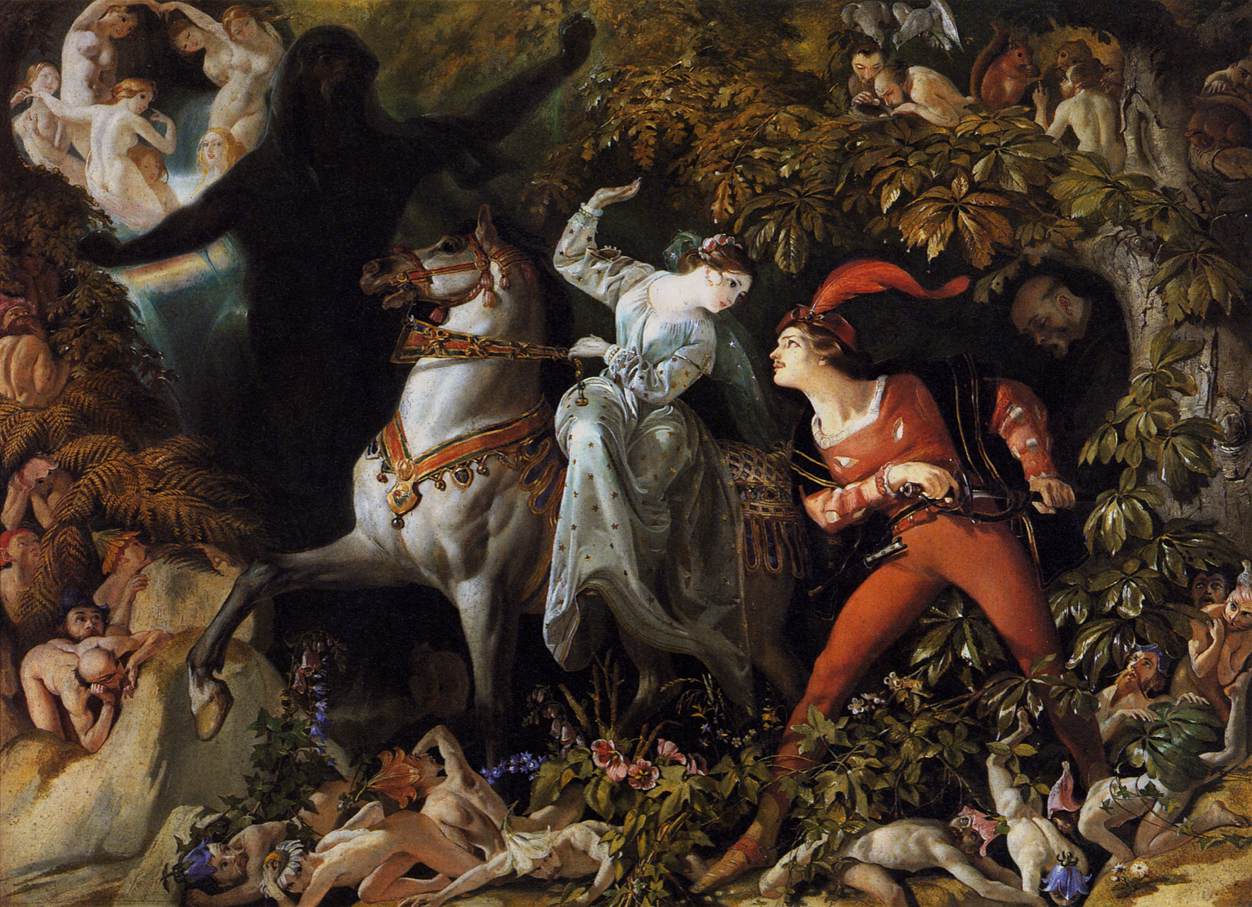
Daniel Maclise (1806–1870), A Scene from ‘Undine’ (1843), oil on canvas, 45 x 61 cm, The Royal Collection at Windsor Castle, Windsor, England. Wikimedia Commons.
In the 1840s, versions of Fouqué’s story had made their way to London in the form of a play. One of the first artists to commit this to canvas was the great ‘faerie painter’ Daniel Maclise, in his 1843 depiction of A Scene from ‘Undine’. Although there are other Undines frolicking in the water at the upper left, Maclise concentrates on the romance between Undine and the man who is to give her a soul, in exchange for his lifelong fidelity.
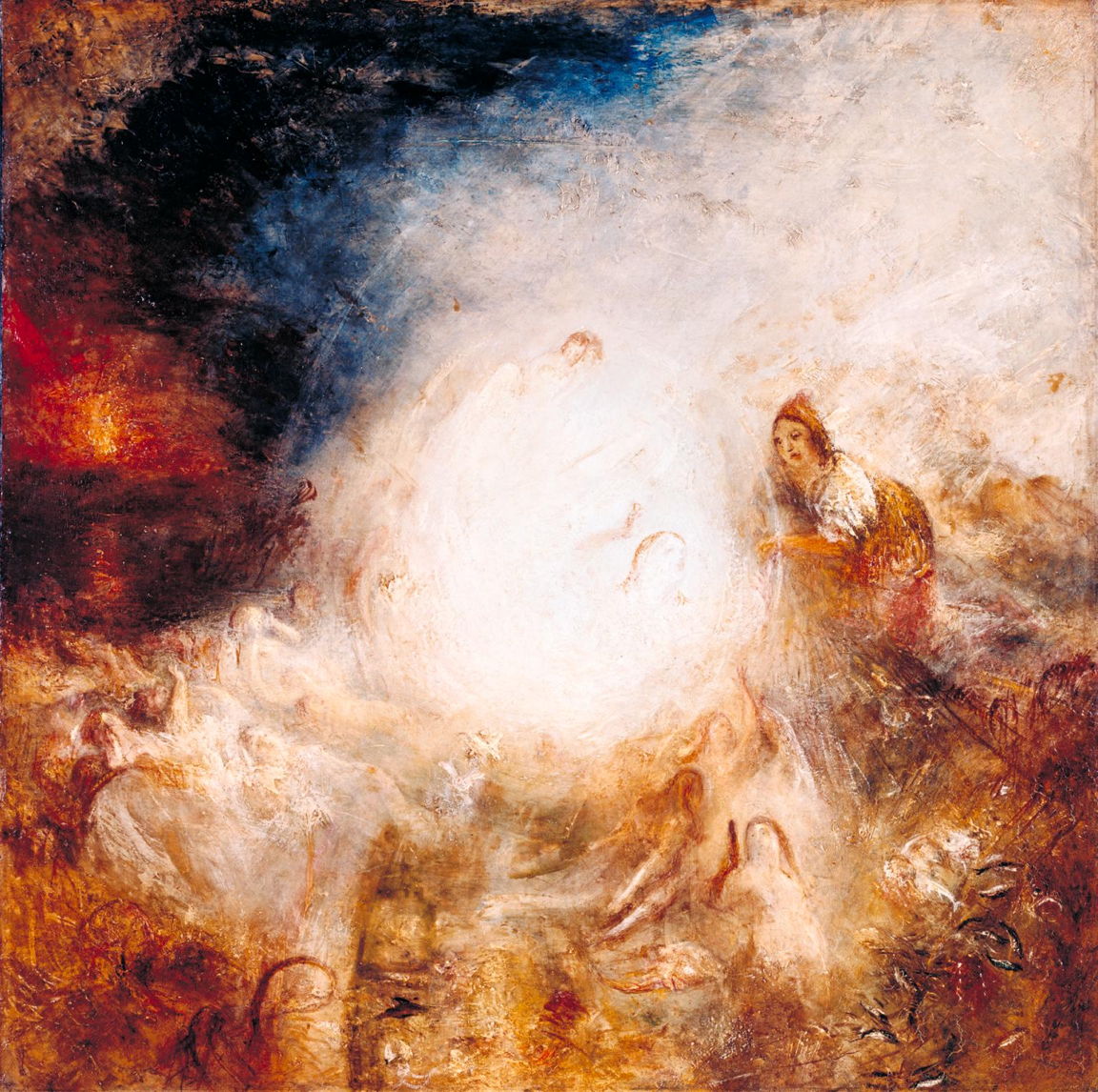
JMW Turner appears to have seen a similar stage production that inspired his Undine Giving the Ring to Massaniello, Fisherman of Naples of 1846. This is one of a pair of his paintings in which spiritual power and transformation are represented by brilliant light; the other, The Angel standing in the Sun, is a vision of the Last Judgement. Turner apparently shows Undine offering a wedding ring to a fisherman, although much of its detail has now been lost in the dazzling light. Around are other Undines in the waves.
John William Waterhouse (1849–1917), Undine (1872), oil on canvas, dimensions not known, Private collection. Wikimedia Commons.
Perhaps living up to his name, John William Waterhouse painted Undine in 1872, arising from a fountain, and modestly dressed. This was twenty years before he took to the nude Naiads of Hylas, shown in yesterday’s article.
Jules Lefebvre (1834–1912), Ondine (1882), oil on canvas, 151 x 92.5 cm, Szépművészeti Múzeum, Budapest, Hungary. Wikimedia Commons.
Jules Lefebvre had no qualms with turning his Ondine of 1882 into yet another classical nude, although her brilliant red hair is an unusual touch.
Paul Gauguin (1848–1903), In the Waves, or Ondine (I) (1889), oil on canvas, 92.5 x 72.4 cm, Cleveland Museum of Art, Cleveland, OH. Wikimedia Commons.
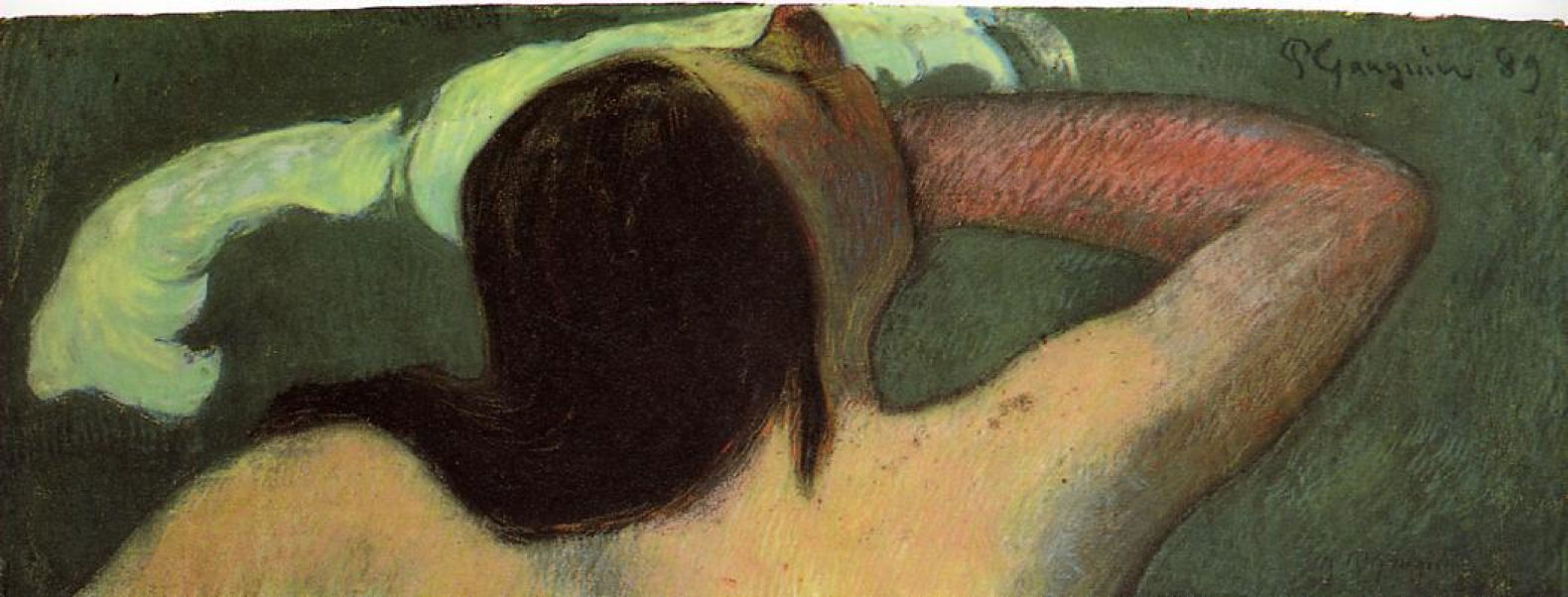
In 1889, Paul Gauguin painted two works in which Ondine is shown among waves in the seas. The first, known now as In the Waves, or Ondine (I) (above), appears the more complete. Ondine II, in pastel and gouache (below), seems likely to have been a study, and its lower edge appears to have been cut or cropped out. He may well have seen Lefebvre’s painting, as the fuller version also features red hair.
Paul Gauguin (1848–1903), Ondine II (1889), pastel and gouache on paper mounted on panel, 18 x 48.2 cm, Private collection. Wikimedia Commons.Albert Tschautsch (1843–1922), Enchantment (1896), oil on canvas, 96 x 134 cm, location not known. Wikimedia Commons.
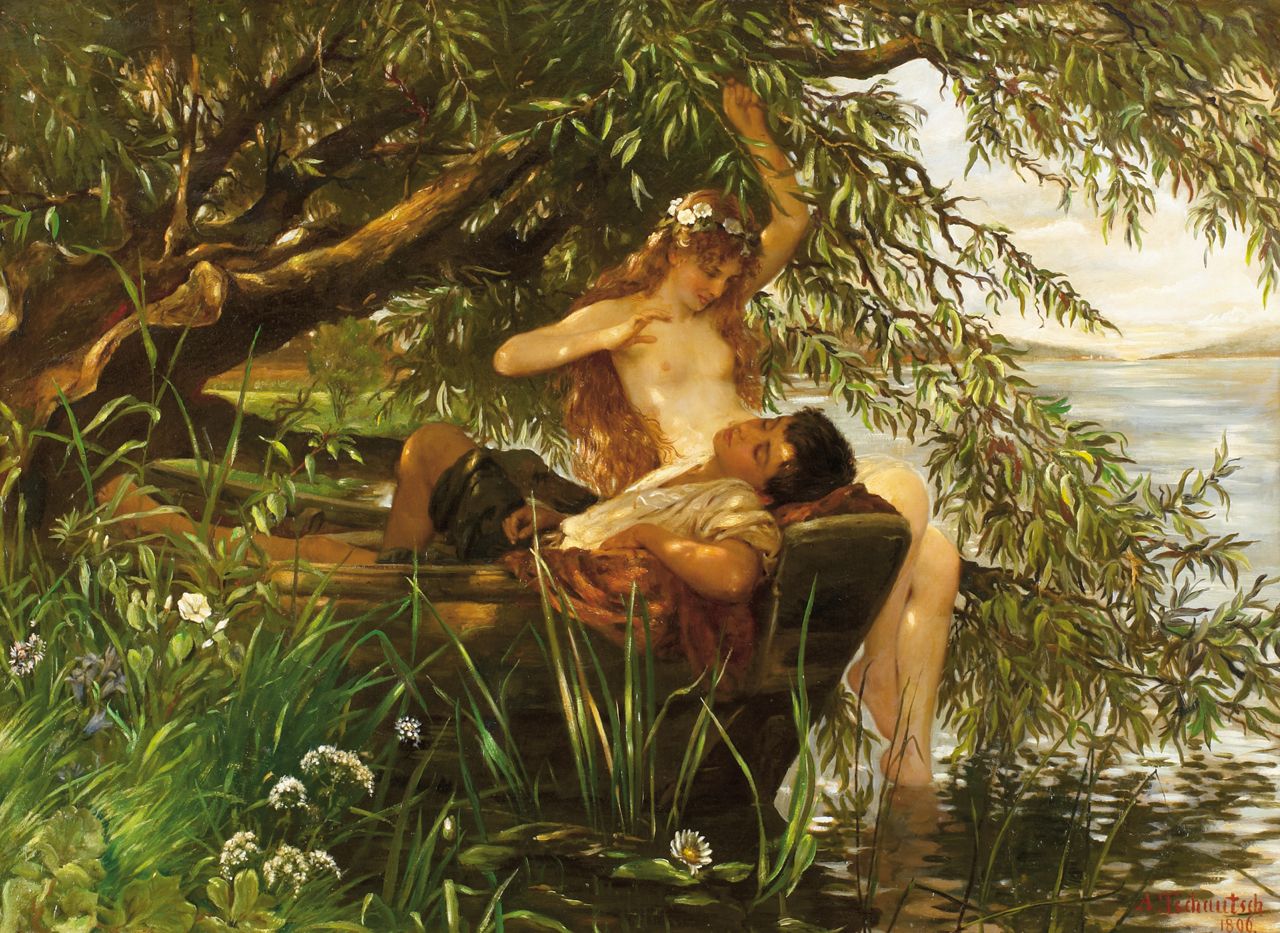
With interest growing in the femme fatale, Ondine was revamped into a figure like Medea, who cast a spell on her husband. Albert Tschautsch’s Enchantment from 1896 is an example of this changing image.
Carl Wilhelmson (1866–1928), Undine (1899), oil on canvas, 39 x 46.5 cm, Göteborgs konstmuseum, Gothenburg, Sweden. Wikimedia Commons.
Carl Wilhelmson is one of the few who has succeeded in making Undine (1899) appear not quite physically there, as she shimmers among red tulips.
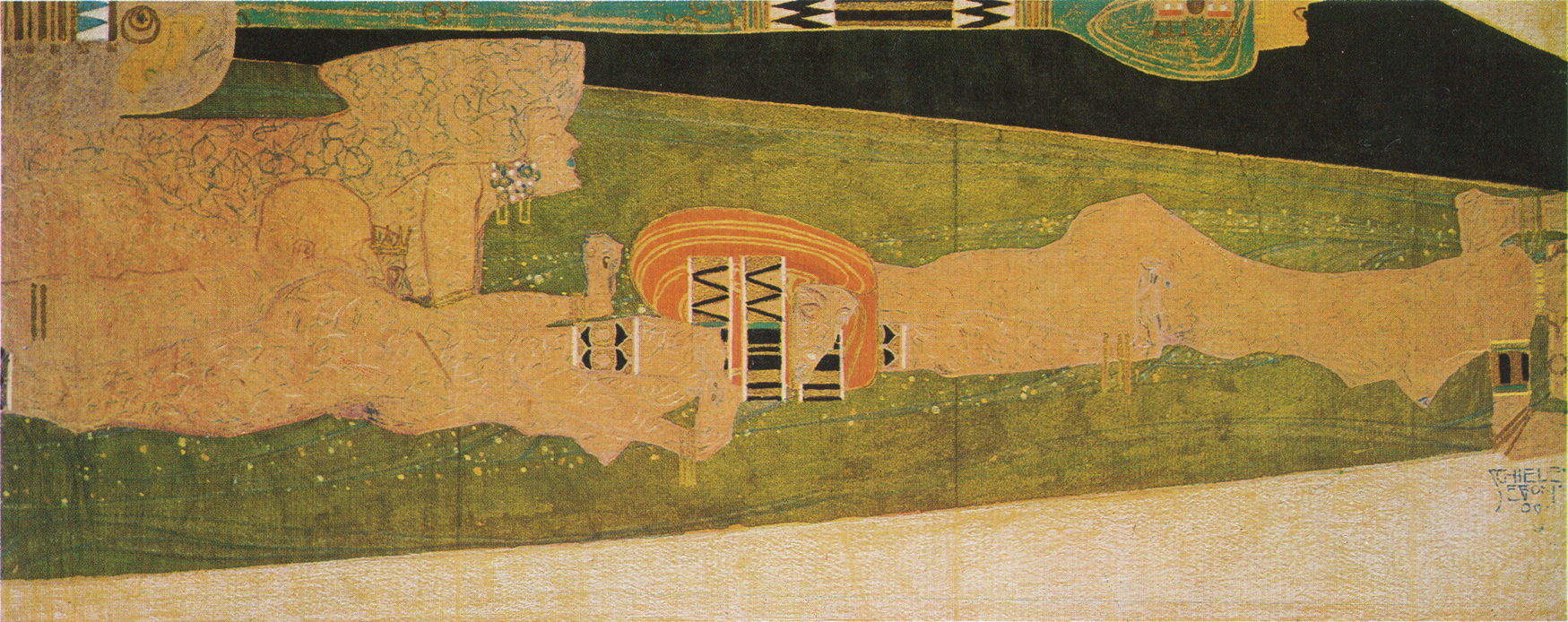
Egon Schiele (1890–1918), Undine II (1908), gouache, crayons, watercolour, white and gold paint on paper, 20.7 x 50.6 cm, Private collection. Wikimedia Commons.
Egon Schiele’s Undine II of 1908 was made in truly mixed media, including gouache, crayons, watercolour, white and gold paints, and a dash of Cubism too, it would appear. Although notoriously hard to read, I can see Undine at the upper left, propped up on her elbows. Nearer to the viewer is a bald-headed man, and there are other presumably female figures laid across the centre of the paper.
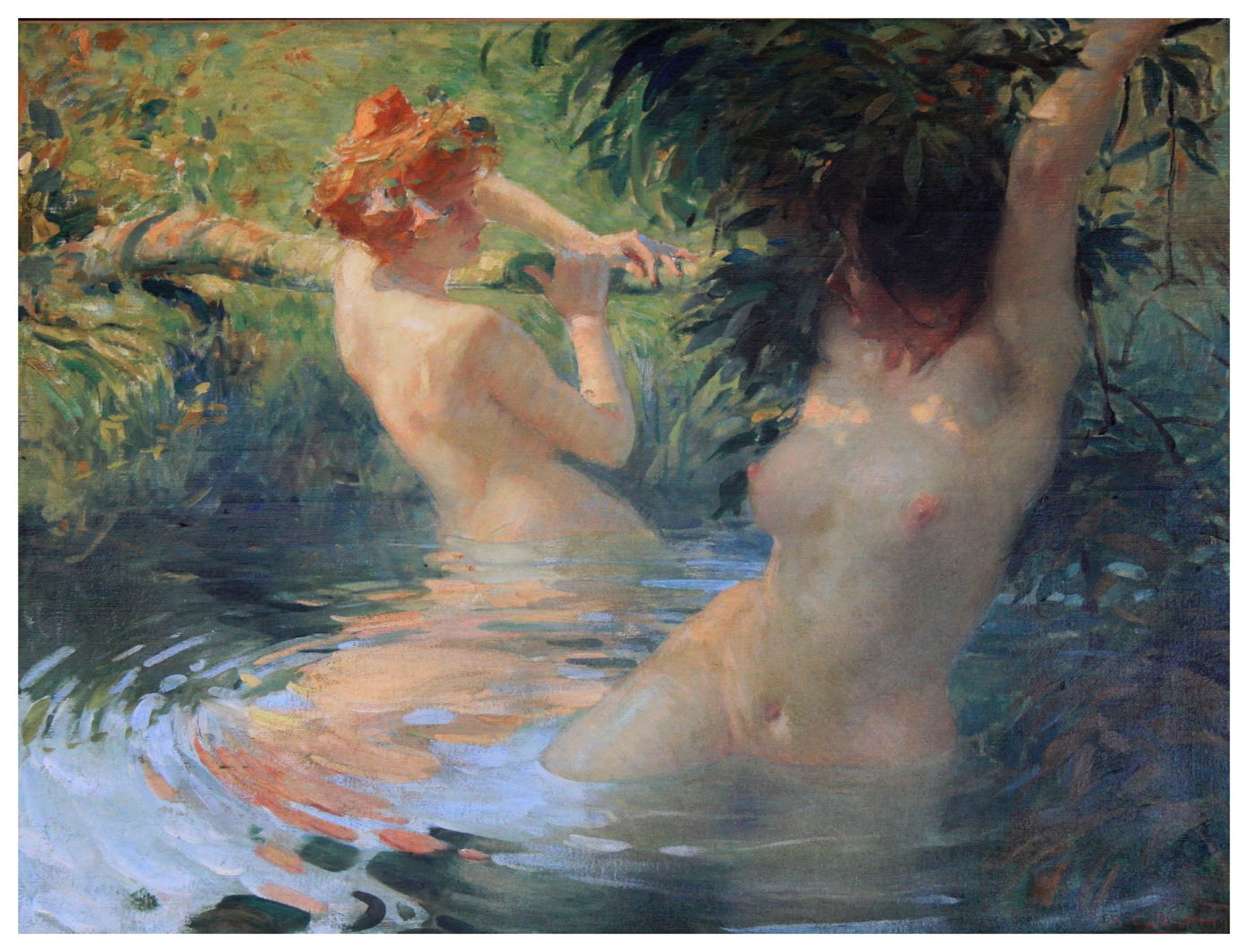
Antoine Calbet (1860–1942), Ondines (date not known), oil on canvas, 80.6 x 100.3 cm, Musée de Cambrai, Cambrai, France. Wikimedia Commons.
My final selection is an undated work from around the turn of the 19th-20th centuries by Antoine Calbet: Ondines, showing two nymphs in a rippled pool of water. One has red hair, which may refer to Gauguin’s version. His style is reminiscent of the great Swedish figurative painter Anders Zorn.
In 1939, Jean Giradoux based his play Ondine on Fouqué’s novella of 1811, and that has in turn been performed in a ballet by Hans Werner Henze (music) and Frederick Ashton (choreography). Ondine there tells her future husband Hans that she will be the breath of his lungs. After they are married, Hans reunites with his first love Bertha; when Hans later marries Bertha, he has to make a conscious effort to breathe. Ondine then kisses Hans, causing him to stop breathing and die, a femme fatale indeed.
There is a rare medical condition in which the automatic control of breathing fails, putting the patient at risk of stopping breathing when they fall asleep. This is known as congenital central hypoventilation syndrome, or Ondine’s curse. I’m confident that neither Paracelsus nor Giradoux had ever come across this condition, but their concepts and words proved extraordinarily prescient.
The Golden Age of the Dutch Republic was a period of war and turmoil. It started in the latter half of the Eighty Years War, thrived when that came to an end in 1648, and collapsed following the Disaster Year (Rampjaar) of 1672. That year brought both the Franco-Dutch and Third Anglo-Dutch Wars, invasion, rebellion, economic crisis, and collapse of the art market.
Antoine Coypel (1661–1722), Glory of Louis XIV after the Peace of Nijmegen (1681), oil on canvas, 153 x 185 cm, Musée Fabre, Montpellier, France. Image by Finoskov, via Wikimedia Commons.
When he was just twenty, the French artist Antoine Coypel painted this Glory of Louis XIV after the Peace of Nijmegen (1681), which gained him admission as a full member to the Académie Royale.
The Treaty of Nijmegen brought an end to the Franco-Dutch War of 1672-78, and was one of a series France signed between August 1678 and September of the following year. These were acclaimed a great success for Louis XIV and France, which gained extensive territory in the north and east as a result. Louis was henceforth known as the Sun King. In this elaborate allegorical flattery, the king is being crowned in the upper left, above a gathering of deities including Minerva, who is wearing her distinctive helmet and golden robes.
Painting didn’t stop, of course, and some artists continued into the following century, but the number of masters declined rapidly.
Domenicus van Wijnen (1661–after 1690), The Temptation of Saint Anthony (c 1685), media and dimensions not known, The National Gallery of Ireland, Dublin. Wikimedia Commons.
Domenicus van Wijnen continued to paint, for example his radical interpretation of The Temptation of Saint Anthony in about 1685. Although this may have appeared an outlier at the time, its symbols and composition may have inspired the ‘faerie’ paintings that became popular in the middle of the nineteenth century.
Adriaen van der Werff (1659–1722), The Judgement of Paris (1716), oil on panel, 63.3 x 45.7 cm, Dulwich Picture Gallery, London. Wikimedia Commons.
Other artists like Adriaen van der Werff reverted to more traditional themes and style, in his Judgement of Paris from 1716.
Herman Frederik Carel ten Kate (1822–1891), A Soldier and Men in an Inn (date not known), watercolour, white body paint and black chalk on paper, 21.5 x 32.8 cm, location not known. Wikimedia Commons.
The Golden Age was revisited by artists in the nineteenth century, particularly in the period scenes painted by Herman Frederik Carel ten Kate. His Soldier and Men in an Inn shows a scene from the Eighty Years War, with the walls decorated by blue on white Delft tiles. This must have been painted between 1850-80, over two centuries after the end of that war.
Jozef Israëls (1824–1911), The Seamstress (1850-88), oil on canvas, 75 × 61 cm, Rijksmuseum Amsterdam, Amsterdam, The Netherlands. Wikimedia Commons.
Early in the career of the Dutch artist Jozef Israëls, he painted The Seamstress (1850-88) as a genre interior from the Golden Age. A young Dutchwoman works with her needle and thread in the light of an unseen window at the left. In the background to the right, there’s a group of Delft tiles on the wall, and there’s a single tulip in a glass vase at the left.
The impact of Golden Age paintings on European art history was broad and deep, with secular themes becoming more popular than the religious and mythological works that had dominated the art of the Renaissance. New genres, like still life, may not have been rated as highly as history painting, but became widespread.
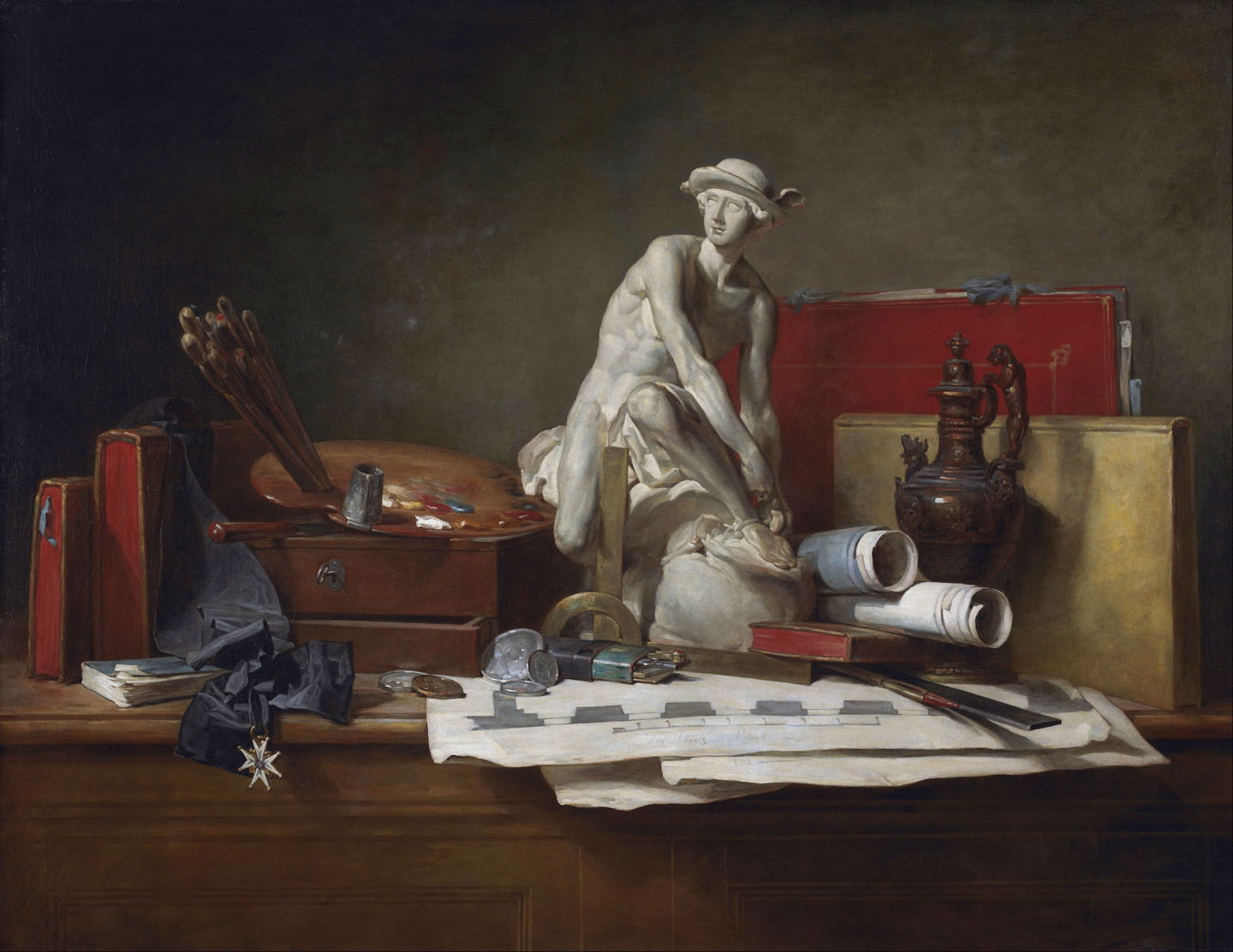
Jean-Baptiste-Siméon Chardin (1699–1779), The Attributes of the Arts and the Rewards Which Are Accorded Them (1766), oil on canvas, 113 x 145 cm, Minneapolis Institute of Art, Minneapolis, MN. Wikimedia Commons.
Late in his career, in 1766, Jean-Baptiste-Siméon Chardin painted The Attributes of the Arts and the Rewards Which Are Accorded Them, in which each object has a clear association. Painting is represented by the brushes and palette on top of a paintbox. Architectural drawings and drawing tools represent architecture. The bronze pitcher at the right refers to the work of the goldsmith. The red portfolio tied with ribbons represents drawing. The plaster model of the figure of Mercury in the centre is a copy of a sculpture by J B Pigalle, a friend of Chardin, who was the first sculptor to win the highest French honour for artists, the Order of Saint Michael, whose cross and ribbon are shown at the left.
Greatest impact was in landscape painting. Prior to the Golden Age, landscapes had primarily been used as accessories to other genres. Most were idealised rather than accurate representations of any real location, and many were mere settings for narratives.
Joseph Vernet (1714–1789), Italianate Harbour Scene (1749), oil on canvas, 104.4 x 117.8 cm, Dulwich Picture Gallery, London. Wikimedia Commons.
The Dutch vogue for expressive skies spread steadily across Europe. This is reflected in Joseph Vernet’s Italianate Harbour Scene from 1749. He still retains formal compositional elements, with figures in the foreground, and scenery behind, but delights in showing us these towering cumulus clouds lit so richly.
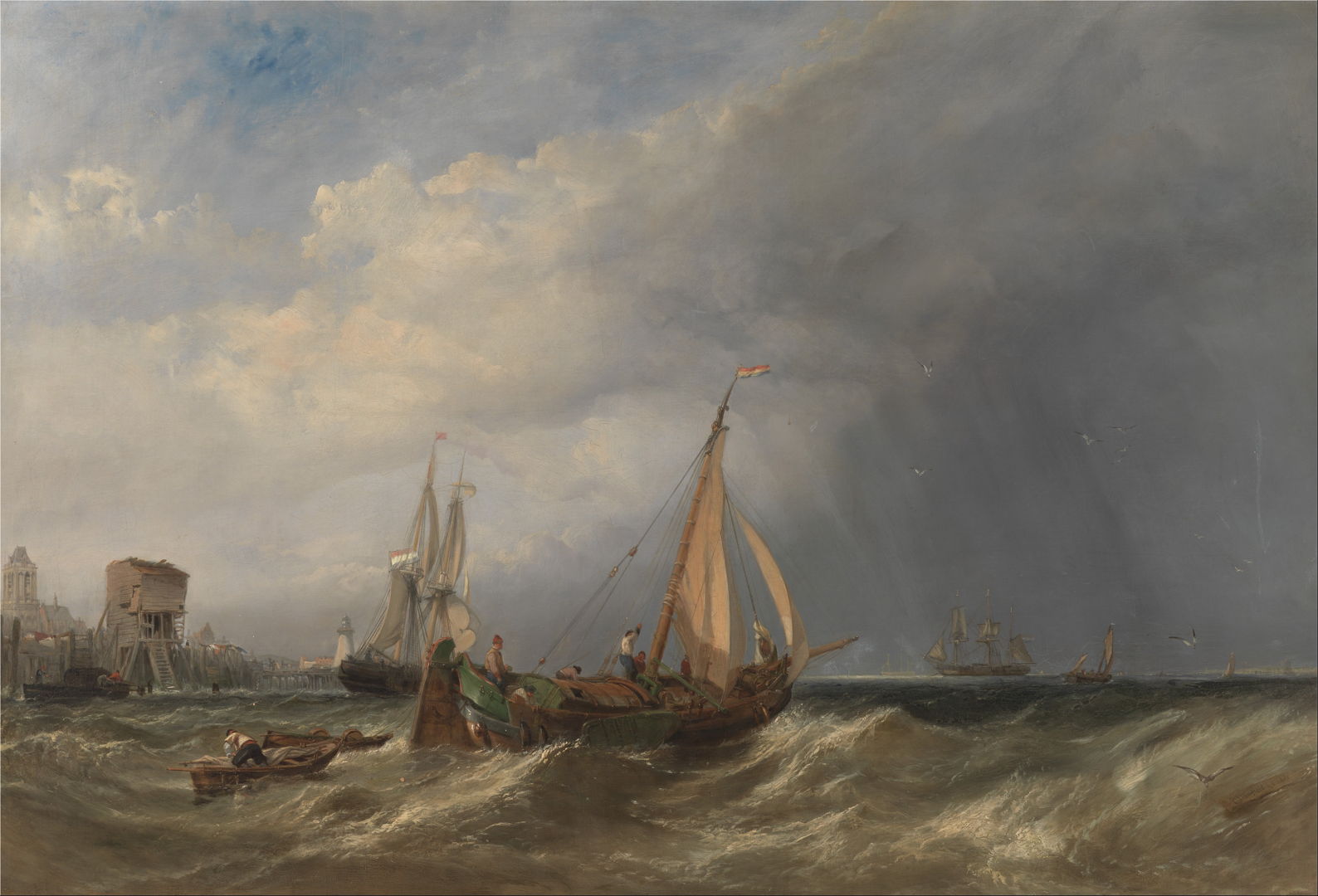
Clarkson Frederick Stanfield (1793–1867), A Dutch Barge and Merchantmen Running out of Rotterdam (1856), oil on canvas, 78.7 x 121.9 cm, Yale Center for British Art, New Haven, CT. Wikimedia Commons.
Marine painting became established as a sub-genre, as shown by the British painter Clarkson Stanfield, whose Dutch Barge and Merchantmen Running out of Rotterdam from 1856 includes rich detail, even down to dilapidated buildings on the waterfront.
John Crome (1768–1821), Landscape with Windmills (date not known), oil on canvas, 51 x 75.5 cm, Muzeum Narodowe w Warszawie, Warsaw, Poland. Wikimedia Commons.
Many of John Crome’s landscapes feature skies inspired by Dutch painters. His Landscape with Windmills is one of his most remarkable, as a signed painting that appears to have been sketched in front of the motif. Others who skied include John Constable and JMW Turner.
Nocturnes were less reliable, as they underwent phases when they were fashionable, then fell into neglect for a while.
James Abbott McNeill Whistler (1834-1903), Nocturne: Blue and Gold — Southampton Water (1872), oil on canvas, 50.5 x 76 cm, Art Institute of Chicago, Chicago, IL. Wikimedia Commons.
James Abbott McNeill Whistler had a penchant for nocturnes, here his Nocturne: Blue and Gold — Southampton Water from 1872. Its vague blue-greys make the pinpoints of light and the rising sun shine out in contrast, a good reason for limiting his palette, while remaining faithful to nature.
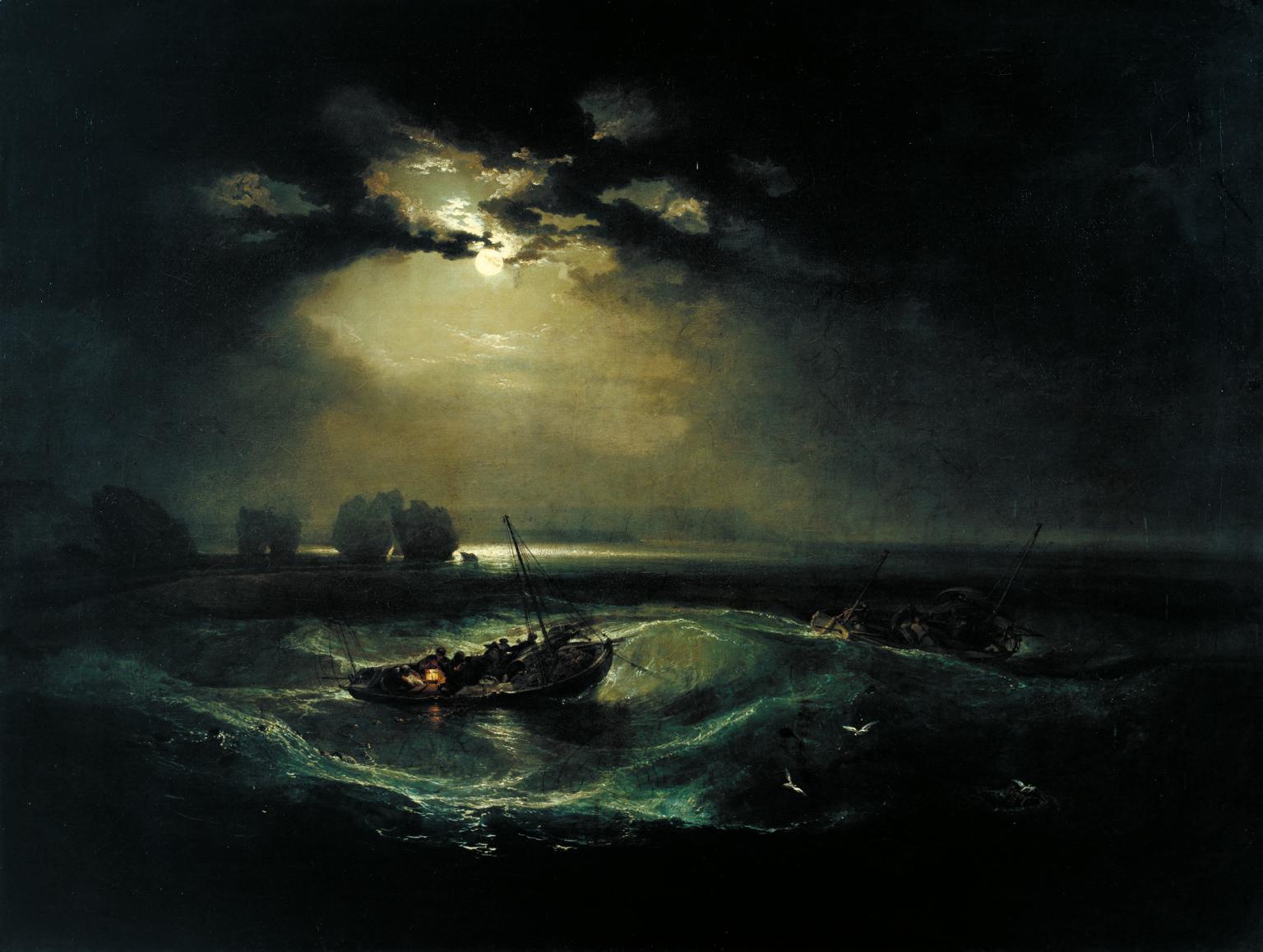
JMW Turner’s Fishermen at Sea from 1796, showing small fishing boats working in heavy swell off The Needles, on the Isle of Wight, is probably the most famous and successful coastal nocturne of all time. This was Turner’s first oil painting to be exhibited at the Royal Academy, when he was just twenty-one.
Paintings by artists of the Dutch Republic had been sold into collections across Europe, where many remain, influencing today’s artists.

 Login
Login