Reading view

There are new articles available, click to refresh the page.

Reading Visual Art: 242 Apelles

Apelles of Kos is one of the most renowned of the great painters of ancient Greece. Claimed to have been active around 330 BCE, he has been attributed at least eight major works. Among these are Aphrodite Anadyomene, in which the goddess Aphrodite rises from the sea. This achieved fame in part because his model for Aphrodite was Campaspe, a former mistress of Alexander the Great, according to the writings of Pliny the Elder. Another was a great allegory of Calumny, he also painted several myths and legends, and portraits of both Alexander the Great and his father Philip.

The only trouble with Apelles’ paintings is that none survive.

venusanadyomenes
Unknown, The Venus Anadyomenes (before 79 CE), fresco, dimensions not known, The House of Venus, Pompeii. By MatthiasKabel, via Wikimedia Commons.

Although several were taken to Rome, and it’s claimed at least one survived as a copy in the ruins of Pompeii (above), all that remains of Apelles’ works are the verbal descriptions in classical writings. Nevertheless, on the strength of that limited evidence, it has long been accepted that Apelles was a great Master, and there are many paintings either depicting Apelles at work, usually painting Campaspe, or revisiting the allegory of Calumny.

Apelles and Campaspe

The story of Apelles and Alexander’s former mistress (or concubine) is straightforward. When Apelles was sketching or painting Campaspe, he fell in love with her. Alexander, in his generosity and as a mark of appreciation of Apelles’ work, presented Campaspe to Apelles. She is claimed to have been the model for his famous painting of Aphrodite, and much later the inspiration to Botticelli for his Birth of Venus, below.

Sandro Botticelli (Alessandro di Mariano di Vanni Filipepi), The Birth of Venus (c 1486), tempera on canvas, 172.5 x 278.9 cm, Galleria degli Uffizi, Florence. WikiArt.
haechtapellescampaspe
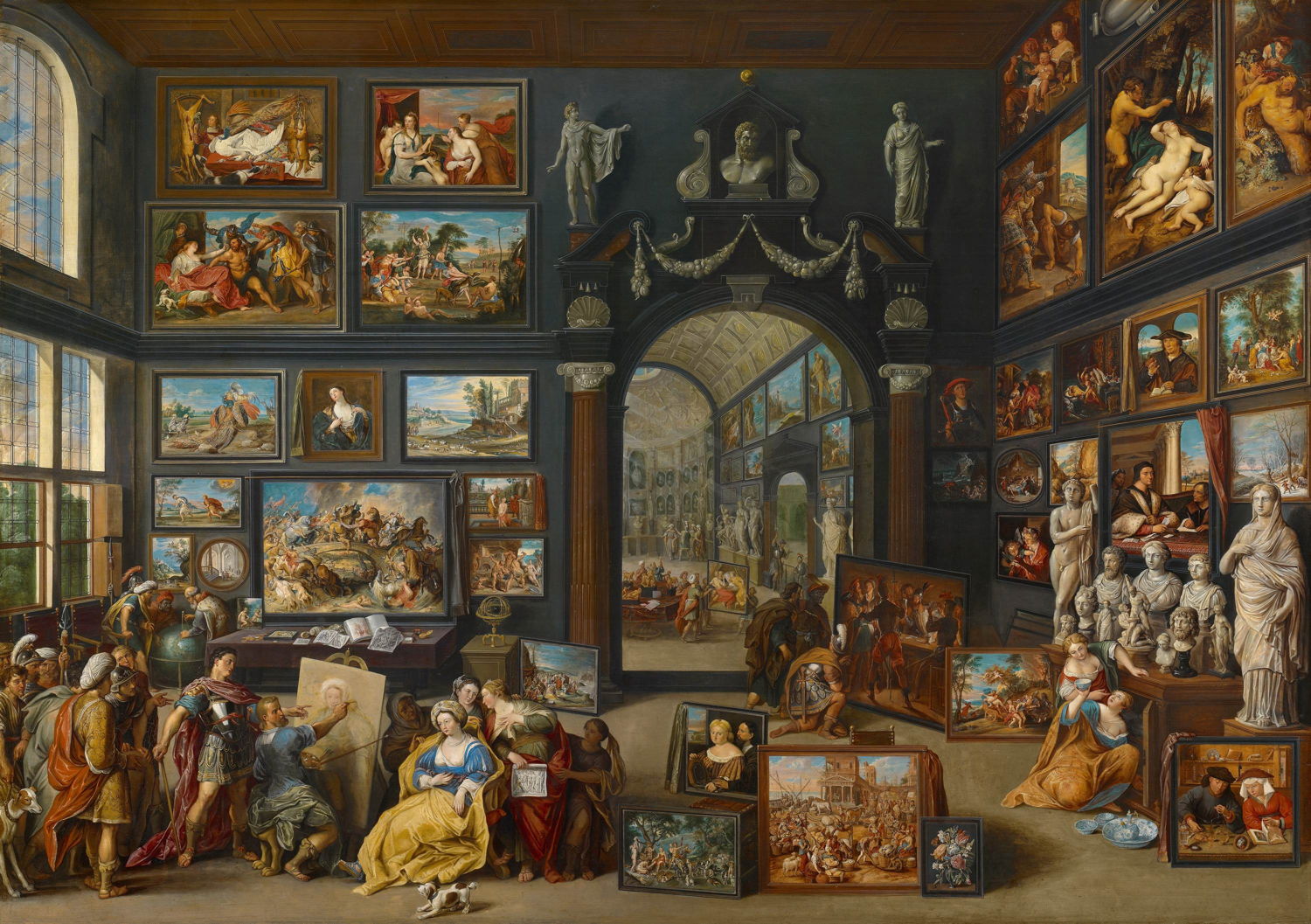
Willem van Haecht (1593–1637), Apelles painting Campaspe (c 1630), oil on panel, 104.9 cm x 148.7 cm, The Royal Picture Gallery Mauritshuis, The Hague. Wikimedia Commons.

Willem van Haecht’s extraordinary Apelles painting Campaspe (c 1630) tucks the story down in its lower left, where Apelles is shown painting a rather bored Campaspe while Alexander, wearing distinctive armour, looks on. That’s set in a painted account of the subsequent history of painting, with miniature versions of nearly forty paintings in that room alone, and more in further rooms beyond. Although an enormous anachronism, it develops the core narrative into something more worthy.
balestraalexanderinapellesstudio
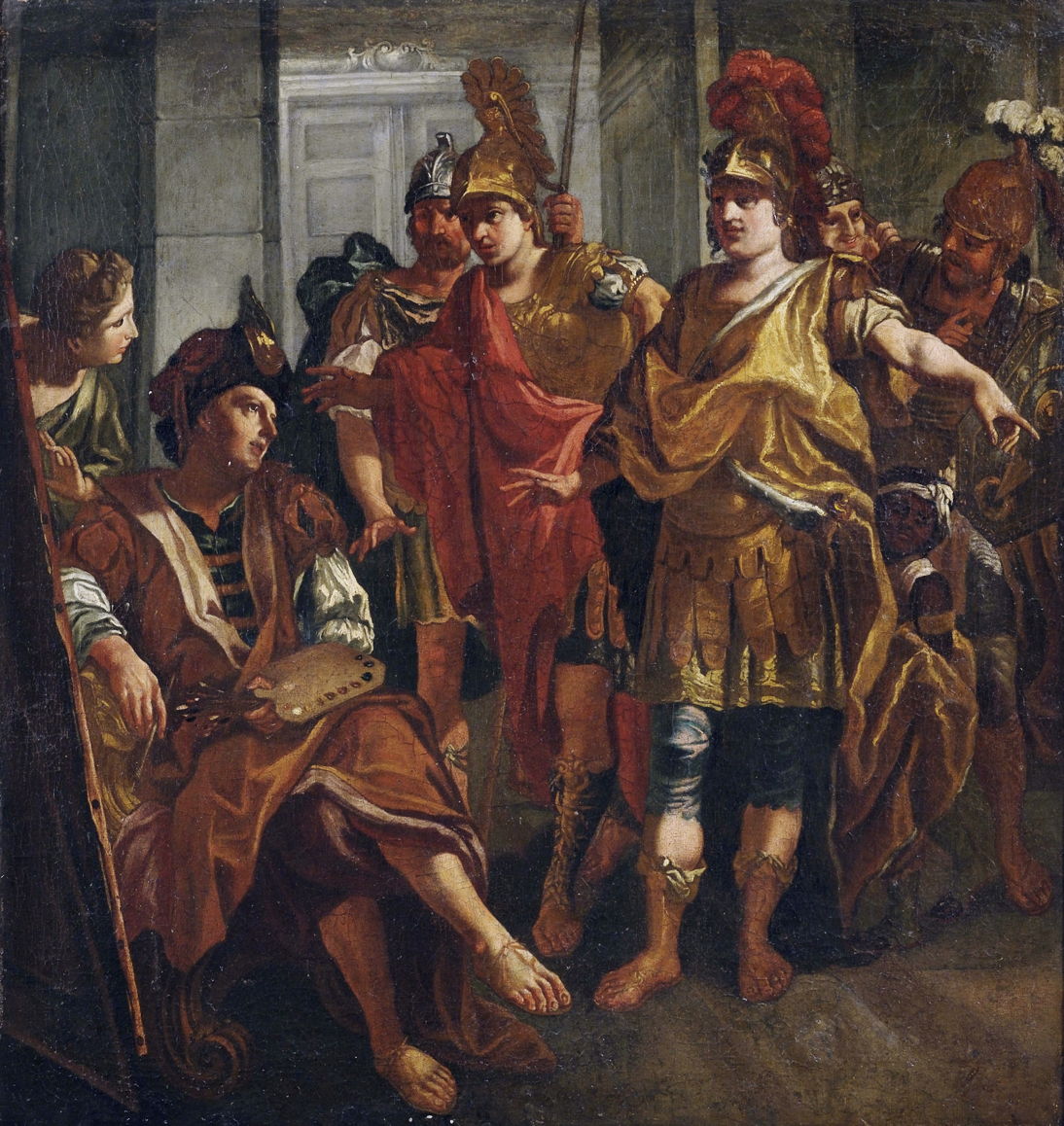
Antonio Balestra (1666–1740), circle of, Alexander the Great in the Painter Apelles’ Studio (c 1700), oil on canvas, 90 x 85 cm, Private collection. Wikimedia Commons.

A member of the circle of Antonio Balestra painted an even simpler story, in their Alexander the Great in the Painter Apelles’ Studio (c 1700), by omitting Campaspe altogether. Although their faces show emotion in their expressions, and there is good body language, it’s hard to assemble those into anything more than their astonishment at how faithful Apelles’ painting is.
vleughelsapellespaintingcampaspe
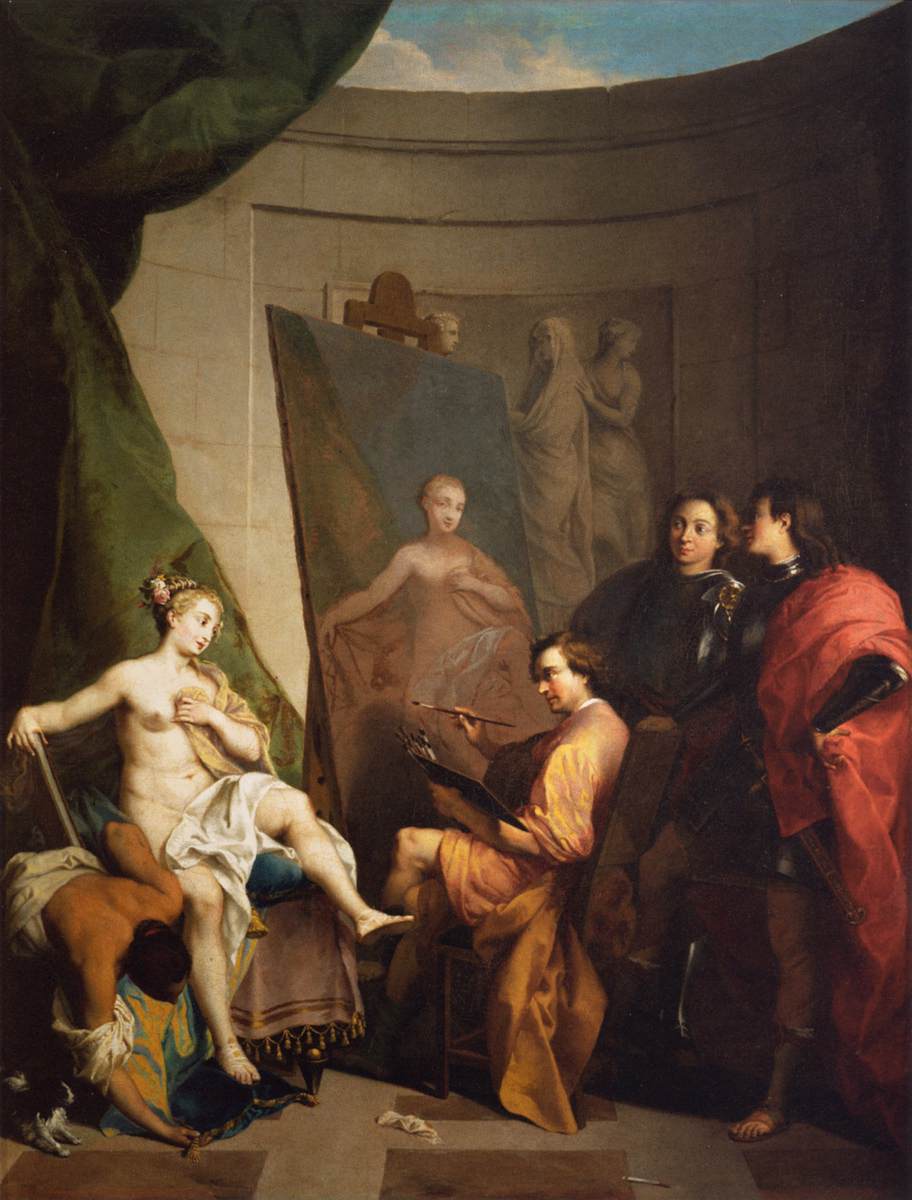
Nicolas Vleughels (1668–1737), Apelles Painting Campaspe (1716), oil on canvas, 126 x 97 cm, Musée du Louvre, Paris. Wikimedia Commons.

Nicolas Vleughels’ Apelles Painting Campaspe from 1716 is perhaps a little closer to any underlying truth in the story. A servant leans down to adjust a cushion on which Campaspe’s right foot rests. Apelles concentrates on the painting in progress, while Alexander and one of his colleagues watch, whispering to one another. However, Vleughels has interesting ideas as to how Apelles would dress when working in his studio.
tiepoloalexanderapelles
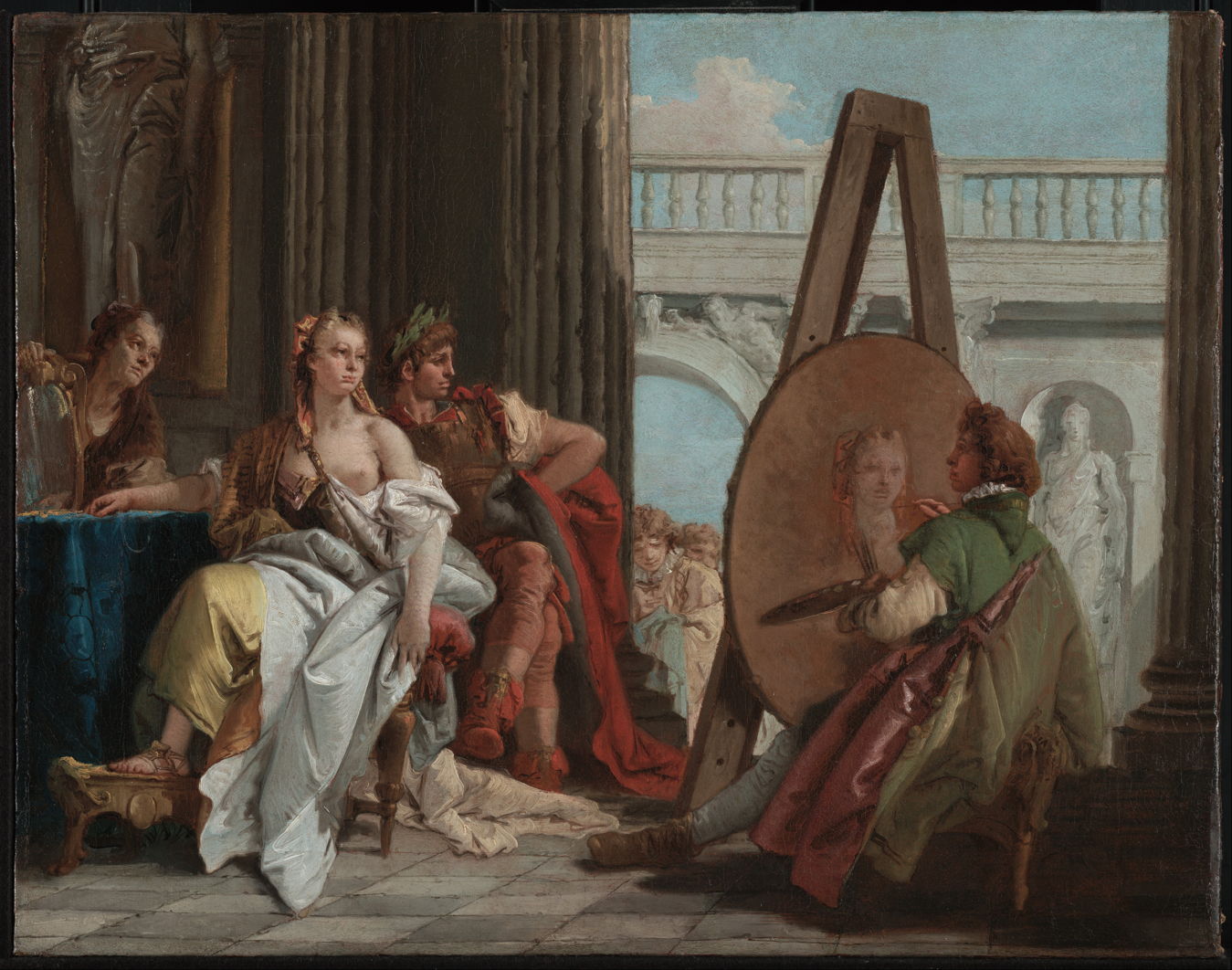
Giovanni Battista Tiepolo (1696–1770), Alexander the Great and Campaspe in the Studio of Apelles (c 1740), oil on canvas, 42.5 x 54 cm, Getty Center, Los Angeles, CA. Wikimedia Commons.

Tiepolo’s Alexander the Great and Campaspe in the Studio of Apelles (c 1740) perhaps reflects his own troubles with ennui among his models, with Campaspe, her maid, and Alexander looking thoroughly unimpressed with the artist’s slow progress, working at an anachronistic tondo.
meynieralexandergivescampaspe
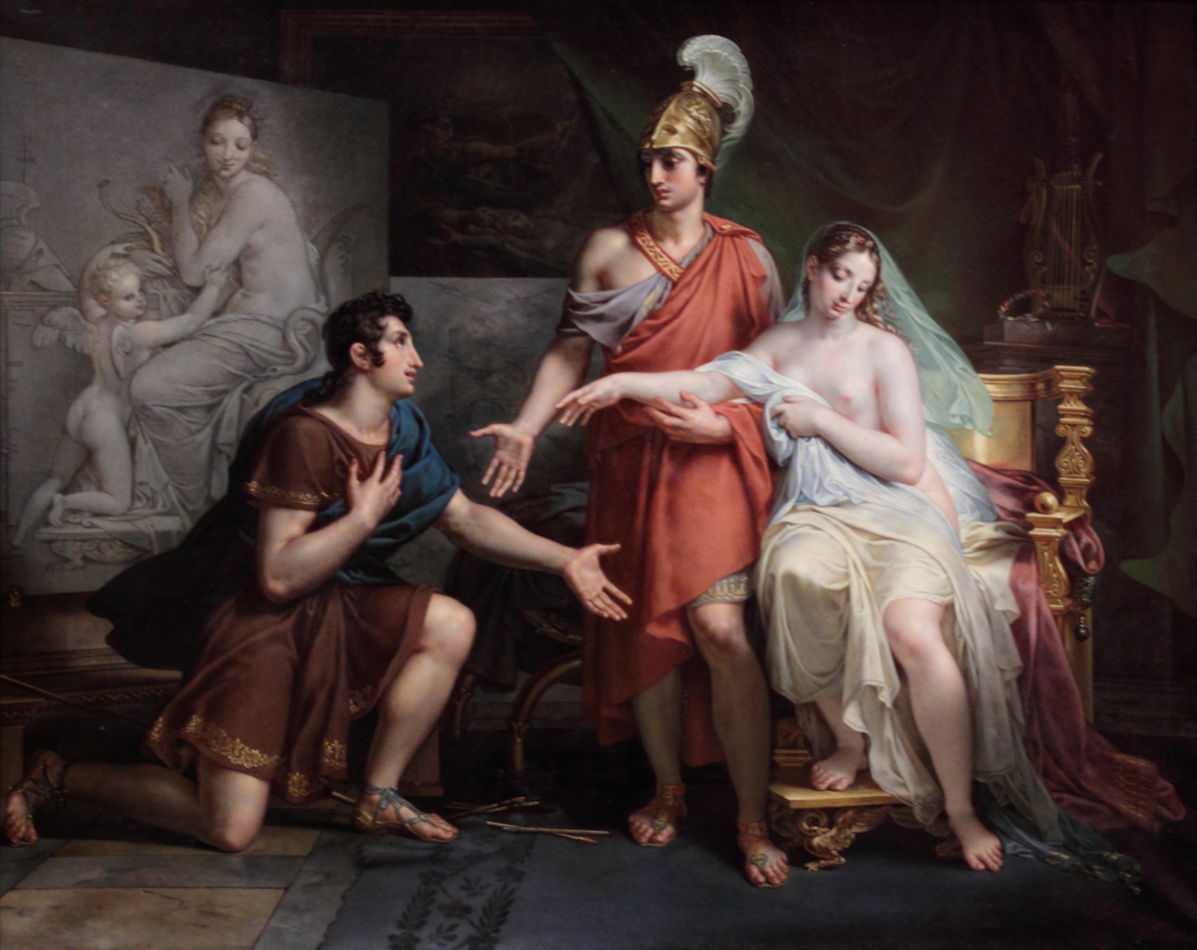
Charles Meynier (1768–1832), Alexander the Great Gives Campaspe to Apelles (1822), oil on canvas, dimensions not known, Museum of Fine Arts, Rennes, France. By Caroline Léna Becker, via Wikimedia Commons.

Charles Meynier, in his Alexander the Great Gives Campaspe to Apelles (1822), is one of the few painters to have taken the story to its conclusion, as Alexander gives Campaspe to a supplicant Apelles, his right hand clutching his breast to express his love for her, and his brushes scattered in symbolic disarray on the carpet.

The Calumny of Apelles

Rivalry between painters in Apelles’ day could become intense, and at times underhand methods were called into play. One of Apelles’ rivals accused him of taking part in a conspiracy against Ptolemy, one of Alexander’s generals. This almost led to Apelles’ execution, but the artist instead expressed himself in his painting of Calumny, in which an innocent youth is falsely accused by Ignorance, Envy, Treachery, and Deceit.
botticellicalumnyofapelles
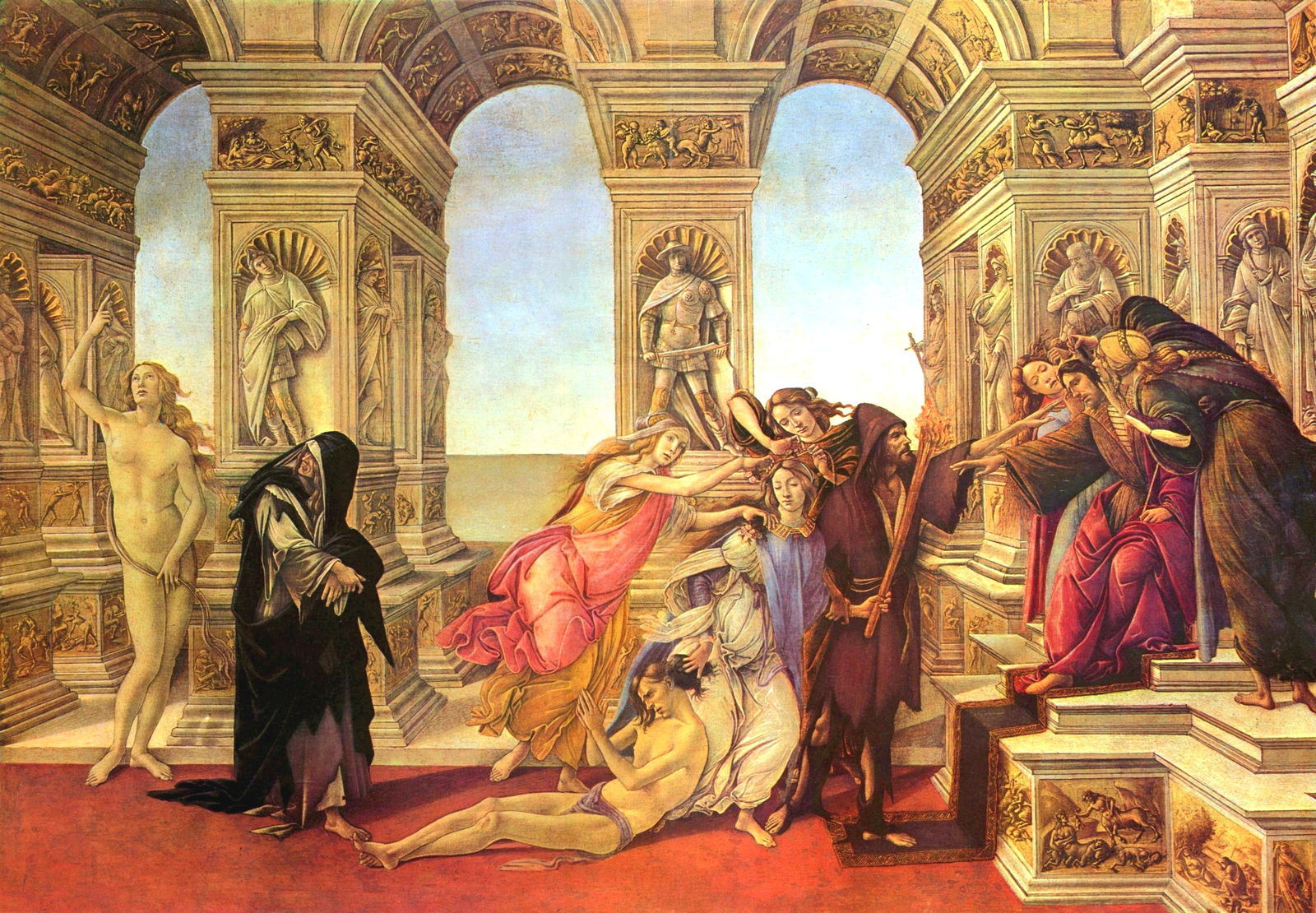
Sandro Botticelli (1445–1510), Calumny of Apelles (c 1496-7), tempera on panel, 62 x 91 cm, Galleria degli Uffizi, Florence. Wikimedia Commons.

Inspired by Lucian’s description of the painting, in his ekphrasis, Botticelli’s intricate Calumny of Apelles (c 1496-7) tries to reconstruct the allegory.

The youth who is the victim of the calumny is being dragged by his hair, clad only in a loincloth, with his hands pressed in prayer. On the throne at the right, perched on a dais, sits Midas with his ass’s ears, extending his right hand towards the distant figure of Slander. On either side of Midas are Ignorance and Suspicion, speaking simultaneously into those ears.

Slander is shown as a beautiful woman, holding a blazing torch in her left hand, and the accused’s hair in her right. At her left, between Slander and Midas, is Envy, who reaches his left hand out towards Midas’ eyes. The two women attending Slander are Fraud and Conspiracy. To the left is Repentance, dressed in deep mourning, her clothing in tatters. She glances back at the naked Truth, who looks up to the gods.

References

Wikipedia on Apelles.
Wikipedia on Botticelli’s Calumny of Apelles.

Painted stories of the Decameron: Overview and contents

Boccaccio’s Decameron is set in Florence at the height of the Black Death or plague of 1348. A group of seven young women and three young men have fled the piles of corpses in the city and taken refuge in a mansion in the surrounding country. To pass the time while they wait for the epidemic to abate, they agree to tell one another stories, ten each day, for ten ‘working’ days over a fortnight.

This series retells six of those that are well-known in their paintings, with a bonus at the end.

postiglionedecameron
Salvatore Postiglione (1861–1906), Scene of the Narration of the Decameron (date not known), oil on canvas, 100 x 151 cm, location not known. Wikimedia Commons.

Introduction

Day 4, Story 1

Told by Fiammetta about those whose love ended unhappily.

meighismunda
Bernardino Mei (1612-1676), Ghismunda (1650-59), oil on canvas, 66.5 x 47.5 cm, Pinacoteca nazionale di Siena, Siena, Italy. Wikimedia Commons.

Bernardino Mei’s Ghismunda from 1650-59 captures the resolute response of Ghismonda, as she stands squeezing her lover’s heart in her hand, tears still on her face.

A father’s revenge

Day 4, Story 5

Told by Filomena about those whose love ended unhappily.

millaisisabella
John Everett Millais (1829–1896), Isabella (Lorenzo and Isabella) (1848-49), oil on canvas, 103 x 142.8 cm, Walker Art Gallery, Liverpool, England. Wikimedia Commons.

John Everett Millais’ Isabella (Lorenzo and Isabella) from 1848-49 is based on Keats’ poetic retelling, and one of the earliest Pre-Raphaelite paintings.

Set at an imaginary family meal, it shows Lisabetta and her lover Lorenzo, with her three brothers. Lorenzo is sharing a blood orange with Lisabetta, white roses and passion flowers climbing from behind their heads. The dog, a surrogate for Lorenzo, is being petted by Lisabetta, but one of her brothers aims a kick at it. Other symbols are shown of the plot to kill Lorenzo: a brother staring at a glass of red wine, spilt salt on the table, and a hawk pecking at a white feather. The pot of basil is already on the balcony, awaiting Lorenzo’s head.

The pot of basil

Day 5, Story 1

Told by Panfilo about the adventures of lovers who survived calamities or misfortunes and reached a state of happiness.

leightoncymoniphigenia
Frederic, Lord Leighton (1830-1896), Cymon and Iphigenia (1884), oil on canvas, 218.4 x 390 cm, Art Gallery of New South Wales, Sydney, Australia. Wikimedia Commons.

Lord Leighton’s Cymon and Iphigenia from 1884 shows Iphigenia stretched out languidly in her sleep, in the last warm light of the day; behind her the full moon is just starting to rise. Cymon stands in shadow on the right, idly scratching his left knee, gazing intently at Iphigenia. But there is much more to Boccaccio’s story than that.

Abducted brides

Day 5, Story 8

Told by Filomena about the adventures of lovers who survived calamities or misfortunes and reached a state of happiness.

botticellinastagiodeglionesti3
Sandro Botticelli (1445–1510), The Story of Nastagio Degli Onesti III (1482-83), tempera on panel, 84 x 142 cm, Museo Nacional del Prado, Madrid, Spain. Wikimedia Commons.

The third painting in Botticelli’s series of four shows a breakfast banquet at which the ghost of a dead woman is attacked by dogs, and is about to be caught and killed in front of Nastagio’s guests. Nastagio used this ghostly spectacle to persuade the woman he loved to stop spurning his advances.

Nastagio degli Onesti’s breakfast

Day 10, Story 5

Told by Emilia about those who have performed liberal or munificent deeds in the cause of love, or for other reasons.

stillmanenchantedgardenmesseransaldo
Marie Spartali Stillman (1844–1927), The Enchanted Garden of Messer Ansaldo (1889), watercolour and gouache on paper mounted on panel, 72.4 × 102.9 cm, Private collection. Image courtesy of Julian Hartnoll, Pre‑Raphaelite Inc., via Wikimedia Commons.

Marie Spartali Stillman’s The Enchanted Garden of Messer Ansaldo from 1889 shows Madonna Dianora visiting the magical garden set up by Messer Ansaldo with its flowers and fruit, in the midst of snow during harsh January weather.

Ansaldo’s enchanted garden

Day 10, Story 10

Told by Dioneo about those who have performed liberal or munificent deeds in the cause of love, or for other reasons.

This is a re-telling of the folk story of Griselda.

anonstorygriselda2
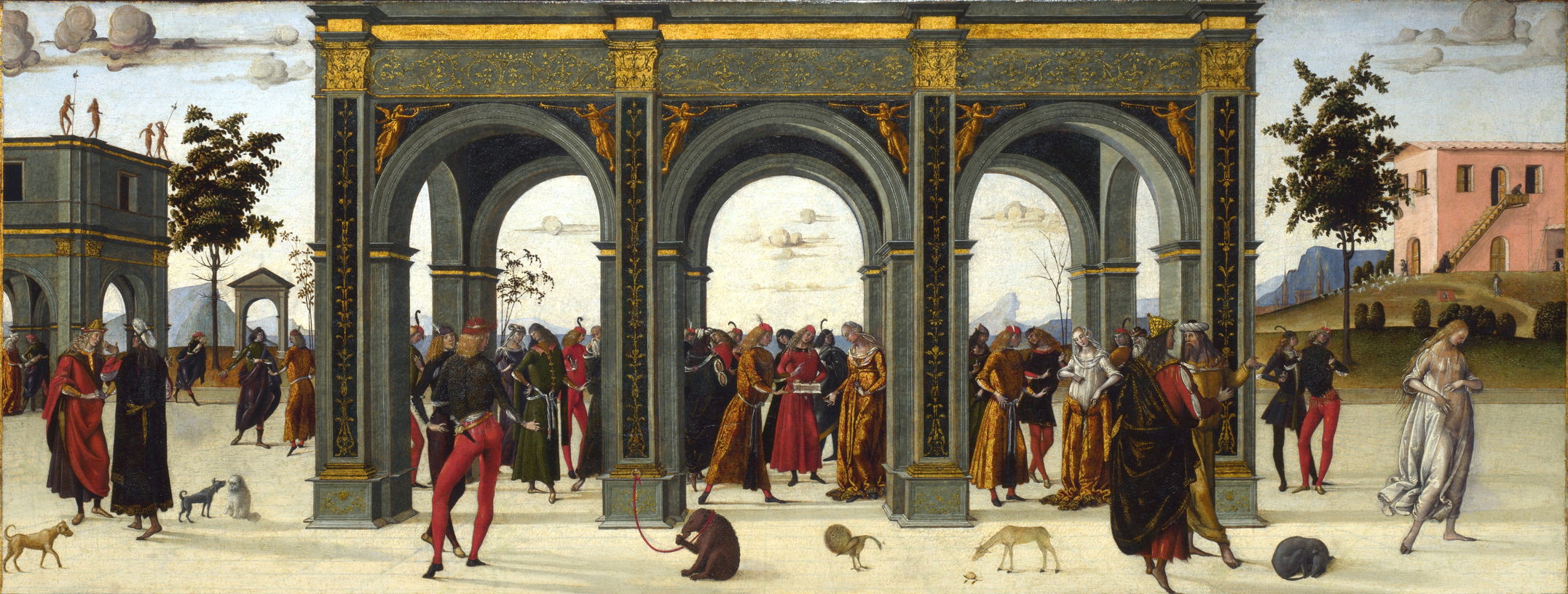
Master of the Griselda Legend (fl 1490-1500), The Story of Griselda, Part 2: Exile (1494), oil and tempera on wood, 61.6 x 154.3 cm, The National Gallery, London. Wikimedia Commons.

The second panel of a series of three is set in the grand surroundings of the house of Gualtieri, Griselda’s husband. At the left edge, Griselda’s infant is taken from her to be killed. In the centre, she is shown a forged Papal dispensation dissolving her marriage, then to the right she is removing her fine clothes prior to leaving Gualtieri’s house. At the far right she is barefoot, wearing just her shift, returning to her father’s house to work as a shepherdess.

Griselda’s suffering

101st Story, Day 4, Introduction

A bonus, the hundred and first story is buried in Filostrato’s introduction to the fourth day. This is the best-known of all the stories in the Decameron as it has made its way into the French language, through one of La Fontaine’s fables.

lancretbrotherphilippesgeese
Nicolas Lancret (1690–1743), Brother Philippe’s Geese (c 1736), oil on copper, 27..3 x 35.2 cm, The Metropolitan Museum of Art (Purchase, Walter and Leonore Annenberg and The Annenberg Foundation Gift, 2004), New York, NY. Courtesy of The Metropolitan Museum of Art.

In about 1736, Nicolas Lancret painted this tale in oil on copper, as one of a pair, among a larger group of his paintings of La Fontaine’s fables.

Brother Philippe’s Geese

❌