
Reading view

There are new articles available, click to refresh the page.

Reading Visual Art: 248 Hood

As with many items of clothing, the term hood is applied to a wide range of garments. For the purposes of this selection of paintings, I confine it to a shaped covering for the head that is part of a garment also covering at least part of the upper body. This includes the cowl integrated into the robes of many monks, and the hooded cape known as a chaperon, described below. It would also include the modern hoodie that became popular in the 1970s.

Hoods are commonly worn by figures associated with death, such as the Grim Reaper, where they provide sinister concealment of the face.
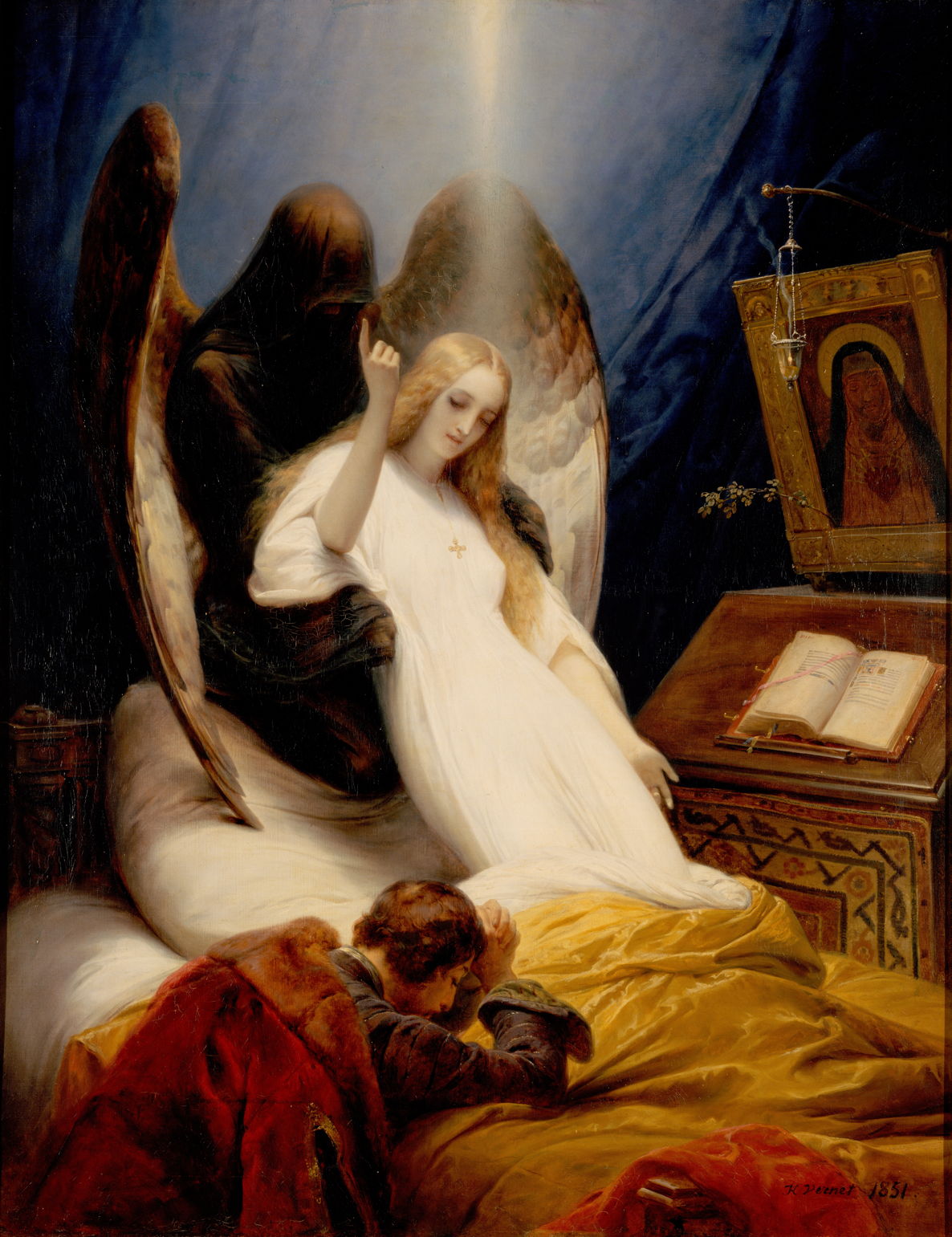
hvernetangelofdeath
Horace Vernet (1789–1863), The Angel of Death (1851), oil on canvas, 146 x 113 cm, The Hermitage Museum, St. Petersburg, Russia. Wikimedia Commons.

In Horace Vernet’s The Angel of Death from 1851, a young man is praying over the side of a bed, kneeling, his hands clasped together. Opposite him, an illuminated Bible is open, above that an icon hangs on the wall, there’s a sprig of flowers, and a flame burns in prayer. But the occupant of the bed, a beautiful young woman, is being lifted out of it. Her right hand is raised, its index finger pointing upwards to heaven. Behind her, the Angel of Death, the outer surface of its wings black, and clad in long black robes, its face concealed beneath a hood, is lifting her out, to raise her body up towards the beam of light shining down from the heavens.

Cowls are a common feature of the robes worn by hermits as well as monks.
boschstwilgefortisd1
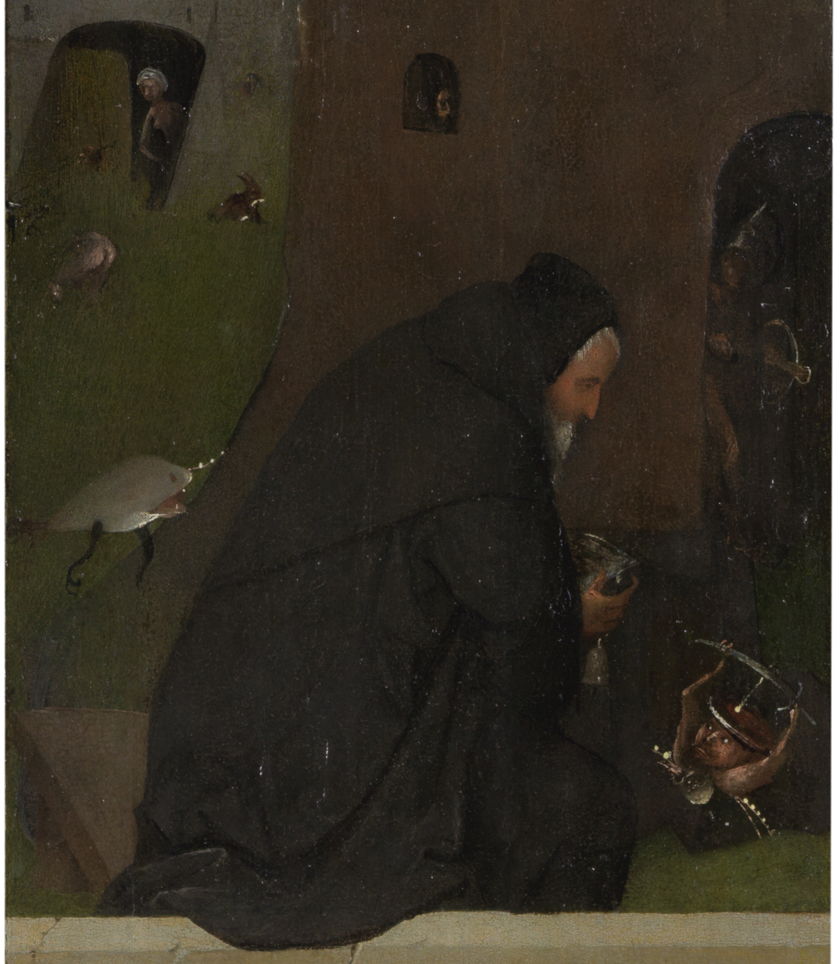
Hieronymus Bosch (c 1450–1516), Saint Wilgefortis Triptych (detail) (c 1495-1505), oil on oak panel, left wing 105.2 × 27.5 cm, central panel 105.2 × 62.7 cm, right wing 104.7 × 27.9 cm, Gallerie dell’Accademia, Venice. Photo Rik Klein Gotink and image processing Robert G. Erdmann for the Bosch Research and Conservation Project.

The figure at the foot of the left panel of Hieronymus Bosch’s Saint Wilgefortis Triptych (c 1495-1505) has some visual similarity with Saint Anthony in his Hermit Saints triptych, and appears to be holding a small bell, one of that saint’s attributes.

daddmonk
Richard Dadd (1817–1886), Portrait of a Monk (1857), watercolour over graphite on moderately thick, slightly textured, beige laid paper, 19.1 x 11.8 cm, Yale Center for British Art, Paul Mellon Collection, New Haven, CT. Courtesy of the Yale Center for British Art.

Richard Dadd painted this Portrait of a Monk on 11 April 1857, from memory of his previous travels in the Middle East.
schikanedercontemplation
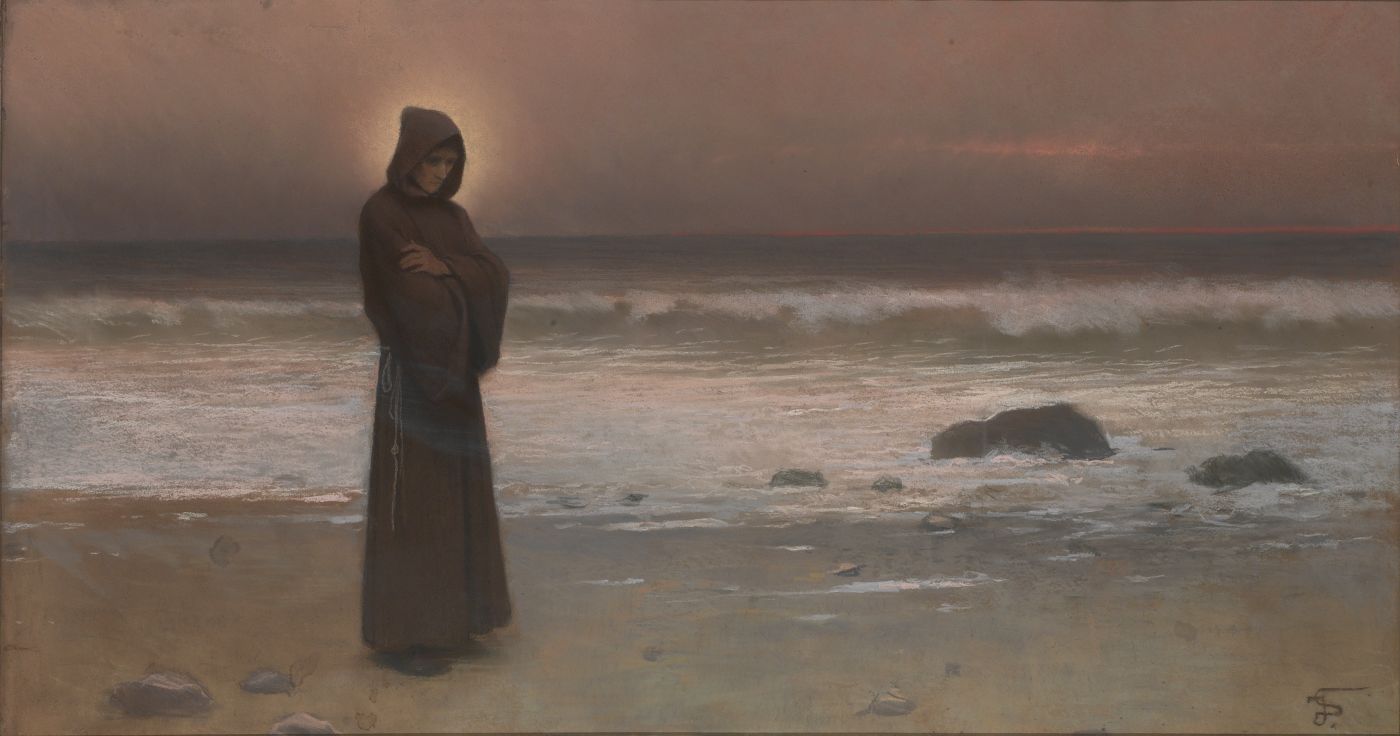
Jakub Schikaneder (1855–1924), Kontemplace, Mnich na mořském břehu (Contemplation, the Monk on the Seashore) (date not known), pastel on paper, further details not known. Wikimedia Commons.

Jakub Schikaneder’s undated Contemplation, the Monk on the Seashore shows a hooded monk on the foreshore, just in front of the water, apparently lost in thought.

Cowls have also been incorporated into other religious dress, where they’re often worn with hats, making them appear vestigial and primarily symbolic.

raphaelportraitcardinal
Raphael (1483–1520), Portrait of a Cardinal (1510-11), oil on panel, 79 x 61 cm, Museo Nacional del Prado, Madrid, Spain. Wikimedia Commons.

Raphael’s magnificent Portrait of a Cardinal from 1510-11 shows the elements of this cardinal’s choir dress: the soft matte surface of the biretta on his head, the subtly patterned sheen of his mozzatta (cape) with its hood, and the luxuriant folds of his white rochet (vestment).

Another uniform that incorporates symbolic hoods is formal academic dress, in which the colours and cut of the hood denote the university and degree.

beraudmadeleinebresthesis
Jean Béraud (1849–1935), The Thesis of Madeleine Brès (or The Doctoral Jury) (date not known), oil on canvas, 63.5 x 48.3 cm, Private collection. The Athenaeum.

In Jean Béraud’s undated The Thesis of Madeleine Brès (or The Doctoral Jury) he shows us one of the early woman doctoral students defending her thesis before the academic jury, who are wearing what might appear now to be fancy dress hats in addition to their colourful hoods. At the time, this was a major landmark in the improvements in women’s rights, and the archaic headwear serves to emphasise this change.

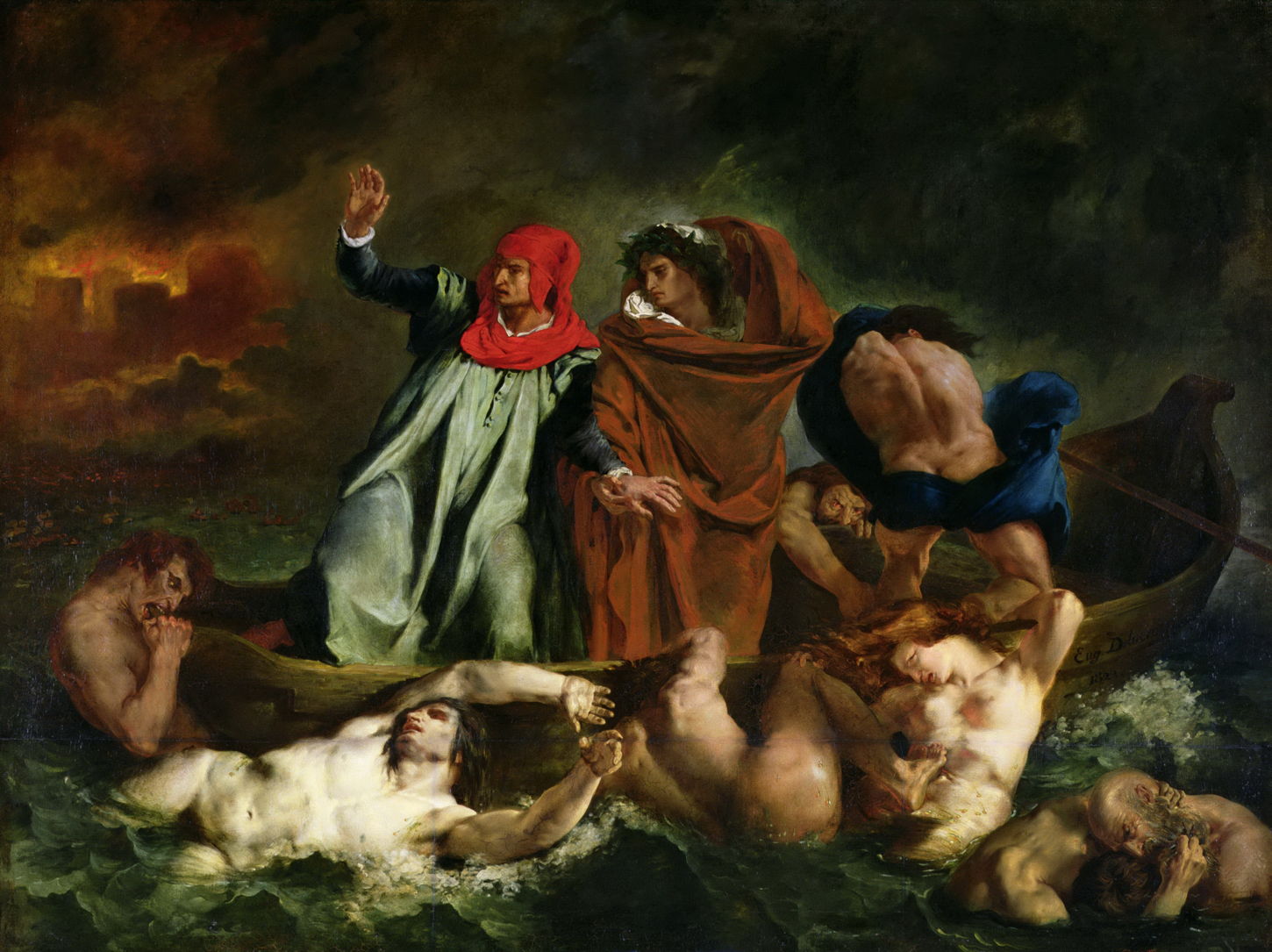
The chaperon had evolved before 1200 as a hooded short cape, then developed into variants that remained popular until becoming unfashionable in about 1500. In paintings it’s most strongly associated with Dante in accounts of his Divine Comedy.
delacroixbarquedante
Eugène Delacroix (1798–1863), The Barque of Dante (Dante and Virgil in Hell) (1822), oil on canvas, 189 x 241 cm, Musée du Louvre, Paris. Wikimedia Commons.

In Eugène Delacroix’s painting of The Barque of Dante from 1822, Dante is inevitably wearing his trademark red chaperon.

hawkinspeasant
Louis Welden Hawkins (1849–1910), A Peasant Woman (c 1880), further details not known. Wikimedia Commons.

The woman’s equivalent of the chaperon persisted until modern times in the hooded cape worn by Louis Welden Hawkins’ Peasant Woman, from about 1880. She is seen near to the rustic village of Grez-sur-Loing, which had become an artist’s colony.

Strangely, the word chaperone (with an added e) is now most commonly used to describe an older woman who accompanies a younger one to ensure that no improper behaviour occurs when in the company of a man.

Before the decline in popularity of hats in the twentieth century, hoods had been relatively uncommon in the general population.

hellqvistvaldemaratterdag
Carl Gustaf Hellqvist (1851–1890), Valdemar Atterdag holding Visby to ransom, 1361 (1882), oil on canvas, 200 × 330 cm, Nationalmuseum, Stockholm. Wikimedia Commons.

Carl Gustaf Hellqvist’s large history painting of Valdemar Atterdag holding Visby to ransom, 1361 from 1882 is an encyclopaedic guide to late medieval dress. Few of its crowd have hoods, and one of those few appears to be a monk, shown in the detail below.

hellqvistvaldemaratterdagdet
Carl Gustaf Hellqvist (1851–1890), Valdemar Atterdag holding Visby to ransom, 1361 (detail) (1882), oil on canvas, 200 × 330 cm, Nationalmuseum, Stockholm. Wikimedia Commons.

Hoods have also been popular with travellers, and from the nineteenth century were incorporated into popular weatherproof capes.

brownlastofenglandoil
Ford Madox Brown (1821–1893), The Last of England (1852/55), oil on panel, 82.5 x 75 cm, Birmingham Museum and Art Gallery, Birmingham, England. Wikimedia Commons.

Ford Madox Brown’s The Last of England (1852/55) shows a young couple with their infant emigrating from England. Tucked under the mother’s weatherproof hooded travelling cape is their baby son.

It seems extraordinary that in the twenty-first century hoodies have been banned as inappropriate items of clothing associated with anti-social behaviour. Perhaps there’s a market for reviving chaperons.

Reading Visual Art: 247 Woodpecker

There are precious few paintings featuring European woodpeckers, but those few come with unusual stories. Of the three species that are common across the continent, it’s most likely that these refer to what’s now known as the great spotted woodpecker, responsible for the distinctive sound it makes when pecking the trunk of a tree.

audubongreatspottedwoodpecker
John James Audubon (1785–1851), Great Spotted Woodpecker (date not known), media and dimensions not known, Houghton Library, Harvard University, Cambridge, MA. Wikimedia Commons.

When he was in Britain, the great American bird artist John James Audubon painted this fine example of a Great Spotted Woodpecker (Dendrocopos major).

The woodpecker has earned itself a place in ancient Roman legend, as one of the two guardians of the infant Romulus and Remus. They were abandoned shortly after birth, put in a trough to float down the River Tiber to their deaths. When the trough was washed up on a bank, they were adopted and fed by a she-wolf, while the woodpecker kept a close watch over the babies, until they were discovered by the swineherd Faustulus. And the rest is legendary Roman history. For its role in saving the co-founders of Rome, the woodpecker was later considered to be sacred to the god Mars.

carracciromulusremus
Ludovico Carracci (1555–1619) and/or Annibale Carracci (1560–1609), She-Wolf Suckling Romulus and Remus (1589-92), fresco, dimensions not known, Palazzo Magnani, Bologna, Italy. Wikimedia Commons.

One of the frescoes in the Palazzo Magnani, probably painted by Ludovico Carracci and/or Annibale Carracci, shows the She-Wolf Suckling Romulus and Remus (1589-92). The twins are still inside the trough in which they had survived their trip down the river, and on the opposite bank a woodpecker is keeping a close watch. At the far right, a now rather diaphanous figure may be Faustulus, one of Amulius’ swineherds who discovered the twins, and took them to his wife.

rubensromulusremus
Peter Paul Rubens (1577–1640), Romulus and Remus (1615-16), oil on canvas, 213 x 212 cm, Musei Capitolini, Rome, Italy. Wikimedia Commons.

Peter Paul Rubens shows Romulus and Remus being discovered by Faustulus in this painting of 1615-16. Not only is the she-wolf taking care of the twins, but a whole family of woodpeckers are bringing worms and grubs to feed them, and there are empty shells and a small crab on the small beach as additional tasty tidbits.

Several mythical figures seem to have been transformed into woodpeckers for various reasons. The sorceress Circe was also claimed to have turned at least one of her lovers into a woodpecker, a story celebrated by Dosso Dossi.

dossicircelovers
Dosso Dossi (–1542), Circe and her Lovers in a Landscape (c 1514-16), oil on canvas, 100 × 136 cm, National Gallery of Art, Washington, DC. Wikimedia Commons.

Dossi’s Circe and her Lovers in a Landscape (c 1514-16) is a remarkably early and realistic mythological landscape, with deep rustic lanes, trees, and a distant farmhouse. Circe leans, naked, at the foot of a tree as she goes through spells on a large tablet, with a book of magic open at her feet. Around her are some of the men who she took a fancy to and transformed into wild creatures. There’s a spoonbill, a small deer, a couple of dogs, a stag, and up in the trees an owl, and a woodpecker in the upper right corner.

dossimelissa
Dosso Dossi (–1542), Melissa (Circe) (c 1518-1531), oil on canvas, 176 × 174 cm, Galleria Borghese, Rome. Wikimedia Commons.

There’s still dispute as to whether this painting of Dossi’s shows Circe again, or the sorceress Melissa from the epic Orlando Furioso. Painted in about 1518-1531, this sorceress sits inside a magic circle, around which are inscribed cabalistic words. In the upper left corner are small homunculi apparently growing on a tree. On the left is a large dog, and perched on top of a suit of armour is another woodpecker.

Finally, the great spotted woodpecker is one of the birds that can be identified in Hieronymus Bosch’s fantastic menageries.

boschtemptationstanthonyrt
Hieronymus Bosch (c 1450–1516), The Temptation of Saint Anthony (Lisbon) (right wing) (c 1500-10), oil on oak panel, left wing 144.8 x 66.5 cm, central panel 145.1 × 132.8 cm, right wing 144.8 × 66.7 cm, Museu Nacional de Arte Antiga, Lisbon. Wikimedia Commons.

The right panel of Bosch’s Temptation of Saint Anthony, now in Lisbon, shows Saint Anthony seated, with a book open in front of him. He is again surrounded by strange figures and creatures from a vision of temptation. The background shows a prominent windmill and towers, behind which is a wintry landscape with snow on the ground.

Deeper into the painting, behind and to the left of the saint, is a group of figures, daemons, and objects, clustered around the hollow trunk of a dead tree. Inside the hollow, a naked woman peers out. The tree is draped with a scarlet sheet, under and on which are several daemons. At the top, an old person pours liquid from a ewer into the bowl held up by a daemon below. A woodpecker is perched on one of the upper branches.

I leave you to speculate on the significance of that woodpecker.

❌