Reading view

There are new articles available, click to refresh the page.

Paintings of Capri: 1884-1928

This weekend we’re sheltering on the island of Capri, at the southern end of the Bay of Naples, Italy, where we’ve reached the 1880s, a time when Capri had become popular with landscape painters.
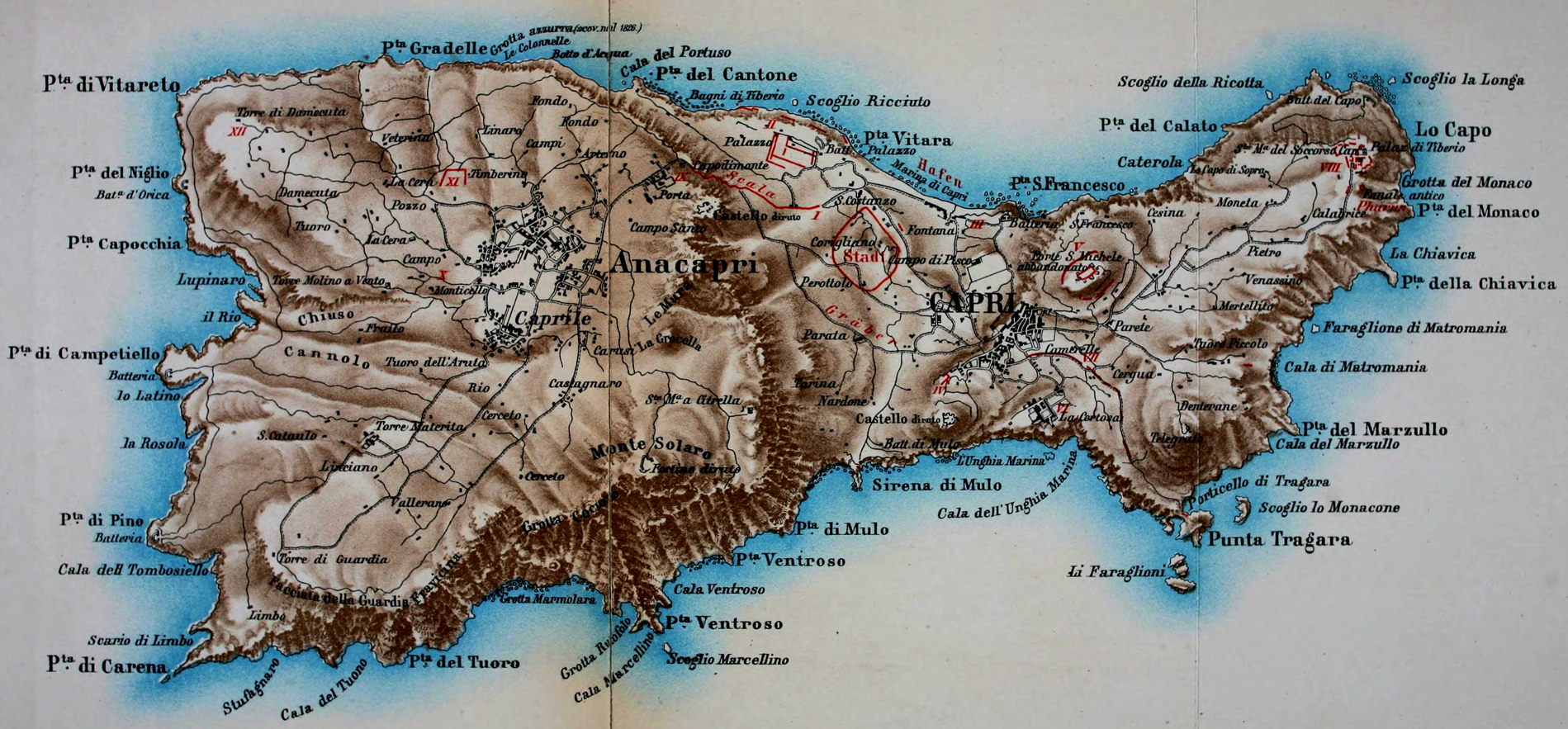
Karl Julius Beloch (1854–1929), Map of Capri (1890), from From Karl Julius Beloch: Campanien. Breslau, 1890. Wikimedia Commons.

Among the many artists who visited the island during the nineteenth century were several who had trained in Düsseldorf, Germany, whose works became popular both in Germany and in the USA.

achenbachcapri
Oswald Achenbach (1827–1905), View of Capri (1884), oil on canvas, 44 × 60.5 cm, Von-der-Heydt-Museum, Wuppertal, Germany. Wikimedia Commons.

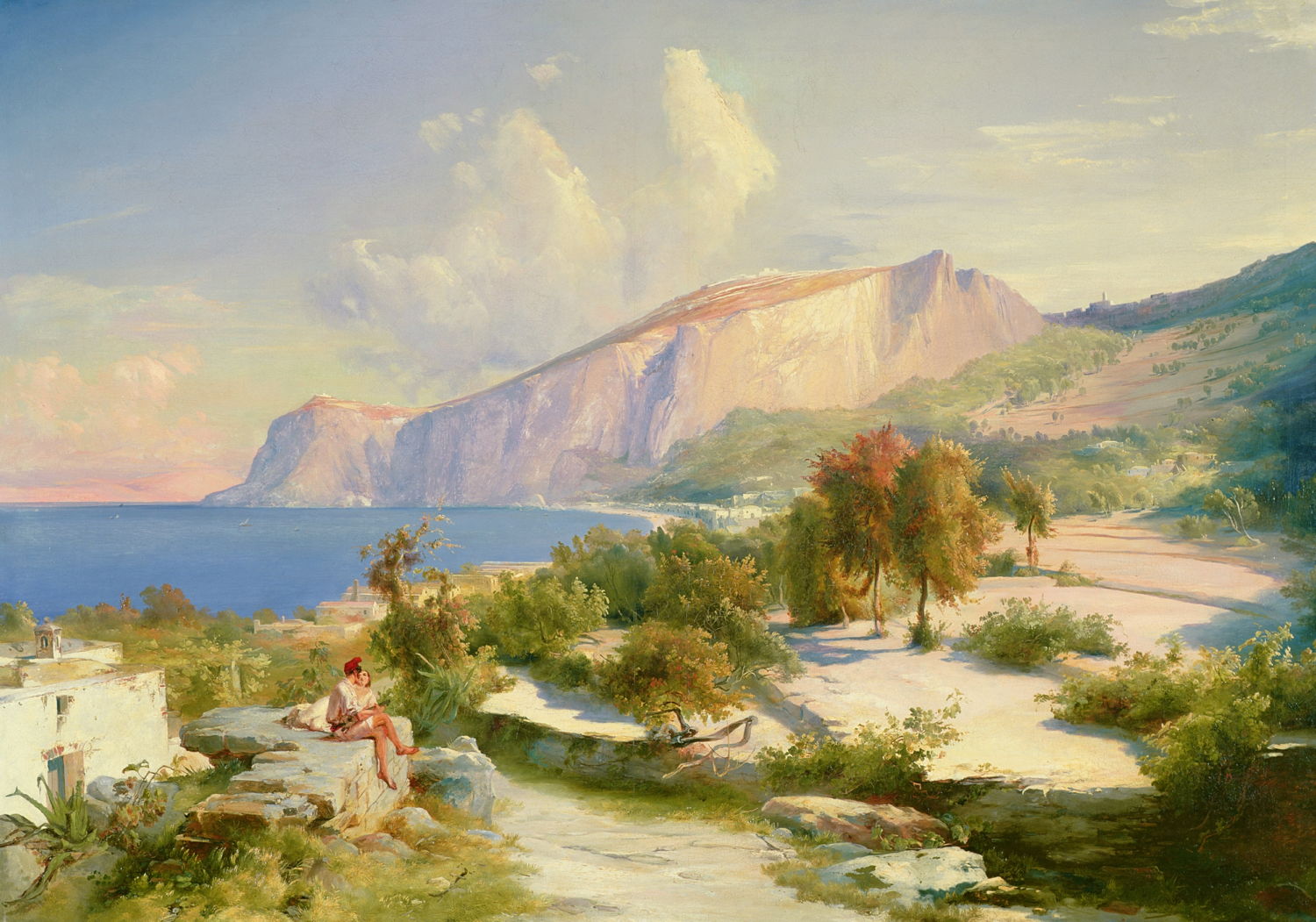
Oswald Achenbach’s View of Capri from 1884 shows the island from a vantage point in the hills above Sorrento on the mainland. Achenbach was another member of the Düsseldorf School who visited Italy on several occasions during his career. His last extended visit started in 1882, and took him to Sorrento, but he had visited Capri a decade earlier, in 1871.

brabazoncapri
Hercules Brabazon Brabazon (1821-1906), Capri (date not known), gouache on paper, 6.9 x 10.1 cm, Phillips Collection, Washington, DC. Wikimedia Commons.

Hercules Brabazon Brabazon’s undated gouache painting of Capri is an unusual nocturne, showing a lonely and rugged section of the coast. An isolated villa stands in the bay, steps curving their way from it down to the tiny beach. This was most probably painted around 1890.
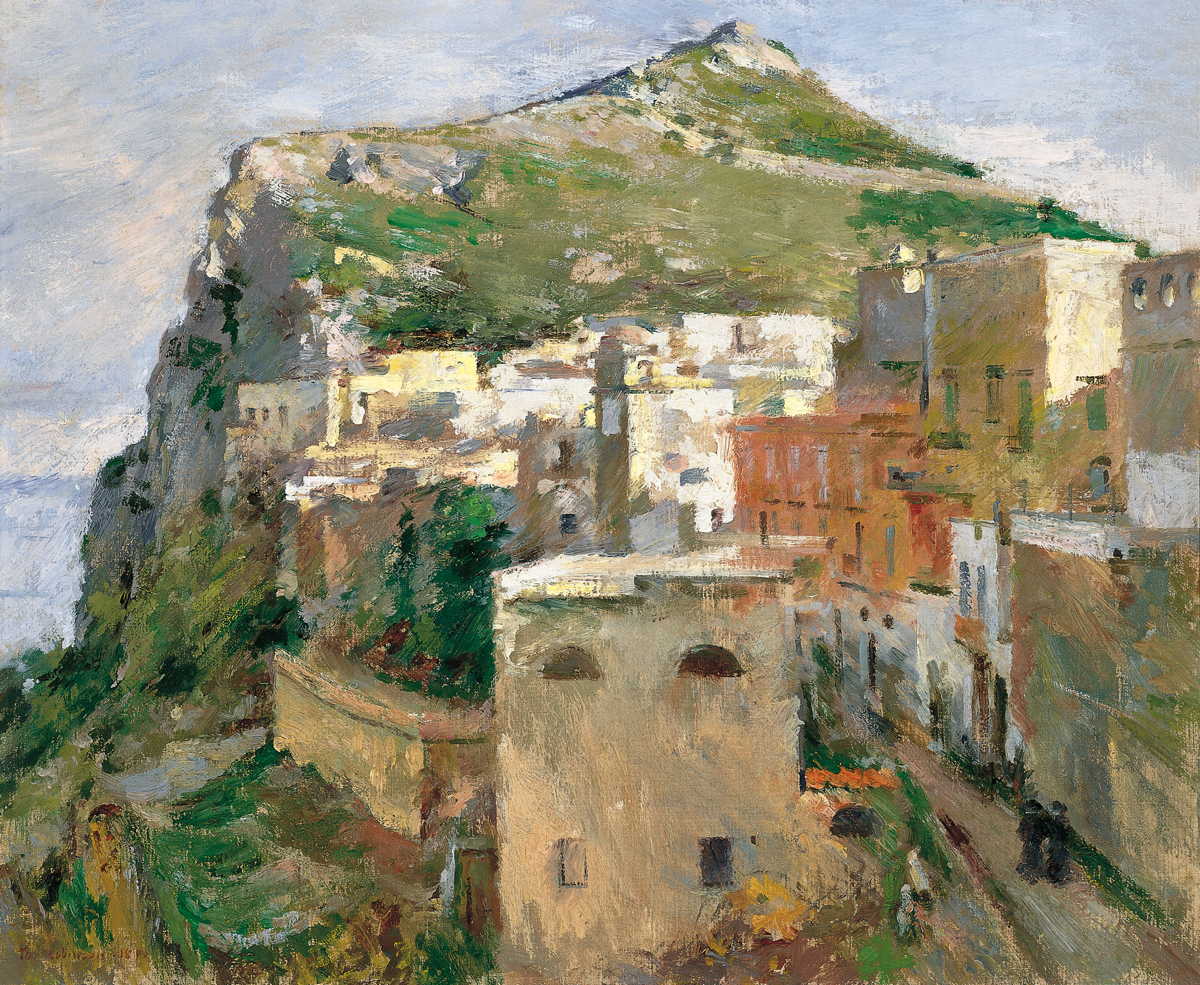
Theodore Robinson, Capri (1890), oil on canvas, 44.5 x 53.3 cm, Thyssen-Bornemisza Museum, Madrid. Wikimedia Commons.
Theodore Robinson (1852-1896), Capri (1890), oil on canvas, 44.5 x 53.3 cm, Thyssen-Bornemisza Museum, Madrid. Wikimedia Commons.

Theodore Robinson was an American Impressionist who trained in New York before heading to Europe in 1876, and must have painted this view of Capri when visiting the island in 1890. It appears to show Monte Tiberio in the far north-east, from the west. Robinson is most famous for his Impressionist landscapes from Giverny, mostly painted after he had moved into the property next door to Claude Monet. Although Monet doesn’t appear to have visited Capri, Robinson here adapted Monet’s style from his views of the cliffs at Étretat and other rugged coasts. Robinson tragically died of an asthma attack in 1896 when he was only 43.

chevalierfaraglioni
Nicholas Chevalier (1828-1902), View of the Faraglioni, Capri (1892), watercolour, 50 x 73.7 cm, location not known. Wikimedia Commons.

Nicholas Chevalier’s View of the Faraglioni, Capri (1892) is a detailed watercolour view painted from the Marina Piccola on the south coast, looking south-east to the rock stacks of the Faraglione in the distance. He trained in Munich rather than Düsseldorf, and from 1851 painted in Britain, then in Australia and New Zealand. This was made during a visit to the island in his late career, when he was growing old and less active.
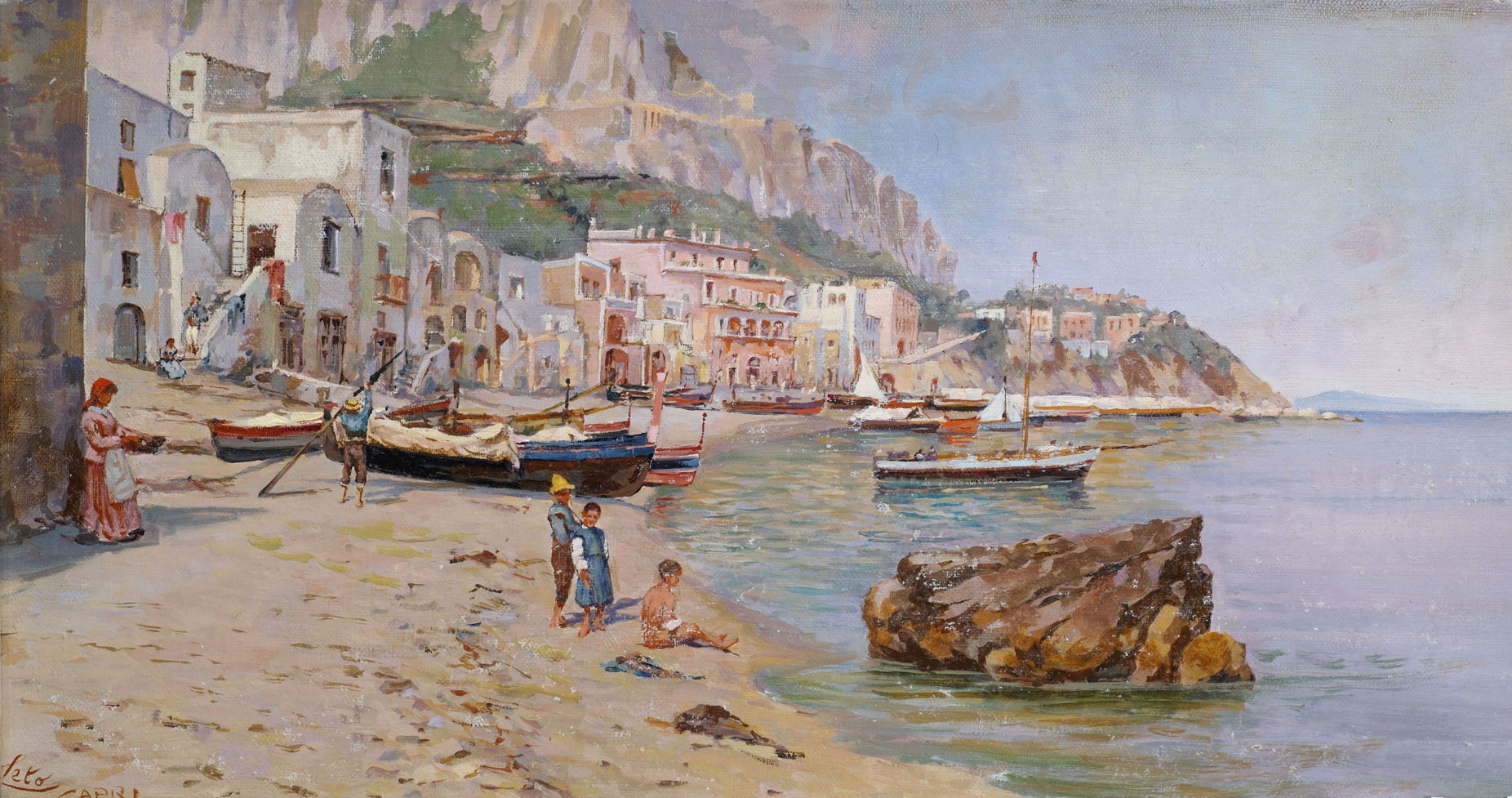
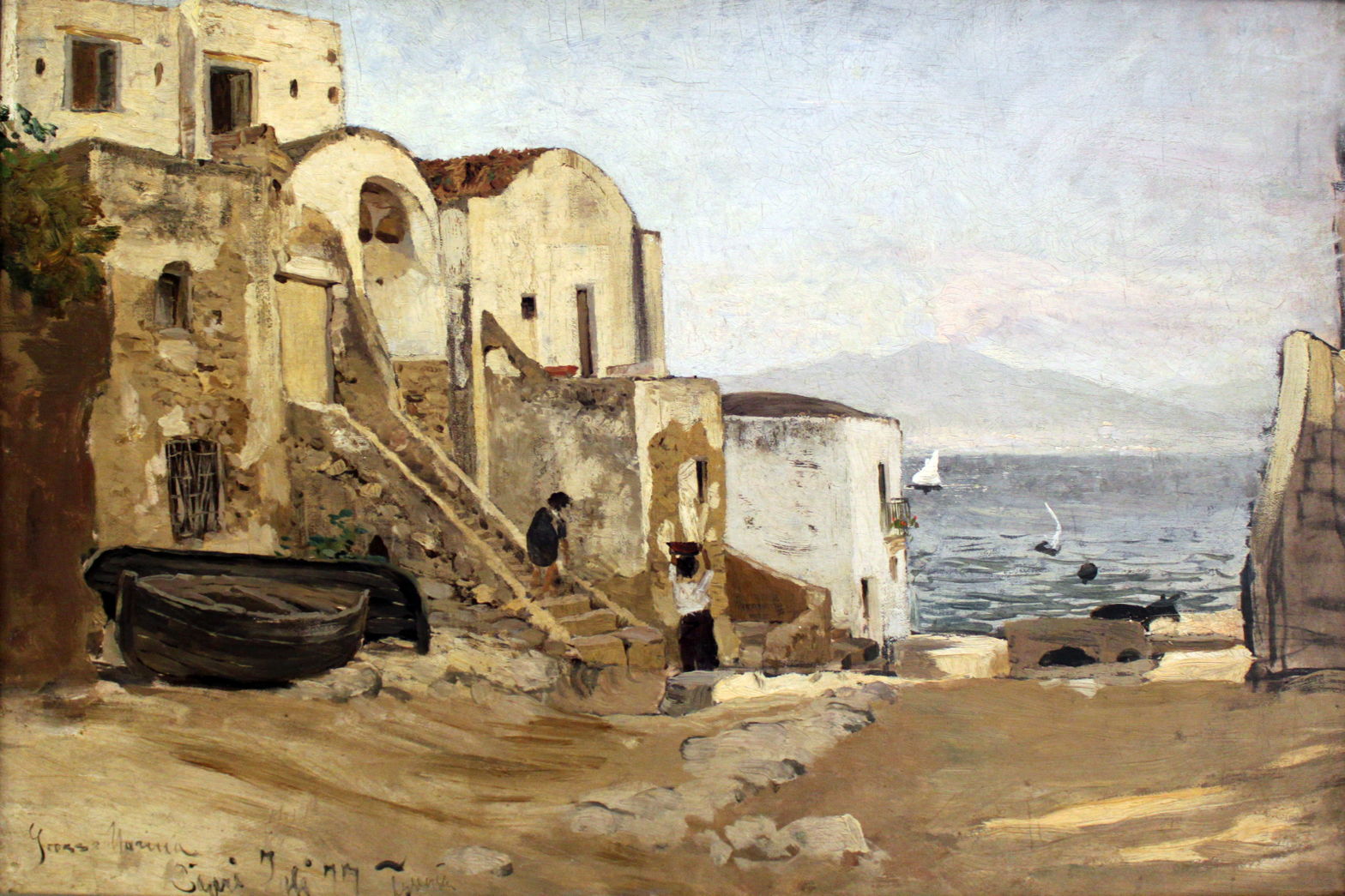
letocapri
Antonino Leto (1844–1913), Capri (date not known), oil on canvas, 21.5 × 30.5 cm, location not known. Wikimedia Commons.

Antonino Leto’s undated view of Capri was most probably painted after he had retired to the island in 1882, following his career of painting landscapes and genre views in Impressionist style. I think that this shows the Marina Grande on the north coast, viewed from the east. Leto was originally inspired by the work of Giuseppe De Nittis, and in 1879 joined him and the group of Italian Impressionists who had gathered in Paris.

By the start of the twentieth century, painting in Capri was changing again. After his naturist and vegan painters’ commune and colony near Vienna went bankrupt from 1899, Karl Wilhelm Diefenbach moved to the island, where others joined him in another commune, perhaps in a more appropriate climate.
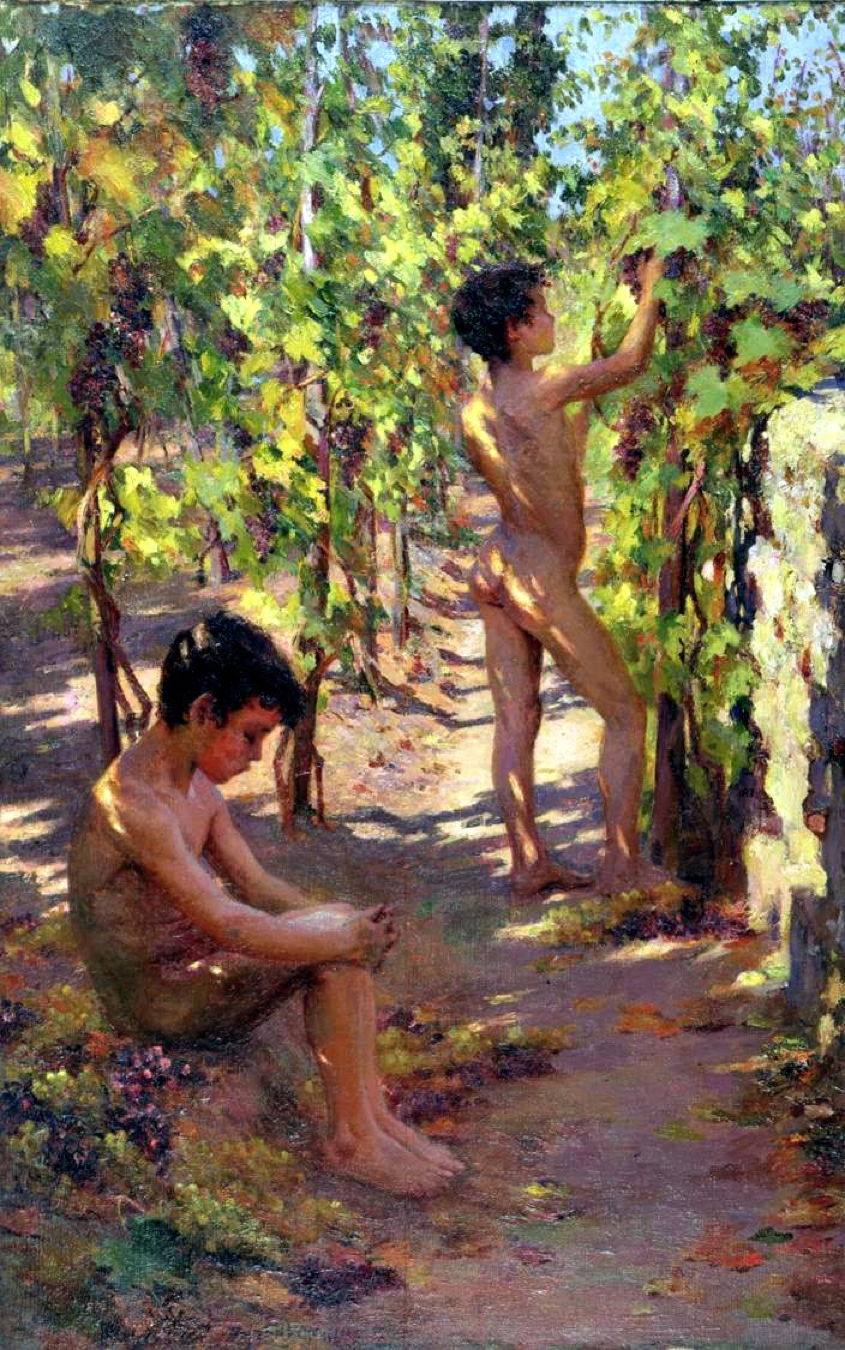
watkinsboyspickinggrapes0
Susan Watkins (1875–1913), Boys Picking Grapes at Capri (c 1906), oil on canvas, 79.4 × 52.1 cm, Chrysler Museum of Art, Norfolk, VA. Wikimedia Commons.

In about 1906, Susan Watkins appears to have visited the island. When there, she painted two superb studies for one of her finest works, showing local boys picking grapes on the island. Her finished painting of Boys Picking Grapes at Capri (c 1906) shows the much looser, more painterly, and richly chromatic style typical of her more mature work.
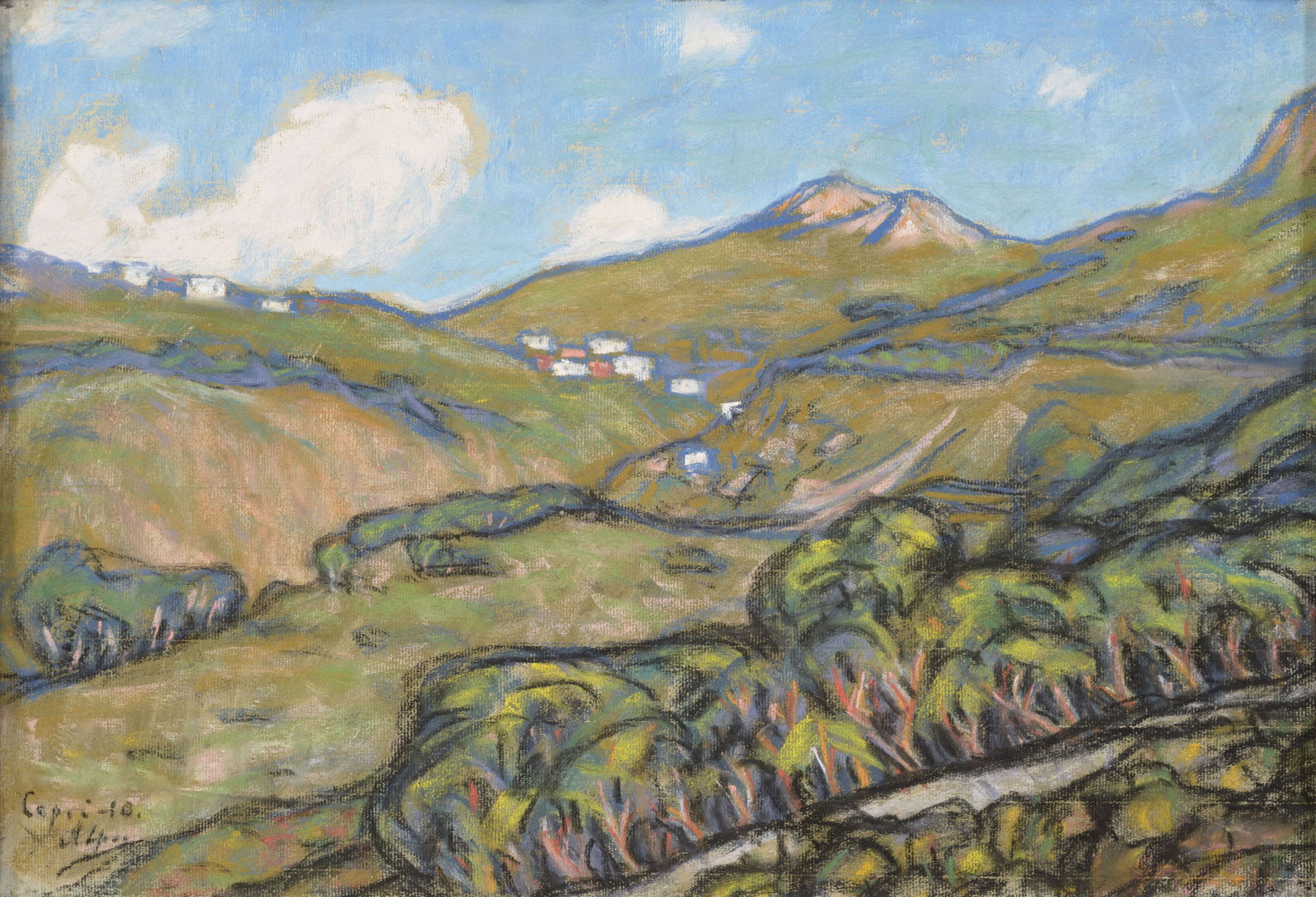
laikmaacaprilandscape1910
Ants Laikmaa (1866–1942), Capri Landscape (1910), pastel on paper, 31.5 x 47 cm, Private collection. Wikimedia Commons.

Between 1910 and 1912, the Estonian pastellist Ants Laikmaa (1866–1942) lived on Capri, where he painted many landscapes. His Capri Landscape from 1910 is unusual for showing the interior of the island with its scattered white houses.
laikmaanightcapri1910
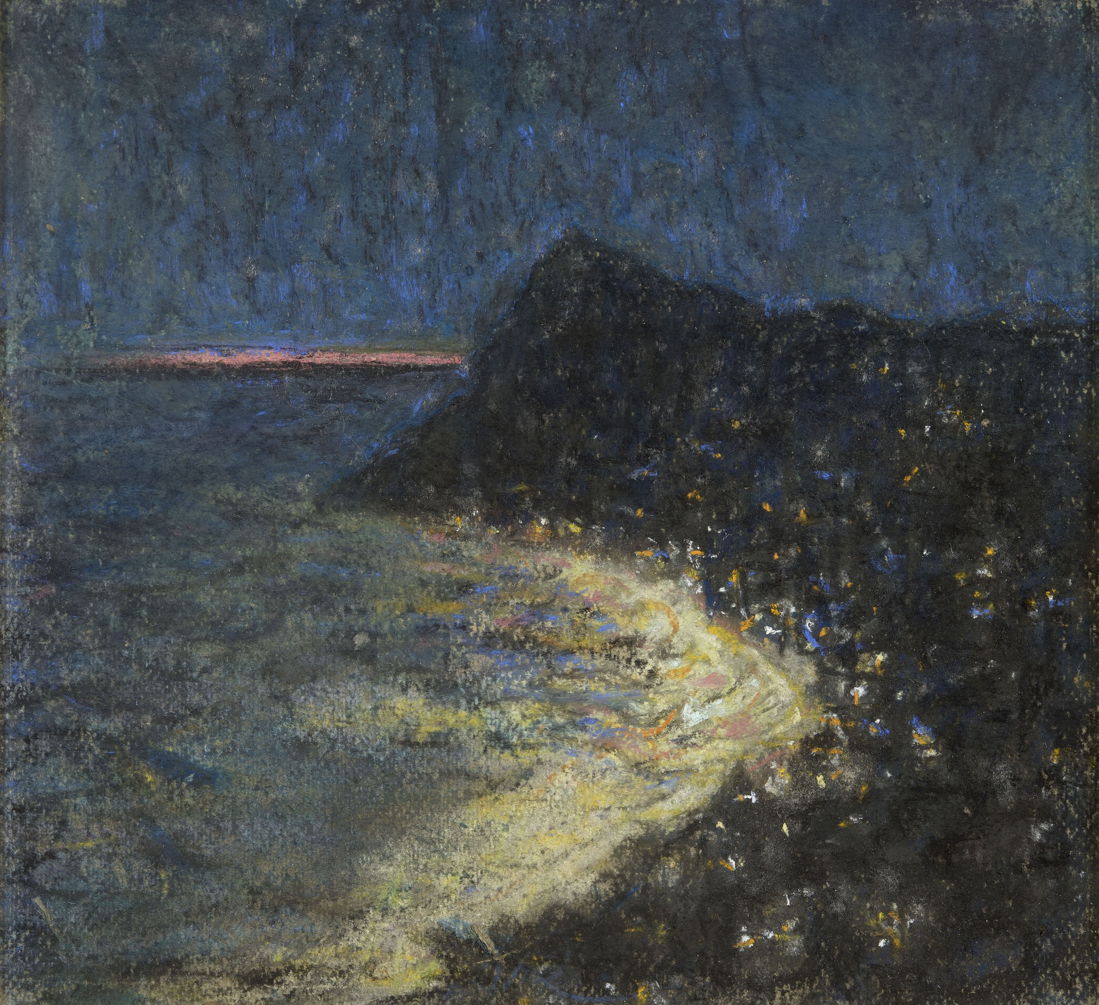
Ants Laikmaa (1866–1942), Night Motif from Capri (1910), pastel on paper, 19 x 20.5 cm, Private collection. Image courtesy of Enn Kunila, via Wikimedia Commons.

Laikmaa’s Night Motif from Capri from the same year is more of an impression of the coast, dotted with lights.

vonspaunfaraglioni
Paul von Spaun (1876–1932), The Faraglioni Cliffs on Capri (1913), oil on canvas, 60 x 60 cm, location not known. Wikimedia Commons.

Paul von Spaun painted this striking view of The Faraglioni Cliffs on Capri from above in 1913. As far as I can gather, he was Diefenbach’s son in law, an Austrian painter who lived in Diefenbach’s commune and fathered Fridolin von Spaun, who went on to research Diefenbach’s life and works, and collected his paintings in a museum on the island, in the Carthusian monastery at Certosa di San Giacomo, painted by Marie-Caroline de Bourbon, shown in the first of these two articles.
vonspaunvillajovis
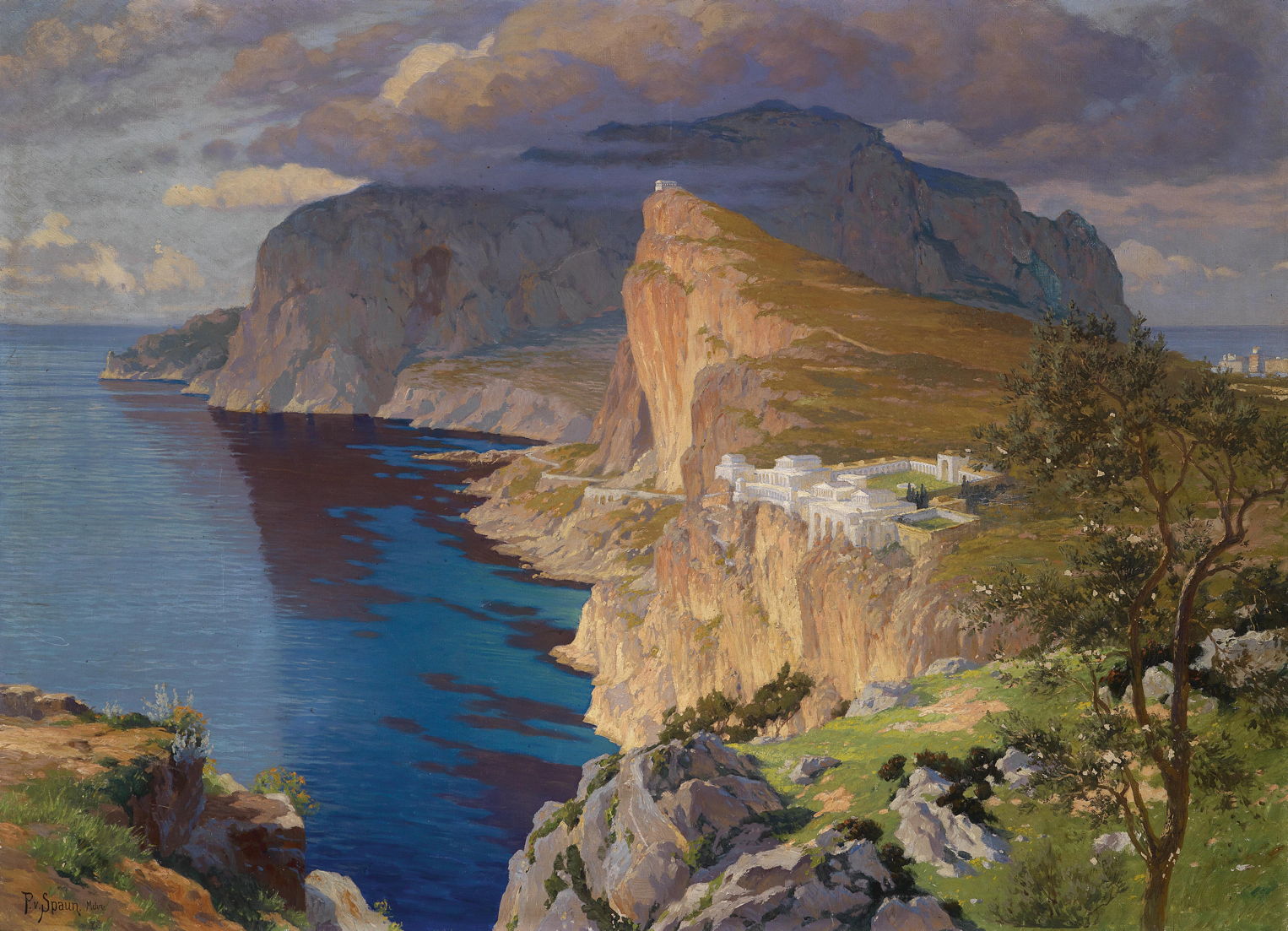
Paul von Spaun (1876-1932), Idealised View of Villa Jovis on the Island of Capri (date not known), oil on canvas, 80 x 110.4 cm, location not known. Wikimedia Commons.

Von Spaun’s undated Idealised View of Villa Jovis on the Island of Capri is one of the most outstanding paintings of the island. But it isn’t a ‘real’ view, as far as I can tell, rather a composite cleverly built from several different features, much in the way that landscape Masters like Nicolas Poussin assembled their idealised landscapes.
wenkcapri
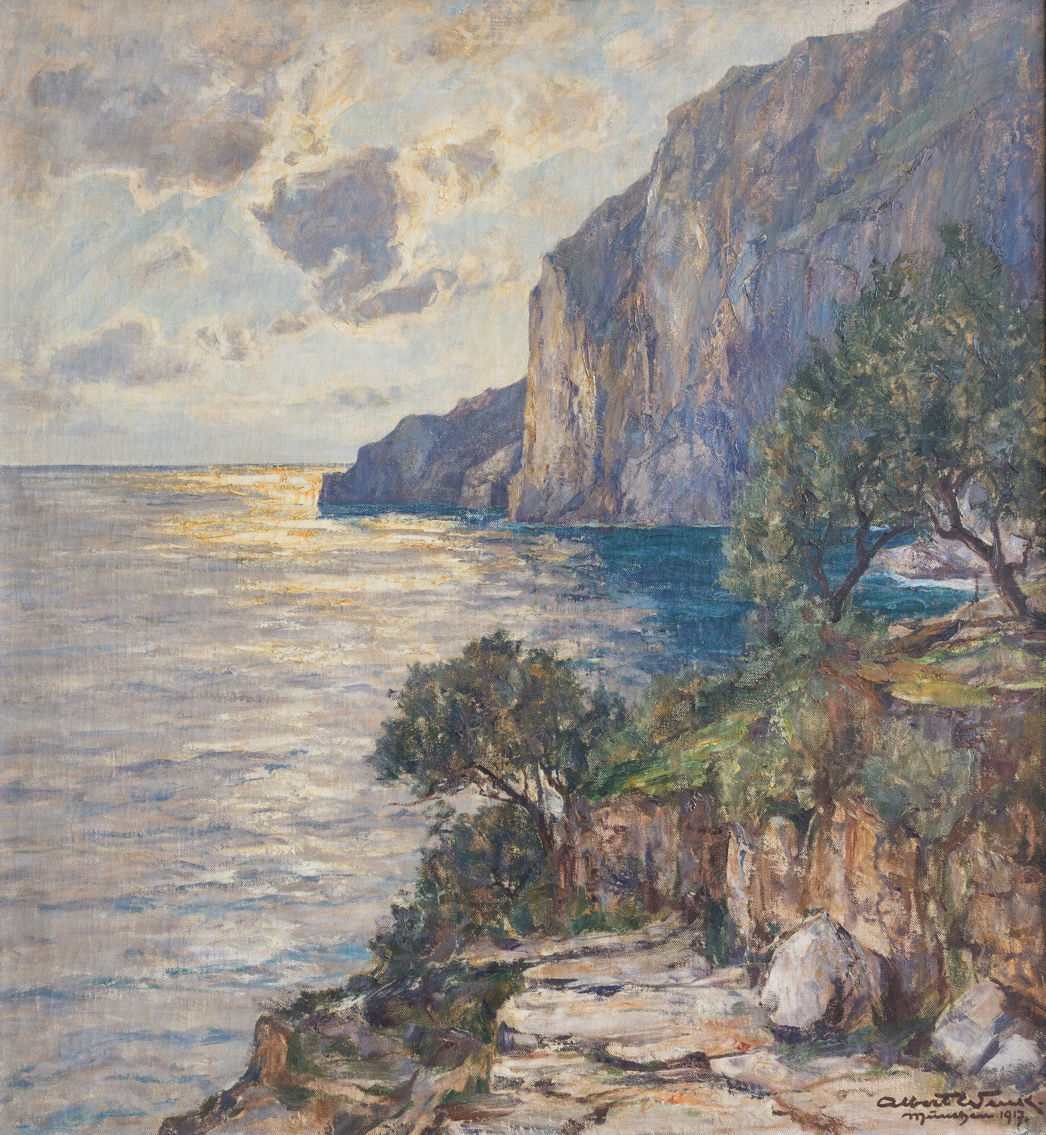
Albert Wenk (1863-1934), Capri (1917), oil on canvas, dimensions and location not known. Image by JTSH26, via Wikimedia Commons.

Albert Wenk’s view of Capri, painted in 1917, may look as if it was painted en plein air, but was probably made, or at least completed, in his Munich studio. It shows the vertiginous steps of the Via Krupp tumbling down the cliff on the south coast to the Marina Piccola, looking to the west in the late afternoon. Wenk had also trained in Düsseldorf.

My final three paintings are by the Russian Post-Impressionist Konstantin Ivanovich Gorbatov. He initially studied civil engineering, but in 1904 started training as an artist. He won a travelling scholarship taking him to Rome, from where he first visited Capri. He left Russia in 1922, and from then until 1926 lived and painted on the island. He next moved to Berlin, where he was an active member of a group of Russian emigré artists, and during the 1930s travelled widely across Europe and the Middle East. His career ended with the outbreak of the Second World War, and he died in Germany just after the Allied victory.
gorbatovcapri1928
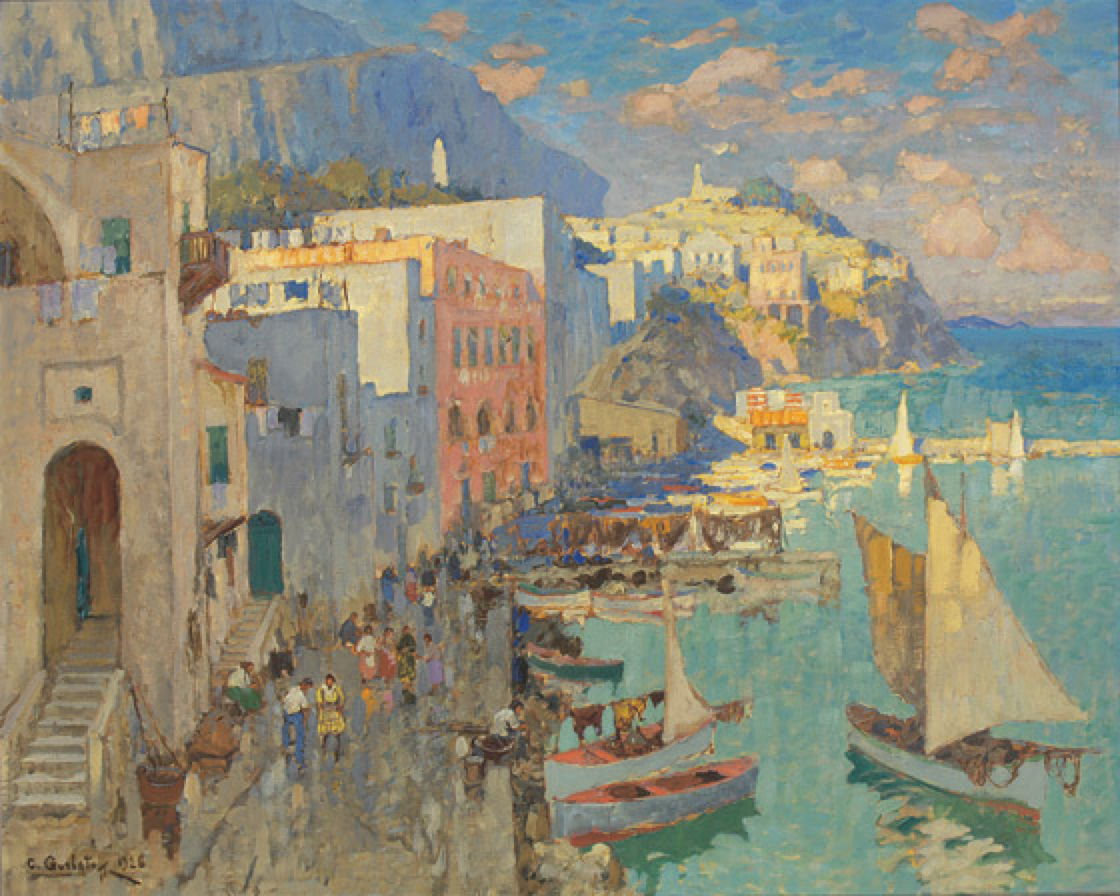
Konstantin Gorbatov (1876-1945), The Port of Capri (1926), oil on canvas, dimensions not known, location not known. Wikimedia Commons.

Gorbatov’s view of The Port of Capri (1926) shows the Marina Grande with the first of its jetties that now provide a more sheltered harbour. This looks west over the harbour on the north coast.

gorbatovcapri1926
Konstantin Gorbatov (1876-1945), Capri (1928), oil, dimensions not known, Private collection. Wikimedia Commons.

His slightly more distant view in Capri, painted in 1928, shows the high chroma style that he appears to have adopted when he moved to Berlin.

gorbatovcapriwc
Konstantin Gorbatov (1876-1945), Capri (date not known), watercolour, dimensions not known, Private collection. Wikimedia Commons.

This undated watercolour reverses those previous views, and looks east along the north coast, towards Monte San Michele and the more distant Monte Tiberio, at the far north-eastern tip of the island.

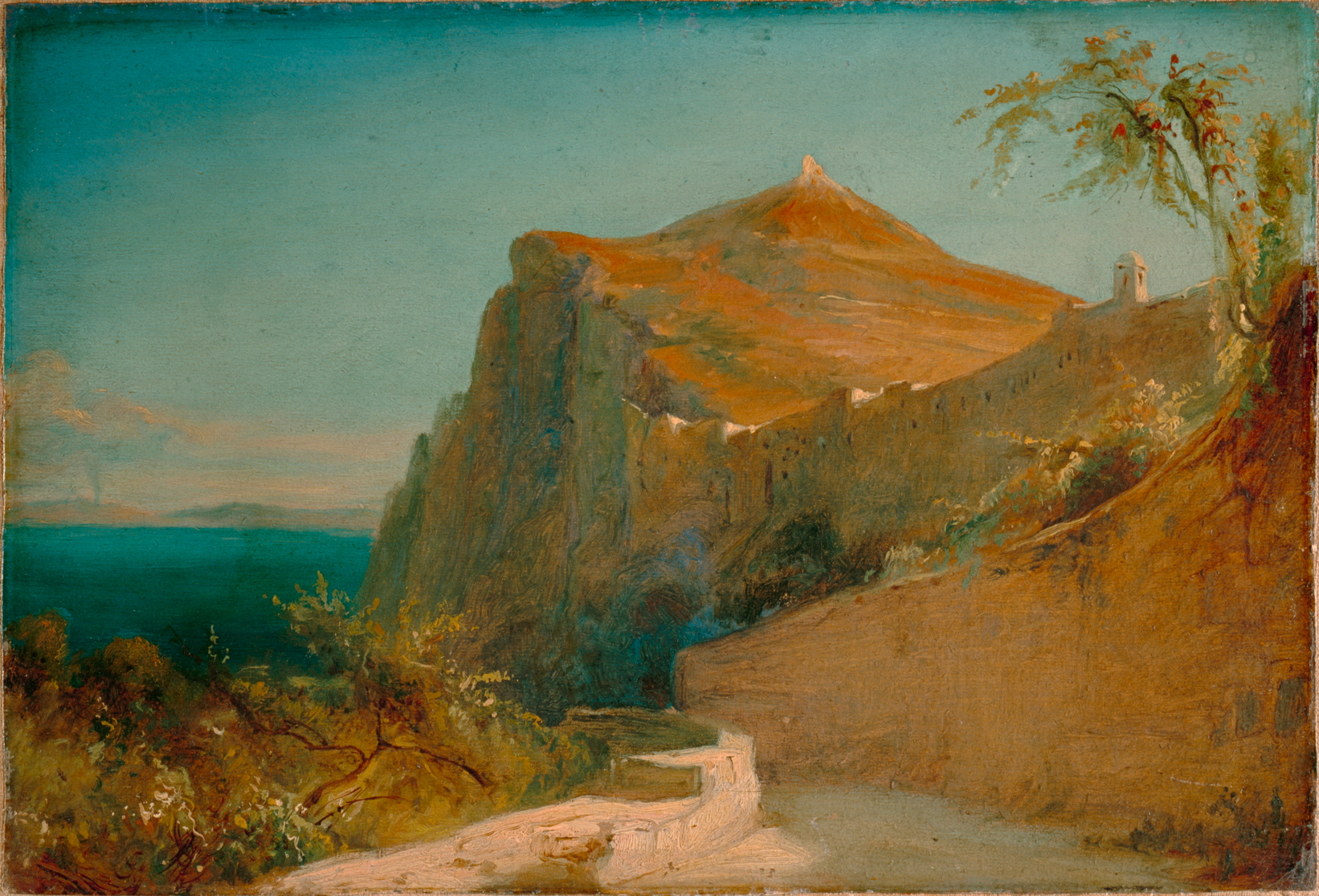
Paintings of Capri: 1828-1879

This weekend we’re escaping from the chills of February to travel to Capri, off the coast of southern Italy. From the north coast of this island you can look across the Bay of Naples towards the crowded city to the north. It’s a small island, with two little towns: Capri in the east, spilling down to harbours on the north and south coasts, and Anacapri, nestling in the hills to the west.

Karl Julius Beloch (1854–1929), Map of Capri (1890), from From Karl Julius Beloch: Campanien. Breslau, 1890. Wikimedia Commons.

It’s ruggedly hilly, with spectacular coastal scenery of high sea cliffs, small bays, and plenty of rock. Although only around 6 km (4 miles) long, it rises to nearly 600 metres (2,000 feet) at its highest point, Monte Solaro. It has everything to offer the coastal painter, including a superb climate, and a refuge from the winters of northern Europe.

Among the more famous artists who have stayed on this island are Albert Bierstadt and John Singer Sargent, while Adrian and Marianne Stokes honeymooned there. Although it has been claimed that Capri only became popular with painters in the late nineteenth century, its fame started rather earlier.

Carl Eduard Ferdinand Blechen, Tiberiusfelsen auf Capri (Tiberius Rocks, Capri) (1828-9), oil on paper mounted on canvas, 20.5 x 30 cm, Lower Saxony State Museum, Hanover. Wikimedia Commons.
Carl Eduard Ferdinand Blechen (1798–1840), Tiberiusfelsen auf Capri (Tiberius Rocks, Capri) (1828-9), oil on paper mounted on canvas, 20.5 x 30 cm, Lower Saxony State Museum, Hanover. Wikimedia Commons.

Carl Blechen visited the island in 1828, made hundreds of sketches there, and developed some into finished paintings when he was back in his Berlin studio. This painting of Tiberius Rocks, Capri (1828-9) seems to have been at least started en plein air, in oils on paper, although he may have finished it after his return. It shows the north coast, looking east to the peak of Monte Tiberio, with the Bay of Naples in the background.

blechenmarinagrande
Carl Eduard Ferdinand Blechen (1798–1840), Marina Grande, Capri (1829), oil on canvas, 90 × 130 cm, Österreichische Galerie Belvedere, Vienna, Austria. Wikimedia Commons.

Blechen’s superb finished painting of Marina Grande, Capri (1829) was made in the studio, though. This shows the north coast again, looking from the west of the Marina Grande towards the east, with the Tiberius Rocks and Monte Tiberio in the distance, and that may well be Vesuvius in the far distance.

friedbluegrotto
Heinrich Jakob Fried (1802-1870), The Blue Grotto, Capri (1835), oil on canvas, 50 × 63 cm, Kunsthalle Bremen, Bremen, Germany. Wikimedia Commons.

Heinrich Jakob Fried’s painting of The Blue Grotto, Capri (1835) shows one of the island’s most famous sights, which has been the motif for many paintings since. This has to be visited by boat, and is at the north-western tip of the island. It features in August Kopisch’s book, published in German in 1838, describing his re-discovery of this cave in 1826, which popularised the island across northern Europe. Fried visited the cave in 1835, and probably painted this in a studio in Naples shortly afterwards, just in time for the book’s publication.
altmarinagrande
Jakob Alt (1789–1872), Marina Grande, Capri (1836), watercolour, 41.1 x 51.7 cm, Albertina, Vienna, Austria. Wikimedia Commons.

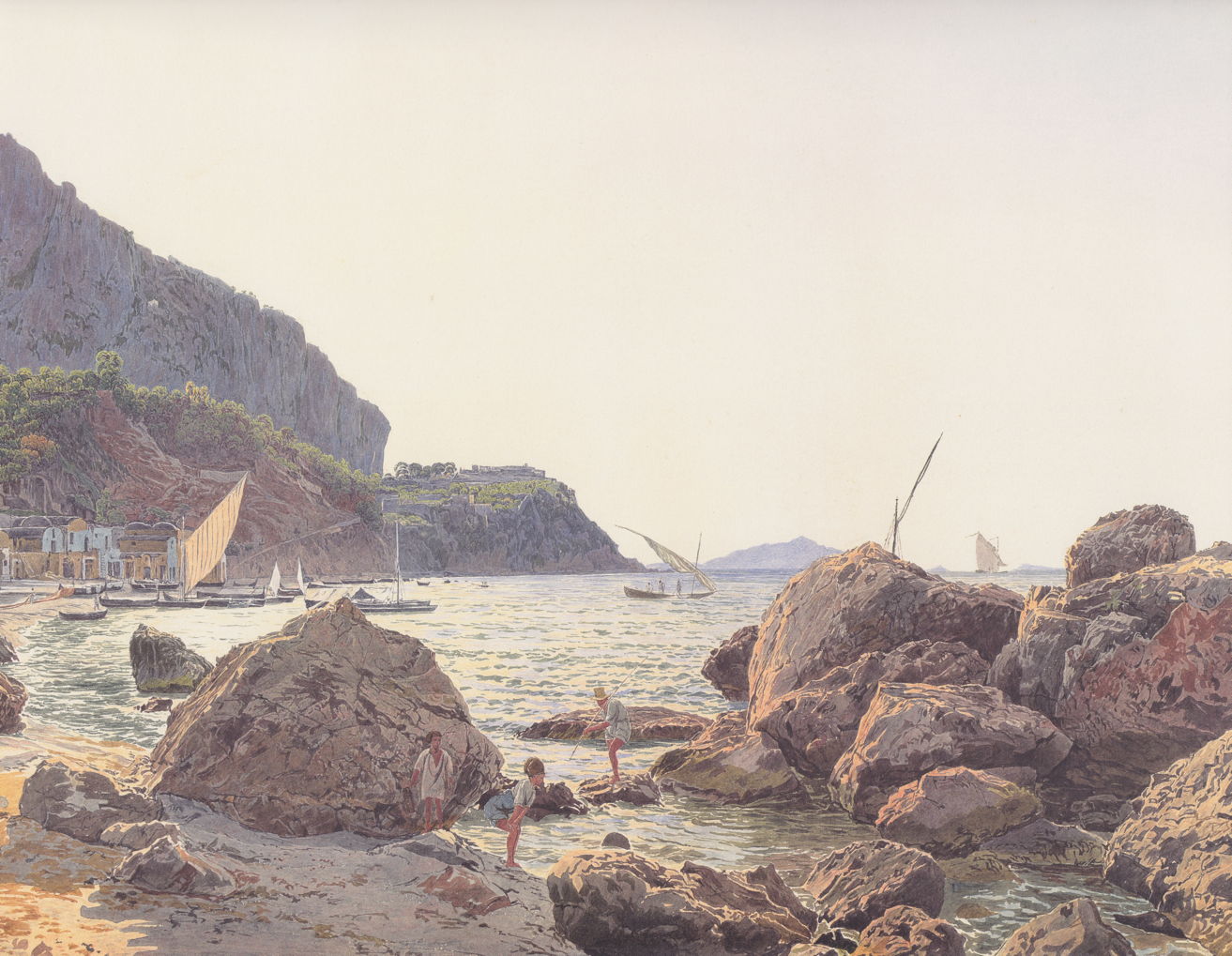
Jakob Alt’s view of Marina Grande, Capri (1836) is an extraordinary watercolour with painstaking detail. His view reverses Blechen’s, looking across the harbour from the east to the west, dropping almost to water level. Alt visited Italy in the mid-1830s, during which he too painted the Blue Grotto.

debourbonbrotherschartreuse
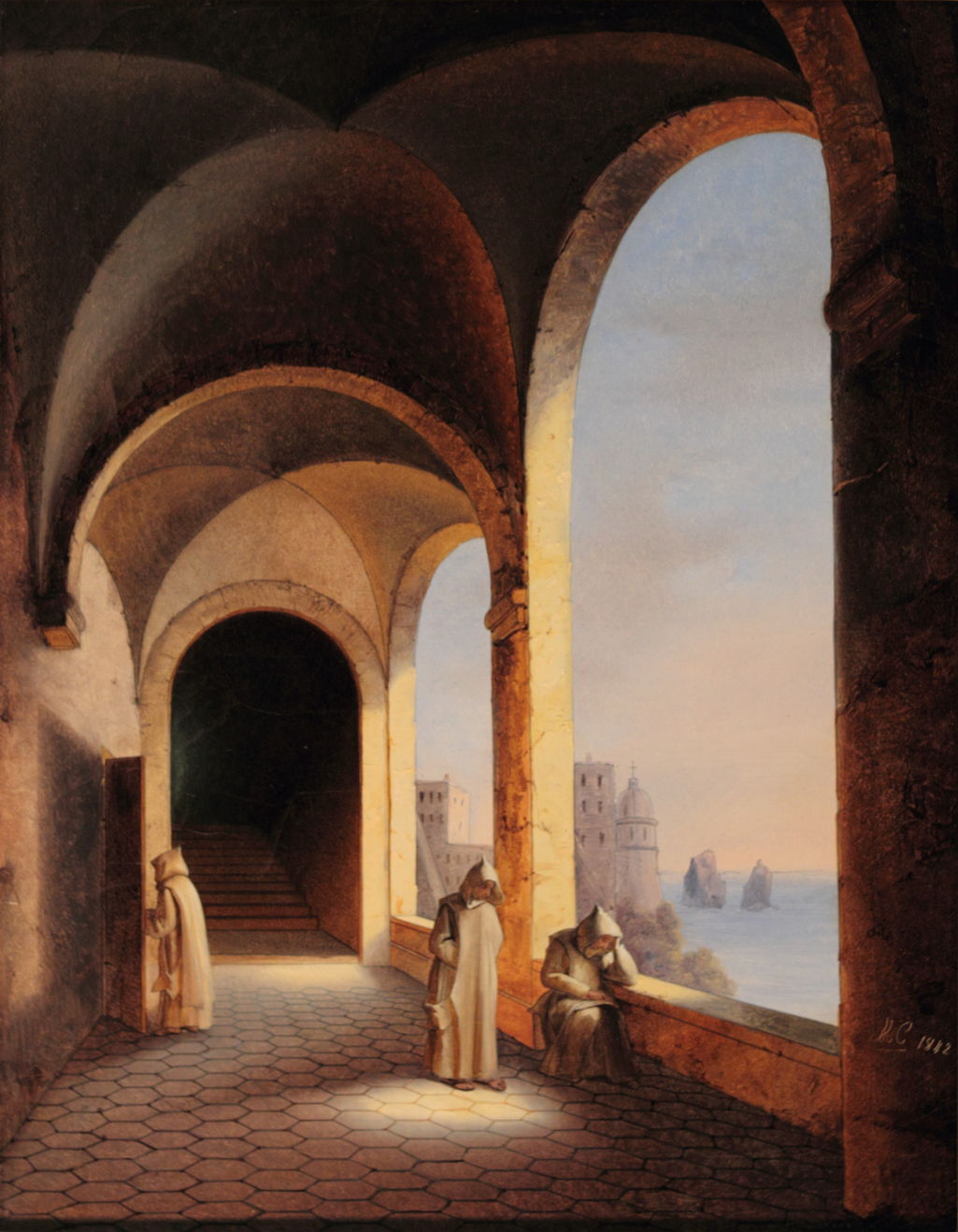
Marie-Caroline de Bourbon (Princess Caroline of Naples and Sicily) (1798–1870), Brothers in the Carthusian Monastery of San Giacomo, Capri (1842), further details not known. Image by PierreSelim, via Wikimedia Commons.

Marie-Caroline de Bourbon, Princess Caroline of Naples and Sicily, was an enthusiastic painter as well as being an avid collector of landscape paintings. The last serious Bourbon pretender to the crown of France, she visited Capri in the early 1840s, after she had been released from imprisonment in the Château of Blaye, and before moving to a palazzo on the Grand Canal in Venice. Her unusual painting of Brothers in the Carthusian Monastery of San Giacomo, Capri (1842) incorporates a vignette landscape view of the coast, almost in the manner of the Renaissance.

bierstadtfishingboats
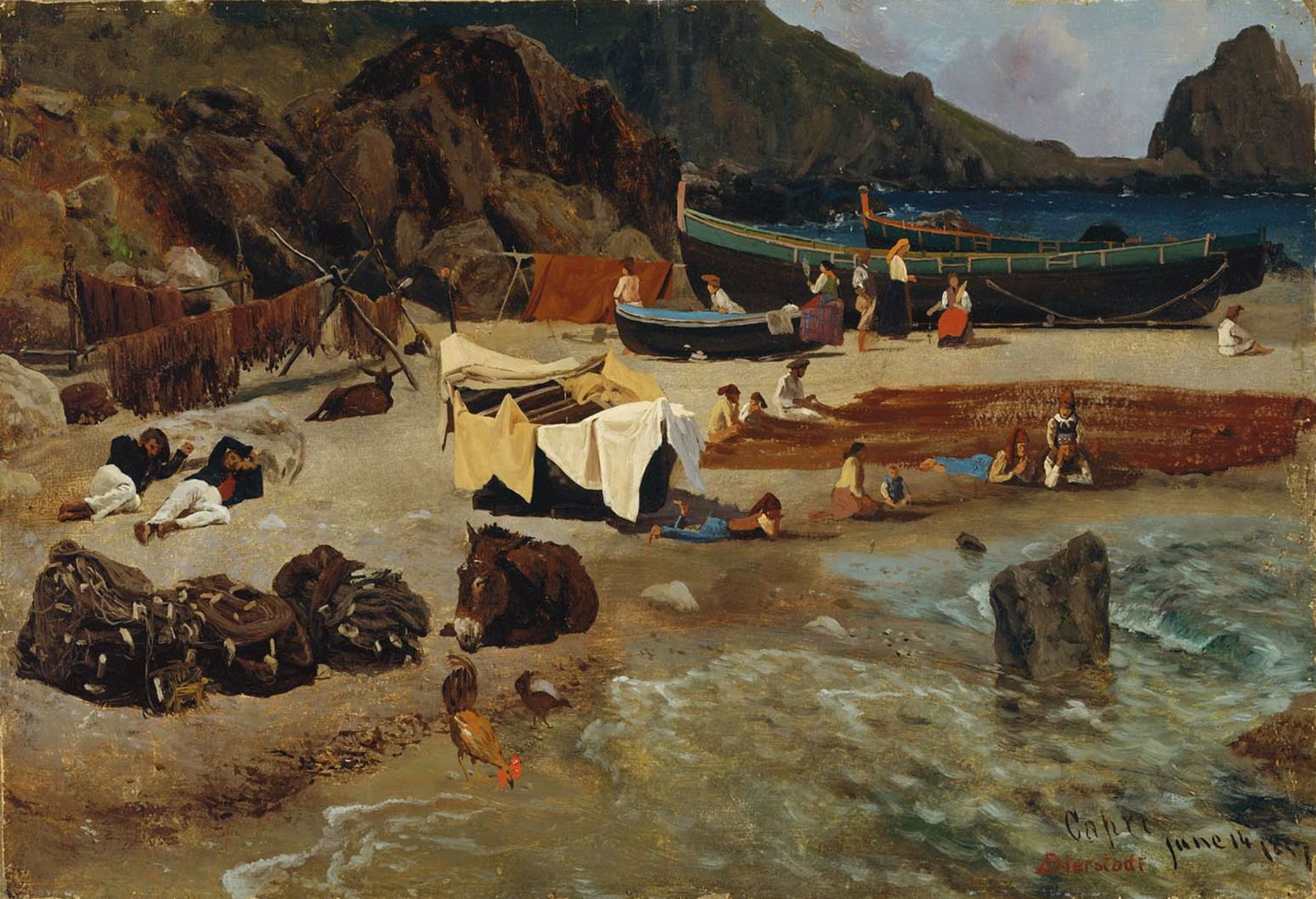
Albert Bierstadt (1830–1902), Fishing Boats at Capri (1857), oil on paper mounted on canvas, 34 × 49.9 cm, Museum of Fine Arts Boston, Boston, MA. Wikimedia Commons.

The great American landscape painter Albert Bierstadt visited Capri on his way back to New Bedford in 1857, following his training in Düsseldorf, Germany, only six years after he had started painting in oils. His Fishing Boats at Capri (1857) is painted in oils on paper, suggesting it may well have been started in front of the motif, and is quite unlike his mature style.

bierstadtmarinapiccola
Albert Bierstadt (1830–1902), The Marina Piccola, Capri (1859), oil on canvas, 106.7 × 182.9 cm, Albright-Knox Art Gallery, Buffalo, NY. Wikimedia Commons.

Bierstadt’s The Marina Piccola, Capri was painted on canvas in 1859, when the artist made his first journey westward to sketch American landscapes, and is more typical of the drama of his mature style. This smaller harbour is on the south side of the island, to the south-west of the town of Capri, and this view looks to the east, showing the distant sea stacks of the Faraglioni at the right.

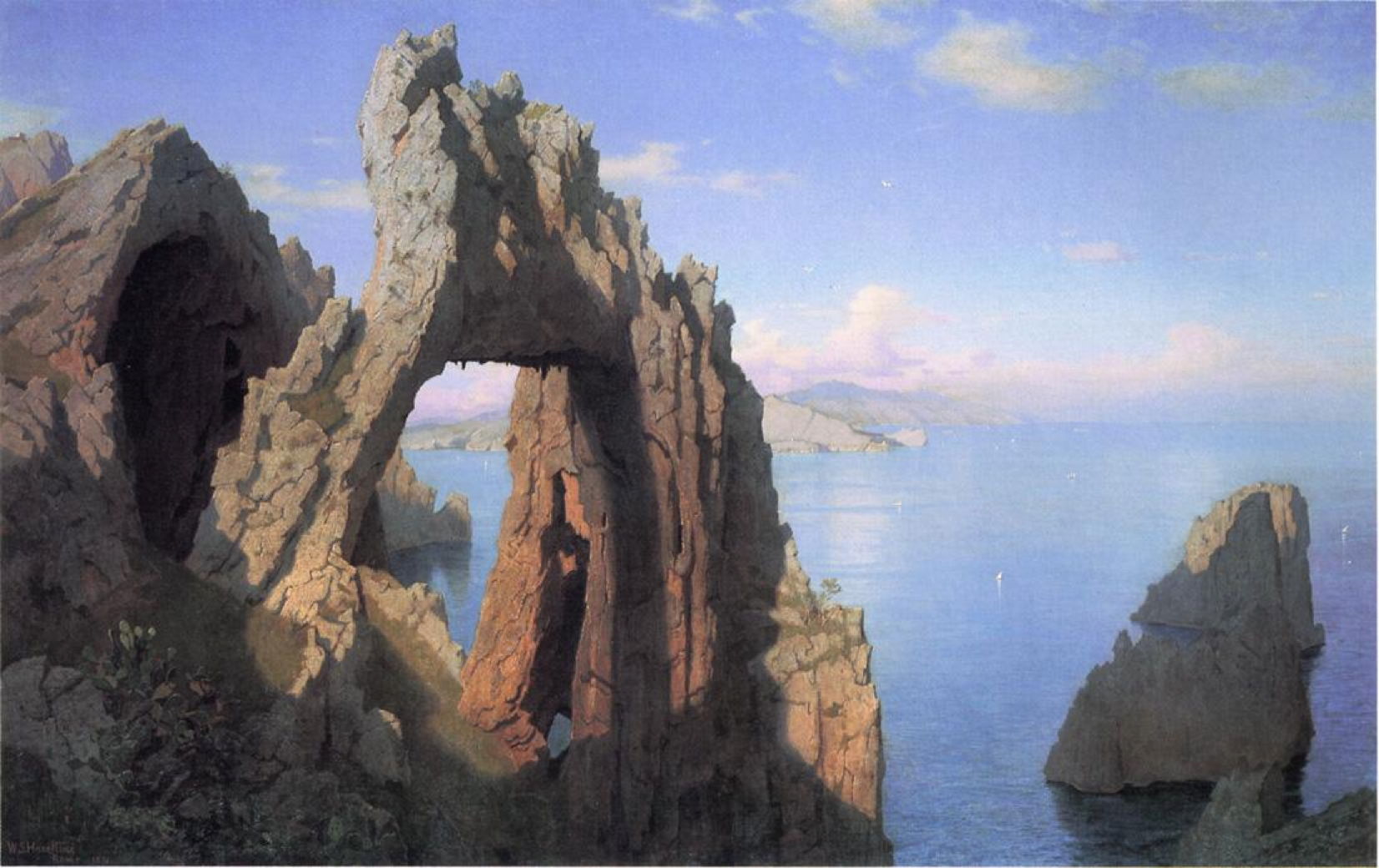
haseltinearconaturale
William Stanley Haseltine (1835–1900), Arco Naturale, Capri (c 1870), further details not known. Wikimedia Commons.

William Stanley Haseltine was another great American landscape painter associated with the Hudson River School, and first met Bierstadt in Düsseldorf in the mid 1850s. Haseltine lived in Rome in 1857-58, and drew and painted both the Roman campagna and Capri during that time. Having made his reputation with dramatic depictions of the New England coast, he moved back to Rome in 1867, from where he travelled to paint across Europe. His paintings of Capri from this period proved popular with visiting Americans, and remain among some of the finest realist views of the island. Arco Naturale, Capri from about 1870 shows another of Capri’s famous sights, a natural rock arch on its short eastern coast.

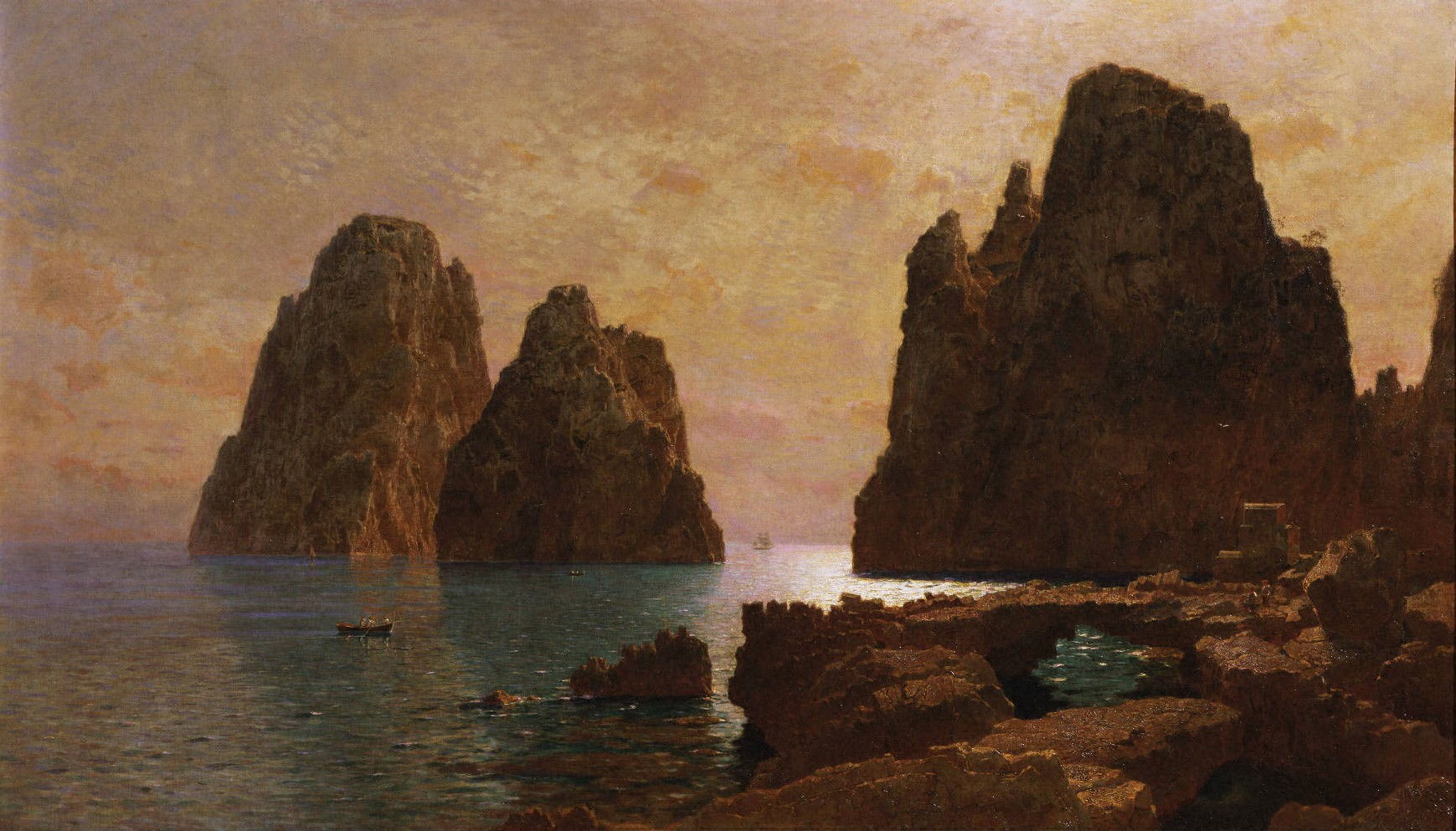
haseltinefaraglioni
William Stanley Haseltine (1835–1900), Isle of Capri: The Faraglioni (1870s), oil on canvas, 83 x 142 cm, Princeton University Art Museum, Princeton, NJ. Wikimedia Commons.

Haseltine’s Isle of Capri: The Faraglioni, from the 1870s, shows these stacks from the north-east, and was probably painted at the Villa Malparte, to the south of the Arco Naturale. He skilfully suggests scale with the tiny boats shown at their foot, although there may be a little exaggeration.

lavolpecapri
Alessandro la Volpe (1820–1887), View of Capri (1875), oil on canvas, 52.5 x 106.5 cm, location not known. Wikimedia Commons.

Alessandro la Volpe was an Italian who was born in, and worked from, Naples. His View of Capri (1875) shows the island in a heat haze, from the hills above Sorrento, to the north-east.

feddersenmarinagrande
Hans Peter Feddersen (1848–1941), Marina Grande, Capri (1877), oil on canvas, dimensions not known, Museumsberg Flensburg, Flensburg, Germany. Image by anagoria, via Wikimedia Commons.

Hans Peter Feddersen was another former student from Düsseldorf, although after Bierstadt and Haseltine. He visited Italy and Capri from April to June 1877, when he painted this view of the Marina Grande, Capri in oils, probably en plein air. Rather than follow early examples, he looks to the north across the harbour, with Vesuvius in the background.

In the summer of 1878, John Singer Sargent had just completed his studies with Carolus-Duran, and had already started to have success at the Salon in Paris. He went off on a working holiday to Capri, staying in the village of Anacapri, as was popular with other artists at the time.

Getting a local model was tricky, because of the warnings that women were given by priests. One local woman, Rosina Ferrara, seemed happy to pose for him, though. She was only 17, and Sargent a mere 22 and just developing his skills in portraiture, following the advice of his teacher Carolus-Duran. Over the course of that summer, Sargent painted at least a dozen works featuring Rosina, who seems to have become an obsession.

sargentdanslesoliviers
John Singer Sargent (1856–1925), Capri Girl (Dans les Oliviers, à Capri) (1878), oil on canvas, 77.5 x 63.5 cm, Private collection. The Athenaeum.

One, Dans les Oliviers, à Capri, he exhibited at the Salon the following year. He sent a near-identical copy back for the annual exhibition of the Society of American Artists in New York, in March 1879.

sargentviewcapri
John Singer Sargent (1856–1925), View of Capri (c 1878), oil on cardboard, 26 x 33.9 cm, Yale University Art Gallery, New Haven, CT. Wikimedia Commons.

Sargent also painted a pair of views of what was probably the roof of his hotel. In View of Capri, above, made on cardboard, Rosina stands looking away, her hands at her hips. In the other, Capri Girl on a Rooftop, below, she dances a tarantella to the beat of a friend’s tambourine.

sargentcaprigirlrooftop
John Singer Sargent (1856–1925), Capri Girl on a Rooftop (1878), oil on canvas, 50.8 x 63.5 cm, Crystal Bridges Museum of American Art, Bentonville, AR. Wikimedia Commons.
hertelviewofcapri
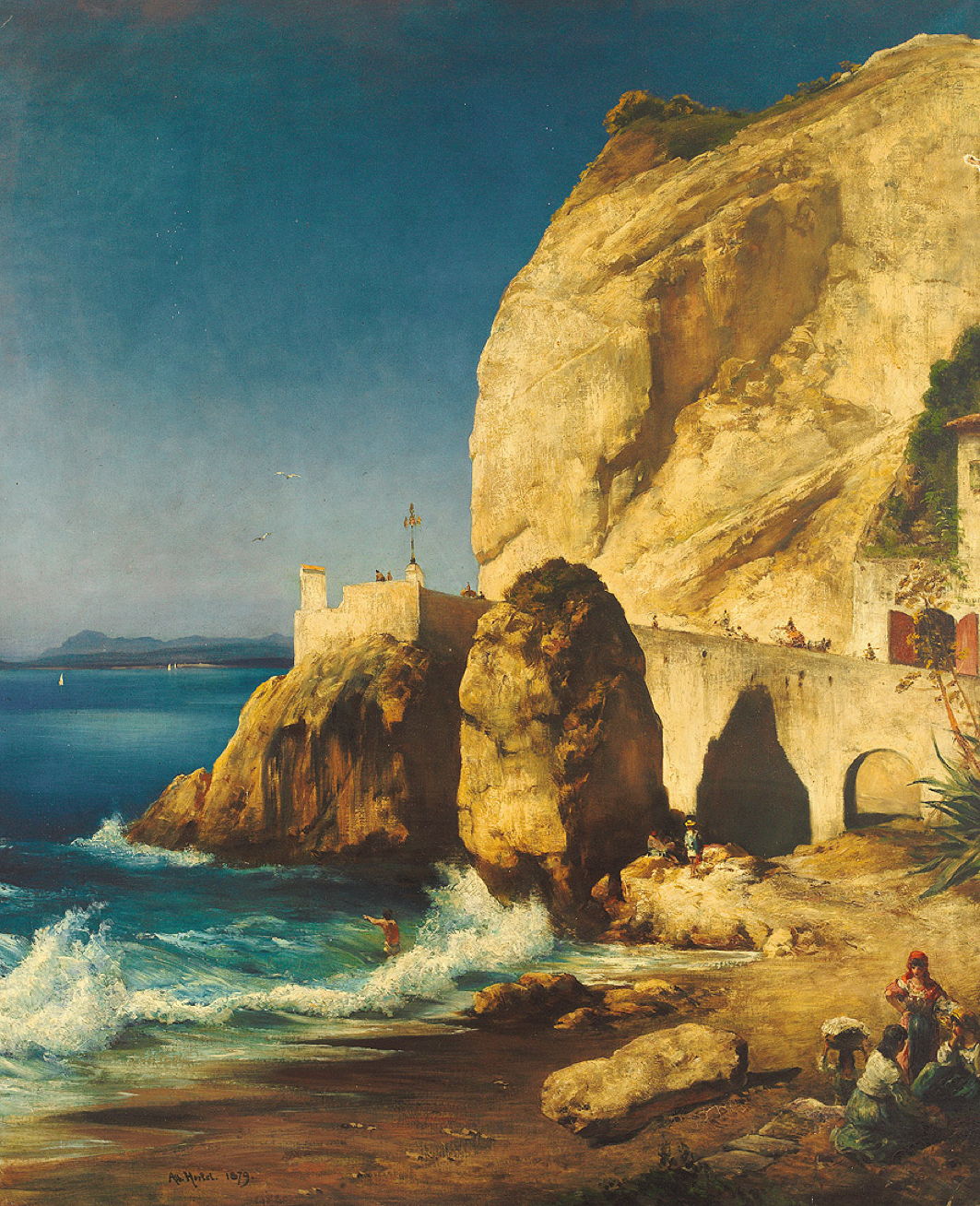
Albert Hertel (1843–1912), View of the Shores of Capri with People (1879), oil on canvas, 173 × 143 cm, location not known. Wikimedia Commons.

Albert Hertel trained in Düsseldorf in 1868-69, prior to which he had lived as a student in Rome for several years. He established himself as a landscape painter in Berlin, from where he seems to have returned to Italy and visited Capri in the late 1870s. His View of the Shores of Capri with People (1879) shows a small bay near Punta Carena, at the south-western tip of the island.

❌