“I have all the thoughts, dreams, longings and intelligence as any neurotypical person,” says Woody Brown, the author of “Upward Bound,” here with his mother at their California home.
As with many items of clothing, the term hood is applied to a wide range of garments. For the purposes of this selection of paintings, I confine it to a shaped covering for the head that is part of a garment also covering at least part of the upper body. This includes the cowl integrated into the robes of many monks, and the hooded cape known as a chaperon, described below. It would also include the modern hoodie that became popular in the 1970s.
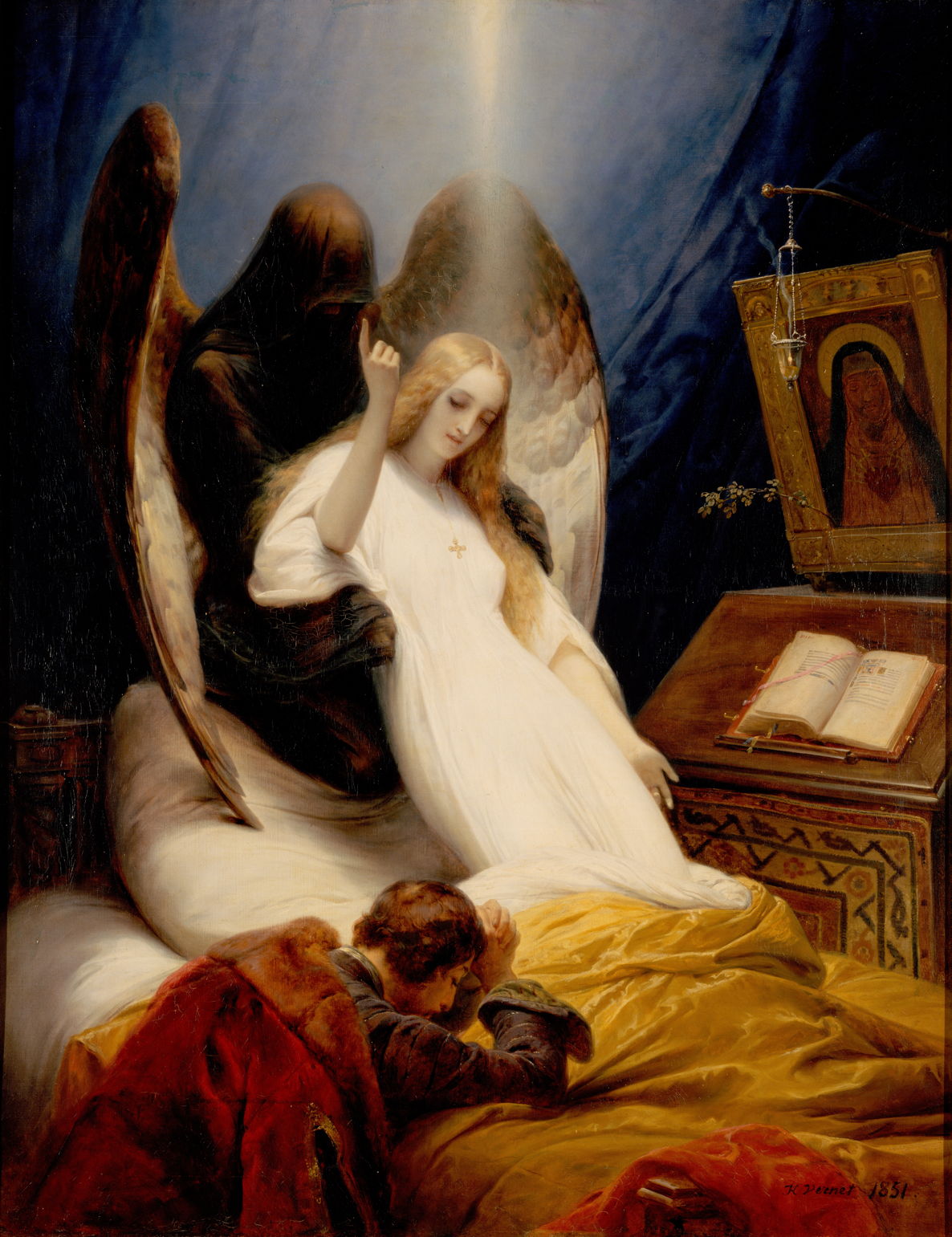
Hoods are commonly worn by figures associated with death, such as the Grim Reaper, where they provide sinister concealment of the face.
Horace Vernet (1789–1863), The Angel of Death (1851), oil on canvas, 146 x 113 cm, The Hermitage Museum, St. Petersburg, Russia. Wikimedia Commons.
In Horace Vernet’s The Angel of Death from 1851, a young man is praying over the side of a bed, kneeling, his hands clasped together. Opposite him, an illuminated Bible is open, above that an icon hangs on the wall, there’s a sprig of flowers, and a flame burns in prayer. But the occupant of the bed, a beautiful young woman, is being lifted out of it. Her right hand is raised, its index finger pointing upwards to heaven. Behind her, the Angel of Death, the outer surface of its wings black, and clad in long black robes, its face concealed beneath a hood, is lifting her out, to raise her body up towards the beam of light shining down from the heavens.
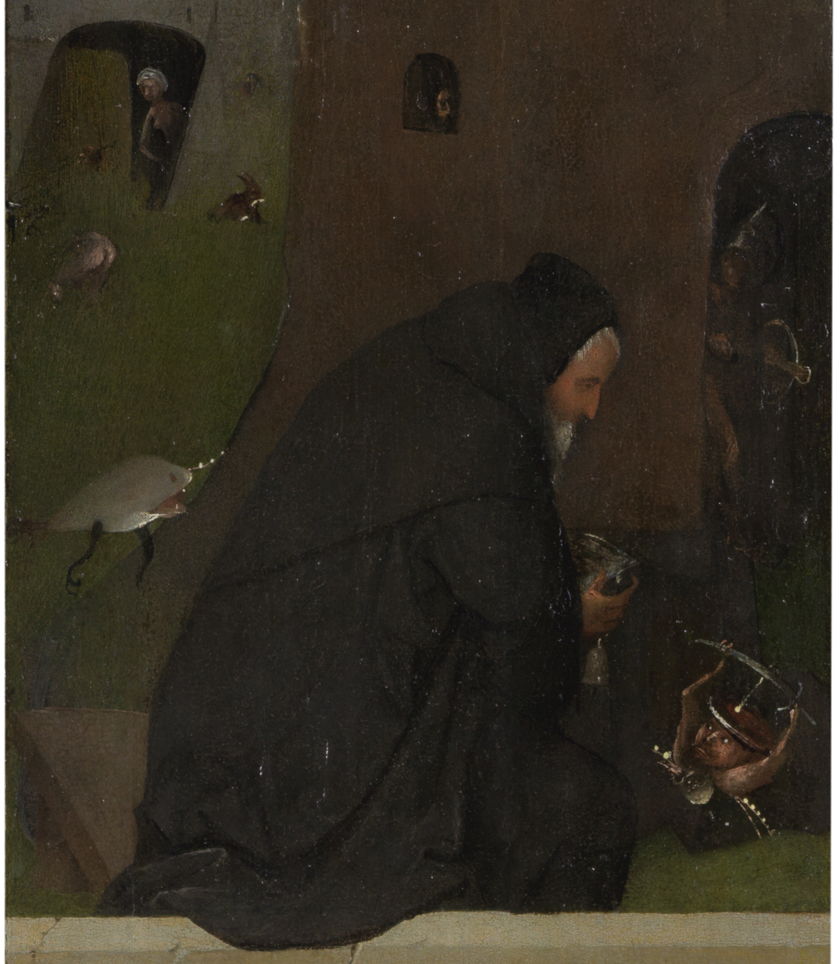
Cowls are a common feature of the robes worn by hermits as well as monks.
Hieronymus Bosch (c 1450–1516), Saint Wilgefortis Triptych (detail) (c 1495-1505), oil on oak panel, left wing 105.2 × 27.5 cm, central panel 105.2 × 62.7 cm, right wing 104.7 × 27.9 cm, Gallerie dell’Accademia, Venice. Photo Rik Klein Gotink and image processing Robert G. Erdmann for the Bosch Research and Conservation Project.
The figure at the foot of the left panel of Hieronymus Bosch’s Saint Wilgefortis Triptych (c 1495-1505) has some visual similarity with Saint Anthony in his Hermit Saints triptych, and appears to be holding a small bell, one of that saint’s attributes.
Richard Dadd (1817–1886), Portrait of a Monk (1857), watercolour over graphite on moderately thick, slightly textured, beige laid paper, 19.1 x 11.8 cm, Yale Center for British Art, Paul Mellon Collection, New Haven, CT. Courtesy of the Yale Center for British Art.
Richard Dadd painted this Portrait of a Monk on 11 April 1857, from memory of his previous travels in the Middle East.
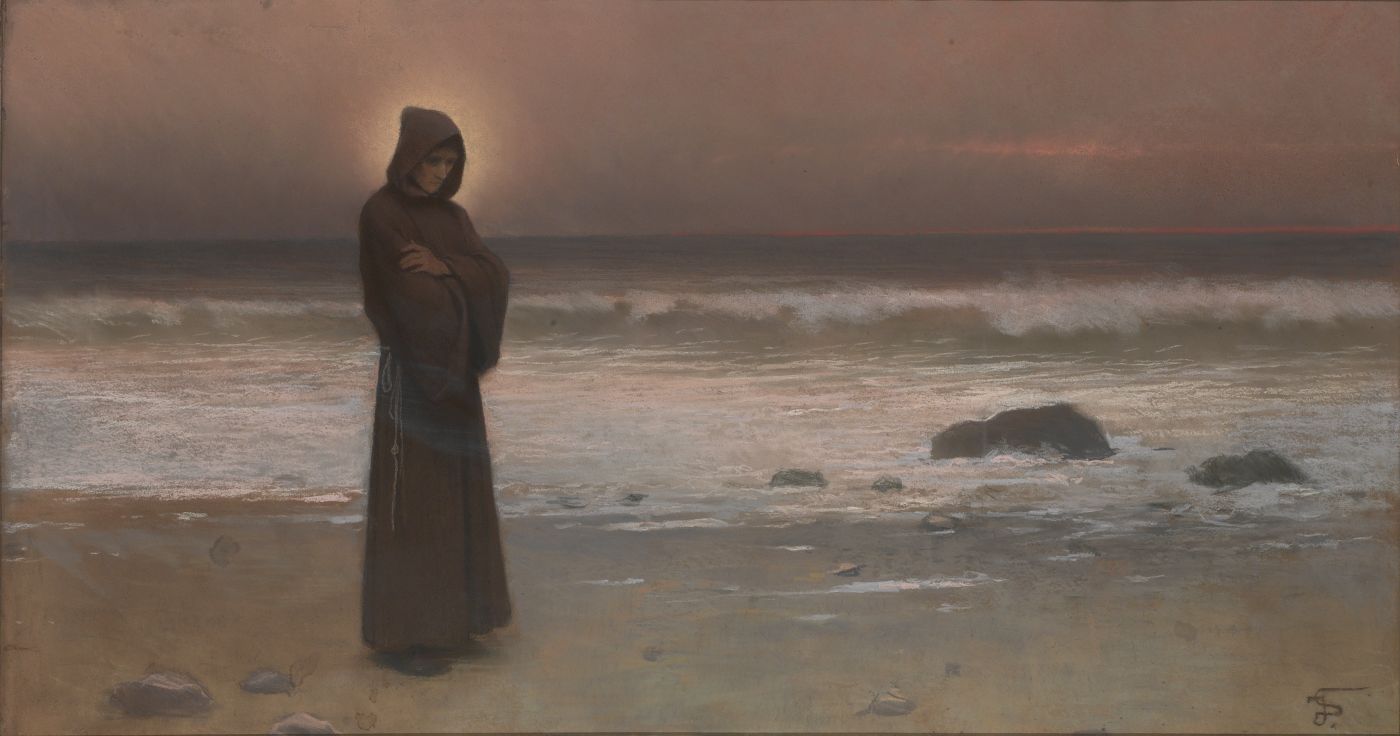
Jakub Schikaneder (1855–1924), Kontemplace, Mnich na mořském břehu (Contemplation, the Monk on the Seashore) (date not known), pastel on paper, further details not known. Wikimedia Commons.
Jakub Schikaneder’s undated Contemplation, the Monk on the Seashore shows a hooded monk on the foreshore, just in front of the water, apparently lost in thought.
Cowls have also been incorporated into other religious dress, where they’re often worn with hats, making them appear vestigial and primarily symbolic.
Raphael (1483–1520), Portrait of a Cardinal (1510-11), oil on panel, 79 x 61 cm, Museo Nacional del Prado, Madrid, Spain. Wikimedia Commons.
Raphael’s magnificent Portrait of a Cardinal from 1510-11 shows the elements of this cardinal’s choir dress: the soft matte surface of the biretta on his head, the subtly patterned sheen of his mozzatta (cape) with its hood, and the luxuriant folds of his white rochet (vestment).
Another uniform that incorporates symbolic hoods is formal academic dress, in which the colours and cut of the hood denote the university and degree.
Jean Béraud (1849–1935), The Thesis of Madeleine Brès (or The Doctoral Jury) (date not known), oil on canvas, 63.5 x 48.3 cm, Private collection. The Athenaeum.
In Jean Béraud’s undated The Thesis of Madeleine Brès (or The Doctoral Jury) he shows us one of the early woman doctoral students defending her thesis before the academic jury, who are wearing what might appear now to be fancy dress hats in addition to their colourful hoods. At the time, this was a major landmark in the improvements in women’s rights, and the archaic headwear serves to emphasise this change.
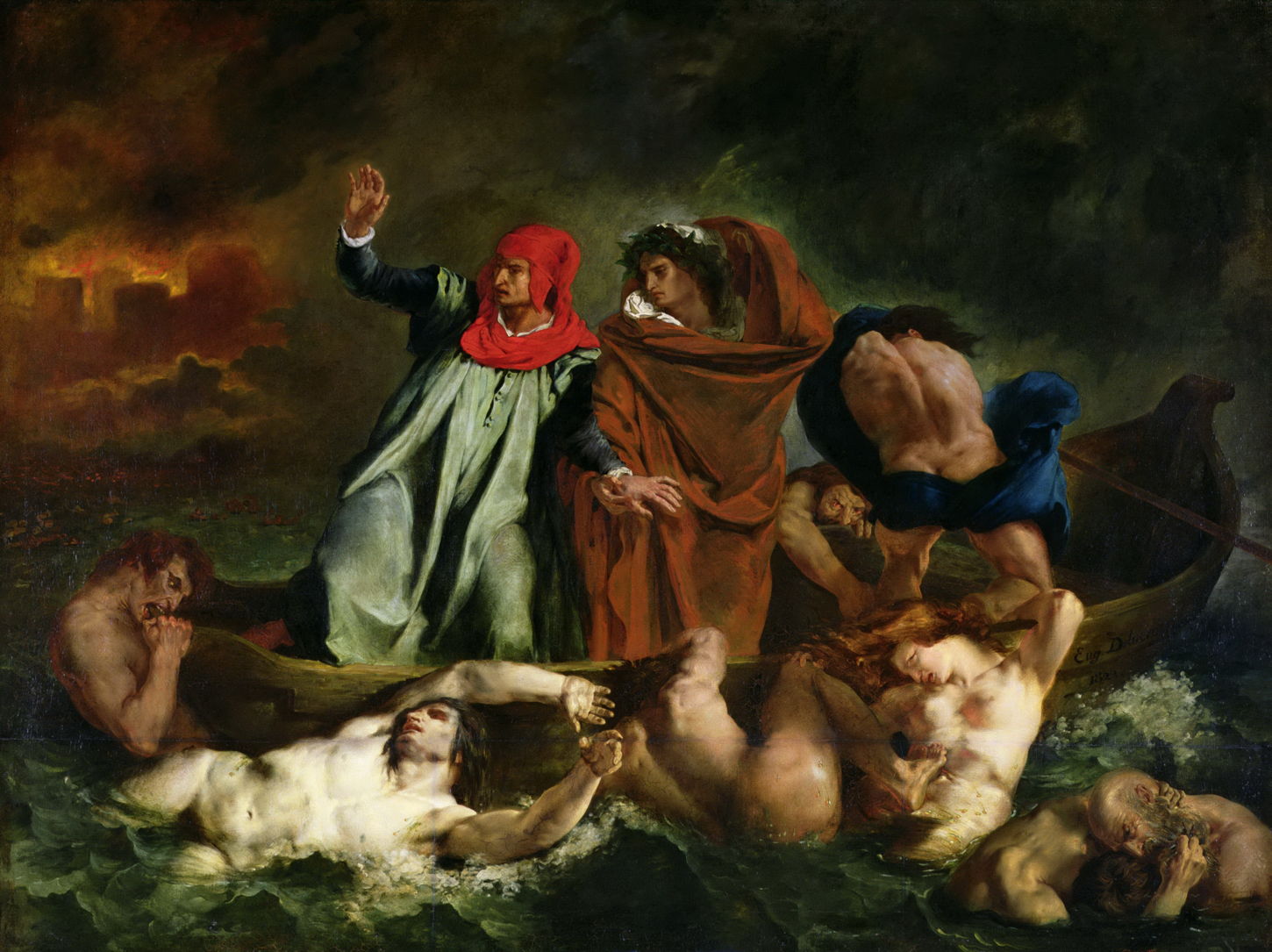
The chaperon had evolved before 1200 as a hooded short cape, then developed into variants that remained popular until becoming unfashionable in about 1500. In paintings it’s most strongly associated with Dante in accounts of his Divine Comedy.
Eugène Delacroix (1798–1863), The Barque of Dante (Dante and Virgil in Hell) (1822), oil on canvas, 189 x 241 cm, Musée du Louvre, Paris. Wikimedia Commons.
In Eugène Delacroix’s painting of The Barque of Dante from 1822, Dante is inevitably wearing his trademark red chaperon.
Louis Welden Hawkins (1849–1910), A Peasant Woman (c 1880), further details not known. Wikimedia Commons.
The woman’s equivalent of the chaperon persisted until modern times in the hooded cape worn by Louis Welden Hawkins’ Peasant Woman, from about 1880. She is seen near to the rustic village of Grez-sur-Loing, which had become an artist’s colony.
Strangely, the word chaperone (with an added e) is now most commonly used to describe an older woman who accompanies a younger one to ensure that no improper behaviour occurs when in the company of a man.
Before the decline in popularity of hats in the twentieth century, hoods had been relatively uncommon in the general population.
Carl Gustaf Hellqvist (1851–1890), Valdemar Atterdag holding Visby to ransom, 1361 (1882), oil on canvas, 200 × 330 cm, Nationalmuseum, Stockholm. Wikimedia Commons.
Carl Gustaf Hellqvist’s large history painting of Valdemar Atterdag holding Visby to ransom, 1361 from 1882 is an encyclopaedic guide to late medieval dress. Few of its crowd have hoods, and one of those few appears to be a monk, shown in the detail below.
Carl Gustaf Hellqvist (1851–1890), Valdemar Atterdag holding Visby to ransom, 1361 (detail) (1882), oil on canvas, 200 × 330 cm, Nationalmuseum, Stockholm. Wikimedia Commons.
Hoods have also been popular with travellers, and from the nineteenth century were incorporated into popular weatherproof capes.
Ford Madox Brown (1821–1893), The Last of England (1852/55), oil on panel, 82.5 x 75 cm, Birmingham Museum and Art Gallery, Birmingham, England. Wikimedia Commons.
Ford Madox Brown’s The Last of England (1852/55) shows a young couple with their infant emigrating from England. Tucked under the mother’s weatherproof hooded travelling cape is their baby son.
It seems extraordinary that in the twenty-first century hoodies have been banned as inappropriate items of clothing associated with anti-social behaviour. Perhaps there’s a market for reviving chaperons.
Some partnerships between artists and their models grew as the model became the artist’s muse, and exerted their influence on the art produced by the partners. This was particularly true for the Pre-Raphaelites, who socialised together, shared models and muses as well. There are several books revealing who slept with whom, and whose parties they each attended, but here I celebrate a few who made Pre-Raphaelite art through their patient posing and sometimes physical hardship.
John Everett Millais (1829–1896), Isabella (Lorenzo and Isabella) (1848-49), oil on canvas, 103 x 142.8 cm, Walker Art Gallery, Liverpool, England. Wikimedia Commons.
John Everett Millais’ masterpiece Isabella (Lorenzo and Isabella) from 1848-49 is much more than a composite of different references to Keats’ poem and Boccaccio’s story. It’s a Pre-Raphaelite group portrait. For example, Lorenzo, actually William Michael Rossetti (brother of Dante Gabriel), shares a blood orange with Lisabetta, in reality Mary Hodgkinson (the artist’s step-cousin-sister-in-law). We see Dante Gabriel Rosetti drinking wine at the far end of the table, and the old man wiping his mouth is Millais’ father. There are two stories here, one from Keats and Boccaccio, the other more contemporary.
John Everett Millais (1829–1896), The Eve of St Agnes (1863), oil on canvas, 117.8 x 154.3 cm, The Royal Collection of Her Majesty Queen Elizabeth II, London. Wikimedia Commons.
Less than fifteen years later, Millais shows how their lives had changed in his Eve of St Agnes (1863). In addition to referring to another of Keats’ poems, here about the elopement of Madeline and her lover Porphyro on Saint Agnes’ Eve, we see more Pre-Raphaelite relationships.
Millais painted this in the King’s Bedroom in the Jacobean house at Knole Park, near Sevenoaks in Kent. His model is his wife Effie, formerly Euphemia Gray, who originally married John Ruskin, the critic. That marriage resulted in annulment on the grounds that it was never consummated. Millais found Effie totally beguiling, and was obsessed with her after painting her in 1852 at Ruskin’s insistence. When Effie was finally free to marry Millais, they must have realised that her previous marriage would exclude her from many of the social functions that she loved, including any event attended by Queen Victoria.
John Everett Millais (1829–1896), Ophelia (1851-2), oil on canvas, 76.2 x 111.8 cm, Tate Britain, London. Wikimedia Commons.
Immediately before Millais painted his future wife, he spent many days painting Elizabeth Siddal in a bath, when she modelled for his Ophelia (1851-2). For this, one of the most famous of all Pre-Raphaelite paintings, he painted its background en plein air near Ewell, Surrey, England, then the following winter he put Siddal into a bath full of water while he painstakingly painted her figure onto the canvas.
Millais tried to warm the water in the bath using the flames of lamps and candles against its outer surface. One day he failed to notice that they had gone out, and Siddal became ill as a result of her prolonged cold immersion. Her parents threatened Millais with her medical bills, and tried to stop their daughter from further modelling.
It’s just as well they failed, as Lizzie Siddal next modelled for Dante Gabriel Rossetti, who became obsessed with her even as he pursued torrid affairs with other ‘stunners’. Rossetti and Siddal married, and for almost six months he seems to have remained faithful. But on 11 February 1862, Lizzie died of an overdose of laudanum (tincture of opium) at the age of only 32.
A couple of years later, Rossetti embarked on an unusual post-mortem portrait of her in the role of Dante’s beloved Beatrice. Although Dante never revealed her true identity, many have believed her to represent Beatrice di Folco Portinari, who died even younger almost six hundred years earlier. Beata Beatrix (c 1864–70) is one of Rossetti’s major works.
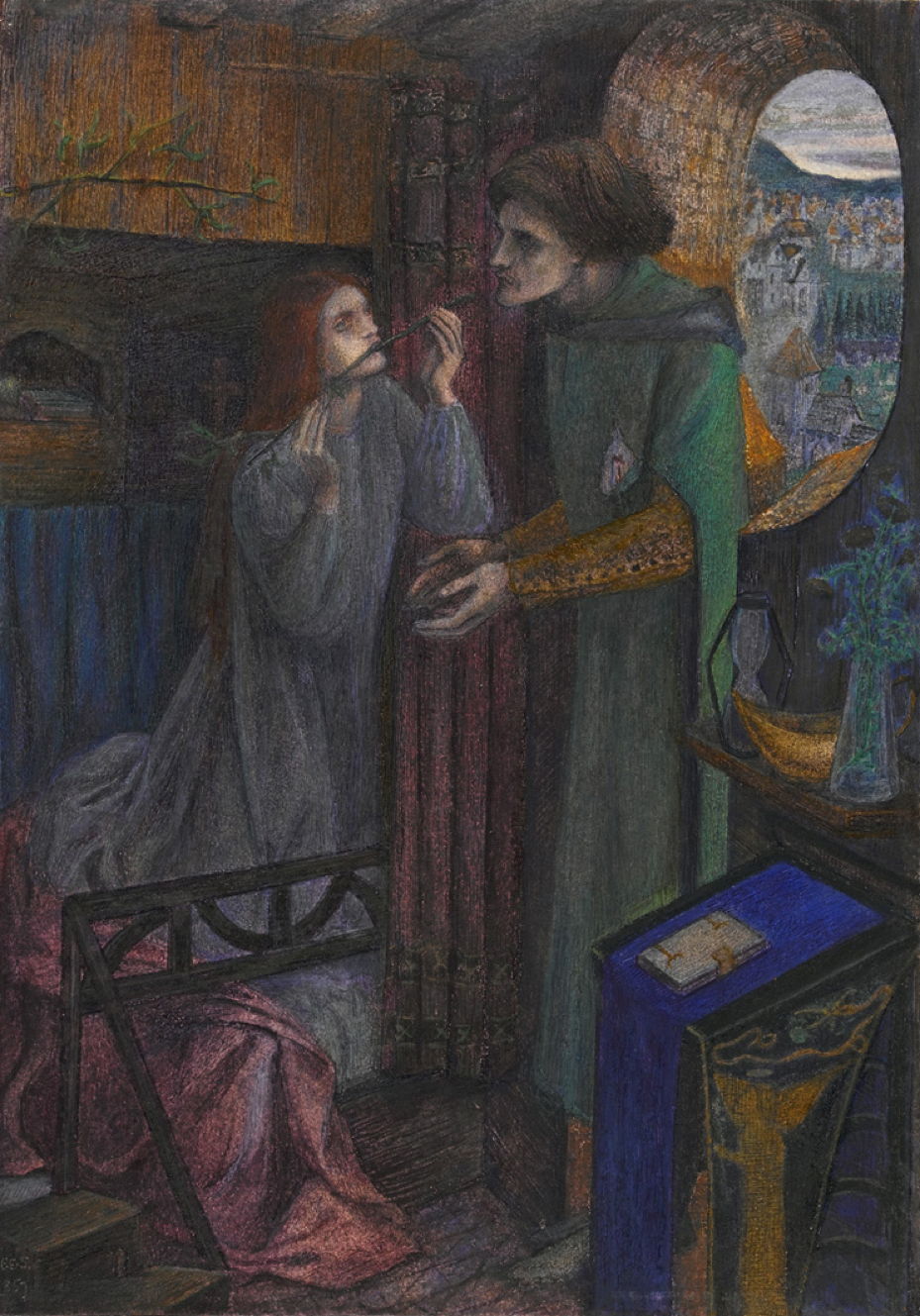
Elizabeth Eleanor Siddal Rossetti (1829–1862), Clerk Saunders (1857), watercolour, bodycolour, coloured chalks, on paper, laid on a stretcher, 28.4 x 18.1 cm, Fitzwilliam Museum, Cambridge, England. Wikimedia Commons.
Lizzie Siddal was an artist in her own right, and was trained by Rossetti, whose influence can be seen in her Clerk Saunders from 1857. This watercolour also has a popular literary reference to the ballad of the same name in Scott’s collection Minstrelsy of the Scottish Border. It shows the heroine May Margaret kneeling on her bed and raising a wand to her lips. As she does this, the ghost of her murdered lover Clerk Saunders walks through the wall, and asks her to renew her vows.
Ford Madox Brown (1821–1893), The Last of England (1852/55), oil on panel, 82.5 x 75 cm, Birmingham Museum and Art Gallery, Birmingham, England. Wikimedia Commons.
Ford Madox Brown’s The Last of England (1852/55) brings another tale of modelling fortitude. Inspired by the emigration of the Pre-Raphaelite sculptor Thomas Woolner to Australia, Brown’s middle class couple is a family portrait. The husband is a self-portrait, his wife is Emma Brown, the artist’s wife, and tucked under her weatherproof hooded travelling cape is their infant son Oliver (Nolly), who was only born in 1855, just in time for completion of this painting.
In accordance with Pre-Raphaelite ideals, Brown painted this largely outdoors, and had his models sit outside in all weathers, even during the winter. His aim here was to recreate “the peculiar look of light all round” he considered prevailed when at sea.
Another familiar masterpiece is William Holman Hunt’s Awakening Conscience from 1851-53. A ‘problem picture’ about an extra-marital relationship with a ‘kept woman’, this small house was in the leafy London suburb of Saint John’s Wood. Hunt’s original model was Annie Miller, who had started her working life as a barmaid, before the artist spotted her as the model he needed for this work.
Hunt rashly promised to teach Miller to be a ‘lady’ along the lines of Eliza Doolittle in My Fair Lady, with the goal of them marrying, but by the time he returned from a working visit to the Middle East, Miller had succumbed to Rossetti’s desires. Hunt then scraped Miller’s face clear and replaced it with that of his wife Fanny Holman Hunt.
Dante Gabriel Rossetti (1828–1882), Bocca Baciata (1859), oil on panel, 32.1 x 27.0 cm, Museum of Fine Arts, Boston, MA. Wikimedia Commons.
Dante Gabriel Rossetti depended on a succession of beautiful women, “stunners” as he called them, as both muses and models. This unashamedly sensuous portrait of one of his better-known flames, Fanny Cornforth, is something of an apogee, even for him. By modern standards, Bocca Baciata may not appear particularly sensuous or shocking. At the time, though, her loose hair, unbuttoned garments, and the abundance of flowers and jewellery were seen as marks of the temptress. These are reinforced by one obvious symbol: the apple, harking back to the Fall of Man. And staid viewers such as William Holman Hunt were shocked, writing “it impresses me as very remarkable in power of execution – but still more remarkable for the gross sensuality of a revolting kind, peculiar to foreign prints”, by which he meant imported pornographic prints.
Dante Gabriel Rossetti (1828–1882), Veronica Veronese (1872), oil on canvas, 109.2 × 88.9 cm, Delaware Art Museum, Wilmington, DE (Samuel and Mary R. Bancroft Memorial, 1935). Courtesy of Delaware Art Museum, via Wikimedia Commons.
Lizzie Siddal’s death in 1862 did nothing to reform Rossetti’s conduct. In 1868, he met the beautiful Alexa Wilding, who immediately became his next obsession. Four years later, she was his model for Veronica Veronese (1872), commissioned by Frederick Leyland, a Liverpool shipping magnate. It then joined Leyland’s collection of Rossetti’s images of women in the drawing room of his Kensington, London, residence.
Dante Gabriel Rossetti (1828–1882), Pandora (1871), oil on canvas, 131 × 79 cm, Private collection. Wikimedia Commons.
Rossetti’s first painting of Pandora, completed in 1871, was one of his earlier paintings of Jane Morris, the wife of his friend William Morris, and the subject of Rossetti’s late passionate obsession. It was commissioned by John Graham for 750 guineas, who was so pleased with the result that he exhibited it, against Rossetti’s wishes, in Glasgow the following year.
Although Rossetti was notorious for his many relationships, Sir Edward Coley Burne-Jones, First Baronet of Rottingdean and of the Grange, appeared more august in photographs. Yet in 1870 he was at the centre of a major scandal and was asked to remove one of his paintings from the exhibition of the Old Water-Colour Society.
Edward Burne-Jones (1833–1898), Phyllis and Demophoon (1870), bodycolour and watercolour with gold medium and gum arabic on composite layers of paper on canvas, 47.5 x 93.8 cm, Birmingham Museum and Art Gallery, Birmingham, England. Wikimedia Commons.
The painting in question was Phyllis and Demophoon (1870), a watercolour showing Phyllis embracing her estranged husband from within the structure of an almond tree. Burne-Jones’ exposure of Demophoon’s genitals in the exact centre of the painting was the most obvious reason for the reaction, but behind it was a more compelling problem: both figures were modelled by Maria Zambaco, who had recently been Burne-Jones’ mistress.
Maria Zambaco was one of three cousins from the leading expatriate (if not refugee) Greek families of London; the other two were Aglaia Coronio and Marie Spartali, an outstanding painter who later married to become Marie Spartali Stillman.
Edward Burne-Jones (1833–1898), The Mill (1882), oil on canvas, 91 × 197 cm, The Victoria & Albert Museum, London. Wikimedia Commons.
All three appear in Burne-Jones’ The Mill (1882). Shown from left to right are Maria Zambaco, Marie Spartali Stillman, and Aglaia Coronio.
Burne-Jones had married Georgiana MacDonald in 1860, and the couple had a son born the following year, and a daughter born in 1866. Maria Cassavetti was ten years younger than Burne-Jones, had married a Dr Zambaco in 1860, and went to live in France, having her own son and daughter by him. When her marriage collapsed, she moved back to London in 1866, and met Burne-Jones when he was commissioned to paint Maria by her mother.
Burne-Jones and Maria Zambaco soon became lovers, a relationship that intensified during 1868, and reached a crisis the following year. Burne-Jones tried to leave his wife and family to live with Zambaco. Maria tried to convince him to join her in a suicide pact, taking an overdose of laudanum by the canal in London’s Little Venice. The police had to be called, and what was already a public scandal become the talk of London.
Although Burne-Jones and Zambaco broke up, he continued to use her as a model in his paintings through the 1870s, and in the group often known as the Three Graces in The Mill. After the Old Water-Colour Society had ‘invited’ him to remove his Phyllis and Demophoon, Burne-Jones exhibited little for almost a decade.
Life as a Pre-Raphaelite was nothing if not complicated.
The former officer traveled to China to train pilots of the People’s Liberation Army Air Force without approval from the State Department, the Justice Department said.
The great majority of paintings are made on rectangular supports, but since ancient times some artists have opted for circular or elliptical shapes instead. These are known as tondo, from the Italian rotondo meaning “round”, with the plural of tondi, or tondos if you really must.
“Aberdeen Painter”, Triptolemus and Korē (c 470-460 BCE), tondo of a red-figure Attic cup discovered at Vulci, 36 cm diameter, Musée du Louvre, Paris. Image by Jastrow, via Wikimedia Commons.
This tondo of a red-figure Attic cup, now in the Louvre, is typical of classical depictions of Triptolemus and Ceres, and dates from 470-460 BCE. The young deity is sat in Ceres’ special winged chariot, as she provides him with seed to be distributed to the lands around the world.
Fabricating a perfect tondo using wooden panels has remained relatively unusual, probably for practical reasons. The increasing use of fabric stretched on a wooden frame enabled them to become more popular, as they did during the Renaissance.
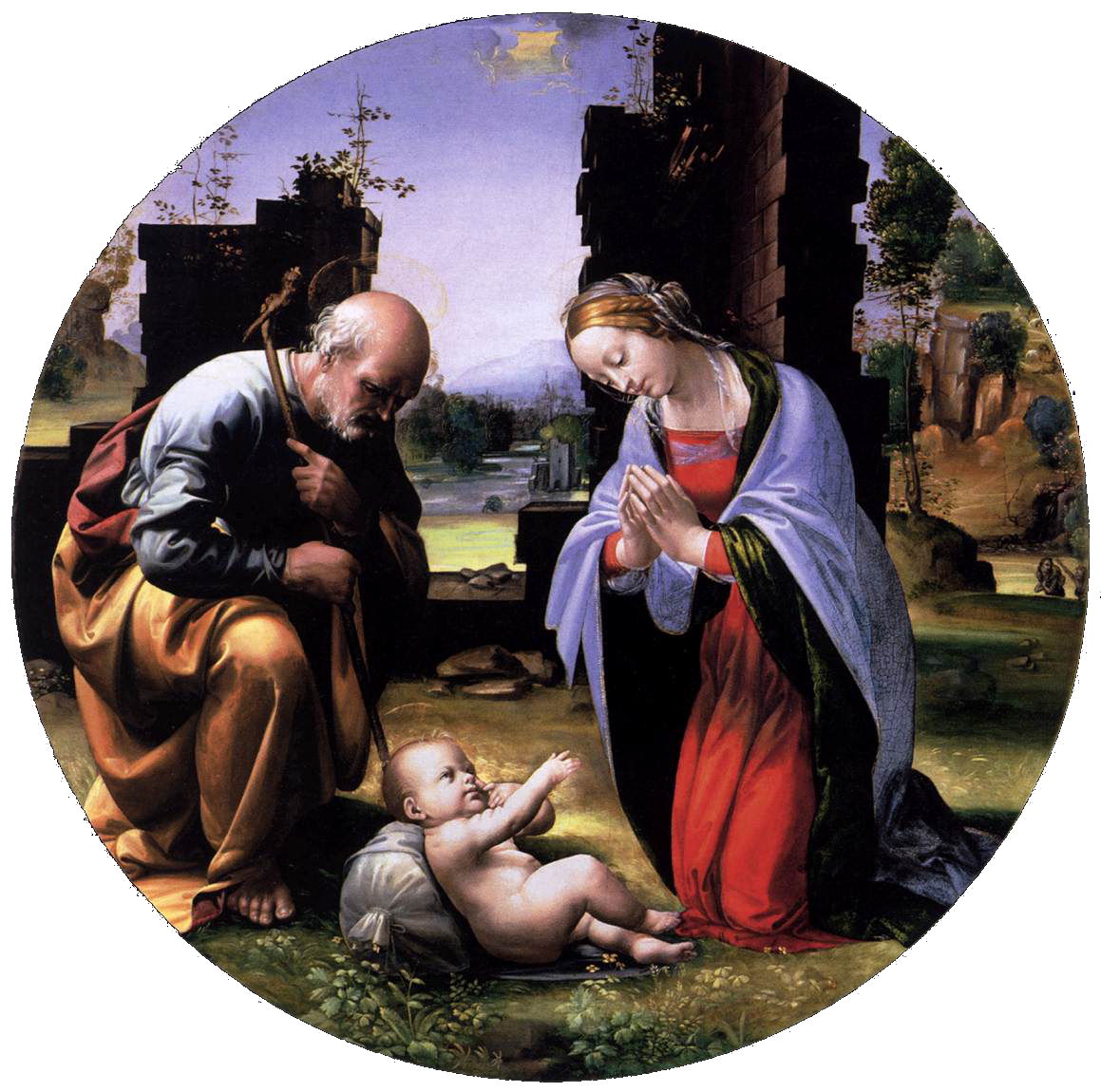
Fra Bartolomeo (1472–1517), Adoration of the Child (c 1499), oil on canvas, dimensions not known, Galleria Borghese, Rome. Wikimedia Commons.
Far Bartolomeo’s tondo of the Adoration of the Child (c 1499) is a fine painting of an enormously popular Christian scene, with Jesus’ parents paying their respects to the baby.
The softer geometry of circles and ellipses makes tondi ideally suited to portraits of the Madonna and child, and for portraits of women more generally. Their use has proved particularly successful in the paintings of Raphael.
Raphael (Rafael Sanzio de Urbino) (1483–1520), The Alba Madonna (c 1510), oil on panel mounted on canvas, diameter 94.5 cm, National Gallery of Art, Washington, DC. Wikimedia Commons.
Raphael’s Alba Madonna was probably painted around 1510, and has spawned many replicas. It was commissioned by a bishop for the church of the Olivetans in Nocera dei Pagani, a town on the coastal plain of the south-west of Italy, in the province of Salerno. Its landscape background is also notable.
Raphael (Rafael Sanzio de Urbino) (1483–1520), Madonna della Sedia (Seated Madonna with the Child on her Lap and the Young Saint John) (1513-14), oil on panel, diameter 71 cm, Palazzo Pitti, Florence, Italy. Wikimedia Commons.
Of all Raphael’s tondo Madonnas, it’s his Madonna della Sedia (Madonna of the Chair) from 1513-14 which is my favourite. It shows a thoroughly real and natural mother with two infants, every surface texture rendered as in life, in a close-cropped composition matched to its shape.
Tondi have also proved ideal for self-portraits.
Sofonisba Anguissola (1530–1625), Self-portrait (date not known), oil on panel, diameter 13.2 cm, Private collection. Wikimedia Commons.
This small undated Self-portrait shows Sofonisba Anguissola, the first great female master.
Nicolas Poussin (1594–1665), Time Defending Truth against the Attacks of Envy and Discord (1641), oil on canvas, diam 297 cm, Musée du Louvre, Paris. Wikimedia Commons.
Although his best-known paintings were all rectangular, Nicolas Poussin’s later tondo Time Defending Truth against the Attacks of Envy and Discord (1641) puts Father Time at its centre, with a firm grip around Truth’s waist, while Envy and Discord sit below them. On this occasion Time doesn’t have a hand free for an hour-glass. This appears to have been projected for placement in a round ceiling, another good reason for his choice of format.
Giovanni Battista Tiepolo (1696–1770), Discovery of the True Cross and Saint Helena (c 1743), oil on canvas, 490 cm diam, Gallerie dell’Accademia, Venice. Wikimedia Commons.
Although Tiepolo’s Discovery of the True Cross and Saint Helena (c 1743) is painted on a flat tondo, it was intended for display from the ceiling of the Capuchin church in Castello, as demonstrated in its projection.
Angelica Kauffman (1741–1807), Cymon and Iphigenia (c 1780), oil on canvas, diam 62.2 cm, Gibbes Museum of Art, Charleston, SC. Wikimedia Commons.
In about 1780, Angelica Kauffman painted this delightful tondo of Cymon and Iphigenia, a variation on a popular theme.
Anne-Louis Girodet de Roussy-Trioson (1767–1824), Portrait of Mlle. Lange as Danae (1799), oil on canvas, 60.3 x 48.6 cm, Minneapolis Institute of Arts, Minneapolis, MN. Wikimedia Commons.
Girodet chose a large elliptical tondo for his ‘revenge’ portrait of Mlle Lange, who had refused his previous portrait of her. As a motif in painting, Danaë had come to be represented as a reclining, beautiful, nude woman, on whom a stream of golden coins was falling, and it was that stream Girodet wanted to exploit. It could have only one reading in this context: that Mlle Lange sold her body in return for money, and Girodet was happy to be even more explicit.
Tondi were also imitated on occasion. Ford Madox Brown’s first painting to establish his interest in more complex storytelling was The Last of England, which he started as his response to the emigration to Australia of the only Pre-Raphaelite sculptor, Thomas Woolner, in 1852.
Ford Madox Brown (1821–1893), The Last of England (1852/55), oil on panel, 82.5 x 75 cm, Birmingham Museum and Art Gallery, Birmingham, England. Wikimedia Commons.
Brown’s original oil version is one of his most subtle compositions. Central to its imitation of a circular tondo is a middle-class couple who are not enjoying the fact that their migrant ship is ‘all one class’. They both stare with grim determination at the prospect of sharing the next few weeks with the rowdy working class passengers behind them, eating the same increasingly stale vegetables which are now slung from cords around the ship’s rail in front of them.
This isn’t just a couple, though: look closely at their hands, and the woman’s left hand is clutching the tiny hand of her baby, who is safely swaddled inside her weatherproof hooded travelling cape. Her right hand, wearing a black leather glove, grasps that of her husband, whose left hand is tucked under his heavy coat. Splashes of brilliant colour are supplied by the wind blowing the woman’s ribbons.
Richard Dadd (1817–1886), Contradiction: Oberon and Titania (1854-8), oil on canvas, 61 x 75.5 cm, Private collection. Wikimedia Commons.
Richard Dadd’s Contradiction: Oberon and Titania from 1854-8 develops his early faerie paintings into a new and unique style, and was painted for the hospital’s first resident Physician-Superintendent, William Charles Hood.
Dadd takes its theme from Shakespeare’s Midsummer Night’s Dream, and there’s hardly a square millimetre of canvas into which he hasn’t squeezed yet another curious detail. Like other great imaginative painters such as Bosch before, his dense details dart about in scale: there are tiny figures next to huge leaves and butterflies, and towards the top these distortions of scale generate an exaggerated feeling of perspective, which his choice of format may have enhanced.
Carlos Schwabe (1866–1926), Medusa (1895), watercolour on paper, dimensions not known, Private collection. Wikimedia Commons.
Carlos Schwabe’s watercolour tondo portrait of Medusa from 1895 is one of the most startling paintings in the round.
All good art suppliers continue to do a steady trade in tondi.

 Login
Login