Reading view

There are new articles available, click to refresh the page.

The Dutch Golden Age: How did it happen?

The Golden Age of the Dutch Republic developed as a result of a combination of circumstances, some of which are made clear in previous articles in this series. This summary brings those together with a small selection of works to illustrate them.

The Northern Renaissance, that had started in the Flemish countries to the south in the 1420s, had flourished in centres such as Antwerp and Brussels during the sixteenth century. As it matured into the Baroque during the early decades of the Golden Age, it was led by Peter Paul Rubens. This gained from the early adoption and development of oil painting on canvas using realist techniques to depict increasingly secular themes, which became centred in the workshops of Antwerp.

Flanders and Brabant in the south remained part of the Habsburg empire ruled from Spain, with intolerance towards Protestant movements leading to religious conflict. Some artists who trained in those countries migrated to the north, where they accelerated the growth of Dutch Golden Age painting.

peetersmesa
Clara Peeters (c 1594-1640), Mesa (Table) (c 1611), oil on panel, 55 x 73 cm, Museo Nacional del Prado, Madrid. Wikimedia Commons.

Among them was Clara Peeters, who seems to have trained in Antwerp before painting innovative still lifes in the Dutch Republic. By about 1611, when she painted Mesa (Table) above, she was selling her paintings to the Spanish royal family. Some of her works ended up in the Spanish Royal Collection, and today remain in the Prado in Madrid as a result. Dutch painters developed her themes, and settings for meals, particularly that of breakfast, later became a sub-genre.

As a secular confederation of provinces, art in the republic wasn’t dominated by religious themes or the patronage of a royal dynasty. Commissions seldom came from religious organisations, but from guilds and other non-religious groups that were flourishing in the growing cities. Most popular among those were group portraits of occupational guilds.

vanmiereveltanatomylesson
Michiel Jansz. van Mierevelt (1566–1641) and Pieter van Mierevelt (1596–1623), The Anatomy Lesson of Dr. Willem van der Meer (1617), oil on canvas, 146.5 x 202 cm, Museum Prinsenhof Delft, Delft, The Netherlands. Wikimedia Commons.

Although guilds had been an important part of Renaissance society, few if any appear to have commissioned group portraits, which were largely confined to noble families. In 1617, Michiel van Mierevelt and his son Pieter, specialists in portraiture, painted The Anatomy Lesson of Dr. Willem van der Meer, one of the earliest portraits of a social group from the Dutch Golden Age. These are thought to be members of the Surgeons’ Guild of the city of Delft, who commissioned this work.

Frans Hals (1582/1583–1666), Militia Company of District XI under the Command of Captain Reynier Reael (1633-37), oil on canvas, 209 x 429 cm, Rijksmuseum, Amsterdam, The Netherlands.

Among the groups responsible for many of these portrait commissions was the civil militia. Frans Hals’ Militia Company of District XI under the Command of Captain Reynier Reael (1633-37) shows a group known as the Meagre Company. He was commissioned to paint this in 1633, but three years later it remained unfinished, and the commission was transferred to Codde to complete the right side of the canvas and many of the hands and faces a year later.

Migration and international trade transformed cities like Amsterdam, which rapidly became multicultural at a time when much of Europe was still oppressing minority groups such as Jews.

hobbemahaarlemlock
Meindert Hobbema (1638–1709), The Haarlem Lock, Amsterdam (1663-65), oil on canvas, 77 x 98 cm, The National Gallery, London. Wikimedia Commons.

Meindert Hobbema’s view of The Haarlem Lock, Amsterdam from 1663-65 shows one of the city’s working locks with a raising bridge, with the masts of many ships in the harbour beyond.

avercampwinterlandscapeskaters1608
Hendrick Avercamp (1585–1634), Winter Landscape with Skaters (1608), oil on panel, 77.3 x 131.9 cm, Rijksmuseum Amsterdam, Amsterdam, The Netherlands. Wikimedia Commons.

Avercamp’s Winter Landscape with Skaters from 1608 shows the many who have spilled out from the warmth of buildings to take to the ice.
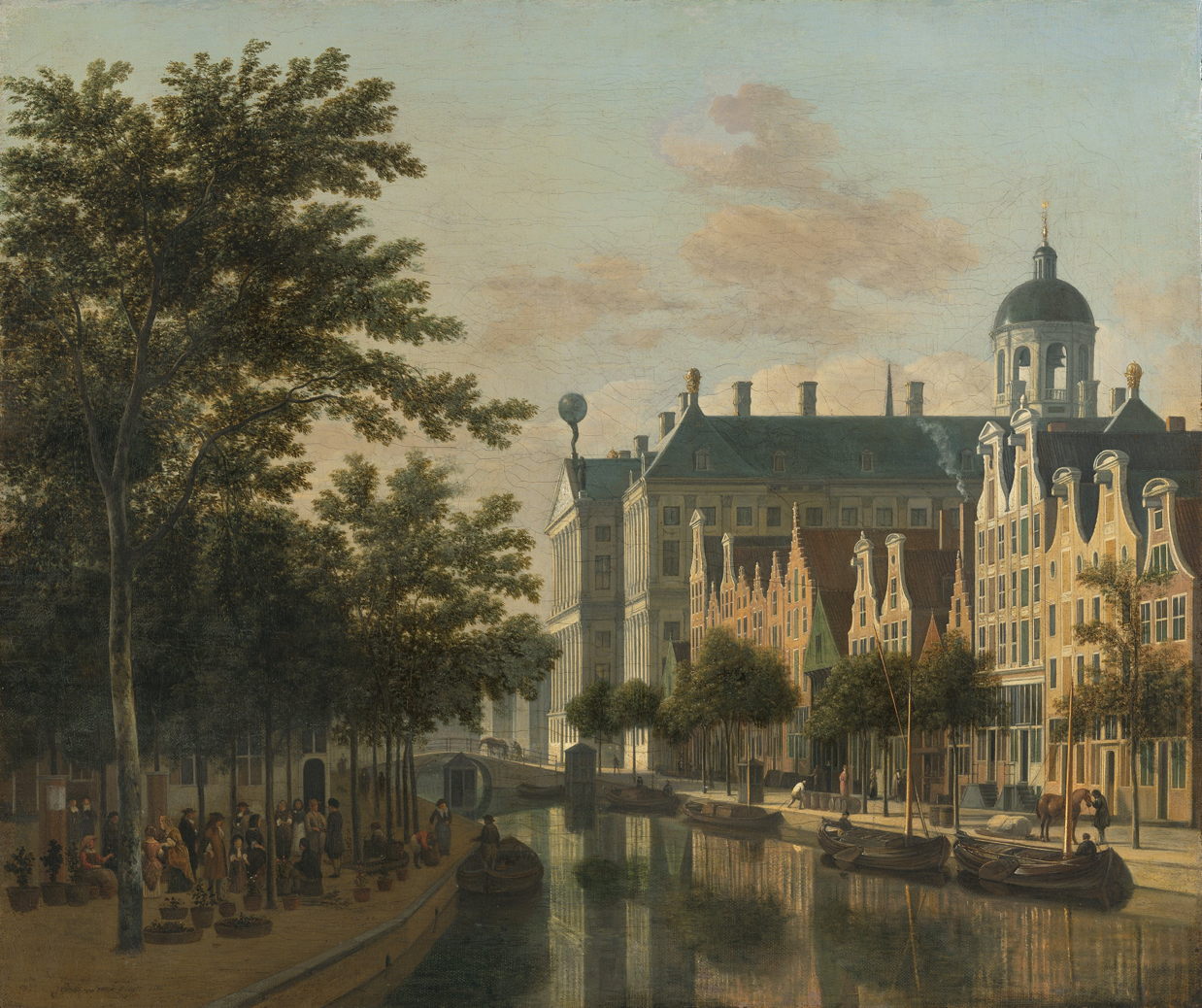
Gerrit Adriaenszoon Berckheyde (1638–1698), The Nieuwezijds Voorburgswal, Amsterdam (1686), oil on canvas, 54 x 64 cm, Museo Nacional Thyssen-Bornemisza, Madrid, Spain. Wikimedia Commons.

Berckheyde’s The Nieuwezijds Voorburgswal, Amsterdam from 1686 shows the canal running at the rear of Amsterdam’s City Hall, built between 1648-65, and featuring the octagonal tower seen at the right. By this time the population of Amsterdam had risen to more than 220,000, many of them immigrants.

With the growth of trade came increasing prosperity, and urban populations who became avid collectors. For some it was household linen or clothing, for others Delft tiles, and for the many who wanted to decorate the walls of their houses, paintings were ideal. Those artists who had achieved recognition could sell through art dealers, some of whom were painters themselves. For smaller and more everyday works, art fairs were held, and collectors flocked to attend them in search of bargains.

Jacob Mathieusen, and his wife, in the background the fleet in the roads of Batavia, by Aelbert Cuyp
Aelbert Cuyp (1620–1691), A Senior Merchant of the Dutch East India Company (1650-59), oil on canvas, 138 x 208 cm, Rijksmuseum Amsterdam, Amsterdam, The Netherlands. Wikimedia Commons.

A Senior Merchant of the Dutch East India Company, painted during 1650-59, is thought to show Jacob Mathieusen and his wife, against a background of the company fleet in Batavia roads. This city in what was then the Dutch East Indies is now the site of Jakarta in Indonesia.

As more secular genres became popular, painters specialised in sub-genres in an effort to appeal to new markets.

beerstraatenoldtownhallamsterdam
Jan Abrahamsz Beerstraaten (1622–1666), The Old Town Hall of Amsterdam on Fire, 7 July 1652 (1652-55), oil on panel, 89 x 121.8 cm, Amsterdam Museum, Amsterdam, The Netherlands. Wikimedia Commons.

In mid 1652, Jan Abrahamsz Beerstraaten seems to have witnessed the destruction by fire of part of the centre of Amsterdam, shown in his studio painting of The Old Town Hall of Amsterdam on Fire, 7 July 1652 (1652-55).

molenaersmell
Jan Miense Molenaer (c 1610–1668), Smell (1637), oil on panel, 19.5 x 24.3 cm, Koninklijk Kabinet van Schilderijen Mauritshuis, The Hague, The Netherlands. Wikimedia Commons.

The sense of Smell, from 1637, is the best of Jan Miense Molenaer visual jokes, a thoroughly secular if not irreverent scene from everyday life.

vanwijnenwitchessabbath
Domenicus van Wijnen (1661–1698), The Witches’ Sabbath by Moonlight (date not known), oil on canvas, 73 x 57.5 cm, location not known. Wikimedia Commons.

The theme of witchcraft was explored in Domenicus van Wijnen’s Witches’ Sabbath by Moonlight, set in a moonlit Italian landscape. This combines many of the now-classical symbols associated with the Dark Arts, and is taking place at an outdoor altar set up at the foot of the gallows, on which a dead body hangs.

With the driving force in painting being removed from a royal family, and professional power resting with local guilds of Saint Luke, the republic avoided adopting a privileged academy system. Painters trained first as apprentices before demonstrating the skills expected of a master, so gaining admission to the guild. These too had originated in Flanders, with the foundation of Antwerp’s by 1382. Amsterdam led in 1579, and several other cities in the Dutch Republic followed from 1609.

Taken together, the main driving forces of Dutch Golden Age painting were a rich diversity in both society and painted themes, and the popularity of paintings among the republic’s citizens. As a result, visual art thrived.

The Dutch Golden Age: Decline and legacy

The Golden Age of the Dutch Republic was a period of war and turmoil. It started in the latter half of the Eighty Years War, thrived when that came to an end in 1648, and collapsed following the Disaster Year (Rampjaar) of 1672. That year brought both the Franco-Dutch and Third Anglo-Dutch Wars, invasion, rebellion, economic crisis, and collapse of the art market.

coypellouisxiv
Antoine Coypel (1661–1722), Glory of Louis XIV after the Peace of Nijmegen (1681), oil on canvas, 153 x 185 cm, Musée Fabre, Montpellier, France. Image by Finoskov, via Wikimedia Commons.

When he was just twenty, the French artist Antoine Coypel painted this Glory of Louis XIV after the Peace of Nijmegen (1681), which gained him admission as a full member to the Académie Royale.

The Treaty of Nijmegen brought an end to the Franco-Dutch War of 1672-78, and was one of a series France signed between August 1678 and September of the following year. These were acclaimed a great success for Louis XIV and France, which gained extensive territory in the north and east as a result. Louis was henceforth known as the Sun King. In this elaborate allegorical flattery, the king is being crowned in the upper left, above a gathering of deities including Minerva, who is wearing her distinctive helmet and golden robes.

Painting didn’t stop, of course, and some artists continued into the following century, but the number of masters declined rapidly.

vanwijnentemptationstanthony
Domenicus van Wijnen (1661–after 1690), The Temptation of Saint Anthony (c 1685), media and dimensions not known, The National Gallery of Ireland, Dublin. Wikimedia Commons.

Domenicus van Wijnen continued to paint, for example his radical interpretation of The Temptation of Saint Anthony in about 1685. Although this may have appeared an outlier at the time, its symbols and composition may have inspired the ‘faerie’ paintings that became popular in the middle of the nineteenth century.

vanderwerffjudgementofparis
Adriaen van der Werff (1659–1722), The Judgement of Paris (1716), oil on panel, 63.3 x 45.7 cm, Dulwich Picture Gallery, London. Wikimedia Commons.

Other artists like Adriaen van der Werff reverted to more traditional themes and style, in his Judgement of Paris from 1716.

tenkatesoldiermeninn
Herman Frederik Carel ten Kate (1822–1891), A Soldier and Men in an Inn (date not known), watercolour, white body paint and black chalk on paper, 21.5 x 32.8 cm, location not known. Wikimedia Commons.

The Golden Age was revisited by artists in the nineteenth century, particularly in the period scenes painted by Herman Frederik Carel ten Kate. His Soldier and Men in an Inn shows a scene from the Eighty Years War, with the walls decorated by blue on white Delft tiles. This must have been painted between 1850-80, over two centuries after the end of that war.

israelsseamstress
Jozef Israëls (1824–1911), The Seamstress (1850-88), oil on canvas, 75 × 61 cm, Rijksmuseum Amsterdam, Amsterdam, The Netherlands. Wikimedia Commons.

Early in the career of the Dutch artist Jozef Israëls, he painted The Seamstress (1850-88) as a genre interior from the Golden Age. A young Dutchwoman works with her needle and thread in the light of an unseen window at the left. In the background to the right, there’s a group of Delft tiles on the wall, and there’s a single tulip in a glass vase at the left.

The impact of Golden Age paintings on European art history was broad and deep, with secular themes becoming more popular than the religious and mythological works that had dominated the art of the Renaissance. New genres, like still life, may not have been rated as highly as history painting, but became widespread.

chardinattributesarts
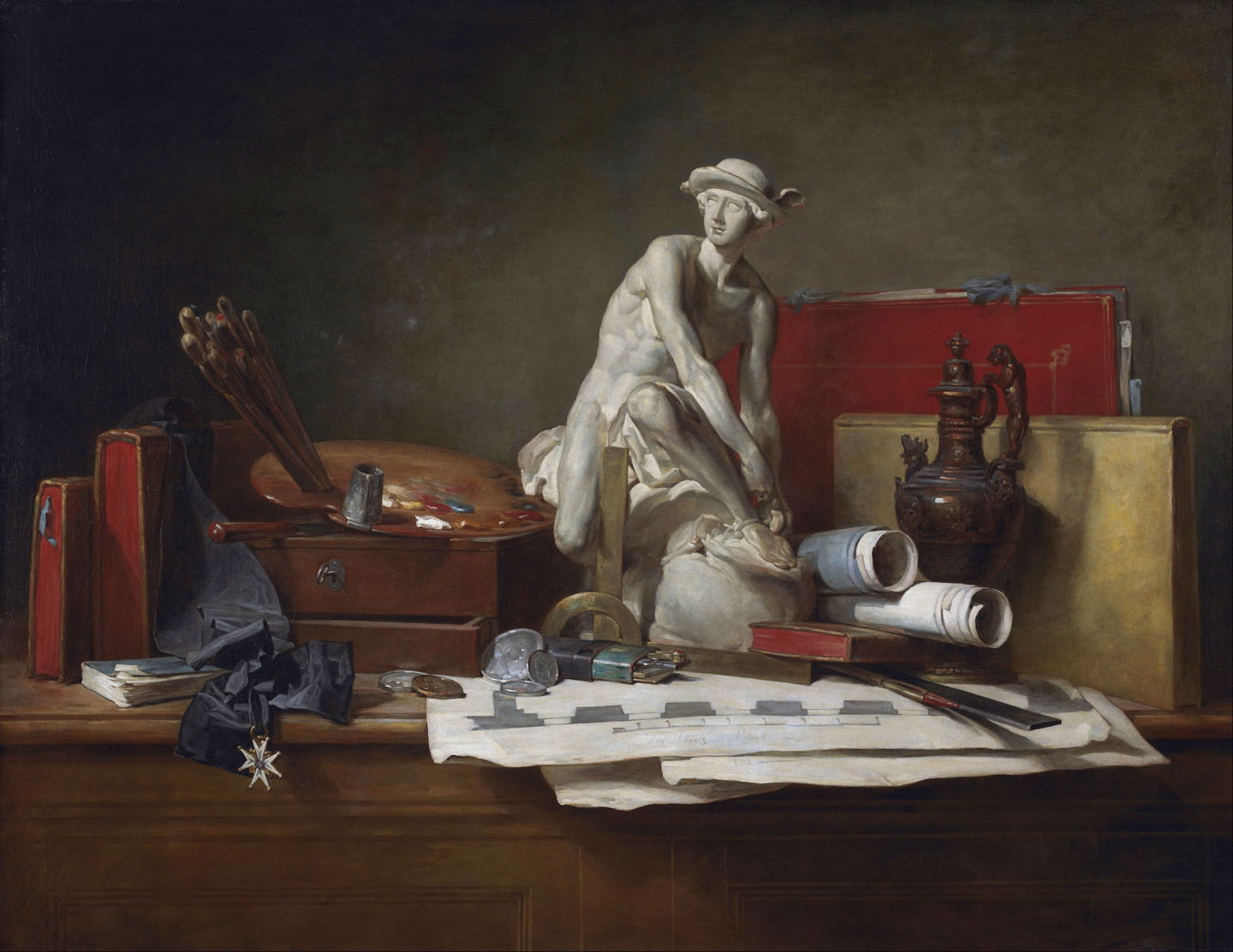
Jean-Baptiste-Siméon Chardin (1699–1779), The Attributes of the Arts and the Rewards Which Are Accorded Them (1766), oil on canvas, 113 x 145 cm, Minneapolis Institute of Art, Minneapolis, MN. Wikimedia Commons.

Late in his career, in 1766, Jean-Baptiste-Siméon Chardin painted The Attributes of the Arts and the Rewards Which Are Accorded Them, in which each object has a clear association. Painting is represented by the brushes and palette on top of a paintbox. Architectural drawings and drawing tools represent architecture. The bronze pitcher at the right refers to the work of the goldsmith. The red portfolio tied with ribbons represents drawing. The plaster model of the figure of Mercury in the centre is a copy of a sculpture by J B Pigalle, a friend of Chardin, who was the first sculptor to win the highest French honour for artists, the Order of Saint Michael, whose cross and ribbon are shown at the left.

Greatest impact was in landscape painting. Prior to the Golden Age, landscapes had primarily been used as accessories to other genres. Most were idealised rather than accurate representations of any real location, and many were mere settings for narratives.

vernetitalianateharbour
Joseph Vernet (1714–1789), Italianate Harbour Scene (1749), oil on canvas, 104.4 x 117.8 cm, Dulwich Picture Gallery, London. Wikimedia Commons.

The Dutch vogue for expressive skies spread steadily across Europe. This is reflected in Joseph Vernet’s Italianate Harbour Scene from 1749. He still retains formal compositional elements, with figures in the foreground, and scenery behind, but delights in showing us these towering cumulus clouds lit so richly.

stanfielddutchbargerotterdam
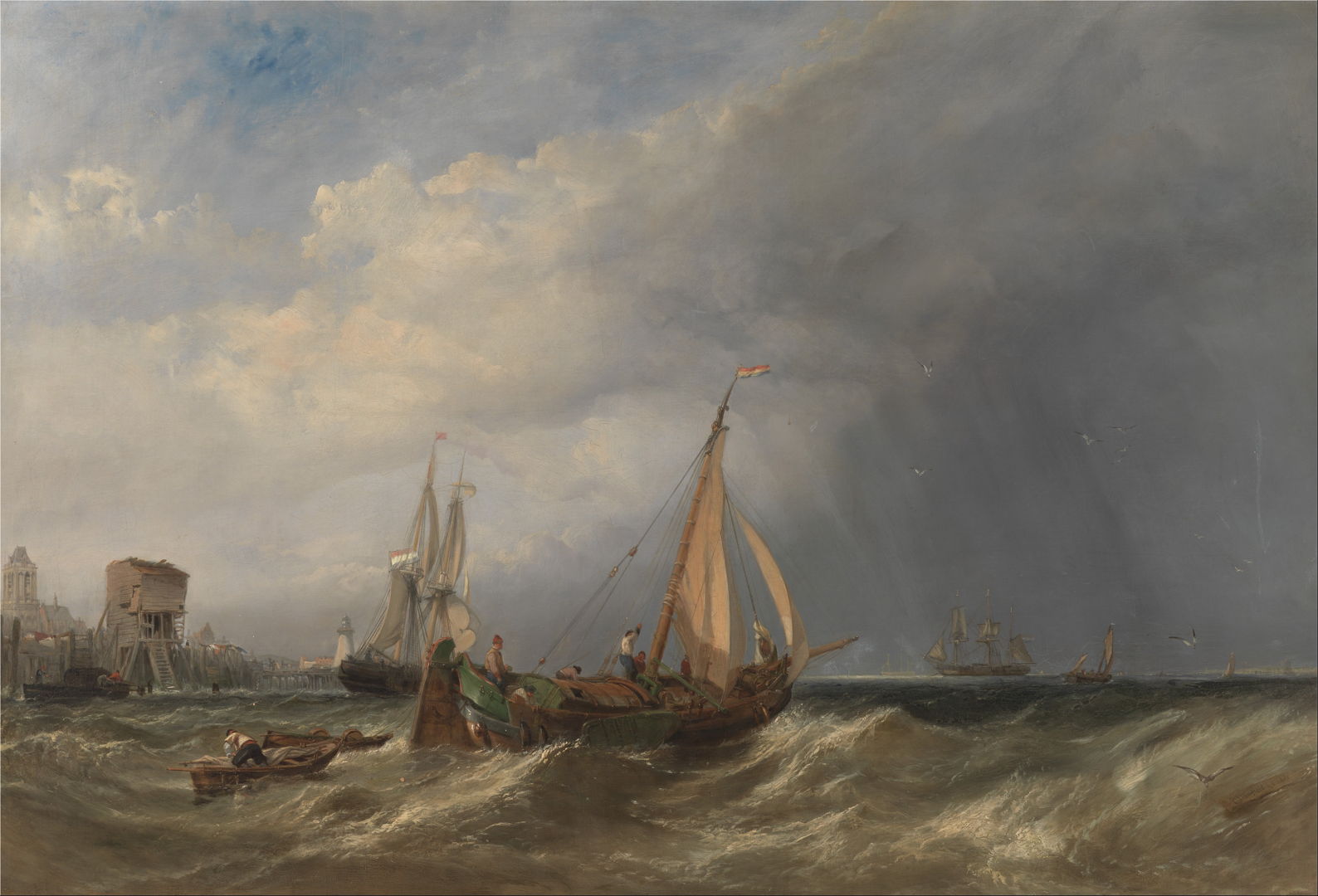
Clarkson Frederick Stanfield (1793–1867), A Dutch Barge and Merchantmen Running out of Rotterdam (1856), oil on canvas, 78.7 x 121.9 cm, Yale Center for British Art, New Haven, CT. Wikimedia Commons.

Marine painting became established as a sub-genre, as shown by the British painter Clarkson Stanfield, whose Dutch Barge and Merchantmen Running out of Rotterdam from 1856 includes rich detail, even down to dilapidated buildings on the waterfront.

John Crome (1768–1821), Landscape with Windmills (date not known), oil on canvas, 51 x 75.5 cm, Muzeum Narodowe w Warszawie, Warsaw, Poland. Wikimedia Commons.

Many of John Crome’s landscapes feature skies inspired by Dutch painters. His Landscape with Windmills is one of his most remarkable, as a signed painting that appears to have been sketched in front of the motif. Others who skied include John Constable and JMW Turner.

Nocturnes were less reliable, as they underwent phases when they were fashionable, then fell into neglect for a while.

whistlernocturnebluegold
James Abbott McNeill Whistler (1834-1903), Nocturne: Blue and Gold — Southampton Water (1872), oil on canvas, 50.5 x 76 cm, Art Institute of Chicago, Chicago, IL. Wikimedia Commons.

James Abbott McNeill Whistler had a penchant for nocturnes, here his Nocturne: Blue and Gold — Southampton Water from 1872. Its vague blue-greys make the pinpoints of light and the rising sun shine out in contrast, a good reason for limiting his palette, while remaining faithful to nature.

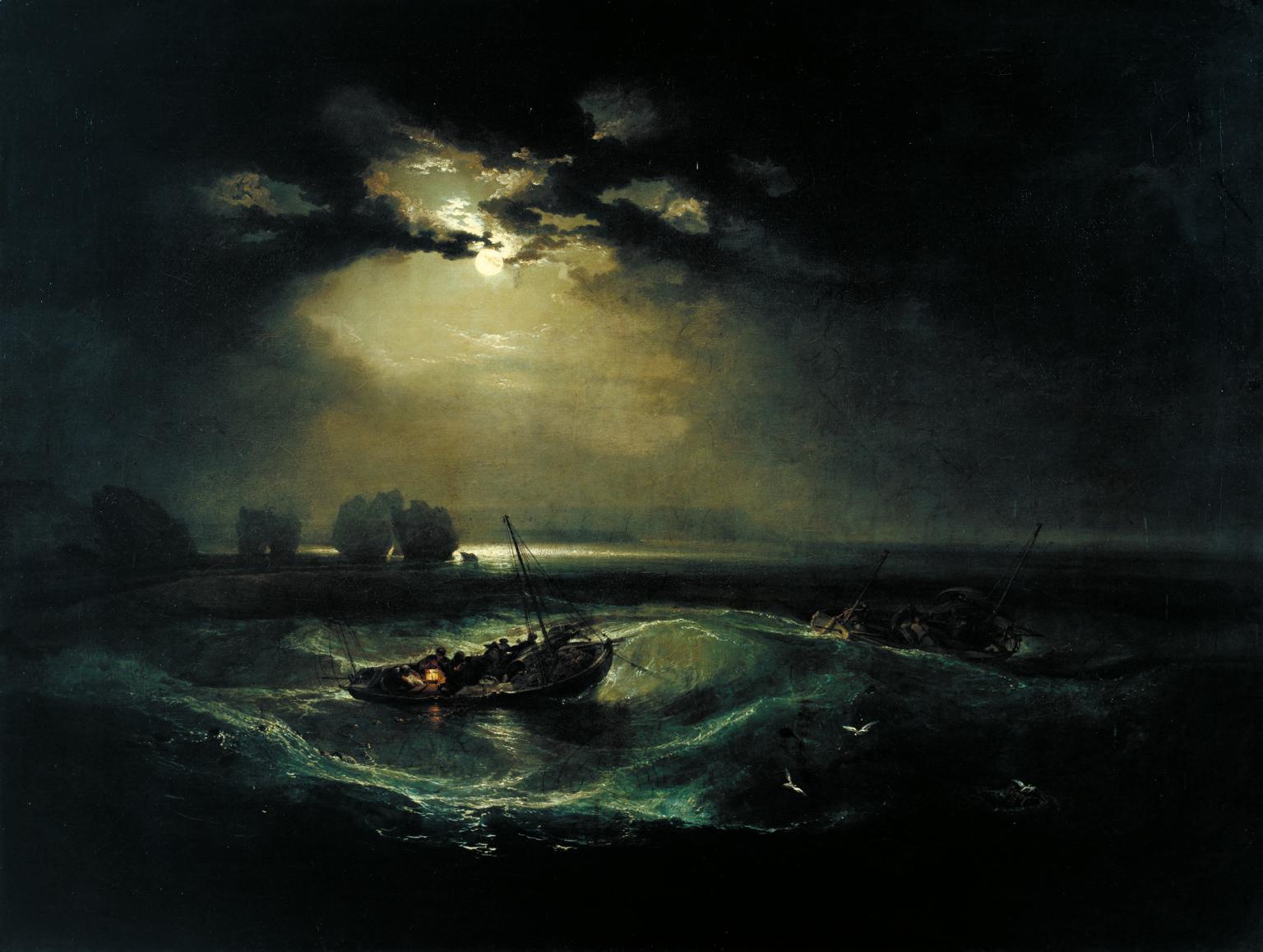
Fishermen at Sea exhibited 1796 by Joseph Mallord William Turner 1775-1851
Joseph Mallord William Turner (1775–1851), Fishermen at Sea (1796), oil on canvas, 91.4 x 122.2 cm, The Tate Gallery (Purchased 1972), London. © The Tate Gallery and Photographic Rights © Tate (2016), CC-BY-NC-ND 3.0 (Unported), http://www.tate.org.uk/art/artworks/turner-fishermen-at-sea-t01585

JMW Turner’s Fishermen at Sea from 1796, showing small fishing boats working in heavy swell off The Needles, on the Isle of Wight, is probably the most famous and successful coastal nocturne of all time. This was Turner’s first oil painting to be exhibited at the Royal Academy, when he was just twenty-one.

Paintings by artists of the Dutch Republic had been sold into collections across Europe, where many remain, influencing today’s artists.

❌