Reading view

There are new articles available, click to refresh the page.

Japonisme in painting: 1889-1918

Hokusai’s woodcuts including The Great Wave of Kanagawa from 1831 may now be most strongly associated with the vogue for Japonisme that swept across Europe in the late nineteenth century, but the prints of others were equally important. Among those were the works of Utagawa Hiroshige (歌川広重) (1797–1858).
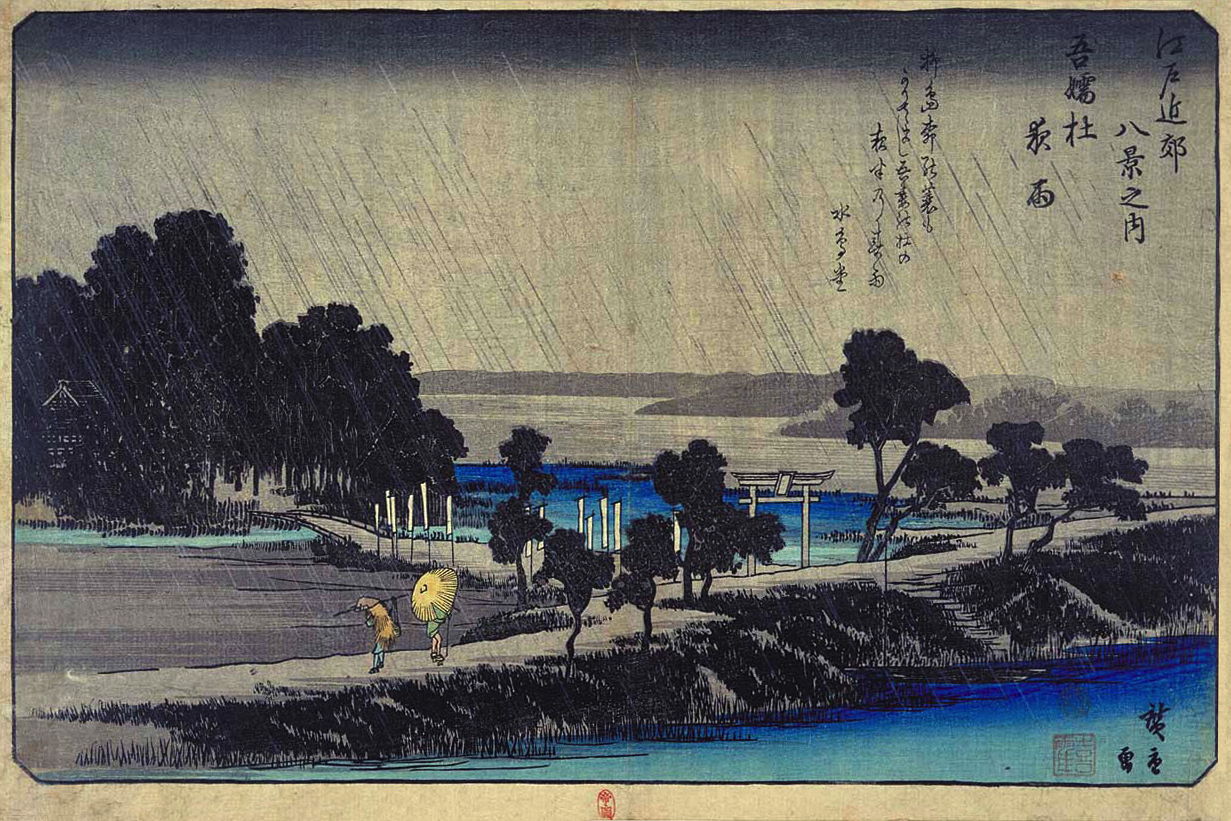
Utagawa Hiroshige (歌川広重) (1797–1858), Evening Rain at Azumi-no Mori (吾嬬杜夜雨) (Edo, 1837-8), woodblock print. Wikimedia Commons.

It’s this print by Hiroshige, Evening Rain at Azumi-no Mori (吾嬬杜夜雨) (Edo, 1837-8), that is now thought to have been influential in Vincent van Gogh’s Rain – Auvers (1890), shown below, that he painted just a few days before his death.

vangoghrainauvers
Vincent van Gogh (1853-1890), Rain – Auvers (1890), oil on canvas, 50.3 x 100.2 cm, National Museum of Wales, Cardiff, Wales. Wikimedia Commons.
bonnardstorkfrogs
Pierre Bonnard (1867-1947), Stork and Four Frogs (c 1889), distemper on red-dyed cotton fabric in a three paneled screen, 159.5 x 163.5 cm, Private collection. The Athenaeum.

Japonisme came to dominate Pierre Bonnard’s early paintings too. Probably the earliest of these is this exquisite three-panelled screen of The Stork and Four Frogs completed around 1889. To mimic the appearance of east Asian lacquerware, Bonnard painted this in distemper on red-dyed cotton fabric. Its story is, though, thoroughly European, based on the fable retold by Jean de la Fontaine of The Frogs who Demand a King.

As Europeans were enthralled by Japanese woodcuts, so more Japanese artists travelled to Europe to learn painting styles and techniques. The son of a samurai in Kagoshima (in the far south-west of Japan), Viscount Kuroda Seiki (黒田 清輝) (Kuroda Kiyoteru) moved to Tokyo, where he first learned English, then switched to French. He went to Paris in 1884 to study law, being supported by his brother-in-law, a member of the Japanese diplomatic mission in France. However after two years there, he changed to study painting in the atelier of Raphael Collin, where he met Kume Keiichirō, also a student of Collin’s; together they explored plein air painting. In 1890 he moved to the international artists’ colony at Grez-sur-Loing, south of Paris, which had been made popular by masters such as Jules Bastien-Lepage.

gauguinseaweedgatherers1
Paul Gauguin (1848–1903), Seaweed Gatherers I (1888-90), gouache and graphite on grey board, 27.6 × 32.4 cm, Private collection. Wikimedia Commons.

In France, Hokusai’s Great Wave found greater interest with Paul Gauguin and his circle who gathered first in Pont-Aven then Le Pouldu in Brittany. Gauguin’s gouache Seaweed Gatherers I (1888-90) shows two Breton women gathering seaweed on the beach. Behind them is a huge wave, its spume formed into a claw, which could only have come from Hokusai.

gauguinondine
Paul Gauguin (1848–1903), In the Waves, or Ondine (I) (1889), oil on canvas, 92.5 x 72.4 cm, Cleveland Museum of Art, Cleveland, OH. Wikimedia Commons.

In 1889, Gauguin painted two works showing Ondine in the sea among waves. The first, known now as In the Waves, or Ondine (I), also refers to Hokusai.
lacombevorhorgreenwave
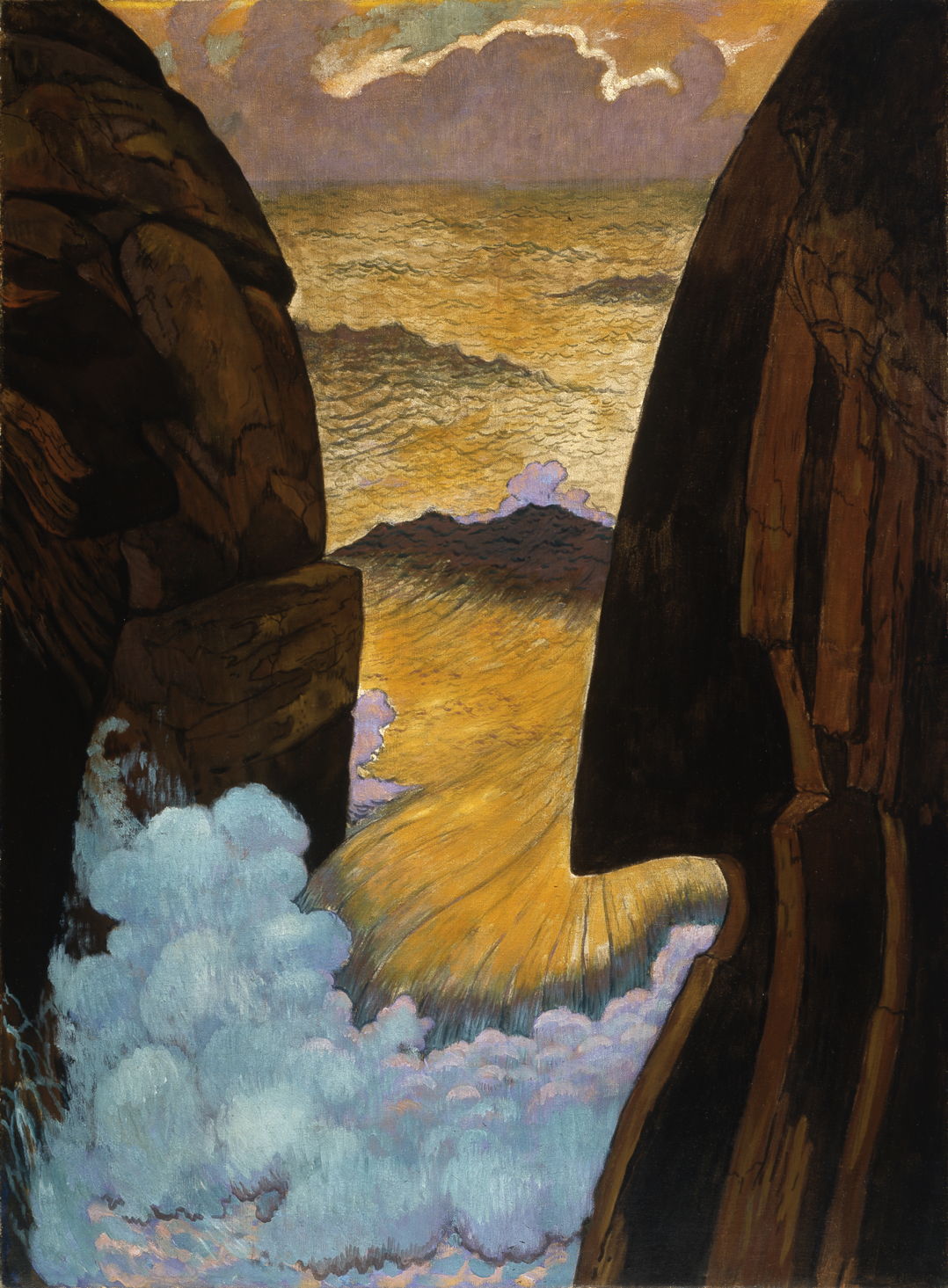
Georges Lacombe (1868–1916), Vorhor, The Green Wave (1896), egg tempera on canvas, 100 x 72 cm, Indianapolis Museum of Art, Indianapolis, IN. Image by Zambonia, via Wikimedia Commons.

The Nabi sculptor, and painter from Gauguin’s school, Georges Lacombe took Hokusai’s motif forward in several of his paintings. This is his treatment of Vorhor, The Green Wave in egg tempera, showing an Atlantic swell coming into the seacliffs of Vorhor near Camaret-sur-Mer in Brittany.
lacombevioletwave
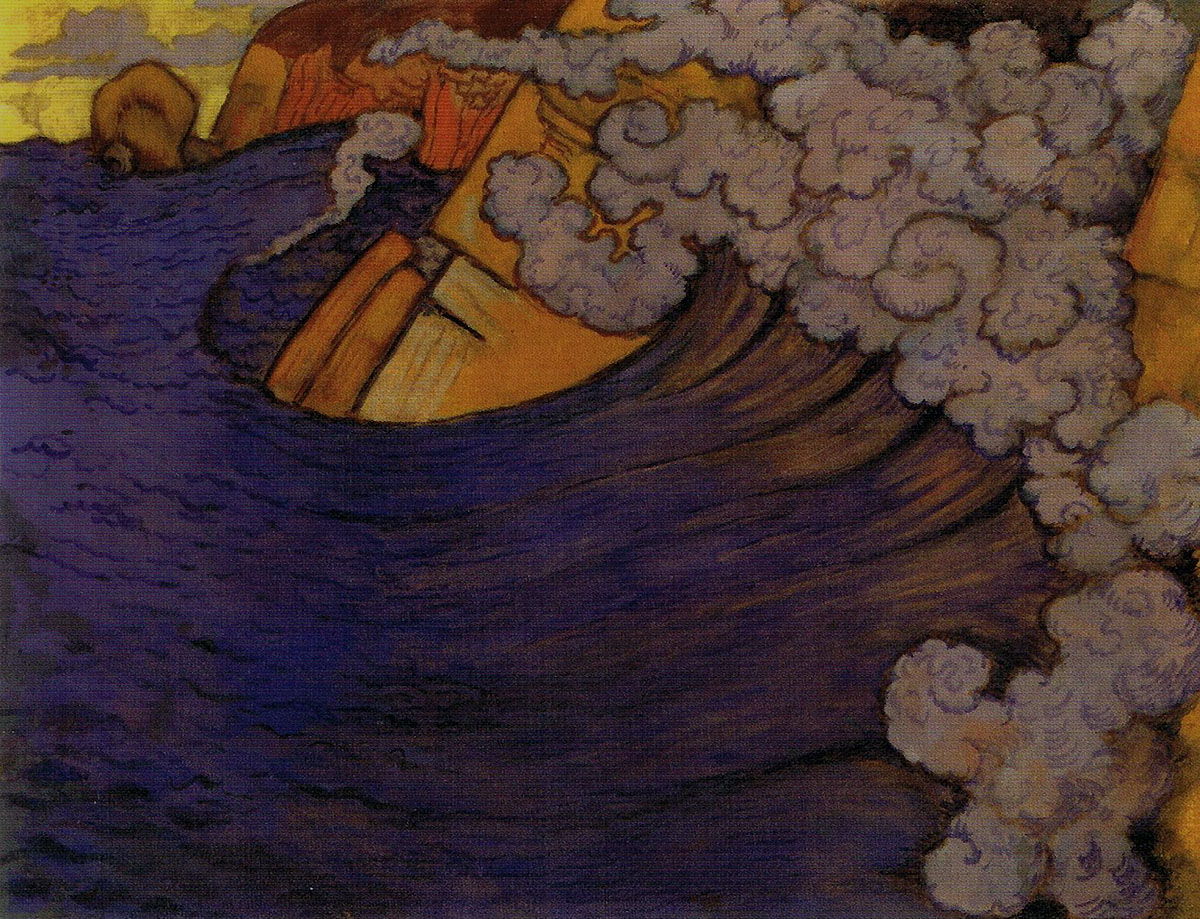
Georges Lacombe (1868–1916), The Violet Wave (1896-97), oil on canvas, 62.5 x 47.5 cm, Private collection. Wikimedia Commons.

Lacombe’s slightly later The Violet Wave also makes its influence abundantly clear.

bouguereauwave
William-Adolphe Bouguereau (1825–1905), The Wave (1896), oil on canvas, 121 x 160.5 cm, Private collection. Wikimedia Commons.

In that same year, even the notorious academic artist William-Adolphe Bouguereau joined Hokusai’s crowd of admirers, in The Wave.

As Japanese artists were studying in Europe, Westerners like Helen Hyde went to Japan. She made friends with an unrelated namesake, Josephine Hyde, and in 1899 the two travelled to Japan to learn Japanese print and painting techniques. Helen Hyde was soon making woodblock prints, which she learned from the Austrian Emil Orlik who was also living in Tokyo at the time.
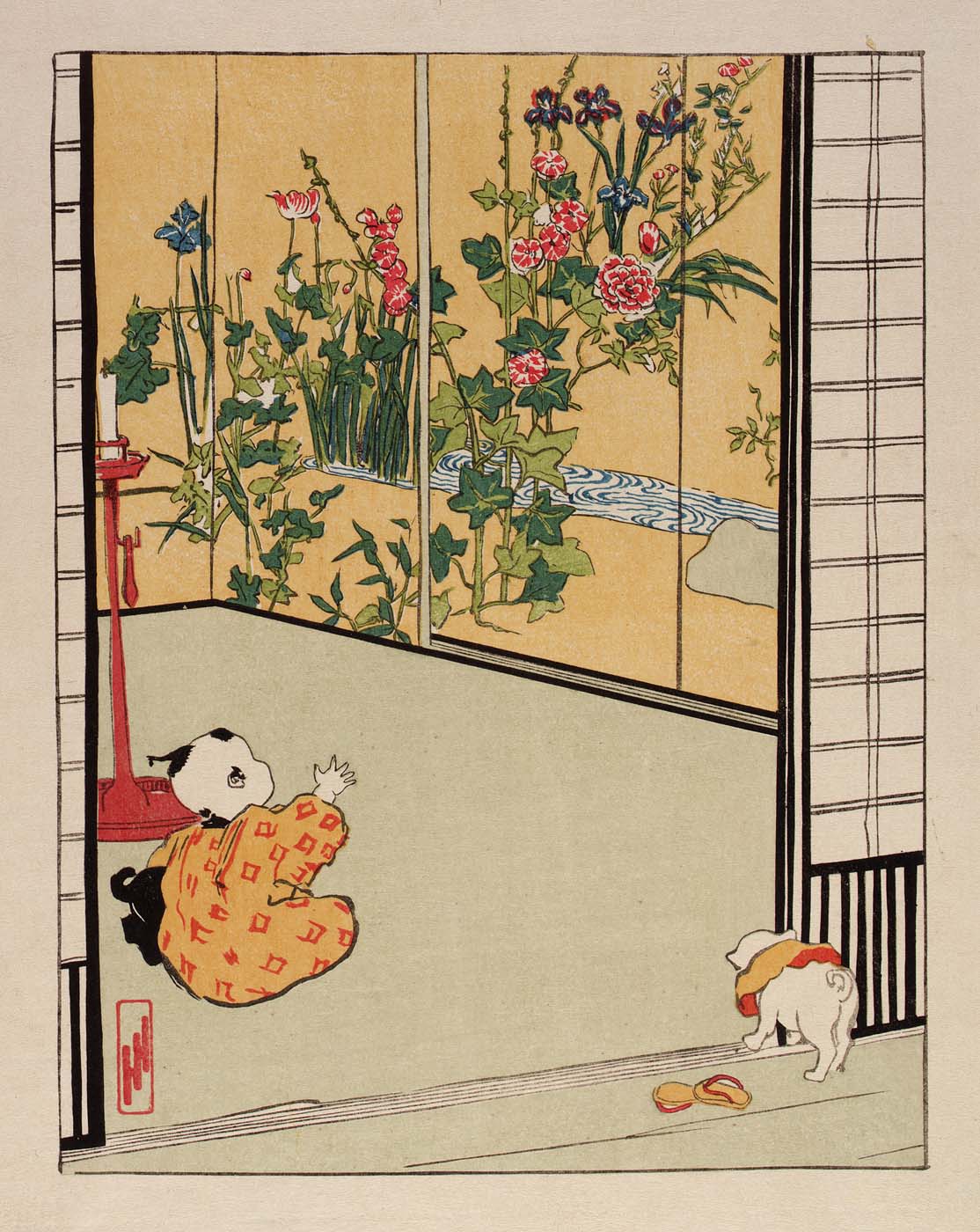
hydeinteriordecoration
Helen Hyde (1868–1919), Interior Decoration (1900), print, dimensions not known, Smithsonian American Art Museum, Washington, DC. Wikimedia Commons.

Interior Decoration from 1900 shows how quickly Hyde learned the technique, and her fascination for Japanese art in everyday settings.
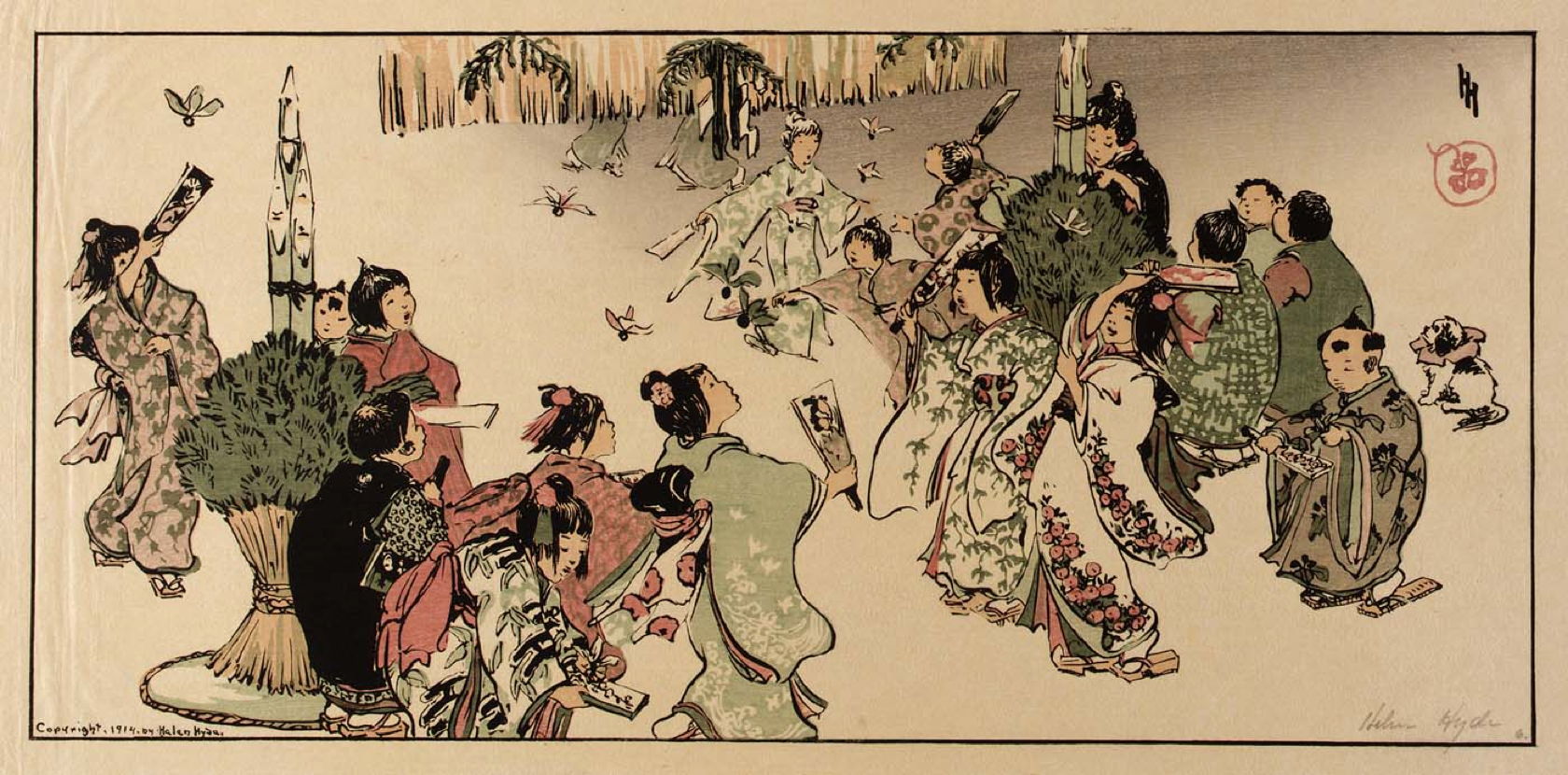
hydenewyearsdaytokyo
Helen Hyde (1868–1919), New Year´s Day in Tokyo (1912), print, dimensions not known, Smithsonian American Art Museum, Washington, DC. Wikimedia Commons.

Hyde’s New Year´s Day in Tokyo, from 1912, is grander in conception, and a carefully composed print of key elements in the Japanese New Year celebrations.

coopersummer
Colin Campbell Cooper (1856–1937), Summer (1918), oil on canvas, 127 x 153 cm, Private collection. Wikimedia Commons.

My final example was painted in 1918, at the end of the First World War, far from the mud and blood of Europe’s battlefields. Colin Campbell Cooper’s Summer (1918) is inspired by Japonisme, fortified here by the east Asian influence of California, and by Monet’s paintings of his garden at Giverny, itself based on a Japanese water garden.

Japonisme in painting: 1863-1888

The first organised trading with Japan was established by the Dutch East India Company in 1609, at the start of its Golden Age, and that continued on a small scale from an artificial island in Nagasaki Harbour until the middle of the nineteenth century. Little of that trade involved paintings or other art, although that was sufficient to start small schools of western painting in Japan.

Japan’s isolation continued until a fleet of American ships, under the command of Commodore Matthew C Perry, arrived in Tokyo Bay in 1853. There followed a rapid opening up of trade and cultural exchange, accelerated when the Tokugawa dynasty was overthrown in the brief Boshin War. This marked the beginning of the Meiji period in 1868, with its dramatic reforms and accelerating Westernisation.

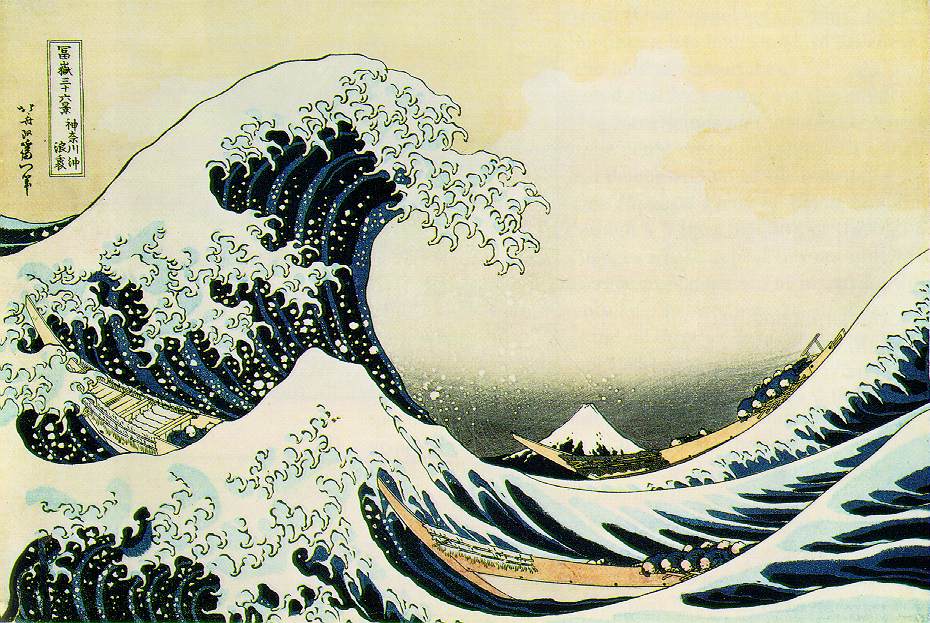
Katsushika Hokusai, The Great Wave of Kanagawa (1831), woodcut print, in "Thirty-six Views of Mount Fuji", Private collection. WikiArt.
Katsushika Hokusai, The Great Wave of Kanagawa (1831), woodcut print, in “Thirty-six Views of Mount Fuji”, Private collection. WikiArt.

No one knows when Hokusai’s Great Wave first appeared in Europe. Although it’s sometimes claimed that this didn’t happen until the Meiji Restoration in 1868, there are records of the first ukiyo-e prints reaching the hands of artists in France more than a decade earlier.

Although popular in Japan, prints including uki-e, megane-e and the most famous ukiyo-e weren’t considered to be fine art at the time, and Japanese art historians see them as primarily artisanal in nature. Despite this, from their appearance in Europe in the nineteenth century to today, they have been accepted as fine art; indeed for many Westerners they are are the only Japanese visual art with which they are familiar, other than traditional painting.

They appear to have first arrived as protective wrapping for porcelain, and in about 1856 the French artist Félix Bracquemond, an accomplished print-maker, came across Hokusai’s prints. There are claims this happened at the workshop of his printer, or that he found a small volume of Hokusai prints used to pack Japanese porcelain. Japonisme then spread rapidly through artistic circles in Paris and other European cities. Among those who collected these prints were Bracquemond, Vincent van Gogh, Claude Monet, Edgar Degas, Gustav Klimt, Édouard Manet, and Paul Gauguin.

Bracquemond initially trained as a lithographer, but then went to work for Guichard, a former pupil of Ingres. A portrait of his was accepted for the Salon in 1852. After that youthful success, he concentrated on engraving and etching, rather than painting, and was part of the nineteenth century revival of print-making in France. He later went to work in the Sèvres porcelain factory, before working for the manufacturer of Limoges porcelain, in 1870. He was a long-standing friend of Manet and Whistler, as well as Millet, Corot, Rodin, Degas and the Impressionists.

bracquemondlandscape
Félix Bracquemond (1833–1914), Landscape (after 1885), colour lithograph, 47.6 x 62.9 cm, The Metropolitan Museum of Art, New York, NY. Photo courtesy of The Metropolitan Museum of Art, The Elisha Whittelsey Collection, The Elisha Whittelsey Fund, 1960, at http://www.metmuseum.org.

Bracquemond’s Landscape is an unusual and exquisitely beautiful colour lithograph made later in his career. Although hardly Impressionist, its style is more closely related to the many designs that he made for paintings on porcelain.

This is a curious historical twist: European prints taken by the Dutch to Japan had inspired Japanese woodblock prints, which were a key influence on most of the Impressionists, who in turn became the inspiration for Japanese painters who went to Europe to train in Western techniques at the end of the nineteenth and early twentieth centuries.

whistlerprincesschina
James Abbott McNeill Whistler (1834–1903), The Princess from the Land of Porcelain (1863-65), oil on canvas, 201.5 x 116.1 cm, Freer Gallery of Art, Smithsonian Institution, Washington, DC. Wikimedia Commons.

One of the earliest painters to manifest Japonisme is the American James Abbott McNeill Whistler, as shown in his Princess from the Land of Porcelain, painted for his Peacock Room in 1863-65.

stevensjapaneseparisian
Alfred Stevens (1823–1906), The Japanese Parisian (1872), oil on canvas, 105 × 150 cm, Musée d’art moderne et d’art contemporain, Liège. Wikimedia Commons.

Others like Alfred Stevens followed. The Japanese Parisian from 1872 shows a woman dressed in fashionable Japonaiserie, holding a fan behind her back, and reflected in a large mirror.

quillerorchardsondolcefarniente
William Quiller Orchardson (1832–1910), Dolce Far Niente (1872), oil on canvas, 76.2 x 99.7 cm, Private collection. Wikimedia Commons.

The same year William Quiller-Orchardson completed Dolce Far Niente, incorporating in its painted screen a contemporary flavour of Japonisme. His woman, dressed in sober black, reclines on a thoroughly European chaise longue, her open book and fan beside her as she stares idly out of an unseen window.

orangekimono1878
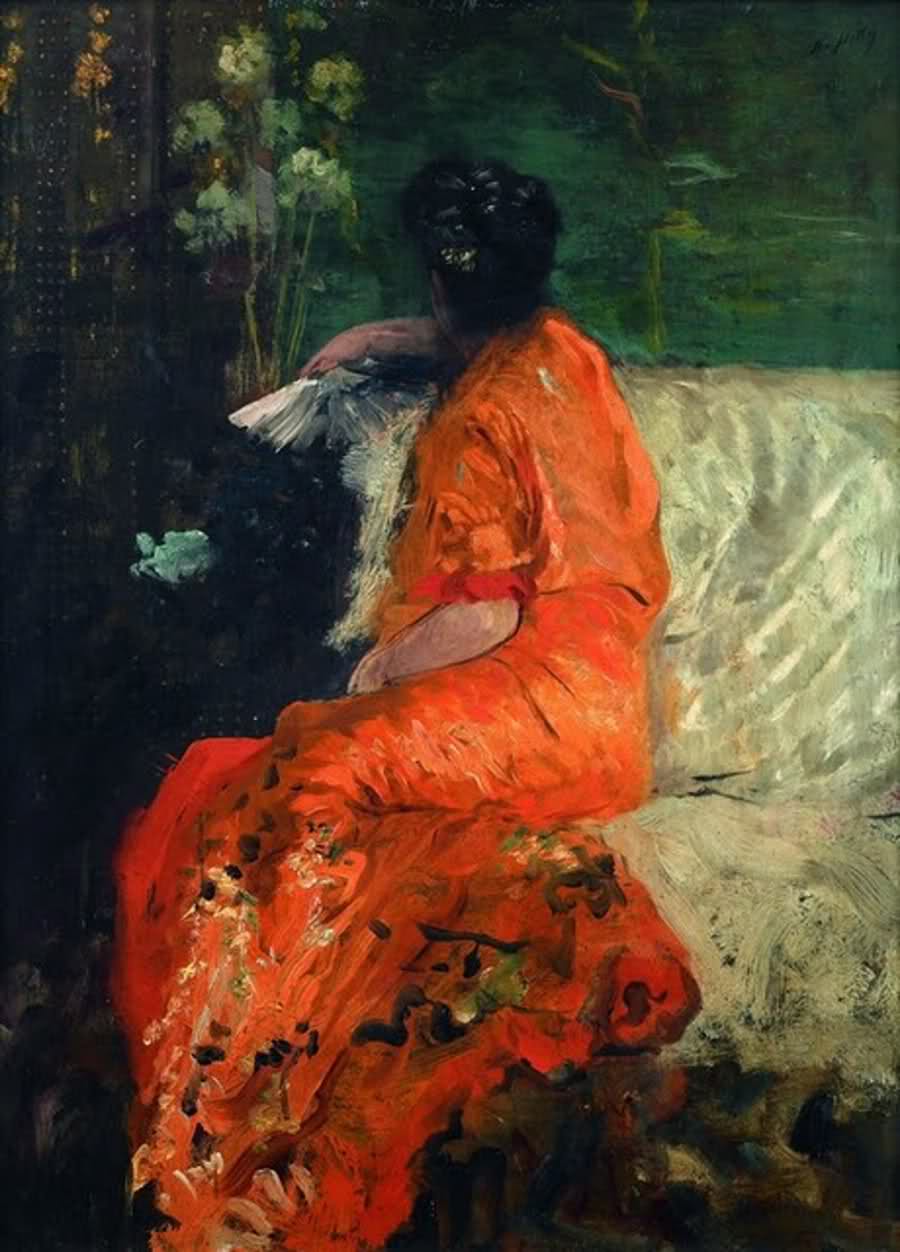
Giuseppe De Nittis (1846–1884), The Orange Kimono (c 1878), oil on canvas, 42 x 31 cm, Private collection. Athenaeum.

In 1878 the Italian Impressionist Giuseppe De Nittis campaigned successfully in London. Among his paintings from that series is The Orange Kimono.

vedderjapanesestilllife
Elihu Vedder (1836–1923), Japanese Still Life (1879), oil on canvas, 54.5 x 88.4 cm, Los Angeles County Museum of Art, Los Angeles, CA. Wikimedia Commons.

The American Elihu Vedder also developed a fascination for east Asian objets d’art, which he assembled in this Japanese Still Life in 1879. This unusual collection may have been assisted by the fact that his brother was a US Navy doctor who was stationed in Japan as it was being re-opened.

dagnanbouveretgustavecourtois
Pascal Dagnan-Bouveret (1852–1929), Bouderie (Sulking, Gustave Courtois in his Studio) (1880), oil on canvas, 48.3 × 63.5 cm, location not known. Wikimedia Commons.

Pascal Dagnan-Bouveret’s Bouderie, meaning sulking, is a splendid and intimate portrait of the artist’s friend and colleague Gustave Courtois, painted in 1880. Courtois is seen at one end of a large sofa, smiling wryly and staring into the distance. He holds his palette and brushes in his left hand, and what may be a long mahlstick in the right. At the opposite end of the sofa, turned with her back towards Courtois, is a young woman dressed in fashionable black clothing, and on the left is a screen decorated with Japanese imagery.

Anders Zorn, Castles in the Air (1885), watercolour on paper, 37 x 26 cm, Nationalmuseum, Stockholm, Sweden. WikiArt.
Anders Zorn (1860–1920), Castles in the Air (1885), watercolour on paper, 37 x 26 cm, Nationalmuseum, Stockholm, Sweden. WikiArt.

The Swedish rising star Anders Zorn painted some Japoniste works, including this parasol portrait, Castles in the Air, from 1885.

Vincent van Gogh (1853–1890), The Pink Orchard (1888), oil on canvas, 64 x 80 cm, Van Gogh Museum, Amsterdam. Wikimedia Commons.

Before he went to Arles, Vincent van Gogh had copied Utagawa Hiroshige’s woodblock print The Plum Orchard in Kameido. Shortly after his arrival there, in 1888, the fruit trees came into flower, and van Gogh painted a triptych intended for his brother Theo’s apartment, including The Pink Orchard above, and The Pink Peach Tree below.

Vincent van Gogh (1853–1890), The Pink Peach Tree (1888), oil on canvas, 80.5 x 59 cm, Van Gogh Museum, Amsterdam. Wikimedia Commons.

Van Gogh’s approach to painting blossoming fruit trees was completely different from that of the Japanese prints he had collected. His trees are built anatomically, with trunk and branches drawn in outline, often using contrasting colour. Flowers are applied using impasto; sadly some of these have faded since, and some of the paint that now appears white or off-white was originally much pinker.

❌