Although Naturalist painting had originated in the countryside among the rural poor, it soon came to record changing times in science. One of the more prominent painters of science and scientists was Léon Lhermitte, now known almost entirely for his rural paintings.
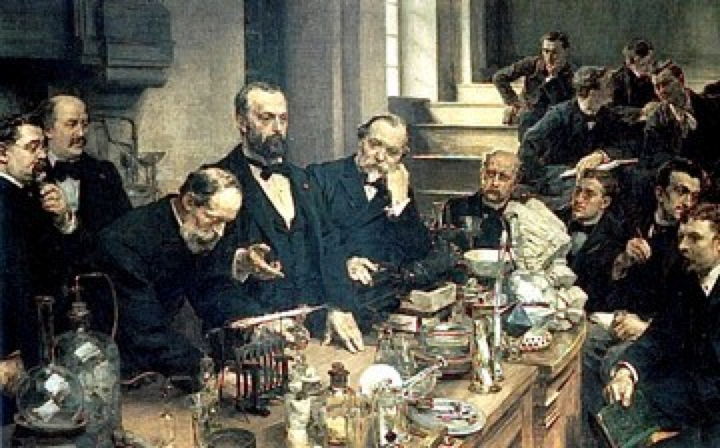
Léon Augustin Lhermitte (1844–1925), Claude Bernard and His Pupils (1889), copy of original by unknown artist, oil on canvas, 86.5 x 112.5 cm, Wellcome Library no. 45530i, London. Courtesy of Wellcome Images, via Wikimedia Commons.
Claude Bernard (1813-1878) was a pioneering physiologist whose writings were of great influence to Naturalists, including Émile Zola. Following Bernard’s death, the Sorbonne (where he had taught) commissioned Lhermitte to paint his portrait in 1886. This is a faithful anonymous copy of Claude Bernard and His Pupils, which was exhibited at the Salon in 1889. This shows Bernard in the midst of performing an experiment on a rabbit, his students discussing its results, and one writing the experimental observations in the laboratory daybook.
Léon Augustin Lhermitte (1844–1925), The Chemist Henri Sainte Claire Deville, Lesson on Aluminium (1890), The Sorbonne, Paris. Wikimedia Commons.
Lhermitte’s painting of The Chemist Henri-Étienne Sainte-Claire Deville, Lesson on Aluminium from the following year was also commissioned by the Sorbonne in Paris; I apologise for the small size of this image. Henri-Étienne Sainte-Claire Deville (1818-1881) was responsible for many significant discoveries in chemistry, the most important being a method for the industrial manufacture of aluminium. He’s shown here surrounded by objects made from this new material, which quickly came to transform manufacturing and to invade every home.
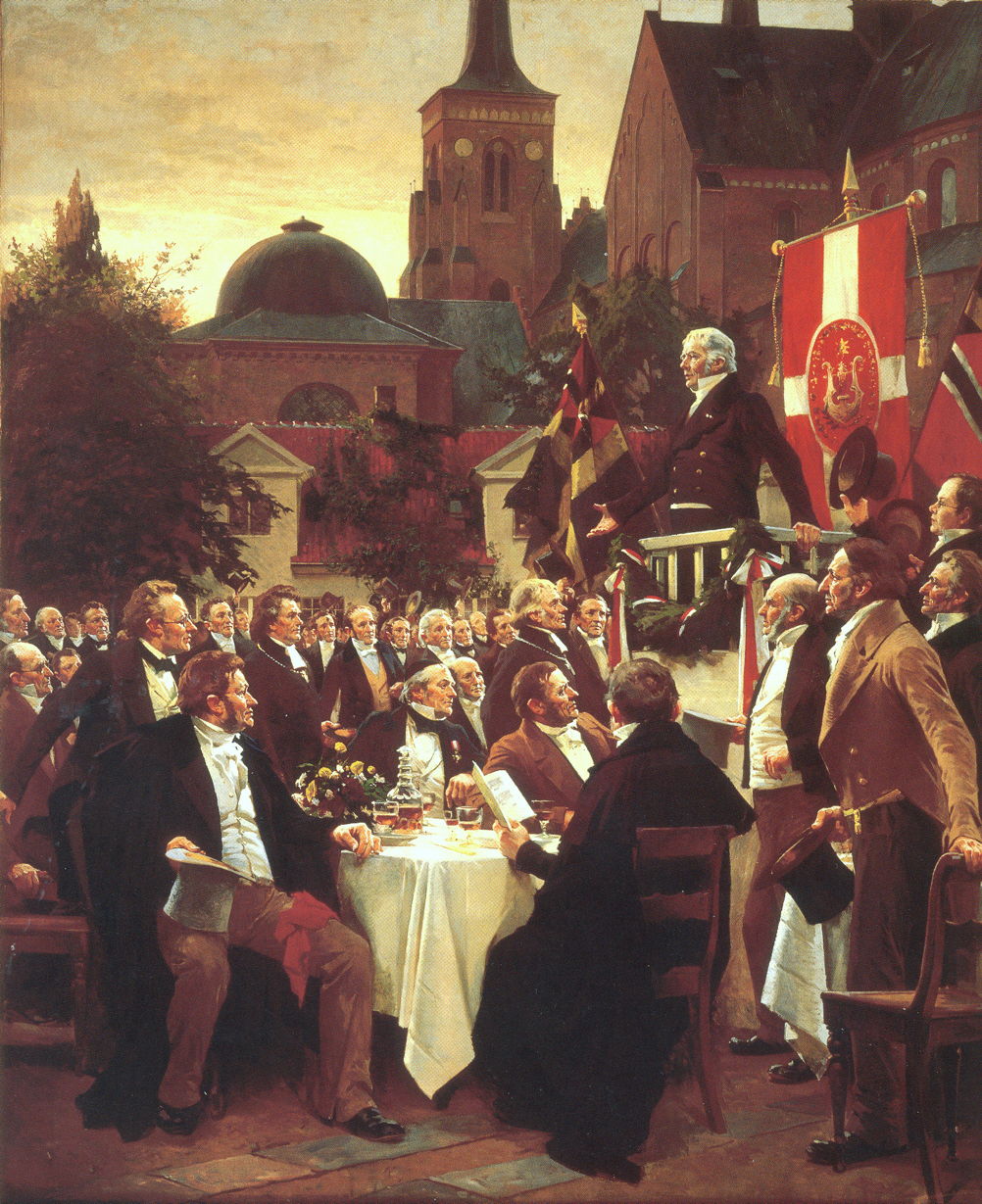
Erik Henningsen (1855–1930), The Nordic Natural Science Research Meeting 14 July 1847 (1895), mural, dimensions not known, Aula, University of Copenhagen, Copenhagen, Denmark. Wikimedia Commons.
Several Naturalist painters were commissioned to paint murals depicting scientific events for universities. Among them is Erik Henningsen’s The Nordic Natural Science Research Meeting 14 July 1847, completed in 1895 for the Aula of the University of Copenhagen. Presiding over this scientific meeting was the great Danish physicist and chemist Hans Christian Ørsted, who was nearly seventy at the time.
Technology was also becoming commonplace at work.
Charles Frederic Ulrich (1858–1908), The Village Printing Shop, Haarlem (1884), oil on panel, 54 × 58.3 cm, Terra Museum of American Art, Chicago, IL. Wikimedia Commons.
Charles Frederic Ulrich painted a young apprentice drinking during a moment’s pause in his work in The Village Printing Shop, Haarlem (1884). In the background is a large and relatively modern printing press.
Jean-Eugène Buland (1852–1926), Un Patron, or The Apprentice’s Lesson (1888), oil on canvas, 102 x 82 cm, Nationalmuseum, Stockholm, Sweden. Image by Erik Cornelius, via Wikimedia Commons.
Another Naturalist artist, Jean-Eugène Buland, in his Un Patron, or The Apprentice’s Lesson from 1888 shows a young boy being trained to make a cogwheel. This was part of the French industrial recovery following its defeat in the Franco-Prussian War.
Louis Muraton (1850–1919), The Photographer (before 1901), further details not known. Wikimedia Commons.
The subject of Louis Muraton’s The Photographer, painted before 1901, is rocking a glass plate in a bath of developer, in his improvised darkroom, another sign of the times.
Major innovations in medical procedures and care were introduced, and duly recorded in Naturalist paintings.
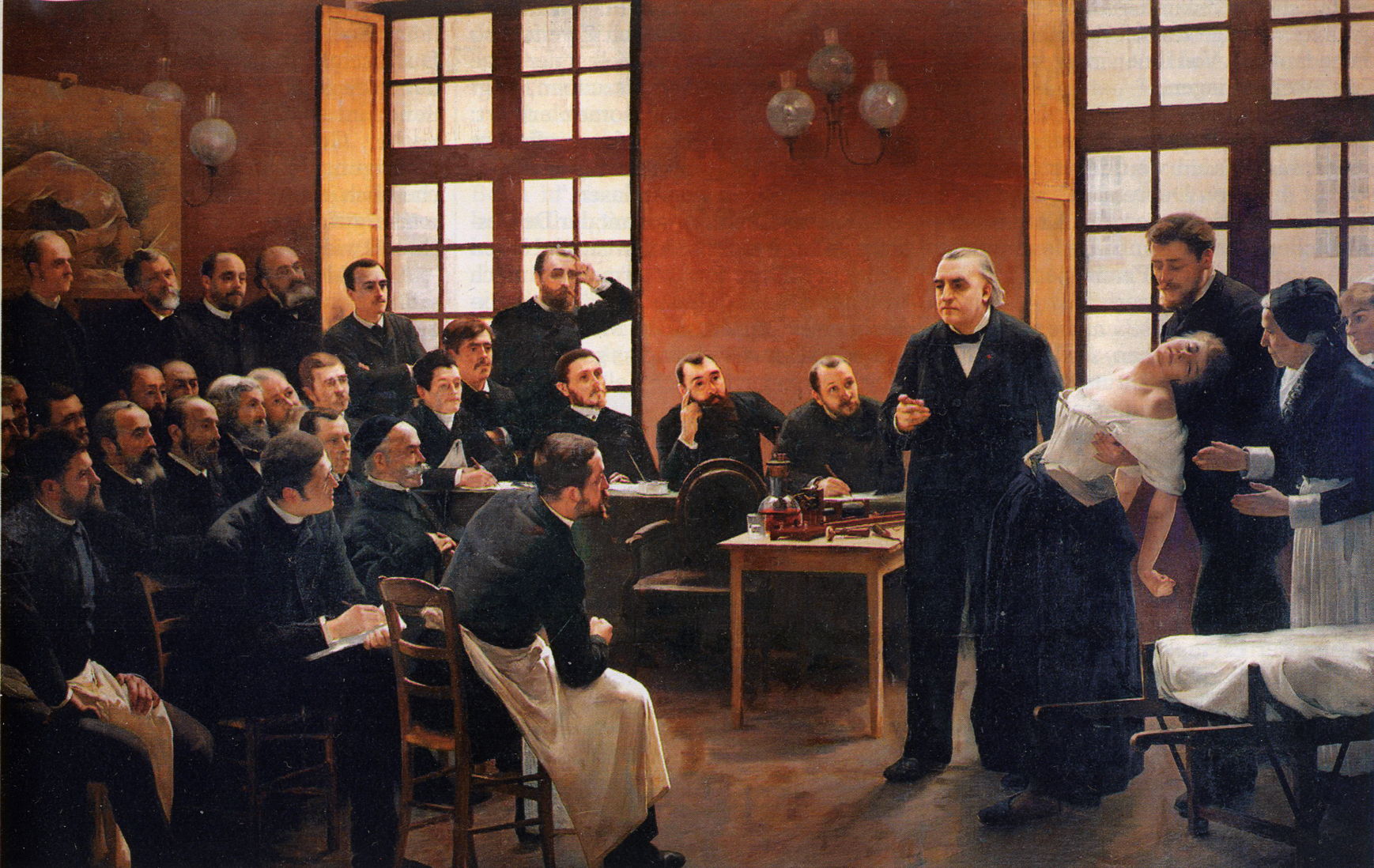
André Brouillet (1857–1914), A Clinical Lesson at The Salpêtrière Hospital (1887), oil, 290 x 430 cm, Paris Descartes University, Paris. Wikimedia Commons.
In André Brouillet’s A Clinical Lesson at the Salpêtrière Hospital (1887), an eminent neurologist Jean-Martin Charcot is demonstrating how he could hypnotise Marie “Blanche” Wittman, the ‘Queen of Hysterics’, into suffering hysterical collapse. Charcot and Wittman were a renowned partnership in this ‘act’, who performed in front of Sigmund Freud when he visited the hospital.
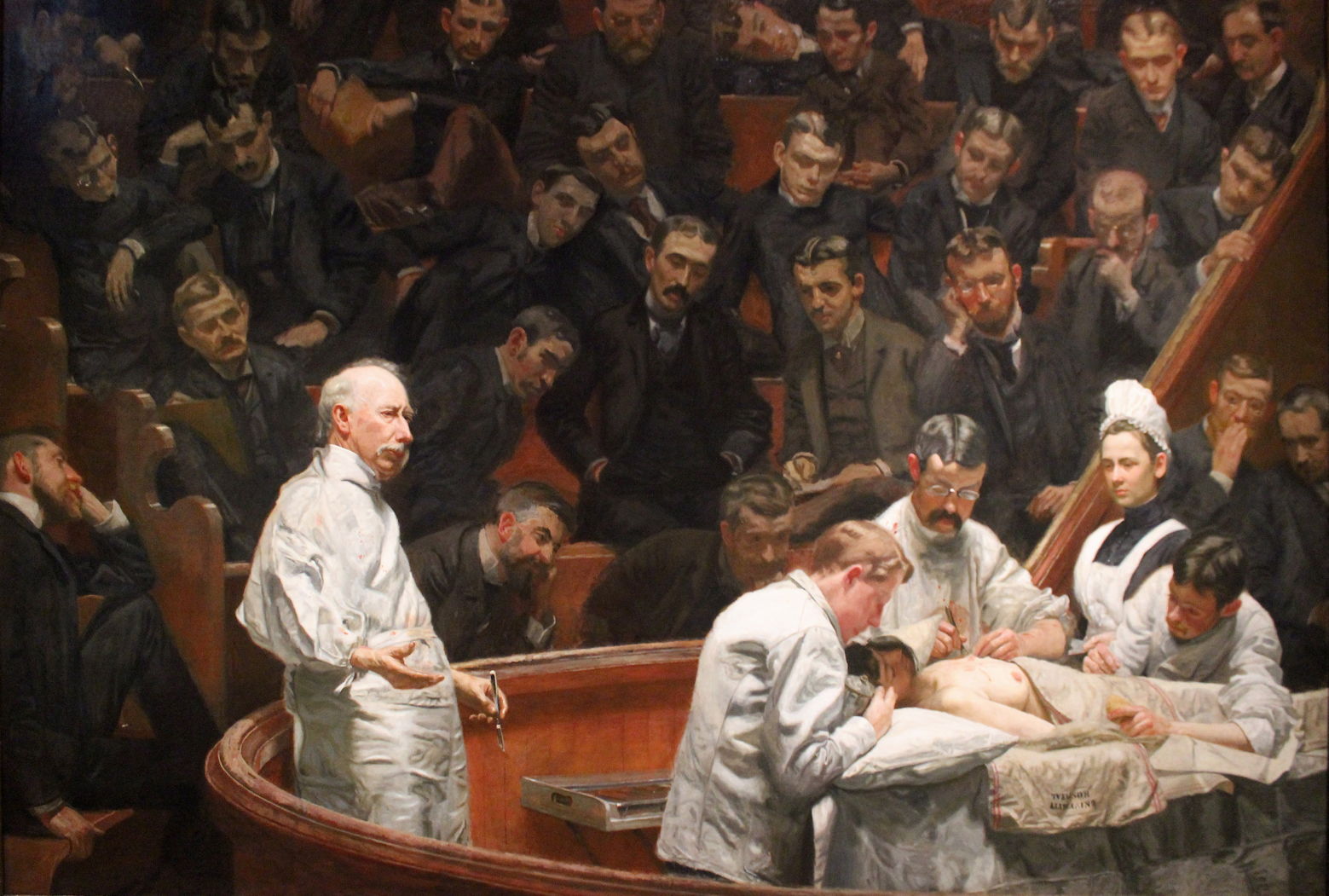
Thomas Eakins (1844–1916), The Agnew Clinic (1889), oil on canvas, 214.2 x 300.1 cm, Philadelphia Museum of Art, Philadelphia, PA. Wikimedia Commons.
In the USA, Thomas Eakins painted the retiring professor of surgery, Dr. David Hayes Agnew, at work in the University of Pennsylvania School of Medicine. The patient is unconscious thanks to a volatile liquid general anaesthetic administered via a mask. Bright surgical lighting puts six figures literally in the limelight, including that of Agnew, holding a scalpel at the left.
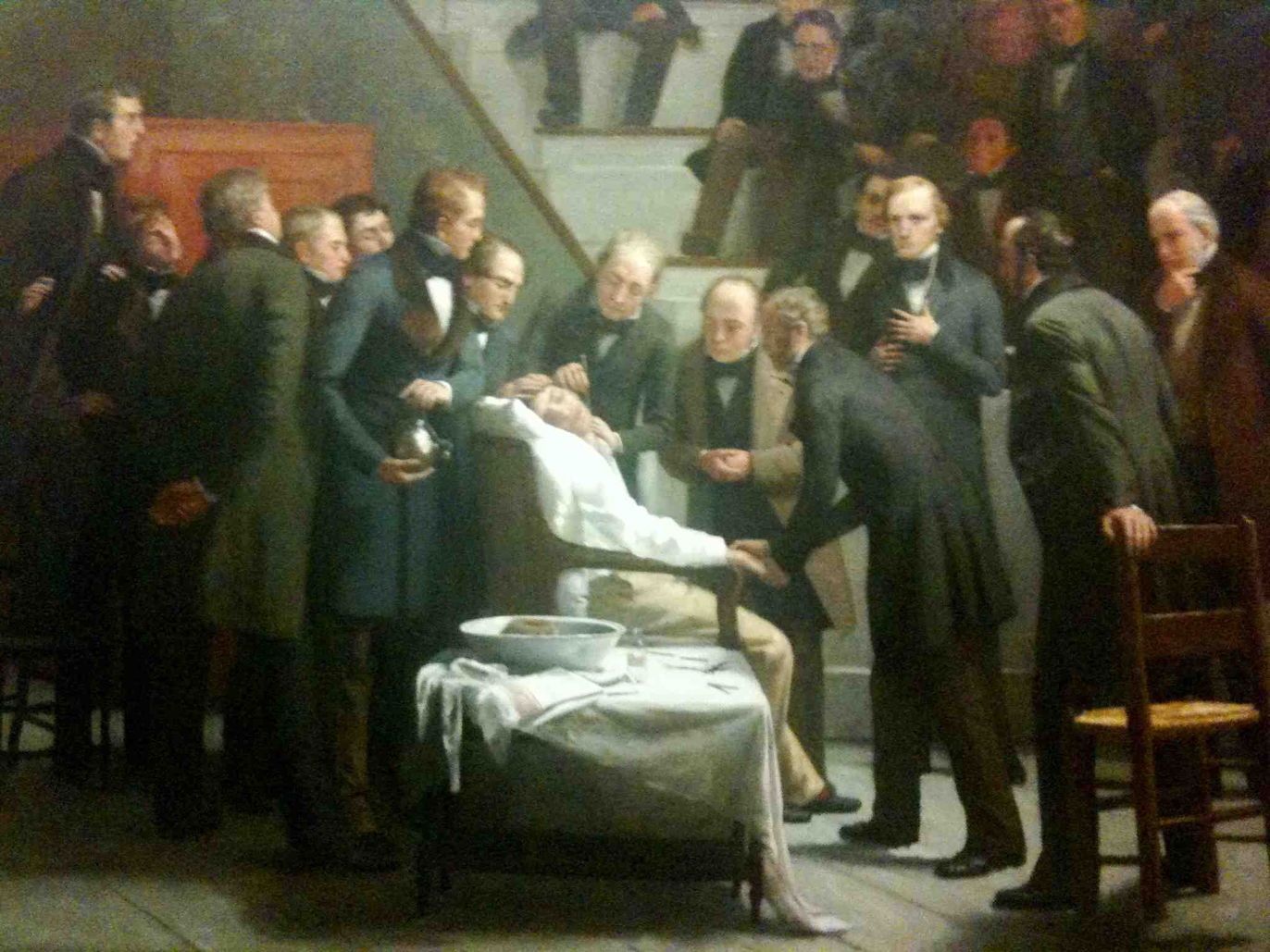
Robert C. Hinckley (1853–1941), Ether Day, or The First Operation with Ether (1882-93), oil on canvas, 243.8 x 292.1 cm, Francis A. Countway Library of Medicine, Harvard University, Cambridge, MA. Wikimedia Commons.
Robert C. Hinckley’s Ether Day, or The First Operation with Ether, painted between 1882-93, recreates the scene on 16 October 1846 in what is now known as the Ether Dome in the Massachusetts General Hospital, Boston, MA. Here John Collins Warren is removing a tumour from the neck of a local printer, Edward G Abbott, who was anaesthetised using ether, in its first recorded use for a general surgical procedure; I apologise for the poor quality of this image.
Anna Sahlstén (1859–1931), Surgery in hospital (c 1893), oil on canvas, dimensions not known, EMMA – Espoon modernin taiteen museo, Espoo, Finland. Wikimedia Commons.
Finally, Anna Sahlstén’s Surgery in Hospital from about 1893 shows the dazzling whiteness of the modern hospital, with a smart professional nurse caring for a child patient in the background. On the wall is a large radiator for the hospital’s modern heating system, which replaced the old stoves seen in so many earlier images of hospital wards.
Critics and the public got their first taste of Naturalist painting in the Salons in the early 1880s, led by the success of Jules Bastien-Lepage. As Paris was the focal point of western painting at that time, this rapidly spread internationally, and ranged wider in its themes.
Literary Naturalism had spread with the translation of the writings of Hippolyte Taine (1828-1893) the critic and historian, Claude Bernard (1813-1878) the physiologist, and the Rougon-Macquart novels of Émile Zola (1840-1902), published between 1871-93. Those became accessible in all the major European languages by 1880, and attracted an intellectual following throughout Europe and North America.
At the time there was a strong Nordic school of painting in France, including Christian Skredsvig (friend of Edvard Munch), Nicolai Ulfsten, Carl Larsson, Karl Nordstrôm, Hans Heyerdahl, Erik Werenskiold, and Christian Krohg.
Christian Krohg (1852–1925), Port Side! (1879), oil on canvas, 99 x 70 cm, Nasjonalgalleriet, Oslo, Norway. The Athenaeum.
Krohg’s Port Side! (1879) is his only painting to be exhibited at the Salon. He started this when he was in Berlin, and completed it when at Skagen in Denmark in the summer of 1879. It didn’t set the Salon of 1882 alight, but was favourably received by some critics.
Hans Heyerdahl (1857–1913), The Dying Child (1881), oil on canvas, 59.5 x 70 cm, Nasjonalgalleriet, Oslo, Norway. Wikimedia Commons.
Hans Heyerdahl’s The Dying Child (1881) was so lauded it was bought from the Salon for the French nation, but has since returned to Norway. Although executed in an older, darker style this motif became popular with Nordic painters including Edvard Munch, and is typical of Naturalism.
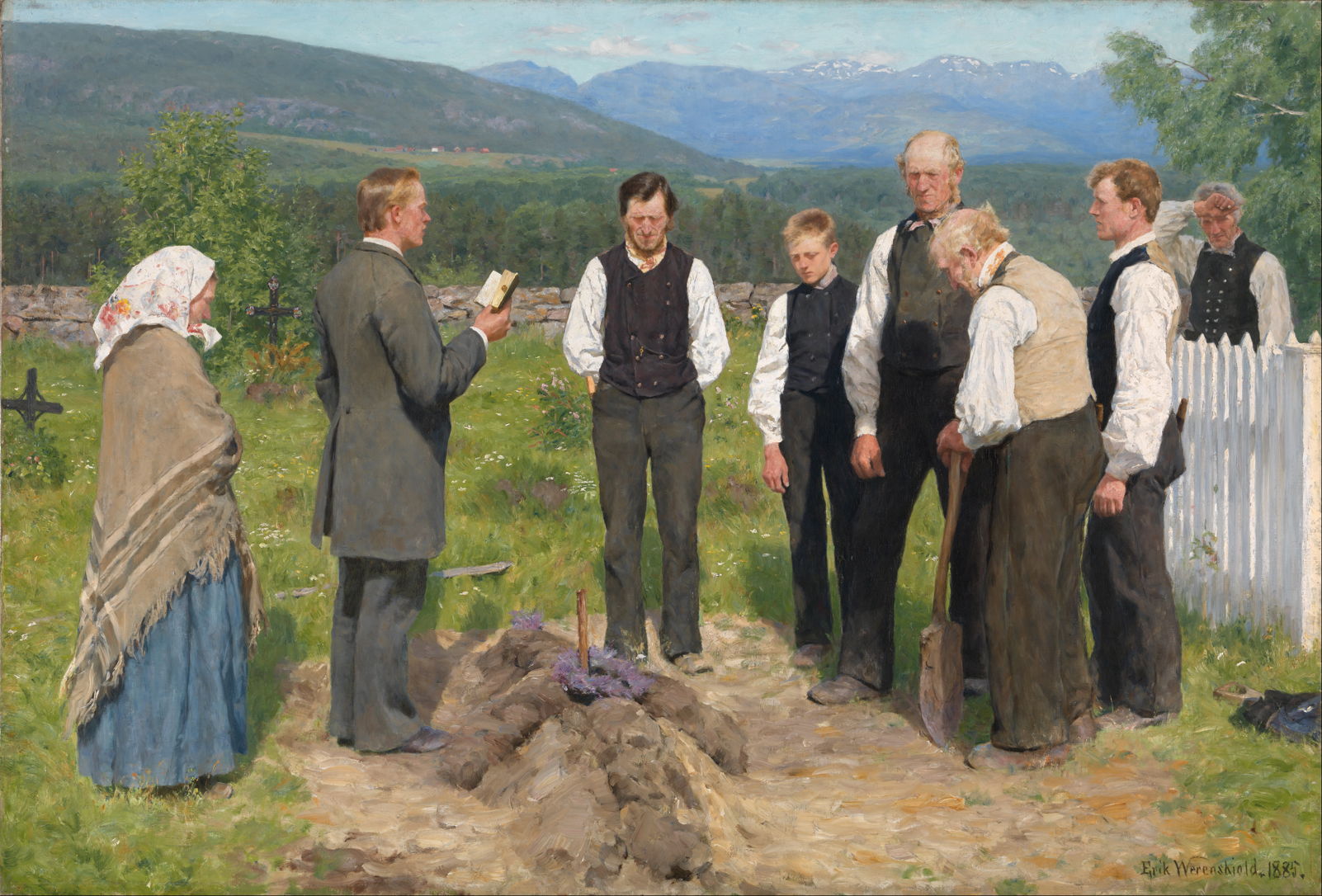
Erik Werenskiold (1855–1938), Peasant Burial (1885), oil on canvas, 102.5 x 150.5 cm, Nasjonalgalleriet, Oslo, Norway. Wikimedia Commons.
A little later, Erik Werenskiold painted his rural Norwegian response to Courbet’s Burial at Ornans, in his Peasant Burial of 1885.
Charles Frederic Ulrich (1858–1908), The Glass Blowers (1883), oil on canvas, 47.8 × 58.4 cm, Museo de Arte de Ponce, Ponce, Puerto Rico. Wikimedia Commons.
Charles Frederic Ulrich was born in New York City in 1858, and had travelled to Europe to attend the Royal Academy in Munich, Germany, as did so many other American painters, including William Merritt Chase. Many of his surviving works show different workplaces across Europe: in The Glass Blowers (1883) the work is delicate, in blowing and preparing glass domes, perhaps for use as covers of watches and clocks.
Joan Planella y Rodríguez (1849–1910), The Little Weaver (1882-89), oil on canvas, 67 x 55 cm, Museu d’Història de Catalunya, Barcelona, Spain. Wikimedia Commons.
Joan Planella was a Catalan painter who studied in Italy rather than France. The Little Weaver (1882-89) shown here is a replica of the original completed in 1882. It shows a young girl working at a large and complex loom in Catalonia, as a man lurks in the background, keeping a watch over her.
Léon Augustin Lhermitte (1844–1925), The Harvesters’ Pay (1882), oil on canvas, 215 x 272 cm, Musée d’Orsay, Paris. Wikimedia Commons.
Following the formative social realism of Jean-François Millet, Léon Lhermitte’s masterpiece The Harvesters’ Pay (1882) takes a more objective look at the realities of rural farmworkers. This evolved rapidly through Bastien-Lepage’s paintings of poor waifs and strays, to the grim battle for survival shown below in Fernand Pelez’s Homeless (1883).
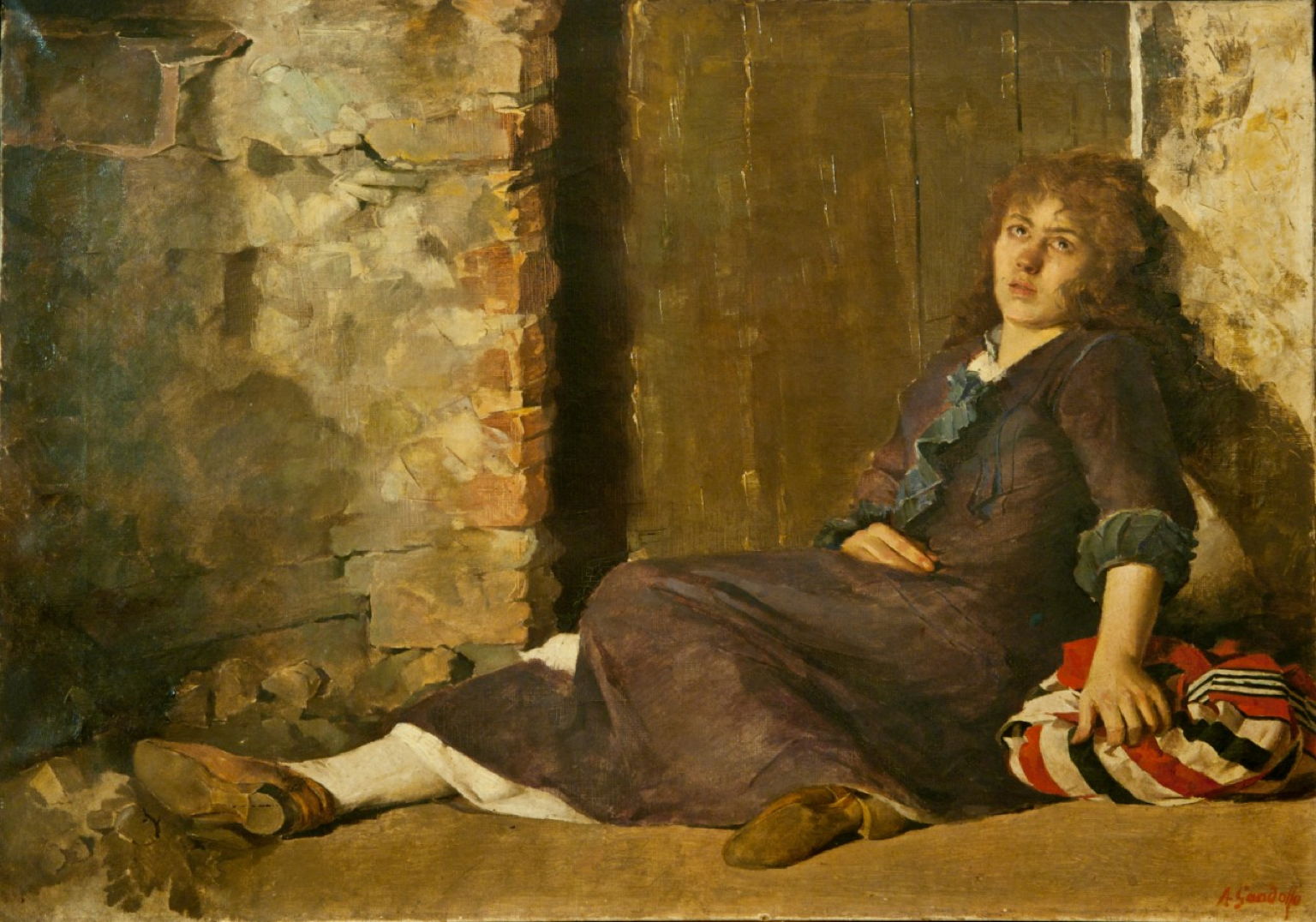
Fernand Pelez (1848-1913), Homeless (1883), oil on canvas, 77.5 x 136 cm, location not known. Image by Bastenbas, via Wikimedia Commons.Antonino Gandolfo (1841–1910), Evicted (Let he who is without sin cast the first stone) (1880), oil on canvas, 88 x 63 cm, location not known. Image by Luigi Gandolfo, via Wikimedia Commons.
These were by no means confined to France. The Sicilian Antonino Gandolfo’s Evicted from 1880 raised similar concerns under a very different political regime.
Even more uncomfortable for the French Third Republic and other states was the depiction of industrial unrest as it swept across Europe in the late nineteenth century.
Alfred Philippe Roll (1846–1919), Miners’ Strike (1880), original badly damaged, shown here as reproduction from ‘Le Petit Journal’, 1 October 1892, further details not known. Wikimedia Commons.
A good example is Alfred Roll’s painting of a Miners’ Strike in 1880. This was probably made from life when he visited the strike at Denain in the Nord-Pas de Calais coalfield that year. His large original painting seems to have been exhibited at the Salon in Paris, from where it was purchased by the State. However, the artist had to sell at ‘cost price’ on the understanding that it would be hung in the capital, in the Ministry of Commerce, where it would have substantial impact.
Once the State got its hands on Roll’s painting, it was despatched to a local museum in Valenciennes, where it seems to have been largely forgotten. The original is now badly damaged, and the image shown above is reproduced from Le Petit Journal, where it didn’t appear until 1 October 1892.
By early 1884, Émile Zola had decided to write a novel in his Rougon-Macquart series about a miners’ strike, and in February 1884 the author visited a strike near Valenciennes, where Roll’s painting was on display, for his research. He started writing Germinal on 2 April 1884, and the book was published in serial form from November of that year. Its story centres on a miners’ strike in the Nord-Pas de Calais coalfield very similar to that painted by Roll, and it remains Zola’s most successful work.
The State may have successfully suppressed the immediate impact of Roll’s painting by hiding it away in the provinces, but in this case it had not anticipated its influence on Zola.
Industrial unrest in Belgium came to a head in 1886, with a succession of strikes across the country. These started in Liège as a commemoration of the fifteenth anniversary of the Paris Commune, but spread through industrialised zones to the region around Charleroi and Hainault.
Robert Koehler (1850–1917), The Strike in the Region of Charleroi (1886), oil on canvas, 181.6 × 275.6 cm, Deutsches Historisches Museum, Berlin, Germany. Wikimedia Commons.
Robert Koehler painted his masterpiece of The Strike in the Region of Charleroi that year, with a group of workers standing outside the smart entrance to offices. The top-hatted owner stands on the top step, one of his managers looking anxious beside him. The leader of the workers is at the foot of the steps telling the industrialist of the workers’ demands. The situation is looking increasingly nasty, although there are no signs yet of police or troops, or of violent confrontation.
Christian Krohg (1852–1925), Tired (1885), oil on canvas, 79.5 x 61.5 cm, Nasjonalgalleriet, Oslo, Norway. Wikimedia Commons.
Politics and art were mixing freely in the Nordic countries too. The Norwegian Christian Krohg explored the theme of fatigue and sleep, particularly among mothers. In Tired from 1885, the young woman seen here is no mother, but a seamstress, one of the many thousands who worked at home at that time, toiling for long hours by lamplight for a pittance.
Home work as a seamstress was seen as the beginning of the descent into prostitution, a major theme in Krohg’s painting and writing. The paltry income generated by sewing quickly proved insufficient, and women sought alternatives, which all too often led to them taking to the street.
Christian Krohg (1852–1925), Albertine in the Police Doctor’s Waiting Room (1885-87), oil on canvas, 211 x 326 cm, Nasjonalgalleriet, Oslo, Norway. Wikimedia Commons.
Just before Christmas 1886, Krohg’s first novel Albertine was published by a left-wing publisher. Its central theme is prostitution in Norway at the time, and the police quickly seized all the copies they could find, banning it on the grounds of violating the good morals of the people. Krohg was found guilty of the offence the following March and fined, although the police were only able to seize 439 of the first 1600 copies to go into circulation.
At the same time as he was writing that novel, Krohg had been working on his largest and most complex painting: Albertine in the Police Doctor’s Waiting Room (1885-87). He also painted several other scenes from the book. Curiously, Krohg’s campaigning writing and painting didn’t want prostitution made legal: quite the opposite, he and others wanted it banned.
Naturalist painting also helped promote advances being made by the state in healthcare and education.
Henri Gervex (1852–1929), Before the Operation (1887), oil on canvas, 242 x 188 cm, Musée d’Orsay, Paris. Wikimedia Commons.
The depiction of modern hospitals, medical teaching and research is a feature of Naturalism. Henri Gervex, who rose to fame with a ‘shocking’ painting of a nude courtesan on the morning after, found a little flesh at the Hôpital Saint-Louis, where an eminent doctor is teaching Before the Operation in 1887.
Jean Geoffroy (1853-1924), Primary School Class (1889), oil on canvas, 145 x 220 cm, Ministère de l’Education Nationale, Paris. Wikimedia Commons.
Jean Geoffroy’s Primary School Class from 1889 shows one of the Third Republic’s new lay teachers working diligently in the classroom with her pupils. This was deemed sufficiently positive to the State as to be purchased by the French National Ministry of Education, where it still hangs.
The new style of Naturalism took the Paris Salon by storm in 1883. As a complement rather than competitor to Impressionism, it found more favour among the establishment, critics and public who attended the Salon, and had roots going back to the genre paintings of the Dutch Golden Age.
Jan Miense Molenaer (c 1610–1668), The Dentist (1630), oil on panel, 66 x 81 cm, Herzog Anton Ulrich-Museum, Braunschweig, Germany. Wikimedia Commons.
The Dentist, painted in 1630, declares Jan Miense Molenaer’s interest in everyday life. A small crowd has gathered outside a church, where a fashionably dressed man is pulling a tooth from a local. The victim is dressed in tatters, with large holes at both his knees and worn-out shoes. These are ordinary, common people depicted objectively in their normal surroundings.
Gerard ter Borch (1617–1681), A Boy with his Dog (The Flea-Catcher) (after 1666), oil on canvas mounted on wood, 35 x 28 cm, Alte Pinakothek, Munich, Germany. Wikimedia Commons.
Gerard ter Borch’s late painting of A Boy with his Dog, also known as The Flea-Catcher (after 1666), shows this boy checking for and removing fleas from his pet in fairly barren surroundings.
Another strand of development was the controversial, even politicised, contemporary event. Géricault’s monumental painting of The Raft of the Medusa made in 1818-19 is perhaps the most important example.
Jean Louis Théodore Géricault (1791–1824), The Raft of the Medusa (1818-19), oil on canvas, 491 x 716 cm, Musée du Louvre, Paris. Wikimedia Commons.
This shows a well-known and scandalous story of the day, when over 130 people on board the French frigate Méduse died after they had abandoned ship onto a makeshift raft. Just fifteen of the 147 people on that raft survived thirteen days before being rescued, and gave harrowing stories of drowning, dehydration, and cannibalism.
Although Géricault undoubtedly painted what was in his mind’s eye, he undertook considerable research, interviewing survivors and making studies of material from the morgue in his efforts to make this as objective as he could. This quest for objectivity was a major theme of the nineteenth century, spilling over from the sciences into creative arts, underlying many of the changes seen in painting.
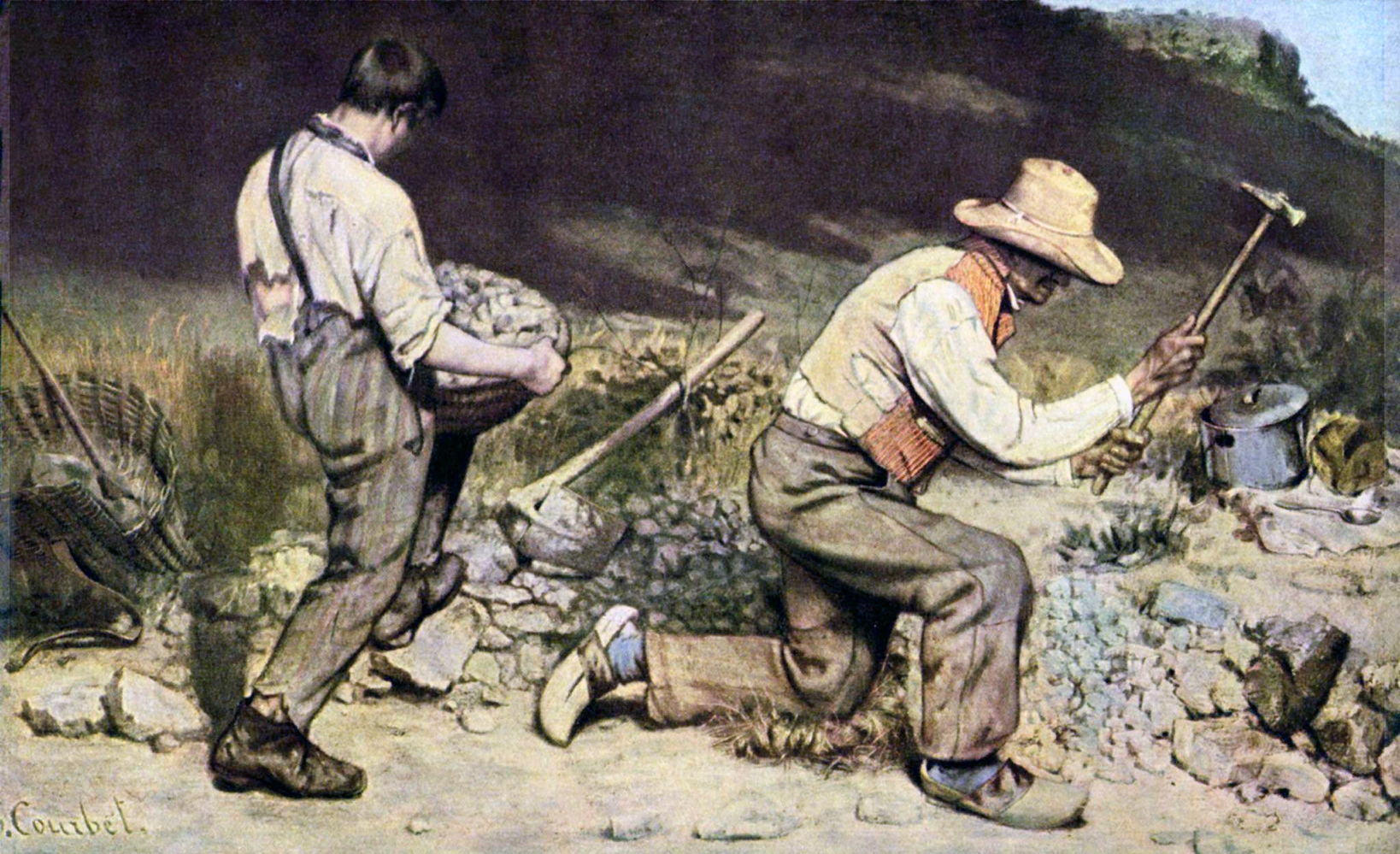
Gustave Courbet (1819–1877), The Stone Breakers (1849), oil on canvas, 165 x 257 cm, Galerie Neue Meister, Dresden, Germany, destroyed by fire 1945. Wikimedia Commons.
Gustave Courbet took it up in the middle of the century, most notably in The Stone Breakers (1849), which was later destroyed by fire during the Allied bombing of Dresden in 1945. This painting was exhibited at the Salon in 1850, and established him as the great-grandfather of Naturalism.
Gustave Courbet (1819–1877), A Burial at Ornans (1849-50), oil on canvas, 315 x 668 cm, Musée d’Orsay, Paris. Wikimedia Commons.
Shown in the same year was his monumental A Burial at Ornans (1849-50), a huge depiction in unemotional and objective terms of the funeral of the artist’s great uncle in the small provincial town of Ornans. The event had taken place in September 1848, but this painting gives the impression that it is a faithful record.
Courbet actually painted the work entirely in the studio, using those who were present as models. It shows a moment which could only have existed in the artist’s memory: like Géricault’s Raft of the Medusa, it doesn’t necessarily represent an image which ever existed in reality. But it has been carefully researched, imagined, composed, and painted to give the impression of accuracy and objectivity, rather than some Romantic fantasy.
At the same time, social realism was arriving on the farms of France, thanks to the paintings of Jean-François Millet.
Jean-François Millet (1814–1875), The Sower (1850), oil on canvas, 101.6 x 82.6 cm, Museum of Fine Arts, Boston, MA. Wikimedia Commons.
Millet’s The Sower was completed in 1850 and shown at the Salon that year; it has since been recognised as his first real masterpiece. This farmworker is striding across a field, sowing seed for the summer’s crop. In the distance to the right, caught in the sunlight, is another worker ploughing with a pair of oxen.
Jean-François Millet (1814–1875), The Gleaners (1857), oil on canvas, 83.5 × 110 cm, Musée d’Orsay, Paris. Wikimedia Commons.
Millet’s The Gleaners of 1857 is sparse, concentrating on just three figures. There are no distractions: it is about the rural poor, who made ends meet by salvaging scraps after the harvest had been cut. This is unavoidably about poverty, and the sector of the population who only just managed to survive each winter. At the time it smacked of socialism, and got the thumbs-down from the rich and middle classes when they saw it in the Salon that year.
Jean-François Millet (1814–1875), L’Angélus (The Angelus) (1857-59), oil on canvas, 55 x 66 cm, Musée d’Orsay, Paris. Wikimedia Commons.
Millet followed that with The Angelus, completed around 1857-59. This had been commissioned by the American collector Thomas Gold Appleton, as Prayer for the Potato Crop, but underwent modification before Millet gave it its present title. At some stage, it’s thought to have included a child’s coffin, but that was overpainted. It shows a couple, praying the Angelus devotion normally recited at six o’clock in the evening, over the potatoes they have been harvesting. It is dusk, and as the last light of the day fades, the bell in the distant church is ringing to mark the end of work, and the start of the evening.
Next to the man is his fork, which he has been using to lift potatoes from the poor, stony soil; his wife has been collecting them in a wicker basket, which now rests at her feet. Behind them is a primitive wheelbarrow with a couple of sacks of potatoes on it. In the gathering dark, viewers often misread the barrow and think that it contains a small child.
With the hostile reception of The Gleaners, Millet didn’t exhibit this painting until 1865, although he had sold it in 1860 for a meagre 1,000 francs. When sold in 1890, its price reached 750,000 francs.
Jules Breton (1827–1906), The Gleaners (1854), oil on canvas, 93 × 138 cm, The National Gallery of Ireland/Gailearaí Náisiúnta na hÉireann, Dublin, Ireland. The Athenaeum.
Jules Breton was also important, more in his compositional devices than in any social realism. His Gleaners from 1854, which was highly successful at the Salon of 1855, is a marvellous painting, although hardly the story of people who spent most of their lives on the edge of survival. But its foreground detail, high horizon and widescreen effect were to be used very successfully by Jules Bastien-Lepage and others.
Another important artist in the late gestation of Naturalism was Édouard Manet, long considered to be a precursor of Impressionism, but who was thoroughly realist.
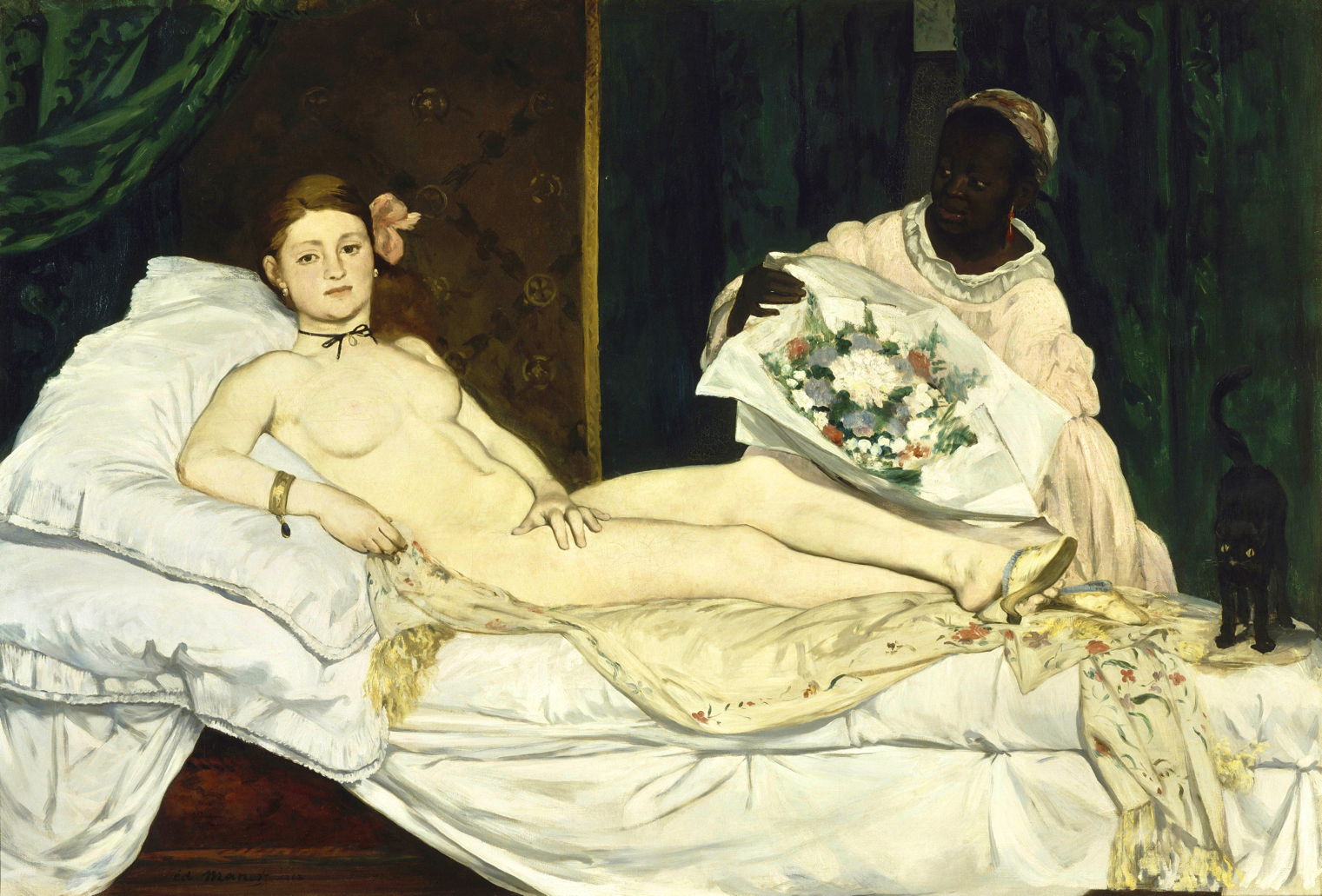
Édouard Manet (1832–1883), Olympia (1863), oil on canvas, 130 x 190 cm, Musée d’Orsay, Paris. Wikimedia Commons.
Manet’s Olympia (1863) shocked those seeing it at the 1865 Salon because here was an ordinary person, a ‘common prostitute’ indeed, seen in a role normally assigned to a mythical goddess such as Venus. And she was very much at her place of work, staring straight at the viewer.
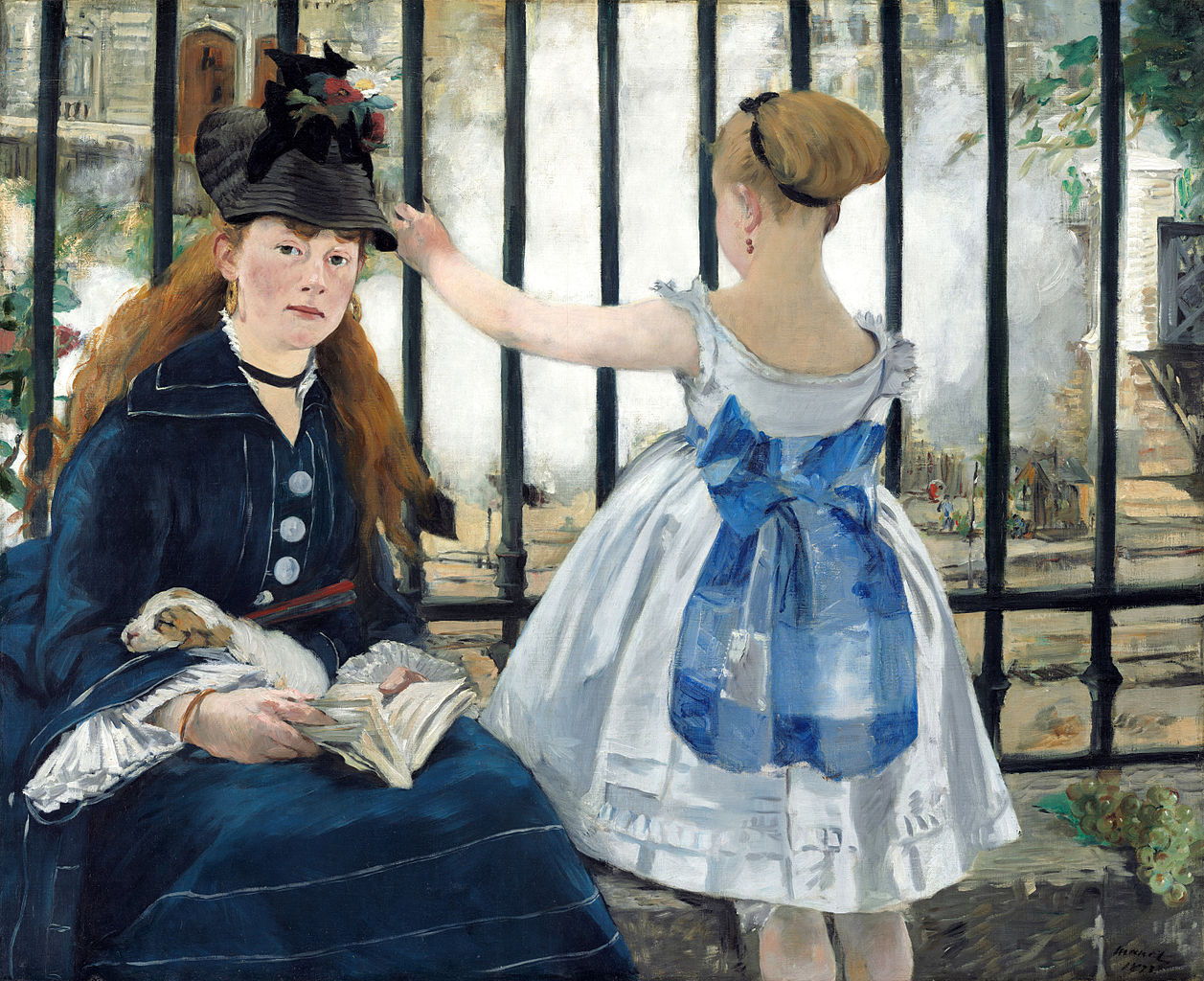
Édouard Manet (1832–1883), The Railway (1873), oil on canvas, 93.3 x 111.5 cm, The National Gallery of Art, Washington, DC. Wikimedia Commons.
A decade later, Manet painted the same model, Victorine Meurent, in The Railway (popularly known as Gare Saint-Lazare) (1873). A genre symbol of modernity, it brought modern technology and urban life to what was at the time a largely unappreciative public.
The most immediate precursors to the Naturalist paintings of 1883 weren’t the early works of Jules Bastien-Lepage, but the paintings of the rural poor by Léon Augustin Lhermitte.
Léon Augustin Lhermitte (1844–1925), Procession near Ploumanac’h (1879), oil on canvas, dimensions not known, Private collection. Wikimedia Commons.
Lhermitte’s sketchy Procession near Ploumanac’h from 1879 shows a religious festival in Brittany, with a small stream of locals making their way along a track on the open hillside towards the church. Its unemotional bleakness is completely different from the dense processions being painted by Jules Breton.
Léon Augustin Lhermitte (1844–1925), The Harvesters’ Pay (1882), oil on canvas, 215 x 272 cm, Musée d’Orsay, Paris. Wikimedia Commons.
Lhermitte’s founding masterpiece of Naturalism is The Harvesters’ Pay from 1882, which looks objectively at the economic and social aspects of the harvest. Four of the harvesters, bearing their heavy-duty scythes, await payment by the farmer’s factor, who holds a bag of coins for the purpose. In the centre of the painting, one of the workers is counting out his pay in front of his wife, who is feeding a young infant at her breast. To their left, another worker just sits and stares blankly into the distance, dead-beat tired and wondering whether his pittance was worth all that effort.
Most importantly, Lhermitte painted these in the early years of the Third Republic, a time when social concerns were sweeping across much of Europe.

 Login
Login