Of all the painting media, oils give the artist greatest flexibility to change their mind. Even when relatively ‘dry’, they can be scraped back carefully and overpainted, although in many cases overpainting is all that’s required. When such changes are detected by the viewer, they’re often referred to as a pentimento, appropriately the Italian for repentance, with pentimenti in the plural.
Written accounts of artists’ practices and careful examination of their paintings can reveal much about their methods. Some undertake such extensive preparations that painting the finished work invariably goes according to plan. Others may rework their composition extensively as it develops, and leave copious evidence of how they changed their mind.
Leonardo da Vinci (1452–1519), Madonna with a Flower (Benois Madonna) (c 1481-83), oil on wood transferred to canvas, 49.5 × 31 cm, Hermitage Museum Государственный Эрмитаж, Saint Petersburg, Russia. Wikimedia Commons.
Several of Leonardo da Vinci’s paintings show how he changed his mind as he worked on the finished painting. His Madonna with a Flower, popularly known as the Benois Madonna, is thought to date from 1481-83, and was preceded in the years 1475-80 by numerous sketches and studies of the Madonna, including several that are strongly linked with this composition. Nevertheless, examination of this painting reveals many pentimenti: the infant’s head was originally larger, and the grasses held by the Madonna in her left hand were originally flowers. Those aren’t visible in this image, though.
Pentimenti can be revealed using special techniques, including infra-red reflectography.
Lucas Cranach the Elder (1472–1553), The Martyrdom of Saint Catherine (1504-5), oil on wood, 112 x 95 cm, Dunamelléki Református Egyházkerület Budapest, Kecskemét, Budapest, Hungary. Wikimedia Commons.
There’s no readily visible evidence that Lucas Cranach the Elder made changes during his painting of The Martyrdom of Saint Catherine in 1504-5.
Lucas Cranach the Elder (1472–1553), The Martyrdom of Saint Catherine (infra-red reflectogram, 900-1700 nm) (1504-5), oil on wood, 112 x 95 cm, Dunamelléki Református Egyházkerület Budapest, Kecskemét, Budapest, Hungary. Wikimedia Commons.
Cranach had a reputation for being quite an impulsive and rapid painter, which seems to be borne out by more thorough analysis. His early works, in particular, show evidence of repeated adjustments in form and colour. The infra-red reflectogram of the Martyrdom of Saint Catherine, below, shows how he laid down the figures in detail in the underdrawing, but extemporised the pyrotechnic effects.
Lucas Cranach the Elder (1472–1553), The Martyrdom of Saint Catherine (detail) (1504-5), oil on wood, 112 x 95 cm, Dunamelléki Református Egyházkerület Budapest, Kecskemét, Budapest, Hungary. Wikimedia Commons.Lucas Cranach the Elder (1472–1553), The Martyrdom of Saint Catherine (infra-red reflectogram, 900-1700 nm) (detail) (1504-5), oil on wood, 112 x 95 cm, Dunamelléki Református Egyházkerület Budapest, Kecskemét, Budapest, Hungary. Wikimedia Commons.
Considerable changes were made to the details during the painting process, as seen here in the underdrawing of the executioner, and the figures to the right of his head.
Sometimes the ageing of a painting brings pentimenti to light, although they wouldn’t have been visible at the time they were completed.
Christoffer Wilhelm Eckersberg (1783–1853), Ulysses’ Revenge on Penelope’s Suitors (1814), media not known, 24 x 42.8 cm, Den Hirschsprungske Samling, Copenhagen, Denmark. Wikimedia Commons.
Christoffer Wilhelm Eckersberg’s Ulysses’ Revenge on Penelope’s Suitors from 1814 shows Odysseus and Telemachus at the left as they attack a small group of the suitors. There are abundant pentimenti visible now in the background, suggesting the artist changed his composition quite radically.
In more modern paintings it can be difficult to distinguish pentimenti from what the artist intended. There are many examples of this in the oil paintings of Paul Cézanne.
Paul Cézanne (1839–1906), Paysage des Bords de l’Oise (Landscape on the Banks of the Oise) (1873-4) (R224), oil on canvas, 73.5 x 93 cm, Palais Princier, Monaco. WikiArt.
Landscape on the Banks of the Oise is an Impressionist view from Cézanne’s first campaign along the River Oise, when he painted in company with Pissarro, and shows the northern bank near the hamlet of Valhermeil.
Closer examination of the reflected image of the house with the red roof merits further study of the painting. Cézanne appears to have made pentimenti to its left edge, at least, and possibly at its right edge too. It appears that an earlier attempt to paint the red roof may have shown it extending more to the left, where it would have been displaced less than now appears.
Paul Cézanne (1839–1906), Paysage des Bords de l’Oise (Landscape on the Banks of the Oise) (1873-4) (R224), oil on canvas, 73.5 x 93 cm, Palais Princier, Monaco. WikiArt. Composite image of detail, adjusted to align the original and reflected images.
These can be seen more clearly in the composite image above, in which I have moved the reflected image to the left so that it does align ‘correctly’ with the real image.
Paul Cézanne (1839–1906), Le Bassin du Jas de Bouffan en Hiver (The Pond of the Jas de Bouffan in Winter) (1878) (R350), oil on canvas, 52.5 x 56 cm, Private collection. WikiArt.
In this painting of The Pond of the Jas de Bouffan in Winter, a view Cézanne must have seen almost every day that he went out from his family home, there is evidence of pentimenti in the right side of the reflected image.
Other media are less forgiving. Watercolours can sometimes cope with small changes, but all too often fail completely. Scraping back isn’t normally possible with acrylics, which tend to be overpainted without scraping, as the latter strips the entire paint layer and may also damage the ground.
Every painter wants to create works as good as those of the Masters like Rembrandt and Rubens. Some decide the only way to achieve that is to discover the secrets of their oil paint, how they controlled its viscosity and got it to look just right. A few come to obsess over those secrets and experiment intensively, abandoning all they know about how to paint in that quest. This article looks at two painters who did just that, and the consequences it had on their work.
Sir Joshua Reynolds (1723–1792) was one of the most famous and prolific portrait painters, who completed a conventional training in oil painting with Thomas Hudson (1701-1779), a successful portrait painter who used traditional and conservative methods with roots going back to the late 1600s. This used layers, starting with dead colouring, the laying in of shadows and lights, then blending in transitions of shading and colour wet-on-wet. Highlights were then brought out, and shadows glazed, to produce a series of thin layers, and a smooth, finished paint surface.
Sir Joshua Reynolds (1723–1792), Mrs. Robinson (c 1784), oil on canvas, 88.6 x 68.9 cm, Yale Center for British Art, New Haven, CT. Wikimedia Commons.
Reynolds’ early stages are shown well in this abandoned portrait of Mrs Robinson from about 1784, where much of its paint layer is sufficiently thin as to allow the texture of the canvas to show through.
Sir Joshua Reynolds (1723–1792), Mrs. Robinson (detail) (c 1784), oil on canvas, 88.6 x 68.9 cm, Yale Center for British Art, New Haven, CT. Wikimedia Commons.Sir Joshua Reynolds (1723–1792), Anne Seymour Damer (née Conway) (1773), oil on canvas, 125.7 x 99.1 cm, Yale Center for British Art, New Haven, CT. Wikimedia Commons.
His finished portrait of Anne Seymour Damer (née Conway) (1773) shows this technique working well, with painterly highlights, and textures in the fabrics. Flesh passages have aged well, with limited fine cracking visible.
Sir Joshua Reynolds (1723–1792), Anne Seymour Damer (née Conway) (detail) (1773), oil on canvas, 125.7 x 99.1 cm, Yale Center for British Art, New Haven, CT. Wikimedia Commons.
Reynolds aspired to the greatness of the Masters, and in his quest to achieve that, he experimented, particularly after visiting Italy in 1749-52. Seeing that the works of Masters like Rembrandt had passages with quite thick applications of paint, Reynolds also applied his paint thickly where appropriate. In order to make his paint sufficiently viscous he took to adding mediums that he felt resembled those used by the Masters. He seldom scraped back paint in order to correct or change his paintings, but applied more paint over the top of as many as ten previous layers, some of them thick and viscous. Reynolds himself admitted that his Infant Hercules Strangling Serpents in his Cradle (1788) had “ten pictures under it, some better, some worse.”
His accounts of ‘experiments’ with paint aren’t recorded in sufficient detail to reproduce any of his materials, but refer to the use of:
copaiba balsam, a controversial oleo-resin thickener that can inhibit drying;
wax, which he was convinced was the secret of success of the Masters;
bitumen, which inhibits drying and commonly causes poor structural integrity in paint layers.
His drying oils were linseed, walnut, and poppy seed, with the latter two mainly used for lighter-coloured paints. They were often heat-treated to pre-polymerise and thicken them.
His greatest error, as far as the longevity of his paintings is concerned, was his excessive use of resins. As a result, contemporaries reported that some of his portraits cracked before they had even left his studio.
Reynolds also experimented with the most dangerous medium of all: Megilp. Known by a variety of similar names, he’s the first British artist known to have referred to its use. Megilp is made by heating a drying oil with a lead drier (usually litharge), then adding substantial amounts of resin until it produces a thick paint of buttery consistency. Variants using different kinds of ‘black oil’ were even more likely to compromise the longevity and structural integrity of paintings. Reynolds seems to have become addicted to them.
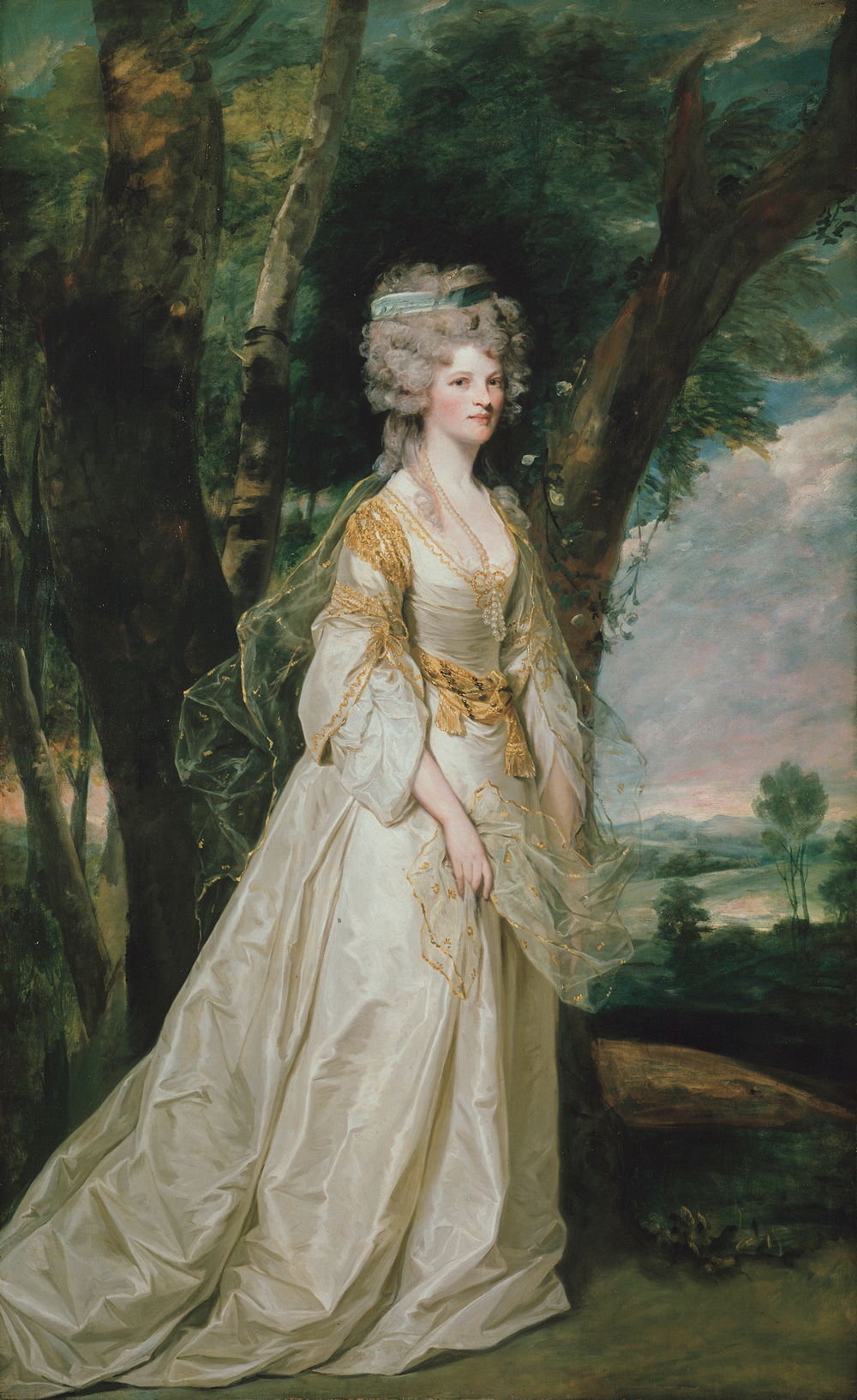
Sir Joshua Reynolds (1723–1792), Lady Sunderland (1786), oil on canvas, 238.5 x 147.5 cm, Gemäldegalerie der Staatlichen Museen zu Berlin, Berlin. Wikimedia Commons.
His portrait of Lady Sunderland (1786) appears to have survived rather better than many of his paintings.
Sir Joshua Reynolds (1723–1792), Lady Sunderland (detail) (1786), oil on canvas, 238.5 x 147.5 cm, Gemäldegalerie der Staatlichen Museen zu Berlin, Berlin. Wikimedia Commons.
But a more careful look at its background shows where paint, presumably diluted with turpentine to aid its rapid application, has run, although other parts of the same brushstroke still show the marks of the brush, indicating the paint had also been thickened prior to dilution.
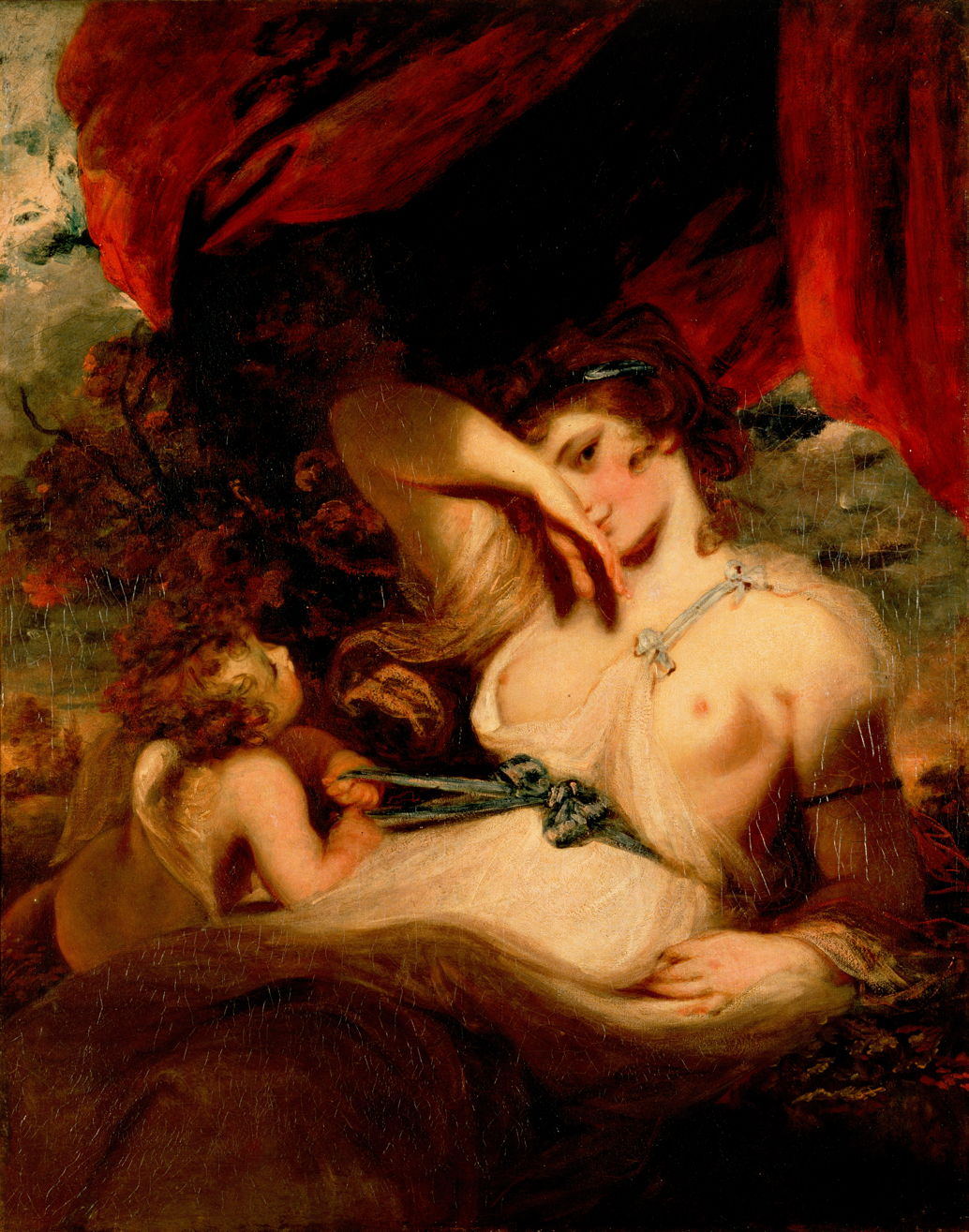
Sir Joshua Reynolds (1723–1792), Cupid Untying the Zone of Venus (1788), oil on canvas, 127.5 x 101 cm, Hermitage Museum, Saint Petersburg. Wikimedia Commons.
His Cupid Untying the Zone of Venus (1788) has catastrophic cracking indicating that surface layers of paint have detached from lower layers. In parts, those cracks have become filled with lighter paint that has risen up from a lower layer that was drying more slowly than those more superficial. The detail below also shows the wide variation in thickness of his paint layer: some passages are thin enough to allow the texture of the canvas to show through, while others are so thick that layers have separated.
Sir Joshua Reynolds (1723–1792), Cupid Untying the Zone of Venus (detail) (1788), oil on canvas, 127.5 x 101 cm, Hermitage Museum, Saint Petersburg. Wikimedia Commons.
Sadly, Reynolds wasn’t the first, and by no means the last, painter to compromise their oil paintings from their desire to emulate the Masters. There were also many more who were tempted to use Megilp and its variants, in the same forlorn hope.
Albert Pinkham Ryder (1847–1917) studied in New York at the National Academy of Design during the early 1870s, and travelled to Europe four times, although when there he didn’t apparently undergo any training as such. He was also a close and longstanding friend of Julian Alden Weir, who trained at the École des Beaux-Arts under Jean-Léon Gérôme and was conservative in his technique.
Ryder apparently became obsessed with creating unique optical effects in his oil paintings, in the course of which he abandoned the discipline of craft. He interlayered oil, resin, wax, non-drying oils, and protein-rich materials in his paint layers. Even in his lifetime many suffered disastrous cracking, which he claimed that he didn’t mind.
Few of his paintings are either structurally stable or readable any more, and the best records of the artist’s intent are now old monochrome photographs taken of them before they deteriorated so badly.
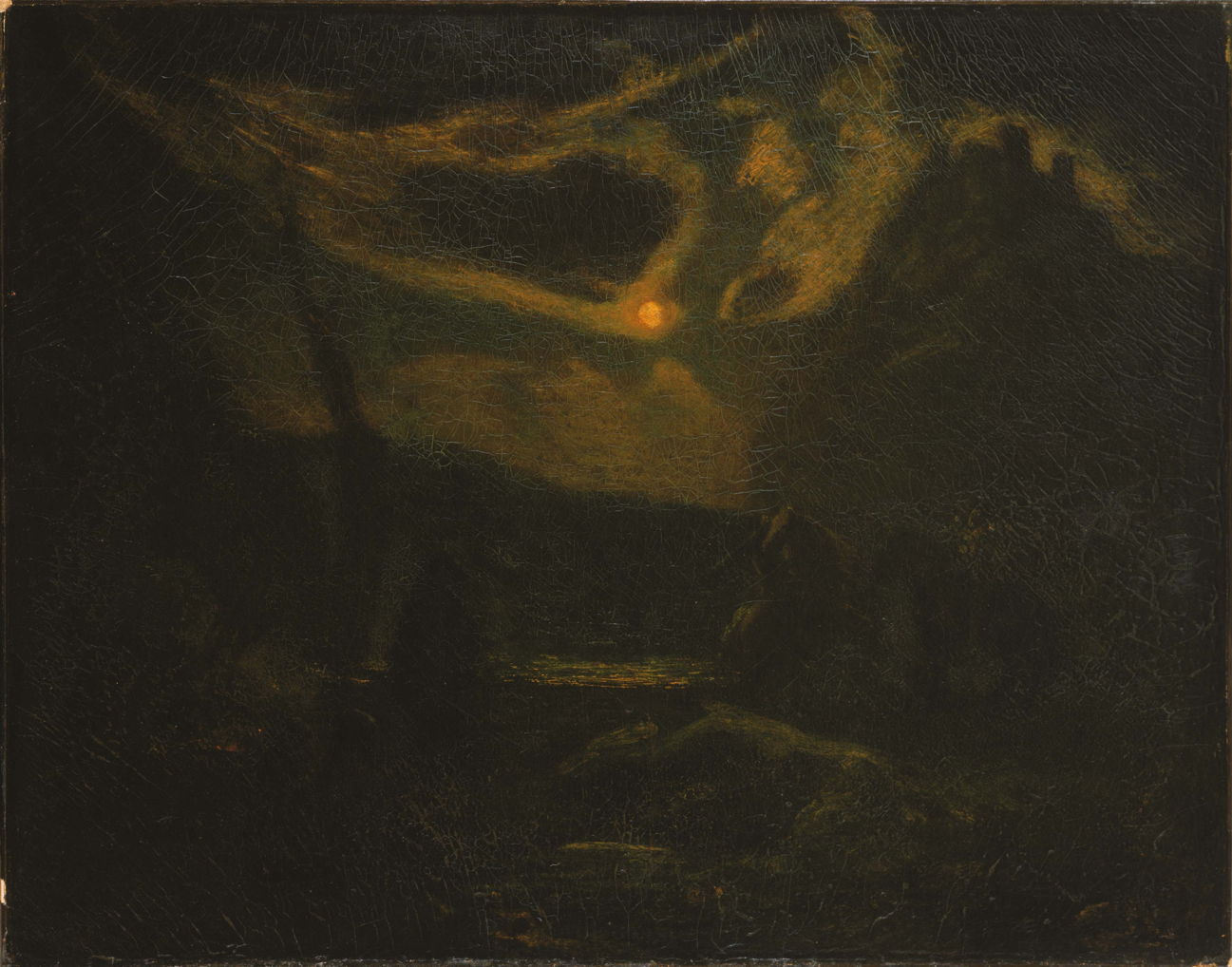
Albert Pinkham Ryder (1847–1917), The Waste of Waters is Their Field (c 1883), oil on panel, 28.8 × 30.5 cm, Brooklyn Museum, New York, NY. Wikimedia Commons.
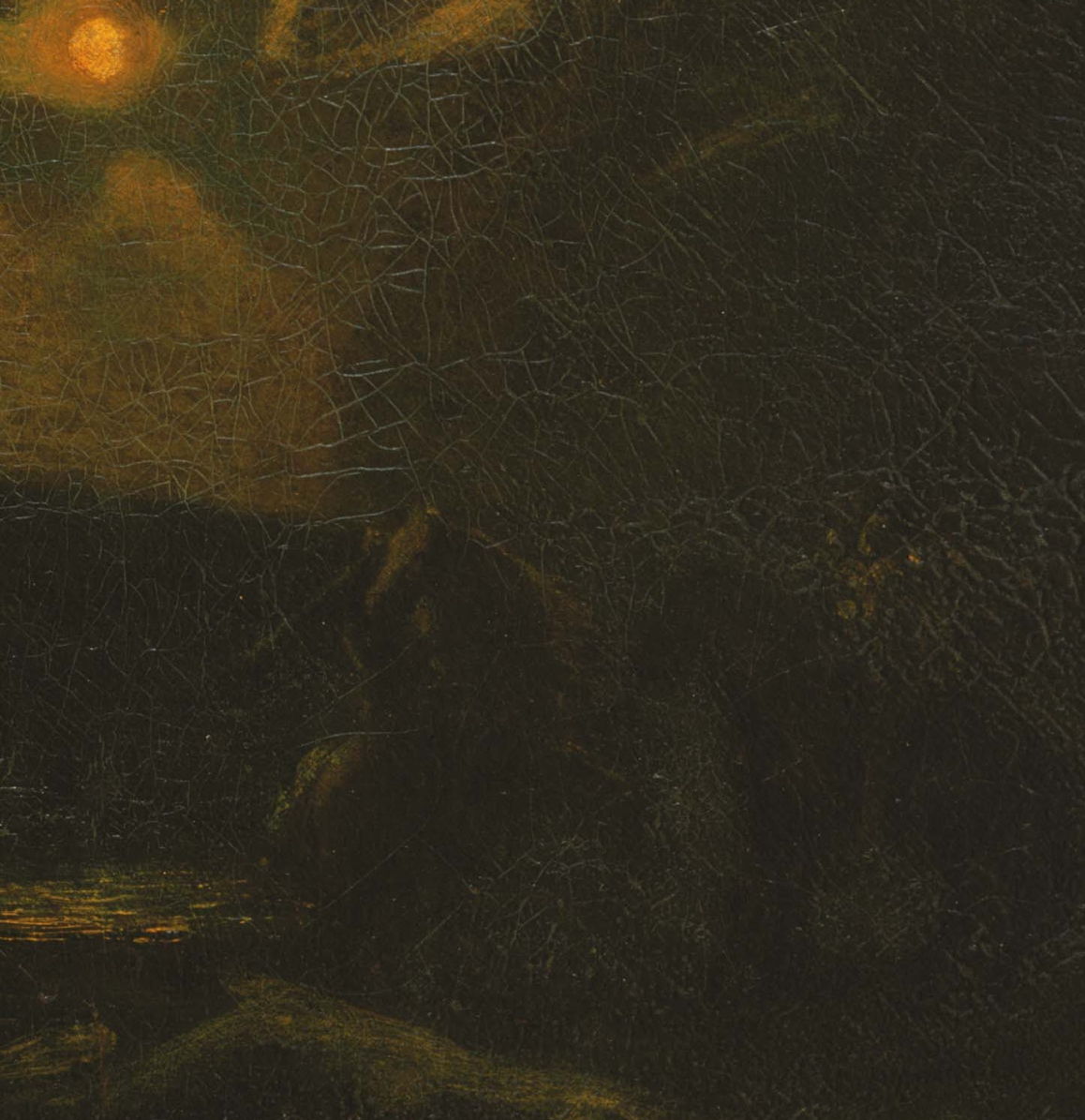
The Waste of Waters is Their Field (c 1883) is a small oil painting that is now almost completely lost, with much of the detail merged into a dark brown mess as its superficial layers have faded, and the deeper layers darkened. The detail below shows that its entire paint layer is dissected by cracks, many of them gaping and oozing lighter wet paint from below.
Albert Pinkham Ryder (1847–1917), The Waste of Waters is Their Field (detail) (c 1883), oil on panel, 28.8 × 30.5 cm, Brooklyn Museum, New York, NY. Wikimedia Commons.Albert Pinkham Ryder (1847–1917), Resurrection (1885), oil on canvas, 17.1 x 14.1 cm, The Phillips Collection, Washington, DC. Wikimedia Commons.
Details can still be made out in his tiny Resurrection (1885), although even this has changed and cracked severely. Many of the cracks are wide and filled with paint that has risen up from lower layers.
Albert Pinkham Ryder (1847–1917), Resurrection (detail) (1885), oil on canvas, 17.1 x 14.1 cm, The Phillips Collection, Washington, DC. Wikimedia Commons.Albert Pinkham Ryder (1847–1917), Macbeth and the Witches (c 1895-1915), oil on canvas, 28.3 x 35.8 cm, The Phillips Collection, Washington, DC. Wikimedia Commons.
Macbeth and the Witches (c 1895-1915) has also become impossible to read, with its almost universal darkening and dense cracking across its paint layer.
Albert Pinkham Ryder (1847–1917), Macbeth and the Witches (detail) (c 1895-1915), oil on canvas, 28.3 x 35.8 cm, The Phillips Collection, Washington, DC. Wikimedia Commons.
Ryder was deemed an important painter whose work was much admired during his lifetime. Collectors invested heavily in his paintings. Tragically their collections are now left with paintings that are nothing like they were originally, whose recovery is technically impossible.
Reynolds’ paintings are now around 250 years old, and Ryder’s are little more than a century. Those of the Masters they tried to emulate are 400 years old, and thankfully in far better health.
Reference
Gent A (2015) Reynolds, Paint and Painting: a Technical Analysis, in Joshua Reynolds, Experiments in Paint, eds. L Davis & M Hallett, The Wallace Collection & Paul Holberton. ISBN 978 0 9007 8575 7.
Edgar Degas had limited formal training in painting, studying at the École des Beaux-Arts in Paris for a year before he went to Italy for three years from the summer of 1856. On his return to Paris, where he set up his first studio in 1859, he followed convention and worked mainly in oils.
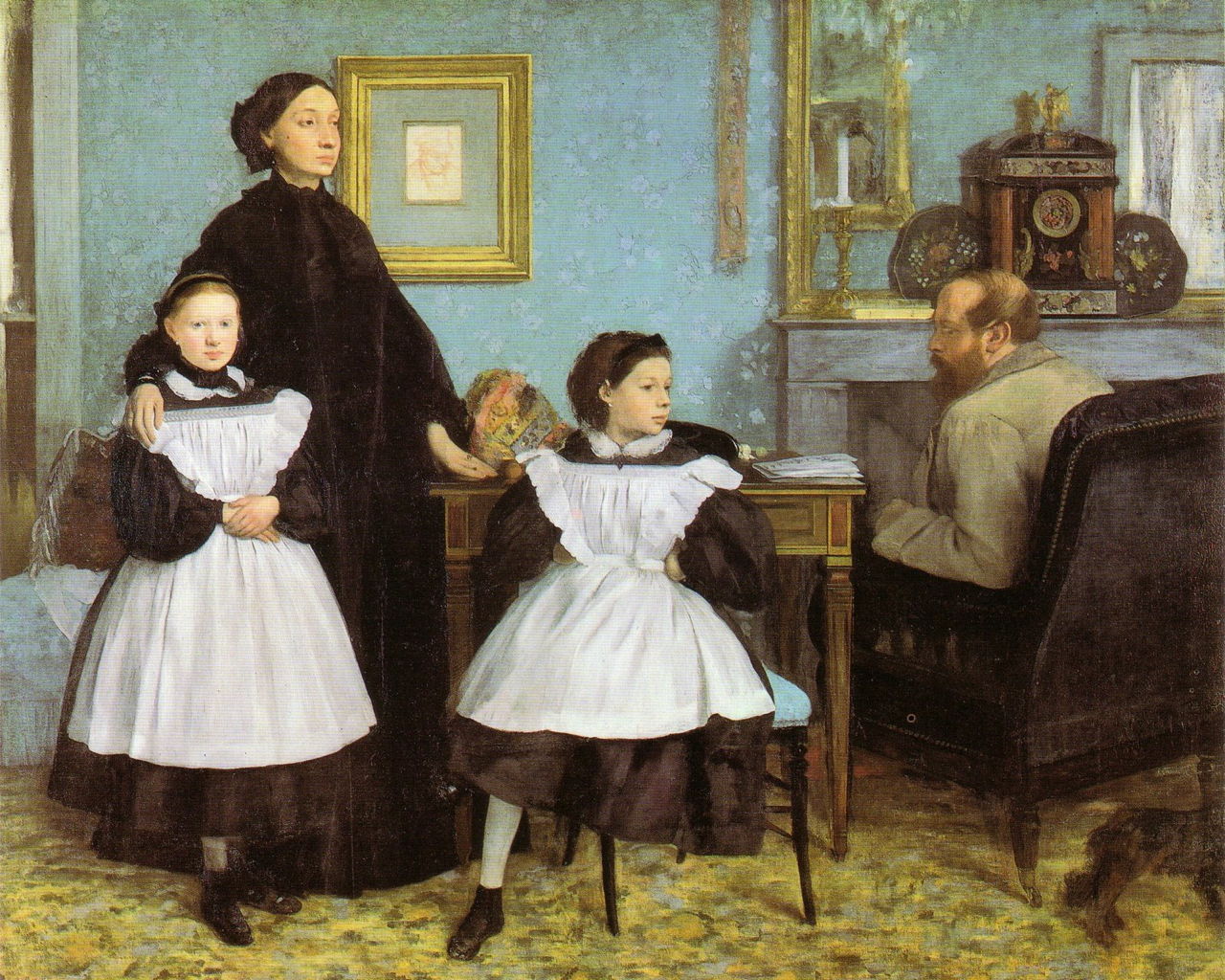
Edgar Degas (1834–1917), The Bellelli Family (1858-67), oil on canvas, 200 × 253 cm, Musée d’Orsay, Paris. Wikimedia Commons.
Degas painted some small portraits early in his career, but his first major work is that of The Bellelli Family, which he laboured over for nearly ten years between 1858-67. He started this when he was staying with the family in Naples.
Edgar Degas (1834–1917), View of Naples (1860), watercolour, dimensions not known, Bibliothèque Nationale de France, Paris. The Athenaeum.
He also made several landscape sketches, some in oil on paper, others like this View of Naples (1860) in watercolour. None seems to have been developed into anything more substantial, though.
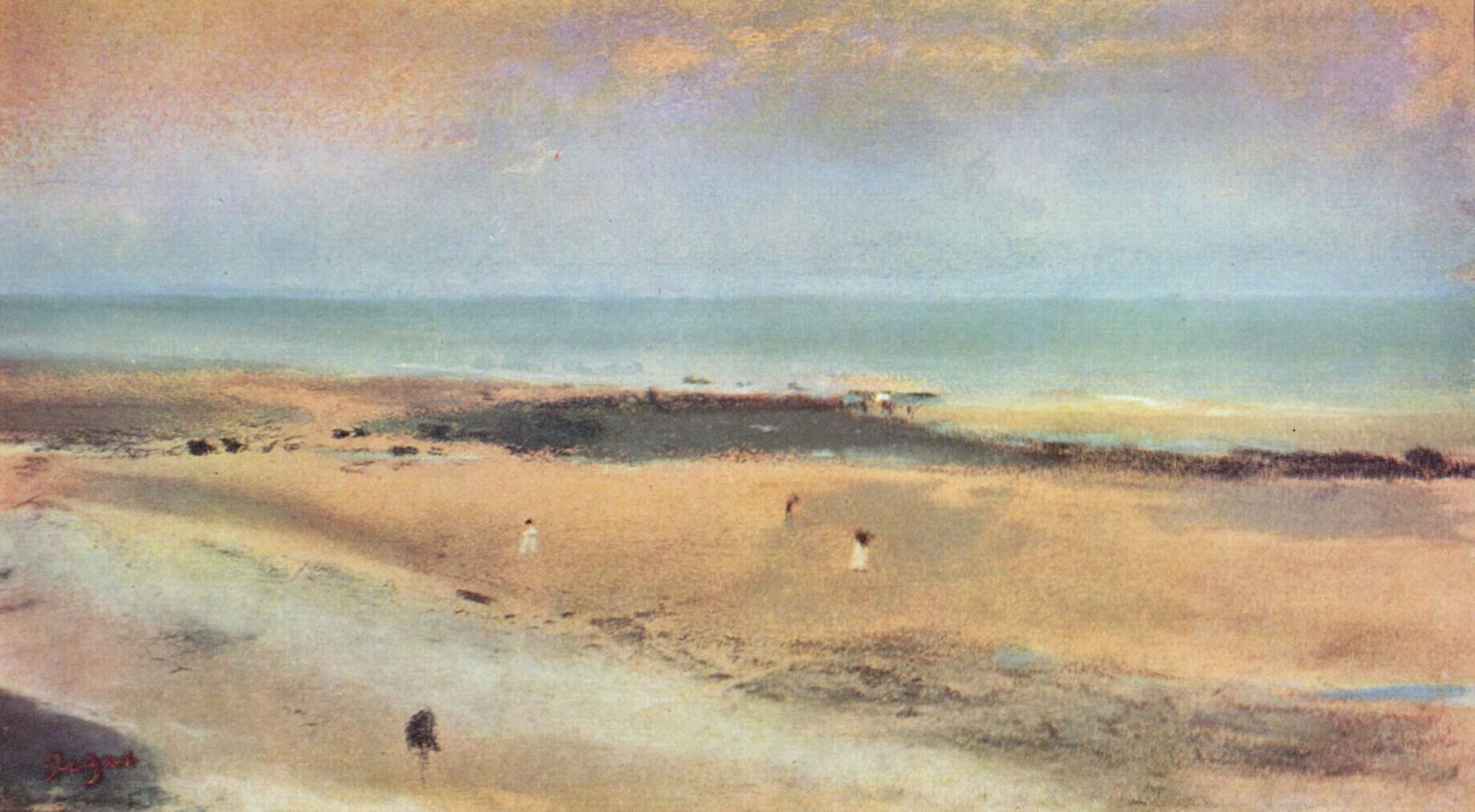
Edgar Degas (1834–1917), Beach at Low Tide (c 1869-70), pastel, 18 × 31 cm, Private collection. Wikimedia Commons.
In the summer of 1869 he travelled to the Normandy coast of France, where he visited Édouard Manet and painted some landscapes in pastels. Among those is Beach at Low Tide (c 1869-70) emphasising its flatness and emptiness. He then seems to have become more experimental in his technique, for example wetting his pastels to apply them with a brush, and combining them with print-making techniques he had been teaching himself. Among his goals seems to have been to reduce the amount of binder in his paint in a bid to apply pure colour.
Edgar Degas (1834–1917), Ballet at the Paris Opéra (1877), pastel over monotype on cream laid paper, 35.2 x 70.6 cm, Art Institute of Chicago, Chicago, IL. Wikimedia Commons.
From the mid-1870s in his paintings of the Ballet at the Paris Opéra, here from 1877, Degas experimented with another method of reducing the binder in his paint layer, by applying pastel over a monotype. He first created this painting on a non-absorbent surface, and while that was still wet used that to make a print on paper, which he completed by applying soft pastel on top.
Edgar Degas (1834–1917), Danseuse basculant (Danseuse verte) (Swaying Dancer, Dancer in Green) (1877-79), pastel and gouache on paper, 64 x 36 cm, Museo Thyssen-Bornemisza, Madrid, Spain. Wikimedia Commons.
As his ballet paintings progressed to smaller groups, they focussed more on their form and movement, as in Danseuse basculant (Danseuse verte) (Swaying Dancer, Dancer in Green) (1877-79). This is painted in a combination of pastel and gouache. By this time he had experimented technically in three main areas: the use of peinture à l’essence, oil paint with the drying oil largely removed, a rich variety of wet and dry techniques with soft pastels, and print-making, in particular his re-introduction of the monotype.
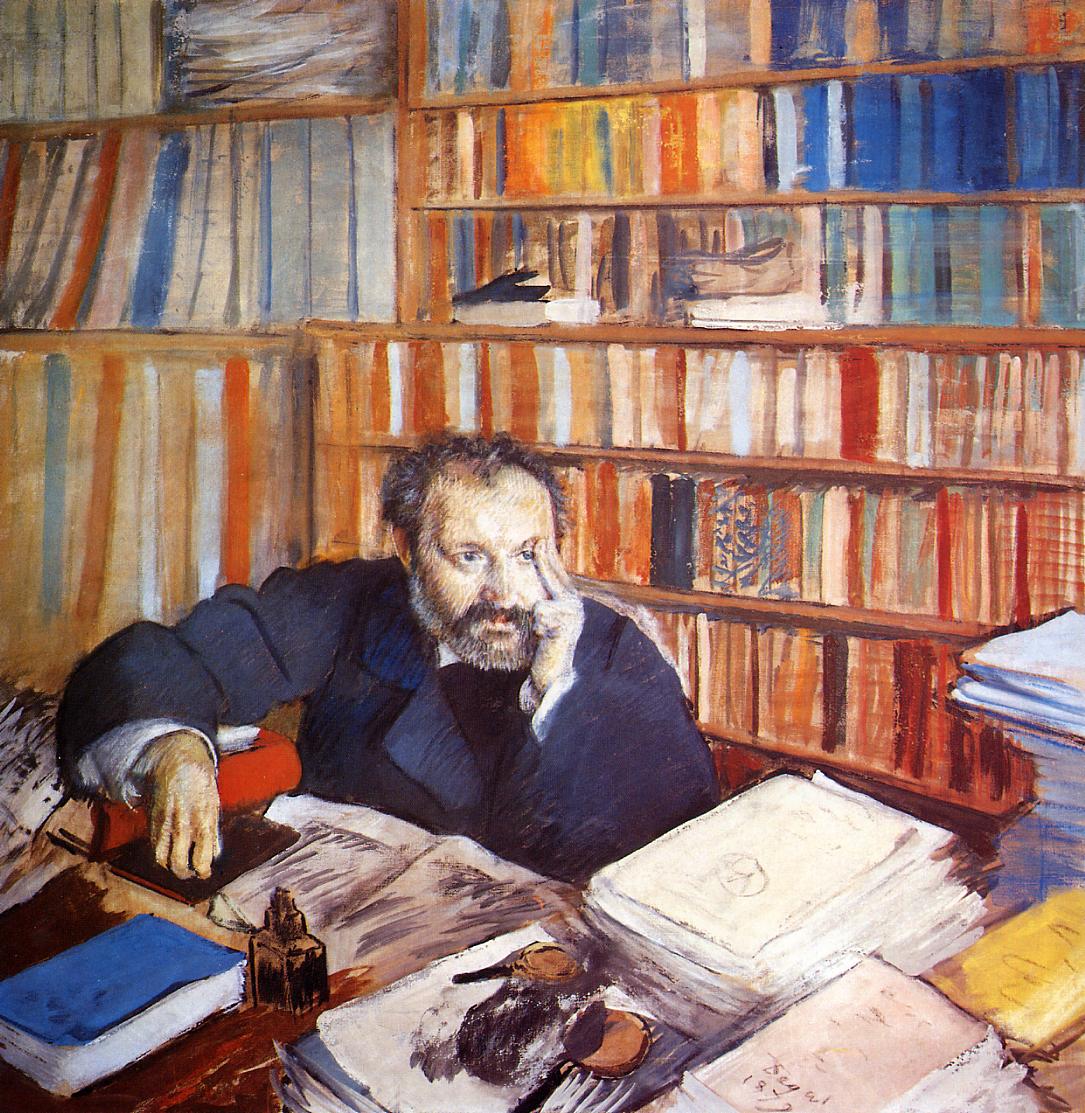
Edgar Degas (1834–1917), Portrait of Edmond Duranty (1879), gouache with pastel on linen, 128 x 128.6 cm, Burrell Collection, Glasgow, Scotland. Image by Rlbberlin, via Wikimedia Commons.
Degas’ Portrait of Edmond Duranty (1879) was unusually painted in gouache with pastel on linen. His friend Duranty is clearly thinking over his next piece of writing, which could have been as influential as his essay The New Painting, published in 1876, often used as a benchmark against which to compare Degas’ work.
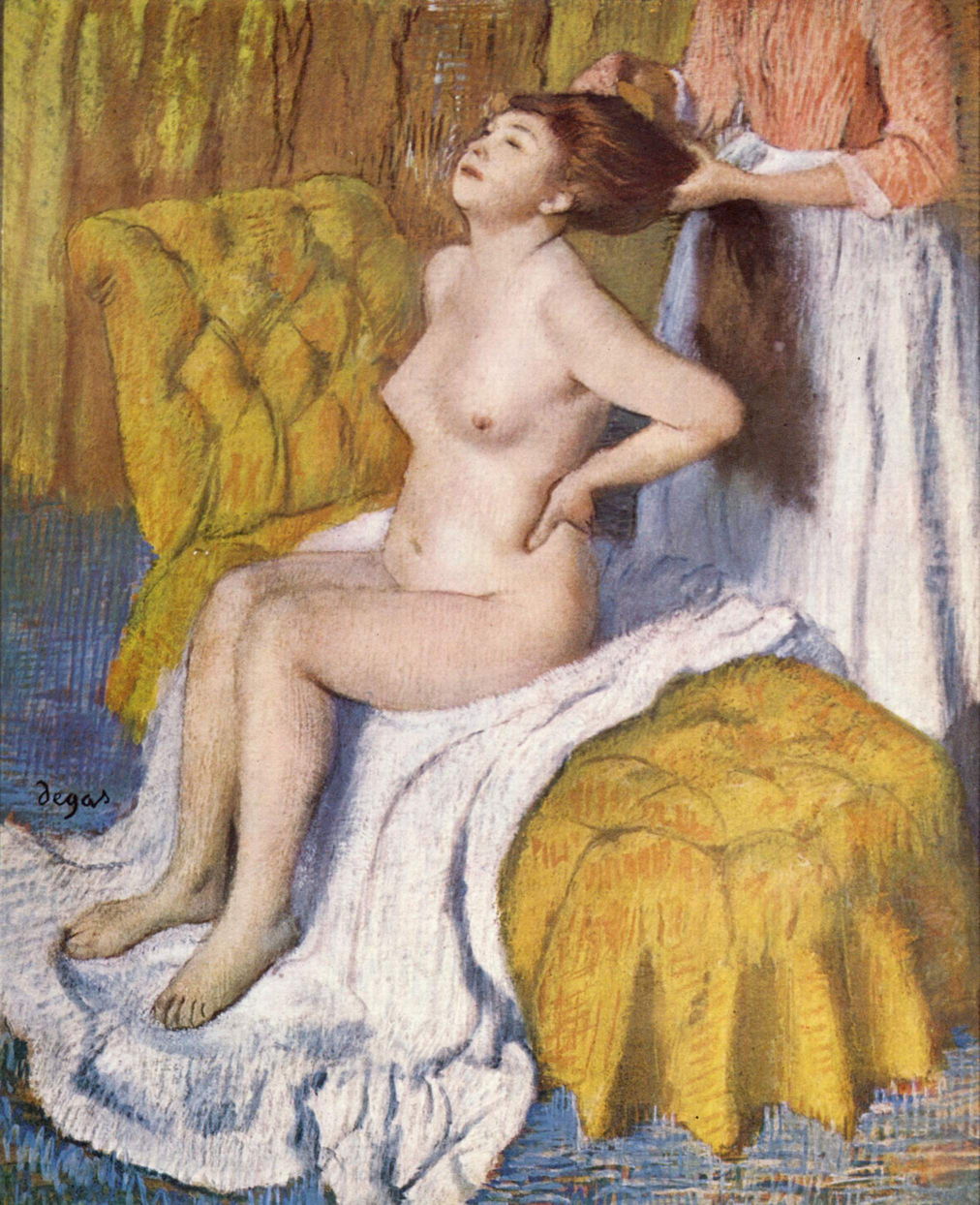
Edgar Degas (1834–1917), Woman Having Her Hair Combed (c 1885), pastel, 73 × 59 cm, Metropolitan Museum of Art, New York, NY. Wikimedia Commons.
This pastel painting of a Woman Having Her Hair Combed from about 1885 shows some of the textures he created using his techniques, from smooth flesh to the frizz of hair.
Edgar Degas (1834–1917), Woman Sponging Her Back (c 1888-92), pastel on paper mounted on cardboard, 70.9 x 62.4 cm, National Museum of Western Art 国立西洋美術館 (Kokuritsu seiyō bijutsukan), Tokyo, Japan. Wikimedia Commons.
This later period of his work also brought an increasing number of paintings of women bathing and dressing, culminating in pastel paintings formed from vigorous vertical or diagonal strokes, such as Woman Sponging Her Back (c 1888-92). The contrast with the previous work is stark.
Edgar Degas (1834–1917), Wheat Field and Green Hill (c 1890-92), pastel over monotype in oil colours on paper, dimensions not known, Norton Simon Museum, Pasadena, CA. Wikimedia Commons.
Degas’ late landscapes are based on similar combinations of media, as in his Wheat Field and Green Hill from the early 1890s, in which he applied soft pastels on a monotype using oil-based ink or paint.
Edgar Degas (1834–1917), Dancer Fastening Her Shoe (c 1893-98), oil colour and turpentine, 70 × 200 cm, Cleveland Museum of Art, Cleveland, OH. Wikimedia Commons.
His remarkable composite work, made using peinture à l’essence, of a Dancer Fastening Her Shoe (c 1893-98), brings together four different views of the same dancer fastening her left shoe. This may have been inspired by Muybridge and Marey’s composite photos of human motion, and may well have reflected his own experiments in photography.
Edgar Degas (1834–1917), After the Bath, Woman Drying Her Back (1896), gelatin silver photographic print, 16.5 x 12 cm, J. Paul Getty Museum, Los Angeles, CA. Wikimedia Commons.
Degas’ gelatin silver photographic print of After the Bath, Woman Drying Her Back from 1896 is one example of his many experiments with photography.
Most of the other more orthodox French Impressionists were remarkably conservative in their choice and use of media, sticking to oil on canvas for almost their entire careers. Degas was the odd man out, not just for what he painted, but for how he did so.
Many of the masters were content to paint with the same media that they originally learned in their youth, but some pushed their experimentation beyond mere technique. Among the most experimental of them all is Francisco Goya (1746–1828), who tried three media that were unusual if not almost unique. This article shows examples of each.
Oil on tinplate
Painting with oil paint on a copper sheet was well established, if uncommon by the time that Goya trained, and the use of tinplate as a support was more unusual among masters of his standing. Tinplate consists of a thin sheet of wrought iron or steel ‘pickled’ in acid and coated with a thin layer of tin to impede rusting. Although an ancient practice, production of tinplate at scale didn’t occur until the seventeenth century, and later became widely used for the production of ‘tin’ cans.
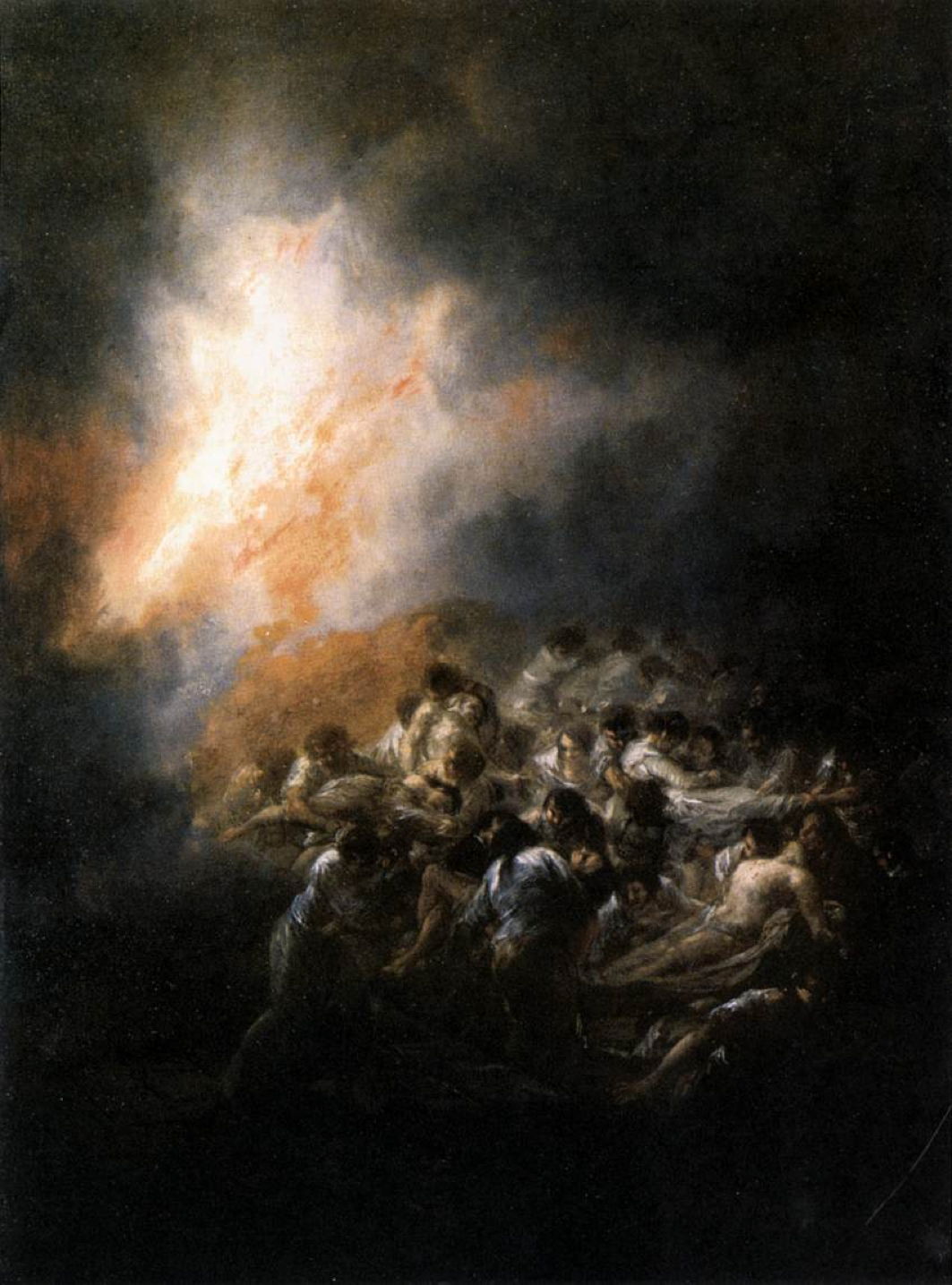
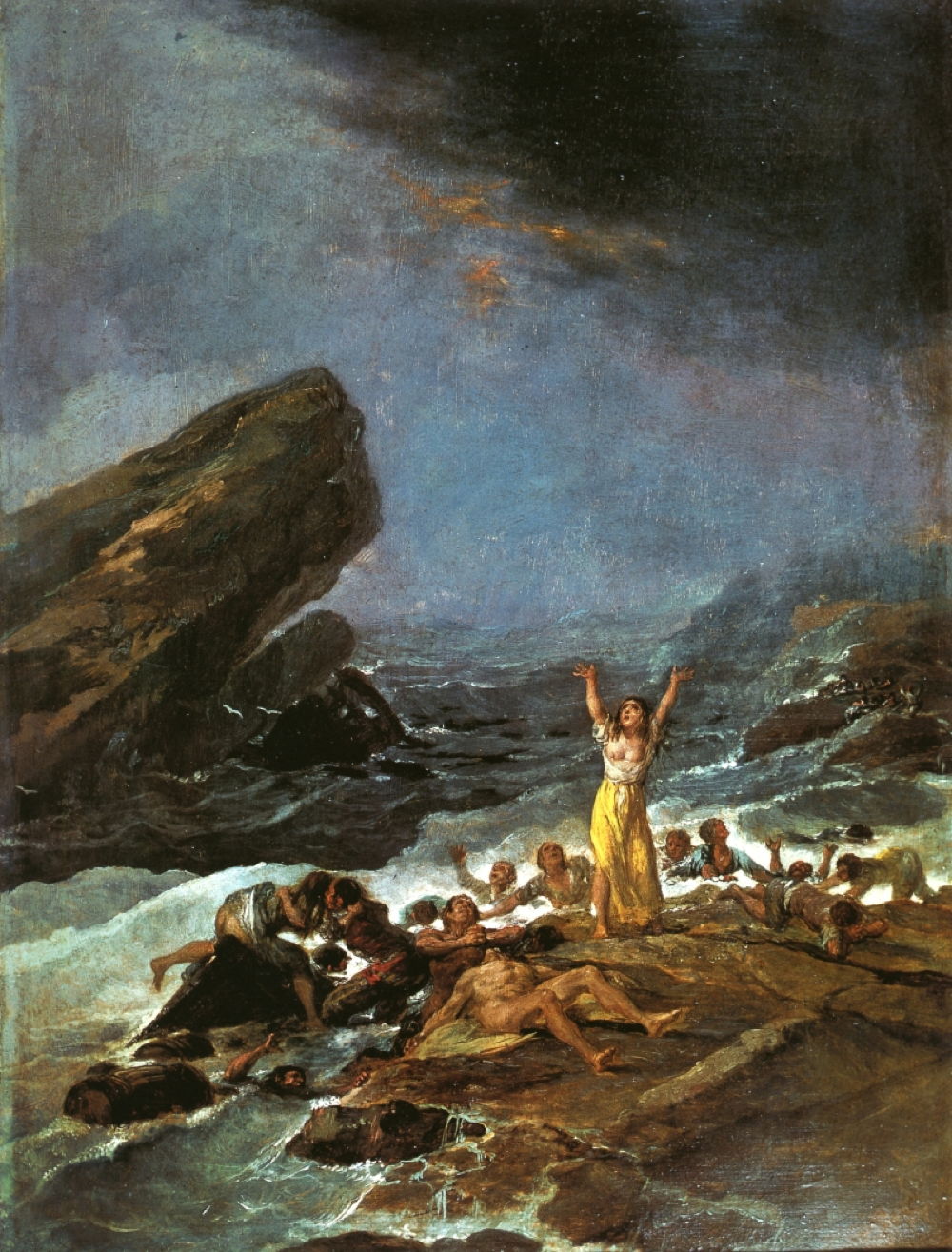
When Goya was convalescing from his serious illness, in 1793, he painted a series of about fourteen works, most of which are on tinplate, and sent them to a connoisseur to be shown to the members of the academy. I show here just four of them.
Francisco Goya (1746–1828), The Strolling Players (1793), oil on tinplate, 43 x 32 cm, Museo Nacional del Prado, Madrid, Spain. Wikimedia Commons.
The Strolling Players (1793) is the lightest of these, showing a small cast of itinerant actors in the commedia dell’arte of the time. This appears to be set on the bank of the River Manzanares in Madrid, with a packed audience behind its stage.
Francisco Goya (1746–1828), Fire at Night (1793-94), oil on tinplate, 50 x 32 cm, Private collection. Wikimedia Commons.
Fire at Night (1793-94) is a dramatic painting relying on subtle suggestion for its effect. A seething mass of people are removing casualties from the burning building at the left. There are flames and thick black smoke billowing up into the night sky, and its victims are dressed for bed.
Francisco Goya (1746–1828), The Shipwreck (1793-94), oil on tinplate, 50 × 23 cm, Bowes Museum, Barnard Castle, England. Wikimedia Commons.
Although it has been suggested that The Shipwreck (1793-94) might show the Biblical flood, the breaking waves and rocky coastline make it more likely to show survivors coming ashore from a stricken vessel, and this is confirmed by a couple of barrels as flotsam to the left.
Francisco Goya (1746–1828), Yard of a Madhouse (1794), oil on tinplate, 43.8 x 31.7 cm, Meadows Museum, Dallas, TX. Wikimedia Commons.
The last of these, showing the Yard of a Madhouse (1794), perhaps sets the scene for Goya’s future paintings, with its disturbing glimpse into the tormented lives of those effectively imprisoned as a result of mental illness. They wrestle and shriek down in the gloom beneath its walls, while there’s the bright light of hope in the sky above.
Oil on plaster
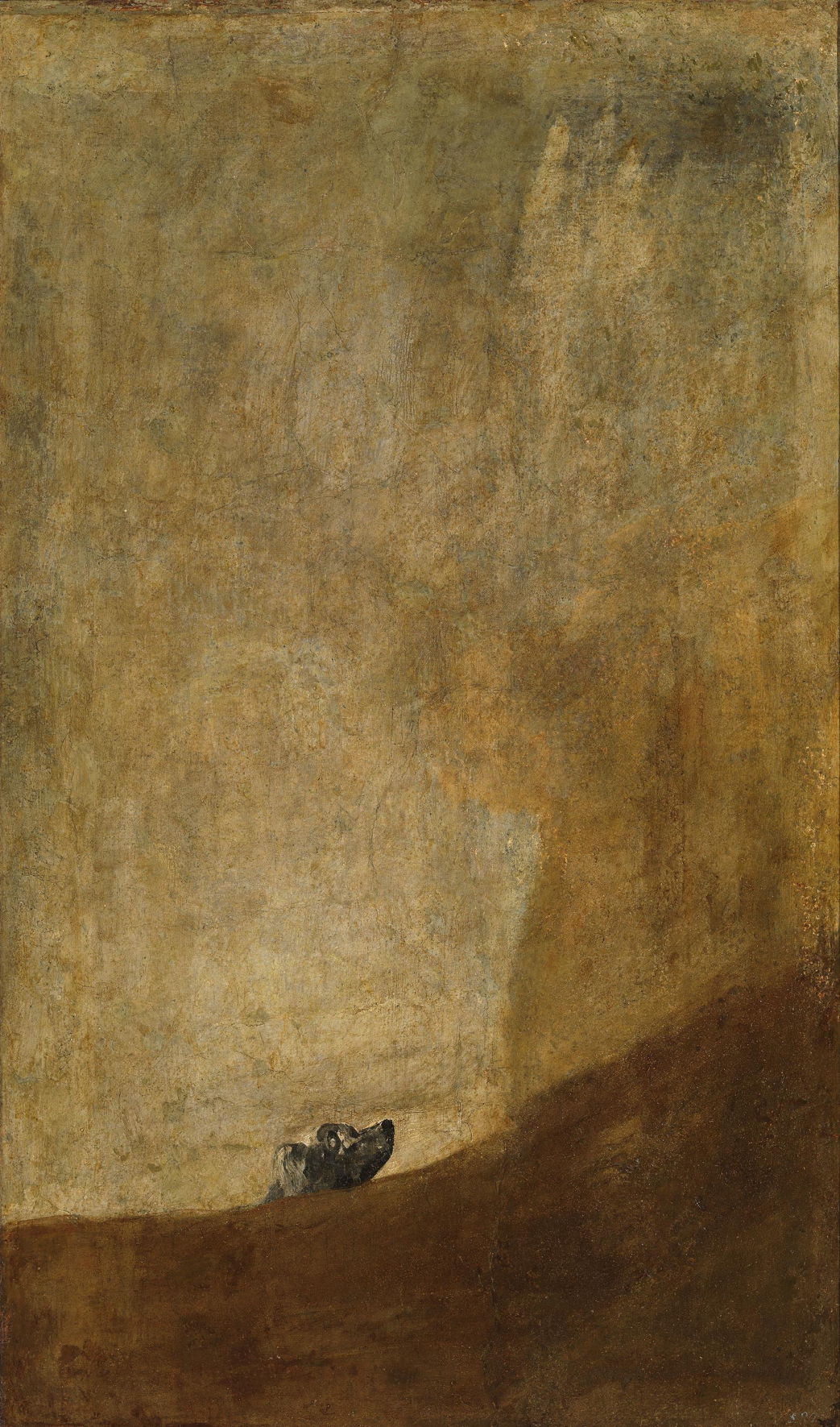
Over twenty-five years later, Goya abandoned the city of Madrid as it descended into chaos, and lived in his villa Quinta del Sordo with his housekeeper, where he decided to decorate its walls with his own paintings. For this he ignored his previous experience painting frescos, and applied oil paint direct to the plaster. The results are his Black Paintings, a collection of his nightmare visions which have since been transferred to canvas and hang now in the Prado. Of the fourteen, I show just three here.
Francisco Goya (1746–1828), Saturn Devouring His Son, Devoration or Saturn Eats His Child (1819-23), oil on canvas, 146 × 83 cm, Museo Nacional del Prado, Madrid, Spain. Wikimedia Commons.
Saturn Devouring His Son is the most famous of these Black Paintings, and the most horrific, as a portrayal of the Titan Cronus eating one of his sons to ensure they wouldn’t grow up to usurp him.
Francisco Goya (1746–1828), Witches’ Sabbath (The Great He-Goat) (1821-23), oil on plaster transferred to canvas, 140.5 x 435.7 cm, Museo Nacional del Prado, Madrid, Spain. Wikimedia Commons.
Witches’ Sabbath (The Great He-Goat) refers back to Goya’s earlier paintings of witchcraft for the Duchess of Osuna, with the black-cloaked figure of the devil incarnate as a billy-goat, sat in front of a mass of hideous women gathered at their Sabbath.
Francisco Goya (1746–1828), The Dog (1820-23), oil on plaster transferred to canvas, 131 x 79 cm, Museo Nacional del Prado, Madrid, Spain. Wikimedia Commons.
Of all these Black Paintings, it’s The Dog that’s the most artistically radical. It shows the head of a dog gazing upwards from behind a darker sloping foreground. There are suggestions of another image in the right half of the painting, but that’s now thought to have been the remains of earlier marks on the plaster.
Watercolour on ivory
During the winter of 1824-25, Goya painted some of the most remarkable works of his career, using watercolour on a prepared support of ivory. He first applied a binder, either egg white or gum arabic, then blackened the thin sliver of ivory with carbon, possibly mixed with a little egg yolk. He next allowed a drop of water to fall on it, which lifted off part of the black ground, leaving chance highlights, which he used as the basis for his painting.
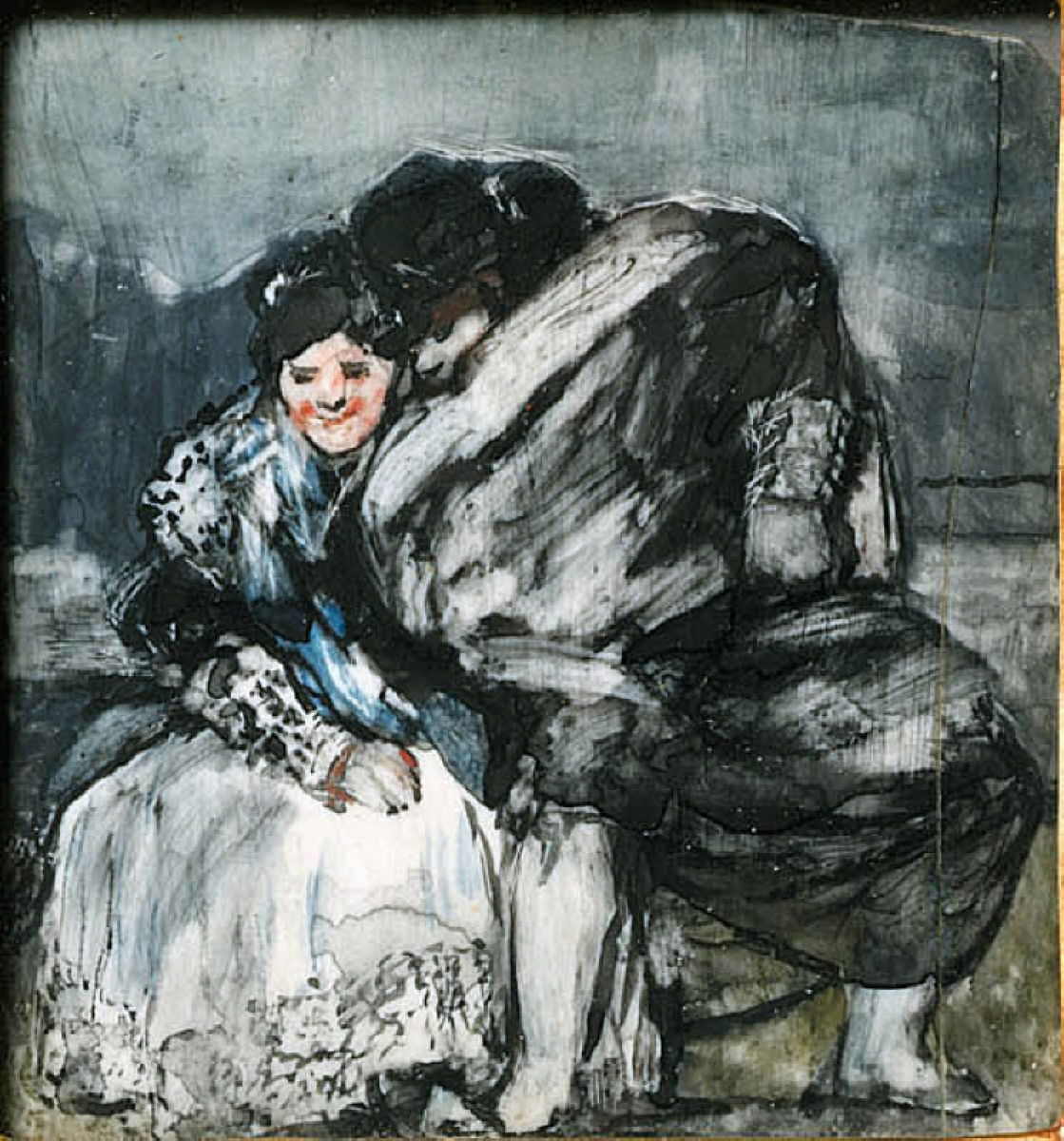
In terms of technique, these owe more to his printmaking than his painting, and are fascinating experiments he appears to have devised himself, based on a practice among some painters of miniature portraits on ivory. Goya reported that he had made about forty of these, of which only ten are known today, and a further twelve are known from reproductions or records. Here are four of the survivors, of which the largest is less than 9 by 9 centimetres (3.5 x 3.5 inches).
Francisco Goya (1746–1828), Maja and Celestina (1824-25), watercolour on ivory, 5.4 x 5.4 cm, Private collection. Wikimedia Commons.
Maja and Celestina combines one of his young Majas with an old woman who is thought to have represented the legendary procuress known as Celestina.
Francisco Goya (1746–1828), Seated Woman and Man in Spanish Cloak, Majo and Maja (1824-25), watercolour on ivory, 8.8 x 8.3 cm, Nationalmuseum, Stockholm, Sweden. Wikimedia Commons.
Seated Woman and Man in Spanish Cloak, Majo and Maja is another reference to his much earlier paintings.
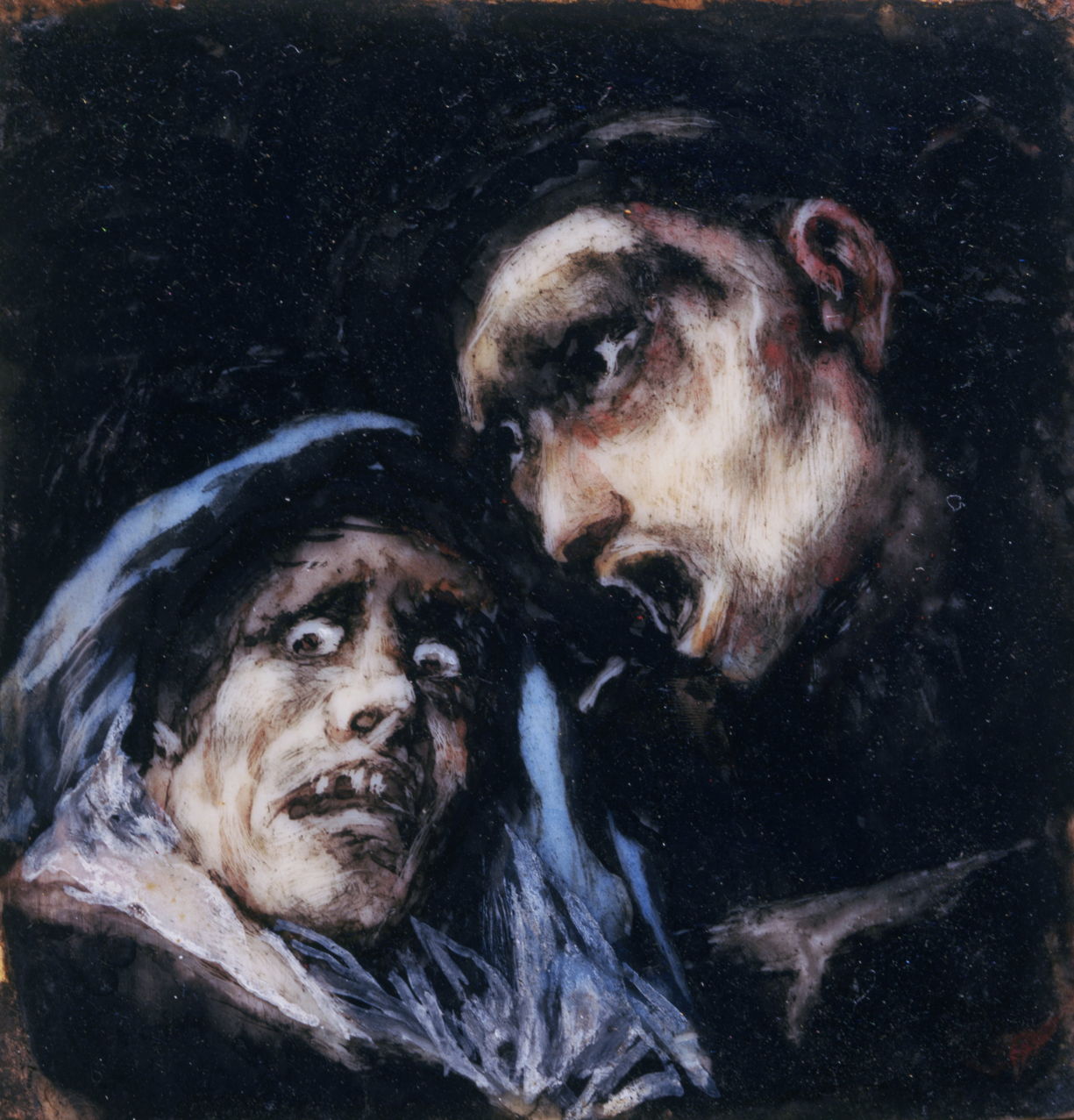
Francisco Goya (1746–1828), Monk Talking to an Old Woman (1824-25), watercolour on ivory, 5.5 x 5.5 cm, Princeton University Art Museum, Princeton, NJ. Wikimedia Commons.
The faces of this Monk Talking to an Old Woman come straight from those who populated his Black Paintings.
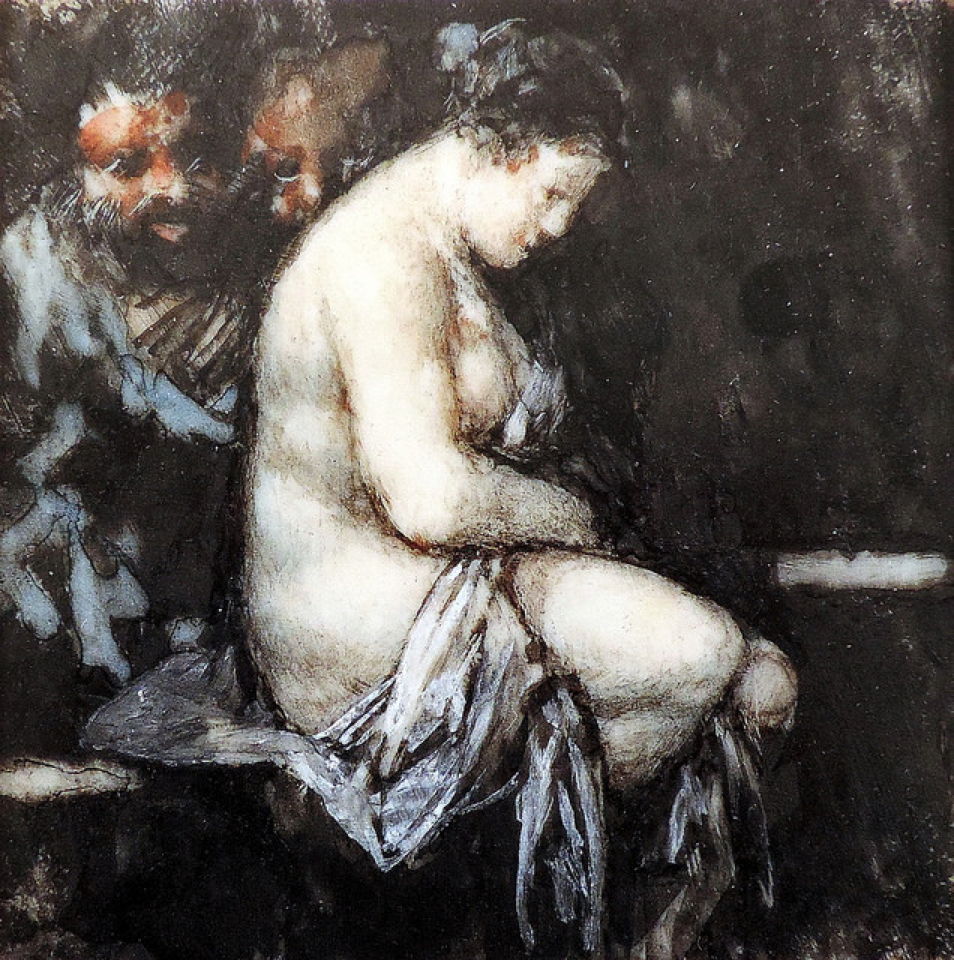
Francisco Goya (1746–1828), Susanna and the Elders (1824-25), watercolour on ivory, 5.5 x 5.5 cm, Private collection. Wikimedia Commons.
Although this painting has been identified as showing Susanna and the Elders, that is by no means certain, if strongly suggested by its composition.

 Login
Login