Reading view

There are new articles available, click to refresh the page.

Naturalists: Origins

The new style of Naturalism took the Paris Salon by storm in 1883. As a complement rather than competitor to Impressionism, it found more favour among the establishment, critics and public who attended the Salon, and had roots going back to the genre paintings of the Dutch Golden Age.

Jan Miense Molenaer (c 1610–1668), The Dentist (1630), oil on panel, 66 x 81 cm, Herzog Anton Ulrich-Museum, Braunschweig, Germany. Wikimedia Commons.

The Dentist, painted in 1630, declares Jan Miense Molenaer’s interest in everyday life. A small crowd has gathered outside a church, where a fashionably dressed man is pulling a tooth from a local. The victim is dressed in tatters, with large holes at both his knees and worn-out shoes. These are ordinary, common people depicted objectively in their normal surroundings.

terborchboydog
Gerard ter Borch (1617–1681), A Boy with his Dog (The Flea-Catcher) (after 1666), oil on canvas mounted on wood, 35 x 28 cm, Alte Pinakothek, Munich, Germany. Wikimedia Commons.

Gerard ter Borch’s late painting of A Boy with his Dog, also known as The Flea-Catcher (after 1666), shows this boy checking for and removing fleas from his pet in fairly barren surroundings.

Another strand of development was the controversial, even politicised, contemporary event. Géricault’s monumental painting of The Raft of the Medusa made in 1818-19 is perhaps the most important example.

gericaultraftofmedusa
Jean Louis Théodore Géricault (1791–1824), The Raft of the Medusa (1818-19), oil on canvas, 491 x 716 cm, Musée du Louvre, Paris. Wikimedia Commons.

This shows a well-known and scandalous story of the day, when over 130 people on board the French frigate Méduse died after they had abandoned ship onto a makeshift raft. Just fifteen of the 147 people on that raft survived thirteen days before being rescued, and gave harrowing stories of drowning, dehydration, and cannibalism.

Although Géricault undoubtedly painted what was in his mind’s eye, he undertook considerable research, interviewing survivors and making studies of material from the morgue in his efforts to make this as objective as he could. This quest for objectivity was a major theme of the nineteenth century, spilling over from the sciences into creative arts, underlying many of the changes seen in painting.
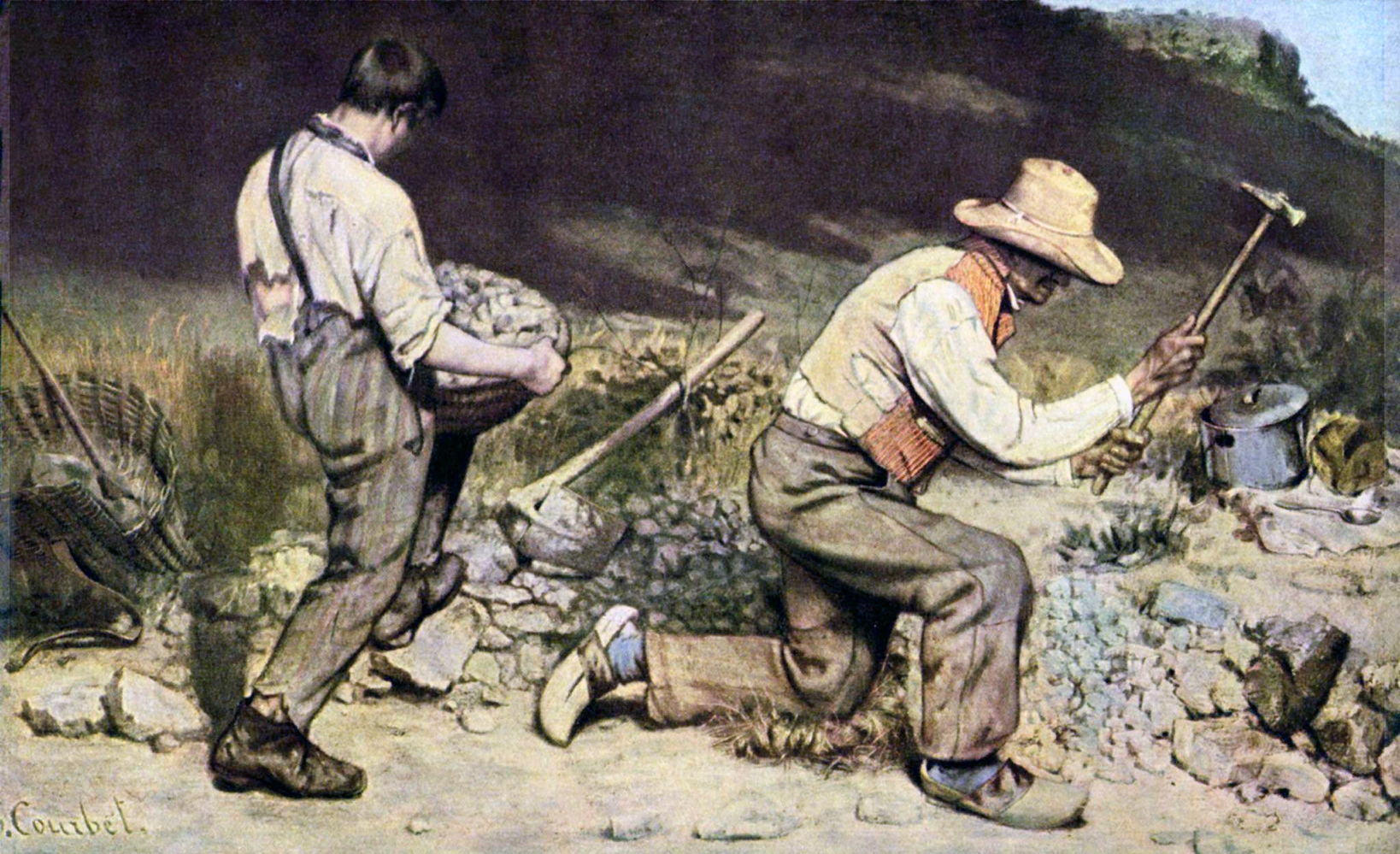
courbetstonebreakers
Gustave Courbet (1819–1877), The Stone Breakers (1849), oil on canvas, 165 x 257 cm, Galerie Neue Meister, Dresden, Germany, destroyed by fire 1945. Wikimedia Commons.

Gustave Courbet took it up in the middle of the century, most notably in The Stone Breakers (1849), which was later destroyed by fire during the Allied bombing of Dresden in 1945. This painting was exhibited at the Salon in 1850, and established him as the great-grandfather of Naturalism.

courbetburialatornans
Gustave Courbet (1819–1877), A Burial at Ornans (1849-50), oil on canvas, 315 x 668 cm, Musée d’Orsay, Paris. Wikimedia Commons.

Shown in the same year was his monumental A Burial at Ornans (1849-50), a huge depiction in unemotional and objective terms of the funeral of the artist’s great uncle in the small provincial town of Ornans. The event had taken place in September 1848, but this painting gives the impression that it is a faithful record.

Courbet actually painted the work entirely in the studio, using those who were present as models. It shows a moment which could only have existed in the artist’s memory: like Géricault’s Raft of the Medusa, it doesn’t necessarily represent an image which ever existed in reality. But it has been carefully researched, imagined, composed, and painted to give the impression of accuracy and objectivity, rather than some Romantic fantasy.

At the same time, social realism was arriving on the farms of France, thanks to the paintings of Jean-François Millet.

milletsower1850
Jean-François Millet (1814–1875), The Sower (1850), oil on canvas, 101.6 x 82.6 cm, Museum of Fine Arts, Boston, MA. Wikimedia Commons.

Millet’s The Sower was completed in 1850 and shown at the Salon that year; it has since been recognised as his first real masterpiece. This farmworker is striding across a field, sowing seed for the summer’s crop. In the distance to the right, caught in the sunlight, is another worker ploughing with a pair of oxen.

milletgleaners
Jean-François Millet (1814–1875), The Gleaners (1857), oil on canvas, 83.5 × 110 cm, Musée d’Orsay, Paris. Wikimedia Commons.

Millet’s The Gleaners of 1857 is sparse, concentrating on just three figures. There are no distractions: it is about the rural poor, who made ends meet by salvaging scraps after the harvest had been cut. This is unavoidably about poverty, and the sector of the population who only just managed to survive each winter. At the time it smacked of socialism, and got the thumbs-down from the rich and middle classes when they saw it in the Salon that year.

milletangelus
Jean-François Millet (1814–1875), L’Angélus (The Angelus) (1857-59), oil on canvas, 55 x 66 cm, Musée d’Orsay, Paris. Wikimedia Commons.

Millet followed that with The Angelus, completed around 1857-59. This had been commissioned by the American collector Thomas Gold Appleton, as Prayer for the Potato Crop, but underwent modification before Millet gave it its present title. At some stage, it’s thought to have included a child’s coffin, but that was overpainted. It shows a couple, praying the Angelus devotion normally recited at six o’clock in the evening, over the potatoes they have been harvesting. It is dusk, and as the last light of the day fades, the bell in the distant church is ringing to mark the end of work, and the start of the evening.

Next to the man is his fork, which he has been using to lift potatoes from the poor, stony soil; his wife has been collecting them in a wicker basket, which now rests at her feet. Behind them is a primitive wheelbarrow with a couple of sacks of potatoes on it. In the gathering dark, viewers often misread the barrow and think that it contains a small child.

With the hostile reception of The Gleaners, Millet didn’t exhibit this painting until 1865, although he had sold it in 1860 for a meagre 1,000 francs. When sold in 1890, its price reached 750,000 francs.

bretongleaners1854
Jules Breton (1827–1906), The Gleaners (1854), oil on canvas, 93 × 138 cm, The National Gallery of Ireland/Gailearaí Náisiúnta na hÉireann, Dublin, Ireland. The Athenaeum.

Jules Breton was also important, more in his compositional devices than in any social realism. His Gleaners from 1854, which was highly successful at the Salon of 1855, is a marvellous painting, although hardly the story of people who spent most of their lives on the edge of survival. But its foreground detail, high horizon and widescreen effect were to be used very successfully by Jules Bastien-Lepage and others.

Another important artist in the late gestation of Naturalism was Édouard Manet, long considered to be a precursor of Impressionism, but who was thoroughly realist.
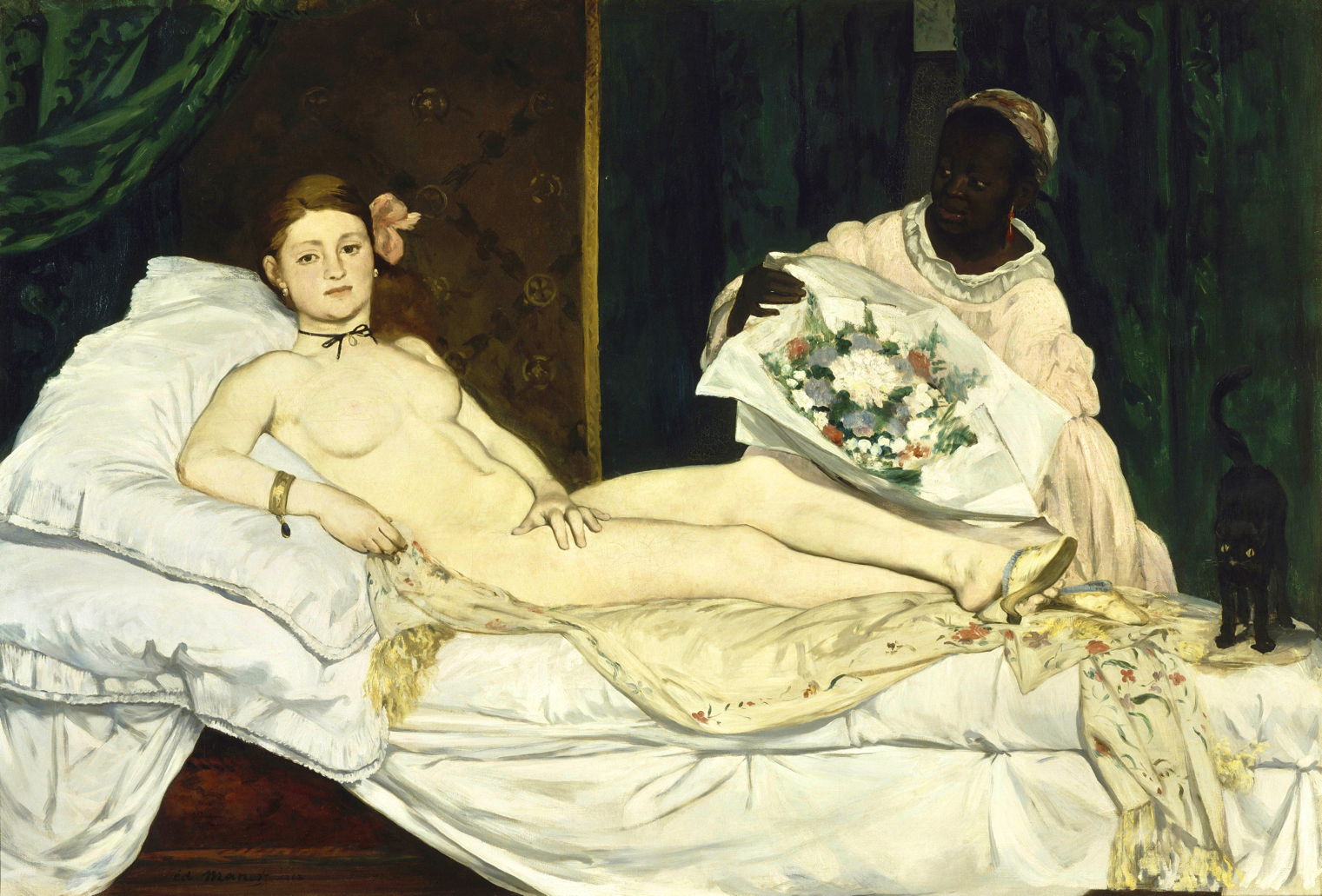
manetolympia
Édouard Manet (1832–1883), Olympia (1863), oil on canvas, 130 x 190 cm, Musée d’Orsay, Paris. Wikimedia Commons.

Manet’s Olympia (1863) shocked those seeing it at the 1865 Salon because here was an ordinary person, a ‘common prostitute’ indeed, seen in a role normally assigned to a mythical goddess such as Venus. And she was very much at her place of work, staring straight at the viewer.
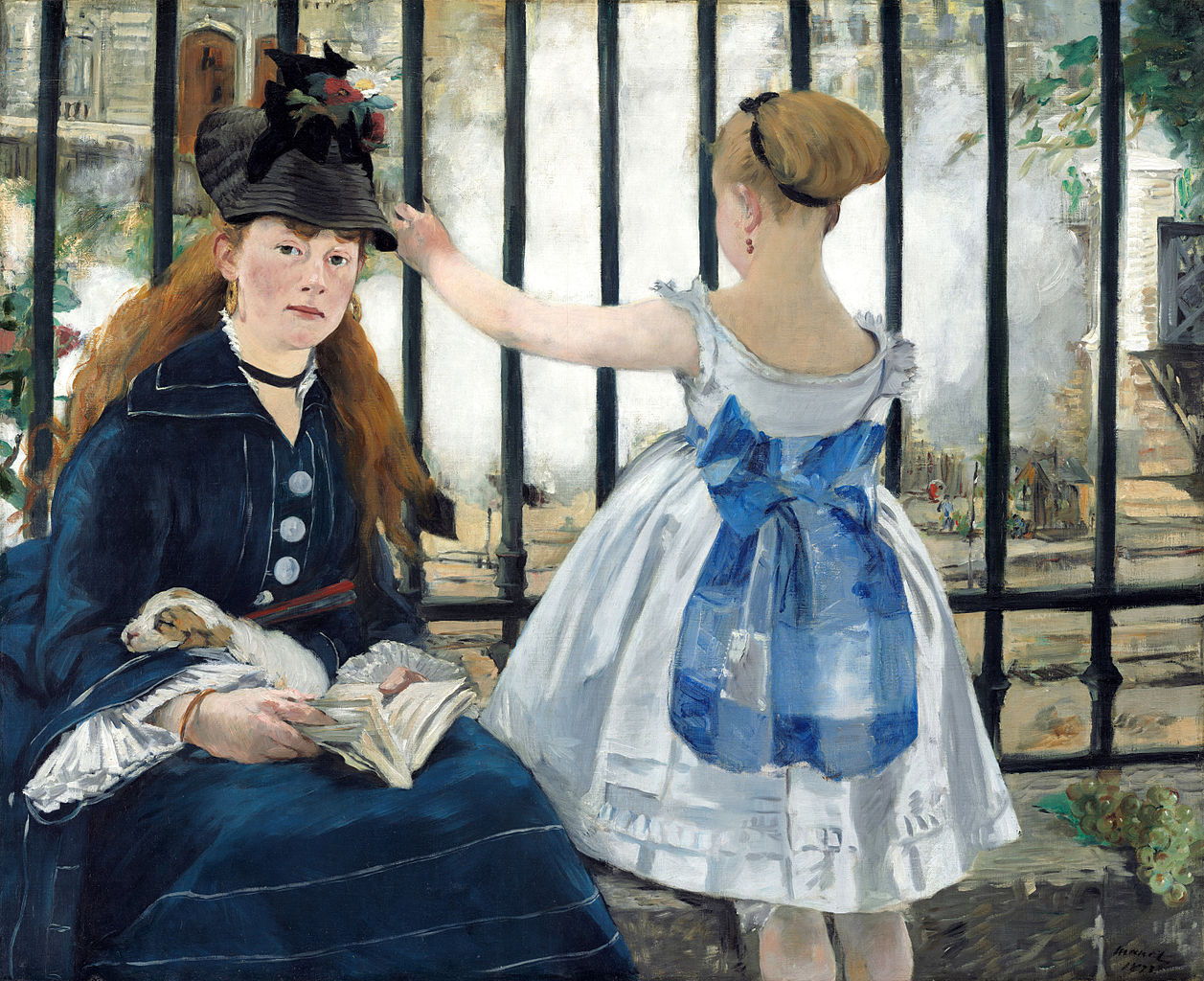
manetrailway
Édouard Manet (1832–1883), The Railway (1873), oil on canvas, 93.3 x 111.5 cm, The National Gallery of Art, Washington, DC. Wikimedia Commons.

A decade later, Manet painted the same model, Victorine Meurent, in The Railway (popularly known as Gare Saint-Lazare) (1873). A genre symbol of modernity, it brought modern technology and urban life to what was at the time a largely unappreciative public.

The most immediate precursors to the Naturalist paintings of 1883 weren’t the early works of Jules Bastien-Lepage, but the paintings of the rural poor by Léon Augustin Lhermitte.

lhermitteprocessionploumanach
Léon Augustin Lhermitte (1844–1925), Procession near Ploumanac’h (1879), oil on canvas, dimensions not known, Private collection. Wikimedia Commons.

Lhermitte’s sketchy Procession near Ploumanac’h from 1879 shows a religious festival in Brittany, with a small stream of locals making their way along a track on the open hillside towards the church. Its unemotional bleakness is completely different from the dense processions being painted by Jules Breton.

lhermittepayharvesters
Léon Augustin Lhermitte (1844–1925), The Harvesters’ Pay (1882), oil on canvas, 215 x 272 cm, Musée d’Orsay, Paris. Wikimedia Commons.

Lhermitte’s founding masterpiece of Naturalism is The Harvesters’ Pay from 1882, which looks objectively at the economic and social aspects of the harvest. Four of the harvesters, bearing their heavy-duty scythes, await payment by the farmer’s factor, who holds a bag of coins for the purpose. In the centre of the painting, one of the workers is counting out his pay in front of his wife, who is feeding a young infant at her breast. To their left, another worker just sits and stares blankly into the distance, dead-beat tired and wondering whether his pittance was worth all that effort.

Most importantly, Lhermitte painted these in the early years of the Third Republic, a time when social concerns were sweeping across much of Europe.

The Dutch Golden Age: Historical context 1644-1674

This is the second article setting some of the finest paintings of the Golden Age in the context of major events in the history of the Dutch Republic, and resumes the account in 1644, shortly before the end of the Thirty Years’ War.

Fresheneesz, Map of the Low Countries, 1556-1648 (2006). Image by Fresheneesz, via Wikimedia Commons.

Constituents of the Dutch Republic are shown in red, orange and yellow in this map. Its centres of art included The Hague, its de facto capital, Utrecht, Leiden, Delft, Harlem, and Amsterdam. To the south were the lands composing the Spanish Netherlands, notably Flanders and Brabant, including the cities of Antwerp and Brussels.

1644-1659

1648 The Peace of Munster was ratified, ending the Thirty Years’ War and formally establishing the Dutch Republic as an independent country (see below).
1652 The United East India Company started settling Cape Colony, later known as the Cape of Good Hope, in South Africa.
1652-54 The First Anglo-Dutch War, ended with the Treaty of Westminster.

vangoyendordrecht
Jan Josefsz. van Goyen (1596-1656), View of Dordrecht with the Grote Kirk Across the Maas (1644), oil on oakwood, 64.8 x 96.8 cm, Walker Art Gallery, Liverpool, England. Wikimedia Commons.

Dutch landscape artists quickly realised that, even if they had relatively little earth and water to depict, the heavens above could be equally interesting. Horizons fell rapidly down their paintings, as seen in Jan van Goyen’s View of Dordrecht with the Grote Kirk Across the Maas from 1644.

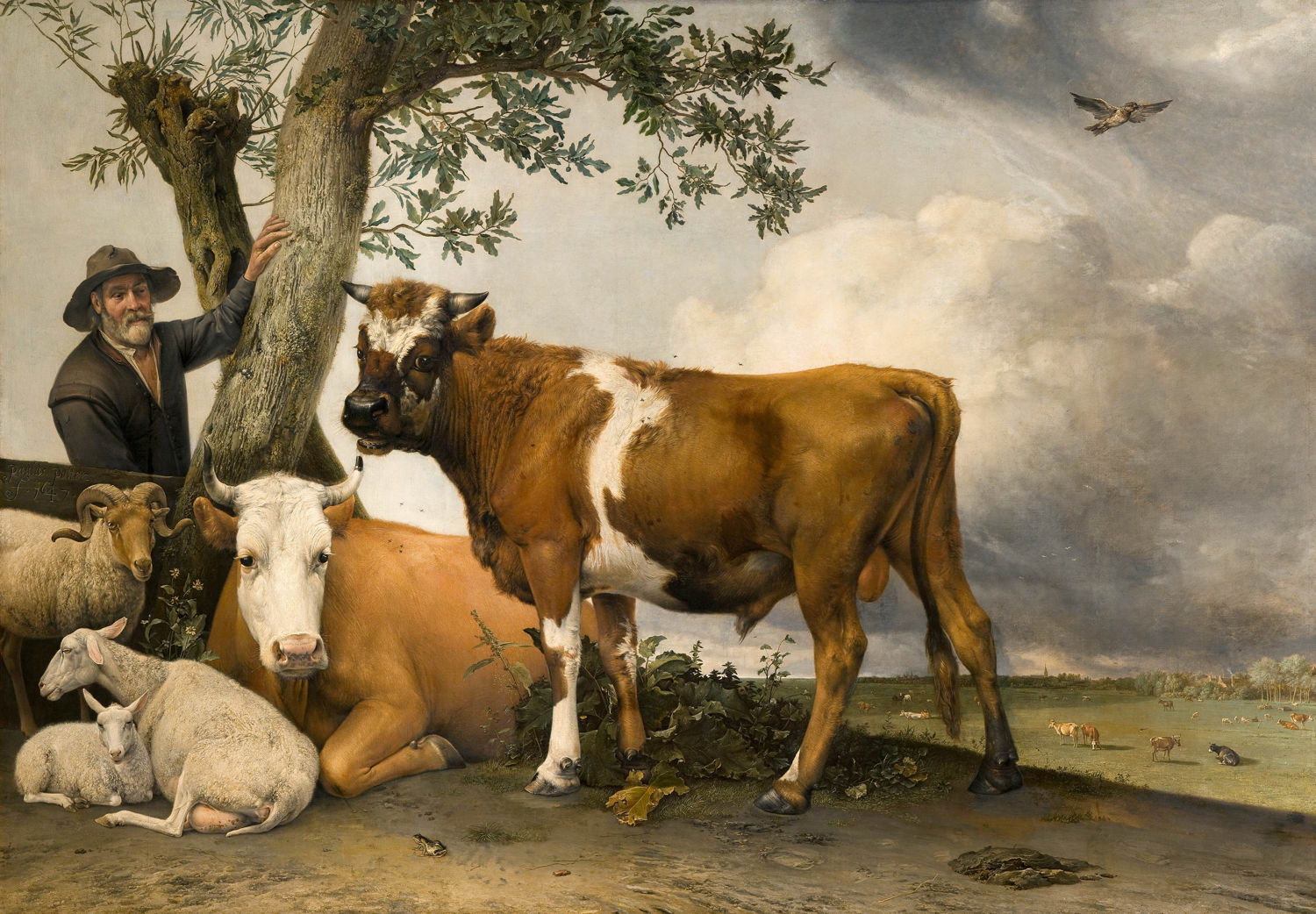
potterbull
Paulus Potter (1625–1654), The Bull (1647), oil on canvas, 235.5 x 339 cm, Koninklijk Kabinet van Schilderijen Mauritshuis, The Hague. Wikimedia Commons.

Paulus Potter, who became a member of the Guild of Saint Luke in Delft in 1646, founded the new genre of animal painting in 1647 with his almost life-size portrait of The Bull (also widely known as The Young Bull). Originally intended as a portrait of just the central bull, Potter enlarged the canvas to accommodate (from the left) a ram, lamb, ewe, herdsman, cow, and above them a bird of prey, possibly a buzzard. Beyond them are more cattle in the meadows receding to the church of Rijswijk, between Delft and The Hague.

terborchratificationoftreatymunster
Gerard ter Borch (1617–1681), The Ratification of the Treaty of Münster, 15 May 1648 (1648), oil on copper, 45.4 x 58.5 cm, Rijksmuseum Amsterdam, Amsterdam, The Netherlands. Wikimedia Commons.

For the thirty years between 1618-1648, central Europe had been engulfed in a bitter war between the Habsburg states, including the Holy Roman Empire and Spain, and their enemies, including the Dutch Republic. Gerard ter Borch’s magnificent painting of The Ratification of the Treaty of Münster, 15 May 1648 (1648) recorded the moment that the Thirty Years’ War ended, with the ratification of this treaty between the Dutch Republic and Spain.

baillyvanitas
David Bailly (1584–1657), Self-Portrait with Vanitas Symbols (1651), oil on panel, 65 x 97.5 cm, Museum De Lakenhal, Leiden, The Netherlands. Wikimedia Commons.

The son a of Flemish immigrant, David Bailly, who lived and worked in Leiden, painted this Self-Portrait with Vanitas Symbols in 1651, with its multiple portraits referring to the past. The figure shows him as a much younger man, holding the maulstick he used in painting. His actual self-portrait at the time is in the painting he is holding with his left hand. Next to that is a painting of his wife, who had already died, and a ghostly image of her is projected onto the wall behind the wine glass.

terborchglasslemonade
Gerard ter Borch (1617–1681), The Glass of Lemonade (1655-60), oil on canvas transferred from panel, 67 x 54 cm, Hermitage Museum Государственный Эрмитаж, Saint Petersburg, Russia. Wikimedia Commons.

Long before its value in preventing scurvy was realised (in 1747), or it was carbonated even later, still cloudy lemonade had become a popular soft drink. The extensive trade links of the Dutch Republic made the drink available to the middle classes, as celebrated in Gerard ter Borch’s The Glass of Lemonade (1655-60).

Johannes Vermeer, The Milkmaid (c 1658-1661), oil on canvas, 45.5 x 41 cm, The Rijksmuseum, Amsterdam. WikiArt.
Johannes Vermeer (1632-1675), The Milkmaid (c 1658-1661), oil on canvas, 45.5 x 41 cm, The Rijksmuseum, Amsterdam. WikiArt.

In Vermeer’s celebrated The Milkmaid (c 1658-1661) the maid is pouring milk from a jug, beside a tabletop with bread. In the left foreground the bread and pots rest on a folded Dutch octagonal table, covered with a mid-blue cloth. A wicker basket of bread is nearest the viewer, broken and smaller pieces of different types of bread behind and towards the woman, in the centre. Behind the bread is a dark blue studded mug with pewter lid, and just in front of the woman a brown earthenware ‘Dutch oven’ pot into which she is pouring milk.

1660-1672

1664-71 The Second Anglo-Dutch War.
1669 The United East India Company was the largest and richest private company in the world, with more than 150 merchant ships, 40 warships, 50,000 employees, and its own private army of 10,000.
1672 The Third Anglo-Dutch War; the Dutch Republic was invaded by France and others, following which its economy went into decline and the art market collapsed.

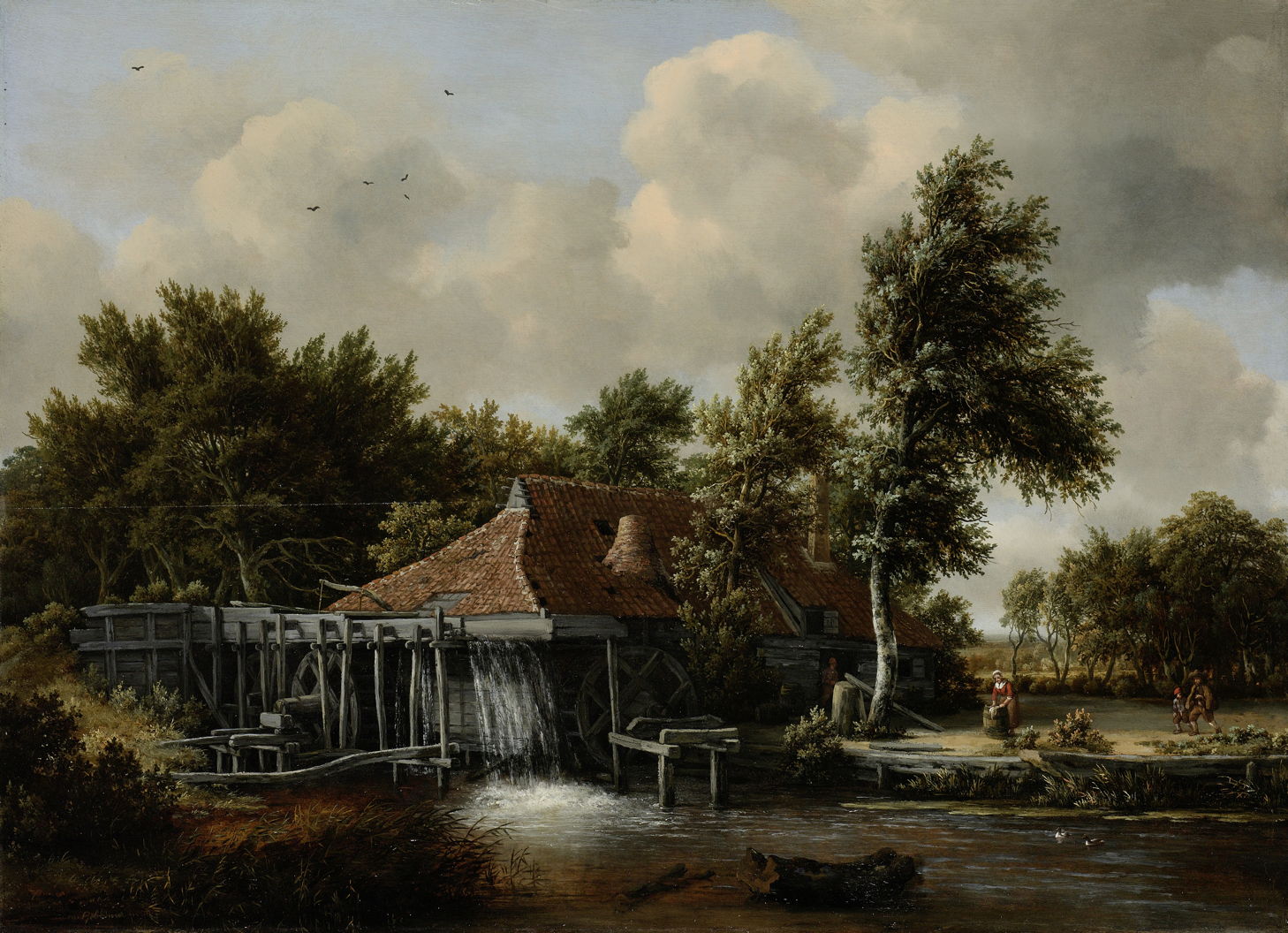
hobbemawatermill
Meindert Hobbema (1638–1709), A Watermill (c 1664), oil on panel, 62 x 85.2 cm, Rijksmuseum Amsterdam, Amsterdam, The Netherlands. Wikimedia Commons.

Meindert Hobbema’s magnificent Watermill from about 1664 accommodates a family: the wife is out doing the washing in a barrel, while the husband and son walk through their garden. It’s also relatively unusual in that the water here is fed through the elevated wooden aqueducts, making this watermill overshot, so capable of generating more power with a lower flow of water, because it uses the weight of water falling against the blades of the waterwheel.

vanruisdaelhaarlembleaching
Jacob van Ruisdael (1628/1629–1682), View of Haarlem with Bleaching Fields (c 1665), oil on canvas, 62.2 x 55.2 cm, Kunsthaus Zürich, Zürich, Switzerland. Wikimedia Commons.

Some painters, including Jacob van Ruisdael, turned their canvases to make portraits of towering clouds, as in his View of Haarlem with Bleaching Fields from about 1665. The distant town of Haarlem with its monumentally large church of Saint Bavo – works of man – is dwarfed by these high cumulus clouds, the works of God. This motif proved so popular that Van Ruisdael painted many variants of the same view, making it now one of the most widespread landscapes across the galleries of Europe.

vermeerartpainting
Johannes Vermeer (1632–1675), The Art of Painting (c 1666-68), oil on canvas, 120 x 100 cm, Kunsthistorisches Museum, Vienna, Austria. Wikimedia Commons.

Johannes Vermeer experimented with optical effects in his late The Art of Painting from about 1666-68, where greatest sharpness is slightly away from the geometrical centre of the canvas, in the woman holding a wind instrument. The high tonal contrast between the marble tiles on the floor is softened in the foreground, and sharpens as they recede deeper into the picture, as would be expected in a depth of field effect.

Rembrandt Harmenszoon van Rijn, The Jewish Bride (c 1667), oil on canvas, 121.5 x 166.5 cm, Rijksmuseum, Amsterdam. Wikimedia Commons.

Rembrandt continued to develop his mark-making right up to his death. It’s often at its most florid when he painted fabrics, such as the clothing of the couple shown in The Jewish Bride of about 1665. The Dutch Republic had long been a safe harbour for Jews fleeing from oppression in other European countries, and Rembrandt had cultivated close relationships with members of the large Jewish community in Amsterdam, some of whom had modelled for his depictions of Old Testament stories.

ruisdaelwindmillwijk
Jacob van Ruisdael (1628/1629–1682), The Windmill at Wijk bij Duurstede (c 1670), oil on canvas, 83 x 101 cm, Rijksmuseum Amsterdam, Amsterdam, The Netherlands. Wikimedia Commons.

One of Jacob van Ruisdael’s best-known paintings of windmills is this view of The Windmill at Wijk bij Duurstede from about 1670. This small town, now a city, is on the bank of the River Rhine, an ideal location for delivering grain by barge, and shipping the resulting flour.

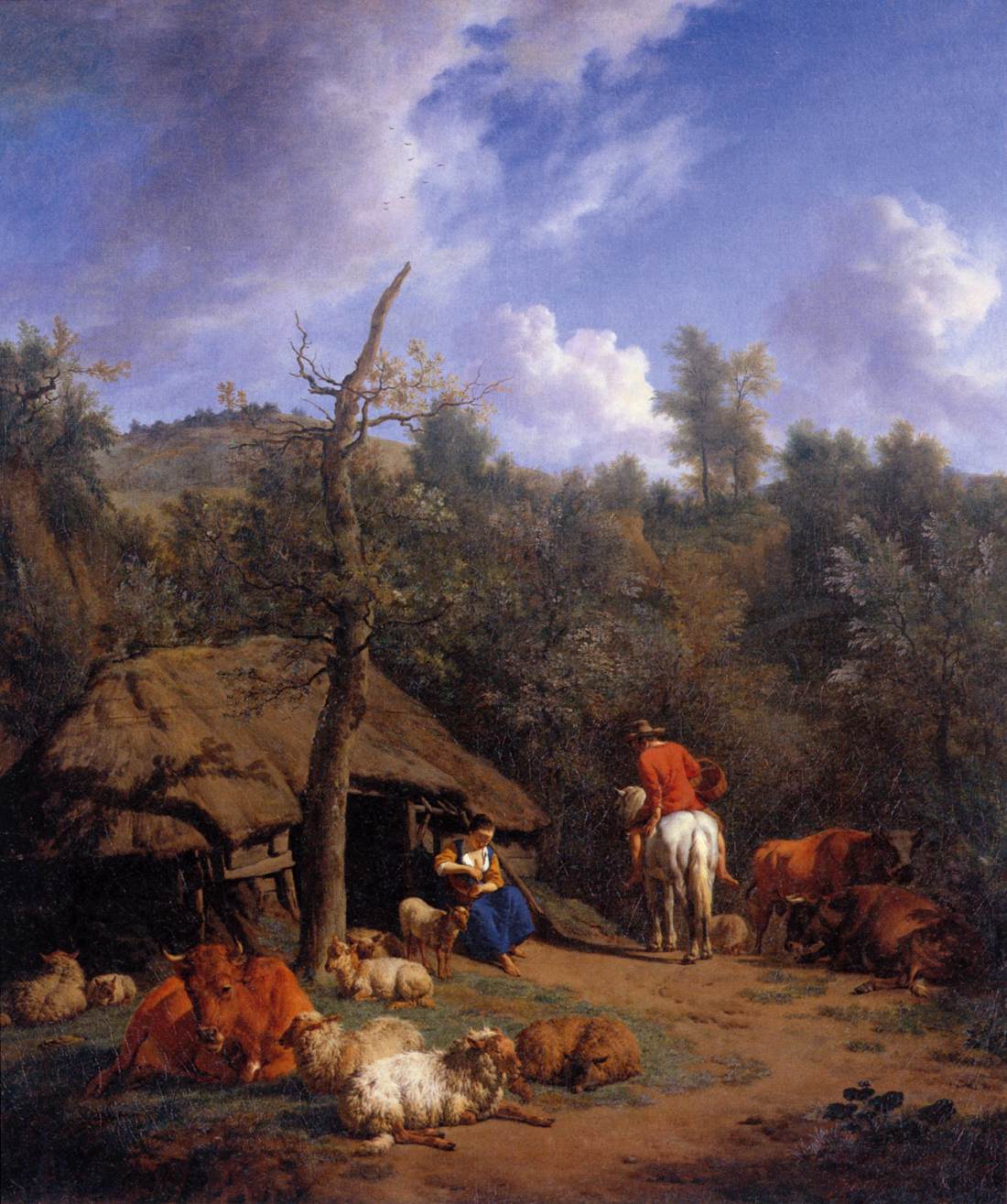
vandeveldethehut
Adriaen van de Velde (1636–1672), The Hut (1671), oil on canvas, 76 x 65 cm, Rijksmuseum Amsterdam, Amsterdam. Wikimedia Commons.

The Hut (1671) was one of Adriaen van de Velde’s last paintings, and has long been esteemed in the Netherlands. It’s one of his most natural compositions, sparkling with bright colour in the clothing and animals. The artist even adds the reality, perhaps as a touch of humour, of some fresh cowpats.

Gerrit Adriaensz Berckheyde, Groote Market in Haarlem, 1673, oil on panel, 42 x 61 cm, Hermitage Museum, St Petersburg. Wikimedia Commons. Shadows give strong depth cues.
Gerrit Adriaensz Berckheyde (1638-1698), Groote Market in Haarlem (1673), oil on panel, 42 x 61 cm, Hermitage Museum, St Petersburg. Wikimedia Commons.

Gerrit Berckheyde’s view of Groote Market in Haarlem from 1673 shows one the largest of the city’s marketplaces at the end of the Golden Age.

Medium and Message: Oil on copper 1620-1926

Painting in oils on copper plates had become relatively popular by 1600, and reached its zenith in the work of Adam Elsheimer, who died in 1610. Although it continued through the seventeenth century, it entered a slow decline as stretched canvas became the norm.

declerckmidas
Hendrick de Clerck (1560/1570–1630), The Contest Between Apollo and Pan (c 1620), oil on copper, 43 x 62 cm, Rijksmuseum Amsterdam, Amsterdam, The Netherlands. Wikimedia Commons.

Copper remained quite popular in the Netherlands. Some artists, such as Hendrick de Clerck, pushed their technique up to larger sizes too, in The Contest Between Apollo and Pan (c 1620). This is a huge 43 by 62 cm (17 by 24.4 inches), dwarfing its predecessors, and providing exquisite detail in the flowers of its foreground.

teniersarmidabeforegodfrey
David Teniers the Younger (1610–1690), Armida before Godfrey of Bouillon (1628-30), oil on copper, 27 x 39 cm, Museo Nacional del Prado, Madrid, Spain. Wikimedia Commons.

To the south, David Teniers the Younger adopted copper for many of his paintings, including Armida before Godfrey of Bouillon (1628-30), significantly smaller than de Clerck’s.

teniersdmonkeyencampment
David Teniers the Younger (1610–1690), A Monkey Encampment (1633), oil on copper, 33 x 41.5 cm, Private collection. Wikimedia Commons.

Teniers even used copper for his singerie of A Monkey Encampment from 1633, showing monkeys in human roles in a camp.

terborchratificationoftreatymunster
Gerard ter Borch (1617–1681), The Ratification of the Treaty of Münster, 15 May 1648 (1648), oil on copper, 45.4 x 58.5 cm, Rijksmuseum Amsterdam, Amsterdam, The Netherlands. Wikimedia Commons.

One of the grandest paintings made in oils on copper is Gerard ter Borch visual record of The Ratification of the Treaty of Münster, 15 May 1648 made in the same year. This recorded the moment that the Thirty Years War ended, with the ratification of this treaty between the Dutch Republic and Spain. It also marked the birth of the Dutch Republic as an independent country. This is 45.4 x 58.5 cm (17.9 by 23 inches), similar to de Clerck’s giant, but far smaller than its equivalent would have been on canvas.

tenierstemptationstanthonyprado
David Teniers the Younger (1610–1690), The Temptation of Saint Anthony (c 1650), oil on copper, 55 × 69 cm, Museo Nacional del Prado, Madrid. Wikimedia Commons.

Teniers appeared to rise to the challenge in The Temptation of Saint Anthony in about 1650: 55 × 69 cm (21.5 by 27 inches).

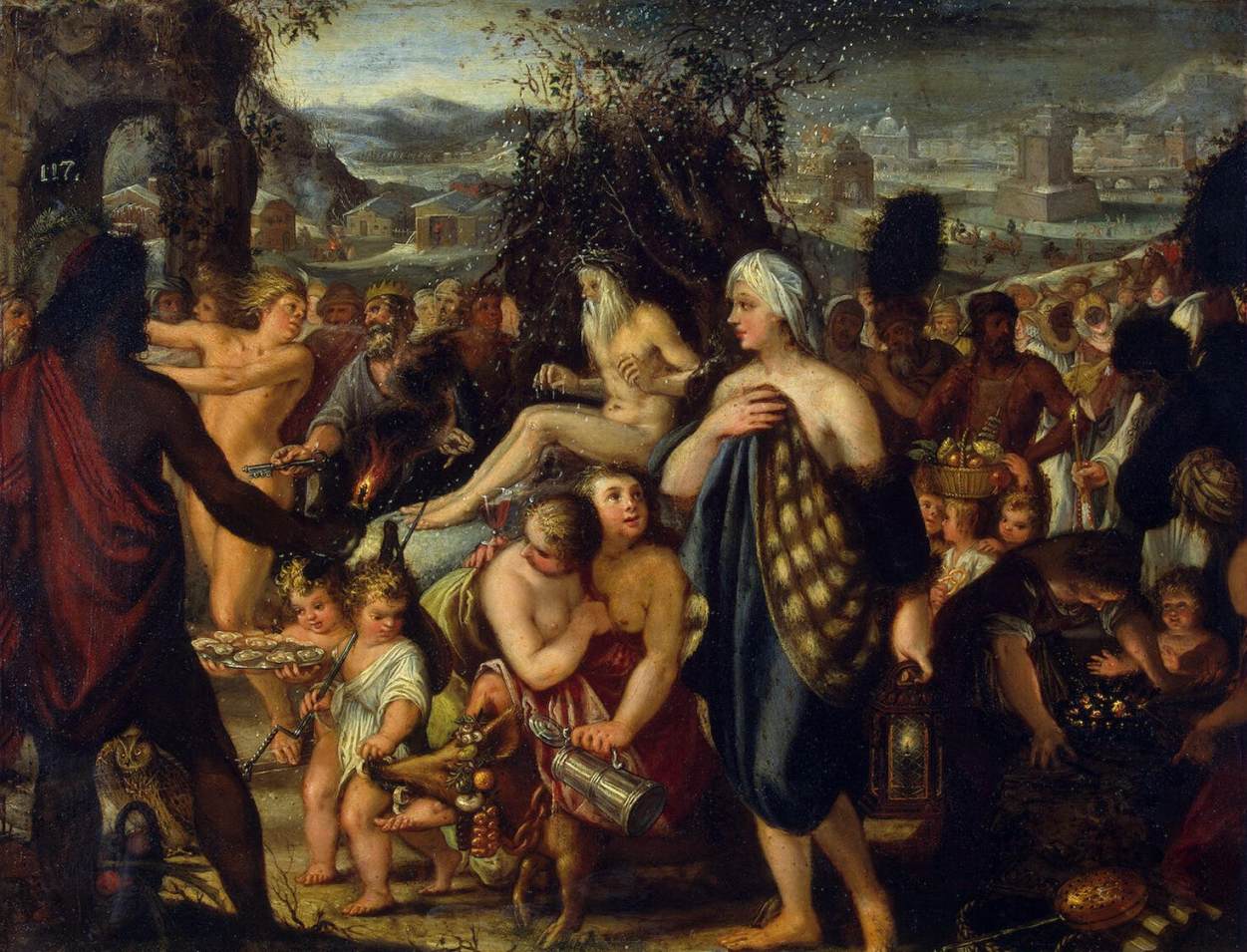
heissallegorywinter
Johann Heiss (1640–1704), Allegory of Winter (1665), oil on copper, 29 x 37 cm, Hermitage Museum Государственный Эрмитаж, Saint Petersburg, Russia. Wikimedia Commons.

Johann Heiss’s Allegory of Winter (1665) depicts fine snowflakes realistically, thanks to its smooth grain-free surface.

By the eighteenth century, the use of copper as a support had become unusual if not exceptional.

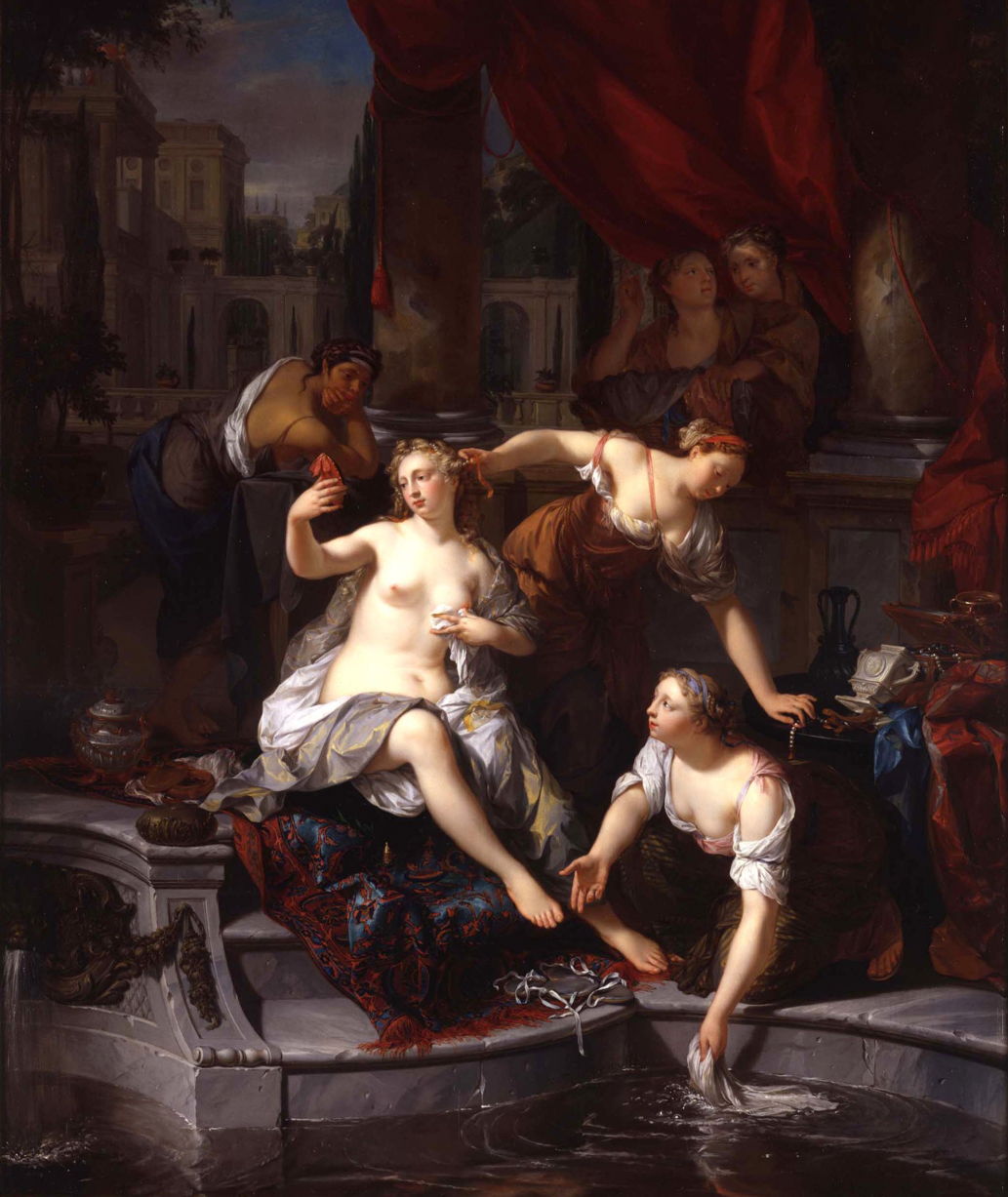
verkoljedavidspyingbathsheba
Nikolaas Verkolje (1673–1746), David Spying on Bathsheba (1716), oil on copper, 62.5 x 52 cm, Private collection. Wikimedia Commons.

Nikolaas Verkolje’s David Spying on Bathsheba from 1716 uses a relatively large sheet for its conventional account of this popular story.

lancretbrotherphilippesgeese
Nicolas Lancret (1690–1743), Brother Philippe’s Geese (c 1736), oil on copper, 27.3 x 35.2 cm, The Metropolitan Museum of Art (Purchase, Walter and Leonore Annenberg and The Annenberg Foundation Gift, 2004), New York, NY. Courtesy of The Metropolitan Museum of Art.

The use of copper has never ceased altogether since the late sixteenth century, and has been continued by a succession of artists with whom it has found favour, such as Nicolas Lancret above, and Johann Georg Platzer below. The latter appears to have painted many works on larger sheets than those used earlier. There’s a delicate balance to be struck, as thinner sheets are less rigid and warp more readily, but are substantially lighter and cheaper.

platzerpaintersstudio
Johann Georg Platzer (1704–1761), The Artist’s Studio (1740-59), oil on copper, 41.9 × 60 cm, Cleveland Museum of Art, Cleveland, OH. Wikimedia Commons.

Platzer’s The Artist’s Studio (1740-59) shows an assistant using a muller, at the far right, to prepare fresh oil paint for the painters at work in this workshop. Sadly, none of the paintings shown appear to have used copper supports.

Since then, copper has reappeared from time to time, usually where it’s least expected.

vernetcjmorning
Claude-Joseph Vernet (1714–1789), The Four Times of Day: Morning (1757), oil on silvered copper, 29.5 x 43.5 cm, Art Gallery of South Australia, Adelaide, Australia. Wikimedia Commons.

Claude-Joseph Vernet used it for his outstanding series The Four Times of Day in 1757. The first, Morning, shows three people busy fishing at the edge of a substantial river, as the sun rises behind a watermill and trees on the left. Making its way slowly towards the viewer is a barge, its sail lofted out by the gentle breeze. Gulls are on the wing, and the day promises to be fine and sunny. These are painted on silvered copper, presumably to give them a lustrous look. Vernet doesn’t appear to have used copper much later in his career.

My final examples come from the underrated Italian-American artist Joseph Stella, who seems to have experimented with large copper supports in the 1920s.

stellaledaswan
Joseph Stella (1877–1946), Leda and the Swan (1922), oil on copper, 108 x 118.1 cm, Private collection. The Athenaeum.

His Leda and the Swan from 1922 is huge by previous standards, although it’s hard to see any advantage gained from the properties of the support.

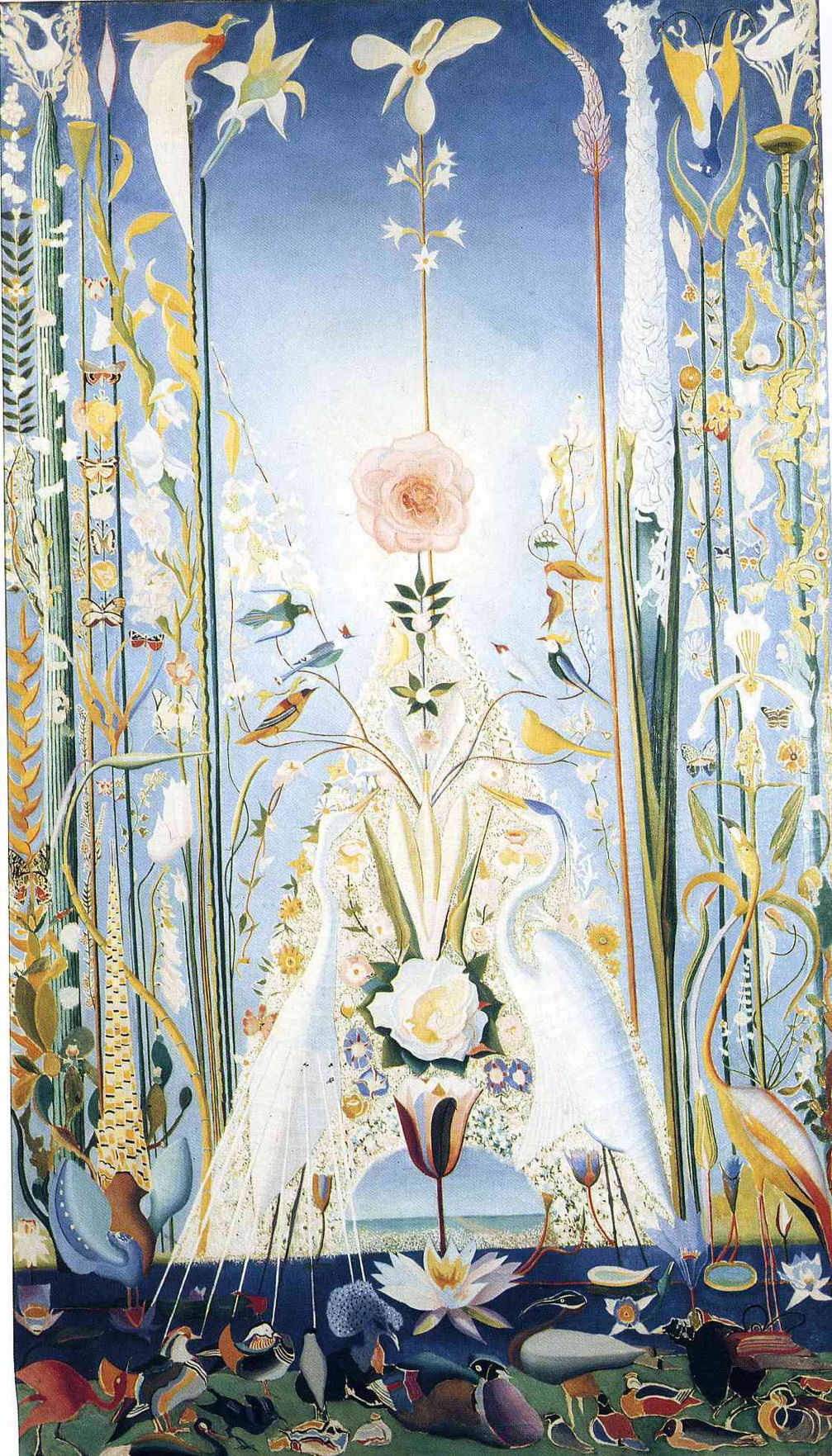
stellaapotheosisrose
Joseph Stella (1877–1946), The Apotheosis of the Rose (1926), oil on copper, 213.4 x 119.4 cm, Private collection. Wikimedia Commons.

The Apotheosis of the Rose from 1926 is the largest work on copper that I have come across, at 213.4 by 119.4 cm (84 by 47 inches). Its fine detail is overwhelming, making it the perfect end to these examples.

The twenty-first century successor to copper plates must be lightweight ‘honeycomb’ alloy and composite panels that have been adopted by some modern painters.

❌