Reading view

There are new articles available, click to refresh the page.

Naturalists: Science and medicine

Although Naturalist painting had originated in the countryside among the rural poor, it soon came to record changing times in science. One of the more prominent painters of science and scientists was Léon Lhermitte, now known almost entirely for his rural paintings.

lhermitteclaudebernard
Léon Augustin Lhermitte (1844–1925), Claude Bernard and His Pupils (1889), copy of original by unknown artist, oil on canvas, 86.5 x 112.5 cm, Wellcome Library no. 45530i, London. Courtesy of Wellcome Images, via Wikimedia Commons.

Claude Bernard (1813-1878) was a pioneering physiologist whose writings were of great influence to Naturalists, including Émile Zola. Following Bernard’s death, the Sorbonne (where he had taught) commissioned Lhermitte to paint his portrait in 1886. This is a faithful anonymous copy of Claude Bernard and His Pupils, which was exhibited at the Salon in 1889. This shows Bernard in the midst of performing an experiment on a rabbit, his students discussing its results, and one writing the experimental observations in the laboratory daybook.
lhermittelessonaluminium
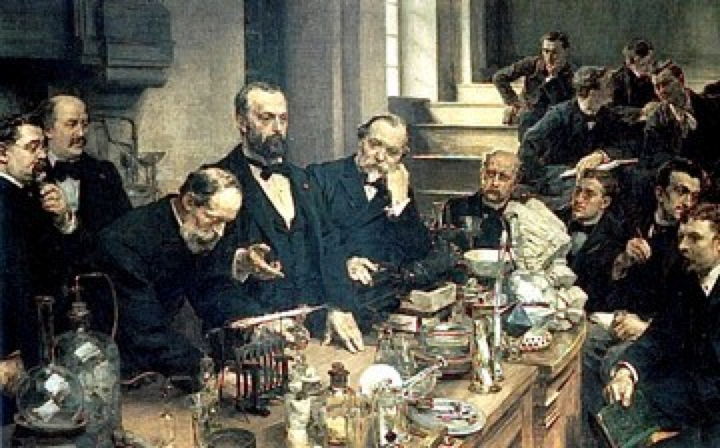
Léon Augustin Lhermitte (1844–1925), The Chemist Henri Sainte Claire Deville, Lesson on Aluminium (1890), The Sorbonne, Paris. Wikimedia Commons.

Lhermitte’s painting of The Chemist Henri-Étienne Sainte-Claire Deville, Lesson on Aluminium from the following year was also commissioned by the Sorbonne in Paris; I apologise for the small size of this image. Henri-Étienne Sainte-Claire Deville (1818-1881) was responsible for many significant discoveries in chemistry, the most important being a method for the industrial manufacture of aluminium. He’s shown here surrounded by objects made from this new material, which quickly came to transform manufacturing and to invade every home.
henningsennordicnatureres
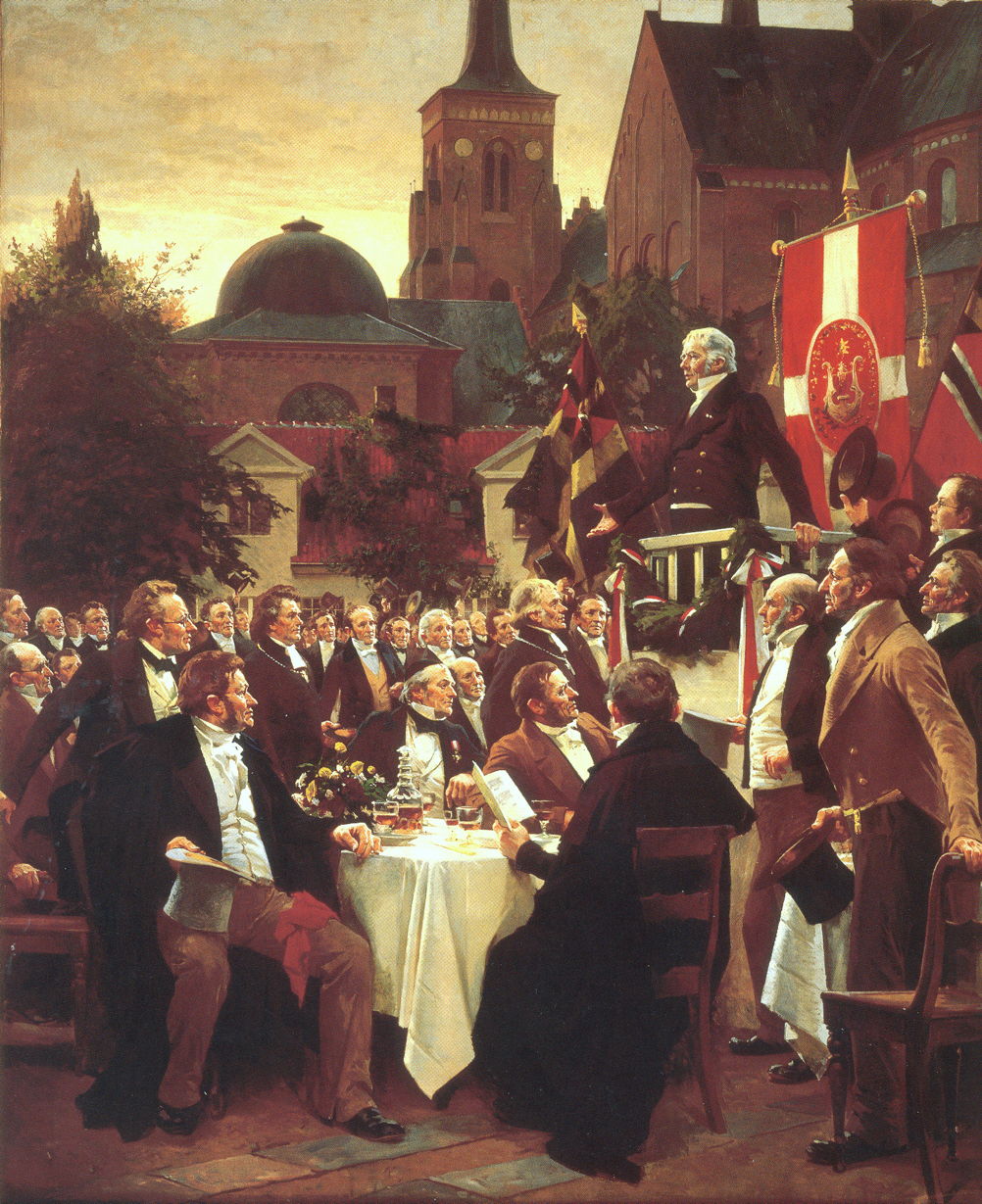
Erik Henningsen (1855–1930), The Nordic Natural Science Research Meeting 14 July 1847 (1895), mural, dimensions not known, Aula, University of Copenhagen, Copenhagen, Denmark. Wikimedia Commons.

Several Naturalist painters were commissioned to paint murals depicting scientific events for universities. Among them is Erik Henningsen’s The Nordic Natural Science Research Meeting 14 July 1847, completed in 1895 for the Aula of the University of Copenhagen. Presiding over this scientific meeting was the great Danish physicist and chemist Hans Christian Ørsted, who was nearly seventy at the time.

Technology was also becoming commonplace at work.

ulrichprintshop
Charles Frederic Ulrich (1858–1908), The Village Printing Shop, Haarlem (1884), oil on panel, 54 × 58.3 cm, Terra Museum of American Art, Chicago, IL. Wikimedia Commons.

Charles Frederic Ulrich painted a young apprentice drinking during a moment’s pause in his work in The Village Printing Shop, Haarlem (1884). In the background is a large and relatively modern printing press.

bulandlessonapprentice
Jean-Eugène Buland (1852–1926), Un Patron, or The Apprentice’s Lesson (1888), oil on canvas, 102 x 82 cm, Nationalmuseum, Stockholm, Sweden. Image by Erik Cornelius, via Wikimedia Commons.

Another Naturalist artist, Jean-Eugène Buland, in his Un Patron, or The Apprentice’s Lesson from 1888 shows a young boy being trained to make a cogwheel. This was part of the French industrial recovery following its defeat in the Franco-Prussian War.

muratonphotographer
Louis Muraton (1850–1919), The Photographer (before 1901), further details not known. Wikimedia Commons.

The subject of Louis Muraton’s The Photographer, painted before 1901, is rocking a glass plate in a bath of developer, in his improvised darkroom, another sign of the times.

Major innovations in medical procedures and care were introduced, and duly recorded in Naturalist paintings.
brouilletlessonclinic
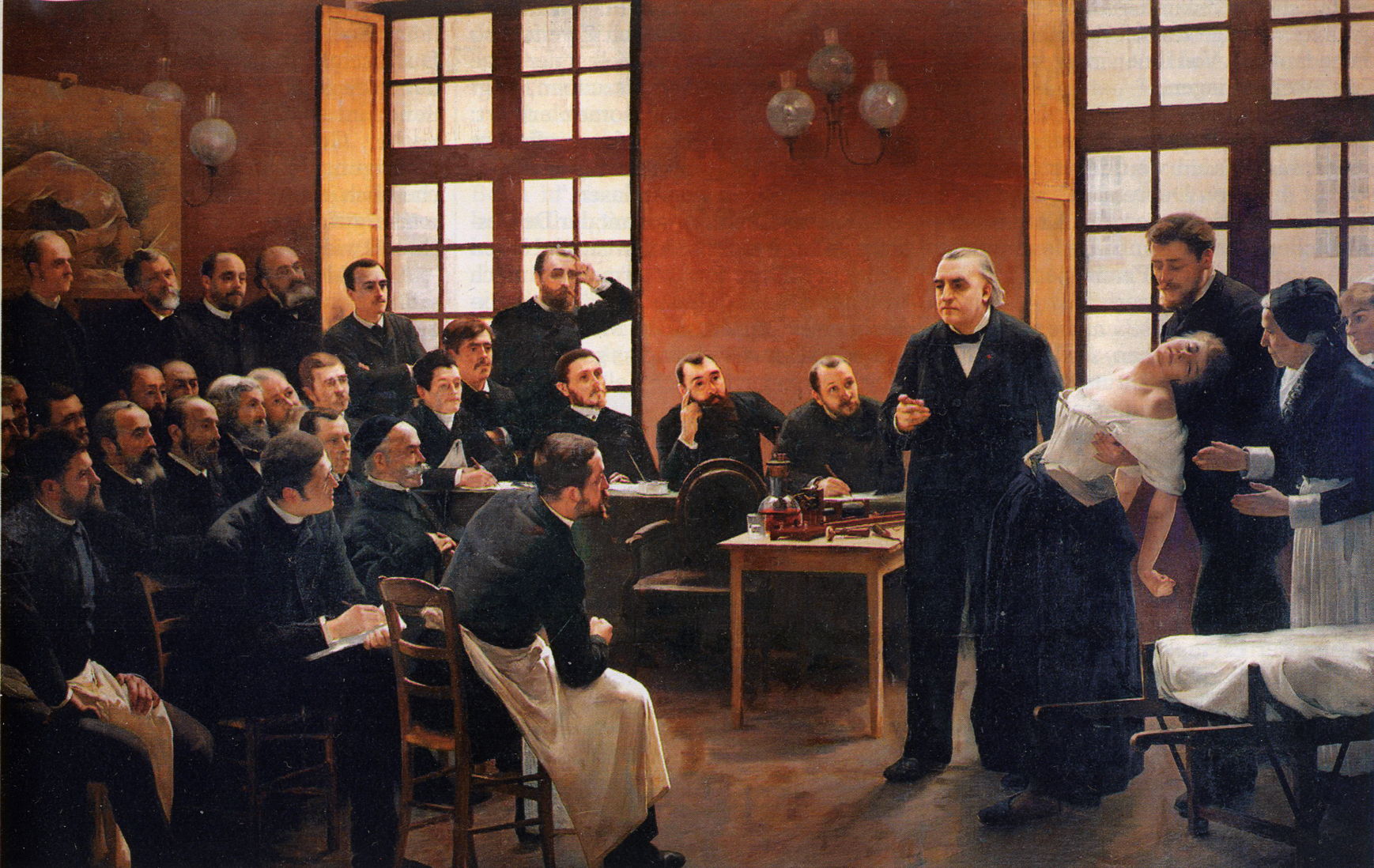
André Brouillet (1857–1914), A Clinical Lesson at The Salpêtrière Hospital (1887), oil, 290 x 430 cm, Paris Descartes University, Paris. Wikimedia Commons.

In André Brouillet’s A Clinical Lesson at the Salpêtrière Hospital (1887), an eminent neurologist Jean-Martin Charcot is demonstrating how he could hypnotise Marie “Blanche” Wittman, the ‘Queen of Hysterics’, into suffering hysterical collapse. Charcot and Wittman were a renowned partnership in this ‘act’, who performed in front of Sigmund Freud when he visited the hospital.
eakinsagnewclinic
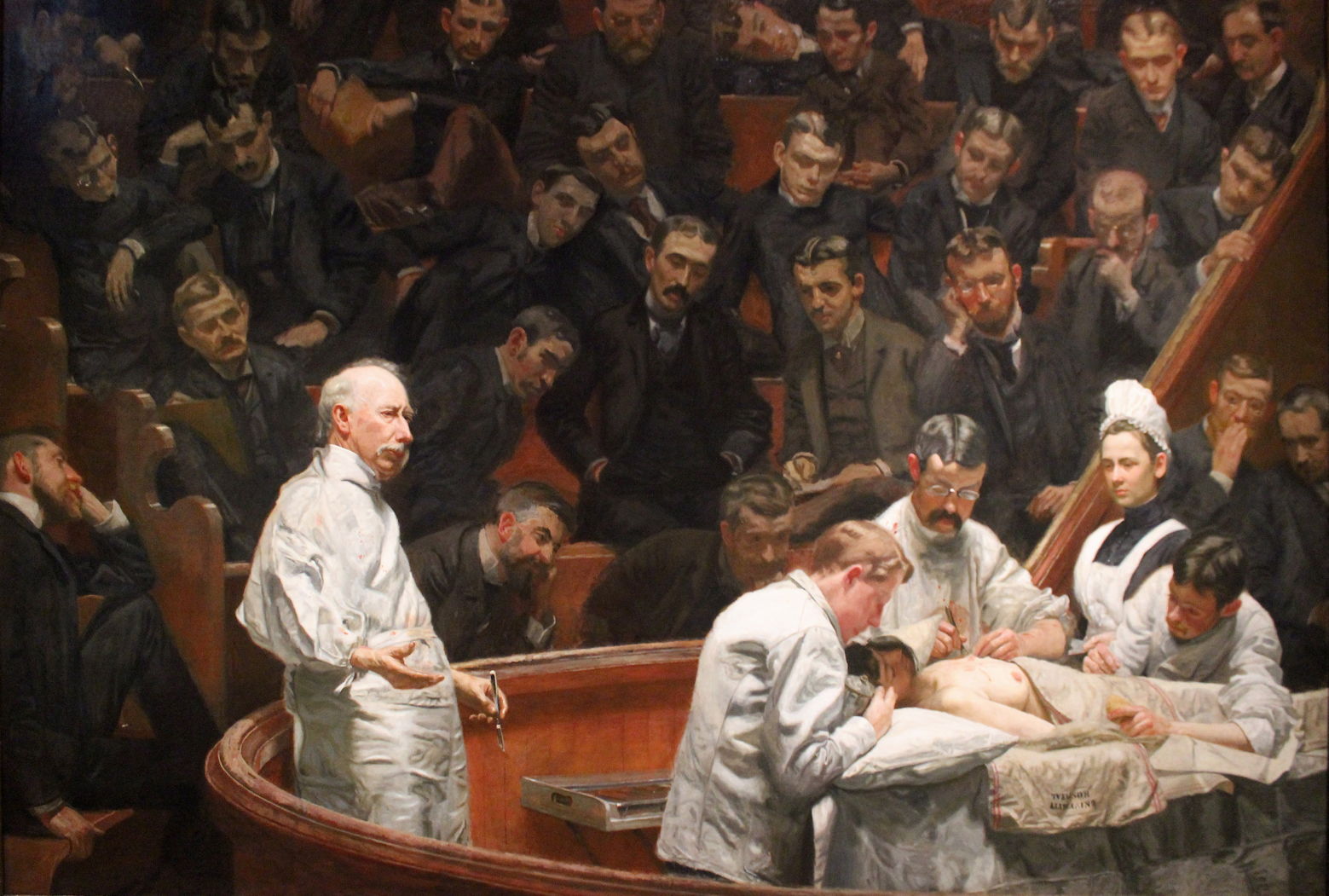
Thomas Eakins (1844–1916), The Agnew Clinic (1889), oil on canvas, 214.2 x 300.1 cm, Philadelphia Museum of Art, Philadelphia, PA. Wikimedia Commons.

In the USA, Thomas Eakins painted the retiring professor of surgery, Dr. David Hayes Agnew, at work in the University of Pennsylvania School of Medicine. The patient is unconscious thanks to a volatile liquid general anaesthetic administered via a mask. Bright surgical lighting puts six figures literally in the limelight, including that of Agnew, holding a scalpel at the left.
hinckleyetherday
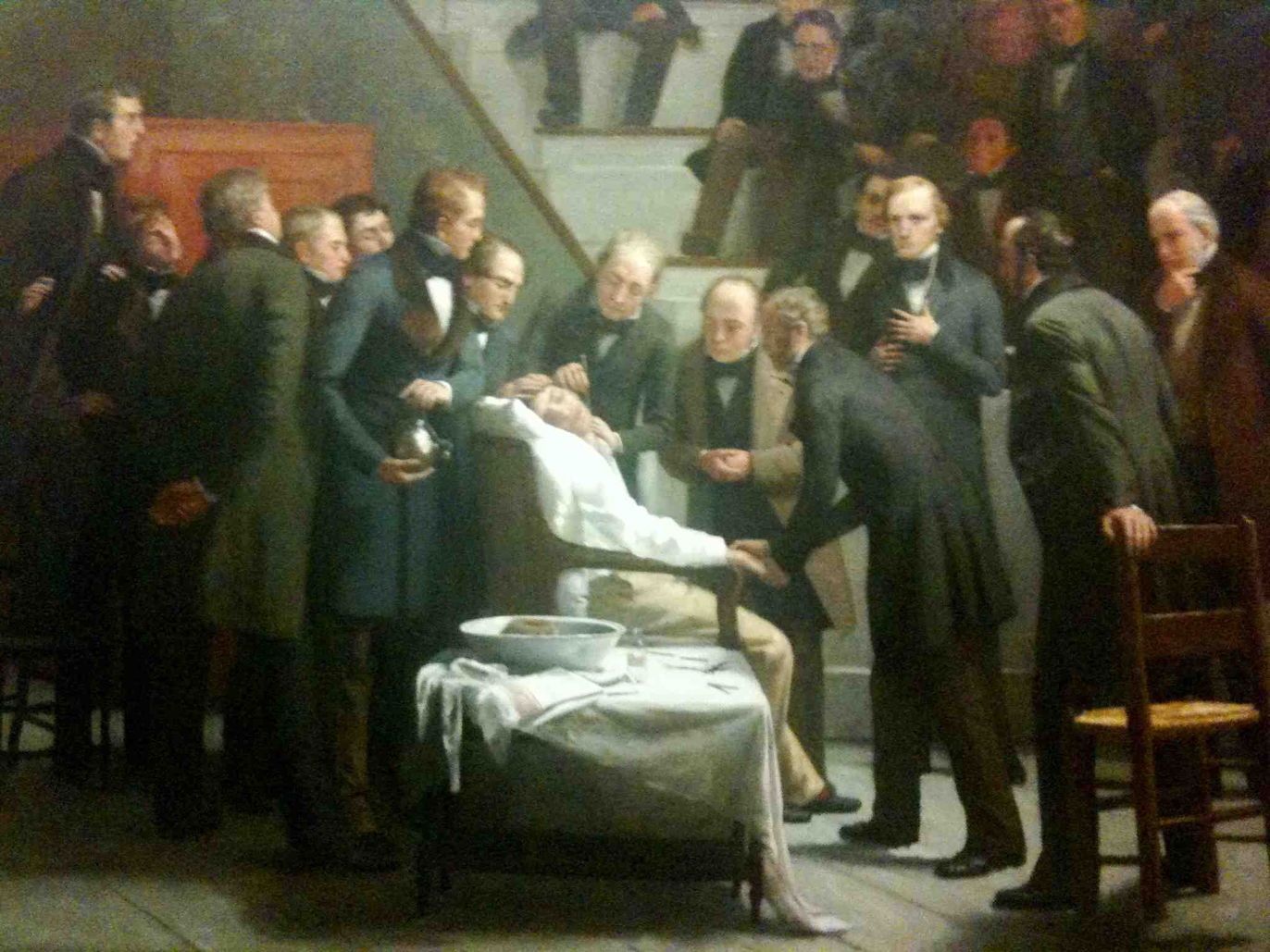
Robert C. Hinckley (1853–1941), Ether Day, or The First Operation with Ether (1882-93), oil on canvas, 243.8 x 292.1 cm, Francis A. Countway Library of Medicine, Harvard University, Cambridge, MA. Wikimedia Commons.

Robert C. Hinckley’s Ether Day, or The First Operation with Ether, painted between 1882-93, recreates the scene on 16 October 1846 in what is now known as the Ether Dome in the Massachusetts General Hospital, Boston, MA. Here John Collins Warren is removing a tumour from the neck of a local printer, Edward G Abbott, who was anaesthetised using ether, in its first recorded use for a general surgical procedure; I apologise for the poor quality of this image.

sahlstensurgeryinhospital
Anna Sahlstén (1859–1931), Surgery in hospital (c 1893), oil on canvas, dimensions not known, EMMA – Espoon modernin taiteen museo, Espoo, Finland. Wikimedia Commons.

Finally, Anna Sahlstén’s Surgery in Hospital from about 1893 shows the dazzling whiteness of the modern hospital, with a smart professional nurse caring for a child patient in the background. On the wall is a large radiator for the hospital’s modern heating system, which replaced the old stoves seen in so many earlier images of hospital wards.

Naturalists: Spread

Critics and the public got their first taste of Naturalist painting in the Salons in the early 1880s, led by the success of Jules Bastien-Lepage. As Paris was the focal point of western painting at that time, this rapidly spread internationally, and ranged wider in its themes.

Literary Naturalism had spread with the translation of the writings of Hippolyte Taine (1828-1893) the critic and historian, Claude Bernard (1813-1878) the physiologist, and the Rougon-Macquart novels of Émile Zola (1840-1902), published between 1871-93. Those became accessible in all the major European languages by 1880, and attracted an intellectual following throughout Europe and North America.

At the time there was a strong Nordic school of painting in France, including Christian Skredsvig (friend of Edvard Munch), Nicolai Ulfsten, Carl Larsson, Karl Nordstrôm, Hans Heyerdahl, Erik Werenskiold, and Christian Krohg.

krohgportside
Christian Krohg (1852–1925), Port Side! (1879), oil on canvas, 99 x 70 cm, Nasjonalgalleriet, Oslo, Norway. The Athenaeum.

Krohg’s Port Side! (1879) is his only painting to be exhibited at the Salon. He started this when he was in Berlin, and completed it when at Skagen in Denmark in the summer of 1879. It didn’t set the Salon of 1882 alight, but was favourably received by some critics.

heyerdahldyingchild
Hans Heyerdahl (1857–1913), The Dying Child (1881), oil on canvas, 59.5 x 70 cm, Nasjonalgalleriet, Oslo, Norway. Wikimedia Commons.

Hans Heyerdahl’s The Dying Child (1881) was so lauded it was bought from the Salon for the French nation, but has since returned to Norway. Although executed in an older, darker style this motif became popular with Nordic painters including Edvard Munch, and is typical of Naturalism.

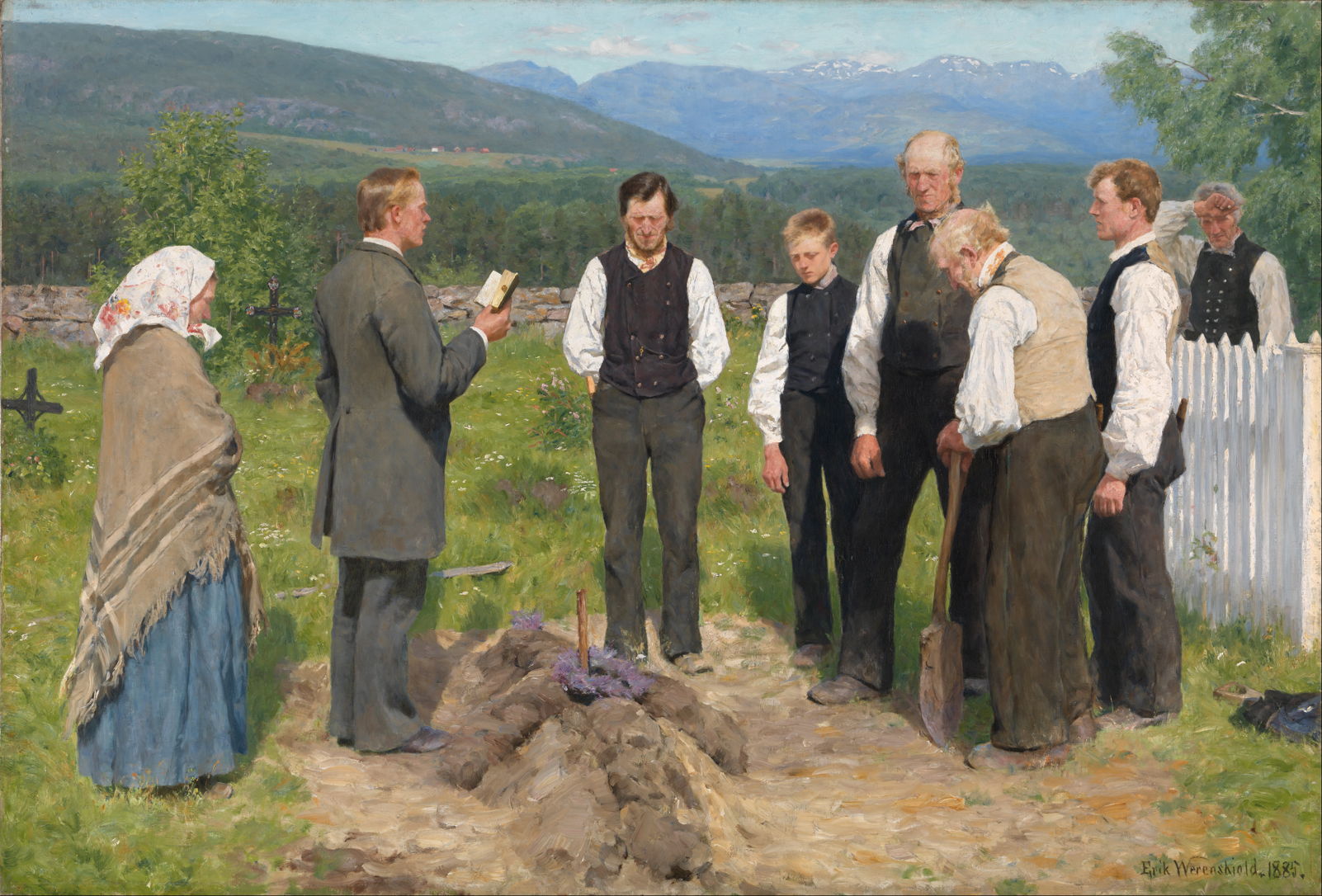
werenskioldpeasantburial
Erik Werenskiold (1855–1938), Peasant Burial (1885), oil on canvas, 102.5 x 150.5 cm, Nasjonalgalleriet, Oslo, Norway. Wikimedia Commons.

A little later, Erik Werenskiold painted his rural Norwegian response to Courbet’s Burial at Ornans, in his Peasant Burial of 1885.

ulrichglassblowers
Charles Frederic Ulrich (1858–1908), The Glass Blowers (1883), oil on canvas, 47.8 × 58.4 cm, Museo de Arte de Ponce, Ponce, Puerto Rico. Wikimedia Commons.

Charles Frederic Ulrich was born in New York City in 1858, and had travelled to Europe to attend the Royal Academy in Munich, Germany, as did so many other American painters, including William Merritt Chase. Many of his surviving works show different workplaces across Europe: in The Glass Blowers (1883) the work is delicate, in blowing and preparing glass domes, perhaps for use as covers of watches and clocks.

planellalittleweaver
Joan Planella y Rodríguez (1849–1910), The Little Weaver (1882-89), oil on canvas, 67 x 55 cm, Museu d’Història de Catalunya, Barcelona, Spain. Wikimedia Commons.

Joan Planella was a Catalan painter who studied in Italy rather than France. The Little Weaver (1882-89) shown here is a replica of the original completed in 1882. It shows a young girl working at a large and complex loom in Catalonia, as a man lurks in the background, keeping a watch over her.

lhermittepayharvesters
Léon Augustin Lhermitte (1844–1925), The Harvesters’ Pay (1882), oil on canvas, 215 x 272 cm, Musée d’Orsay, Paris. Wikimedia Commons.

Following the formative social realism of Jean-François Millet, Léon Lhermitte’s masterpiece The Harvesters’ Pay (1882) takes a more objective look at the realities of rural farmworkers. This evolved rapidly through Bastien-Lepage’s paintings of poor waifs and strays, to the grim battle for survival shown below in Fernand Pelez’s Homeless (1883).

pelezhomeless
Fernand Pelez (1848-1913), Homeless (1883), oil on canvas, 77.5 x 136 cm, location not known. Image by Bastenbas, via Wikimedia Commons.
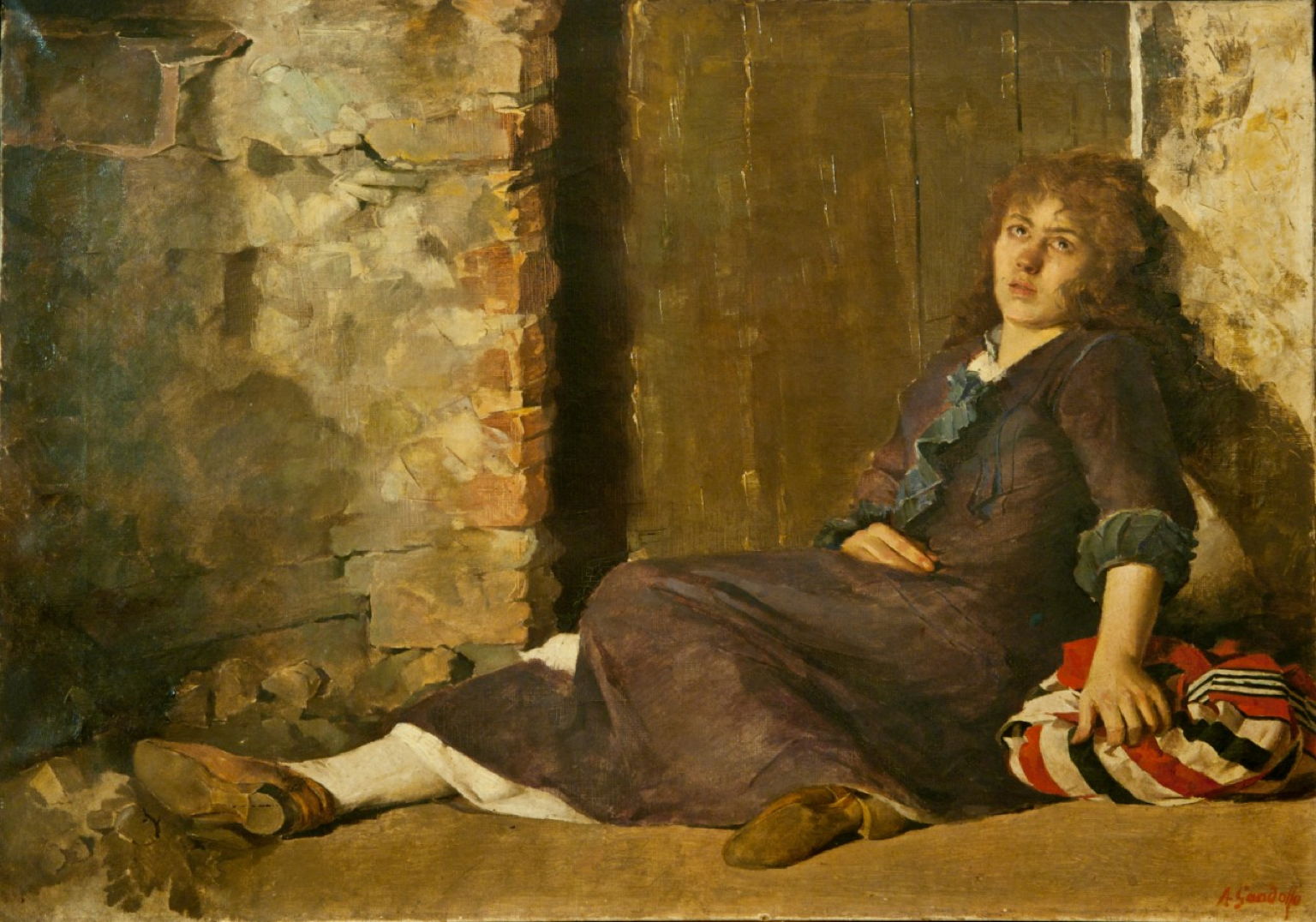
gandolfoevicted
Antonino Gandolfo (1841–1910), Evicted (Let he who is without sin cast the first stone) (1880), oil on canvas, 88 x 63 cm, location not known. Image by Luigi Gandolfo, via Wikimedia Commons.

These were by no means confined to France. The Sicilian Antonino Gandolfo’s Evicted from 1880 raised similar concerns under a very different political regime.

Even more uncomfortable for the French Third Republic and other states was the depiction of industrial unrest as it swept across Europe in the late nineteenth century.

rollminersstrike
Alfred Philippe Roll (1846–1919), Miners’ Strike (1880), original badly damaged, shown here as reproduction from ‘Le Petit Journal’, 1 October 1892, further details not known. Wikimedia Commons.

A good example is Alfred Roll’s painting of a Miners’ Strike in 1880. This was probably made from life when he visited the strike at Denain in the Nord-Pas de Calais coalfield that year. His large original painting seems to have been exhibited at the Salon in Paris, from where it was purchased by the State. However, the artist had to sell at ‘cost price’ on the understanding that it would be hung in the capital, in the Ministry of Commerce, where it would have substantial impact.

Once the State got its hands on Roll’s painting, it was despatched to a local museum in Valenciennes, where it seems to have been largely forgotten. The original is now badly damaged, and the image shown above is reproduced from Le Petit Journal, where it didn’t appear until 1 October 1892.

By early 1884, Émile Zola had decided to write a novel in his Rougon-Macquart series about a miners’ strike, and in February 1884 the author visited a strike near Valenciennes, where Roll’s painting was on display, for his research. He started writing Germinal on 2 April 1884, and the book was published in serial form from November of that year. Its story centres on a miners’ strike in the Nord-Pas de Calais coalfield very similar to that painted by Roll, and it remains Zola’s most successful work.

The State may have successfully suppressed the immediate impact of Roll’s painting by hiding it away in the provinces, but in this case it had not anticipated its influence on Zola.

Industrial unrest in Belgium came to a head in 1886, with a succession of strikes across the country. These started in Liège as a commemoration of the fifteenth anniversary of the Paris Commune, but spread through industrialised zones to the region around Charleroi and Hainault.

koehlerstrike
Robert Koehler (1850–1917), The Strike in the Region of Charleroi (1886), oil on canvas, 181.6 × 275.6 cm, Deutsches Historisches Museum, Berlin, Germany. Wikimedia Commons.

Robert Koehler painted his masterpiece of The Strike in the Region of Charleroi that year, with a group of workers standing outside the smart entrance to offices. The top-hatted owner stands on the top step, one of his managers looking anxious beside him. The leader of the workers is at the foot of the steps telling the industrialist of the workers’ demands. The situation is looking increasingly nasty, although there are no signs yet of police or troops, or of violent confrontation.

krohgtired
Christian Krohg (1852–1925), Tired (1885), oil on canvas, 79.5 x 61.5 cm, Nasjonalgalleriet, Oslo, Norway. Wikimedia Commons.

Politics and art were mixing freely in the Nordic countries too. The Norwegian Christian Krohg explored the theme of fatigue and sleep, particularly among mothers. In Tired from 1885, the young woman seen here is no mother, but a seamstress, one of the many thousands who worked at home at that time, toiling for long hours by lamplight for a pittance.

Home work as a seamstress was seen as the beginning of the descent into prostitution, a major theme in Krohg’s painting and writing. The paltry income generated by sewing quickly proved insufficient, and women sought alternatives, which all too often led to them taking to the street.

krohgalbertinepolicesurgeon
Christian Krohg (1852–1925), Albertine in the Police Doctor’s Waiting Room (1885-87), oil on canvas, 211 x 326 cm, Nasjonalgalleriet, Oslo, Norway. Wikimedia Commons.

Just before Christmas 1886, Krohg’s first novel Albertine was published by a left-wing publisher. Its central theme is prostitution in Norway at the time, and the police quickly seized all the copies they could find, banning it on the grounds of violating the good morals of the people. Krohg was found guilty of the offence the following March and fined, although the police were only able to seize 439 of the first 1600 copies to go into circulation.

At the same time as he was writing that novel, Krohg had been working on his largest and most complex painting: Albertine in the Police Doctor’s Waiting Room (1885-87). He also painted several other scenes from the book. Curiously, Krohg’s campaigning writing and painting didn’t want prostitution made legal: quite the opposite, he and others wanted it banned.

Naturalist painting also helped promote advances being made by the state in healthcare and education.

gervexoperation
Henri Gervex (1852–1929), Before the Operation (1887), oil on canvas, 242 x 188 cm, Musée d’Orsay, Paris. Wikimedia Commons.

The depiction of modern hospitals, medical teaching and research is a feature of Naturalism. Henri Gervex, who rose to fame with a ‘shocking’ painting of a nude courtesan on the morning after, found a little flesh at the Hôpital Saint-Louis, where an eminent doctor is teaching Before the Operation in 1887.

geoffroyinclass
Jean Geoffroy (1853-1924), Primary School Class (1889), oil on canvas, 145 x 220 cm, Ministère de l’Education Nationale, Paris. Wikimedia Commons.

Jean Geoffroy’s Primary School Class from 1889 shows one of the Third Republic’s new lay teachers working diligently in the classroom with her pupils. This was deemed sufficiently positive to the State as to be purchased by the French National Ministry of Education, where it still hangs.

In memoriam Jean-Eugène Buland, painter of the Third Republic

Several other Naturalist painters achieved acclaim alongside Jules Bastien-Lepage and sustained the movement after his untimely death in 1884. Jean-Eugène Buland (1852–1926) was among them, and continued painting into the twentieth century. He died one hundred years ago today, and this article gives a brief overview of his career with a small selection of his paintings.

Buland trained at the École des Beaux-Arts in Paris under Alexandre Cabanel, and with his teacher’s influence turned first to history painting. In 1878 and 1879 he was second in the contest for the Prix de Rome, but then switched to painting genre scenes of modern life, classical Naturalist motifs inspired by the literary Naturalism of Émile Zola in particular.

His meticulous realism was well-received at the Salon, and after winning a series of medals there, in 1889 he was awarded a silver medal at the Exposition Universelle in Paris.

Buland settled in the village of Charly-sur-Marne, to the east of Paris, and steadfastly refused to become part of the art scene in the capital. He only seems to have ventured into Paris for the annual Salon, and to paint commissions in the Hôtel de Ville (City Hall).

bulandalmsbeggar
Jean-Eugène Buland (1852–1926), Alms of a Beggar (1880), oil on canvas, 117 × 89 cm, location not known. Wikimedia Commons.

From the outset, Buland took on challenging motifs with equally challenging readings. In Alms of a Beggar (1880), a young woman dressed immaculately in white is sat outside a church seeking charity. Approaching her, a coin in his right hand, is a man who can only be a beggar himself. His clothes are patched on patches, faded and filthy, and he wears battered old wooden shoes, yet he is about to give the young woman what is probably his last coin.

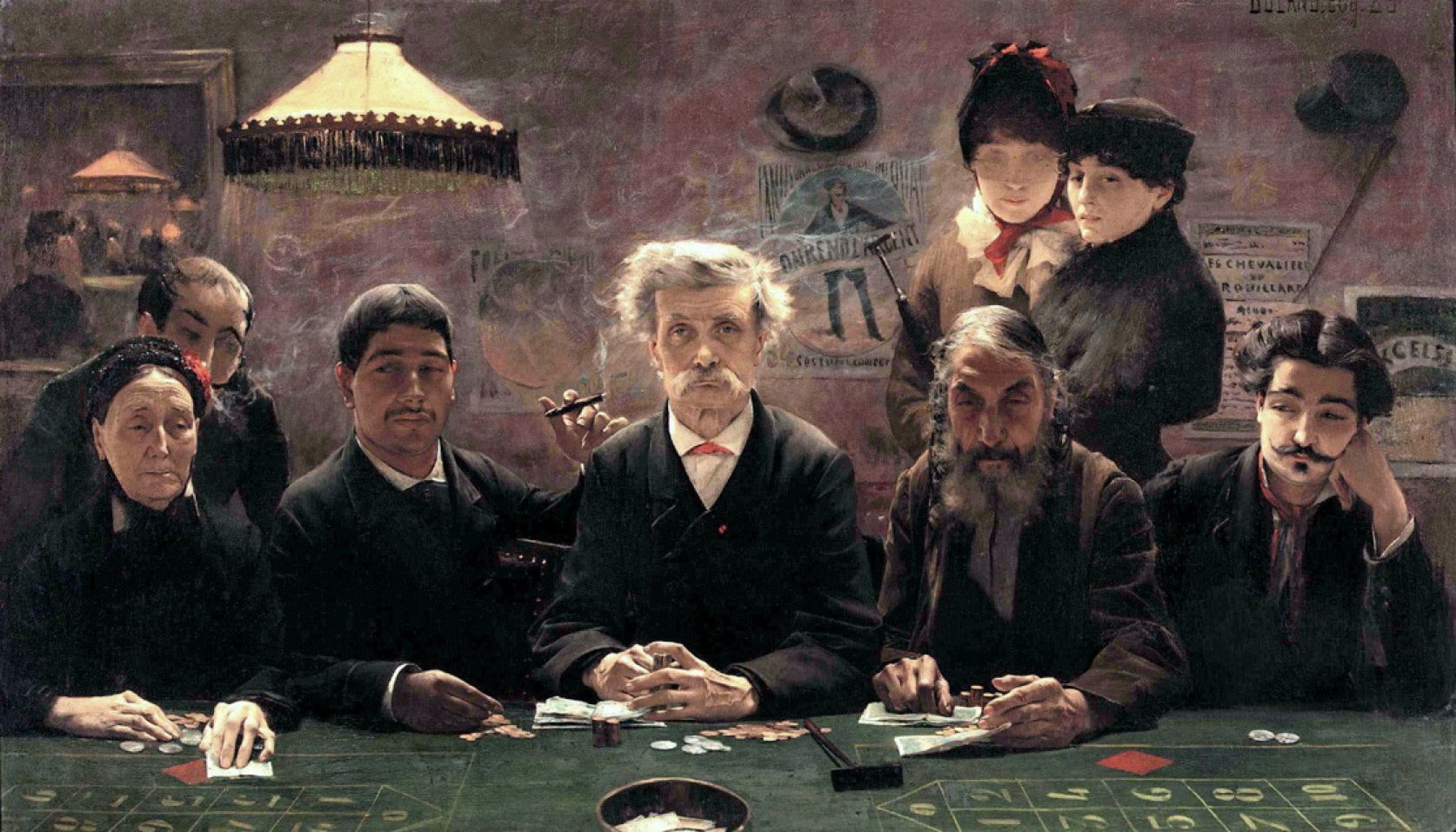
bulandtripot
Jean-Eugène Buland (1852–1926), Le Tripot (The Dive) (1883), oil on canvas, 63.5 × 109.2 cm, location not known. Wikimedia Commons.

Le Tripot (The Dive) (1883) is one of my favourite paintings of this period. Set in a seedy, downmarket gambling den, it’s a group portrait of five hardened gamblers at their table. Each is rich in character, and makes you wonder how they came to be there. A little old widow at the left, for example, looks completely out of place, but is resolutely staking her money. Looking over her shoulder is a man, whose face is partially obscured. Is he, perhaps, a son, or a debtor? A young spiv at the far right is down to his last couple of silver coins, and looks about to lose them too. The air is thick with smoke, the walls in need of redecoration, and a pair of young streetwalkers prowl behind them, looking for a winner who will spend some of their cash on them.

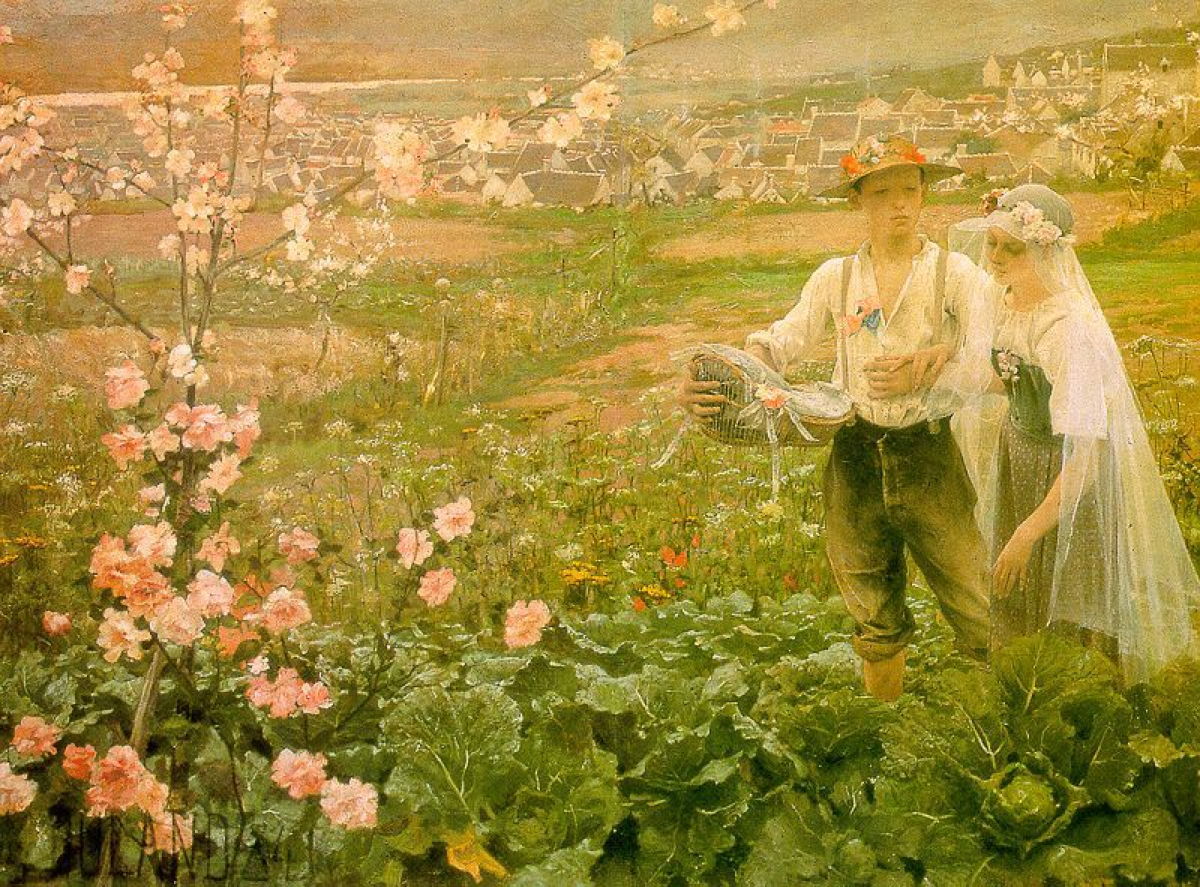
bulandinnocentwedding
Jean-Eugène Buland (1852–1926), Innocent Wedding (1884), oil on canvas, dimensions not known, Musée des Beaux-Arts de Carcassonne, Carcassonne, France. The Athenaeum.

Buland also seems to have painted some unashamedly populist works, including this idyllic Innocent Wedding (1884). With the distant village, blossom, and a young couple arm in arm, it’s deeply romantic, and a far cry from the works above.

bulandofferingvirgin
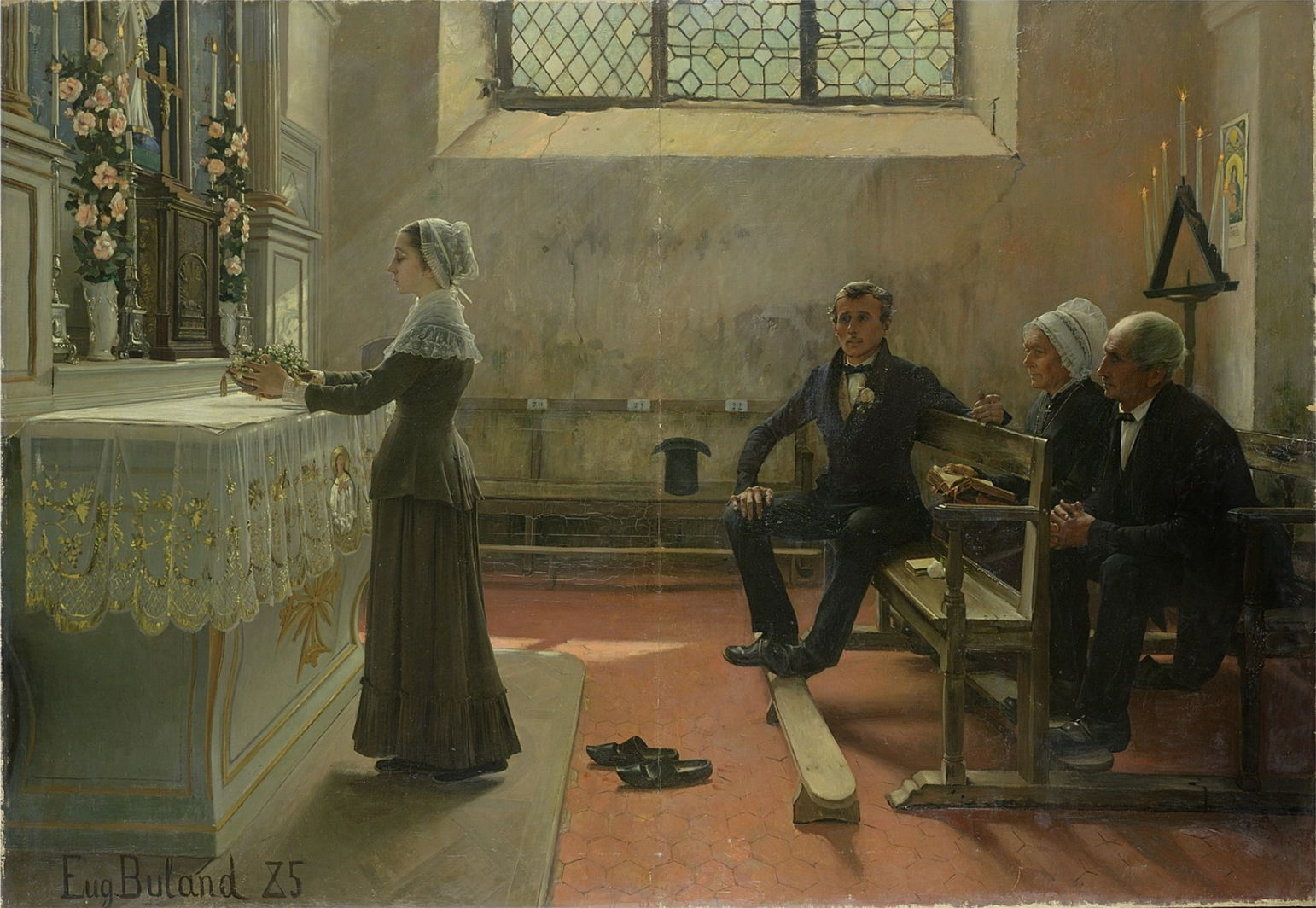
Jean-Eugène Buland (1852–1926), Offering to the Virgin the Day After the Wedding (1885), oil on canvas, 144 × 209 cm, Musée des Beaux-Arts de Caen, Caen, France. Wikimedia Commons.

That led to a series of paintings showing events the day after the wedding, including this of the newlywed bride Offering to the Virgin the Day After the Wedding (1885). There’s a crisp formality in these figures, who appear stilted and posed as they go through the rites and processes of life.

bulandlessonapprentice
Jean-Eugène Buland (1852–1926), Un Patron, or The Apprentice’s Lesson (1888), oil on canvas, 102 x 82 cm, Nationalmuseum, Stockholm, Sweden. Image by Erik Cornelius, via Wikimedia Commons.

Buland went to the factory for Un Patron, or The Apprentice’s Lesson (1888). A young boy is being trained by his foreman to make a cogwheel, when many might have preferred him still to be at school. Buland used photographs extensively in the preparatory work for this painting, to capture its wealth of detail.

This also marks an overt politicisation in his work: the apprentice was part of the nation’s efforts to advance in industry and manufacturing after the disaster of the Franco-Prussian War.

bulandpropaganda
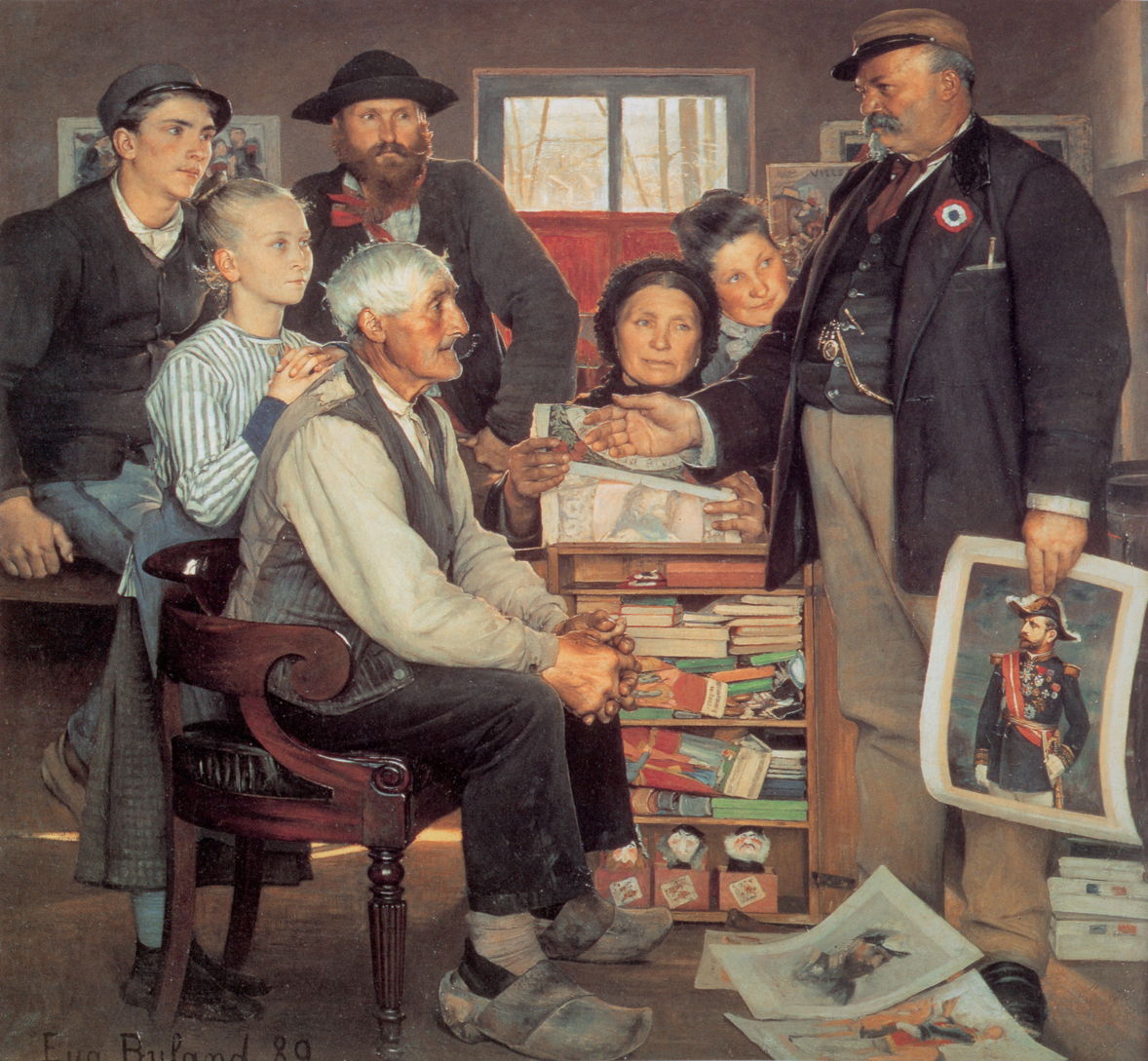
Jean-Eugène Buland (1852–1926), Propaganda Campaign (1889), oil on canvas, 181.8 × 191.4 cm, Musée d’Orsay, Paris. Wikimedia Commons.

Propaganda Campaign (1889) is even more political, and Buland’s stark rendering of its figures makes them pop out, almost like cut-outs. A travelling salesman is in the home of a poor family, selling books and coloured prints to the head of the household. That in his left hand shows the populist politician General Boulanger, and the salesman’s motives combine politics with business. His buttonhole rosette declares his role as a canvasser for the General.

bulandstrollpark
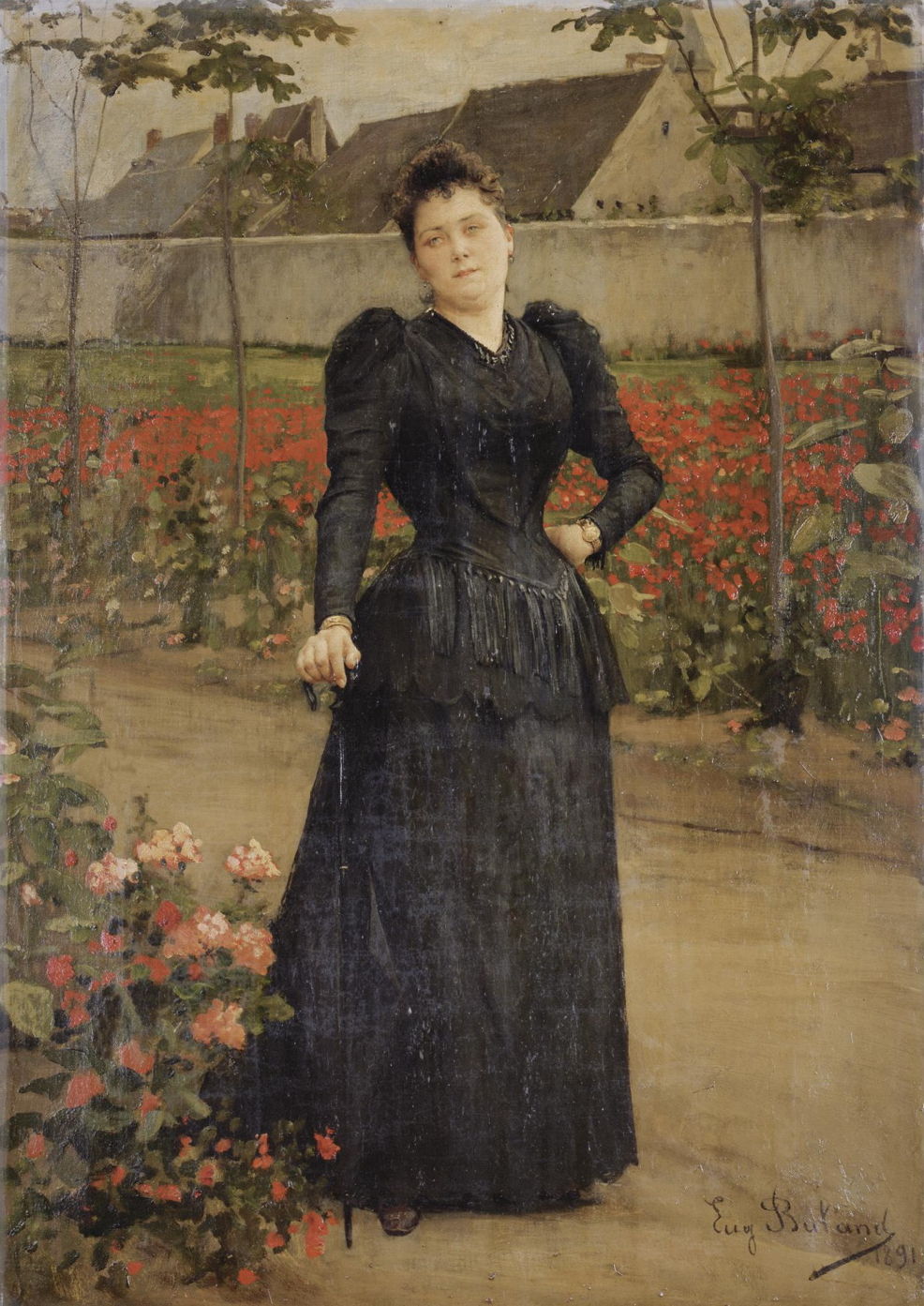
Jean-Eugène Buland (1852–1926), A Stroll in the Park (1891), oil on canvas, 92.5 × 65 cm, location not known. Wikimedia Commons.

A Stroll in the Park (1891) seems a more innocent full-length portrait of a woman, although I have been unable to discover her identity or any reason for the painting.

bulandmunicipalcouncil
Jean-Eugène Buland (1852–1926), Municipal Council and Commission of Pierrelaye Organizing a Festival (1891), oil on canvas, 140 × 200 cm, Town Hall, Pierrelaye, France. Wikimedia Commons.

Municipal Council and Commission of Pierrelaye Organizing a Festival (1891) is another fascinating painting with much contemporary relevance, an example of provincial municipal art. It’s a group portrait of the council of this village to the north-west of Paris, clearly commissioned by them to record their great deeds. It has a similar stiff formality to Propaganda Campaign, rather than the more insightful approach of Rembrandt’s group portraits.

bulandmarriage
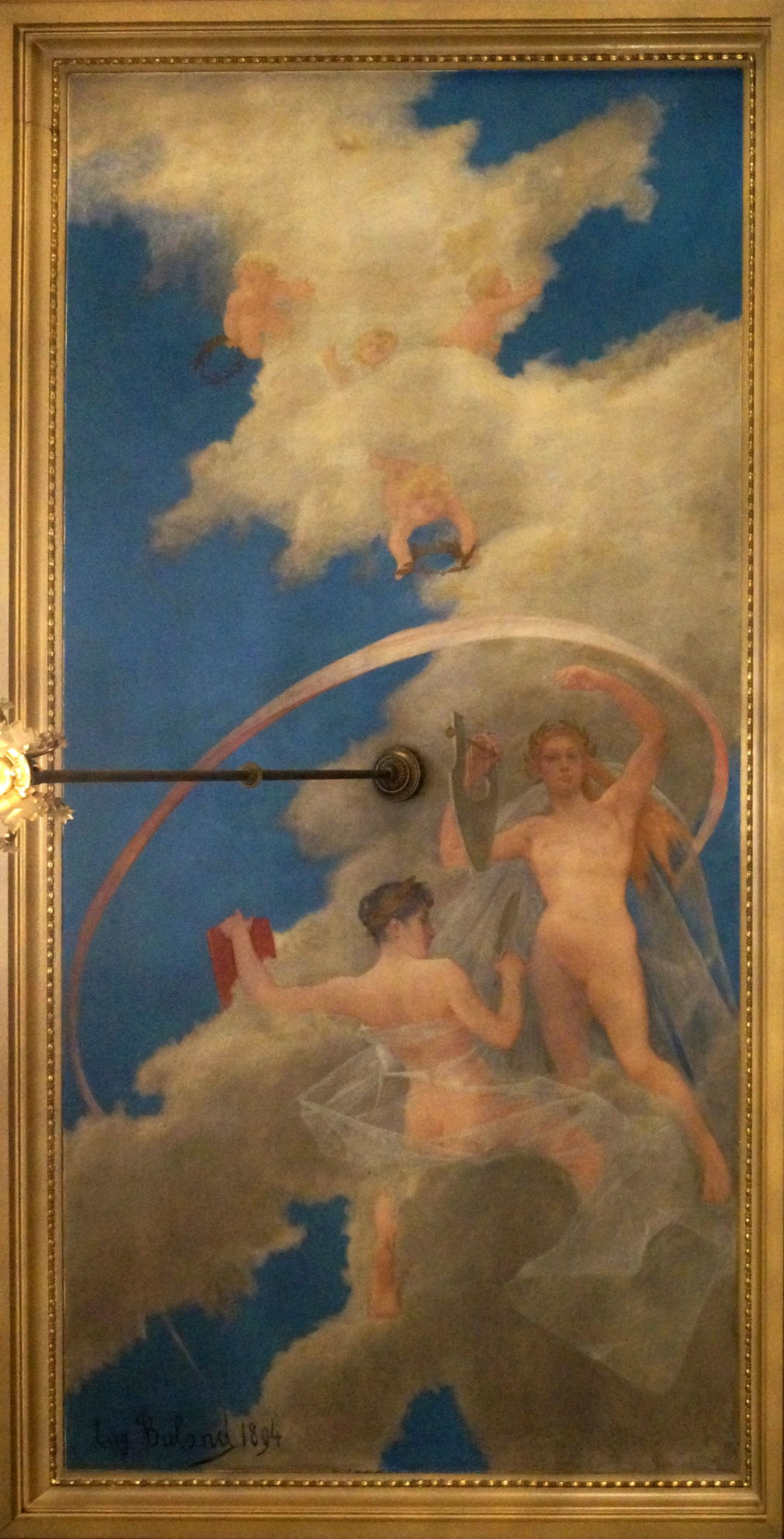
Jean-Eugène Buland (1852–1926), Marriage (date not known), painted ceiling, dimensions and location not known (?Hôtel de Ville, Paris). Image by G.Garitan, via Wikimedia Commons.

I suspect that Buland’s romantically painted ceiling of Marriage was one of his commissions for the rebuilt Hôtel de Ville in Paris, and completed in the 1890s.

bulandparentalhappiness
Jean-Eugène Buland (1852–1926), Parental Happiness (1903), oil on canvas, 97.5 × 129 cm, location not known. Wikimedia Commons.

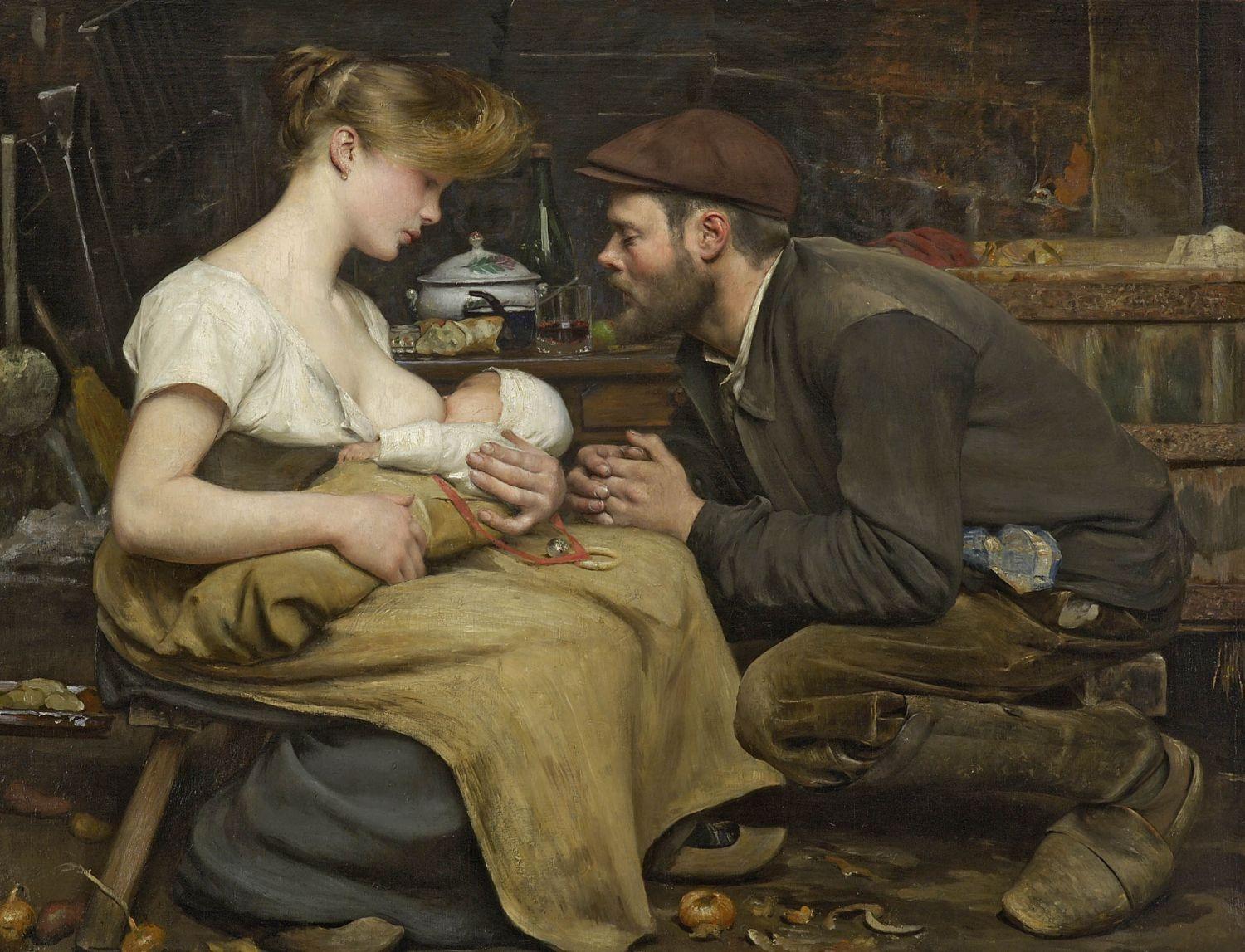
He returned to poor working families in his Parental Happiness from 1903. A young couple are nursing their first baby, and appear to be living in an agricultural outhouse. The floor is strewn with vegetables and their parings, and the husband is dressed as a labourer, with worn working shoes, and his wife in wooden clogs.

bulandtinker
Jean-Eugène Buland (1852–1926), The Tinker (1908), oil on canvas, 112.6 × 145 cm, Private collection. Wikimedia Commons.

Buland’s The Tinker (1908) is busy at his cottage industry, repairing damaged pots, pans, and domestic metal objects. The stone wall at the left glistens with the damp.

Jean-Eugène Buland died in his home village of Charly-sur-Marne on 18 March 1926, at the age of 73.

This century has brought something of a revival for Buland. His first solo retrospective exhibition was held at Carcassonne in 2007-08, and his prices at auction are moving steadily upwards. I hope it doesn’t prove too late to conserve and document what remains of his work.

Reference

Richard Thomson (2012) Art of the Actual, Naturalism and Style in Early Third Republic France, 1880-1900, Yale UP. ISBN 978 0 300 17988 0.

Naturalists: Marie Bashkirtseff

Jules Bastien-Lepage’s brilliant protégé was a young woman who started training in Paris in 1877, and who died from tuberculosis seven years later, just three months before him, Marie Bashkirtseff (1858–1884).

She was born and brought up in Havrontsi (Gavrontsi), to the north of Poltava in central Ukraine, between Kyiv and Kharkiv, where she first started to learn to draw and paint. Her affluent parents split up when she was twelve, following which she travelled around Europe with her mother, eventually settling in Paris. She originally hoped to be a singer, but after an illness ruined her voice, she decided to be an artist. She then studied with Robert-Fleury from 1877, and at the Académie Julian.

bashkirtseffaselfportrait
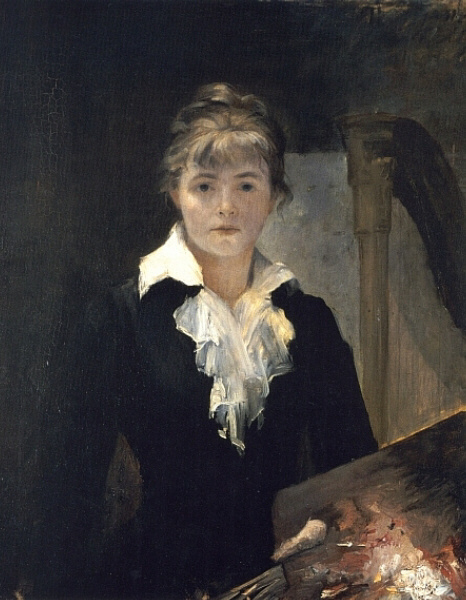
Marie Bashkirtseff (1858–1884), Self-portrait with Palette (1880), oil on canvas, dimensions not known, Musée des Beaux-Arts Jules Chéret, Nice, France. Wikimedia Commons.

A self-assured painter from the beginning, she set her sights high and had the ability and drive to paint excellently. Her early Self-portrait with Palette (1880) was painted in the same year that she first had a work accepted for exhibition at the Paris Salon, and she was successful again in every subsequent Salon until her death.

bashkirtseffinthestudio
Marie Bashkirtseff (1858–1884), In the Studio (1881), oil on canvas, 188 x 154 cm, Dnipro State Art Museum, Dnipro, Ukraine. Wikimedia Commons.

While still studying at the Académie Julien in 1881, she painted In the Studio, which gives good insight into what her training was like. Her class was of course entirely female, and the Académie Julien was one of the few reputable schools that accepted women pupils at that time. The artist is seated in the centre foreground, holding her palette and knife as she looks up at one of her fellow pupils.

bashkirtseffpainterssister
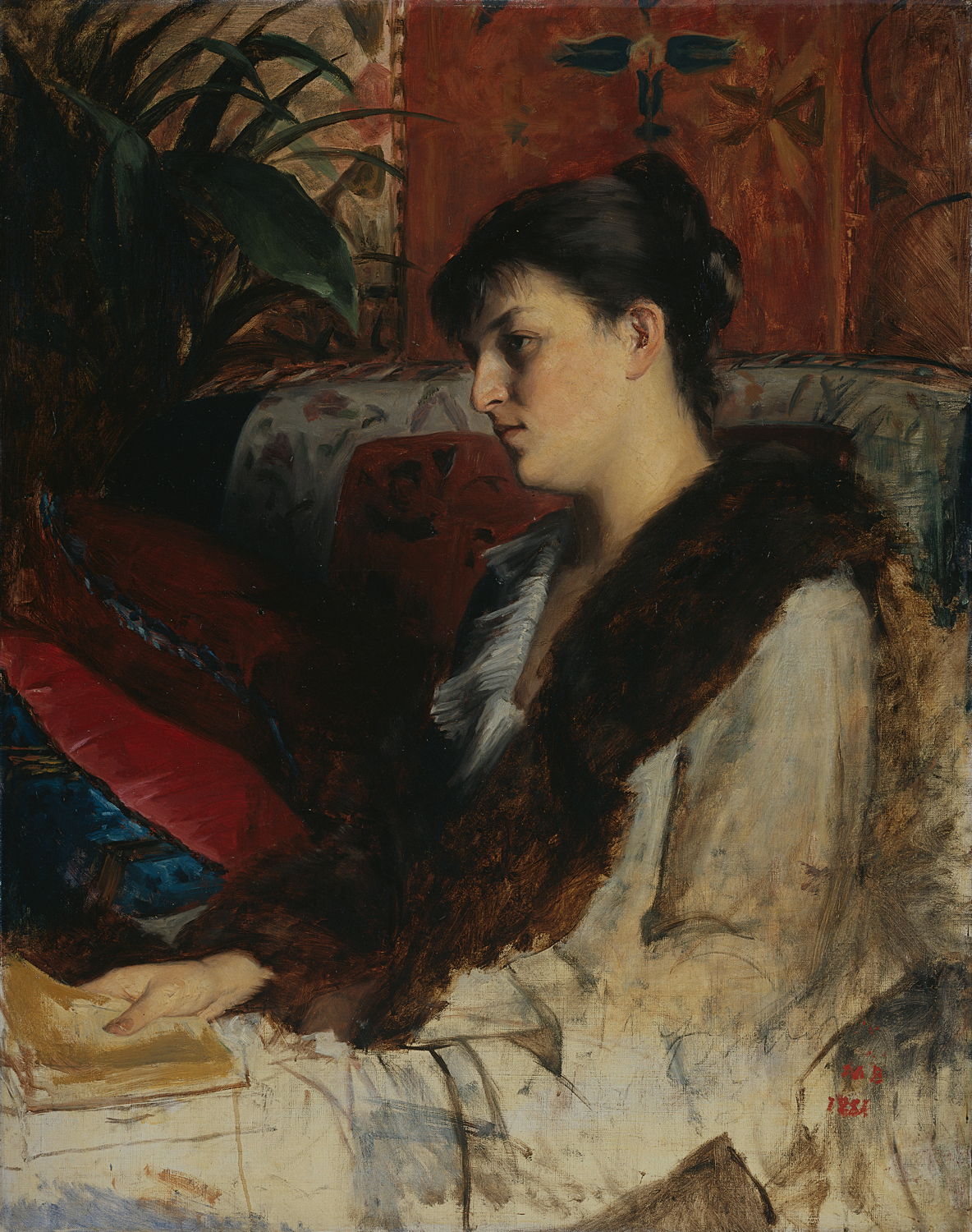
Marie Bashkirtseff (1858–1884), The Artist’s Sister (1881), oil on canvas, 92 x 73 cm, Rijksmuseum, Amsterdam. Wikimedia Commons.

Her early portraits are skilful if conventional, as is The Artist’s Sister from 1881. She started establishing herself in the art scene; it has been claimed that she wrote a column for the mysandrist newspaper La Citoyenne under the name of Pauline Orrel, but that appears to be unsupported by the original edited versions of her diaries.

She became a close friend of Jules Bastien-Lepage when visiting Nice in 1882, and he acted as her mentor if not teacher, as she described herself as his pupil. She also formed a close friendship with the writer Guy de Maupassant.

bashkirtseffatabook
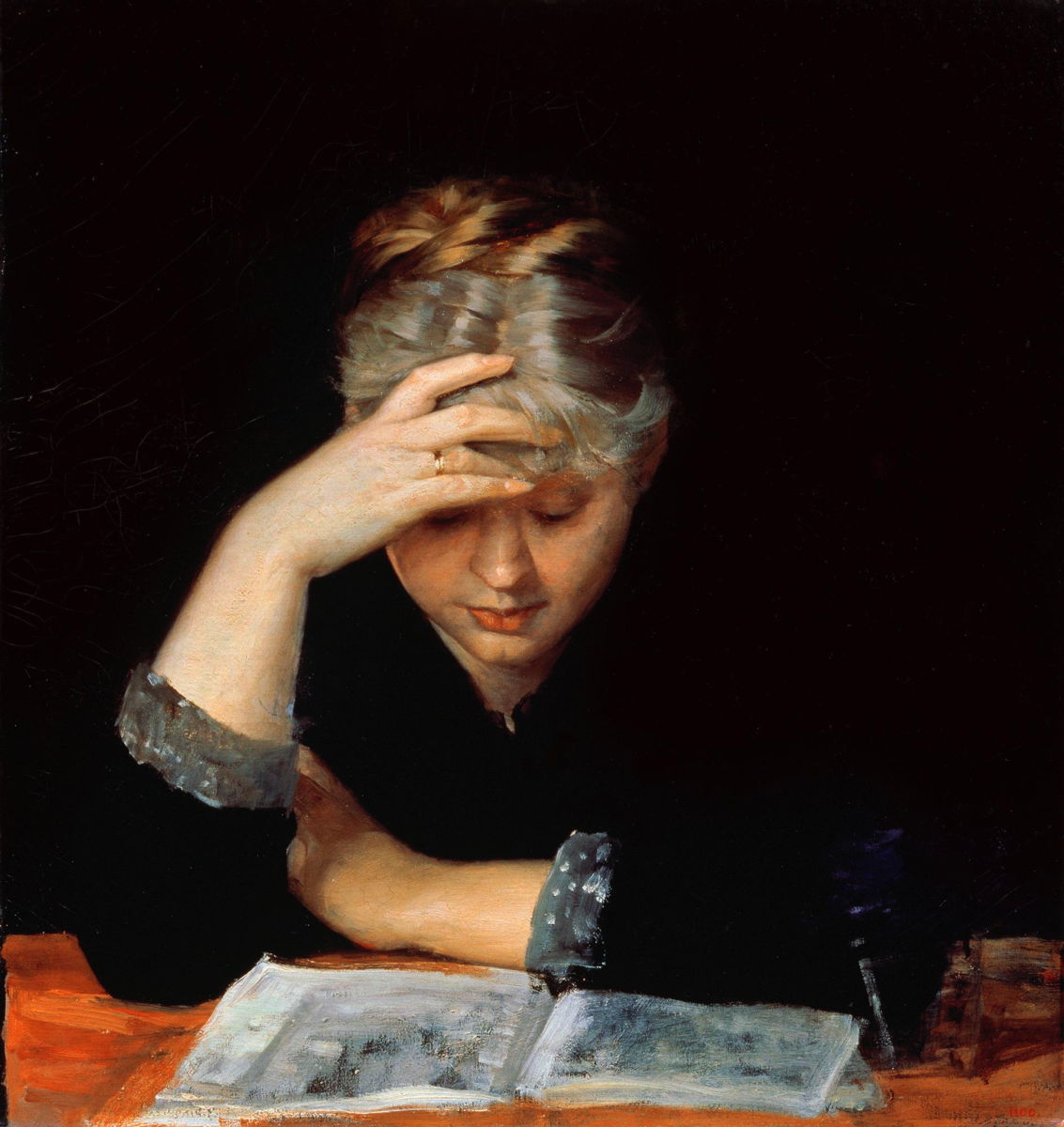
Marie Bashkirtseff (1858–1884), At a Book (c 1882), oil on canvas, 63 × 60.5 cm, Kharkiv Art Museum, Kharkiv, Ukraine. Wikimedia Commons.

As she developed a more distinctive style in her portraits, so her brushwork loosened. She was an astute observer of women’s life, as shown in At a Book (c 1882), with its emphasis on her model’s unusual hair.

bashkirtseffyoungrussiangirl
Marie Bashkirtseff (1858–1884), Young Russian Girl (c 1882), other details not known. Wikimedia Commons.

Young Russian Girl (c 1882) is another delicate portrait, although I suspect the original isn’t as soft-focus as this image.

bashkirtseffinthemist
Marie Bashkirtseff (1858–1884), In the Mist (1882), oil on canvas, 47 x 55 cm, Österreichische Galerie Belvedere, Vienna, Austria. Wikimedia Commons.

Although Bashkirtseff accepted that her mentor Bastien-Lepage reigned supreme in the countryside, she felt that she was his match when it came to depicting the urban environment of Paris. In the Mist from 1882 is a good demonstration of how well she captures the almost deserted city streets on a foggy day, with a bright plume of flame from a fire in the centre of her canvas.

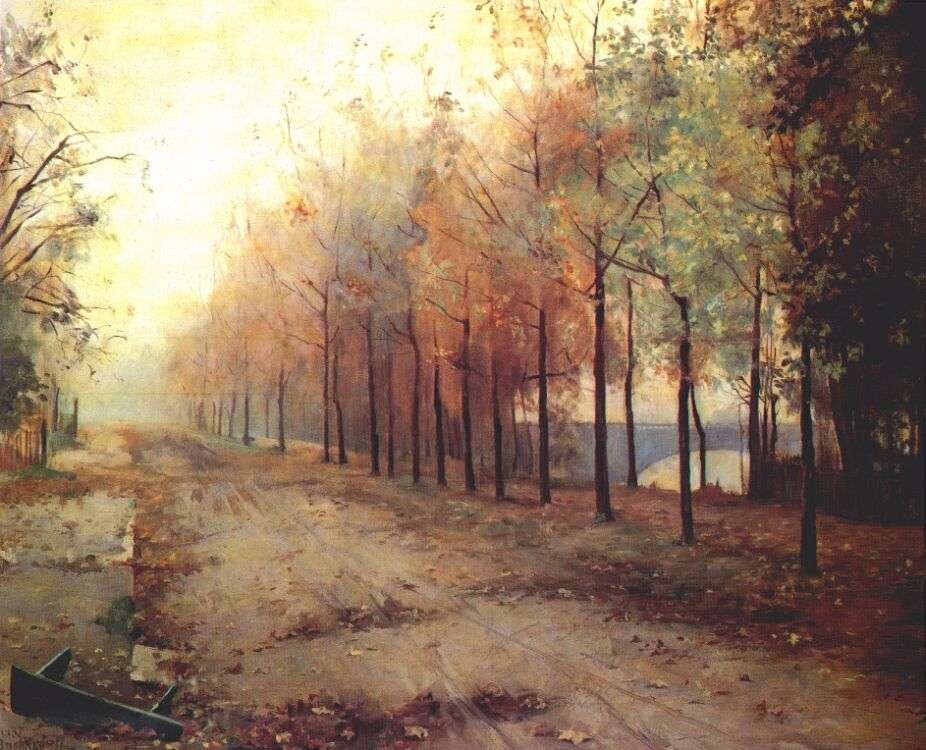
bashkirtseffautumn
Marie Bashkirtseff (1858–1884), Autumn (1883), oil on canvas, dimensions not known, State Russian Museum, Saint Petersburg. The Athenaeum.

Autumn, from 1883, is an impressive and Impressionist depiction of a row of trees on the bank of the River Seine in the centre of Paris, but is unusual in being devoid of people. The leaf litter, occasional rubbish, and fallen bench strengthen its feeling of desolation in the midst of the bustling city.

bashkirtseffumbrella
Marie Bashkirtseff (1858–1884), The Umbrella (1883), oil on canvas, 93 × 74 cm, State Russian Museum, Saint Petersburg. Wikimedia Commons.

Bastien’s composite of detailed realism blended with more painterly passages shows in one of her best portraits, The Umbrella (1883). This girl’s tenacious stare at the viewer is quite unnerving. That year she was awarded an honourable mention from the Salon.

bashkirtseffmeeting
Marie Bashkirtseff (1858–1884), A Meeting (1884), oil on canvas, 193 x 177 cm, Musée d’Orsay, Paris. Wikimedia Commons.

A Meeting (1884) finally justified her claim to paint the urban poor, and to match Bastien-Lepage. This painting was a great success when shown at the Salon that year, and is probably her finest work.

bashkirtseffportraitmmex
Marie Bashkirtseff (1858–1884), Portrait of Madame X (1884), pastel and charcoal, 56 x 46.5 cm, Musée d’Orsay. Wikimedia Commons.

Her pastel Portrait of Madame X (1884), now in the Musée d’Orsay together with A Meeting, was also shown in the Salon that year.

By that summer, Bashkirtseff’s fragile health was deteriorating rapidly because of tuberculosis. She died on 31 October, less than a month before she would have turned twenty-six, and less than three months before her mentor died.

Her ambition was better fulfilled after her death than in life. Her huge mausoleum in Cimitière de Passy, Paris, designed by Bastien’s younger brother Émile, contains her artist’s studio complete with an unfinished painting of Holy Women by the Grave. Three years later, her copious and revelatory diaries were published, and propelled her to international fame.

References

Wikipedia.
An English translation of her journal, on archive.org.

Naturalists: Jules Bastien-Lepage 1882-84

After two unsuccessful attempts to win the Prix de Rome and become a history painter, Jules Bastien-Lepage had specialised in depicting the rural poor, to growing acclaim at the Salon.

bastienlepagesnowdamvillers
Jules Bastien-Lepage (1848–1884), Snow Effect, Damvillers (c 1882), oil on canvas, 45.1 x 55.3 cm, Fine Arts Museums of San Francisco, San Francisco, CA. The Athenaeum.

Not all his paintings were typically Naturalist. He continued to paint landscapes, of which Snow Effect, Damvillers from about 1882, is one of his finest and most Impressionist.

bastienlepageeveningdamvillers
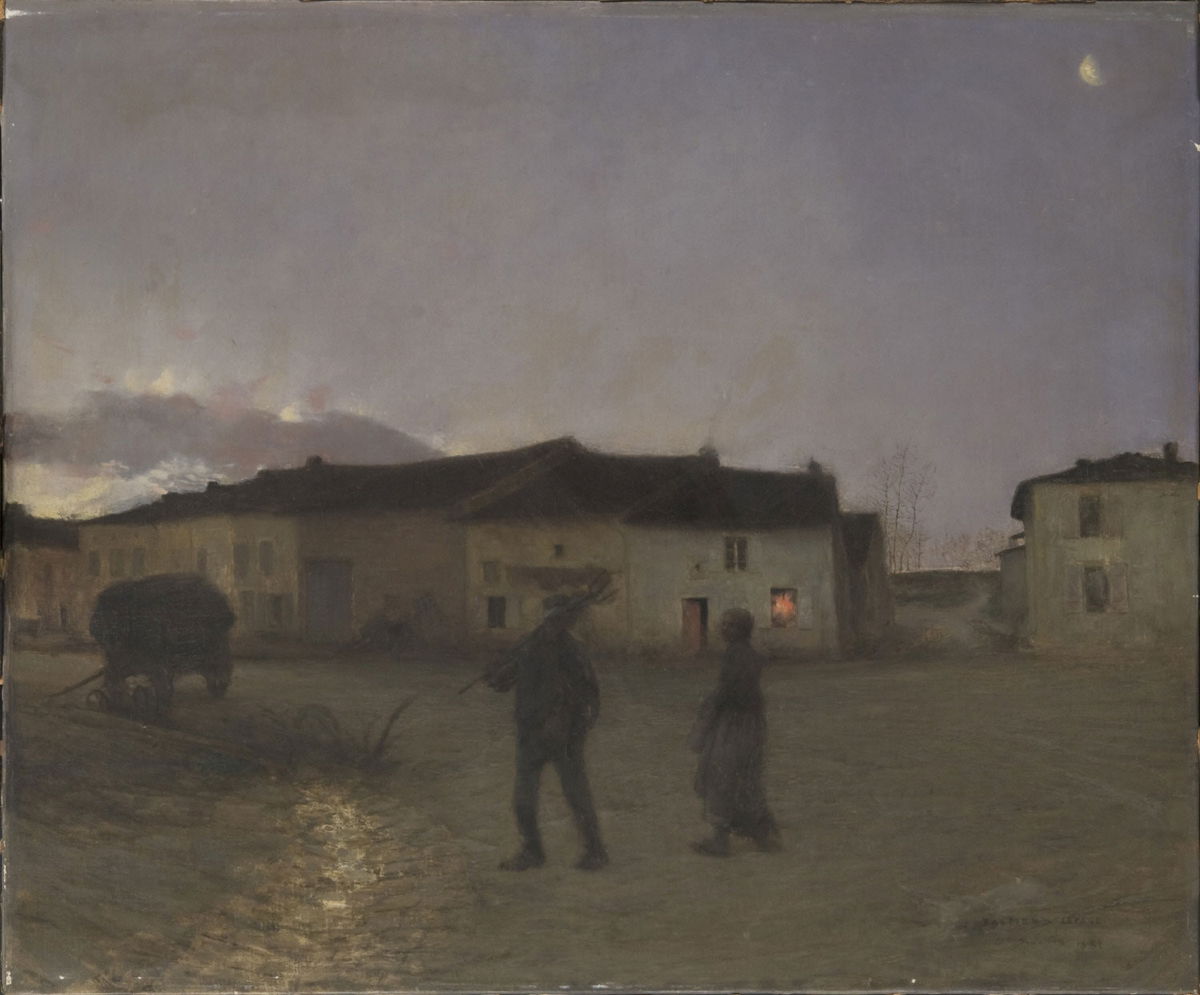
Jules Bastien-Lepage (1848–1884), Evening at Damvillers (1882), oil on canvas, 66.4 x 80.3 cm, Philadelphia Museum of Art, Philadelphia, PA. The Athenaeum.

The shadowy figures caught in the late dusk of his Evening at Damvillers (1882) are a reminder that people remained at the centre of his art.

blepageroadsideflowers
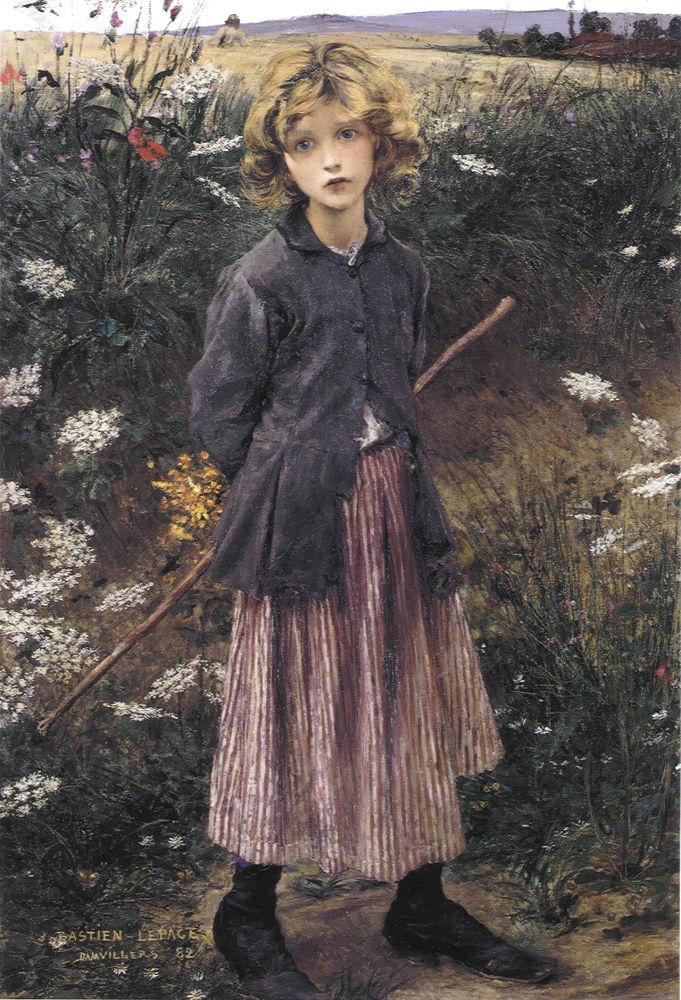
Jules Bastien-Lepage (1848–1884), Roadside Flowers (The Little Shepherdess) (1882), oil on canvas, 132.1 x 88.9 cm, Private collection. Wikimedia Commons.

Bastien pushed his compositional formula to the limit in this enchanting painting of Roadside Flowers or The Little Shepherdess (1882). The sky has been reduced to a thin sliver, and almost the whole canvas is devoted to its detailed foreground. Like the weeds behind her, this little girl has a wide-eyed and sad beauty. Although her clothing is visibly tatty, her face and hair are idealistically clean, in keeping with a romantic sentimentalism rather than the objectivity more characteristic of true Naturalism.

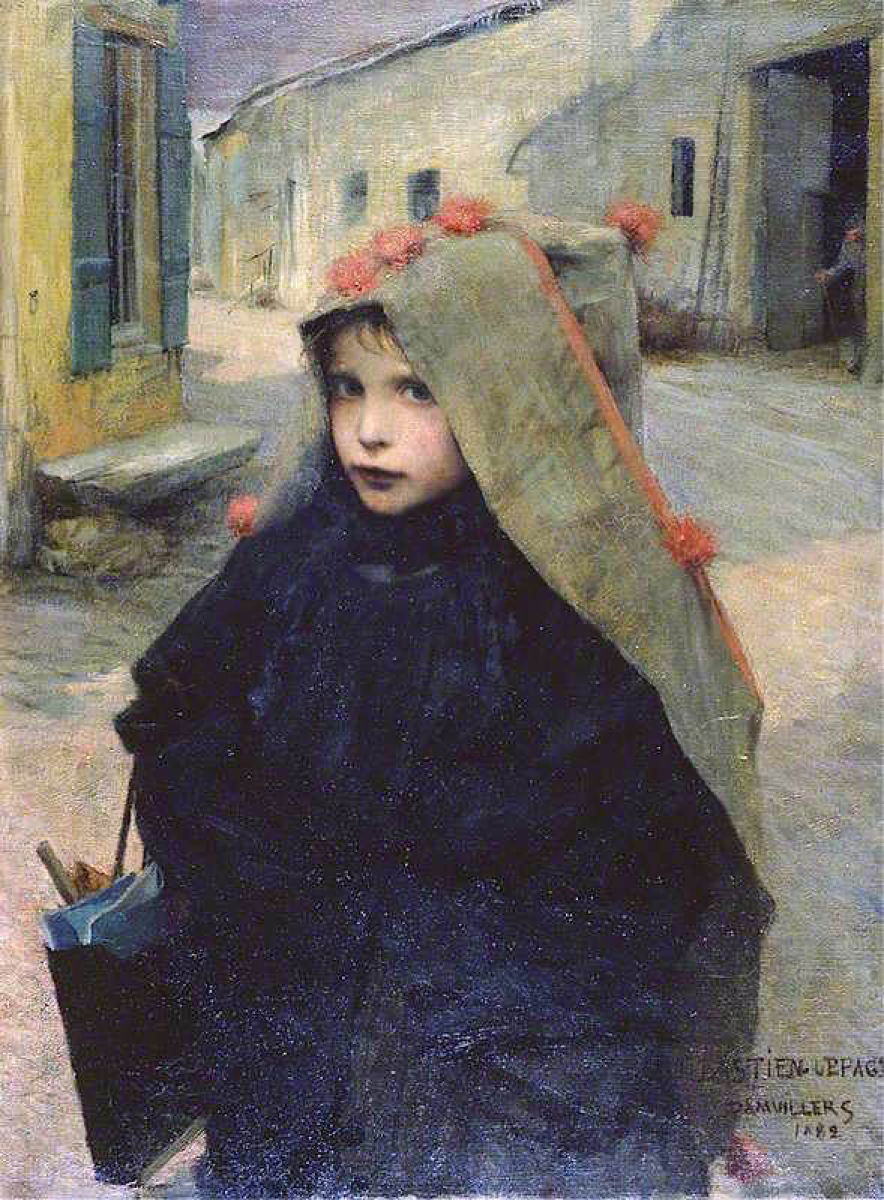
bastienlepagegoingtoschool
Jules Bastien-Lepage (1848–1884), Going to School (1882), oil on canvas, 80.9 x 59.8 cm, Aberdeen Art Gallery and Museums, Aberdeen, Scotland. The Athenaeum.

Going to School (1882) takes us back into the village, but again this girl is far too clean and perfect to be an objective account.

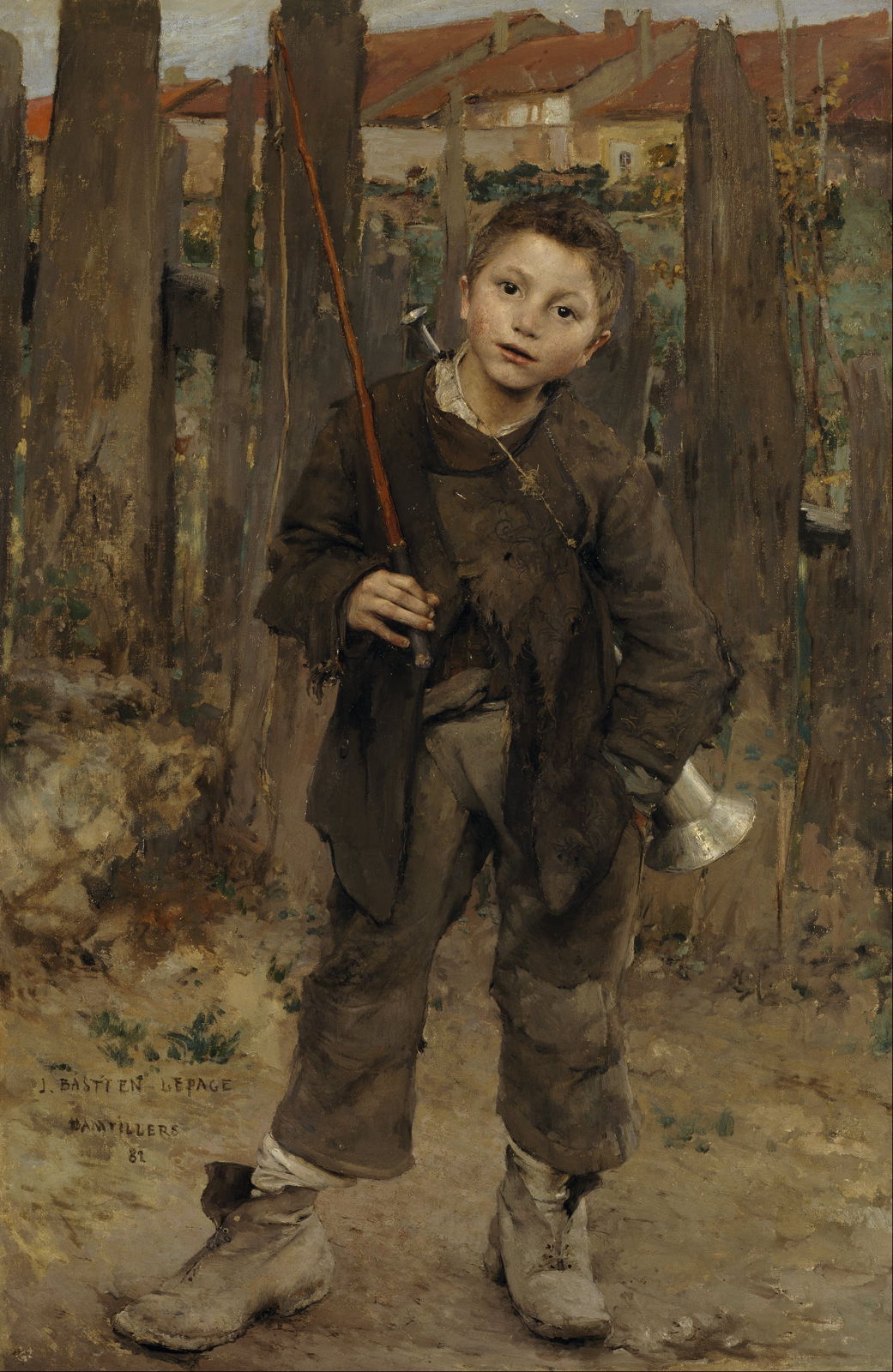
blepagenothingdoing
Jules Bastien-Lepage (1848–1884), Pas Mèche (Nothing Doing) (1882), oil on canvas, 132.1 x 89.5 cm, Scottish National Gallery, Edinburgh, Scotland. Wikimedia Commons.

Pas Mèche (Nothing Doing) (1882) is nearer the mark: a cheeky ploughboy equipped with his whip and horn, on his way out to work in the fields. His face is grubby, his clothing frayed, patched, and dirty, and his boots caked in mud and laceless.
bastienlepagelovevillage
Jules Bastien-Lepage (1848–1884), Love in the Village (1882), oil on canvas, 194 × 180 cm, Pushkin Museum of Fine Arts Музей изобразительных искусств им. А.С. Пушкина, Moscow, Russia. Wikimedia Commons.
Many of his paintings from 1882 were single-figure portraits, mostly of children, but in Love in the Village he shows a young couple on either side of a tumbledown fence, chatting intimately among the vegetable patches. One early reading, by Mette, wife of Paul Gauguin, claimed the girl was under age, and the relationship accordingly beyond the pale. The girl not only faces away from the viewer, but her whole body is turned away, leaving that unresolved.

bastienlepagethameslondon
Jules Bastien-Lepage (1848–1884), The Thames, London (1882), oil on canvas, 54 x 74.3 cm, Philadelphia Museum of Art, Philadelphia, PA. The Athenaeum.

Bastien visited London, where he painted the river in The Thames, London (1882). This maintains fine detail right into the far distance, except where it’s affected by the smoky and hazy atmosphere, and its horizon is kept well below the middle of the canvas.

bastienlepagelondonbootblack
Jules Bastien-Lepage (1848–1884), London Bootblack (1882), oil on canvas, 132.5 x 89.5 cm, Musée d’Orsay, Paris. The Athenaeum.

While in London he painted one of his most characteristically Naturalistic works, showing a young boy working on the street as a London Bootblack (1882). This could have been taken straight from the journalistic accounts of London’s streetlife by Henry Mayhew, or their fictional reworking in the novels of Charles Dickens. The documentary realism of the foreground gives way to a more sketchy and jumbled background.

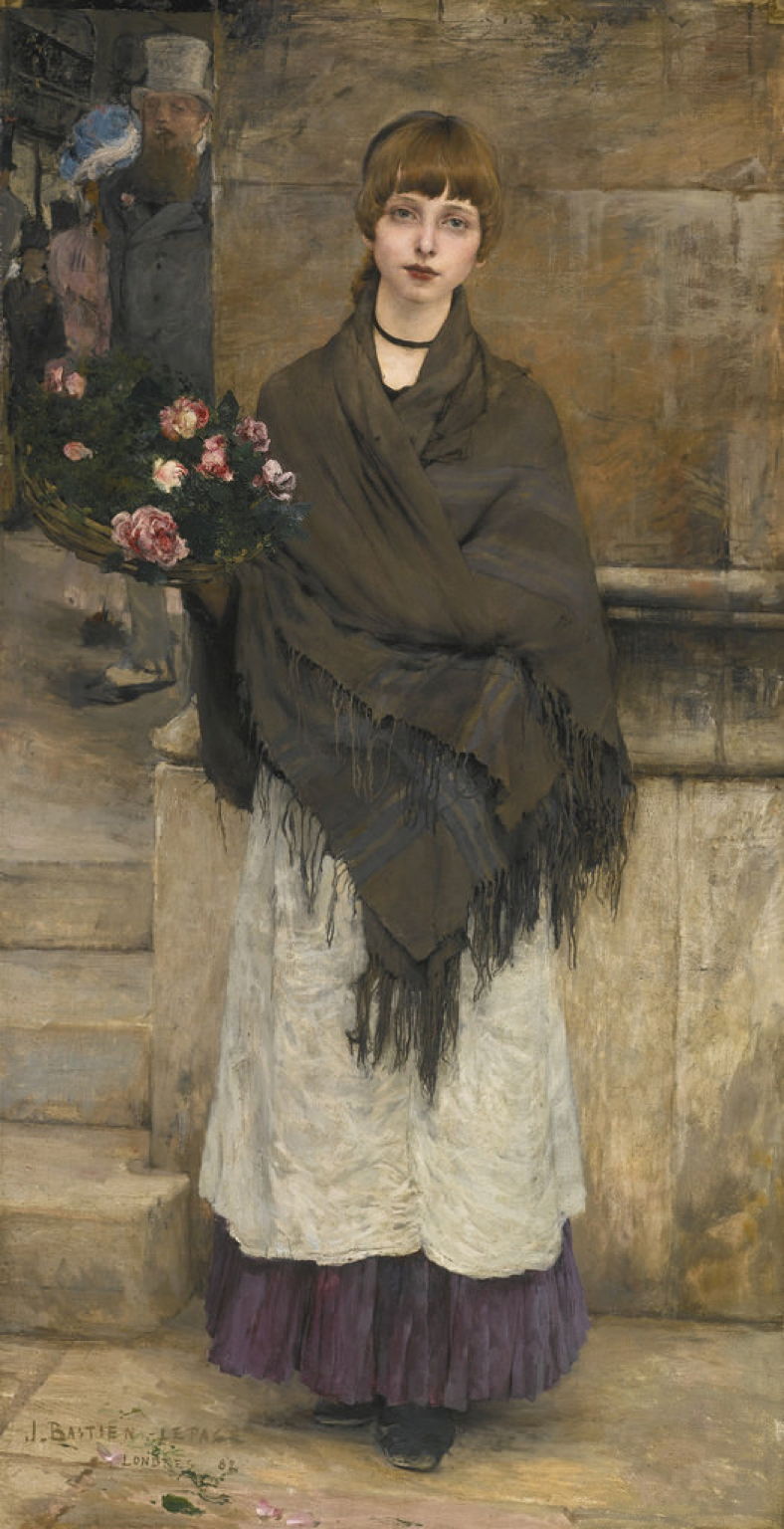
bastienlepageflowermarketlondon
Jules Bastien-Lepage (1848–1884), Flower Market in London (1882), oil on canvas, 173.4 x 90.2 cm, Private collection. The Athenaeum.

His portrait of a flower seller in a Flower Market in London (1882) is The Little Shepherdess of the city, posed against dull brown stonework. In the background is a reminder of how the other half lived, as an affluent man in a pale top hat walks alongside a woman wearing an exuberant blue hat.

bastienlepageblindbeggar
Jules Bastien-Lepage (1848–1884), The Blind Beggar (date not known), oil on canvas, dimensions not known, Musée des Beaux-Arts Tournai, Tournai, Belgium. Wikimedia Commons.

I haven’t been able to read the date on this portrait of The Blind Beggar, painted back in Damvillers, but guess that it was most probably painted between 1880 and 1883.

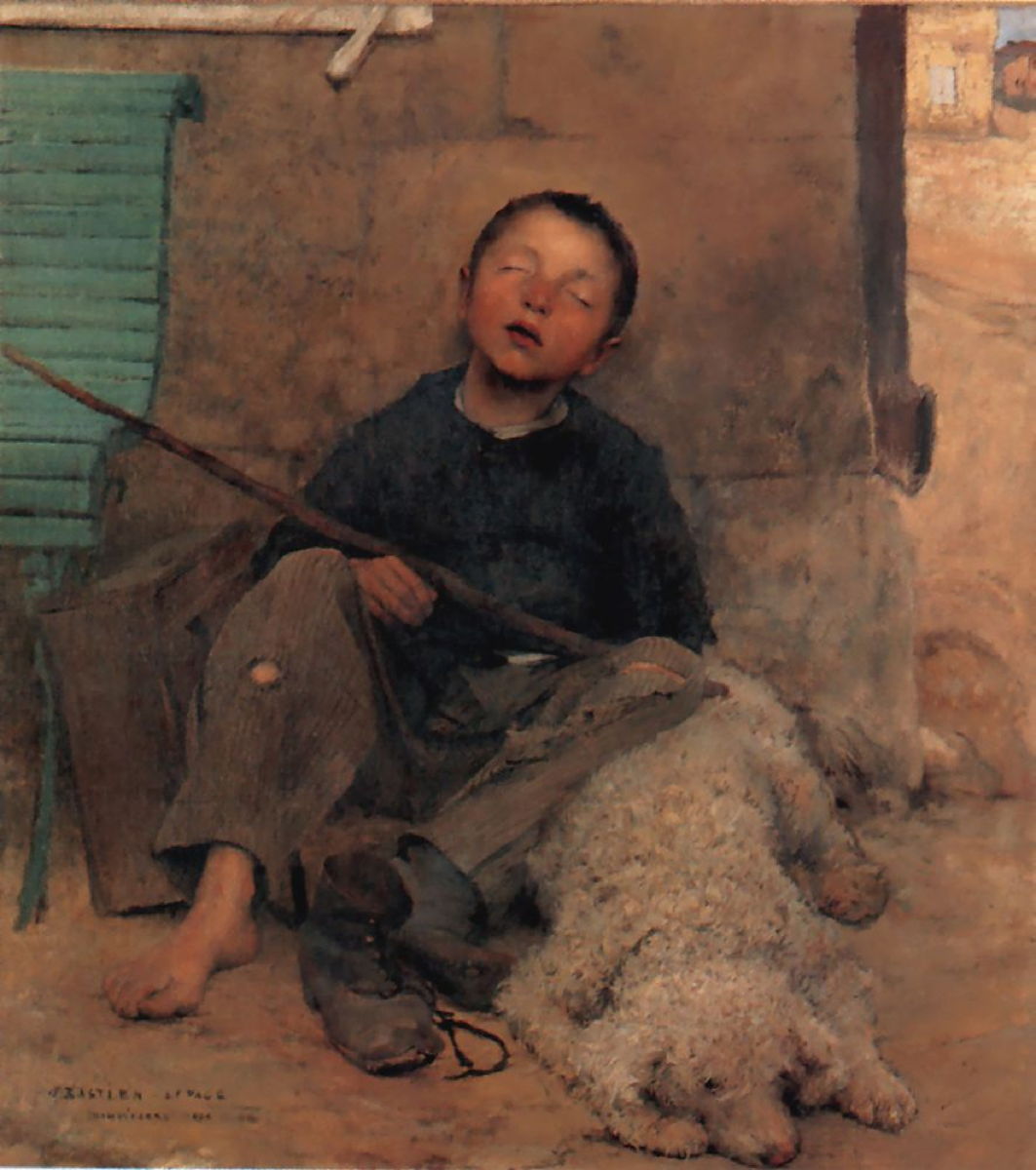
By 1880, Bastien’s health was starting to deteriorate as a result of what was most probably tuberculosis. He tried a brief stay in Algiers, but that didn’t help, and his output appears to have fallen dramatically in 1883-84.

bastienlepagechimneysweep
Jules Bastien-Lepage (1848–1884), The Little Chimneysweep (Damvillers) (1883), oil on canvas, 102 x 116 cm, location not known. Wikimedia Commons.

Dated in 1883, The Little Chimneysweep (Damvillers) is unusual as its subject isn’t shown standing, face-on to the viewer, but he sits and looks down at the kitten at the lower right. This young boy is also the dirtiest of Bastien’s waifs, his left hand still being black with soot from his work. He appears to be living in a hovel, with the embers of a fire at the left edge. Although signed, and presumably complete, the prominent white cat in the foreground remains very sketchy, and contrasts with the careful detail of the boy and his large bread roll.

Jules Bastien-Lepage’s declining health forced him to abandon his work in 1884, and he died on 10 December at the age of 36. His paintings continued to influence Naturalist painters well into the 1890s. Even critics like Émile Zola and Roger Fry recognised the importance of his work.

Naturalists: Jules Bastien-Lepage 1875-81

Impressionism had developed rapidly in the late 1860s, with its first buds appearing in Renoir and Monet’s paintings at La Grenouillère in 1869, and flowered in the first Impressionist Exhibition five years later. Naturalism had a slower evolution, and blossomed in the Paris Salons of 1883 and 1884 in the paintings of Jules Bastien-Lepage.

Born as Jules Bastien in the village of Damvillers in the northeast of France, he showed an early aptitude for drawing, and his father taught him to paint. He enrolled in the École des Beaux-Arts in Paris in 1868, where he adopted the surname of Bastien-Lepage by incorporating his mother’s maiden name. While there he was taught the Academic and Salon tradition by Cabanel.

He fought, and was wounded, in the Franco-Prussian War of 1870-1, but managed to have his first work accepted for the Salon in 1870. Unfortunately this, and another acceptance in 1872, passed unnoticed by the critics and public. It wasn’t until 1874 that his portrait of his grandfather, painted at home the previous year, was awarded a third class medal at the Salon, and he started attracting more attention. He entered the prestigious Prix de Rome in 1875, and by public reaction would have received the award. However, the jury rejected his painting on a trumped-up technicality.

blepageannunciationshepherds
Jules Bastien-Lepage (1848–1884), The Annunciation to the Shepherds (1875), oil on canvas, 147.9 x 115.2 cm, National Gallery of Victoria, Melbourne. Wikimedia Commons.

Bastien’s submission for the final was The Annunciation to the Shepherds (1875), in accordance with the prescribed subject of “the annunciation of the nativity of Christ by the angel to the shepherds of Bethlehem”, as in the Gospel of Luke, chapter 2, verses 8-15. When he was unsuccessful, the jury attempted to avert outcry by awarding him a consolation prize, but it was too late, the damage had been done. He retreated to his rural village, and the pursuit of truth in his painting. He tried a second time the following year, but was again unsuccessful, so abandoned his ambition of becoming a history painter.

blepagediogenes
Jules Bastien-Lepage (1848–1884), Diogenes (1877), oil on canvas, dimensions not known, Musée Marmottan Monet, Paris. Wikimedia Commons.

His Diogenes (1877) tackles human anguish in his depiction of this ancient Greek philosopher and cynic. Traditionally shown living in a barrel, Bastien gives him cruelly mutilated feet, and one of the most expressive faces since Rembrandt.

blepagehaymaking
Jules Bastien-Lepage (1848–1884), Les Foins (Haymakers) (1877), oil on canvas, 160 x 195 cm, Musée d’Orsay, Paris. Wikimedia Commons.

He returned to the Salon in 1878 with Haymakers (1877). It provoked debate over what was considered to be its harsh portrayal of life and work in the country. It was also a pioneering composition for him, with its high horizon and fine detail in the foreground. Together these give the impression that the whole canvas is meticulously realist, although in fact much of its surface consists of visible brushstrokes and other painterly marks. At the same time its deep recession and broad inclusion of land gives it the illusion of a wide-angle panorama, enhancing the exhaustion and desolation of its figures.

blepageoctober
Jules Bastien-Lepage (1848–1884), October: Potato Gatherers (1878), oil on canvas, 180.7 x 196 cm, National Gallery of Victoria, Melbourne. Wikimedia Commons.

The following year, Bastien returned with what is now sometimes known as October or Potato Gatherers (1878), but was originally shown as October: Potato Harvest. He employs the same compositional scheme: high horizon, fine foreground detail, deep recession here enhanced by the distant figures, and broad land. This time, though, his rural poor are smiling and happy in their labour, and it proved a huge success.

blepageallsaints
Jules Bastien-Lepage (1848–1884), La Toussaint (All Souls’ Day) (1878), oil on canvas, 46 x 55 cm, Museum of Fine Arts, Budapest. By Yelkrokoyade, via Wikimedia Commons.

All Souls’ Day, also completed in 1878, was a more sentimental incursion into the outskirts of the city, as a grandfather is taken for a walk by two of his young grandchildren. They are strolling through land that had been, until recently, open fields. It has now been transformed as smoky factories sprawl from the edges of the cities, with a narrow no-man’s-land of allotments and smallholdings as seen here.

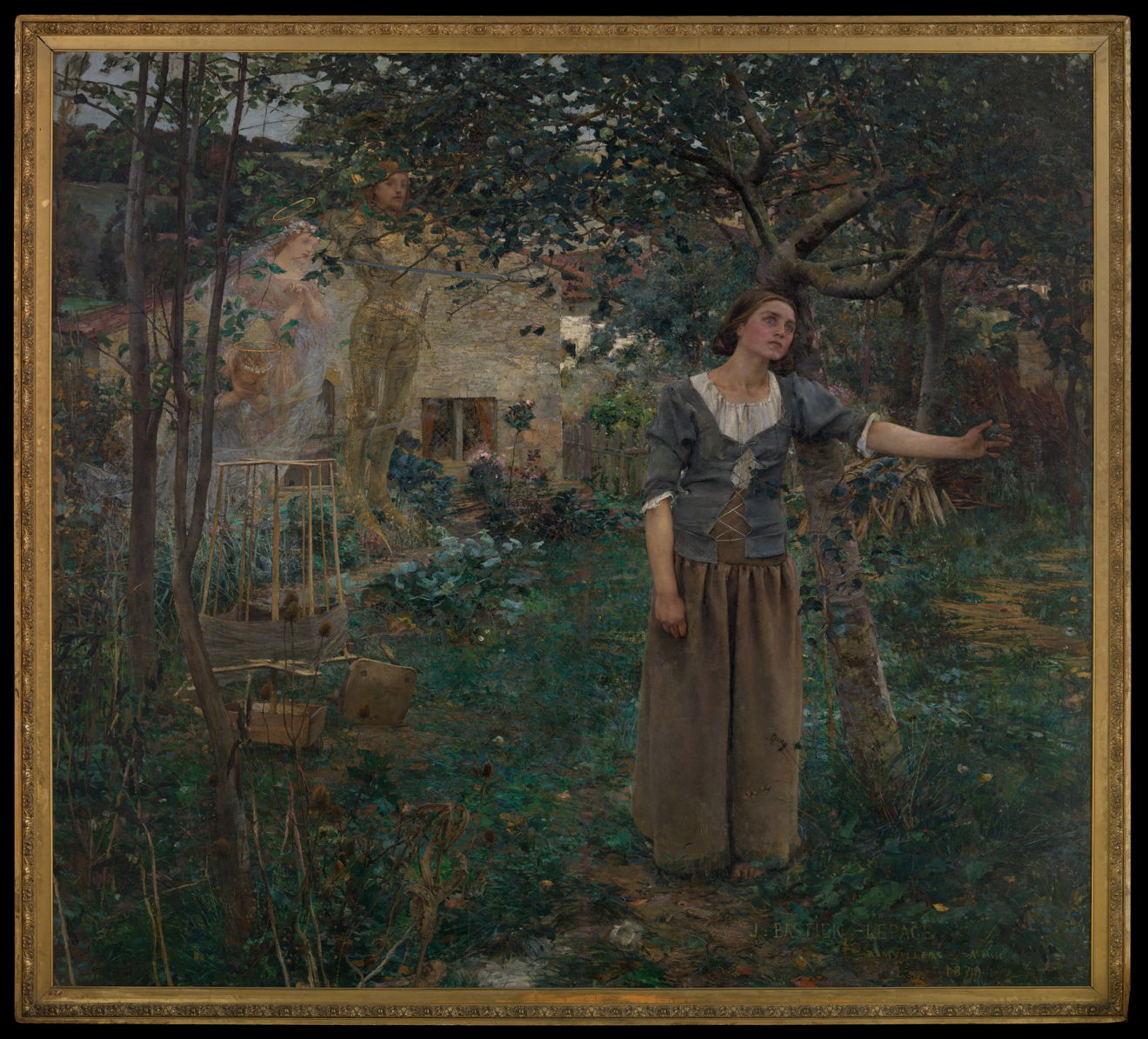
bastienlepagejoanofarc
Jules Bastien-Lepage (1848–1884), Joan of Arc (1879), oil on canvas, 254 × 279.4 cm, The Metropolitan Museum of Art, New York, NY. Courtesy of The Metropolitan Museum of Art, via Wikimedia Commons.

Then in 1879, Bastien revisited history painting with his new formula in Joan of Arc. Its horizon is so high that little sky is visible beyond the trees. The lower half of the canvas is its intricately detailed foreground, even down to the clutter of woolworking apparatus, an ingenious link to the thread of fate, and the unkempt garden.

The corner of a house sharply divides the painting into halves. On its right is the very real and tangible figure of Joan of Arc, her piercing blue eyes staring into the distance, as she receives her call to arms. On the left are the ethereal figures of Saints Michael, Margaret, and Catherine, which gave rise to a surprisingly hostile reception by critics.

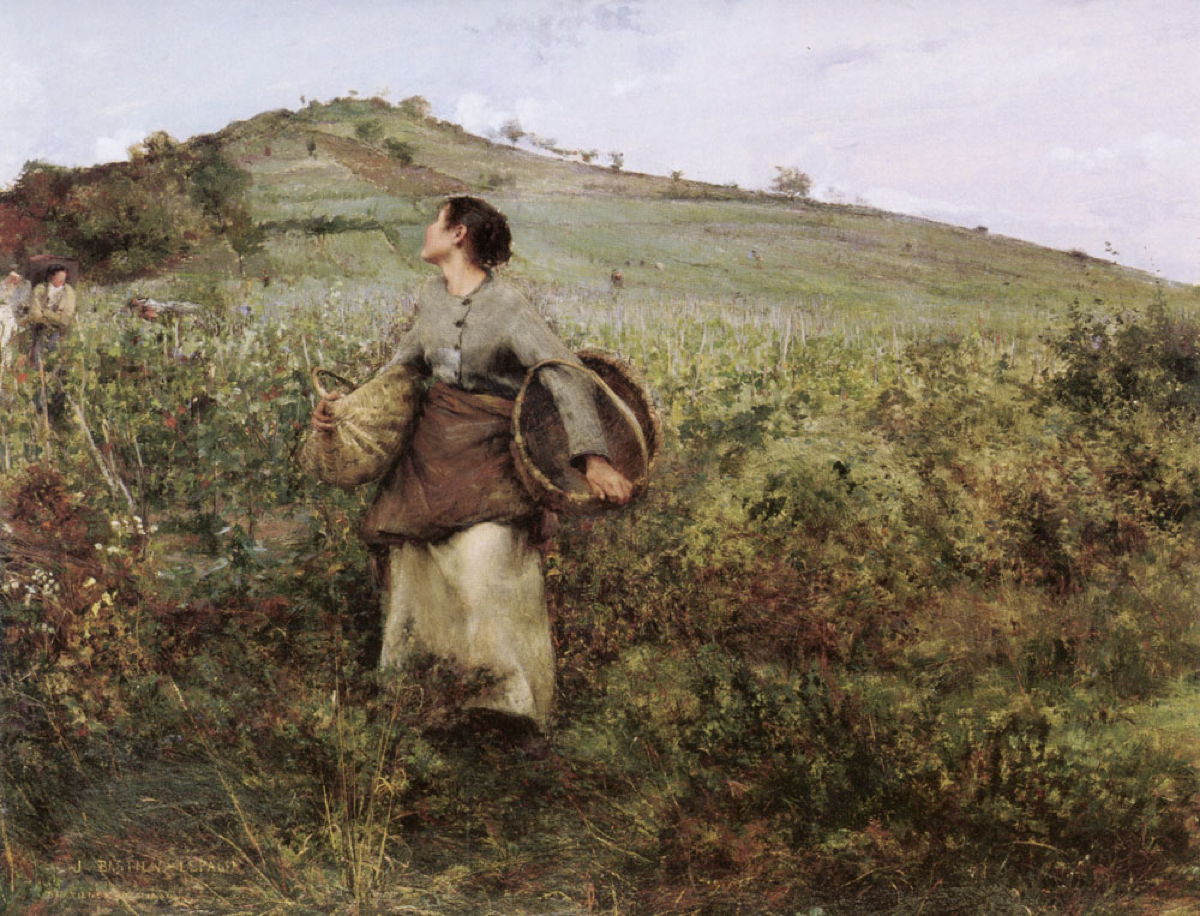
bastienlepageatharvesttime
Jules Bastien-Lepage (1848–1884), The Grape Harvest (Harvest Time) (1880), oil, dimensions not known, Van Gogh Museum, Amsterdam, The Netherlands. Wikimedia Commons.

The Grape Harvest, also known as Harvest Time, (1880) varies the compositional formula, and doesn’t produce the same effects. Its horizon draws the eye more strongly, distracting from the foreground detail, and the land rises too soon to achieve the deep panorama of his earlier paintings.

bastienlepagebeggar
Jules Bastien-Lepage (1848–1884), The Beggar (1880-81), oil on canvas, 199 x 181 cm, Ny Carlsberg Glyptotek, Copenhagen, Denmark. The Athenaeum.

Back in his native Damvillers, Bastien-Lepage painted portraits of the poor. The Beggar (1880) shows an old man who has apparently been knocking on doors in his quest for charity. A well-dressed young girl stares sadly at him as he walks away from her house, and she is closing the door on him.

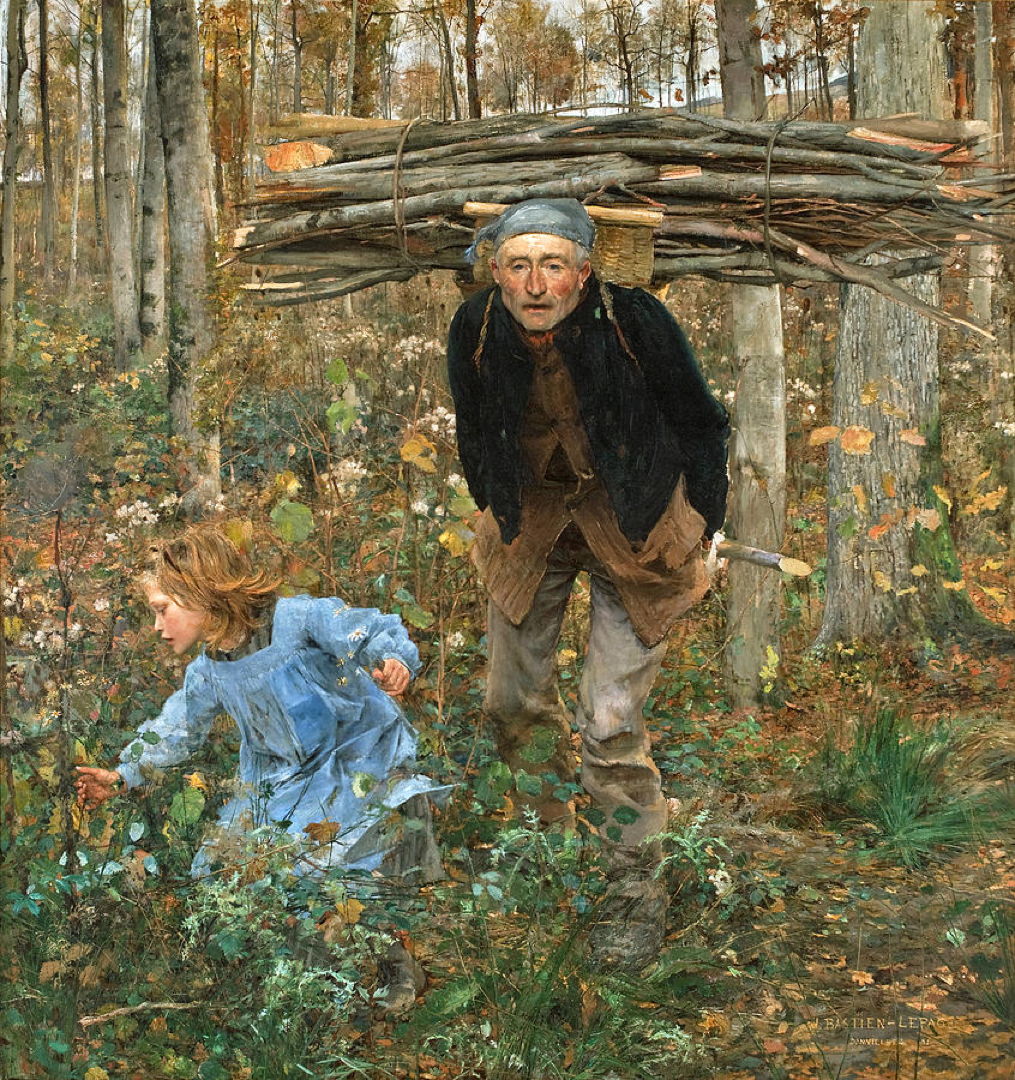
bastienlepagewoodgatherer
Jules Bastien-Lepage (1848–1884), The Wood Gatherer (Father Jacques) (1881), oil on canvas, 199 x 181 cm, Milwaukee Art Museum, Milwaukee, WI. Wikimedia Commons.

Bastien’s The Wood Gatherer (Father Jacques) (1881) is one of the key Naturalist works of art, also one of the most successful examples of his compositional formula. Its high horizon and woodland break its thin slice of sky into fine fragments. The detailed foreground includes both of the figures, who are diametric opposites: an old man bent with his load of firewood, who at any moment could keel over and die, and a young child (probably a girl) who runs free among the wild flowers. The perception of depth is enhanced by the recession of tree forms, although here the space is enclosed rather than open.

blepageophelia
Jules Bastien-Lepage (1848–1884), Ophelia (unfinished) (1881), oil on canvas, dimensions not known, Museum of Fine Arts of Nancy, Nancy, France. Wikimedia Commons.

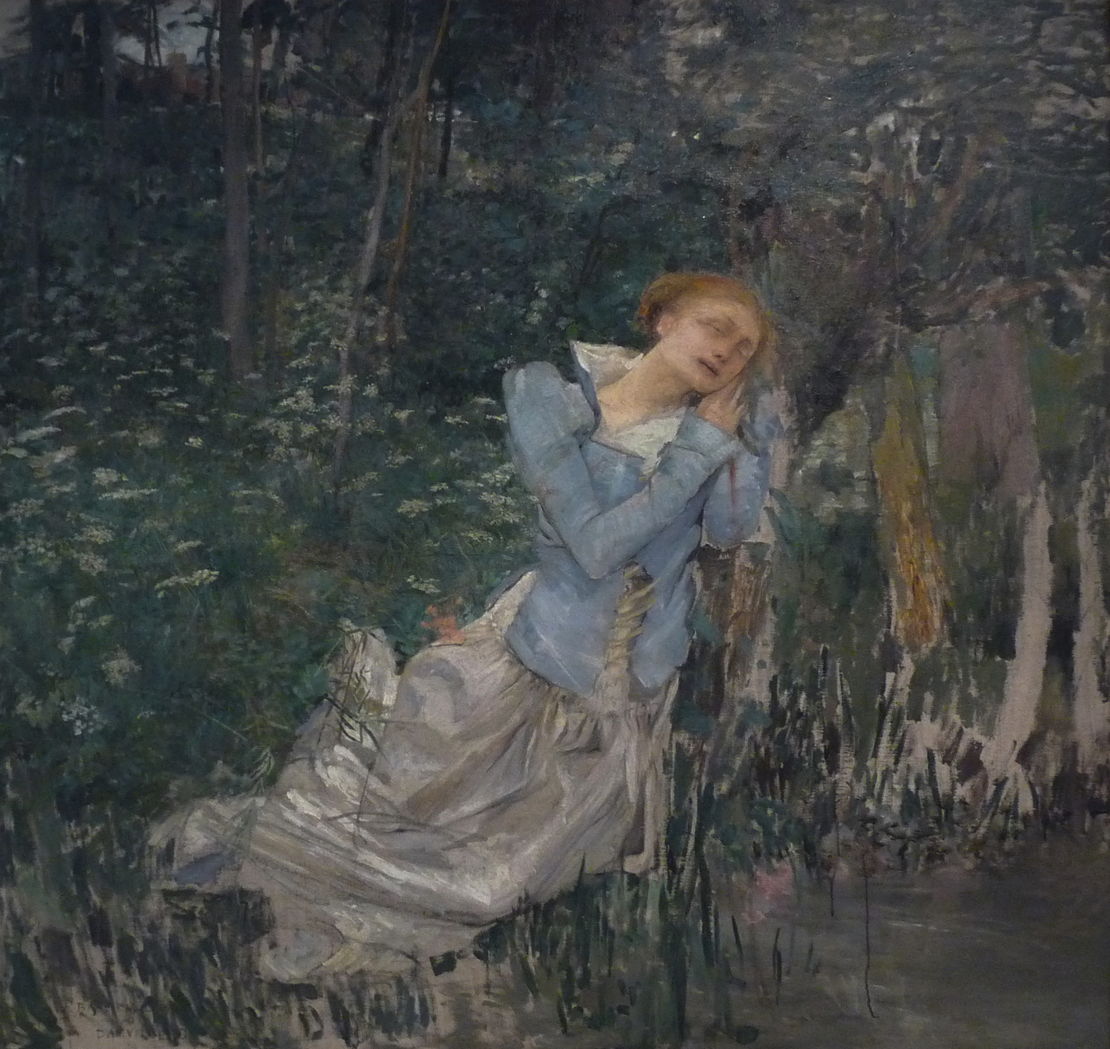
His formula can be seen in progress in his Ophelia (1881), showing the character from Shakespeare’s play Hamlet as her anguish is about to drive her body down into the water to drown her. At the time of his death, Bastien still had to paint all the foreground detail. This would have covered the lower half of the canvas, and given it a finely detailed appearance overall.

blepagepoorfauvette
Jules Bastien-Lepage (1848–1884), Poor Fauvette (1881), oil on canvas, 162.5 x 125.5 cm, Kelvingrove Art Gallery, Glasgow, Scotland. Wikimedia Commons.

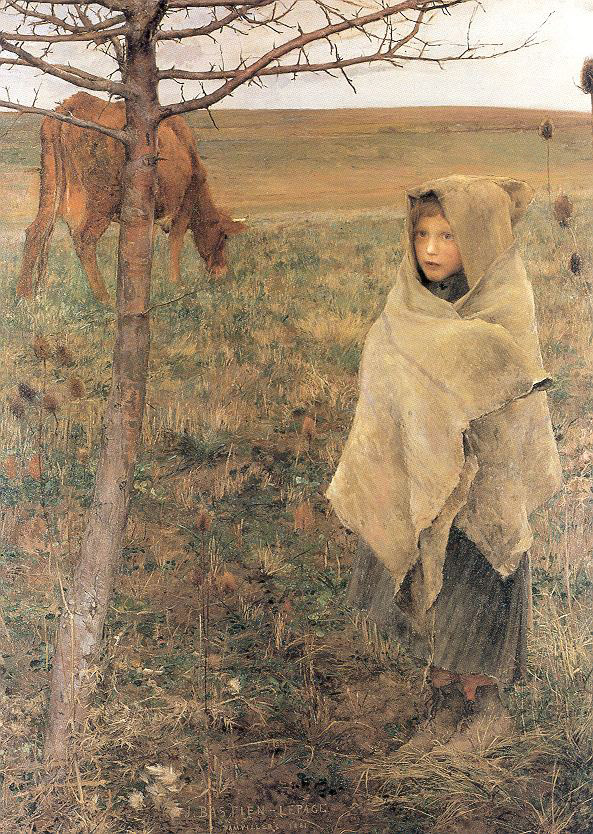
Back in Damvillers, he returned to the rural poor, now focussing on children as innocent victims. The formula is applied again, this time with the superimposition of a leafless sapling and the thyrsus-like flower-heads of the teasel. The tree is placed most unusually over the grazing cow, and the whole painting cropped as if a photograph.

The following year marks the high-point of Bastien’s Naturalism.

Naturalists: Origins

The new style of Naturalism took the Paris Salon by storm in 1883. As a complement rather than competitor to Impressionism, it found more favour among the establishment, critics and public who attended the Salon, and had roots going back to the genre paintings of the Dutch Golden Age.

Jan Miense Molenaer (c 1610–1668), The Dentist (1630), oil on panel, 66 x 81 cm, Herzog Anton Ulrich-Museum, Braunschweig, Germany. Wikimedia Commons.

The Dentist, painted in 1630, declares Jan Miense Molenaer’s interest in everyday life. A small crowd has gathered outside a church, where a fashionably dressed man is pulling a tooth from a local. The victim is dressed in tatters, with large holes at both his knees and worn-out shoes. These are ordinary, common people depicted objectively in their normal surroundings.

terborchboydog
Gerard ter Borch (1617–1681), A Boy with his Dog (The Flea-Catcher) (after 1666), oil on canvas mounted on wood, 35 x 28 cm, Alte Pinakothek, Munich, Germany. Wikimedia Commons.

Gerard ter Borch’s late painting of A Boy with his Dog, also known as The Flea-Catcher (after 1666), shows this boy checking for and removing fleas from his pet in fairly barren surroundings.

Another strand of development was the controversial, even politicised, contemporary event. Géricault’s monumental painting of The Raft of the Medusa made in 1818-19 is perhaps the most important example.

gericaultraftofmedusa
Jean Louis Théodore Géricault (1791–1824), The Raft of the Medusa (1818-19), oil on canvas, 491 x 716 cm, Musée du Louvre, Paris. Wikimedia Commons.

This shows a well-known and scandalous story of the day, when over 130 people on board the French frigate Méduse died after they had abandoned ship onto a makeshift raft. Just fifteen of the 147 people on that raft survived thirteen days before being rescued, and gave harrowing stories of drowning, dehydration, and cannibalism.

Although Géricault undoubtedly painted what was in his mind’s eye, he undertook considerable research, interviewing survivors and making studies of material from the morgue in his efforts to make this as objective as he could. This quest for objectivity was a major theme of the nineteenth century, spilling over from the sciences into creative arts, underlying many of the changes seen in painting.

courbetstonebreakers
Gustave Courbet (1819–1877), The Stone Breakers (1849), oil on canvas, 165 x 257 cm, Galerie Neue Meister, Dresden, Germany, destroyed by fire 1945. Wikimedia Commons.

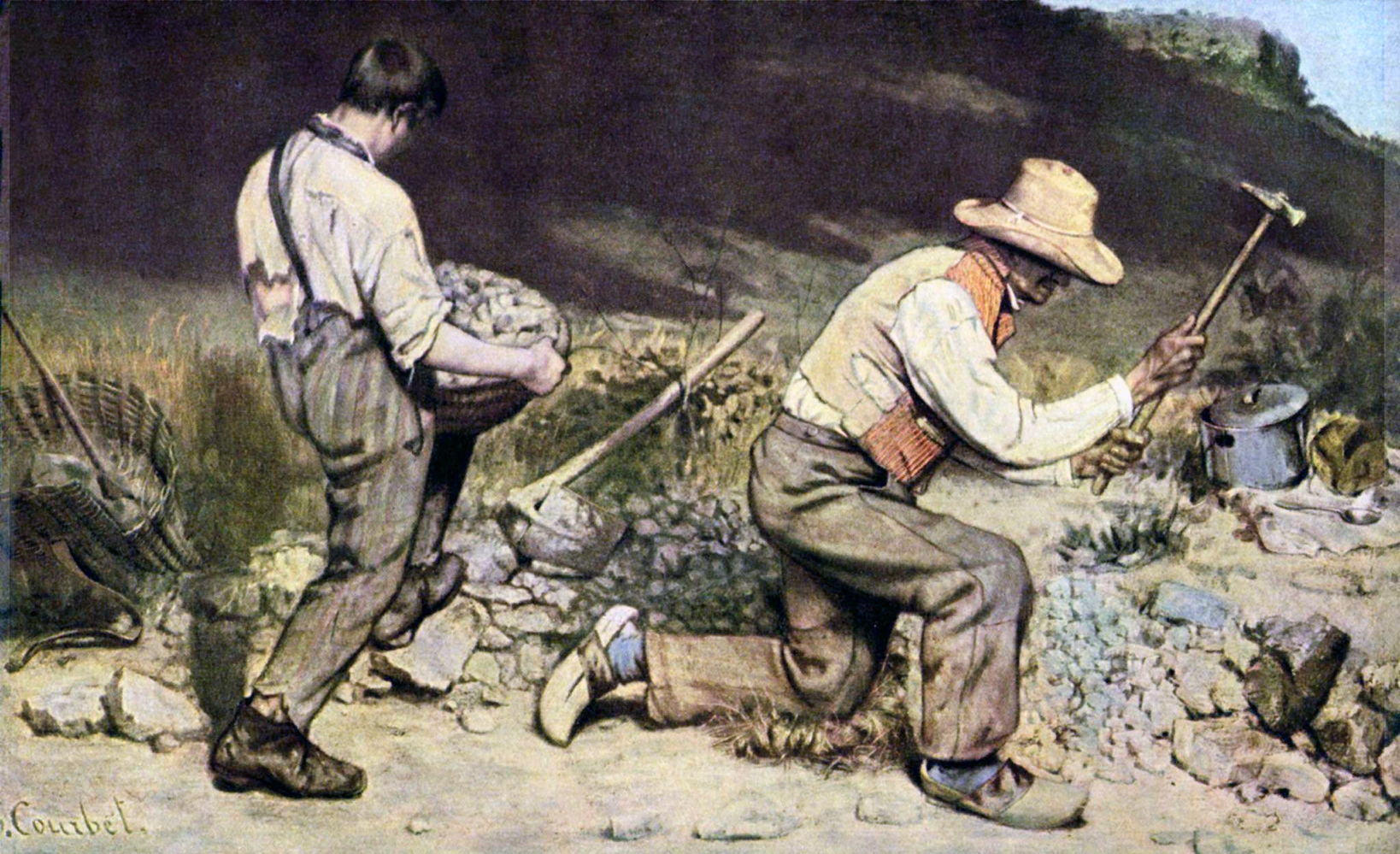
Gustave Courbet took it up in the middle of the century, most notably in The Stone Breakers (1849), which was later destroyed by fire during the Allied bombing of Dresden in 1945. This painting was exhibited at the Salon in 1850, and established him as the great-grandfather of Naturalism.

courbetburialatornans
Gustave Courbet (1819–1877), A Burial at Ornans (1849-50), oil on canvas, 315 x 668 cm, Musée d’Orsay, Paris. Wikimedia Commons.

Shown in the same year was his monumental A Burial at Ornans (1849-50), a huge depiction in unemotional and objective terms of the funeral of the artist’s great uncle in the small provincial town of Ornans. The event had taken place in September 1848, but this painting gives the impression that it is a faithful record.

Courbet actually painted the work entirely in the studio, using those who were present as models. It shows a moment which could only have existed in the artist’s memory: like Géricault’s Raft of the Medusa, it doesn’t necessarily represent an image which ever existed in reality. But it has been carefully researched, imagined, composed, and painted to give the impression of accuracy and objectivity, rather than some Romantic fantasy.

At the same time, social realism was arriving on the farms of France, thanks to the paintings of Jean-François Millet.

milletsower1850
Jean-François Millet (1814–1875), The Sower (1850), oil on canvas, 101.6 x 82.6 cm, Museum of Fine Arts, Boston, MA. Wikimedia Commons.

Millet’s The Sower was completed in 1850 and shown at the Salon that year; it has since been recognised as his first real masterpiece. This farmworker is striding across a field, sowing seed for the summer’s crop. In the distance to the right, caught in the sunlight, is another worker ploughing with a pair of oxen.

milletgleaners
Jean-François Millet (1814–1875), The Gleaners (1857), oil on canvas, 83.5 × 110 cm, Musée d’Orsay, Paris. Wikimedia Commons.

Millet’s The Gleaners of 1857 is sparse, concentrating on just three figures. There are no distractions: it is about the rural poor, who made ends meet by salvaging scraps after the harvest had been cut. This is unavoidably about poverty, and the sector of the population who only just managed to survive each winter. At the time it smacked of socialism, and got the thumbs-down from the rich and middle classes when they saw it in the Salon that year.

milletangelus
Jean-François Millet (1814–1875), L’Angélus (The Angelus) (1857-59), oil on canvas, 55 x 66 cm, Musée d’Orsay, Paris. Wikimedia Commons.

Millet followed that with The Angelus, completed around 1857-59. This had been commissioned by the American collector Thomas Gold Appleton, as Prayer for the Potato Crop, but underwent modification before Millet gave it its present title. At some stage, it’s thought to have included a child’s coffin, but that was overpainted. It shows a couple, praying the Angelus devotion normally recited at six o’clock in the evening, over the potatoes they have been harvesting. It is dusk, and as the last light of the day fades, the bell in the distant church is ringing to mark the end of work, and the start of the evening.

Next to the man is his fork, which he has been using to lift potatoes from the poor, stony soil; his wife has been collecting them in a wicker basket, which now rests at her feet. Behind them is a primitive wheelbarrow with a couple of sacks of potatoes on it. In the gathering dark, viewers often misread the barrow and think that it contains a small child.

With the hostile reception of The Gleaners, Millet didn’t exhibit this painting until 1865, although he had sold it in 1860 for a meagre 1,000 francs. When sold in 1890, its price reached 750,000 francs.

bretongleaners1854
Jules Breton (1827–1906), The Gleaners (1854), oil on canvas, 93 × 138 cm, The National Gallery of Ireland/Gailearaí Náisiúnta na hÉireann, Dublin, Ireland. The Athenaeum.

Jules Breton was also important, more in his compositional devices than in any social realism. His Gleaners from 1854, which was highly successful at the Salon of 1855, is a marvellous painting, although hardly the story of people who spent most of their lives on the edge of survival. But its foreground detail, high horizon and widescreen effect were to be used very successfully by Jules Bastien-Lepage and others.

Another important artist in the late gestation of Naturalism was Édouard Manet, long considered to be a precursor of Impressionism, but who was thoroughly realist.

manetolympia
Édouard Manet (1832–1883), Olympia (1863), oil on canvas, 130 x 190 cm, Musée d’Orsay, Paris. Wikimedia Commons.

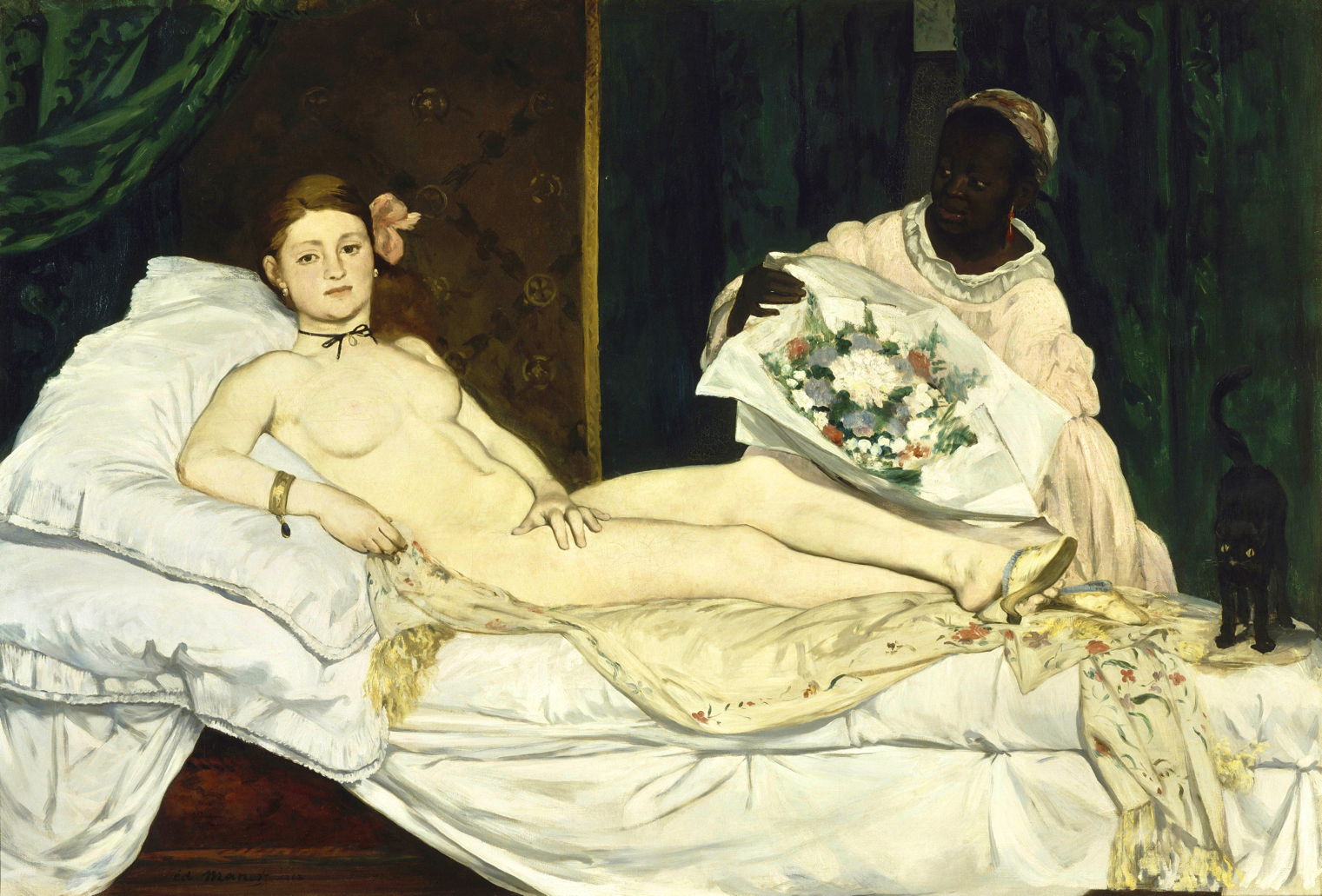
Manet’s Olympia (1863) shocked those seeing it at the 1865 Salon because here was an ordinary person, a ‘common prostitute’ indeed, seen in a role normally assigned to a mythical goddess such as Venus. And she was very much at her place of work, staring straight at the viewer.

manetrailway
Édouard Manet (1832–1883), The Railway (1873), oil on canvas, 93.3 x 111.5 cm, The National Gallery of Art, Washington, DC. Wikimedia Commons.

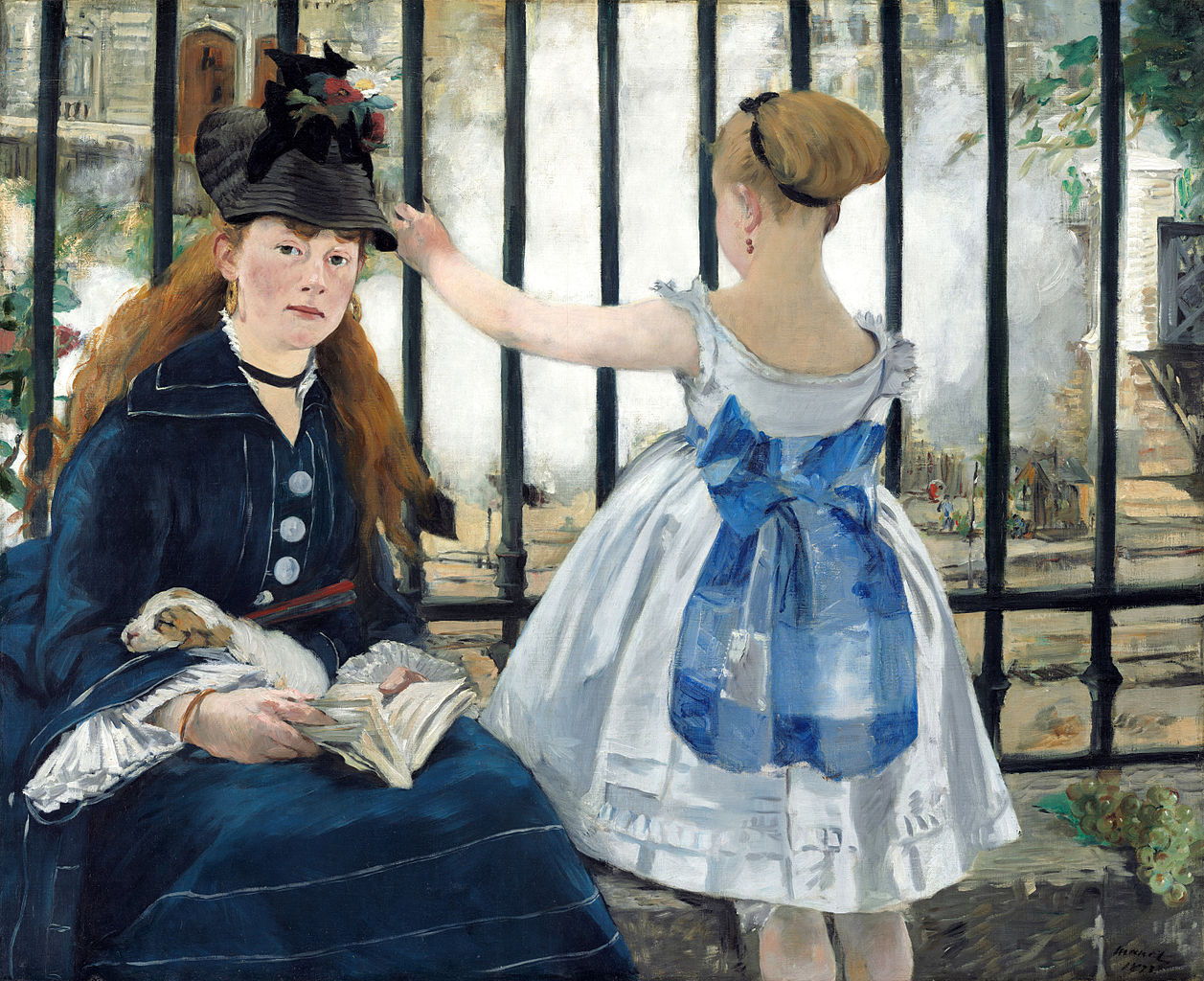
A decade later, Manet painted the same model, Victorine Meurent, in The Railway (popularly known as Gare Saint-Lazare) (1873). A genre symbol of modernity, it brought modern technology and urban life to what was at the time a largely unappreciative public.

The most immediate precursors to the Naturalist paintings of 1883 weren’t the early works of Jules Bastien-Lepage, but the paintings of the rural poor by Léon Augustin Lhermitte.

lhermitteprocessionploumanach
Léon Augustin Lhermitte (1844–1925), Procession near Ploumanac’h (1879), oil on canvas, dimensions not known, Private collection. Wikimedia Commons.

Lhermitte’s sketchy Procession near Ploumanac’h from 1879 shows a religious festival in Brittany, with a small stream of locals making their way along a track on the open hillside towards the church. Its unemotional bleakness is completely different from the dense processions being painted by Jules Breton.

lhermittepayharvesters
Léon Augustin Lhermitte (1844–1925), The Harvesters’ Pay (1882), oil on canvas, 215 x 272 cm, Musée d’Orsay, Paris. Wikimedia Commons.

Lhermitte’s founding masterpiece of Naturalism is The Harvesters’ Pay from 1882, which looks objectively at the economic and social aspects of the harvest. Four of the harvesters, bearing their heavy-duty scythes, await payment by the farmer’s factor, who holds a bag of coins for the purpose. In the centre of the painting, one of the workers is counting out his pay in front of his wife, who is feeding a young infant at her breast. To their left, another worker just sits and stares blankly into the distance, dead-beat tired and wondering whether his pittance was worth all that effort.

Most importantly, Lhermitte painted these in the early years of the Third Republic, a time when social concerns were sweeping across much of Europe.

Naturalists: Naturalism and Impressionism

There’s a popular and relatively recent myth that European painting in the late nineteenth century consisted almost entirely of Impressionist landscapes and their descendants in Post-Impressionism, or the dying embers of the Academic past. That oversimplification carefully omits many of the innovative artists of the day, who developed the social realism of Jean-François Millet and Gustave Courbet into what became Naturalism. Among its other key influences were Édouard Manet and the novelist and critic Émile Zola (1840-1902), who were also associated with Impressionism.

Impressionism was primarily a revolt against established ideas as to how paintings should be made, and how they should look. Although the term has been extended to other arts, it’s only really meaningful in the context of painting.

Naturalism arose first and became most extensive in literature. Among its great influences was the pioneering French physiologist Claude Bernard (1813-1878), whose writings were read avidly by Naturalists including Zola. Bernard’s approach to science stressed not only the importance of observation, but of experiment, forming the basis for his accounts of the working of the body, and the scientific foundations of medicine. Bernard’s Introduction to the Study of Experimental Medicine, published in 1865, convinced Zola to use an experimental approach to writing his novels. He thus watched people in life and filled notebooks with his observations. He then set characters up in the scenario for a novel, and they behaved according to his observations. He finally documented this imaginary experiment as his next novel.

Naturalist painting made no attempt to follow Zola’s experimental approach, but aimed to document ordinary people going about their normal daily activities in their normal surroundings, with a degree of objectivity rather than sentiment. Its style is a neutral realism showing as much fine detail as necessary for its purpose, and sometimes being almost photographic in quality.

Naturalism and Impressionism were by no means mutually exclusive, but served different purposes. Some of the finest artists of the last thirty years of the nineteenth century were exponents of both. Landscapes were predominantly approached as Impressions, while figurative paintings worked better using Naturalist techniques. Here are some examples from about 1883, when both were at their height.

blepagenothingdoing
Jules Bastien-Lepage (1848–1884), Pas Mèche (Nothing Doing) (1882), oil on canvas, 132.1 x 89.5 cm, Scottish National Gallery, Edinburgh, Scotland. Wikimedia Commons.

At that time, it was Jules Bastien-Lepage who was having greatest impact at the Salon with his Naturalist portraits of the rural poor. Pas Mèche (Nothing Doing) (1882) catches this cheeky ploughboy equipped with his whip and horn, on his way out to work in the fields. His face is grubby, his clothing frayed, patched, and dirty, and his boots caked in mud and laceless. It has other traits of Bastien’s style, such as its high horizon almost shutting the sky out, and his careful control of detail. The boy’s face is meticulous, but the cottage gardens behind have been sketched in roughly.

bastienlepagechimneysweep
Jules Bastien-Lepage (1848–1884), The Little Chimneysweep (Damvillers) (1883), oil on canvas, 102 x 116 cm, location not known. Wikimedia Commons.

Bastien’s Little Chimneysweep (Damvillers) from the following year is unusual as its subject isn’t shown standing, face-on to the viewer, but sits and looks down at the kitten at the lower right. This young boy is also the dirtiest of Bastien’s waifs, his left hand still black with soot from his work. He appears to be living in a hovel, with the embers of a fire at the left edge, once again sketched loosely.

bashkirtseffumbrella
Marie Bashkirtseff (1858–1884), The Umbrella (1883), oil on canvas, 93 × 74 cm, State Russian Museum, Saint Petersburg. Wikimedia Commons.

Bastien’s combination of detailed realism blended with more painterly passages is seen in one of Marie Bashkirtseff best portraits, The Umbrella (1883). This girl’s tenacious stare at the viewer quickly becomes quite unnerving. This earned her an honourable mention in the Salon.

bulandtripot
Jean-Eugène Buland (1852–1926), Le Tripot (The Dive) (1883), oil on canvas, 63.5 × 109.2 cm, location not known. Wikimedia Commons.

In the same year, Jean-Eugène Buland’s The Dive is set in a seedy, downmarket gambling den, as a group portrait of five hardened gamblers at their table. Each is rich in character, and makes you wonder how they came to be there. A little old widow at the left, for example, looks completely out of place, but is resolutely staking her money. Looking over her shoulder is a man, whose face is partially obscured. Is he, perhaps, a son, or a debtor? A young spiv at the far right is down to his last couple of silver coins, and looks about to lose them too. The air is thick with smoke, the walls in need of redecoration, and a pair of young streetwalkers prowl behind them, looking for a winner who will spend some of their cash on them.

pissarropoultrymarketontoise1882
Camille Pissarro (1830–1903), The Poultry Market, Pontoise (1882), oil on canvas, 81 x 65 cm, Norton Simon Museum, Pasadena, CA. Wikimedia Commons.

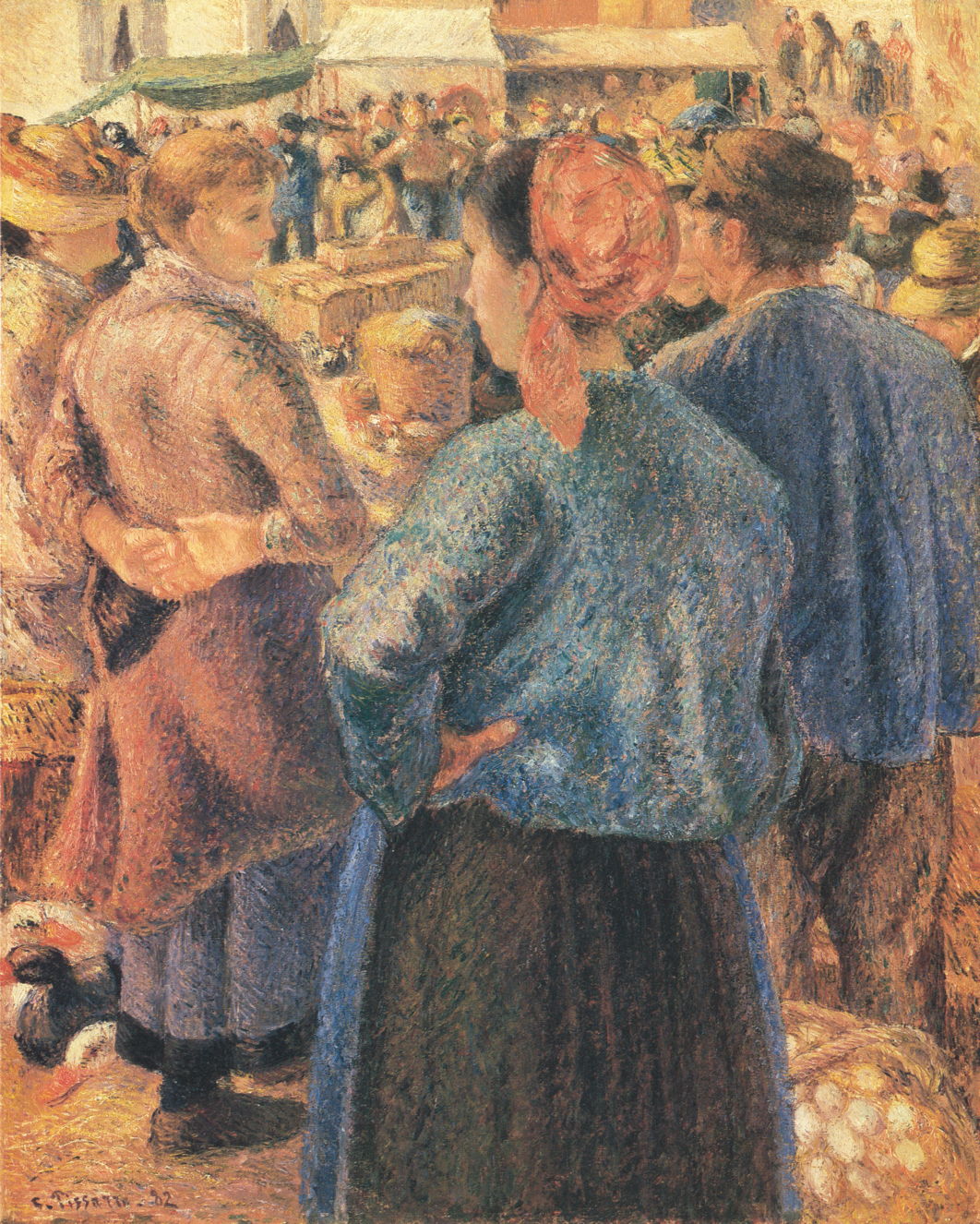
Camille Pissarro was a fine figurative artist when he wanted, and had a particular liking for markets and fairs, which may seem strange for a landscape painter. He painted this scene from The Poultry Market, Pontoise twice in 1882: once using (glue?) distemper, and here in oils, where his use of tiny marks is evolving, particularly in the fabrics.

29.100.125
Pierre-Auguste Renoir (1841–1919), By the Seashore (1883), oil on canvas, 92.1 x 72.4 cm, Metropolitan Museum of Art, New York, NY. Wikimedia Commons.

For his portrait of his partner Aline Charigot in By the Seashore (1883), Pierre-Auguste Renoir most probably painted her in the studio, and took its background from the Normandy coast near Dieppe. This shows the growing divergence in his paintings during the 1880s, with landscapes becoming increasingly soft and high in chroma, while his figures remained realist and emphasised by his “dry” manner.

bashkirtseffautumn
Marie Bashkirtseff (1858–1884), Autumn (1883), oil on canvas, dimensions not known, State Russian Museum, Saint Petersburg. The Athenaeum.

Bashkirtseff’s Autumn (1883) is a thoroughly Impressionist depiction of a row of trees on the bank of the River Seine in the centre of Paris, but is unusual in being devoid of people. The leaf litter, occasional rubbish, and fallen bench strengthen its feeling of desolation in the midst of the bustling city.

Gustave Caillebotte, The Plain at Gennevilliers, A Group of Poplars (1883), oil on canvas, 54.3 x 65 cm, Private collection. WikiArt.
Gustave Caillebotte (1848–1894), The Plain at Gennevilliers, A Group of Poplars (1883), oil on canvas, 54.3 x 65 cm, Private collection. WikiArt.

Gustave Caillebotte also painted in both styles, with several of his best-known works being Naturalist. The Plain at Gennevilliers, A Group of Poplars (1883) is more formally Impressionist, although it retains foreground detail and has a relatively high horizon.

sisleywillowsbanksorvanne1883
Alfred Sisley (1839–1899), Willows on the Banks of the Orvanne (1883), oil on canvas, 50 x 70 cm, Private collection. Wikimedia Commons.

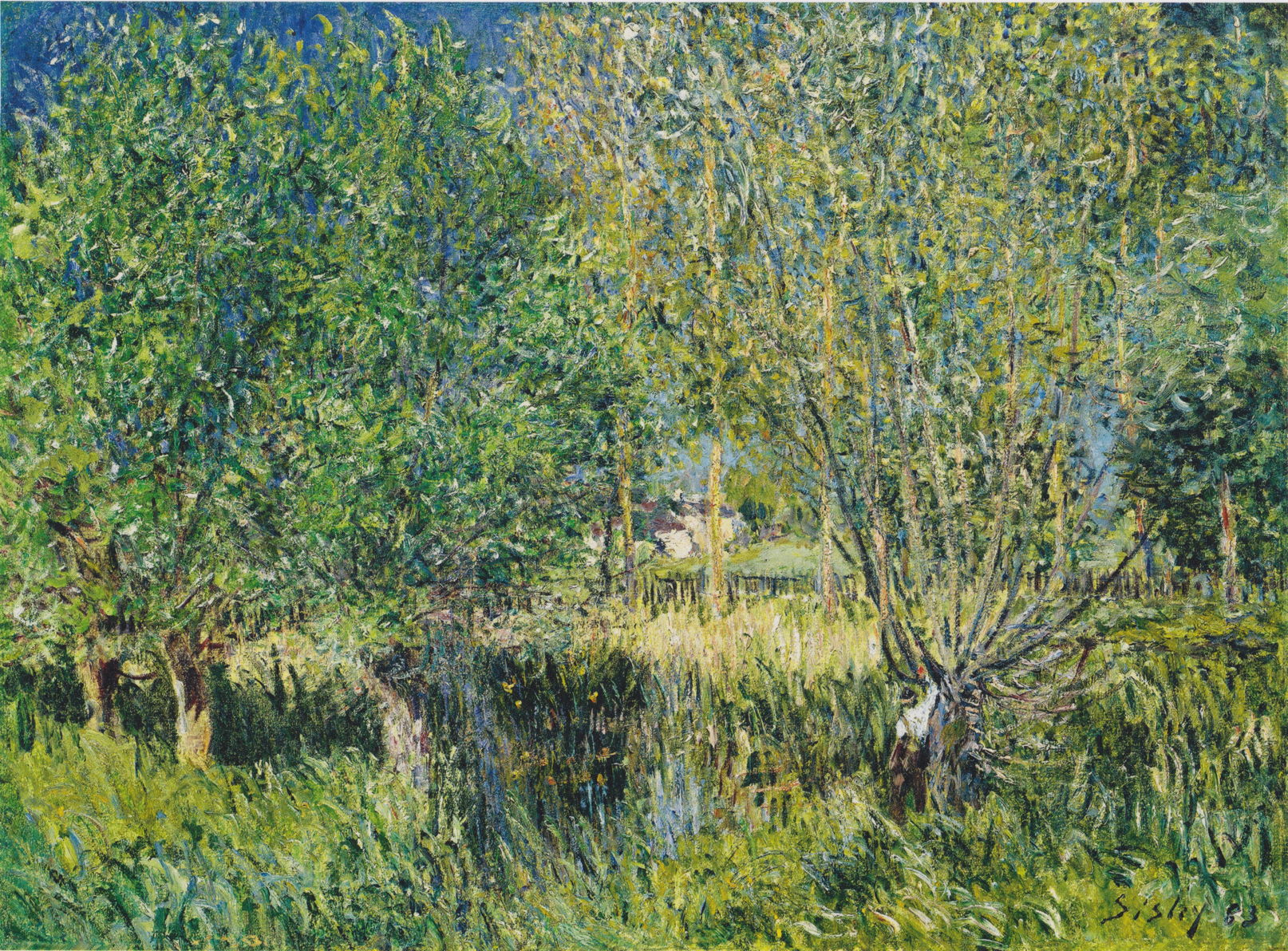
Alfred Sisley’s Willows on the Banks of the Orvanne (1883) is also more representative of Impressionism. An irregular row of pollarded willows, with well-developed heads, crosses the foreground, behind which there is the river Orvanne, reeds, and a tall stand of poplars. Behind this dense vegetation is a fence, field, and distant buildings, at the midpoint of the painting.

monetstormyseaetretat
Claude Monet (1840–1926), Stormy Sea in Étretat (1883), oil on canvas, 100 x 81 cm, Musée des Beaux-Arts, Lyon, France. Wikimedia Commons.

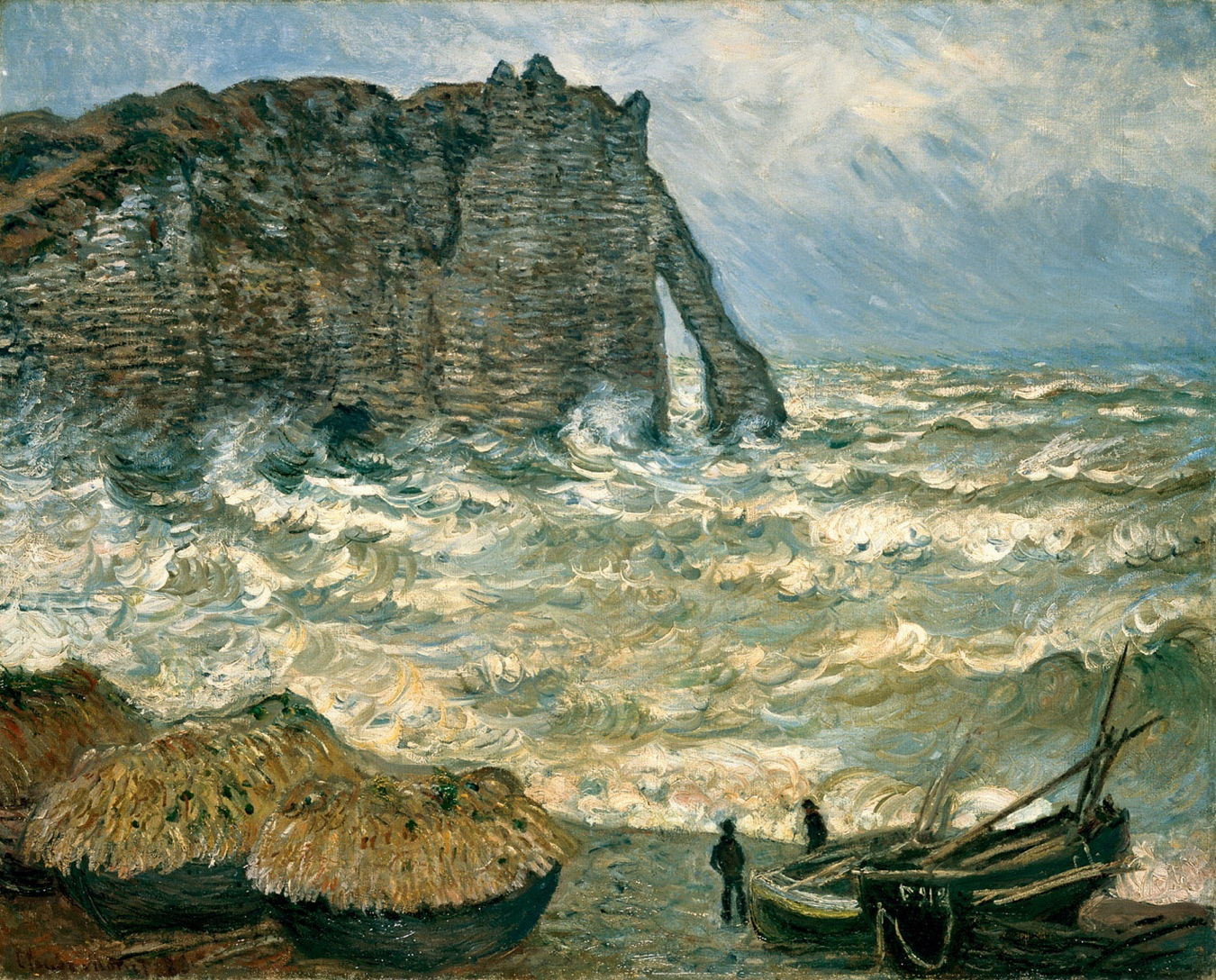
At the Impressionist end of the spectrum is Claude Monet’s Stormy Sea at Étretat (1883), painted from the beach directly in front of the the village, and a prototype for a small series.

renoirsunsetdouarnenez
Pierre-Auguste Renoir (1841–1919), Sunset at Douarnenez (c 1883), oil on canvas, 53.7 x 64.4 cm, location not known. Wikimedia Commons.

For all his realist figures, Renoir’s Sunset at Douarnenez, from around 1883, is a classical Impressionist view looking into the setting sun.

I hope this small collection of paintings demonstrates there was a great deal more to French and European painting in 1883 than Impressionism. In this series I will explore the artists and paintings that accompanied Impressionism, but have now been largely forgotten. I hope you’ll join me.

❌