Reading view

There are new articles available, click to refresh the page.

Medium and Message: Oil studies

Many of the great Masters are known to have painted preparatory studies prior to starting on full-size finished studio paintings. Unfortunately, most of those studies were either destroyed by the artist in their lifetime, or by their heirs following their death. Seeing studies alongside a finished work tells a great deal about the artist’s intent and methods, and some exhibitions have made a point of including as many studies as possible. This article shows a small selection of some whose images I have been able to gather.

Some of the best surviving studies are the oil sketches made by Peter Paul Rubens, some of which were given to assistants in his studio for completion.

rubensrapehippodamesketch
Peter Paul Rubens (1577–1640), The Rape of Hippodame (sketch) (c 1637-38), oil on panel, 26 × 40 cm, Koninklijke Musea voor Schone Kunsten van België / Musées Royaux des Beaux Arts de Belgique, Brussels, Belgium. Wikimedia Commons.

Towards the end of his life, he painted this brilliant oil sketch of The Rape of Hippodame (c 1637-38). At the right, Eurytus is trying to carry off Hippodame, the bride, with Theseus just about to rescue her from the centaur’s back. At the left, Lapiths are attacking with their weapons, and behind them another centaur is trying to abduct a woman. Rubens typically sketched on small wood panels, here 26 x 40 cm (10 x 16 inches), with wonderfully painterly brushstrokes.

rubensrapehippodame
Peter Paul Rubens (1577–1640), The Rape of Hippodame (Lapiths and Centaurs) (1636-38), oil on canvas, 182 × 290 cm, Museo Nacional del Prado, Madrid, Spain. Wikimedia Commons.

That became this finished painting, The Rape of Hippodame (Lapiths and Centaurs) (1636-38), which remains faithful to the sketch and its composition. Facial expressions, particularly that of the Lapith at the left bearing a sword, are particularly powerful.

Studies were better preserved in the nineteenth century, when tastes changed and some realised worthwhile sums in posthumous sales of the contents of studios.

IF
Jean Louis Théodore Géricault (1791–1824), Study for The Raft of the Medusa (1819), oil on canvas, 36 x 48 cm, Musée du Louvre, Paris. Wikimedia Commons.

Among the most studied are those made by Géricault when he was working up his landmark painting of The Raft of the Medusa. This oil study on canvas was probably made as he was completing his preparations during the autumn of 1818, and reveals some of his compositional thinking, for instance over the size of the ship that rescued the survivors.

gericaultraftofmedusa
Jean Louis Théodore Géricault (1791–1824), The Raft of the Medusa (1818-19), oil on canvas, 491 x 716 cm, Musée du Louvre, Paris. Wikimedia Commons.

The end result is this vast canvas, its figures shown life-sized, which has had huge impact on everyone who has seen it since its completion in 1819. It appears completely authentic, and given the work that Géricault put into making it so, that’s perhaps not surprising. But most gain the impression that the raft was almost square in form, as a result of the tight cropping applied, and that even with those few survivors on board, it was overcrowded. This is because Géricault chose to pack all his figures into one small section of the raft.

I was fortunate enough to visit an exhibition of some of John Constable’s works, in which his studies were shown alongside finished paintings. Here I show just one example. Had Constable lived fifty years later, he might have been persuaded to stop his paintings when they were still late oil studies, rather than take them to their finished conclusions.

constablehadleighcastlesk
John Constable (1776–1837), Hadleigh Castle (sketch) (1828-29), oil on millboard, 20 × 24 cm, Yale Center for British Art, New Haven, CT. Wikimedia Commons.

This early sketch of Hadleigh Castle (1828-29) already contains some surprisingly detailed passages: at the far left, a shepherd, his black dog by his side, with a small flock of sheep grazing near the ruined tower. There’s a brown and white blob on the seaward slope, probably a cow grazing there. Wheeling in wrinkles of impasto above the tower are a few birds resembling small runnels of liquid metal like solder. By this time, many artists were painting their oil studies on cheaper millboard, as Constable did here. Millboard is made by pasting together many sheets of fine paper, so isn’t as durable as cheaper stretched canvas.
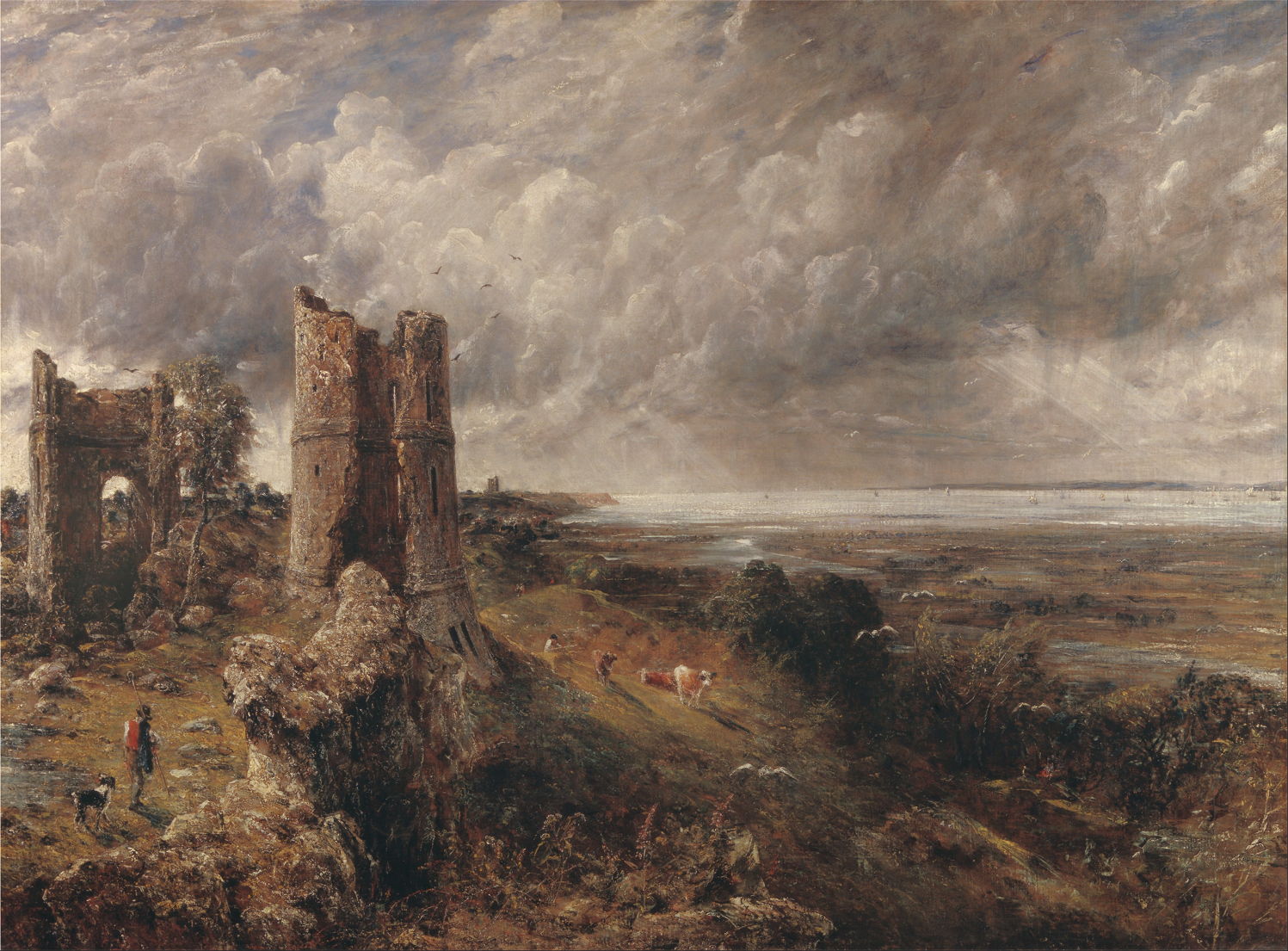
constablehadleighcastle
John Constable (1776–1837), Hadleigh Castle, The Mouth of the Thames – Morning after a Stormy Night (1829), oil on canvas, 121.9 x 164.5 cm, Yale Center for British Art, New Haven, CT. Wikimedia Commons.

By the finished work, the splendid Hadleigh Castle, The Mouth of the Thames – Morning after a Stormy Night (1829), the basic disposition of those figures has changed little, but Constable has changed each to suit his image. The shepherd, still carrying his long crook, is separated from his dog, and has lost his sheep, which have become scattered rocks. The single cow on the sloping grass has gained a couple of friends, and a cowherd. Beyond them are another couple of tiny specks of figures, and there are more by the wood in the lower right corner.

frithderbydaystudy
William Powell Frith (1819–1909), Derby Day (study) (before 1857), oil on canvas, 39.4 x 91.1 cm, Private collection. Wikimedia Commons.

William Powell Frith’s late study for Derby Day was probably painted in about 1856, and is very close to the finished work shown below, although covering only about a tenth of its area.

frithderbyday
William Powell Frith (1819–1909), The Derby Day (1856-58), oil on canvas, 140.5 x 264 cm, The Tate Gallery, London. Wikimedia Commons.

Jacob Bell commissioned Frith to paint his finished Derby Day (1856-58) for the huge fee of £1,500, and the artist was paid a further £1,500 for rights to make prints. It was exhibited at the Royal Academy in 1858, and proved so popular that a guard rail had to be installed in front of it to protect the work from the admiring crowds.

Georges Seurat’s preparations are also revealed in his surviving studies, and are very different given his Pointillist technique. Some of the later Divisionists made conventional studies, and there are some experimental examples using larger tiles of colour (see below). Seurat instead rehearsed parts of the overall view when preparing his masterwork.

Georges Seurat, Landscape - the Island of the Grande Jatte (1884), oil on canvas, 69.9 x 85.7 cm, Private collection. WikiArt.
Georges Seurat (1859–1891), Landscape – the Island of the Grande Jatte (1884), oil on canvas, 69.9 x 85.7 cm, Private collection. WikiArt.

Seurat’s first and greatest masterpiece, generally known as La Grande Jatte, uses the technique of optical mixing of colour. Rather than blending pigments on the canvas, it’s constructed of tiny dots that are high in chroma, and allow for optical mixing, one of the fundamental techniques in Seurat’s new scientific painting. His theory was that the mixing of colour would then occur in the retina of the viewer, and he tried this in a pure landscape study (above), and in his huge finished painting (below).

Georges Seurat, Un dimanche après-midi à l'Île de la Grande Jatte (A Sunday Afternoon on the Island of La Grande Jatte) (1884-6), oil on canvas, 207.5 × 308.1 cm, Art Institute of Chicago, Chicago, IL. Wikimedia Commons.
Georges Seurat (1859–1891), Un dimanche après-midi à l’Île de la Grande Jatte (A Sunday Afternoon on the Island of La Grande Jatte) (1884-6), oil on canvas, 207.5 × 308.1 cm, Art Institute of Chicago, Chicago, IL. Wikimedia Commons.

He painted his finished version in three phases. In the first, the dots he applied were mixed from available and fairly conventional pigments, including duller earths. In the second phase, he used a limited number of brighter and higher chroma pigments. In the third and final phase he added coloured borders which are distinctive of his paintings.

By the late nineteenth century oil studies were being supplemented by photographs.

eakinsstudentsatswimminghole
Circle of Thomas Eakins (1844–1916), Eakins’s Students at the “The Swimming Hole” (1884), albumen silver print, 9.3 x 12.1 cm, The Getty Center, J. Paul Getty Museum, Los Angeles, CA. Wikimedia Commons.

Thomas Eakins’ preparatory studies for Swimming (1885) grew from a series of photographs taken by the artist and his friends. But photos never replaced his own sketches: for this work, Eakins made several figure studies, details such as the dog, and different landscape backgrounds, then brought them together in oil sketches.

eakinsstudyswimming
Thomas Eakins (1844–1916), Swimming Hole (sketch) (1884), oil on fiberboard mounted on masonite, 22.1 × 27 cm, The Hirshhorn Museum and Sculpture Garden, Washington, DC. Wikimedia Commons.

Once he was happy, he embarked on his final version. In at least some cases, including his paintings of shad fishing from 1881-82, the figures in his Arcadia (c 1883), and Swimming (1885), he put final photographic images into a ‘magic lantern’ projector, which he then projected at the canvas.

He developed a sophisticated system not only for using the projected image to make a graphite underdrawing, but as the painting progressed, to incise key points and lines of reference in the paint surface. This enabled him to create paintings that were accurately calibrated to his reference images: a great advance on the traditional system of enlargement using grids, and one factor in his detailed realism. This technique was discovered by Mark Tucker and Nica Gutman.

eakinsswimming
Thomas Eakins (1844–1916), Swimming (The Swimming Hole) (1885), oil on canvas, 70.2 × 93 cm, Amon Carter Museum of American Art, Fort Worth, TX. Wikimedia Commons.

Together with other photos and various studies, Eakins then painted Swimming (The Swimming Hole) in 1885.

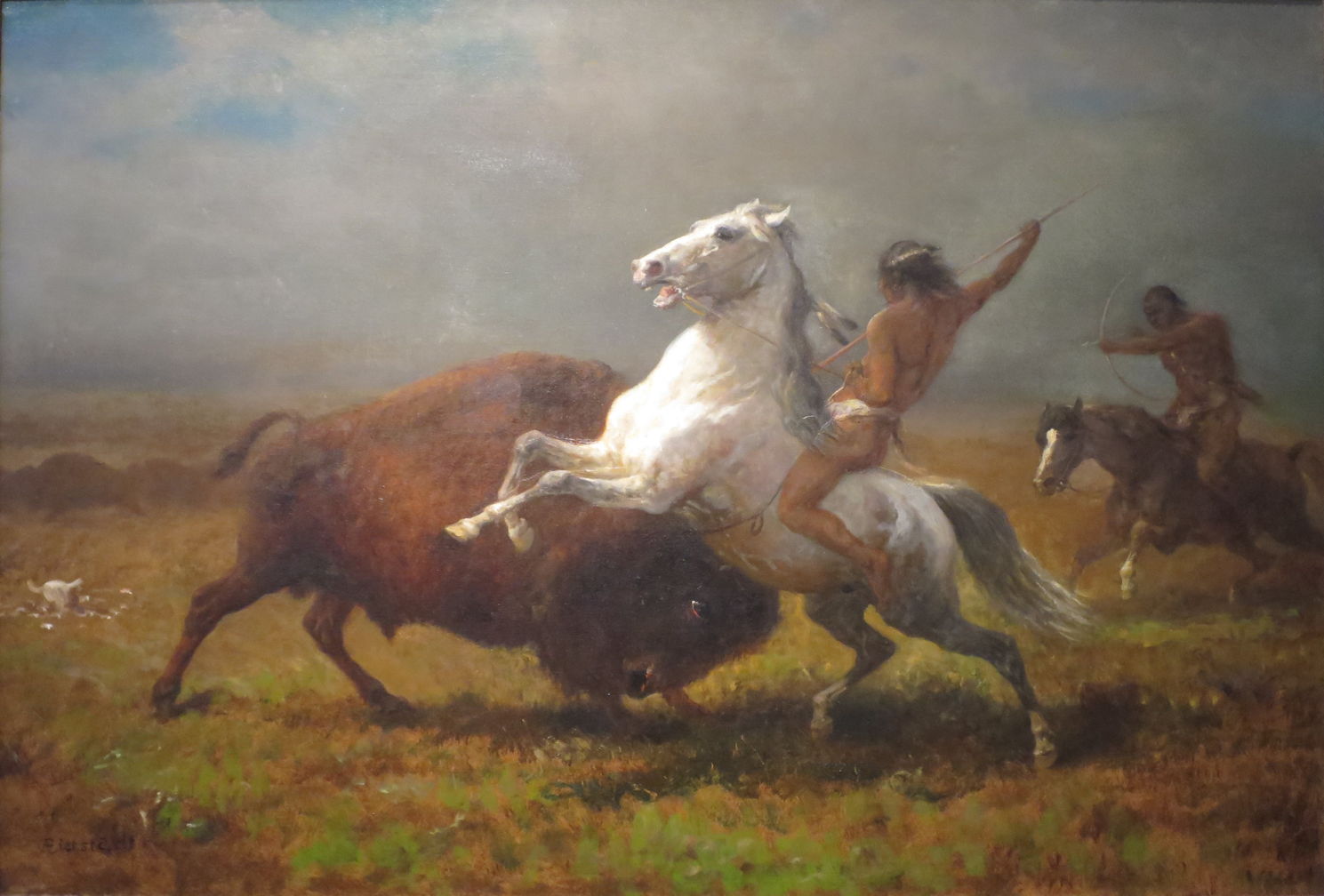
Albert Bierstadt was more traditional in his preparatory studies for The Last of the Buffalo in 1888.
bierstadtstudylastbuffalo
Albert Bierstadt (1830–1902), Study for ‘The Last of the Buffalo’ (c 1888), oil on canvas, 62.9 x 91.1 cm, De Young Museum, San Francisco, CA. Wikimedia Commons.

This late study was painted on canvas, and is 63 x 91 cm (25 x 36 inches). It concentrates on the action to be embedded in a broader landscape.

bierstadtlastbuffalo
Albert Bierstadt (1830–1902), The Last of the Buffalo (c 1888), oil on canvas, 153 x 245.1 cm, Buffalo Bill Center of the West, Cody, WY. Wikimedia Commons.

Bierstadt’s finished painting is larger still, and sets that action in a more characteristic grand panorama, with bleached skulls and dying buffalo in the foreground. In the middle distance are hundreds of animals in the herd, suggesting that extinction was by no means the only outcome.

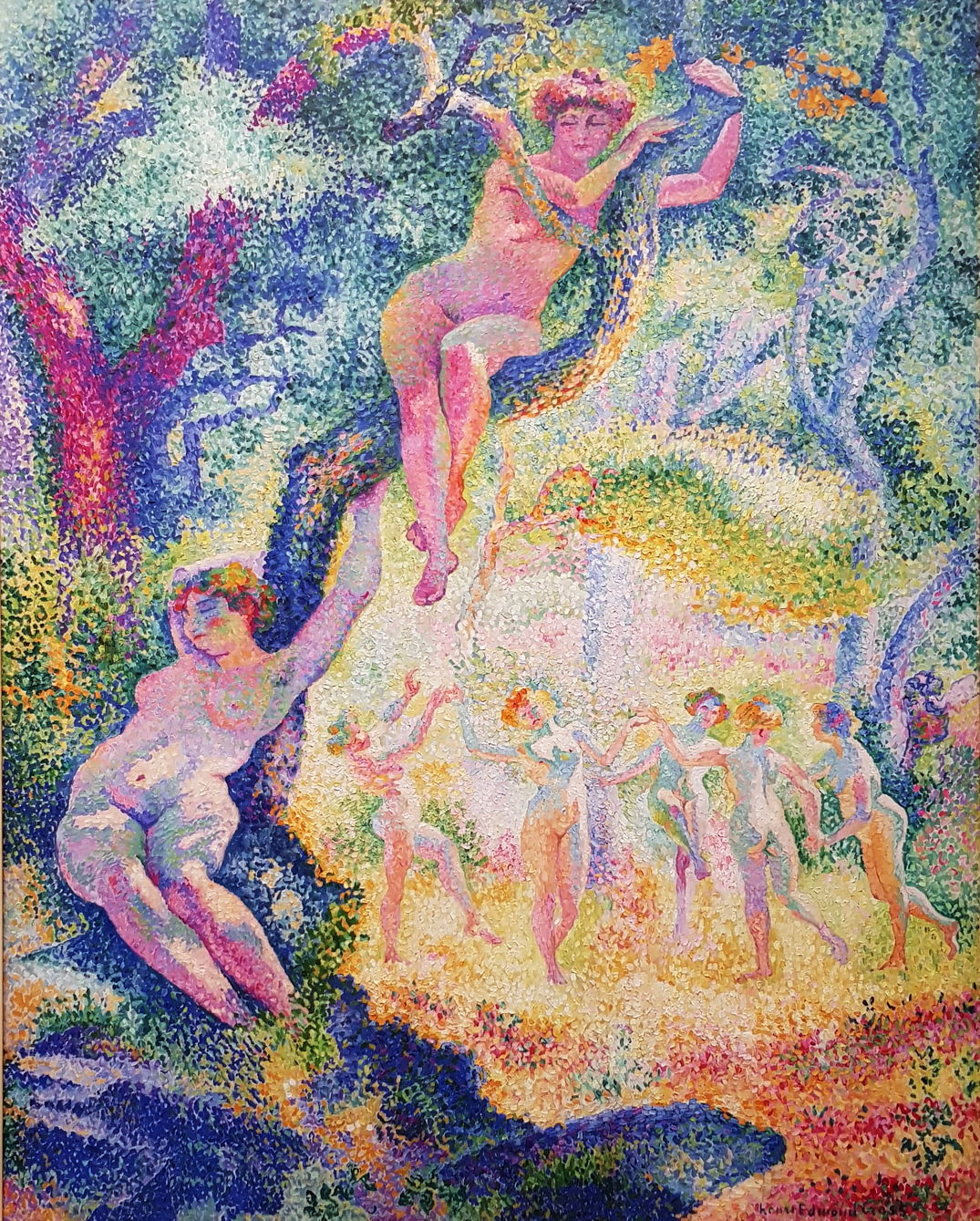
Finally, a pair of paintings by the less-known Divisionist Henri-Edmond Cross shows an alternative approach to Seurat’s, where his study is built of small daubs of colour, which are then reduced in size for the Pointillism of his final version.

crossclearingprovence
Henri-Edmond Cross (1856–1910), Clearing in Provence (study) (c 1906), oil on paper mounted on canvas, 56.5 x 44 cm, Israel Museum מוזיאון ישראל, Jerusalem, Israel. Wikimedia Commons.

His Clearing in Provence from about 1906 was painted on paper, and has subsequently been mounted on canvas for display in the Israel Museum, Jerusalem.
crossglade
Henri-Edmond Cross (1856–1910), The Glade (1906), oil on canvas, 162 x 130 cm, Wallraf-Richartz-Museum & Fondation Corboud, Cologne, Germany. Image by anagoria, via Wikimedia Commons.

That sketch formed the basis of the woodland setting Cross used in The Glade, painted in oils in 1906. Colour changes are prominent, and the chroma has been considerably enhanced. The size has grown, and it’s on a more permanent support of stretched canvas.

Seen through modern eyes, many of the oil studies of the past deserve to be seen more widely, rather than being kept in storage.

Reading Visual Art: 247 Woodpecker

There are precious few paintings featuring European woodpeckers, but those few come with unusual stories. Of the three species that are common across the continent, it’s most likely that these refer to what’s now known as the great spotted woodpecker, responsible for the distinctive sound it makes when pecking the trunk of a tree.

audubongreatspottedwoodpecker
John James Audubon (1785–1851), Great Spotted Woodpecker (date not known), media and dimensions not known, Houghton Library, Harvard University, Cambridge, MA. Wikimedia Commons.

When he was in Britain, the great American bird artist John James Audubon painted this fine example of a Great Spotted Woodpecker (Dendrocopos major).

The woodpecker has earned itself a place in ancient Roman legend, as one of the two guardians of the infant Romulus and Remus. They were abandoned shortly after birth, put in a trough to float down the River Tiber to their deaths. When the trough was washed up on a bank, they were adopted and fed by a she-wolf, while the woodpecker kept a close watch over the babies, until they were discovered by the swineherd Faustulus. And the rest is legendary Roman history. For its role in saving the co-founders of Rome, the woodpecker was later considered to be sacred to the god Mars.

carracciromulusremus
Ludovico Carracci (1555–1619) and/or Annibale Carracci (1560–1609), She-Wolf Suckling Romulus and Remus (1589-92), fresco, dimensions not known, Palazzo Magnani, Bologna, Italy. Wikimedia Commons.

One of the frescoes in the Palazzo Magnani, probably painted by Ludovico Carracci and/or Annibale Carracci, shows the She-Wolf Suckling Romulus and Remus (1589-92). The twins are still inside the trough in which they had survived their trip down the river, and on the opposite bank a woodpecker is keeping a close watch. At the far right, a now rather diaphanous figure may be Faustulus, one of Amulius’ swineherds who discovered the twins, and took them to his wife.

rubensromulusremus
Peter Paul Rubens (1577–1640), Romulus and Remus (1615-16), oil on canvas, 213 x 212 cm, Musei Capitolini, Rome, Italy. Wikimedia Commons.

Peter Paul Rubens shows Romulus and Remus being discovered by Faustulus in this painting of 1615-16. Not only is the she-wolf taking care of the twins, but a whole family of woodpeckers are bringing worms and grubs to feed them, and there are empty shells and a small crab on the small beach as additional tasty tidbits.

Several mythical figures seem to have been transformed into woodpeckers for various reasons. The sorceress Circe was also claimed to have turned at least one of her lovers into a woodpecker, a story celebrated by Dosso Dossi.

dossicircelovers
Dosso Dossi (–1542), Circe and her Lovers in a Landscape (c 1514-16), oil on canvas, 100 × 136 cm, National Gallery of Art, Washington, DC. Wikimedia Commons.

Dossi’s Circe and her Lovers in a Landscape (c 1514-16) is a remarkably early and realistic mythological landscape, with deep rustic lanes, trees, and a distant farmhouse. Circe leans, naked, at the foot of a tree as she goes through spells on a large tablet, with a book of magic open at her feet. Around her are some of the men who she took a fancy to and transformed into wild creatures. There’s a spoonbill, a small deer, a couple of dogs, a stag, and up in the trees an owl, and a woodpecker in the upper right corner.

dossimelissa
Dosso Dossi (–1542), Melissa (Circe) (c 1518-1531), oil on canvas, 176 × 174 cm, Galleria Borghese, Rome. Wikimedia Commons.

There’s still dispute as to whether this painting of Dossi’s shows Circe again, or the sorceress Melissa from the epic Orlando Furioso. Painted in about 1518-1531, this sorceress sits inside a magic circle, around which are inscribed cabalistic words. In the upper left corner are small homunculi apparently growing on a tree. On the left is a large dog, and perched on top of a suit of armour is another woodpecker.

Finally, the great spotted woodpecker is one of the birds that can be identified in Hieronymus Bosch’s fantastic menageries.

boschtemptationstanthonyrt
Hieronymus Bosch (c 1450–1516), The Temptation of Saint Anthony (Lisbon) (right wing) (c 1500-10), oil on oak panel, left wing 144.8 x 66.5 cm, central panel 145.1 × 132.8 cm, right wing 144.8 × 66.7 cm, Museu Nacional de Arte Antiga, Lisbon. Wikimedia Commons.

The right panel of Bosch’s Temptation of Saint Anthony, now in Lisbon, shows Saint Anthony seated, with a book open in front of him. He is again surrounded by strange figures and creatures from a vision of temptation. The background shows a prominent windmill and towers, behind which is a wintry landscape with snow on the ground.

Deeper into the painting, behind and to the left of the saint, is a group of figures, daemons, and objects, clustered around the hollow trunk of a dead tree. Inside the hollow, a naked woman peers out. The tree is draped with a scarlet sheet, under and on which are several daemons. At the top, an old person pours liquid from a ewer into the bowl held up by a daemon below. A woodpecker is perched on one of the upper branches.

I leave you to speculate on the significance of that woodpecker.

Painting the spirits of water: gods and Naiads

Narrative painting of classical myths has many conventions that can appear confusing. This weekend I look at those associated with river gods and their associated nymphs Naiads, and tomorrow more recent relatives Ondines.

In Greek, and subsequently Roman, mythology, the river gods or Potamoi (Greek for rivers) are three thousand sons of Oceanus, the great river encircling the earth, and Tethys, his Titan sister and wife. A river god is both that river and a distinct deity: Achelous is the god of the River Achelous, the largest in Greece, who wrestled unsuccessfully with Hercules for the right to marry Deianira.

Associated with sources and bodies of fresh water are also water nymphs, Naiads or Potamides, often stated to be the daughters of the river gods. In ancient times, there was a weaker distinction between fresh and salt waters, so although nymphs associated with the sea are usually termed Nereids when in Mediterranean waters, or Oceanids, Naiads can also be encountered in what we would consider to be sea.

dititoheliades
Santi di Tito (1536–1603) The Sisters of Phaethon Transformed into Poplars (c 1570), fresco, dimensions not known, Palazzo Vecchio, Musei Civici Fiorentini, Florence. Wikimedia Commons.

The standard depiction for any river god in a classical story is that of an older bearded man lounging by a large earthenware pot from which water pours forth into the river. This is shown well in Santi di Tito’s fresco of The Sisters of Phaethon Transformed into Poplars, from about 1570. Although this story tells how the sisters of Phaeton grieve for him after his death, and are transformed into poplar trees, as it shows a river, there must still be a god of that river.

rubensromulusremus
Peter Paul Rubens (1577–1640), Romulus and Remus (1615-16), oil on canvas, 213 x 212 cm, Musei Capitolini, Rome, Italy. Wikimedia Commons.

Rubens’ delightful painting of Romulus and Remus being discovered by Faustulus, from 1615-16, shows both the river god Tiberinus and his daughter nymph, at the left with the god’s pot.

poussincephalusaurora
Nicolas Poussin (1594–1665), Cephalus and Aurora (1630), oil on canvas, 96.9 x 131.3 cm, The National Gallery, London. Wikimedia Commons.

In Nicolas Poussin’s Cephalus and Aurora from 1630, the river god is again at the left, and looks tired of the whole business, with a mere trickle of water emerging from his pot.

garzialpheusarethusa
Luigi Garzi (attr) (1638–1721), Alpheus and Arethusa (c 1690), oil on canvas, 120.7 x 171.5 cm, location not known. Wikimedia Commons.

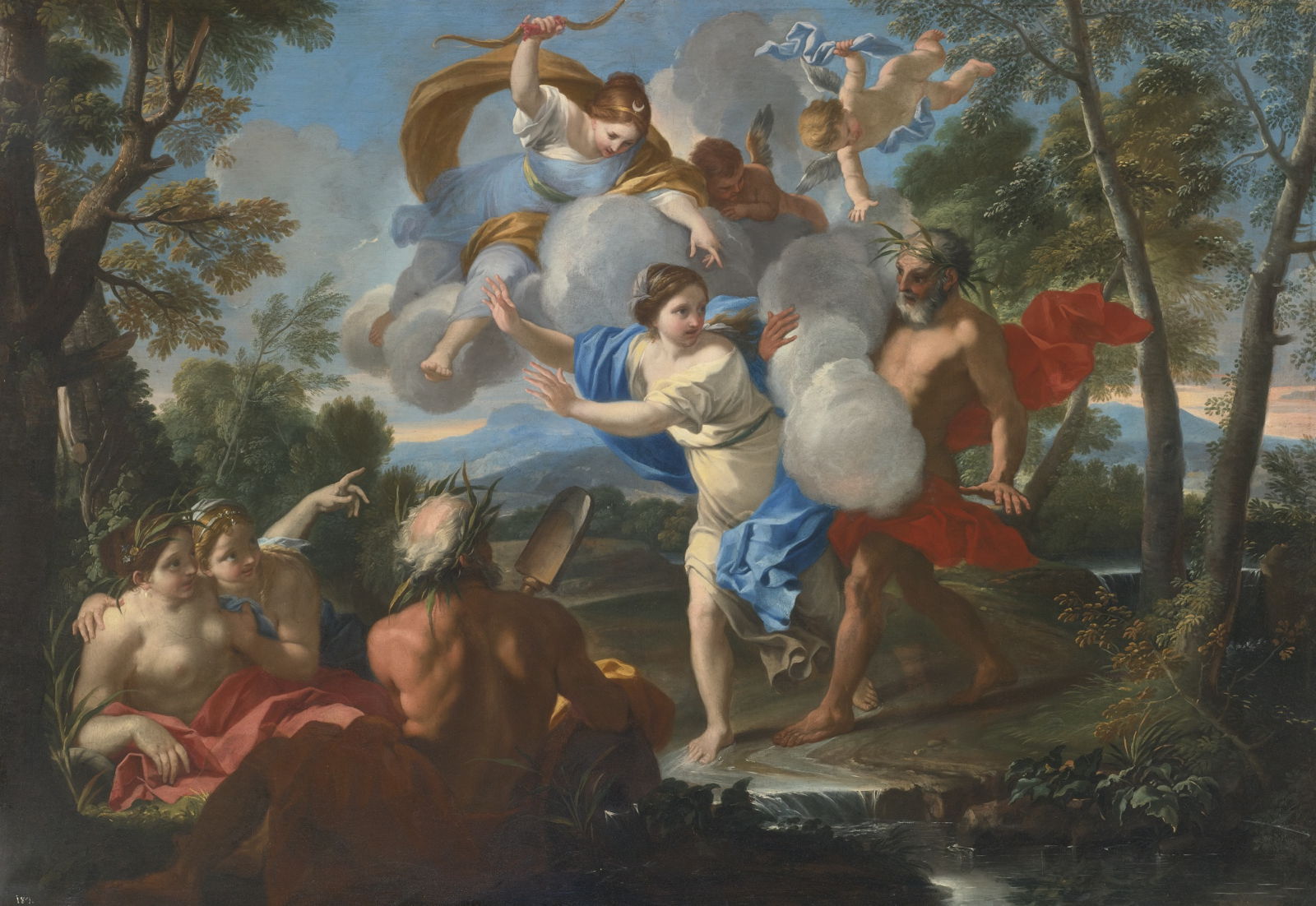
This beautiful painting attributed to Luigi Garzi, of Alpheus and Arethusa from around 1690, shows one river god and two nymphs. The god leans on his pot, and in his left hand holds a small spade, another attribute sometimes seen with them.

coypelalpheuschasingarethusa
Antoine Coypel (1661–1722), Alpheus Chasing Arethusa (c 1710), oil on canvas, dimensions and location not known. Wikimedia Commons.

Antoine Coypel’s version of the same Ovidian myth, Alpheus Chasing Arethusa from about 1710, places the river god at the lower left, and two Naiads separately on the right.

boucherpansyrinx
François Boucher (1703–1770), Pan and Syrinx (1743), oil on canvas, 101 × 133 cm, Private collection. Wikimedia Commons.

So far, the river deities have enjoyed a rather passive life in paintings, but this wasn’t a requirement. In François Boucher’s Pan and Syrinx from 1743, the nymph Syrinx is seeking the help of the river god and Naiad, as she attempts to evade Pan’s attentions. The god’s pot is almost hidden beneath luxuriant red fabric, under his right hand.

tiepoloapollodaphne
Giovanni Battista Tiepolo (1696–1770), Apollo and Daphne (c 1744-45), oil on canvas, 96 x 79 cm, Musée du Louvre, Paris. Wikimedia Commons.

In Tiepolo’s Apollo and Daphne (c 1744-45), the river god is given much of the foreground and lower section of the painting, and holds an oar or paddle, a more unusual but distinctive attribute.

mengsapollomnemosyne
Anton Raphael Mengs (1728–1779), Apollo, Mnemosyne, and the Nine Muses (1761), fresco, 313 × 580 cm, Gallery of the Villa Albani-Torlonia, Rome. Wikimedia Commons.

Sometimes, artists conceal the river god as if challenging the viewer to locate him. This is the case in Anton Raphael Mengs’ fresco of Apollo, Mnemosyne, and the Nine Muses (1761), in which the god’s bearded and hoary figure is tucked away behind Apollo’s legs. There’s also an Orphic tradition in which the River Mnemosyne is the source of water to bring inspiration, and this perhaps alludes to that obscure sub-narrative.

brenetaethrashowingtheseus
Nicolas-Guy Brenet (1728–1792), Aethra Showing her Son Theseus the Place Where his Father had Hidden his Arms (1768), oil on canvas, 50.2 × 59.7 cm, Los Angeles County Museum of Art, Los Angeles, CA. Wikimedia Commons.

In some paintings, river gods seem to be included even when their river is nowhere to be seen. Nicolas-Guy Brenet’s painting of Aethra Showing her Son Theseus the Place Where his Father had Hidden his Arms (1768) tucks this extra into the lower left corner again.

schmidtdanaides
Martin Johann Schmidt (1718–1801), The Labour of the Danaides (1785), oil on copper plate, 54.5 × 77 cm, Narodna galerija Slovenije, Ljubljana, Slovenia. Wikimedia Commons.

Martin Johann Schmidt’s Labour of the Danaides (1785) informs us that the Danaïds were also water-nymphs by placing a river god at the left. They were condemned to keep trying to fill this leaky container with water as their penance in the underworld.

cranenyadsdryads
Walter Crane (1845–1915), Nyads and Dryads (date not known), watercolour on paper, 23.5 × 16.5 cm, location not known. Wikimedia Commons.

Walter Crane shows the association between Naiads and other nymphs in his watercolour of Nyads and Dryads, probably painted between 1880-1900. He melds the Dryads in with their trees, puts the ‘Nyads’ or Naiads in the water, and has a river god watching from the reeds in the distance.

waterhousenaiad
John William Waterhouse (1849–1917), A Naiad, or Hylas with a Nymph (1893), oil on canvas, 66 x 127 cm, Private collection. Wikimedia Commons.

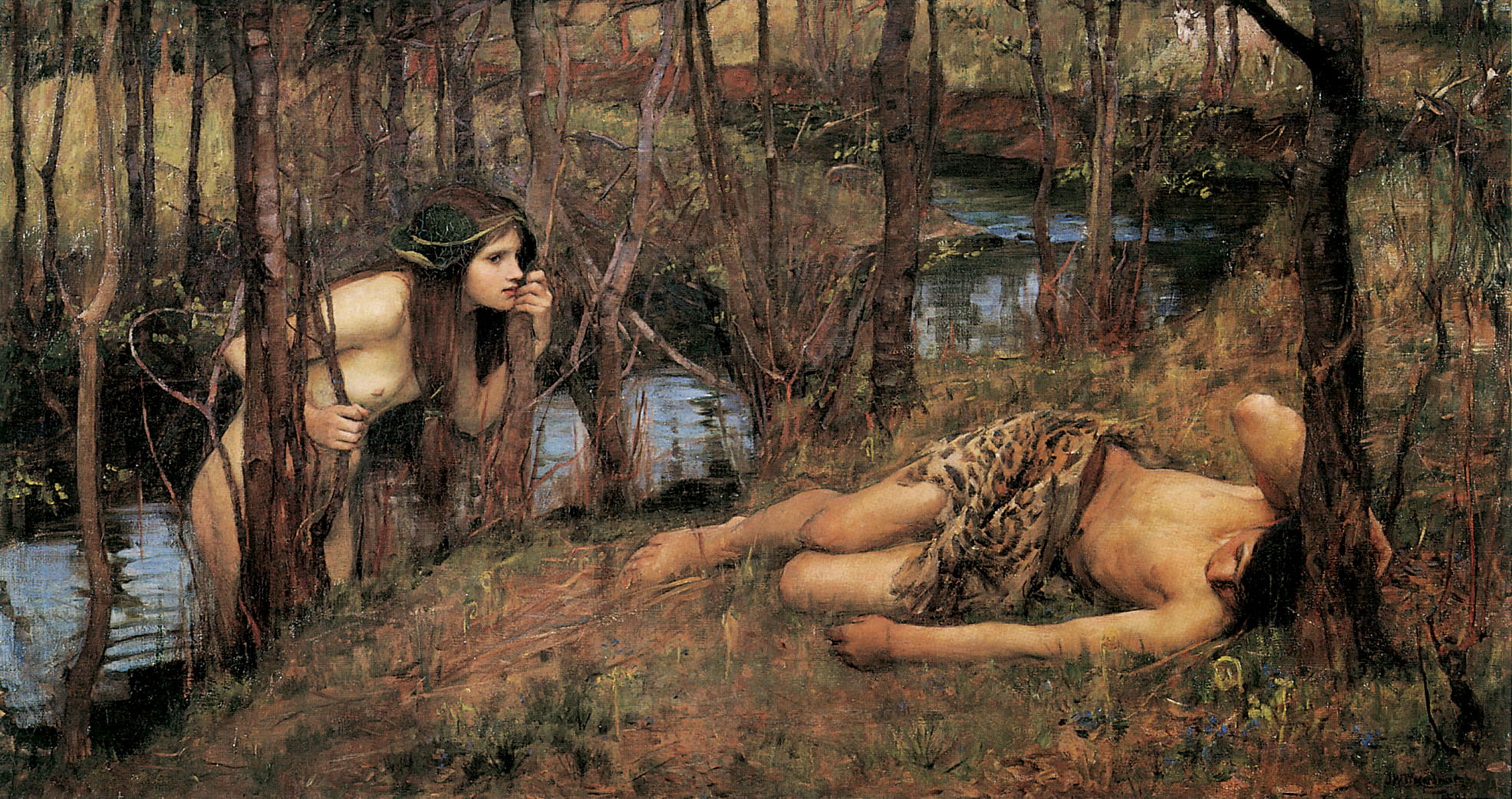
By the end of the nineteenth century, enthusiasm for the tradition of showing river gods was waning, and nude, cavorting Naiads came to the fore. One of their greatest exponents was John William Waterhouse, who led with this first tentative retelling of the myth of Hylas in 1893, in A Naiad, or Hylas with a Nymph.

Hylas was companion and servant to Heracles (Hercules), who accompanied the hero on Jason’s ship Argo. When the Argonauts were ashore in modern Turkey, Hylas approached the spring of Pegae, where the Naiads fell in love with and kidnapped him. He vanished without trace, leading Heracles and Polyphemus to search for him at length. They were delayed in this so long that the Argo sailed without them.

This first version shows one of the Naiads discovering the sleeping Hylas by a small river. There’s no sign of any river god, but there are some goats on the right side of the painting.

waterhousehylasnymphs
John William Waterhouse (1849–1917), Hylas and the Nymphs (1896), oil on canvas, 132.1 x 197.5 cm, Manchester Art Gallery, Manchester, England. Wikimedia Commons.

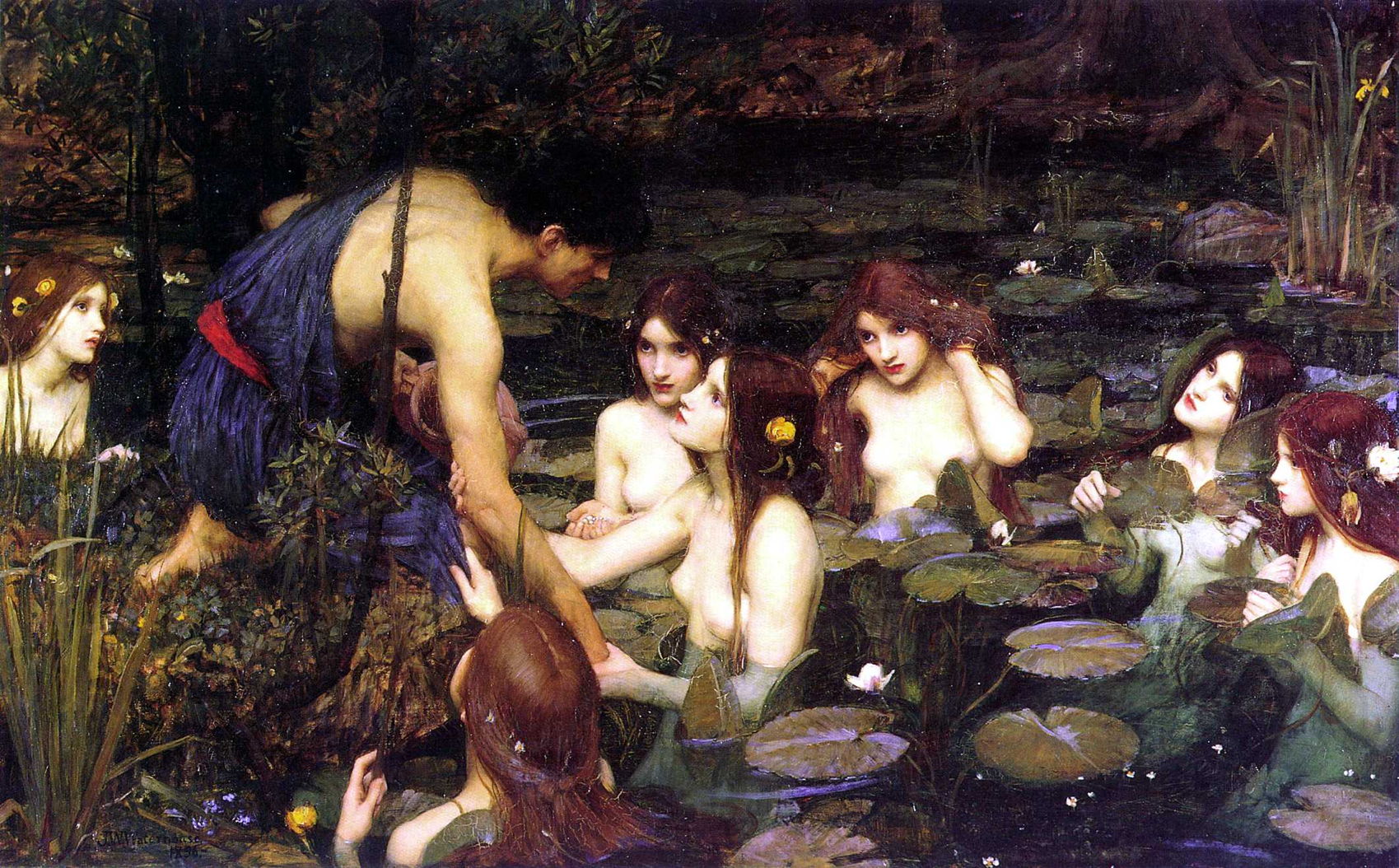
Three years later, Waterhouse’s Hylas and the Nymphs (1896) stays closer to the myth. Hylas holds an earthenware pot, almost as if he were about to become the river god.

In January 2018, this well-known painting was removed from exhibition in Manchester, England, and replaced by a notice which explained that a temporary space had been left “to prompt conversations about how we display and interpret artworks in Manchester’s public collection”. The painting soon returned after protests. It’s surprising that more than a century after it was first exhibited, it was still capable of causing such controversy.

raehylaswaternymphs
Henrietta Rae (1859–1928), Hylas and the Water Nymphs (c 1909), oil on canvas, 142.3 × 222.8 cm, Private collection. Wikimedia Commons.

Waterhouse is not the only artist to have courted controversy with this story. Henrietta Rae’s Hylas and the Water Nymphs from about 1909 was exhibited at the Royal Academy in 1910, and is no less fleshly than Waterhouse’s version. Rae was a pioneer in her painting of nudes, at a time when most of society still considered that women shouldn’t be allowed to attend classes learning to draw or paint nude models.

poyntercaveofstormnymphs
Edward Poynter (1836–1919), Cave of the Storm Nymphs (1903), oil on canvas, 145.9 × 110.4 cm, Private collection. Wikimedia Commons.

Edward Poynter’s Cave of the Storm Nymphs (1903) might appear to be still more exploitative of the male appeal of the female nude, but there’s a more complex narrative behind this scene. Its literary reference is most probably to the Naiads of Homer’s Odyssey, book 13, who live in a sea cave, updated to encompass more contemporary references to Wreckers, who lured ships onto the rocks in order to steal their precious cargos: sirens without the socially unacceptable habit of cannibalism.

❌