Reading view

There are new articles available, click to refresh the page.

Jerusalem Delivered: 9 Armida’s Garden

The crusaders led by Godfrey of Bouillon desperately need Rinaldo back if they are to resume their assault on Jerusalem. Guelph’s party, notably the knights Charles (Carlo) and Ubaldo, have gone in search of him. But Rinaldo has been lured into a trap by the sorceress Armida, who intended to kill him. At the last moment, though, she falls in love with him and abducts him in her chariot.

That flies the couple to the distant, deserted and enchanted Fortunate Isles, where she lives in her garden that is perpetually in Spring. The wizard explains this to Charles and Ubaldo, to aid them in their mission to rescue the knight.
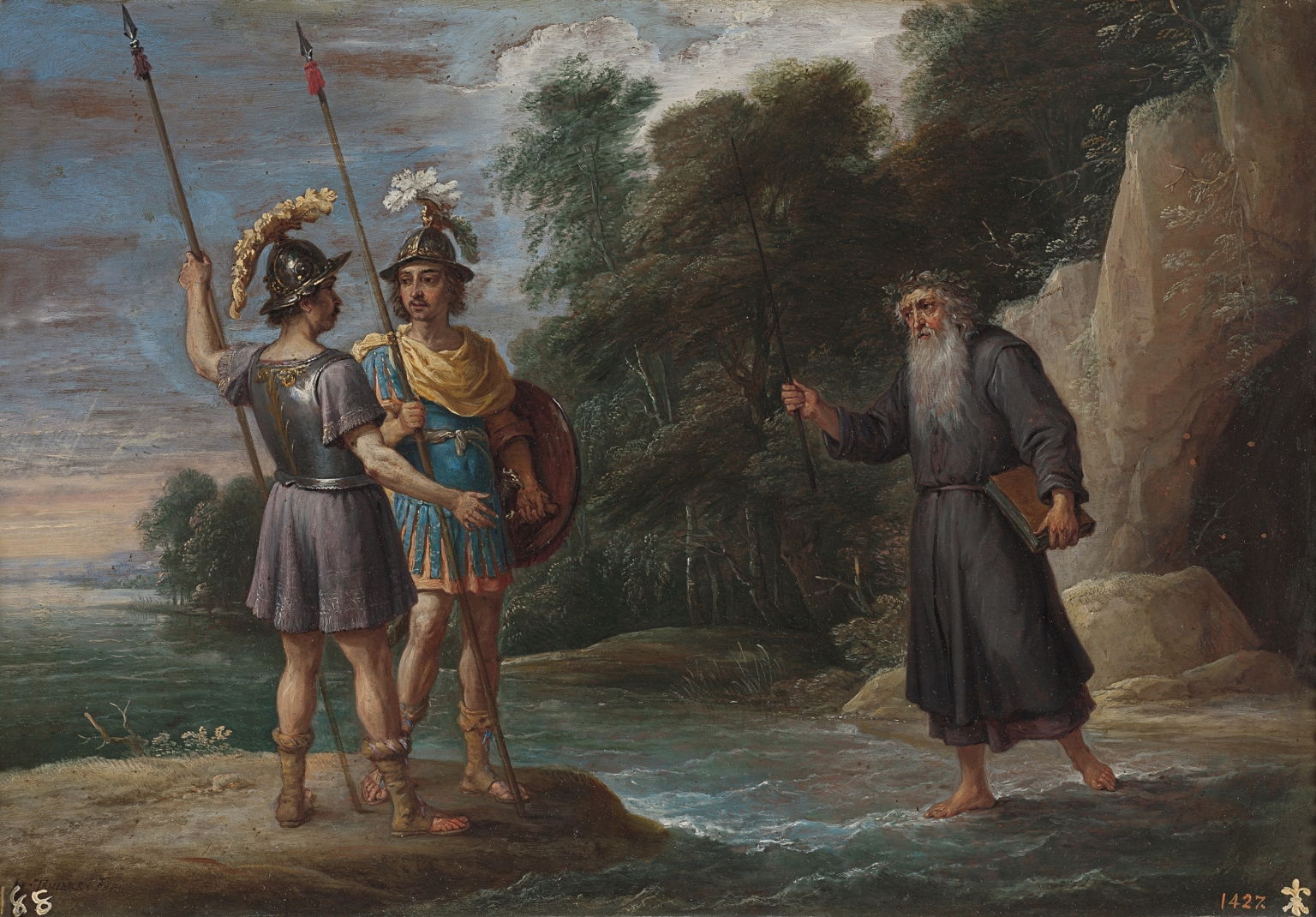
teniersmagiciandiscoverscarlosubaldo
David Teniers the Younger (1610–1690), The Magician Shows Carlos and Ubaldo the Whereabouts of Rinaldo (The search for Rinaldo) (1628-30), oil on copper, 27 x 39 cm , Museo Nacional del Prado, Madrid, Spain. Wikimedia Commons.

David Teniers the Younger’s The Magician Shows Carlos and Ubaldo the Whereabouts of Rinaldo (The search for Rinaldo) from 1628-30 is a small oil on copper painting in his series telling this section of Tasso’s epic. Here the wizard despatches the two knights to the Fortunate Isles.

At the start of canto fifteen, Charles and Ubaldo set off to retrace their steps with the wizard as their guide. The river takes them gently down to the sea, where a ship awaits. They board, and sail at miraculous speed past Ascalon and the mouths of the River Nile, westward through the Mediterranean, and through the Pillars of Hercules into the Atlantic Ocean. They eventually approach the Fortunate Isles, pull into a harbour, and the two knights disembark.

They spend the night at the foot of the mountain they have to climb to reach Armida’s garden with the captive Rinaldo. They set off at dawn, only to encounter their first obstacle: a fearsome dragon blocking their passage up the mountain. Charles draws his sword ready to slay the dragon, but Ubaldo waves a golden wand, a gift of the wizard, which drives it away.

poussincompanionsrinaldo
Nicolas Poussin (1594–1665), The Companions of Rinaldo (c 1633-4), oil on canvas, 119 x 101 cm, The Metropolitan Museum of Art, New York, NY. Wikimedia Commons.

Poussin’s The Companions of Rinaldo (c 1633-4) shows the two knights confronting this dragon. Charles stands in the centre with his sword ready, but Ubaldo behind him leaves his weapon in its scabbard and brandishes his golden wand instead. In the background at the left is the magic ship in which they sailed, and standing in its prow is the maiden who steered it.
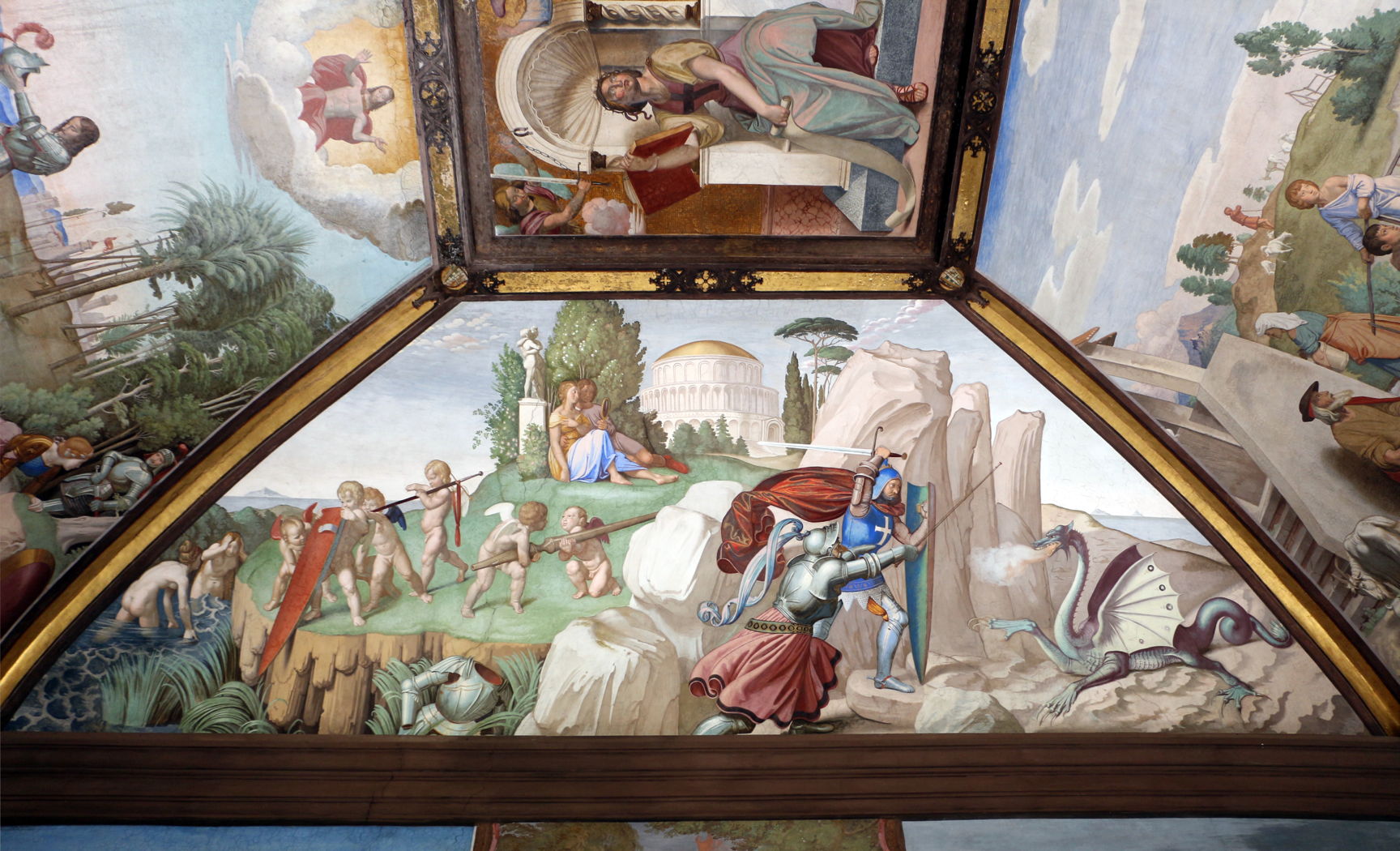
overbeckubaldocarloliberaterinaldo
Johann Friedrich Overbeck (1789-1869), Ubaldo and Carlo free Rinaldo from Armida’s Castle (1819-27), fresco, dimensions not known, Casa Massimo, Rome, Italy. Image by Sailko, via Wikimedia Commons.

Johann Friedrich Overbeck’s fresco of Ubaldo and Carlo free Rinaldo from Armida’s Castle from 1819-27, in the Casa Massimo, Rome, shows an interesting composite scene. To the right of centre, Charles and Ubaldo wield their sword and wand, and in the distance are Armida and Rinaldo in the garden on the summit. Amorini are playing with Rinaldo’s weapons, and his empty suit of armour has been cast into the undergrowth.

Next the pair have to face a lion, which is similarly dismissed with a wave of the wand. After that comes an army of animals they disperse readily, and Charles and Ubaldo are on the ascent towards the stretch of snow and ice they must cross before reaching Armida’s eternal Spring. Once up at the top, the two knights pause from their strenuous climb, slaking their thirst in a mountain stream. Grassy banks either side of the stream have a fine banquet laid out on them, and there are two naked young women cavorting in the water.

tenierscarlosubaldoislands
David Teniers the Younger (1610–1690), Carlos and Ubaldo in The Fortunate Isles (1628-30), oil on copper, 27 x 39 cm, Museo Nacional del Prado, Madrid, Spain. Wikimedia Commons.

David Teniers the Younger’s Carlos and Ubaldo in The Fortunate Isles (1628-30) shows this moment, with the banquet laid out on a clean white tablecloth rather than grass. Surrounded by trees and standing proud on the skyline is Armida’s palace, their destination.

delafossedanishwarriors
Charles-Alexandre Coëssin de la Fosse (1829–1910), Danish Warriors in the Garden of Armida (1848), others detail unknown, but believed to be oil on canvas and the original in colour. By Salon 1913, via Wikimedia Commons.

I only have this monochrome image of Charles-Alexandre Coëssin de la Fosse’s painting of Danish Warriors in the Garden of Armida from 1848. The two knights are dallying rather longer than their mission had intended.

Once Charles and Ubaldo can tear themselves away from these nymphs, they press on to the circular outer wall of the palace, which opens the sixteenth canto as they enter Armida’s garden.

mullergardenofarmida
Édouard Muller (1823-1876), The Garden of Armida (1854), block-printed wallpaper, 386.1 x 335.3 cm, Philadelphia Museum of Art, Philadelphia, PA. Wikimedia Commons.

In the eighteenth and nineteenth centuries, Armida’s garden appeared on all manner of products. This wallpaper designed by Édouard Muller in 1854 is now in the Philadelphia Museum of Art, while smaller images appeared on coffee cups and much else.

Tasso gives a brief description of the garden with its figs, apples and grape vines. Birds sing, and the wind murmurs softly. One bird speaks to the two knights, telling of the chaste and modest rose flower that springs virgin from its green leaves.
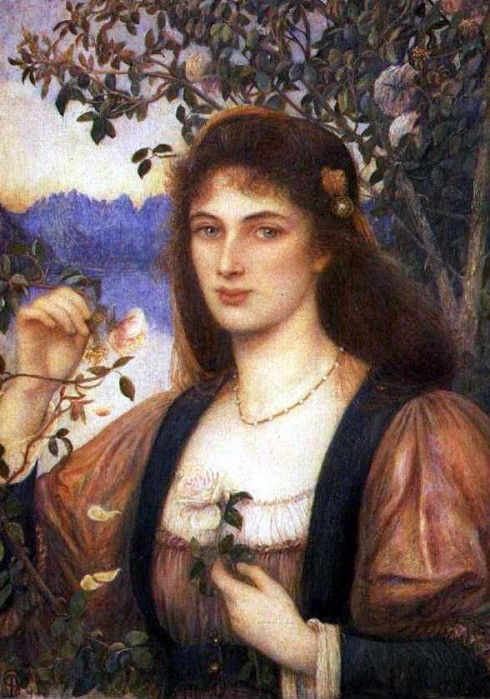
stillmanrosefromarmidasgarden
Marie Spartali Stillman (1844–1927), A Rose in Armida’s Garden (1894), watercolour and graphite on paper, 64.8 x 43.2 cm, Private collection. Wikimedia Commons.

This passage about the rose was the inspiration for Marie Spartali Stillman’s exquisite watercolour of A Rose in Armida’s Garden from 1894, given by the artist as a wedding gift to a family friend.

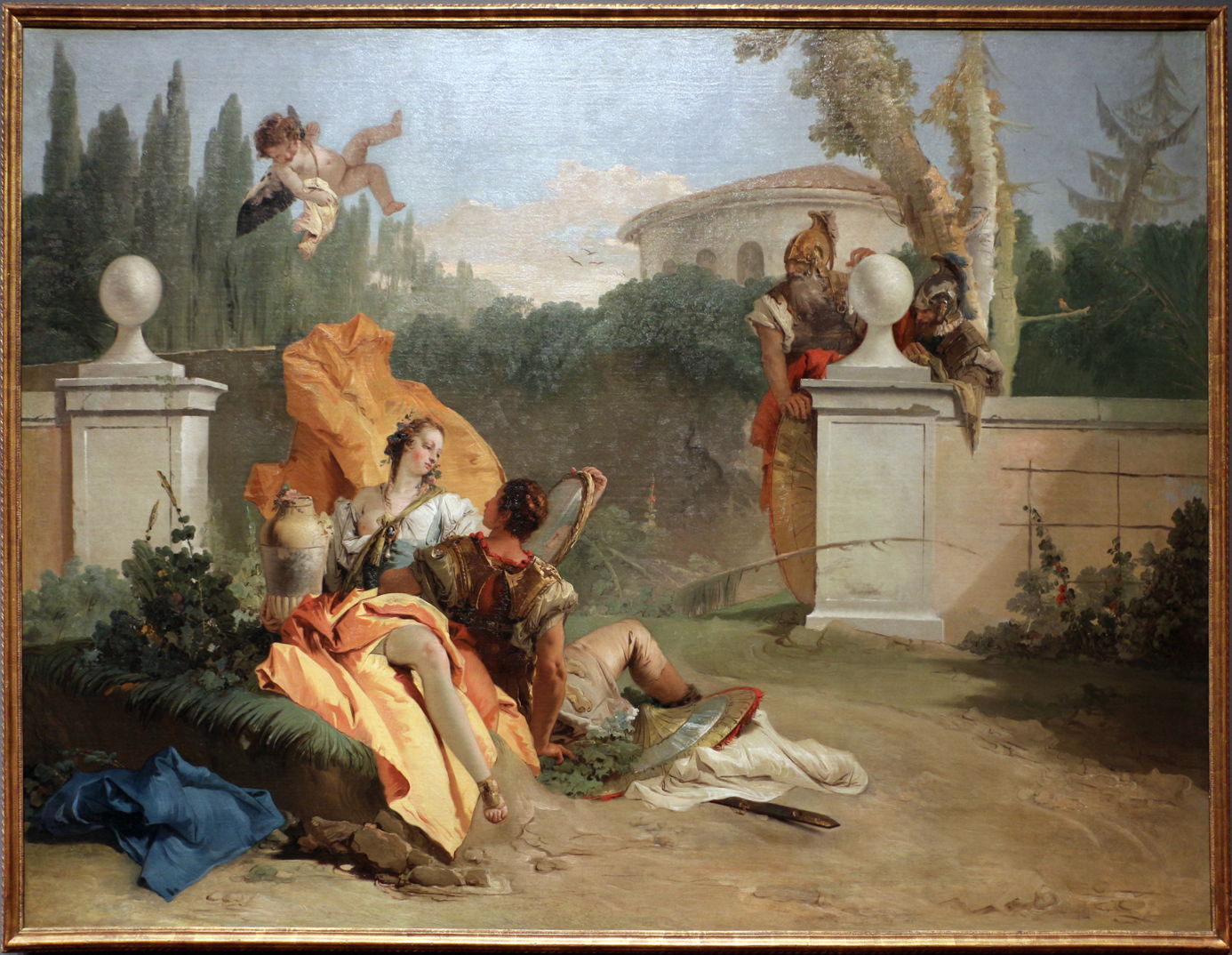
Charles and Ubaldo then peer through the leaves and spot a loving couple, who they presume to be Rinaldo and Armida. The knight’s head rests in Armida’s lap. He then stands up and takes a crystal glass hanging at his side. Armida uses this as a mirror to adjust her hair, telling Rinaldo to keep looking into her eyes.
tiepolorinaldoarmidagarden
Giovanni Battista Tiepolo (1696–1770), Rinaldo and Armida in Her Garden (1742-45), oil on canvas, 187 x 260 cm, The Art Institute of Chicago, Chicago, IL. Image by Sailko, via Wikimedia Commons.

Tiepolo paints this clearly in his Rinaldo and Armida in Her Garden from 1742-45, now in The Art Institute of Chicago. It was originally hung in a special room dedicated to Tasso’s epic in the Palazzo Corner a San Polo in Venice, where it belonged to the noble Serbelloni family.

kauffmannrinarm
Angelica Kauffman (1741–1807), Rinaldo and Armida (1771), oil on canvas, 130.8 x 153 cm, Yale Center for British Art, New Haven, CT. Wikimedia Commons.

In Angelica Kauffman’s Rinaldo and Armida from 1771, the crystal glass is ready at Armida’s feet, and she is busy distracting him by sprinkling flowers over his head.

hayezrinaldoarmida
Francesco Hayez (1791–1881), Rinaldo and Armida (1812-13), oil on canvas, dimensions not known, Gallerie dell’Accademia, Venice, Italy. Wikimedia Commons.

Francesco Hayez shows a variation in his Rinaldo and Armida from 1812-13. Anticipating the next part of Tasso’s narrative, instead of Rinaldo wearing the crystal glass at his side, his circular shield rests on the ground next to Armida. Charles and Ubaldo are shown peering from behind a tree trunk, safely in the distance.

Armida then kisses Rinaldo goodbye and leaves. Charles and Ubaldo see their opportunity and step out from the bushes, dressed in full armour. Ubaldo holds a highly polished shield up so that Rinaldo can see himself for what he has become, a woman’s dandy, not a warrior knight.

References

Wikipedia on Jerusalem Delivered.
Wikipedia on Torquato Tasso.

Project Gutenberg (free) English translation (Fairfax 1600).

Librivox audiobook of the Fairfax (1600) English translation (free).

Thomas Asbridge (2004) The First Crusade, A New History, Free Press, ISBN 978 0 7432 2084 2.
Anthony M Esolen, translator (2000) Torquato Tasso, Jerusalem Delivered, Gerusalemme Liberata, Johns Hopkins UP. ISBN 978 0 801 863233. A superb modern translation into English verse.
John France (1994) Victory in the East, a Military History of the First Crusade, Cambridge UP. ISBN 978 0 521 589871.
Joanthan Riley-Smith, ed (1995) The Oxford Illustrated History of the Crusades, Oxford UP. ISBN 978 0 192 854285.
Jonathan Riley-Smith (2014) The Crusades, A History, 3rd edn., Bloomsbury. ISBN 978 1 4725 1351 9.
Johathan Unglaub (2006) Poussin and the Poetics of Painting, Pictorial Narrative and the Legacy of Tasso, Cambridge UP. ISBN 978 0 521 833677.

Jerusalem Delivered: 7 The death of Clorinda

With Armida creating havoc among the crusaders, and leading ten of their best warriors out on a fool’s errand, Erminia had dressed in Clorinda’s armour, tried to help the wounded Tancred, then became lost in the countryside by the River Jordan. Tancred had left in pursuit of her, thinking she was his love Clorinda, but he too strays and loses her trail in a wood.

It’s dusk by the time Tancred emerges from the wood, and mindful of his battle to complete with Argante in the morning, he turns for home. As he does, a messenger comes galloping towards him, claiming to come from Bohemond. Tancred follows him to a moated castle, where the messenger blows his horn for its drawbridge to be lowered.

Tancred is wary, but as he approaches the castle, a familiar figure appears: Gascon Rambald, one of the ten knights who set off with Armida. But the knight tells Tancred to disarm, and admits to having been ‘turned’ to a ‘pagan’ by Armida. Tasso tells us what Tancred cannot see: Armida is watching and listening to this from a throne high above them in her castle.

Tancred’s only option is to kill Gascon Rambald, who runs out onto the drawbridge. Once Tancred is there with him, the castle and its burning brands vanish into the darkness. Tancred walks on into the black night, steps through a gate, and is sealed in a trap. From behind the dungeon’s bars he recalls his duty to face Argante at dawn.

The following day Argante is getting himself ready before dawn. Godfrey is woken by Argante’s herald blowing fiercely on his horn, only to discover that Tancred and many of his best fighters are missing. His first task is to find a substitute for Tancred to resume the battle with Argante. He draws lots in the end, and pulls out the name of Raymond of Toulouse, who at least has the advantage of a guardian angel.

The contest between Argante and Raymond starts with the former missing his opponent altogether, thanks to the angel’s intervention. With his great experience in combat, Raymond proves a match for the Circassian, and is saved repeatedly by angelic force. However, Argante has already made a pact with the devil, and his guardian intervenes by asking a nearby archer to shoot Raymond in the eye.

The arrow is loosed and strikes Raymond by the belt, its force attenuated by his angel. This breach of the code of chivalry provokes the watching armies into immediate battle: soldiers from the city are forced to defend Argante, as crusaders rush in to kill as many as they can. When the enemy forces are forced to flee, only Argante remains.

Then the hand of God intervenes, as the sky turns black in a terrific storm, with violent wind, torrential rain, thunder and lightning.

At the start of the eighth canto the storm has abated, but there is more bad news for Godfrey. Reinforcements led by Sven, son of the King of Denmark, have been slaughtered by King Soliman’s far larger army before they could reach the main force. Only one hundred survive out of the original two thousand.

Then a foraging party returns and reports they found the headless corpse of Rinaldo, whose armour had been shattered and cut through in battle. Although Godfrey isn’t entirely convinced by their story, it’s sufficient to keep him awake for much of the night. He’s disturbed by sudden insurrection within the camp, led by Argillan, and driven by one of the Furies. The riot is settled, but Godfrey now realises that he must attack Jerusalem soon.

The ninth canto opens with a night attack by Arab forces on the crusaders’ camp, which is initially very successful, and puts French troops to flight. But Godfrey quickly responds and leads his main army in a counter-attack. Jerusalem then becomes aware of the battle, and Clorinda and Argante bring their army out to join in.

Godfrey rallies his men as some turn to run, and leads them into the mêlée. The archangel Michael arrives, and commands the devil’s forces to disengage, as God has ordained that they may not intervene directly. Argante and Clorinda continue to fight, though, claiming many crusaders’ lives. Argillan, freed from prison, joins in, only to be killed by Soliman himself. The tide turns in favour of the crusaders, and the Arab army is put to rout when fifty knights who had followed Armida unexpectedly return. The crusaders pursue the Arabs, slaughtering all they can catch, and Soliman withdraws.

In the tenth canto, Soliman is saved by the sorceror Ismen, who inspires him with the promise of success, and carries him in a magic chariot. They pass over the crusaders, who are now salvaging weapons and armour from the battlefield. They land on a hill, from where they walk, hidden in a cloud, to Mount Sion. There, they enter a cave, and Ismen leads them, invisible, to a meeting of Aladine’s council in the city of Jerusalem. Soliman and Ismen then reveal themselves to the meeting.

Godfrey has paid his fallen warriors their last respects, and then turns his attention to debriefing his knights who had returned from Armida, with the help of Peter the Hermit. They tell him of their journey to Armida’s castle near Sodom, its surrounding swamp in which nothing sinks [possibly a reference to the Dead Sea], and the bewitching meal that Armida served them.

She changed some of them into creatures, like fish, to demonstrate her evil powers, and demanded they became ‘pagans’. They refused, but also saw her take Tancred prisoner. Armida then despatched them to Egypt, but Rinaldo killed their guards and rescued them. In the process, his armour became too damaged to wear, so he discarded it.

Peter the Hermit then has a vision of the future, in which he declares that Rinaldo is still alive, and will survive.

The eleventh canto opens with the crusaders celebrating mass on Mount Olivet, as the citizens of Jerusalem watch first in silence, then break into jeers and blasphemous shouts. Afterwards, Godfrey briefs his commanders to prepare to attack at first light the next day.

As the crusaders ready themselves first thing in the morning, Aladine moves his troops to defend the city’s most vulnerable western wall, where Argante and Clorinda position themselves. She is ready with her bow and a full load of arrows. The crusaders then array themselves, the infantry being covered in the rear by cavalry, with mobile units all around. Siege engines are moved in, and towers made of oak.

Argante, Clorinda, and the city’s defenders rain boulders and arrows on the crusaders, who batter the defences with a ram and climb the towers, to loose arrows and spears at those on the city’s walls. Some of the leaders, including Guelph and Raymond, fall, to the dismay of the crusaders. Argante proclaims “This is not Antioch!” Even Godfrey finds himself pierced by an arrow, but that’s soon removed and his wound dressed.

As night starts to fall, the towers are drawn back for protection, and battle comes to a halt for the day, under the code of chivalry. Godfrey’s engineers work through the night repairing the damage to their siege engines and towers. At the same time, those inside the walls are shoring them up from the damage they have suffered.

Canto twelve opens with Clorinda walking with Argante, asking him to take care of her dearest in the event that she doesn’t survive. The Circassian is taken aback at this, but agrees. The two then put a proposal to Aladine to set fire to the siege towers when everyone has gone to sleep. Ismen offers them incendiary materials to help.

Clorinda’s eunuch then tells of her origins and birth in Ethiopia, as the white daughter of the black Christian queen, and how she was never baptised but raised a ‘pagan’. The eunuch pleads with his mistress to lay down her arms.

Argante and Clorinda then sneak out of the city and set the siege towers alight, burning each to the ground. The pair retreat to the city, where Aladine has the Golden Gate thrown open to receive them. But only Argante makes his way in: Clorinda has wandered off, and by the time she returns the gate is shut with her outside, in the midst of the enemy.

Tancred then appears, and assuming that Clorinda is a man, challenges her to fight. She tries to escape, to find another way back into the city, but can’t refuse his challenge. They fight one another in the darkness of the night, so close they can’t even swing their swords.

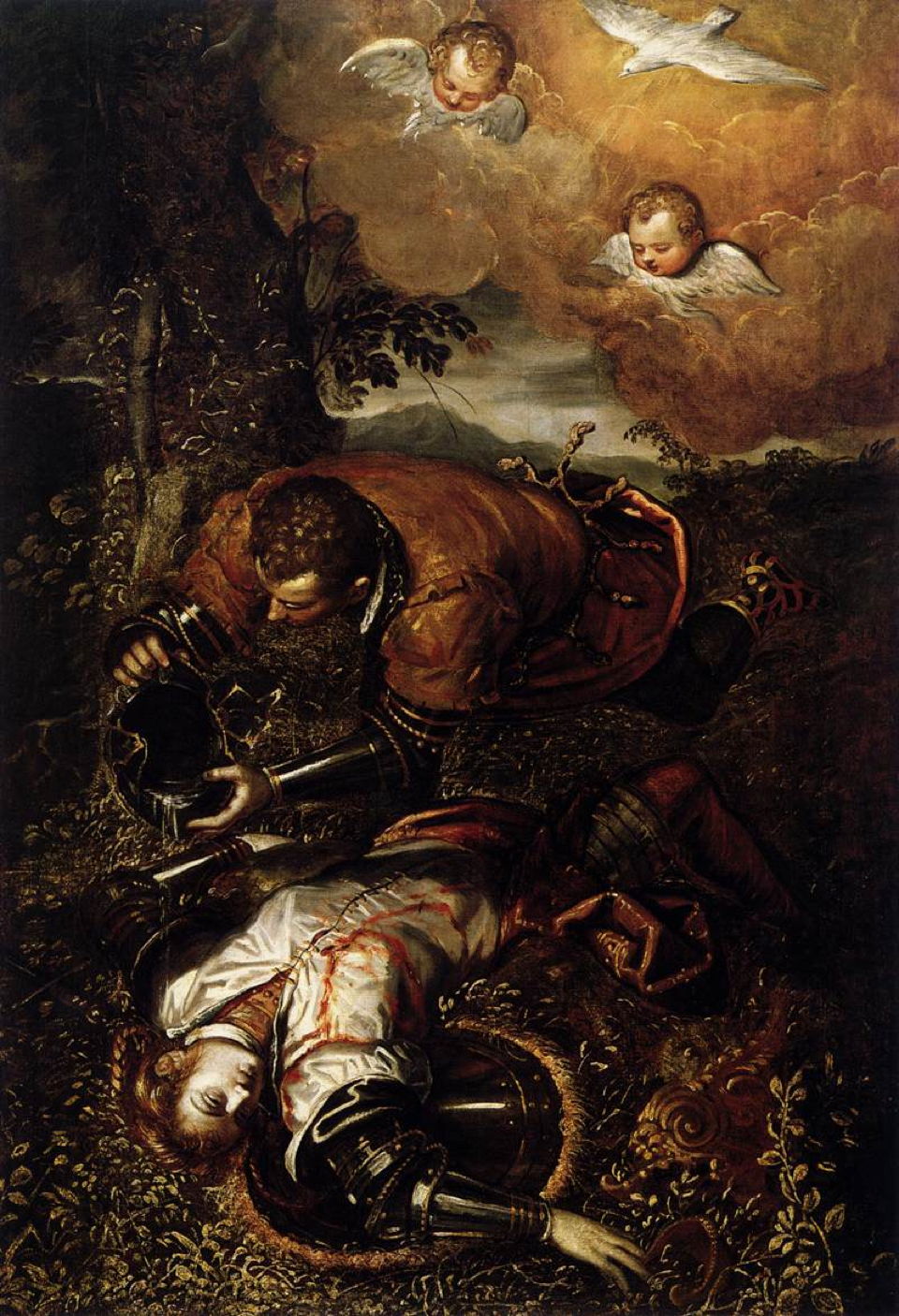
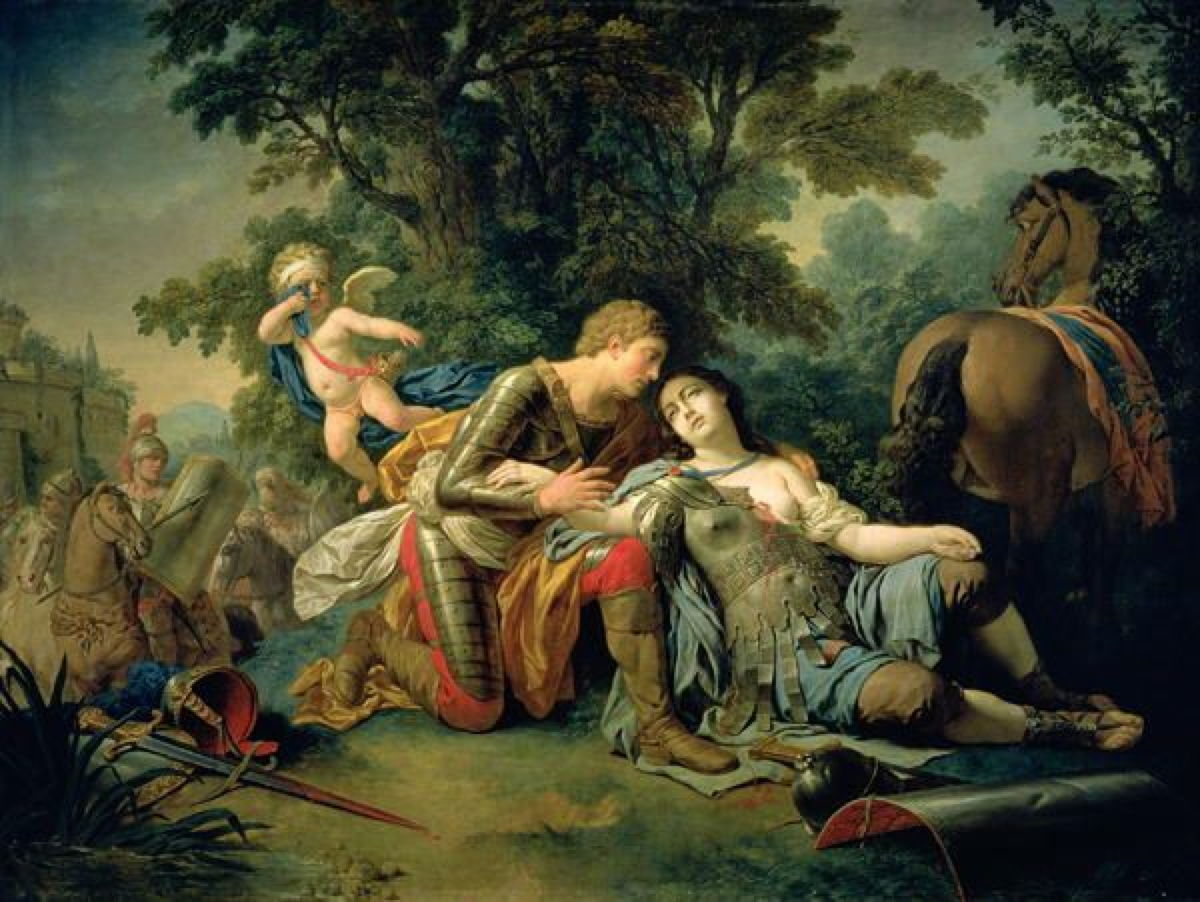
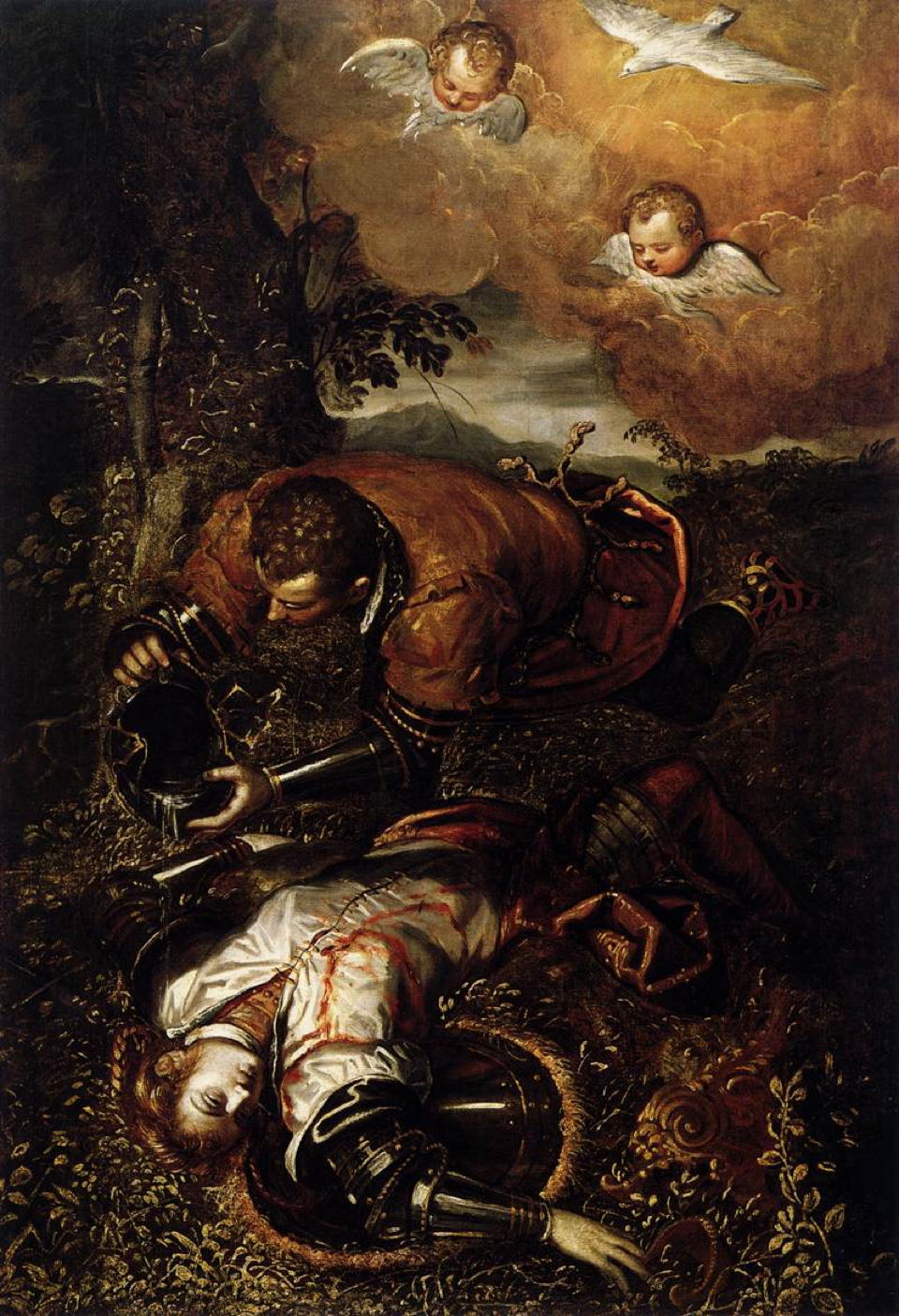
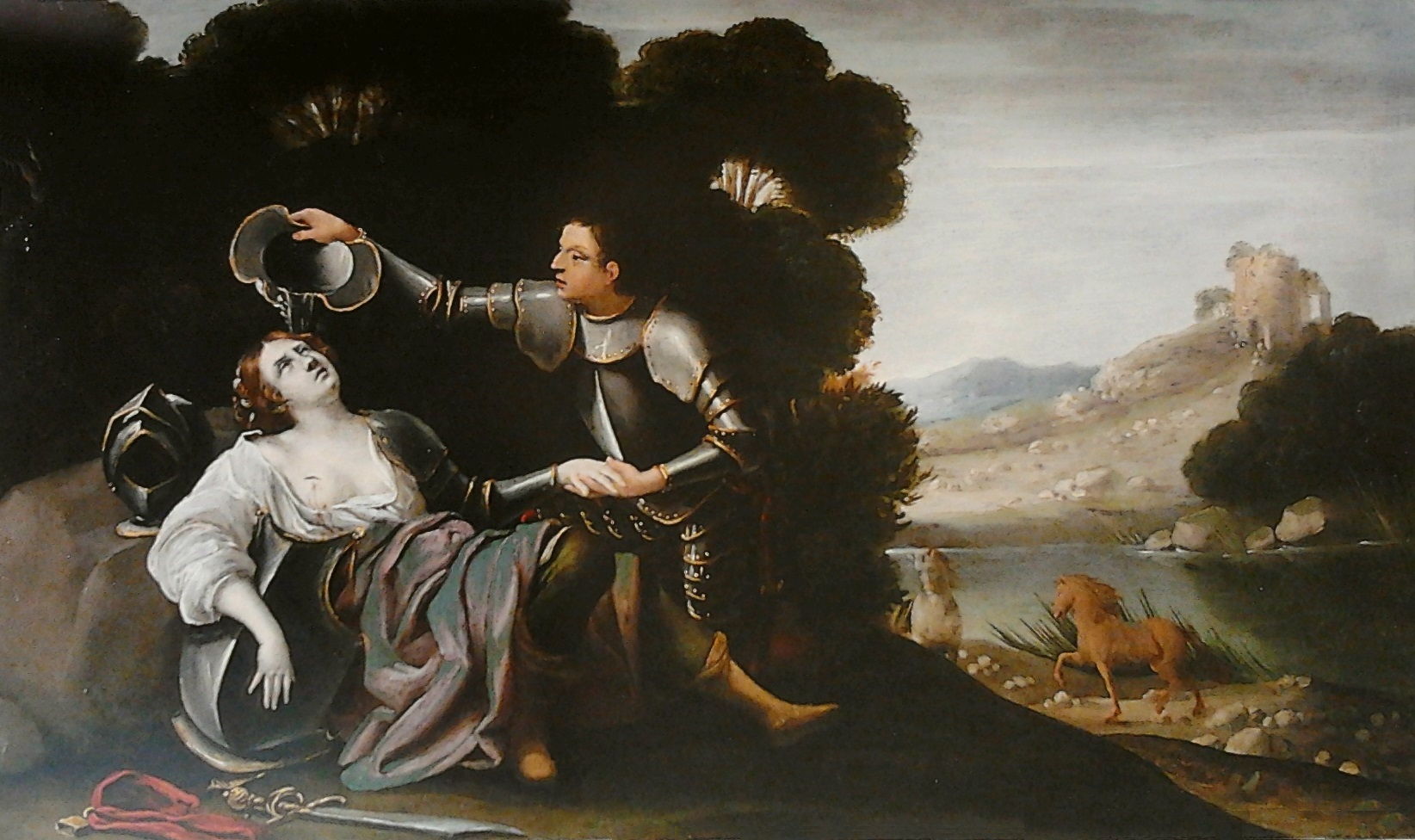
Tancred finally asks who she is. She refuses to tell, and they fight on, to the inevitable moment when Tancred sinks his sword deep into her chest. Her legs collapse from under her. In a frail voice she tells him she forgives him, and asks that he baptises her. Tancred runs over to a nearby stream and fills his helmet with water. When he gets back to her, he removes her helmet and sees that it is his love Clorinda dying in his arms. He baptises her, and in her last breath she says that she goes in peace.

One of the most moving moments in the whole of Tasso’s epic, this has proved a challenge to paint: it’s still night, perhaps with the faintest light of dawn to the east, and there’s a complex sequence of events and details.

lagreneetancredclorinda
Louis-Jean-François Lagrenée (1725–1805), Tancred and Clorinda (1761), further details not known. Wikimedia Commons.

Louis-Jean-François Lagrenée’s Tancred and Clorinda from 1761 shows this in daylight, and without reference to Clorinda’s baptism. Tancred’s helmet and bloodied sword lie at the left, and the only slightly bloodied Clorinda swoons away against his left knee. Above them is Cupid, in a pose suggestive of his bow and arrow but actually wiping a tear from his eye. Oddly, Lagrenée balances him against the hindquarters of Tancred’s horse, an unfortunate compositional choice.

tintorettodomenicotancredbaptizingclorinda
Domenico Tintoretto (1560–1635), Tancred Baptizing Clorinda (c 1585), oil on canvas, 168 x 115 cm, Museum of Fine Arts, Houston, TX. Wikimedia Commons.

Jacopo Tintoretto’s son Domenico must have painted his Tancred Baptizing Clorinda in about 1585, just a few years after the epic’s first publication. Although generally rated far below his father, this painting is rather special. It captures the light well, and Tancred’s rushed baptism under the watchful eye of the white dove of the Holy Spirit and two cherubic angels.

anonbaptismclorinda1625
Artist not known, The Baptism of Clorinda (c 1625), oil on canvas, dimensions not known, Zamek Królewski w Warszawie, Warsaw, Poland. Wikimedia Commons.

This anonymous painting of The Baptism of Clorinda thought to be from about 1625 tells the story fairly faithfully, and provides a source of water in the distance.

anontancredbaptisesclorinda1650
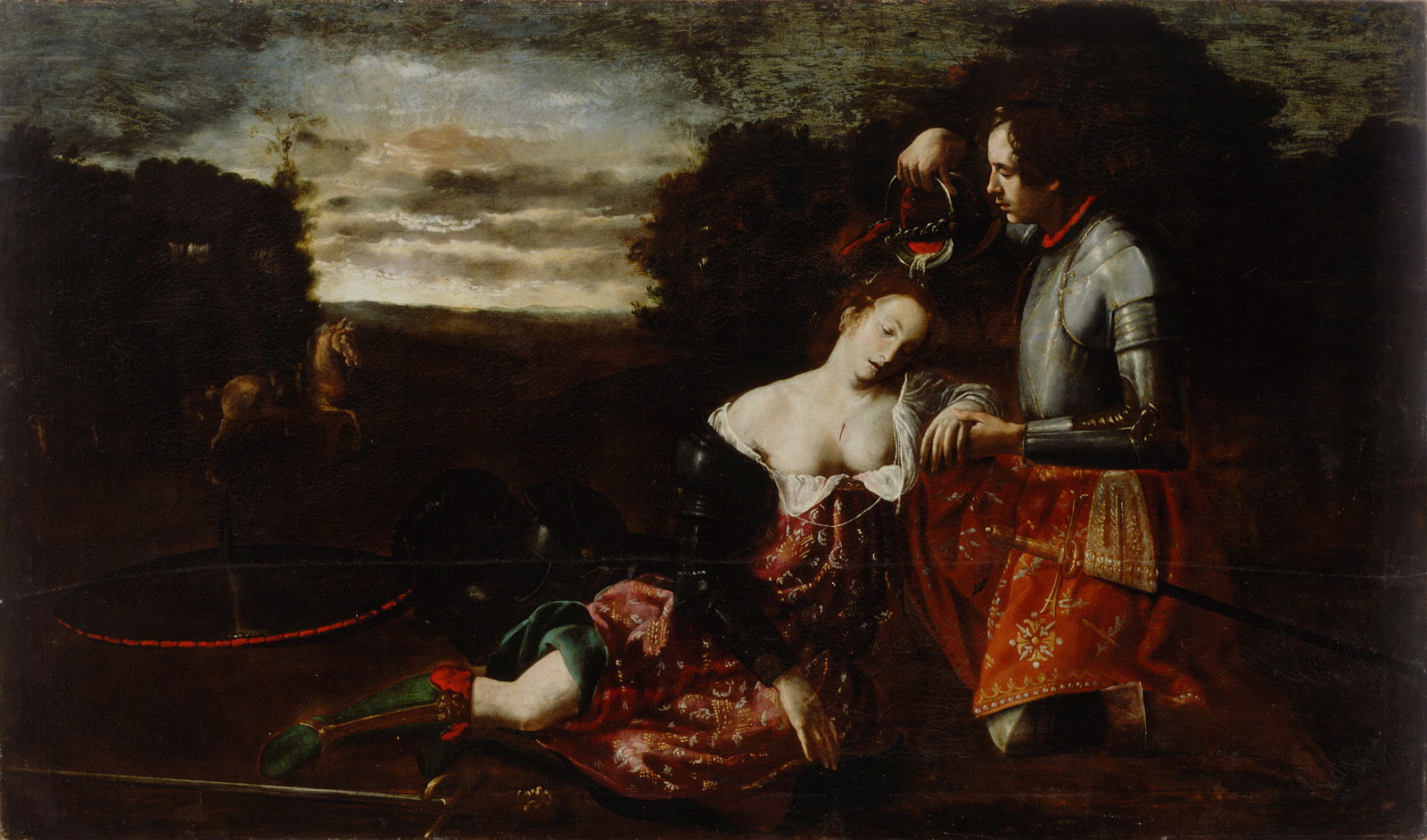
Artist not known, Tancred Baptises Clorinda (c 1650), oil on canvas, 107 x 181 cm, Narodna galerija Slovenije, Ljubljana, Slovenia. Wikimedia Commons.

Another painting by an unidentified artist, Tancred Baptises Clorinda from about 1650, is more faithful to the time of day. The strange red arc at the left is the edging of a circular shield resting on the ground.

ivanovtancredclorinda
Andrey Ivanovich Ivanov (1775–1848), Tancred and Clorinda (c 1798), oil on canvas, 114 x 87.5 cm, Ekaterinburg Museum of Fine Arts Екатеринбургский музей изобразительных искусств, Yekaterinburg, Russia. Wikimedia Commons.

Andrey Ivanovich Ivanov’s Tancred and Clorinda from about 1798 again sets this in daylight, and avoids any trace of blood.

overbeckdeathclorinda
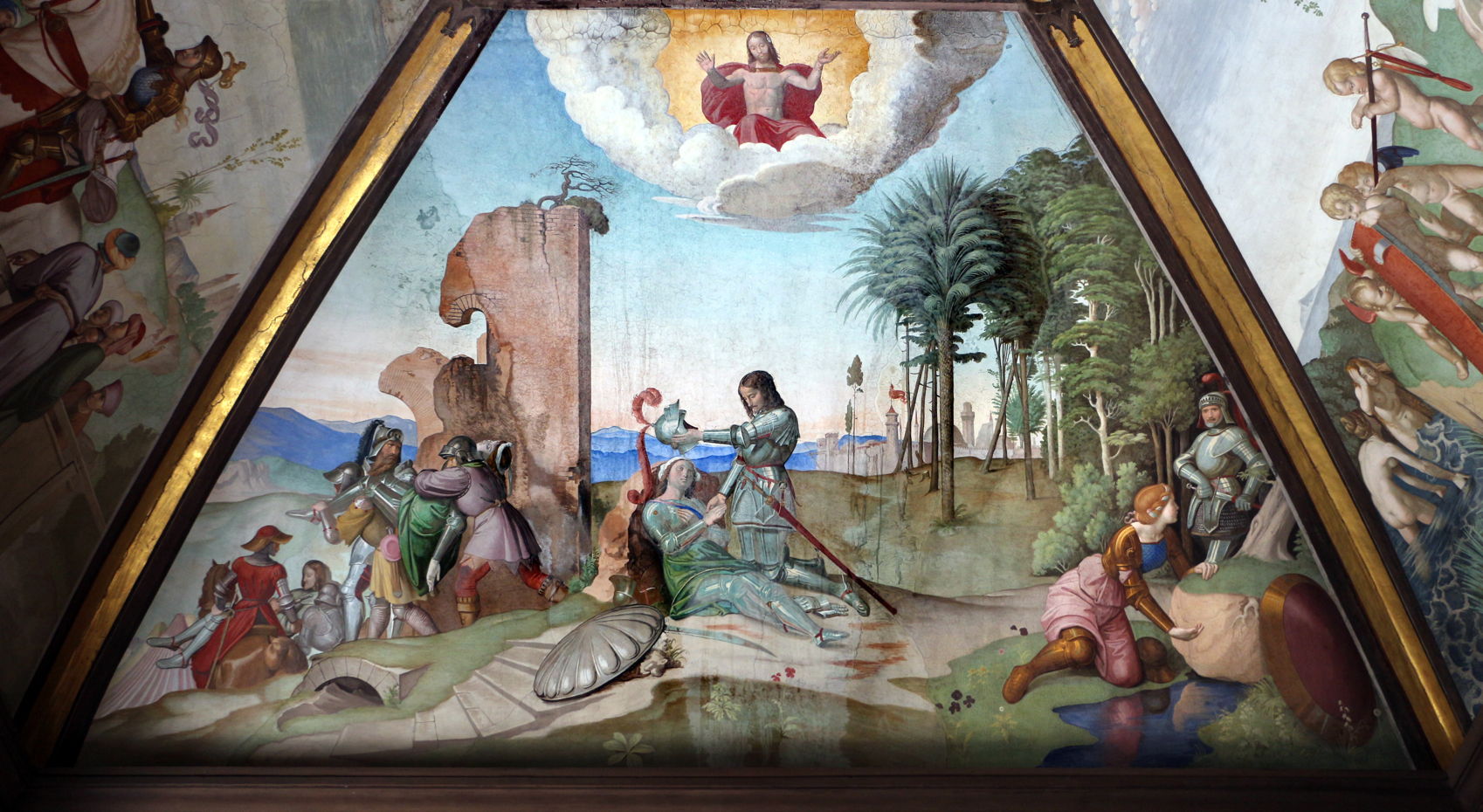
Johann Friedrich Overbeck (1789-1869), The Death of Clorinda (1819-27), fresco, dimensions not known, Casa Massimo, Rome, Italy. Image by Sailko, via Wikimedia Commons.

By far the most fascinating depiction, though, is that of Johann Friedrich Overbeck’s fresco in the Casa Massimo, Rome, painted between 1819-27. The section showing The Death of Clorinda features her baptism in the centre, and places the city of Jerusalem in the distance. It also includes two other scenes involving other characters from the epic, and the unmistakable figure of Christ watching from heaven above.

References

Wikipedia on Jerusalem Delivered.
Wikipedia on Torquato Tasso.

Project Gutenberg (free) English translation (Fairfax 1600).

Librivox audiobook of the Fairfax (1600) English translation (free).

Thomas Asbridge (2004) The First Crusade, A New History, Free Press, ISBN 978 0 7432 2084 2.
Anthony M Esolen, translator (2000) Torquato Tasso, Jerusalem Delivered, Gerusalemme Liberata, Johns Hopkins UP. ISBN 978 0 801 863233. A superb modern translation into English verse.
John France (1994) Victory in the East, a Military History of the First Crusade, Cambridge UP. ISBN 978 0 521 589871.
Joanthan Riley-Smith, ed (1995) The Oxford Illustrated History of the Crusades, Oxford UP. ISBN 978 0 192 854285.
Jonathan Riley-Smith (2014) The Crusades, A History, 3rd edn., Bloomsbury. ISBN 978 1 4725 1351 9.
Johathan Unglaub (2006) Poussin and the Poetics of Painting, Pictorial Narrative and the Legacy of Tasso, Cambridge UP. ISBN 978 0 521 833677.
Jerusalem Delivered: 5 First skirmish and a sorceress

Those able-bodied Christians who were banished from the city of Jerusalem, together with Sophronia and Olindo, are gathering at the nearby town of Emmaus, where the crusaders have just arrived on their way to lay siege to the city.

As the crusaders are camping there at dusk, two ambassadors arrive from the king of Egypt: Alete, and Argante the Circassian. They are taken to meet Godfrey, and Tasso devotes the remainder of the second canto to their discussions. Alete courteously and diplomatically invites Godfrey to call a halt to the crusade before he attacks Jerusalem. He warns that continuing on his current course could bring the king of Egypt against him, and when united with Persian and Turkish forces, he would be heavily outnumbered. In return for stopping short of Jerusalem, Alete offers a truce and free passage to safety.

Godfrey politely rejects the offer, stressing how it is God’s hand that directs the crusaders. Argante is brief and blunt, and tells Godfrey that his rejection means war. When they leave, Alete returns to Egypt, and Argante to Jerusalem. That night, Godfrey and his army cannot sleep.

The third canto opens at dawn on the following day, as the crusaders march onward, and get their first sight of Jerusalem the Holy City. Within its walls, a sentinel sees the approaching army, first from the cloud of dust it throws up as it draws closer. He calls the citizens to defend their city; the old, young, and those unable to help in the defence go and shelter in its mosques.

Jerusalem’s ruler Aladine does his rounds of the defences, and calls for the company of Erminia, daughter of the dead former king of Antioch, who managed to flee to safety in Jerusalem when her father’s city fell to the crusaders.

pretierminia
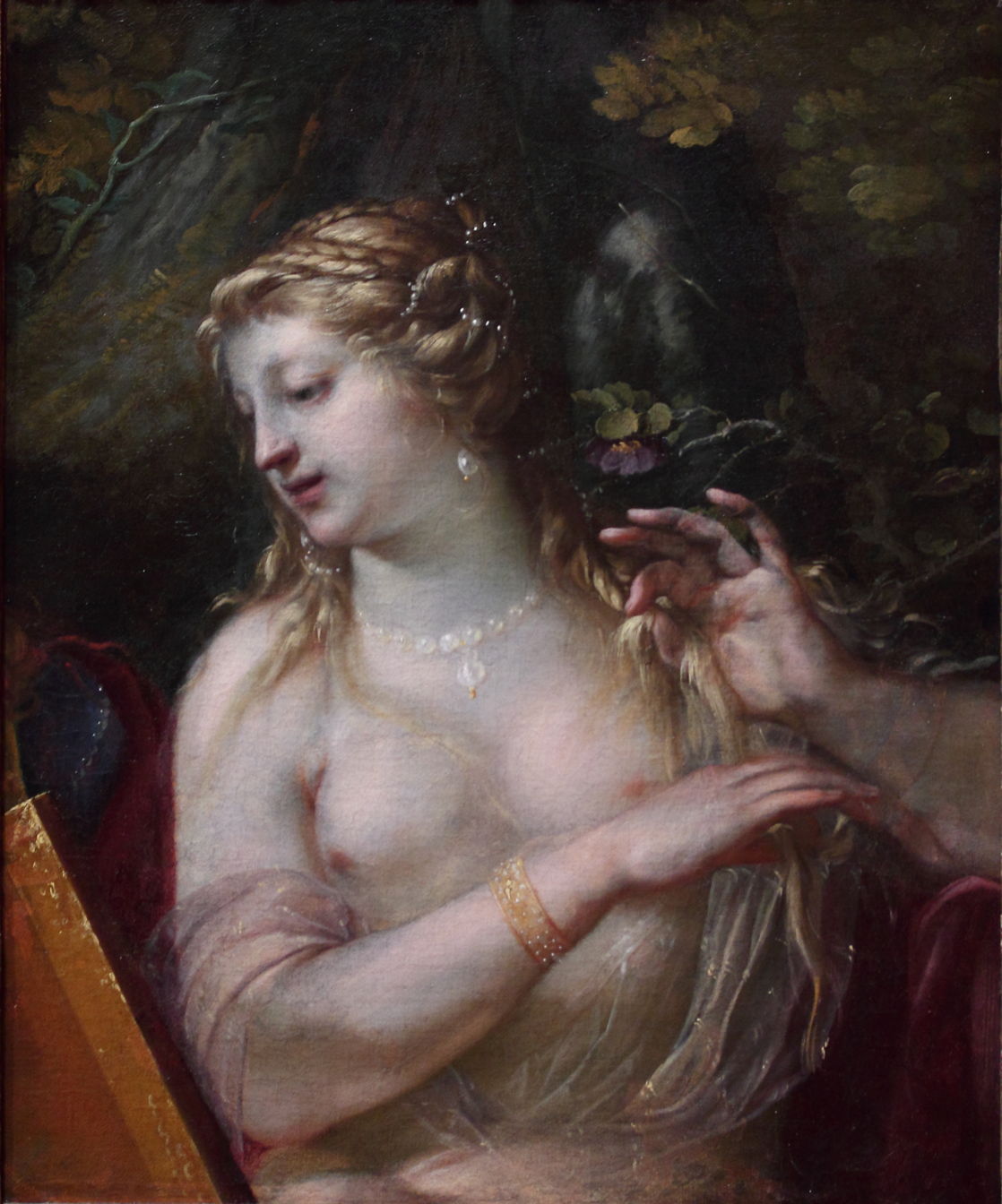
Mattia Preti (1613–1699), Erminia, Princess of Antioch (date not known), oil on canvas, 98 x 73 cm, location not known. Wikimedia Commons.

Mattia Preti’s Erminia, Princess of Antioch, painted in the middle of the seventeenth century, shows her exuding nobility, with shoulder-length hair. She is reading an unintelligible inscription on a tree.

Clorinda leads the city’s troops out to attack the French crusaders, with Argante the Circassian holding himself in reserve in a secret gate in the city’s wall. She heads an attack on an advance party of crusaders who have been sent on to scavenge for livestock and crops to feed the army.

The captain of the city’s defenders is quickly knocked to the ground, but Clorinda weighs in and forces the French into retreat. They regroup on a hill, just as Godfrey sends Tancred and his troops to support them. Aladine is watching this with Erminia alongside him, and asks her to identify Prince Tancred from her experience at Antioch. Erminia cannot reply, as she chokes back tears, but finally tells Aladine of her desire to make him captive for her “sweet revenge”.

On the battlefield in front of them, Clorinda and Tancred charge at one another. Their lances strike the other’s visor and shatter, but Tancred’s blow knocks Clorinda’s helmet off, unfurling her long, golden hair. Tancred is thunderstruck by this revelation.

She charges at him a second time, but he turns away and attacks others with his sword. She chases after him, brandishing her sword and calling for him to turn and fight her. He refuses to respond to the blows from her sword, but calls on her to settle the matter away from the main battle. He then asks her to agree the terms on which she will fight. He proposes that she should remove his heart, drops his weapon, and bares his chest to her.

finogliajerusalem
Paolo Domenico Finoglia (1590–1645), Tancred Faces Clorinda (1640-45), media and dimensions not known, Palazzo Acquaviva, Conversano, Italy. Wikimedia Commons.

Paolo Domenico Finoglia’s painting of Tancred Faces Clorinda from 1640-45 shows this tense moment, when Tancred, his sword held low and away from Clorinda (who surprisingly has dark brown hair), makes clear his love for her. The battle rages on behind them.

Elsewhere, the crusaders are getting the better of Jerusalem’s forces, and the latter are starting to retreat to the city. One of the crusaders prepares to strike Clorinda from behind with his sword, but Tancred parries it away. It still strikes her neck a glancing blow, and blood from a small wound starts to colour her blonde hair. Clorinda seizes the opportunity to run back to her troops and join their retreat.

As the city troops reach the walls, they stop and wheel round to attack the rear of their pursuers. At the same time, Argante sends a small team out to attack their front. Argante leads them, and he and Clorinda start to gain victims from among overreaching crusaders. These are from Dudon’s ‘Adventurers’, with Rinaldo in the lead. Erminia tells Aladine about Rinaldo’s great skills in battle, and then points out their leader Dudon, and Gernando, brother of the king of Norway, and a married couple, Edward and Gildippe, who always fight side by side.

overbeckarganterinaldoclorinda
Johann Friedrich Overbeck (1789-1869), Argante, Rinaldo and Clorinda in Battle (1819-27), fresco, dimensions not known, Casa Massimo, Rome, Italy. Image by Sailko, via Wikimedia Commons.

Johann Friedrich Overbeck’s fresco of Argante, Rinaldo and Clorinda in Battle (1819-27), in the Casa Massimo in Rome, may show another scene from this battle, although here it would make more sense if the unhelmeted Clorinda were with Tancred rather than Rinaldo. Another puzzle is the white smock bearing the red cross of a crusader, being worn by Clorinda.

Rinaldo and Tancred now break through, and Rinaldo strikes Argante so hard he can barely get up again. Rinaldo’s horse is then struck, and he’s forced to pause while he extracts his foot from underneath it. The remaining city troops make the safety of the walls, leaving Argante and Clorinda to guard their rear. Dudon presses on, killing four of Argante’s men and threatening Argante himself, who manages to sink the blade of his sword deep into Dudon’s body.

Argante doesn’t hang around, but gets back to the wall, as the citizens start hurling rocks and loosing arrows at the crusaders. Rinaldo, free at last from his horse, is fired by the death of Dudon, and charges at the city troops despite the hail of rocks and arrows. He and the other crusaders pull up short, and they too turn away from the fight, recovering the body of Dudon on the way.

Godfrey has taken the opportunity to study the city and its defences, and notes that its approach is difficult on three of its four sides, but easiest from the north, where it’s most strongly fortified.

As he is weighing up where best to pitch camp, Erminia points him out to Aladine, who recognises him from a meeting when he was an Egyptian diplomat to the court of France. Also identified, standing next to Godfrey, is his brother Baldwin, and on his other side Raymond, William son of the king of England, and Guelph, but Bohemond (who killed Erminia’s family) is nowhere to be seen.

Godfrey decides that, as he has insufficient troops to encircle the city, he will station them at all its points of entry, and that they will dig in using ditches to prevent surprise attacks. He then goes off to join those mourning the death of Dudon in the dark night.

Overnight, Godfrey makes further plans. Recognising the strength of the city’s walls, he tries to work out where he can acquire timber to build siege towers. At first light, he joins Dudon’s funeral. After that, he has a Syrian take him to the only woods in the area, where he sets men to work felling those trees in preparation. That ends the third canto.

The fourth canto opens with a long and florid account of pagan visions of the underworld conjured up in Aladine’s mind, and an accompanying speech by Satan to inspire the “pagans” of Jerusalem to defeat the crusaders. This leads to the introduction of Hydrotes, a “magician” who rules Damascus and its neighbouring cities, whose niece is the beautiful sorceress Armida.

blanchardarmide
Jacques Blanchard (1600–1638), Armida (date not known), oil on canvas, dimensions not known, Musée de Beaux-Art de Rennes, Rennes, France. Image by Caroline Léna Becker, via Wikimedia Commons.

Jacques Blanchard’s undated portrait of Armida, probably from around 1630, shows her dangerously alluring like Circe.

Hydrotes sees Armida as central to his grand plan to defeat the crusaders, and directs her to the enemy camp, to win the warriors over, and make Godfrey infatuated with her. Armida rises to the challenge, and travels through the night to enter the crusaders’ camp. She quickly beguiles the men there, and can twist them around her little finger.

Armida spins the crusaders a story of how she has fallen on bad times, and calls on Godfrey to shelter her. She bumps into his brother, and in no time is speaking with Godfrey himself.

teniersarmidabeforegodfrey
David Teniers the Younger (1610–1690), Armida before Godfrey of Bouillon (1628-30), oil on copper, 27 x 39 cm, Museo Nacional del Prado, Madrid, Spain. Wikimedia Commons.

David Teniers the Younger shows this scene in this wonderful painting in oil on copper of Armida before Godfrey of Bouillon, from 1628-30. The sorceress is seen with a small lapdog and a couple of young maids, as might befit a contemporary woman of her standing. Next to the young Godfrey is Peter the Hermit, with his long white beard.

After introductory flattery, Armida proceeds to tell Godfrey a long sob story, from the death of her mother just prior to her birth, to the threat of torture and death for her and her friends because she was alleged to have conspired to poison a tyrant. All she needs are ten of Godfrey’s best knights to go and sort that king out.

Godfrey sat and thought about her request.

References

Wikipedia on Jerusalem Delivered.
Wikipedia on Torquato Tasso.

Project Gutenberg (free) English translation (Fairfax 1600).

Librivox audiobook of the Fairfax (1600) English translation (free).

Thomas Asbridge (2004) The First Crusade, A New History, Free Press, ISBN 978 0 7432 2084 2.
Anthony M Esolen, translator (2000) Torquato Tasso, Jerusalem Delivered, Gerusalemme Liberata, Johns Hopkins UP. ISBN 978 0 801 863233. A superb modern translation into English verse.
John France (1994) Victory in the East, a Military History of the First Crusade, Cambridge UP. ISBN 978 0 521 589871.
Joanthan Riley-Smith, ed (1995) The Oxford Illustrated History of the Crusades, Oxford UP. ISBN 978 0 192 854285.
Jonathan Riley-Smith (2014) The Crusades, A History, 3rd edn., Bloomsbury. ISBN 978 1 4725 1351 9.
Johathan Unglaub (2006) Poussin and the Poetics of Painting, Pictorial Narrative and the Legacy of Tasso, Cambridge UP. ISBN 978 0 521 833677.
Jerusalem Delivered: 4 Advance to Emmaus

My previous articles in this series provided a short summary of the First Crusade, setting the context for Torquato Tasso’s epic Jerusalem Delivered, which opens with a conventional dedication to the muse, and homage to his patron, Alfonso II of Este.

Tasso’s narrative starts with events six years after the Pope’s call to crusade (actually in late 1095), and briefly mentions the capture of Nicaea and Antioch, to set the opening scene in the following winter (1098-99), with the crusaders in their quarters at ‘Tortosa’. That is now known as Tartus in Syria, a port on the Mediterranean coast well to the south of Antioch.

Tasso gives an overview of the main figures of the First Crusade through the eyes of God:

  • Godfrey of Bouillon, whom he praises as a hero;
  • Baldwin, with his ‘vain ambition’;
  • Tancred, who is suffering the pangs of love;
  • Bohemond, who is bringing law and order to Antioch as its ruler;
  • Rinaldo, the courageous and restless warrior.
blondeltancred
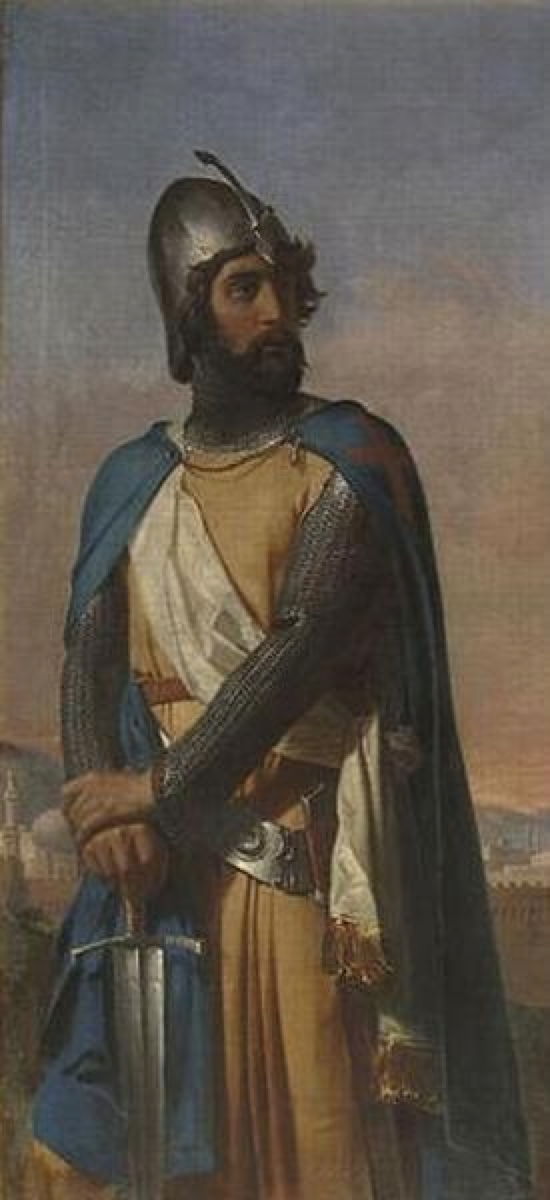
Merry-Joseph Blondel (1781–1853), Tancred of Hauteville, Prince of Galilee (1840), oil on canvas, 167 x 78 cm, Château de Versailles, Versailles, France. Wikimedia Commons.

Three of these figures are well-known, and appear in various paintings, but Tasso reinvents those of Tancred and Rinaldo, the heroes of his epic. Merry-Joseph Blondel’s painting of Tancred of Hauteville, Prince of Galilee from 1840 shows Tancred rather later during the Crusade, looking suitably grand.

God therefore sends down the Archangel Gabriel to spur Godfrey to lead the Crusaders onwards to free Jerusalem, which the archangel does just as Godfrey is at his morning prayers.

overbeckarchangelgabrielgodfrey
Johann Friedrich Overbeck (1789-1869), The Archangel Gabriel Appears to Godfrey of Bouillon (1819-27), fresco, dimensions not known, Casa Massimo, Rome, Italy. Image by Sailko, via Wikimedia Commons.

In this section of Johann Friedrich Overbeck’s magnificent frescoes in the Casa Massimo, in Rome, The Archangel Gabriel Appears to Godfrey of Bouillon. His companions are still asleep as Gabriel speaks to Godfrey, clutching what most would now recognise as a flag of the Cross of Saint George, in red on a white background.

guardigodfreyboulogne
Francesco Guardi (1712–1793), Godfrey of Boulogne Summons His Chiefs to Council (c 1755), oil on canvas, 250.2 x 109.9 cm, Norton Simon Museum, Pasadena, CA. Wikimedia Commons.

Francesco Guardi shows a slightly later moment, as the archangel flies away from the scene, and Godfrey of Boulogne Summons His Chiefs to Council (c 1755).

All the leaders except Bohemond attend this meeting, at which Godfrey reminds them of their primary mission, to deliver the Holy City of Jerusalem, and the need to make haste towards it. Peter the Hermit then speaks in support, castigating the individual leaders for their in-fighting and rivalry. The leaders agree to Godfrey being in overall command.

The following morning, their troops parade as they prepare to set off to travel south along the coast. This provides Tasso with the opportunity to enumerate them:

  • French, from the Île de France, formerly led by Hugh, now by Clothar, one thousand;
  • Norman cavalry under Robert, one thousand;
  • former priests from the Low Countries under Bishops William and Ademar, totalling eight hundred;
  • forces of Godfrey and his brother Baldwin, with the Count of Chartres too, 1600 in all;
  • Germans from between the Danube and the Rhine, under Guelph, less than two thousand;
  • Dutch and Flemish, under another Robert, two thousand total;
  • English, under William, the son of the king, slightly more than two (or one?) thousand;
  • Irish, no leader or number given;
  • from Campania, under Tancred, eight hundred;
  • Greece, led by Tatin, just two hundred;
  • ‘adventurers’, or unattached and mercenaries, led by Dudin of Contz, no number given;
  • men from the Pyrenees, under Raymond of Toulouse, four thousand;
  • men from Blois and Tours, under Stephen of Ambois, five thousand;
  • Swiss, under Alcasto, six thousand;
  • Italians, under Camillus, seven thousand.

Tasso gives a grand total of around thirty-five thousand, which is probably more than double the number of surviving crusaders at this stage.

In his remarks about Tancred, Tasso tells the story of him falling in love at first sight with a young girl clad in armour, during a battle in which Persians were put to flight. Tancred had gone to a brook to cool off afterwards, when this ‘pagan’ arrived for the same purpose. She then left, donning her helmet, without Tasso even revealing her name at this stage.

The army’s departure is made the more urgent as Godfrey has heard the ruler of Egypt with his army is on his way to his fortress at Gaza, which could be used to attack the crusaders as they approach Jerusalem. Godfrey then sends his trusty messenger by boat to Greece, to obtain reinforcements promised by the king.

The next day they depart to the sound of trumpets and drums. Godfrey sends lightly-armoured knights to scout in advance and ensure the main army isn’t ambushed, and field engineers to ensure their route of march is free from obstacles. The crusaders meet little opposition as they make their way south: even the King of Tripoli capitulates and welcomes them into his well-defended city.

As they march down the coast, they receive ships from several of their supporting countries bringing them provisions.

Word of their progress reaches Aladine, ruler of Jerusalem, who, being newly in charge of the city, already has other concerns. He had raised taxes on the Christian minority in Jerusalem, and harbours ideas of killing them all. He doesn’t attempt that, but burns their harvest, demolishes their huts, and poisons their wells, while strengthening the city’s fortifications.

The second Canto starts with Aladine in Jerusalem. A former Christian soothsayer, Ismen, warns the ruler to prepare for the arrival of the crusaders, but predicts that Aladine will be triumphant. Ismen then asks for a sacred icon of the Virgin Mary to be secretly stolen and hidden away to protect the ruler.

Aladine has this done, but the theft is noticed by a guard, who reports it to the ruler. The latter then claims that it must have been stolen by a Christian, and has the city searched. He decrees that the thief will die, but if no thief is found, it provides him with an excuse for killing all the Christians. He incites a mob, calling for them to “burn and kill”.

A young Christian woman named Sophronia, who is in love with the Christian Olindo, then comes forward and tells Aladine that it was she, and she alone, who stole the icon. When the ruler asks her where it is hidden she responds that she burned it. Sophronia is condemned to death by being burned at the stake.

As the crowds are gathering to watch her die, Olindo arrives, and insists that she is not the thief. Although he gives Aladine an account of how he accomplished this, the ruler of course knows that neither did. But he cannot back down, and sentences Olindo to die at the same stake, tied with his back to his love, so they cannot see one another as they die.

bauginolindosofroniapyre
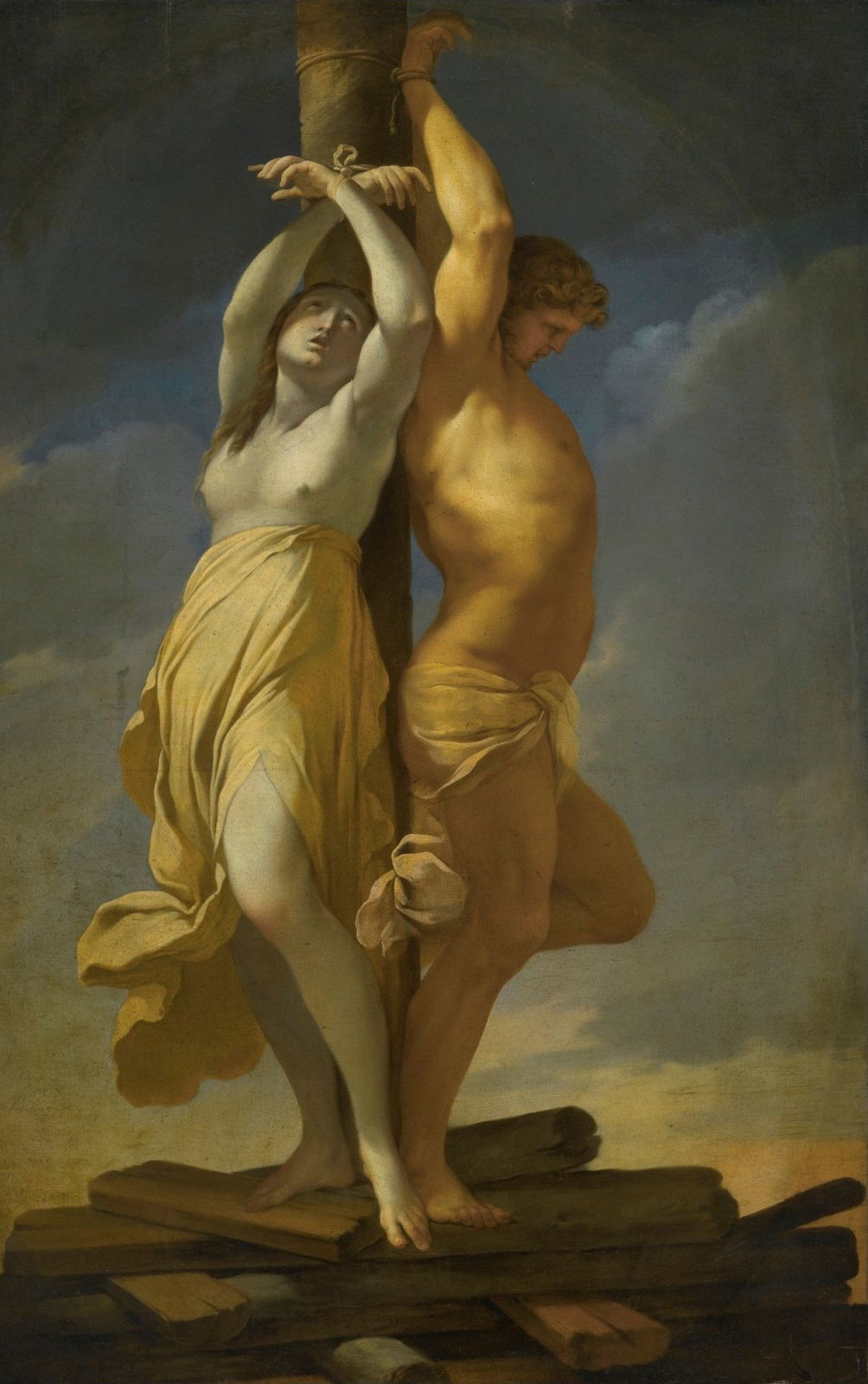
Lubin Baugin (1612–1663), Olindo and Sophronia on the Pyre (c 1645), oil on canvas, 157.5 × 111.8 cm, location not known. Wikimedia Commons.

Lubin Baugin’s dramatically simple painting from about 1645 shows Olindo and Sophronia on the Pyre.

Just as Aladine’s men are about to light the kindling and kill the Christian couple, who are making their farewell speeches, a warrior rides up. This is Clorinda, a beautiful young woman, who is moved by the sight of the two lovers about to die together. When a bystander explains what is happening, she instructs the executioners to stop their preparations as she speaks to Aladine.

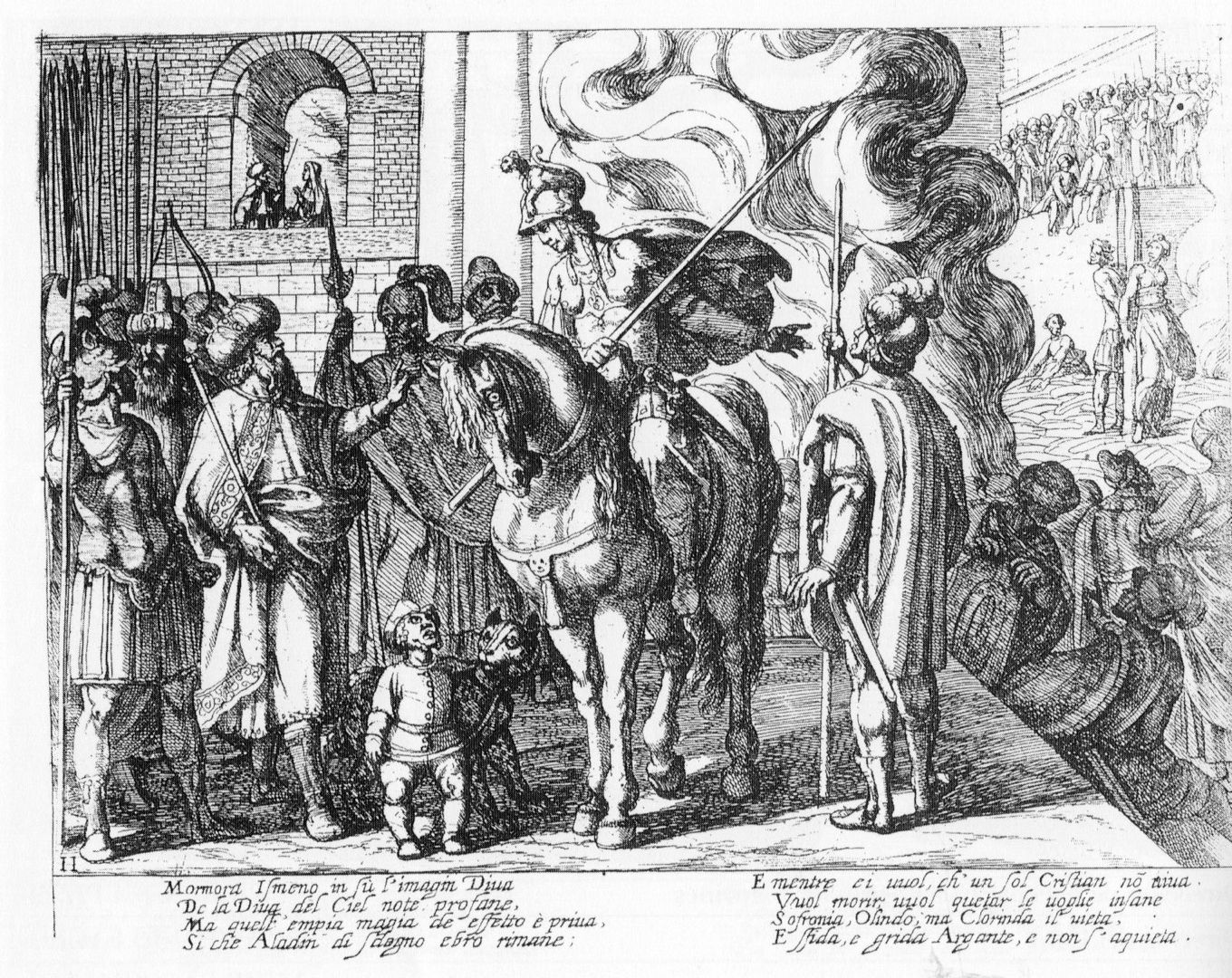
Clorinda introduces herself to Aladine, and offers her services. In return, she asks that he frees Sophronia and Olindo, on the grounds that no Christian would have stolen such a holy icon. This has proved a popular scene with a succession of artists, from shortly after the publication of Tasso’s epic up to the middle of the nineteenth century.

tempestaolindosofronia
Antonio Tempesta (1555–1630), illustration from Tasso’s ‘Gerusalemme Liberata’ (c 1597), engraving, further details not known. Wikimedia Commons.

Antonio Tempesta’s engraved illustration from about 1597 puts Clorinda in the centre foreground, as she talks to Aladine at the left. The couple are shown at a stake to the far right, in the background.

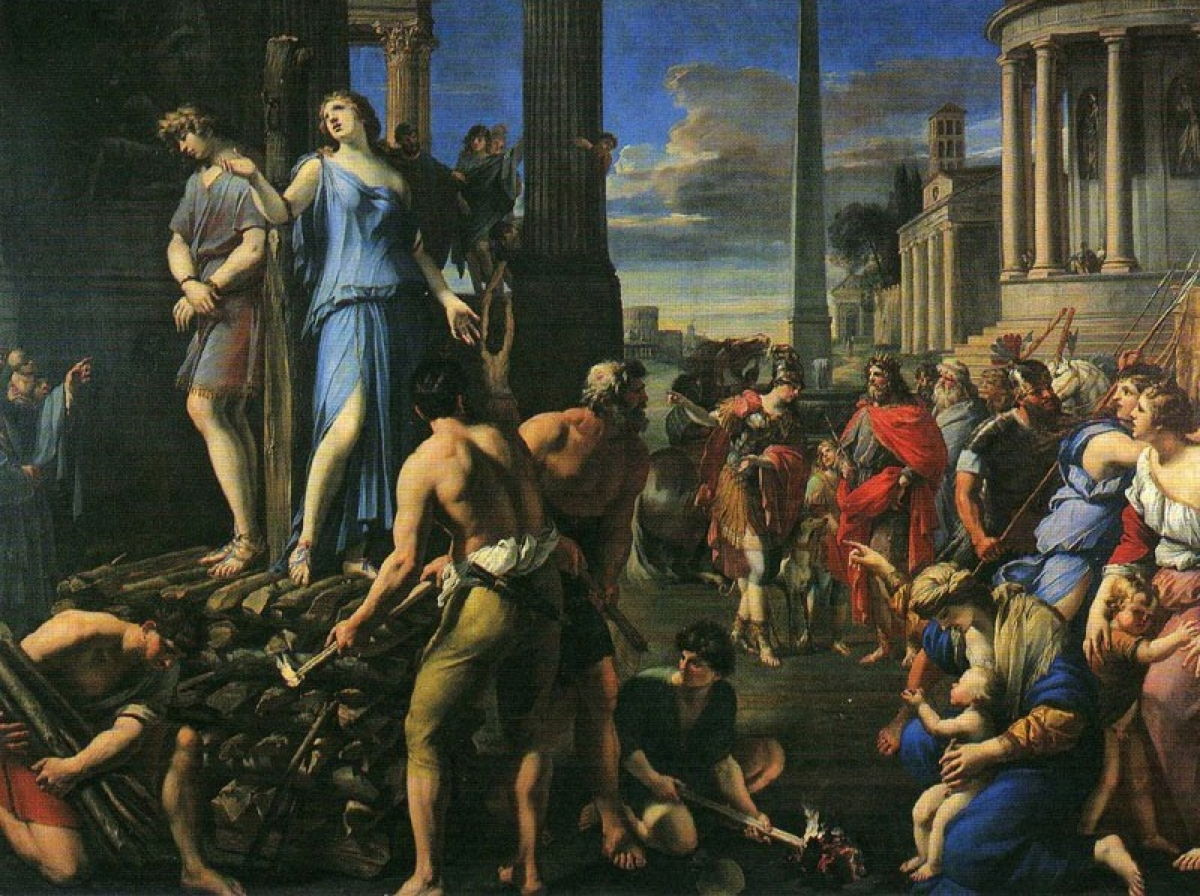
perrierolindosofronia
François Perrier (1594–1649), Olindo and Sophronia (c 1639), media and dimensions not known, Musée des beaux-arts de Reims, Reims, France. Wikimedia Commons.

François Perrier’s Olindo and Sophronia from about 1639 reverses this, with Clorinda and Aladine in the distance at the right, and the young couple standing as their executioners prepare the pile of wood for burning.

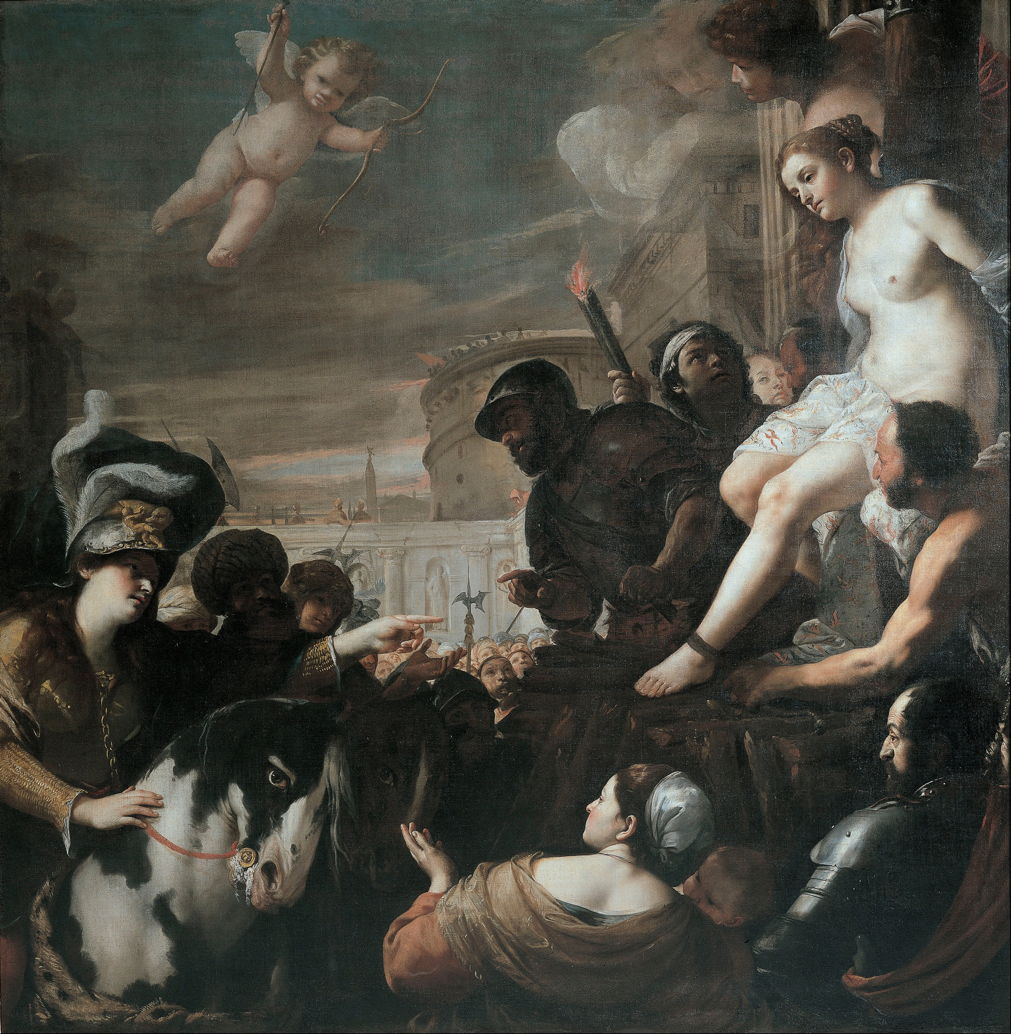
preticlorindarescuesolindo
Mattia Preti (1613–1699), Clorinda rescues Olindo and Sophronia (1646), media not known, 248 x 245 cm, Musei di Strada Nuova, Genoa, Italy. Wikimedia Commons.

Mattia Preti brings them all together in Clorinda Rescues Olindo and Sophronia from 1646, with a man stood behind Aladine bearing a burning brand. In the sky is a Cupid, and Sophronia is almost unclad.

vanpoelenburghclorindasavingolindo
Cornelius van Poelenburgh (1594/95–1667), Clorinda Saving Olindo and Sophronia from the Stake (date not known), further details not known. Wikimedia Commons.

Cornelius van Poelenburgh’s undated Clorinda Saving Olindo and Sophronia from the Stake is less structured and more expansive. Clorinda is on her horse at the right, and a naked Sophronia stands at the stake in the centre.

overbecksofroniaolindosaved
Johann Friedrich Overbeck (1789-1869), Sophronia and Olindo Saved by Clorinda (1819-27), fresco, dimensions not known, Casa Massimo, Rome, Italy. Image by Sailko, via Wikimedia Commons.

Although painted almost two centuries later, Overbeck’s fresco of Sophronia and Olindo Saved by Clorinda (1819-27) is less cluttered and easier to read. Unusually, Clorinda is shown riding a white charger, and with golden rather than black armour.

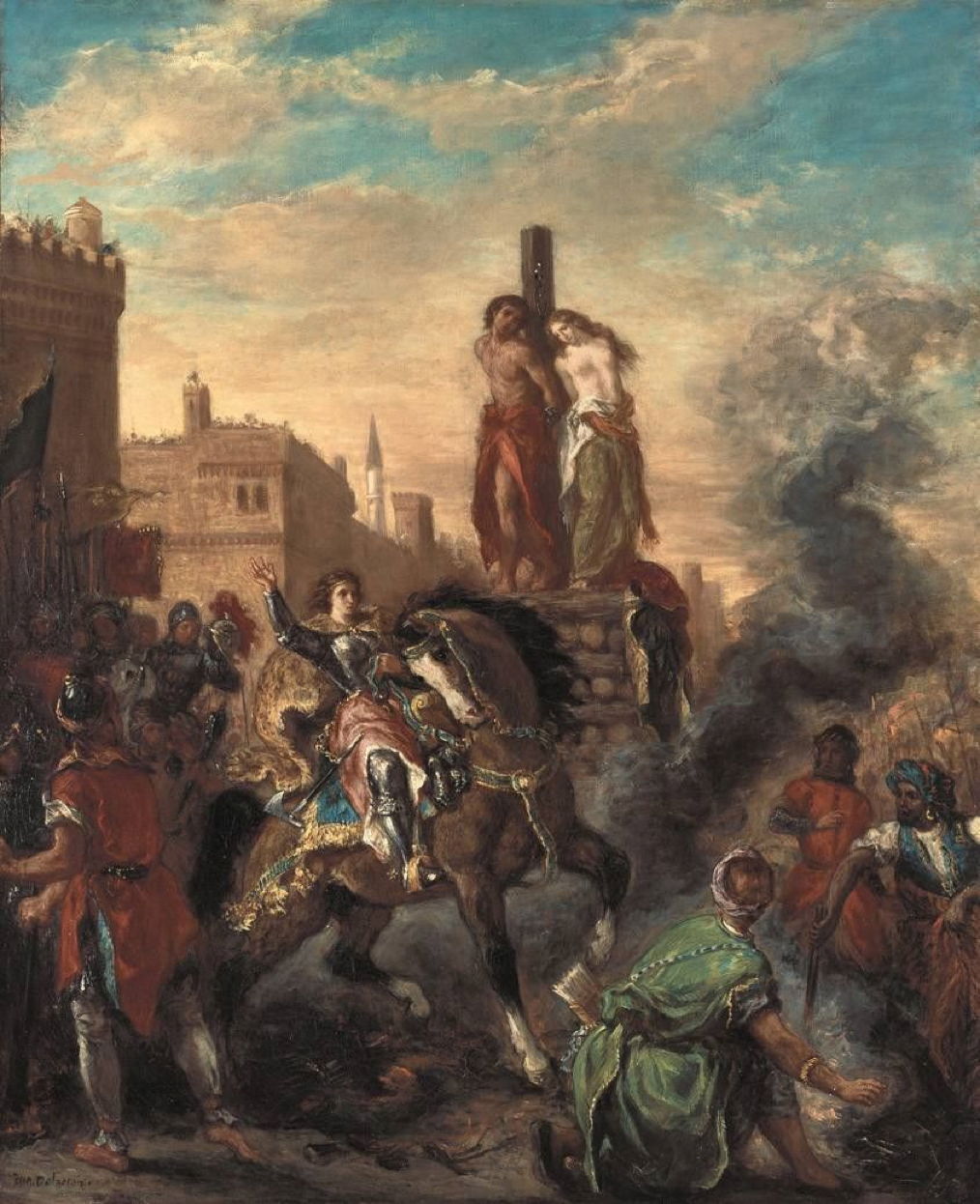
delacroixclorindafreesolindo
Eugène Delacroix (1798–1863), Clorinda Rescues Olindo and Sophronia (1856), oil on canvas, 101 x 82 cm, Neue Pinakothek, Munich, Germany. Wikimedia Commons.

Eugène Delacroix’s Clorinda Rescues Olindo and Sophronia from 1856 is a minor masterpiece. Clorinda has just arrived, wearing her more conventional black armour, as one of the enemies of the crusaders, and holds up her right hand to tell the executioners to stay as they are. The stake is raised high, putting the couple in full view, although Aladine is nowhere to be seen.

Aladine cannot refuse Clorinda, nor refute her reasoning, so he decrees that the couple be freed. However, he imposes the condition that they are banished from Jerusalem, and must live outside Palestine. He also banishes all other able-bodied Christians, who could pose a threat when the crusaders arrive. They mostly find their way to the town of Emmaus, which the crusaders have just reached.

References

Wikipedia on Jerusalem Delivered.
Wikipedia on Torquato Tasso.

Project Gutenberg (free) English translation (Fairfax 1600).

Librivox audiobook of the Fairfax (1600) English translation (free).

Thomas Asbridge (2004) The First Crusade, A New History, Free Press, ISBN 978 0 7432 2084 2.
Anthony M Esolen, translator (2000) Torquato Tasso, Jerusalem Delivered, Gerusalemme Liberata, Johns Hopkins UP. ISBN 978 0 801 863233. A superb modern translation into English verse.
John France (1994) Victory in the East, a Military History of the First Crusade, Cambridge UP. ISBN 978 0 521 589871.
Joanthan Riley-Smith, ed (1995) The Oxford Illustrated History of the Crusades, Oxford UP. ISBN 978 0 192 854285.
Jonathan Riley-Smith (2014) The Crusades, A History, 3rd edn., Bloomsbury. ISBN 978 1 4725 1351 9.
Johathan Unglaub (2006) Poussin and the Poetics of Painting, Pictorial Narrative and the Legacy of Tasso, Cambridge UP. ISBN 978 0 521 833677.
Jerusalem Delivered: 1 A forgotten epic

In almost every collection of paintings from before 1900, you’ll come across works bearing mystifying titles like Tancred Baptizing Clorinda. Those names don’t come from mythology, nor are they Biblical. I suspect that most just abandon trying to read that painting, and pass on by.

tintorettodtancredbaptisingclorinda
Domenico Tintoretto (1560–1635), Tancred Baptizing Clorinda (c 1585), oil on canvas, 168 x 115 cm, Museum of Fine Arts, Houston, TX. Wikimedia Commons.

In about 1585, Domenico Tintoretto, son of the famous Jacopo, painted just that, Tancred Baptizing Clorinda. Tancred was a fictional prince who fell in love with a pagan female warrior, Clorinda, but later mortally wounded her, and at her request baptised her just before she died.

They are among the leading figures in what was, until about 1900, one of the most widely-read epic poems in the western world: Torquato Tasso’s Gerusalemme LiberataJerusalem Delivered. Being so well known and loved, it was the basis for hundreds, perhaps thousands, of paintings, many by the masters. After Ovid’s Metamorphoses, it has probably been the source for more narrative paintings than any other literary work, apart from the Bible.

poussinwhole
Nicolas Poussin (1594–1665), Rinaldo and Armida (c 1630), oil on canvas, 82.2 x 109.2 cm, Dulwich Picture Gallery. Wikimedia Commons.

One of the greatest of the narrative artists to paint stories from this epic is Nicolas Poussin, whose Rinaldo and Armida from about 1630 remains one of the most brilliant narrative paintings ever made. Contemporary accounts of Poussin’s life record that his copy of Tasso’s epic was almost worn out through repeated use.

Unless you’re a scholar of Italian Renaissance literature, all you’ll see here is a pretty young woman on the one hand about to murder a sleeping knight with a dagger, and on the other hand caressing his brow.

The sleeping knight is Rinaldo, the greatest of Tasso’s Christian knights, who has stopped to rest near the ford of the Orontes. On hearing a woman singing, he goes to the river, where he catches sight of Armida swimming naked. Armida, though, has an evil aim. As a ‘Saracen’ witch, she has been secretly following Rinaldo, intending to murder him with her dagger. Having revealed herself to him, she sings and lulls him into an enchanted sleep so that she can thrust her dagger home.

Just as she’s about to do this, she falls in love with him instead, and this is the instant, the twist or peripeteia (Aristotle’s term), shown here. A winged amorino, lacking the bow and arrows of a true Cupid, restrains her right arm bearing her weapon. Her facial expression and left hand reveal her new intent to enchant and abduct Rinaldo in her chariot, so he can become infatuated with her, and forget his mission of war.

tiepolorinaldoarmidagarden
Giovanni Battista Tiepolo (1696–1770), Rinaldo and Armida in Her Garden (1742-45), oil on canvas, 187 x 260 cm, The Art Institute of Chicago, Chicago, IL. Image by Sailko, via Wikimedia Commons.

This couple are central to the complex intertwined threads within Jerusalem Delivered. Tiepolo was another artist who became obsessed with its stories and painted them on many occasions. This example shows Rinaldo and Armida in Her Garden (1742-45), and is now in The Art Institute of Chicago. It was originally hung in a special room dedicated to this epic in the Palazzo Corner a San Polo in Venice, where it belonged to the noble Serbelloni family.

overbeckubaldocarloliberaterinaldo
Johann Friedrich Overbeck (1789-1869), Ubaldo and Carlo free Rinaldo from Armida’s Castle (1819-27), fresco, dimensions not known, Casa Massimo, Rome, Italy. Image by Sailko, via Wikimedia Commons.

Johann Friedrich Overbeck worked for eight years painting this magnificent fresco of Ubaldo and Carlo free Rinaldo from Armida’s Castle (1819-27) in another room dedicated to the epic, in Rome’s Casa Massimo.

stillmanrosefromarmidasgarden
Marie Spartali Stillman (1844–1927), A Rose in Armida’s Garden (1894), watercolour and graphite on paper, 64.8 x 43.2 cm, Private collection. Wikimedia Commons.

For over three centuries, artists retold Tasso’s stories. Marie Spartali Stillman painted A Rose in Armida’s Garden as late as 1894. More of an aesthetic portrait than the depictions of others before her, Stillman gave this to a family friend for their wedding.

colliergardenofarmida
John Collier (1850–1934), The Garden of Armida (1899), oil on canvas, 262 x 178 cm, Private collection. WikiArt.

In 1899, John Collier tried his interpretation of The Garden of Armida in contemporary setting and dress. Although it wasn’t a success, Collier was one of the few who tried to adapt Tasso for the twentieth century.

mullergardenofarmida
Édouard Muller (1823-1876), The Garden of Armida (1854), block-printed wallpaper, 386.1 x 335.3 cm, Philadelphia Museum of Art, Philadelphia, PA. Wikimedia Commons.

Images inspired by the epic appeared in some of the most surprising places. This wallpaper designed by Édouard Muller in 1854 shows yet again The Garden of Armida, and is now in the Philadelphia Museum of Art. Smaller images were to be found on coffee cups and all manner of other objects.

Jerusalem Delivered is set in the midst of the First Crusade, which for many today makes it even more difficult to access. It’s a curious fact that most Europeans and North Americans are more familiar with the history, figures, and mythology of classical Rome, than with the crusades that dominated much of European society in mediaeval times and later.

teniersarmidainbattle
David Teniers the Younger (1610–1690), Armida in the Battle Against the Saracens (1628-30), oil on copper, 27 x 39 cm, Museo Nacional del Prado, Madrid, Spain. Wikimedia Commons.

David Teniers the Younger shows this clearly in this oil on copper painting of Armida in the Battle Against the Saracens from 1628-30. Armed as an archer, the ‘Saracen’ witch rides on a chariot into battle outside a large city. It’s a painting that makes no sense at all without knowing Tasso’s epic, a bit of background about the First Crusade, and the fact that the city is Jerusalem.

Next week I set the scene for this new series by looking at paintings of that First Crusade, summarising its real history, and introducing some of the characters Tasso wrote into his poetry. I hope that you’ll join me then in the town of Clermont, France, in late 1095.

References

Wikipedia on Jerusalem Delivered.
Wikipedia on Torquato Tasso.

Project Gutenberg (free) English translation (Fairfax 1600).

Librivox audiobook of the Fairfax (1600) English translation (free).

Anthony M Esolen, translator (2000) Torquato Tasso, Jerusalem Delivered, Gerusalemme Liberata, Johns Hopkins UP. ISBN 978 0 801 863233. A superb modern translation into English verse.
Johathan Unglaub (2006) Poussin and the Poetics of Painting, Pictorial Narrative and the Legacy of Tasso, Cambridge UP. ISBN 978 0 521 833677.
❌