Reading view

There are new articles available, click to refresh the page.

Paintings of British Cathedrals and Abbeys: Constable and others

Following the early death of Thomas Girtin in 1802, there was no successor who proved as prolific in painting the cathedrals of Britain, and attention was transferred to those further south.

leaderworcestercathedral
Benjamin Williams Leader (1831–1923), Worcester Cathedral (1894), oil on canvas, dimensions not known, Chazen Museum of Art, University of Wisconsin-Madison, Madison, WI. Wikimedia Commons.

In 1894, Benjamin Williams Leader painted this view of Worcester Cathedral backing onto the River Severn. This was built between 1084-1504 in an unusual mixture of styles from Norman to Perpendicular Gothic, and contains the tomb of King John in its chancel. Judging by the smoke rising from the chimneys, this was painted in the early autumn.

John Constable (1776–1837), Salisbury Cathedral from the Bishop's Garden (1823), oil on canvas, 87.6 × 111.8 cm, V&A, London. Wikimedia Commons.
John Constable (1776–1837), Salisbury Cathedral from the Bishop’s Garden (1823), oil on canvas, 87.6 × 111.8 cm, V&A, London. Wikimedia Commons.

If any artist came close to Girtin’s achievement it must have been John Constable. In about 1820, Bishop John Fisher commissioned him to paint Salisbury Cathedral from the grounds of his Palace, and Constable started to prepare sketches and studies for that medium-sized painting Salisbury Cathedral from the Bishop’s Garden, completed in 1823.

John Constable (1776–1837), Study for Salisbury Cathedral from the Meadows (1830-1), oil on canvas, 71 × 90 cm, Private collection. Wikimedia Commons.

Constable was still battling with depression after the death of his wife when Archdeacon John Fisher, younger cousin of the Bishop, who had died in 1825, encouraged him to paint a larger and more ambitious view of Salisbury Cathedral, from the nearby meadows on the banks of the River Nadder. This late oil sketch was sold by auction in 2015 for more than five million dollars.

John Constable (1776–1837), Salisbury Cathedral from the Meadows (1831), oil on canvas, 151.8 × 189.9 cm, The Tate Gallery, London. Wikimedia Commons.

Constable completed his finished painting above for exhibition in the Royal Academy in 1831. It is perhaps a little over-egged with its storm clouds, rainbow and bolt of lightning. Despite several showings, it remained unsold when Constable died. Salisbury Cathedral was almost entirely built within the period 1220-1258, although its tower and spire, the tallest in England, were completed by 1330.

Although there is a Westminster Cathedral in London, it’s Roman Catholic, unlike the more famous Westminster Abbey, a collegiate church of the Church of England that has long been popular for coronations and interments of British monarchs and the nation’s most distinguished figures. The present building was constructed between 1245-1269 close to the Palace of Westminster on the north bank of the River Thames.

Samuel Scott (1702–1772), Westminster from Lambeth, with the Ceremonial Barge of the Ironmongers' Company (c 1745), oil on canvas, 79.4 x 150.5 cm, Yale Center for British Art, New Haven, CT. Wikimedia Commons.
Samuel Scott (1702–1772), Westminster from Lambeth, with the Ceremonial Barge of the Ironmongers’ Company (c 1745), oil on canvas, 79.4 x 150.5 cm, Yale Center for British Art, New Haven, CT. Wikimedia Commons.

Samuel Scott’s Westminster from Lambeth, with the Ceremonial Barge of the Ironmongers’ Company (c 1745) shows a section of the River Thames on a windy day, with showers not far away. Teams of rowers pull their boats out to attend to the ceremonial barges in the foreground, reminiscent of Venetian boat ceremonies. The opposite bank shows, from the left, the imposing twin towers of Westminster Abbey, the old Palace of Westminster almost hidden behind trees, and Westminster Bridge.

B2014.2
Benjamin West (1738–1820), Milkmaids in St. James’s Park, Westminster Abbey beyond (c 1801), oil on panel, further details not known. Wikimedia Commons.

The American history painter Benjamin West painted this view of Milkmaids in St. James’s Park, Westminster Abbey beyond in about 1801. Two cows and attendant milkmaids are providing a supply of fresh milk for the crowds in this royal park with Buckingham Palace on its edge. This remains 57 acres (23 hectares) of grass, trees and lakes.

The Church of England cathedral in London is of course Saint Paul’s, on Ludgate Hill a few miles to the east in the centre of the city of London. It was built between 1675-1710 to the designs of Sir Christopher Wren, following the destruction of its predecessor in the Great Fire of London of 1666.

canalettostpaulscathedral
Canaletto (Giovanni Antonio Canal) (1697–1768), St. Paul’s Cathedral (c 1754), oil on canvas, 52.1 x 61.6 cm, Yale Center for British Art, New Haven, CT. Wikimedia Commons.

Canaletto painted this imposing view of St. Paul’s Cathedral when he was working in England in about 1754. This Venetian artist lived and painted in London between 1746-1755 when the War of the Austrian Succession disrupted the art market in Venice.
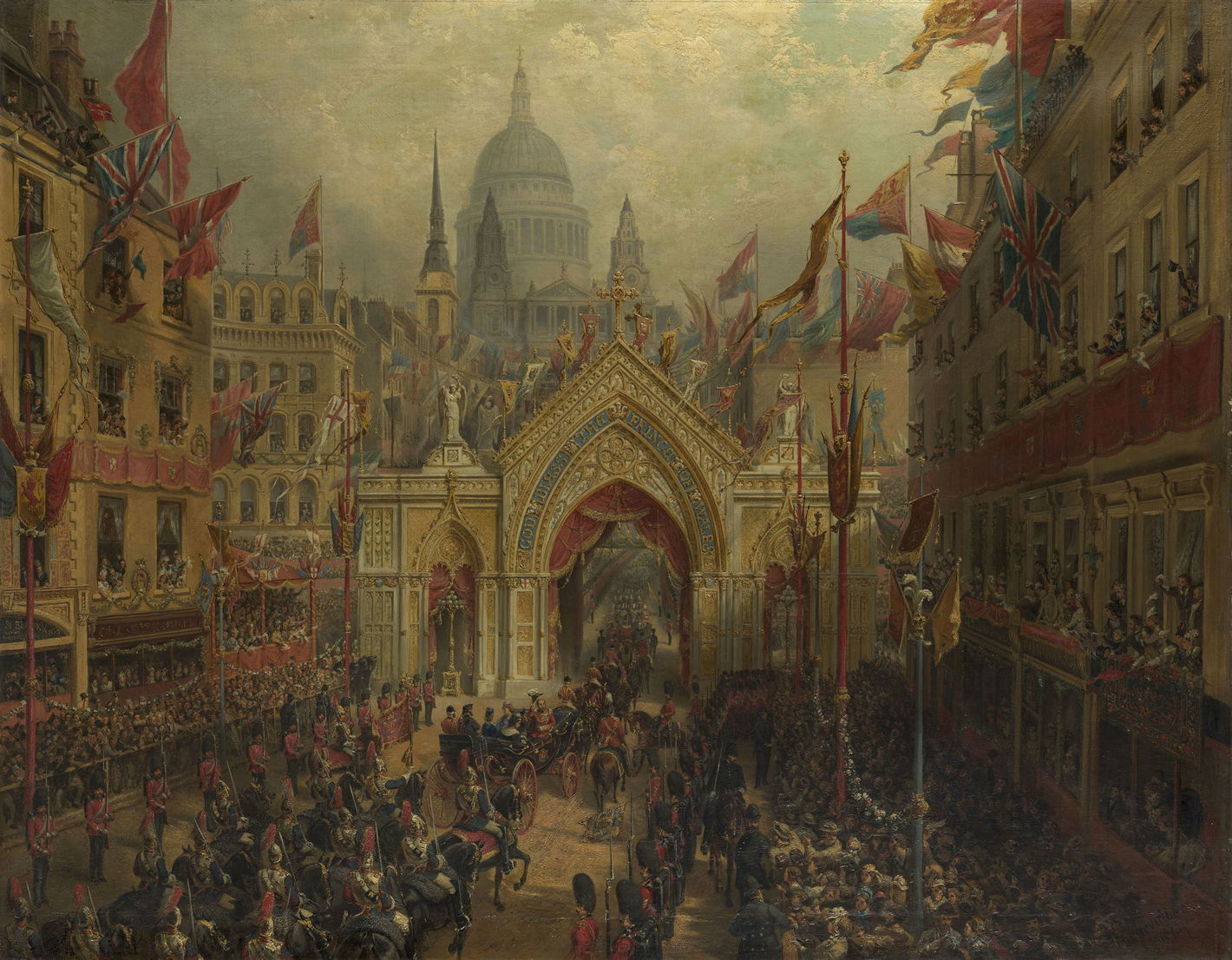
chevalierthanksgivingday
Nicholas Chevalier (1828–1902), ‘Thanksgiving Day’: The Procession to St Paul’s Cathedral, 27 February 1872 (after 1872), oil on canvas, 79 x 99.3 cm, Royal Collection of the United Kingdom, UK. By courtesy of the Royal Collection Trust, via Wikimedia Commons.

Nicholas Chevalier painted ‘Thanksgiving Day’: The Procession to St Paul’s Cathedral, 27 February 1872 shortly after this royal event. Not to be confused with US Thanksgiving, this was a one-off state thanksgiving for the recovery from severe illness of the Prince of Wales. The widowed Queen Victoria and her son Prince Edward attended Saint Paul’s Cathedral (the obvious dome in the distance) to give public thanks to God. Approaching the arch is the carriage containing the royal party.

Canaletto wasn’t the only visitor from continental Europe to paint Wren’s prominent dome.
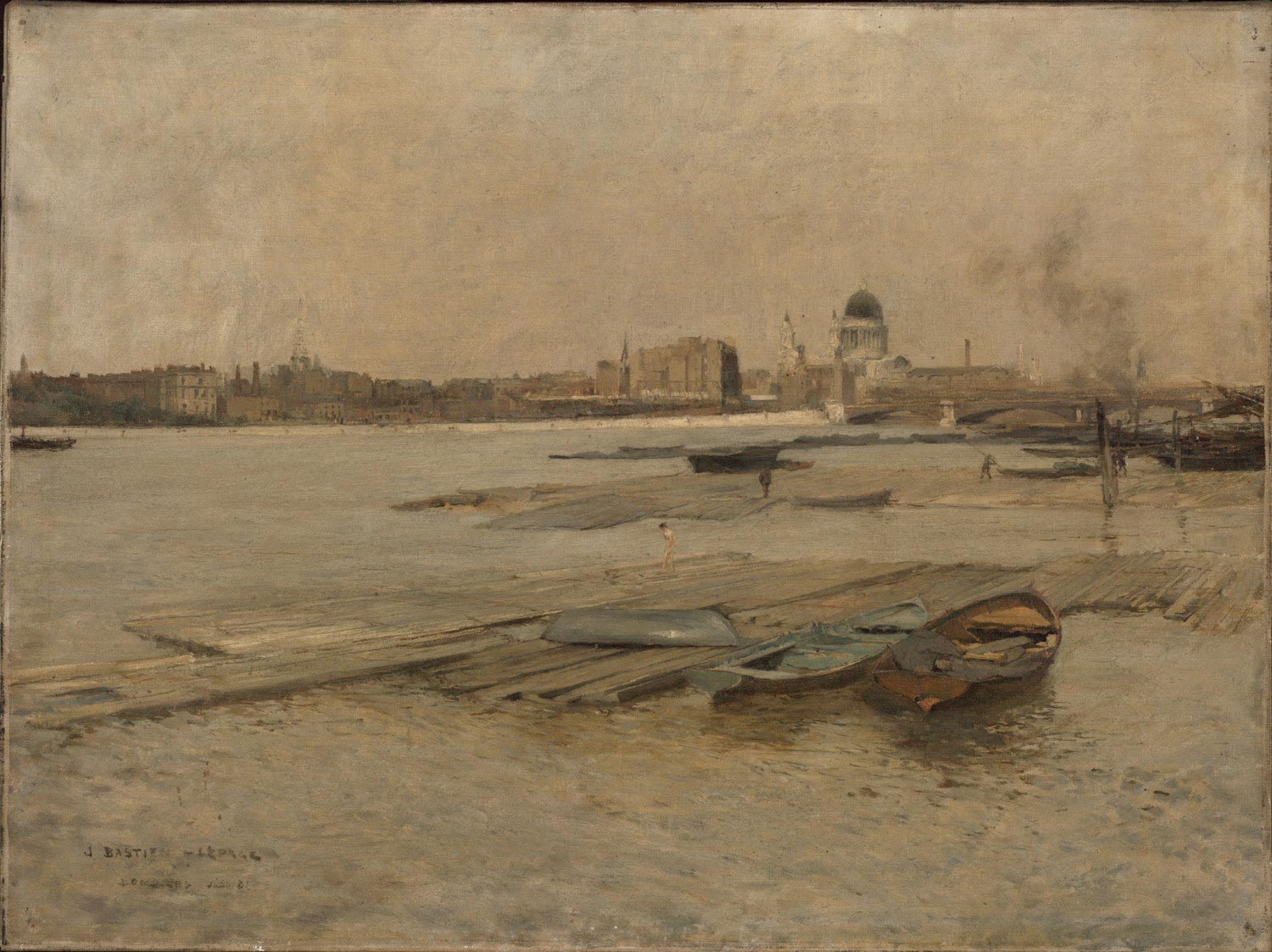
bastienlepageblackfriarsbridge
Jules Bastien-Lepage (1848–1884), Blackfriars Bridge and the Thames, London (1881), oil on canvas, 51.1 x 68.9 cm, Philadelphia Museum of Art, Philadelphia, PA. The Athenaeum.

From 1880, Jules Bastien-Lepage visited London repeatedly. Blackfriars Bridge and the Thames, London (1881) is his fine depiction of this stretch of the River Thames, with his characteristic gradation of detail from its foreground into the distance. Standing proud on the skyline towards the right is the distinctive dome of Saint Paul’s.

lesidanerstpaulsfromriver
Henri Le Sidaner (1862–1939), St. Paul’s from the River: Morning Sun in Winter (1906-07), oil on canvas, 90 x 116 cm, Walker Art Gallery, Liverpool, England. Wikimedia Commons.

Henri Le Sidaner also visited Britain on several occasions, and in 1906-07 painted this view of St. Paul’s from the River: Morning Sun in Winter, which may have been inspired by Monet’s series paintings of Rouen Cathedral, here expressed using his own distinctive marks.

In case you think Wren’s Saint Paul’s appears recent compared with Britain’s older cathedrals, in my lifetime I have seen two new Church of England cathedrals consecrated: Coventry in 1962, replacing an older building destroyed during the Second World War, and Guildford in 1961, built on a new site altogether over a period of twenty-five years.

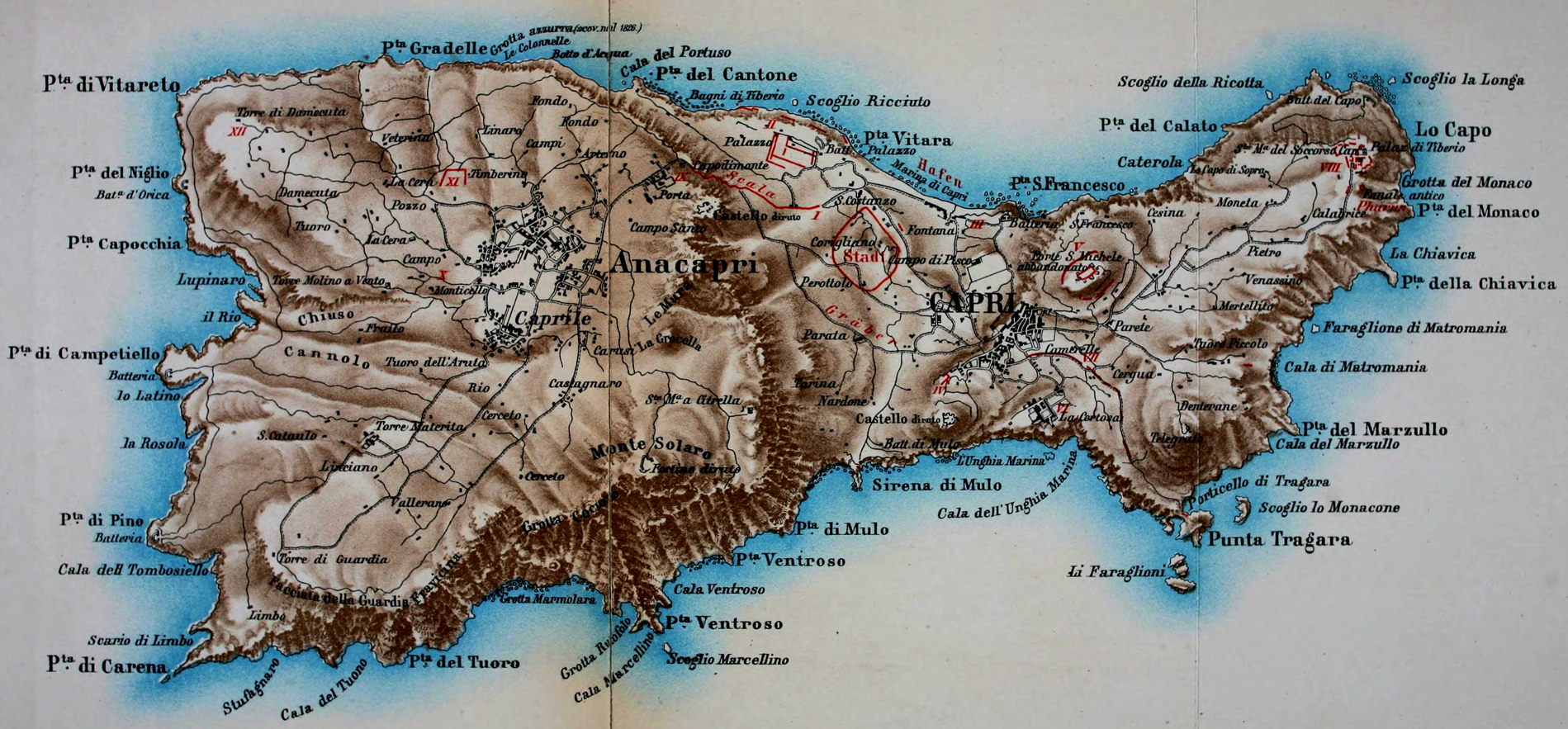
Paintings of Capri: 1884-1928

This weekend we’re sheltering on the island of Capri, at the southern end of the Bay of Naples, Italy, where we’ve reached the 1880s, a time when Capri had become popular with landscape painters.

Karl Julius Beloch (1854–1929), Map of Capri (1890), from From Karl Julius Beloch: Campanien. Breslau, 1890. Wikimedia Commons.

Among the many artists who visited the island during the nineteenth century were several who had trained in Düsseldorf, Germany, whose works became popular both in Germany and in the USA.

achenbachcapri
Oswald Achenbach (1827–1905), View of Capri (1884), oil on canvas, 44 × 60.5 cm, Von-der-Heydt-Museum, Wuppertal, Germany. Wikimedia Commons.

Oswald Achenbach’s View of Capri from 1884 shows the island from a vantage point in the hills above Sorrento on the mainland. Achenbach was another member of the Düsseldorf School who visited Italy on several occasions during his career. His last extended visit started in 1882, and took him to Sorrento, but he had visited Capri a decade earlier, in 1871.

brabazoncapri
Hercules Brabazon Brabazon (1821-1906), Capri (date not known), gouache on paper, 6.9 x 10.1 cm, Phillips Collection, Washington, DC. Wikimedia Commons.

Hercules Brabazon Brabazon’s undated gouache painting of Capri is an unusual nocturne, showing a lonely and rugged section of the coast. An isolated villa stands in the bay, steps curving their way from it down to the tiny beach. This was most probably painted around 1890.

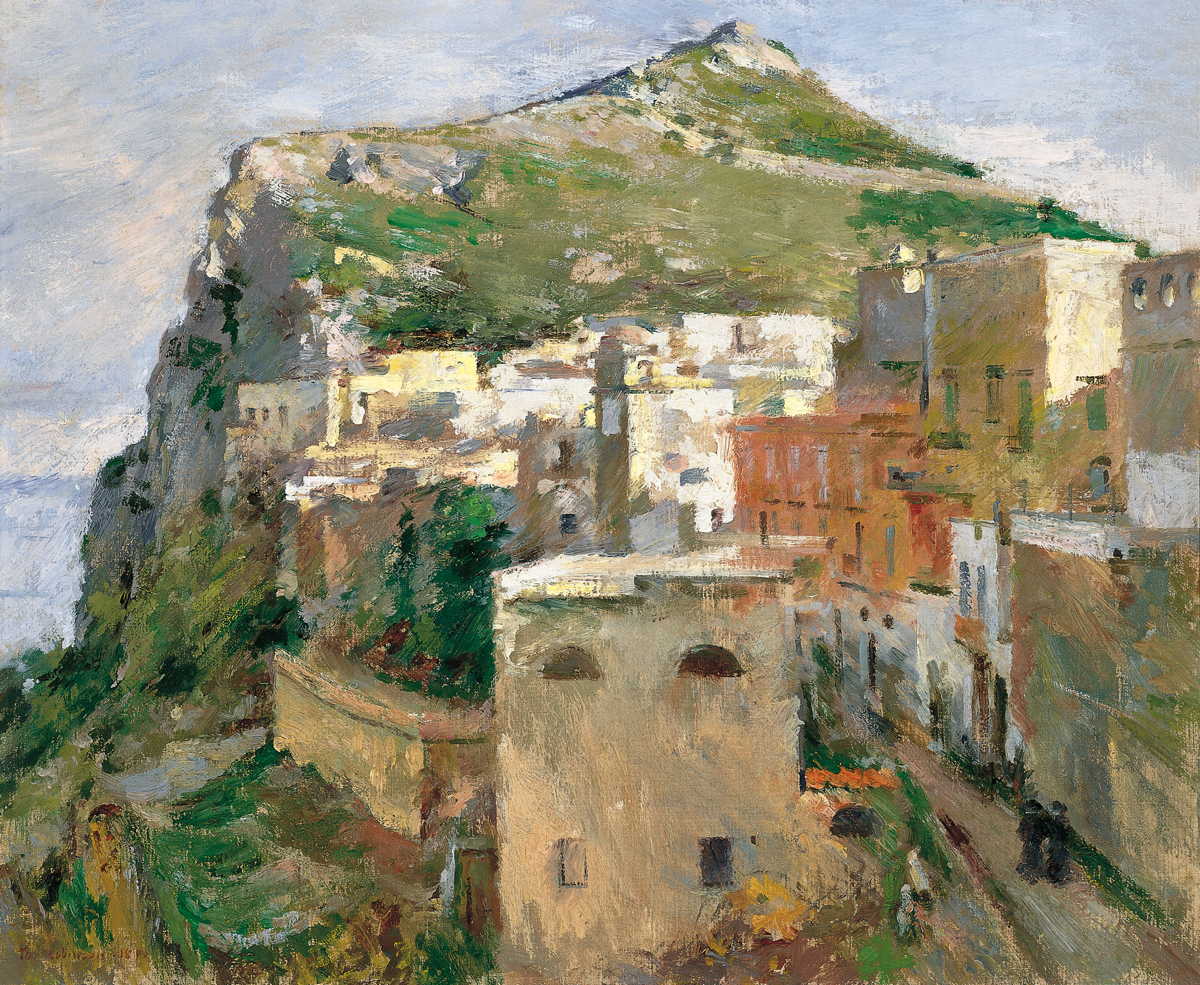
Theodore Robinson, Capri (1890), oil on canvas, 44.5 x 53.3 cm, Thyssen-Bornemisza Museum, Madrid. Wikimedia Commons.
Theodore Robinson (1852-1896), Capri (1890), oil on canvas, 44.5 x 53.3 cm, Thyssen-Bornemisza Museum, Madrid. Wikimedia Commons.

Theodore Robinson was an American Impressionist who trained in New York before heading to Europe in 1876, and must have painted this view of Capri when visiting the island in 1890. It appears to show Monte Tiberio in the far north-east, from the west. Robinson is most famous for his Impressionist landscapes from Giverny, mostly painted after he had moved into the property next door to Claude Monet. Although Monet doesn’t appear to have visited Capri, Robinson here adapted Monet’s style from his views of the cliffs at Étretat and other rugged coasts. Robinson tragically died of an asthma attack in 1896 when he was only 43.

chevalierfaraglioni
Nicholas Chevalier (1828-1902), View of the Faraglioni, Capri (1892), watercolour, 50 x 73.7 cm, location not known. Wikimedia Commons.

Nicholas Chevalier’s View of the Faraglioni, Capri (1892) is a detailed watercolour view painted from the Marina Piccola on the south coast, looking south-east to the rock stacks of the Faraglione in the distance. He trained in Munich rather than Düsseldorf, and from 1851 painted in Britain, then in Australia and New Zealand. This was made during a visit to the island in his late career, when he was growing old and less active.

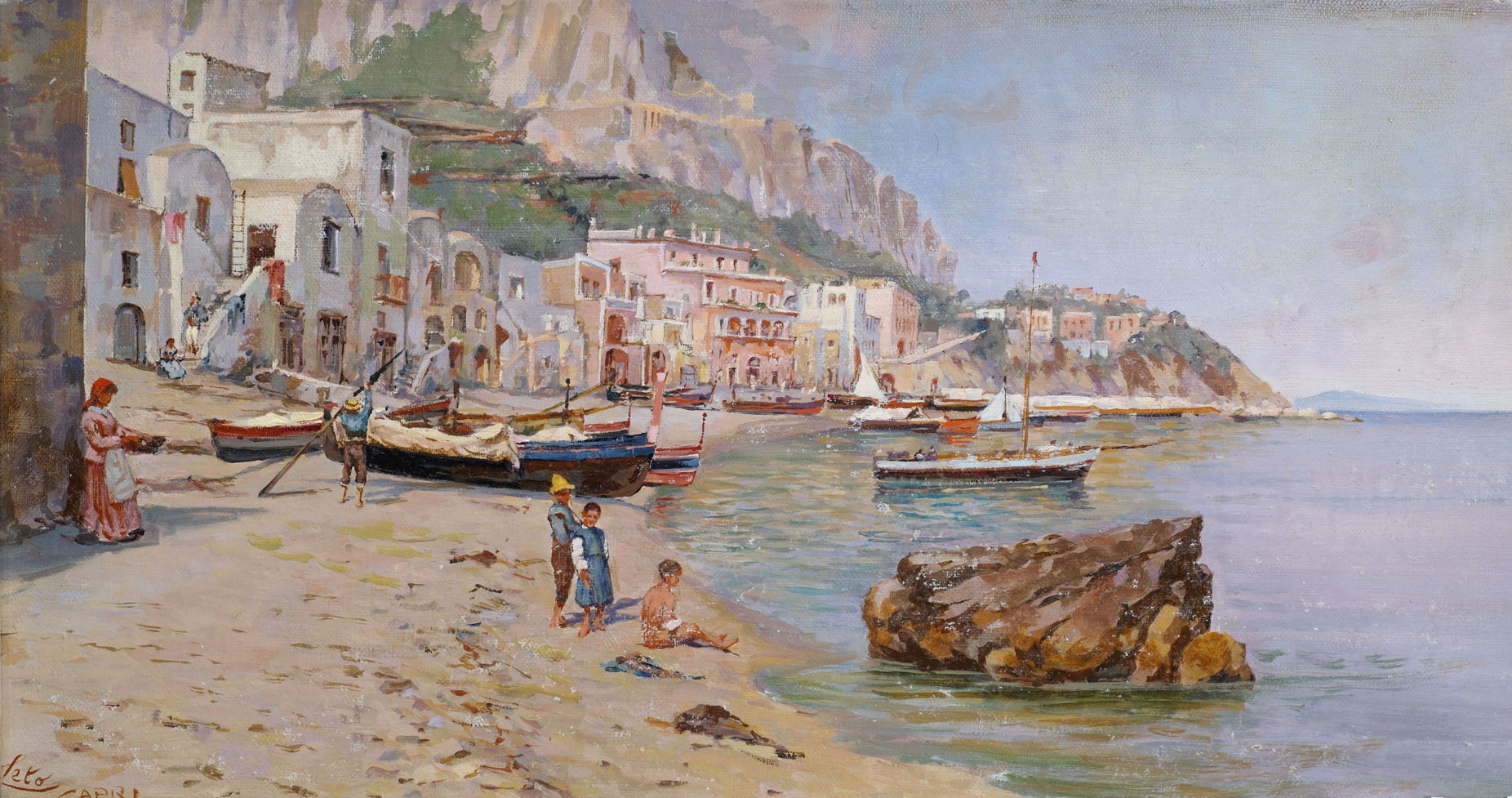
letocapri
Antonino Leto (1844–1913), Capri (date not known), oil on canvas, 21.5 × 30.5 cm, location not known. Wikimedia Commons.

Antonino Leto’s undated view of Capri was most probably painted after he had retired to the island in 1882, following his career of painting landscapes and genre views in Impressionist style. I think that this shows the Marina Grande on the north coast, viewed from the east. Leto was originally inspired by the work of Giuseppe De Nittis, and in 1879 joined him and the group of Italian Impressionists who had gathered in Paris.

By the start of the twentieth century, painting in Capri was changing again. After his naturist and vegan painters’ commune and colony near Vienna went bankrupt from 1899, Karl Wilhelm Diefenbach moved to the island, where others joined him in another commune, perhaps in a more appropriate climate.

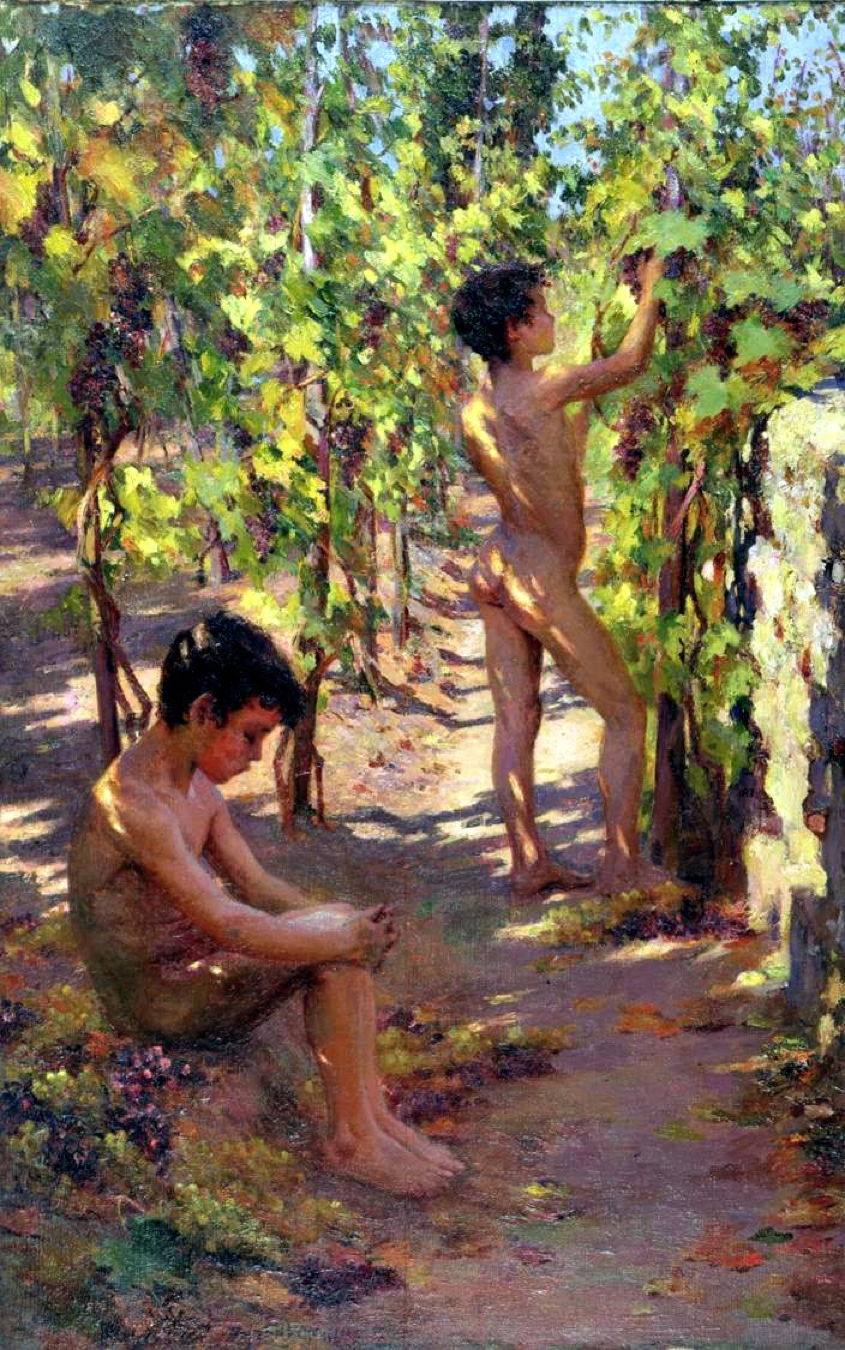
watkinsboyspickinggrapes0
Susan Watkins (1875–1913), Boys Picking Grapes at Capri (c 1906), oil on canvas, 79.4 × 52.1 cm, Chrysler Museum of Art, Norfolk, VA. Wikimedia Commons.

In about 1906, Susan Watkins appears to have visited the island. When there, she painted two superb studies for one of her finest works, showing local boys picking grapes on the island. Her finished painting of Boys Picking Grapes at Capri (c 1906) shows the much looser, more painterly, and richly chromatic style typical of her more mature work.

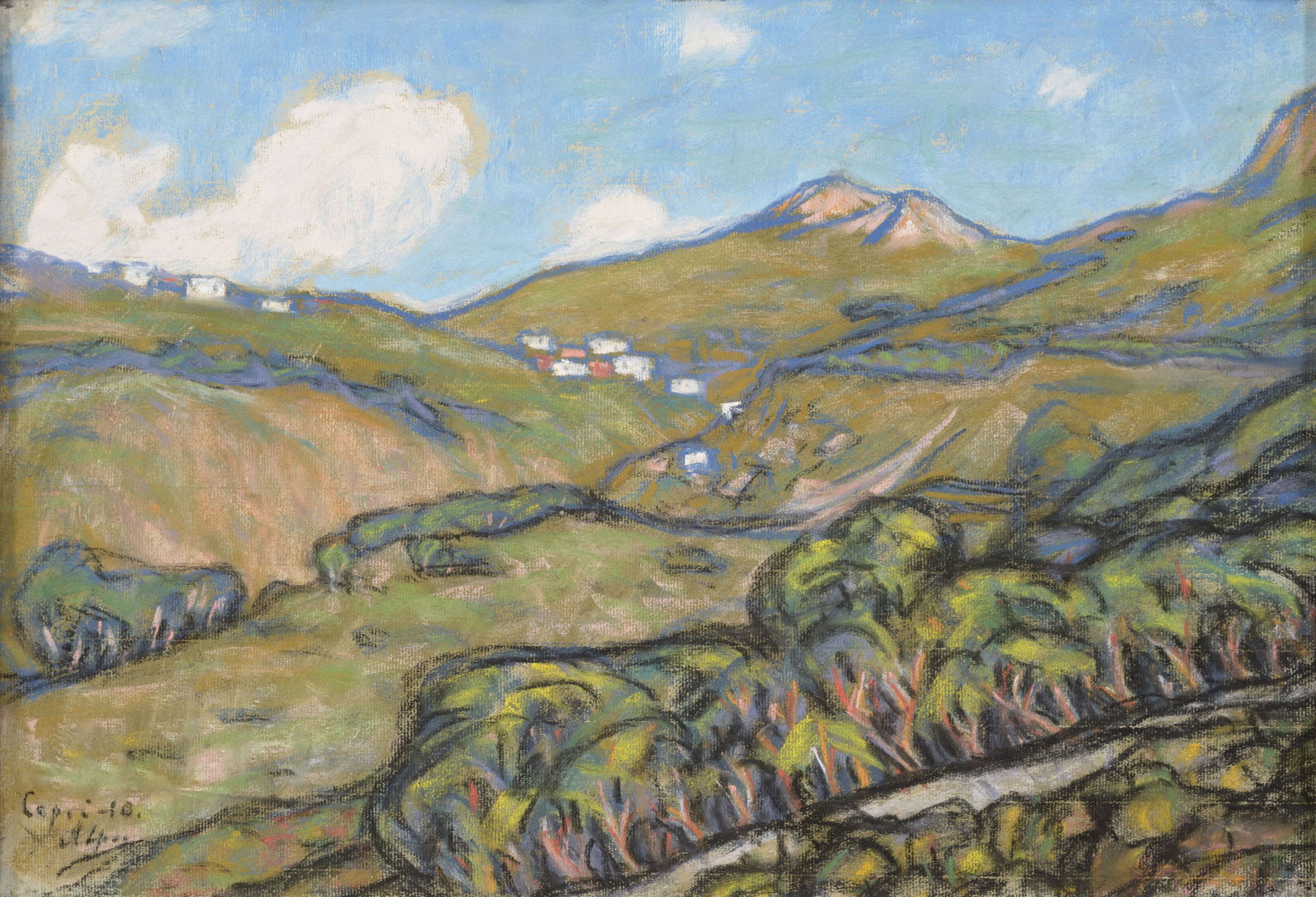
laikmaacaprilandscape1910
Ants Laikmaa (1866–1942), Capri Landscape (1910), pastel on paper, 31.5 x 47 cm, Private collection. Wikimedia Commons.

Between 1910 and 1912, the Estonian pastellist Ants Laikmaa (1866–1942) lived on Capri, where he painted many landscapes. His Capri Landscape from 1910 is unusual for showing the interior of the island with its scattered white houses.

laikmaanightcapri1910
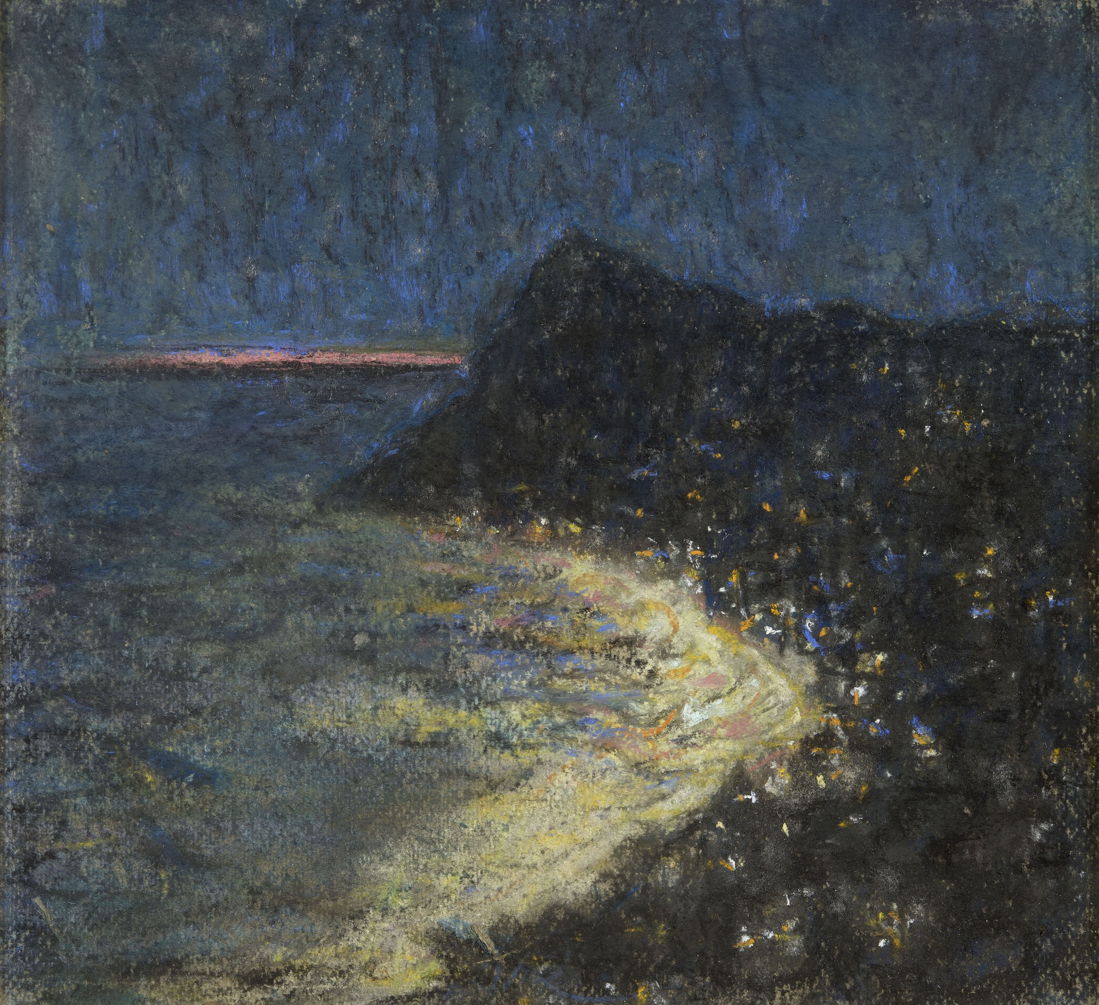
Ants Laikmaa (1866–1942), Night Motif from Capri (1910), pastel on paper, 19 x 20.5 cm, Private collection. Image courtesy of Enn Kunila, via Wikimedia Commons.

Laikmaa’s Night Motif from Capri from the same year is more of an impression of the coast, dotted with lights.

vonspaunfaraglioni
Paul von Spaun (1876–1932), The Faraglioni Cliffs on Capri (1913), oil on canvas, 60 x 60 cm, location not known. Wikimedia Commons.

Paul von Spaun painted this striking view of The Faraglioni Cliffs on Capri from above in 1913. As far as I can gather, he was Diefenbach’s son in law, an Austrian painter who lived in Diefenbach’s commune and fathered Fridolin von Spaun, who went on to research Diefenbach’s life and works, and collected his paintings in a museum on the island, in the Carthusian monastery at Certosa di San Giacomo, painted by Marie-Caroline de Bourbon, shown in the first of these two articles.

vonspaunvillajovis
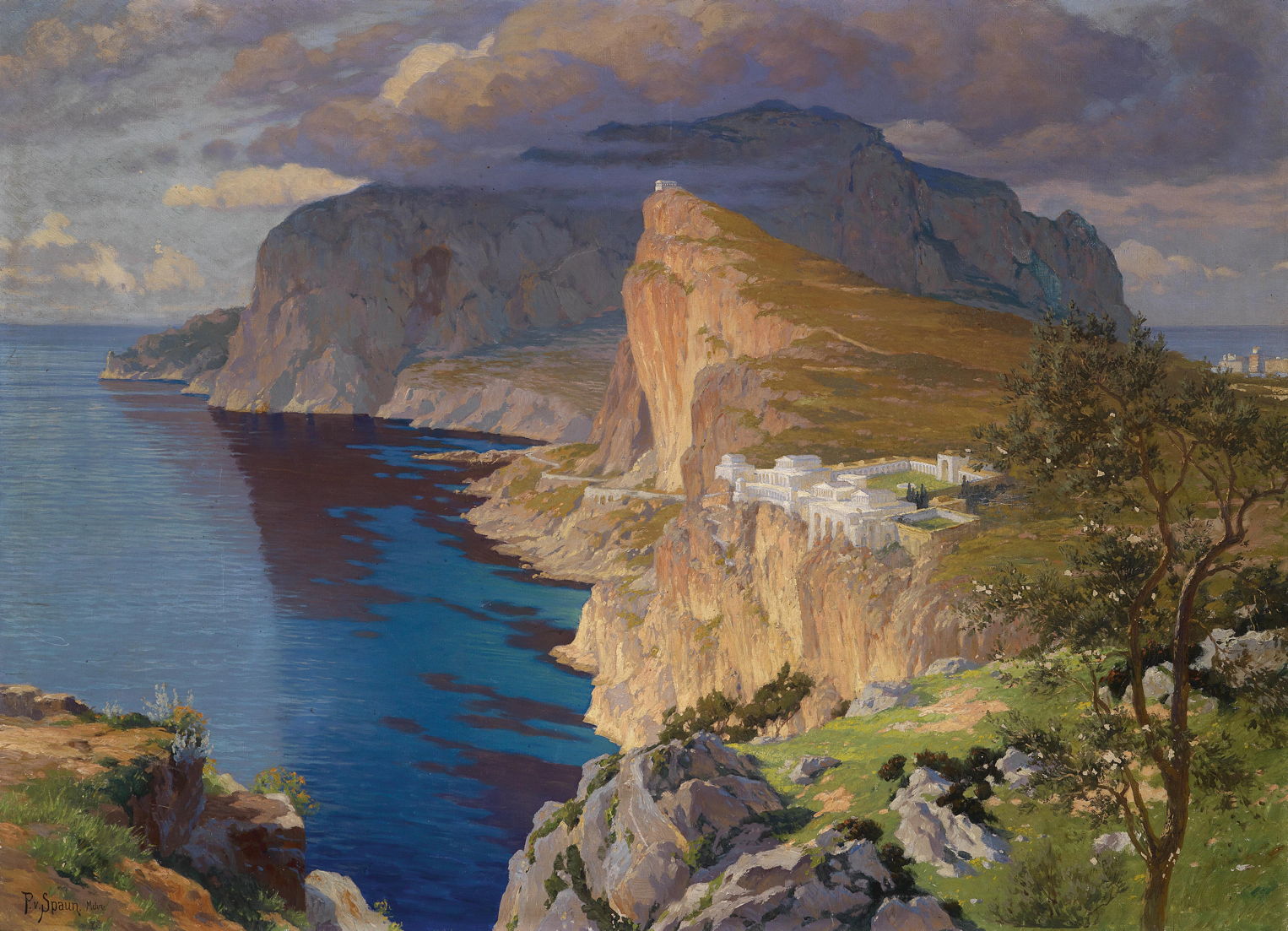
Paul von Spaun (1876-1932), Idealised View of Villa Jovis on the Island of Capri (date not known), oil on canvas, 80 x 110.4 cm, location not known. Wikimedia Commons.

Von Spaun’s undated Idealised View of Villa Jovis on the Island of Capri is one of the most outstanding paintings of the island. But it isn’t a ‘real’ view, as far as I can tell, rather a composite cleverly built from several different features, much in the way that landscape Masters like Nicolas Poussin assembled their idealised landscapes.

wenkcapri
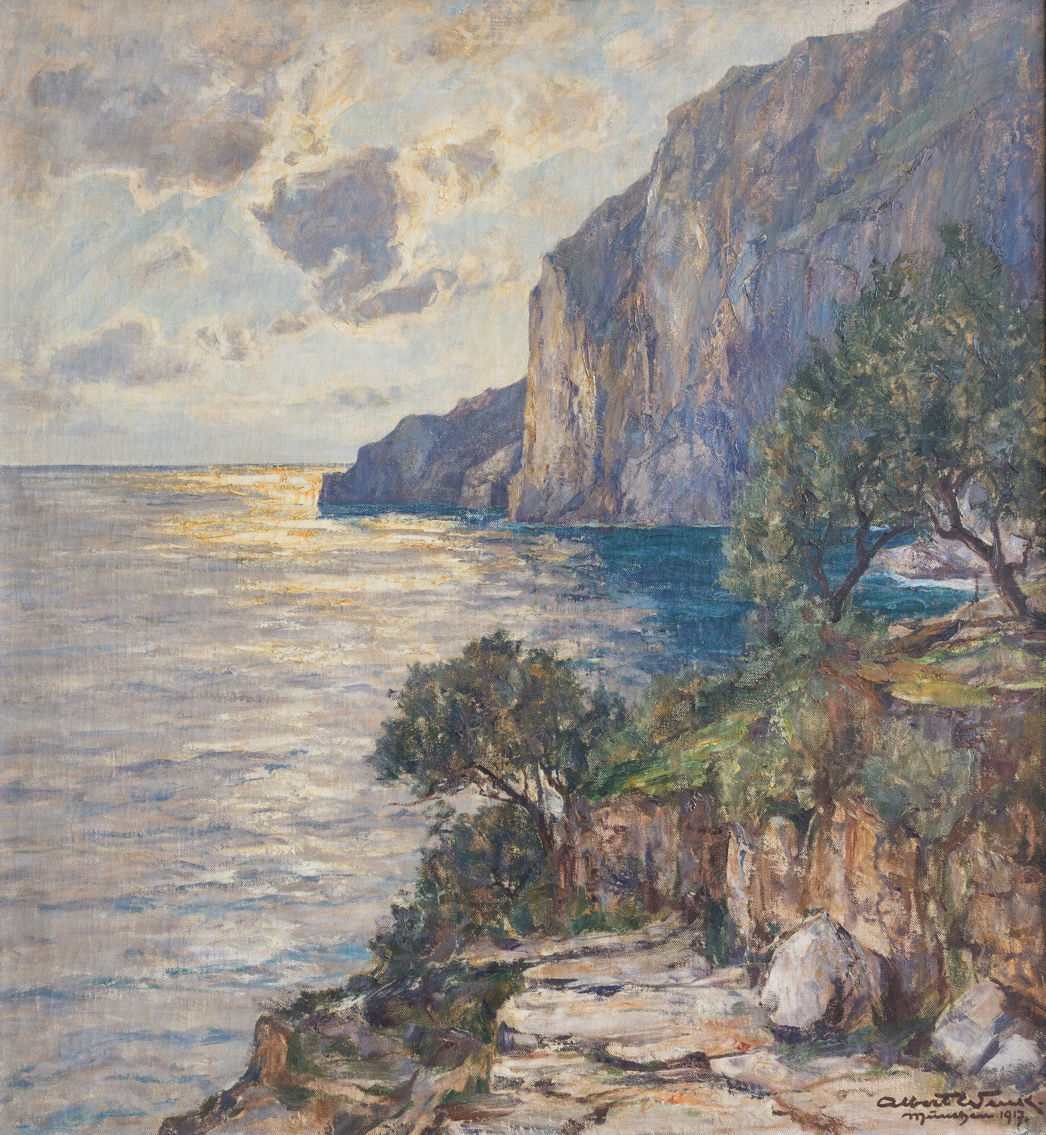
Albert Wenk (1863-1934), Capri (1917), oil on canvas, dimensions and location not known. Image by JTSH26, via Wikimedia Commons.

Albert Wenk’s view of Capri, painted in 1917, may look as if it was painted en plein air, but was probably made, or at least completed, in his Munich studio. It shows the vertiginous steps of the Via Krupp tumbling down the cliff on the south coast to the Marina Piccola, looking to the west in the late afternoon. Wenk had also trained in Düsseldorf.

My final three paintings are by the Russian Post-Impressionist Konstantin Ivanovich Gorbatov. He initially studied civil engineering, but in 1904 started training as an artist. He won a travelling scholarship taking him to Rome, from where he first visited Capri. He left Russia in 1922, and from then until 1926 lived and painted on the island. He next moved to Berlin, where he was an active member of a group of Russian emigré artists, and during the 1930s travelled widely across Europe and the Middle East. His career ended with the outbreak of the Second World War, and he died in Germany just after the Allied victory.

gorbatovcapri1928
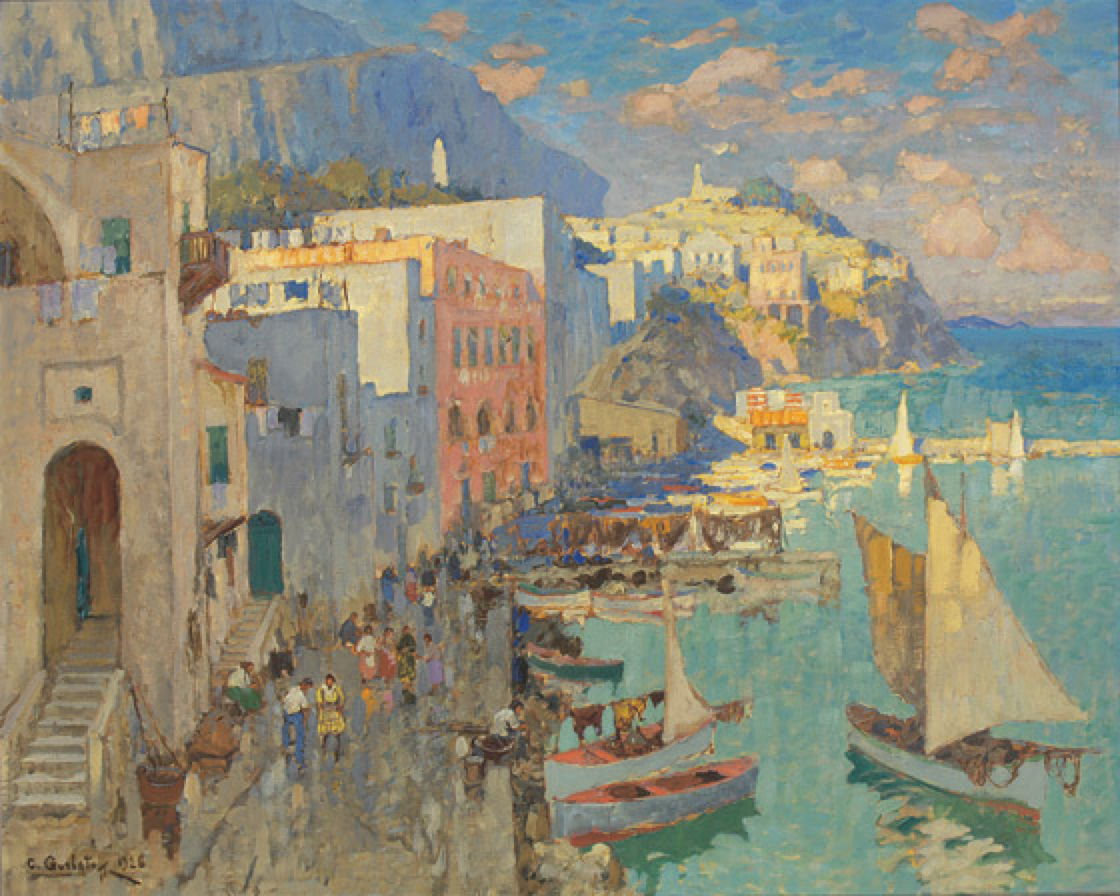
Konstantin Gorbatov (1876-1945), The Port of Capri (1926), oil on canvas, dimensions not known, location not known. Wikimedia Commons.

Gorbatov’s view of The Port of Capri (1926) shows the Marina Grande with the first of its jetties that now provide a more sheltered harbour. This looks west over the harbour on the north coast.

gorbatovcapri1926
Konstantin Gorbatov (1876-1945), Capri (1928), oil, dimensions not known, Private collection. Wikimedia Commons.

His slightly more distant view in Capri, painted in 1928, shows the high chroma style that he appears to have adopted when he moved to Berlin.

gorbatovcapriwc
Konstantin Gorbatov (1876-1945), Capri (date not known), watercolour, dimensions not known, Private collection. Wikimedia Commons.

This undated watercolour reverses those previous views, and looks east along the north coast, towards Monte San Michele and the more distant Monte Tiberio, at the far north-eastern tip of the island.

❌