Storm Bram brought heavy rain and high winds in Carnlough, Northern Ireland, in December 2025. Storm Dave is headed to the United Kingdom this weekend.
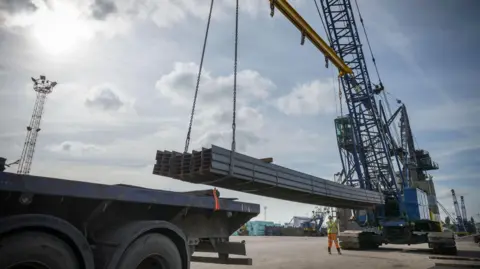
Iran is the 10th largest producer of steel globally (file photo)
Iran's two largest steel plants have been shut down due to multiple rounds of US-Israeli air strikes, the companies operating them say.
"Our initial estimate is that restarting these units will take at least six months and up to one year," Mehran Pakbin, deputy head of operations at the Khuzestan Steel Company in south-western Iran, was quoted as saying by Iranian media.
Mobarakeh Steel Company said its production lines in the centre of the country had "completely shut down following the high volume of attacks".
The strikes, which Israeli media and Iran's foreign minister said were first launched by Israel in co-ordination with the US last Friday, could cause major damage to Iran's economy.
Iran is the 10th biggest producer of steel globally, according to data from the World Steel Association. In addition to using steel domestically for construction and manufacturing, it exports the material across the world.
Any halt to production could have major implications to supply chains and businesses across the country, which for years have been affected by comprehensive Western sanctions.
The BBC has reached out to the Israel Defense Forces (IDF) and the US military's Central Command (Centcom) for comment.
Iranian Foreign Minister Abbas Araghchi said in a social media post on Friday: "Israel has hit two of Iran's largest steel factories, a power plant and civilian nuclear sites among other infrastructure. Israel claims it acted in co-ordination with the US."
Israeli media reported that an Israeli security source had said the strikes were expected to cause billions of dollars in damage to the Iranian economy, and that the steel plants were linked to Iran's Islamic Revolution Guard Corps (IRGC).
The IRGC said it had targeted US-linked steel and aluminium facilities in Gulf states in response.
On Thursday, the Israeli military reported several new incoming missile attacks from Iran, while the United Arab Emirates (UAE) said its military had "engaged with" 19 missiles and 26 drones launched from Iran.
The IRGC also targeted an Amazon cloud computing centre in Bahrain, according to Iranian state media.
US and Israeli forces look to have been hitting a wider range of targets in Iran in recent weeks, with US President Donald Trump and Defence Secretary Pete Hegseth saying on Wednesday that the US would bring Iran "back to the stone ages".
The comments sparked concern among Iranians - even those who support US-Israeli intervention against the Islamic Republic - that the scope of the offensive is broadening beyond the Iranian government and military.
There have also been attacks on health-linked facilities, with a spokesperson for Iran's health ministry confirming on Thursday that a medical research centre in Tehran - the Pasteur Institute of Iran - was attacked on 23 March. The spokesman described it as "a direct assault on international health security" and said it breached the Geneva Conventions.
On Tuesday, the Iranian government said there was an attack on one of the largest pharmaceutical companies in Iran - Tofigh Daru Research & Engineering Company - which produces anaesthetic and cancer drugs.
The IDF said in a statement that it had carried out the strike and alleged that the company had transferred "chemical substances, including fentanyl, that were used for research and development of chemical weapons".
Separately, on Thursday, a highway bridge linking the capital Tehran to the nearby city of Karaj was hit by air strikes, Iran's semi-official Fars news agency reported. Two people were killed, according to the deputy for security at the Alborz governor's office.
There was no immediate comment from the US military, but Trump wrote on Truth Social: "The biggest bridge in Iran comes tumbling down, never to be used again."
"Much more to follow! IT IS TIME FOR IRAN TO MAKE A DEAL BEFORE IT IS TOO LATE, AND THERE IS NOTHING LEFT OF WHAT STILL COULD BECOME A GREAT COUNTRY!" he added.
The IDF told the BBC it was "not aware" of any strikes on Karaj.
Iran has been under internet blackout for 34 days, with connectivity to the outside world at 1% of normal levels on Thursday, according to NetBlocks - making it difficult to verify information from the country.
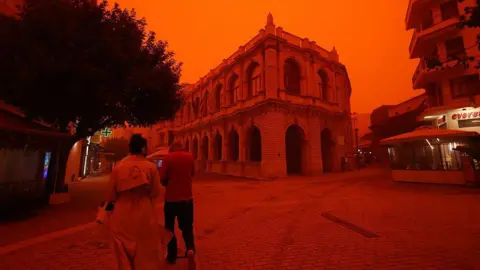
A man takes pictures as the city of Heraklion that is covered in red dust coming from Africa
A man has died near Athens as a storm hits parts of Greece with gale-force winds and flooding, while a Saharan dust storm enveloped the island of Crete.
The man was found under a car in the Nea Makri rural area early on Thursday, according to the fire department.
Storm Erminio has flooded streets, closed some schools and moored ferries. Meanwhile, some flights were disrupted on Crete on Wednesday after dust from an African storm filled the air, turning the sky red-orange.
The weather is expected to be bad on Thursday in most areas of the country "with long-lasting and intense rains and storms and possibly with local hail", according to the national meteorological service.
Stefanos Rapanis/Anadolu via Getty Images
Crete cloaked by a Saharan dust storm on 1 April
A red warning is in place in Crete, mainly in the west and south, from midday until late at night on Thursday.
The fire department received 674 calls for assistance from Wednesday through the early hours of Thursday. The majority were in the Attica region that encompasses Athens, with most calls for fallen trees.
High winds have kept ferries moored in ports, with Greek media reporting some departures may resume on Thursday, weather permitting.
Streets as well as the basement of the local police station in Nea Makri were flooded. A bridge was knocked down on the island of Poros and vehicles have reportedly been swept away. Some schools have also been closed.
Brady Ebert, a founding member of the Baltimore hardcore punk band, hit the father of Brendan Yates, the group’s lead vocalist, with his car, the police said.
Patrick Moore went to Humberside Police about Robert Bush
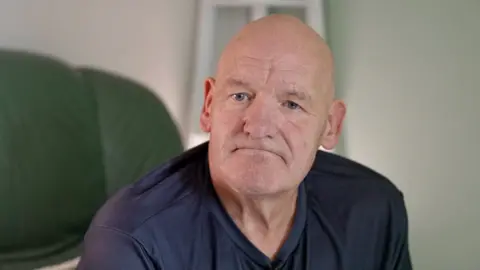
"I think he was living beyond his means," says Patrick Moore about disgraced undertaker Robert Bush.
Moore is trying to explain why his former boss hoarded 30 bodies and half a tonne of human ashes at Legacy Independent Funeral Directors in Hull.
A judge at the city's crown court earlier told Bush he is going to prison for preventing the burials of 30 people and giving grieving families the wrong ashes.
He also fraudulently sold funeral plans and stole from 12 charities, including the Salvation Army and Macmillan Cancer Support.
Legacy Independent Funeral Directors
Robert Bush wrote on social media that his funeral home was a "special place"
Moore, 65, says he was a "general dogsbody" at Legacy.
And he insists he did not know Bush had kept 30 bodies after their families had held funeral services. He says he knew of only three deceased people on the premises.
But the father-of-two says it became clear to him that "there was something wrong" in Bush's business affairs.
"Every time the phone rang, Rob was real jumpy… but I knew that was because he'd been getting phone calls and threats to be cut off from his electric.
"He'd put his laptop in one of these places [a pawnbroker] for a couple of days to get some money.
"Anything that he could sell, he'd sell it."
Although his Facebook account has since been deleted, posts showed Bush was selling a hearse, cars and even trying to give away a mortuary fridge that, according to the advert, "ran cool not cold".
A county court hearing in May 2024 highlighted Bush had debts amounting to almost £55,000, including to local councils for unpaid cremation and burial fees.
Facebook/Robert Bush
Robert Bush enjoyed motorbike racing and often posted on social media about racing his own bikes
According to Moore, Bush had been making his own coffins to save money – on occasion staying up all night at the firm's Hessle Road parlour.
He advertised these on social media as being "handcrafted" and "special".
Several local funeral businesses have told the BBC they would not supply Legacy with coffins, for fear they would not be paid.
Kevin Moxon, a former police officer who opened a funeral home in Hull six months before the investigation, claims he was warned about Bush.
"Other people within the funeral profession have said, 'don't get involved with him, don't lend cars, don't supply coffins'.
"The rumour was that you wouldn't get paid."
Bush oversaw about 2,000 funerals during his career. He began by working for other undertakers before setting up his own business.
So what happened to the money, paid by bereaved families?
Bush spent it, according to Moore.
Facebook/Robert Bush
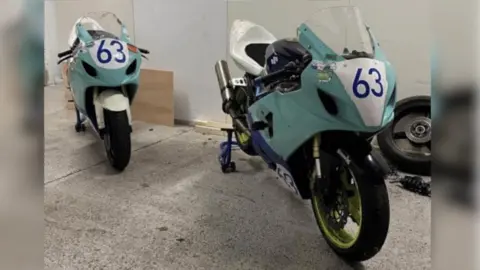
Two of Robert Bush's track bikes that were listed on a selling site, photographed by a mortuary fridge on Legacy premises.
He invested in racing bikes and splashed out on expensive track days, often posting videos of his lap times on social media.
His family home was in an exclusive street where property values reach half a million pounds.
And he enjoyed holidays abroad.
Despite his debts, Bush flew to Los Angeles in March 2024 to watch motorcycle racing.
"Rob was in America and I was looking after things for about four days," says Moore.
"He said if anybody comes just don't answer the door. Simple as that, that was what I got.
Bush's crimes may never have come to light, but for what happened when he was in America.
Moore says he used a stretcher, borrowed from another funeral service, to collect a body from a local nursing home.
Two men, who came to retrieve the stretcher, saw inside Legacy's premises.
Moore recalls: "While I was talking to one of them, the other one went in the fridge.
"They had seen it shouldn't be like this."
One of the men rang the police. Shortly afterwards, Moore went to the station.
The father-of-two says he had previously challenged Bush about practices at Legacy.
"Just the state of everything and I could see, when I was working with Rob, I could see there's something wrong here."
But Moore says his boss "always had an answer for everything".
"He was good at that."
PA Media
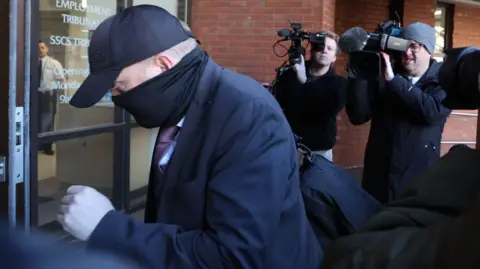
Bush arrives at Hull Crown Court on Thursday
Moore's account was integral to the investigation – one of the most intricate in Humberside Police's history.
Thirty-five bodies and half a tonne of human ashes were discovered at Legacy's premises by officers in March 2024.
In contrast to the air of respectability which greeted grieving families, Moore says the rear of Legacy's premises was like "something out of a horror movie".
Thirty-one of the remains discovered by police were those of loved ones whose families had already held funerals.
Those families had been told by Bush their relatives had been cremated.
More than 100 families had been presented with the ashes of strangers.
One of those families was that of baby Sunny Beverley-Conlin, who was born prematurely in May 2022. They held a funeral and were given ashes.
In March 2024, police found their son's body, still at the funeral home, and the family were told the ashes were not Sunny's.
Moore insists he had never seen Bush mixing up ashes.
"If I had have known, I would have been [to the police] a lot earlier," he says.
'Good actor'
Bush was the only person charged in relation to the Legacy investigation.
One victim's family says Bush operated behind a veneer of respectability.
"He genuinely seemed like a lovely guy. He seemed sad for us. Sympathetic.
"He was a good actor."
Emma Hardy MP, who represents many of the victims in the constituency of Hull West and Haltemprice, describes Bush as a "complete conman" who "made out that he cared".
"Anyone who treats people in that way is utterly without compassion," she adds. "He's a completely selfish individual who was thinking about his business, his money [while] disregarding human life."
Hardy says she does not accept the excuse that Bush was struggling financially, pointing out that he had a "large house" and enough money for holidays "while knowing all the time he was enjoying himself that he had left 35 human bodies in his funeral parlour".
The Legacy case has led to calls for the funeral industry to be regulated. Currently, it is not.
According to Hardy, there are more checks and regulations to set up a sandwich shop.
"You can set up tomorrow as a funeral director. Pop your name on the front of the shop and off you go. And nobody comes to look at anything."
Bush, formerly of East Yorkshire and now living in West Yorkshire, was granted conditional bail until he is sentenced on 27 July.
To play this video you need to enable JavaScript in your browser.
This video can not be played
Media caption,
Watch bodycam footage of Tiger Woods' arrest
ByLorraine McKenna
BBC Sport Journalist
Published
Police have released body camera footage showing Tiger Woods after he clipped a truck and rolled his car in Florida last month.
The 15-time major winner, 50, was arrested and charged with driving under the influence and submitted a written plea of not guilty via his lawyers on Tuesday.
He was also charged with property damage and refusal to submit to a lawful test.
Woods has been given permission by a judge to seek treatment overseas, and said he will be stepping away from professional golf to focus on his recovery and health.
Nobody was injured in the crash, but Woods had to crawl out of the passenger door to free himself. He passed a breathalyser test but refused a urinalysis test for other drugs, according to Martin County Sheriff John Budensiek.
In the arrest affidavit, an officer wrote Woods was "sweating profusely", his pupils were "extremely dilated" and his movements were "lethargic and slow".
In the video, Woods, who is wearing a blue polo shirt, shorts and dark sunglasses, is seen being handcuffed as officers question him.
He is told they suspect his "normal faculties are impaired" by an "unknown substance". Authorities then find two white pills, which were identified as hydrocodone - an opioid used to treat pain - in his pocket.
Woods, who remains still while officers search him, is asked does he have anything else on his person, to which he replies he does not.
On Wednesday, it was announced that Woods had turned down the role of United States Ryder Cup captain when the biennial tournament takes place in Ireland in 2027.
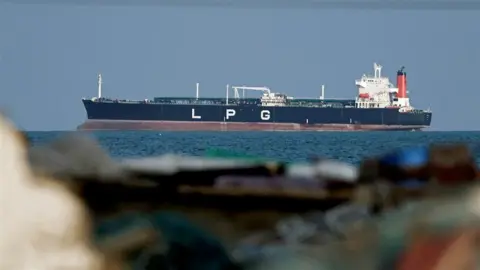
The amount of cargo traffic in the Strait of Hormuz has drastically decreased since war broke out
A coalition of about 30 nations are to discuss plans to reopen the vital Strait of Hormuz shipping lane in the Middle East, at a virtual summit hosted by the UK on Thursday.
The virtual summit is expected to consider what diplomatic and political steps could be taken to reopen the important shipping route, though the US was not set to attend.
Iran has attacked several vessels in the strait in response to the war waged against it by the US and Israel, severely disrupting energy exports and sending global fuel prices soaring.
On Wednesday, US President Donald Trump said it was for other nations to "build up some delayed courage" and reopen the route.
Trump said allies "should have done it" earlier, adding: "Go to the Strait and just take it. Protect it. Use it for yourselves."
Washington has repeatedly accused allies of not doing enough to secure the shipping route or to support its war effort, leaving the UK and other nations weighing how to contribute to securing the strait without becoming involved in the wider war.
Foreign Secretary Yvette Cooper is set to chair Thursday's virtual meeting.
The summit was expected to involve governments which signed a joint statement in mid-March calling on Iranian forces to halt attacks against commercial ships.
That statement was supported by some Gulf nations, as well as France, Germany, Japan, Australia and others.
The statement says: "We express our readiness to contribute to appropriate efforts to ensure safe passage through the Strait.
"We welcome the commitment of nations who are engaging in preparatory planning."
The talks come a day after Prime Minister Sir Keir Starmer said the UK was "exploring each and every diplomatic avenue that is available" to reopen the route.
He also said British military planners would consider what could be done in the future to "make the Strait accessible and safe after the fighting has stopped".
At the same time, governments around the world are weighing how to respond to cost-of-living pressures triggered by rising energy prices.
About a fifth of the world's oil and gas passes through the Strait of Hormuz.
The price of a barrel of Brent crude, the global benchmark for oil prices, has jumped from $73 (£55) to well over $100 in recent weeks.
The president failed to provide any meaningful strategy on the two central issues that define the war on Iran: reopening the Strait of Hormuz and what to do about that country’s uranium.
The board had been expected to vote to approve the project last month, but it was delayed after about 32,000 mostly negative comments rolled in from across the country.
Will Scharf, who was appointed by President Trump as the chairman of the National Capital Planning Commission, at a meeting to approve the White House ballroom plans on Thursday.
The move could unlock more federal research into how drinking water can be treated to remove pollutants, but it may also lead to costly new standards for water utilities.
A flight carrying people being deported from the US has landed in Uganda, as Donald Trump’s administration pushes on with its strategy of expelling migrants to countries they have no ties to.
The deported people would stay in the east African country as “a transition phase for potential onward transmission to other countries”, an unnamed senior Ugandan government official told Reuters.
The Uganda Law Society, which condemned the arrivals, said 12 people were on the flight, the first under an agreement Uganda signed with the US in August. No other details of the deportees, including their nationalities, have been made public.
The US has already deported dozens of people to third countries. Other African countries that have accepted or agreed to accept deportees include Eswatini, Ghana, Rwanda and South Sudan which have received people from as far afield as Cuba, Jamaica, Yemen, Vietnam, Laos and Myanmar.
The Uganda Law Society said it would be filing legal challenges to the deportations in Ugandan and regional courts. It criticised “an undignified, harrowing and dehumanising process that has reduced [the deported people] to little more than chattel, for the benefit of private interests on both sides of the Atlantic”.
All deportations “are in full cooperation with the government of Uganda”, said Yasmeen Hibrawi, a public affairs counsellor at the US embassy in Kampala.
Hibrawi said: “We do not, however, discuss the details of our private diplomatic communications and for privacy reasons, we cannot discuss the particulars to their cases.”
In August, Uganda said it had reached a deal with the US to take in people from third countries who might not get asylum in the US but were “reluctant” to be sent back to their home countries.
It said it would not accept people with criminal records or unaccompanied minors and did not specify if the US was paying. Uganda already hosts nearly 2 million refugees and asylum seekers, most from other east African countries including the Democratic Republic of the Congo, Ethiopia, Eritrea and Sudan.
Orders for deportation to Uganda have been issued to hundreds of asylum seekers, according to the Associated Press. Oryem Okello, the Ugandan minister for foreign affairs, said none had arrived yet.
The US may be “doing a cost analysis” and trying to avoid dispatching flights with only a few people onboard, he said. Okello added: “You can’t be doing one, two people at a time. Planeloads – that is the most effective way.”
The US agreed to pay Eswatini $5.1m (£3.8m) to take up to 160 third-country nationals, according to Reuters. Five men were deported by the US to the southern African nation in July, with another 10 sent in October. Two have since been repatriated to Jamaica and Cambodia respectively, while the rest remain in a maximum security prison.
US Immigration and Customs Enforcement (ICE) had detained more than 63,000 people in the US, as of 12 March, according to government data. Toddlers and newborn babies were among the 5,600 people imprisoned at an ICE detention centre in Dilley, Texas, between April 2025 and February 2026, according to a report by the non-profit organisations Human Rights First and Raices.
Todd Blanche, the deputy attorney general, has helped usher in President Trump’s retribution campaign. But he faces anger on the right for resisting some of the most extreme measures.
A coalition of legal groups claims the Homeland Security Department adopted an unconstitutional policy allowing its agents to enter homes without a judicial warrant.
President Trump faces the possibility that at the end of his own two-to-three week window for wrapping up the war in Iran, nothing much will have changed.
A building in Tehran damaged by airstrikes. This week, President Trump said: “It’s not possible for us to take care of day care, Medicaid, Medicare, all of these individual things, they can do it on a state basis.”
The justices seems poised to rule against the president’s birthright citizenship plan. He is already furious over their decision rejecting his tariffs program.
 Login
Login



 BBC
BBC NIKOS CHALKIADAKIS/EPA/Shutterstock
 Stefanos Rapanis/Anadolu via Getty Images
 Stefanos Rapanis/Anadolu via Getty Images
 BBC
BBC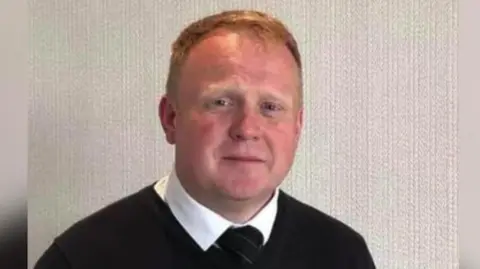 Legacy Independent Funeral Directors
 Facebook/Robert Bush
 Facebook/Robert Bush
 PA Media
 Reuters