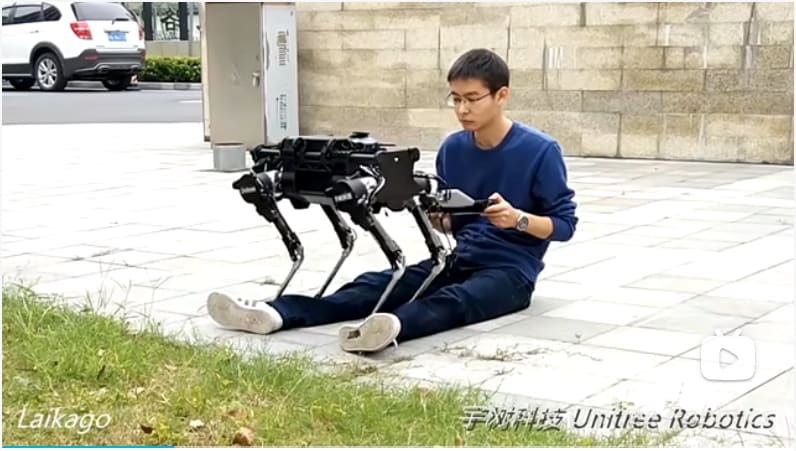
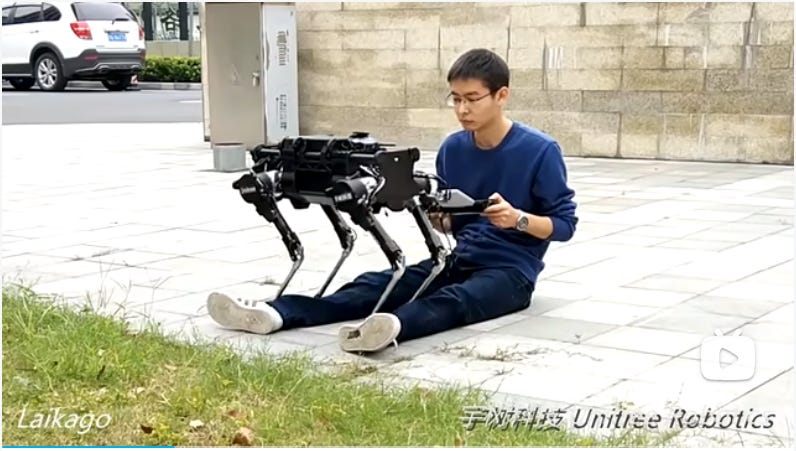
In 2017, Hangzhou-based robotics firm Unitree 宇树科技 launched its first quadruped, Laikago. Laika was the name of the Soviet space dog onboard Sputnik 2, and the American English pronunciation of “go” is similar to that of the Chinese word for dogs, 狗 gǒu. Unitree’s battery-powered tribute to Laika wasn’t fuzzy, but walked on four feet and navigated through basic obstacles.
Unitree founder Wang Xingxing 王兴兴 has long held faith in the potential of robotic canines. Since 2020, when Unitree started gaining media attention, he has insisted in multipleinterviews that humans are drawn to four-legged creatures and will have a natural fondness for their artificial counterparts.
Wang Xingxing with a Laikago in 2017. (Source: Bilibili)
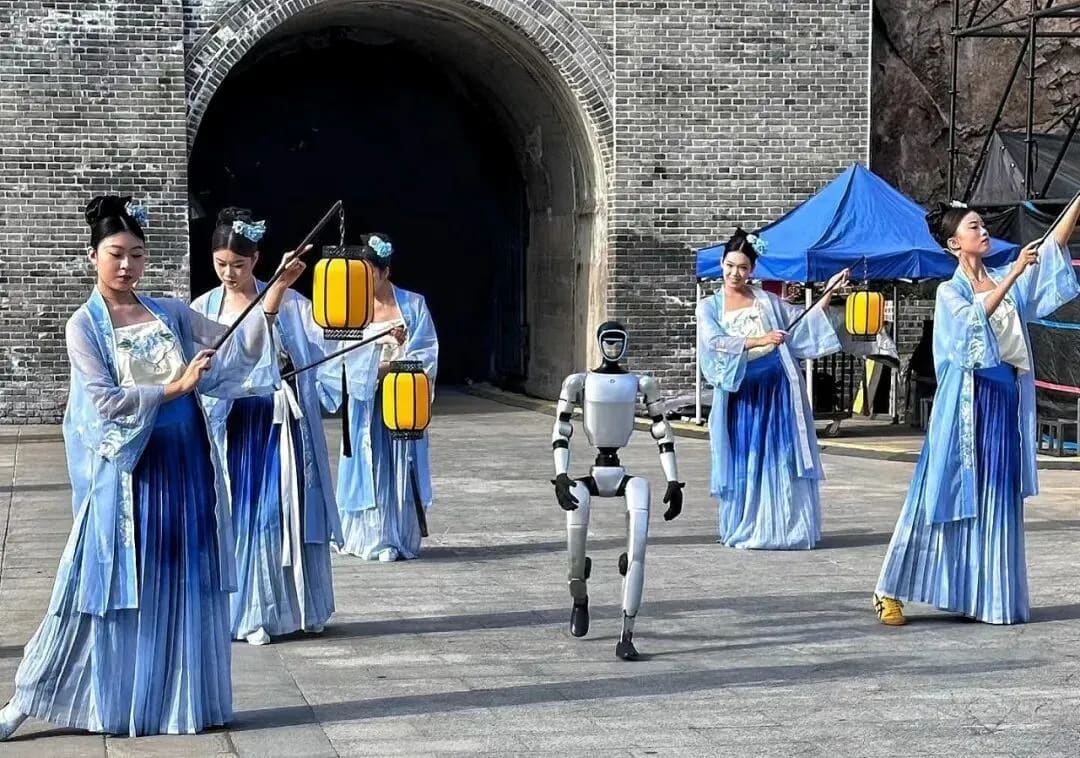
Fast forward to 2026, and Unitree has just filed for a $610-million IPO on the Shanghai Stock Exchange. The company is a household name in China after its humanoid robots performed dances at the CCTV Spring Festival Gala for two consecutive years and counting. Through their IPO disclosures (investor prospectus and response letter to the Shanghai Stock Exchange’s inquiries), we get some answers to important questions about the development of embodied AI.
How is Unitree profitable?
Where is diffusion happening inside China, aside from dancing on TV?
Are Chinese robotics companies content to lead in hardware and applications, or do they also see themselves as pursuing some kind of generalized “frontier”?
And finally, what does this all mean for US-China dynamics in robotics?
What’s the money maker?
One of the most notable things about Unitree is the fact that it actually makes money. Unprofitability is a near-universal challenge because AI robotics, despite massive advances in the past few years, is still an early-stage technology. Mass adoption has not yet arrived; pathways out of bottlenecks like data are uncertain; and important safety standards have not caught up. Even shipping products consistently can be a challenge for some companies in the space, let alone manufacturing at scale and booking reliable customers.
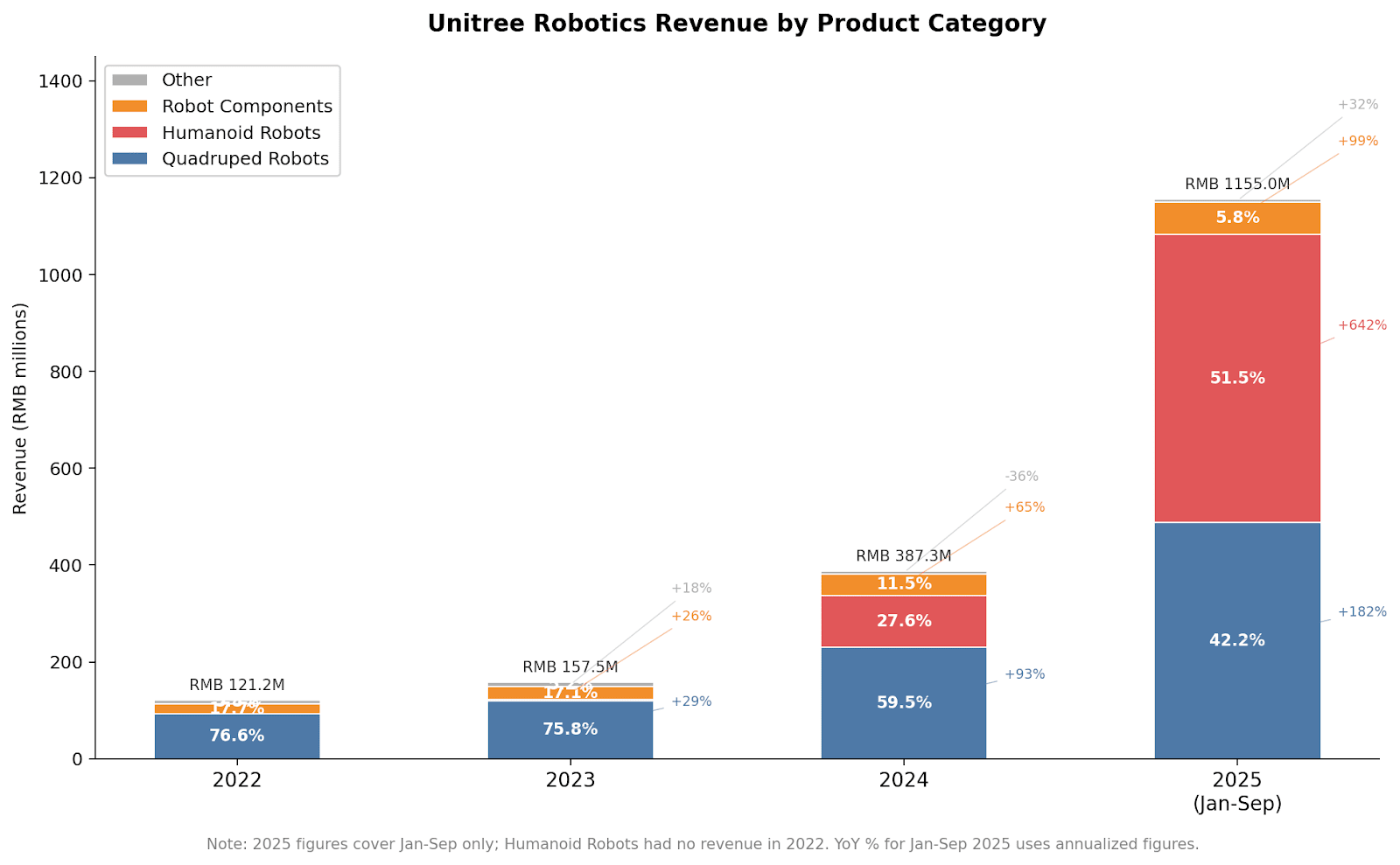
This context is why observers have found Unitree’s ability to turn a profit remarkable. Not only has the company’s net profit been positive since 2024, but from 2024 to 2025, its net profit grew by 204.29%. A look at its growth, broken down by product category, reveals the most significant source of this revenue explosion: humanoids.
It’s perhaps ironic that, despite the company’s longstanding work in quadrupeds, it is humanoids that have catapulted its business model to success. By meeting genuine demand in academia — and staging an especially strong marketing campaign in front of the Chinese public — Unitree has transformed itself into a humanoid frontrunner. Some analyses trace their potent commercialization drive back to Unitree’s origins. Wang Xingxing’s cofounder Chen Li 陈立, who was Wang’s classmate throughout both their undergraduate and Master’s programs, worked in international sales for the Hangzhou-based, partly state-owned surveillance tech giant Hikvision (海康威视) before joining Unitree. Hikvision has been extremely successful at expanding internationally (including in the US before it was added to the Entity List over its involvement in human rights abuses against ethnic and religious minorities in China). Investors have told Chinese media that Chen’s experience is an important asset for Unitree’s global commercialization, driving sales to governments and businesses in particular.
Unitree has earned name recognition in the West, but it is far from the only Chinese robotics company meaningfully shaping the future of embodied AI. In fact, it is part of an increasingly competitive market for AI-powered robots. Among listed peers, UBTECH and Dobot are major competitors named in Unitree’s prospectus. A fellow member of the “Hangzhou Six Dragons,” DEEP Robotics, is betting big on scenario-adapted applications, while AgiBot, by some estimates, shipped even more humanoid units last year than Unitree did.
In their response to the Shanghai Stock Exchange’s inquiry letter, Unitree emphasized in-house development of hardware parts as its key strategy for cutting costs. Unitree designs, builds, and assembles most components (other than commodity components like battery cells, flash storage, and the core computing board) in-house. It does offer outsourced alternatives for add-ons like LiDAR, cameras, and dextrous hands, but has also developed in-house options for all of these.
Where are the robots?
Unitree’s most reliable customers are universities, research institutions, and other companies conducting research into robotics. Its hold on academic customers worldwide is so firm that it’s caused alarm among DC policymakers. In May 2025, the China Select Committee called for Unitree to be designated as a “Chinese military company” and to be added to the Entity List.
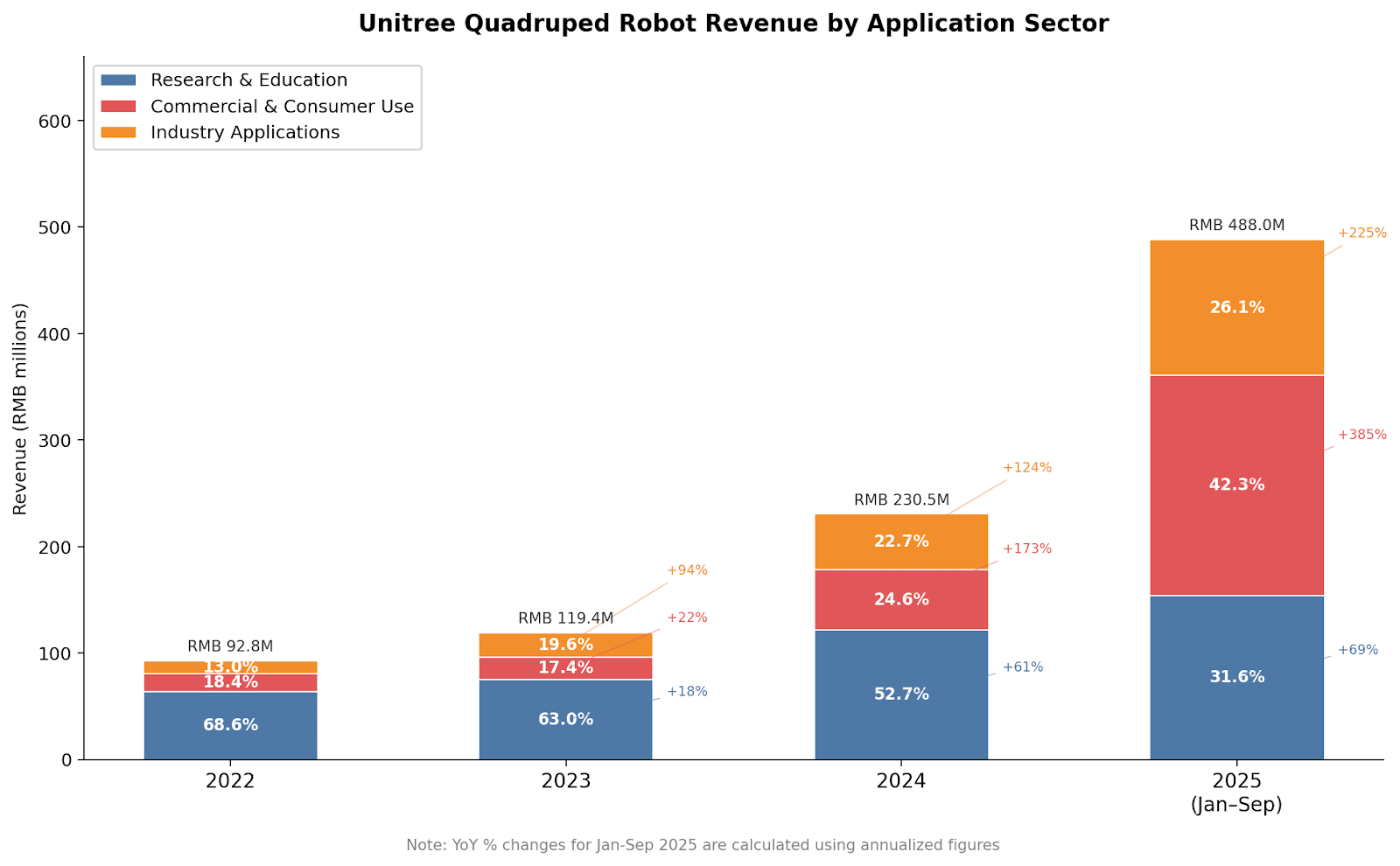
The data Unitree disclosed about its revenue sources, however, paints a more complex picture. For quadrupeds, the research and education sector has been the company’s most reliable source of revenue since at least 2022 (IPOs generally do not require companies to disclose audited financial statements from more than three years ago). But starting in 2024, revenue from both commercial and industry customers more than doubled. Consumer sales revenue nearly quadrupled year-on-year in only the first nine months of 2025.
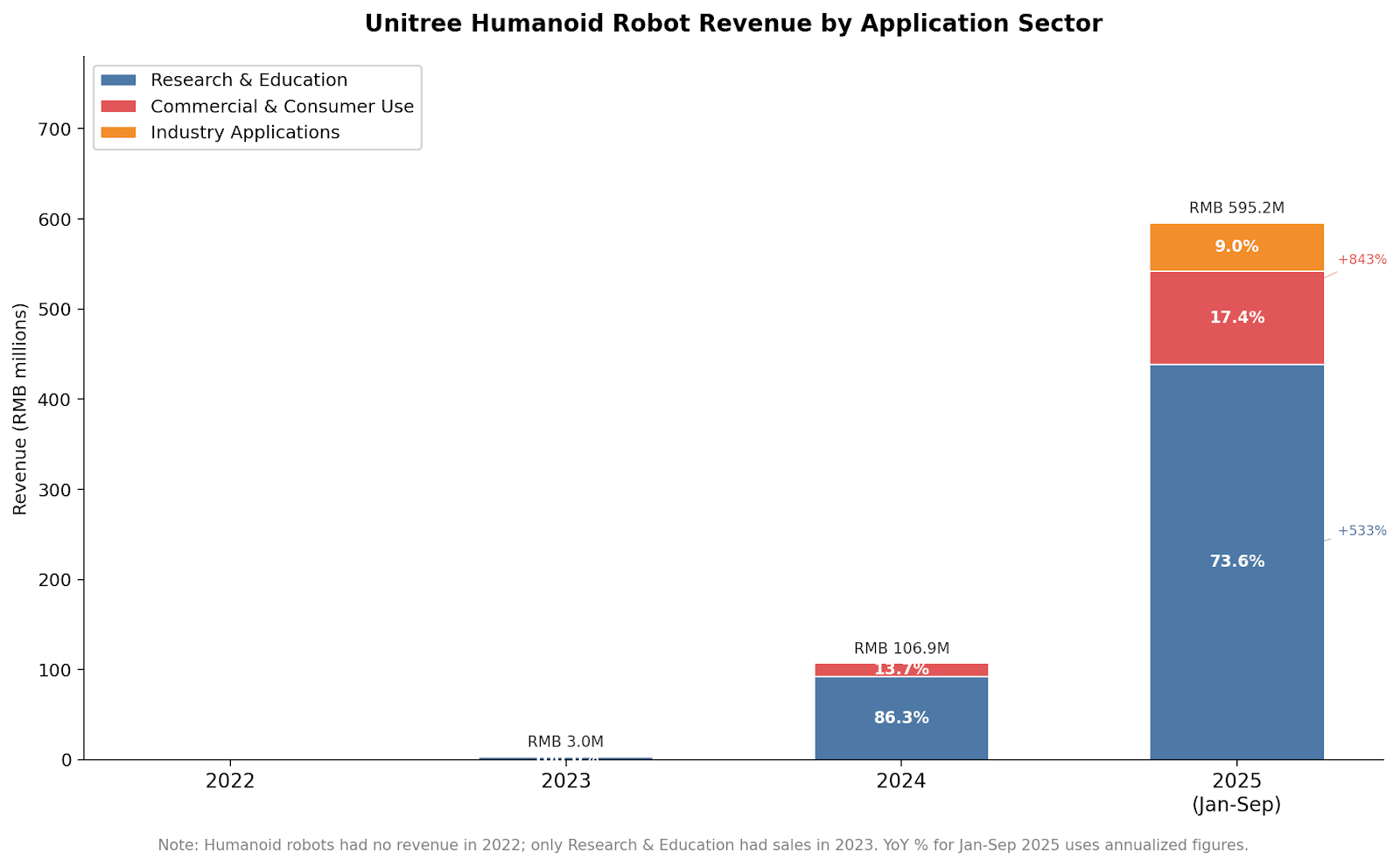
A similar, if more compact, story emerges for humanoids as well. Demand still largely comes from researchers and educational institutions, but commercial and industrial demand has grown from a near-zero starting point on a seemingly exponential trajectory since 2024. Consumers are especially excited about humanoids due to Unitree’s successful marketing of the concept. Industrial applications of humanoids are more limited compared to those of quadrupeds, but are also appearing.
What, exactly, are people doing with these robots? “Research & Education” encompasses sales to researchers, who use Unitree hardware and platforms to conduct their own experiments. The “Commercial & Consumer Use” and “Industry Applications” categories roughly map onto B2C and B2B sales, respectively. According to Unitree, non-academic consumers who buy their robots mostly do so “for show”: they’re deploying these robots as attractive promoters in retail settings, at tourist sites, and in performances and exhibitions. Some use them as novelty companions.
Applications in industry are more interesting. Quadrupeds are deployed as “smart inspectors” in power grids, subway tunnels, and gas pipelines. They can also assist in harsh settings like emergency response and outdoor surveys, and complete manufacturing and logistical tasks. E-commerce firm JD.com is Unitree’s biggest corporate customer. Humanoids, according to Unitree, are being used for inspections and manufacturing as well, though in a more limited capacity because the technology is less mature. Unitree expects consumer demand for humanoids to grow in the medium term, but we will have to wait a while longer for genuinely useful humanoids on the factory floor.
Is Unitree… AGI-Pilled?
Received wisdom in robotics has it that the US leads in software-related research, while China’s strength is in hardware. The implication is that the US is likely to reach “generalized” machine intelligence in the physical world faster than China, but — in the meantime — Chinese companies could get to practical applications faster through quick iterations inside an unparalleled manufacturing ecosystem.
Unitree’s business model is often quoted as direct evidence of this dynamic, and it is indeed true that hardware is the crux of Unitree’s success. But does that mean Unitree, and the Chinese robotics industry writ large, has less interest in generalizability or the intelligence frontier? The IPO disclosures indicate otherwise.
Unitree called on incoming investors to “realize humanity’s ultimate dream — AGI” 实现人类最终极的梦想—AGI with them. Their lawyer-drafted definition of AGI is “a form of intelligence that possesses general cognitive capabilities comparable to those of humans, capable of understanding, learning, and executing intellectual tasks across any domain, and autonomously reasoning, planning, making decisions, and continuously learning in unknown environments.”
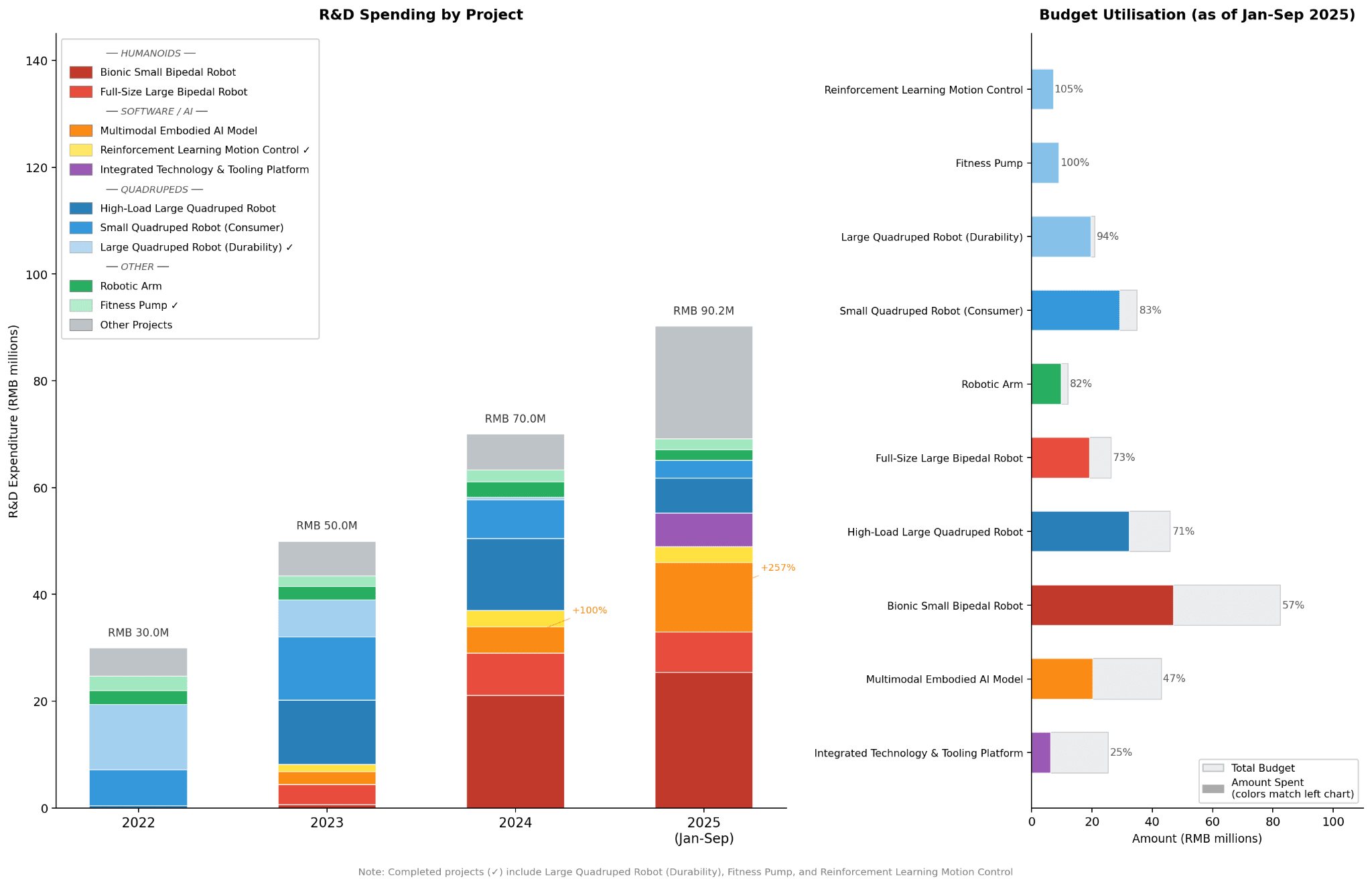
The financial reality tells us that most of Unitree’s R&D budget has gone to hardware. This is clearly downstream of their aforementioned focus on developing as many components in-house as possible to cut costs.
However, it’s important to notice in the chart above that Unitree’s R&D expenditure on “Multimodal Embodied AI Model” — the “big brain” of its robots — increased exponentially between 2024 and 2025, while other areas of R&D have grown at a steadier pace. Unitree is clearly ambitious about developing its models, even if it is known mostly for its hardware business.
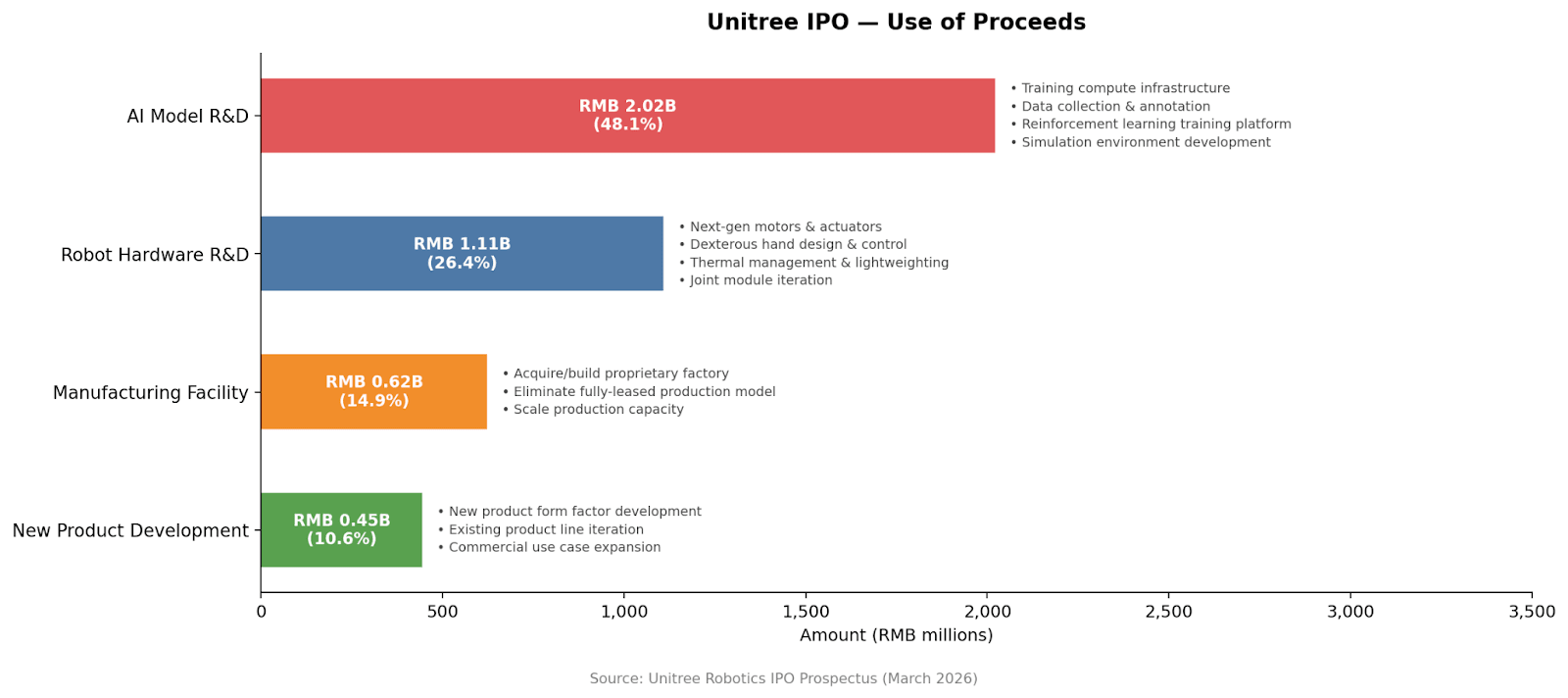
This becomes clearer when we look at Unitree’s plan for using the 4.2 billion RMB (around 607.7 million USD) raised through the IPO. Unitree’s stakeholders approved the following distribution in early 2026:
Nearly half of the IPO’s proceeds will be spent on training AI models over the next three years. That’s around 673 million RMB per year, which is not quite comparable to more well-known model makers (MiniMax, for example, spent around 1.75 billion RMB on R&D last year) but still a significant amount that signals long-term software ambitions.
Unitree currently owns no real estate, but plans to build its own factory with IPO proceeds. Per its disclosures, it has already secured a nod of approval from Hangzhou’s Binjiang District 滨江区 and plans to build there. Transitioning from an all-leased manufacturing model to proprietary manufacturing facilities is in line with their emphasis on in-house development and increasing production efficiency.
What comes next?
These disclosures answer many factual questions about Unitree’s business model, but raise more fundamental questions about the future of automation, US-China competitive dynamics, and both countries’ big bet on AI.
Question one: What will come of Unitree’s “AGI” ambitions? A public company is required to either use proceeds as stated in official disclosures, or publicly justify any changes. (Shareholders can vote to reappropriate funds, but unauthorized deviations could invoke China’s securities law and trigger scrutiny from the Stock Exchange.) Barring major issues, we should expect Unitree to spend handsomely on model training and development for the next three years. The biggest challenge will be making sure that these investments produce consequential returns. This uncertainty is not exclusive to Unitree; no one knows what the next three years will bring. But Unitree has now put itself on a path away from hardware-first and towards a more diversified strategy. This is, of course, risky, but relying on academia’s demand for hardware is no longer secure.
Question two: Will America turn against Unitree? A “Chinese military company” designation, which places companies into the annually-updated 1260H list, would merely exclude Unitree from contracting with the Department of Defense, but being placed on the Entity List would subject it to US export controls. Neither designation would prevent Unitree from selling to American customers outright, but they would hobble the company’s growth. As Unitree’s own prospectus describes:
Throughout the reporting period, revenue from overseas markets consistently exceeded 35% of total revenue. Should the United States continue to intensify trade and tariff policies that materially disadvantage Chinese exporters, or place the company on restricted lists governing procurement partnerships or technology export controls, the company faces the risk of being unable to sustain high growth in overseas sales — and potentially suffering an overall decline in performance. … Given uncertainty in industrial trade policy and the international political environment, any adverse shifts in external supply chain conditions or overseas market controls — compounded by further escalation of US trade restrictions and export control measures — could negatively affect the company’s ability to procure imported materials and maintain technology partnerships.
Policymakers eager to run “Trojan horse tech” out of America have to reckon with the dilemma that, for academic researchers at the forefront of embodied AI, there are few alternatives to Chinese-made hardware and platforms; Unitree is simply the most successful of the lot. Affordability and reliability are the most important factors for nonprofit academic labs. Robotics research is also a rough-and-tumble affair: there is wear and tear, and I’ve had researchers and students show me bruises they’ve sustained on the job from handling heavy humanoids. Unitree’s scale, consistency, and pricing meets academics where they are. Moreover, Unitree has been cultivating its relationships with international researchers long before the reporting periods of these IPO disclosures. The company started shipping internationally in 2018, and some of the earliest buyers of its quadrupeds were university research labs.
Imagine writing code for a dishwasher without dishwashers to test the code on. That’s a massively oversimplified comparison, but it is the same proposition in spirit. If Washington severs this symbiotic relationship, it will almost certainly make it harder for American researchers to maintain their lead in the software side of embodied AI.
Finally, question three: Can Unitree keep its lead inside China? As mentioned earlier, the company has formidable challengers in its own backyard, and has had to continuously trim costs to stay competitive. DEEP Robotics also joined the leagues of profitable companies in 2025. AgiBot’s CEO said at the end of last year that the company’s total sales revenue in 2025 likely exceeded 1 billion RMB. Up until now, Unitree’s success is arguably a case of first-mover advantage. Many more companies are taking up the Unitree playbook, and the future of robotics in China is far from determined.
If you aren’t yet ready to open your home to a robot dog, the company also sells fitness equipment inspired by robotics technology…
U.S. soldiers in a military exercise with NATO members in Romania in June. The U.S. secretary of state has warned that relations with NATO will need to be re-examined.
In his address, President Trump did not define a clear path out of the war but said the United States would hit Iran “extremely hard” in the next few weeks.
Regina Wallace-Jones, the chief executive of the liberal fund-raising organization ActBlue, at the 2024 Democratic National Convention in Chicago. A 2023 letter from her to Congress later played a role in internal turmoil at ActBlue.
As Robert F. Kennedy Jr. calls for medical schools to redesign curriculums, an agency that oversees dozens has deleted diversity standards and added nutrition.
The tech industry has predicted A.I. will profoundly affect the nature of white-collar work. The industry’s own workers are already getting a taste of that future.
The cousin, Antoine Kassis, was found guilty of conspiracy to support a terrorist group, after trying to sell weapons from the fallen regime to a Colombian militia.
Jeff Martin opened the independent bookstore Magic City Books in Tulsa in 2017. Since then, it’s become a bastion of bibliophilia in the midsize prairie town.
Seedance 2.0 是视频生成领域的全球 SOTA 模型,但让它对企业真正可用的,不只是生成质量。火山引擎为它建了一套覆盖全流程的肖像与版权安全标准,从输入素材的合规校验,到生成过程中的肖像权保护,再到输出内容的版权风险拦截。Deepfake、侵权这些让企业法务部夜不能寐的问题,在模型层就做了拦截。
这套安全机制覆盖视频生成涉及的各种模态和创作前后的全部环节。说白了,火山引擎选择在模型最火的时候,先把安全门焊死,再把 API 钥匙交给企业。
Remnants of munitions have been discovered in impacted areas of the city
At least four people have been killed by a series of powerful explosions at an ammunitions depot in Burundi's largest city, Bujumbura, local residents have told the BBC.
The blasts erupted late on Tuesday at the facility, located in the suburb of Musaga, due to an electrical fault, an army spokesperson said.
Shrapnel and debris were propelled more than 5km (three miles) and several houses in nearby districts were destroyed by the force of the explosions.
The authorities have not yet provided any casualty figures but family members and eyewitnesses told the BBC of four separate deaths in the city. The AFP news agency quotes security sources as saying that dozens of people had died.
One woman told BBC Gahuza that a relative, who had been detained at Mpimba Central Prison, had died after a bomb hit the facility.
Numerous inmates at the prison, which is located near the ammunitions store, are reported to have been injured.
In the north-eastern neighbourhood of Gisandema, witnesses told BBC Gahuza that a bomb had destroyed a house and killed a domestic worker.
The authorities have said they cannot yet comment on the number of casualties as they are still assessing the extent of the damage.
The explosions sent plumes of smoke rising above the city, sparking panic in the city of more than a million people.
President Evariste Ndayishimiye, in a message on X, expressed his condolences to all Burundians, adding that the authorities are "here to help".
The columnist M. Gessen sits down with the writer Harriet Clark to talk through the complexity of maintaining relationships with family members who have done unthinkable things.
Republicans once saw Georgia as the crown jewel of their Senate pickup opportunities. They’re now blaming each other as the GOP primary unravels into an intraparty brawl that could cost them their chance of defeating Democratic Sen. Jon Ossoff.
The party is grappling with a crowded field, no dominant front-runner, no endorsement from President Donald Trump — and the reality that the May 19 primary will very likely extend into an expensive, bruising mid-June runoff.
Rep. Mike Collins (R-Ga.), a close Trump ally, leads in public polling, with fellow Rep. Buddy Carter (R-Ga.) and Gov. Brian Kemp-endorsed former football coach Derek Dooley battling for second. But a large share of voters remain undecided, underscoring how fluid the race is. Meanwhile, incumbent Ossoff — who faces no primary challenge of his own — is keeping his powder dry and has amassed a formidable eight-figure campaign war chest ready to deploy in the general election.
“If Ossoff could write a playbook for how he wants this primary to go, this is exactly it,” said a GOP operative, who, like others interviewed for this story, was granted anonymity to speak candidly about the race’s dynamics. They said that Georgia is like a "red-headed stepchild" not getting any attention from Washington.
Republicans point to several unforced errors that got the party to this point. Some say their current challenges were set in motion last year, when they failed to convince the state’s popular outgoing GOP governor, Kemp, to run for Ossoff’s seat. Others point to a lackluster effort by the National Republican Senatorial Committee to recruit a stronger crop of candidates or unify the field. Many also fault Trump and Kemp, who have had a sometimes-testy relationship, for failing to agree on a candidate they both could support to avoid a costly primary.
“It's not ideal that it looks like it's going to runoff,” said Cole Muzio, president of the conservative Frontline Policy Council. “There was so much talk about Kemp and Trump getting together and finding a nominee together, landing the plane on one person. I'm not going to try to sort out what happened with that, but a unity nominee would have been ideal.”
The early finger-pointing that has emerged in conversations with a dozen GOP strategists and officials in Georgia reflects their deep frustration with the state of their primary — and their chances of holding onto the Senate majority. The party is fending off competitive Democratic candidates in several red states as voters sour on Trump's agenda, making flipping Georgia even more of a priority.
"It's a mess that could have been much less messy if they had figured this out six months ago," said a second Georgia-based Republican strategist unaffiliated with any campaign. "Everybody's resigned to this going to May and then a June runoff and then pick up the pieces after that."
Early general election polling shows Ossoff leading all three potential GOP candidates in a head-to-head matchup. After five years in the Senate, he has built a formidable political operation, churned out razor-thin statewide wins and amassed a sizable fundraising cushion.
“Jon Ossoff has $24 million. Jon Ossoff is on TV all of the time, carefully articulating his positions, grilling Tulsi Gabbard — really being methodical,” said Ryan Mahoney, a GOP strategist unaffiliated in the race. “He has tons of resources — great name ID, a lot of exposure — while the Republicans are fighting against each other, trying to see who can break out and ultimately be the nominee.”
“He's just in a great position,” Mahoney noted.
Still, several Republicans say they’re confident about their prospects in a state that Trump won in 2024, and they expect money and outside support to dramatically ramp up once their nominee is decided.
“Republicans created this problem. We created this problem and it's not any one person,” the second GOP strategist said. "I still think a Republican can win, I just think we're making it way harder.”
With around 40 percent of likely GOP primary voters still undecided, according to recent public polling, the Senate candidates have been jockeying for Trump’s blessing — an endorsement that could be pivotal in deciding the future of the race.
All three candidates have engaged with the White House directly. In an interview with conservative host Clay Travis’ Outkick podcast, Dooley said he met with Trump in the Oval Office last year and had a “very engaging conversation.” Carter, for his part, told POLITICO in a brief interview that his campaign continues “to talk to the administration” about the race. Collins and the president have also met and discussed the race, according to a person familiar with the conversation. In February, Collins appeared onstage with the president during an event in Rome, Georgia, focused on Trump’s economic agenda.
Collins’ campaign recently released a lengthy memo outlining his argument for why the field should coalesce him around the primary. “[Democrats] are watching Republicans turn what should be the best pickup opportunity of the midterms into a needless intraparty squabble that wastes time and resources,” the memo reads. “Instead of spending the majority of 2026 focused on defeating Jon Ossoff, Republicans are on track to not be unified until late June, after a runoff, leaving the Republican nominee only four months to raise money and campaign across the largest state east of the Mississippi to unseat the Democrat.”
Most outside groups have been waiting to line up behind a clear front-runner, though Club for Growth PAC, a major conservative super PAC, has already endorsed Collins’ campaign — an unusual step for a group that usually acts in lockstep with the White House’s political strategy.
The White House did not respond to a request for comment regarding Trump’s thinking about the primary or his conversations with the three candidates.
Then there’s the Kemp factor.
After the governor declined to run, Republicans feared the primary could become a proxy war between himand Trump, who’ve previously clashed over Trump’s insistence that the 2020 election in Georgia was fraudulent. That hasn’t quite played out, with the president staying out of the race so far. But Kemp’s decision to back Dooley, the former football coach, means it’s unlikely they’ll find common ground.
“It's no secret that the profile of a candidate that President Trump would prefer is much different than the profile of a candidate that Governor Kemp would prefer,” said a third local GOP strategist, who is unaffiliated in the race. “The nexus between those two just made it very hard, if not impossible, to come out with a consensus candidate.”
Garrison Douglas, a spokesperson for Kemp, doubled down on the governor’s support for Dooley in a statement and said he isn’t “wasting time worrying about the complaints of anonymous consultants.” Dooley spokesperson Connor Whitney said he’s confident Georgia voters will “choose the only political outsider in this race — not another stale D.C. politician.”
Carter spokesperson Chris Crawford rejected the criticism of running a messy primary, saying that “only in Washington do consultants think voters choosing their nominee is a problem.”
Collins, in a statement, expressed confidence in his ability to win the primary, and added that his campaign “would welcome any help to ensure we could wrap this up in May and get on to the main event."
With Georgia in a holding pattern, some local Republicans worry that Washington’s attention is drifting toward Michigan, where former GOP Rep. Mike Rogers has unified the party — and the president — around him in the state’s key battleground Senate race as a trio of Democrats battle it out in their own messy primary.
“There's offense and defense. I think on offense, [Georgia] is still a top race. I think the only difference is that Michigan is a clear field. Rogers is ready to roll. He's raising money. Dems have a mess on their side over there,” said one national Republican familiar with the party’s midterm strategy, who was granted anonymity to discuss behind-the-scenes planning.
Still, the person said they believe Georgia remains competitive, particularly if Republicans unify.
In a statement, Nick Puglia, a spokesperson for the NRSC, said Ossoff “is the most vulnerable incumbent on the map” and Georgia “has been and remains a top state for Republicans to expand President Trump’s Senate Majority.”
But Republicans in the Peach State are skeptical.
“I sense from some Republicans a feeling that maybe Michigan is a better opportunity, and of course, one of the reasons … for that is, ‘well, the field’s been cleared,’” said a fourth GOP strategist in Georgia.
“It feels like D.C. is shifting to Michigan because of a problem that they could solve today,” said the second Georgia-based GOP strategist.
Watch the moment Artemis II blasts into space on historic mission
Nasa's Artemis II mission thundered away from Florida's coast, taking its four crew members on their historic journey to circle the Moon.
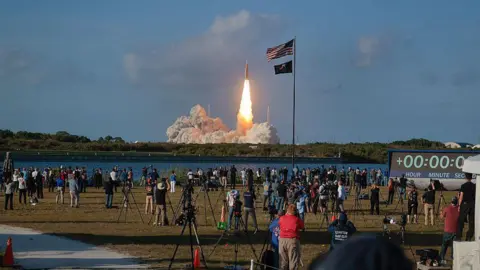
There was a deep rumbling as a sheet of brilliant white flame suddenly erupted, momentarily engulfing the whole launch pad as the mightiest rocket Nasa has ever built rose into the sky.
Nasa's Space Launch System (SLS) majestically crept upwards - slow at first, then gathering pace, riding on two blinding pillars of flame that crackled and roared with increasing volume until the rumbling was almost deafening, a sound we could feel in our bodies as we watched on in amazement, three miles (4.8km) away from the launch pad.
There were small cheers from those in the know as the rocket past the moment of maximum danger - one minute and 10 seconds into the launch. This is where the pressure hits the rocket the hardest, and when engineers know that even a small structural weakness can be disastrous.
There was no weakness, and SLS arced out over the Atlantic like a fiery white angel, leaving a white smoky trail as the sound subsided and the spacecraft disappeared from view, shrinking to a single bright star as it chased the Moon.
Chip Somodevilla/Getty Images
Spectators are kept at a safe distance, but the deep rumbling of the rocket launch can still be physically felt
Afterwards, there was a giddy euphoria among staff at the Kennedy Space Center.
One person told me they felt quite emotional and another said they wanted to cry – no doubt a release of tension built up over the past few months when Artemis II came close to launch, but ended up being scrubbed for various reasons.
Tonight, though, Nasa employees were laughing and clapping - this is the moment that they have spent years working towards. There is still work to do, but for now they are bathing in the moment of triumph.
In the hour before take-off there were issues which threatened the launch.
They concerned the launch abort system, which enables Nasa engineers to eject the astronauts and blow up the rocket if there is a malfunction.
The countdown clock was held at 10 minutes while engineers resolved the problem. They worked quickly, but it was an agonising wait to see if the launch could still go ahead.
Then came the staccato rhythm of the calls by each engineer responsible for the rocket's critical systems: "booster, go", "GNC, go", "range, go" – each reply, a tiny release of tension and a build-up of expectation.
"Artemis II, this is launch director," said Charlie Blackwell-Thompson, the first woman to hold the position at Nasa.
"You are go for launch," she told the crew. "We go for all humanity", Commander Reid Wiseman responded.
Cheesy words in normal circumstances, but that was the moment our spines began to tingle and we knew we were about to witness history.
Gerardo Mora/Getty Images
Many thousands of people gathered at viewing locations around the Kennedy Space Center in Florida to watch the launch
The Kennedy Space Center was built to send astronauts to the Moon, but that hasn't happened since 1972 when Apollo 17 blasted off. Today, the centre was back in business, doing what it was made for.
The press corps headed outside, where clouds that had threatened to cancel the launch had evaporated.
As the countdown clock restarted, the atmosphere turned to electric anticipation.
The four RS 25 engines and twin solid rocket boosters lit up, driving more than 8.8 million pounds of thrust into the Florida evening sky.
"God Speed Artemis II" Blackwell-Thompson said in another echo from the past. The same words were used in a launch from here in 1962 to send John Glenn, the first American to orbit the Earth, on his way.
NASA
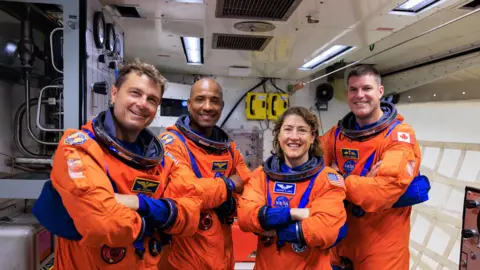
On their way to the Moon: Commander Reid Wiseman, pilot Victor J Glover, and mission specialists Christina Koch and Jeremy Hansen
I have been lucky enough to see launches of the Space Shuttle to the International Space Station from the Kennedy Space Center. Those launches are almost as impressive in flight, surging into space with an enormous bang and rising at the speed of a bullet.
But the SLS launch was not only more beautiful, it meant much more: a moment full of emotion for all those who saw it, perhaps because it reminded us of what humanity can do when it comes together, or perhaps because we may be entering a new era of space travel.
In the 1990s, I had the opportunity to speak to Neil Armstrong, who, in 1969, became the first person to ever walk on the moon.
Our discussion came at a time when the dream of human space travel seemed to be over. I asked him whatever happened to that dream? He smiled and said "the reality may have faded but the dream is still there and it will come back in time".

 Login
Login