Reading view

There are new articles available, click to refresh the page.

Naturalists: Photography

Few accounts of painting in the last decades of the nineteenth century consider the importance of photography at the time. Yet photography was enjoying remarkable technical advances: in 1884, George Eastman started replacing glass plates with light-sensitive film, and four years later he launched the first Kodak camera, the predecessor of the Kodak Brownie that was to follow in 1901. As Naturalist painting was taking the Salon by storm, its rival was becoming more widely available, and no longer required a private chemistry lab.

First responses to photography by painters were often hostile.

sporrerthephoto
Philipp Sporrer (1829-1899), The Photo (1870), oil on canvas, 81.5 x 63.5 cm, location not known. Wikimedia Commons.

Philipp Sporrer’s The Photo (1870) is probably the most pointed painted propaganda. The young photographer is not the sort of man you would leave your wife or daughter with. He’s down at heel, unkempt, and his straw hat is abominably tatty. His studio is poorly-lit, probably an old shed, its floor littered with rubbish, and its window broken. His subject is manifestly poor and uncouth, sitting in ill-fitting clothes and picking his nose as he waits for the photographer to fiddle with his equipment.
dagnanbouveretwedding
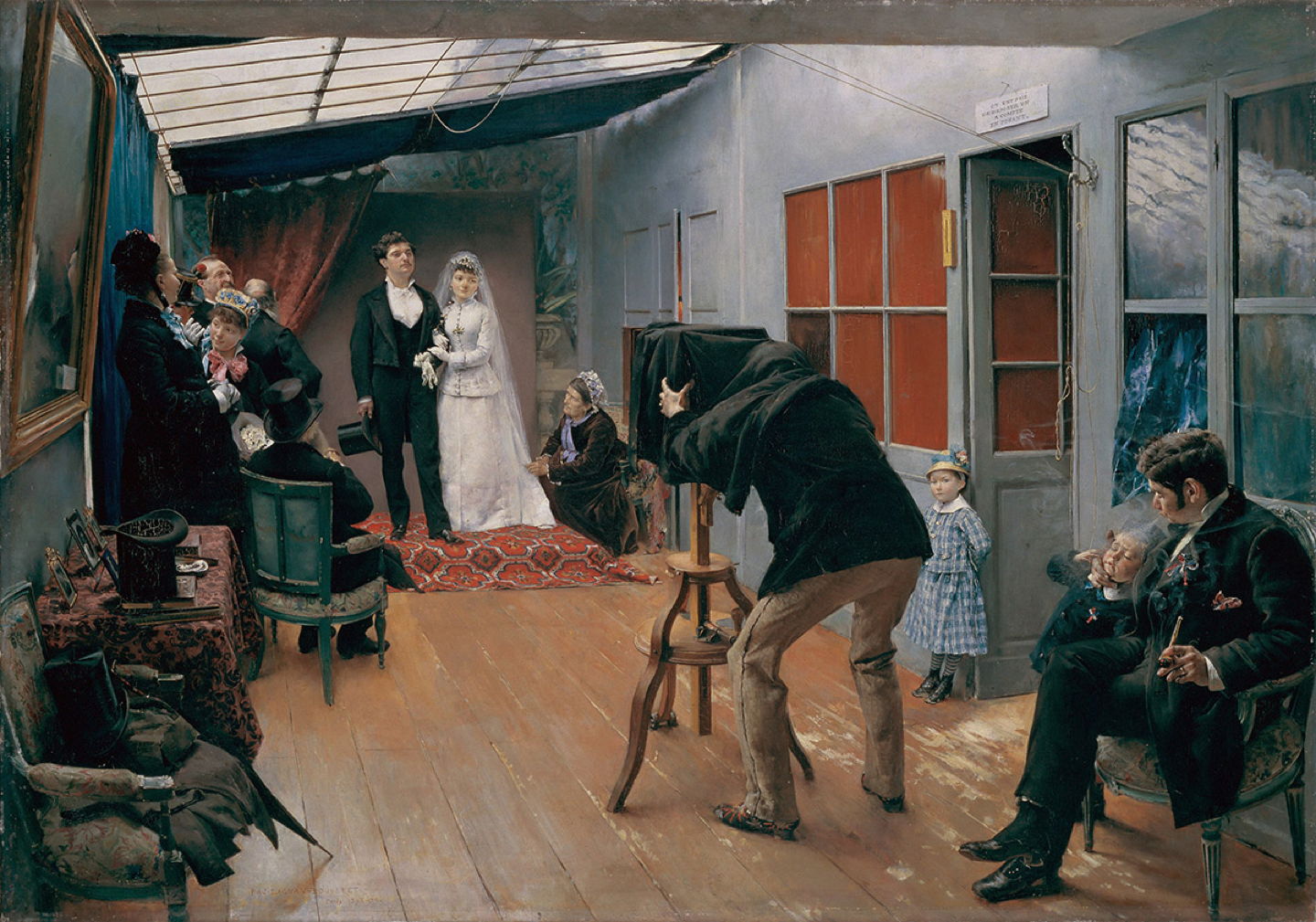
Pascal Dagnan-Bouveret (1852–1929), Une noce chez le photographe (A Wedding at the Photographer’s) (1879), oil on canvas, 120 x 81.9 cm, Musée des Beaux-Arts, Lyon, France. Wikimedia Commons.

Pascal Dagnan-Bouveret’s A Wedding at the Photographer’s (1879) seems more calculated. Hugely successful at the Salon, this artist saw no threat from wedding photography, a market in which there was no competition between painting and photography. But he still takes the opportunity to show the photographer and his studio as being tatty and tawdry.

Gradually, painting started to become influenced by the nascent art of photography, most obviously in the use of views through the lens of a camera.

caillebottefloorplaners
Gustave Caillebotte (1848–1894), Les Raboteurs de parquet (The Floor Scrapers) (1875), oil on canvas, 102 x 147 cm, Musée d’Orsay, Paris. Wikimedia Commons.

Gustave Caillebotte’s major painting of 1875 shows three workmen preparing a wooden floor in the artist’s studio at 77 rue de Miromesnil. It’s thoroughly detailed, Realist, and despite its innovative view and unusual subject, it conformed to the highest standards of the Salon at the time.

Caillebotte was hurt and angry when he was informed that this painting had been rejected by the Salon jury. The grounds given seem extraordinary now: apparently the jury was shocked at this depiction of the working class at work, and not even fully-clothed. It was deemed to have a ‘vulgar subject matter’ unsuitable for the public to view. Or was it really because of his wide-angle photographic effect?

caillebotteparisstreetrainyday
Gustave Caillebotte (1848–1894), Paris Street, Rainy Day (1877), oil on canvas, 212.2 x 276.2 cm, Art Institute of Chicago, Chicago, IL. Wikimedia Commons.

Caillebotte was one of the first established painters to experiment with photography, as demonstrated in another wide-angle view of Paris Street, Rainy Day from 1877.

blepagehaymaking
Jules Bastien-Lepage (1848–1884), Les Foins (Haymakers) (1877), oil on canvas, 160 x 195 cm, Musée d’Orsay, Paris. Wikimedia Commons.

During his development of Naturalism, Jules Bastien-Lepage arrived at a compositional formula that achieved similar effects, as seen in his Haymakers or Hay making in the same year, with its high horizon and fine detail in the foreground. Together these also give the visual impression that the whole canvas is meticulously realist, although in fact much of its surface consists of visible brushstrokes and other more painterly forms.
burnandbull
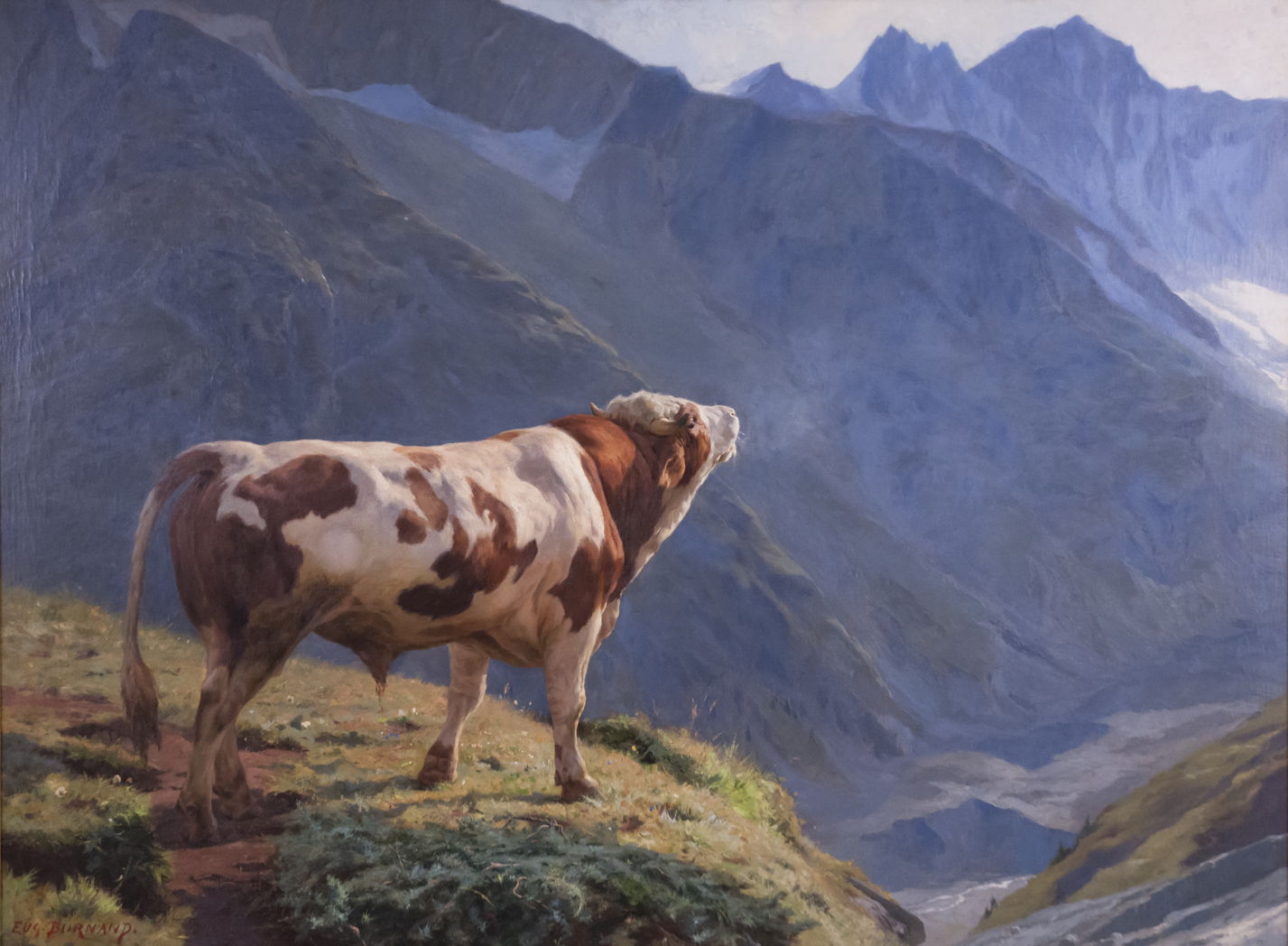
Eugène Burnand (1850–1921), Bull in the Alps (1884), oil, dimensions and location not known. Wikimedia Commons.

Eugène Burnand’s magnificent painting of Bull in the Alps from 1884 is fascinating for his use of both optical effects and extreme aerial perspective. Not only are there marked contrasts between the foreground and background in terms of chroma, hue and lightness, but Burnand has used defocussing in a photographic manner. The crisp edges of the bull stand proud of the softer edges and forms in the mountains behind. It’s worth noting that Burnand had been a pupil of Jean-Léon Gérôme.

desamoignesinclassroom
Paul Louis Martin des Amoignes (1858–1925), In the Classroom (1886), oil on canvas, 68.5 × 110.5 cm, location not known. Wikimedia Commons.

Paul Louis Martin des Amoignes’ painted his wonderful In the Classroom two years later, in 1886. It bears unmistakeable evidence that it was either painted from photographs or strongly influenced by them. One boy, staring intently at the teacher in front of the class, is caught crisply, pencil poised in his hand. Beyond him the crowd of heads becomes more blurred.

By the 1890s, more painters were experimenting with photography.

degaslerolledaughters
Edgar Degas (1834–1917), Portrait of Henry Lerolle with two of his daughters, Yvonne and Christine and a mirror (1895-96), albumen print, 28 x 37 cm, Musée d’Orsay, Paris. Wikimedia Commons.

Among them was Edgar Degas. This is an albumen print of patron and amateur painter Henry Lerolle with two of his daughters, Yvonne and Christine, taken by Degas in 1895-96.

The realist painter Jean-Léon Gérôme not only experimented with photography for many years, but was an enthusiastic advocate for its recognition as an art in its own right.

IF
Jean-Léon Gérôme (1824–1904), Truth Coming out of her Well to Shame Mankind (1896), oil on canvas, 91 x 72 cm, Musée Anne-de-Beaujeu, Moulins, France. Wikimedia Commons.

Gérôme’s Truth Coming out of her Well to Shame Mankind (1896) is based on a quotation attributed to Democritus, “Of a truth we know nothing, for truth is in a well” (or, more literally, ‘in an abyss’). Gérôme used the same allusion in his preface to Émile Bayard’s posthumous collection of collotype plates of photographs of nudes, Le Nu esthétique. L’Homme, la Femme, L’Enfant. Album de documents artistiques inédits d’après Nature, published in 1902, where he wrote:
Photography is an art. It forces artists to discard their old routine and forget their old formulas. It has opened our eyes and forced us to see that which previously we have not seen; a great and inexpressible service for Art. It is thanks to photography that Truth has finally come out of her well. She will never go back.

The Naturalist painter Jules-Alexis Muenier became a photographer by the time he travelled to North Africa with Pascal Dagnan-Bouveret in 1888, armed with cameras.

anonmuenierharpsichordlesson
Artist not known, Jules-Alexis Muenier painting ‘The Harpsichord Lesson’ (date not known), photograph, further details not known. Image by Rauzierd, via Wikimedia Commons.

Although I have been unable to find a suitable image of the painting, this photograph shows Muenier with his painting of The Harpsichord Lesson in about 1911, which became his most famous work during his lifetime. Muenier, Gérôme and Dagnan-Bouveret weren’t just happy snapper photographers, but believed in photography as fine art. All three were early members of local photographic clubs, and Muenier and Dagnan-Bouveret exhibited their photographs as seriously as their paintings.

Naturalists: Marie Bashkirtseff

Jules Bastien-Lepage’s brilliant protégé was a young woman who started training in Paris in 1877, and who died from tuberculosis seven years later, just three months before him, Marie Bashkirtseff (1858–1884).

She was born and brought up in Havrontsi (Gavrontsi), to the north of Poltava in central Ukraine, between Kyiv and Kharkiv, where she first started to learn to draw and paint. Her affluent parents split up when she was twelve, following which she travelled around Europe with her mother, eventually settling in Paris. She originally hoped to be a singer, but after an illness ruined her voice, she decided to be an artist. She then studied with Robert-Fleury from 1877, and at the Académie Julian.

bashkirtseffaselfportrait
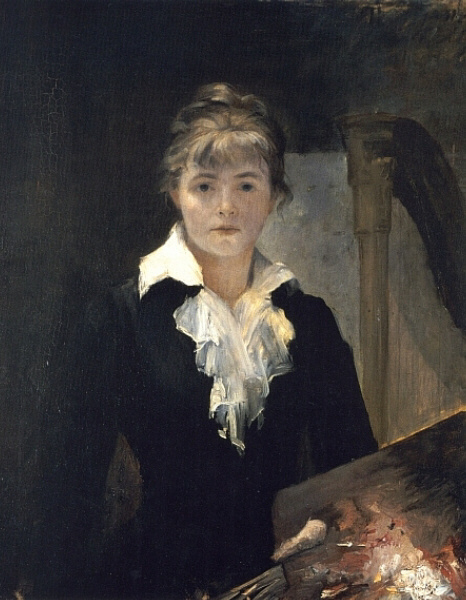
Marie Bashkirtseff (1858–1884), Self-portrait with Palette (1880), oil on canvas, dimensions not known, Musée des Beaux-Arts Jules Chéret, Nice, France. Wikimedia Commons.

A self-assured painter from the beginning, she set her sights high and had the ability and drive to paint excellently. Her early Self-portrait with Palette (1880) was painted in the same year that she first had a work accepted for exhibition at the Paris Salon, and she was successful again in every subsequent Salon until her death.

bashkirtseffinthestudio
Marie Bashkirtseff (1858–1884), In the Studio (1881), oil on canvas, 188 x 154 cm, Dnipro State Art Museum, Dnipro, Ukraine. Wikimedia Commons.

While still studying at the Académie Julien in 1881, she painted In the Studio, which gives good insight into what her training was like. Her class was of course entirely female, and the Académie Julien was one of the few reputable schools that accepted women pupils at that time. The artist is seated in the centre foreground, holding her palette and knife as she looks up at one of her fellow pupils.

bashkirtseffpainterssister
Marie Bashkirtseff (1858–1884), The Artist’s Sister (1881), oil on canvas, 92 x 73 cm, Rijksmuseum, Amsterdam. Wikimedia Commons.

Her early portraits are skilful if conventional, as is The Artist’s Sister from 1881. She started establishing herself in the art scene; it has been claimed that she wrote a column for the mysandrist newspaper La Citoyenne under the name of Pauline Orrel, but that appears to be unsupported by the original edited versions of her diaries.

She became a close friend of Jules Bastien-Lepage when visiting Nice in 1882, and he acted as her mentor if not teacher, as she described herself as his pupil. She also formed a close friendship with the writer Guy de Maupassant.

bashkirtseffatabook
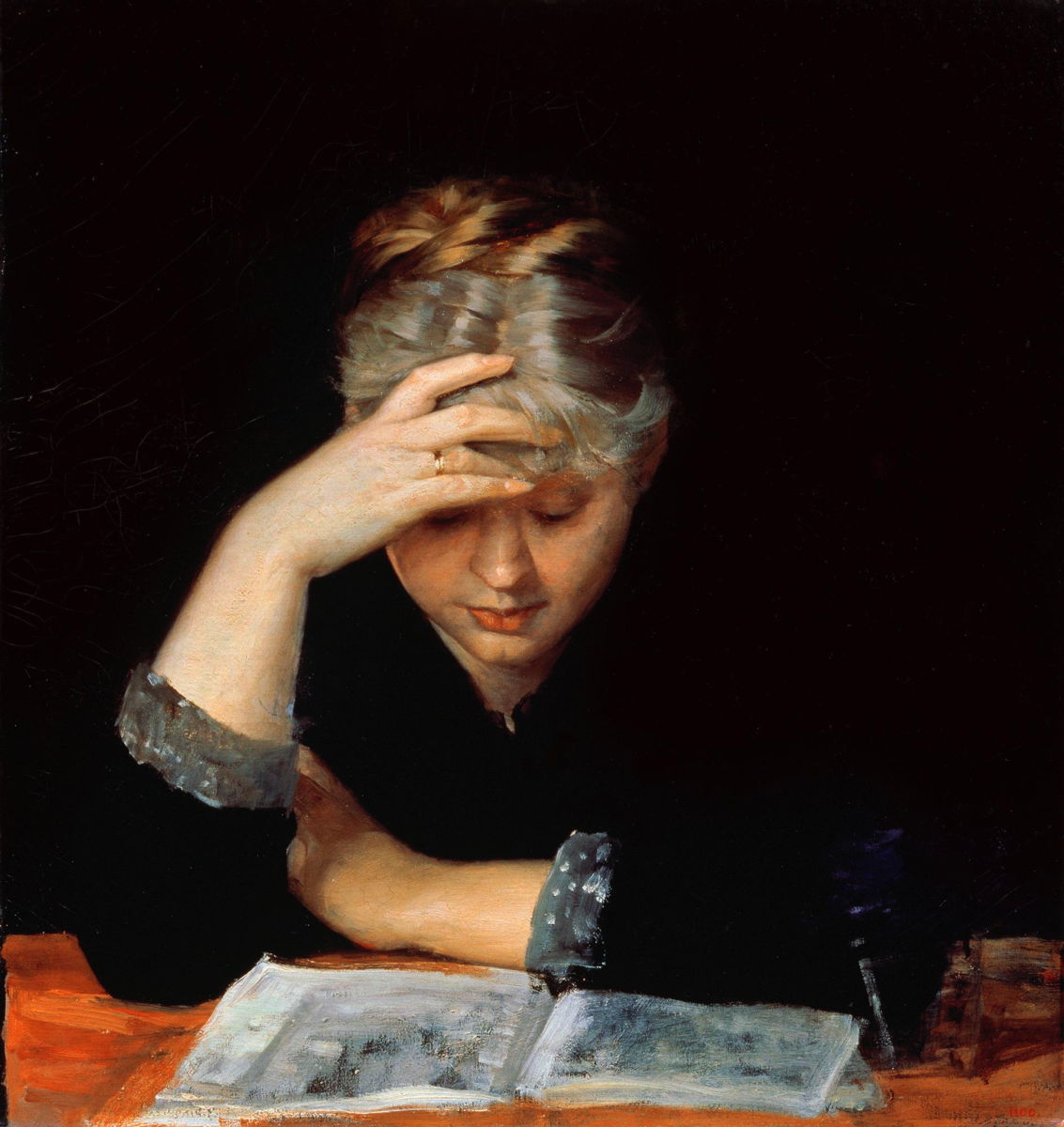
Marie Bashkirtseff (1858–1884), At a Book (c 1882), oil on canvas, 63 × 60.5 cm, Kharkiv Art Museum, Kharkiv, Ukraine. Wikimedia Commons.

As she developed a more distinctive style in her portraits, so her brushwork loosened. She was an astute observer of women’s life, as shown in At a Book (c 1882), with its emphasis on her model’s unusual hair.

bashkirtseffyoungrussiangirl
Marie Bashkirtseff (1858–1884), Young Russian Girl (c 1882), other details not known. Wikimedia Commons.

Young Russian Girl (c 1882) is another delicate portrait, although I suspect the original isn’t as soft-focus as this image.

bashkirtseffinthemist
Marie Bashkirtseff (1858–1884), In the Mist (1882), oil on canvas, 47 x 55 cm, Österreichische Galerie Belvedere, Vienna, Austria. Wikimedia Commons.

Although Bashkirtseff accepted that her mentor Bastien-Lepage reigned supreme in the countryside, she felt that she was his match when it came to depicting the urban environment of Paris. In the Mist from 1882 is a good demonstration of how well she captures the almost deserted city streets on a foggy day, with a bright plume of flame from a fire in the centre of her canvas.

bashkirtseffautumn
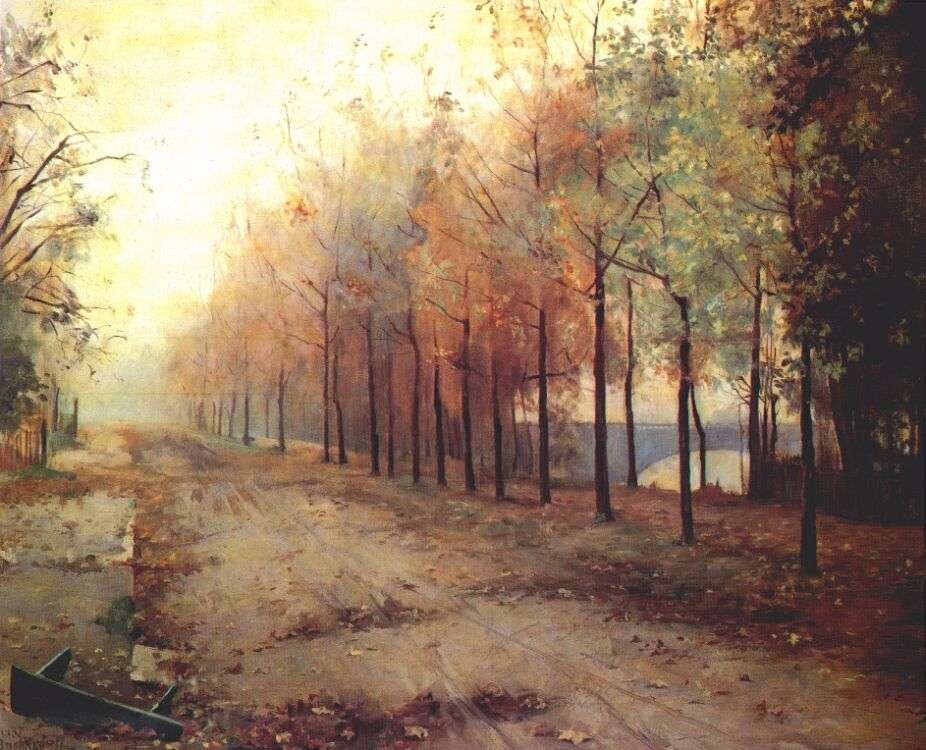
Marie Bashkirtseff (1858–1884), Autumn (1883), oil on canvas, dimensions not known, State Russian Museum, Saint Petersburg. The Athenaeum.

Autumn, from 1883, is an impressive and Impressionist depiction of a row of trees on the bank of the River Seine in the centre of Paris, but is unusual in being devoid of people. The leaf litter, occasional rubbish, and fallen bench strengthen its feeling of desolation in the midst of the bustling city.

bashkirtseffumbrella
Marie Bashkirtseff (1858–1884), The Umbrella (1883), oil on canvas, 93 × 74 cm, State Russian Museum, Saint Petersburg. Wikimedia Commons.

Bastien’s composite of detailed realism blended with more painterly passages shows in one of her best portraits, The Umbrella (1883). This girl’s tenacious stare at the viewer is quite unnerving. That year she was awarded an honourable mention from the Salon.

bashkirtseffmeeting
Marie Bashkirtseff (1858–1884), A Meeting (1884), oil on canvas, 193 x 177 cm, Musée d’Orsay, Paris. Wikimedia Commons.

A Meeting (1884) finally justified her claim to paint the urban poor, and to match Bastien-Lepage. This painting was a great success when shown at the Salon that year, and is probably her finest work.

bashkirtseffportraitmmex
Marie Bashkirtseff (1858–1884), Portrait of Madame X (1884), pastel and charcoal, 56 x 46.5 cm, Musée d’Orsay. Wikimedia Commons.

Her pastel Portrait of Madame X (1884), now in the Musée d’Orsay together with A Meeting, was also shown in the Salon that year.

By that summer, Bashkirtseff’s fragile health was deteriorating rapidly because of tuberculosis. She died on 31 October, less than a month before she would have turned twenty-six, and less than three months before her mentor died.

Her ambition was better fulfilled after her death than in life. Her huge mausoleum in Cimitière de Passy, Paris, designed by Bastien’s younger brother Émile, contains her artist’s studio complete with an unfinished painting of Holy Women by the Grave. Three years later, her copious and revelatory diaries were published, and propelled her to international fame.

References

Wikipedia.
An English translation of her journal, on archive.org.

❌