Frederic Edwin Church, who was born two centuries ago on 4 May 1826, is one of the founding American masters, and one of the world’s great nineteenth century landscape painters. As the only pupil of Thomas Cole, who founded the Hudson River School, Church has a pivotal place in the history of American painting.
His career started at the time of the Barbizon School, and continued into the height of Impressionism in France, and its arrival in North America. Unlike those, and subsequent US landscape painters, Church was a devout realist who produced huge canvases with meticulous, almost obsessive, detail. He was thus a rival to his contemporary, Albert Bierstadt (1830-1902), who worked largely within his unchallenged territory to the west of the Mississippi.
Church was a precocious artist, and by the time he started his training with Cole in 1844 he seems to have been a fine draftsman and a competent landscape painter. During his two years with Cole, the pair travelled around New England and New York State. Church sold his first painting to his neighbour Daniel Wadsworth, who founded the Wadsworth Athenaeum in Hartford, CT.
From these early days Church’s working methods were traditional, and similar to those of John Constable. He drew in pencil and sketched in oils in front of his motif, then assembled those into highly detailed and finished oil paintings in his studio. Church was an obsessive sketcher in oils, and thousands of his drawings and oil sketches survive in collections such as those of the Cooper Hewitt, Smithsonian Design Museum in New York.
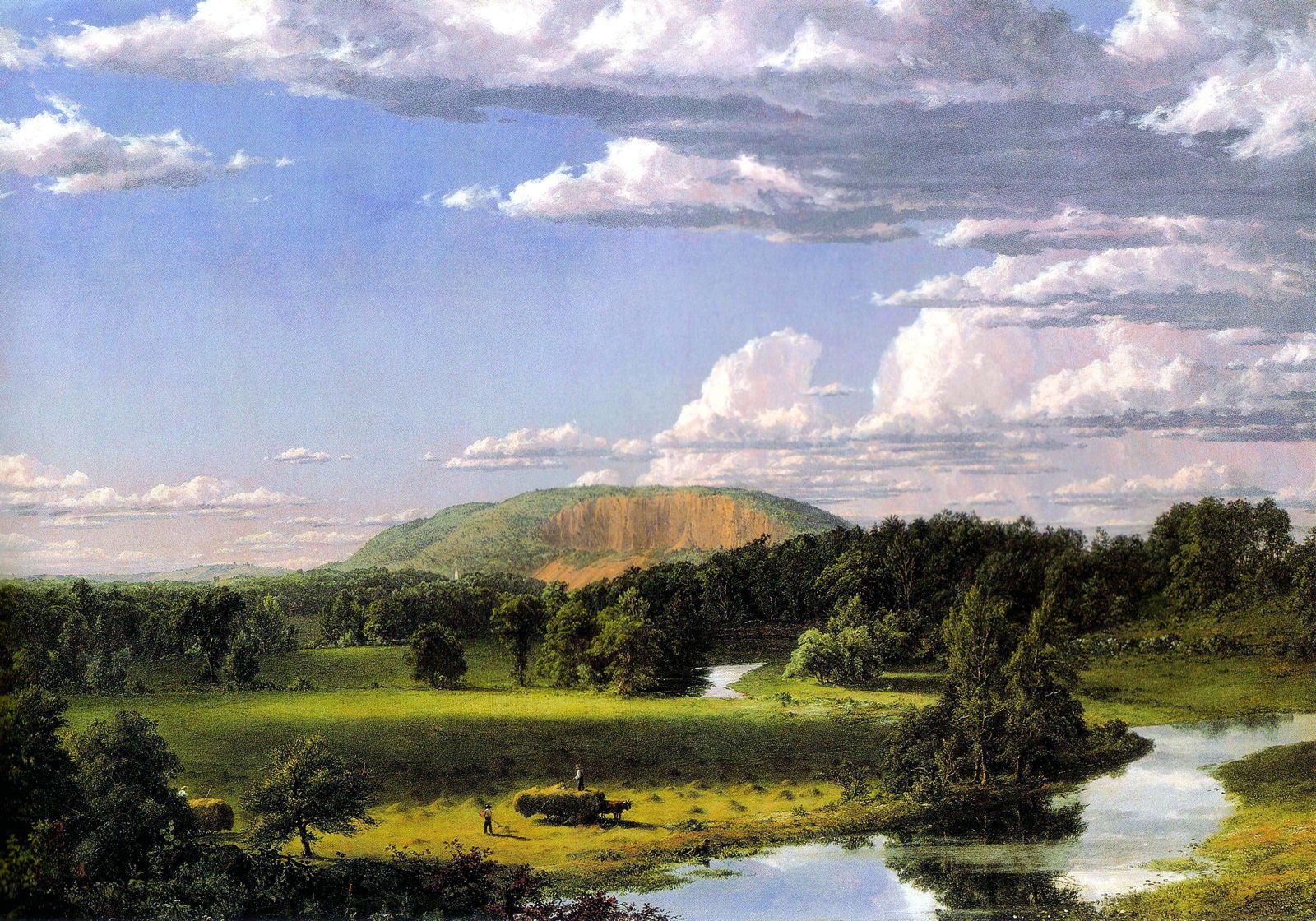
Frederic Edwin Church (1826–1900), West Rock, New Haven (1849), oil on canvas, 68.9 × 101.9 cm, New Britain Museum of American Art, New Britain, CT. Wikimedia Commons.
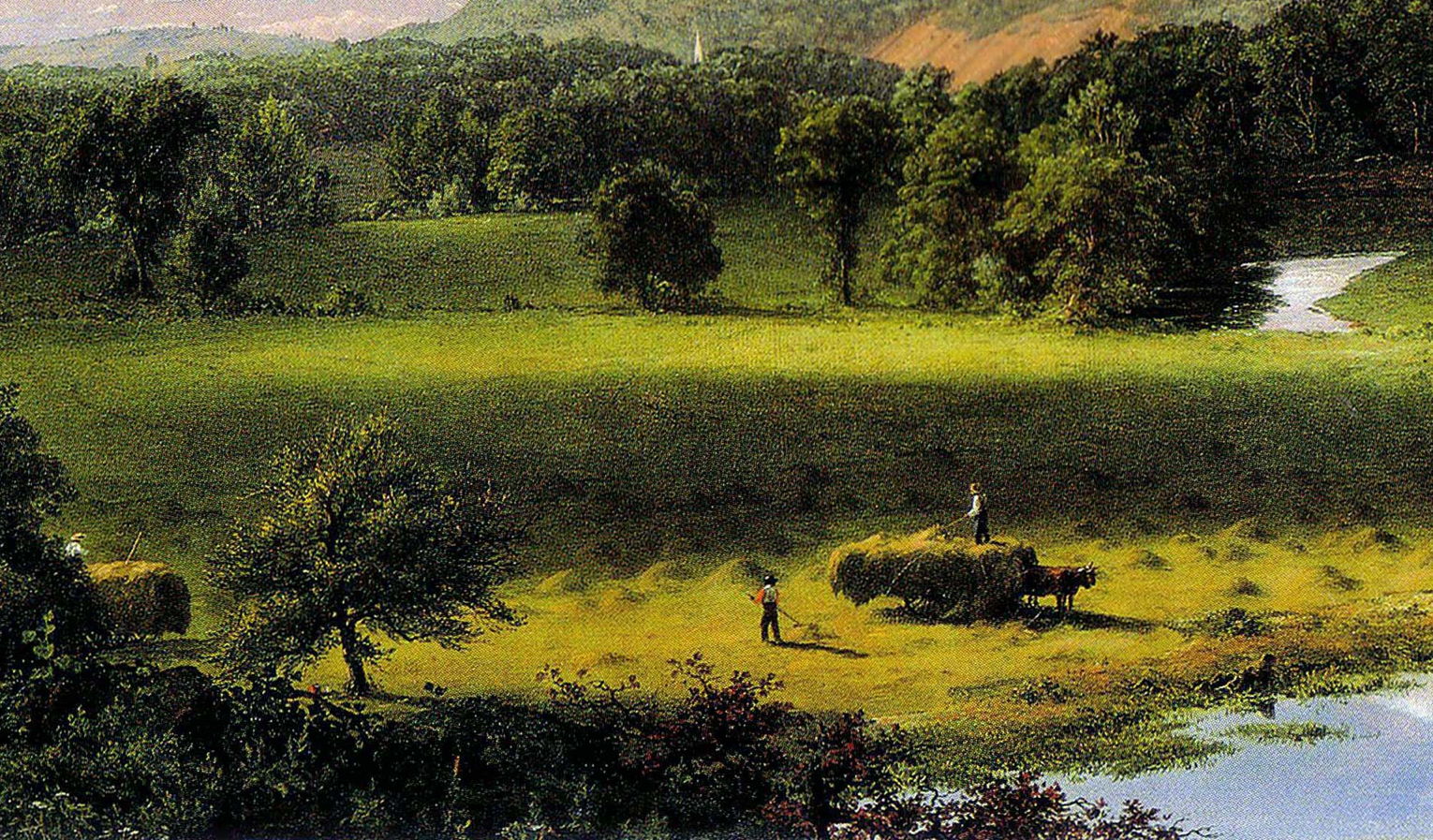
Church’s early landscape painting of West Rock, New Haven (1849) is a good example of his attention to detail in finished paintings. As shown in the detail below, its foreground features three figures making hay, which they’re stacking onto carts drawn by oxen. Down at the river bank, a dog is enjoying a paddle. Just peeking proud of the distant treetops is the white tip of a church spire.
Frederic Edwin Church (1826–1900), West Rock, New Haven (detail) (1849), oil on canvas, 68.9 × 101.9 cm, New Britain Museum of American Art, New Britain, CT. Wikimedia Commons.Frederic Edwin Church (1826–1900), Mt. Desert Island, Maine Coast (1850), oil on cream wove paper, Cooper Hewitt, Smithsonian Design Museum, New York, NY. Wikimedia Commons.
He had settled in New York by 1850, and from then went on trips most summers to the wilds of Maine to paint en plein air in oils. He made this rather sparse view of Mt. Desert Island, Maine Coast in oils on paper in 1850.
Frederic Edwin Church (1826–1900), Beacon, off Mount Desert Island (1851), oil on canvas, 116.8 × 78.7 cm, Private collection. Wikimedia Commons.
The following year Church painted this rich twilight seascape of a Beacon, off Mount Desert Island (1851). Judging from its size and canvas support, this was intended as a finished work rather than a study.
Frederic Edwin Church (1826–1900), Schoodic Peninsula from Mount Desert at Sunrise (1850–55), oil on paperboard, 22.9 x 34.9 cm, Cooper Hewitt, Smithsonian Design Museum, New York, NY. Wikimedia Commons.
Schoodic Peninsula from Mount Desert at Sunrise (1850–55) is one of many oil sketches which he made during a summer visit to Maine during this period.
Frederic Edwin Church (1826–1900), Eagle Lake Viewed from Cadillac Mountain, Mount Desert Island, Maine (1850–60), oil and graphite on paperboard, 29.4 x 44.5 cm, Cooper Hewitt, Smithsonian Design Museum, New York, NY. Wikimedia Commons.
Eagle Lake Viewed from Cadillac Mountain, Mount Desert Island, Maine (1850–60) is another oil sketch featuring a considerably more complex motif. Cadillac Mountain is relatively low at 466 metres (1,530 feet), but the highest point of Mount Desert Island, so affords such spectacular views.
In 1852, Church read Alexander von Humboldt’s account of his travels in central America, and decided to rise to Humboldt’s challenge to depict the ‘physiognomy’ of the Andes mountains. The following year he travelled to Columbia and Ecuador with the businessman Cyrus West Field, who bankrolled their trip in the hope that he could use Church’s paintings to promote his own local business ventures. They based themselves in Quito, travelling from there to awe-inspiring views of mountains and volcanoes.
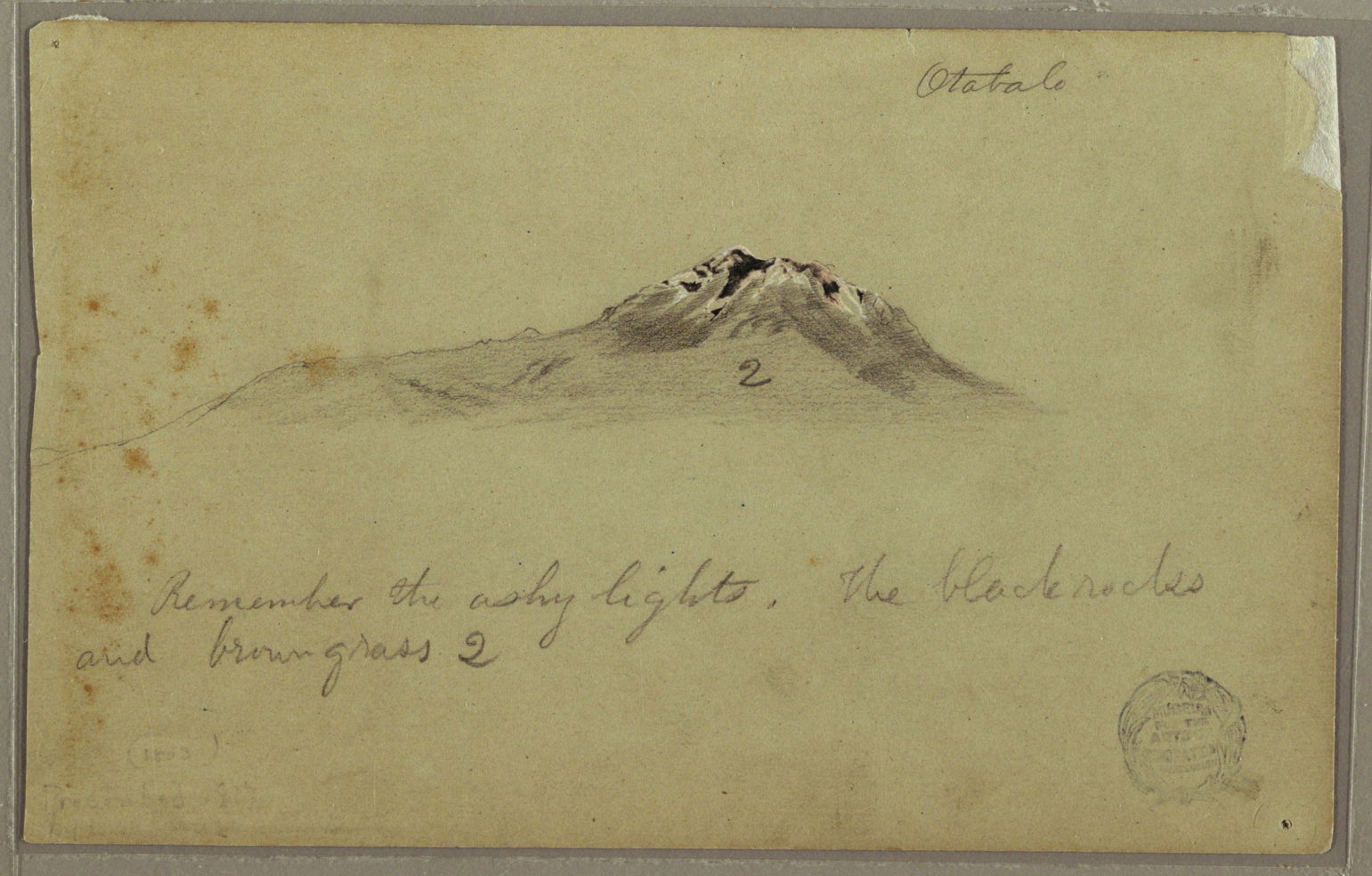
Frederic Edwin Church (1826–1900), Drawing, Andean Mountain Peak (Cayambe ?), Otavalo, Ecuador (August/September 1853), graphite, burch and ozicized white gouache on gray paper, 12.4 x 19.7 cm, Cooper Hewitt, Smithsonian Design Museum, New York, NY. Wikimedia Commons.
Church painted this view of what’s thought to be Cayambe in Ecuador in August or September 1853. This isn’t an oil sketch, though, but was made in pencil and gouache.
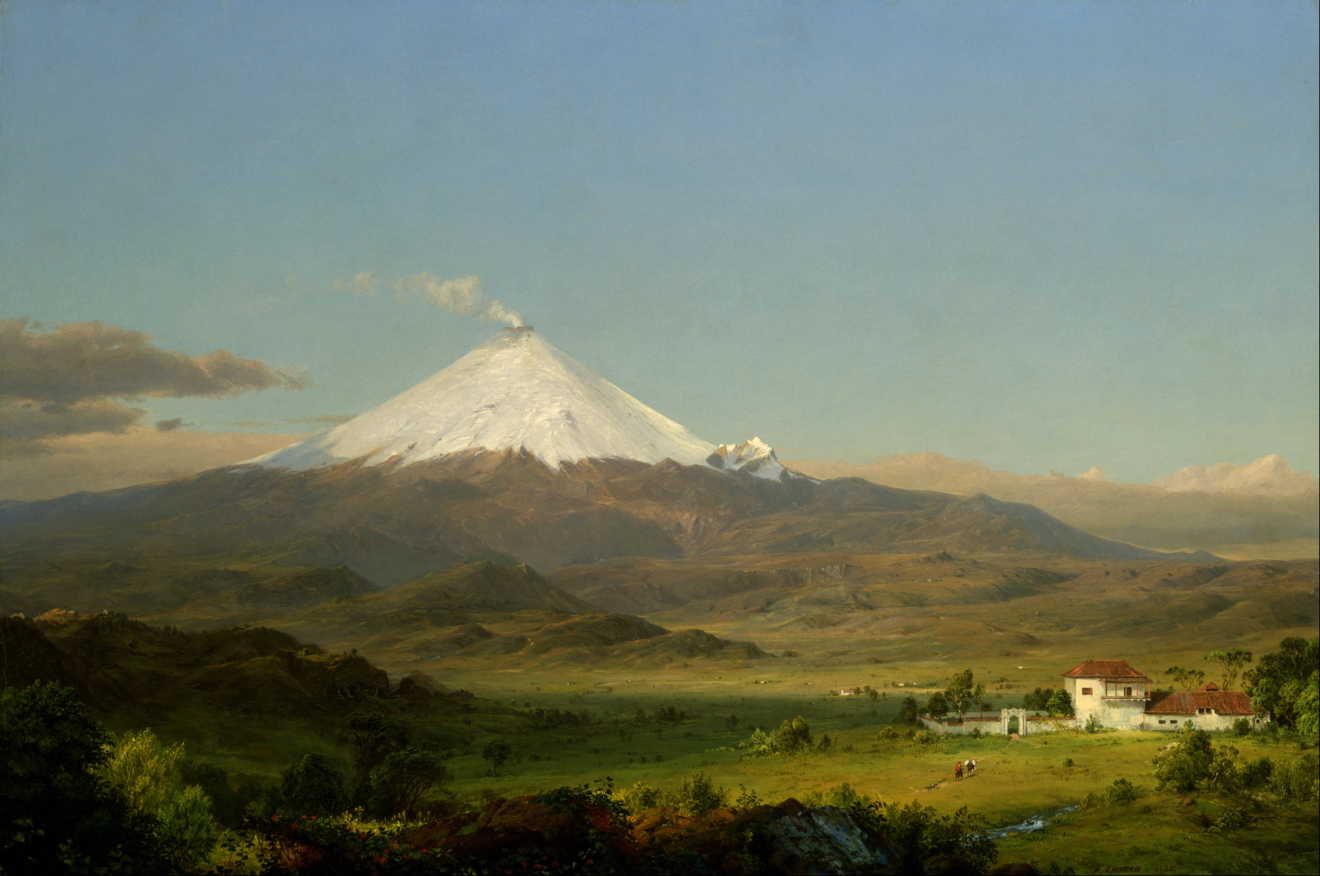
Frederic Edwin Church, Cotopaxi (1855), oil on canvas, 71 x 106.7 cm, Smithsonian American Art Museum, Washington, DC. Wikimedia Commons.
On his return to his studio in New York, Church turned those hundreds of sketches and drawings into larger finished paintings, in this case one of his many views of Cotopaxi (1855) in Ecuador. As was conventional at the time, these are highly finished, with no evidence of brushwork and a smooth paint surface.
His other versions of this motif weren’t as peaceful: that of 1862, commissioned by James Lenox, shows rugged waterfalls in the foreground, a barren rocky plain, and the volcano itself ejecting a high plume of smoke and ash. All this is lit by a blood-red sun, sitting low in the sky. This was to enable Church’s painting to serve as a pendant to one of Lenox’s other paintings, Turner’s dramatic Staffa, Fingal’s Cave (1832).
Frederic Edwin Church (1826-1900), Niagara (1857), oil on canvas, 101.6 x 229.9 cm, National Gallery of Art, Washington, DC. Wikimedia Commons.
Church was among the many landscape painters who visited Niagara (1857). Jennifer Raab has set this painting in its historical context, at a time when secession of Southern states seemed imminent. The Niagara Falls became associated with union and the unity of its details.
He returned to central America in 1857 with the artist Louis Rémy Mignot and added hundreds more drawings and sketches to his collection.
Frederic Edwin Church (1826–1900), Cross in the Wilderness (1857), oil on canvas, 41.3 × 61.5 cm, Museo Thyssen-Bornemisza, Madrid. Wikimedia Commons.
Cross in the Wilderness, painted later that year, is one of the earlier works to result from his second visit. This wilderness is unpopulated, devoid of figures or other signs of human presence. It was another two years before Church painted his masterpiece that drew the crowds and established his popularity.
Reference
Raab, Jennifer (2015) Frederic Church, The Art and Science of Detail, Yale UP. ISBN 978 0 300 20837 5.
Many of the great Masters are known to have painted preparatory studies prior to starting on full-size finished studio paintings. Unfortunately, most of those studies were either destroyed by the artist in their lifetime, or by their heirs following their death. Seeing studies alongside a finished work tells a great deal about the artist’s intent and methods, and some exhibitions have made a point of including as many studies as possible. This article shows a small selection of some whose images I have been able to gather.
Some of the best surviving studies are the oil sketches made by Peter Paul Rubens, some of which were given to assistants in his studio for completion.
Peter Paul Rubens (1577–1640), The Rape of Hippodame (sketch) (c 1637-38), oil on panel, 26 × 40 cm, Koninklijke Musea voor Schone Kunsten van België / Musées Royaux des Beaux Arts de Belgique, Brussels, Belgium. Wikimedia Commons.
Towards the end of his life, he painted this brilliant oil sketch of The Rape of Hippodame (c 1637-38). At the right, Eurytus is trying to carry off Hippodame, the bride, with Theseus just about to rescue her from the centaur’s back. At the left, Lapiths are attacking with their weapons, and behind them another centaur is trying to abduct a woman. Rubens typically sketched on small wood panels, here 26 x 40 cm (10 x 16 inches), with wonderfully painterly brushstrokes.
Peter Paul Rubens (1577–1640), The Rape of Hippodame (Lapiths and Centaurs) (1636-38), oil on canvas, 182 × 290 cm, Museo Nacional del Prado, Madrid, Spain. Wikimedia Commons.
That became this finished painting, The Rape of Hippodame (Lapiths and Centaurs) (1636-38), which remains faithful to the sketch and its composition. Facial expressions, particularly that of the Lapith at the left bearing a sword, are particularly powerful.
Studies were better preserved in the nineteenth century, when tastes changed and some realised worthwhile sums in posthumous sales of the contents of studios.
Jean Louis Théodore Géricault (1791–1824), Study for The Raft of the Medusa (1819), oil on canvas, 36 x 48 cm, Musée du Louvre, Paris. Wikimedia Commons.
Among the most studied are those made by Géricault when he was working up his landmark painting of The Raft of the Medusa. This oil study on canvas was probably made as he was completing his preparations during the autumn of 1818, and reveals some of his compositional thinking, for instance over the size of the ship that rescued the survivors.
Jean Louis Théodore Géricault (1791–1824), The Raft of the Medusa (1818-19), oil on canvas, 491 x 716 cm, Musée du Louvre, Paris. Wikimedia Commons.
The end result is this vast canvas, its figures shown life-sized, which has had huge impact on everyone who has seen it since its completion in 1819. It appears completely authentic, and given the work that Géricault put into making it so, that’s perhaps not surprising. But most gain the impression that the raft was almost square in form, as a result of the tight cropping applied, and that even with those few survivors on board, it was overcrowded. This is because Géricault chose to pack all his figures into one small section of the raft.
I was fortunate enough to visit an exhibition of some of John Constable’s works, in which his studies were shown alongside finished paintings. Here I show just one example. Had Constable lived fifty years later, he might have been persuaded to stop his paintings when they were still late oil studies, rather than take them to their finished conclusions.
John Constable (1776–1837), Hadleigh Castle (sketch) (1828-29), oil on millboard, 20 × 24 cm, Yale Center for British Art, New Haven, CT. Wikimedia Commons.
This early sketch of Hadleigh Castle (1828-29) already contains some surprisingly detailed passages: at the far left, a shepherd, his black dog by his side, with a small flock of sheep grazing near the ruined tower. There’s a brown and white blob on the seaward slope, probably a cow grazing there. Wheeling in wrinkles of impasto above the tower are a few birds resembling small runnels of liquid metal like solder. By this time, many artists were painting their oil studies on cheaper millboard, as Constable did here. Millboard is made by pasting together many sheets of fine paper, so isn’t as durable as cheaper stretched canvas.
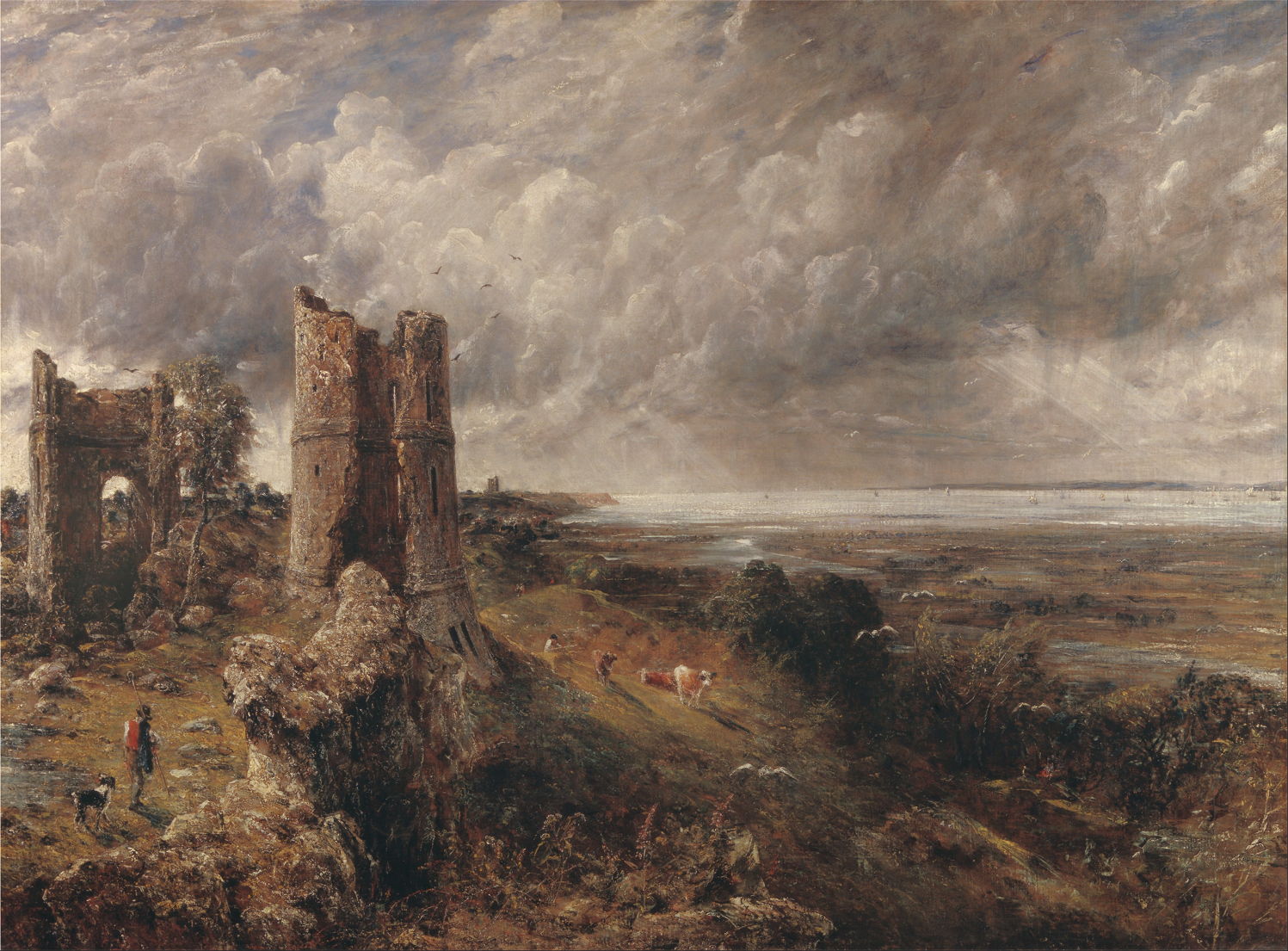
John Constable (1776–1837), Hadleigh Castle, The Mouth of the Thames – Morning after a Stormy Night (1829), oil on canvas, 121.9 x 164.5 cm, Yale Center for British Art, New Haven, CT. Wikimedia Commons.
By the finished work, the splendid Hadleigh Castle, The Mouth of the Thames – Morning after a Stormy Night (1829), the basic disposition of those figures has changed little, but Constable has changed each to suit his image. The shepherd, still carrying his long crook, is separated from his dog, and has lost his sheep, which have become scattered rocks. The single cow on the sloping grass has gained a couple of friends, and a cowherd. Beyond them are another couple of tiny specks of figures, and there are more by the wood in the lower right corner.
William Powell Frith (1819–1909), Derby Day (study) (before 1857), oil on canvas, 39.4 x 91.1 cm, Private collection. Wikimedia Commons.
William Powell Frith’s late study for Derby Day was probably painted in about 1856, and is very close to the finished work shown below, although covering only about a tenth of its area.
William Powell Frith (1819–1909), The Derby Day (1856-58), oil on canvas, 140.5 x 264 cm, The Tate Gallery, London. Wikimedia Commons.
Jacob Bell commissioned Frith to paint his finished Derby Day (1856-58) for the huge fee of £1,500, and the artist was paid a further £1,500 for rights to make prints. It was exhibited at the Royal Academy in 1858, and proved so popular that a guard rail had to be installed in front of it to protect the work from the admiring crowds.
Georges Seurat’s preparations are also revealed in his surviving studies, and are very different given his Pointillist technique. Some of the later Divisionists made conventional studies, and there are some experimental examples using larger tiles of colour (see below). Seurat instead rehearsed parts of the overall view when preparing his masterwork.
Georges Seurat (1859–1891), Landscape – the Island of the Grande Jatte (1884), oil on canvas, 69.9 x 85.7 cm, Private collection. WikiArt.
Seurat’s first and greatest masterpiece, generally known as La Grande Jatte, uses the technique of optical mixing of colour. Rather than blending pigments on the canvas, it’s constructed of tiny dots that are high in chroma, and allow for optical mixing, one of the fundamental techniques in Seurat’s new scientific painting. His theory was that the mixing of colour would then occur in the retina of the viewer, and he tried this in a pure landscape study (above), and in his huge finished painting (below).
Georges Seurat (1859–1891), Un dimanche après-midi à l’Île de la Grande Jatte (A Sunday Afternoon on the Island of La Grande Jatte) (1884-6), oil on canvas, 207.5 × 308.1 cm, Art Institute of Chicago, Chicago, IL. Wikimedia Commons.
He painted his finished version in three phases. In the first, the dots he applied were mixed from available and fairly conventional pigments, including duller earths. In the second phase, he used a limited number of brighter and higher chroma pigments. In the third and final phase he added coloured borders which are distinctive of his paintings.
By the late nineteenth century oil studies were being supplemented by photographs.
Circle of Thomas Eakins (1844–1916), Eakins’s Students at the “The Swimming Hole” (1884), albumen silver print, 9.3 x 12.1 cm, The Getty Center, J. Paul Getty Museum, Los Angeles, CA. Wikimedia Commons.
Thomas Eakins’ preparatory studies for Swimming (1885) grew from a series of photographs taken by the artist and his friends. But photos never replaced his own sketches: for this work, Eakins made several figure studies, details such as the dog, and different landscape backgrounds, then brought them together in oil sketches.
Thomas Eakins (1844–1916), Swimming Hole (sketch) (1884), oil on fiberboard mounted on masonite, 22.1 × 27 cm, The Hirshhorn Museum and Sculpture Garden, Washington, DC. Wikimedia Commons.
Once he was happy, he embarked on his final version. In at least some cases, including his paintings of shad fishing from 1881-82, the figures in his Arcadia (c 1883), and Swimming (1885), he put final photographic images into a ‘magic lantern’ projector, which he then projected at the canvas.
He developed a sophisticated system not only for using the projected image to make a graphite underdrawing, but as the painting progressed, to incise key points and lines of reference in the paint surface. This enabled him to create paintings that were accurately calibrated to his reference images: a great advance on the traditional system of enlargement using grids, and one factor in his detailed realism. This technique was discovered by Mark Tucker and Nica Gutman.
Thomas Eakins (1844–1916), Swimming (The Swimming Hole) (1885), oil on canvas, 70.2 × 93 cm, Amon Carter Museum of American Art, Fort Worth, TX. Wikimedia Commons.
Together with other photos and various studies, Eakins then painted Swimming (The Swimming Hole) in 1885.
Albert Bierstadt was more traditional in his preparatory studies for The Last of the Buffalo in 1888.
Albert Bierstadt (1830–1902), Study for ‘The Last of the Buffalo’ (c 1888), oil on canvas, 62.9 x 91.1 cm, De Young Museum, San Francisco, CA. Wikimedia Commons.
This late study was painted on canvas, and is 63 x 91 cm (25 x 36 inches). It concentrates on the action to be embedded in a broader landscape.
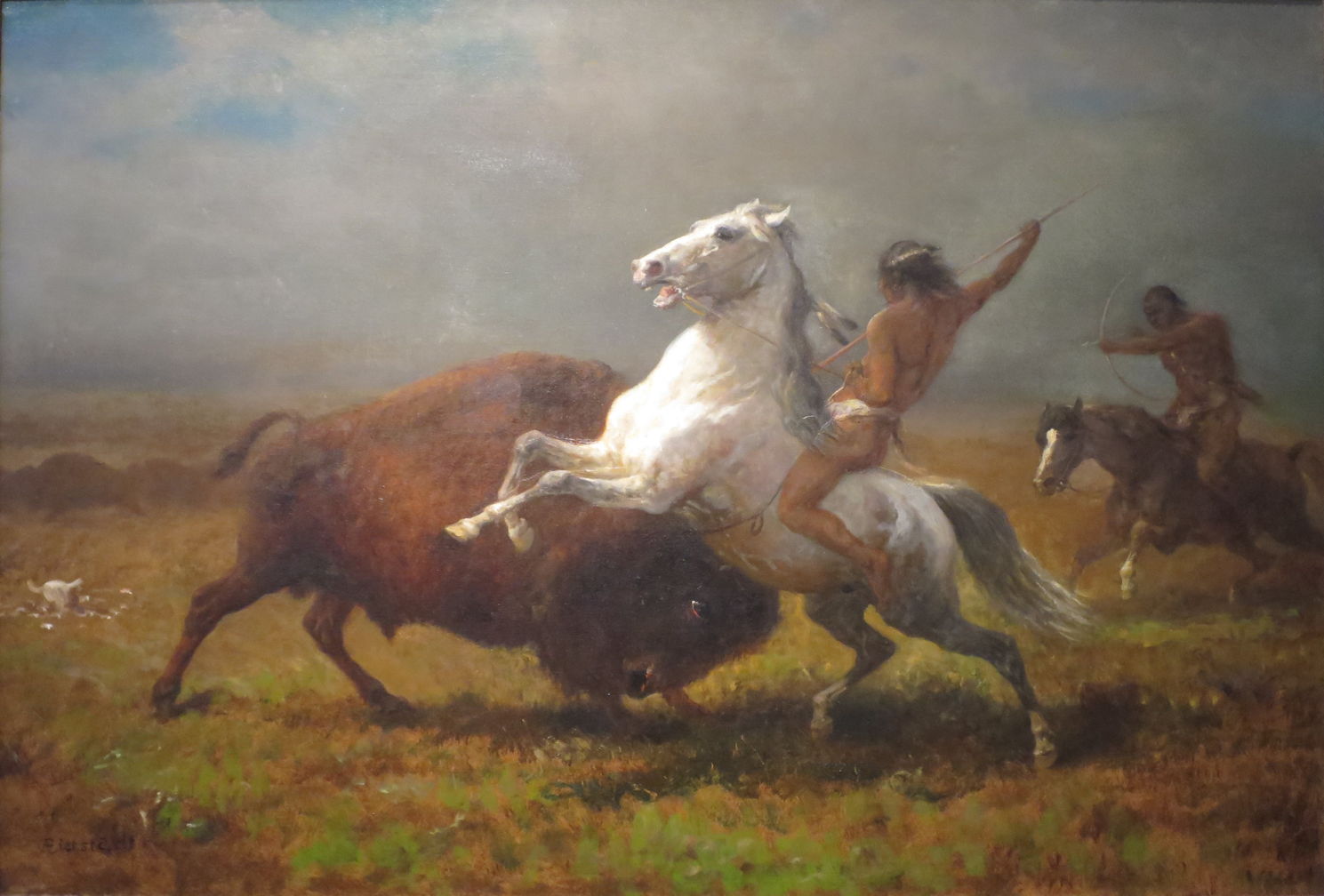
Albert Bierstadt (1830–1902), The Last of the Buffalo (c 1888), oil on canvas, 153 x 245.1 cm, Buffalo Bill Center of the West, Cody, WY. Wikimedia Commons.
Bierstadt’s finished painting is larger still, and sets that action in a more characteristic grand panorama, with bleached skulls and dying buffalo in the foreground. In the middle distance are hundreds of animals in the herd, suggesting that extinction was by no means the only outcome.
Finally, a pair of paintings by the less-known Divisionist Henri-Edmond Cross shows an alternative approach to Seurat’s, where his study is built of small daubs of colour, which are then reduced in size for the Pointillism of his final version.
Henri-Edmond Cross (1856–1910), Clearing in Provence (study) (c 1906), oil on paper mounted on canvas, 56.5 x 44 cm, Israel Museum מוזיאון ישראל, Jerusalem, Israel. Wikimedia Commons.
His Clearing in Provence from about 1906 was painted on paper, and has subsequently been mounted on canvas for display in the Israel Museum, Jerusalem.
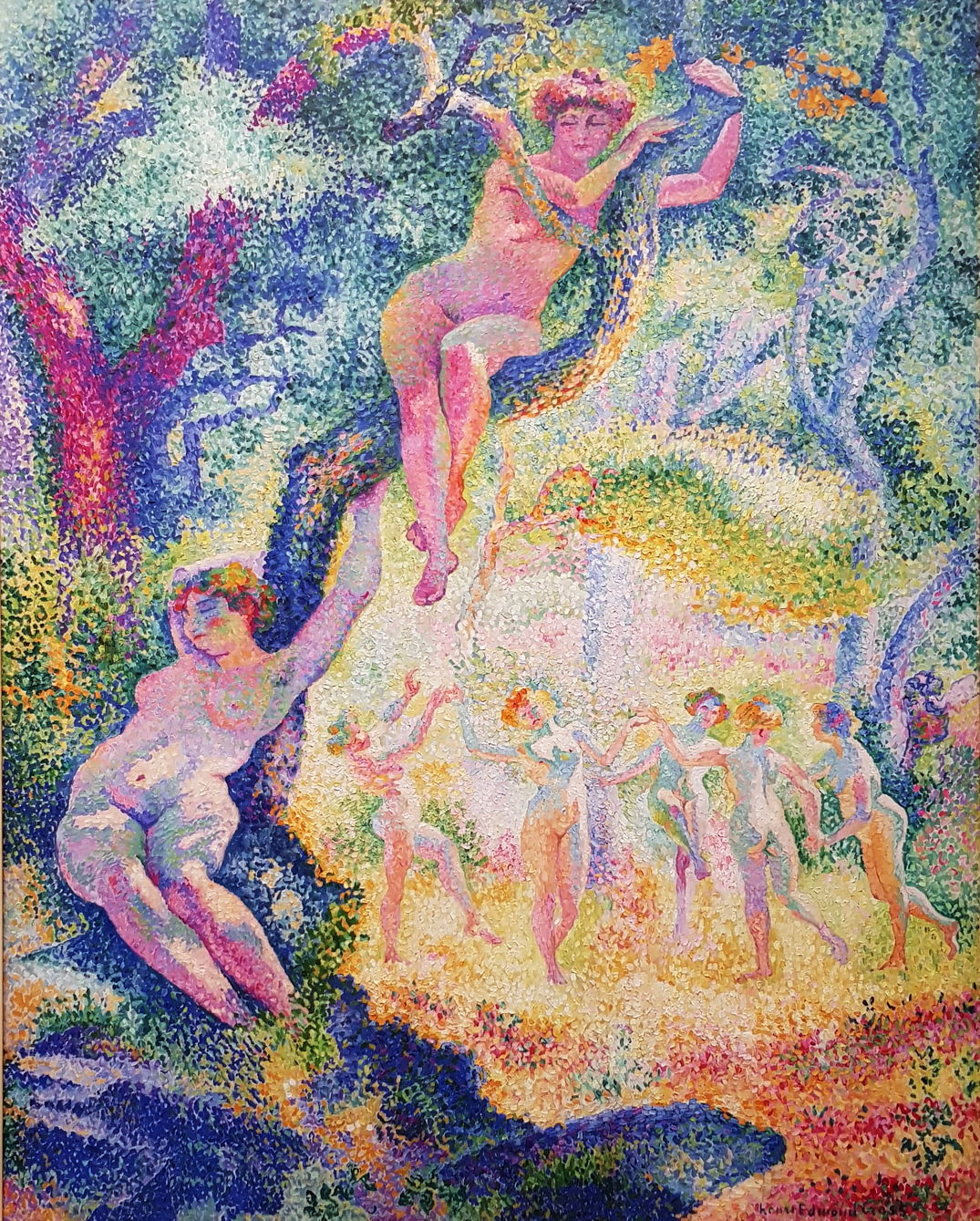
Henri-Edmond Cross (1856–1910), The Glade (1906), oil on canvas, 162 x 130 cm, Wallraf-Richartz-Museum & Fondation Corboud, Cologne, Germany. Image by anagoria, via Wikimedia Commons.
That sketch formed the basis of the woodland setting Cross used in The Glade, painted in oils in 1906. Colour changes are prominent, and the chroma has been considerably enhanced. The size has grown, and it’s on a more permanent support of stretched canvas.
Seen through modern eyes, many of the oil studies of the past deserve to be seen more widely, rather than being kept in storage.

 Login
Login