Reading view

There are new articles available, click to refresh the page.

On Reflection: The Venus Effect

In 2003, the psychologists Marco Bertamini, Richard Latto and Alice Spooner published a paper in which they described a known phenomenon in the perception of paintings, and named it the Venus Effect. Their definition is: “The Venus effect occurs every time the observer sees both an actor (eg Venus) and a mirror, not placed along the observer’s line of sight, and concludes that Venus is seeing her reflection at the same location in the mirror that the observer is seeing.”

Although they dismissed optical “mistakes” as being of less interest, they were intrigued by “the situations in which we as observers read the scene in a certain way, but the mirror itself is used (deliberately or not) to lead us down the wrong path. More specifically, the mirror shows us something that we accept as the view available to the actor in the scene. However, the actor has a different vantage point
from us and therefore the laws of optics imply that he/she cannot be seeing what we see in the mirror.”

In this article, I explore what I believe to be the artist’s intention in this effect, of revealing the face of the subject of a painting in its reflection rather than in the original, a popular form of mirror play.

florisallegoryofsight
Frans Floris (1519/1520–1570), Allegory of Sight (date not known), oil on panel, 95.8 × 81.3 cm, location not known. Wikimedia Commons.

Frans Floris’s Allegory of Sight was probably painted around 1550, making it an early and quite sophisticated entry to the subject. The face of its figure is shown reflected in the only appropriate optical instrument of the day: a simple mirror, carefully angled to project most of the face. Although only a small feature, that reflection looks fiendishly difficult, given the wildly different angle between the mirror and the picture plane. In this case, what’s shown in the mirror is optically plausible, although the subject is looking at the viewer rather than the reflection.

janssenssight
Abraham Janssens (1567–1632) (attr), Sight (date not known), oil on canvas, 117 × 93 cm, location not known. Wikimedia Commons.

This painting of Sight has been attributed to Abraham Janssens, and could date to any time between about 1590 and 1632. It appears to have been inspired by Floris’s Allegory of Sight, and the reflection of the woman’s face in the mirror doesn’t appear optically correct. She does appear to be looking at her reflection, although that’s optically impossible.

vonaachendavidbathsheba
Hans von Aachen (1552–1615), David and Bathsheba (c 1612-15), oil on canvas, 138 x 105 cm, Kunsthistorisches Museum, Vienna, Austria. Wikimedia Commons.

Hans von Aachen’s David and Bathsheba of about 1612-15 introduces a figure standing behind Bathsheba, holding a mirror in front of her face with his outstretched left arm. A glance at that reflection says that something is seriously amiss: von Aachen has painted a reflection in which Bathsheba is looking to the left, although her face is actually looking to the right. No single plane mirror could ever achieve that optical impossibility.

velazquezvenus
Diego Velázquez (1599–1660), Venus at Her Mirror, The Toilet of Venus (Rokeby Venus) (1644-48) [101], oil on canvas, 122.5 x 177 cm, The National Gallery, London. Image by Diego Delso, via Wikimedia Commons.

Although often illustrated by one of Titian’s paintings of Venus, the canonical example must be Velázquez’ Venus at Her Mirror, also known as The Toilet of Venus or the Rokeby Venus, from 1644-48. It shows the goddess Venus, whose face is blurred in a false reflection in a mirror being held by her son Cupid. The theme was common, seen in paintings by Titian and Rubens, with Venus sat upright. Giorgione and others had posed her reclining and facing the viewer, making her pose here unusual. Most other paintings of Venus set her in a landscape: here she rests on luxurious even sensuous fabrics.

No matter how convincing her face might appear in the mirror, a moment spent placing yourself in the same position confirms that the image in the mirror is wholly imaginary, and optically incorrect. Yet, according to Bertamini and others, the majority of viewers succumb to the Venus Effect and believe that Venus is looking at that image of her face.

waterhousemarianasouth1897
John William Waterhouse (1849–1917), Mariana in the South (c 1897), oil on canvas, 114 × 74 cm, Private collection. Wikimedia Commons.

JW Waterhouse’s Mariana in the South from about 1897 stands her in front of a full-length mirror revealing her face to the viewer, but she too is looking at her own reflection.

lalmatademaknockatdoor
Laura Theresa Alma-Tadema (1852–1909), A Knock at the Door (1897), oil on panel, 63.8 × 44.8 cm, Currier Museum of Art, Manchester, NH. Wikimedia Commons.

Laura Theresa Alma-Tadema’s A Knock at the Door, also from 1897, shows an attractive young woman checking that she is looking at her best in a mirror, before receiving a visitor. Once again it is the reflection that shows her face, and we’re struggling to be sure whether this is optically correct, although in this case the artist has at least brought closer alignment between the two optical axes.

friesekenudeseateddressingtable
Frederick Carl Frieseke (1874–1939), Nude Seated at Her Dressing Table (1909), oil on canvas, 162.3 x 131.1 cm, Smithsonian American Art Museum, Washington, DC. Wikimedia Commons.

Frederick Carl Frieseke’s Nude Seated at Her Dressing Table (1909) also uses closer alignment to appear more optically plausible, as this nude apparently studies herself in the mirror.

cranemirror
Walter Crane (1845–1915) The Mirror, illustration for Arthur Kelly’s The Rosebud and Other Tales (1909), pen, black ink and watercolor, 20.3 × 15.3 cm, Private collection. Wikimedia Commons.

Walter Crane made this watercolour and ink drawing of The Mirror for Arthur Kelly’s The Rosebud and Other Tales, published in 1909. Although there are clear disparities between the alignment of face and chest with their reflection, this too appears plausible.

corinthatthemirror
Lovis Corinth (1858–1925), At the Mirror (1912), oil on canvas, dimensions not known, Worcester Art Museum, Worcester, MA. Wikimedia Commons.

Lovis Corinth’s At the Mirror from 1912 complicates this further by raising the viewer well above the subject and her reflection, and revealing the artist standing behind her.

There are a few paintings where the artist has overtly declined to employ the Venus Effect.

tintorettosusannaelders1555
Jacopo Tintoretto (c 1518-1594), Susannah and the Elders (c 1555) (E&I 64), oil on canvas, 146 x 193.6 cm, Kunsthistorisches Museum, Vienna, Austria. Wikimedia Commons.

Tintoretto’s Susannah and the Elders from about 1555 goes further with mirror play. Susannah has been caught as she is drying her leg after bathing in the small pool beside her, looking at herself in a rectangular mirror, which is propped up against a rosy trellis in a secluded part of her garden. Unlike in other paintings of nudes, neither the image seen in the mirror nor the reflection on the water show anything more of Susannah.

Painting Pandora and her box: 1883-1919

The ancient Greek myth of Pandora had been almost unknown in paintings until the nineteenth century. During the 1870s it suddenly became a popular theme for European paintings, but its narrative had altered from the original in showing the first woman in Greek mythology with a box containing the ills of the world, rather than a large earthenware storage pot, and only one artist had depicted its crux.

churchopenedpandorasbox
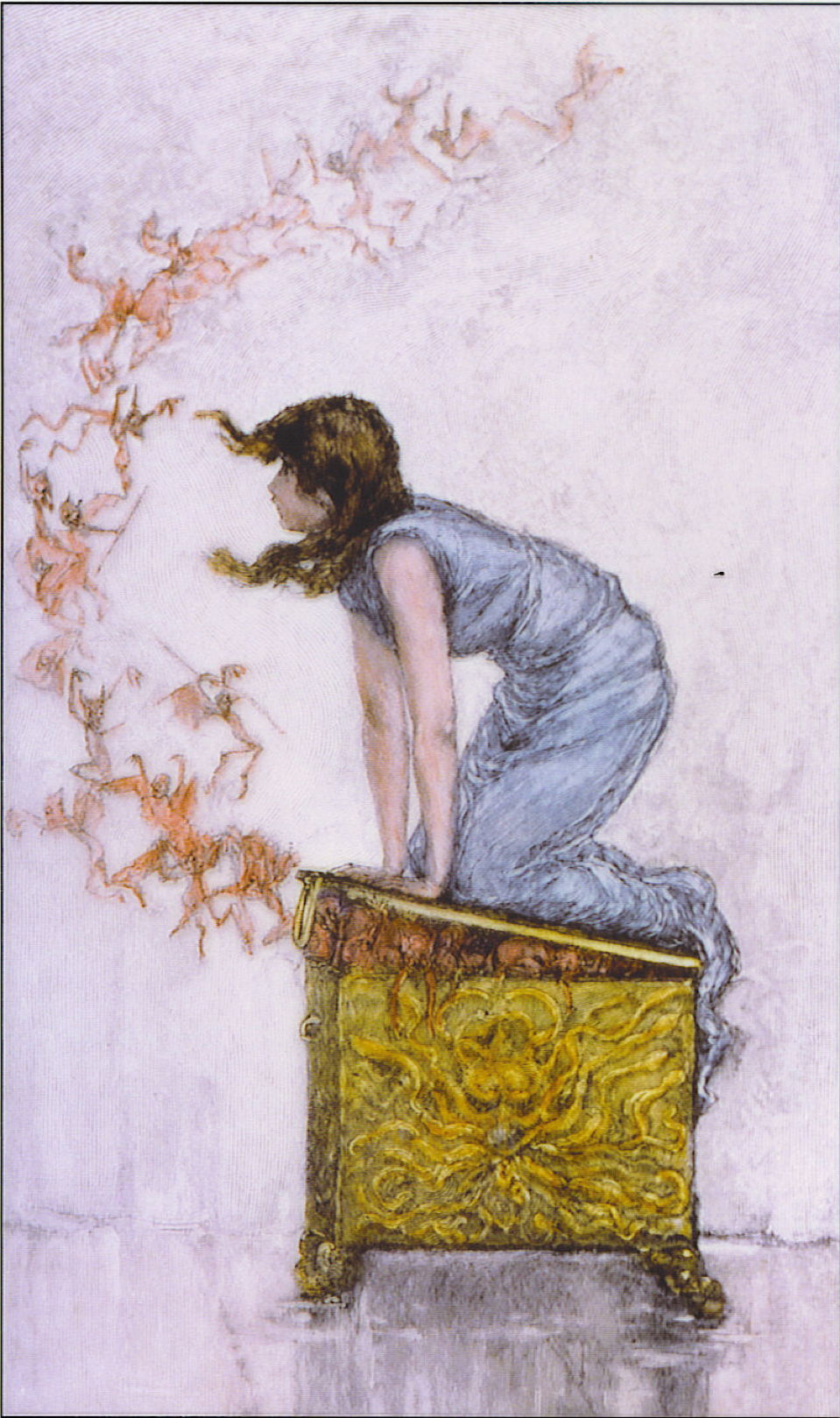
Frederick Stuart Church (1842–1924), Pandora (1883), pencil and ink wash on paper, 30.2 x 45.7 cm, Private collection. Wikimedia Commons.

The story broke out of Europe by 1883, when the American painter and illustrator Frederick Stuart Church painted his more illustrative Pandora. Dressed more modestly (presumably for a wider audience), she is shown as an innocent young woman kneeling on a large golden chest as she tries to close its lid and stop the emerging stream of red demons. I suspect this was intended as an illustration for a printed collection of classical myths.

Walter Crane (1845–1915), Pandora (1885), watercolour on paper, 53.3 x 73.6 cm, location not known. Wikimedia Commons.

The following year Walter Crane, a British painter and illustrator, painted Pandora in an unusual interpretation that’s only loosely connected with the original myth. She is here draped in grief over a substantial casket, and on its side panel are the figures of the three Fates. At the corners of the casket are guardian winged sphinxes, each clasping a sphere.

bouguereaupandora
William-Adolphe Bouguereau (1825–1905), Pandora (1890), oil on canvas, 92.5 × 64.5 cm, location not known. Wikimedia Commons.

In his later years, William-Adolphe Bouguereau chose an oddly androgynous model for his depiction of Pandora in 1890, but has rather lost the narrative. Her neutral expression, body language, and the closed box tell little of what is imminent.

waterhousepandora
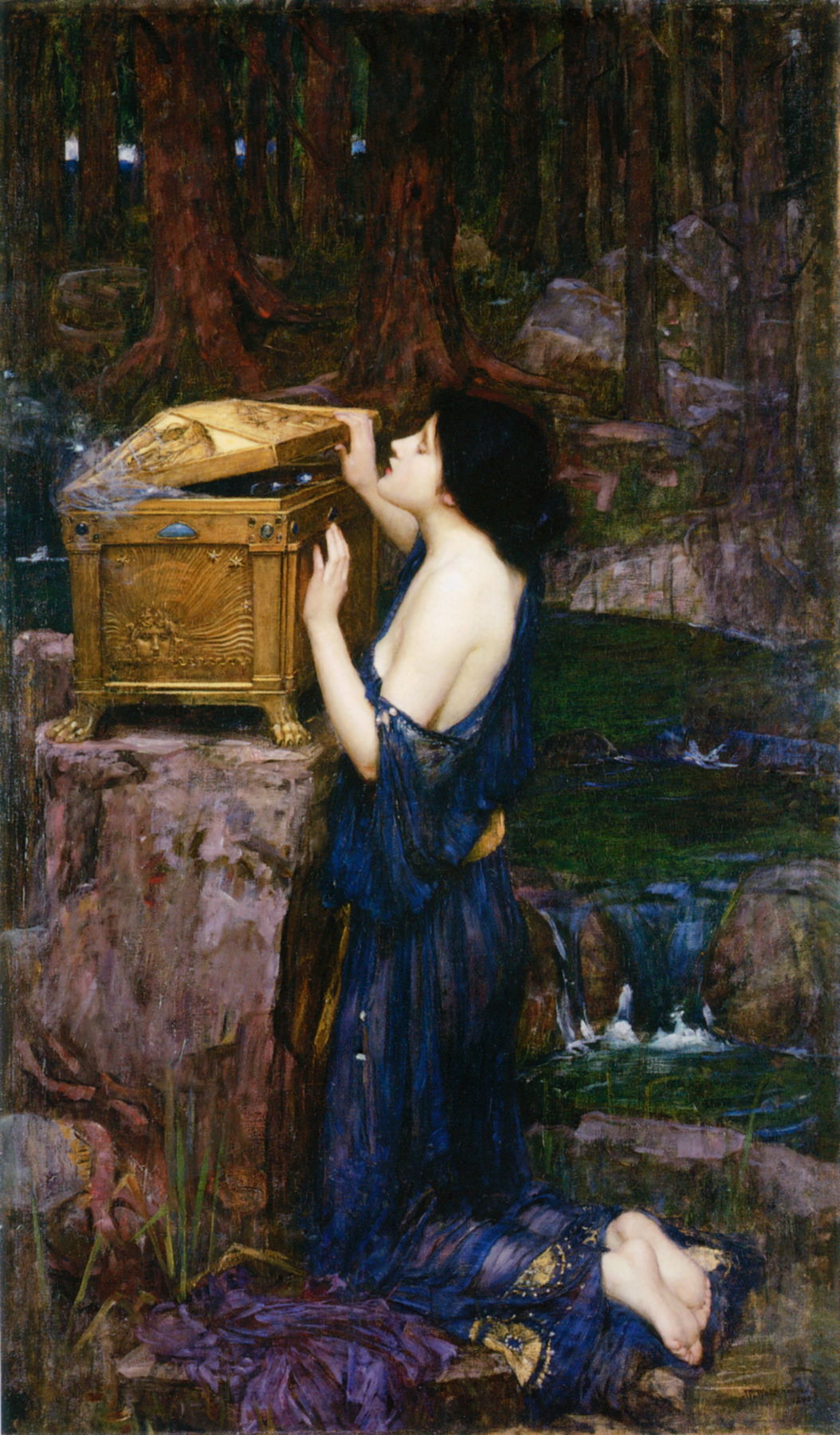
John William Waterhouse (1849–1917), Pandora (1896), oil on canvas, 152 × 91 cm, Private collection. Wikimedia Commons.

One of his lesser-known paintings, John William Waterhouse’s Pandora from 1896 is a major depiction of this myth, and one of the most complete. Set by a small brook in a dark, primeval forest, her box has become a large gold chest encrusted with precious stones and decorated with mythological motifs. Pandora kneels by its side, peeking inside as she carefully raises its lid, but even this tentative glimpse is sufficient to release its stream of ills, of which she appears unaware.

normandpandora
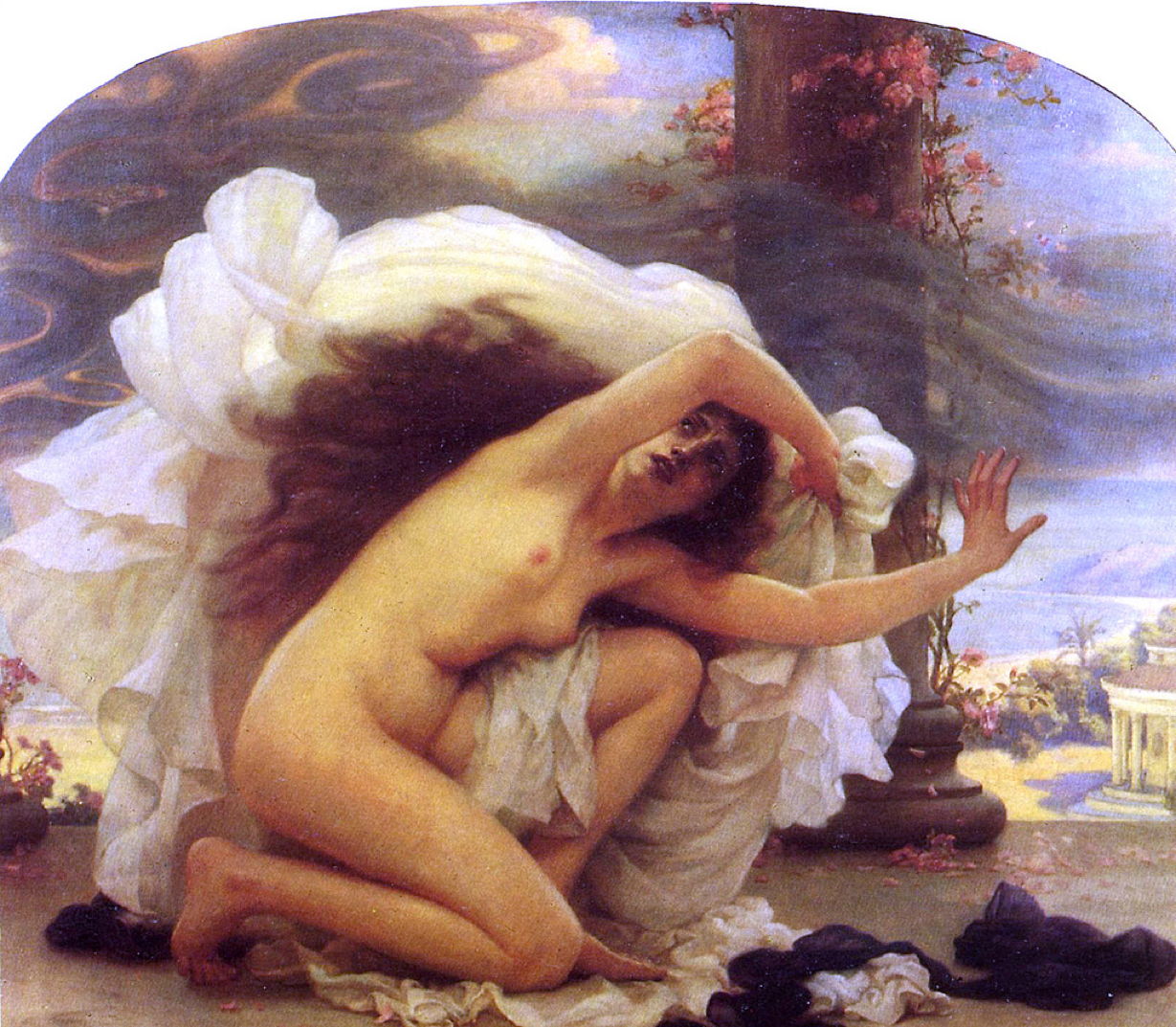
Ernest Normand (1857-1923), Pandora (1899), further details not known. The Athenaeum.

Ernest Normand is one of few painters to show a later moment, in which Pandora (1899) bends low to duck beneath the swirling grey clouds of evils as they spread out into the idyllic world beyond, causing blossom to fall as petals to the ground. Her jar is only hinted at, behind her billowing white robes, almost depriving the viewer of this vital clue to the original story.

rackhampandora
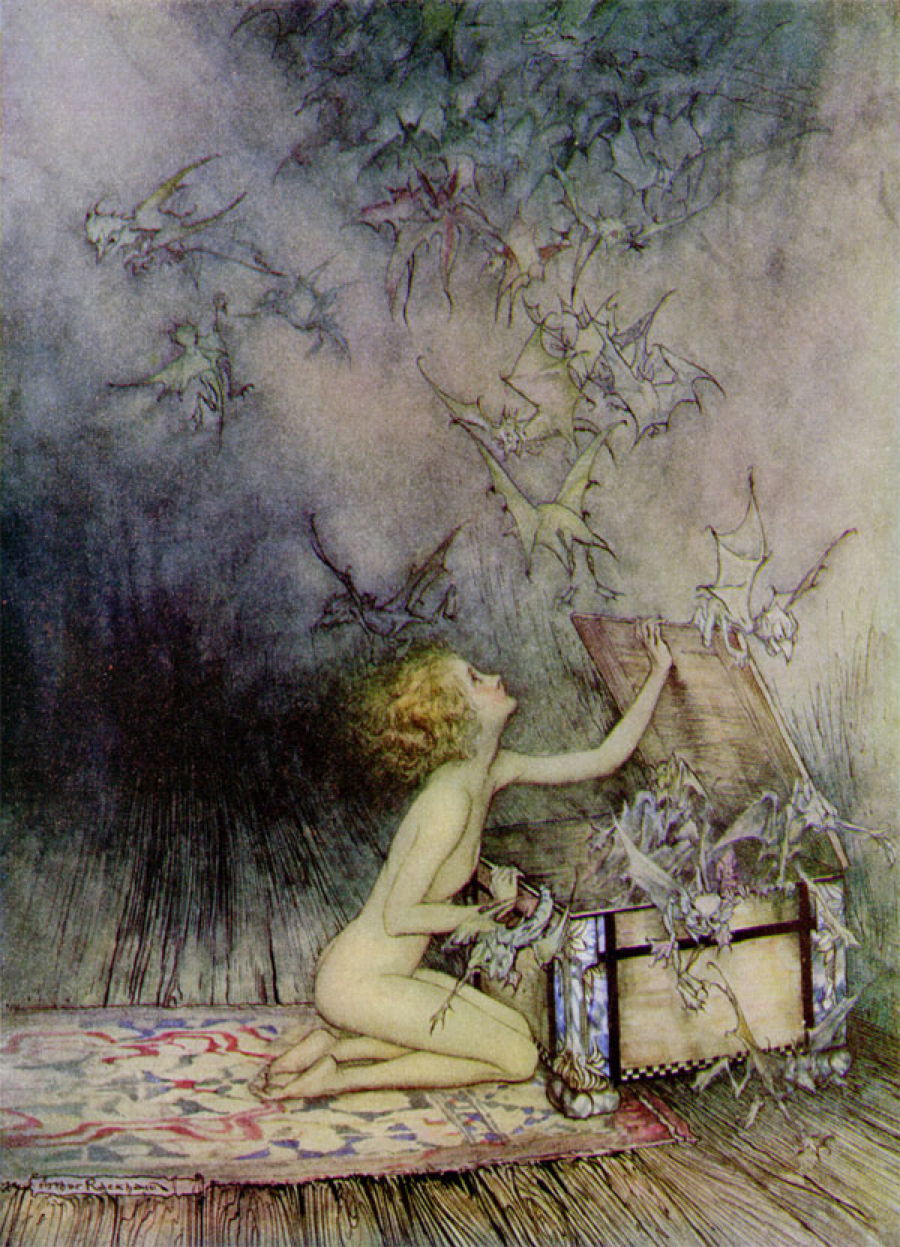
Arthur Rackham (1867–1939), Pandora (date not known), further details not known. Wikimedia Commons.

I have been unable to find a date for this presumed illustration by the great Arthur Rackham of Pandora, but suspect it was made around the turn of the twentieth century, and intended to accompany a British English retelling of this myth. As with Church before, Pandora is young and innocent in her nakedness. She gazes up in awe at the batlike demons as they escape from the open lid of her large wooden chest, seemingly unaware of what she is unleashing in her curiosity.

kenningtonpandora
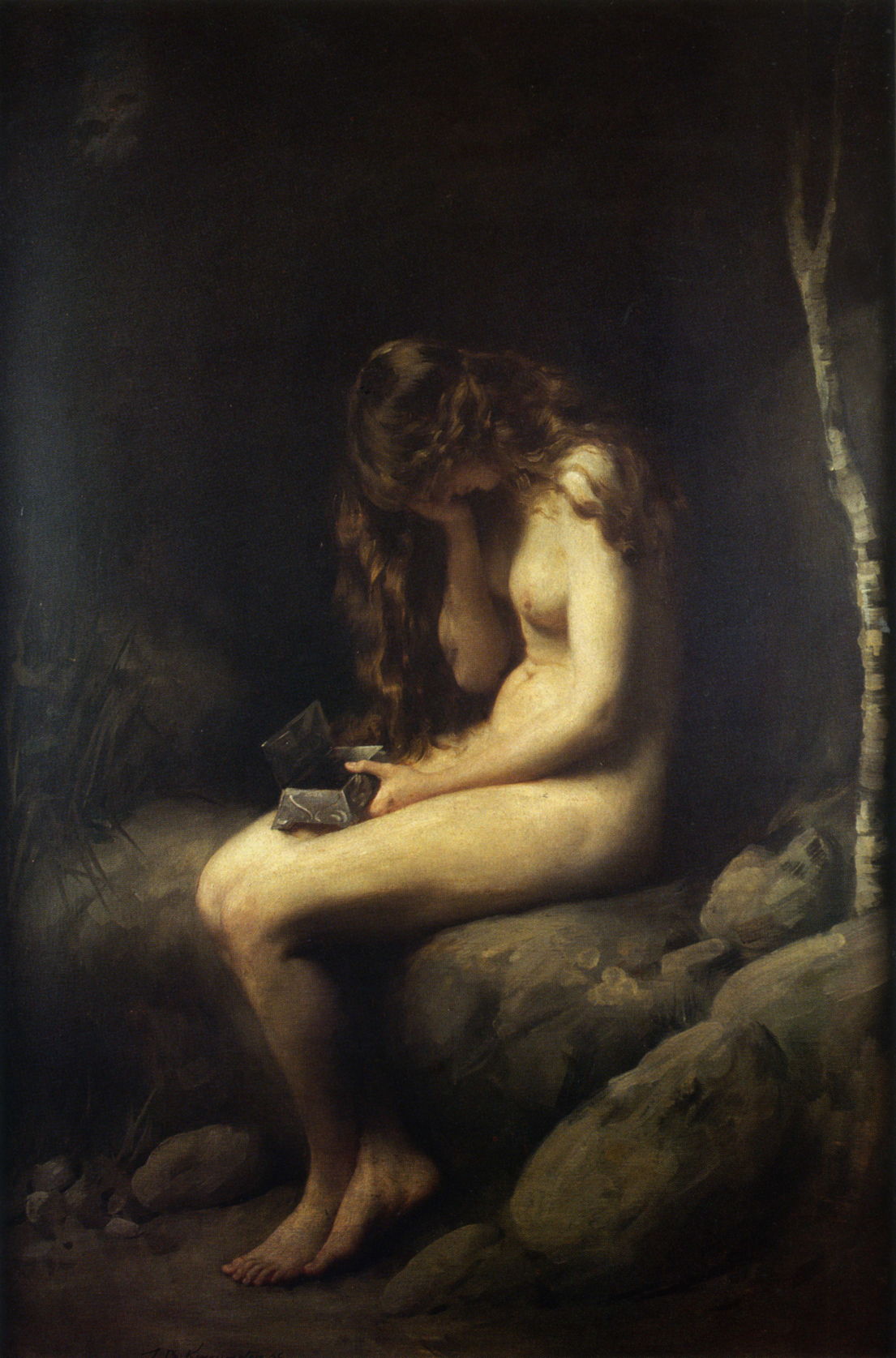
Thomas Benjamin Kennington (1856–1916), Pandora (1908), oil on canvas, 166.3 × 113 cm, Private collection. Wikimedia Commons.

Thomas Benjamin Kennington shows Pandora (1908) in the final phase of regret and sorrow, after the evils have all been released. Her box, now empty, with no sign of the remaining Hope, rests on her thigh. She hangs her head in shame, resting it on her right hand as she weeps at what she has done. Unfortunately, the released demons shown at the left edge are so dark that they are hard to see.

Over this period, other artists had also been painting the story of the creation of Pandora, a theme I have avoided so far. I will, though, show one of its more unusual depictions, a painting lost for forty years.

battenpandora
John Dixon Batten (1860-1932), The Creation of Pandora (1913), tempera on fresco, 128 x 168 cm, Reading University, Reading, England. Wikimedia Commons.

John Dixon Batten’s The Creation of Pandora was painted anachronistically in egg tempera on a fresco ground by 1913. Batten was one of the late adherents of the Pre-Raphaelite movement, and now almost forgotten. It had been exhibited in a commercial gallery, and was acquired by the University of Reading, England, shortly before the First World War. Deemed unfashionable in 1949, it was put into storage and quietly forgotten until its rediscovery in 1990.

Pandora is at the centre, having just been fashioned out of earth by Hephaestus, who stands at the left, his foot on his anvil. Behind them, other blacksmiths work metal in his forge. At the right, Athena is about to place her gift of a robe about Pandora’s figure, and other gods queue behind her to offer their contributions.

Just before the start of the First World War, Odilon Redon made a series of studies leading to a radically different presentation of Pandora’s story.

redonpandorahouston
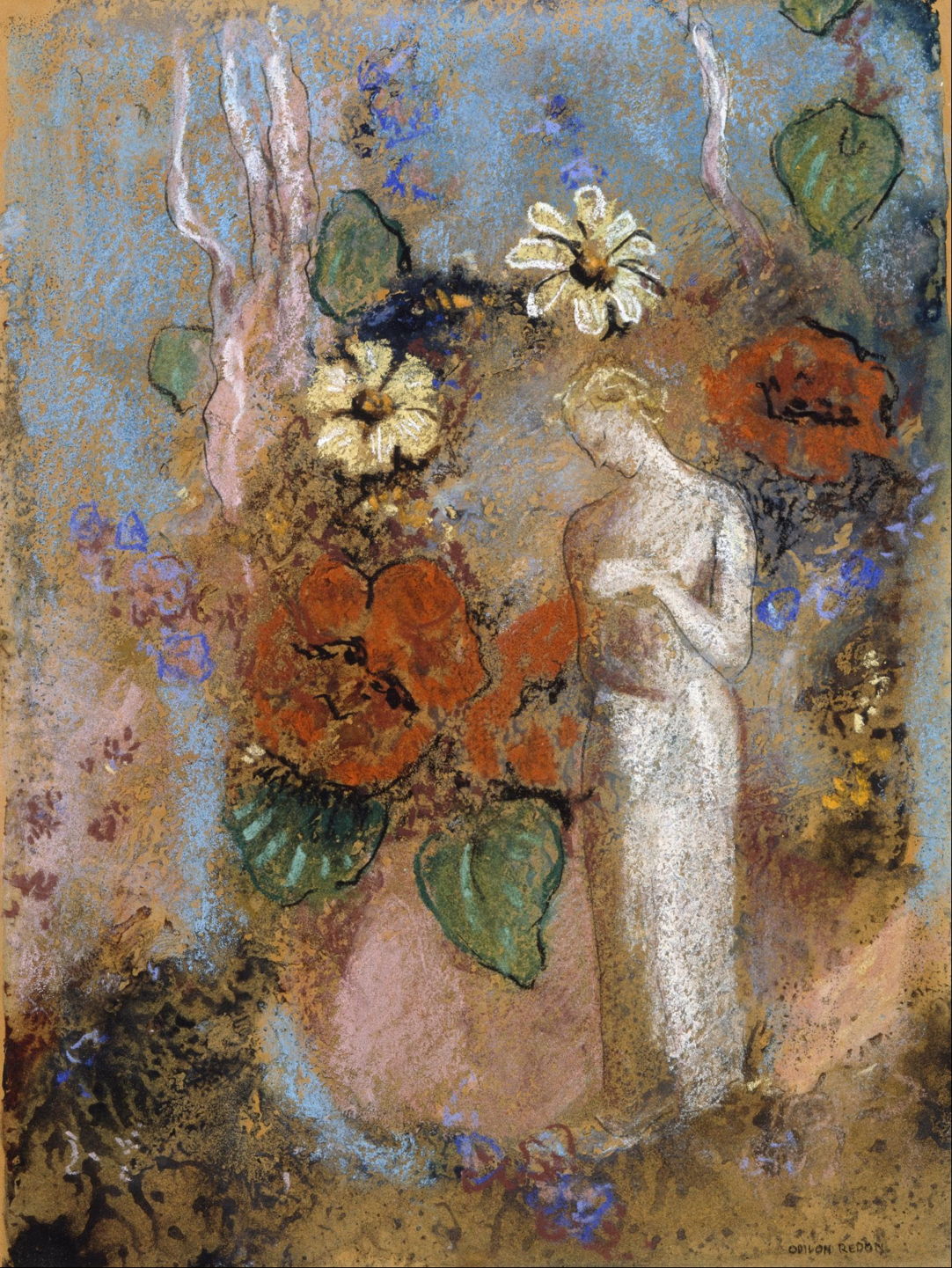
Odilon Redon (1840–1916), Pandora (date not known), pastel and charcoal on board, 22.1 x 29.1 cm, Museum of Fine Arts, Houston, TX. Wikimedia Commons.

Redon’s undated pastel study of Pandora shows her clasping her box close in the midst of huge floral images.

redonpandoramet
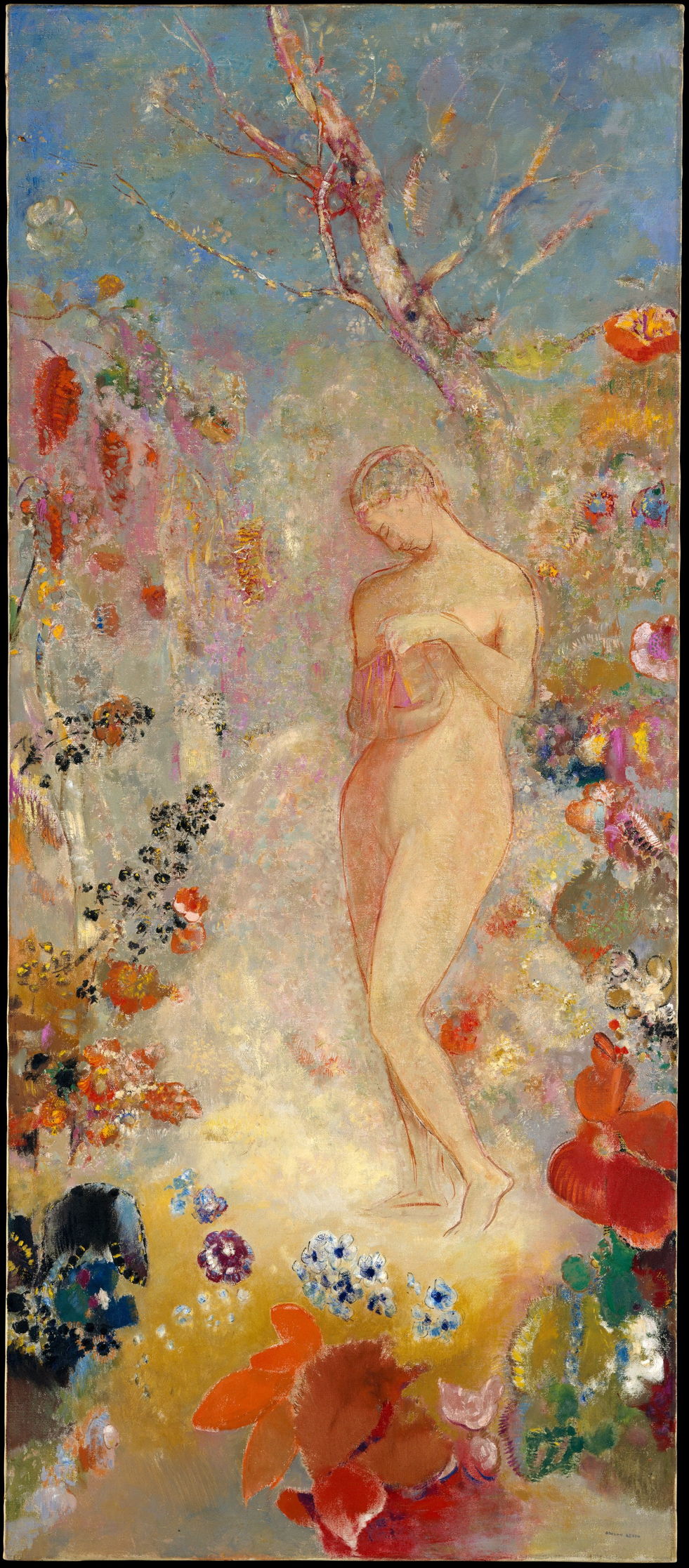
Odilon Redon (1840–1916), Pandora (c 1914), oil on canvas, 143.5 x 62.2 cm, The Metropolitan Museum of Art (Bequest of Alexander M. Bing, 1959), New York, NY. Courtesy of The Metropolitan Museum of Art.

Redon’s finished oil painting of Pandora from about 1914 shows her more clearly, surrounded by a garden of exquisite and exotic blooms, referring to Eve’s Paradise before the Fall. She holds her box to her bosom, as she succumbs to the temptation to open it, but Redon stops just short of showing its evils pouring out.

gregorypandora
Yvonne Gregory (Park) (1889-1970), Pandora (1919), photograph, published in ‘Photograms of the Year’, 1919, further details not known. Wikimedia Commons.

My final representation of the myth of Pandora is a photograph from 1919 by the society portrait photographer Yvonne Gregory (who also worked under her married surname of Park): Pandora. The box lies wide open by her knees, as Pandora is bent double in distress over it, her left arm over her head to shelter her from the demons that have been released, and in grief at what she has done.

Given the disasters that had struck the world in the years immediately preceding this photograph – the mass carnage of the war, and the influenza pandemic which followed it – it must have had great impact when it was published in 1919. Much as these images have today. For despite the story’s underlying misogyny, I can’t help thinking that Pandora’s box has been opened yet again.

Reference

Wikipedia on the myth of Pandora.

❌