Reading view

There are new articles available, click to refresh the page.

Jerusalem Delivered: Overview and contents

This article provides a brief overview of the plot and sub-stories of Torquato Tasso’s epic poem Jerusalem Delivered, with links to individual articles, and some of the very best of the paintings.

Jerusalem Delivered is a fictional elaboration of the events at the end of the first Crusade, starting with the departure from Antioch, after its capture, and ending with the full possession of the city of Jerusalem.

Introduction: A forgotten epic

Historical background

Mounting the First Crusade
Capture of Jerusalem

Jerusalem Delivered

Advance to Emmaus
overbeckarchangelgabrielgodfrey
Johann Friedrich Overbeck (1789-1869), The Archangel Gabriel Appears to Godfrey of Bouillon (1819-27), fresco, dimensions not known, Casa Massimo, Rome, Italy. Image by Sailko, via Wikimedia Commons.

The crusaders’ leader, Godfrey of Bouillon, is visited early one morning by the Archangel Gabriel, who spurs the French noble to lead his army south to the Holy City. During their journey, they are provisioned by sea, and meet little opposition.

Aladine, ruler of Jerusalem, hears of their progress and starts preparing to receive them. Ismen, formerly a Christian soothsayer now turned to ‘pagan’ sorceror, arranges a trap to oppress the remaining Christians in the city, by having a sacred icon of the Virgin Mary stolen. Aladine attributes this to a Christian and uses it as an excuse to persecute the Christians.

Sophronia, a young Christian woman, tells Aladine she stole the icon, and is condemned to burn at the stake. Her lover Olindo insists that he is the thief, and is tied on the other side of the stake for execution with her. Just as the kindling is about to be lit, the beautiful ‘pagan’ knight Clorinda arrives and intervenes.
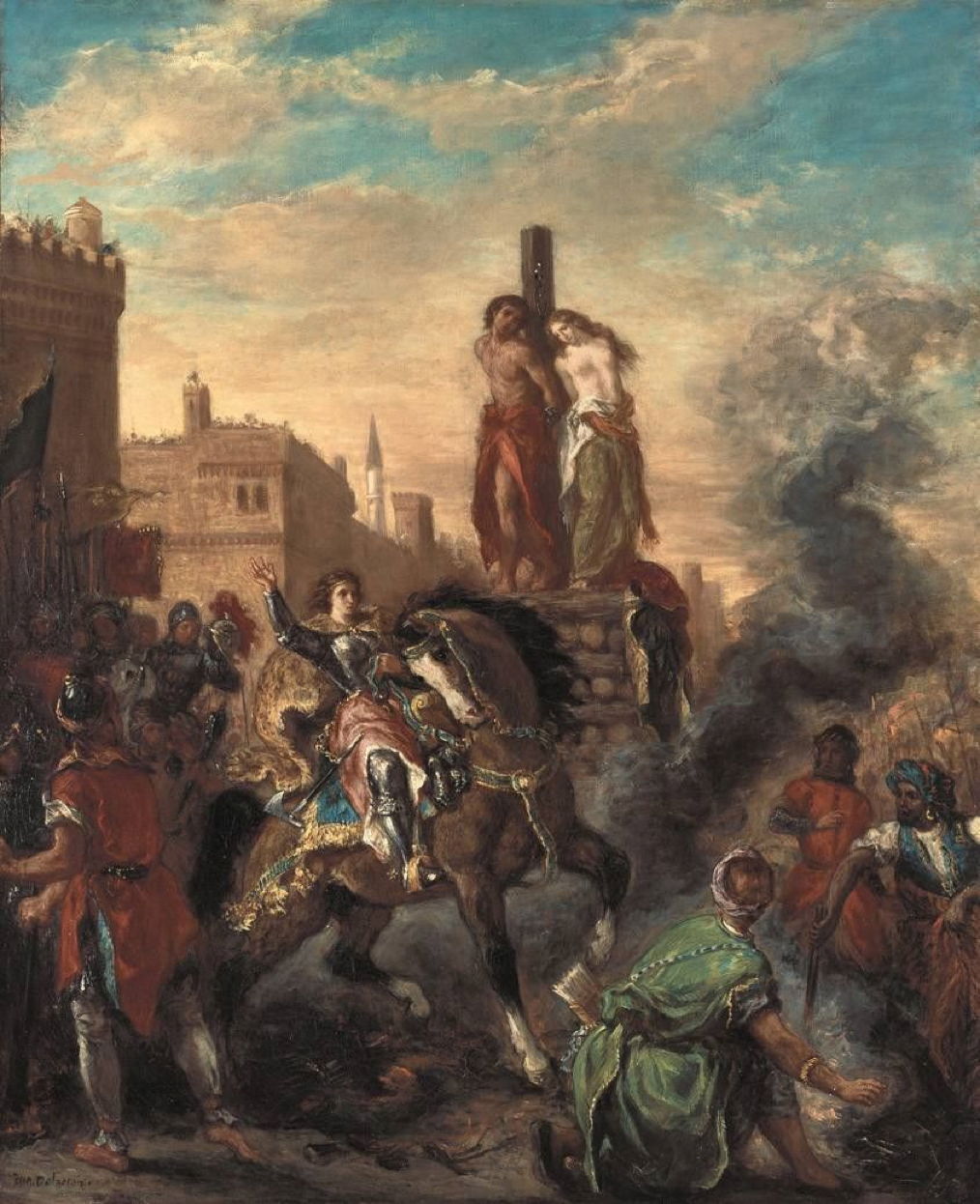
delacroixclorindafreesolindo
Eugène Delacroix (1798–1863), Clorinda Rescues Olindo and Sophronia (1856), oil on canvas, 101 x 82 cm, Neue Pinakothek, Munich, Germany. Wikimedia Commons.

Sophronia and Olindo are spared, but Aladine banishes them and all other able-bodied Christians to beyond the city limits. Most flee to Emmaus, where the crusaders have just arrived.

First skirmish and a sorceress

Godfrey of Bouillon politely rejects overtures from two ambassadors of Egypt, inviting him to abandon his mission to capture Jerusalem. One, the Circassian Argante, warns Godfrey of dire consequences before he heads off to join Aladine in Jerusalem.

Soon after the crusaders arrive at the city, Clorinda leads an initial skirmishing party to size up the French forces. Godfrey sends Tancred to support the French, and when he knocks Clorinda’s helmet off, he falls hopelessly in love with her. Inside Jerusalem Erminia, former princess of Antioch, reveals her love for Rinaldo, another of the crusader knights. Argante shows himself to be a fearsome warrior by claiming the life of Dudon.

Godfrey decides a plan of action, and realises his need for a good supply of timber to build siege towers and engines.

The ‘pagan’ wizard Hydrotes sees his beautiful niece Armida, a sorceress herself, as an essential weapon in the campaign, so directs her to sow chaos inside Godfrey’s camp.

teniersarmidabeforegodfrey
David Teniers the Younger (1610–1690), Armida before Godfrey of Bouillon (1628-30), oil on copper, 27 x 39 cm, Museo Nacional del Prado, Madrid, Spain. Wikimedia Commons.

Armida tells the crusaders a story of woe, and beguiles many of the finest of Godfrey’s knights to follow her on a fool’s errand.

Erminia flees

In the midst of the chaos wrought by Armida, Rinaldo accuses Gernando of being a liar; they settle this when Rinaldo kills Gernando in a duel. Godfrey condemns Rinaldo to death, and he storms off from the camp. Armida then leads many other knights away on her diversionary mission.

In an attempt to expedite matters, Argante challenges the crusaders in one-to-one combat. Godfrey approves Tancred as the knight to face the Circassian. They fight viciously, wounding one another, but are brought to a halt by nightfall.

Erminia decides to go and tend Tancred’s wounds, so dresses up in Clorinda’s armour and slips out of the city in the dead of night. However, that makes her appear to be Clorinda to the crusaders, and she is forced to flee in panic. Tancred then rides off in pursuit of her, thinking her to be Clorinda. Overnight, both Erminia and Tancred become lost, and fail to find one another.
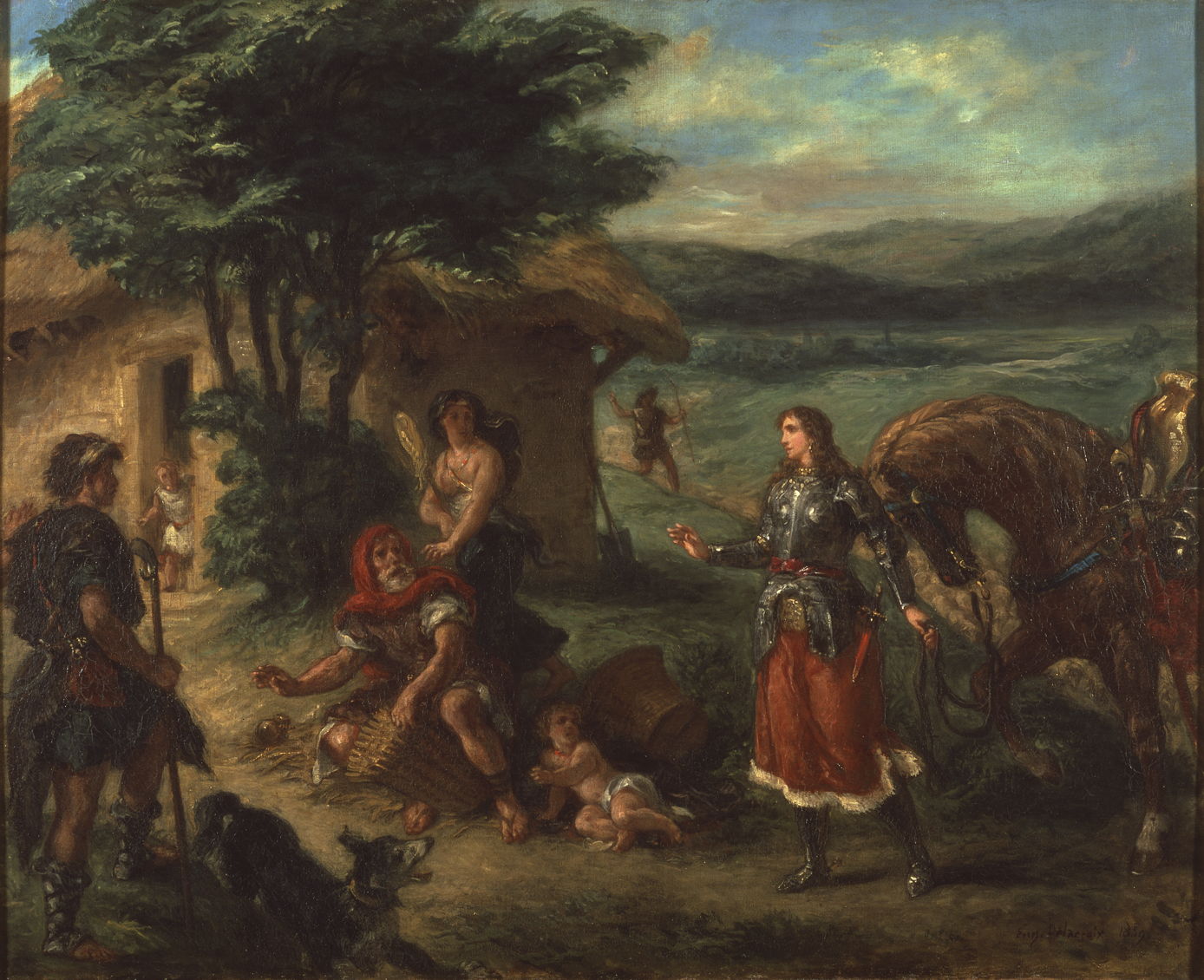
delacroixerminiashepherds
Eugène Delacroix (1798–1863), Erminia and the Shepherds (1859), oil on canvas, 82 x 104.5 cm, Nationalmuseum, Stockholm, Sweden. Wikimedia Commons.

Erminia happens on a small family of shepherds, who console her, and dress her in their country clothes.

The death of Clorinda

Tancred is trapped in Armida’s magic castle, behind the bars of its dungeon. The following morning, with his combat against Argante due to restart soon after dawn, he is nowhere to be found. Raymond of Toulouse is drawn by lot to fight as his substitute, and proves a match. The devil, though, gets a ‘pagan’ archer to loose an arrow that strikes Raymond without wounding him. At this breach of chivalry, the affronted crusaders and defenders of Jerusalem join battle, which turns bloody until the hand of God intervenes with a massive thunderstorm.

Rinaldo and Tancred are still missing, but the crusaders riot in fear that the former has been killed. Godfrey realises he must attack the city soon.

Arab forces then attack the crusaders by night, which develops into more general battle. Knights return from their mission for Armida, reporting that they had been rescued by Rinaldo, who hadn’t been killed after all. They report that Armida has taken Tancred prisoner.

Godfrey prepares for assault on the city, first celebrating mass on Mount Olivet. The following day the crusaders bring up their siege towers and engines to tackle the walls of Jerusalem, but make slow progress against a strong defence. At nightfall the towers are pulled back, but Clorinda sneaks out of the city and sets alight to the towers, burning them to the ground.

She is caught outside the walls by Tancred, who cannot tell it is her and engages her in combat. Eventually he wounds her mortally, recognises her, and she asks to be baptised before she dies. Tancred does so, and she goes in peace.
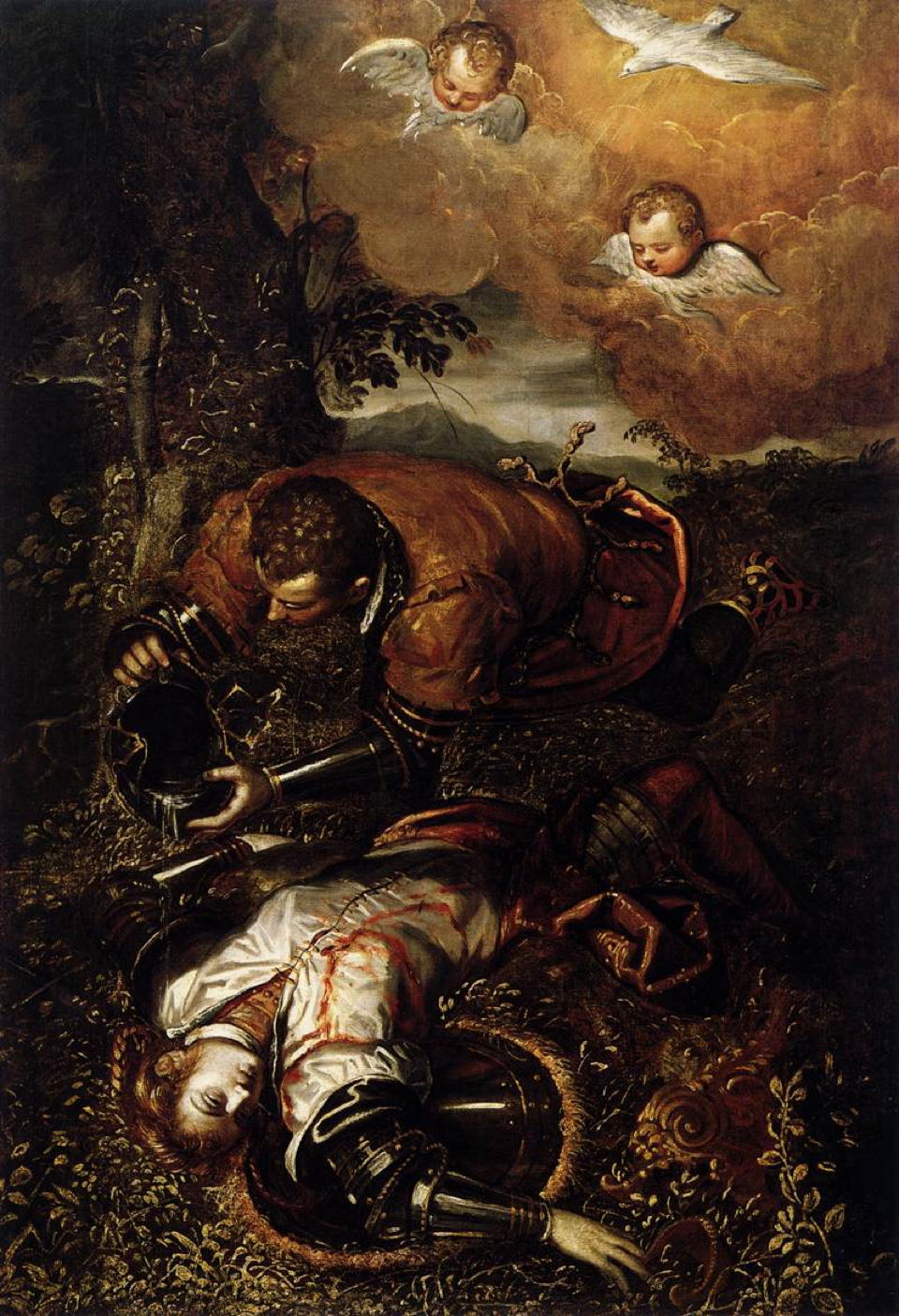
tintorettodomenicotancredbaptizingclorinda
Domenico Tintoretto (1560–1635), Tancred Baptizing Clorinda (c 1585), oil on canvas, 168 x 115 cm, Museum of Fine Arts, Houston, TX. Wikimedia Commons.
Rinaldo abducted by Armida

The wounded Tancred is carried back to his tent.

Ismen enchants the forest which is the crusaders’ only supply of wood, preventing them from cutting replacement timbers for new siege towers. The weather turns oppressively hot and dry, causing crusaders to collapse and die of heat and dehydration. After prayers of the crusaders, the weather breaks and there is heavy rain.

Godfrey has a vision revealing the importance of finding Rinaldo to break the spell so that he can obtain timber again. Charles and Ubaldo leave on a mission to discover Rinaldo. They learn that Armida had originally intended to kill him, but just as she was about to sink her dagger into his sleeping body, she fell in love with him and abducted him instead.

poussinwhole
Nicolas Poussin (1594–1665), Rinaldo and Armida (c 1630), oil on canvas, 82.2 x 109.2 cm, Dulwich Picture Gallery. Wikimedia Commons.
Armida’s Garden

With the help of a wizard, Charles and Ubaldo sail in a magic ship to the Fortunate Isles. Overcoming various obstacles, they see the couple together in Armida’s garden, where Rinaldo has clearly become Armida’s dandy, and no warrior knight.
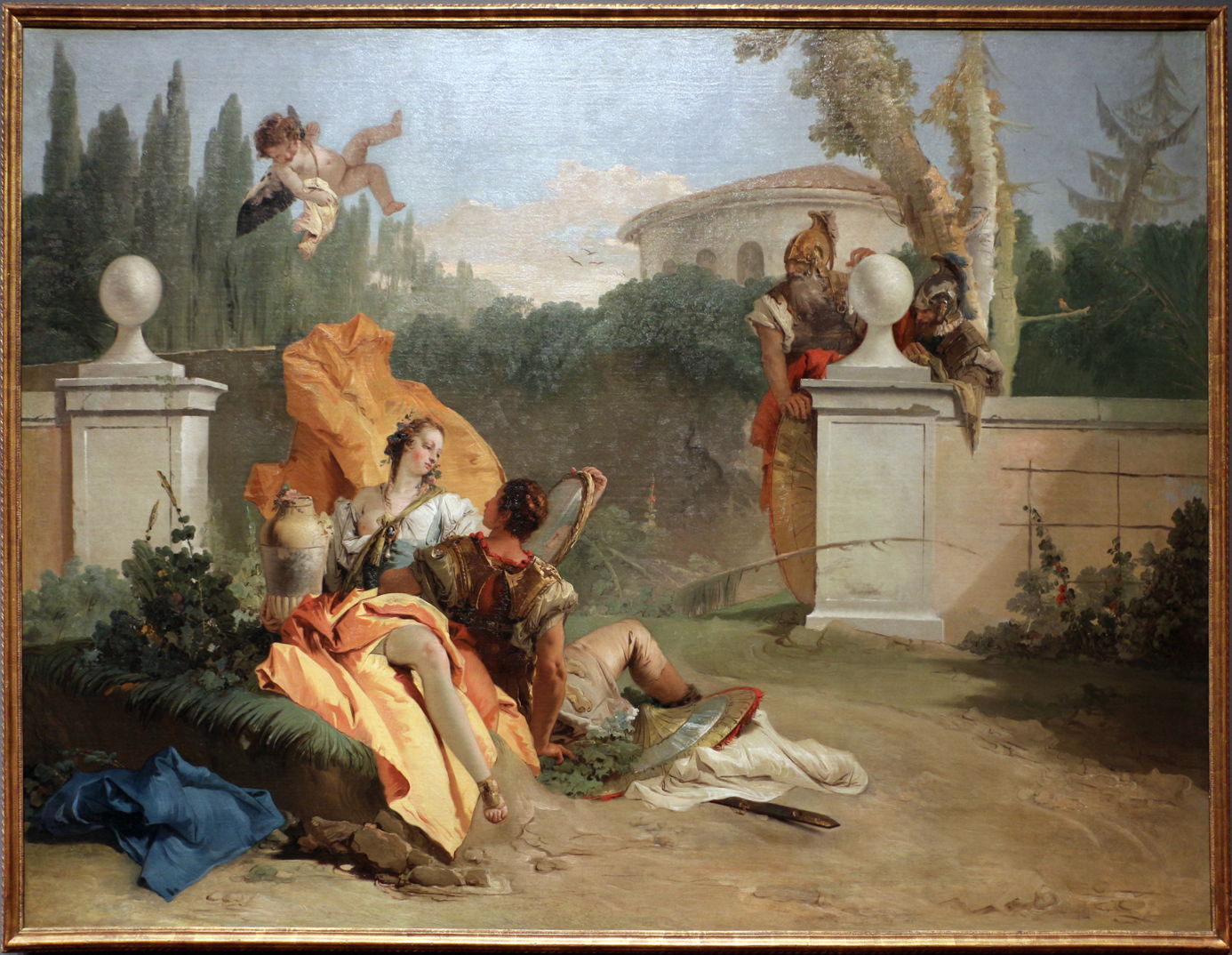
tiepolorinaldoarmidagarden
Giovanni Battista Tiepolo (1696–1770), Rinaldo and Armida in Her Garden (1742-45), oil on canvas, 187 x 260 cm, The Art Institute of Chicago, Chicago, IL. Image by Sailko, via Wikimedia Commons.
Rinaldo retrieved

Showing Rinaldo his image in a polished shield, Charles and Ubaldo get him to see how he has changed, and to return to the siege of Jerusalem with them.
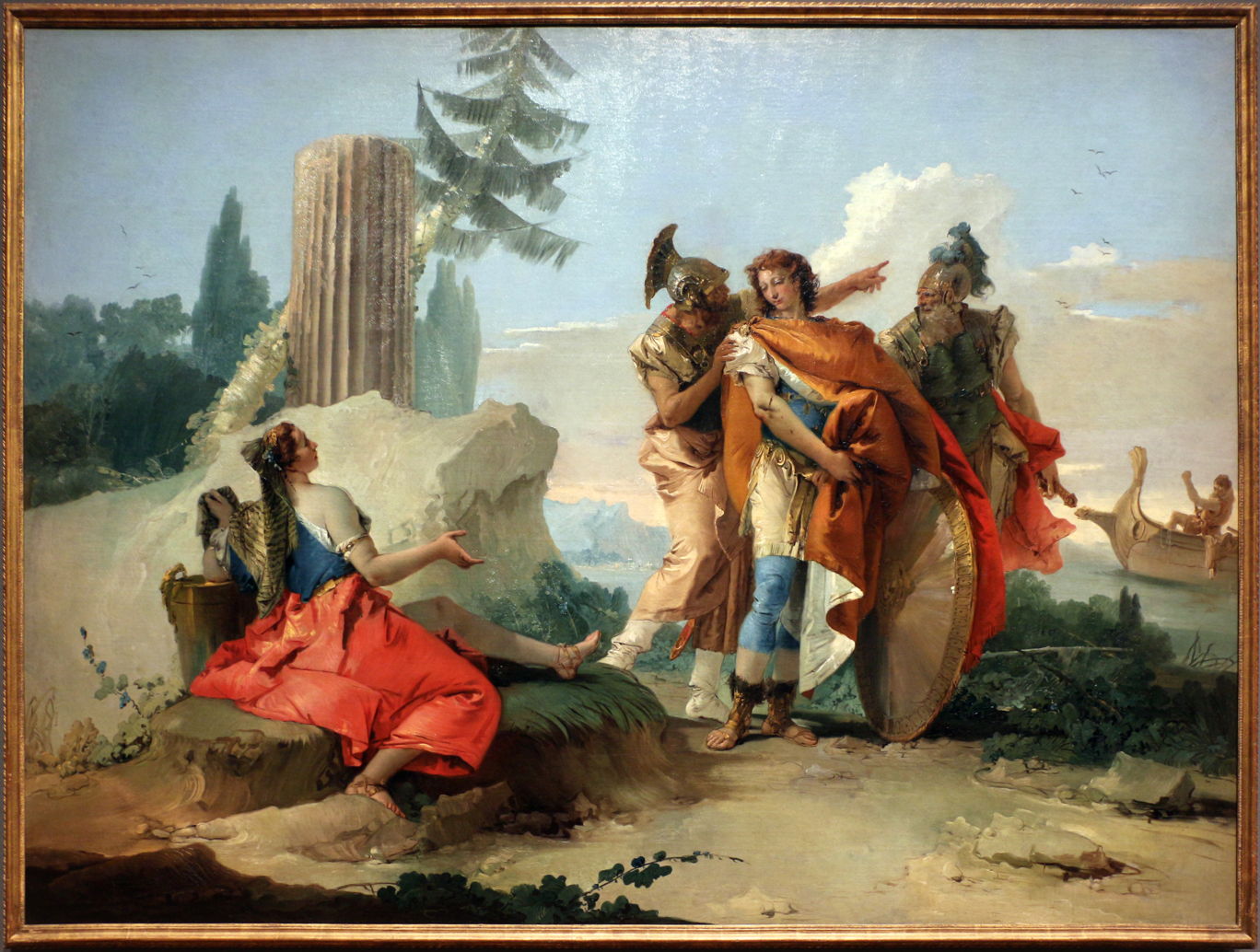
tiepoloarmidaabandonsrinaldo1745
Giovanni Battista Tiepolo (1696–1770), Armida Abandoning Rinaldo (1742-45), oil on canvas, 186.7 x 259.4 cm, The Art Institute of Chicago, Chicago, IL. Image by Sailko, via Wikimedia Commons.

Armida first tries to lure him back, then weeps, and finally departs in rage in her own chariot, to wreak vengeance.

Into Jerusalem

Rinaldo is reunited with Godfrey, who asks him to solve the problem of the enchanted wood. Rinaldo enters the wood and breaks Ismen’s spell, enabling timbers to be felled to build fresh siege towers.

Meanwhile, the King of Egypt is leading a massed army towards the crusaders at Jerusalem. Joining him is Armida with forces provided by her evil uncle. There are several volunteers who promise to kill Rinaldo in return for her hand in marriage. The King of Egypt also plots how he will kill Godfrey using deception. Those plans are discovered by a crusader spy, Vafrine.

With new towers built, Godfrey resumes the assault on Jerusalem before the Egyptian forces are due to arrive. Rinaldo, Tanred, Godfrey and others lead the ascent of the walls, and crusaders enter the city, where they quickly start massacring its ‘pagan’ defenders.

Argante and Tancred agree to conclude their previous combat beyond the city walls. After a bitter fight, in which both men are badly wounded, Tancred finishes the Circassian off, then collapses at dusk.

Vafrine has completed his mission spying on the Egyptian forces when he is recognised by Erminia, who wants to defect to the crusader camp. On their way back, they stumble across Argante’s body, then the wounded Tancred.
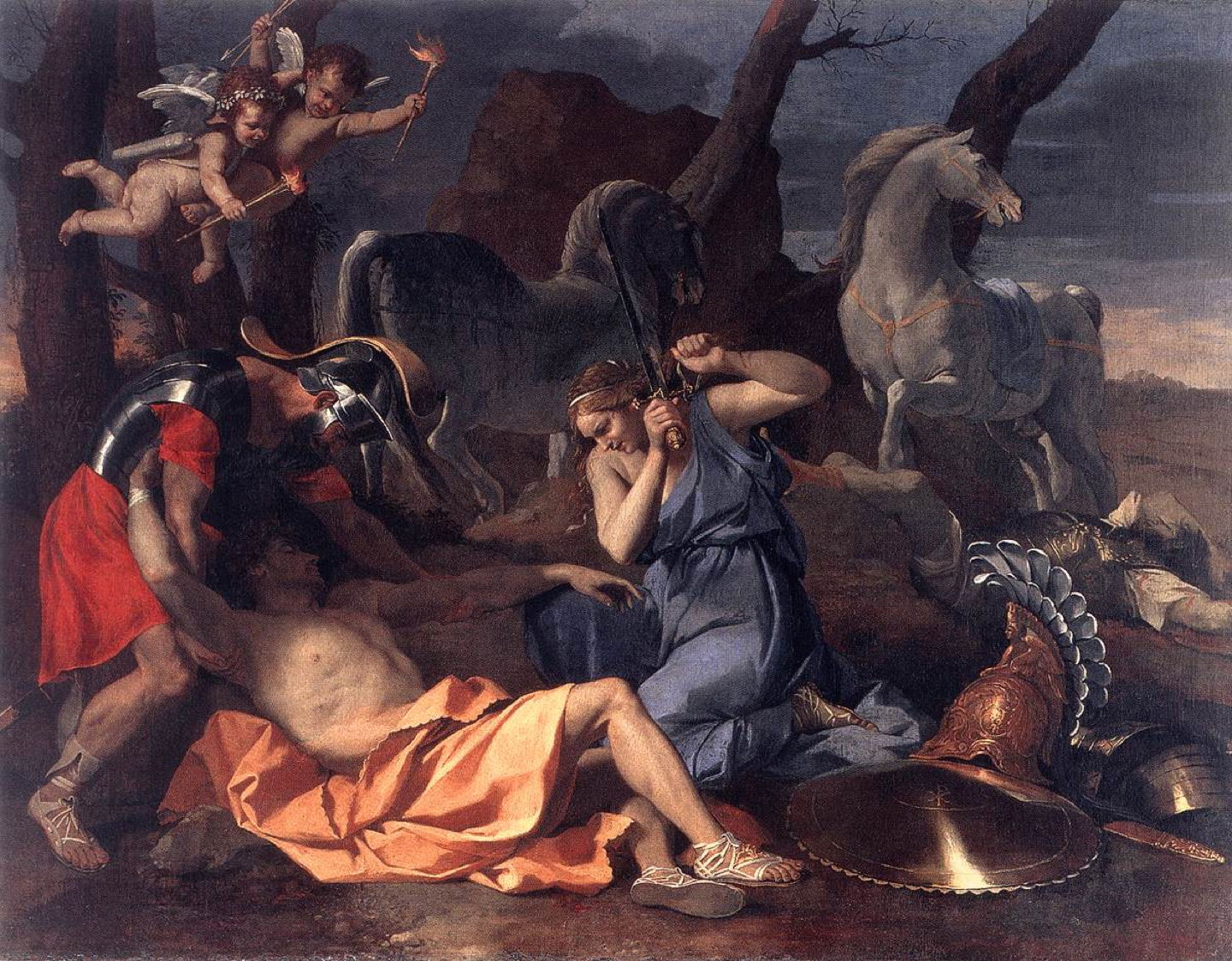
poussintancrederminiabirmgham
Nicolas Poussin (1594–1665), Tancred and Erminia (c 1634), oil on canvas, 75 x 100 cm, Barber Institute of Fine Arts, Birmingham, England. Wikimedia Commons.

Erminia cuts tresses from her hair to make improvised bandages for Tancred’s wounds, and he is taken into Jerusalem for further care. Vafrine goes on to brief Godfrey of the Egyptians’ plans, to help him plan his defence.

Delivery

The Egyptian army arrives late the following day, but Godfrey won’t be rushed, and battle commences at dawn the next day. Egyptians wearing false colours as crusaders get close to Godfrey but are quickly recognised and killed.

As the battle rages on, Rinaldo sees Armida as an archer in her chariot, but passes her by to continue fighting. She struggles to loose her arrows at him, and those that she does shoot, bounce off ineffectively. With the Egyptian forces in full retreat and their leaders all dead, Armida flees on one of her horses.
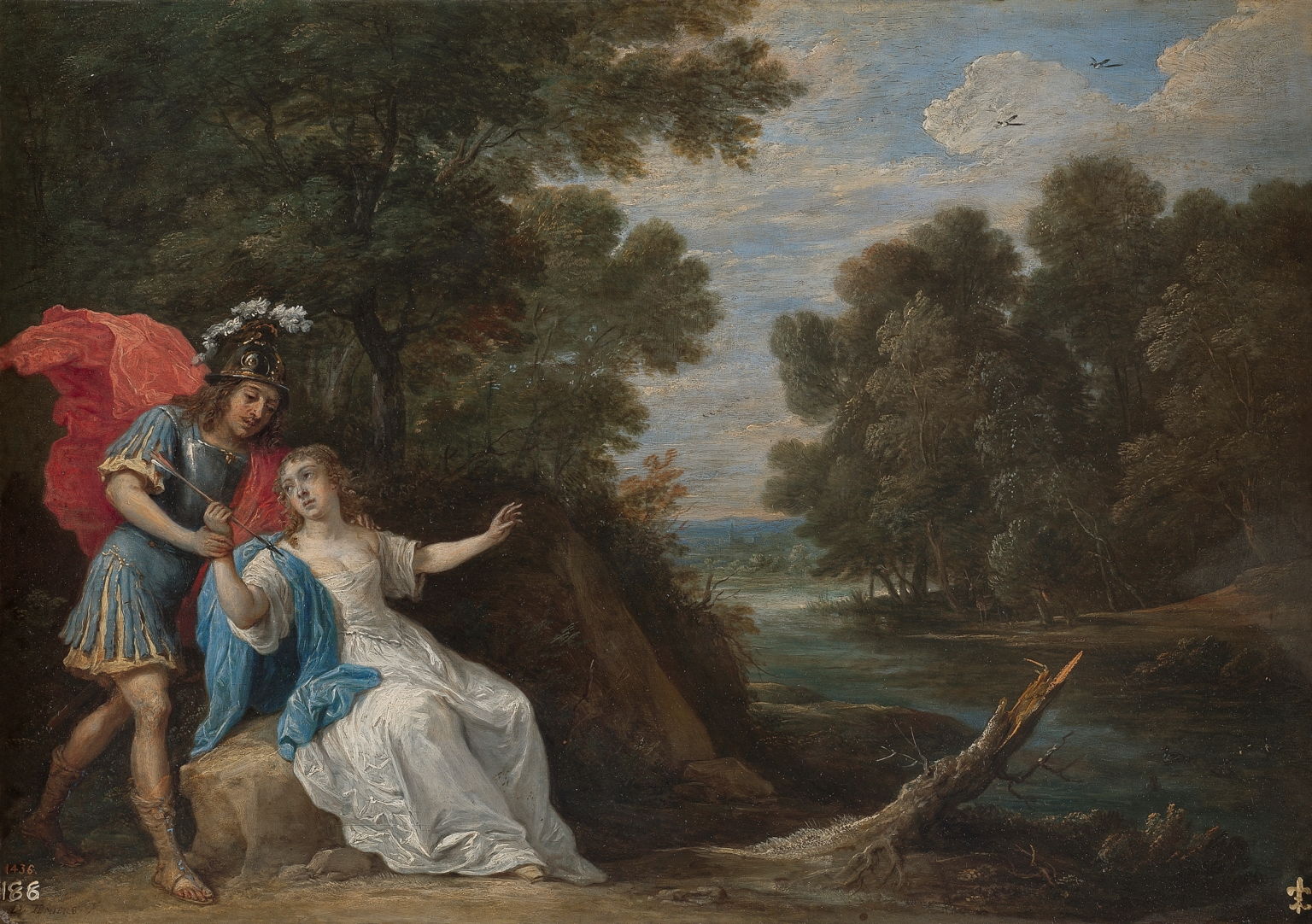
teniersreconciliationrinaldoarmida
David Teniers the Younger (1610–1690), Reconciliation of Rinaldo and Armida (1628-30), oil on copper, 27 x 39 cm, Museo Nacional del Prado, Madrid, Spain. Wikimedia Commons.

Rinaldo catches her, just as she is about to stab herself with one of her own arrows in a bid to end her life. She swoons into his arms, he cries with pity for her, and Rinaldo promises to be her servant and her champion.

With the ‘pagan’ armies defeated and departed, Godfrey now leads his crusaders into the city as the sun sets. He goes to the Temple, having fulfilled his vow to deliver Jerusalem.

overbeckgodfreykneels
Johann Friedrich Overbeck (1789-1869), Consecration of Godfrey (1819-27), fresco, dimensions not known, Casa Massimo, Rome, Italy. Image by Sailko, via Wikimedia Commons.
Leading characters

References

Wikipedia on Jerusalem Delivered.
Wikipedia on Torquato Tasso.

Project Gutenberg (free) English translation (Fairfax 1600).

Librivox audiobook of the Fairfax (1600) English translation (free).

Thomas Asbridge (2004) The First Crusade, A New History, Free Press, ISBN 978 0 7432 2084 2.
Anthony M Esolen, translator (2000) Torquato Tasso, Jerusalem Delivered, Gerusalemme Liberata, Johns Hopkins UP. ISBN 978 0 801 863233. A superb modern translation into English verse.
John France (1994) Victory in the East, a Military History of the First Crusade, Cambridge UP. ISBN 978 0 521 589871.
Joanthan Riley-Smith, ed (1995) The Oxford Illustrated History of the Crusades, Oxford UP. ISBN 978 0 192 854285.
Jonathan Riley-Smith (2014) The Crusades, A History, 3rd edn., Bloomsbury. ISBN 978 1 4725 1351 9.
Johathan Unglaub (2006) Poussin and the Poetics of Painting, Pictorial Narrative and the Legacy of Tasso, Cambridge UP. ISBN 978 0 521 833677.

Jerusalem Delivered: 13 Leading characters

Over the last three months I have illustrated a summary of Torquato Tasso’s epic Jerusalem Delivered, concluding that last week. To draw this to a close, this article considers the stories and fate of its six leading characters.

The three leading men are Godfrey of Bouillon, Prince Tancred, and Rinaldo. The leading women are Clorinda the ‘pagan’ knight, Princess Erminia of Antioch, and Armida the sorceress. One fact is immediately apparent: Tasso’s heroes are all crusaders, but the heroines all ‘pagans’, supposedly their enemies.

Godfrey of Bouillon

According to Tasso, the hero of heroes was Godfrey of Bouillon, who led the crusaders to a remarkable victory. Current historical analysis differs: despite the astonishing success of the crusaders at Jerusalem, at no time did they appear to have a single person in overall command, and much of their success was due to Count Raymond of Toulouse rather than Godfrey.

overbeckarchangelgabrielgodfrey
Johann Friedrich Overbeck (1789-1869), The Archangel Gabriel Appears to Godfrey of Bouillon (1819-27), fresco, dimensions not known, Casa Massimo, Rome, Italy. Image by Sailko, via Wikimedia Commons.

As with Tasso’s poetry, the paintings of Godfrey portray him as a pious warrior, as in this section of Johann Friedrich Overbeck’s magnificent frescoes in the Casa Massimo in Rome. Here The Archangel Gabriel Appears to Godfrey of Bouillon, reminding him of the pressing need to get on with the delivery of the Holy City.

overbeckgodfreykneels
Johann Friedrich Overbeck (1789-1869), Consecration of Godfrey (1819-27), fresco, dimensions not known, Casa Massimo, Rome, Italy. Image by Sailko, via Wikimedia Commons.

This is reiterated in Overbeck’s Consecration of Godfrey, where Peter the Hermit stands holding the crucifix, as Godfrey, still wearing his armour, sinks on bended knee.

As a pious knight and leader, Godfrey never succumbs to the temptations offered by Armida. As far as we’re told, he remains pure and celibate in both body and mind, his sole mission being to deliver the city.

Tancred and Rinaldo are very different, hot-blooded young knights who fight like there’s no tomorrow, and engage in amorous adventures that get about as explicit as you’ll encounter in literature of this period. But their relationships are each unusual.

Tancred and Clorinda

Clorinda, one of two women warriors featured by Tasso (the other being Gildippe, a crusader), is in love at first sight with Tancred.

overbecksofroniaolindosaved
Johann Friedrich Overbeck (1789-1869), Sophronia and Olindo Saved by Clorinda (1819-27), fresco, dimensions not known, Casa Massimo, Rome, Italy. Image by Sailko, via Wikimedia Commons.

Clorinda is portrayed from her arrival as upholding the standards of chivalry, fighting ferociously but fairly, and being morally sound. She first arrives on her charger and holds up her right hand to tell those about to burn Olindo and Sophronia at the stake to hold fire, and quickly secures their release.

She has a vindictive streak, though, which becomes apparent when she decides to torch the wooden siege towers after the first day’s assault on the city walls. This backfires when she is caught outside those walls by Tancred; knowing it’s him, she forces him to fight, resulting in her death.

tintorettodomenicotancredbaptizingclorinda
Domenico Tintoretto (1560–1635), Tancred Baptizing Clorinda (c 1585), oil on canvas, 168 x 115 cm, Museum of Fine Arts, Houston, TX. Wikimedia Commons.

Predictably perhaps for a Catholic of his age, Tasso ends this part of the story with her baptism in the moments before her death, shown so brilliantly in Domenico Tintoretto’s Tancred Baptizing Clorinda of about 1585. Tasso also provides details of Clorinda’s ‘unfortunate’ upbringing outside the Christian faith of her mother, reinforcing that her sacrifice in battle was to her ultimate benefit in life after death, a thoroughly moralising thread.

Erminia and Tancred

From the outset Erminia is noble, cultured, and in love with Tancred, who had treated her well after the fall of Antioch and the slaughter of the rest of her family. But her love for Tancred isn’t returned: he’s smitten by Clorinda instead.

pretierminia
Mattia Preti (1613–1699), Erminia, Princess of Antioch (date not known), oil on canvas, 98 x 73 cm, location not known. Wikimedia Commons.

Mattia Preti’s undated portrait of Erminia, Princess of Antioch expresses well Tasso’s descriptions of her.

This unfortunate threesome doesn’t unravel until after Clorinda’s death. Before that, following the first round of the duel between Tancred and Argante, it becomes more complex. Seeing Tancred wounded in that battle, Erminia leaves the city of Jerusalem wearing Clorinda’s armour. Although that provides her passport to exit the city, she is recognised as Clorinda by crusaders, and is forced to flee from her bid to tend to her beloved Tancred.

That sets up an almost comical situation, in which Tancred leaves the crusaders’ camp in pursuit of a woman he thinks is Clorinda, whom he loves, who is in fact Erminia (who loves him) wearing Clorinda’s armour.

delacroixerminiashepherdsd1
Eugène Delacroix (1798–1863), Erminia and the Shepherds (detail) (1859), oil on canvas, 82 x 104.5 cm, Nationalmuseum, Stockholm, Sweden. Wikimedia Commons.

Eugène Delacroix shows this in his Erminia and the Shepherds of 1859, a detail of which I show above. Here is Erminia dressed as Clorinda, with Tancred erroneously in pursuit, heading for trouble in Armida’s magic castle.

Tasso doesn’t develop this confusion any further, but picks up the one-sided relationship again when Argante is dead and Tancred badly wounded, outside Jerusalem. Erminia gets her chance to revive the ailing Tancred, sacrificing her tresses to fabricate improvised bandages.

turchierminiafindstancred
Alessandro Turchi (1578–1649), Erminia Finds the Wounded Tancred (c 1630), oil on canvas, 147 x 233.5 cm, Kunsthistorisches Museum, Vienna, Austria. Wikimedia Commons.

This is shown best in Alessandro Turchi’s Erminia Finds the Wounded Tancred (c 1630). We are left in suspense over the further development, even consummation, of this relationship.

Armida and Rinaldo

By far the most complex of Tasso’s characters is Armida. The niece of a ‘pagan’ ruler and sorceror Hydrotes, her mission is to wreak havoc in the crusader camp, so destroying command, unity and morale, as she does so effectively.

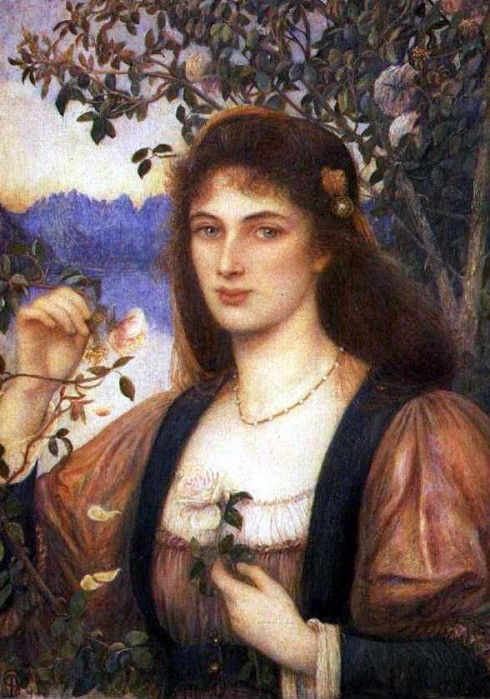
stillmanrosefromarmidasgarden
Marie Spartali Stillman (1844–1927), A Rose in Armida’s Garden (1894), watercolour and graphite on paper, 64.8 x 43.2 cm, Private collection. Wikimedia Commons.

But Tasso is ambiguous about Armida, and early on reveals some of the complexity of her character. In a lyrical passage about a rose in her garden, Tasso’s poetry inspired Marie Spartali Stillman’s exquisite watercolour of A Rose in Armida’s Garden from 1894.

Having literally seduced many of the crusaders, led them astray, and sold them into slavery, she gets her hands on Rinaldo, who has stormed off under Godfrey’s over-zealous sentence of death. Although Prince Tancred (whom she also imprisons for a while) is one of the crusaders’ finest knights, Tasso repeatedly shows Rinaldo as the most valiant of all. That’s probably the result of Rinaldo being a fictional ancestor of Tasso’s patron.

Armida’s original plan was to beguile Rinaldo and murder him, but she falls in love and devises a more mutually satisfying fate: she abducts him to her enchanted garden, where he becomes her on-call gigolo.

hayezrinaldoarmida
Francesco Hayez (1791–1881), Rinaldo and Armida (1812-13), oil on canvas, dimensions not known, Gallerie dell’Accademia, Venice, Italy. Wikimedia Commons.

Francesco Hayez in his Rinaldo and Armida from 1812-13 is almost as explicit as Tasso’s lines in depicting their relationship. It’s only Charles and Ubaldo who save Rinaldo from a life of empty pleasure, making love not war, achieved by getting the knight to see himself for what he has become in his self-reflection.

Hell hath no greater fury than Armida spurned: with her lover’s departure, she joins forces with the King of Egypt to exact her vengeance, being promised Rinaldo’s head on a plate, in the manner of John the Baptist’s for Salome (although that reinterpretation didn’t become popular until the late nineteenth century).

The last great battle to secure Jerusalem, which is probably based on the crusaders’ battle at Ascalon, is thus not just between Godfrey and the King of Egypt, representing the forces of God and those of the devil, but a personal feud between Armida and Rinaldo.

teniersreconciliationrinaldoarmida
David Teniers the Younger (1610–1690), Reconciliation of Rinaldo and Armida (1628-30), oil on copper, 27 x 39 cm, Museo Nacional del Prado, Madrid, Spain. Wikimedia Commons.

That concludes with Armida in despair, trying to take her own life with one of Cupid’s symbolic bolts of love, and her rescue by Rinaldo. He then promises to be her servant and her champion, in the hope that true faith will be revealed and convert her to Christianity.

Armida has often been compared to Circe and other sorceresses who anticipated the more modern concept of the femme fatale. Tasso’s Armida is still more complex, and the fate of her relationship with Rinaldo left open to speculation.

References

Wikipedia on Jerusalem Delivered.
Wikipedia on Torquato Tasso.

Project Gutenberg (free) English translation (Fairfax 1600).

Librivox audiobook of the Fairfax (1600) English translation (free).

Thomas Asbridge (2004) The First Crusade, A New History, Free Press, ISBN 978 0 7432 2084 2.
Anthony M Esolen, translator (2000) Torquato Tasso, Jerusalem Delivered, Gerusalemme Liberata, Johns Hopkins UP. ISBN 978 0 801 863233. A superb modern translation into English verse.
John France (1994) Victory in the East, a Military History of the First Crusade, Cambridge UP. ISBN 978 0 521 589871.
Joanthan Riley-Smith, ed (1995) The Oxford Illustrated History of the Crusades, Oxford UP. ISBN 978 0 192 854285.
Jonathan Riley-Smith (2014) The Crusades, A History, 3rd edn., Bloomsbury. ISBN 978 1 4725 1351 9.
Johathan Unglaub (2006) Poussin and the Poetics of Painting, Pictorial Narrative and the Legacy of Tasso, Cambridge UP. ISBN 978 0 521 833677.

Centaurs 1: Fights

In Greek and Roman mythology centaurs were creatures with the upper body of a human, down to the waist, fused onto the body of a horse, with all its four legs. Although some tales about centaurs suggest otherwise, in general they represented the lower appetites and behaviours of humans, and were more like wild horses than people. They were known for their fights with Lapiths, an Aeolian tribe, against whom they wielded rocks and limbs of trees. Centaurs persisted in legends and stories well into the Middle Ages, and are the subject of this weekend’s two articles about paintings.

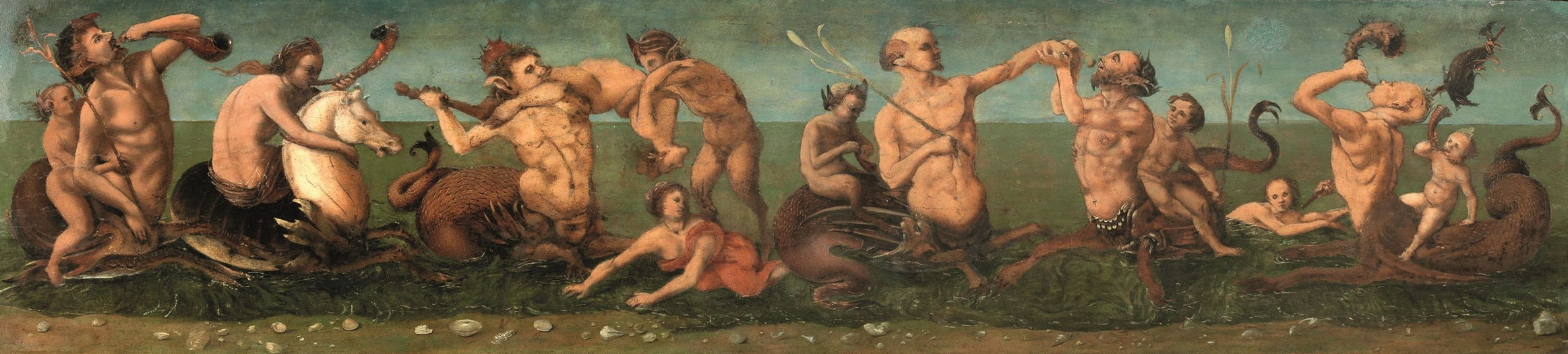
dicosimotritonsnereids
Piero di Cosimo (1462–1522), Tritons and Nereids, with Satyrs and Centaurs (c 1500-05), oil on panel, 37 x 158 cm, Private collection. Wikimedia Commons.

Piero di Cosimo’s assembly of Tritons and Nereids, with Satyrs and Centaurs painted in about 1500-05 shows an odd range of centaur-like creatures, and is believed to have been commissioned for the Palazzo Vespucci.

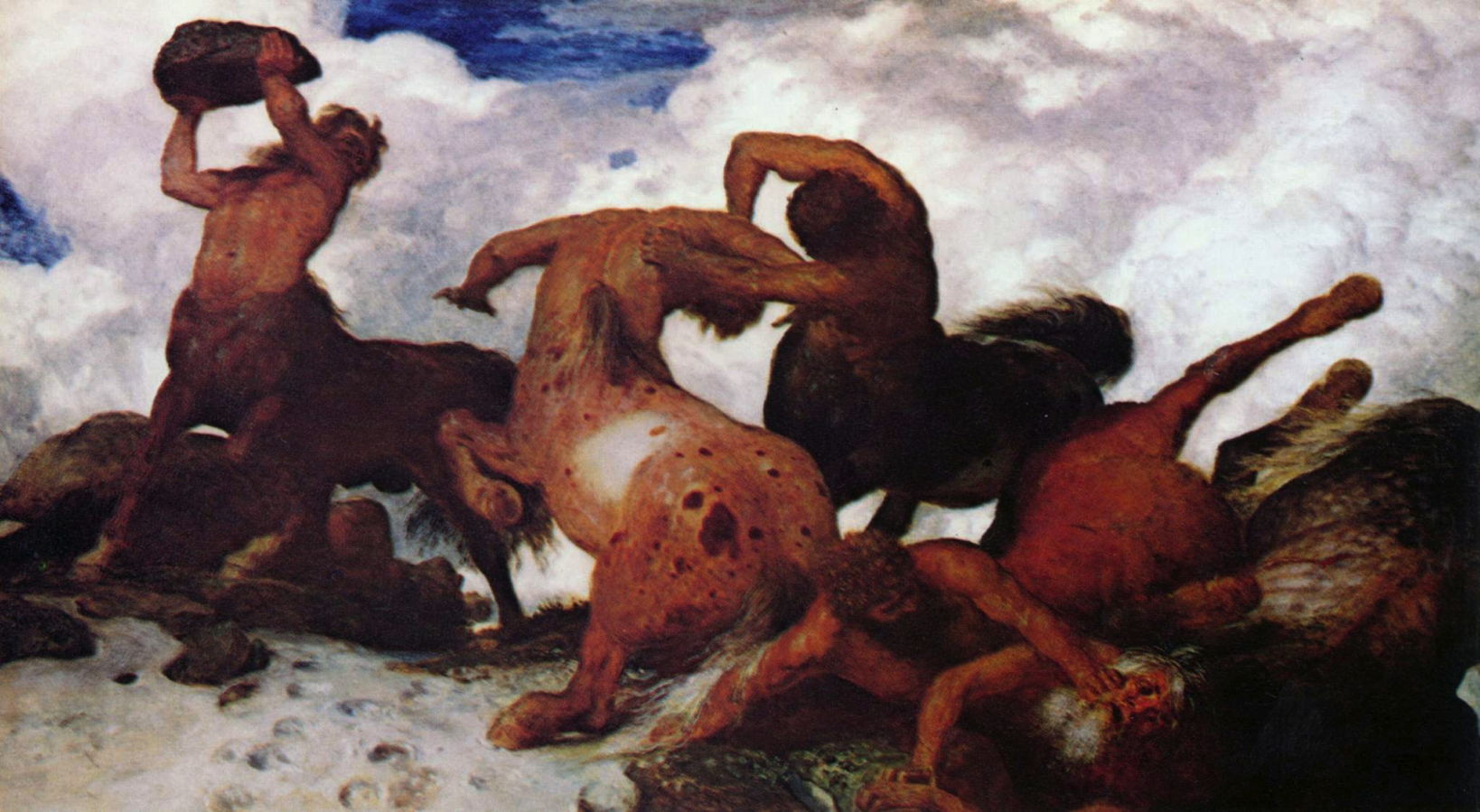
boecklinfightcentaurs
Arnold Böcklin (1827–1901), Fight of the Centaurs (1873), oil on canvas, 105 × 195 cm, Kunstmuseum Basel, Switzerland. Wikimedia Commons.

Those in Böcklin’s Fight of the Centaurs (1873) are behaving more in character, in hand-to-hand combat, and by wielding rocks.

But Eugène Delacroix had better to report.

delacroixachilles
Eugène Delacroix (1798–1863), Poetry: The Education of Achilles (1838-1847), oil on canvas, 221 x 292 cm, Bibliothèque de l’Assemblée nationale, Palais Bourbon, Paris. Wikimedia Commons.

In the Poetry cupola of the Library of the National Assembly in Paris, Delacroix painted The Education of Achilles. This shows the myth of the young Achilles with a bow and arrow, riding on the back of his tutor Chiron the centaur, on the steep slopes of Mount Pelion. This was to become one of Delacroix’s favourite motifs.

delacroixeducationachilles
Eugène Delacroix (1798–1863), The Education of Achilles (c 1862), pastel on paper, 30.6 x 41.9 cm, Getty Center, Los Angeles, CA. Wikimedia Commons.

His last known pastel painting, and one of his finest, is The Education of Achilles, painted in about 1862, showing the same scene of the ‘wisest and justest of all the centaurs’ Chiron teaching Achilles to hunt. The artist gave this to his longstanding friend Aurore Dudevant, better known under her pen name of George Sand.

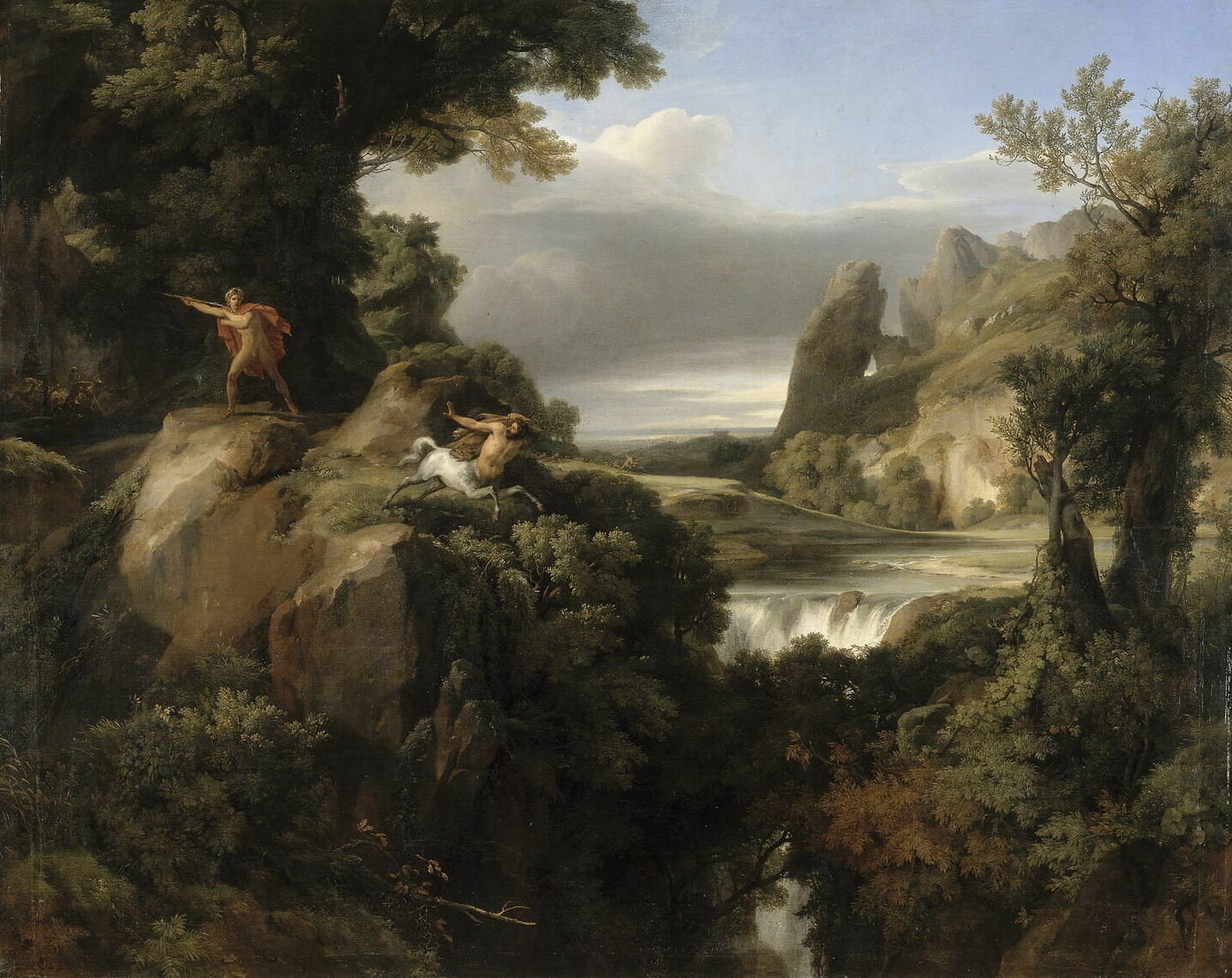
michallontheseus
Achille Etna Michallon (1796–1822), Landscape: Theseus Pursuing the Centaurs (1821), oil on canvas, 218 x 273 cm, Musée du Louvre, Paris. Wikimedia Commons.

Following the tradition of Nicolas Poussin, Achille Etna Michallon (a namesake of Achilles) set mythological figures in some of his finished landscape paintings. His Landscape: Theseus Pursuing the Centaurs from 1821 shows the Greek hero about to throw his spear at a galloping centaur.

stuckfantastichunt
Franz von Stuck (1863–1928), Fantastic Hunt (1890), oil on canvas, dimensions not known, Museum Villa Stuck, Munich, Germany. Image by Yelkrokoyade, via Wikimedia Commons.

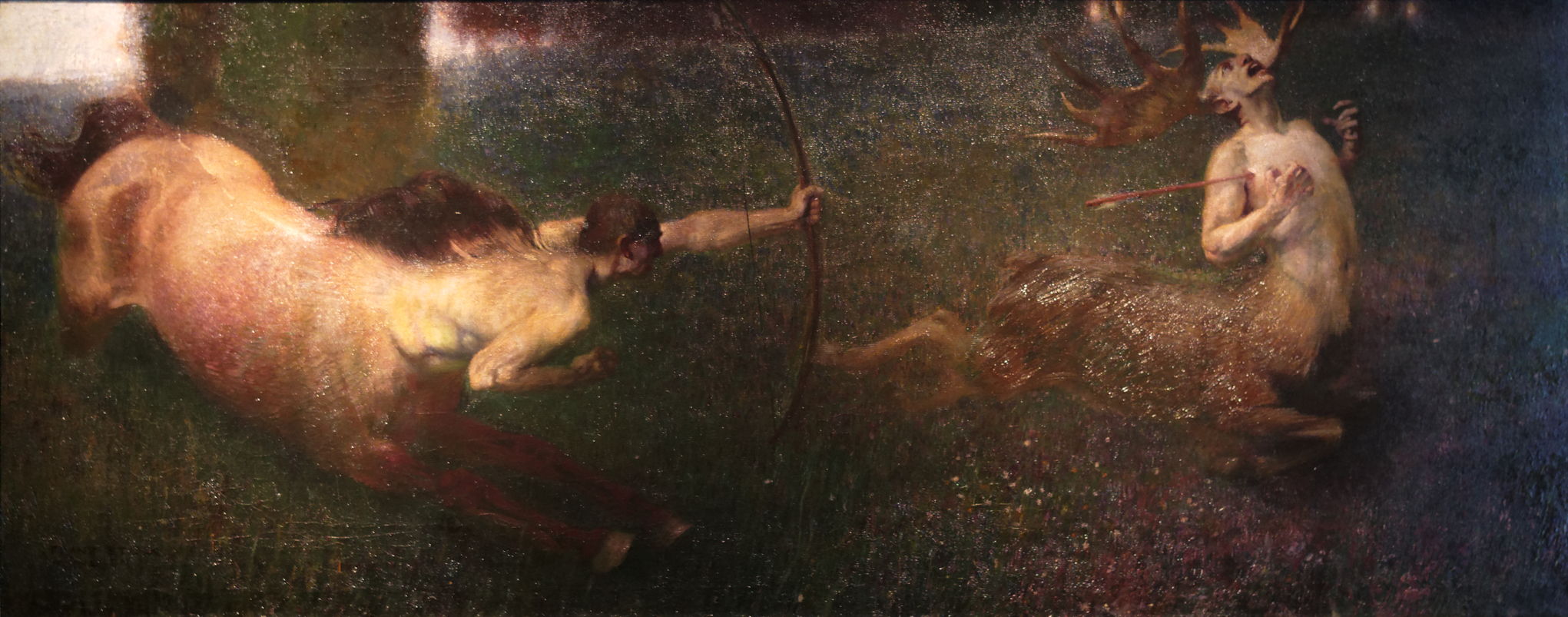
Franz von Stuck added centaurs to his repertoire of mythical beasts in his Fantastic Hunt (1890). Here an archer centaur has buried his arrow into the right axilla of a deer-like variant, perhaps resembling Actaeon after Diana’s vicious metamorphosis. The deer-centaur’s legs have already buckled under him, and his hands claw at the air in his agony.

There are two major myths involving centaurs that have been painted extensively, both picturing them at their worst, at a wedding feast that turned into a pitched battle, and the attempted abduction of the wife of Hercules.

The account of the former is given by Nestor in Ovid’s Metamorphoses, and is one of a pair of primaeval battles said to have established world order: that between the Titans and the Gods ended the heavenly Titanomachy, and that between the Lapiths and Centaurs ended the earthly Centauromachy.

When Pirithous married Hippodame, the couple invited centaurs to the feast. Unfortunately, passions of the centaur Eurytus became inflamed by drink and lust for the bride, and he carried Hippodame off by her hair. The other centaurs followed suit by each seizing a woman of their choice, turning the wedding feast into utter chaos, more like a city being sacked.

Theseus castigated Eurytus and rescued the bride, so the centaur attacked him. Theseus responded by throwing a huge wine krater at Eurytus, killing him. The centaurs then started throwing goblets and crockery, and the battle escalated from there. Nestor details a succession of grisly accounts of Lapiths and Centaurs killed. Gryneus the centaur ripped up the altar and crushed two Lapiths with its weight, only to have his eyeballs gouged out by a Lapith using the prongs of some antlers. Not content with using the objects around them as weapons, they started using their own lances and swords.

When the centaur Petraeus was trying to uproot a whole oak tree, the groom Pirithous pinned the centaur to the tree-trunk with his lance. Nestor also tells of the success of Caeneus, formerly Caenis, in killing five centaurs. The centaur Latreus taunted Caeneus, so the latter wounded the centaur with his spear. Latreus thrust his lance in Caeneus’ face, but was unable to hurt him, so he tried with his sword, which broke against the invulnerable Caeneus, leaving him to finish the centaur off with thrusts of his own sword.

The centaurs then united to try to overwhelm Caeneus by crushing him under their combined weight. Just as they thought they had succeeded, Caeneus was transformed into a bird and flew out from underneath them. With that the survivors dispersed, the Lapiths having won the day.

dicosimolapithscentaurs
Piero di Cosimo (1462–1522), The Fight between Lapiths and Centaurs (1500-15), oil on wood, 71 x 260 cm, The National Gallery, London. Wikimedia Commons.

Piero di Cosimo’s The Fight between Lapiths and Centaurs (1500-15) is my favourite among the earlier paintings, and remains one of its best-structured and complete accounts. In the centre foreground, Hylonome embraces and kisses the dying Cyllarus, a huge arrow-like spear resting underneath them. Immediately behind them, on large carpets laid out for the wedding feast, centaurs are still abducting women. All around are scenes of pitched and bloody battles, with eyes being gouged out, Lapiths and Centaurs wielding clubs and other weapons at one another.

rubensrapehippodamesketch
Peter Paul Rubens (1577–1640), The Rape of Hippodame (sketch) (c 1637-38), oil on panel, 26 × 40 cm, Koninklijke Musea voor Schone Kunsten van België / Musées Royaux des Beaux Arts de Belgique, Brussels, Belgium. Wikimedia Commons.

Towards the end of his life, Peter Paul Rubens painted this brilliant oil sketch of The Rape of Hippodame (c 1637-38). At the right, Eurytus is trying to carry off the bride, with Theseus just about to rescue her from the centaur’s back. At the left, Lapiths are attacking with their weapons, and behind them another centaur is trying to abduct a woman.

rubensrapehippodame
Peter Paul Rubens (1577–1640), The Rape of Hippodame (Lapiths and Centaurs) (1636-38), oil on canvas, 182 × 290 cm, Museo Nacional del Prado, Madrid, Spain. Wikimedia Commons.

That became the finished painting, The Rape of Hippodame (Lapiths and Centaurs) (1636-38), which remains faithful to Rubens’ sketch and its composition. Facial expressions, particularly that of the Lapith at the left bearing a sword, are particularly powerful.

giordanolapithscentaurs
Luca Giordano (1632–1705), Battle of Lapiths and Centaurs (1688), oil on canvas, 255 x 390 cm, State Hermitage Museum, Saint Petersburg, Russia. Image by Wayne77, via Wikimedia Commons.

Luca Giordano’s later painting of the Battle of Lapiths and Centaurs from 1688 lacks the narrative structure of Piero di Cosimo’s, and covers later action than Rubens’. As a result, its story has become a little lost in the mêlée of battle.

riccilapithscentaurs
Sebastiano Ricci (1659–1734), The Battle of the Lapiths and Centaurs (c 1705), oil on canvas, 138.4 × 176.8 cm, The High Museum of Art, Atlanta, GA. Wikimedia Commons.

Sebastiano Ricci’s The Battle of the Lapiths and Centaurs from about 1705 has similar problems, although it does use multiplex narrative to help. In the left background, Hippodame is seen being carried away by Eurytus, and to the right there are further scenes of abduction.

solimenalapithscentaurs
Francesco Solimena (1657–1747), Battle between Lapiths and Centaurs (1735-40), oil on canvas, 104 x 130 cm, Private collection. Wikimedia Commons.

Francesco Solimena’s Battle between Lapiths and Centaurs (1735-40) puts multiple abductions in the foreground, with pitched battles taking place behind.

Tomorrow I’ll look at paintings of the fight between Nessus and Hercules, and how Nessus got his revenge.

Reading Visual Art: 248 Hood

As with many items of clothing, the term hood is applied to a wide range of garments. For the purposes of this selection of paintings, I confine it to a shaped covering for the head that is part of a garment also covering at least part of the upper body. This includes the cowl integrated into the robes of many monks, and the hooded cape known as a chaperon, described below. It would also include the modern hoodie that became popular in the 1970s.

Hoods are commonly worn by figures associated with death, such as the Grim Reaper, where they provide sinister concealment of the face.

hvernetangelofdeath
Horace Vernet (1789–1863), The Angel of Death (1851), oil on canvas, 146 x 113 cm, The Hermitage Museum, St. Petersburg, Russia. Wikimedia Commons.

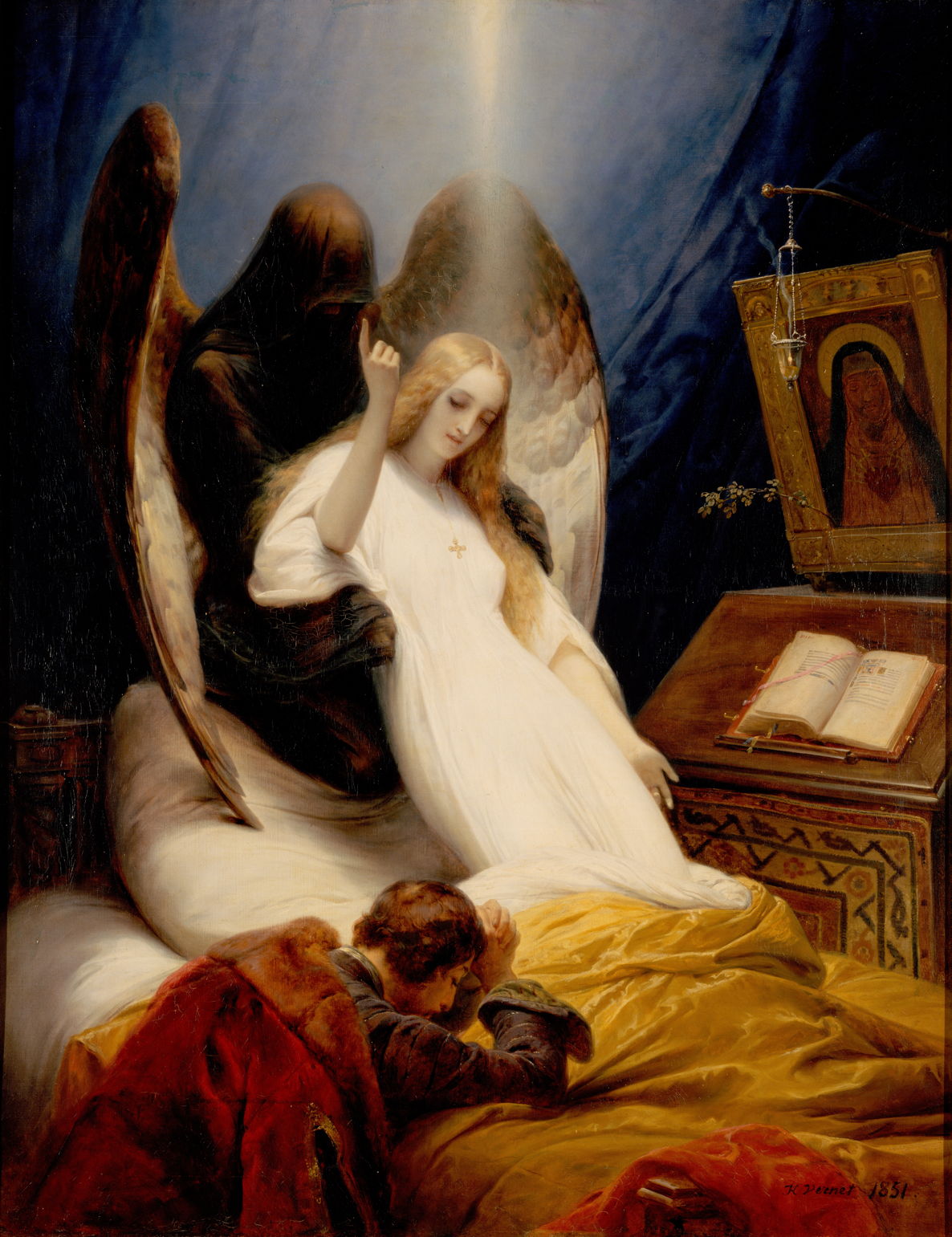
In Horace Vernet’s The Angel of Death from 1851, a young man is praying over the side of a bed, kneeling, his hands clasped together. Opposite him, an illuminated Bible is open, above that an icon hangs on the wall, there’s a sprig of flowers, and a flame burns in prayer. But the occupant of the bed, a beautiful young woman, is being lifted out of it. Her right hand is raised, its index finger pointing upwards to heaven. Behind her, the Angel of Death, the outer surface of its wings black, and clad in long black robes, its face concealed beneath a hood, is lifting her out, to raise her body up towards the beam of light shining down from the heavens.

Cowls are a common feature of the robes worn by hermits as well as monks.

boschstwilgefortisd1
Hieronymus Bosch (c 1450–1516), Saint Wilgefortis Triptych (detail) (c 1495-1505), oil on oak panel, left wing 105.2 × 27.5 cm, central panel 105.2 × 62.7 cm, right wing 104.7 × 27.9 cm, Gallerie dell’Accademia, Venice. Photo Rik Klein Gotink and image processing Robert G. Erdmann for the Bosch Research and Conservation Project.

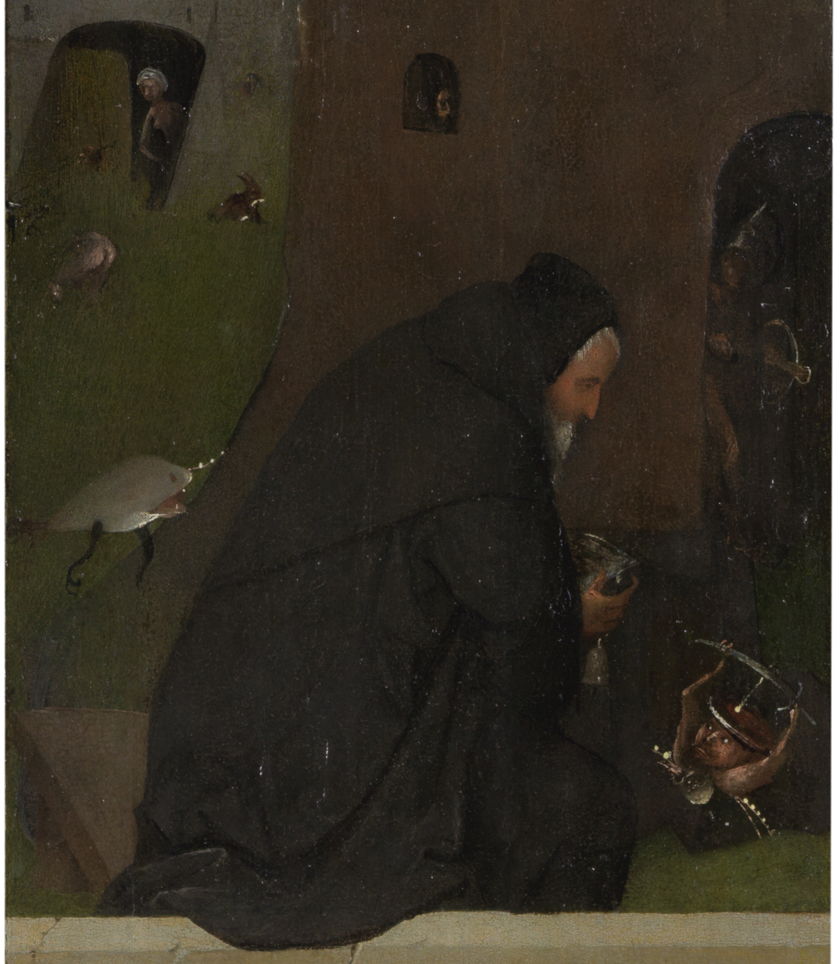
The figure at the foot of the left panel of Hieronymus Bosch’s Saint Wilgefortis Triptych (c 1495-1505) has some visual similarity with Saint Anthony in his Hermit Saints triptych, and appears to be holding a small bell, one of that saint’s attributes.

daddmonk
Richard Dadd (1817–1886), Portrait of a Monk (1857), watercolour over graphite on moderately thick, slightly textured, beige laid paper, 19.1 x 11.8 cm, Yale Center for British Art, Paul Mellon Collection, New Haven, CT. Courtesy of the Yale Center for British Art.

Richard Dadd painted this Portrait of a Monk on 11 April 1857, from memory of his previous travels in the Middle East.

schikanedercontemplation
Jakub Schikaneder (1855–1924), Kontemplace, Mnich na mořském břehu (Contemplation, the Monk on the Seashore) (date not known), pastel on paper, further details not known. Wikimedia Commons.

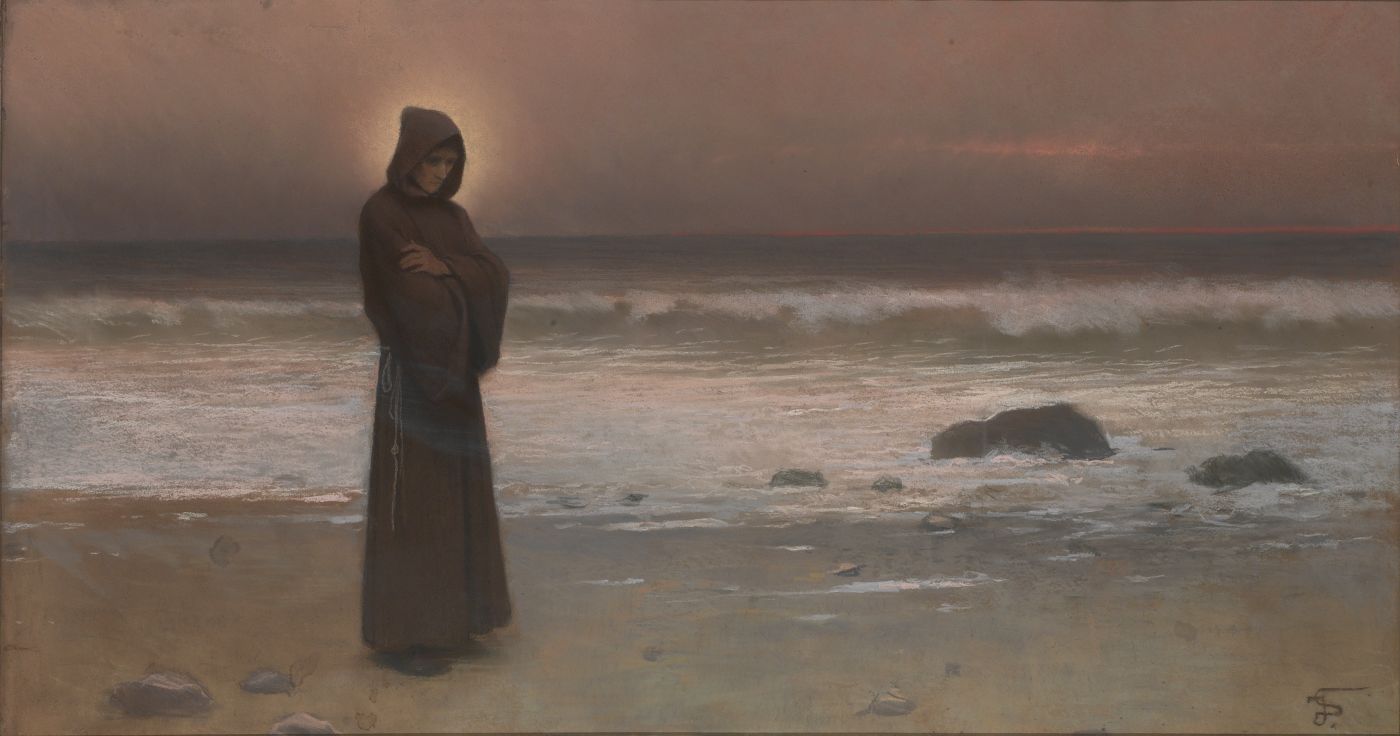
Jakub Schikaneder’s undated Contemplation, the Monk on the Seashore shows a hooded monk on the foreshore, just in front of the water, apparently lost in thought.

Cowls have also been incorporated into other religious dress, where they’re often worn with hats, making them appear vestigial and primarily symbolic.

raphaelportraitcardinal
Raphael (1483–1520), Portrait of a Cardinal (1510-11), oil on panel, 79 x 61 cm, Museo Nacional del Prado, Madrid, Spain. Wikimedia Commons.

Raphael’s magnificent Portrait of a Cardinal from 1510-11 shows the elements of this cardinal’s choir dress: the soft matte surface of the biretta on his head, the subtly patterned sheen of his mozzatta (cape) with its hood, and the luxuriant folds of his white rochet (vestment).

Another uniform that incorporates symbolic hoods is formal academic dress, in which the colours and cut of the hood denote the university and degree.

beraudmadeleinebresthesis
Jean Béraud (1849–1935), The Thesis of Madeleine Brès (or The Doctoral Jury) (date not known), oil on canvas, 63.5 x 48.3 cm, Private collection. The Athenaeum.

In Jean Béraud’s undated The Thesis of Madeleine Brès (or The Doctoral Jury) he shows us one of the early woman doctoral students defending her thesis before the academic jury, who are wearing what might appear now to be fancy dress hats in addition to their colourful hoods. At the time, this was a major landmark in the improvements in women’s rights, and the archaic headwear serves to emphasise this change.

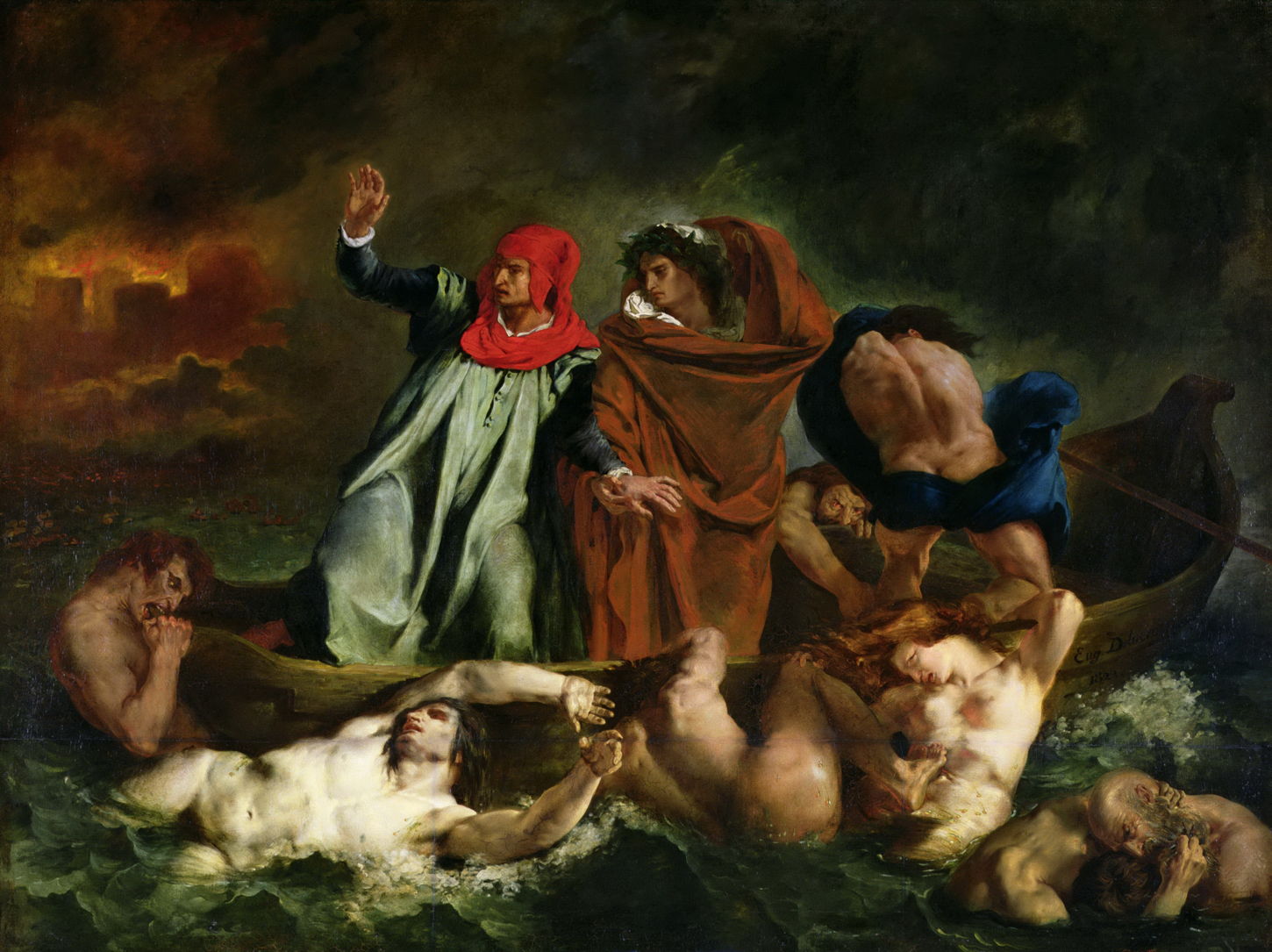
The chaperon had evolved before 1200 as a hooded short cape, then developed into variants that remained popular until becoming unfashionable in about 1500. In paintings it’s most strongly associated with Dante in accounts of his Divine Comedy.

delacroixbarquedante
Eugène Delacroix (1798–1863), The Barque of Dante (Dante and Virgil in Hell) (1822), oil on canvas, 189 x 241 cm, Musée du Louvre, Paris. Wikimedia Commons.

In Eugène Delacroix’s painting of The Barque of Dante from 1822, Dante is inevitably wearing his trademark red chaperon.

hawkinspeasant
Louis Welden Hawkins (1849–1910), A Peasant Woman (c 1880), further details not known. Wikimedia Commons.

The woman’s equivalent of the chaperon persisted until modern times in the hooded cape worn by Louis Welden Hawkins’ Peasant Woman, from about 1880. She is seen near to the rustic village of Grez-sur-Loing, which had become an artist’s colony.

Strangely, the word chaperone (with an added e) is now most commonly used to describe an older woman who accompanies a younger one to ensure that no improper behaviour occurs when in the company of a man.

Before the decline in popularity of hats in the twentieth century, hoods had been relatively uncommon in the general population.

hellqvistvaldemaratterdag
Carl Gustaf Hellqvist (1851–1890), Valdemar Atterdag holding Visby to ransom, 1361 (1882), oil on canvas, 200 × 330 cm, Nationalmuseum, Stockholm. Wikimedia Commons.

Carl Gustaf Hellqvist’s large history painting of Valdemar Atterdag holding Visby to ransom, 1361 from 1882 is an encyclopaedic guide to late medieval dress. Few of its crowd have hoods, and one of those few appears to be a monk, shown in the detail below.

hellqvistvaldemaratterdagdet
Carl Gustaf Hellqvist (1851–1890), Valdemar Atterdag holding Visby to ransom, 1361 (detail) (1882), oil on canvas, 200 × 330 cm, Nationalmuseum, Stockholm. Wikimedia Commons.

Hoods have also been popular with travellers, and from the nineteenth century were incorporated into popular weatherproof capes.

brownlastofenglandoil
Ford Madox Brown (1821–1893), The Last of England (1852/55), oil on panel, 82.5 x 75 cm, Birmingham Museum and Art Gallery, Birmingham, England. Wikimedia Commons.

Ford Madox Brown’s The Last of England (1852/55) shows a young couple with their infant emigrating from England. Tucked under the mother’s weatherproof hooded travelling cape is their baby son.

It seems extraordinary that in the twenty-first century hoodies have been banned as inappropriate items of clothing associated with anti-social behaviour. Perhaps there’s a market for reviving chaperons.

❌