Battlefield gains and drone deals with Europe have given Kyiv rare leverage heading into the G7 world leaders’ summit, even as Washington's attention is elsewhere.
When reading a painting of classical myth, the feet and footwear can be very important. Although they’re by no means common, if you see a figure wearing what could be winged sandals, you can narrow them down to one of two: Hermes or Mercury as messenger of the gods, and the hero Theseus. However, their depictions aren’t always consistent, and the absence of winged sandals doesn’t mean you can exclude them, unfortunately.
I start with the god, whose talaria were fashioned from gold by Hephaestus/Vulcan to enable him to fly as fast as any bird.
Sandro Botticelli (Alessandro di Mariano di Vanni Filipepi), Primavera (Spring) (c 1482), tempera on panel, 202 x 314 cm, Galleria degli Uffizi, Florence. Wikimedia Commons.
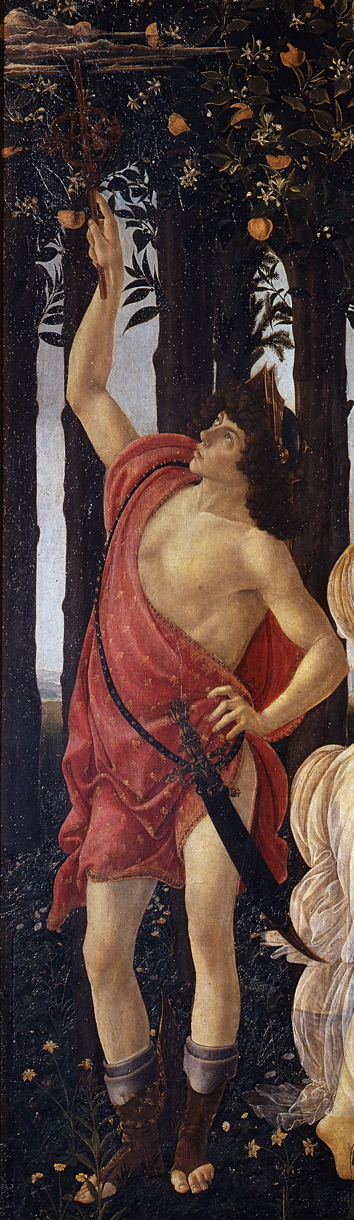
One of the most famous depictions of Hermes, typically in a supporting role, is in Botticelli’s magnificent Primavera from around 1482.
Sandro Botticelli (Alessandro di Mariano di Vanni Filipepi), Primavera (Spring) (detail) (c 1482), tempera on panel, 202 x 314 cm, Galleria degli Uffizi, Florence. Wikimedia Commons.
Hermes’ mother Maia gave her name to the month of May, so is associated with Spring. Botticelli has chosen to give the serpents on his caduceus wings to make them resemble small dragons. The god is also more typically seen with his caduceus in his left hand, rather than his right as shown here, and his winged sandals clearly aren’t made of gold.
Andrea Mantegna (1431–1506), Parnassus (Mars and Venus) (1496-97), oil on canvas, 159 x 192 cm, Musée du Louvre, Paris. Wikimedia Commons.
Hermes is a frequent figure in paintings of gatherings of deities, including Andrea Mantegna’s Mars and Venus, known better as Parnassus (1496-97), painted for Isabella d’Este. At the right of this complex gathering is Hermes with his winged sandals and caduceus, and Pegasus the winged horse. Apollo is at the far left, making music for the Muses on his lyre.
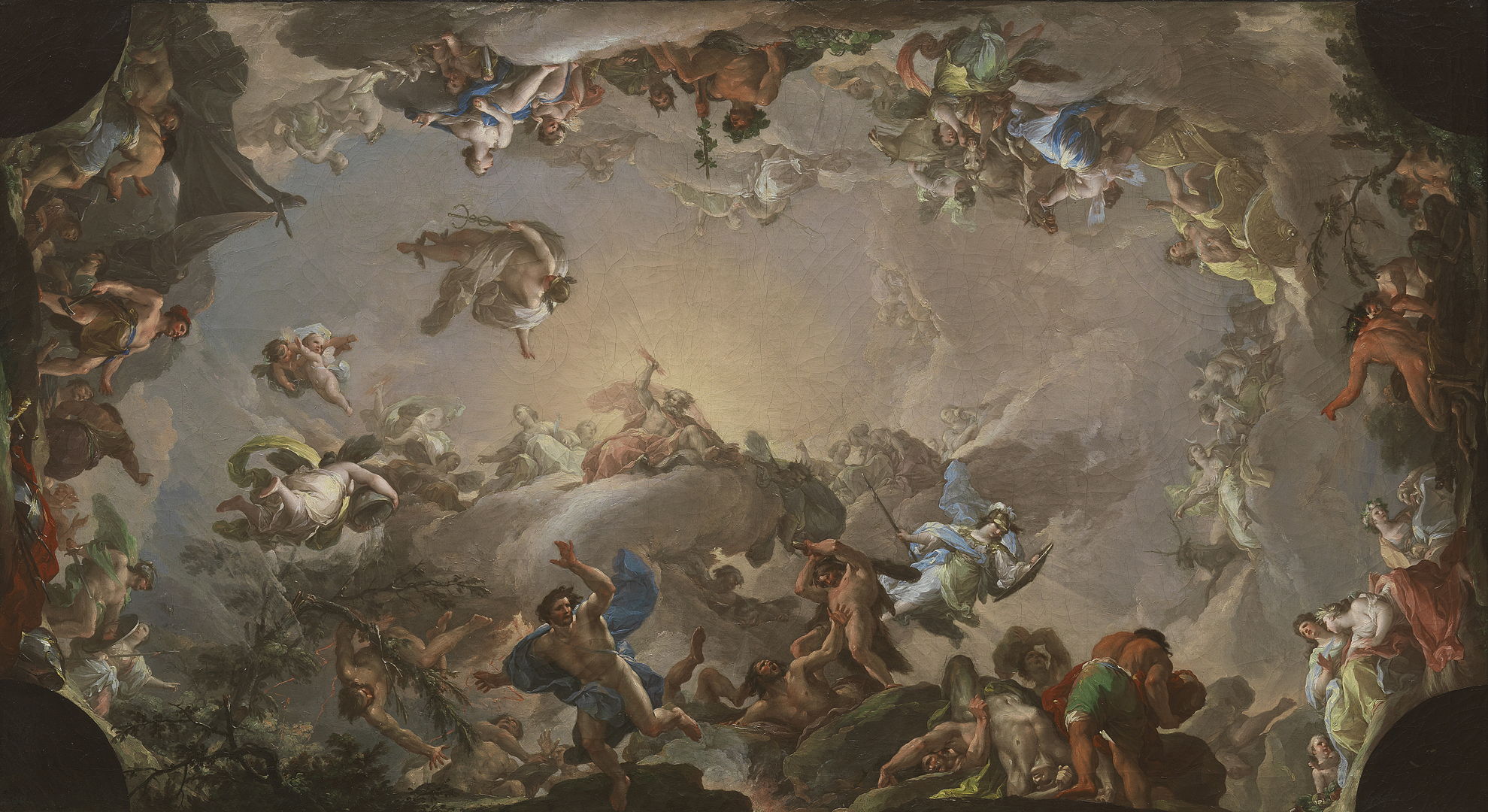
Francisco Bayeu y Subías (1734–1795), Olympus: The Fall of the Giants (1764), oil on canvas, 68 x 123 cm, Museo Nacional del Prado, Madrid, Spain. Wikimedia Commons.
Francisco Bayeu y Subías was Goya’s brother-in-law. His Olympus: The Fall of the Giants from 1764 shows the war between the Titans and Olympian gods, and was presumably hung under a ceiling. Just to the upper left of its centre, holding his caduceus and wearing winged sandals, is Hermes.
Pierre-Auguste Renoir (1841–1919), The Judgment of Paris (c 1908-10), oil on canvas, 73 x 92.5 cm, Hiroshima Museum of Art, Hiroshima, Japan. Wikimedia Commons.
Auguste Renoir’s account of The Judgment of Paris, from about 1908-10, demonstrates his skill as a narrative painter. After Paris has accepted Aphrodite’s bribe of Helen, he is shown awarding her the golden apple provided by the discordant Eris from the garden of the Hesperides. Watching on is Hermes, complete with his winged helmet and sandals, and caduceus.
Hermes seldom lent out his talaria, but there’s one occasion that has become well known. When Perseus was on his mission to obtain the head of Medusa, he was kitted out with Hermes’ sandals, the cap of Hades for invisibility, and a kibisis or sack in which to conceal the Gorgon’s severed head.
Unknown, Perseus Freeing Andromeda (c 50-75 CE), height 122 cm, Casa dei Dioscuri (VI, 9, 6), Pompeii, moved to Museo Archeologico Nazionale di Napoli, Naples. By WolfgangRieger, via Wikimedia Commons.
This Pompeian account of Perseus Freeing Andromeda from about 50-75 CE shows Andromeda still chained to the rock by her left wrist, and partially clad rather than naked as the myth related. Perseus has Medusa’s head tucked behind him, her face shown for ease of recognition. He is wearing his winged sandals, and carrying his sword in his left hand, although there’s no sign of Cetus the sea-monster yet.
Peter Paul Rubens (1577–1640), Perseus and Andromeda (c 1622), oil on canvas, 99.5 x 139 cm, Hermitage Museum, Saint Petersburg, Russia. Wikimedia Commons.
Peter Paul Rubens’ Perseus and Andromeda from about 1622 contains most of the cues and clues to the original narrative. Andromeda is almost naked, although unchained at this stage, on the left. Perseus is clearly in the process of claiming her hand as his reward, for which he is being crowned with laurels, as the victor. He wears winged sandals, and holds the polished shield that still reflects Medusa’s face and snake hair. Much of the right of the painting is taken up by Pegasus, and at the lower edge is the dead Cetus, its fearsome mouth wide open.
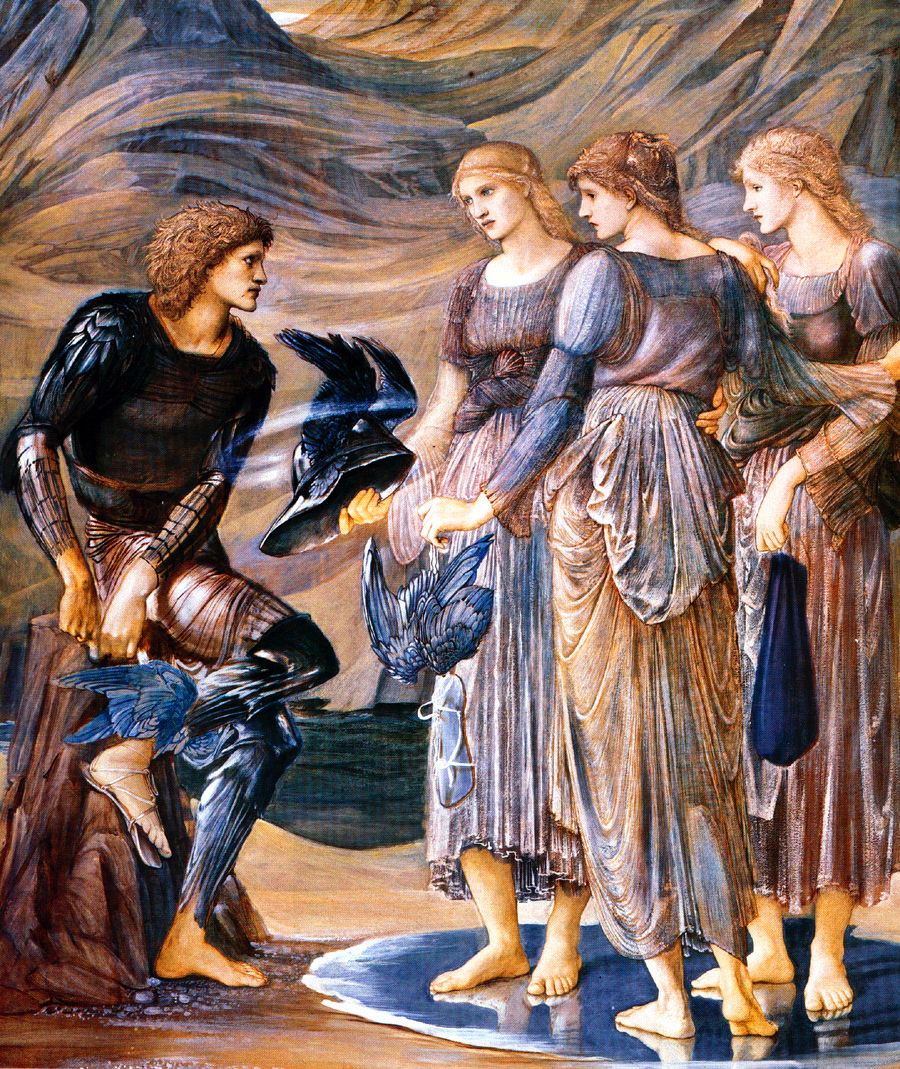
In Edward Burne-Jones’ Perseus Series, the hero’s winged sandals are one of its less consistent features.
Edward Burne-Jones (1833–1898), The Perseus Series: Perseus and the Sea Nymphs (1877), bodycolour, 152.8 × 126.4 cm, Southampton City Art Gallery, Southampton, England. Wikimedia Commons.
The third painting, Perseus and the Sea Nymphs (1877), shows the Hesperides equipping Perseus with the kibisis at the far right. Burne-Jones combines with that his donning the winged sandals (centre) and Hades’ helmet, as provided by Hermes and Zeus.
Edward Burne-Jones (1833–1898), The Perseus Series: The Doom Fulfilled (1888), oil on canvas, 155 × 140.5 cm, Staatsgalerie Stuttgart, Stuttgart. Wikimedia Commons.
Further on in the series, in his finished oil version of The Doom Fulfilled (1888), the sandals are shown clearly as Perseus takes on Cetus.
Frederic, Lord Leighton (1830–1896), Perseus On Pegasus Hastening To the Rescue of Andromeda (c 1895-6), oil on canvas, 184 x 189.6 cm, New Walk Museum & Art Gallery, Leicester, England. Wikimedia Commons.
In one of Frederic, Lord Leighton’s last paintings, of Perseus On Pegasus Hastening To the Rescue of Andromeda from about 1895-96, the wings on his sandals are tiny but distinctive.
Colouring glass is ancient in origin, and in Europe its use in church windows reached its height during the Middle Ages. As a craft it has tended to develop independently of fine art painting, but since the nineteenth century’s revivals of better integrated arts and crafts, some painters have designed stained glass windows. At the same time, other painters have been depicting them.
In the Italian Renaissance, several artists best-known as painters, among them Paolo Uccello and Donatello, designed stained glass windows for Florence Cathedral and other churches. In the nineteenth century revival of the craft, contemporary arts and crafts movements drew established painters from the Pre-Raphaelite movement in Britain, and Art Nouveau across much of Europe. Among those who created successful designs are Edward Burne-Jones, Alfonse Mucha, Koloman Moser and Marc Chagall.
Koloman Moser (1868–1918), Art, design sketch for a round window (1897), India ink and watercolor on paper, 20.9 x 22.8 cm, Österreichisches Museum für angewandte Kunst (MAK), Vienna, Austria. Wikimedia Commons.
Koloman Moser’s Art is one of his design sketches from 1897 intended for a round stained glass window in the new Secession Building in the centre of Vienna.
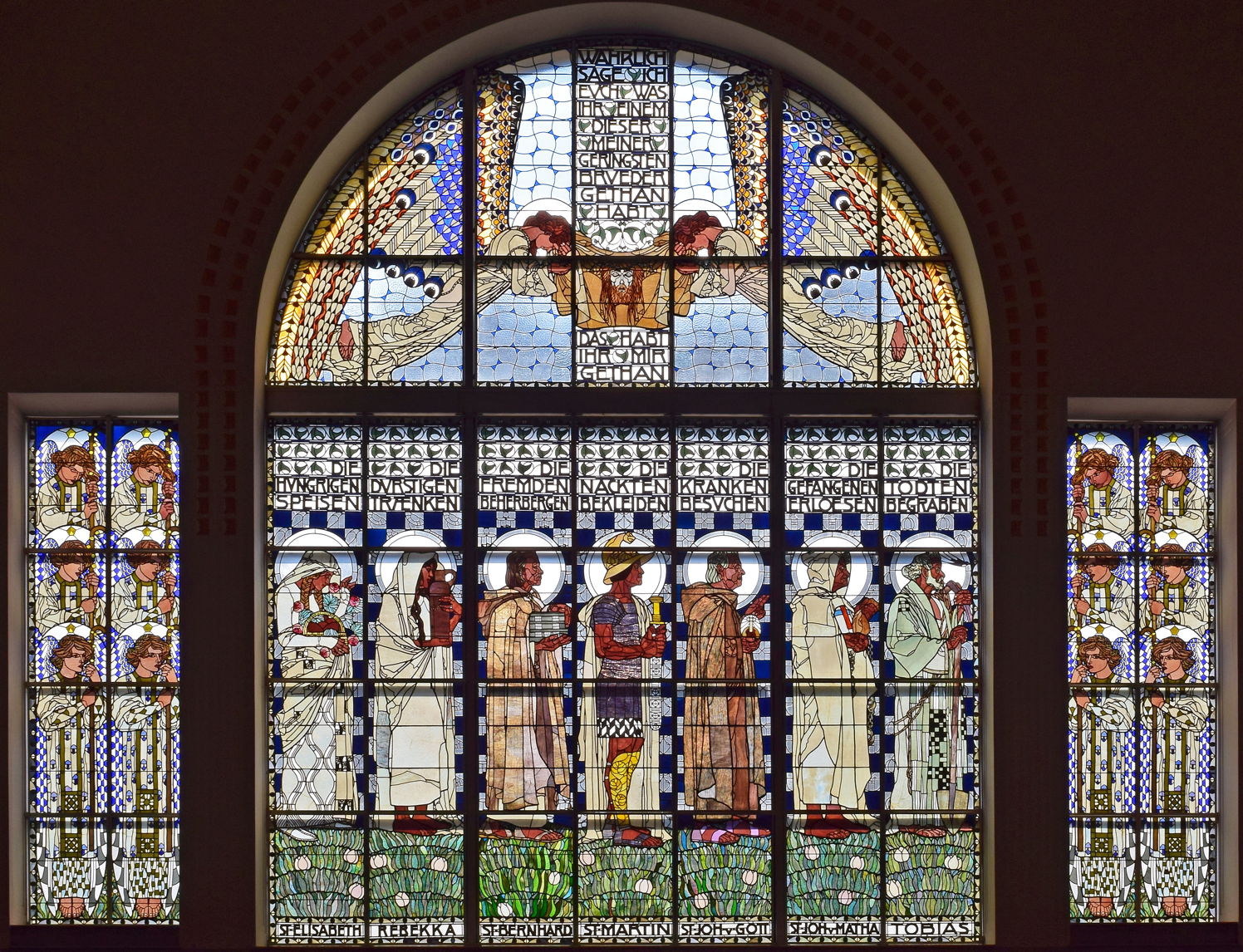
Koloman Moser (1868–1918) (design) and Leopold Forstner (1878-1936) (execution), The Physical Virtues (1905-07), stained glass, Kirche am Steinhof (Otto-Wagner-Kirche), Vienna, Austria. Image by Haeferl, via Wikimedia Commons.
In 1905-07, Moser collaborated with Leopold Forstner (1878-1936), already famous for making mosaics and stained glass, in the design and production of windows and mosaics for the Kirche am Steinhof (also known as Otto-Wagner-Kirche) in Vienna. Most impressive among these is this window of The Physical Virtues.
Am Steinhof, as it was widely known then, is a large psychiatric and neurological hospital complex planned by the architect Otto Koloman Wagner (1841-1918), and built between 1904-07 in a suburb to the west of Vienna. Its architecture is Art Nouveau, and it contains several of the finest examples of that style, particularly its Roman Catholic oratory: Wikipedia has an excellent article about it here, and an extensive library of images in Wikimedia Commons.
At the same time, artists started featuring stained glass windows in their paintings.
John Everett Millais’ final version of Mariana (1851) was first shown at the Royal Academy in 1851, and refers to Tennyson’s poem of the same name. This richly-coloured painting is full of symbols: fallen leaves to indicate the passage of time, her embroidery as a means of passing that time, the Annunciation in the stained glass contrasting her with the Virgin’s fulfilment, the motto ‘in coelo quies’ (in heaven is rest), and the snowdrop flower in the glass meaning consolation. Mariana’s posture is intended to indicate her yearning for her lover Angelo.
Paul César Helleu (1859–1927), The Interior of the Abbey Church of Saint Denis (c 1891), oil on canvas, dimensions not known, The Isabella Stewart Gardner Museum, Boston, MA. The Athenaeum.
Paul César Helleu’s Interior of the Basilica of Saint-Denis (c 1891) is an example of his interest in churches and their stained glass, which included Reims Cathedral. The Basilica of Saint-Denis was the burial place for almost every French king between the tenth and eighteenth centuries, and it now lies within the north of the city of Paris, although Saint-Denis was formerly its own city. The window shown is that of the north transept, featuring the tree of Jesse; a south transept rose shows the Creation.
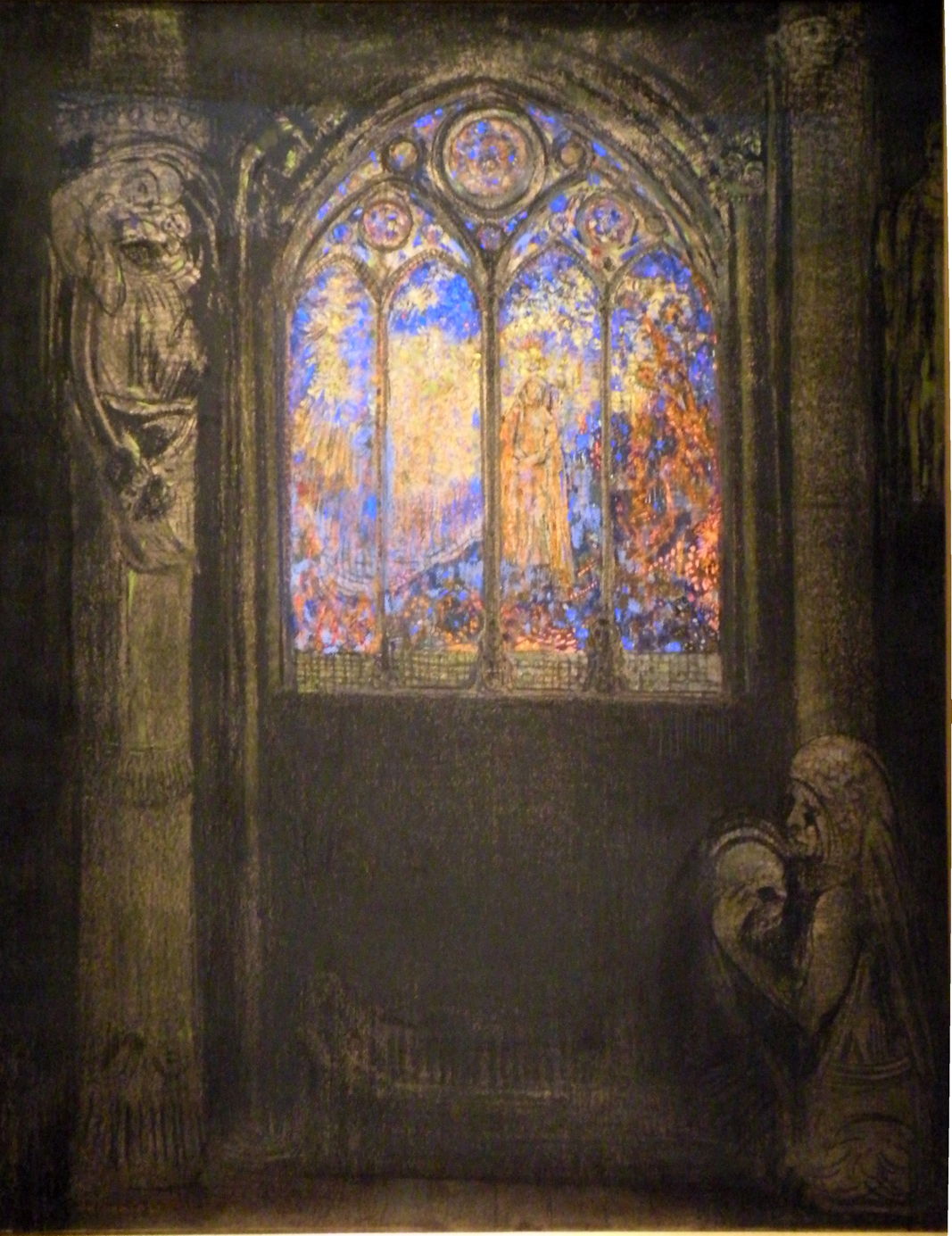
Odilon Redon (1840–1916), Le grand vitrail (The Large Window) (1904), charcoal, pastel and stumping on cardboard, 87 x 68 cm, Musée d’Orsay, Paris. Image EHN & DIJ Oakley.
Odilon Redon’s The Large Window, from 1904, is one of the most remarkable pastel paintings that I have seen. Framed by carved masonry shown in the dull greys of charcoal, a mediaeval stained glass window dazzles with its bright, rich colours, the pure pigment of pastel at its best.
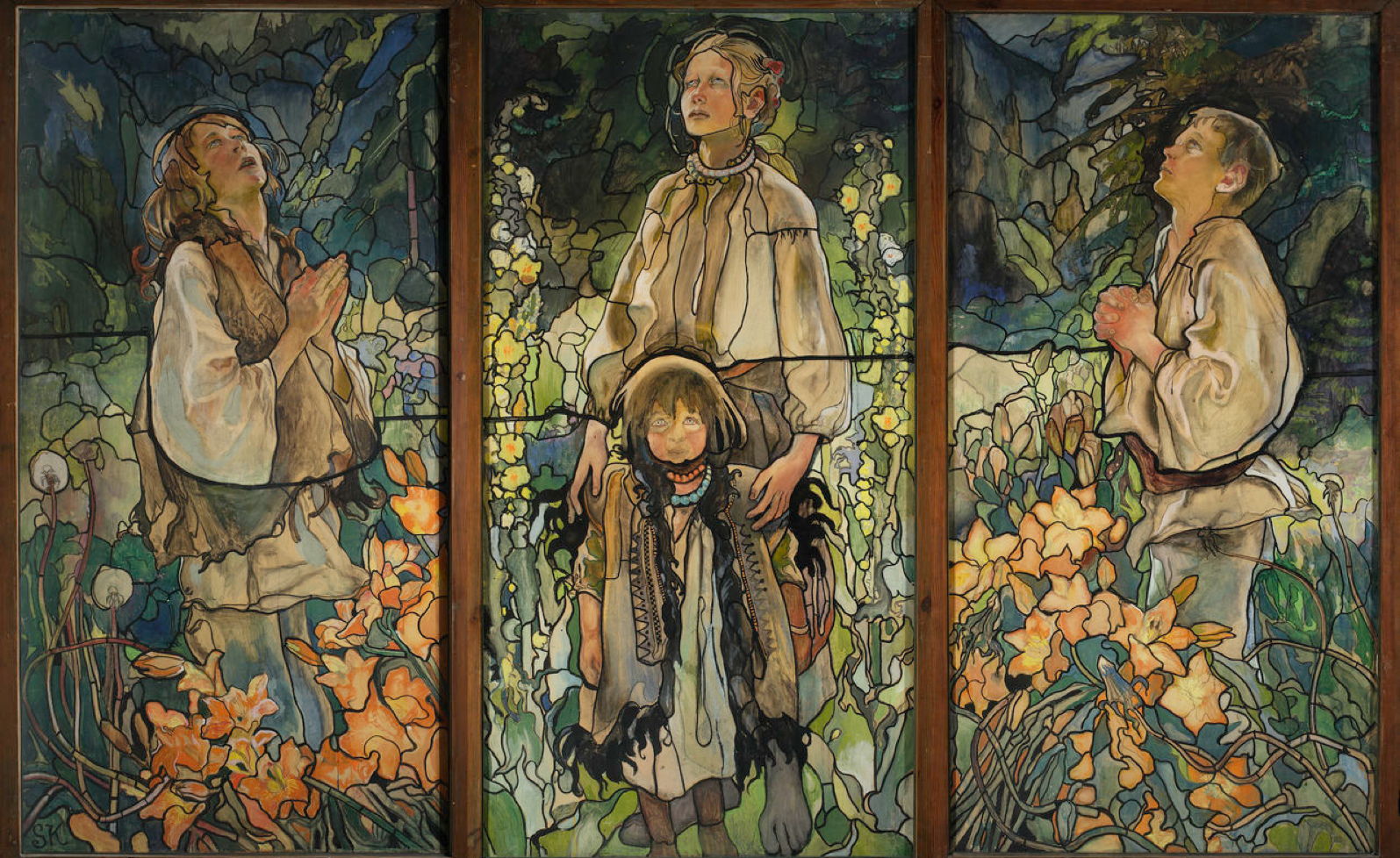
Kazimierz Sichulski (1879–1942), Spring Triptych (1909), tempera and pastel on cardboard, 145 x 231 cm Source National Museum, Warsaw, Muzeum Narodowe w Warszawie, Warsaw, Poland. Wikimedia Commons.
Three years after Kazimierz Sichulski painted his first triptychs, he used mixed media of tempera and pastel to create some that look as if they’re stained glass. His Spring Triptych from 1909 bridges the religious and secular, with the centre panel showing a woman and child.
Léon Augustin Lhermitte (1844–1925), The Prayer, the Church of Saint-Bonnet (before 1920), pastel on stretched paper, 49.8 × 57.5 cm, location not known. Wikimedia Commons.
Léon Augustin Lhermitte had painted a few religious works earlier in his career, but his late pastel of The Prayer, the Church of Saint-Bonnet (before 1920) is probably the most moving.
Georges Rochegrosse (1859–1938), Interior of the Cathedral of Reims in Flames (1915), oil on canvas, 100 x 73 cm, Musée des beaux-arts, Reims, France. By G.Garitan, via Wikimedia Commons.
At the start of the First World War, the cathedral of Notre-Dame de Reims, where the Kings of France were once crowned, had been commissioned as a hospital and demilitarised. German shells hit the cathedral during opening engagements on 20 September 1914, setting alight scaffolding, and destroying some of the stonework. The fire spread through woodwork, melting the lead on the roof, and destroying the bishop’s palace. The French accused the Germans of the deliberate destruction of part of its national and cultural heritage.
Georges Rochegrosse’s Interior of the Cathedral of Reims in Flames (1915) casts this in a curious combination of the physical reality of the shattered masonry and fire, the ancient glory of the cathedral’s stained glass, and an Arthurian figure (possibly the Madonna herself) reaching up to seek divine intervention.

 Login
Login