Reading view

There are new articles available, click to refresh the page.

Naturalists: Into the 20th century

Although Naturalism in literature continued well into the early twentieth century, in painting it was fading before 1900. This article shows some examples from those later years.

henningsenevicted
Erik Henningsen (1855–1930), Evicted (1892), oil on canvas, dimensions not known, Statens Museum for Kunst (Den Kongelige Malerisamling), Copenhagen, Denmark. Wikimedia Commons.

The Danish artist Erik Henningsen’s Evicted from 1892 returns to a theme perhaps more appropriate to ‘social realism’, as a family of four is evicted into the street in the winter snow. With them are their meagre possessions, including a saw suggesting the father may be a carpenter. In the background he is still arguing with a policeman.
henningseninjuredworker
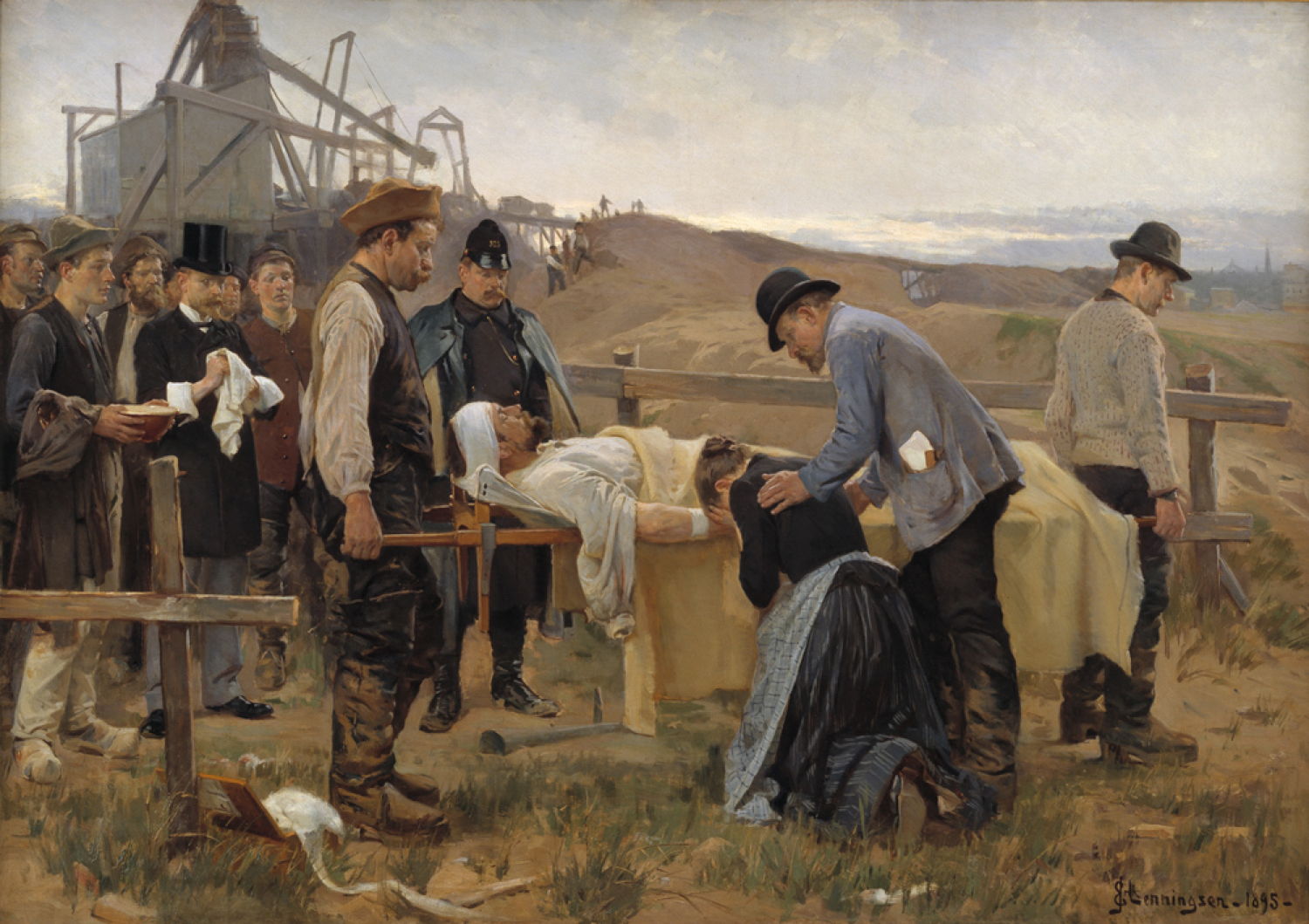
Erik Henningsen (1855–1930), An Injured Worker (1895), oil on canvas, 131.5 x 187 cm, Statens Museum for Kunst (Den Kongelige Malerisamling), Copenhagen, Denmark. Wikimedia Commons.

In An Injured Worker from 1895, Henningsen tackles another major social issue. The scene is a gravel or sand pit outside a town (in the distance at the right). A worker has just been injured, and is being carried away on a stretcher. By his side is his wife, who is in tears and being comforted by one of her husband’s managers. Behind and to the left are a policeman, and a doctor who wears a top hat and is wiping his hands after dressing the man’s wounds.

lhermittestmalovegmarket
Léon Augustin Lhermitte (1844–1925), Vegetable Market in St-Malo (1893), pastel, dimensions not known, Private collection. Wikimedia Commons.

In France, the veteran Léon Augustin Lhermitte painted this pastel of the Vegetable Market in St-Malo in 1893. It’s a good example of his balance between detail, as seen in the distant crowd and shop fronts, and a more painterly style.

lhermitteleshalles
Léon Augustin Lhermitte (1844–1925), Les Halles (1895), oil on canvas, dimensions not known, Petit Palais, Paris. Wikimedia Commons.

In 1889, Lhermitte was commissioned to paint Les Halles, the main and most central market in the city of Paris. He completed this, perhaps his last major work, in 1895, when it was exhibited at the Salon. The market’s origins were mediaeval, then during the nineteenth century it grew even busier, and was re-housed in iron and glass buildings erected during the 1850s. Lhermitte’s friend Émile Zola set his novel Le Ventre de Paris (1873) in this market.

friantsorrow
Émile Friant (1863–1932), Sorrow (1898), oil on canvas, dimensions not known, Musée des beaux-arts de Nancy, Nancy, France. Wikimedia Commons.

Émile Friant’s Sorrow (1898) visits a municipal cemetery for a funeral, and an intimate study of the grief of a widow, who is being helped by two younger women. Their overt reactions contrast with the cluster of men, with their stern beards, at the left.

In the 1890s, Friant became a passionate aviation enthusiast. Together with a friend from Nancy, one of the oarsmen in his painting of 1887, he founded an aviation society, and flew in balloons and early aircraft.

friantjourneytoinfinity
Émile Friant (1863–1932), Journey to Infinity (1899), oil on canvas, 150 × 120 cm, location not known. Wikimedia Commons.

Journey to Infinity (1899) is an extraordinary flight of fancy in a balloon, which is soaring high above a bank of grey clouds (or possibly a rugged mountain ridge) containing the forms of five nude women, one of them apparently performing a handstand. I suspect this painting may have been made for Marie Marvingt (1875-1963), an athlete, mountaineer, and pioneer aviator, who had moved to Nancy in 1889.
bulandparentalhappiness
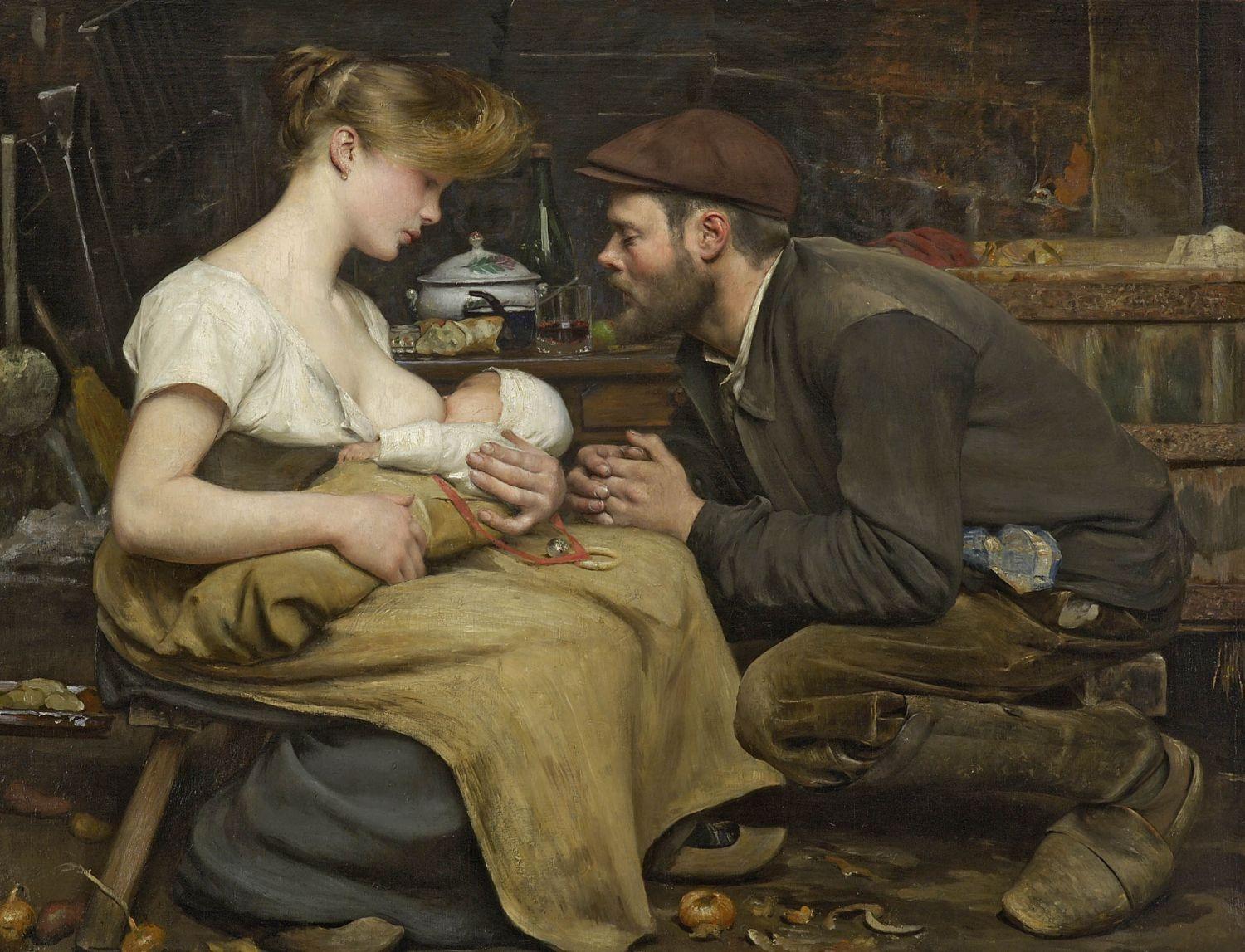
Jean-Eugène Buland (1852–1926), Parental Happiness (1903), oil on canvas, 97.5 × 129 cm, location not known. Wikimedia Commons.

Jean-Eugène Buland returned to poor working families in his Parental Happiness from 1903. A young couple are nursing their first baby, and appear to be living in an agricultural outhouse. The floor is strewn with vegetables and their parings, and the husband is dressed as a labourer, with worn working shoes, his wife in wooden clogs.

bulandtinker
Jean-Eugène Buland (1852–1926), The Tinker (1908), oil on canvas, 112.6 × 145 cm, Private collection. Wikimedia Commons.

Buland’s The Tinker (1908) is busy at his cottage industry, repairing damaged pots, pans, and domestic metal objects. The stone wall at the left glistens with the damp.

During this period two aspiring artists who were to achieve greatness in the early twentieth century went through a period of Naturalism, Joaquín Sorolla in Spain, and Anders Zorn in Sweden, the subject of the next article in this series.

Naturalists: The modern meal

Eating together with family and friends is one of the great social events, and became a popular theme in nineteenth century painting. It was enthusiastically adopted by several of the leading Naturalist painters, as shown below.

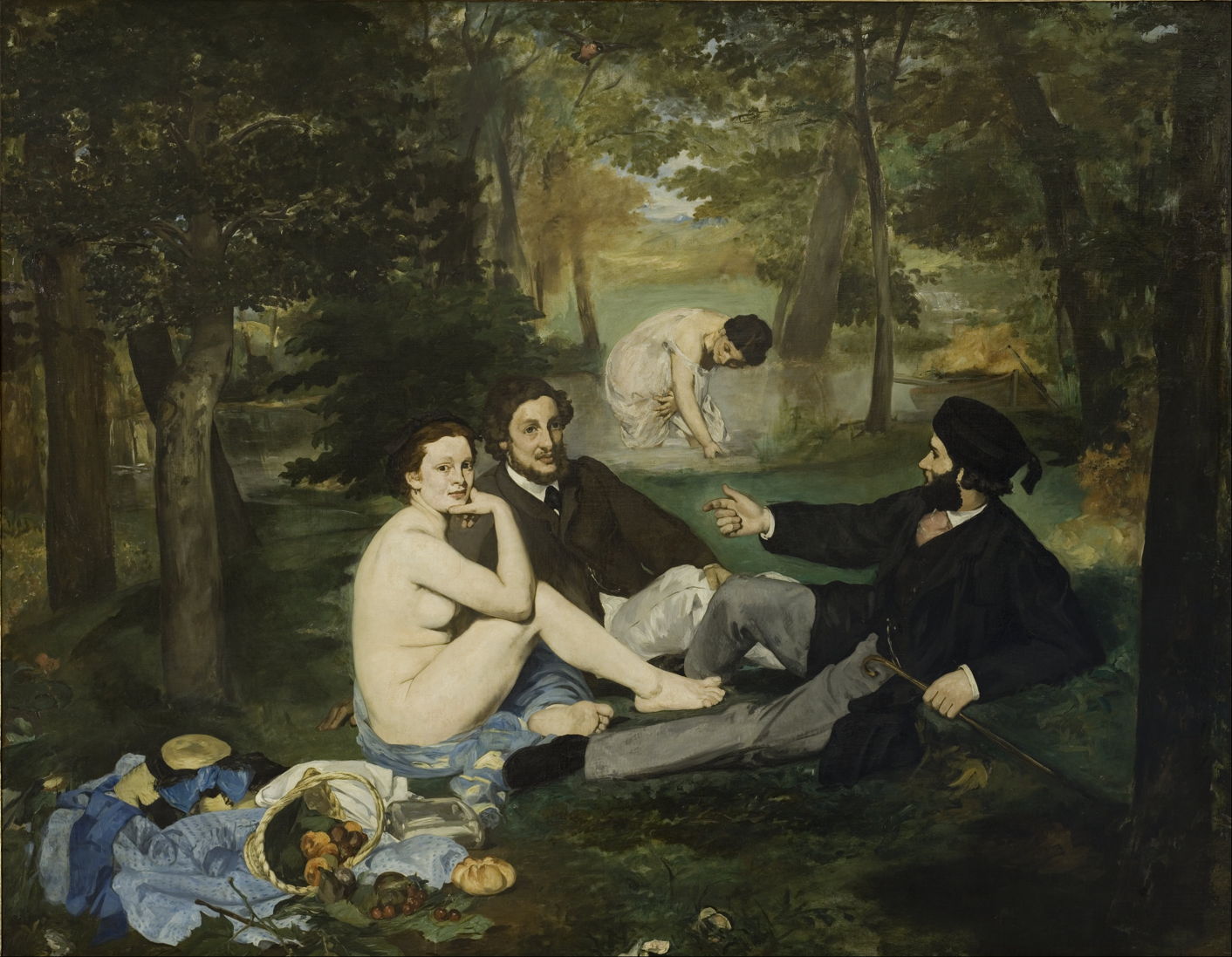
manetluncheonongrass
Édouard Manet (1832-1883), Le Déjeuner sur l’herbe (Luncheon on the Grass) (1863), oil on canvas, 208 × 264.5 cm, Musée d’Orsay, Paris. Wikimedia Commons.

Édouard Manet’s Le Déjeuner sur l’herbe from 1863 is one of the best-known if not infamous paintings of a social meal. Two couples are apparently disinterested in the token picnic of fruit and bread that has spilled out from its basket in the left foreground. As the two men talk, fully dressed, a conspicuously naked woman stares unnervingly at the viewer, and the other woman is washing herself in the river behind. This was rejected by the Salon of that year, ensuring its lasting fame and influence.

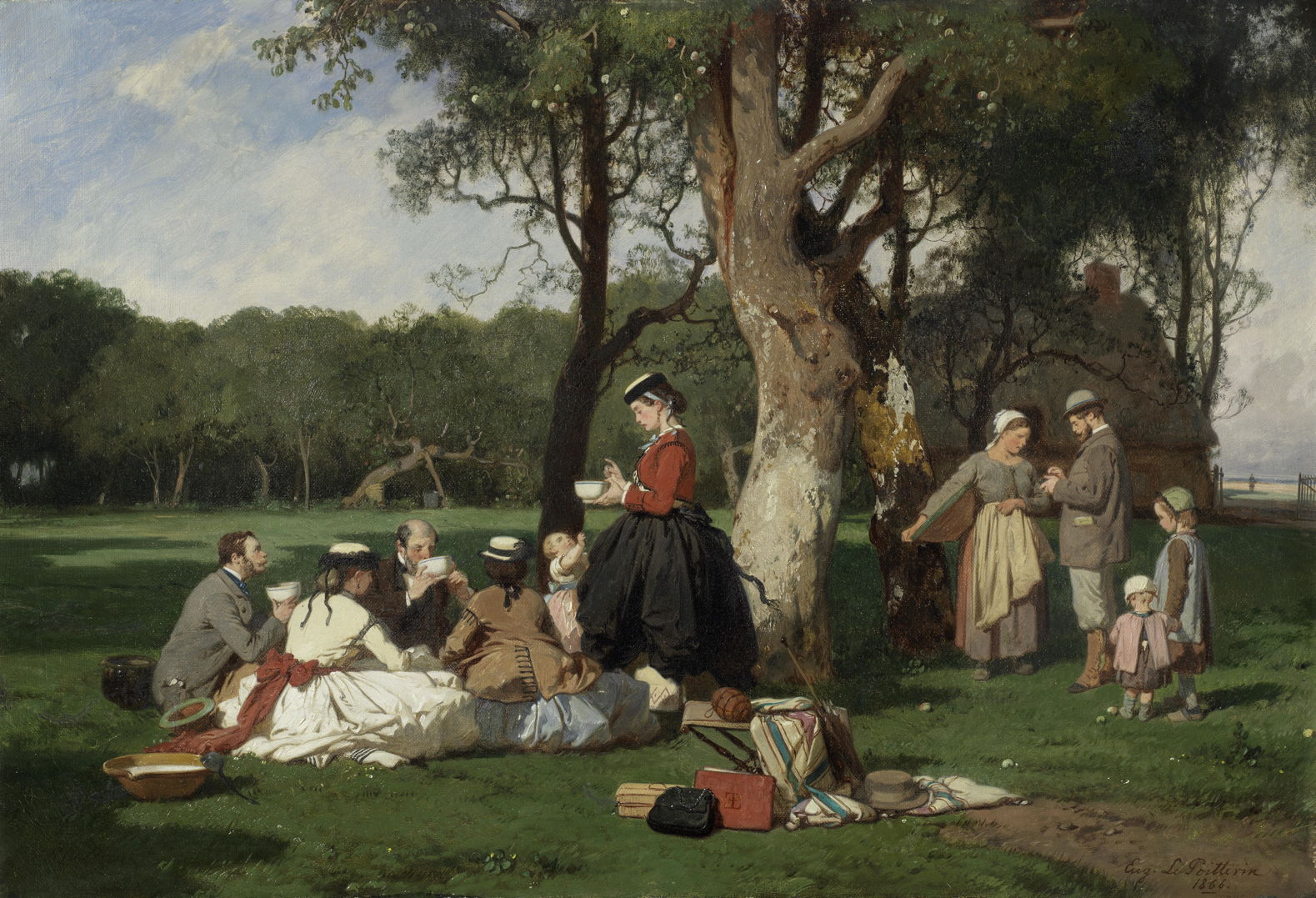
lepoittevinpicnic
Eugène Lepoittevin (1806-1870), A Picnic (1866), oil on canvas, 43 x 62.5 cm, location not known. Wikimedia Commons.

A far cry from Manet’s meal, Eugène Lepoittevin’s Picnic from 1866 captures a picnic’s distinctive combination of the planned and impromptu. This group has lugged crockery, soup and a folding stool for their simple meal sitting on the grass under some trees.

renoirluncheonboatingparty
Pierre-Auguste Renoir (1841–1919), Luncheon of the Boating Party (1880-81), oil on canvas, 130.2 x 175.6 cm, The Phillips Collection, Washington, DC. Wikimedia Commons.

Renoir’s masterpiece Luncheon of the Boating Party (1880-81) is set on the Île de Chatou under the awning of the Restaurant Fournaise. Among his models are his partner and later wife Aline Charigot (left foreground, with affenpinscher dog), the actress Jeanne Samary (upper right), and fellow artist Gustave Caillebotte (seated, lower right). This meal seems all but over, the wineglasses near-empty as the party turns from eating to conversation.

denittisbreakfastingarden
Giuseppe De Nittis (1846–1884), Breakfast in the Garden (c 1883), oil on canvas, 81 x 117 cm, Pinacoteca De Nittis, Barletta, Italy. By LPLT, via Wikimedia Commons.

In summer, breakfast became a favourite meal in your own garden. Just a year before his untimely death in 1884, the Italian peri-Impressionist Giuseppe De Nittis painted this startling Breakfast in the Garden, with its contrast between the detail of the glass soda syphon, covered bowl, glasses, and other reflective materials on the table, and its wonderfully sketchy garden background.

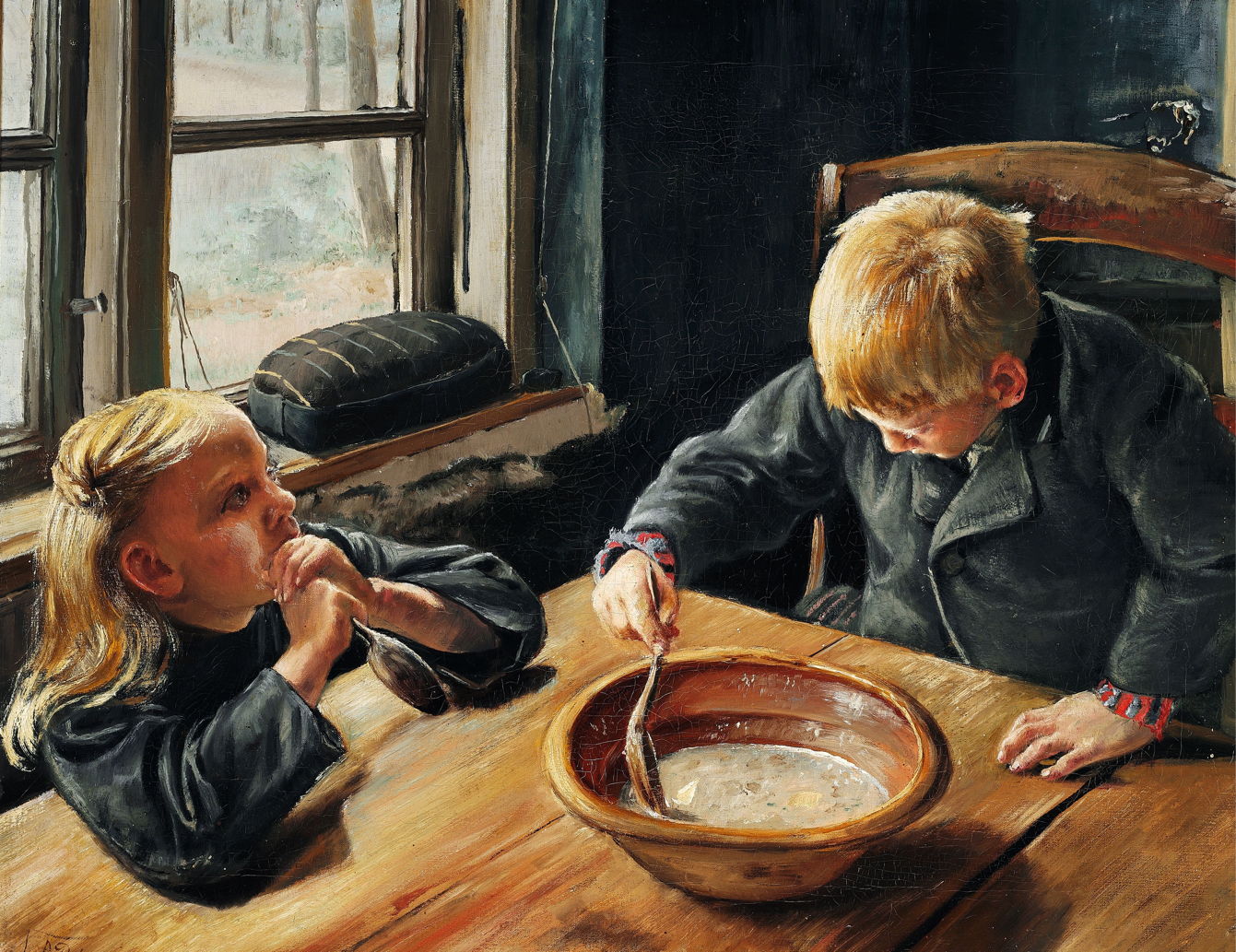
ringboygirllunch
Laurits Andersen Ring (1854–1933), A Boy and a Girl Eating Lunch (1884), oil on canvas, 44 x 56 cm, location not known. Wikimedia Commons.

Laurits Andersen Ring was more pointed in his social message in A Boy and a Girl Eating Lunch, from 1884. Paupers’ children, they have a single bowl of broth between them, and there’s not even a hint of wine and fruit. The girl looks up in tears, hoping for a miracle to change their lives, and take them away from this bare wooden table and blackened walls.

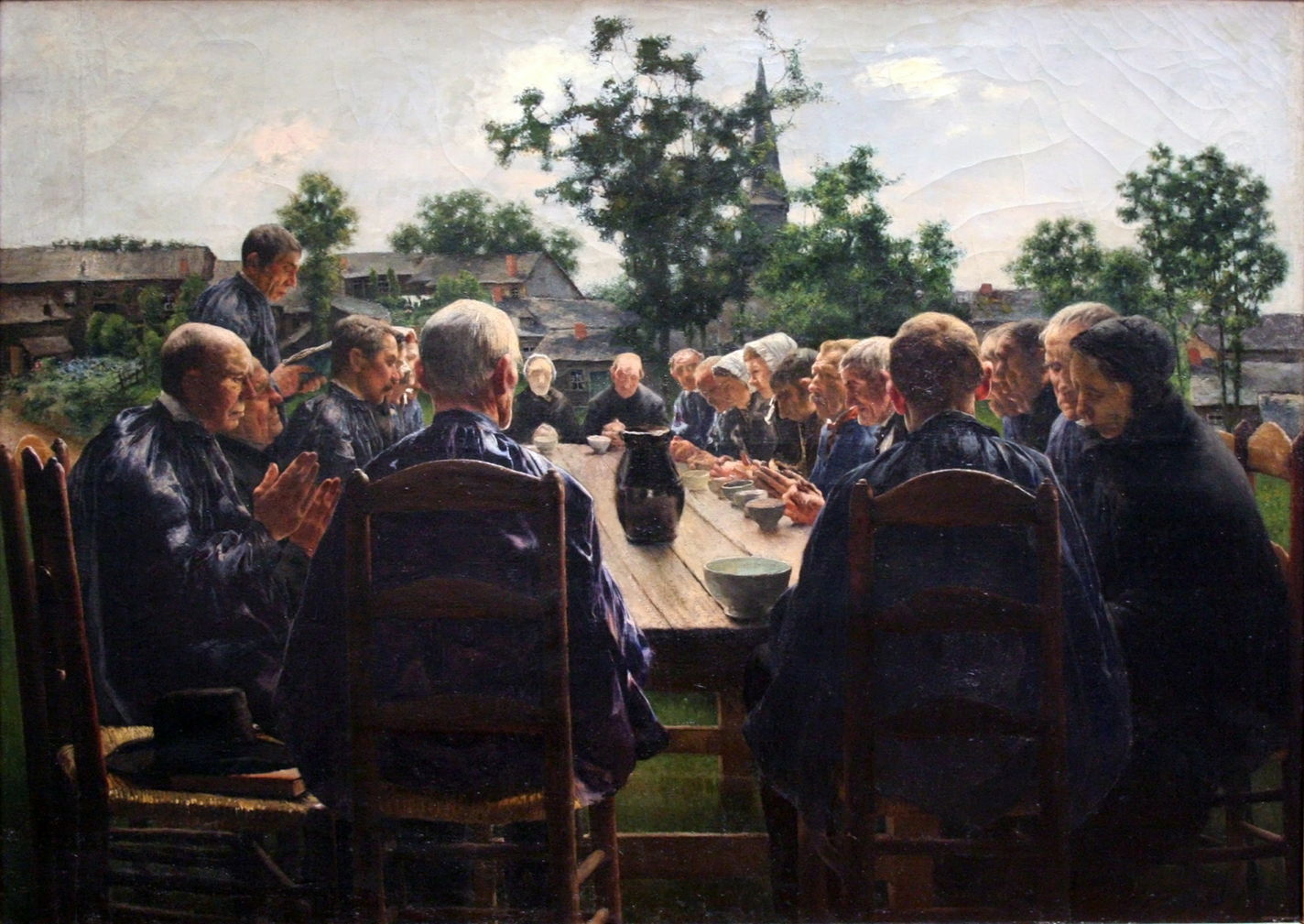
MSKG - Het begrafenismaal - Léon Frédéric (1886)
Léon Frédéric (1856–1940), The Funeral Meal (1886), oil on canvas, 125.5 x 177.5 cm, Museum voor Schone Kunsten, Ghent, Belgium. Image by Ophelia2, via Wikimedia Commons.

Léon Frédéric’s Funeral Meal from 1886 shows a large group of mourners sitting outside in the summer sunshine to remember the deceased following their funeral. Their meal is simple if not frugal, and there are neither glasses of wine nor mugs of beer. This is the moment that grace, or perhaps a eulogy for the deceased, is being read.

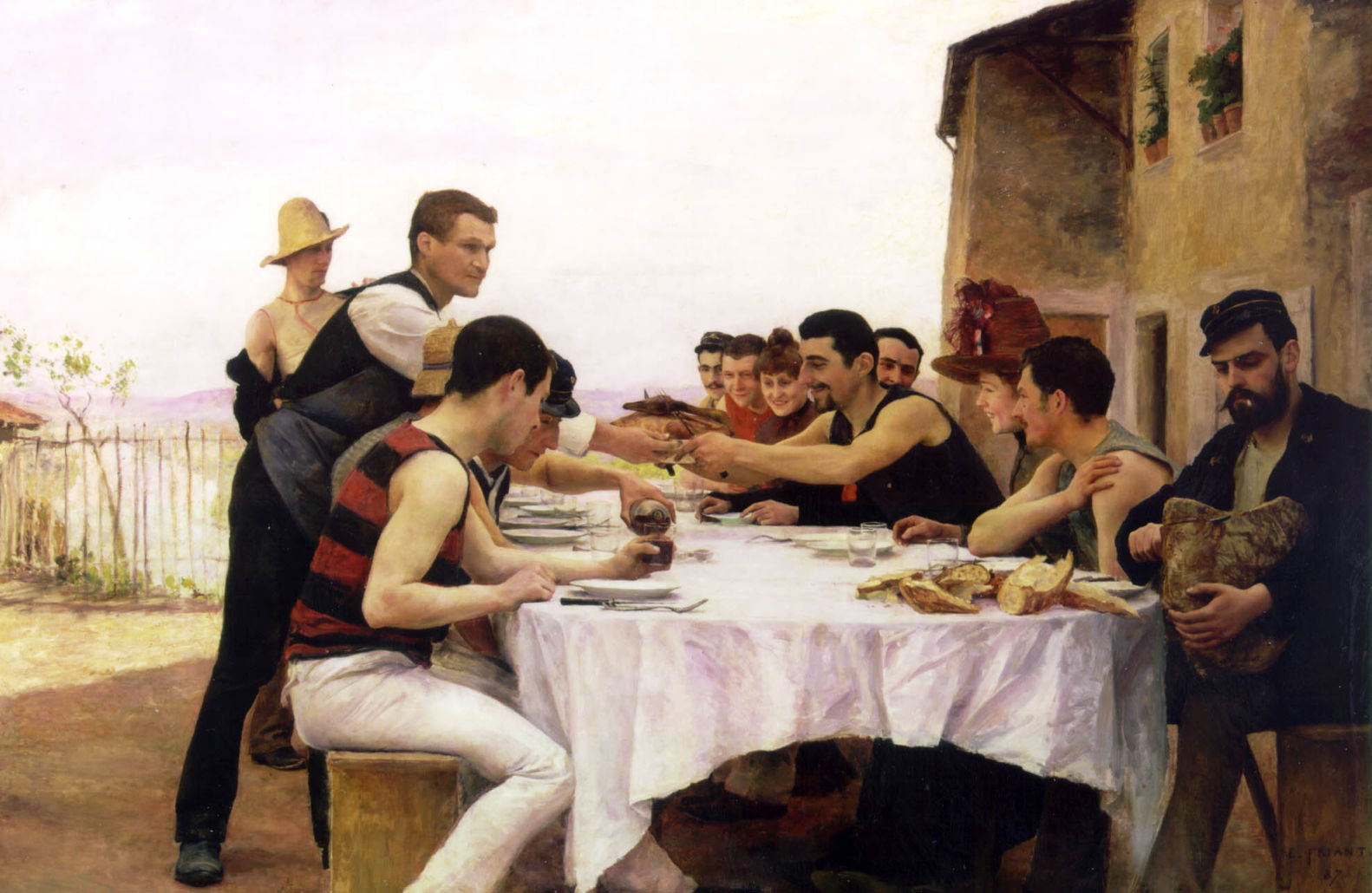
friantcanotiersmeurthe
Émile Friant (1863–1932), The Meurthe Boating Party (Reunion of the Meurthe Boating Party) (1887), oil on canvas, 110 x 166 cm, Musée de l’École de Nancy, Nancy, France. Wikimedia Commons.

Now almost forgotten is Émile Friant’s masterpiece The Meurthe Boating Party, also known as Reunion of the Meurthe Boating Party or The Oarsmen of the Meurthe, from 1887. This shows the artist’s watersporting friends eating lunch together on the river Meurthe in Nancy. This can be read as a broad message of well-being and conviviality: healthy, fit young men engaged in team sports; fraternity; and harmony across different classes within society. It was exhibited at the Salon in 1888, and as a result of its success was featured as a full page in the popular magazine Le Monde Illustré, bringing Friant instant fame.

paulibreakfasttime
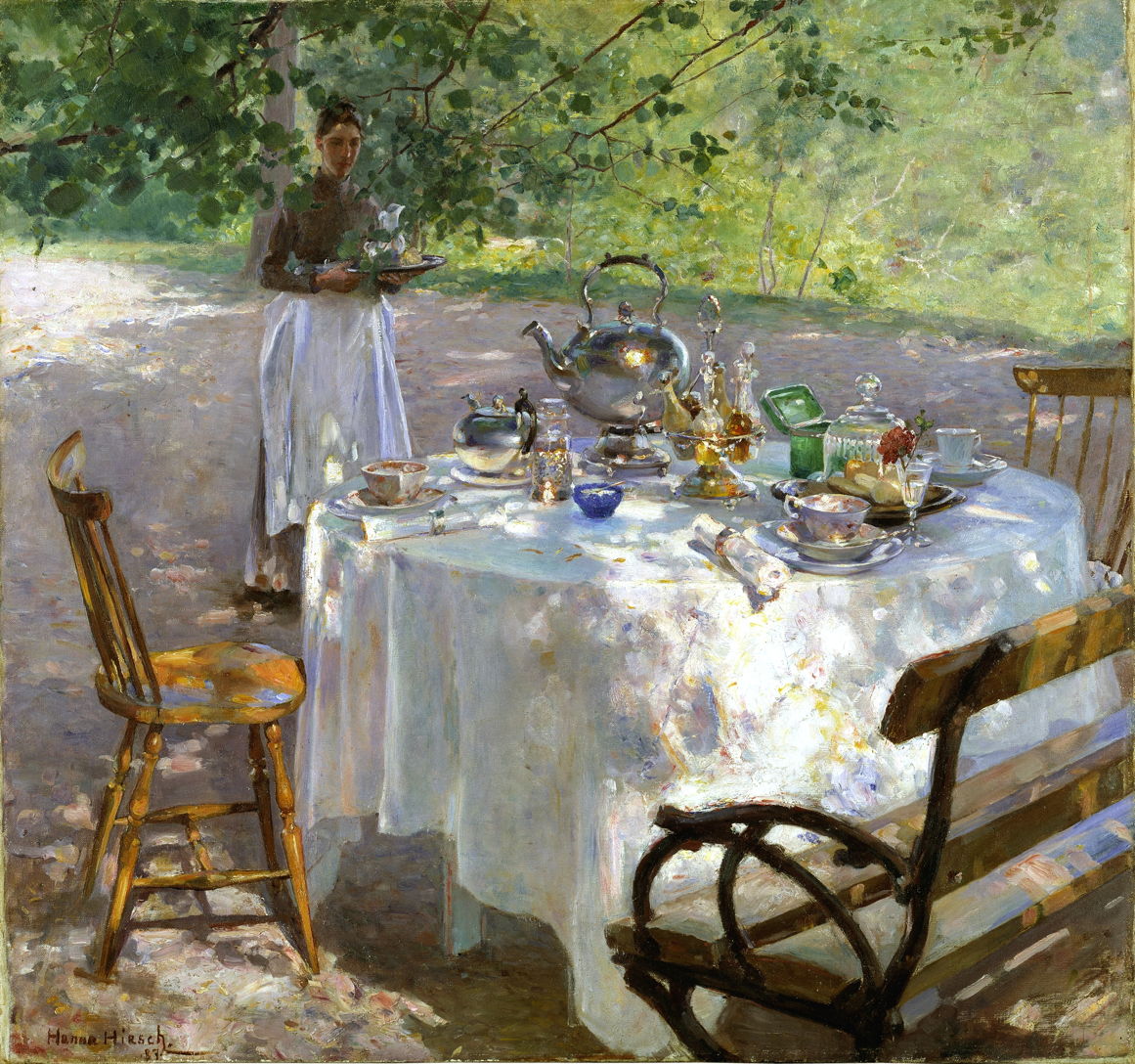
Hanna Pauli (1864-1940), Breakfast-Time (1887), oil on canvas, 87 x 91 cm, Nationalmuseum, Stockholm, Sweden. Wikimedia Commons.

That same year the 23-year-old Swedish painter Hanna Pauli made the meal table the centrepiece of her virtuoso painting of Breakfast-Time (1887). She uses it as a demonstration of her skills in depicting the reflective surfaces of silverware, porcelain and abundant glassware, but its table is now deserted.

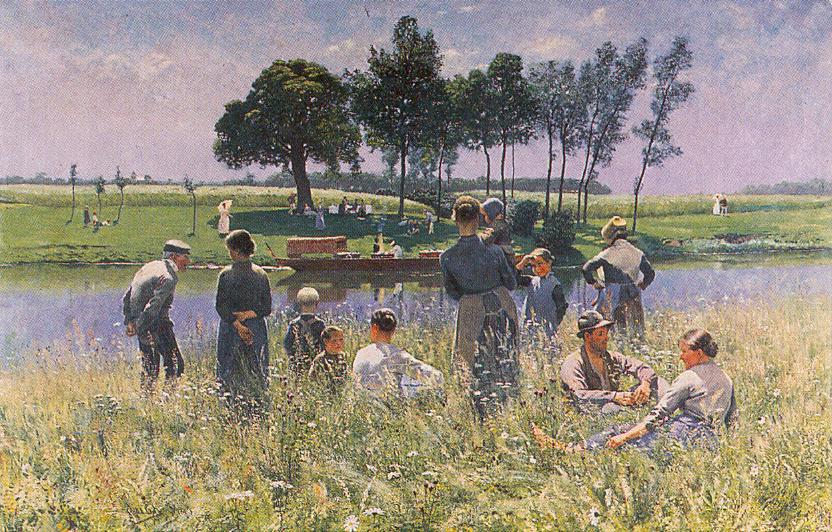
Émile Claus, Pique-nique, paysage la Lys (The Picnic) (1887), oil on canvas, 129 x 198 cm, Institut Royal du Patrimoine artistique, Brussels. WikiArt.
Émile Claus (1849-1924), Pique-nique, paysage la Lys (The Picnic) (1887), oil on canvas, 129 x 198 cm, Institut Royal du Patrimoine artistique, Brussels. WikiArt.

The Belgian artist Émile Claus also painted The Picnic in 1887. It’s set in the French/Belgian countryside around the River Lys, in the area of Ypres, which was devastated during the First World War. The plain clothing worn indicates these are poor farmworkers rather than landowners.

❌