Reading view

There are new articles available, click to refresh the page.

On Reflection: Extending the image

Jan van Eyck’s famous double-portrait of the Arnolfini Wedding (1434) introduced mirror-play, but didn’t quite demonstrate its use to extend the scene depicted because of the small size of its reflected image. Surprisingly it appears that four centuries were to pass before reflections became more widely adopted for this purpose, although I’m sure they had already been used for it in interior decoration.

One of the earliest of my examples refers back to the Arnolfini Wedding in its use of a circular and non-planar mirror.

'Take your Son, Sir' ?1851-92 by Ford Madox Brown 1821-1893
Ford Madox Brown (1821–1893), Take your Son, Sir! (1851-52), oil on canvas, 70.5 x 38.1 cm, The Tate Gallery (Presented by Miss Emily Sargent and Mrs Ormond in memory of their brother, John S. Sargent), London. © The Tate Gallery and Photographic Rights © Tate (2016), CC-BY-NC-ND 3.0 (Unported), https://www.tate.org.uk/art/artworks/brown-take-your-son-sir-n04429

The dates and background to Ford Madox Brown’s unfinished painting Take your Son, Sir! remain unclear. It’s thought that Brown started work on this in 1851, although it shows his second wife Emma with their newborn son. Their first son, Oliver, wasn’t born until 1855, and their second, Arthur, in September 1856, suggesting that he didn’t start this until at least 1855. It’s generally held that this shows not Oliver, who lived until 1874, but Arthur, who died aged ten months in July 1857, at which time Brown abandoned the painting. The detail seen reflected in the mirror is of a contemporary living room and a man, presumably a self-portrait.

The Awakening Conscience 1853 by William Holman Hunt 1827-1910
William Holman Hunt (1827-1910), The Awakening Conscience (1851-53), oil on canvas, 76.2 x 55.9 cm, The Tate Gallery (Presented by Sir Colin and Lady Anderson through the Friends of the Tate Gallery 1976), London. © The Tate Gallery and Photographic Rights © Tate (2016), CC-BY-NC-ND 3.0 (Unported), https://www.tate.org.uk/art/artworks/hunt-the-awakening-conscience-t02075

A few years before that, William Holman Hunt’s The Awakening Conscience, painted over the period 1851-53, employs the reflection seen in a much larger mirror to add substantial detail to its unresolved narrative. This places the scene in a small if not cramped house in the leafy suburbs of London, in reality Saint John’s Wood, where this couple are clearly in an extra-marital relationship.
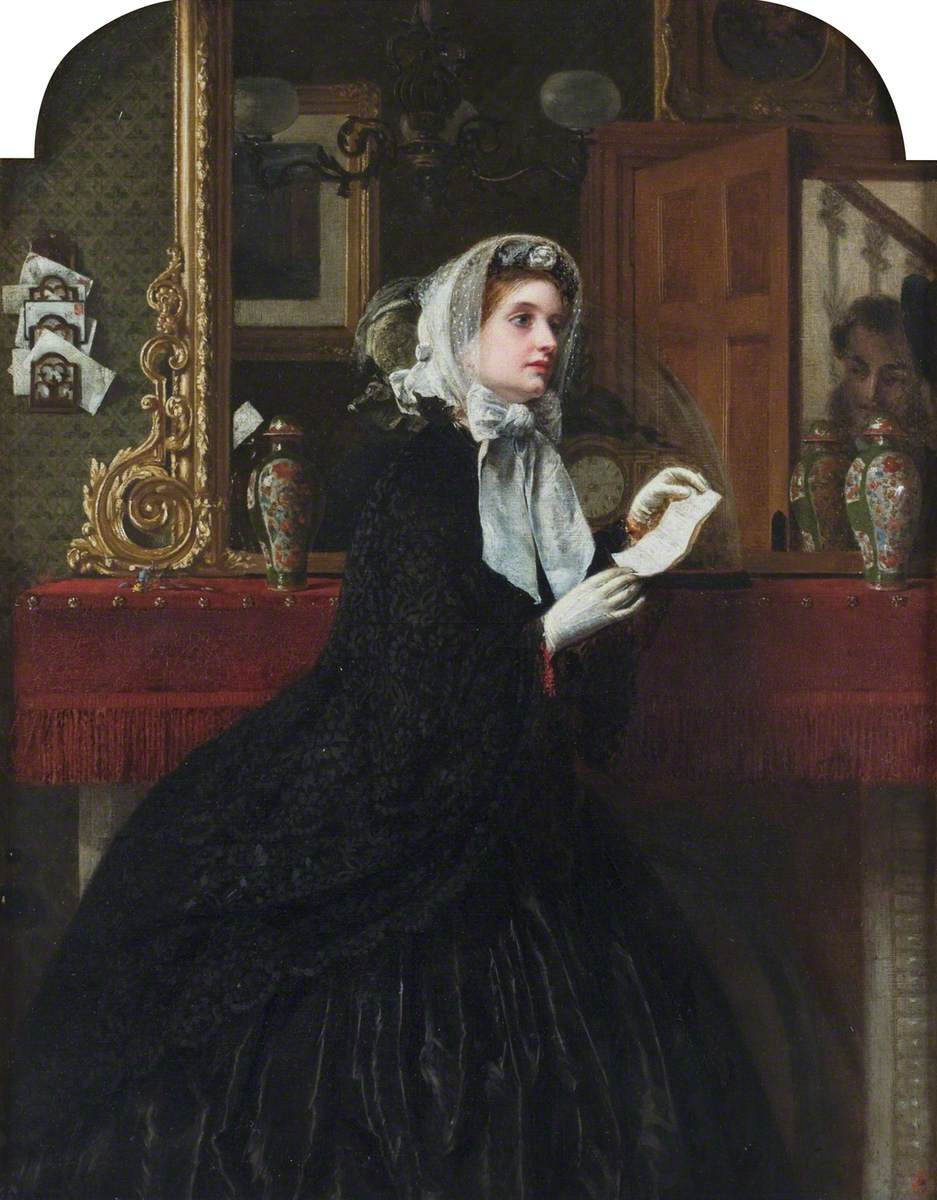
Solomon, Rebecca, 1832-1886; The Appointment
Rebecca Solomon (1832-1886), The Appointment (1861), media and dimensions not known, The Geffrye, Museum of the Home. Wikimedia Commons.

Rebecca Solomon’s Appointment (1861) is another early problem picture, with a deliberately open-ended narrative set in an interior. A beautiful woman stands in front of a mirror, and looks intently at a man, who is only seen in his reflection in the mirror, and stands in a doorway behind the viewer’s right shoulder. The woman is dressed to go out, and is holding a letter in her gloved hands.

stevensjapaneseparisian
Alfred Stevens (1823–1906), The Japanese Parisian (1872), oil on canvas, 105 × 150 cm, Musée d’art moderne et d’art contemporain, Liège. Wikimedia Commons.

In 1872 Alfred Stevens’ The Japanese Parisian filled its canvas with the reflection of the face of his model framed by floating flowers, which must be behind the viewer.
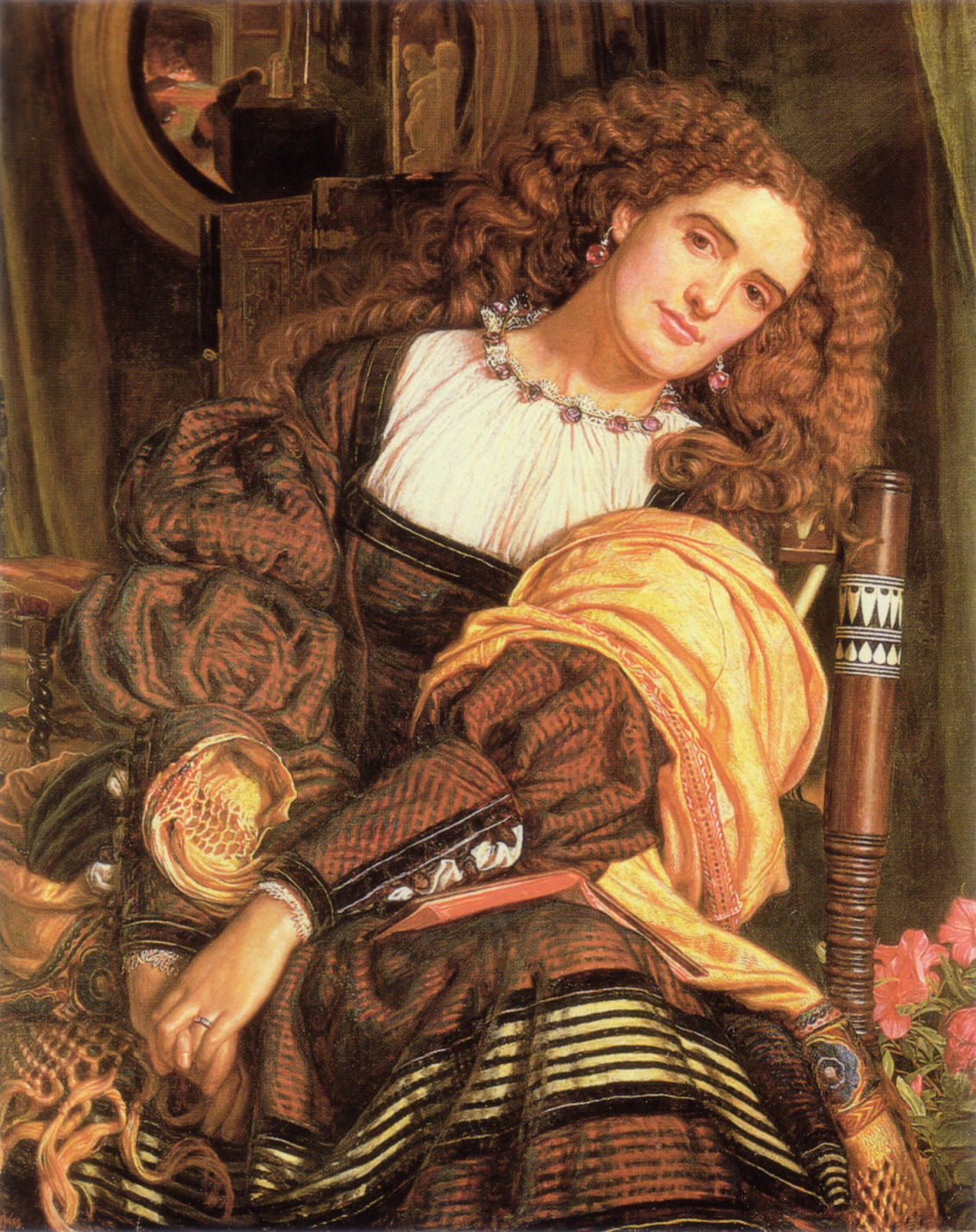
huntdolcefarniente
William Holman Hunt (1827–1910), Dolce Far Niente (1865-75), oil on canvas, 99 × 82.5 cm, Private collection. Wikimedia Commons.

Soon after William Holman Hunt had completed his Awakening Conscience above, he started work on another painting using a smaller circular mirror to extend the scene and its reading, Dolce Far Niente, which may have been started as early as 1859 but wasn’t completed until 1875. The reflection in the mirror above the woman’s head shows this to be a domestic scene, with another figure leaning over a large wooden bureau or a dressing-table, perhaps.

So far, these examples have all appeared to conform to optical principles. It was Édouard Manet who challenged those.

Édouard Manet (1832–1883), A Bar at the Folies-Bergère (1882), oil on canvas, 96 x 130 cm, The Courtauld Gallery, London. Wikimedia Commons.

His Bar at the Folies-Bergère from 1882 poses the problem of resolving the optically impossible, no matter how you try to read it. This forlorn young woman is serving at the bar in front of her, with what is presumed to be a large mirror behind showing a reflection that doesn’t match its original. Arranged on the bar are assorted bottles of beers and spirits, that on the far left bearing the artist’s signature. According to the reflection, the audience at the Folies-Bergère are watching the show under the light of a huge chandelier.

IF
John William Waterhouse (1849–1917), Circe Offering the Cup to Odysseus (1891), oil on canvas, 149 x 92 cm, Gallery Oldham, Manchester, England. Wikimedia Commons.

John William Waterhouse’s Circe Offering the Cup to Odysseus from 1891 develops the circular mirror of the Arnolfini Wedding into a key narrative device. Circe sits on her throne, holding up a krater for Ulysses to drink, with her wand in the other hand. The viewer is Ulysses, seen preparing to draw his sword in the large mirror behind the sorceress. On the left side of the mirror is his ship.

In the closing years of his career, Waterhouse returned with an even larger mirror at the centre of his story.

waterhousehalfsickshadows
John William Waterhouse (1849–1917), “I am Half Sick of Shadows” said the Lady of Shalott (1915), oil on canvas, 100 x 74 cm, Art Gallery of Ontario, Toronto, Canada. Wikimedia Commons.

His “I am Half Sick of Shadows” said the Lady of Shalott (1915) is the third and last of his paintings based on the poem The Lady of Shalott by Alfred Lord Tennyson (1809–1892), published in 1833 and 1842. This recounts part of the Arthurian legends, the tragedy of Elaine of Astolat, as retold in an Italian novella from the 1200s from which it draws its title.

The Lady of Shalott lives in a castle connected to Camelot by a river. She’s subject to a mysterious curse confining her to weaving images on her loom, and mustn’t look directly at the outside world, although she can view it using a mirror. Tennyson calls these reflected images ‘shadows of the world’, and this painting depicts the stanza from the poem:

But in her web she still delights
To weave the mirror’s magic sights,
For often thro’ the silent nights
A funeral, with plumes and lights,
And music, went to Camelot:
Or when the moon was overhead,
Came two young lovers lately wed;
‘I am half sick of shadows,’ said
The Lady of Shalott.

The circular image behind her isn’t a window, but a mirror revealing Camelot with its winding river. Although this includes her loom, the castle can’t be real, but one of “the mirror’s magic sights”.

My last example, painted just before the Second World War by Paul Nash, extends this deeper into the unconscious.
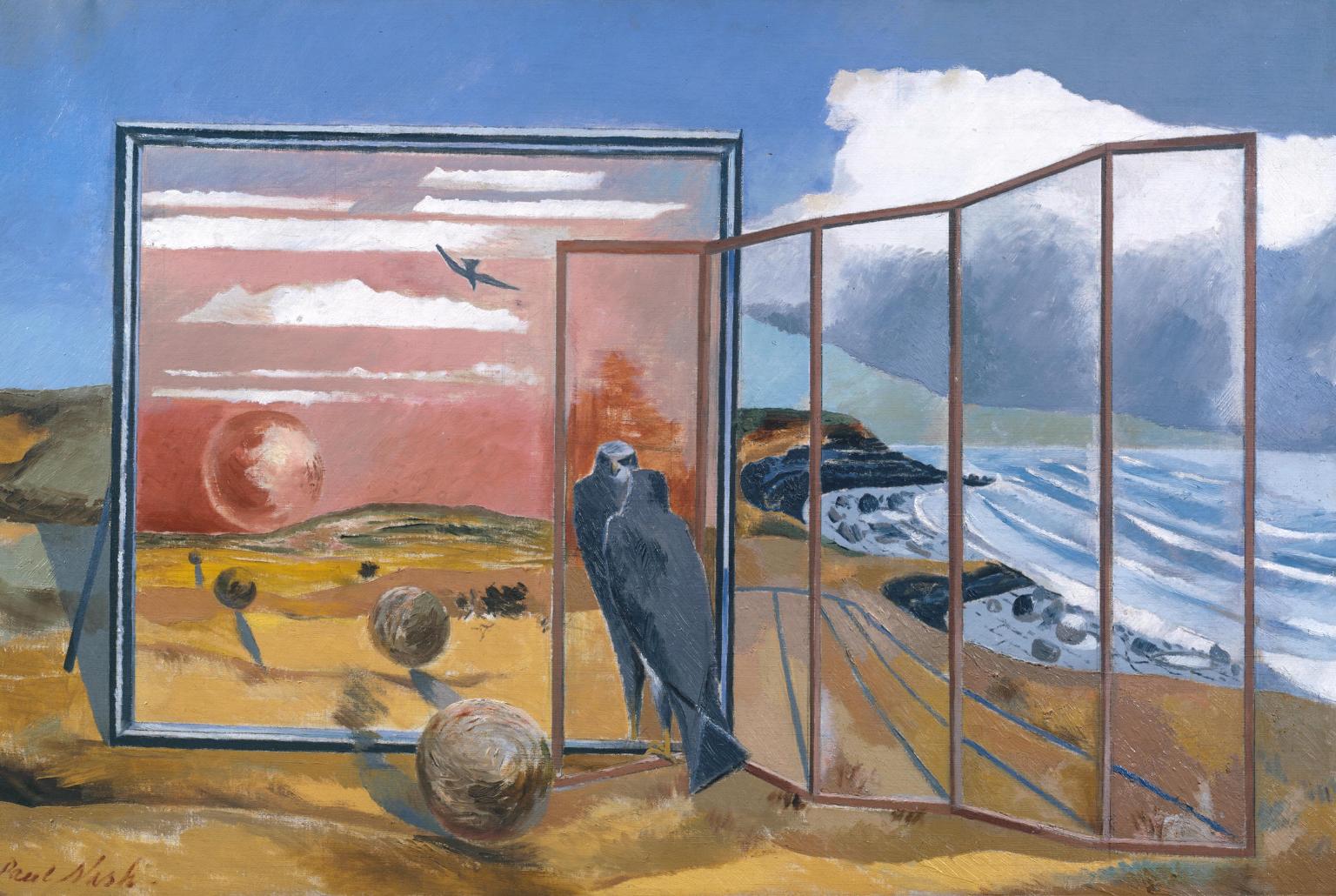
Landscape from a Dream 1936-8 by Paul Nash 1889-1946
Paul Nash (1892–1946), Landscape from a Dream (1936-38), oil on canvas, 67.9 x 101.6 cm, The Tate Gallery (Presented by the Contemporary Art Society 1946), London. © The Tate Gallery and Photographic Rights © Tate (2016), CC-BY-NC-ND 3.0 (Unported), http://www.tate.org.uk/art/artworks/nash-landscape-from-a-dream-n05667

Landscape from a Dream (1936-38) was inspired by Freud’s theories of the significance of dreams as reflections of the unconscious. Nash locates this collection of incongruous objects on the Dorset coast, a landscape he associated with the praeternatural. Dominating the scene is a large framed planar mirror, almost parallel with the picture plane.

Stood at the right end of the mirror is a hawk staring at its own reflection, which Nash explained is a symbol of the material world. To the left, the mirror reflects several floating spheres, referring to the soul. The reflection shows that behind the viewer is a red sun setting in a red sky, with another hawk flying high, away from the scene. To the right of the hawk is a five-panelled screen made of glass, through which the coastal landscape can be seen: it’s a screen which doesn’t screen.

A walk in the parks of London and Paris

This weekend, as the season moves steadily towards summer, we’re on a whistle-stop tour of six famous parks in five great cities, that for many are the closest they’ll get to real countryside.

As cities grew during the nineteenth century, what had been countryside in and around them was swallowed up by housing and factories. In the first couple of decades, livestock grazed and cows were milked within a couple of miles of the centre of London.

B2014.2
Benjamin West (1738–1820), Milkmaids in St. James’s Park, Westminster Abbey beyond (c 1801), oil on panel, further details not known. Wikimedia Commons.

The American history painter Benjamin West painted this view of Milkmaids in St. James’s Park, Westminster Abbey beyond in about 1801. Two cows and attendant milkmaids are providing a supply of fresh milk for the crowds in this royal park with Buckingham Palace on its edge. This remains 57 acres (23 hectares) of grass, trees and lakes in central London.

linnelleveningbayswater
John Linnell (1792–1882), Evening, Bayswater (1818), oil on panel, 38.3 x 58.1 cm, Yale Center for British Art, New Haven, CT. Wikimedia Commons.

John Linnell’s Evening, Bayswater from 1818, only two centuries ago, shows what was then a rural part of London, out to the west of what’s now Paddington Station, in more peaceful times before this area was assimilated into the growing city. Although it has retained some garden squares, this became a densely populated area during the nineteenth century.

denittisserpentine
Giuseppe De Nittis (1846–1884), The Serpentine, Hyde Park, London (1878), oil on panel, 26.7 x 35.6 cm, Private collection. Athenaeum.

The lake shown in Giuseppe De Nittis’ view of The Serpentine, Hyde Park, London from 1878 is the eastern section of a single body of water marking the boundary between Hyde Park and Kensington Gardens. Once fed from a small river, that became so polluted it has long been supplied by water from three boreholes. It hosts a swimming club, rowing boats, and a solar-powered ferry.

fannerhydepark
Alice Maud Fanner (1866-1930), Hyde Park (c 1900), further details not known. Image by Leonard Bentley, via Wikimedia Commons.

Alice Maud Fanner painted this view of the edge of Hyde Park, London, in about 1900. The London plane trees are leafless, indicating this is a fine day in the winter, although the figures look lightly dressed for that time of year. The view looks north-east towards the road encircling the park and mansions in Park Lane beyond. This park is, at 350 acres (140 hectares), the largest of a chain of Royal Parks running from Kensington Gardens in the west, past Buckingham Palace to St James’s Park to the southeast.

Kensington Gardens: Vicinity of the Pond ?1907 by Paul Maitland 1863-1909
Paul Fordyce Maitland (1863–1909), Kensington Gardens: Vicinity of the Pond (c 1907), oil on canvas, 25.4 x 45.4 cm, The Tate Gallery (Presented by Cyril Andrade 1928), London. © The Tate Gallery and Photographic Rights © Tate (2016), CC-BY-NC-ND 3.0 (Unported), https://www.tate.org.uk/art/artworks/maitland-kensington-gardens-vicinity-of-the-pond-n04398

Kensington Gardens: Vicinity of the Pond, painted by Paul Fordyce Maitland in about 1907, shows the Oval Pond in the middle of these gardens, another of the Royal Parks in London, to the west of the Serpentine Lake in the adjacent Hyde Park.

Over the same period, central Paris was extensively rebuilt, but preserved some of its green spaces, including the gardens of the Tuileries Palace.

The Tuileries Garden in central Paris is the city’s best-known open space. It runs between the Louvre and the Place de la Concorde with its iconic Arc de Triomphe, an area of 63 acres (25.5 hectares). Shortly before painting his most famous scene in the Tuileries, Édouard Manet completed a smaller and less ambitious work set among its trees, Children in the Tuileries Garden (c 1861-2).

Édouard Manet (1832–1883), Children in the Tuileries Garden (c 1861-2), oil on canvas, 37.8 x 46 cm, RISD Museum, Rhode Island School of Design, RI. Wikimedia Commons.

Seen now as the work which gave him the idea for his second painting, this shows a small group of children apparently being directed by an older girl in black, with a blue bonnet. There’s an eery impersonality about the figures, though, as they’re either viewed from behind, or have little or no detail in their faces.

Édouard Manet (1832–1883), Music in the Tuileries (1862), oil on canvas, 76.2 × 118.1 cm, The National Gallery, London, and the Hugh Lane, Dublin. Courtesy of National Gallery (CC), via Wikimedia Commons.

Manet’s Music in the Tuileries from 1862 is one of ten paintings shared between the National Gallery in London, and the Hugh Lane in Dublin, as part of the Hugh Lane bequest. Packed into its rhythmic layout of trees are members of the fashionable Parisian crowd, who have come to listen to the music, socialise, and chat. Historians have identified many of Manet’s circle among them: the poet Baudelaire, novelist Gautier, composer Offenbach, Fantin-Latour the painter, and the artist’s brother Eugène, a painter who married Berthe Morisot, the Impressionist.

Adolph Menzel (1815–1905), Afternoon in the Tuileries Gardens (1867), oil on canvas, 49 x 70 cm, The National Gallery, London. Courtesy of National Gallery (CC), via Wikimedia Commons.

Adolph Menzel’s Afternoon in the Tuileries Gardens from 1867 is assumed to have been inspired by Manet’s Music in the Tuileries, and has compositional similarities. He includes some direct quotations of figures in homage to Manet’s work. However, Menzel remained a realist, as shown in finely detailed foliage, foreground shadows and the figures. He was known to have made several sketches in the Tuileries Gardens, but painted this work back in his Berlin studio. Conventionally this would have been based on those sketches, but when Menzel first showed the work he claimed it was executed from memory.

Maurice Brazil Prendergast (1861–1924), The Tuileries Gardens, Paris (1895). Wikimedia Commons.

The Tuileries Gardens, Paris (1895) may have been painted shortly before Maurice Brazil Prendergast left the city to return to Boston, MA. While he was in Paris he met Édouard Vuillard, whose influence appears to have extended to his use of colour here, and Pierre Bonnard, an addicted sketcher of street scenes in Paris.

Camille Pissarro (1830–1903), The Garden of the Tuileries on a Spring Morning (1899), oil on canvas, 73.3 × 92.1 cm, The Metropolitan Museum of Art, New York, NY. Wikimedia Commons.

Pissarro’s Garden of the Tuileries on a Spring Morning from the same year is an aerial view of the gardens when they’re well into Spring, with the trees in full leaf, in their brilliant fresh green foliage.

Tomorrow we’ll resume in the city of Rome.

Naturalists: The modern meal

Eating together with family and friends is one of the great social events, and became a popular theme in nineteenth century painting. It was enthusiastically adopted by several of the leading Naturalist painters, as shown below.

manetluncheonongrass
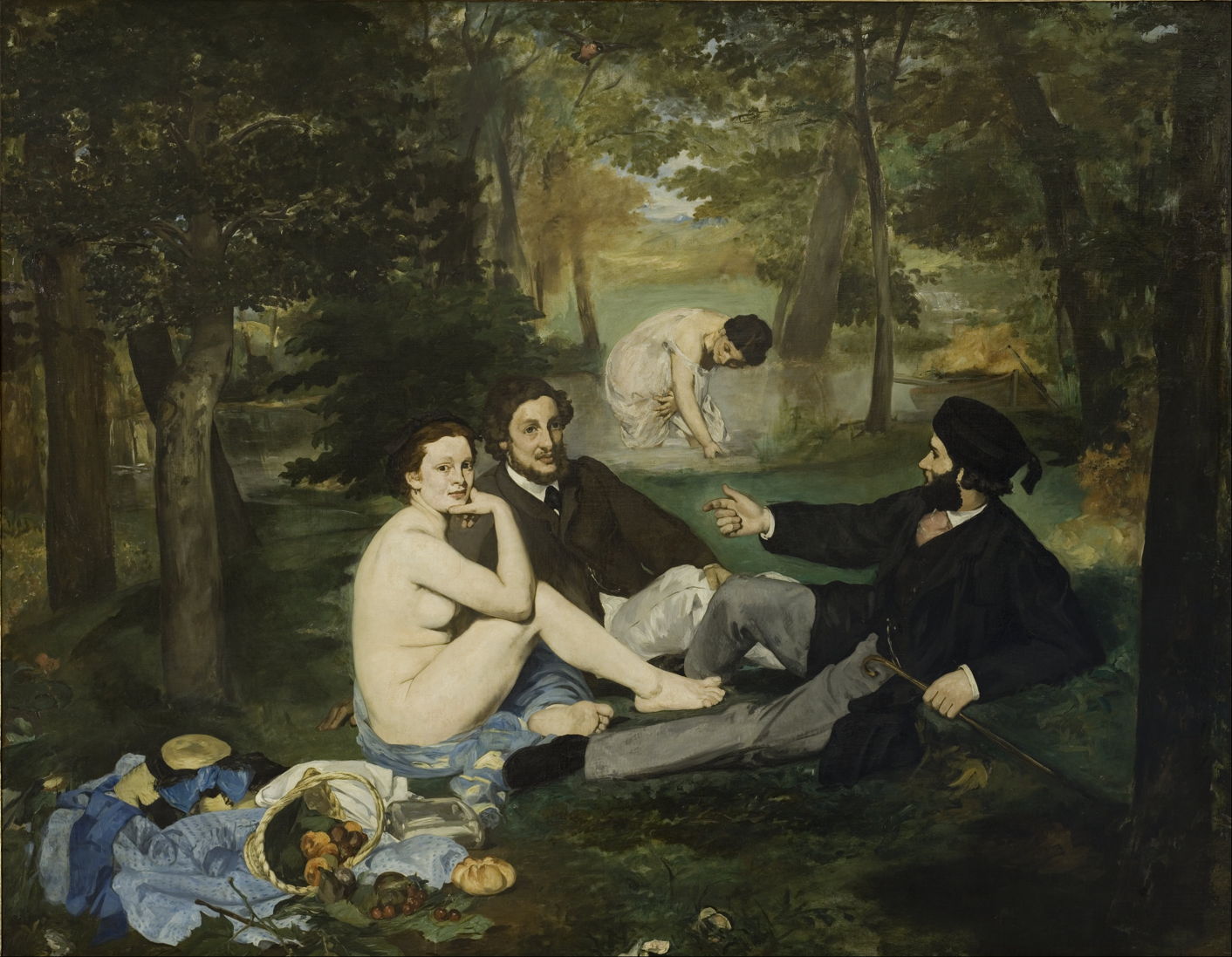
Édouard Manet (1832-1883), Le Déjeuner sur l’herbe (Luncheon on the Grass) (1863), oil on canvas, 208 × 264.5 cm, Musée d’Orsay, Paris. Wikimedia Commons.

Édouard Manet’s Le Déjeuner sur l’herbe from 1863 is one of the best-known if not infamous paintings of a social meal. Two couples are apparently disinterested in the token picnic of fruit and bread that has spilled out from its basket in the left foreground. As the two men talk, fully dressed, a conspicuously naked woman stares unnervingly at the viewer, and the other woman is washing herself in the river behind. This was rejected by the Salon of that year, ensuring its lasting fame and influence.

lepoittevinpicnic
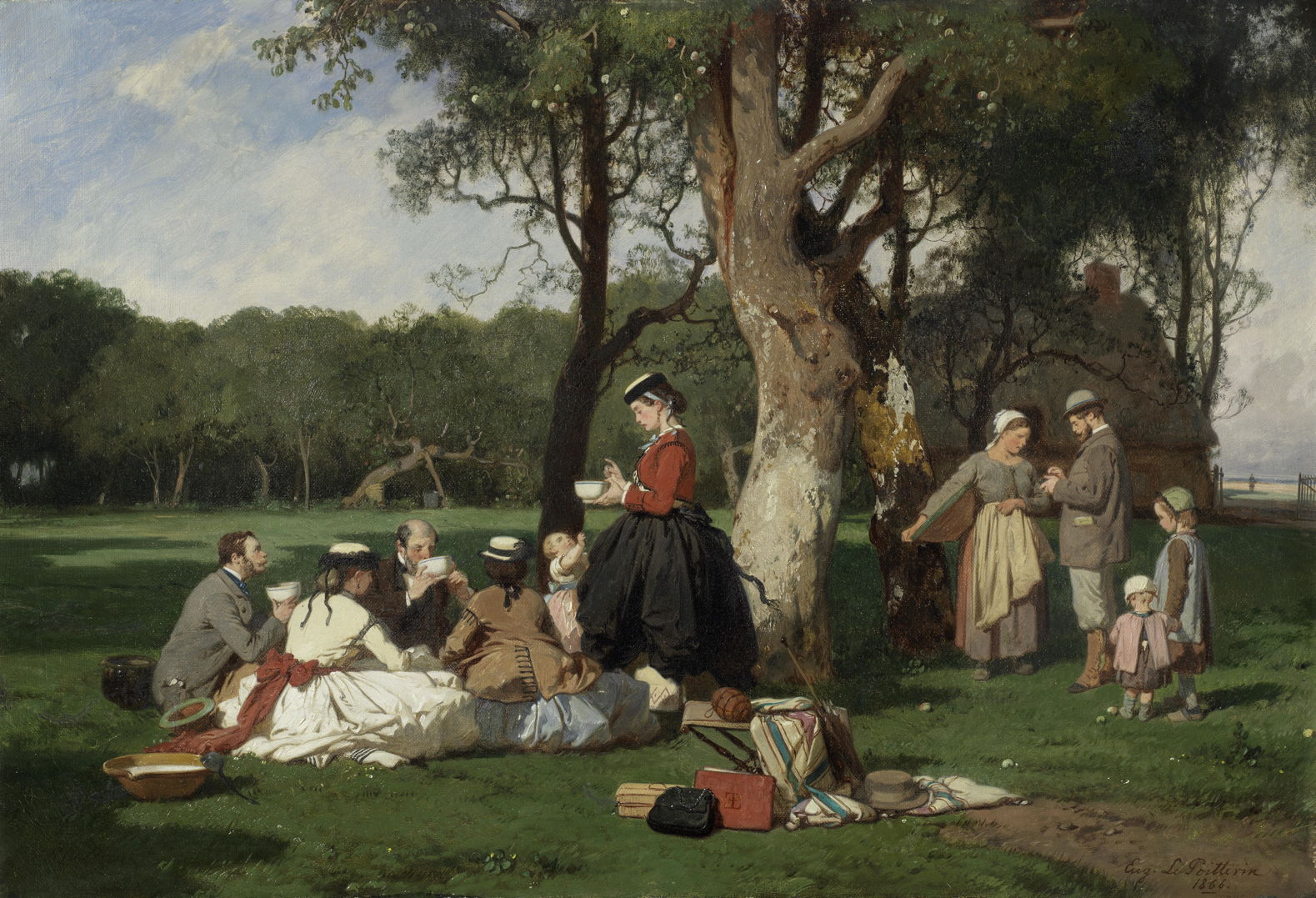
Eugène Lepoittevin (1806-1870), A Picnic (1866), oil on canvas, 43 x 62.5 cm, location not known. Wikimedia Commons.

A far cry from Manet’s meal, Eugène Lepoittevin’s Picnic from 1866 captures a picnic’s distinctive combination of the planned and impromptu. This group has lugged crockery, soup and a folding stool for their simple meal sitting on the grass under some trees.

renoirluncheonboatingparty
Pierre-Auguste Renoir (1841–1919), Luncheon of the Boating Party (1880-81), oil on canvas, 130.2 x 175.6 cm, The Phillips Collection, Washington, DC. Wikimedia Commons.

Renoir’s masterpiece Luncheon of the Boating Party (1880-81) is set on the Île de Chatou under the awning of the Restaurant Fournaise. Among his models are his partner and later wife Aline Charigot (left foreground, with affenpinscher dog), the actress Jeanne Samary (upper right), and fellow artist Gustave Caillebotte (seated, lower right). This meal seems all but over, the wineglasses near-empty as the party turns from eating to conversation.

denittisbreakfastingarden
Giuseppe De Nittis (1846–1884), Breakfast in the Garden (c 1883), oil on canvas, 81 x 117 cm, Pinacoteca De Nittis, Barletta, Italy. By LPLT, via Wikimedia Commons.

In summer, breakfast became a favourite meal in your own garden. Just a year before his untimely death in 1884, the Italian peri-Impressionist Giuseppe De Nittis painted this startling Breakfast in the Garden, with its contrast between the detail of the glass soda syphon, covered bowl, glasses, and other reflective materials on the table, and its wonderfully sketchy garden background.

ringboygirllunch
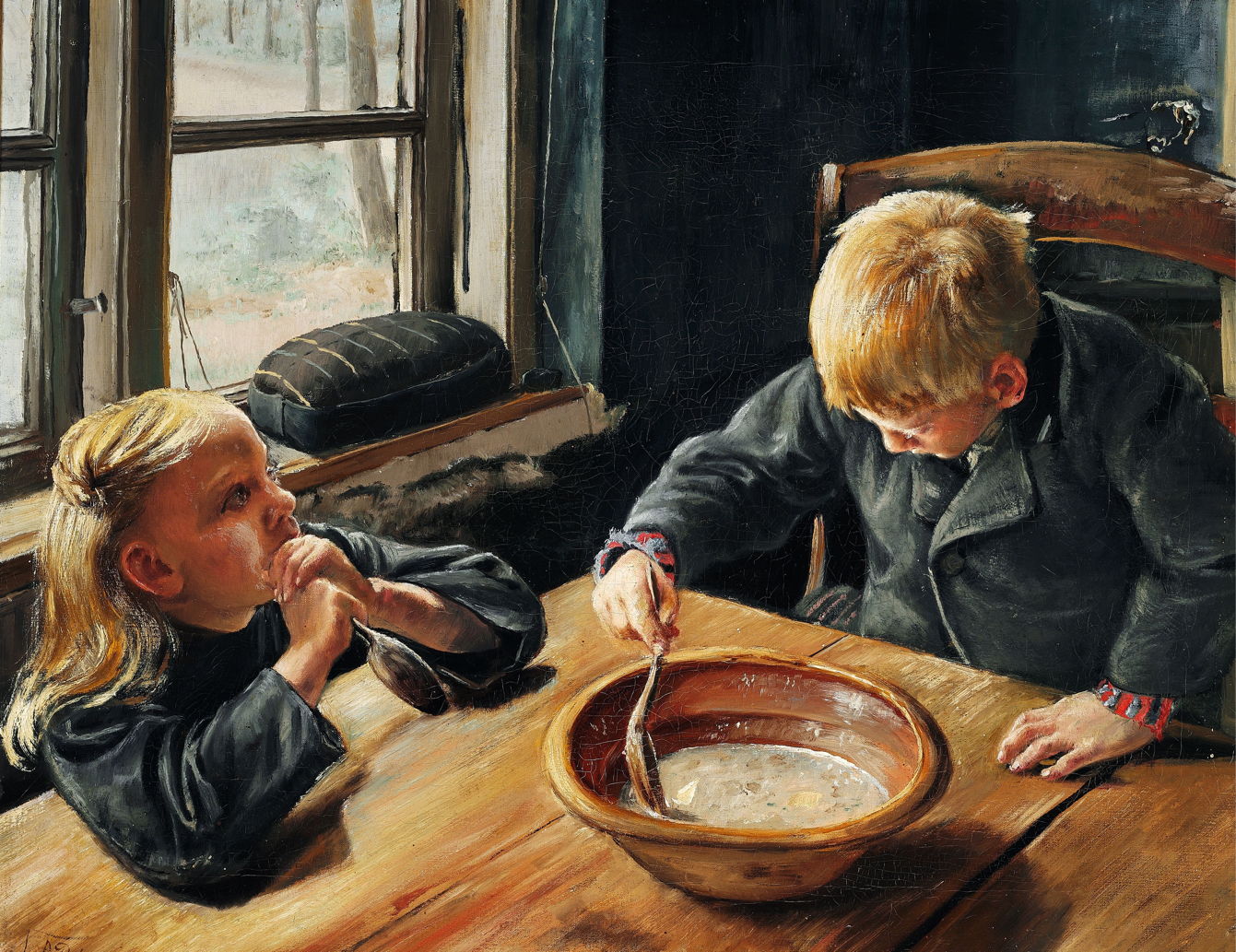
Laurits Andersen Ring (1854–1933), A Boy and a Girl Eating Lunch (1884), oil on canvas, 44 x 56 cm, location not known. Wikimedia Commons.

Laurits Andersen Ring was more pointed in his social message in A Boy and a Girl Eating Lunch, from 1884. Paupers’ children, they have a single bowl of broth between them, and there’s not even a hint of wine and fruit. The girl looks up in tears, hoping for a miracle to change their lives, and take them away from this bare wooden table and blackened walls.

MSKG - Het begrafenismaal - Léon Frédéric (1886)
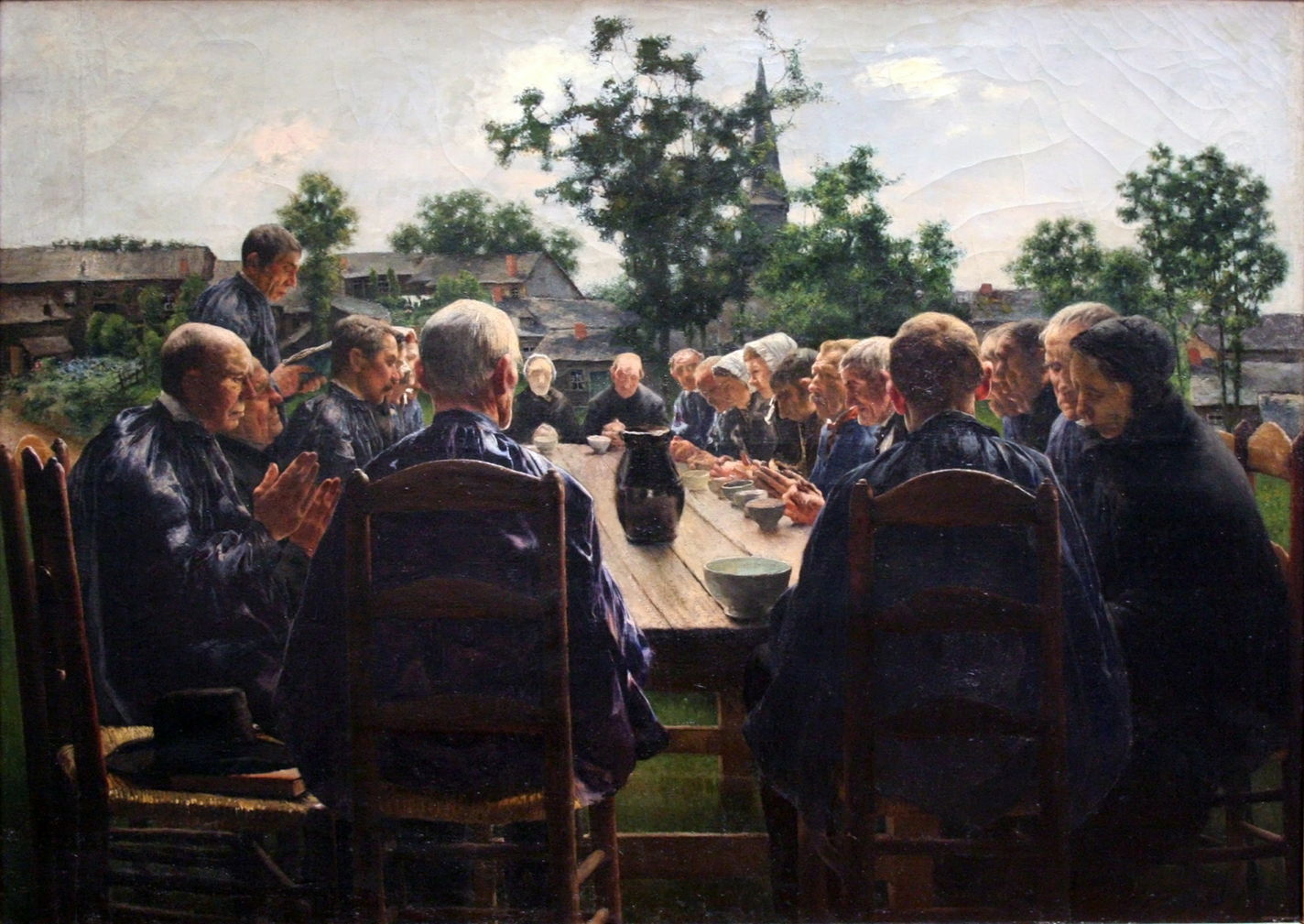
Léon Frédéric (1856–1940), The Funeral Meal (1886), oil on canvas, 125.5 x 177.5 cm, Museum voor Schone Kunsten, Ghent, Belgium. Image by Ophelia2, via Wikimedia Commons.

Léon Frédéric’s Funeral Meal from 1886 shows a large group of mourners sitting outside in the summer sunshine to remember the deceased following their funeral. Their meal is simple if not frugal, and there are neither glasses of wine nor mugs of beer. This is the moment that grace, or perhaps a eulogy for the deceased, is being read.

friantcanotiersmeurthe
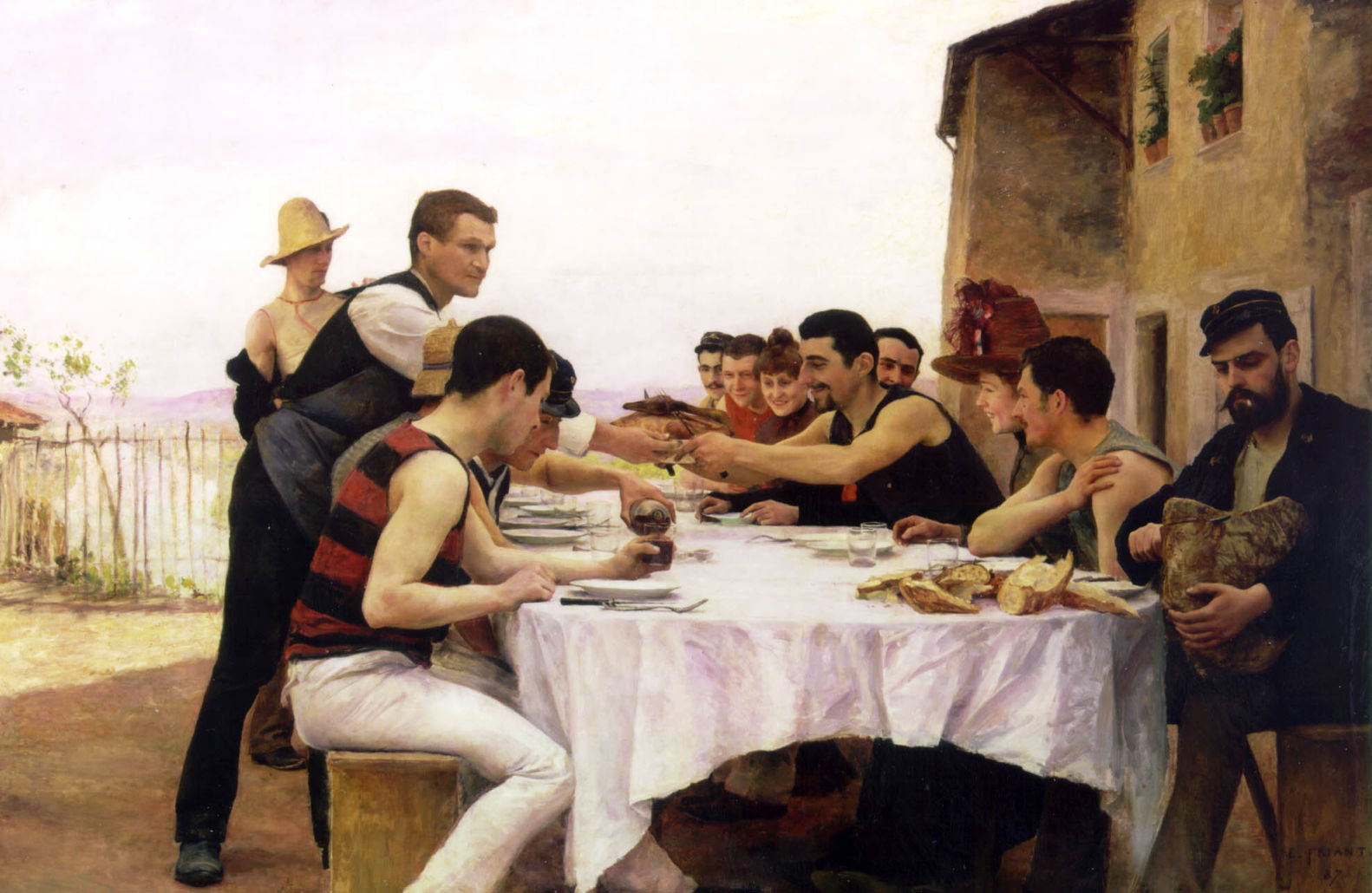
Émile Friant (1863–1932), The Meurthe Boating Party (Reunion of the Meurthe Boating Party) (1887), oil on canvas, 110 x 166 cm, Musée de l’École de Nancy, Nancy, France. Wikimedia Commons.

Now almost forgotten is Émile Friant’s masterpiece The Meurthe Boating Party, also known as Reunion of the Meurthe Boating Party or The Oarsmen of the Meurthe, from 1887. This shows the artist’s watersporting friends eating lunch together on the river Meurthe in Nancy. This can be read as a broad message of well-being and conviviality: healthy, fit young men engaged in team sports; fraternity; and harmony across different classes within society. It was exhibited at the Salon in 1888, and as a result of its success was featured as a full page in the popular magazine Le Monde Illustré, bringing Friant instant fame.

paulibreakfasttime
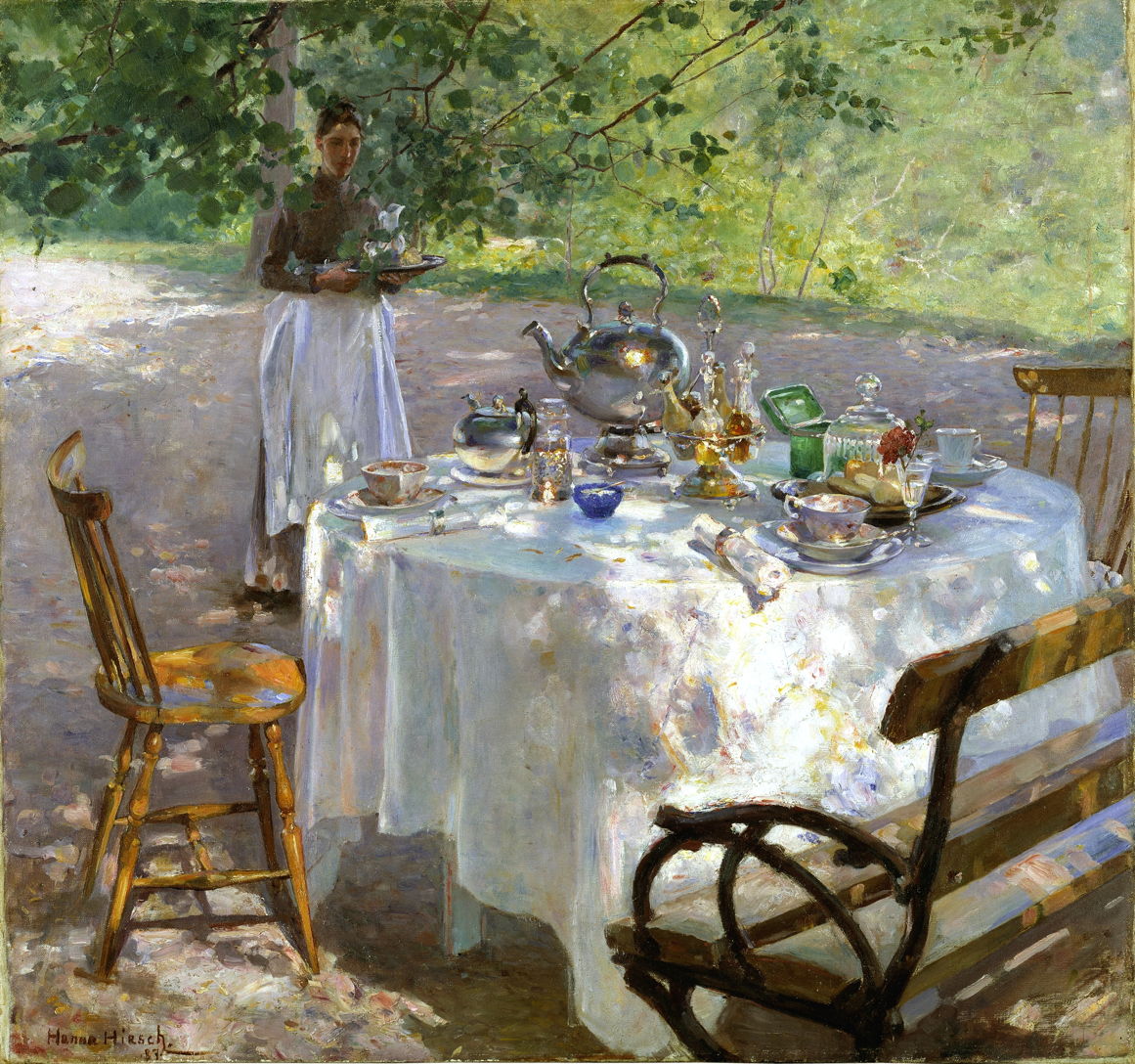
Hanna Pauli (1864-1940), Breakfast-Time (1887), oil on canvas, 87 x 91 cm, Nationalmuseum, Stockholm, Sweden. Wikimedia Commons.

That same year the 23-year-old Swedish painter Hanna Pauli made the meal table the centrepiece of her virtuoso painting of Breakfast-Time (1887). She uses it as a demonstration of her skills in depicting the reflective surfaces of silverware, porcelain and abundant glassware, but its table is now deserted.

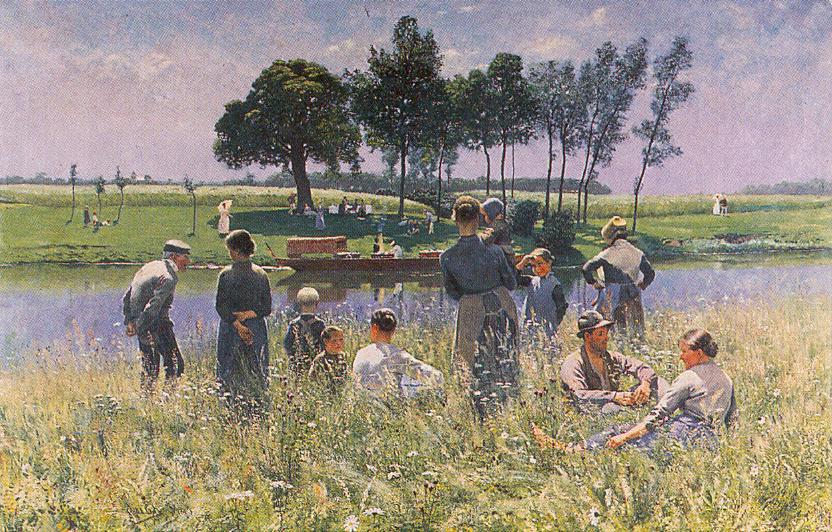
Émile Claus, Pique-nique, paysage la Lys (The Picnic) (1887), oil on canvas, 129 x 198 cm, Institut Royal du Patrimoine artistique, Brussels. WikiArt.
Émile Claus (1849-1924), Pique-nique, paysage la Lys (The Picnic) (1887), oil on canvas, 129 x 198 cm, Institut Royal du Patrimoine artistique, Brussels. WikiArt.

The Belgian artist Émile Claus also painted The Picnic in 1887. It’s set in the French/Belgian countryside around the River Lys, in the area of Ypres, which was devastated during the First World War. The plain clothing worn indicates these are poor farmworkers rather than landowners.

❌