Reading view

There are new articles available, click to refresh the page.

Hero or hooligan: Perseus 2

The legendary hero Perseus was the son of Danaë, conceived when Zeus/Jupiter impregnated her in a shower of gold. He had been sent by Polydectes on a mission to bring him the head of Medusa, and on his return with that secured in a kibisis, he stopped off in Ethiopia, where the princess Andromeda was awaiting sacrifice to the sea monster Cetus.

titianandromeda
Titian (Tiziano Vecelli) (1490–1576), Perseus and Andromeda (1553-9), oil on canvas, 179 × 197 cm, The Wallace Collection, London. Wikimedia Commons.

Titian’s Perseus and Andromeda (1553-59) shows the height of the action, remaining largely faithful to Ovid’s account of this story. All three actors are present, with Andromeda still shackled and Perseus attacking Cetus from the air using a sword with a curved blade.

veroneseperseus
Paolo Veronese (1528–1588), Perseus Rescuing Andromeda (1576-78), oil on canvas, 260 × 211 cm, Musée des Beaux-Arts, Rennes, France. Wikimedia Commons.

Paolo Veronese’s Perseus Rescuing Andromeda followed soon afterwards, in 1576-78. His composition is similar to Titian’s, and equally faithful to the text, but his additional attention to the details of Perseus and Cetus brings this to life.

burnejonesperseus8b
Edward Burne-Jones (1833–1898), The Perseus Series: The Doom Fulfilled (1888), oil on canvas, 155 × 140.5 cm, Staatsgalerie Stuttgart, Stuttgart. Wikimedia Commons.

In the ninth painting in Edward Burne-Jones’ series, The Doom Fulfilled (1888), Perseus is swathed in Cetus’ coils with their almost calligraphic form, brandishing his sword and ready to slaughter the monster and bring its terror to an end.

vallottonperseuskillingdragon
Félix Edouard Vallotton (1865-1925), Perseus Killing the Dragon (1910), oil on canvas, 160 x 233 cm, Musée d’art et d’histoire de Genève, Geneva. By Codex, via Wikimedia Commons.

In the early twentieth century, the former Nabi artist Félix Edouard Vallotton painted a series of narrative works, including his Perseus Killing the Dragon, from 1910, a thoroughly contemporary interpretation that is exceptionally free with Ovid’s account.

As with most classical myths, several variants of the story have developed over time. All painted accounts that I have seen follow the action-packed version in which Perseus slays Cetus with his sword, but some literary versions report that the sea monster was turned to stone by Medusa’s face, which would have made far duller paintings.

A more recent variant has the hero flying to Andromeda’s aid not with his winged sandals, but on the back of the winged horse Pegasus.

rubensperseusandromeda
Peter Paul Rubens (1577–1640), Perseus and Andromeda (c 1622), oil on canvas, 99.5 x 139 cm, Hermitage Museum, Saint Petersburg, Russia. Wikimedia Commons.

By the time that Rubens came to paint Perseus and Andromeda in about 1622, the newer revised version including Pegasus seems to have become popular. Andromeda is at the left, unchained from her rock where she had been placed as a delightful morsel for Cetus, which has just been killed by Perseus and now lies at the lower edge with its fearsome mouth wide open. Perseus is in the process of claiming Andromeda’s hand as his reward, for which he is being crowned with laurels. Although he clearly flew in on Pegasus, he is still wearing his winged sandals, and holds the polished shield reflecting Medusa’s face and snake hair.

pierodicosimofreeingofandromeda
Piero di Cosimo (1462–1521), Andromeda freed by Perseus (c 1510-15), oil on panel, 70 x 123 cm, Galleria degli Uffizi, Florence. Wikimedia Commons.

Piero di Cosimo uses multiplex narrative to show most of the story in his large Andromeda Freed by Perseus (c 1510-15). Centred on the great bulk of Cetus, Perseus stands on its back and is about to hack at its neck with his curved sword. At the upper right, Perseus is shown a few moments earlier, as he was flying past in his winged sandals. To the left of Cetus, Andromeda is still secured to the rock by red fabric bindings, not chains, and is bare only to her waist.

In the foreground in front of Cetus are Andromeda’s parents stricken in grief. Near them is a group of courtiers with ornate head-dress. But in the right foreground the wedding party is already in full swing, complete with musicians and dancers.

Perseus’ reward for rescuing Andromeda and saving the kingdom of Ethiopia was naturally the hand of the princess in marriage. There was only one obstacle, that she had already been promised to Phineus, who was clearly no match when it came to killing sea monsters. Whether or not Phineus was invited, he and his friends turned up at the wedding of Andromeda and Perseus, and trouble soon broke out. The punch-up turned lethal when the weapons came out, and Perseus decided it was time to show Medusa’s face to the unwelcome guests.

ricciperseusconfronts
Sebastiano Ricci (1659–1734), Perseus Confronting Phineus with the Head of Medusa (c 1705-10), oil on canvas, 64.1 × 77.2 cm, The J. Paul Getty Museum, Los Angeles, CA. Courtesy of J. Paul Getty Museum.

Sebastiano Ricci’s Perseus Confronting Phineus with the Head of Medusa (c 1705-10) shows the final moments of the battle, as Phineus cowers next to two of his henchmen who have almost completed the process of changing into stone. Although not shown here, Athena herself turned up to make sure that no one got the better of Perseus.

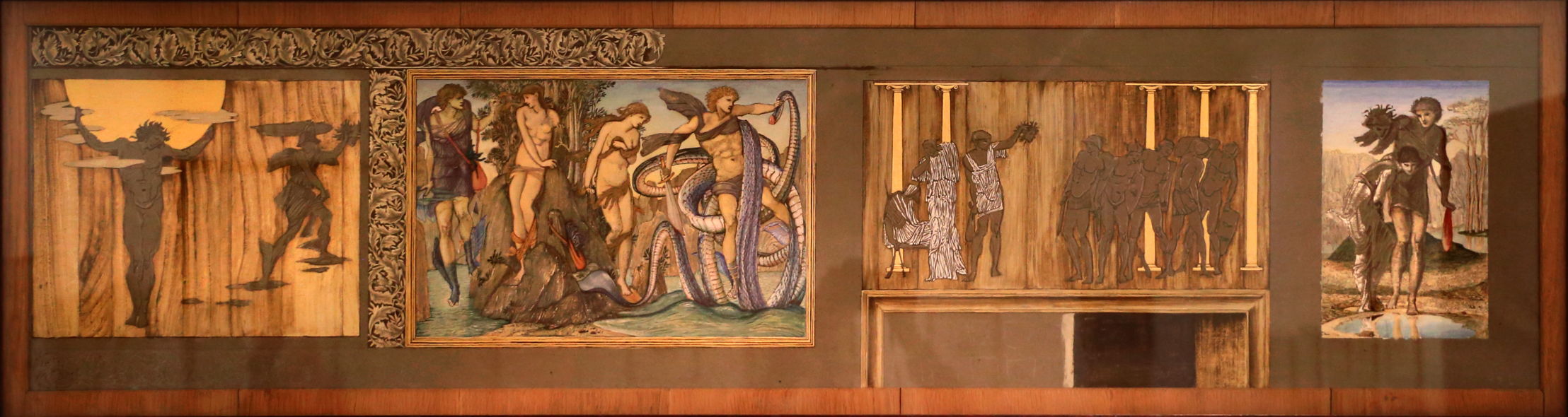
Edward Burne-Jones worked on many sketches and preliminary designs for his series, among which were gouache and gold layouts to show how his paintings would fit into their carved surrounds in his patron’s Music Room.
burnejonesperseusstudy
Edward Burne-Jones (1833–1898), Atlas Turned to Stone; The Rock of Doom and the Doom Fulfilled; The Court of Phineas; The Baleful Head (designs for The Story of Perseus) (1875-76), gouache, gold paint, graphite and chalk on paper, 36.7 x 148.7 cm, The Tate Gallery, London. Image by Sailko, via Wikimedia Commons.

This design shows an outline of the whole series, which had originally been intended to include Phineus and the wedding. The scenes shown are, from the left, Atlas Turned to Stone, The Rock of Doom and the Doom Fulfilled, The Court of Phineas, and The Baleful Head, shown below.
burnejonesperseus9b
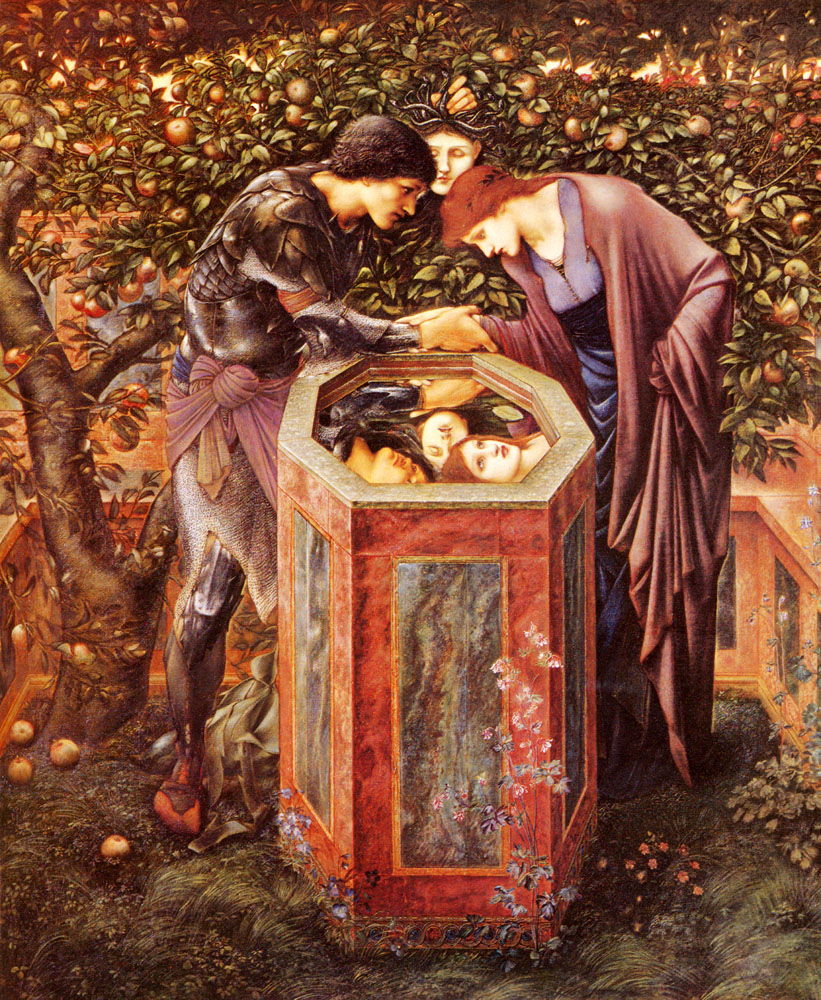
Edward Burne-Jones (1833–1898), The Perseus Series: The Baleful Head (1886-7), oil on canvas, 155 × 130 cm, Staatsgalerie Stuttgart, Stuttgart. Wikimedia Commons.

The tenth and final painting in Burne-Jones’ series, The Baleful Head (1885), shows Perseus and Andromeda, their right hands clenching one another’s wrists, looking at the image of Medusa’s face reflected in the surface of a well. This is set in a peaceful garden, with a fruit-laden apple tree behind, and flowers springing up from the grass beneath them.

Literary accounts take the couple on to live at Tiryns in Argos, from where Heracles/Hercules later undertook his Twelve Labours. They had seven sons and two daughters, and among their descendants were Heracles, Castor and Pollux, Clytemnestra, and the Achaemenid Persians.

When Perseus returned to Seriphos, he discovered Polydectes was still trying to seduce his mother Danaë. Perseus therefore used Medusa’s face to turn him to stone, and made Dictys king and his mother’s consort. His mission accomplished, Perseus returned the weapon and equipment loaned by the gods, and gave Athena the head of Medusa, which she then set in her shield as the Gorgoneion, more commonly referred to as the Aegis.
rubensjudgementparis
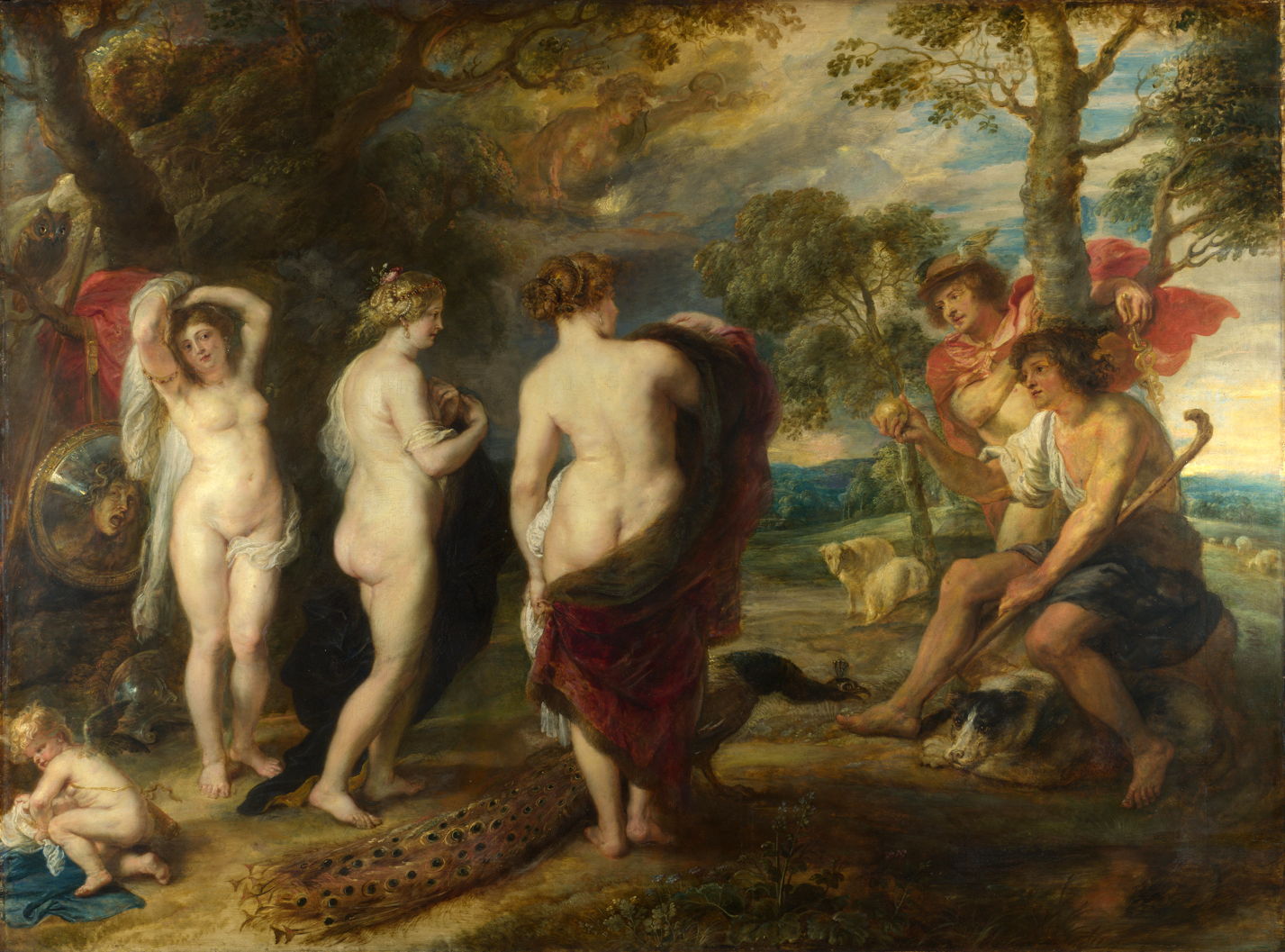
Peter Paul Rubens (1577–1640), The Judgement of Paris (1632-35), oil on oak, 144.8 x 193.7 cm, National Gallery, London. Wikimedia Commons.

Distinguishing the three goddesses taking part in The Judgement of Paris, shown in Rubens’ late account from 1632-35, often relies in part on the aegis. The three goddesses are, from the left, Athena with her shield, Aphrodite, and Hera with her peacock.

There was still one loose end to be tied, though: the prediction that Perseus would kill his father Acrisius. Various accounts are given of this, but consensus is that Perseus threw a quoit or discus that unintentionally struck Acrisius and killed him. Thereafter, he ruled a kingdom until he and Andromeda died. They were both catasterised into their own constellations, where they can still be seen today.

Centaurs 1: Fights

In Greek and Roman mythology centaurs were creatures with the upper body of a human, down to the waist, fused onto the body of a horse, with all its four legs. Although some tales about centaurs suggest otherwise, in general they represented the lower appetites and behaviours of humans, and were more like wild horses than people. They were known for their fights with Lapiths, an Aeolian tribe, against whom they wielded rocks and limbs of trees. Centaurs persisted in legends and stories well into the Middle Ages, and are the subject of this weekend’s two articles about paintings.

dicosimotritonsnereids
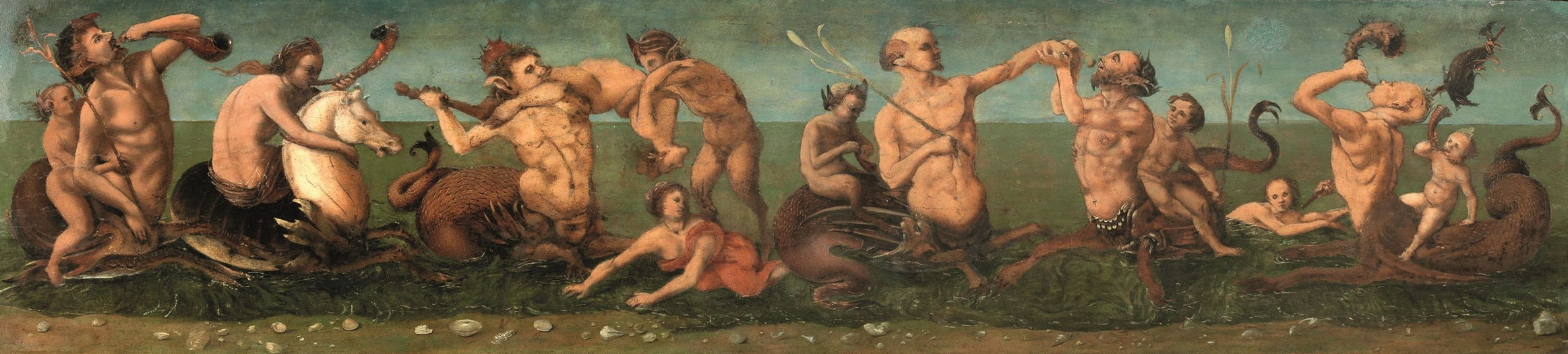
Piero di Cosimo (1462–1522), Tritons and Nereids, with Satyrs and Centaurs (c 1500-05), oil on panel, 37 x 158 cm, Private collection. Wikimedia Commons.

Piero di Cosimo’s assembly of Tritons and Nereids, with Satyrs and Centaurs painted in about 1500-05 shows an odd range of centaur-like creatures, and is believed to have been commissioned for the Palazzo Vespucci.

boecklinfightcentaurs
Arnold Böcklin (1827–1901), Fight of the Centaurs (1873), oil on canvas, 105 × 195 cm, Kunstmuseum Basel, Switzerland. Wikimedia Commons.

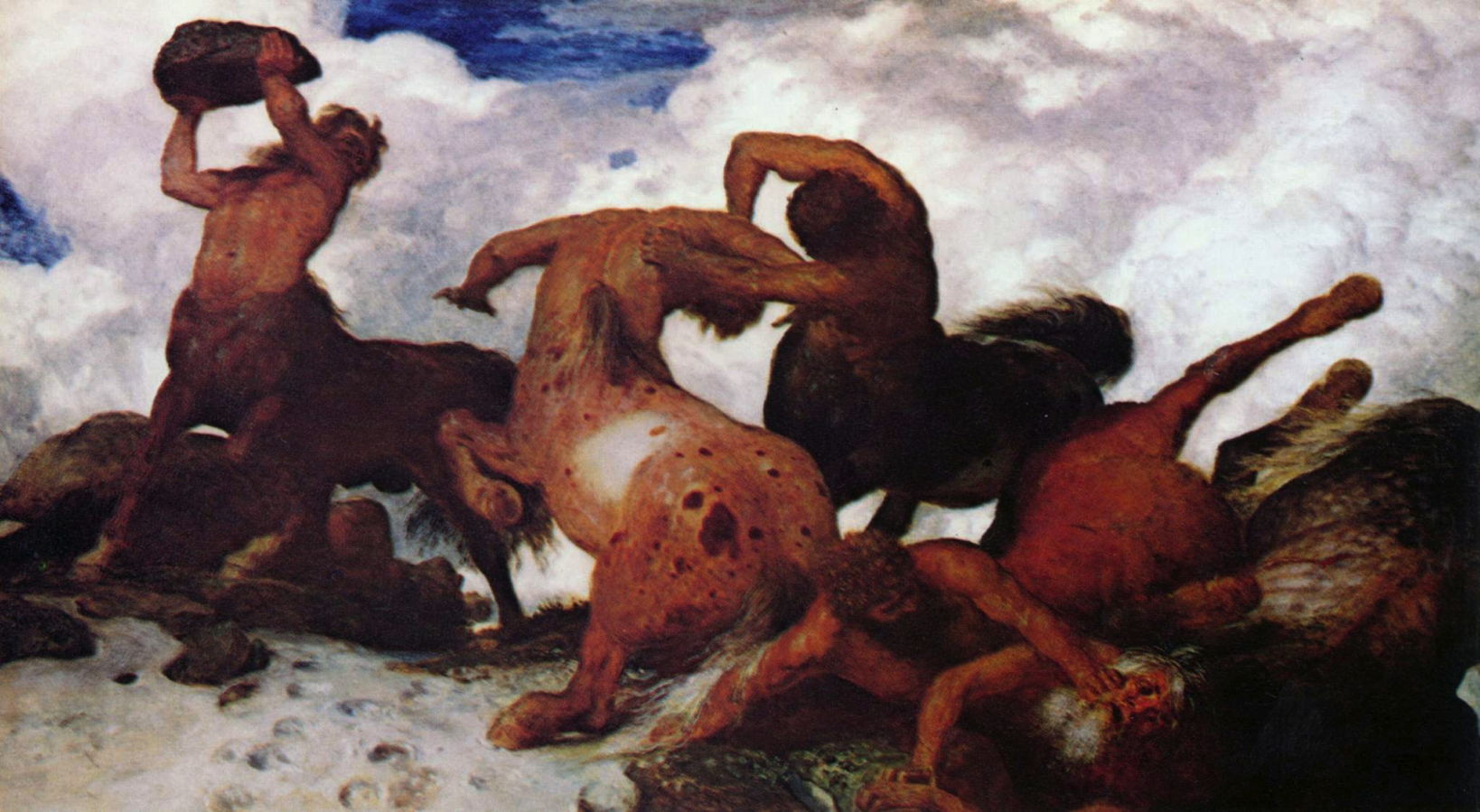
Those in Böcklin’s Fight of the Centaurs (1873) are behaving more in character, in hand-to-hand combat, and by wielding rocks.

But Eugène Delacroix had better to report.

delacroixachilles
Eugène Delacroix (1798–1863), Poetry: The Education of Achilles (1838-1847), oil on canvas, 221 x 292 cm, Bibliothèque de l’Assemblée nationale, Palais Bourbon, Paris. Wikimedia Commons.

In the Poetry cupola of the Library of the National Assembly in Paris, Delacroix painted The Education of Achilles. This shows the myth of the young Achilles with a bow and arrow, riding on the back of his tutor Chiron the centaur, on the steep slopes of Mount Pelion. This was to become one of Delacroix’s favourite motifs.

delacroixeducationachilles
Eugène Delacroix (1798–1863), The Education of Achilles (c 1862), pastel on paper, 30.6 x 41.9 cm, Getty Center, Los Angeles, CA. Wikimedia Commons.

His last known pastel painting, and one of his finest, is The Education of Achilles, painted in about 1862, showing the same scene of the ‘wisest and justest of all the centaurs’ Chiron teaching Achilles to hunt. The artist gave this to his longstanding friend Aurore Dudevant, better known under her pen name of George Sand.

michallontheseus
Achille Etna Michallon (1796–1822), Landscape: Theseus Pursuing the Centaurs (1821), oil on canvas, 218 x 273 cm, Musée du Louvre, Paris. Wikimedia Commons.

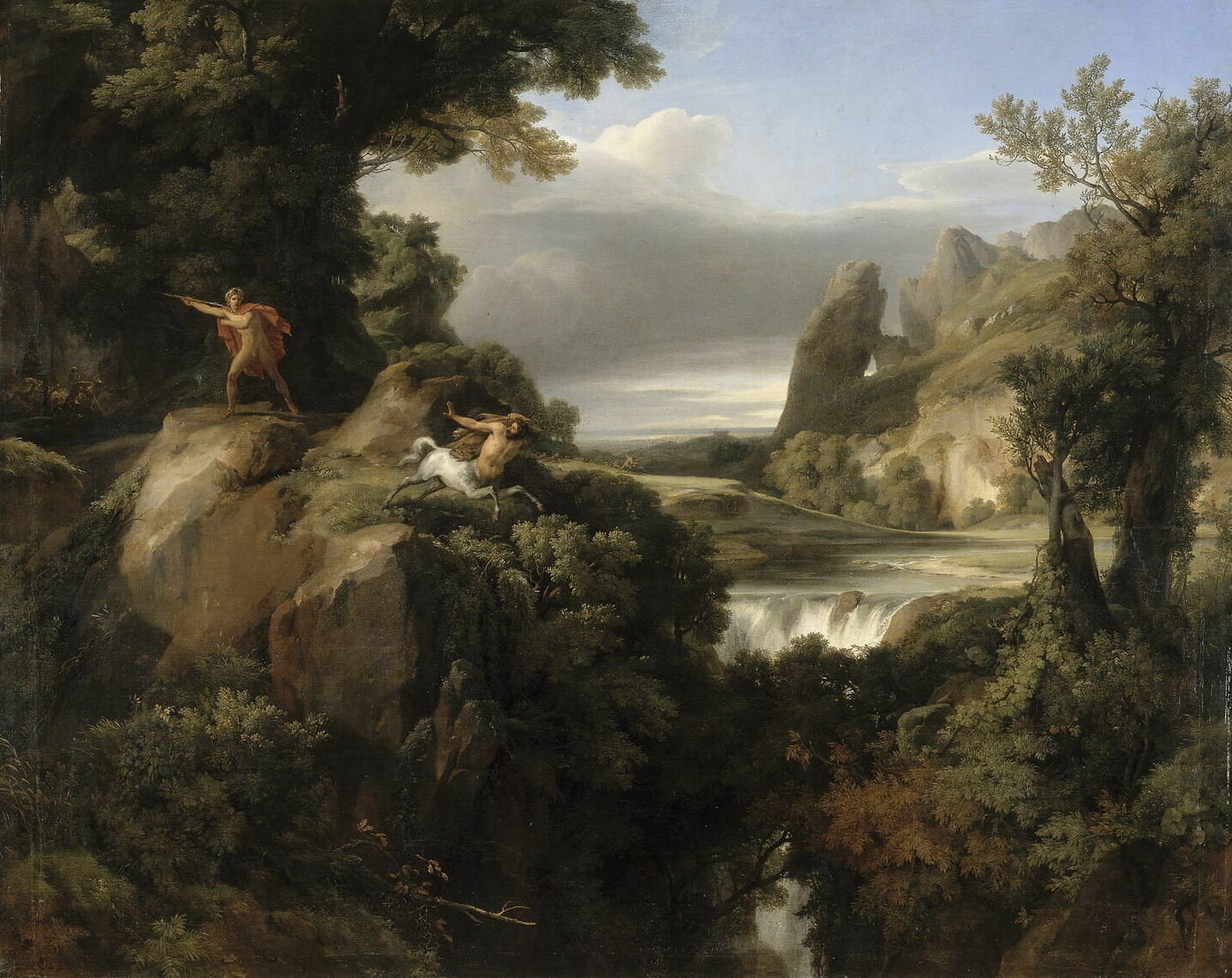
Following the tradition of Nicolas Poussin, Achille Etna Michallon (a namesake of Achilles) set mythological figures in some of his finished landscape paintings. His Landscape: Theseus Pursuing the Centaurs from 1821 shows the Greek hero about to throw his spear at a galloping centaur.

stuckfantastichunt
Franz von Stuck (1863–1928), Fantastic Hunt (1890), oil on canvas, dimensions not known, Museum Villa Stuck, Munich, Germany. Image by Yelkrokoyade, via Wikimedia Commons.

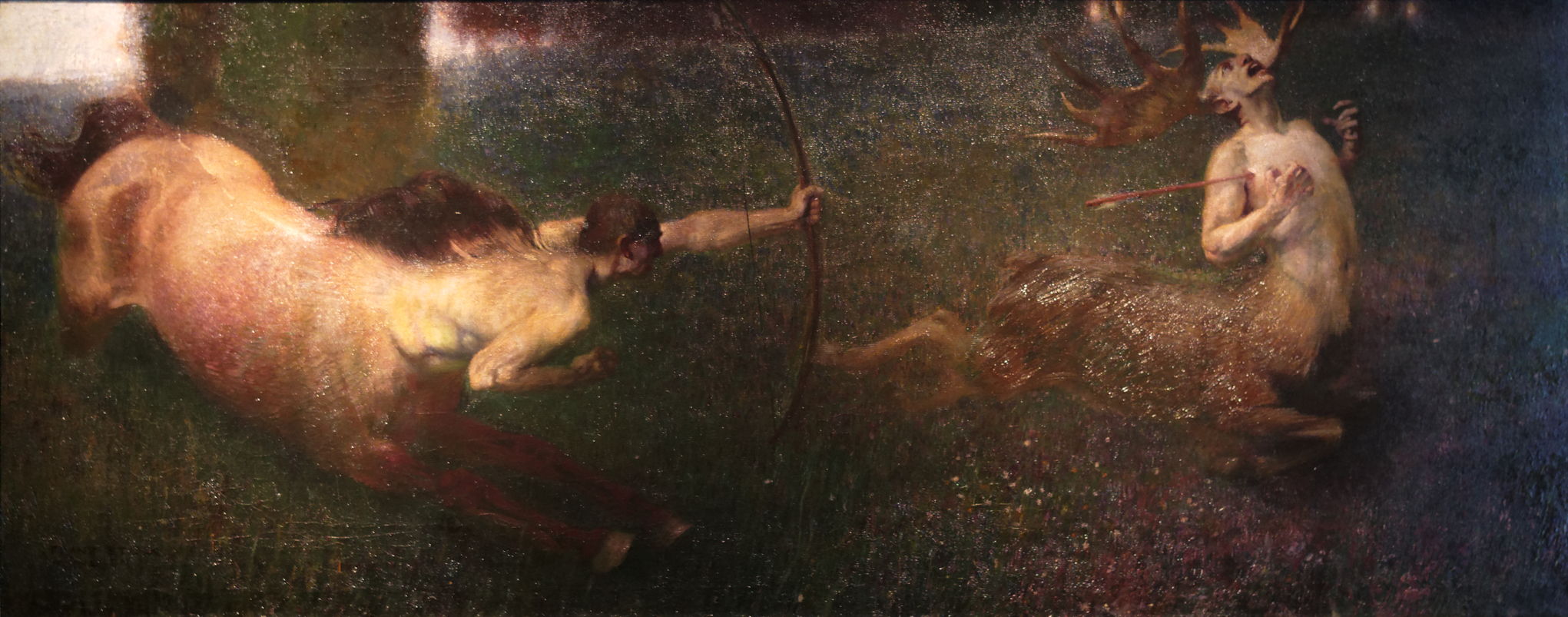
Franz von Stuck added centaurs to his repertoire of mythical beasts in his Fantastic Hunt (1890). Here an archer centaur has buried his arrow into the right axilla of a deer-like variant, perhaps resembling Actaeon after Diana’s vicious metamorphosis. The deer-centaur’s legs have already buckled under him, and his hands claw at the air in his agony.

There are two major myths involving centaurs that have been painted extensively, both picturing them at their worst, at a wedding feast that turned into a pitched battle, and the attempted abduction of the wife of Hercules.

The account of the former is given by Nestor in Ovid’s Metamorphoses, and is one of a pair of primaeval battles said to have established world order: that between the Titans and the Gods ended the heavenly Titanomachy, and that between the Lapiths and Centaurs ended the earthly Centauromachy.

When Pirithous married Hippodame, the couple invited centaurs to the feast. Unfortunately, passions of the centaur Eurytus became inflamed by drink and lust for the bride, and he carried Hippodame off by her hair. The other centaurs followed suit by each seizing a woman of their choice, turning the wedding feast into utter chaos, more like a city being sacked.

Theseus castigated Eurytus and rescued the bride, so the centaur attacked him. Theseus responded by throwing a huge wine krater at Eurytus, killing him. The centaurs then started throwing goblets and crockery, and the battle escalated from there. Nestor details a succession of grisly accounts of Lapiths and Centaurs killed. Gryneus the centaur ripped up the altar and crushed two Lapiths with its weight, only to have his eyeballs gouged out by a Lapith using the prongs of some antlers. Not content with using the objects around them as weapons, they started using their own lances and swords.

When the centaur Petraeus was trying to uproot a whole oak tree, the groom Pirithous pinned the centaur to the tree-trunk with his lance. Nestor also tells of the success of Caeneus, formerly Caenis, in killing five centaurs. The centaur Latreus taunted Caeneus, so the latter wounded the centaur with his spear. Latreus thrust his lance in Caeneus’ face, but was unable to hurt him, so he tried with his sword, which broke against the invulnerable Caeneus, leaving him to finish the centaur off with thrusts of his own sword.

The centaurs then united to try to overwhelm Caeneus by crushing him under their combined weight. Just as they thought they had succeeded, Caeneus was transformed into a bird and flew out from underneath them. With that the survivors dispersed, the Lapiths having won the day.

dicosimolapithscentaurs
Piero di Cosimo (1462–1522), The Fight between Lapiths and Centaurs (1500-15), oil on wood, 71 x 260 cm, The National Gallery, London. Wikimedia Commons.

Piero di Cosimo’s The Fight between Lapiths and Centaurs (1500-15) is my favourite among the earlier paintings, and remains one of its best-structured and complete accounts. In the centre foreground, Hylonome embraces and kisses the dying Cyllarus, a huge arrow-like spear resting underneath them. Immediately behind them, on large carpets laid out for the wedding feast, centaurs are still abducting women. All around are scenes of pitched and bloody battles, with eyes being gouged out, Lapiths and Centaurs wielding clubs and other weapons at one another.

rubensrapehippodamesketch
Peter Paul Rubens (1577–1640), The Rape of Hippodame (sketch) (c 1637-38), oil on panel, 26 × 40 cm, Koninklijke Musea voor Schone Kunsten van België / Musées Royaux des Beaux Arts de Belgique, Brussels, Belgium. Wikimedia Commons.

Towards the end of his life, Peter Paul Rubens painted this brilliant oil sketch of The Rape of Hippodame (c 1637-38). At the right, Eurytus is trying to carry off the bride, with Theseus just about to rescue her from the centaur’s back. At the left, Lapiths are attacking with their weapons, and behind them another centaur is trying to abduct a woman.

rubensrapehippodame
Peter Paul Rubens (1577–1640), The Rape of Hippodame (Lapiths and Centaurs) (1636-38), oil on canvas, 182 × 290 cm, Museo Nacional del Prado, Madrid, Spain. Wikimedia Commons.

That became the finished painting, The Rape of Hippodame (Lapiths and Centaurs) (1636-38), which remains faithful to Rubens’ sketch and its composition. Facial expressions, particularly that of the Lapith at the left bearing a sword, are particularly powerful.

giordanolapithscentaurs
Luca Giordano (1632–1705), Battle of Lapiths and Centaurs (1688), oil on canvas, 255 x 390 cm, State Hermitage Museum, Saint Petersburg, Russia. Image by Wayne77, via Wikimedia Commons.

Luca Giordano’s later painting of the Battle of Lapiths and Centaurs from 1688 lacks the narrative structure of Piero di Cosimo’s, and covers later action than Rubens’. As a result, its story has become a little lost in the mêlée of battle.

riccilapithscentaurs
Sebastiano Ricci (1659–1734), The Battle of the Lapiths and Centaurs (c 1705), oil on canvas, 138.4 × 176.8 cm, The High Museum of Art, Atlanta, GA. Wikimedia Commons.

Sebastiano Ricci’s The Battle of the Lapiths and Centaurs from about 1705 has similar problems, although it does use multiplex narrative to help. In the left background, Hippodame is seen being carried away by Eurytus, and to the right there are further scenes of abduction.

solimenalapithscentaurs
Francesco Solimena (1657–1747), Battle between Lapiths and Centaurs (1735-40), oil on canvas, 104 x 130 cm, Private collection. Wikimedia Commons.

Francesco Solimena’s Battle between Lapiths and Centaurs (1735-40) puts multiple abductions in the foreground, with pitched battles taking place behind.

Tomorrow I’ll look at paintings of the fight between Nessus and Hercules, and how Nessus got his revenge.

❌