Reading view

There are new articles available, click to refresh the page.

Portraits of trees: Introduction

Trees are prominent features of every continent apart from Antarctica, and even our more densely urban areas find room for a few of them. From our origins in East Africa to the city parks of New York, London and Tokyo, humans and trees have lived together. As a result, trees feature in a great many paintings. This series explores how they have been depicted in European and North American art from before the Renaissance to the early twentieth century.

Peter Paul Rubens (1577–1640), Landscape (c 1635-40), gouache, 24 × 45 cm, Hermitage Museum, Saint Petersburg, Russia. Wikimedia Commons.

Like many artists since, Peter Paul Rubens made studies of trees to support his studio paintings in oils. This one, known simply as Landscape, is a careful and quite detailed sketch in gouache (opaque watercolour) of a group of trees on the bank of a small river, painted during the last five years of his life. The evidence from the tree in the mid-right is that he constructed them anatomically, by putting in the structural curves and lines of the branches, then laying down areas of foliage, a method developed during the Renaissance and still widespread today.

This practice of painting studies from life was recommended by the great landscape artist and teacher Pierre Henri Valenciennes (1750-1819), who wrote in his book Elements of Practical Perspective for the Use of Artists:
“Be sure to make several painted studies of beautiful trees, whether standing alone or in groups. Pay close attention to every detail of the bark, moss, roots, branches, and the ivy that surrounds and clings to them; above all, make good choices and study the variety of wood, bark, and foliage, which is of the utmost importance.” (Second edition, 1820.)

Landscape specialists like John Constable painted studies of trees throughout their career, to inform finished works.
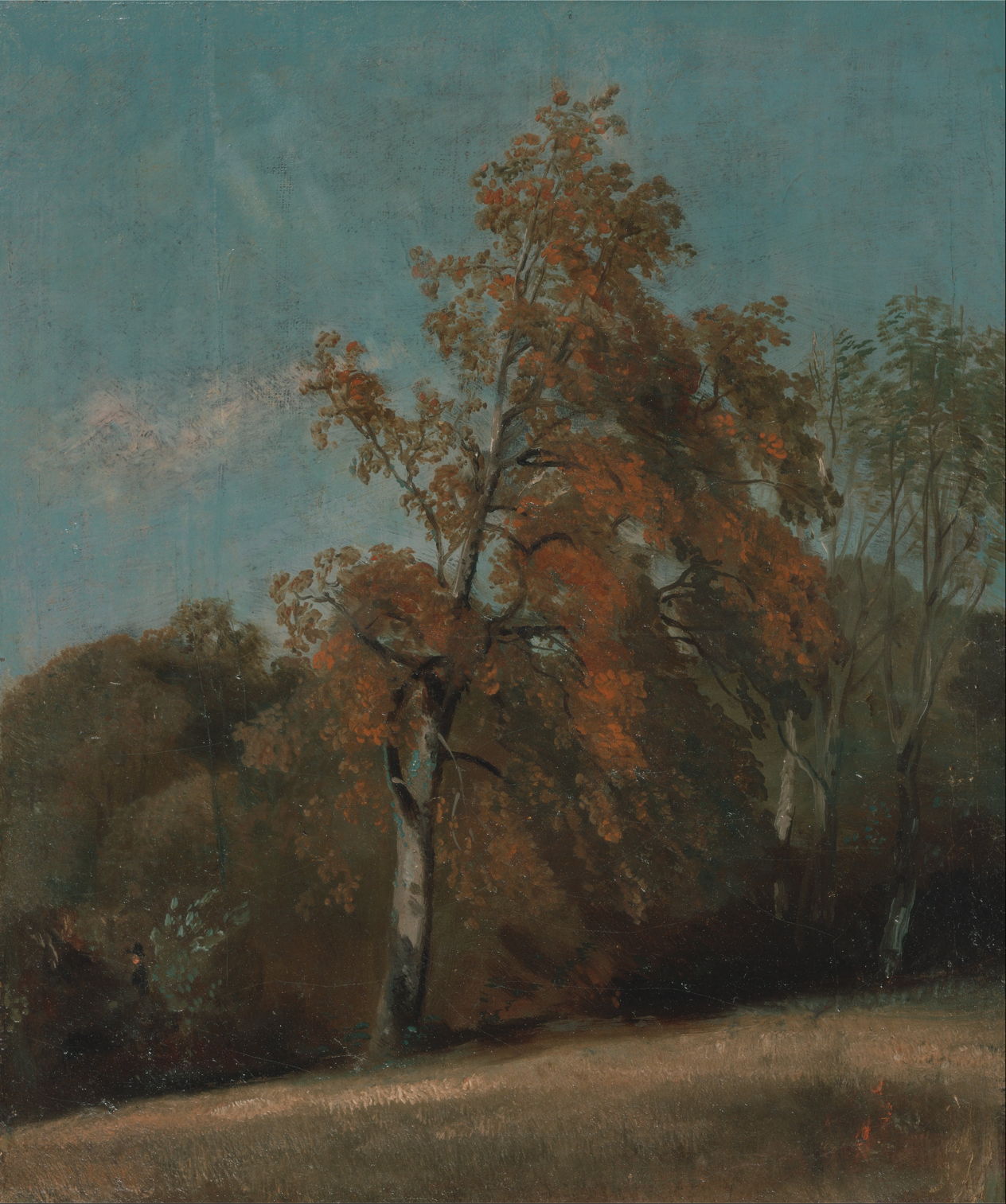
John Constable (1776–1837), Study of an Ash Tree (1801-3 or 1810-30), oil on canvas laid to artist's board, 39.4 x 29.8 cm, Yale Center for British Art, New Haven, CT. Wikimedia Commons.
John Constable (1776–1837), Study of an Ash Tree (1801-3 or 1810-30), oil on canvas laid to artist’s board, 39.4 x 29.8 cm, Yale Center for British Art, New Haven, CT. Wikimedia Commons.

He learned to create plein air sketches in oils, which he used extensively for ‘skying’ particularly around Hampstead Heath near London, and for remarkable studies of trees, such as this ash, seen in its autumn colours. Here he too has taken the time to construct the tree anatomically, and to detail its foliage.

This continued through the middle of the nineteenth century, when landscape painting was evolving towards Impressionism.
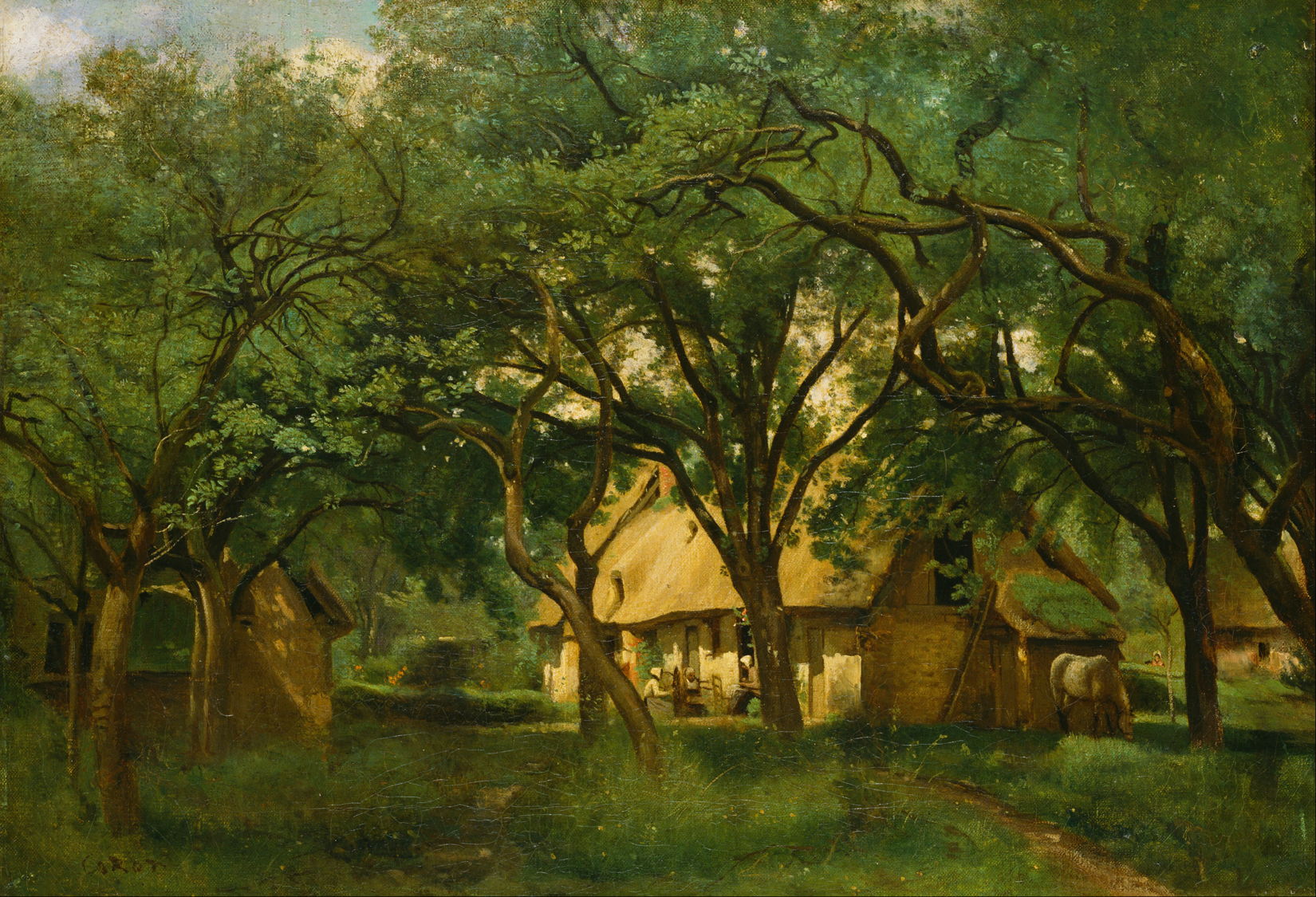
Jean-Baptiste-Camille Corot (1796–1875), The Toutain Farm, Honfleur (c 1845), oil on canvas, 44.4 × 63.8 cm, Bridgestone Museum of Art, Tokyo. Wikimedia Commons.

Camille Corot’s The Toutain Farm, Honfleur from about 1845 appears to be a finished studio painting, perhaps intended for the Salon. Its trees are marvellous and all but obscure and upstage the farmhouse beyond. Their sinuous limbs reflect his structured approach to painting their canopies with a catalogue of ways the trunk can give rise to branches. The canopy itself is shown in careful detail, although at the upper left it seems more vague and sketchy.

Europe has a rich and varied flora of tree species, and one of the challenges in painting its landscapes has been to capture their distinctive characteristics.

vanruisdaelroadthroughoakforest
Jacob Isaakszoon van Ruisdael (1628/9–1682), Road through an Oak Forest (c 1646-7), oil on canvas, 65 x 85 cm, Statens Museum for Kunst, København, Denmark. Wikimedia Commons.

Jacob van Ruisdael gave insight into the stages in the life and looks of oak trees. In Road through an Oak Forest (c 1646-7) he captures the later life of a stag-headed oak on the left, which lost its crown long ago, a flush of new growth on a fallen trunk, and another still clinging onto life despite a great split at its base. Judging by the girth of their trunks, the oaks shown here are around 400 years old, making it likely they were saplings in the thirteenth century, possibly even earlier. They form a remarkable window in time back to the late Middle Ages.

Camille Pissarro (1830-1903), The Big Walnut Tree in Spring, Éragny (1894), oil on canvas, 60 x 73 cm, Private collection. Wikimedia Commons.

Camille Pissarro’s Big Walnut Tree in Spring, Éragny from 1894 celebrates a species that is a source of binder in oil paint, in walnut oil, although it’s used far less frequently than linseed. Its wood is also sought after, making this tree a long-term investment for the landowner’s heirs.

Vincent van Gogh, Cypresses (1889), oil on canvas, 93.4 x 74 cm, The Metropolitan Museum of Art, New York, NY. Wikimedia Commons.
Vincent van Gogh (1853-1890), Cypresses (1889), oil on canvas, 93.4 x 74 cm, The Metropolitan Museum of Art, New York, NY. Wikimedia Commons.

Vincent van Gogh’s Cypresses (1889) are some of the best-remembered of all. As he moved style on beyond Impressionism, his swirling brushstrokes form solid but thoroughly living trees. These are most probably Italian cypresses, which are characteristic of the landscape around the Saint-Paul-de-Mausole asylum where he was living at that time, and throughout Provence.

Vincent van Gogh, Olive Grove (1889), oil on canvas, 72 x 92 cm, Kröller-Müller Museum, Otterlo. WikiArt.
Vincent van Gogh (1853-1890), Olive Grove (1889), oil on canvas, 72 x 92 cm, Kröller-Müller Museum, Otterlo. WikiArt.

In his Olive Grove (1889), those swirling strokes of foliage complement the tortuous curves of the branches and gnarled blue-grey trunks.
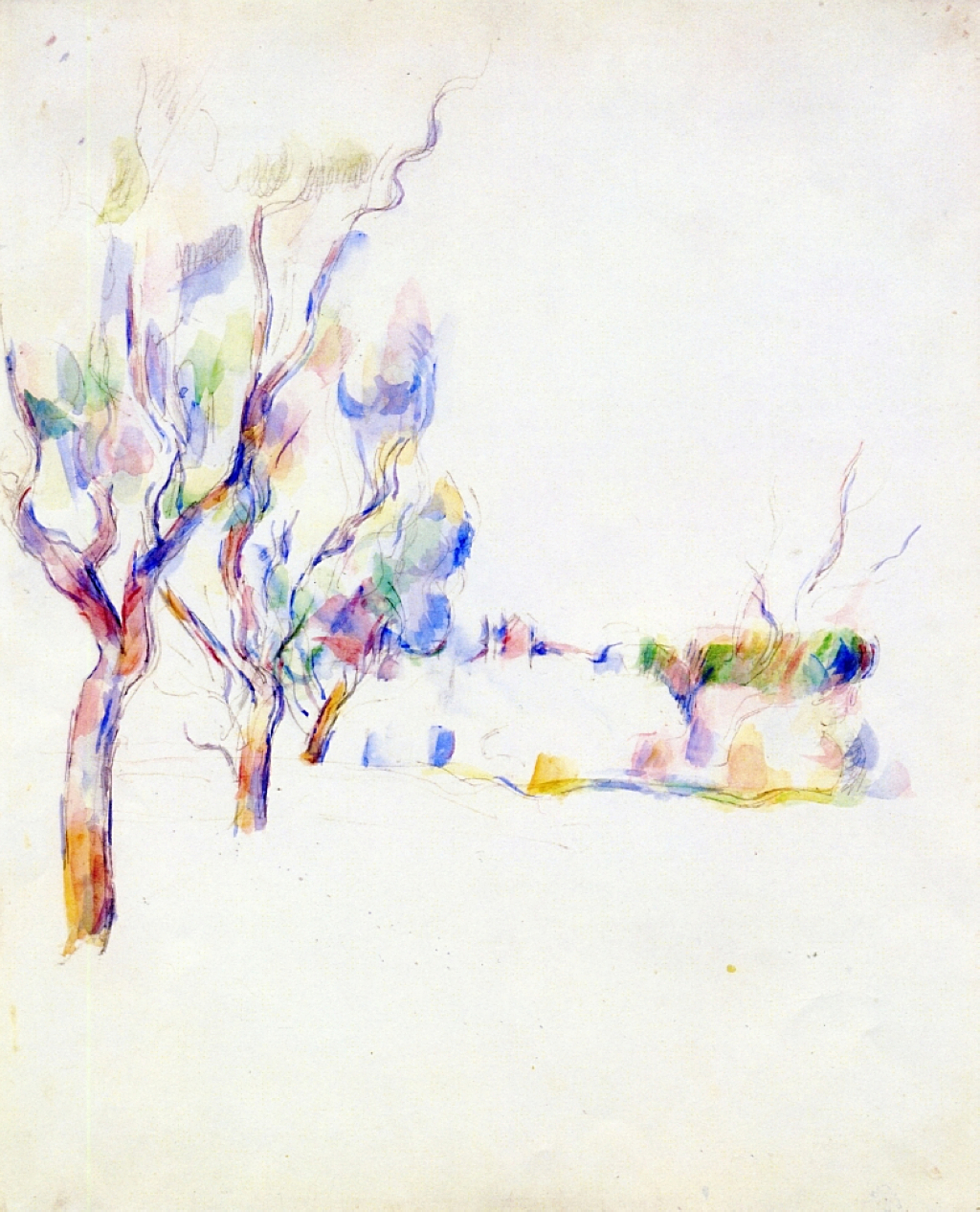
Paul Cézanne, Almond Trees in Provence (1900). Graphite and watercolour on paper, 58.5 x 47.5 cm, private collection (WikiArt).
Paul Cézanne (1839–1906), Almond Trees in Provence (1900). Graphite and watercolour on paper, 58.5 x 47.5 cm, private collection (WikiArt).

Paul Cézanne’s oil paintings of trees, although abundant, show his emphasis on patterned brushstrokes in what is known as his constructive stroke. This isn’t true of his watercolours, as shown in Almond Trees in Provence (1900), where each tree rises in a flare of brilliant colours.
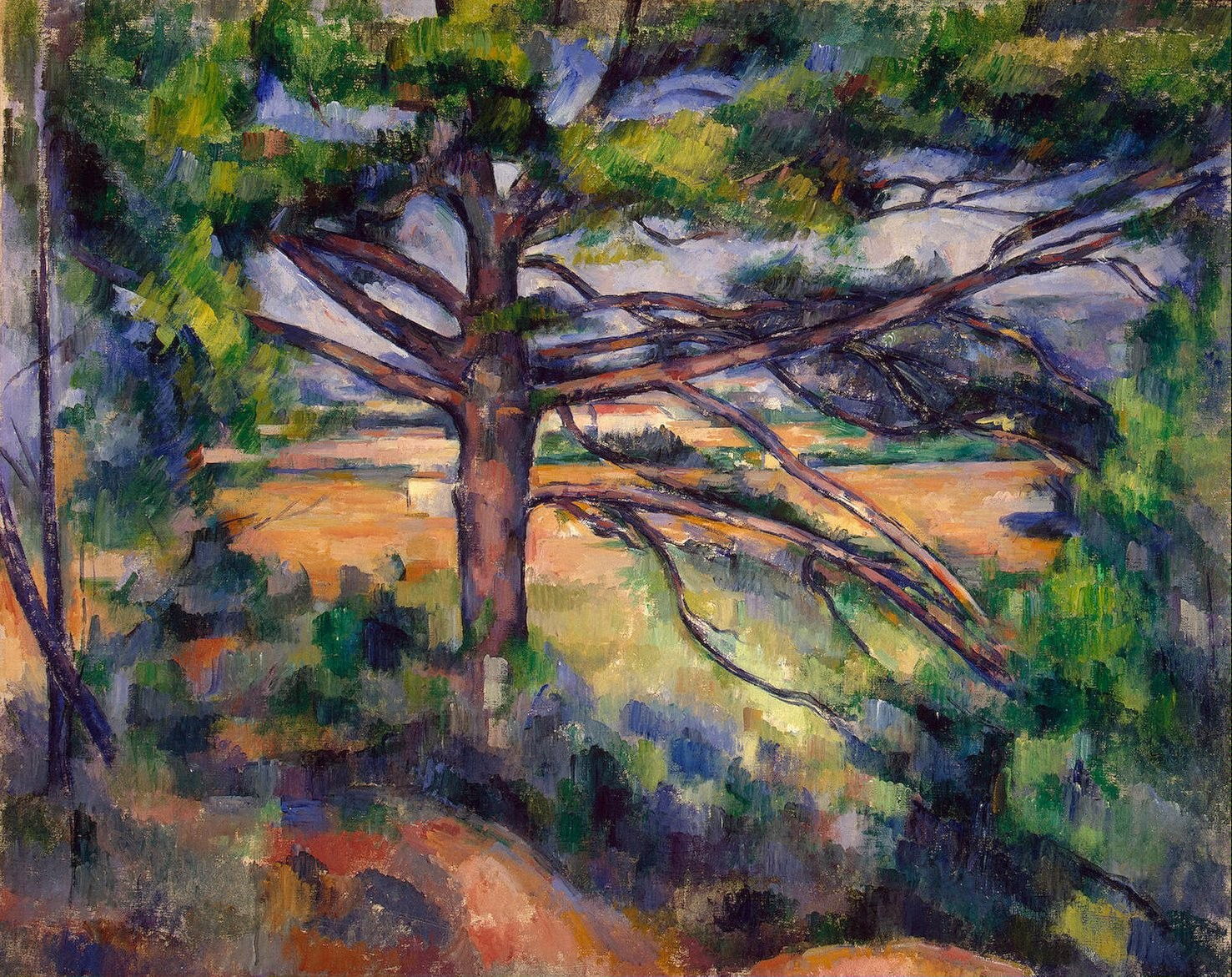
cézannelargepineredearth1895
Paul Cézanne (1839–1906), Grand pin et terres rouges (Large Pine and Red Earth) (1890–95), oil on canvas, 72 x 91 cm, Hermitage Museum, St. Petersburg. Wikimedia Commons.

Cézanne’s constructive stroke became more prominent and started to dominate the structure of his oil paintings after 1890. In Large Pine and Red Earth (1890–5) it’s used throughout the foreground foliage and vegetation, and has even started to appear in some patches on the trunk.

Théo van Rysselberghe, Pine by the Mediterranean Sea (1916), oil on canvas, 81 x 199 cm, Centraal Museum, Utrecht. WikiArt.
Théo van Rysselberghe (1862-1926), Pine by the Mediterranean Sea (1916), oil on canvas, 81 x 199 cm, Centraal Museum, Utrecht. WikiArt.

Finally, Théo van Rysselberghe’s Pine by the Mediterranean Sea (1916) appears almost as substantial as the bleached rocks below it. Contrast between the lit segments and those in cast shadow behind is wide, as is seen on the shores of the Mediterranean.

I hope you will join me in exploring these and many other fine portraits of trees over the coming weeks.

A walk in the parks of London and Paris

This weekend, as the season moves steadily towards summer, we’re on a whistle-stop tour of six famous parks in five great cities, that for many are the closest they’ll get to real countryside.

As cities grew during the nineteenth century, what had been countryside in and around them was swallowed up by housing and factories. In the first couple of decades, livestock grazed and cows were milked within a couple of miles of the centre of London.

B2014.2
Benjamin West (1738–1820), Milkmaids in St. James’s Park, Westminster Abbey beyond (c 1801), oil on panel, further details not known. Wikimedia Commons.

The American history painter Benjamin West painted this view of Milkmaids in St. James’s Park, Westminster Abbey beyond in about 1801. Two cows and attendant milkmaids are providing a supply of fresh milk for the crowds in this royal park with Buckingham Palace on its edge. This remains 57 acres (23 hectares) of grass, trees and lakes in central London.

linnelleveningbayswater
John Linnell (1792–1882), Evening, Bayswater (1818), oil on panel, 38.3 x 58.1 cm, Yale Center for British Art, New Haven, CT. Wikimedia Commons.

John Linnell’s Evening, Bayswater from 1818, only two centuries ago, shows what was then a rural part of London, out to the west of what’s now Paddington Station, in more peaceful times before this area was assimilated into the growing city. Although it has retained some garden squares, this became a densely populated area during the nineteenth century.

denittisserpentine
Giuseppe De Nittis (1846–1884), The Serpentine, Hyde Park, London (1878), oil on panel, 26.7 x 35.6 cm, Private collection. Athenaeum.

The lake shown in Giuseppe De Nittis’ view of The Serpentine, Hyde Park, London from 1878 is the eastern section of a single body of water marking the boundary between Hyde Park and Kensington Gardens. Once fed from a small river, that became so polluted it has long been supplied by water from three boreholes. It hosts a swimming club, rowing boats, and a solar-powered ferry.

fannerhydepark
Alice Maud Fanner (1866-1930), Hyde Park (c 1900), further details not known. Image by Leonard Bentley, via Wikimedia Commons.

Alice Maud Fanner painted this view of the edge of Hyde Park, London, in about 1900. The London plane trees are leafless, indicating this is a fine day in the winter, although the figures look lightly dressed for that time of year. The view looks north-east towards the road encircling the park and mansions in Park Lane beyond. This park is, at 350 acres (140 hectares), the largest of a chain of Royal Parks running from Kensington Gardens in the west, past Buckingham Palace to St James’s Park to the southeast.

Kensington Gardens: Vicinity of the Pond ?1907 by Paul Maitland 1863-1909
Paul Fordyce Maitland (1863–1909), Kensington Gardens: Vicinity of the Pond (c 1907), oil on canvas, 25.4 x 45.4 cm, The Tate Gallery (Presented by Cyril Andrade 1928), London. © The Tate Gallery and Photographic Rights © Tate (2016), CC-BY-NC-ND 3.0 (Unported), https://www.tate.org.uk/art/artworks/maitland-kensington-gardens-vicinity-of-the-pond-n04398

Kensington Gardens: Vicinity of the Pond, painted by Paul Fordyce Maitland in about 1907, shows the Oval Pond in the middle of these gardens, another of the Royal Parks in London, to the west of the Serpentine Lake in the adjacent Hyde Park.

Over the same period, central Paris was extensively rebuilt, but preserved some of its green spaces, including the gardens of the Tuileries Palace.

The Tuileries Garden in central Paris is the city’s best-known open space. It runs between the Louvre and the Place de la Concorde with its iconic Arc de Triomphe, an area of 63 acres (25.5 hectares). Shortly before painting his most famous scene in the Tuileries, Édouard Manet completed a smaller and less ambitious work set among its trees, Children in the Tuileries Garden (c 1861-2).

Édouard Manet (1832–1883), Children in the Tuileries Garden (c 1861-2), oil on canvas, 37.8 x 46 cm, RISD Museum, Rhode Island School of Design, RI. Wikimedia Commons.

Seen now as the work which gave him the idea for his second painting, this shows a small group of children apparently being directed by an older girl in black, with a blue bonnet. There’s an eery impersonality about the figures, though, as they’re either viewed from behind, or have little or no detail in their faces.

Édouard Manet (1832–1883), Music in the Tuileries (1862), oil on canvas, 76.2 × 118.1 cm, The National Gallery, London, and the Hugh Lane, Dublin. Courtesy of National Gallery (CC), via Wikimedia Commons.

Manet’s Music in the Tuileries from 1862 is one of ten paintings shared between the National Gallery in London, and the Hugh Lane in Dublin, as part of the Hugh Lane bequest. Packed into its rhythmic layout of trees are members of the fashionable Parisian crowd, who have come to listen to the music, socialise, and chat. Historians have identified many of Manet’s circle among them: the poet Baudelaire, novelist Gautier, composer Offenbach, Fantin-Latour the painter, and the artist’s brother Eugène, a painter who married Berthe Morisot, the Impressionist.

Adolph Menzel (1815–1905), Afternoon in the Tuileries Gardens (1867), oil on canvas, 49 x 70 cm, The National Gallery, London. Courtesy of National Gallery (CC), via Wikimedia Commons.

Adolph Menzel’s Afternoon in the Tuileries Gardens from 1867 is assumed to have been inspired by Manet’s Music in the Tuileries, and has compositional similarities. He includes some direct quotations of figures in homage to Manet’s work. However, Menzel remained a realist, as shown in finely detailed foliage, foreground shadows and the figures. He was known to have made several sketches in the Tuileries Gardens, but painted this work back in his Berlin studio. Conventionally this would have been based on those sketches, but when Menzel first showed the work he claimed it was executed from memory.

Maurice Brazil Prendergast (1861–1924), The Tuileries Gardens, Paris (1895). Wikimedia Commons.

The Tuileries Gardens, Paris (1895) may have been painted shortly before Maurice Brazil Prendergast left the city to return to Boston, MA. While he was in Paris he met Édouard Vuillard, whose influence appears to have extended to his use of colour here, and Pierre Bonnard, an addicted sketcher of street scenes in Paris.

Camille Pissarro (1830–1903), The Garden of the Tuileries on a Spring Morning (1899), oil on canvas, 73.3 × 92.1 cm, The Metropolitan Museum of Art, New York, NY. Wikimedia Commons.

Pissarro’s Garden of the Tuileries on a Spring Morning from the same year is an aerial view of the gardens when they’re well into Spring, with the trees in full leaf, in their brilliant fresh green foliage.

Tomorrow we’ll resume in the city of Rome.

On Reflection: Divisionism

Given the technical challenge of painting optically faithful reflections on water, the painstaking and protracted work required for Divisionist techniques resulted in the omission of reflections, or only notional depictions. This article gathers some examples of Divisionist paintings that were taken the extra mile, and tried to do better.

Georges Seurat, Landscape - the Island of the Grande Jatte (1884), oil on canvas, 69.9 x 85.7 cm, Private collection. WikiArt.
Georges Seurat (1859–1891), Landscape – the Island of the Grande Jatte (1884), oil on canvas, 69.9 x 85.7 cm, Private collection. WikiArt.

Seurat’s first and greatest masterpiece, generally known as La Grande Jatte, uses the technique of optical mixing of colour. Rather than blending pigments on the canvas, it’s constructed of tiny high chroma dots to allow for optical mixing. Recognising the difficulty of recreating reflections when he was laboriously applying those dots to the large canvas for his finished painting, Seurat developed them in smaller studies such as that above.

Georges Seurat, Un dimanche après-midi à l'Île de la Grande Jatte (A Sunday Afternoon on the Island of La Grande Jatte) (1884-6), oil on canvas, 207.5 × 308.1 cm, Art Institute of Chicago, Chicago, IL. Wikimedia Commons.
Georges Seurat (1859–1891), Un dimanche après-midi à l’Île de la Grande Jatte (A Sunday Afternoon on the Island of La Grande Jatte) (1884-6), oil on canvas, 207.5 × 308.1 cm, Art Institute of Chicago, Chicago, IL. Wikimedia Commons.

Those are seen quoted in the finished work, which took him almost eighteen months to paint in three stages between 1884-86.

Camille Pissarro, Île Lacruix Rouen, Effect of Fog, 1888, oil on canvas, 44 x 55 cm, private collection. (WikiArt)
Camille Pissarro (1830-1903), The Seine at Rouen, the Île Lacroix, Effect of Fog (1888), oil on canvas, 46.7 x 55.9 cm, Philadelphia Museum of Art, Philadelphia, PA. (WikiArt)

The Seine at Rouen, the Île Lacroix, Effect of Fog from 1888 is one of Camille Pissarro’s best-known Divisionist paintings, and one of the few to depict reflections in detail. This was based on studies he had made during a visit to the city back in 1883, five years before he started work on this finished painting.

signacseineesandelys142
Paul Signac (1863-1935), Les Andelys. Le Quai (The Seine at Les Andelys) (Op 142) (1886), oil on canvas, 46 x 65 cm, Norton Simon Museum, Los Angeles, CA. Wikimedia Commons.

Paul Signac also made use of sketches made in front of the motif, such as this of Les Andelys. Le Quai from 1886, which contains extensive passages of reflections.

signaclesandelyscoôtedaval139
Paul Signac (1863-1935), Les Andelys. Côte d’aval (Op 139) (1886), oil on canvas, 64 x 95 cm, Art Institute of Chicago, Chicago, IL. Wikimedia Commons.

His finished view of Les Andelys. Côte d’aval, completed the same year, completely omits reflections, though.

signaclesandelysberge141
Paul Signac (1863-1935), Les Andelys. La Berge (Op 141) (1886), oil on canvas, 65 x 81 cm, Musée d’Orsay, Paris. Wikimedia Commons.

A different view of the same village, Les Andelys. La Berge, from the same year, includes extensive reflections that appear fairly accurate.

signacsunsetherblay206
Paul Signac (1863-1935), Sunset, Herblay (Op 206) (1889 Sep), oil on canvas, 58.1 x 90.2 cm, Kelvingrove Art Gallery and Museum, Glasgow, Scotland. Wikimedia Commons.

Signac’s Sunset, Herblay, painted in September 1889, is a good attempt but has small disparities. For example, reflected images of the trees seen on the bank at the left don’t tally with their originals in either vertical or horizontal dimension.

signaceveningcalmconcarneau220
Paul Signac (1863-1935), Evening Calm, Concarneau, Opus 220 (Allegro Maestoso) (Op 220) (1891), oil on canvas, 64.8 x 81.3 cm, Metropolitan Museum of Art, New York, NY. Wikimedia Commons.

Evening Calm, Concarneau, Opus 220 (Allegro Maestoso) from 1891 must have been a major challenge that Signac carries off with aplomb. Again there are some small discrepancies: the most prominent boat in the foreground is heeling slightly to the left, but the left side of its reflection if anything leans slightly to the right.

signactartanes240
Paul Signac (1863-1935), Tartanes pavoisées (Sailing Boats in Saint-Tropez Harbour) (Op 240) (1893), oil on canvas, 56 x 46 cm, Von der Heydt Museum, Wuppertal, Germany. Wikimedia Commons.

Reflections are even more complex in Signac’s Tartanes pavoisées, or Fishing Boats Dressed Overall, from 1893. To get its triangular composition right, and inform his rendering of the reflections, he painted three studies for this. Despite that, two years later he traded this painting for a bicycle, but in 1910 it became his first painting to enter a public collection, in Wuppertal, Germany.

Paul Signac, The Port of Saint-Tropez (1901-2), oil on canvas, 131 x 161.5 cm, National Museum of Western Art, Tokyo. WikiArt.
Paul Signac (1863-1935), The Port of Saint-Tropez (1901-2), oil on canvas, 131 x 161.5 cm, National Museum of Western Art, Tokyo. WikiArt.

Another challenging view of The Port of Saint-Tropez from 1901-2 is less precise, but uses reflections to great effect.

signacgiudecca411
Paul Signac (1863-1935), Mouillage de la Giudecca (Giudecca Anchorage, S. Maria della Salute) (Cachin 411) (1904), oil on canvas, 73.5 x 92.5 cm, Neue Pinakothek, Munich, Germany. Image by Ad Meskens, via Wikimedia Commons.

Signac’s later Giudecca Anchorage from 1904 uses coarser tiles of colour, giving him more leeway.

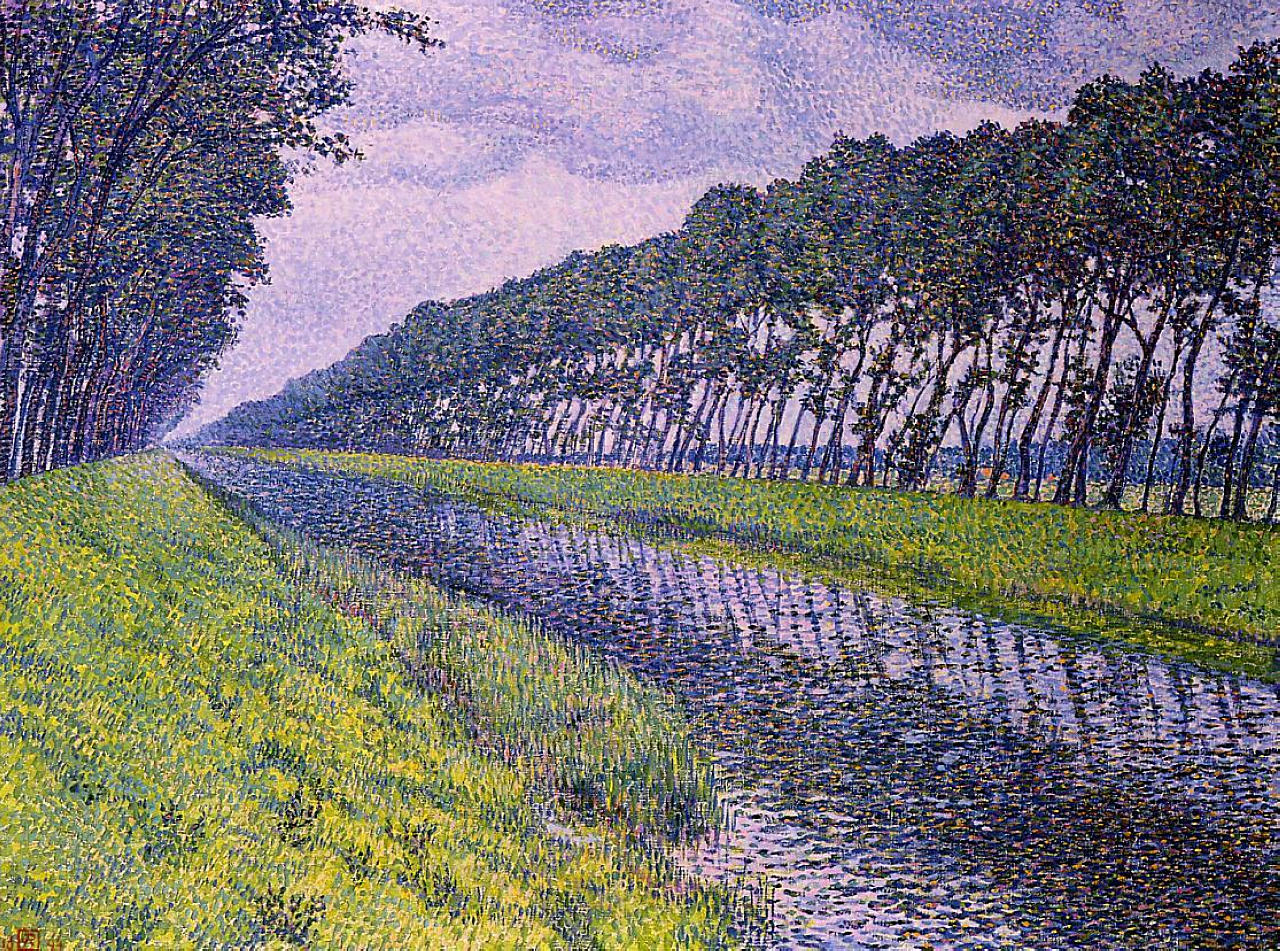
Of all the Neo-Impressionist and Divisionist paintings of reflections, the undisputed champion must be Théo van Rysselberghe’s Canal in Flanders from 1894. This too was preceded by a study, but that almost completely excluded any reflections. The artist then moved his viewpoint to the right, and must have spent months getting its reflections right.

Théo van Rysselberghe (1862-1926), Canal in Flanders (1894), oil on canvas, 152.4 x 203.2 cm, Private collection. WikiArt.

This uniquely combines radical perspective projection, intense rhythm and meticulous reflections. The artist painted few further views with reflections afterwards.

❌