Although legend held that Theseus was the founder of the city of Athens, it’s probably more accurate to attribute to him its early growth and development. Despite being ranked among the great heroes of classical Greece, he also displayed fundamental flaws. For a long time, the life of Theseus was as celebrated a series of myths as those of Heracles, Jason or Aeneas.
In about 1340-41, Giovanni Boccaccio wrote an epic poem of almost ten thousand lines Teseida, or The Theseid, which in turn inspired The Knight’s Tale in Chaucer’s Canterbury Tales.
Paolo da Visso (1431–1481) Scenes from Boccaccio’s Teseida (date not known), front of a cassone, further details not known. Wikimedia Commons.
Paolo da Visso painted these three scenes from Boccaccio’s epic on the front of a cassone, a visual equivalent of Plutarch’s account of the adventures of Theseus.
Like Perseus, Theseus had complicated origins. His mortal father, Aegeus the king of a far smaller Athens, had been childless, but following the prophecy of the oracle at Delphi, the King of Troezen got him drunk and packed him off to bed with his daughter Aethra. She was instructed in a dream to leave Aegeus asleep, and to go to a nearby island, where she was also impregnated by the god Poseidon. Theseus, who is presumed to have been conceived that night, was thus considered to have double paternity, by god and man, a qualification for the heroes of myth.
After he had buried his sword and sandals under a massive rock, Aegeus returned to Athens. He told Aethra that when his son grew up, she should tell him to move the rock, as a test. If he succeeded, then he should take the sandals and sword as evidence of his paternity.
When Theseus was old enough, his mother Aethra showed him the rock, and told him Aegeus’ instructions. Theseus moved the rock, found the sandals and sword, and then undertook an epic journey overland to his father in Athens.
Laurent de La Hyre (1606–1656), Theseus And His Mother Aethra (1635-36), oil on canvas, 141 × 118.5 cm, Szépművészeti Múzeum, Budapest, Hungary. Wikimedia Commons.
One of the earliest depictions of the young Theseus is Laurent de La Hyre’s Theseus And His Mother Aethra (1635-36). This shows the lad lifting a heavy pillar to reveal a pair of shoes and a sword.
Nicolas Poussin (1594–1665) and Jean Lemaire (1598–1659), Theseus Recovering his Father’s Sword (c 1638), oil on canvas, 98 x 134 cm, Musée Condé, Chantilly, France. Wikimedia Commons.
In one of his rare collaborative paintings, Nicolas Poussin worked with Jean Lemaire to tell this fragment of the story in Theseus Recovering his Father’s Sword, from about 1638. They draw a marked contrast between the two actors: Theseus, destined to be a great hero, looks rough and brutish, while his mother Aethra wouldn’t look out of place standing in for the Madonna.
Nicolas-Guy Brenet (1728–1792), Aethra Showing her Son Theseus the Place Where his Father had Hidden his Arms (1768), oil on canvas, 50.2 × 59.7 cm, Los Angeles County Museum of Art, Los Angeles, CA. Wikimedia Commons.
Nicolas-Guy Brenet’s more sketchy Aethra Showing her Son Theseus the Place Where his Father had Hidden his Arms (1768) adds a river god for good measure, and has Aethra giving Theseus marching orders to go find his father.
Antonio Balestra (1666–1740), Theseus Discovering his Father’s Sword (c 1725), oil on canvas, 287 x 159 cm, Private collection. Wikimedia Commons.
Antonio Balestra’s Theseus Discovering his Father’s Sword (c 1725) makes Theseus look less than enthusiastic to follow his mother’s directions.
Aethra told her son to travel by sea to take the sword and sandals to his father, but inspired by Heracles he chose to travel overland instead.
Like his hero, Theseus had a series of adventures on this journey. He first killed Periphetes, who had wielded a large club at him; impressed by this club, he took it and killed another opponent, Sinis, raped his daughter and made her pregnant. Theseus went out of his way to meet the fearsome Crommyonian Sow, which he also killed. Coming to the borders of Megara, Theseus met Sciron, whom he threw down a cliff to his death, and killed another two people before reaching the city.
Theseus found Athens, and his father’s court, in disarray, with the king cohabiting with the sorceress Medea, who had promised to cure his lack of children. Aegeus remained unaware of Theseus’ true identity, but invited him to a banquet, at which Medea, acting in conspiracy with the king, tried to get Theseus to drink from a goblet laced with the poison aconite.
Luckily for Theseus, just before he was going to drink from the goblet, he drew his father’s sword, making as if to carve the meat with it. Aegeus recognised the sword, realised that his guest who was just about to drink poison was his son, and knocked the goblet from Theseus’ hand to stop his lips from touching it.
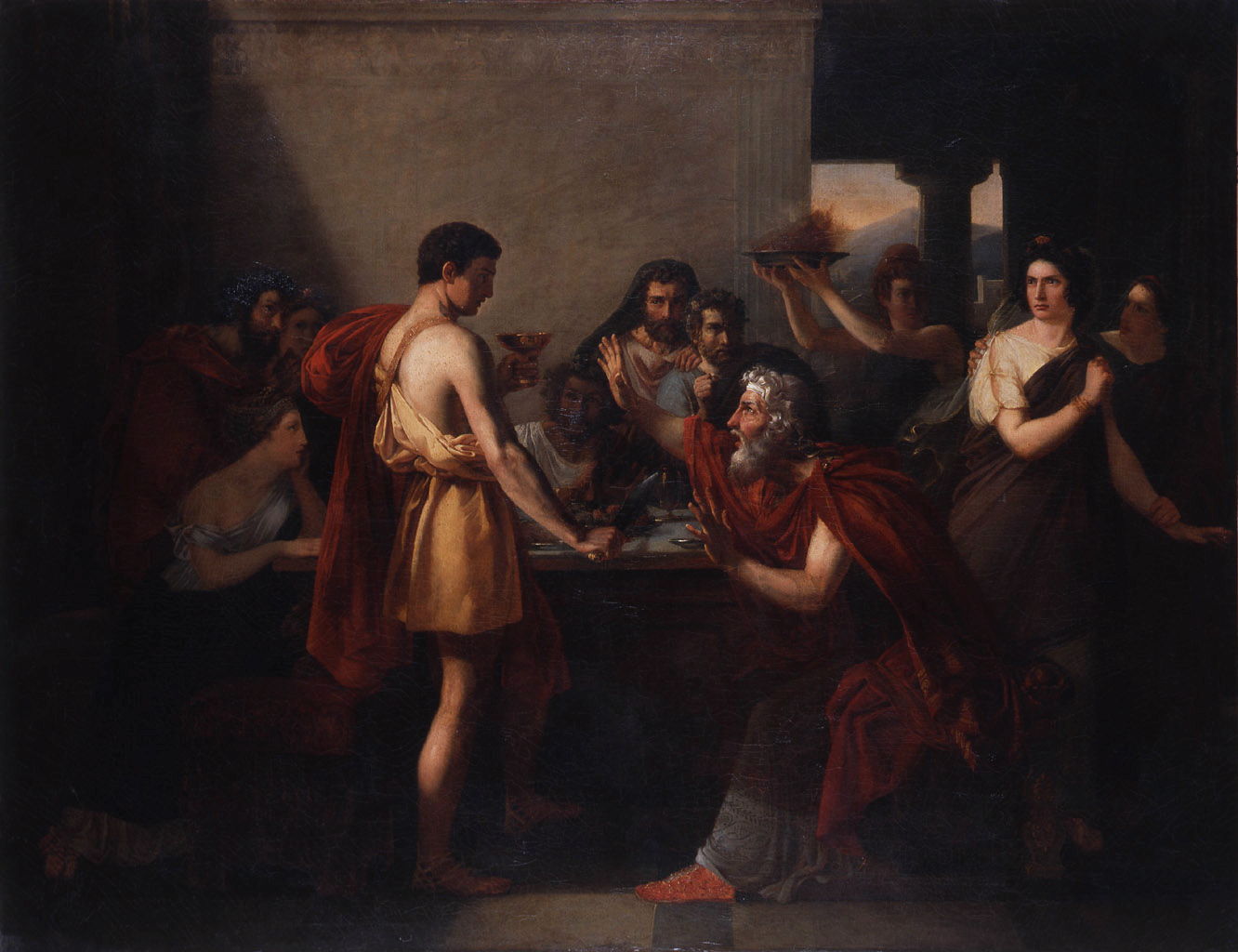
Antoine-Placide Gibert (1806-1875), Theseus Recognised by his Father (1832), oil, dimensions not known, Musée des Beaux-Arts, Bordeaux, France. Image by VladoubidoOo, via Wikimedia Commons.
In Antoine-Placide Gibert’s Theseus Recognised by his Father (1832), the three principal actors are arranged almost linearly across the canvas. Just left of centre, Theseus stands, his head in profile, the fateful cup in his left hand, and his father’s sword in his right. The king is just right of centre, looking Theseus in the eye, and appearing animated if not alarmed. At the far right is Medea, her face like thunder, sensing that her plot to kill Theseus is about to fall apart.
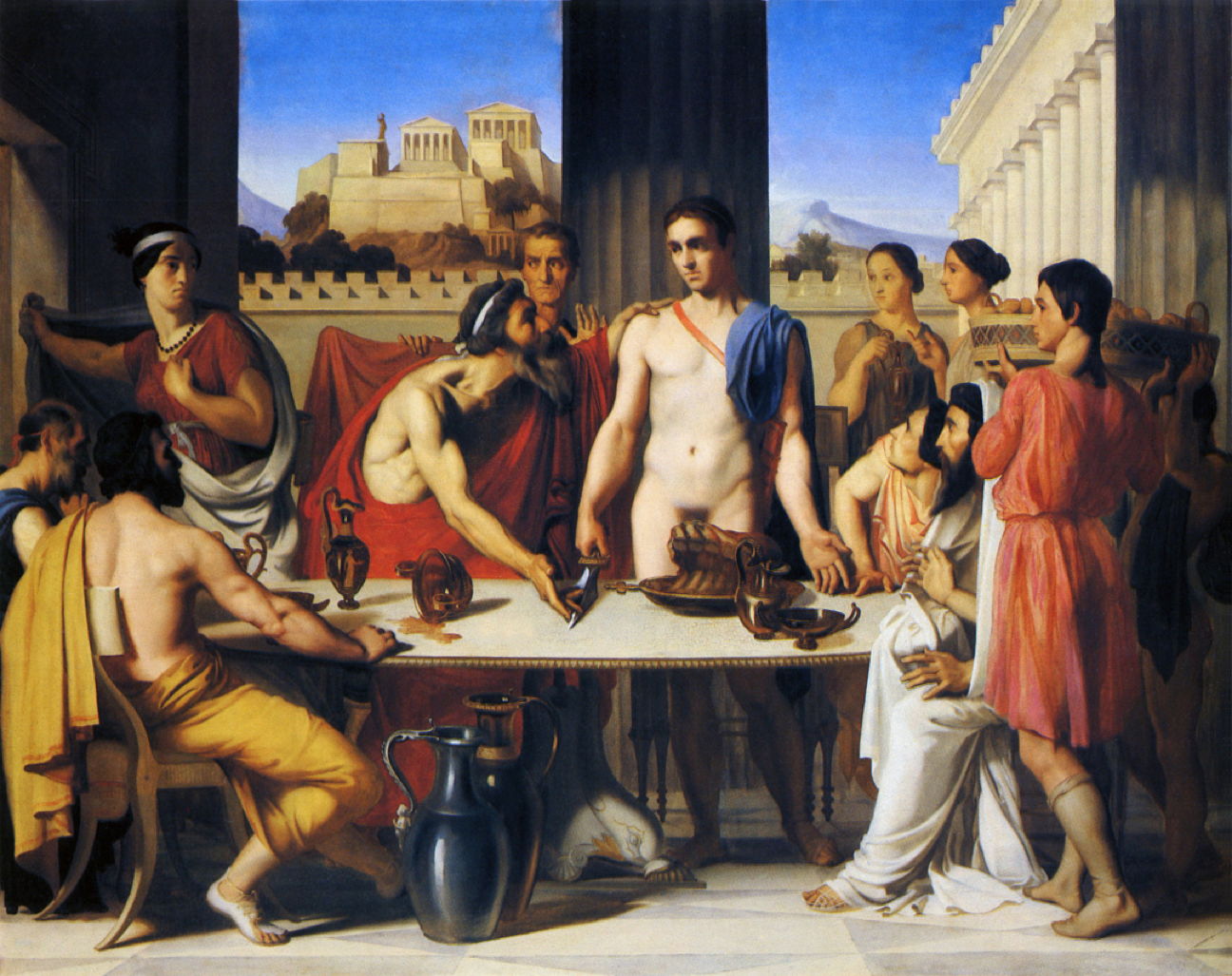
Hippolyte Flandrin (1809–1864), Theseus Recognized by his Father (1832), oil on canvas, 114.9 × 146.1 cm, École nationale supérieure des Beaux-Arts, Paris. Wikimedia Commons.
Hippolyte Flandrin’s Theseus Recognized by his Father beat Gibert’s painting for the Prix de Rome in 1832, and has a more neoclassical look, as if influenced by Jacques-Louis David. With a view of the Acropolis in the background, this shows the moment immediately after Aegeus has recognised his son, and the cup of aconite lies spilt on the table. Theseus, conspicuously naked, stands in the middle of the canvas, his father’s sword held rather limply in his right hand. Aegeus stands to the left of centre, talking emotionally to his son.
Of all the characters shown in this painting, it’s Medea who is the most fascinating. Stood at the far left, she appears to be on her way out. She is po-faced, and looks as if she has come not from Greece, but from central Asia.
Aegeus then declared Theseus to be his heir and successor as King of Athens. This was opposed by the sons of Pallas, who tried to attack the city. Theseus was tipped off by one of their men, surprised his opponents, and killed the lot of them. Like his hero Heracles, Theseus then set out to deal with the problem posed by the Marathonian Bull, captured it, and drove it through the city of Marathon before sacrificing it to Apollo. He then went on to battle with another bull, this time on the island of Crete.
This article provides a brief overview of the plot and sub-stories of Torquato Tasso’s epic poem Jerusalem Delivered, with links to individual articles, and some of the very best of the paintings.
Jerusalem Delivered is a fictional elaboration of the events at the end of the first Crusade, starting with the departure from Antioch, after its capture, and ending with the full possession of the city of Jerusalem.
Johann Friedrich Overbeck (1789-1869), The Archangel Gabriel Appears to Godfrey of Bouillon (1819-27), fresco, dimensions not known, Casa Massimo, Rome, Italy. Image by Sailko, via Wikimedia Commons.
The crusaders’ leader, Godfrey of Bouillon, is visited early one morning by the Archangel Gabriel, who spurs the French noble to lead his army south to the Holy City. During their journey, they are provisioned by sea, and meet little opposition.
Aladine, ruler of Jerusalem, hears of their progress and starts preparing to receive them. Ismen, formerly a Christian soothsayer now turned to ‘pagan’ sorceror, arranges a trap to oppress the remaining Christians in the city, by having a sacred icon of the Virgin Mary stolen. Aladine attributes this to a Christian and uses it as an excuse to persecute the Christians.
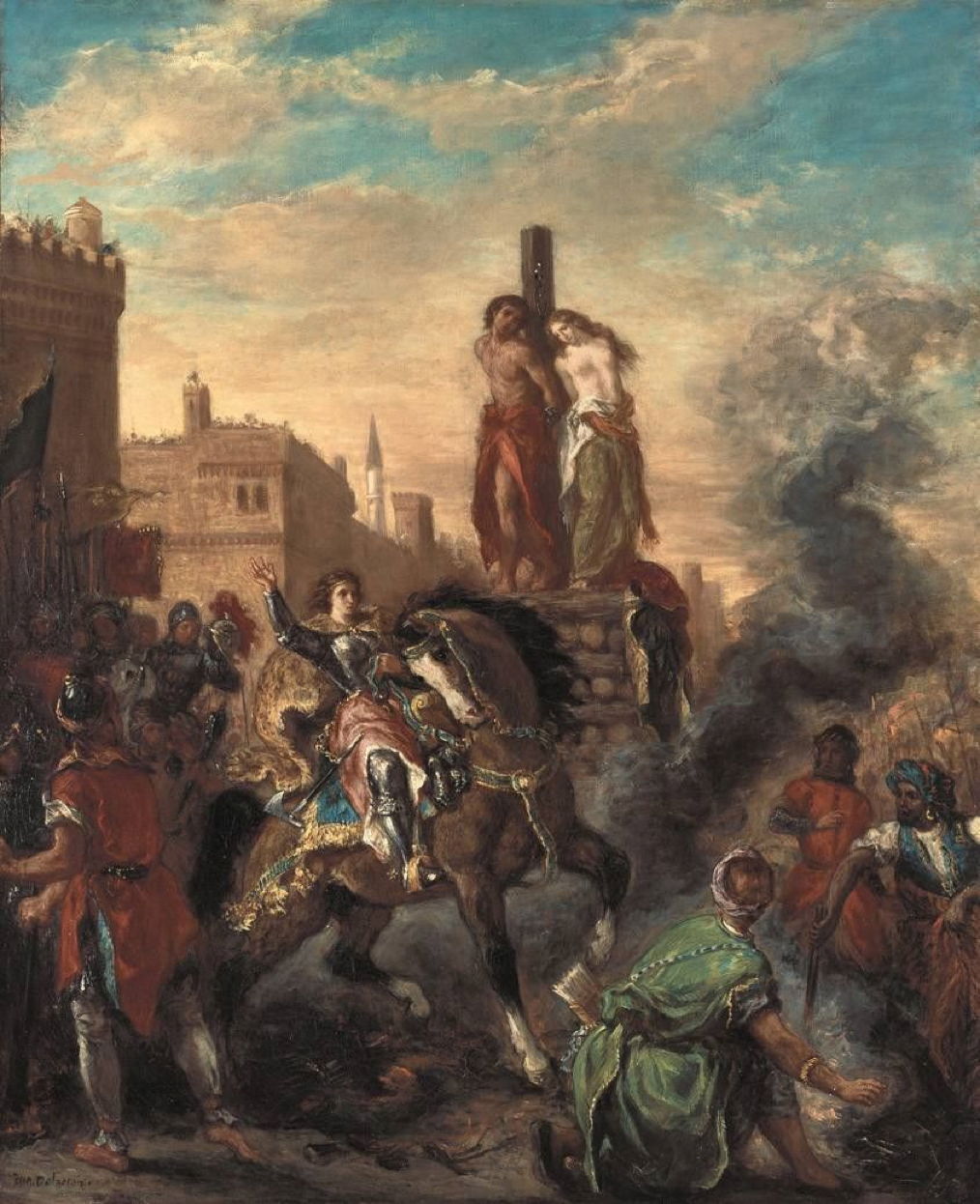
Sophronia, a young Christian woman, tells Aladine she stole the icon, and is condemned to burn at the stake. Her lover Olindo insists that he is the thief, and is tied on the other side of the stake for execution with her. Just as the kindling is about to be lit, the beautiful ‘pagan’ knight Clorinda arrives and intervenes.
Eugène Delacroix (1798–1863), Clorinda Rescues Olindo and Sophronia (1856), oil on canvas, 101 x 82 cm, Neue Pinakothek, Munich, Germany. Wikimedia Commons.
Sophronia and Olindo are spared, but Aladine banishes them and all other able-bodied Christians to beyond the city limits. Most flee to Emmaus, where the crusaders have just arrived.
Godfrey of Bouillon politely rejects overtures from two ambassadors of Egypt, inviting him to abandon his mission to capture Jerusalem. One, the Circassian Argante, warns Godfrey of dire consequences before he heads off to join Aladine in Jerusalem.
Soon after the crusaders arrive at the city, Clorinda leads an initial skirmishing party to size up the French forces. Godfrey sends Tancred to support the French, and when he knocks Clorinda’s helmet off, he falls hopelessly in love with her. Inside Jerusalem Erminia, former princess of Antioch, reveals her love for Rinaldo, another of the crusader knights. Argante shows himself to be a fearsome warrior by claiming the life of Dudon.
Godfrey decides a plan of action, and realises his need for a good supply of timber to build siege towers and engines.
The ‘pagan’ wizard Hydrotes sees his beautiful niece Armida, a sorceress herself, as an essential weapon in the campaign, so directs her to sow chaos inside Godfrey’s camp.
David Teniers the Younger (1610–1690), Armida before Godfrey of Bouillon (1628-30), oil on copper, 27 x 39 cm, Museo Nacional del Prado, Madrid, Spain. Wikimedia Commons.
Armida tells the crusaders a story of woe, and beguiles many of the finest of Godfrey’s knights to follow her on a fool’s errand.
In the midst of the chaos wrought by Armida, Rinaldo accuses Gernando of being a liar; they settle this when Rinaldo kills Gernando in a duel. Godfrey condemns Rinaldo to death, and he storms off from the camp. Armida then leads many other knights away on her diversionary mission.
In an attempt to expedite matters, Argante challenges the crusaders in one-to-one combat. Godfrey approves Tancred as the knight to face the Circassian. They fight viciously, wounding one another, but are brought to a halt by nightfall.
Erminia decides to go and tend Tancred’s wounds, so dresses up in Clorinda’s armour and slips out of the city in the dead of night. However, that makes her appear to be Clorinda to the crusaders, and she is forced to flee in panic. Tancred then rides off in pursuit of her, thinking her to be Clorinda. Overnight, both Erminia and Tancred become lost, and fail to find one another.
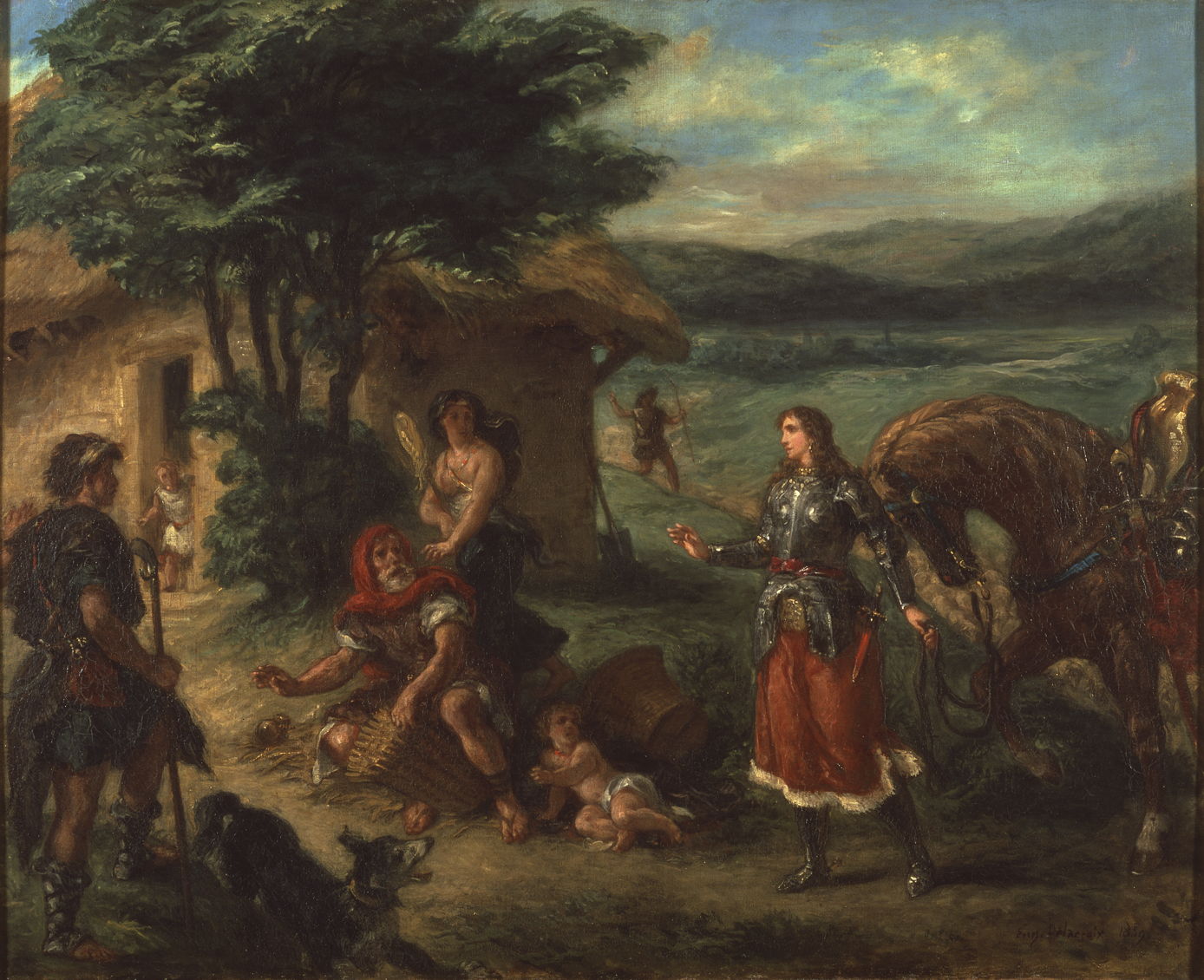
Eugène Delacroix (1798–1863), Erminia and the Shepherds (1859), oil on canvas, 82 x 104.5 cm, Nationalmuseum, Stockholm, Sweden. Wikimedia Commons.
Erminia happens on a small family of shepherds, who console her, and dress her in their country clothes.
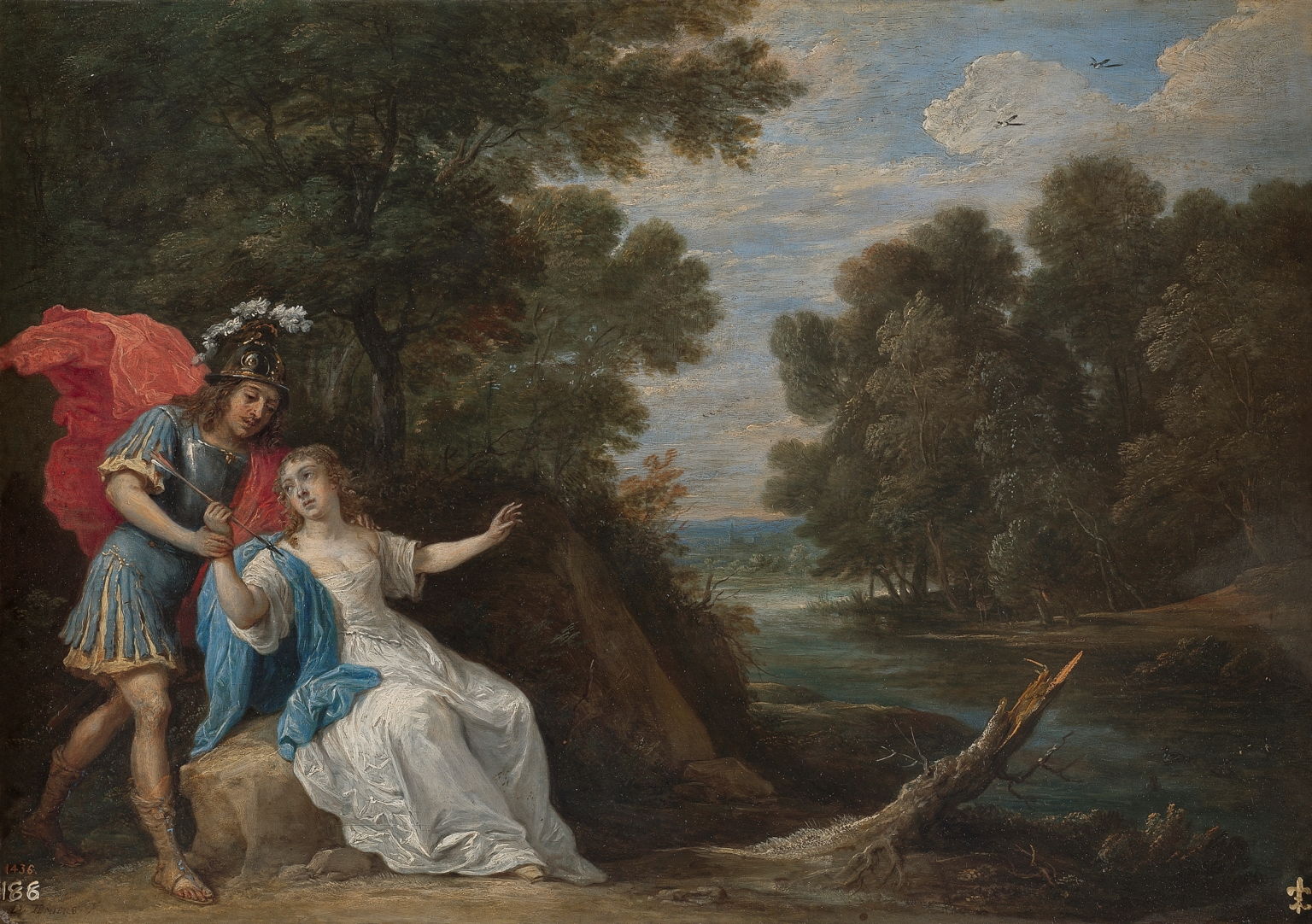
Tancred is trapped in Armida’s magic castle, behind the bars of its dungeon. The following morning, with his combat against Argante due to restart soon after dawn, he is nowhere to be found. Raymond of Toulouse is drawn by lot to fight as his substitute, and proves a match. The devil, though, gets a ‘pagan’ archer to loose an arrow that strikes Raymond without wounding him. At this breach of chivalry, the affronted crusaders and defenders of Jerusalem join battle, which turns bloody until the hand of God intervenes with a massive thunderstorm.
Rinaldo and Tancred are still missing, but the crusaders riot in fear that the former has been killed. Godfrey realises he must attack the city soon.
Arab forces then attack the crusaders by night, which develops into more general battle. Knights return from their mission for Armida, reporting that they had been rescued by Rinaldo, who hadn’t been killed after all. They report that Armida has taken Tancred prisoner.
Godfrey prepares for assault on the city, first celebrating mass on Mount Olivet. The following day the crusaders bring up their siege towers and engines to tackle the walls of Jerusalem, but make slow progress against a strong defence. At nightfall the towers are pulled back, but Clorinda sneaks out of the city and sets alight to the towers, burning them to the ground.
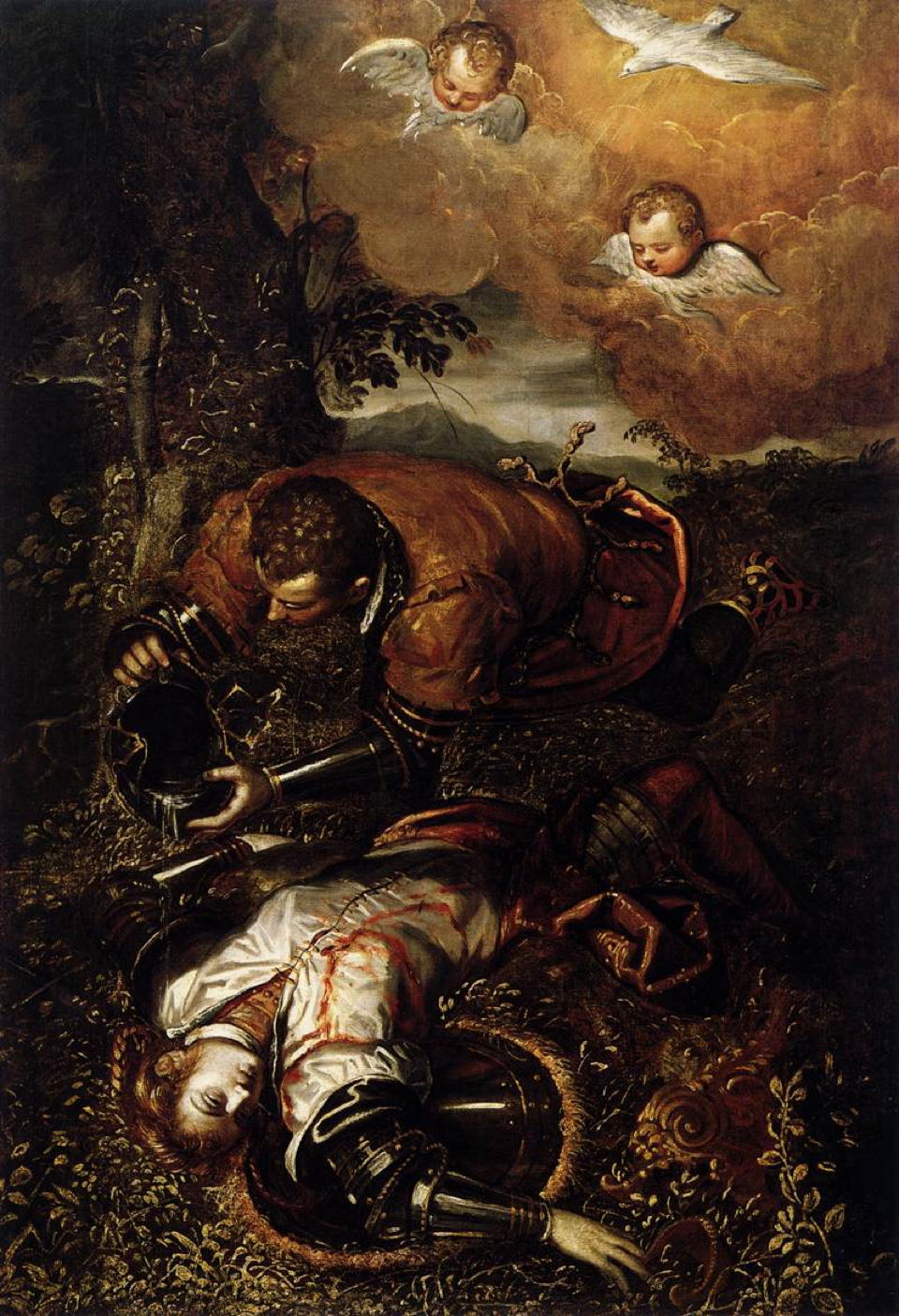
She is caught outside the walls by Tancred, who cannot tell it is her and engages her in combat. Eventually he wounds her mortally, recognises her, and she asks to be baptised before she dies. Tancred does so, and she goes in peace.
Domenico Tintoretto (1560–1635), Tancred Baptizing Clorinda (c 1585), oil on canvas, 168 x 115 cm, Museum of Fine Arts, Houston, TX. Wikimedia Commons.
Ismen enchants the forest which is the crusaders’ only supply of wood, preventing them from cutting replacement timbers for new siege towers. The weather turns oppressively hot and dry, causing crusaders to collapse and die of heat and dehydration. After prayers of the crusaders, the weather breaks and there is heavy rain.
Godfrey has a vision revealing the importance of finding Rinaldo to break the spell so that he can obtain timber again. Charles and Ubaldo leave on a mission to discover Rinaldo. They learn that Armida had originally intended to kill him, but just as she was about to sink her dagger into his sleeping body, she fell in love with him and abducted him instead.
Nicolas Poussin (1594–1665), Rinaldo and Armida (c 1630), oil on canvas, 82.2 x 109.2 cm, Dulwich Picture Gallery. Wikimedia Commons.
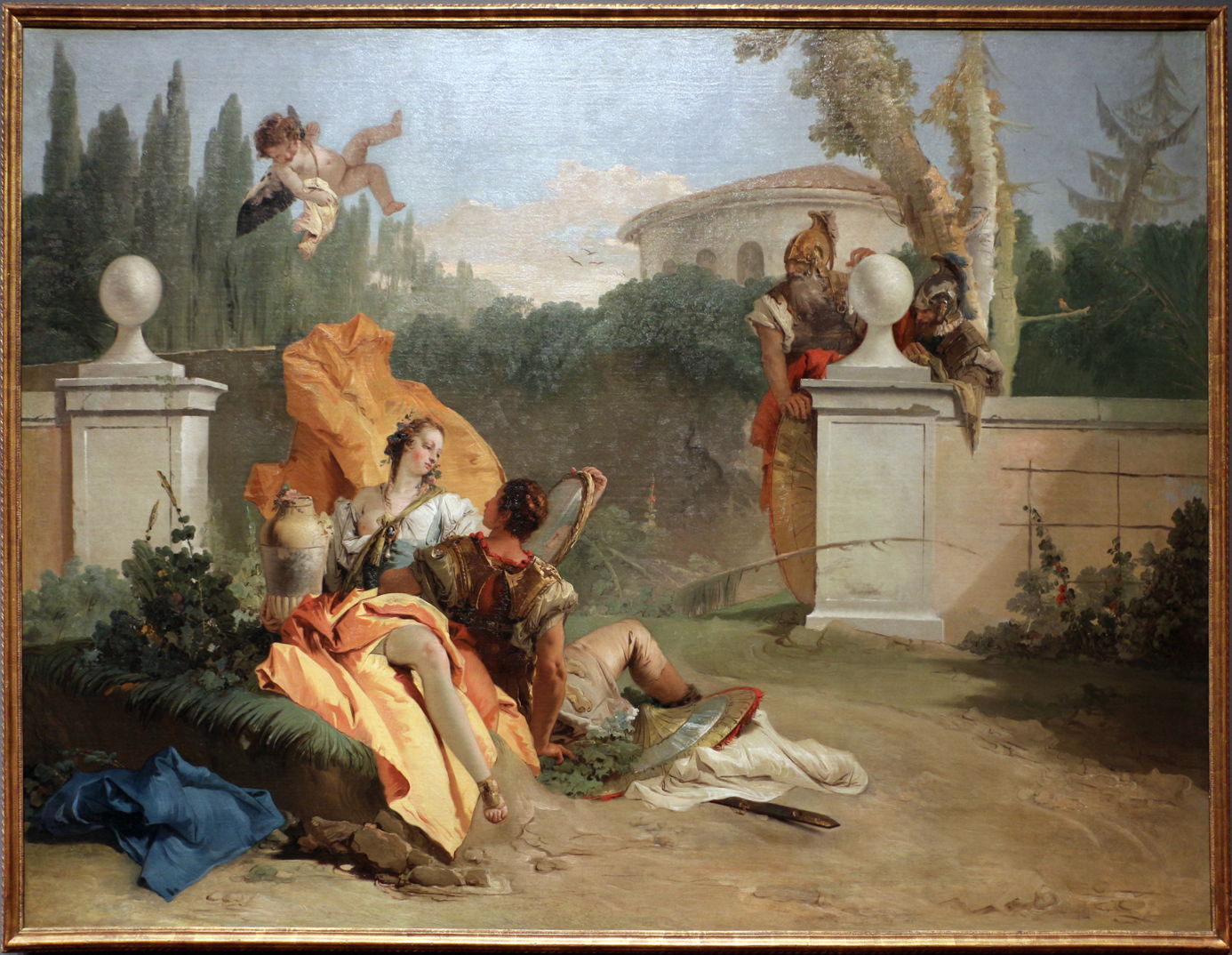
With the help of a wizard, Charles and Ubaldo sail in a magic ship to the Fortunate Isles. Overcoming various obstacles, they see the couple together in Armida’s garden, where Rinaldo has clearly become Armida’s dandy, and no warrior knight.
Giovanni Battista Tiepolo (1696–1770), Rinaldo and Armida in Her Garden (1742-45), oil on canvas, 187 x 260 cm, The Art Institute of Chicago, Chicago, IL. Image by Sailko, via Wikimedia Commons.
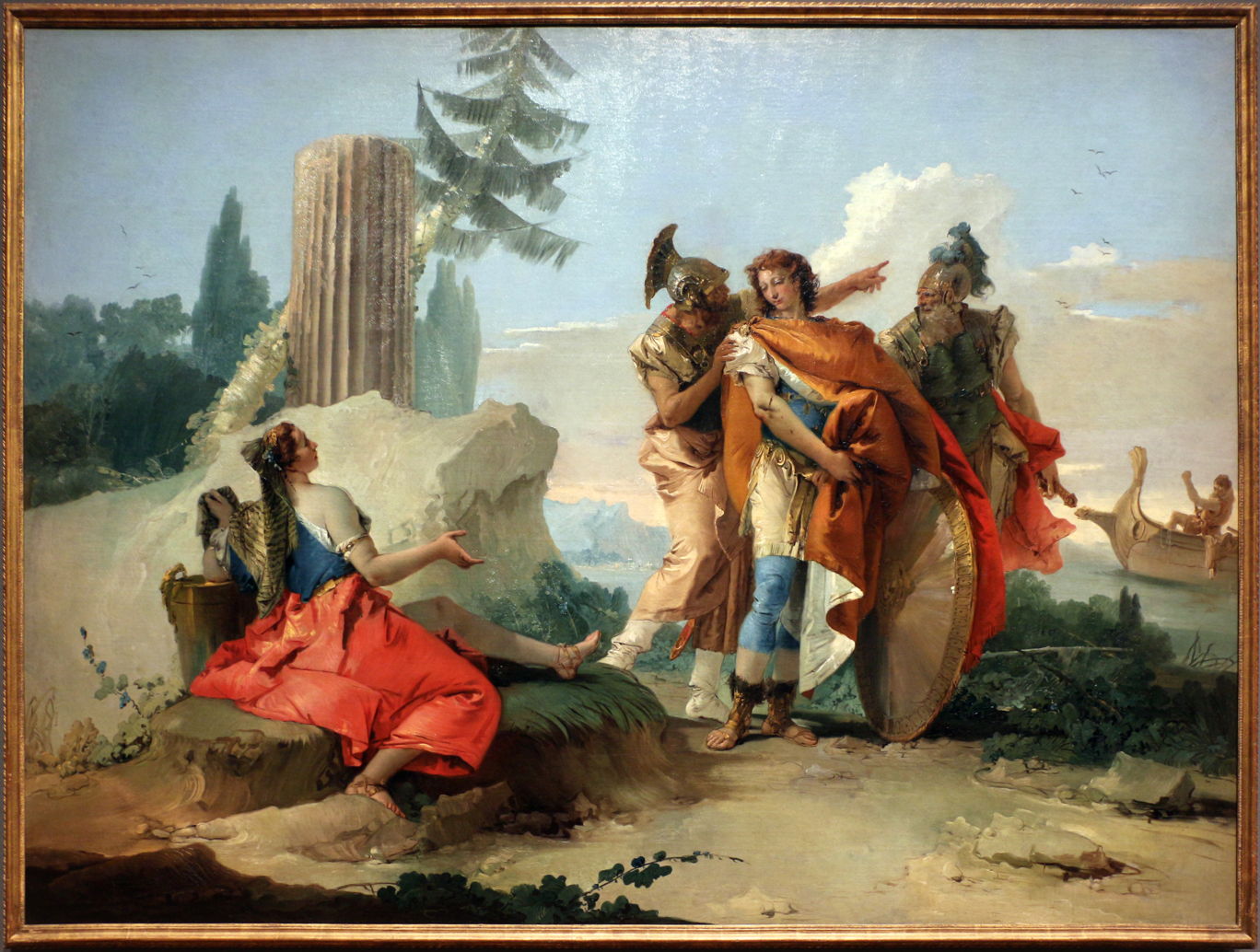
Showing Rinaldo his image in a polished shield, Charles and Ubaldo get him to see how he has changed, and to return to the siege of Jerusalem with them.
Giovanni Battista Tiepolo (1696–1770), Armida Abandoning Rinaldo (1742-45), oil on canvas, 186.7 x 259.4 cm, The Art Institute of Chicago, Chicago, IL. Image by Sailko, via Wikimedia Commons.
Armida first tries to lure him back, then weeps, and finally departs in rage in her own chariot, to wreak vengeance.
Rinaldo is reunited with Godfrey, who asks him to solve the problem of the enchanted wood. Rinaldo enters the wood and breaks Ismen’s spell, enabling timbers to be felled to build fresh siege towers.
Meanwhile, the King of Egypt is leading a massed army towards the crusaders at Jerusalem. Joining him is Armida with forces provided by her evil uncle. There are several volunteers who promise to kill Rinaldo in return for her hand in marriage. The King of Egypt also plots how he will kill Godfrey using deception. Those plans are discovered by a crusader spy, Vafrine.
With new towers built, Godfrey resumes the assault on Jerusalem before the Egyptian forces are due to arrive. Rinaldo, Tanred, Godfrey and others lead the ascent of the walls, and crusaders enter the city, where they quickly start massacring its ‘pagan’ defenders.
Argante and Tancred agree to conclude their previous combat beyond the city walls. After a bitter fight, in which both men are badly wounded, Tancred finishes the Circassian off, then collapses at dusk.
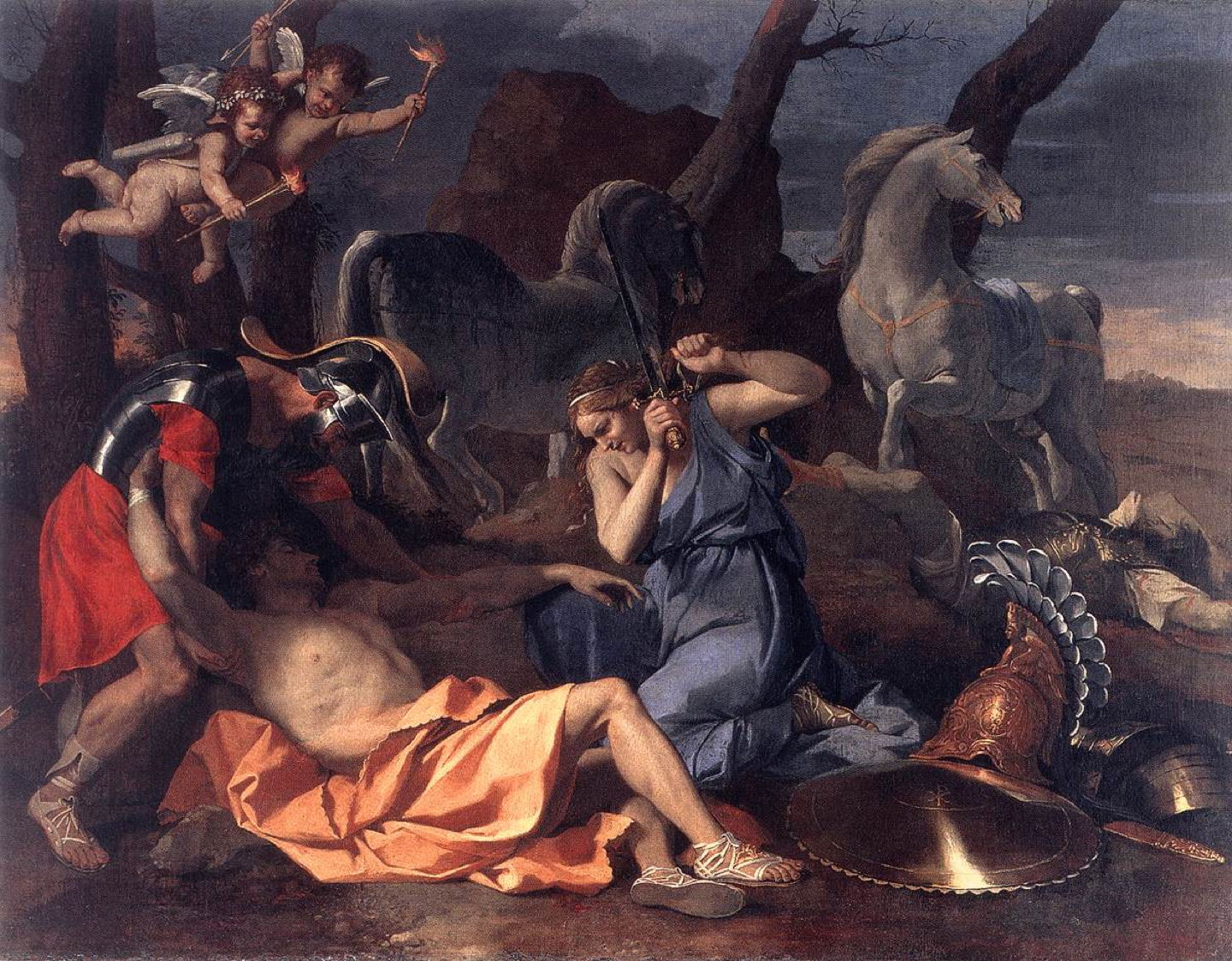
Vafrine has completed his mission spying on the Egyptian forces when he is recognised by Erminia, who wants to defect to the crusader camp. On their way back, they stumble across Argante’s body, then the wounded Tancred.
Nicolas Poussin (1594–1665), Tancred and Erminia (c 1634), oil on canvas, 75 x 100 cm, Barber Institute of Fine Arts, Birmingham, England. Wikimedia Commons.
Erminia cuts tresses from her hair to make improvised bandages for Tancred’s wounds, and he is taken into Jerusalem for further care. Vafrine goes on to brief Godfrey of the Egyptians’ plans, to help him plan his defence.
The Egyptian army arrives late the following day, but Godfrey won’t be rushed, and battle commences at dawn the next day. Egyptians wearing false colours as crusaders get close to Godfrey but are quickly recognised and killed.
As the battle rages on, Rinaldo sees Armida as an archer in her chariot, but passes her by to continue fighting. She struggles to loose her arrows at him, and those that she does shoot, bounce off ineffectively. With the Egyptian forces in full retreat and their leaders all dead, Armida flees on one of her horses.
David Teniers the Younger (1610–1690), Reconciliation of Rinaldo and Armida (1628-30), oil on copper, 27 x 39 cm, Museo Nacional del Prado, Madrid, Spain. Wikimedia Commons.
Rinaldo catches her, just as she is about to stab herself with one of her own arrows in a bid to end her life. She swoons into his arms, he cries with pity for her, and Rinaldo promises to be her servant and her champion.
With the ‘pagan’ armies defeated and departed, Godfrey now leads his crusaders into the city as the sun sets. He goes to the Temple, having fulfilled his vow to deliver Jerusalem.
Johann Friedrich Overbeck (1789-1869), Consecration of Godfrey (1819-27), fresco, dimensions not known, Casa Massimo, Rome, Italy. Image by Sailko, via Wikimedia Commons.
Thomas Asbridge (2004) The First Crusade, A New History, Free Press, ISBN 978 0 7432 2084 2.
Anthony M Esolen, translator (2000) Torquato Tasso, Jerusalem Delivered, Gerusalemme Liberata, Johns Hopkins UP. ISBN 978 0 801 863233. A superb modern translation into English verse.
John France (1994) Victory in the East, a Military History of the First Crusade, Cambridge UP. ISBN 978 0 521 589871.
Joanthan Riley-Smith, ed (1995) The Oxford Illustrated History of the Crusades, Oxford UP. ISBN 978 0 192 854285.
Jonathan Riley-Smith (2014) The Crusades, A History, 3rd edn., Bloomsbury. ISBN 978 1 4725 1351 9.
Johathan Unglaub (2006) Poussin and the Poetics of Painting, Pictorial Narrative and the Legacy of Tasso, Cambridge UP. ISBN 978 0 521 833677.
Armida has been abandoned by Rinaldo so he could return to the siege of Jerusalem, and has joined the massed army of the King of Egypt. One of its leaders, Adrastus, has promised to rip Rinaldo’s heart out, and present his head to Armida, to satisfy her lust for vengeance.
Rinaldo, Charles and Ubaldo return in their magic ship, and land on Judea’s shore. Waiting nearby is an old man guarding Rinaldo’s new suit of armour, specially forged and crafted to protect him. His shield bears figures demonstrating its heroic roots, and Rinaldo is presented with the predestined sword that had been owned by Sven, the late Prince of Denmark. The three are then whisked through the night sky in the old man’s chariot to rejoin the crusaders in their camp near Jerusalem.
At the start of Canto eighteen, Rinaldo and Godfrey of Bouillon are re-united: the knight says he is ready to redeem himself, and Godfrey throws his arms around him. The leader then explains to Rinaldo the problem they have with the enchanted wood, which is stopping them from felling trees to replace their siege engines and towers so they can resume their assault on the city.
Rinaldo accepts Godfrey’s challenge and, with the encouragement of Peter the Hermit, he sets off alone for the wood, where all is still and calm. He seeks a place to cross the river, and a bridge of gold appears, sees him across, then vanishes again. In front of him, the trunk of an oak splits open to give birth to a fully-grown nymph resembling Armida.
Rinaldo ignores the nymph’s overtures, draws his sword, and goes to cut down some myrtle. The nymph intervenes, and transforms into a monster with many arms bearing swords. Then there is lightning and thunder, and heavy rain, but Rinaldo persists and cuts through a black walnut tree. This instantly dispels the enchantment, and the wood returns to normal.
Rinaldo goes back to the camp and tells of his success. Crusaders and their expert engineers swarm out to the woods to fell trees and build new siege machines. In no time they build three great towers to place against the city’s walls, replacing those burnt to the ground by Clorinda before her death.
There is frantic work going on inside Jerusalem to repair and reinforce the city’s walls, build their own towers, and create inflammable weapons using mixtures of sulphur and bitumen.
Some French crusaders then spot a messenger pigeon, which is attacked by a hawk. The pigeon lands on Godfrey, who discovers the message it’s carrying. This is from the Egyptian forces expecting to arrive at Jerusalem in four or five days. Godfrey knows how little time he has left to capture the city, and calls on his commanders to prepare to assault its walls.
In their meeting, Raymond nominates his polyglot valet Vafrine to be a spy on the approaching army from Egypt. The valet agrees, and promises to bring back full details of their forces and disposition.
The day before their intended assault they spend in prayer, confession and celebrating Mass. The crusaders then move their siege towers to a well-armed gate to mislead the enemy. Overnight they shift them again to where they intend to use them, catching the defenders of the city off guard.
Soon after dawn, with their host of smaller engines brought into play, the crusaders start their massed assault. The air is filled with arrows tipped with poison, then stones hurled from the walls. The knights and soldiers approach under cover, and Rinaldo has a high ladder placed against the wall so he can lead many others also scaling its heights.
The crusaders swarm up using ladders and the three towers, taking casualties from missiles and heavy objects dropped upon them. Then balls of fire start to rain upon them, as if from hell. As the soldiers try to control fires burning in their wooden towers, the wind suddenly changes and blows the flames back at those defending the city. This sets alight woollen materials they had been using as protection, and the defenders are scorched away.
Ismen takes two of his neophytes out to try to cast spells, but a stone flung from one of the towers kills all three in a single shot.
As Soliman takes to leading the defence, the Archangel Michael appears to Godfrey, and reveals a whole army of angels in support. This inspires Godfrey to challenge Soliman. Rinaldo makes a way for his leader to plant a holy Cross on the top of the city’s wall, bringing cheers from the crusaders, who push onward and upward. Tancred too storms over the wall, raising his banner of the Cross in victory over Argante’s men.
Finally, the nearby gate is opened, and the whole crusader army enters Jerusalem. The wrath of their victory is immediate, and the city’s streets are soon awash with blood and piled high with corpses.
Canto nineteen opens within the conquered city, where only Argante the Circassian fights on. He is met by Tancred, and the two agree to conclude their previous combat alone, outside the city. Argante has no shield, and stands higher by his head against his opponent. They swing their swords at one another, inflicting wounds, but fight on. Taunting one another, they grapple and wrestle so forcefully that both fall to the ground.
Argante is the slower to get up, and they continue slashing through their armour into flesh. But Argante is now bleeding badly from his arm, and Tancred offers to call a halt. The Circassian responds by wounding Tancred viciously in the shoulder and ribs. Argante then falls to the ground, opening up his wounds. Still he won’t give up, and Tancred has to drive his blade into Argante’s skull to finish him off.
Tancred may be the victor, but is himself badly wounded, and struggles to walk. He sits down, trembling, and as night falls he lapses into unconsciousness.
While Argante and Tancred have been engaged in their duel to the death, slaughter has continued in the captured city. Rinaldo will only kill those who remain armed. Many of the citizens are packed into the shelter of the Temple of Solomon, whose doors are quickly battered in, leading to mass murder of the occupants.
Aladine and Soliman find their way to the Tower of David, where they barricade themselves in, armed with a steel mace. When Count Raymond of Toulouse tries to break into them, he is knocked senseless and dragged in as a hostage. Rinaldo is just about to enter when Godfrey sounds the retreat for the night, leaving the storming of the tower for the following morning.
Meanwhile Vafrine has been sizing up the Egyptian forces during the day. He has spoken freely within their camp, gleaned details of strengths and plans, even learning of the soldier who has been designated to kill Godfrey. He found Armida, and her suitors who have vowed to kill Rinaldo for her hand. There he bumps into a beautiful woman who recognises him: it is Erminia, who asks him to take her back with him.
Erminia tells Vafrine how the death of Godfrey has been planned using subterfuge. His killers will be dressed as crusaders, bearing the red cross on white to ensure they can get close to him, with just a small sign on their helmets to distinguish them as ‘pagans’.
By dusk, Erminia and Vafrine are nearing the crusader camp, when they spot Argante’s corpse, and a little beyond it the unconscious Tancred, who at first appears dead. When Erminia, who is in love with Tancred, recognises his faint voice, she leaps from her horse and weeps over him. Vafrine tells her that there is still time to cure his wounds and save his life, and removes Tancred’s armour.
Erminia has nothing to use as bandages to bind Tancred’s wounds, so cuts her hair off and uses that. Tancred regains consciousness, and recognises Vafrine. Others who have been searching for Tancred arrive, and start to carry him back to camp. Tancred insists on two things, though: that Argante is given a proper burial, and that he is carried into the city of Jerusalem to rest.
It is this last section that has been painted most often, and by great masters.
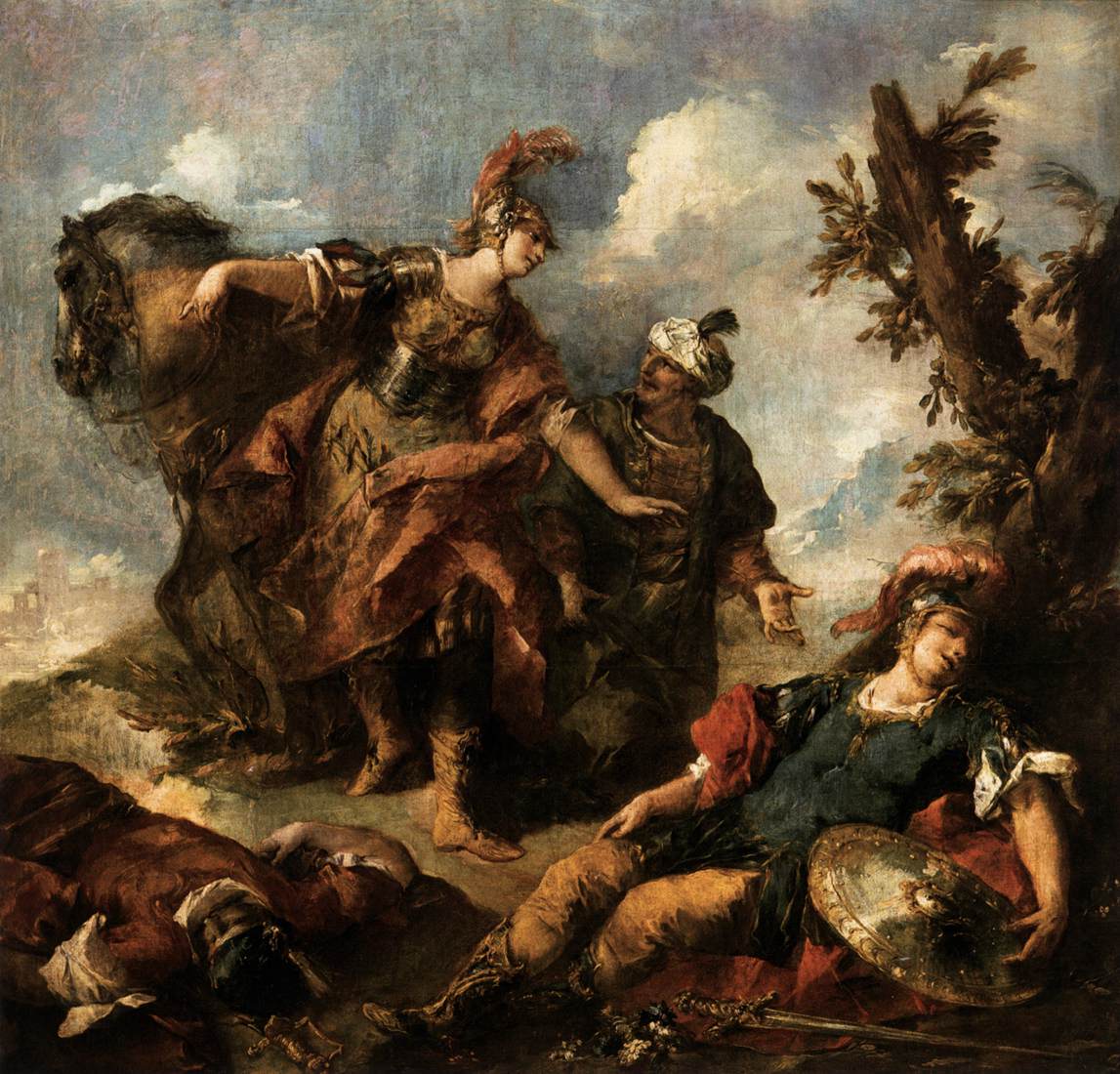
Giovanni Antonio Guardi (1699–1760), Herminia and Vafrino Find the Wounded Tancred (c 1750-55), oil on canvas, 250 x 261 cm, Gallerie dell’Accademia, Venice, Italy. Wikimedia Commons.
Giovanni Antonio Guardi’s Herminia and Vafrine Find the Wounded Tancred from about 1750-55 shows the start of the sequence, just after Erminia has leapt from her horse. The corpse of Argante is in the lower left corner, Tancred’s sword still impaling its head.
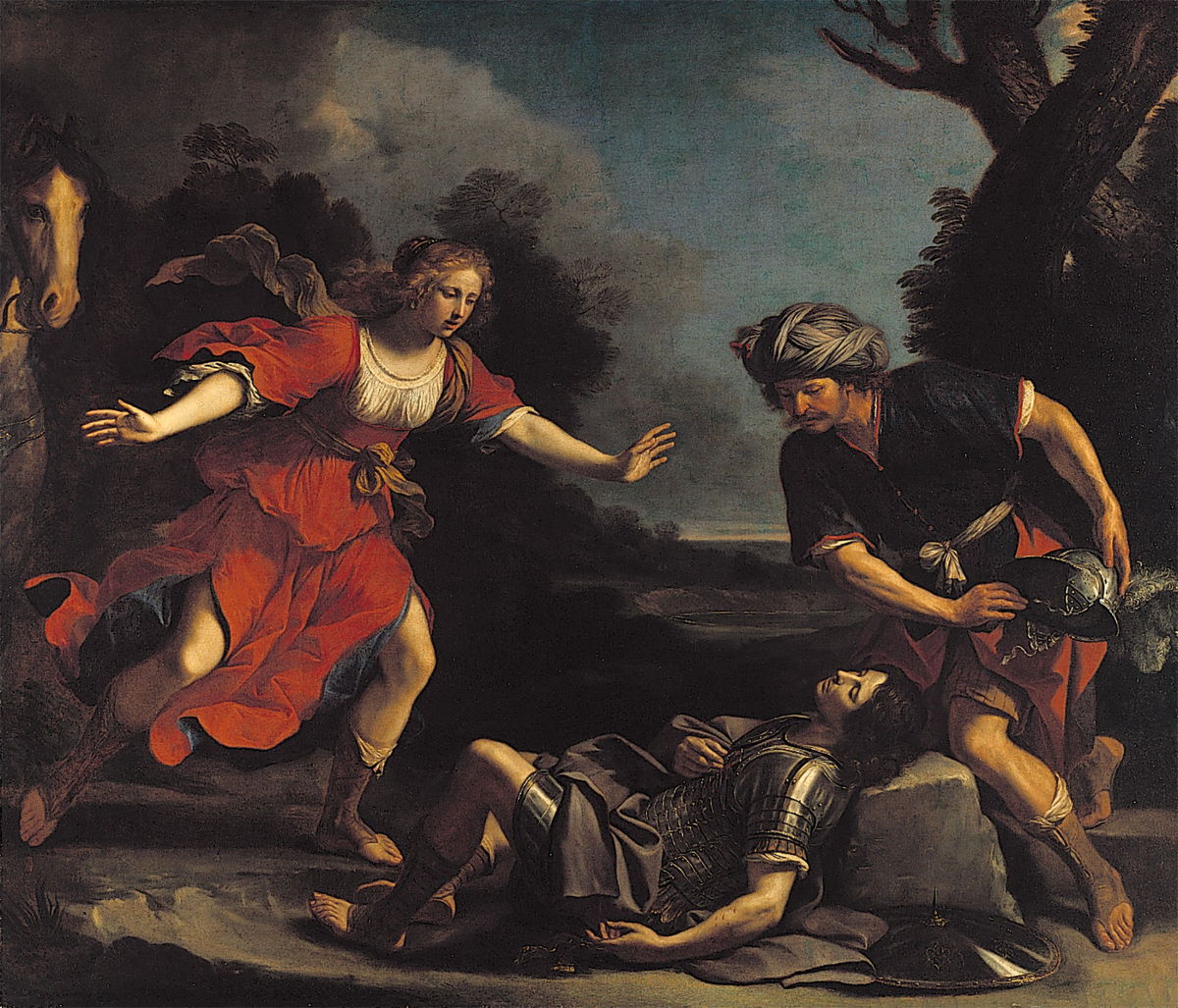
Guercino (Giovanni Francesco Barbieri) (1591–1666), Erminia Finding the Wounded Tancred (c 1650), oil on canvas, 244 x 297 cm, National Galleries of Scotland, Edinburgh, Scotland. Wikimedia Commons.
Guercino’s Erminia Finding the Wounded Tancred from about 1650 shows the scene slightly later, as Erminia rushes over to minister to the ailing Tancred, still uncertain whether he is alive or dead. This painting was originally commissioned by the Papal Legate of Bologna, but he let the Duke and Duchess of Mantua buy it from its creator in 1652.
Guercino (Giovanni Francesco Barbieri) (1591–1666), Erminia Finds the Wounded Tancred (1618-19), oil on canvas, 145.5 x 187.5 cm, Galleria Doria Pamphilj, Rome, Italy. Wikimedia Commons.
Much earlier in his career, Guercino had painted a few moments further into the story, in Erminia Finds the Wounded Tancred from 1618-19. Vafrine has now removed Tancred’s armour, and they are trying to work out how to bandage his wounds.
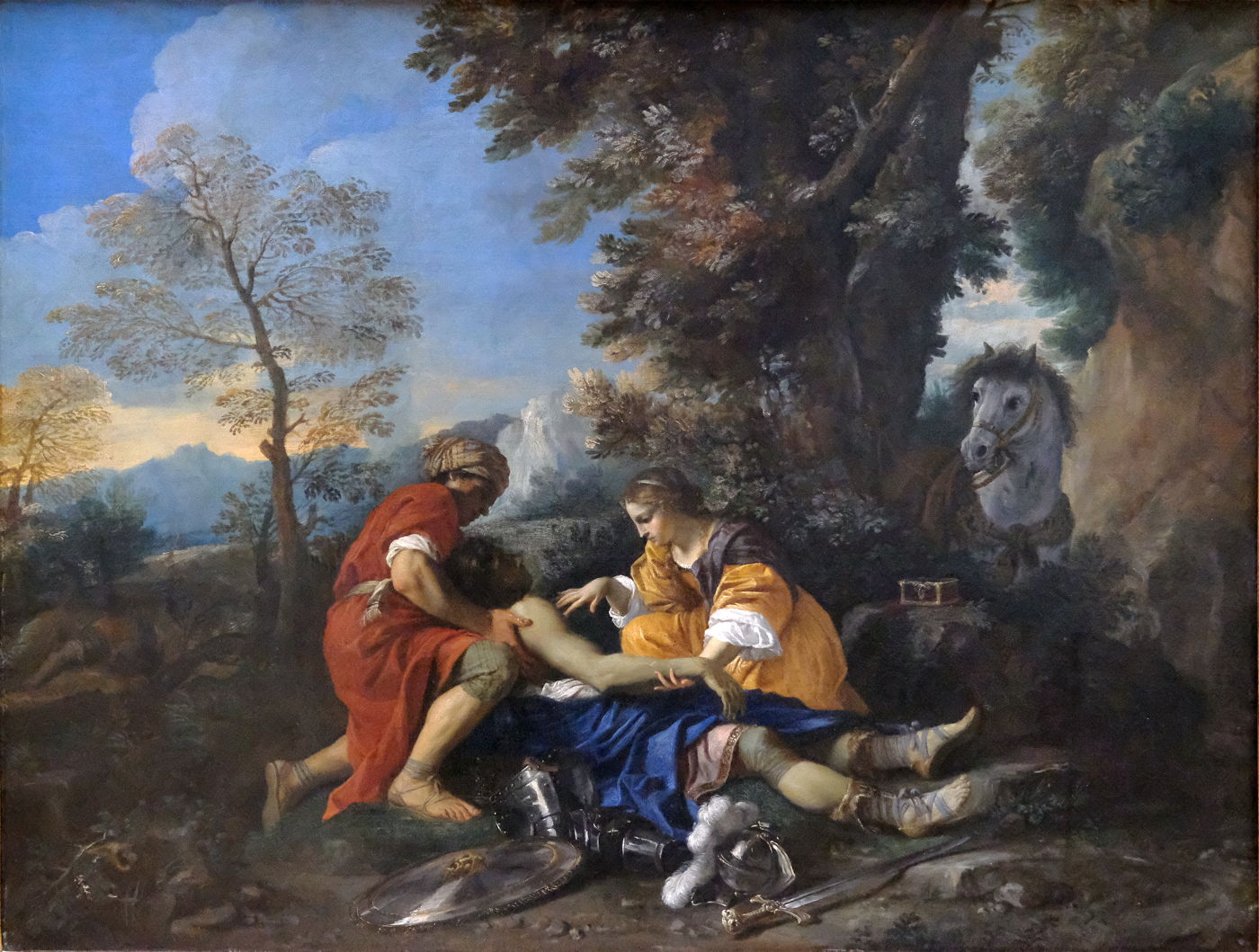
Pier Francesco Mola (1612–1666), Erminia and Vafrino Tending the Wounded Tancred After the Battle with Argante (c 1650-60), oil on canvas, 69 x 91.8 cm, Musée du Louvre, Paris. Wikimedia Commons.
Pier Francesco Mola’s Erminia and Vafrine Tending the Wounded Tancred After the Battle with Argante from about 1650-60 shows a similar scene, with Vafrine cradling the knight’s head and upper body, and the body of Argante at the far left.
There are three great paintings depicting the strange climax, when Erminia cuts her tresses to form bandages.
Alessandro Turchi (1578–1649), Erminia Finds the Wounded Tancred (c 1630), oil on canvas, 147 x 233.5 cm, Kunsthistorisches Museum, Vienna, Austria. Wikimedia Commons.
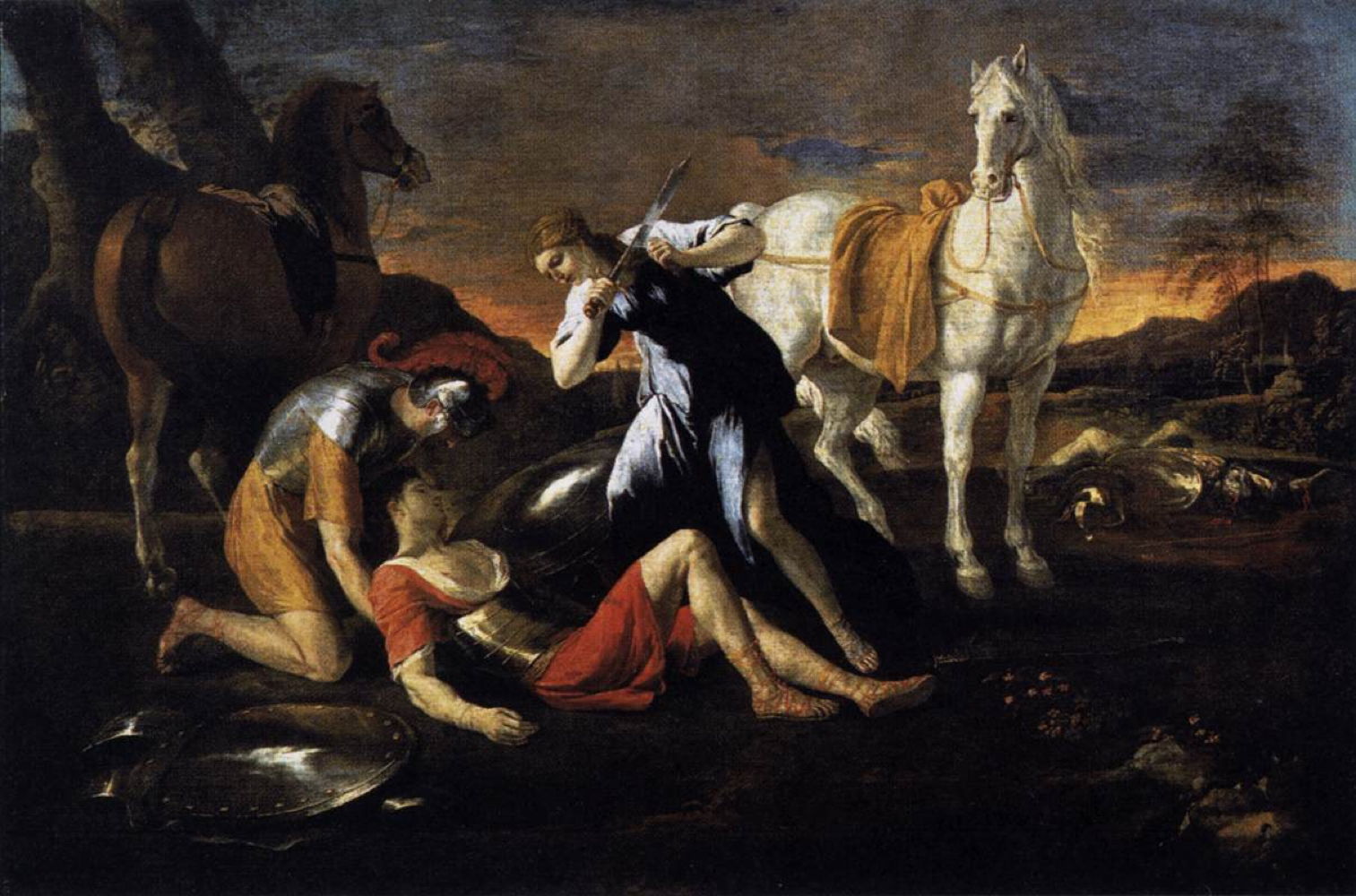
Alessandro Turchi’s Erminia Finds the Wounded Tancred is thought to have been painted in about 1630. Erminia is using Tancred’s sword to cut her hair, a detail omitted from Tasso’s text. Argante’s body is behind them.
Nicolas Poussin (1594–1665), Tancred and Erminia (c 1631), oil on canvas, 98 x 147 cm, Hermitage Museum Государственный Эрмитаж, Saint Petersburg, Russia. Wikimedia Commons.
At about the same time, Nicolas Poussin was painting this first version of Tancred and Erminia (c 1631), now in the Hermitage. It contains the same elements, even back to Argante’s body, but in a more open composition dominated by Erminia and her white horse.
Nicolas Poussin (1594–1665), Tancred and Erminia (c 1634), oil on canvas, 75 x 100 cm, Barber Institute of Fine Arts, Birmingham, England. Wikimedia Commons.
This slightly later version by Poussin is thought to date from about 1634, and has a more powerful close-in composition. Erminia’s arms are in a similar position, also using Tancred’s sword, but she is now kneeling at Tancred’s side. The love between Erminia and Tancred is also made clear in the pair of cupids, and the two horses are anticipating the arrival of other crusaders to carry Tancred away.
It is now night, and Vafrine has a lot to brief Godfrey about, as the crusaders prepare to complete their conquest of Jerusalem then defend it from the approaching Egyptian army.
Thomas Asbridge (2004) The First Crusade, A New History, Free Press, ISBN 978 0 7432 2084 2.
Anthony M Esolen, translator (2000) Torquato Tasso, Jerusalem Delivered, Gerusalemme Liberata, Johns Hopkins UP. ISBN 978 0 801 863233. A superb modern translation into English verse.
John France (1994) Victory in the East, a Military History of the First Crusade, Cambridge UP. ISBN 978 0 521 589871.
Joanthan Riley-Smith, ed (1995) The Oxford Illustrated History of the Crusades, Oxford UP. ISBN 978 0 192 854285.
Jonathan Riley-Smith (2014) The Crusades, A History, 3rd edn., Bloomsbury. ISBN 978 1 4725 1351 9.
Johathan Unglaub (2006) Poussin and the Poetics of Painting, Pictorial Narrative and the Legacy of Tasso, Cambridge UP. ISBN 978 0 521 833677.
The crusaders led by Godfrey of Bouillon desperately need Rinaldo back if they are to resume their assault on Jerusalem. Guelph’s party, notably the knights Charles (Carlo) and Ubaldo, have gone in search of him. But Rinaldo has been lured into a trap by the sorceress Armida, who intended to kill him. At the last moment, though, she falls in love with him and abducts him in her chariot.
That flies the couple to the distant, deserted and enchanted Fortunate Isles, where she lives in her garden that is perpetually in Spring. The wizard explains this to Charles and Ubaldo, to aid them in their mission to rescue the knight.
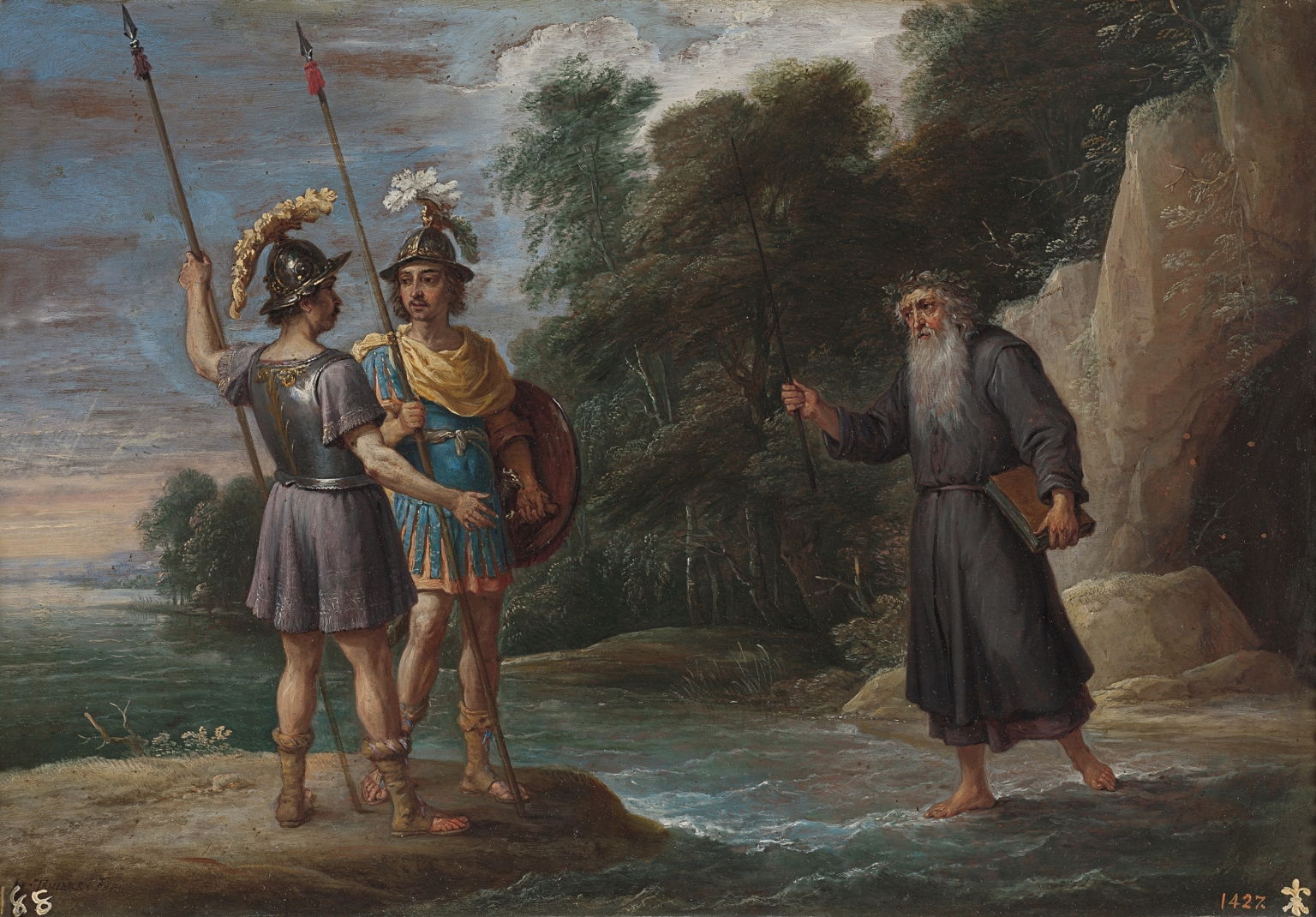
David Teniers the Younger (1610–1690), The Magician Shows Carlos and Ubaldo the Whereabouts of Rinaldo (The search for Rinaldo) (1628-30), oil on copper, 27 x 39 cm , Museo Nacional del Prado, Madrid, Spain. Wikimedia Commons.
David Teniers the Younger’s The Magician Shows Carlos and Ubaldo the Whereabouts of Rinaldo (The search for Rinaldo) from 1628-30 is a small oil on copper painting in his series telling this section of Tasso’s epic. Here the wizard despatches the two knights to the Fortunate Isles.
At the start of canto fifteen, Charles and Ubaldo set off to retrace their steps with the wizard as their guide. The river takes them gently down to the sea, where a ship awaits. They board, and sail at miraculous speed past Ascalon and the mouths of the River Nile, westward through the Mediterranean, and through the Pillars of Hercules into the Atlantic Ocean. They eventually approach the Fortunate Isles, pull into a harbour, and the two knights disembark.
They spend the night at the foot of the mountain they have to climb to reach Armida’s garden with the captive Rinaldo. They set off at dawn, only to encounter their first obstacle: a fearsome dragon blocking their passage up the mountain. Charles draws his sword ready to slay the dragon, but Ubaldo waves a golden wand, a gift of the wizard, which drives it away.
Nicolas Poussin (1594–1665), The Companions of Rinaldo (c 1633-4), oil on canvas, 119 x 101 cm, The Metropolitan Museum of Art, New York, NY. Wikimedia Commons.
Poussin’s The Companions of Rinaldo (c 1633-4) shows the two knights confronting this dragon. Charles stands in the centre with his sword ready, but Ubaldo behind him leaves his weapon in its scabbard and brandishes his golden wand instead. In the background at the left is the magic ship in which they sailed, and standing in its prow is the maiden who steered it.
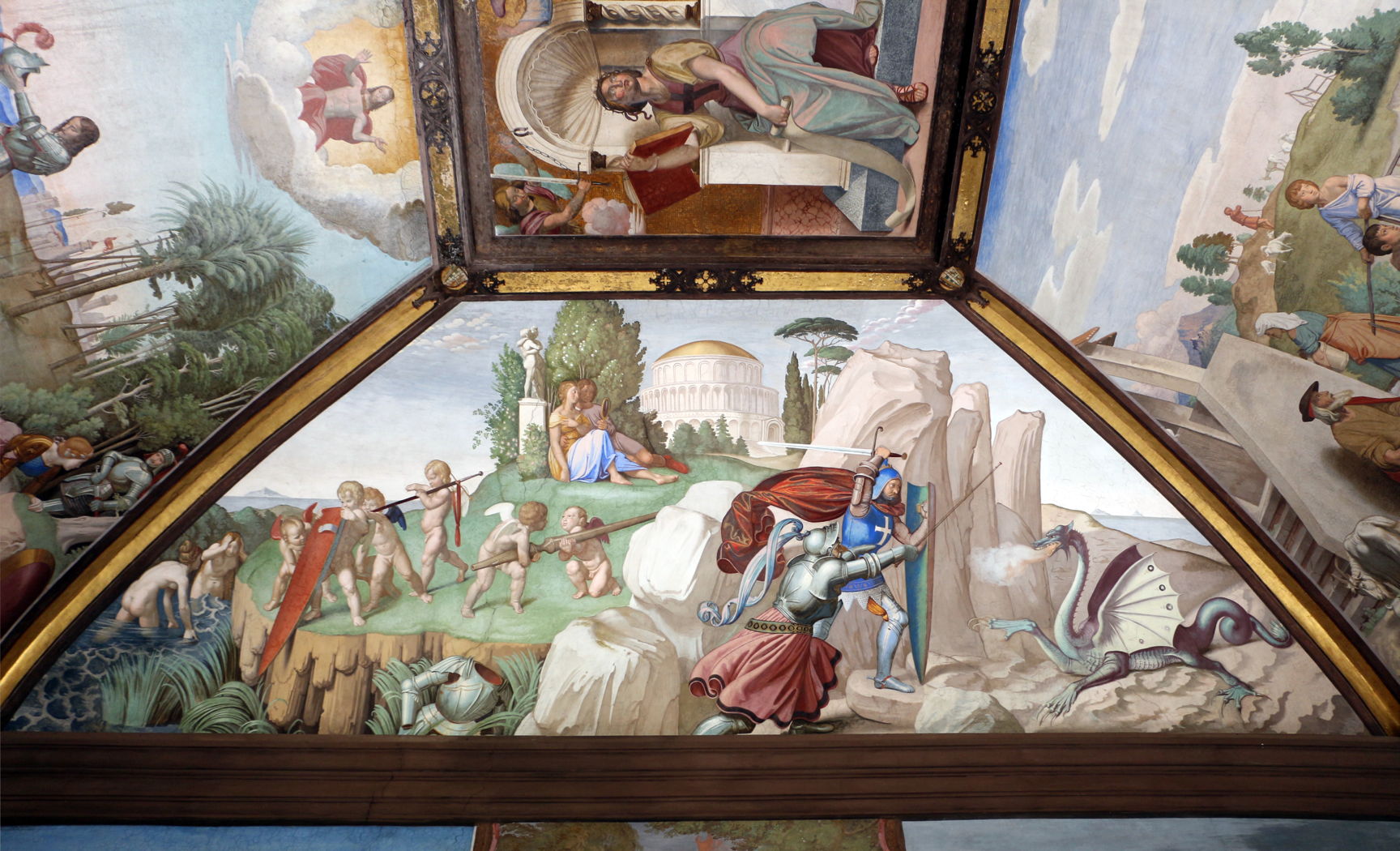
Johann Friedrich Overbeck (1789-1869), Ubaldo and Carlo free Rinaldo from Armida’s Castle (1819-27), fresco, dimensions not known, Casa Massimo, Rome, Italy. Image by Sailko, via Wikimedia Commons.
Johann Friedrich Overbeck’s fresco of Ubaldo and Carlo free Rinaldo from Armida’s Castle from 1819-27, in the Casa Massimo, Rome, shows an interesting composite scene. To the right of centre, Charles and Ubaldo wield their sword and wand, and in the distance are Armida and Rinaldo in the garden on the summit. Amorini are playing with Rinaldo’s weapons, and his empty suit of armour has been cast into the undergrowth.
Next the pair have to face a lion, which is similarly dismissed with a wave of the wand. After that comes an army of animals they disperse readily, and Charles and Ubaldo are on the ascent towards the stretch of snow and ice they must cross before reaching Armida’s eternal Spring. Once up at the top, the two knights pause from their strenuous climb, slaking their thirst in a mountain stream. Grassy banks either side of the stream have a fine banquet laid out on them, and there are two naked young women cavorting in the water.
David Teniers the Younger (1610–1690), Carlos and Ubaldo in The Fortunate Isles (1628-30), oil on copper, 27 x 39 cm, Museo Nacional del Prado, Madrid, Spain. Wikimedia Commons.
David Teniers the Younger’s Carlos and Ubaldo in The Fortunate Isles (1628-30) shows this moment, with the banquet laid out on a clean white tablecloth rather than grass. Surrounded by trees and standing proud on the skyline is Armida’s palace, their destination.
Charles-Alexandre Coëssin de la Fosse (1829–1910), Danish Warriors in the Garden of Armida (1848), others detail unknown, but believed to be oil on canvas and the original in colour. By Salon 1913, via Wikimedia Commons.
I only have this monochrome image of Charles-Alexandre Coëssin de la Fosse’s painting of Danish Warriors in the Garden of Armida from 1848. The two knights are dallying rather longer than their mission had intended.
Once Charles and Ubaldo can tear themselves away from these nymphs, they press on to the circular outer wall of the palace, which opens the sixteenth canto as they enter Armida’s garden.
Édouard Muller (1823-1876), The Garden of Armida (1854), block-printed wallpaper, 386.1 x 335.3 cm, Philadelphia Museum of Art, Philadelphia, PA. Wikimedia Commons.
In the eighteenth and nineteenth centuries, Armida’s garden appeared on all manner of products. This wallpaper designed by Édouard Muller in 1854 is now in the Philadelphia Museum of Art, while smaller images appeared on coffee cups and much else.
Tasso gives a brief description of the garden with its figs, apples and grape vines. Birds sing, and the wind murmurs softly. One bird speaks to the two knights, telling of the chaste and modest rose flower that springs virgin from its green leaves.
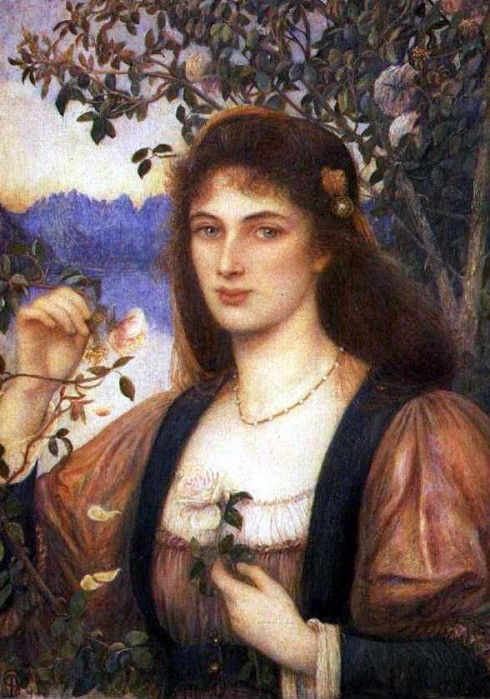
Marie Spartali Stillman (1844–1927), A Rose in Armida’s Garden (1894), watercolour and graphite on paper, 64.8 x 43.2 cm, Private collection. Wikimedia Commons.
This passage about the rose was the inspiration for Marie Spartali Stillman’s exquisite watercolour of A Rose in Armida’s Garden from 1894, given by the artist as a wedding gift to a family friend.
Charles and Ubaldo then peer through the leaves and spot a loving couple, who they presume to be Rinaldo and Armida. The knight’s head rests in Armida’s lap. He then stands up and takes a crystal glass hanging at his side. Armida uses this as a mirror to adjust her hair, telling Rinaldo to keep looking into her eyes.
Giovanni Battista Tiepolo (1696–1770), Rinaldo and Armida in Her Garden (1742-45), oil on canvas, 187 x 260 cm, The Art Institute of Chicago, Chicago, IL. Image by Sailko, via Wikimedia Commons.
Tiepolo paints this clearly in his Rinaldo and Armida in Her Garden from 1742-45, now in The Art Institute of Chicago. It was originally hung in a special room dedicated to Tasso’s epic in the Palazzo Corner a San Polo in Venice, where it belonged to the noble Serbelloni family.
Angelica Kauffman (1741–1807), Rinaldo and Armida (1771), oil on canvas, 130.8 x 153 cm, Yale Center for British Art, New Haven, CT. Wikimedia Commons.
In Angelica Kauffman’s Rinaldo and Armida from 1771, the crystal glass is ready at Armida’s feet, and she is busy distracting him by sprinkling flowers over his head.
Francesco Hayez (1791–1881), Rinaldo and Armida (1812-13), oil on canvas, dimensions not known, Gallerie dell’Accademia, Venice, Italy. Wikimedia Commons.
Francesco Hayez shows a variation in his Rinaldo and Armida from 1812-13. Anticipating the next part of Tasso’s narrative, instead of Rinaldo wearing the crystal glass at his side, his circular shield rests on the ground next to Armida. Charles and Ubaldo are shown peering from behind a tree trunk, safely in the distance.
Armida then kisses Rinaldo goodbye and leaves. Charles and Ubaldo see their opportunity and step out from the bushes, dressed in full armour. Ubaldo holds a highly polished shield up so that Rinaldo can see himself for what he has become, a woman’s dandy, not a warrior knight.
Thomas Asbridge (2004) The First Crusade, A New History, Free Press, ISBN 978 0 7432 2084 2.
Anthony M Esolen, translator (2000) Torquato Tasso, Jerusalem Delivered, Gerusalemme Liberata, Johns Hopkins UP. ISBN 978 0 801 863233. A superb modern translation into English verse.
John France (1994) Victory in the East, a Military History of the First Crusade, Cambridge UP. ISBN 978 0 521 589871.
Joanthan Riley-Smith, ed (1995) The Oxford Illustrated History of the Crusades, Oxford UP. ISBN 978 0 192 854285.
Jonathan Riley-Smith (2014) The Crusades, A History, 3rd edn., Bloomsbury. ISBN 978 1 4725 1351 9.
Johathan Unglaub (2006) Poussin and the Poetics of Painting, Pictorial Narrative and the Legacy of Tasso, Cambridge UP. ISBN 978 0 521 833677.
In the middle of the night following the crusaders’ first major assault on the city of Jerusalem, Clorinda had burned their siege towers down. Tancred then mortally wounded her in a fight before realising who she was, but baptised her just before she died in his arms.
The wounded Tancred feels disgust at his killing of Clorinda, and the pair are carried back to his tent. In spite of his injuries, he makes his farewell to her corpse. She later appears to him in a dream and his emotions are reconciled following her burial.
Canto thirteen returns to the siege, and the crusaders’ need to replace their wooden towers. Ismen visits the ancient wood that’s the closest source of timber, and casts a spell to prevent any more of its trees from being felled. He then reassures Aladine that he is safe, particularly as he forecasts the weather is set to turn very hot and dry, and advises Aladine he should sit tight in the city rather than try to force an end to the siege as Argante wants.
Godfrey wants to rebuild his siege towers quickly, before the defenders of Jerusalem have had time to repair the damage to the city’s defences. He dispatches men to the woods to cut down the timber required for the new towers, but they’re now repelled by the bewitched trees. Godfrey sends troops on three successive days, but each time they’re driven out by the dire effects of Ismen’s spell.
Finally, Tancred, recovered from his wounds, plucks up courage and enters the enchanted wood. He feels no ill-effects, and makes his way to its centre, where there’s a cryptic inscription written on an ancient tree. The trees then speak to him, claiming to be the spirit of Clorinda and others, warning him not to try cutting any of them down. Tancred reports this to Godfrey, who turns to other plans.
As Ismen had forecast, the weather becomes unrelentingly hot and dry. Even the nights remain hot, and crusaders are dying as a result. The nearby stream of Siloa, which had been a major supply of water, dries up, and there are deaths from dehydration. Morale collapses, with many of the crusaders questioning Godfrey’s inaction. The remaining Greeks desert and start their journey home. Godfrey prays for divine assistance and succeeds with a torrential rainstorm and the return to more comfortable conditions at last.
Canto fourteen opens with nightfall, when at last the cooler conditions enable everyone to sleep properly again. Godfrey has a vision in which he is told to recall Rinaldo from his self-imposed exile, and to absolve him from his error. No sooner does Godfrey awake the following morning than Guelph asks him for Rinaldo’s pardon, in the hope that the knight will be brave enough to overcome Ismen’s spell and cut wood to build their siege towers.
Godfrey agrees, leaving Guelph and a team of volunteers to locate and recover the missing knight. As the group are discussing where to look, Peter the Hermit interrupts and advises them to travel to Ascalon, and to ask the man they meet there.
When they reach Ascalon, a wizard with a white beard, beech crown and wand tells them to follow him as their guide. He takes them into hidden caves beneath a stream, where they see the sources of the great rivers of the world, set in a huge cavern whose walls are speckled with jewels. The wizard tells them this is the womb of the earth. He then reveals what happened to Rinaldo after he had freed the other knights who had been made captive by Armida, and how Rinaldo’s armour came to be made to look as if the knight had been killed.
Armida had been waiting for Rinaldo at the ford on the river Orontes. When he arrived, he found a column with an inscription that enticed him to go further, leaving his esquires behind as he boarded a boat. He then came to an island that appeared deserted, so decided to rest there, and put his helmet down beside him.
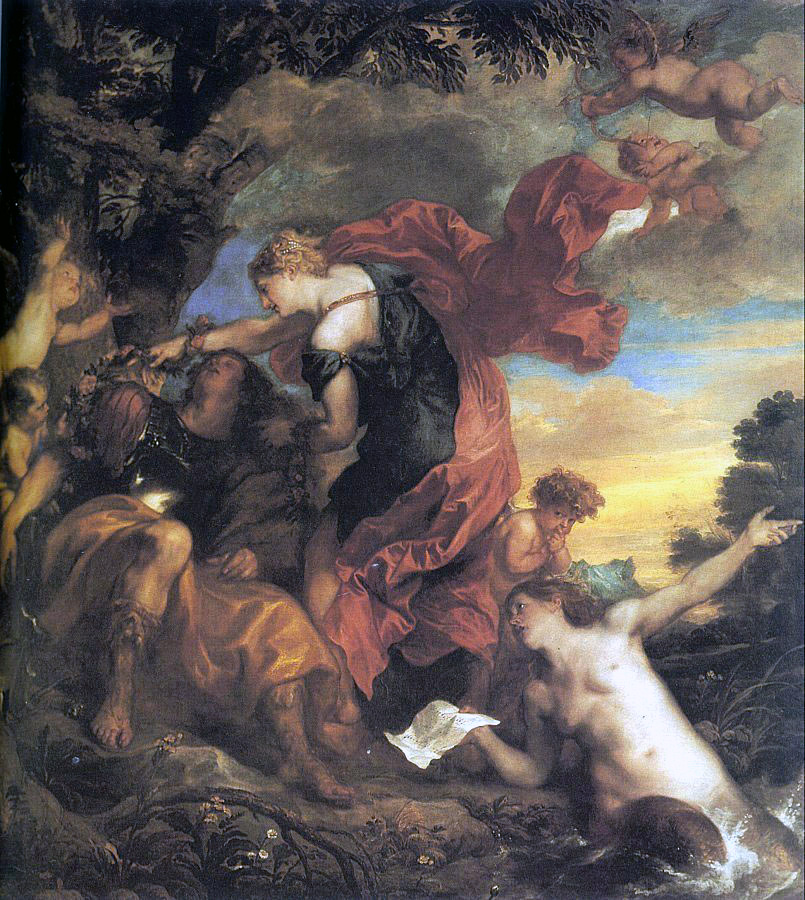
A little later, he heard a sound from the river, and spied a beautiful woman emerging naked from the water. She sang a song that lulled Rinaldo to sleep, then came over intending to kill him. But when she saw him breathing gently in his sleep, her anger melted away and she fell in love with him instead. She then put garlands of flowers around his neck, arms and feet that she had bewitched to act as bonds, had him lifted into her chariot, and abducted him.
This remarkable turn of events has been a favourite among painters, and a particular challenge to depict in a single image. As a classical example of what Aristotle in his Poetics refers to as peripeteia, it has led to some superb narrative paintings.
Anthony van Dyck (1599–1641), Rinaldo and Armida (1629), oil on canvas, 235.3 x 228.7 cm, Baltimore Museum of Art, Baltimore, MD. Wikimedia Commons.
In Anthony van Dyck’s Rinaldo and Armida of 1629, the key elements of the couple and attendant symbolic amorino are enriched by a second woman with non-human legs still immersed in the river and clutching a sheet of paper, and additional amorini. Armida appears unarmed but starting to bind him with garlands, and it’s possible the letter represents her commission to murder him, which the woman in the water, perhaps a nymph, is reminding her about.
Nicolas Poussin (1594–1665), Rinaldo and Armida (c 1630), oil on canvas, 82.2 x 109.2 cm, Dulwich Picture Gallery. Wikimedia Commons.
The most brilliant account to date is Nicolas Poussin’s justly famous Rinaldo and Armida from about 1630.
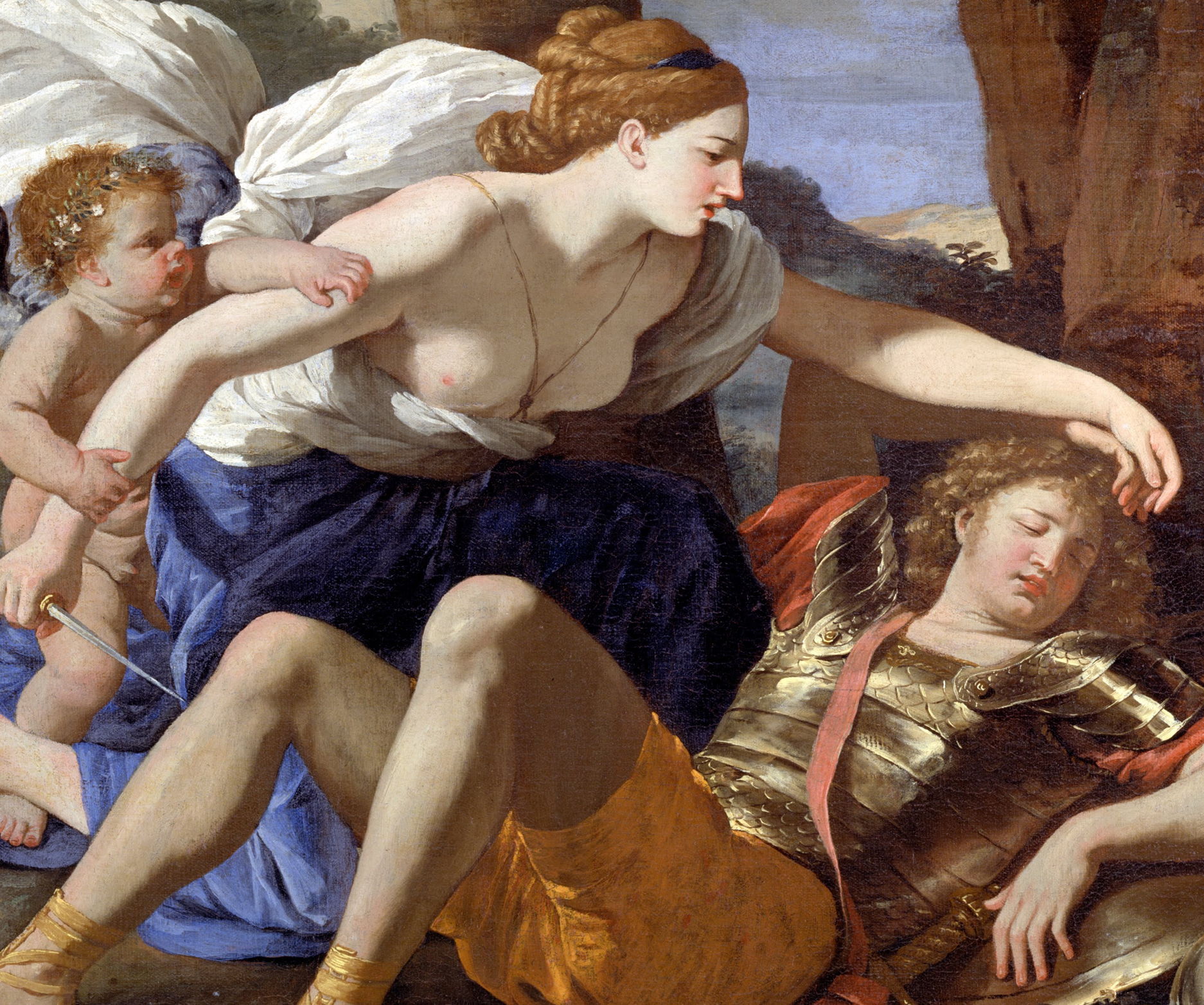
Nicolas Poussin (1594–1665), Rinaldo and Armida (detail) (c 1630), oil on canvas, 82.2 x 109.2 cm, Dulwich Picture Gallery. Wikimedia Commons.
There are two distinctive elements within Poussin’s depiction, Armida’s facial expression, and her posture, particularly the conflict between her arms. Armida’s expression is key to understanding the narrative, as she is perplexed, in a quandary, unsure whether to kill or kiss the young knight. Armida’s right hand represents her original intent, to murder him with her dagger, an action the amorino is trying to stop. Her left hand, though, reaches down to touch his hand in a loving caress. Poussin manages to tell us what she had intended to do in the immediate past, and what she is going to do next in the future: three moments in time conveyed in a single image.
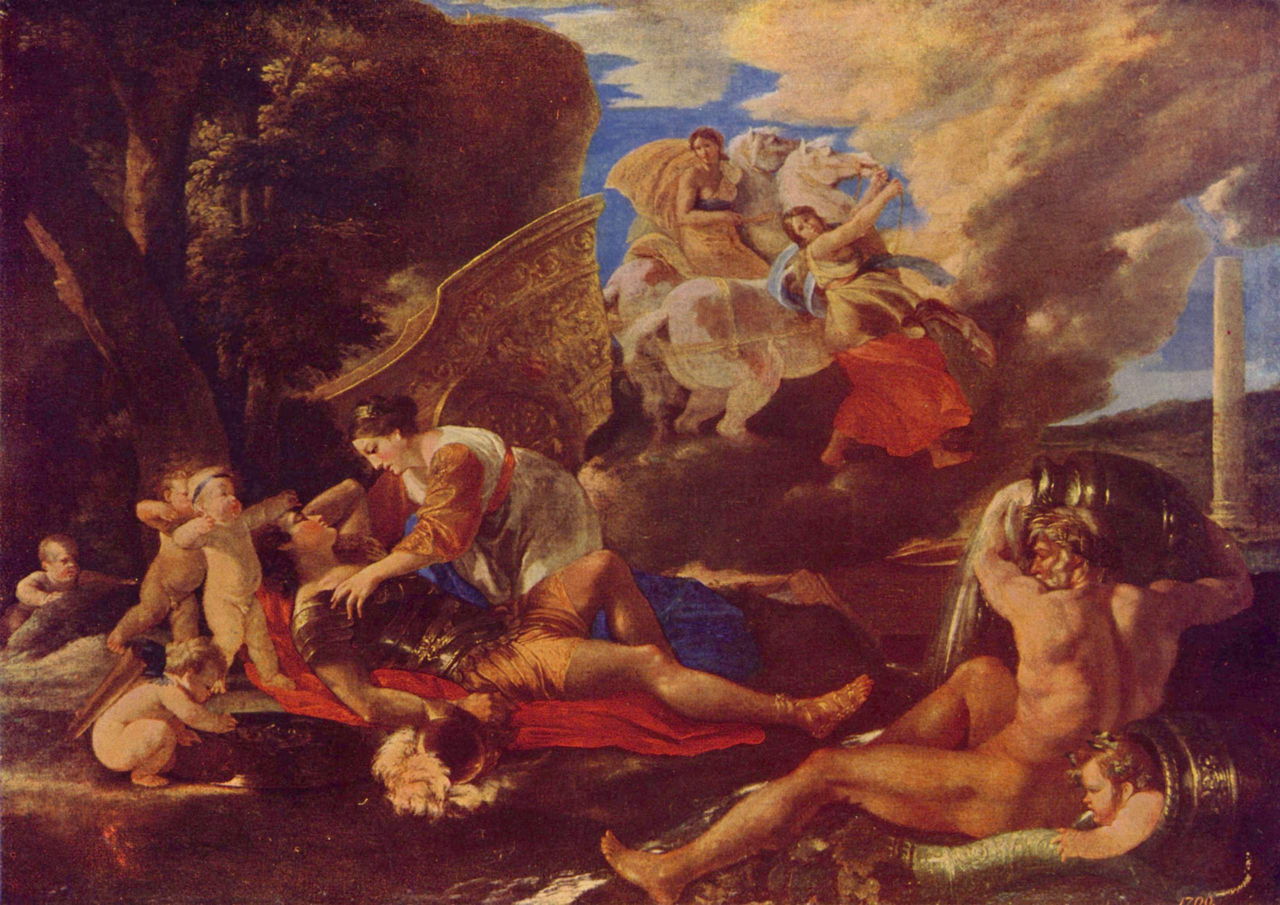
Nicolas Poussin (1594–1665), Rinaldo and Armida (c 1635), oil on canvas, 95 × 133 cm, Pushkin Museum, Moscow. Wikimedia Commons.
Poussin’s Rinaldo and Armida (c 1635) is a later and more explicit version of this same episode, in which Armida is falling in love with Rinaldo. There are many amorini who seem less engaged in the action. A river-god pours his river from a pitcher. In the background, Armida’s chariot is already prepared for the abduction of Rinaldo.
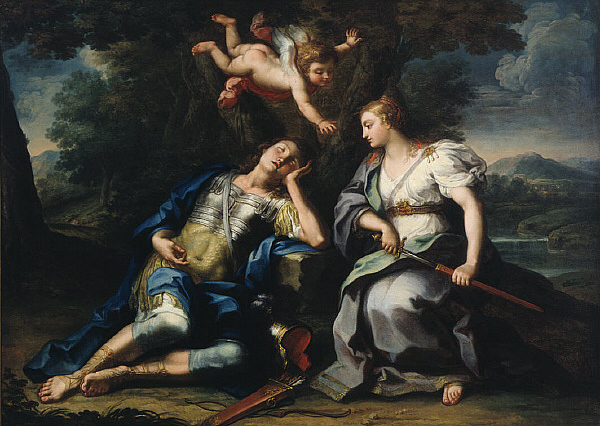
Sebastiano Conca (1680–1764) (attr), Rinaldo and Armida (c 1725), oil on canvas, 99.1 × 135.9 cm, Saint Louis Art Museum, St. Louis, MO. Wikimedia Commons.
Sebastiano Conca’s Rinaldo and Armida from about 1725 is a return to simpler composition, based on a central triangle, and content. Armida is drawing her sword, and looking pensive, as the sole amorino reaches from above to intervene.
Giovanni Battista Tiepolo (1696–1770), Rinaldo Enchanted by Armida (1742-45), oil on canvas, 187.5 x 216.8 cm, Art Institute of Chicago, Chicago, IL. Wikimedia Commons.
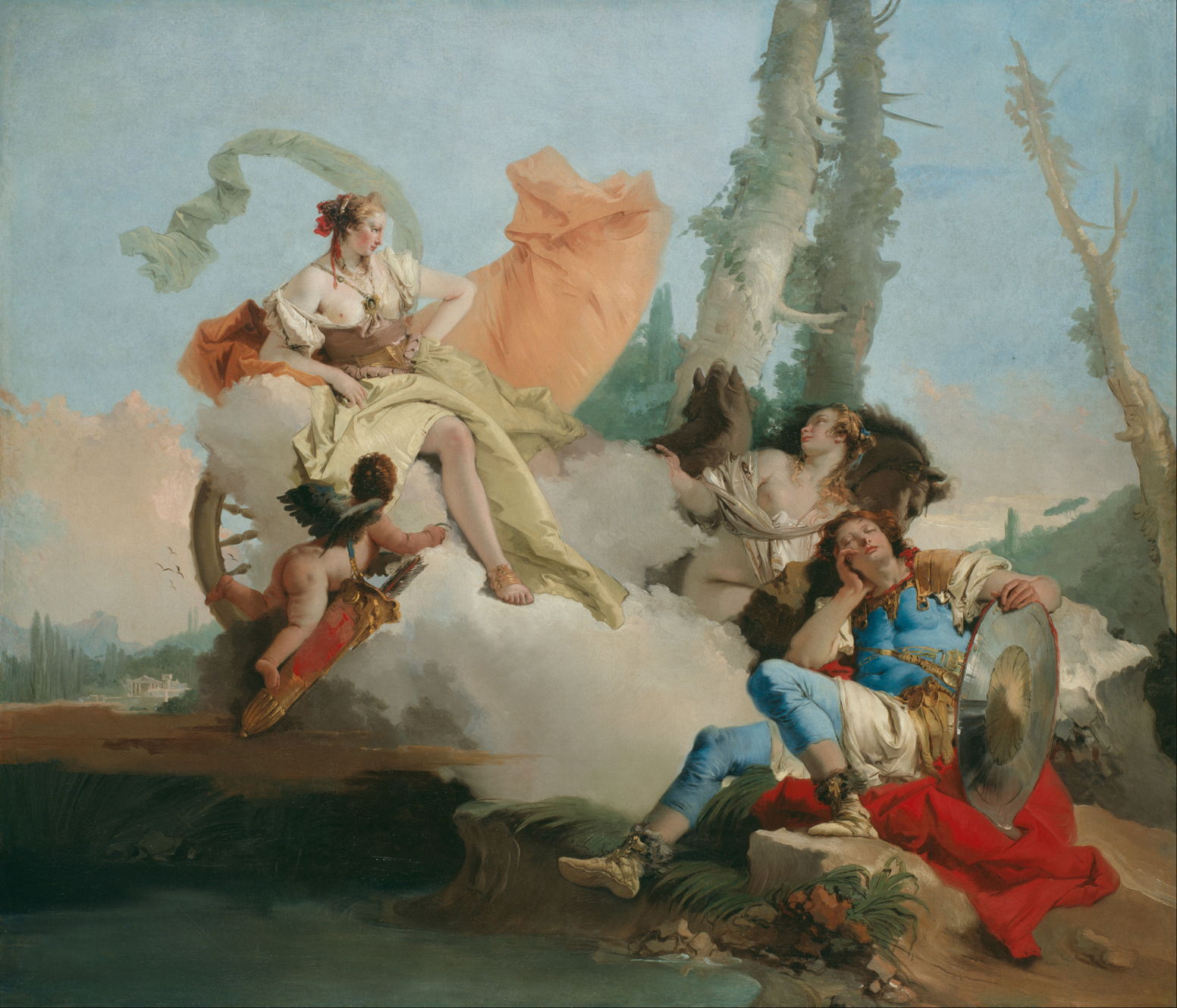
Tiepolo’s Rinaldo Enchanted by Armida (1742-45) is another permutation of the elements in Tasso’s story. Armida has already brought her enchanted flying chariot, in which there is another woman, perhaps Venus herself, with an accompanying amorino. Armida is almost undressed and unarmed, and her facial expression is more of unhappy pleading than internal conflict, while her female companion appears cold and unaffected.
Jean-Honoré Fragonard (1732–1806), Rinaldo and Armida (c 1760-65), oil on canvas, 221.5 x 256.5, National Gallery of Armenia, Yerevan, Armenia. Wikimedia Commons.
Fragonard’s Rinaldo and Armida from 1760-65 is another elaborate painting with an abundance of amorini. Armida’s right hand clutches a dagger, and is restrained by two of the amorini, although it’s hard to determine her facial expression.
With Guelph’s party searching for Rinaldo, Armida now whisks him away in her chariot, still fast asleep, and unaware of what’s in store for him.
Thomas Asbridge (2004) The First Crusade, A New History, Free Press, ISBN 978 0 7432 2084 2.
Anthony M Esolen, translator (2000) Torquato Tasso, Jerusalem Delivered, Gerusalemme Liberata, Johns Hopkins UP. ISBN 978 0 801 863233. A superb modern translation into English verse.
John France (1994) Victory in the East, a Military History of the First Crusade, Cambridge UP. ISBN 978 0 521 589871.
Joanthan Riley-Smith, ed (1995) The Oxford Illustrated History of the Crusades, Oxford UP. ISBN 978 0 192 854285.
Jonathan Riley-Smith (2014) The Crusades, A History, 3rd edn., Bloomsbury. ISBN 978 1 4725 1351 9.
Johathan Unglaub (2006) Poussin and the Poetics of Painting, Pictorial Narrative and the Legacy of Tasso, Cambridge UP. ISBN 978 0 521 833677.

 Login
Login