Reading view

There are new articles available, click to refresh the page.

Medium and Message: Stained glass

Colouring glass is ancient in origin, and in Europe its use in church windows reached its height during the Middle Ages. As a craft it has tended to develop independently of fine art painting, but since the nineteenth century’s revivals of better integrated arts and crafts, some painters have designed stained glass windows. At the same time, other painters have been depicting them.

In the Italian Renaissance, several artists best-known as painters, among them Paolo Uccello and Donatello, designed stained glass windows for Florence Cathedral and other churches. In the nineteenth century revival of the craft, contemporary arts and crafts movements drew established painters from the Pre-Raphaelite movement in Britain, and Art Nouveau across much of Europe. Among those who created successful designs are Edward Burne-Jones, Alfonse Mucha, Koloman Moser and Marc Chagall.

moserart
Koloman Moser (1868–1918), Art, design sketch for a round window (1897), India ink and watercolor on paper, 20.9 x 22.8 cm, Österreichisches Museum für angewandte Kunst (MAK), Vienna, Austria. Wikimedia Commons.

Koloman Moser’s Art is one of his design sketches from 1897 intended for a round stained glass window in the new Secession Building in the centre of Vienna.
moserottowagnerkirche
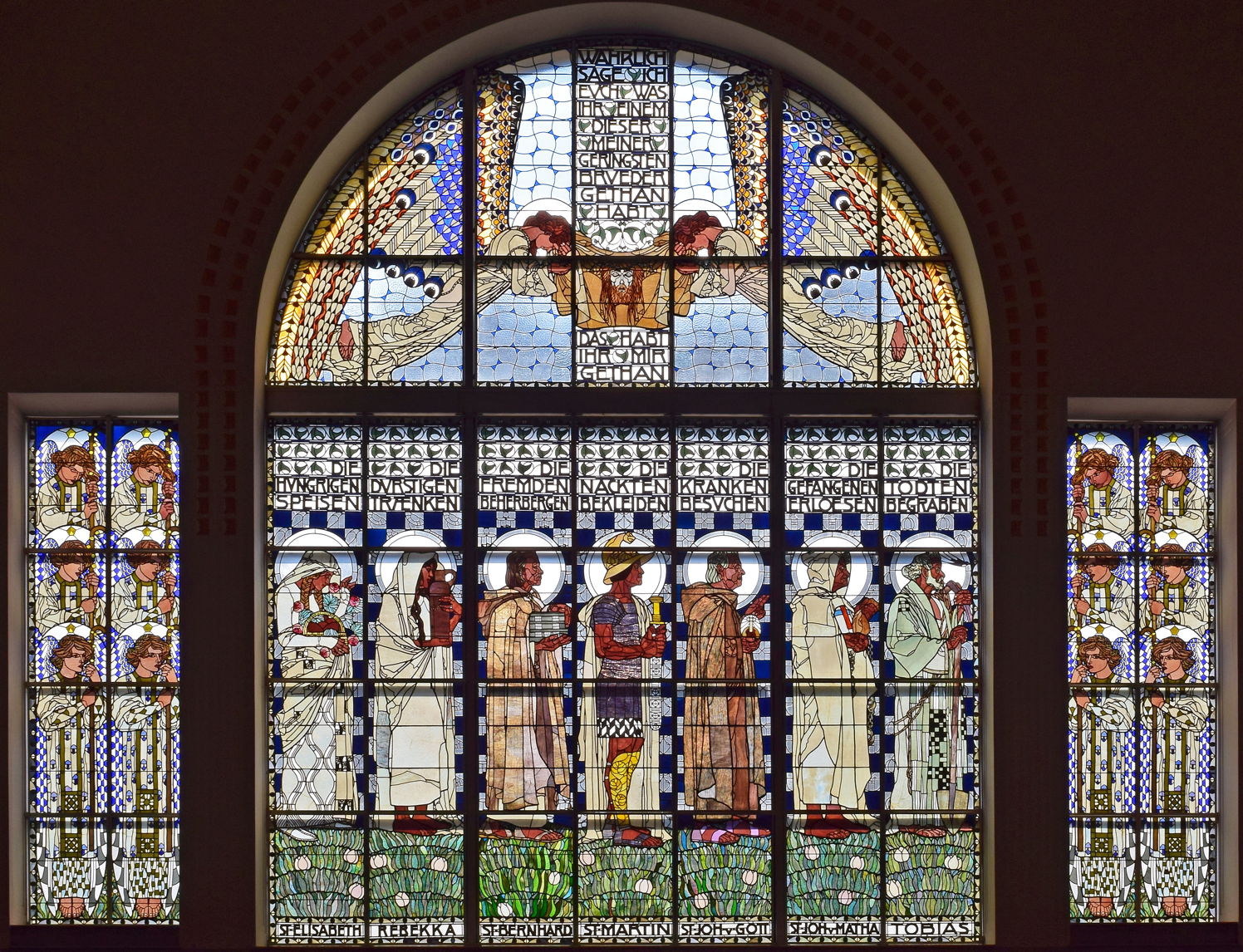
Koloman Moser (1868–1918) (design) and Leopold Forstner (1878-1936) (execution), The Physical Virtues (1905-07), stained glass, Kirche am Steinhof (Otto-Wagner-Kirche), Vienna, Austria. Image by Haeferl, via Wikimedia Commons.

In 1905-07, Moser collaborated with Leopold Forstner (1878-1936), already famous for making mosaics and stained glass, in the design and production of windows and mosaics for the Kirche am Steinhof (also known as Otto-Wagner-Kirche) in Vienna. Most impressive among these is this window of The Physical Virtues.

Am Steinhof, as it was widely known then, is a large psychiatric and neurological hospital complex planned by the architect Otto Koloman Wagner (1841-1918), and built between 1904-07 in a suburb to the west of Vienna. Its architecture is Art Nouveau, and it contains several of the finest examples of that style, particularly its Roman Catholic oratory: Wikipedia has an excellent article about it here, and an extensive library of images in Wikimedia Commons.

At the same time, artists started featuring stained glass windows in their paintings.

Mariana 1851 by Sir John Everett Millais, Bt 1829-1896
Sir John Everett Millais (1829–1896), Mariana (1851), oil on mahogany, 59.7 x 49.5 cm, The Tate Gallery (Accepted by HM Government in lieu of tax and allocated to the Tate Gallery 1999), London. © The Tate Gallery and Photographic Rights © Tate (2016), CC-BY-NC-ND 3.0 (Unported), http://www.tate.org.uk/art/artworks/millais-mariana-t07553

John Everett Millais’ final version of Mariana (1851) was first shown at the Royal Academy in 1851, and refers to Tennyson’s poem of the same name. This richly-coloured painting is full of symbols: fallen leaves to indicate the passage of time, her embroidery as a means of passing that time, the Annunciation in the stained glass contrasting her with the Virgin’s fulfilment, the motto ‘in coelo quies’ (in heaven is rest), and the snowdrop flower in the glass meaning consolation. Mariana’s posture is intended to indicate her yearning for her lover Angelo.

helleusaintdenis
Paul César Helleu (1859–1927), The Interior of the Abbey Church of Saint Denis (c 1891), oil on canvas, dimensions not known, The Isabella Stewart Gardner Museum, Boston, MA. The Athenaeum.

Paul César Helleu’s Interior of the Basilica of Saint-Denis (c 1891) is an example of his interest in churches and their stained glass, which included Reims Cathedral. The Basilica of Saint-Denis was the burial place for almost every French king between the tenth and eighteenth centuries, and it now lies within the north of the city of Paris, although Saint-Denis was formerly its own city. The window shown is that of the north transept, featuring the tree of Jesse; a south transept rose shows the Creation.
redongrandvitrail
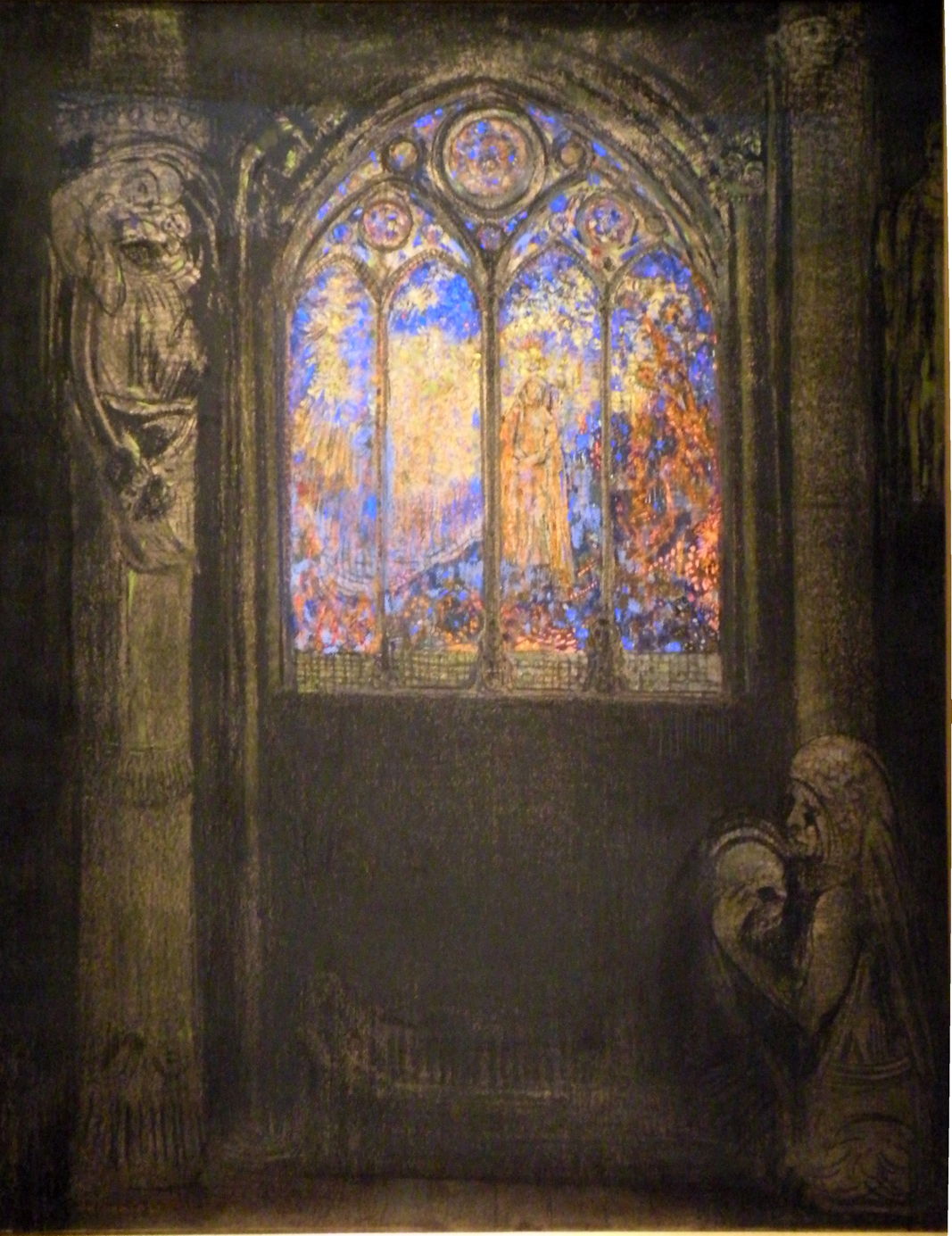
Odilon Redon (1840–1916), Le grand vitrail (The Large Window) (1904), charcoal, pastel and stumping on cardboard, 87 x 68 cm, Musée d’Orsay, Paris. Image EHN & DIJ Oakley.

Odilon Redon’s The Large Window, from 1904, is one of the most remarkable pastel paintings that I have seen. Framed by carved masonry shown in the dull greys of charcoal, a mediaeval stained glass window dazzles with its bright, rich colours, the pure pigment of pastel at its best.
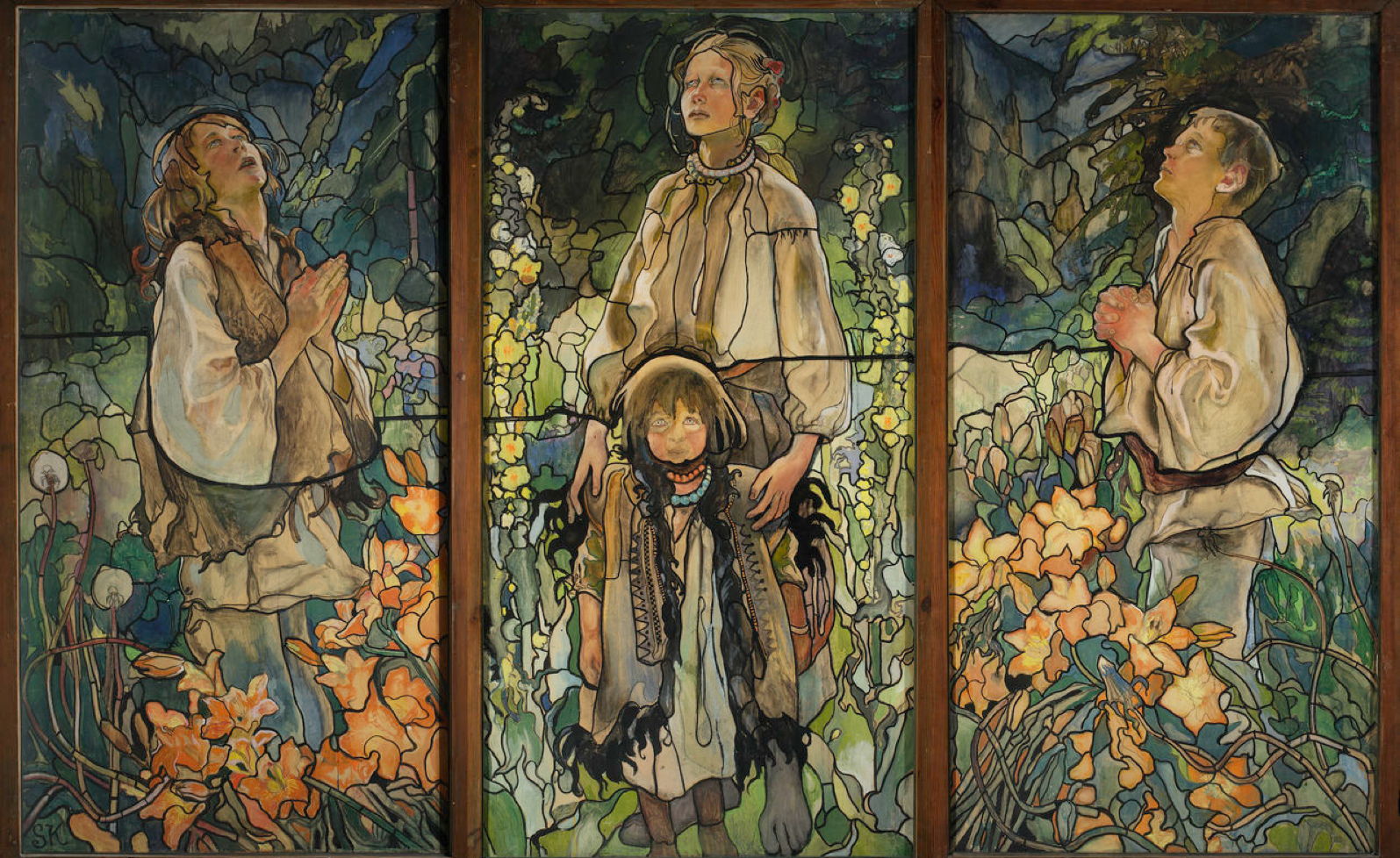
sichulskispring
Kazimierz Sichulski (1879–1942), Spring Triptych (1909), tempera and pastel on cardboard, 145 x 231 cm Source National Museum, Warsaw, Muzeum Narodowe w Warszawie, Warsaw, Poland. Wikimedia Commons.

Three years after Kazimierz Sichulski painted his first triptychs, he used mixed media of tempera and pastel to create some that look as if they’re stained glass. His Spring Triptych from 1909 bridges the religious and secular, with the centre panel showing a woman and child.

lhermittechurchsaintbonnet
Léon Augustin Lhermitte (1844–1925), The Prayer, the Church of Saint-Bonnet (before 1920), pastel on stretched paper, 49.8 × 57.5 cm, location not known. Wikimedia Commons.

Léon Augustin Lhermitte had painted a few religious works earlier in his career, but his late pastel of The Prayer, the Church of Saint-Bonnet (before 1920) is probably the most moving.

rochegrosseinteriorofthecathedral
Georges Rochegrosse (1859–1938), Interior of the Cathedral of Reims in Flames (1915), oil on canvas, 100 x 73 cm, Musée des beaux-arts, Reims, France. By G.Garitan, via Wikimedia Commons.

At the start of the First World War, the cathedral of Notre-Dame de Reims, where the Kings of France were once crowned, had been commissioned as a hospital and demilitarised. German shells hit the cathedral during opening engagements on 20 September 1914, setting alight scaffolding, and destroying some of the stonework. The fire spread through woodwork, melting the lead on the roof, and destroying the bishop’s palace. The French accused the Germans of the deliberate destruction of part of its national and cultural heritage.

Georges Rochegrosse’s Interior of the Cathedral of Reims in Flames (1915) casts this in a curious combination of the physical reality of the shattered masonry and fire, the ancient glory of the cathedral’s stained glass, and an Arthurian figure (possibly the Madonna herself) reaching up to seek divine intervention.

Medium and Message: Mosaic

Mosaics, composed of small fragments of coloured stone, glass or ceramic in a matrix of plaster or mortar, have ancient origins in the civilisations of the Fertile Crescent in the Middle East. Although widely viewed as being decorative, some of the best examples transcend that to become fine art.

sanzeno
Unknown, Mosaic of the vault of the chapel of San Zeno (817-824 CE), Santa Prassede, Rome. Image by Livioandronico2013, via Wikimedia Commons.

This breathtaking mosaic in the vault of the chapel of San Zeno, in Santa Prassede, Rome, created in 817-824 CE, goes well beyond mere ceiling decoration.

IF
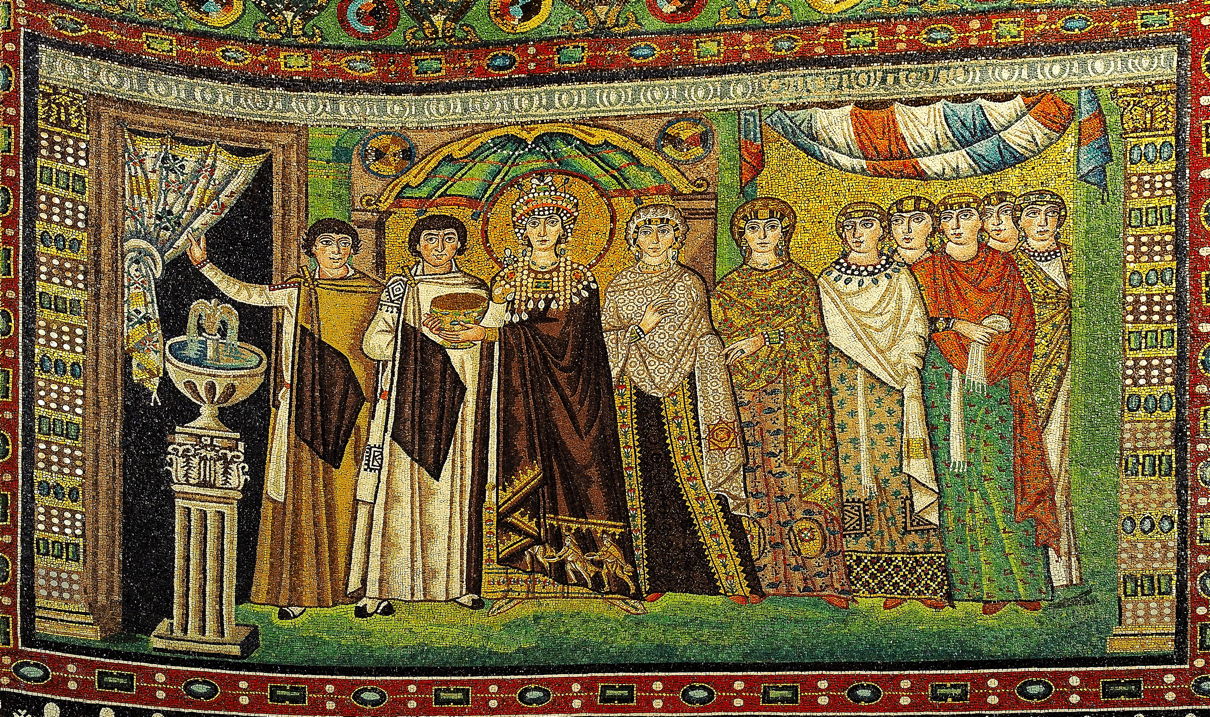
Unknown, Mosaic of Theodora – Basilica of San Vitale (built A.D. 547), Ravenna, Italy. UNESCO World heritage site. Image by Petar Milošević, via Wikimedia Commons.

At the end of 1903, Gustav Klimt visited one of the major collocations of mosaics in Ravenna, Italy, where he saw and was deeply impressed by the spectacular Byzantine mosaics of Justinian I and the Empress Theodora in the Basilica of San Vitale. They inspired a portrait he completed four years later.

klimtadeleblochbauer1
Gustav Klimt (1862–1918), Portrait of Adele Bloch-Bauer I (1907), oil, silver and gold on canvas, 140 x 140 cm, Private collection. Wikimedia Commons.

His first Portrait of Adele Bloch-Bauer (1907) is the most extreme and startling work from Klimt’s Golden Phase. Apart from her bust and arms, which are painted in oils, the rest of his canvas is, like the mosaic of the Empress Theodora, encrusted with gold and silver. Its decorative patterns include symbols of eyes, flowers, whorls, ellipses divided into halves, and rich textures worked into the gold leaf.

A few accomplished painters also created mosaics, usually later in their career.

mersonsacrecoeur
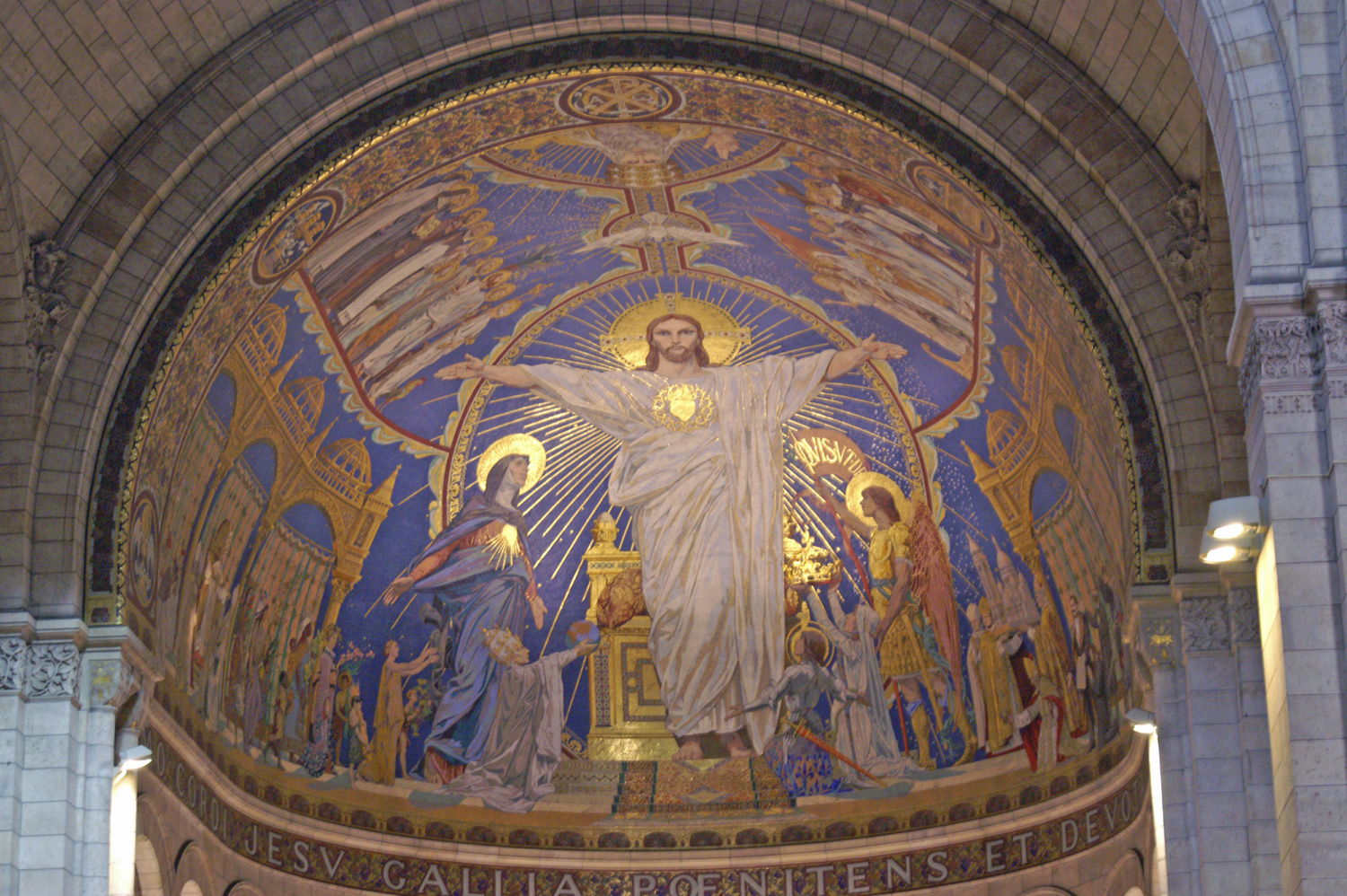
Luc-Olivier Merson (1846–1920), Christ in Majesty (date not known), mosaic, dimensions not known, Basilique du Sacré-Cœur de Montmartre, Paris. Image by Didier B, via Wikimedia Commons.

Between about 1890-1910, the French Naturalist painter Luc-Olivier Merson created this extraordinary mosaic of Christ in Majesty in the apse of the Basilica of the Sacred Heart (Sacré-Cœur) of Paris in Montmartre. This is thought to be one of the largest mosaics in the world.

At about the same time, the American painter Elihu Vedder was creating a mosaic in the central arched panel leading to the Visitor’s Gallery of the Library of Congress, in Washington, DC.

IF
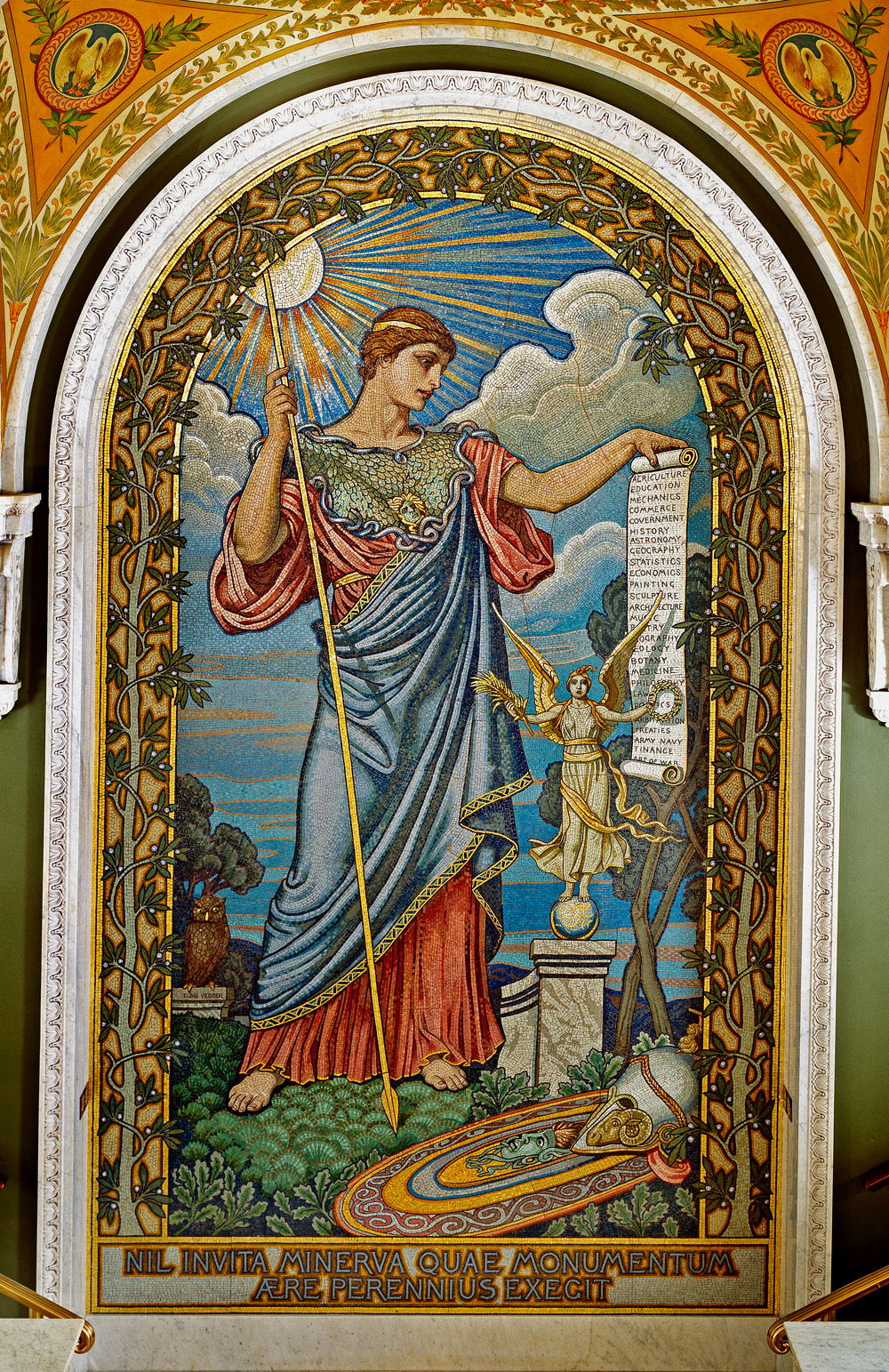
Elihu Vedder (1836–1923), Minerva of Peace (1897), mosaic, dimensions not known, central arched panel leading to the Visitor’s Gallery, Library of Congress Thomas Jefferson Building, Washington, DC. Photographed in 2007 by Carol M. Highsmith (1946–), who explicitly placed the photograph in the public domain, via Wikimedia Commons.

His Minerva of Peace (1897) shows this Roman goddess of wisdom, the guardian of civilisation, and sponsor of arts, trade, and strategy. Vedder stresses that this was attained by warfare, and shows a miniature statue of Nike, the Greek winged goddess of victory, known to the Romans as Victoria. Nike holds the palm frond of peace and the laurel of victory.

Minerva’s helmet and shield rest on the ground, but she remains ever-vigilant in holding a spear in her right hand. Her left hand holds a scroll listing the fields of learning, from Agriculture to Zoology and Finance. These reveal her association with wisdom and knowledge. To the left of Minerva’s right knee is an owl, symbolising wisdom.

The inscription below, Nil invita Minerva, quae monumentum aere perennius exegit, means Not unwilling, Minerva raises a monument more lasting than bronze, and is quoted from Horace’s Ars Poetica.

Other artists painted in the style of mosaics.

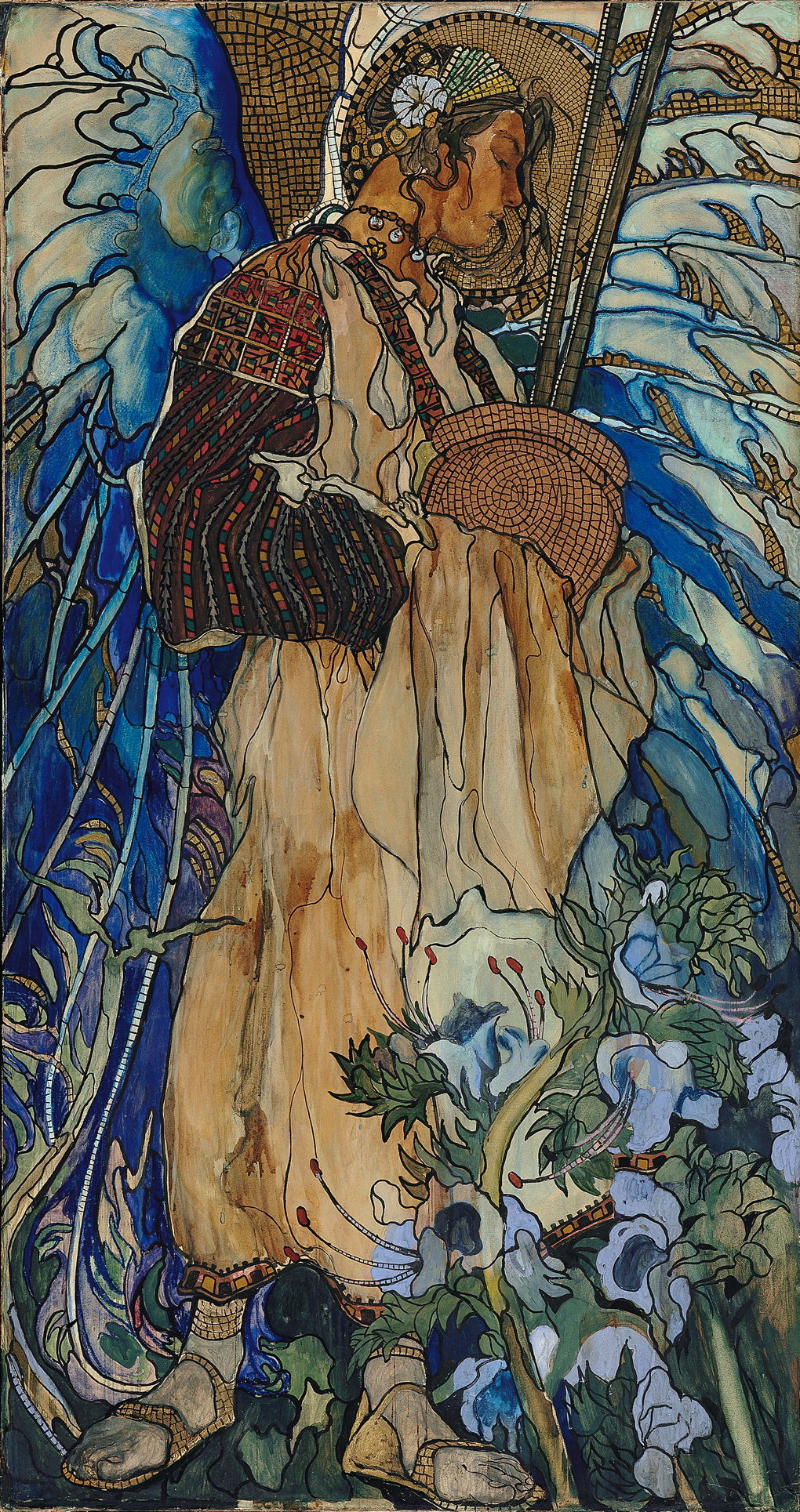
sichulskihutsulmadonna
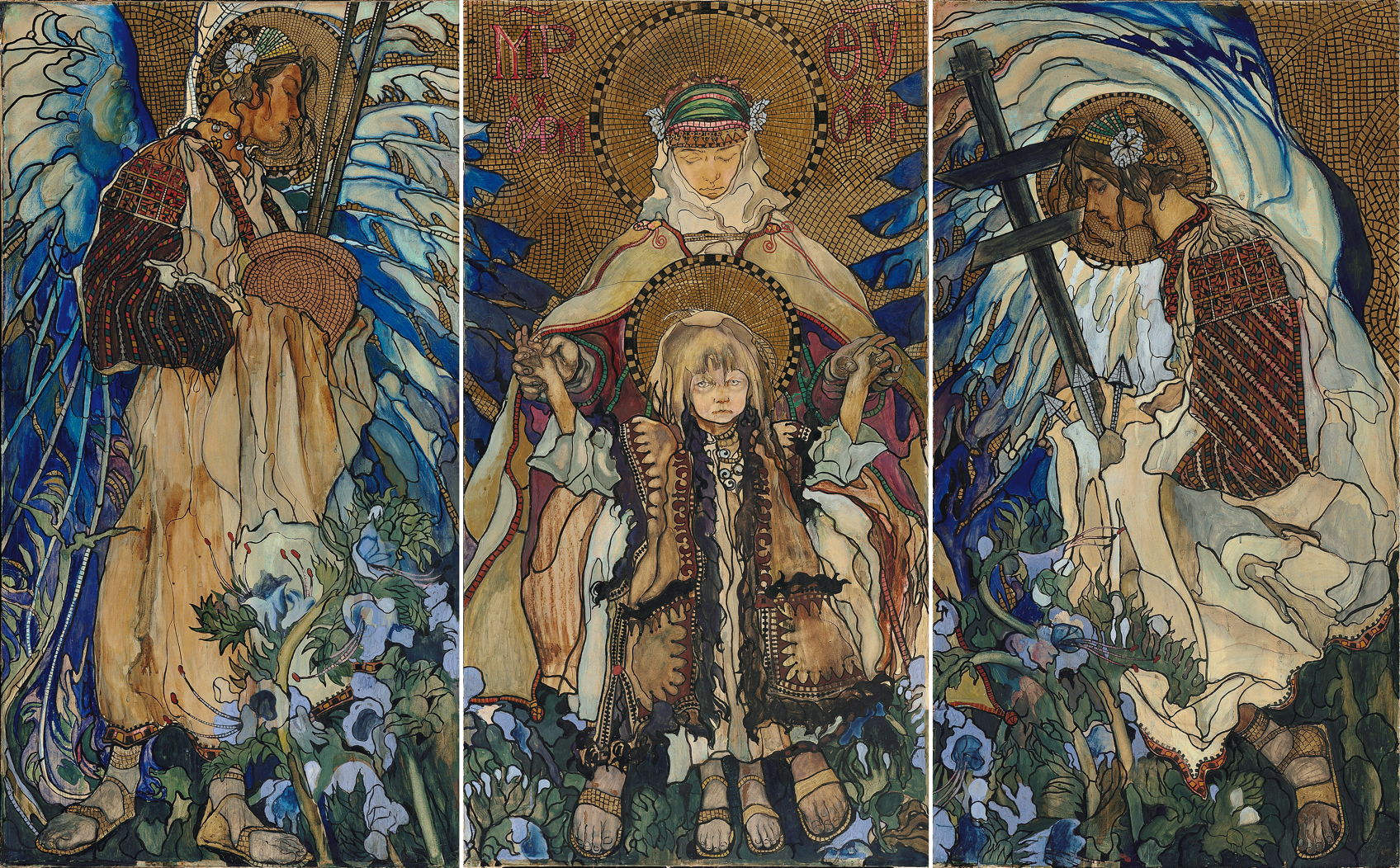
Kazimierz Sichulski (1879–1942), The Hutsul Madonna (1909), tempera and pastel on paper laid on canvas, 167 x 270 cm (overall), Österreichische Galerie Belvedere, Vienna, Austria. Wikimedia Commons.

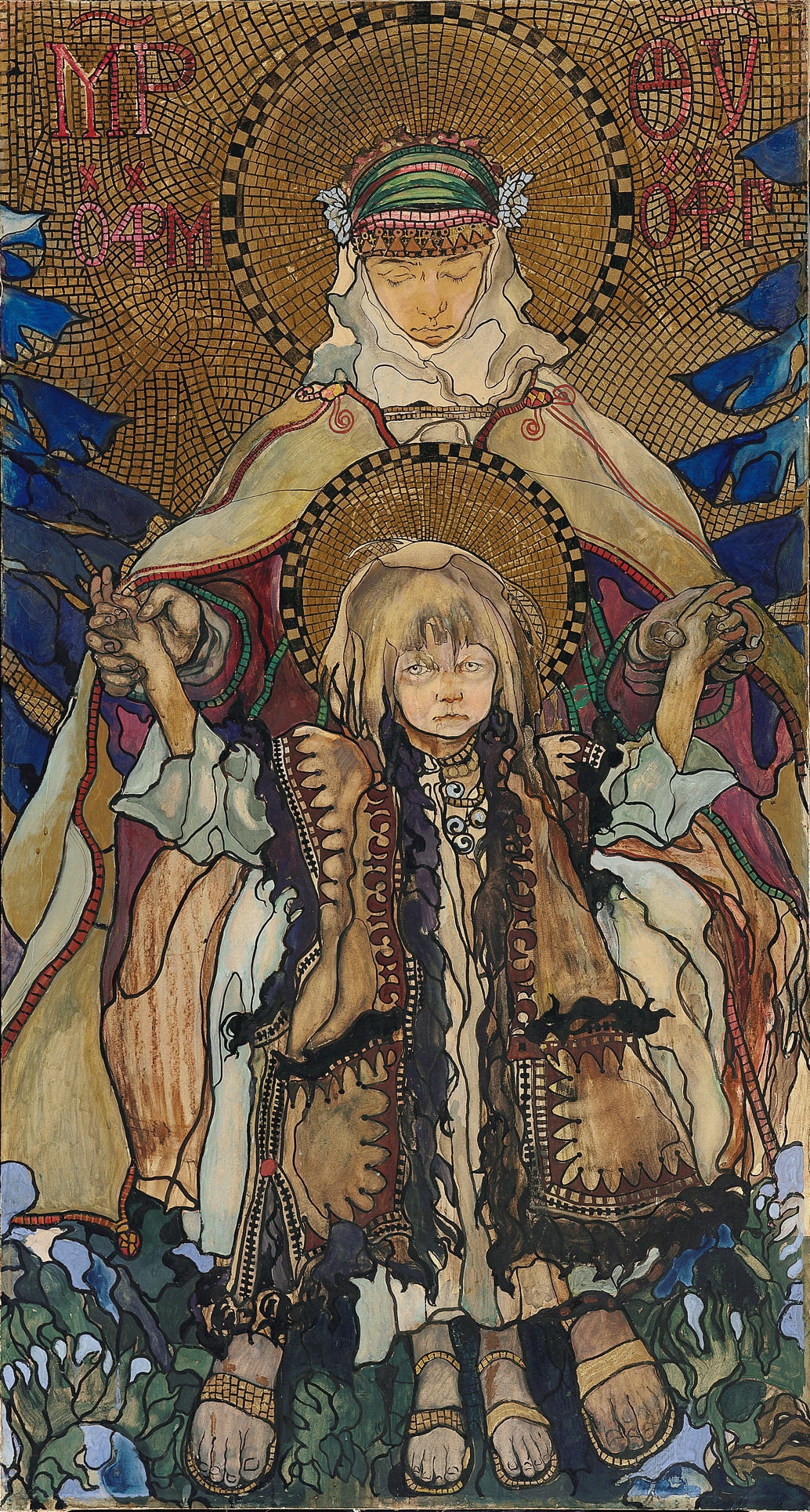
In The Hutsul Madonna from 1909, Kazimierz Sichulski used a combination of tempera and pastel to create passages that appear to be mosaics, while others look more like stained glass, in a luminous Art Nouveau style.

sichulskihutsulmadonna1
Kazimierz Sichulski (1879–1942), The Hutsul Madonna (left panel) (1909), tempera and pastel on paper laid on canvas, 167 x 270 cm (overall), Österreichische Galerie Belvedere, Vienna, Austria. Wikimedia Commons.

Above is the left panel, and below is its centre panel.

sichulskihutsulmadonna2
Kazimierz Sichulski (1879–1942), The Hutsul Madonna (centre panel) (1909), tempera and pastel on paper laid on canvas, 167 x 270 cm (overall), Österreichische Galerie Belvedere, Vienna, Austria. Wikimedia Commons.

Some of the Divisionists, notably Paul Signac, applied their paint in small rectangular patches termed tesserae, the same word for the coloured pieces used to compose mosaics.

signaclighthousegroix568
Paul Signac (1863-1935), Lighthouse at Groix (Cachin 568) (1925), oil on canvas, 74 x 92.4 cm, Metropolitan Museum of Art, New York, NY. Wikimedia Commons.

Signac adopted these by 1905, and continued to use them for the rest of his career. They’re shown above in his painting of The Lighthouse at Groix from 1925, and in the detail below. These are oriented to help form each object.

signaclighthousegroix568d1
Paul Signac (1863-1935), Lighthouse at Groix (Cachin 568) (detail) (1925), oil on canvas, 74 x 92.4 cm, Metropolitan Museum of Art, New York, NY. Wikimedia Commons.

Although these create a distinctive effect, they don’t follow Georges Seurat’s original intention of optical mixing of colours in fine dots, although they’re much quicker to apply, and refer back to the great Byzantine mosaics.

On Reflection: Realism in the late 19th century

In the late nineteenth century, Realist landscape painters challenged themselves with increasingly difficult reflections, where the water surface isn’t mirror-like, but broken.

Gustave Caillebotte, Rain on the Yerres (1875), oil on canvas, 81 x 59 cm, Indiana University Art Museum, Bloomington IN. WikiArt.
Gustave Caillebotte (1848–1894), Rain on the Yerres (1875), oil on canvas, 81 x 59 cm, Indiana University Art Museum, Bloomington IN. WikiArt.

Gustave Caillebotte’s Rain on the Yerres (1875) is an innovative study of a reflective water surface disrupted by circles projected by raindrops.

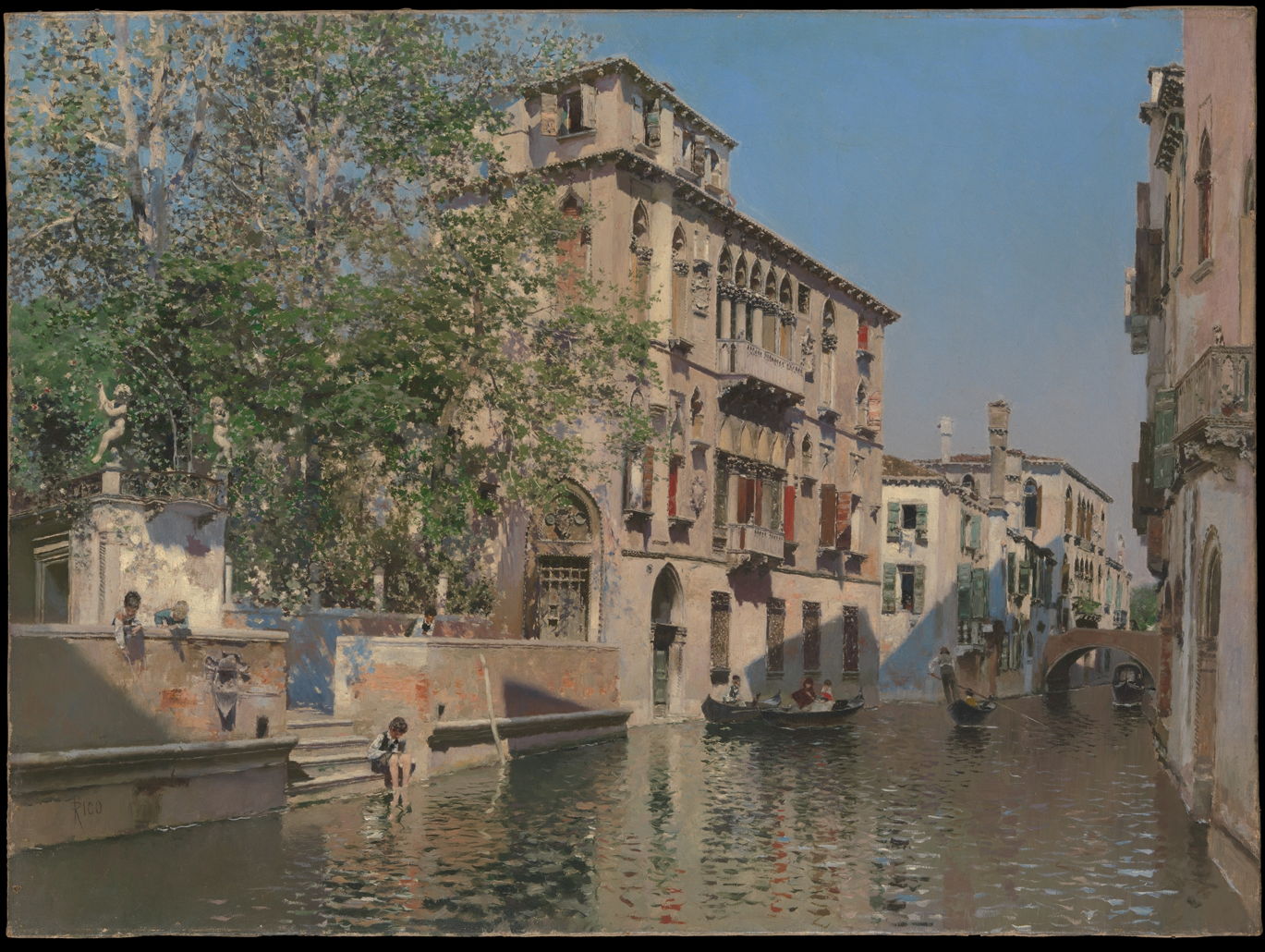
ricocanalvenicemet
Martín Rico y Ortega (1833–1908), A Canal in Venice (c 1875), oil on canvas, 50.2 x 67.9 cm, The Metropolitan Museum of Art, New York, NY. Wikimedia Commons.

The broken reflections in Martín Rico’s A Canal in Venice from about the same time may have been painted mostly en plein air, despite their fine detail.

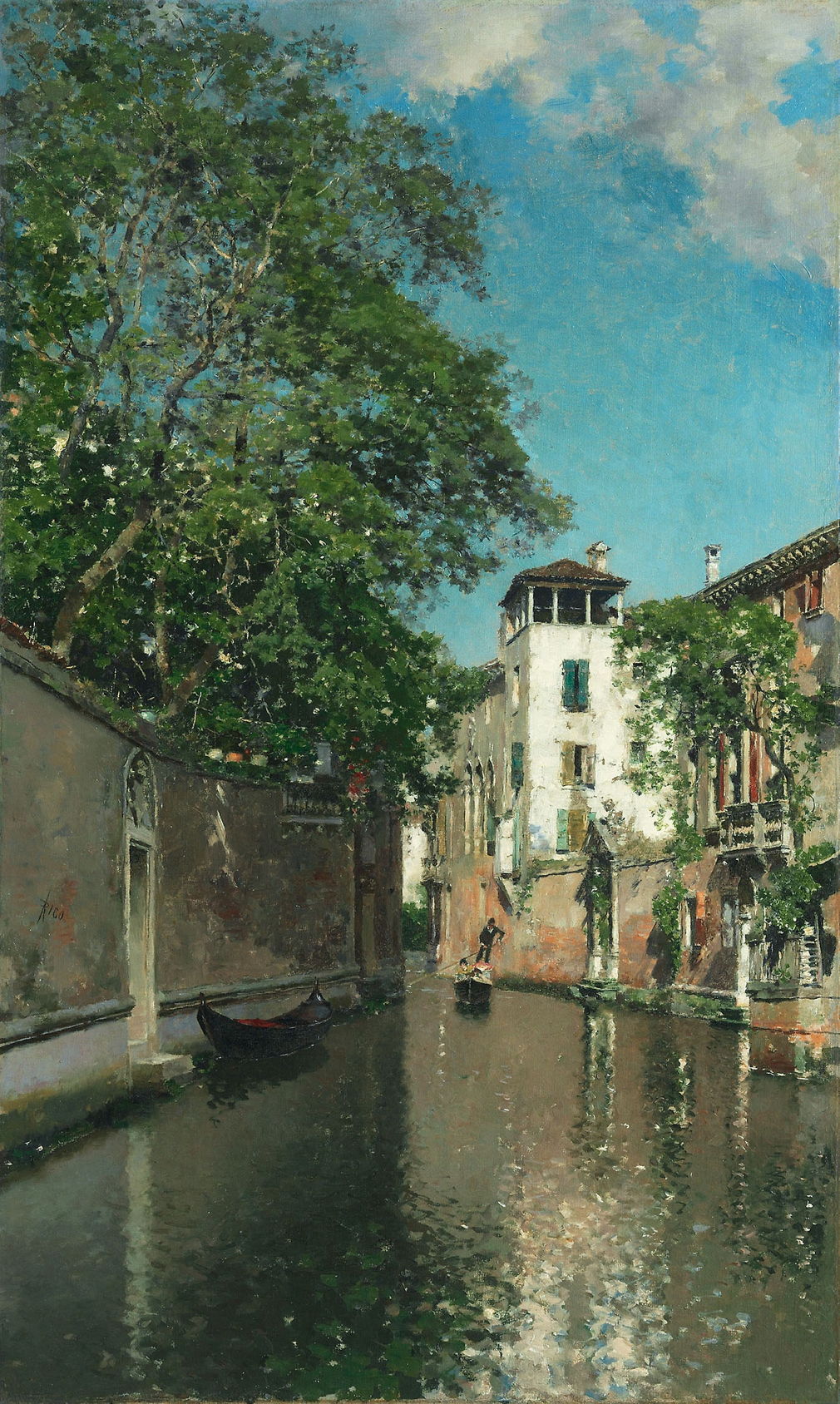
ricocanalveniceaic
Martín Rico y Ortega (1833–1908), Canal in Venice (date not known), oil on canvas, dimensions not known, The Art Institute of Chicago, Chicago, IL. Wikimedia Commons.

Rico’s Canal in Venice uses more painterly marks in its reflections.

At the same time, Eilert Adelsteen Normann was painting the grander effects seen in the fjords of Norway.

normannfromromsdalfjord
Eilert Adelsteen Normann (1848–1918), From Romsdal Fjord, 1875 (1875), oil on canvas, dimensions not known, Bergen kunstmuseum (Kunstmuseene i Bergen), Bergen, Norway. Wikimedia Commons.

Normann’s From Romsdal Fjord, also from 1875, shows the ninth longest fjord in Norway as it carves its way through this huge mountain gorge. Although much of the water surface is glassy calm, there’s a slight blur of fine ripples, and patches where it’s more disrupted by gentle breeze.

normannsteamship
Eilert Adelsteen Normann (1848-1918), The Steamship (date not known), further details not known. Wikimedia Commons.

The unidentified fjord in Normann’s undated The Steamship shows a similar repertoire of subtle optical effects.

ringaldertrunks
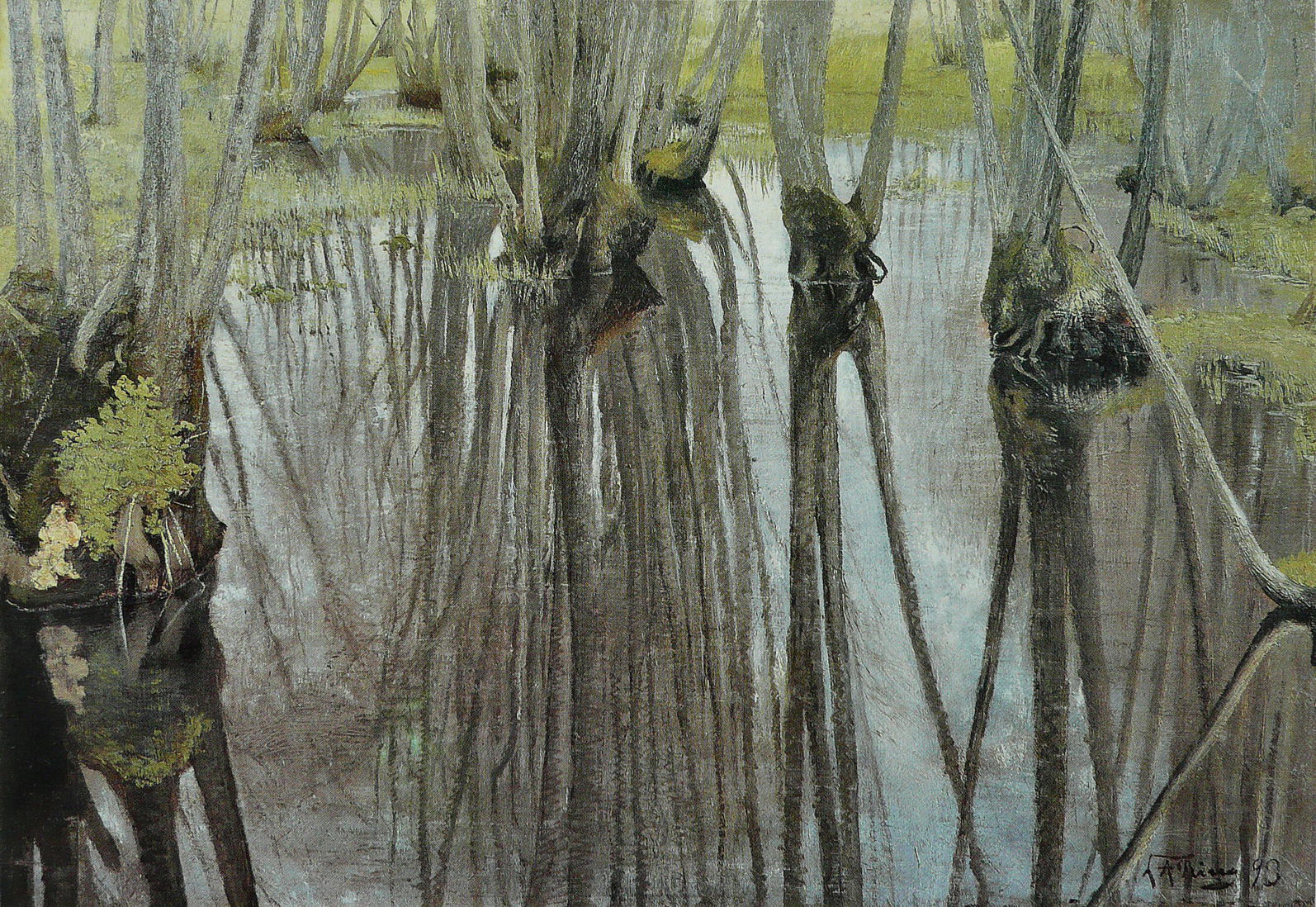
Laurits Andersen Ring (1854–1933), Alder Trunks (1893), oil on canvas, 52.9 x 73.5 cm, Collection of Her Majesty the Queen Margrethe II, Copenhagen, Denmark. Wikimedia Commons.

Alder Trunks from 1893 is one of Laurits Andersen Ring’s finest landscapes, and has earned its place in the Danish Royal Collection. He shows these old coppiced alders mainly in reflection. Although their details are quite painterly, the overall effect is that of meticulous realism.

The specialist of this period is the Norwegian Frits Thaulow.

thaulowwinterriversimoa
Frits Thaulow (1847–1906), Winter at the River Simoa (1883), oil on canvas, 49.5 x 78.5 cm, Nasjonalgalleriet, Oslo, Norway. Wikimedia Commons.

Thaulow seems to have discovered what was going to be his recurrent theme for much of his career by 1883, when he painted this scene of Winter at the River Simoa. A lone woman, dressed quite lightly for the conditions, is rowing her tiny boat over the quietly flowing river, towards the tumbledowns on the other side. The surface of the river shows the glassy ripples so common on semi-turbulent water, and the effect on reflections is visibly complex. The distant side of the river is also partly frozen, breaking the reflections further.

thaulowmillsmontreuil
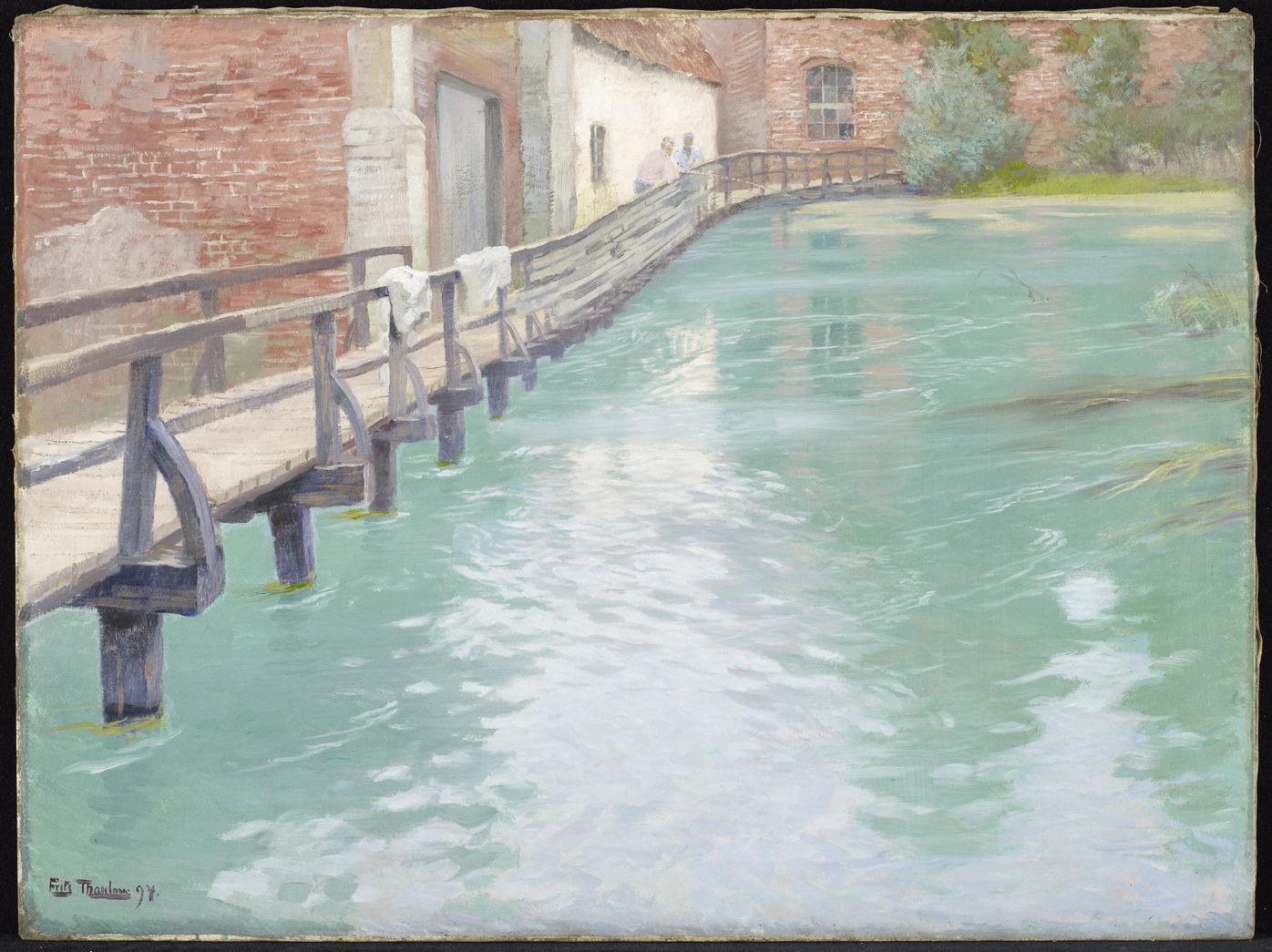
Frits Thaulow (1847–1906), The Mills at Montreuil-sur-Mer, Normandy (1894), oil on canvas, dimensions not known, Minneapolis Institute of Art, Minneapolis, MN. Wikimedia Commons.

Thaulow later returned to his studies of flowing rivers, for example in The Mills at Montreuil-sur-Mer, Normandy. This painting has been claimed to date from 1891, before the artist moved to Montreuil, but I think that its date reads 1894.

thaulowadigeriververona
Frits Thaulow (1847–1906), The Adige River at Verona (c 1894), oil on canvas, 81 x 100 cm, Walters Art Museum, Baltimore, MD. Wikimedia Commons.

In 1894, Thaulow travelled across northern Italy to Venice, stopping off to paint The Adige River at Verona. This shows the five arches of the Ponte della Pietra, with wonderfully disrupted reflections describing the river’s turbulent flow.

thaulowdordogne
Frits Thaulow (1847–1906), La Dordogne (1903), oil, further details not known. Wikimedia Commons.

Soon after Thaulow had settled at Beaulieu in central France, he found form with the magnificent river surface and lighting of La Dordogne (1903), whose precise detail in the foreground quickly yields to a more sketchy background.

A few artists rose to the challenge of combined reflected and refracted images, among them Kazimierz Sichulski.

sichulskifish
Kazimierz Sichulski (1879–1942), Fish (1908), pastel on paperboard, 63 x 82 cm, Muzeum Narodowe w Poznaniu, Poznań, Poland. Wikimedia Commons.

Sichulski’s Fish (1908) is a startlingly unusual pastel painting, a virtuoso combination of reflections from and views through this water surface. It’s an essay in practical optics.

❌