Reading view

There are new articles available, click to refresh the page.

Medium and message: Vast canvases

Venice became an important part of the southern Renaissance with the paintings of the Bellini brothers in the latter half of the fifteenth century, and flourished in the sixteenth century with their successors Giorgione, Titian, Tintoretto and Veronese. Venetian painting distinguished itself by emphasising colour over line and form, but there were also important differences in media.

From long before the Renaissance, the largest paintings in Europe were made using fresco on the walls and ceilings of churches and other religious buildings. Because Venice had been built on marshy islands in a lagoon, the walls of its buildings remained damp and proved unsuitable for classical fresco technique. Supplies of wood were also limited, and the fabrication of large wooden panels was impractical. It was in Venice that the largest paintings were thus made in oil paints on stretched canvas.

In other circumstances, what are considered to be large canvases might attain five or six metres (16-20 feet) in their longer dimension. This article shows a selection where that exceeds ten metres (33 feet), and in one case twenty-two metres (72 feet), all but one created by Jacopo Tintoretto and his workshop.

In 1559-60, Tintoretto painted two commissions for the church of Madonna dell’Orto, where he was to be buried. Each nearly fifteen metres (50 feet) high, they’re among his most spectacular.

tintorettolastjudgement1560
Jacopo Tintoretto (c 1518-1594), The Last Judgment (c 1559-60) (E&I 77), oil on canvas, 1450 x 590 cm, Madonna dell’Orto, Venice, Italy. Image by Didier Descouens, via Wikimedia Commons.

The Last Judgment was probably painted first, and shows apocalyptic scenes from Biblical eschatology, notably the book of Revelation. To some extent, paintings of the last judgement are inevitably chaotic, as that is part of the event, but Tintoretto’s overall composition here isn’t as well-conceived as in the second of the pair. The painting has several focal passages, in particular the horizontal winged angel wearing orange shorts just over half way up, and the figure of Christ at its apex.

tintorettolastjudgement1560d1
Jacopo Tintoretto (c 1518-1594), The Last Judgment (detail) (c 1559-60) (E&I 77), oil on canvas, 1450 x 590 cm, Madonna dell’Orto, Venice, Italy. Image by Didier Descouens, via Wikimedia Commons.

The lower sections show a dark base filled with contorted bodies blending in with rock and water, an underworld without the usual fire. Above is a band of sea green, in which there is a reprise of the flood, and bodies are washed along in a great wave. The middle then takes to the air, where figures sit on clouds still bringing rain to those in the waters below. The central crucifix seen at the foot isn’t part of the painting.

tintorettolastjudgement1560d2
Jacopo Tintoretto (c 1518-1594), The Last Judgment (detail) (c 1559-60) (E&I 77), oil on canvas, 1450 x 590 cm, Madonna dell’Orto, Venice, Italy. Image by Didier Descouens, via Wikimedia Commons.

In the upper section, above the angel in orange, rays of light are streaming down from Jesus at the apex. Individual figures are now more readily distinguished, and some of them recognisable. At each side are winged angels with long trumpets, and a double band of black clouds marking the threshold of heaven. On the right, a martyr wearing a deep blue loincloth sits with his crucifix against his shoulder: he could be Saint Andrew.

Higher still is the mother of twins, her back to the viewer, looking up towards the heaped black cloud on which Jesus Christ sits at the centre, with the Virgin Mary on one side and Saint John the Baptist on the other. Particularly in the upper section, many of the figures are foreshortened and distorted.

tintorettogoldencalf
Jacopo Tintoretto (c 1518-1594), Making of the Golden Calf (c 1559-60) (E&I 78), oil on canvas, 1450 x 580 cm, Madonna dell’Orto, Venice, Italy. Image by Didier Descouens, via Wikimedia Commons.

The second, the Making of the Golden Calf, shows one of the more memorable stories of Moses, from the book of Exodus in the Old Testament. During that epic journey from bondage in Egypt to the Promised Land, Moses left the Israelites for a period of forty days and nights, when he ascended Mount Sinai to be given the Ten Commandments. While he was away, the people demanded that Moses’ brother and deputy Aaron made them a graven image to worship.

He gathered all their gold, which was melted down and cast into the form of a calf, which they then worshipped. God told Moses that they had already fallen from his ways, so Moses descended from Sinai. He was so angry with the Israelites that he broke the two tablets containing the commandments. He burnt the golden calf, ground it to powder, scattered it on water, and made the people drink it. The only people who didn’t worship the calf were the tribe of Levi, who became the first priestly class.

Tintoretto’s overall design of this simpler narrative is clearer and well-organised. The lower half of the painting shows the golden calf and the Israelites worshipping and feasting around it. Just over half way up is Moses on the summit of the mountain, being delivered the tablets with the commandments, and above that is heaven, with the Israelites’ God.

tintorettogoldencalfd1
Jacopo Tintoretto (c 1518-1594), Making of the Golden Calf (detail) (c 1559-60) (E&I 78), oil on canvas, 1450 x 580 cm, Madonna dell’Orto, Venice, Italy. Image by Didier Descouens, via Wikimedia Commons.

The graven image of the golden calf is being carried with difficulty by four men. Piles of golden jewellery, coins, and chain are still apparently being melted down. Sitting on a rock bench above, under an ornamental awning, are several young women, who are being dressed and prepared for ceremonies to take place with the idol. More people are seen feasting on the grass over to the left.

tintorettogoldencalfd2
Jacopo Tintoretto (c 1518-1594), Making of the Golden Calf (detail) (c 1559-60) (E&I 78), oil on canvas, 1450 x 580 cm, Madonna dell’Orto, Venice, Italy. Image by Didier Descouens, via Wikimedia Commons.

In the upper section of the painting, Moses is stood on the top of the mountain, his arms outstretched to the sky, ready to receive the tablets containing the commandments. God still holds those, immediately above Moses, and two winged angels are just taking the tablets from him, to pass down to Moses. Around them and above are several other figures, flying around the clouds.

One last remark about these two exceptionally tall paintings: recognising that viewers would have to look up sharply to see their upper sections, Tintoretto projected their figures and other details as if they were ceiling panels. The higher up each canvas you look, the more the figures appear to be above you. That is an ingenious projection to enhance their visual impact.

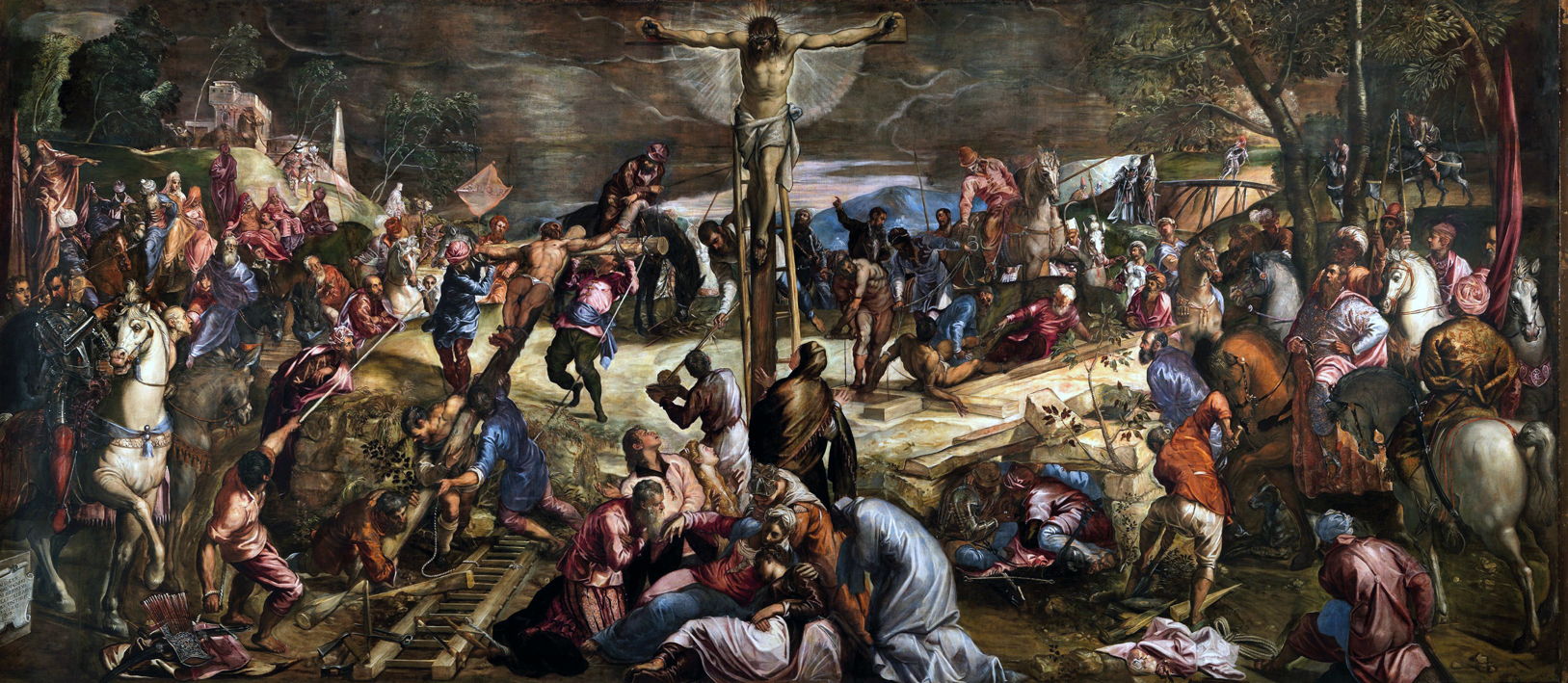
In 1565, commissioned by the Scuola Grande for its albergo, Tintoretto painted one of the major religious works of the century: his vast Crucifixion, more than 5 metres (17 feet) high, and 12 metres (40 feet) across.
tintorettocrucifixionsanrocco
Jacopo Tintoretto (c 1518-1594), The Crucifixion (E&I 123) (1565), oil on canvas, 536 x 1224 cm, Albergo, Scuola Grande di San Rocco, Venice, Italy. Wikimedia Commons.

He applied the lessons learned in his tall works for the Madonna dell’Orto. He makes use of space and uses a narrative technique based on the traditional ‘multiplex’ form popular during the Renaissance, in which its single image shows events at more than a single point in time, in an ingenious and modern manner. Naturally, the painting centres on Christ crucified, but the two thieves executed beside him are not shown, as would be traditional, already hanging from their crosses.

tintorettocrucifixionsanroccod1
Jacopo Tintoretto (c 1518-1594), The Crucifixion (detail) (E&I 123) (1565), oil on canvas, 536 x 1224 cm, Albergo, Scuola Grande di San Rocco, Venice, Italy. Wikimedia Commons.

Instead, to the right of Christ, the ‘bad’ thief is still being attached to his cross, which rests on the ground. To the left of Christ, the ‘good’ thief is just being raised to the upright position. There is nothing in the well-known gospel accounts to make this anachronistic, but it’s most probable that the crucifixions were more simultaneous.

Spaced out around the canvas are relevant sub-stories from that whole. At the foot of Christ’s cross is his group of mourners, including the Marys. Each of the crosses has attendant workers, busy with the task of conducting the crucifixion, climbing ladders, hauling on lines, and fastening each victim to his cross. This mechanical and human detail brings the scene to life and adds to its credibility, and grim process.
tintorettocrucifixionsanroccod2
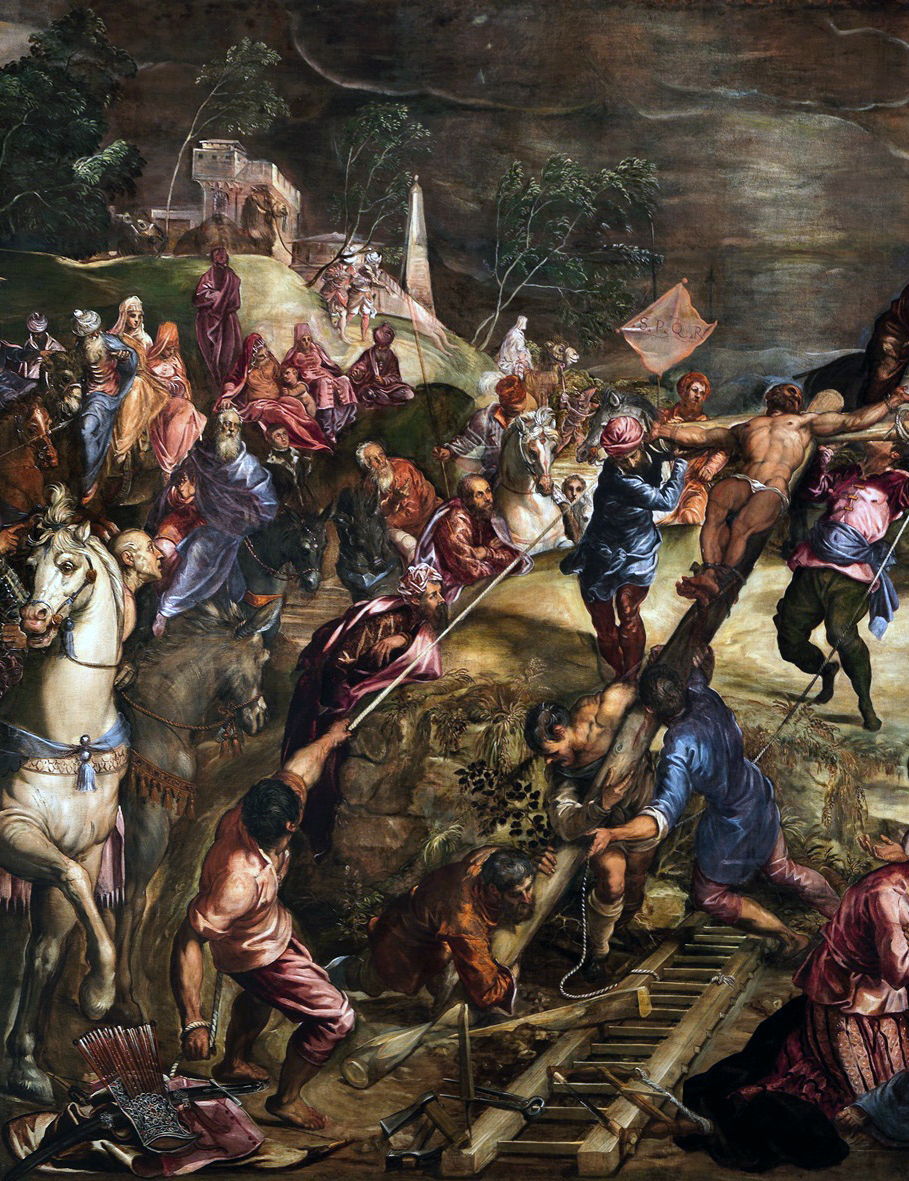
Jacopo Tintoretto (c 1518-1594), The Crucifixion (detail) (E&I 123) (1565), oil on canvas, 536 x 1224 cm, Albergo, Scuola Grande di San Rocco, Venice, Italy. Wikimedia Commons.

The crowd on the left is more spread out than in an earlier version. In the distance is a flag bearing the letters SPQR representing the Roman Empire, and its link through Pilate. Most faces are turned towards Christ, with their eyes wide in awe.
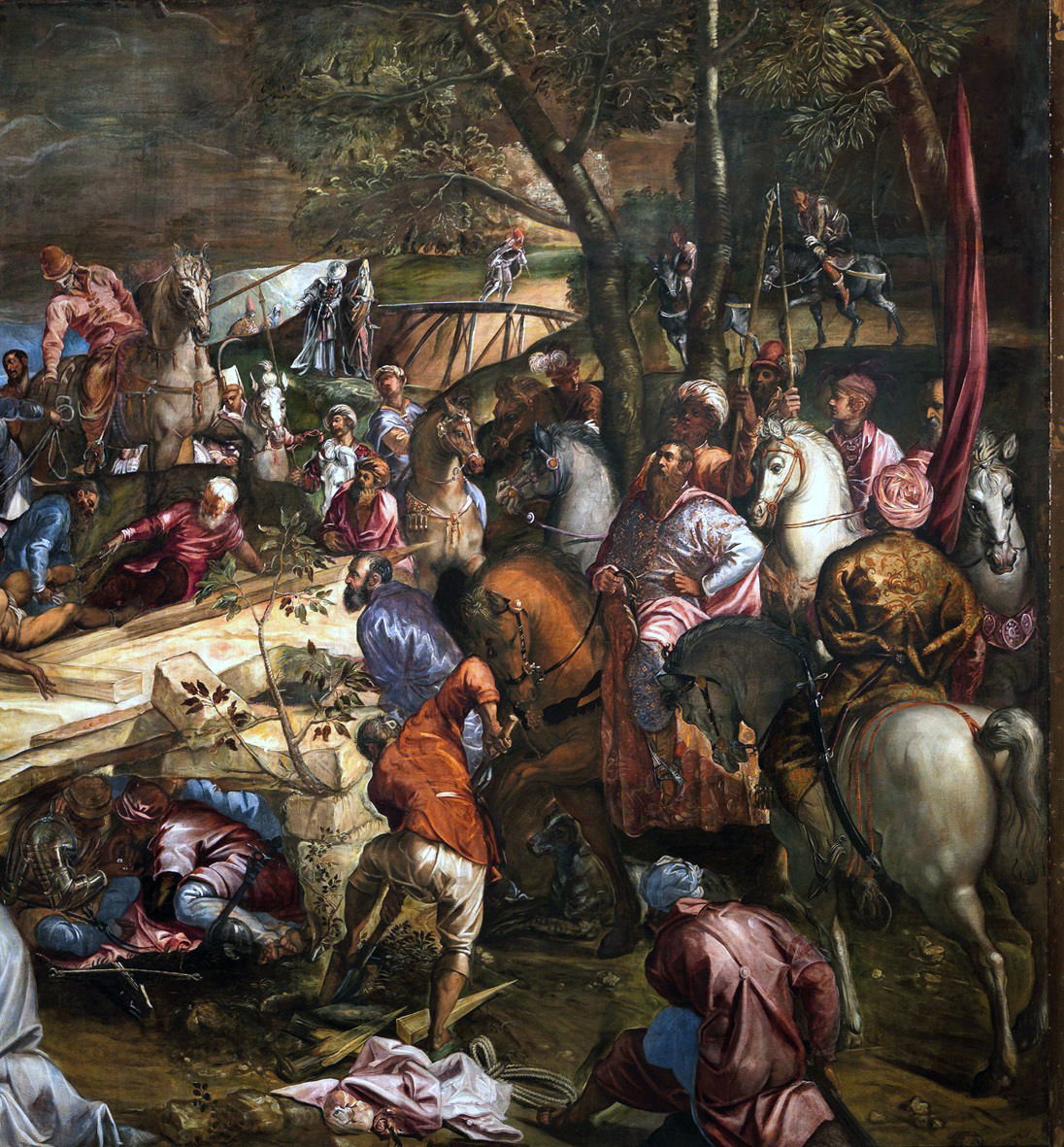
tintorettocrucifixionsanroccod3
Jacopo Tintoretto (c 1518-1594), The Crucifixion (detail) (E&I 123) (1565), oil on canvas, 536 x 1224 cm, Albergo, Scuola Grande di San Rocco, Venice, Italy. Wikimedia Commons.

On the right, in a small rock shelter suggestive of a tomb, two men are gambling with dice. To the right of them, a gravedigger has just started his work with a spade. The ruling class, perhaps Herod himself, have turned up on horseback, and they too stare wide-eyed at Christ.

When the Doge’s Palace, or Palazzo Ducale, in Venice was destroyed by fire in 1577, it took with it a fresco from around 1365 by Guariento. Although initially unsuccessful in obtaining the commission to provide a replacement, with the death of Veronese in 1588, Tintoretto was invited to do so. By this time the artist was seventy, so much of the painting was performed by his son Domenico Robusti.

The room in which this painting was to be hung, the Sala del Maggior Consiglio, is one of the most majestic and imposing in the whole building, and was used for meetings of the Grand Council of Venice, at which it considered legislation and elected the city’s magistrates.
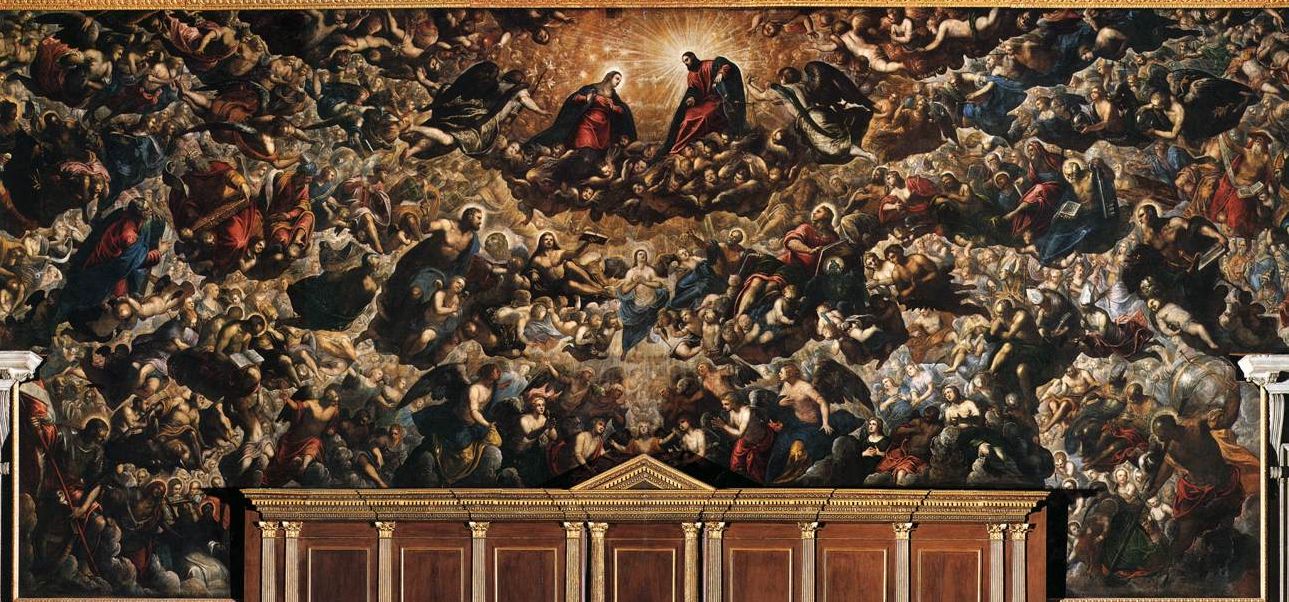
tintorettoparadise
Jacopo Tintoretto (c 1518-1594) and Domenico Robusti, Paradise (E&I 298) (1588-1592), oil on canvas, 700 x 2200 cm, Sala del Maggior Consiglio, Palazzo Ducale, Venice. Wikimedia Commons.

The resulting painting, which is seven metres (almost 23 feet) high and twenty-two metres (72 feet) across, was probably designed by Jacopo and largely entrusted to his son Domenico and the workshop to paint. In conformity with the rules of the commission, its composition focusses on the Coronation of the Virgin, inspired by Dante’s Paradise, as shown in the detail below.
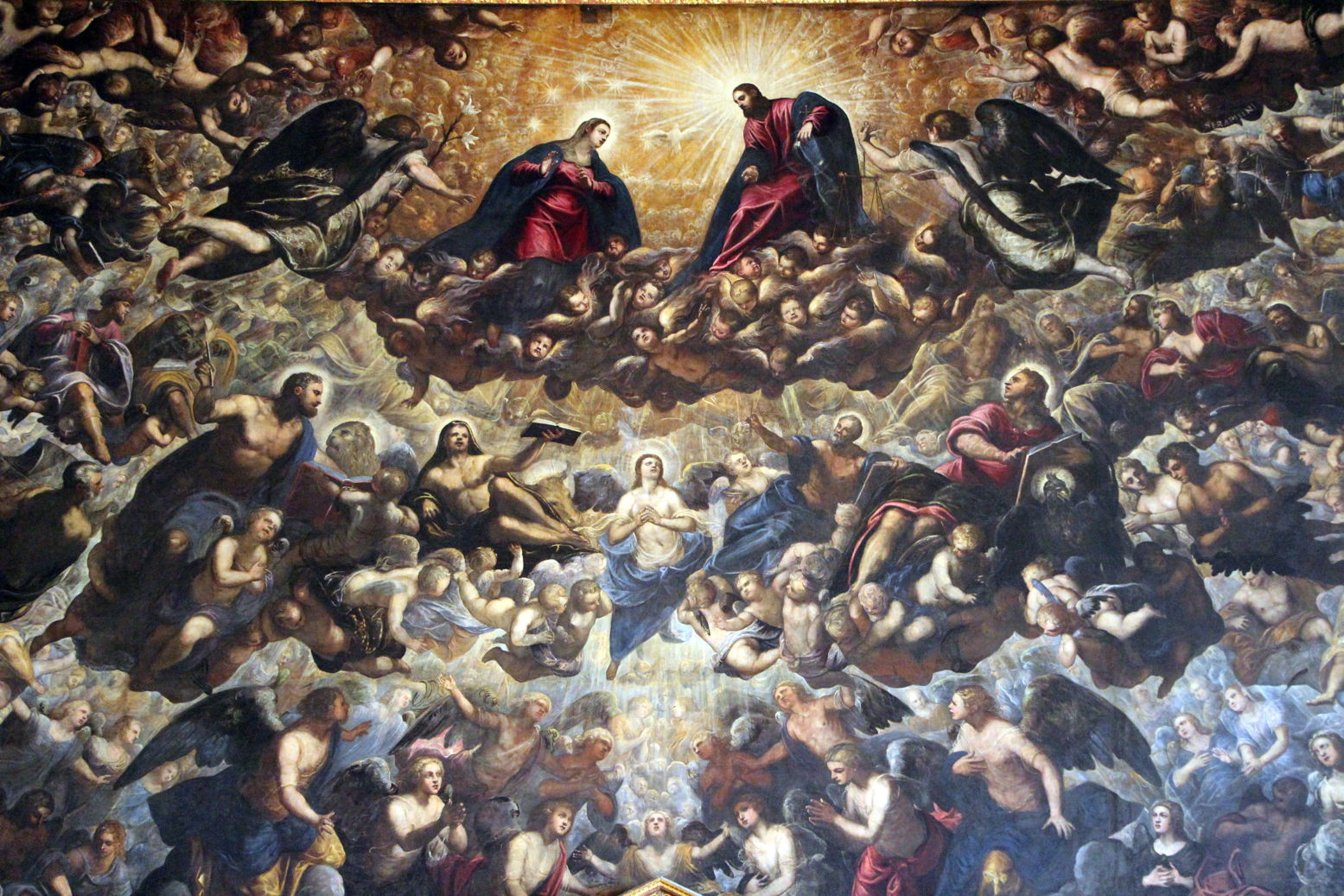
tintorettoparadised1
Jacopo Tintoretto (c 1518-1594) and Domenico Robusti, Paradise (E&I 298) (detail) (1588-1592), oil on canvas, 700 x 2200 cm, Sala del Maggior Consiglio, Palazzo Ducale, Venice. Image by Sailko, via Wikimedia Commons.

At the top, the Virgin Mary, behind whom is her traditional symbol of the white lily, stands with Jesus Christ, in their matching red and blue robes. Between them is the white dove of the Holy Ghost, and all around are cherubic heads of infant angels. To the right are the scales of justice, also used for the weighing of souls.

tintorettoparadised2
Jacopo Tintoretto (c 1518-1594) and Domenico Robusti, Paradise (E&I 298) (detail) (1588-1592), oil on canvas, 700 x 2200 cm, Sala del Maggior Consiglio, Palazzo Ducale, Venice. Image by Sailko, via Wikimedia Commons.

Even at the height of his powers, and with his exceptionally fast brushwork, completing such a huge work would have been a major feat for Jacopo.

tintorettoparadised3
Jacopo Tintoretto (c 1518-1594) and Domenico Robusti, Paradise (E&I 298) (detail) (1588-1592), oil on canvas, 700 x 2200 cm, Sala del Maggior Consiglio, Palazzo Ducale, Venice. Image by Sailko, via Wikimedia Commons.

Paolo Veronese also made a name for himself with his earlier large canvases, but in 1573 exceeded them all in The Feast in the House of Levi, which wasn’t its original title.
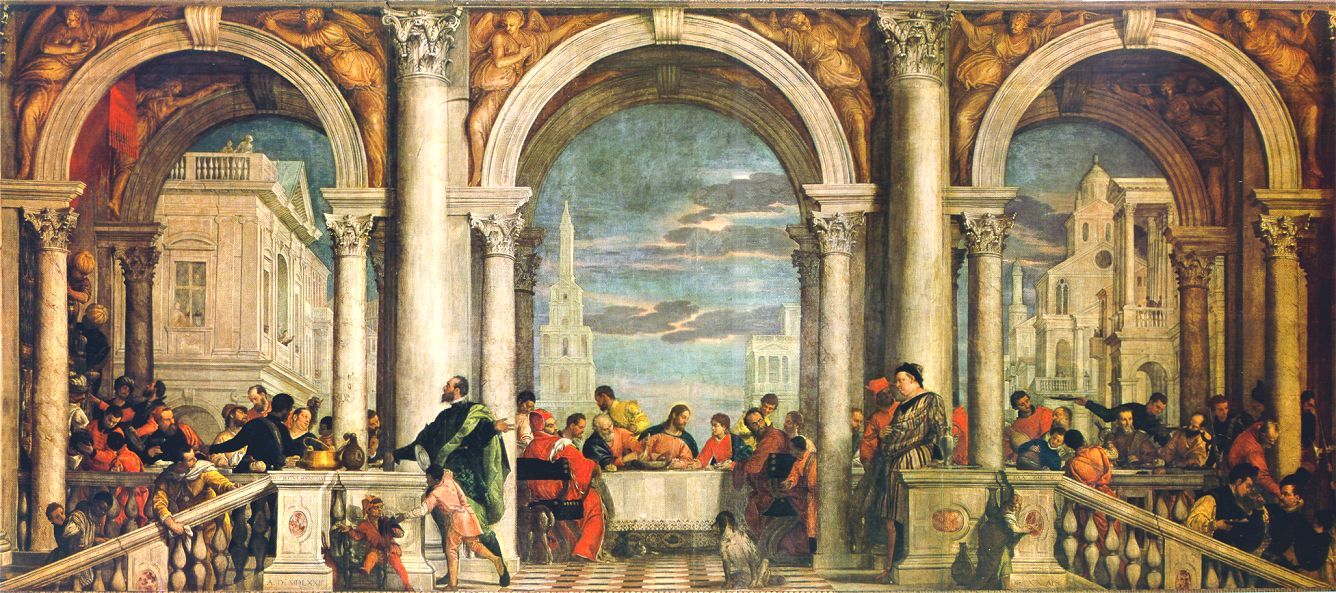
veronesefeasthouselevi
Paolo Veronese (1528–1588), The Feast in the House of Levi (1573), oil on canvas, 555 × 1280 cm, Galleria dell’Accademia, Venice. Wikimedia Commons.

Veronese painted this thirteen metre-long (42 feet) scene for the refectory of the Dominican Friary of the Basilica di Santi Giovanni e Paolo, but it was intended to show the Last Supper, Christ’s last meal with his disciples before he was betrayed and crucified, at which he laid out the sacrament of Communion, a key part of Christian life ever since.

However, he over-reached himself, and the painting was deemed so offensive that he was brought before the Inquisition accused of blasphemy. Thankfully the Inquisition didn’t impose any penalty on Veronese himself, but required that he ‘correct’ the painting within a period of three months. This he did by changing its title, not its content, to The Feast in the House of Levi.

Christ is shown in the centre of the painting, further emphasised by his halo. In addition to the standard row of disciples, Veronese adds a rich collection of other figures, described by the Inquisition as “buffoons, drunken Germans, dwarfs and other such scurrilities”, more in the manner of a Venetian feast.

Hero or hooligan: Perseus 2

The legendary hero Perseus was the son of Danaë, conceived when Zeus/Jupiter impregnated her in a shower of gold. He had been sent by Polydectes on a mission to bring him the head of Medusa, and on his return with that secured in a kibisis, he stopped off in Ethiopia, where the princess Andromeda was awaiting sacrifice to the sea monster Cetus.

titianandromeda
Titian (Tiziano Vecelli) (1490–1576), Perseus and Andromeda (1553-9), oil on canvas, 179 × 197 cm, The Wallace Collection, London. Wikimedia Commons.

Titian’s Perseus and Andromeda (1553-59) shows the height of the action, remaining largely faithful to Ovid’s account of this story. All three actors are present, with Andromeda still shackled and Perseus attacking Cetus from the air using a sword with a curved blade.

veroneseperseus
Paolo Veronese (1528–1588), Perseus Rescuing Andromeda (1576-78), oil on canvas, 260 × 211 cm, Musée des Beaux-Arts, Rennes, France. Wikimedia Commons.

Paolo Veronese’s Perseus Rescuing Andromeda followed soon afterwards, in 1576-78. His composition is similar to Titian’s, and equally faithful to the text, but his additional attention to the details of Perseus and Cetus brings this to life.

burnejonesperseus8b
Edward Burne-Jones (1833–1898), The Perseus Series: The Doom Fulfilled (1888), oil on canvas, 155 × 140.5 cm, Staatsgalerie Stuttgart, Stuttgart. Wikimedia Commons.

In the ninth painting in Edward Burne-Jones’ series, The Doom Fulfilled (1888), Perseus is swathed in Cetus’ coils with their almost calligraphic form, brandishing his sword and ready to slaughter the monster and bring its terror to an end.

vallottonperseuskillingdragon
Félix Edouard Vallotton (1865-1925), Perseus Killing the Dragon (1910), oil on canvas, 160 x 233 cm, Musée d’art et d’histoire de Genève, Geneva. By Codex, via Wikimedia Commons.

In the early twentieth century, the former Nabi artist Félix Edouard Vallotton painted a series of narrative works, including his Perseus Killing the Dragon, from 1910, a thoroughly contemporary interpretation that is exceptionally free with Ovid’s account.

As with most classical myths, several variants of the story have developed over time. All painted accounts that I have seen follow the action-packed version in which Perseus slays Cetus with his sword, but some literary versions report that the sea monster was turned to stone by Medusa’s face, which would have made far duller paintings.

A more recent variant has the hero flying to Andromeda’s aid not with his winged sandals, but on the back of the winged horse Pegasus.

rubensperseusandromeda
Peter Paul Rubens (1577–1640), Perseus and Andromeda (c 1622), oil on canvas, 99.5 x 139 cm, Hermitage Museum, Saint Petersburg, Russia. Wikimedia Commons.

By the time that Rubens came to paint Perseus and Andromeda in about 1622, the newer revised version including Pegasus seems to have become popular. Andromeda is at the left, unchained from her rock where she had been placed as a delightful morsel for Cetus, which has just been killed by Perseus and now lies at the lower edge with its fearsome mouth wide open. Perseus is in the process of claiming Andromeda’s hand as his reward, for which he is being crowned with laurels. Although he clearly flew in on Pegasus, he is still wearing his winged sandals, and holds the polished shield reflecting Medusa’s face and snake hair.

pierodicosimofreeingofandromeda
Piero di Cosimo (1462–1521), Andromeda freed by Perseus (c 1510-15), oil on panel, 70 x 123 cm, Galleria degli Uffizi, Florence. Wikimedia Commons.

Piero di Cosimo uses multiplex narrative to show most of the story in his large Andromeda Freed by Perseus (c 1510-15). Centred on the great bulk of Cetus, Perseus stands on its back and is about to hack at its neck with his curved sword. At the upper right, Perseus is shown a few moments earlier, as he was flying past in his winged sandals. To the left of Cetus, Andromeda is still secured to the rock by red fabric bindings, not chains, and is bare only to her waist.

In the foreground in front of Cetus are Andromeda’s parents stricken in grief. Near them is a group of courtiers with ornate head-dress. But in the right foreground the wedding party is already in full swing, complete with musicians and dancers.

Perseus’ reward for rescuing Andromeda and saving the kingdom of Ethiopia was naturally the hand of the princess in marriage. There was only one obstacle, that she had already been promised to Phineus, who was clearly no match when it came to killing sea monsters. Whether or not Phineus was invited, he and his friends turned up at the wedding of Andromeda and Perseus, and trouble soon broke out. The punch-up turned lethal when the weapons came out, and Perseus decided it was time to show Medusa’s face to the unwelcome guests.

ricciperseusconfronts
Sebastiano Ricci (1659–1734), Perseus Confronting Phineus with the Head of Medusa (c 1705-10), oil on canvas, 64.1 × 77.2 cm, The J. Paul Getty Museum, Los Angeles, CA. Courtesy of J. Paul Getty Museum.

Sebastiano Ricci’s Perseus Confronting Phineus with the Head of Medusa (c 1705-10) shows the final moments of the battle, as Phineus cowers next to two of his henchmen who have almost completed the process of changing into stone. Although not shown here, Athena herself turned up to make sure that no one got the better of Perseus.

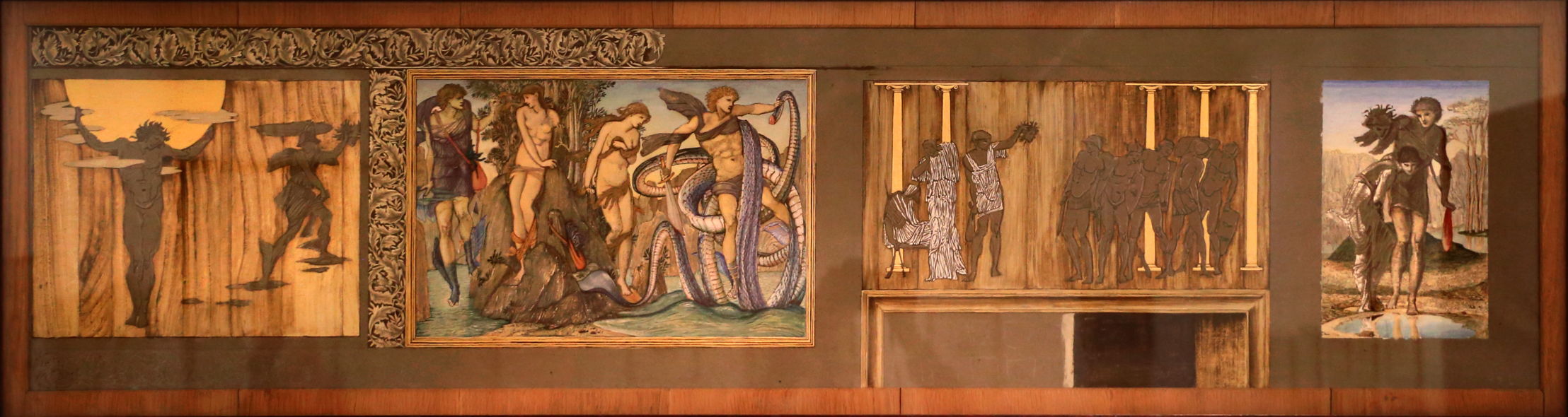
Edward Burne-Jones worked on many sketches and preliminary designs for his series, among which were gouache and gold layouts to show how his paintings would fit into their carved surrounds in his patron’s Music Room.

burnejonesperseusstudy
Edward Burne-Jones (1833–1898), Atlas Turned to Stone; The Rock of Doom and the Doom Fulfilled; The Court of Phineas; The Baleful Head (designs for The Story of Perseus) (1875-76), gouache, gold paint, graphite and chalk on paper, 36.7 x 148.7 cm, The Tate Gallery, London. Image by Sailko, via Wikimedia Commons.

This design shows an outline of the whole series, which had originally been intended to include Phineus and the wedding. The scenes shown are, from the left, Atlas Turned to Stone, The Rock of Doom and the Doom Fulfilled, The Court of Phineas, and The Baleful Head, shown below.

burnejonesperseus9b
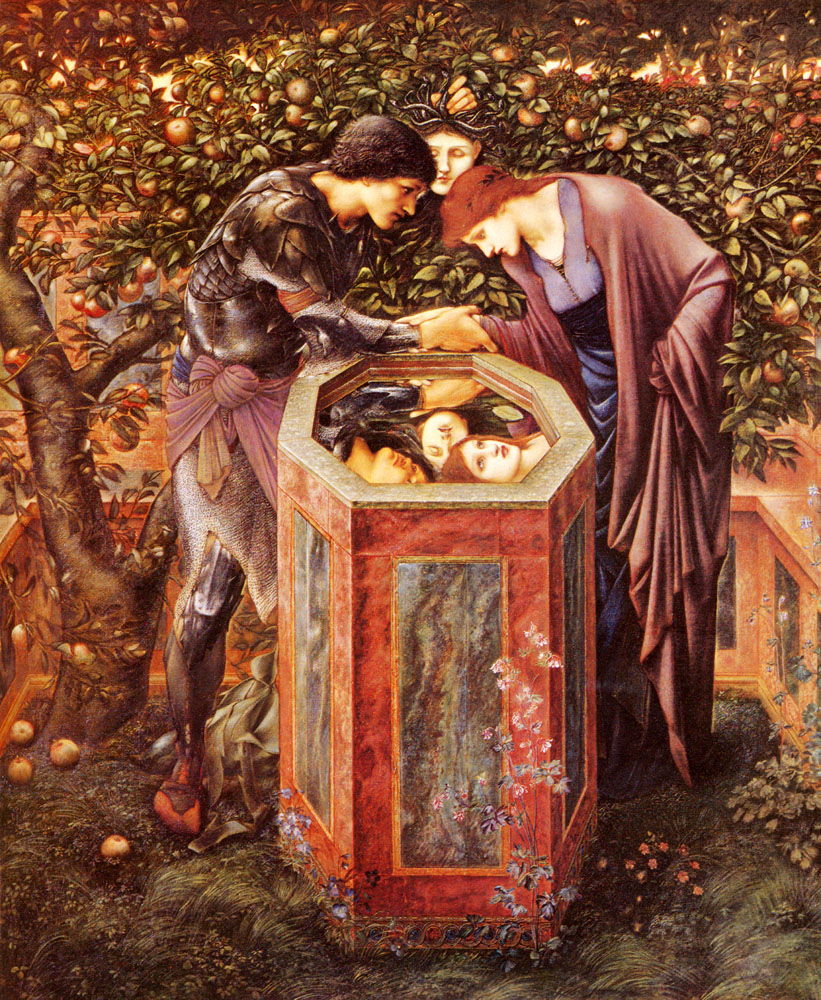
Edward Burne-Jones (1833–1898), The Perseus Series: The Baleful Head (1886-7), oil on canvas, 155 × 130 cm, Staatsgalerie Stuttgart, Stuttgart. Wikimedia Commons.

The tenth and final painting in Burne-Jones’ series, The Baleful Head (1885), shows Perseus and Andromeda, their right hands clenching one another’s wrists, looking at the image of Medusa’s face reflected in the surface of a well. This is set in a peaceful garden, with a fruit-laden apple tree behind, and flowers springing up from the grass beneath them.

Literary accounts take the couple on to live at Tiryns in Argos, from where Heracles/Hercules later undertook his Twelve Labours. They had seven sons and two daughters, and among their descendants were Heracles, Castor and Pollux, Clytemnestra, and the Achaemenid Persians.

When Perseus returned to Seriphos, he discovered Polydectes was still trying to seduce his mother Danaë. Perseus therefore used Medusa’s face to turn him to stone, and made Dictys king and his mother’s consort. His mission accomplished, Perseus returned the weapon and equipment loaned by the gods, and gave Athena the head of Medusa, which she then set in her shield as the Gorgoneion, more commonly referred to as the Aegis.

rubensjudgementparis
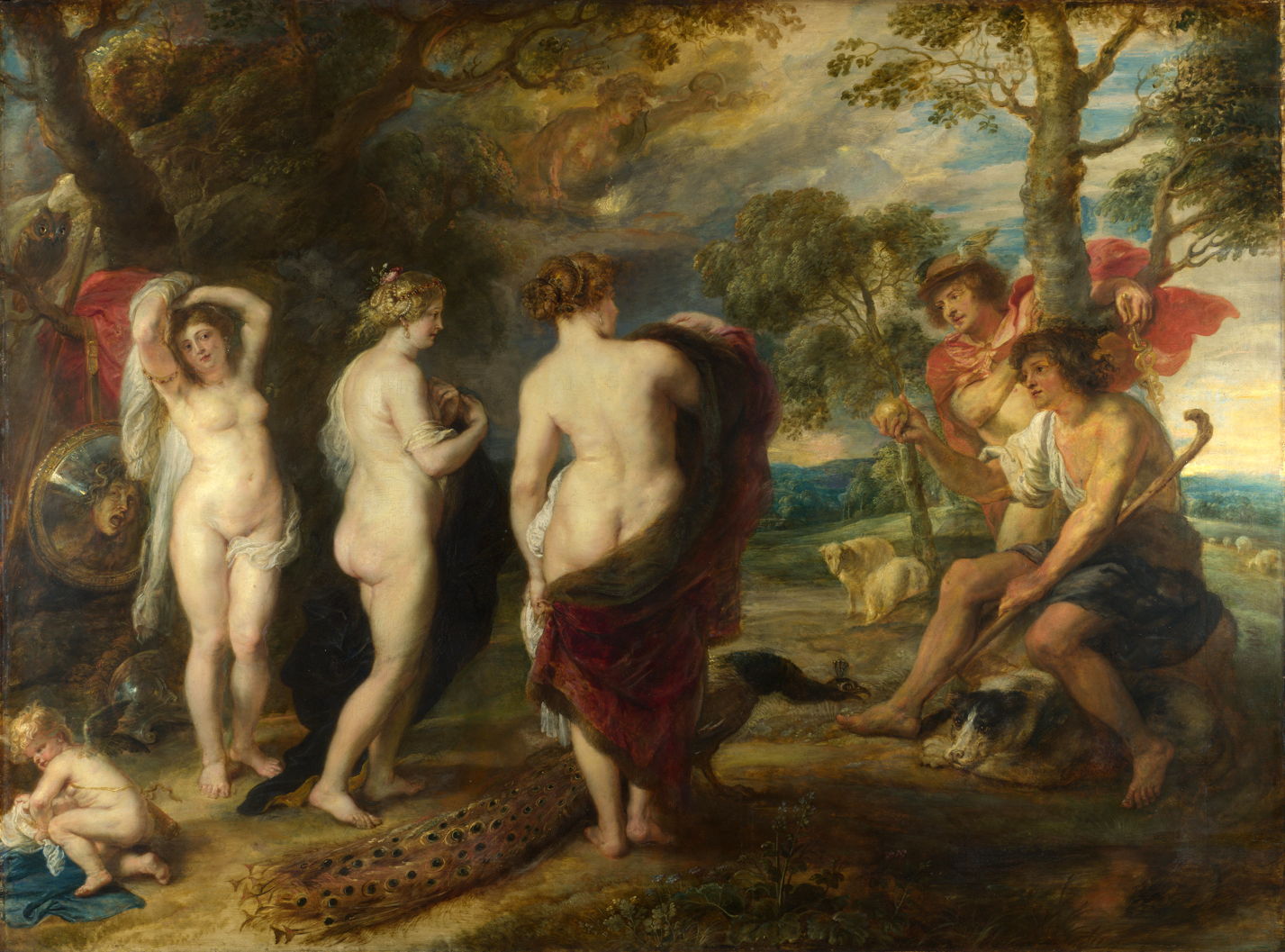
Peter Paul Rubens (1577–1640), The Judgement of Paris (1632-35), oil on oak, 144.8 x 193.7 cm, National Gallery, London. Wikimedia Commons.

Distinguishing the three goddesses taking part in The Judgement of Paris, shown in Rubens’ late account from 1632-35, often relies in part on the aegis. The three goddesses are, from the left, Athena with her shield, Aphrodite, and Hera with her peacock.

There was still one loose end to be tied, though: the prediction that Perseus would kill his father Acrisius. Various accounts are given of this, but consensus is that Perseus threw a quoit or discus that unintentionally struck Acrisius and killed him. Thereafter, he ruled a kingdom until he and Andromeda died. They were both catasterised into their own constellations, where they can still be seen today.

Centaurs 2: Revenge

In addition to his account of the battle between Lapiths and centaurs at the wedding feast of Pirithous and Hippodame, Ovid tells the story of Nessus the centaur and his attempt to abduct Hercules’ wife.

Nessus had set himself up as the ferryman on the river Euenos, in western Greece. One day, Deianeira, the beautiful wife of Hercules, wanted to cross the river, so she mounted Nessus’ back and he took her across. As he was doing so, he decided to try to abduct and rape her. However, Hercules was on the bank they had just left, and heard her cries. He drew his bow and shot Nessus in the breast with an arrow whose tip was poisoned with the blood of the Lernean Hydra.

As Nessus lay dying, in an act of revenge he told Deianeira that his blood would act as a love charm to ensure that Hercules would be true to her forever, which she foolishly believed. She collected his blood, and kept it ready for use. Some years later, Hercules was having an affair with the young and beautiful Iole. When Deianeira discovered this, she spread Nessus’ blood on a shirt (chiton), which she gave to her husband to wear, in the hope that it would bring him back to her.

When Hercules was away, Deianeira accidentally spilt some of Nessus’ blood on the floor, where it lay smoking in the light of dawn. She realised that Nessus had tricked her, and that his blood would harm Hercules. She sent a messenger to warn him, but that was too late for Hercules, whose body had been horribly burned by the shirt. He took himself out to die a noble death on a pyre of oak branches, from where Zeus took him to Mount Olympus.

romanherculesnessus
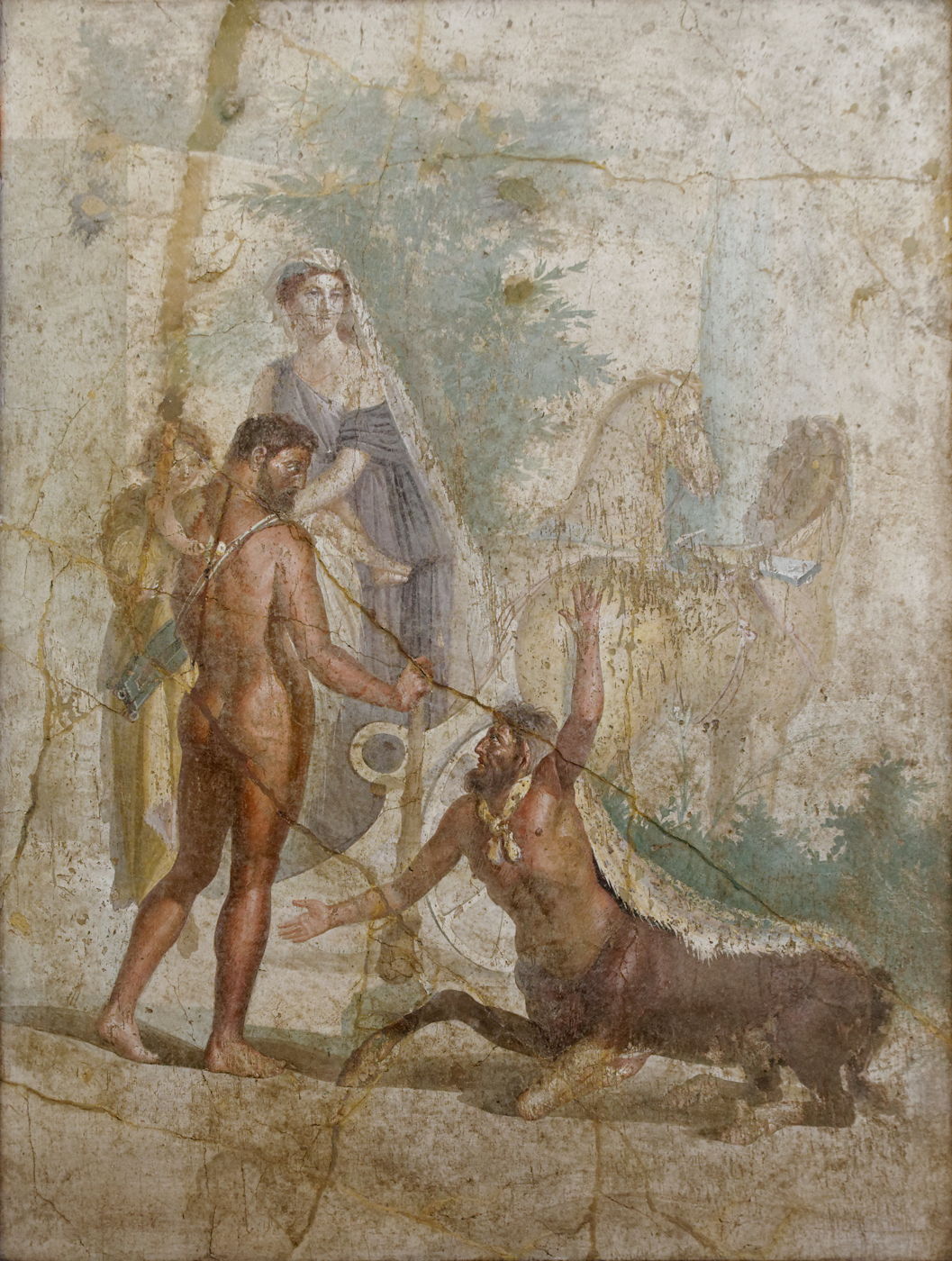
Unknown artist, Hercules carrying his son Hyllus looks at the centaur Nessus, who is about to carry Deianeira across the river on his back (c 50 CE), fresco, 152 x 124 cm, Museo Archeologico Nazionale di Napoli, Naples, Italy. Wikimedia Commons.

This story is shown on several Greek pots, and this Roman fresco from around 50 CE. Although an interesting painting, it seems to show a variant to the story involving Hercules’ son Hyllus and a chariot. The artist has also chosen to show the group before Nessus carries Deianeira across the river, thus before the attempted abduction, a puzzling choice.

anonherculesdeianeiranessus
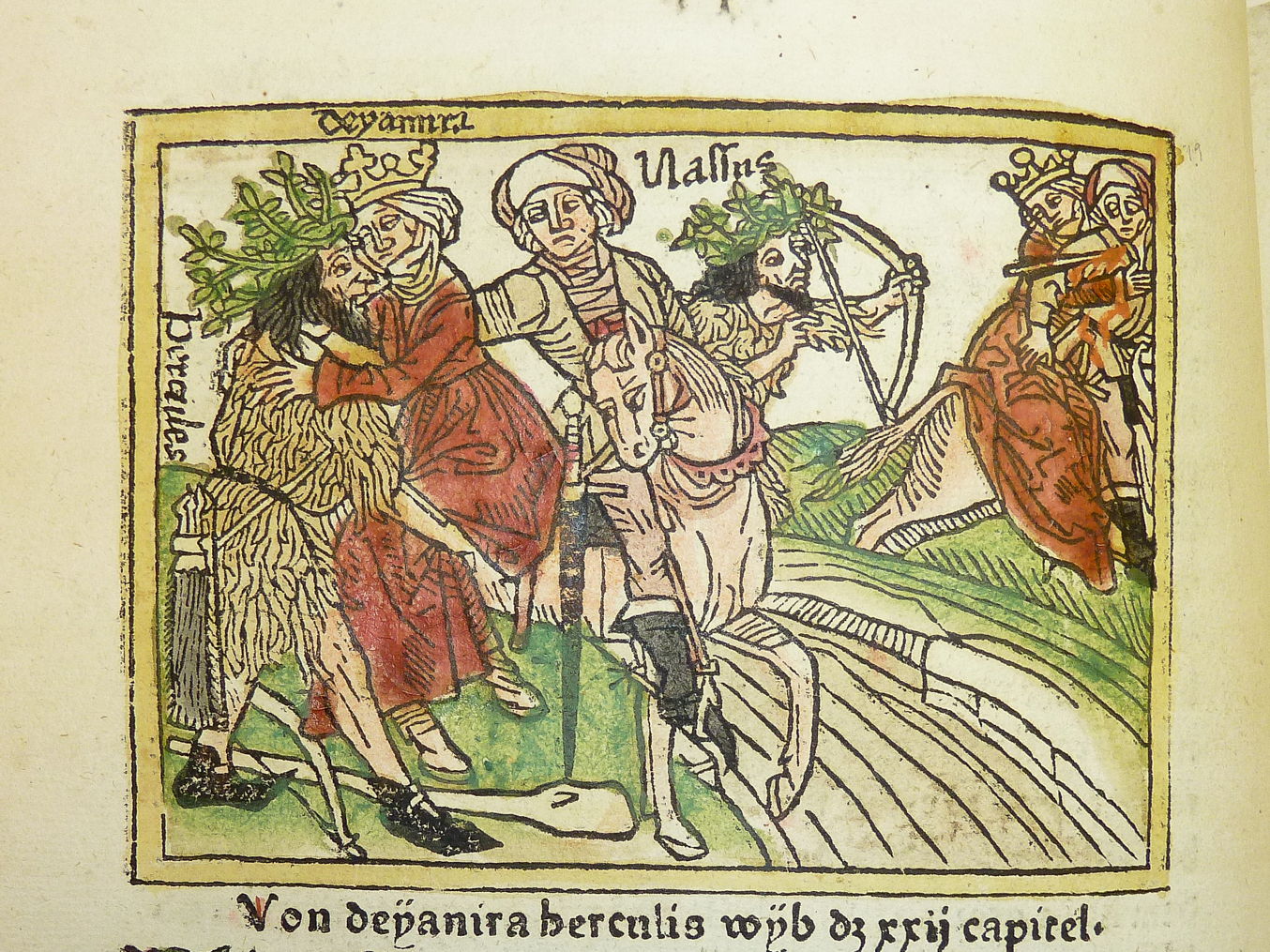
Unknown artist, Hercules, Deianira and Nessus (c 1474), hand-coloured woodcut print from German translation by Heinrich Steinhöwel of Giovanni Boccaccio’s ‘De mulieribus claris’, printed by Johannes Zainer, Ulm. Penn Libraries, Philadelphia, PA. Wikimedia Commons.

This wonderful woodcut from around 1474 may not have quite grasped what a centaur is, but includes two complete copies of the protagonists in its single frame. Hercules is first seen placing Deianeira onto a horse, then Hercules has shot the horseman. In trying to squeeze these two instants into the image, it runs out of space at the right.

pollaioloherculesdeianeira
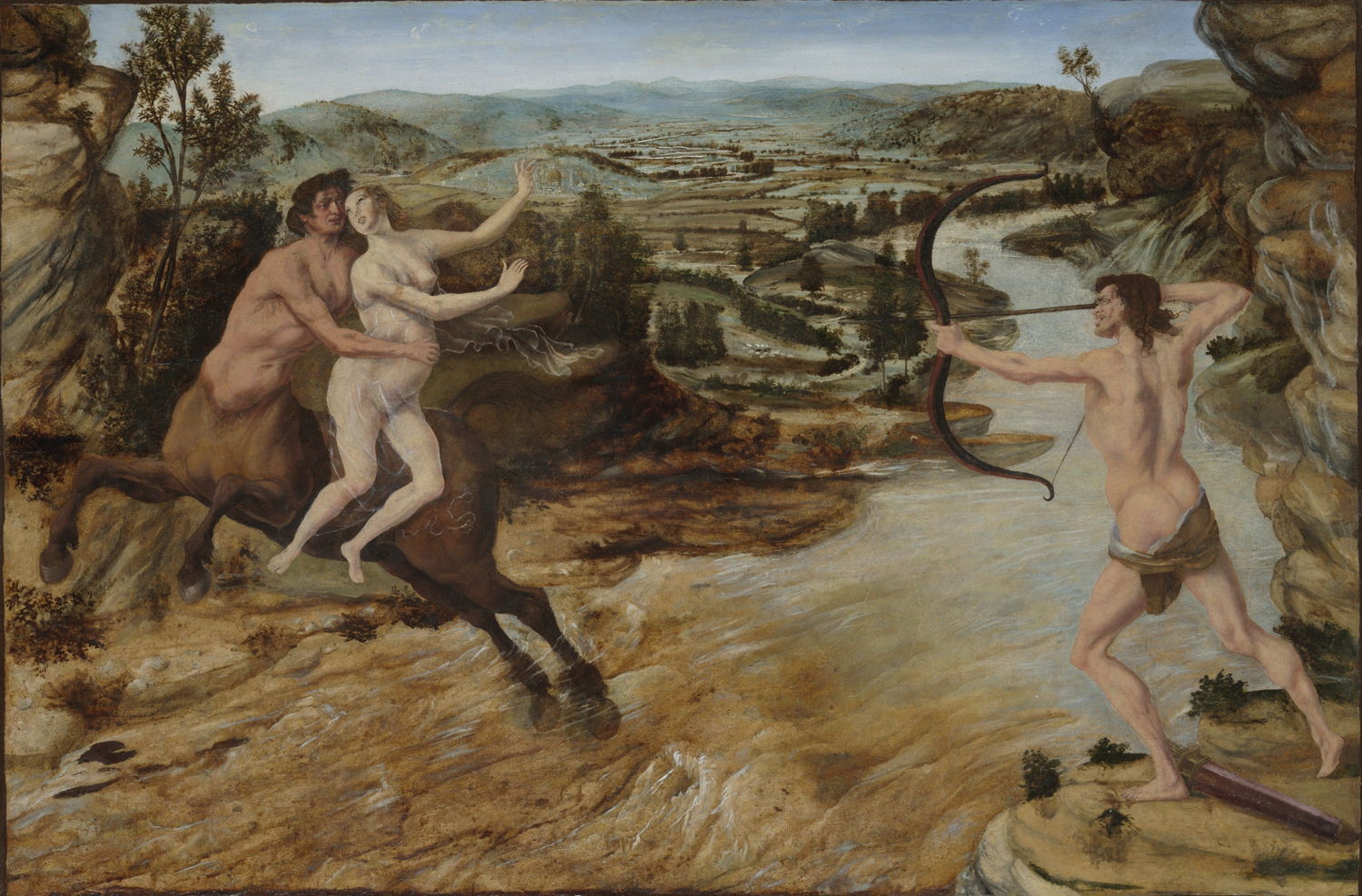
Antonio del Pollaiolo (1431–1498), Hercules and Deianira (c 1475–80), oil on panel transferred to canvas, 54.6 × 79.2 cm, Yale University Art Gallery, New Haven, CT. Wikimedia Commons.

Antonio del Pollaiolo’s painting from about 1475–80 tries a side-on view, requiring Nessus to be shot while still in the river, a slight adjustment to the original story. Deianeira appears precariously balanced, and must be grateful that Nessus’ muscular arms save her from being dropped into the river below. The artist also leaves it to the viewer to know that Hercules’ poisoned arrow strikes Nessus rather than Deianeira.

sprangerherculesdeianiranessus
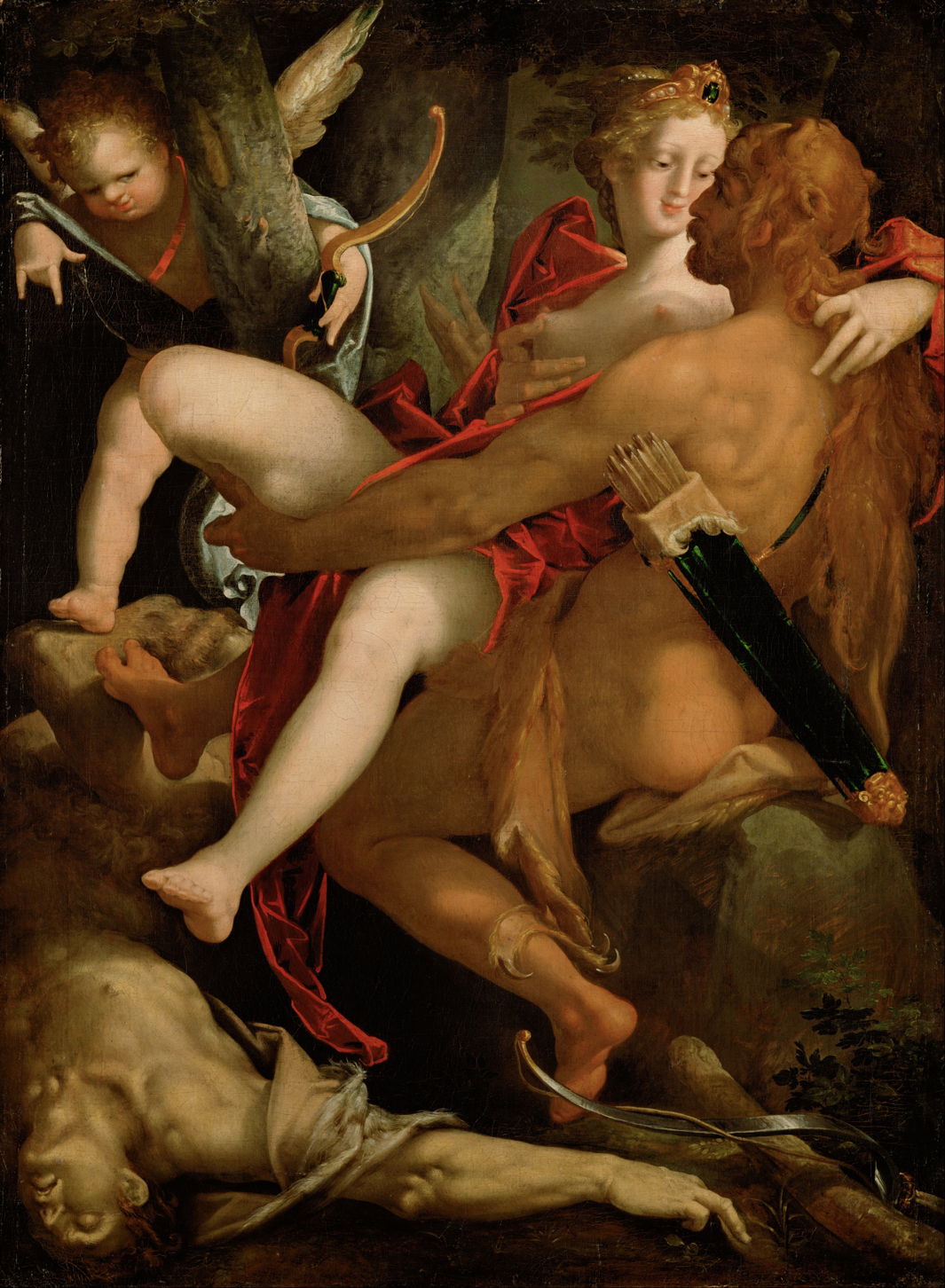
Bartholomeus Spranger (1546–1611), Hercules, Deianeira and the Centaur Nessus (1580-82), oil on canvas, 112 x 82 cm, Kunsthistorisches Museum, Vienna, Austria. Wikimedia Commons.

In about 1580, Bartholomeus Spranger painted one of the few accounts timed after the death of Nessus. Hercules has caught his wife up in his arms, and a winged Cupid looks a little puzzled from the top left, as if wondering how his arrow could have killed the centaur. The sequel story, relying on Nessus’ blood, appears to have been lost in the joy of reunion, leaving the viewer confused as to how this matches the literary narrative.

veroneseherculesdeianeiranessus
Paolo Veronese (1528–1588), Hercules, Deianira and the Centaur Nessus (c 1586), oil on canvas, 68.4 × 53.4 cm, Kunsthistorisches Museum, Vienna, Austria. Wikimedia Commons.

Paolo Veronese’s painting from about 1586 elects for a much earlier moment, as Hercules is readying his bow and arrow, with Nessus just reaching the opposite bank. He also shows the scene from Hercules’ position, but discovers the problems with that point of view: Nessus and Deianeira are now small, and Nessus is looking away (and his chest concealed), and even Hercules’ face is turned from the viewer.

renirapeofdeianira
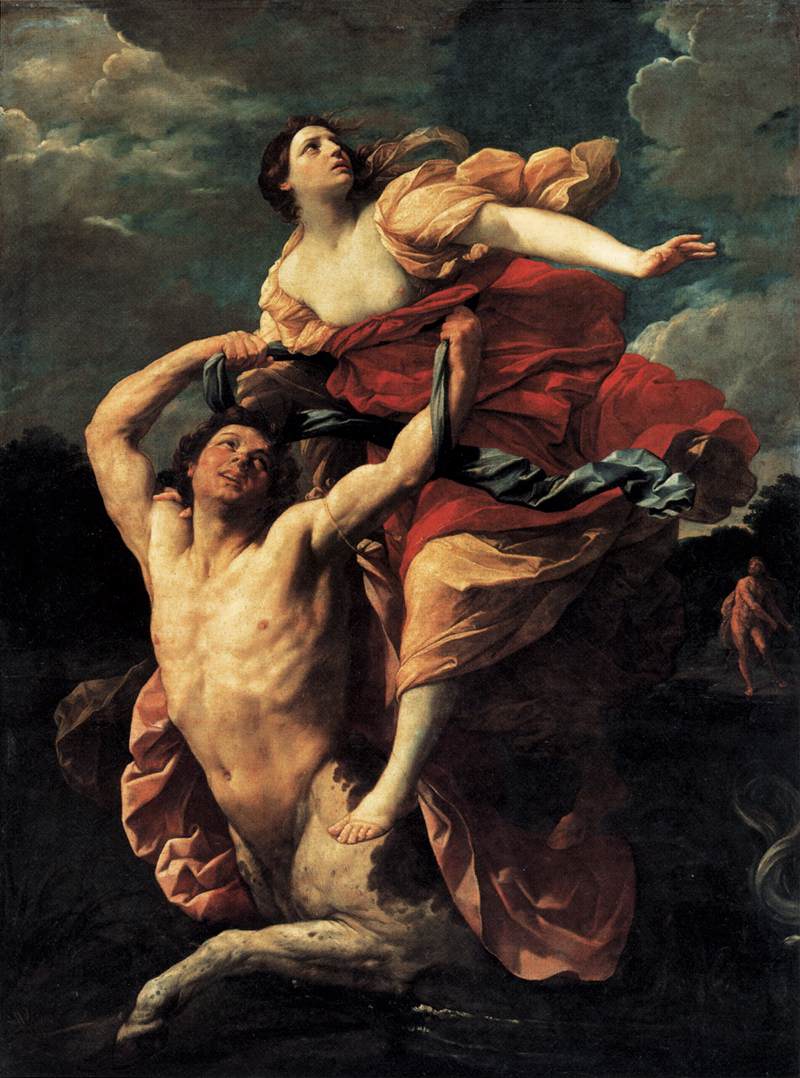
Guido Reni (1575–1642), The Abduction of Deianeira (1617-21), oil on canvas, 239 x 193 cm, Musée du Louvre, Paris. Wikimedia Commons.

Guido Reni’s masterly painting from around 1620, one of the finest of its period in the Louvre, almost fills the canvas with Nessus, who looks worryingly heroic, and Deianeira, who seems to be flying. The small figure of Hercules in the distance is well-lit, but loses the details of bow and arrow. In any case, the arrow could hardly strike Nessus in the chest.

rubenscentaur
Peter Paul Rubens (1577–1640) (workshop of), The Abduction of Deianeira by the Centaur Nessus (c 1640), media not known, dimensions not known, Niedersächsisches Landesmuseum Hannover, Hanover, Germany. Wikimedia Commons.

This painting is almost certainly not the work of Peter Paul Rubens, but was probably painted in his workshop around the time of Rubens’ death, in 1640. Like Veronese, the artist adopts the point of view from the bank on which Hercules is poised to shoot his arrow into Nessus. By turning the centaur round, to run across the width of the canvas, his face and chest are well exposed, and Hercules’ target is feasible. Even Deianeira appears more comfortable with the force of gravity.

They have added a winged Cupid, to make clear Nessus’ intentions, and Deianeira’s facial expression is marvellously clear in intent. The additional couple, in the right foreground, might be intended to be a river god and naiad, who would be superfluous apart from their role in achieving compositional balance.

coypelherculesdeianeira
Noël Coypel (1628-1707), Hercules and Deianeira (date not known), media and dimensions not known, Musée de Versailles, Versailles, France. Wikimedia Commons.

Noël Coypel’s painting from around 1680 includes more narrative elements than others, but in doing so I fear becomes confusing to read. Nessus has been struck, is bleeding, and holding out some cloth that is slightly blood-stained. An arrow lies on the ground in front of him, but none in his chest. Deianeira is still on his back, although his legs have buckled under him, and he looks distressed. Approaching them with a heavy club in his right hand is Hercules, perhaps coming to finish the centaur off.

To those Coypel adds three winged putti, who seem to be pointing out those clues to the story, and behind them is a river god, and another couple of figures, watching but not apparently part of this story.

ricciherculesnessus
Sebastiano Ricci (1659–1734), Hercules Fighting with the Centaur Nessus (1706-7), fresco, dimensions not known, Palazzo Marucelli-Fenzi, Florence. Wikimedia Commons.

In about 1706, Sebastiano Ricci embroidered the story further, showing Hercules, his left hand grasping Nessus’ mouth, about to club the centaur to death, while a slightly bedraggled Deianeira watches in the background. There is no arrow in Nessus’ chest, and Hercules’ quiver is trapped under Nessus’ right foreleg. Three other figures of uncertain roles are at the right, and a winged putto hovers overhead, covering its eyes with its right hand.

dizianirapeofdeianiera
Gaspare Diziani (1689–1767), The Rape of Deianeira (date not known), oil on canvas, 62 x 74 cm, location not known. Wikimedia Commons.

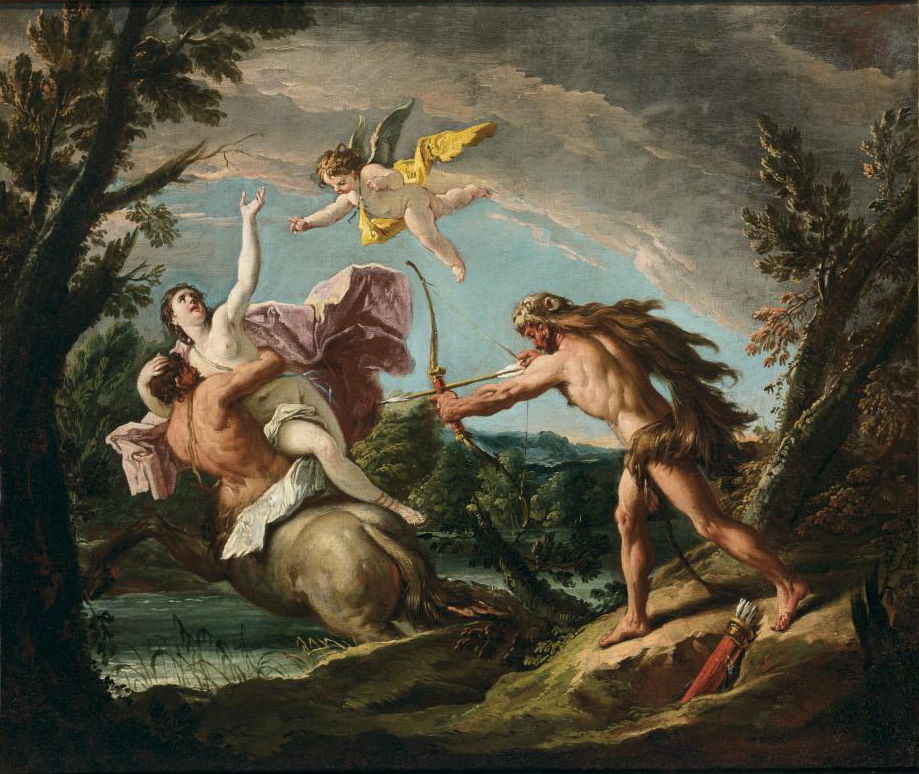
Although Gaspare Diziani returned to the original story in his painting of about 1730, he fell foul of the same compositional problems as in earlier works. Nessus is making off with Deianeira as he is crossing the river. He clutches the woman in his arms, which at least allows us to see her face, and the hand calling for assistance, but his face and chest are almost occluded.

Hercules has to stand so close as to almost be able to touch him, so it is feasible for his arrow, when loosed, to enter the right side of the centaur’s chest, under the armpit. Hercules is looking down at his feet, although drawing back ready to shoot Nessus. Above them an incongruous winged putto forms the apex of a triangle with the other figures. Where will Hercules’ arrow strike?

lagreneeabductiondeianeira
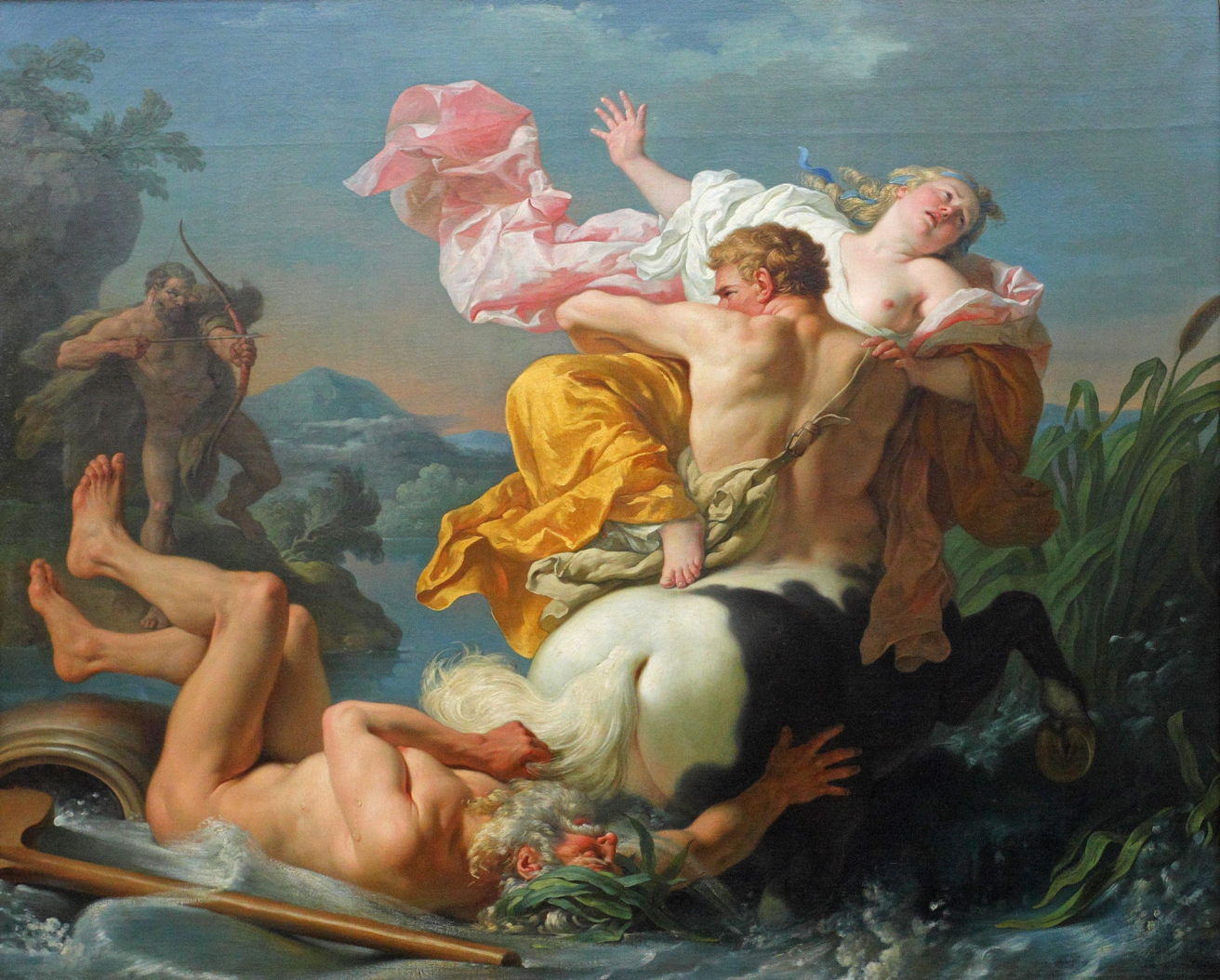
Louis-Jean-François Lagrenée (1724–1805), The Abduction of Deianeira by the Centaur Nessus (1755), oil on canvas, 157 × 185 cm, Musée du Louvre, Paris. Wikimedia Commons.

In 1755 Louis-Jean-François Lagrenée clearly understood the compositional problem. His solution is unfortunately no better, despite his beautiful painting. Nessus, bearing a distressed Deianeira in his arms, has just reached the opposite bank, in the foreground. Hercules is on the left in the distance, and we can at least see his face, bow and arrow. Unlike Reni, he has not lit Hercules to best effect, and there appears to be no way that Hercules’ arrow could impale Nessus’ chest, without first passing through some of the abundant Deianeira. He also adds a river god, who seems to have been knocked over in Nessus’ haste to make off with his captive.

moreauabductionofdeianira
Gustave Moreau (1826–1898), Enlèvement de Déjanire (Abduction of Deianeira) (c 1860), pen and brown ink wash on pencil on paper, 22.6 × 15.6 cm, Musée National Gustave-Moreau, Paris. Wikimedia Commons.

Gustave Moreau’s final drawing of about 1860, squared up and ready to transfer to canvas for painting, alters the story to make its composition feasible. He puts Nessus in the foreground, with the attendant risk of making him appear the hero, somehow supporting the upstretched body of Deianeira. In the right distance, Hercules has already loosed the fatal arrow, which is prominently embedded not the front of Nessus’ chest, but his back. The centaur’s legs have collapsed under him, and his head and neck are stretched up in the agony of death.

moreauautumn
Gustave Moreau (1826–1898), Autumn (Deianeira) (1872), oil on panel, dimensions not known, J. Paul Getty Museum, Los Angeles, CA. Wikimedia Commons.

Moreau’s eventual painting of Nessus and Deianeira, in 1872, was titled Autumn (Deianeira), and quite different from that drawing. Deianeira and Nessus are in very similar postures, although reversed onto the opposite bank of the river, with Nessus still very much alive, and Deianeira apparently in a trance-like state. Hercules may be lurking in the dense wood around them, but for the moment I cannot see him.

39-16-05/57
Arnold Böcklin (1827–1901), Nessus and Deianira (1898), oil on panel, 104 x 150 cm, Museum Pfalzgalerie Kaiserslautern, Kaiserslautern, Germany.

My last example is also the most puzzling: Arnold Böcklin’s painting from 1898. Nessus is far from part-human, and Deianeira not the beauty that she was claimed to be. As those two wrestle grimly, Hercules has stolen up behind them, and is busy pushing a spear into Nessus’ bulging belly. Blood pours from the wound, but Deianeira seems to be in no position to collect it.

❌