When Matteo Messina Denaro died in 2023, many of his secrets died with him. That began to change with a tip about a wealthy Sicilian woman’s significant assets in a tiny European principality.
Many of the great buildings, their friezes and statues of classical times, and in the Middle Ages, were painted, a practice known as polychrome. This article looks at some more modern examples made by those who also painted flat surfaces.
Lawrence Alma-Tadema (1836–1912), Phidias Showing the Frieze of the Parthenon to his Friends (1868), oil on canvas, 72 × 110.5 cm, Birmingham Museum and Art Gallery, Birmingham, England. Wikimedia Commons.
Lawrence Alma-Tadema’s beautiful painting of Phidias Showing the Frieze of the Parthenon to his Friends from 1868 shows a group including Pericles (at the right), Aspasia, Alcibiades and Socrates, admiring this famous frieze in the glory of its original colours.
Master of the Biberach Holy Kinship (fl. 1520), Workshop of, The Last Judgement (c 1520), polychrome predella on limewood, 55 x 172 cm, Musée des Beaux-Arts, Lyon, France. Wikimedia Commons.
This magnificent polychrome limewood sculpture shows The Last Judgement (c 1520) as an outbreak of plague, and may be based on descriptions of the Black Death.
Much of the output from the workshops of Spanish painters during the seventeenth century wasn’t two-dimensional painting, but polychrome wood carvings destined for religious use.
Juan de Mesa (1583–1627), The Immaculate Conception (c 1610-15), polychrome wood carving, dimensions not known, Matthiesen Gallery, London. Wikimedia Commons.
Juan de Mesa (1583–1627) was a Cordoban sculptor who trained and worked in Seville from 1606 to his death there in 1627. He was responsible for many of the processional effigies which were – and some still are – featured in the celebrations of Holy Week in Seville. The Immaculate Conception is a fine example of his work from about 1610-15.
Many painters have also sculpted, but one specialised in polychrome figures, Jean-Léon Gérôme. Not only that, but he made paintings of him working on his sculptures, and of polychrome sculptures more generally.
Jean-Léon Gérôme (1824–1904), The End of the Pose (1886), oil on canvas, 48.3 x 40.6 cm, Private collection. Wikimedia Commons.
Gérôme’s The End of the Pose (1886) is the first of a series of unusual compound paintings, which are at once self-portraits of Gérôme as a sculptor, studies in the relationship between a model and their sculpted double, and forays into issues of what is seen, visual revelation, and truth.
Here, while Gérôme cleans up, his model is seen covering up her sculpted double with sheets, as she remains completely naked. Apart from various diversionary entertainments, including a couple of stuffed birds and a model boat, there is a single red rose on the wooden platform on which the model and statue stand.
It’s not far from here to the myth of the perfect sculptor, Pygmalion, whose creation was given life, turning statue into lover, which was Gérôme’s next step in 1890.
Jean-Léon Gérôme (1824–1904), Pygmalion and Galatea (c 1890), oil on canvas, 88.9 x 68.6 cm, Metropolitan Museum of Art, New York, NY. Wikimedia Commons.
Gérôme’s finished Pygmalion and Galatea (c 1890) just managed to stay on the right side of what in the day was deemed decent. His attention to detail is, as always, delightful, with two masks against the wall at the right, Cupid ready with his bow and arrow, an Aegis bearing the head of Medusa, and a couple of statues about looking and seeing.
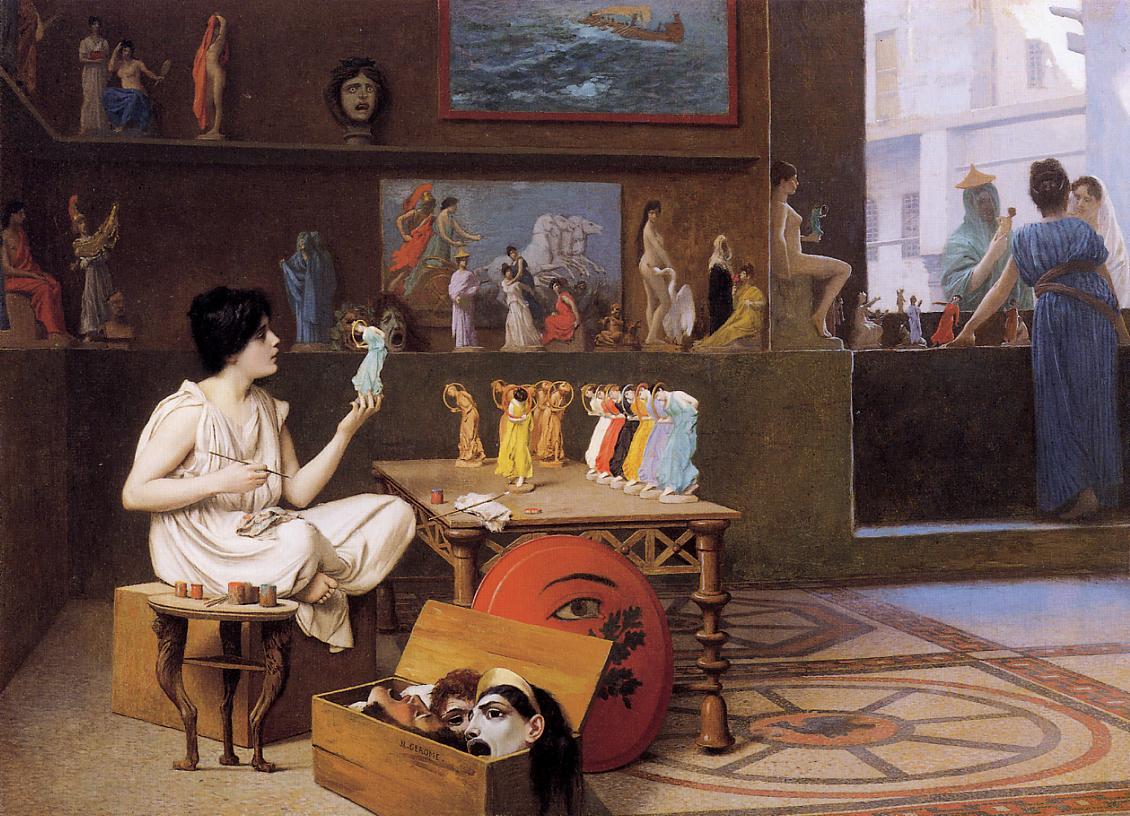
Jean-Léon Gérôme (1824–1904), Sculpturae Vitam Insufflat Pictura (Painting Breathes Life into Sculpture) (1893), oil on canvas, 50.2 x 69.2 cm, Art Gallery of Ontario, Toronto. Wikimedia Commons.
In 1874, archaeologists discovered large numbers of polychrome cast terracotta figurines in the Boeotian town of Tanagra. These dated from Greek civilisations active there during the late fourth century BCE, and their quantity and quality impressed many, including Gérôme.
Having painted the story of Pygmalion and Galatea in 1890, Gérôme moved on to two works in which he built imaginary worlds around the Tanagra figurines. Sculpturae Vitam Insufflat Pictura (Painting Breathes Life into Sculpture) (1893) combines his own love of polychrome sculpture with a celebration of those archaeological discoveries.
In doing so, Gérôme progresses his long-running theme of visual revelation and truth, with these painted miniature humans, mimicking reality, and the wooden box of masks in the foreground. Several of the figurines refer to his own painting and sculpture.
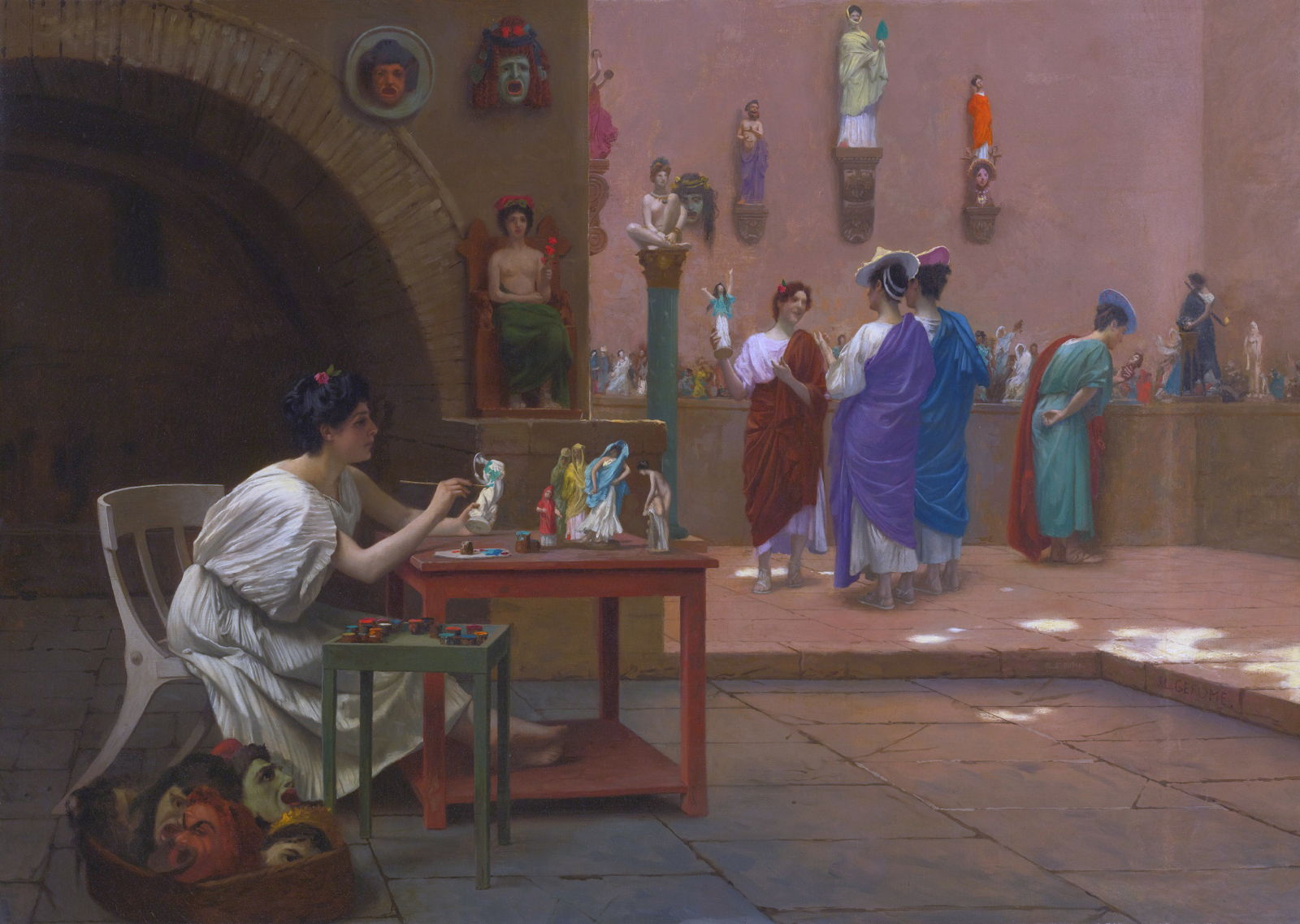
Jean-Léon Gérôme (1824–1904), Atelier of Tanagra (1893), oil on canvas, 65.1 x 91.1 cm, Private collection. Wikimedia Commons.
As a painting, I don’t think that his Atelier of Tanagra (1893) is as effective and convincing as the previous work, but its wider range of figurines gives deeper insight into what Gérôme was thinking about. Several of the figurines shown here are his own polychrome sculptures, most obviously that of the naked woman sitting on the top of a blue pillar, in the centreline of the painting.
Jean-Léon Gérôme (1824–1904), The Artist’s Model (1895), oil on canvas, 50.8 x 39.6 cm, Dahesh Museum of Art, New York, NY. Wikimedia Commons.
In The Artist’s Model (1895), Gérôme paints himself at work on his marble figure Tanagra (1890), currently in the Musée d’Orsay, which he had already included among the figurines in his Sculpturae Vitam Insufflat Pictura. He thus painted himself making a sculpture which he had previously painted in a painting as a sculpture. Scattered in the image are reminders of gladiatoral armour and other props used for his paintings, one of his paintings of Pygmalion and Galatea, together with one of his polychrome sculptures of a woman with a hoop, at the right edge.
In 1894, Jean-Léon Gérôme started work on this polychrome marble head of the famous actor Sarah Bernhardt (1894-1901), which he completed in 1901. He bequeathed it to the French nation.
Jean-Léon Gérôme (1824–1904), Self-Portrait Painting The Ball Player (c 1902), oil on canvas, 61 x 50 cm, Musée Georges-Garret, Vesoul, France. The Athenaeum.
In about 1902 Gérôme returned to his series of paintings of himself as a sculptor. His Self-Portrait Painting The Ball Player is a fascinating variation of the traditional form of self-portrait, in that he is here applying the colour to one of his polychrome sculptures, a figure of a ball player, who closely resembles those seen earlier in his paintings of sculptures, including Pygmalion and Galatea.
Georges Lacombe was the sculptor among the Nabis, who painted Breton motifs and sculptures he created in wood.
Georges Lacombe (1868–1916), Isis (c 1895), mahogany wood sculpture, 111.5 x 62 cm, Musée d’Orsay, Paris. Wikimedia Commons.
Some of Lacombe’s sculptures are stunning: this wood carving in mahogany with added colour shows the goddess Isis, and was made in about 1895. It’s now in the Musée d’Orsay. Lacombe’s symbolism here may refer to the role of this Egyptian goddess in producing and protecting the heir to Osiris, Horus.
Few accounts of painting in the last decades of the nineteenth century consider the importance of photography at the time. Yet photography was enjoying remarkable technical advances: in 1884, George Eastman started replacing glass plates with light-sensitive film, and four years later he launched the first Kodak camera, the predecessor of the Kodak Brownie that was to follow in 1901. As Naturalist painting was taking the Salon by storm, its rival was becoming more widely available, and no longer required a private chemistry lab.
First responses to photography by painters were often hostile.
Philipp Sporrer (1829-1899), The Photo (1870), oil on canvas, 81.5 x 63.5 cm, location not known. Wikimedia Commons.
Philipp Sporrer’s The Photo (1870) is probably the most pointed painted propaganda. The young photographer is not the sort of man you would leave your wife or daughter with. He’s down at heel, unkempt, and his straw hat is abominably tatty. His studio is poorly-lit, probably an old shed, its floor littered with rubbish, and its window broken. His subject is manifestly poor and uncouth, sitting in ill-fitting clothes and picking his nose as he waits for the photographer to fiddle with his equipment.
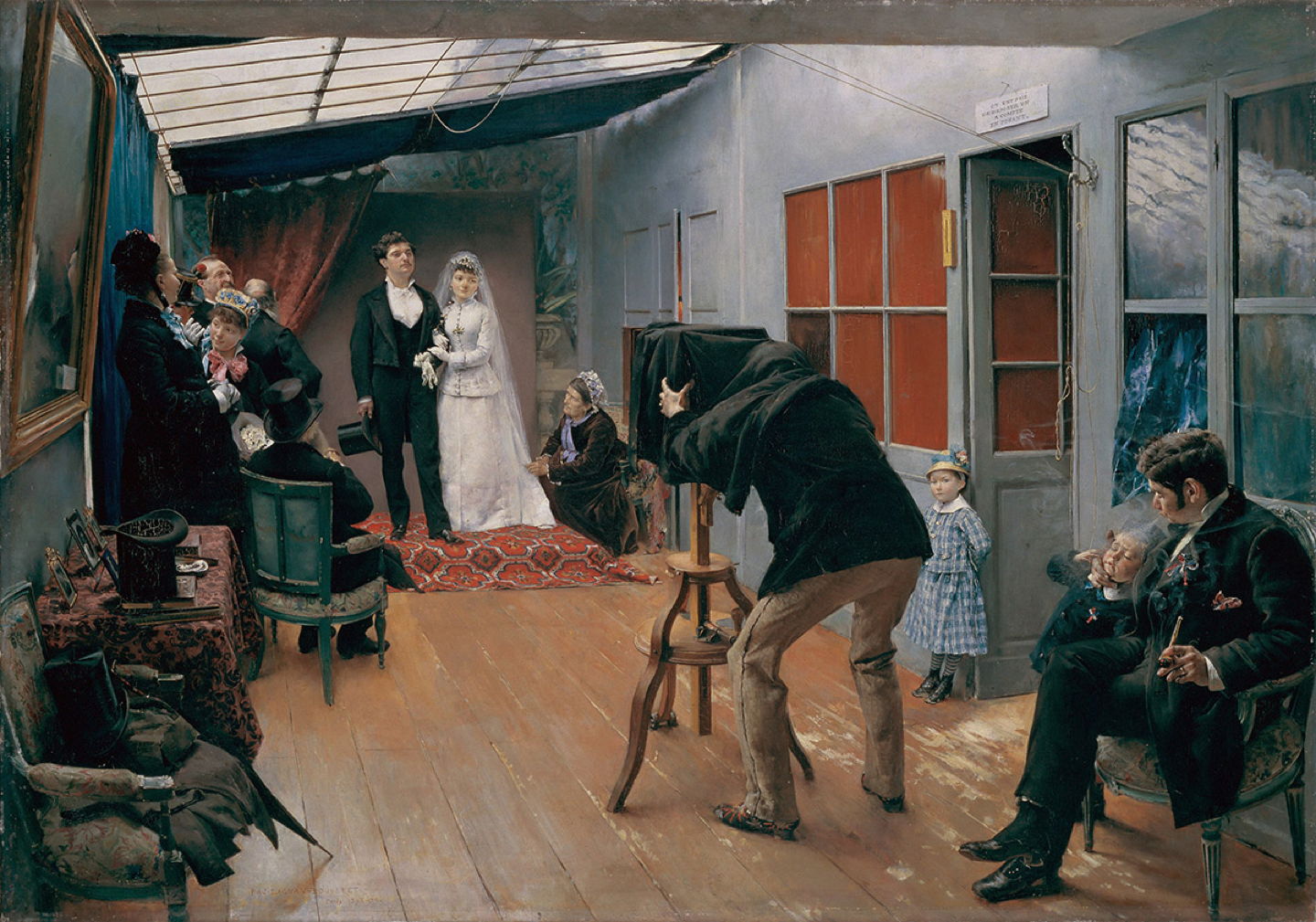
Pascal Dagnan-Bouveret (1852–1929), Une noce chez le photographe (A Wedding at the Photographer’s) (1879), oil on canvas, 120 x 81.9 cm, Musée des Beaux-Arts, Lyon, France. Wikimedia Commons.
Pascal Dagnan-Bouveret’s A Wedding at the Photographer’s (1879) seems more calculated. Hugely successful at the Salon, this artist saw no threat from wedding photography, a market in which there was no competition between painting and photography. But he still takes the opportunity to show the photographer and his studio as being tatty and tawdry.
Gradually, painting started to become influenced by the nascent art of photography, most obviously in the use of views through the lens of a camera.
Gustave Caillebotte (1848–1894), Les Raboteurs de parquet (The Floor Scrapers) (1875), oil on canvas, 102 x 147 cm, Musée d’Orsay, Paris. Wikimedia Commons.
Gustave Caillebotte’s major painting of 1875 shows three workmen preparing a wooden floor in the artist’s studio at 77 rue de Miromesnil. It’s thoroughly detailed, Realist, and despite its innovative view and unusual subject, it conformed to the highest standards of the Salon at the time.
Caillebotte was hurt and angry when he was informed that this painting had been rejected by the Salon jury. The grounds given seem extraordinary now: apparently the jury was shocked at this depiction of the working class at work, and not even fully-clothed. It was deemed to have a ‘vulgar subject matter’ unsuitable for the public to view. Or was it really because of his wide-angle photographic effect?
Gustave Caillebotte (1848–1894), Paris Street, Rainy Day (1877), oil on canvas, 212.2 x 276.2 cm, Art Institute of Chicago, Chicago, IL. Wikimedia Commons.
Caillebotte was one of the first established painters to experiment with photography, as demonstrated in another wide-angle view of Paris Street, Rainy Day from 1877.
Jules Bastien-Lepage (1848–1884), Les Foins (Haymakers) (1877), oil on canvas, 160 x 195 cm, Musée d’Orsay, Paris. Wikimedia Commons.
During his development of Naturalism, Jules Bastien-Lepage arrived at a compositional formula that achieved similar effects, as seen in his Haymakers or Hay making in the same year, with its high horizon and fine detail in the foreground. Together these also give the visual impression that the whole canvas is meticulously realist, although in fact much of its surface consists of visible brushstrokes and other more painterly forms.
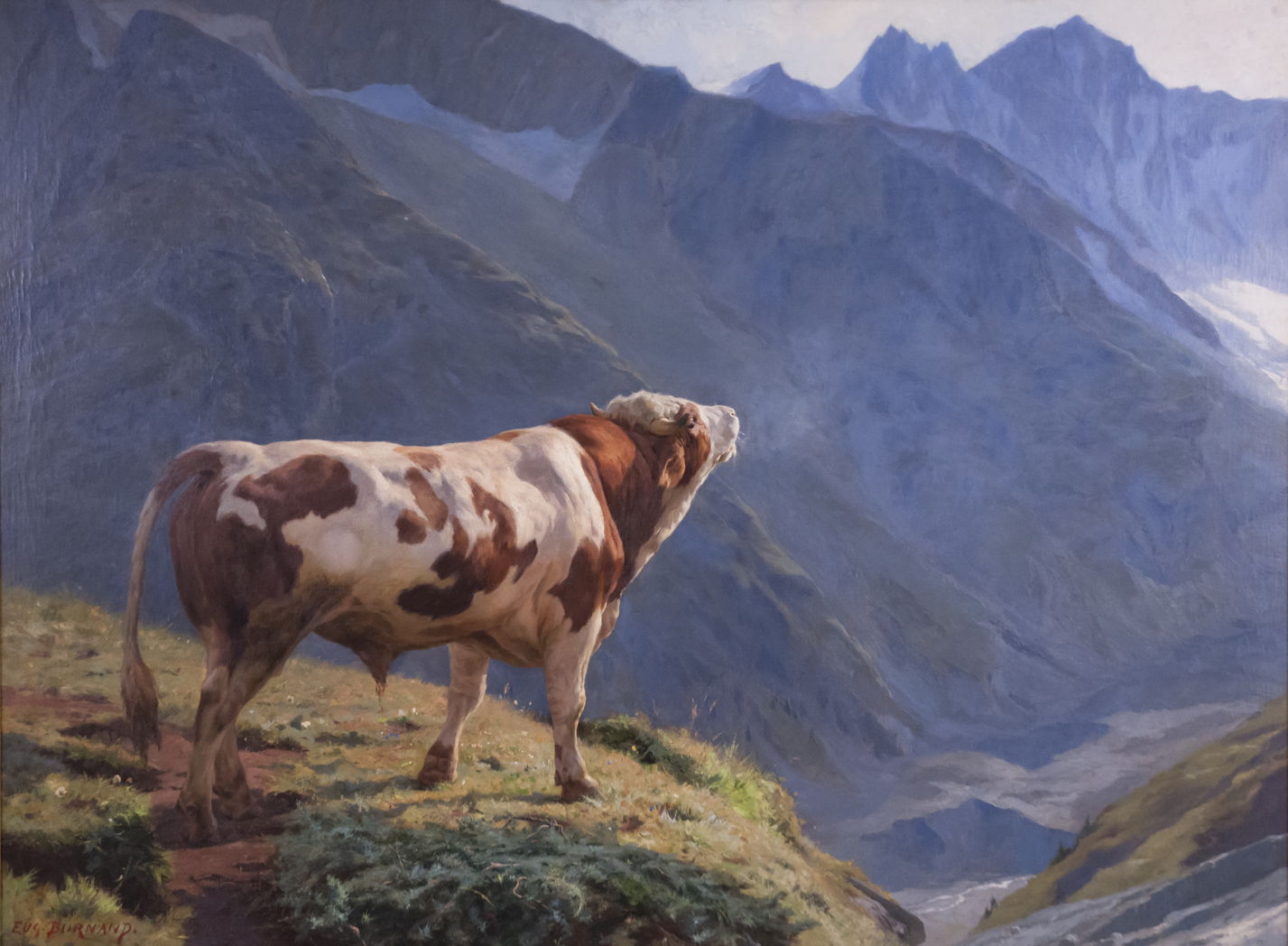
Eugène Burnand (1850–1921), Bull in the Alps (1884), oil, dimensions and location not known. Wikimedia Commons.
Eugène Burnand’s magnificent painting of Bull in the Alps from 1884 is fascinating for his use of both optical effects and extreme aerial perspective. Not only are there marked contrasts between the foreground and background in terms of chroma, hue and lightness, but Burnand has used defocussing in a photographic manner. The crisp edges of the bull stand proud of the softer edges and forms in the mountains behind. It’s worth noting that Burnand had been a pupil of Jean-Léon Gérôme.
Paul Louis Martin des Amoignes (1858–1925), In the Classroom (1886), oil on canvas, 68.5 × 110.5 cm, location not known. Wikimedia Commons.
Paul Louis Martin des Amoignes’ painted his wonderful In the Classroom two years later, in 1886. It bears unmistakeable evidence that it was either painted from photographs or strongly influenced by them. One boy, staring intently at the teacher in front of the class, is caught crisply, pencil poised in his hand. Beyond him the crowd of heads becomes more blurred.
By the 1890s, more painters were experimenting with photography.
Edgar Degas (1834–1917), Portrait of Henry Lerolle with two of his daughters, Yvonne and Christine and a mirror (1895-96), albumen print, 28 x 37 cm, Musée d’Orsay, Paris. Wikimedia Commons.
Among them was Edgar Degas. This is an albumen print of patron and amateur painter Henry Lerolle with two of his daughters, Yvonne and Christine, taken by Degas in 1895-96.
The realist painter Jean-Léon Gérôme not only experimented with photography for many years, but was an enthusiastic advocate for its recognition as an art in its own right.
Jean-Léon Gérôme (1824–1904), Truth Coming out of her Well to Shame Mankind (1896), oil on canvas, 91 x 72 cm, Musée Anne-de-Beaujeu, Moulins, France. Wikimedia Commons.
Gérôme’s Truth Coming out of her Well to Shame Mankind (1896) is based on a quotation attributed to Democritus, “Of a truth we know nothing, for truth is in a well” (or, more literally, ‘in an abyss’). Gérôme used the same allusion in his preface to Émile Bayard’s posthumous collection of collotype plates of photographs of nudes, Le Nu esthétique. L’Homme, la Femme, L’Enfant. Album de documents artistiques inédits d’après Nature, published in 1902, where he wrote: Photography is an art. It forces artists to discard their old routine and forget their old formulas. It has opened our eyes and forced us to see that which previously we have not seen; a great and inexpressible service for Art. It is thanks to photography that Truth has finally come out of her well. She will never go back.
The Naturalist painter Jules-Alexis Muenier became a photographer by the time he travelled to North Africa with Pascal Dagnan-Bouveret in 1888, armed with cameras.
Artist not known, Jules-Alexis Muenier painting ‘The Harpsichord Lesson’ (date not known), photograph, further details not known. Image by Rauzierd, via Wikimedia Commons.
Although I have been unable to find a suitable image of the painting, this photograph shows Muenier with his painting of The Harpsichord Lesson in about 1911, which became his most famous work during his lifetime. Muenier, Gérôme and Dagnan-Bouveret weren’t just happy snapper photographers, but believed in photography as fine art. All three were early members of local photographic clubs, and Muenier and Dagnan-Bouveret exhibited their photographs as seriously as their paintings.
A mask is a cover worn over part or all of the face. Covering the face more generally has been considered in this previous article. Here I’ll concentrate on masks that represent the face, and those used in the theatre, carnivals and masked balls.
Masks have been associated with acting and the theatre since ancient times, and can be seen as symbolic of drama and the stage.
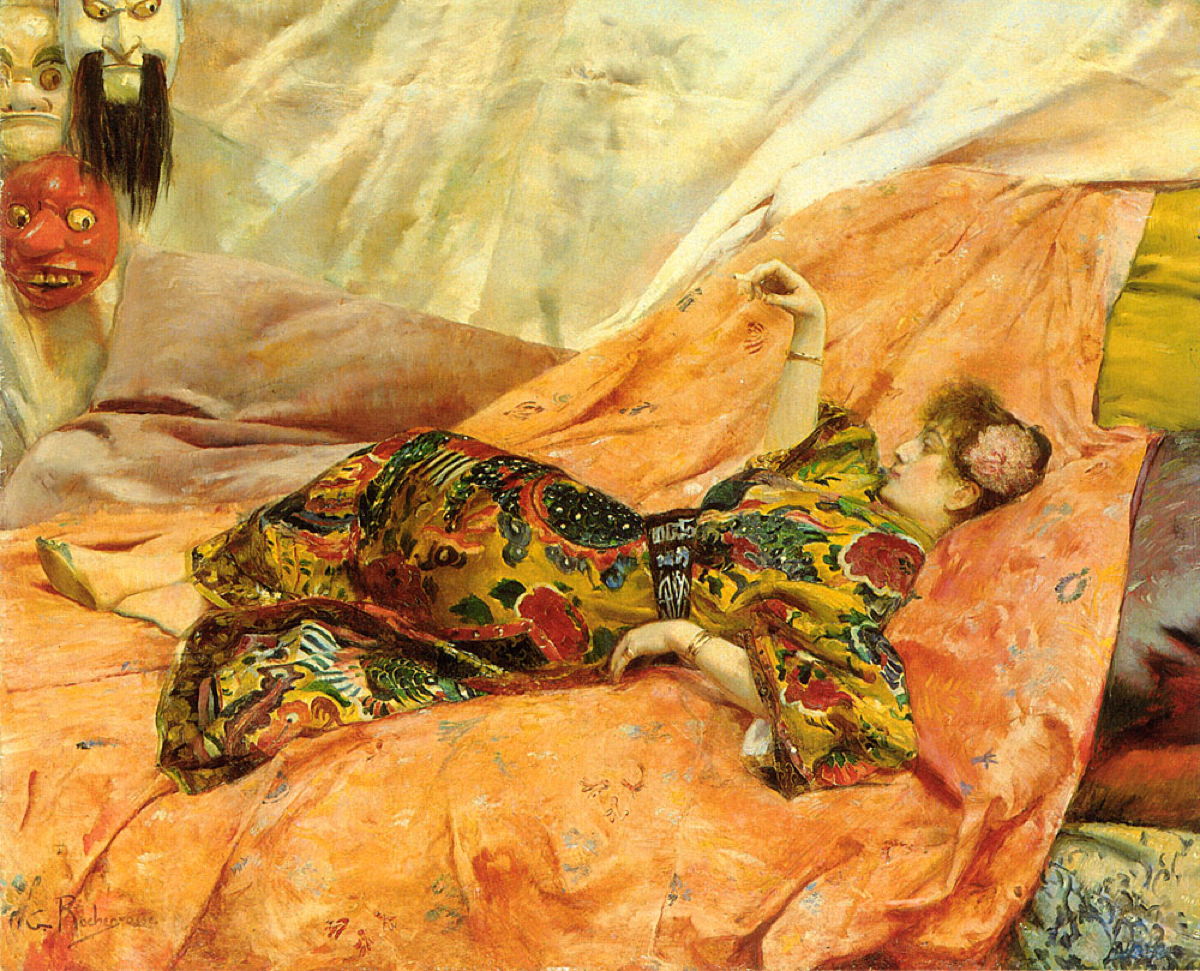
Georges Rochegrosse (1859–1938), Portrait of Sarah Bernhardt (c 1900), further details not known. Wikimedia Commons.
Georges Rochegrosse painted this Portrait of Sarah Bernhardt in about 1900, including three masks taken from Japanese Noh theatre at the left edge. Bernhardt was one of the most famous actresses of this period.
Some of the most remarkable archaeological discoveries of the late nineteenth century were unearthed at Tanagra in Greece around 1874, and included numerous painted terracotta figurines that Jean-Léon Gérôme featured in several of his paintings.
Jean-Léon Gérôme (1824–1904), Sculpturae Vitam Insufflat Pictura (Painting Breathes Life into Sculpture (1893), oil on canvas, 50.2 x 69.2 cm, Art Gallery of Ontario, Toronto. Wikimedia Commons.
Sculpturae Vitam Insufflat Pictura (Painting Breathes Life into Sculpture) (1893) is a combination of a manifesto for Gérôme’s own polychrome sculpture, and a celebration of those discoveries at Tanagra. In addition to painted figurines, there’s a wooden box of masks in the foreground, and some on the shelves behind.
Jean-Léon Gérôme (1824–1904), Atelier of Tanagra (1893), oil on canvas, 65.1 x 91.1 cm, Private collection. Wikimedia Commons.
Gérôme’s Atelier of Tanagra from the same year includes a wider range of figurines and masks in a similar setting. These are typical of classical masks, where the face with mouth agape stands for tragedy, and the smiling face for comedy.
Jean-Léon Gérôme (1824–1904), The Artist’s Model (1895), oil on canvas, 50.8 x 39.6 cm, Dahesh Museum of Art, New York, NY. Wikimedia Commons.
If his painting of The Artist’s Model from 1895 is to be believed, Gérôme kept several masks as props in his own studio, where he’s working on full-size sculpture of his model Emma.
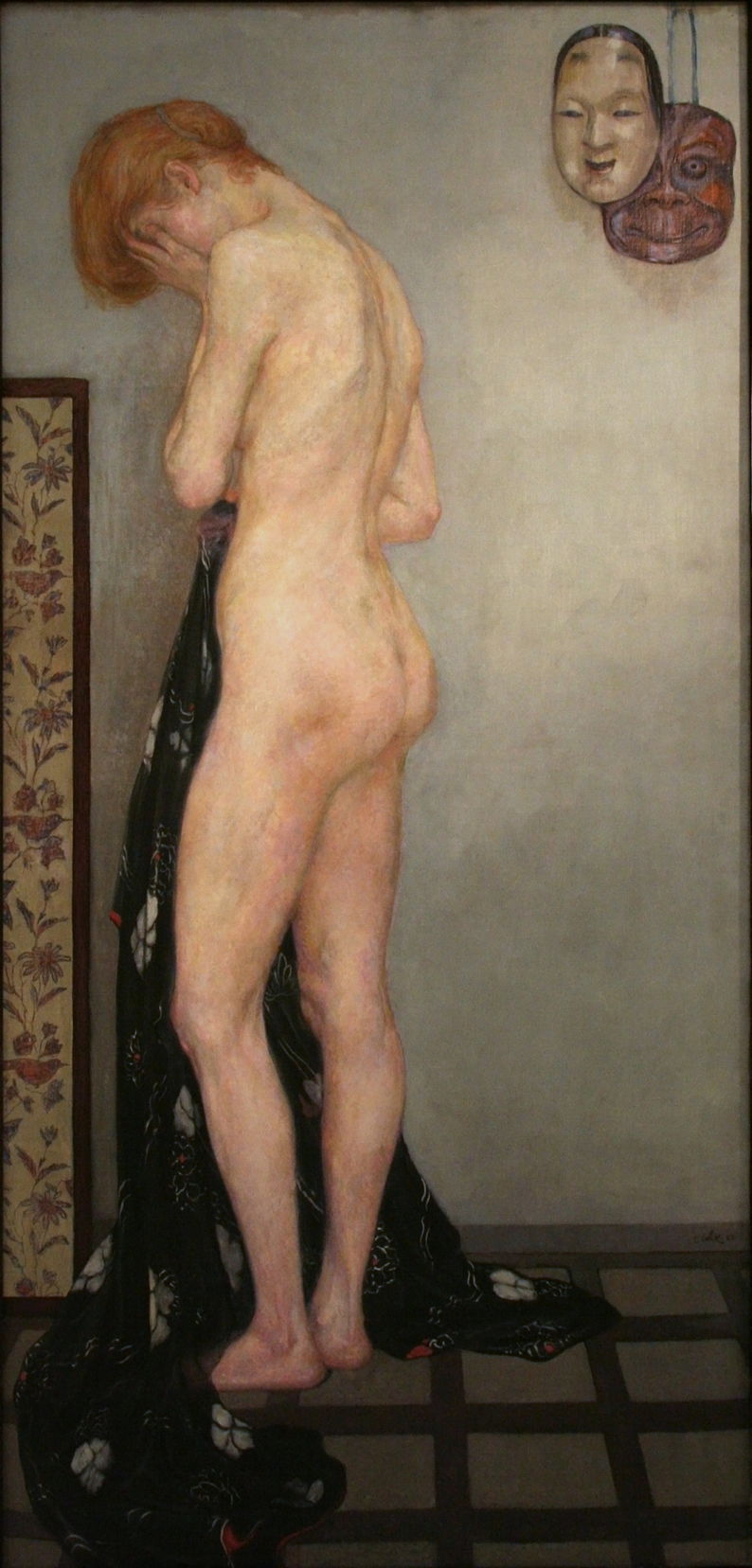
Emil Orlík (1870–1932), Model (1904), oil on canvas, 195 × 92 cm, Národní galerie v Praze, Prague, The Czech Republic. Image by Ophelia2, via Wikimedia Commons.
Emil Orlík painted this unusual Model in 1904. She appears to have become shy or distressed. Her gown, screen, floor and hanging masks are evidence of the artist’s Japonisme.
Masks worn for balls seldom covered the whole face, and their primary purpose has been to disguise identity, thus to encourage extra-marital relationships, even promiscuity.
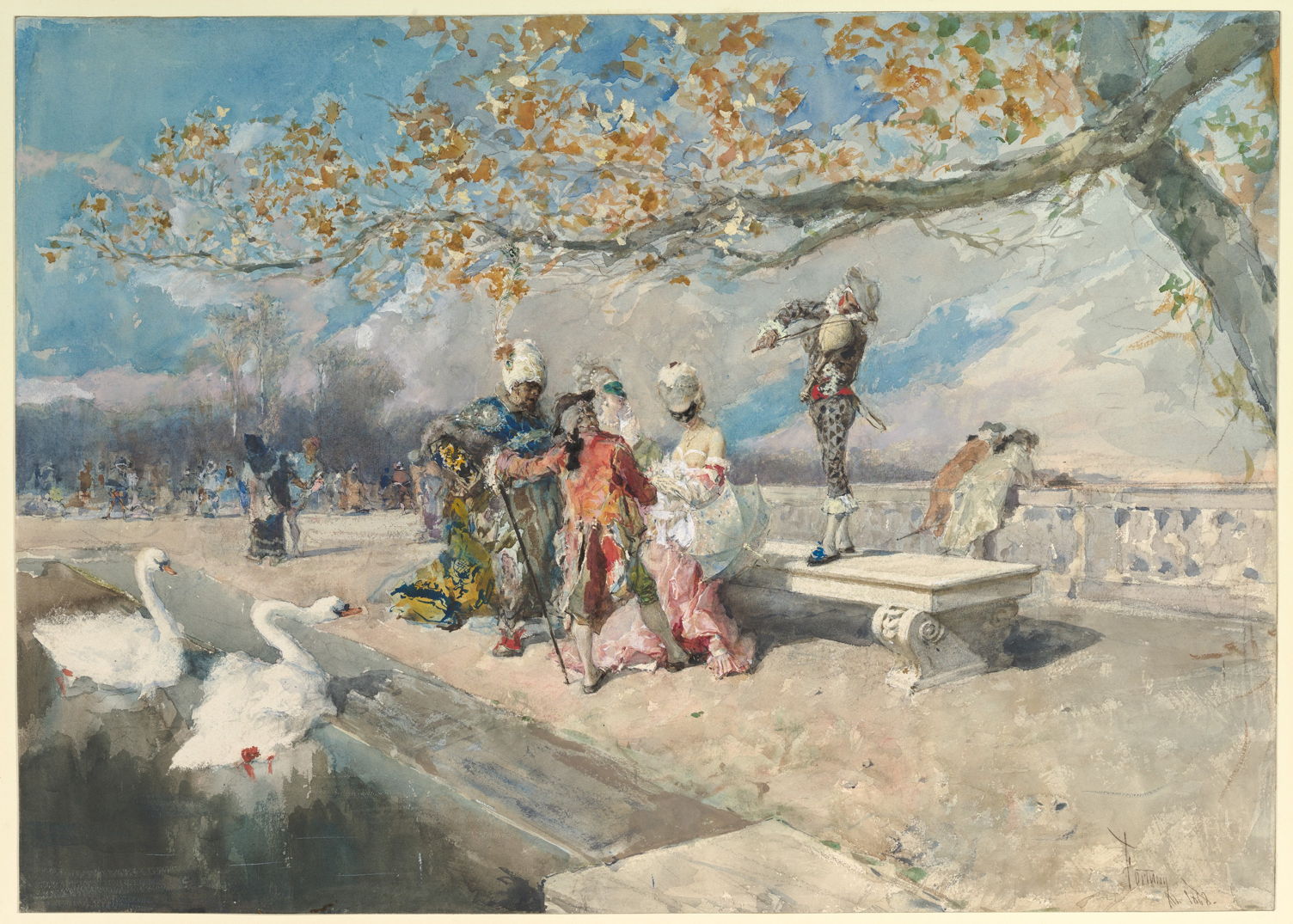
Marià Fortuny (1838–1874), Masquerade (1868), brush and watercolor and gouache over black graphite on off-white heavy paper, 44.9 x 62.9 cm, The Metropolitan Museum of Art (Bequest of Mary Livingston Willard, 1926), New York, NY. Wikimedia Commons.
Marià Fortuny’s Masquerade (1868) is a marvellously loose watercolour showing an open-air masked ball, presumably held in Italy in the autumn, which is arousing the interest or bemusement of two swans. Dress is liberal to say the least, with the masked woman in the centre baring her breasts and holding a parasol.
Lovis Corinth (1858–1925), The Witches (1897), oil on canvas, 94 × 120 cm, Private collection. Wikipedia Commons.
Despite its title, Lovis Corinth’s Witches (1897) isn’t a depiction of sensuous rites taking place in a coven. Instead the women are preparing a younger woman to attend a masked ball. Their subject has just got out of the wooden tub in the foreground, has been dried off, and is about to don the fine clothes laid over the chair at the left, including the black mask.
Fernand Pelez (1848-1913), La Vachalcade (The Cow-valcade) (1896), media and dimensions not known, Musée du Petit Palais, Paris. Wikimedia Commons.
Fernand Pelez’s La Vachalcade (The Cow-valcade) from 1896 shows young revellers taking part in a carnival procession, perhaps one of those in Montmartre at the time. Several are wearing full masks.
Once Gustave Moreau had recovered from the trauma of the Franco-Prussian War, he started on his next major works. He had been invited to join the select group of artists who were engaged to paint murals in major public buildings, but declined. Despite that, in 1875 he was made a member of the Legion of Honour, which pleased him and his mother deeply. All he needed now was another success at the Salon.
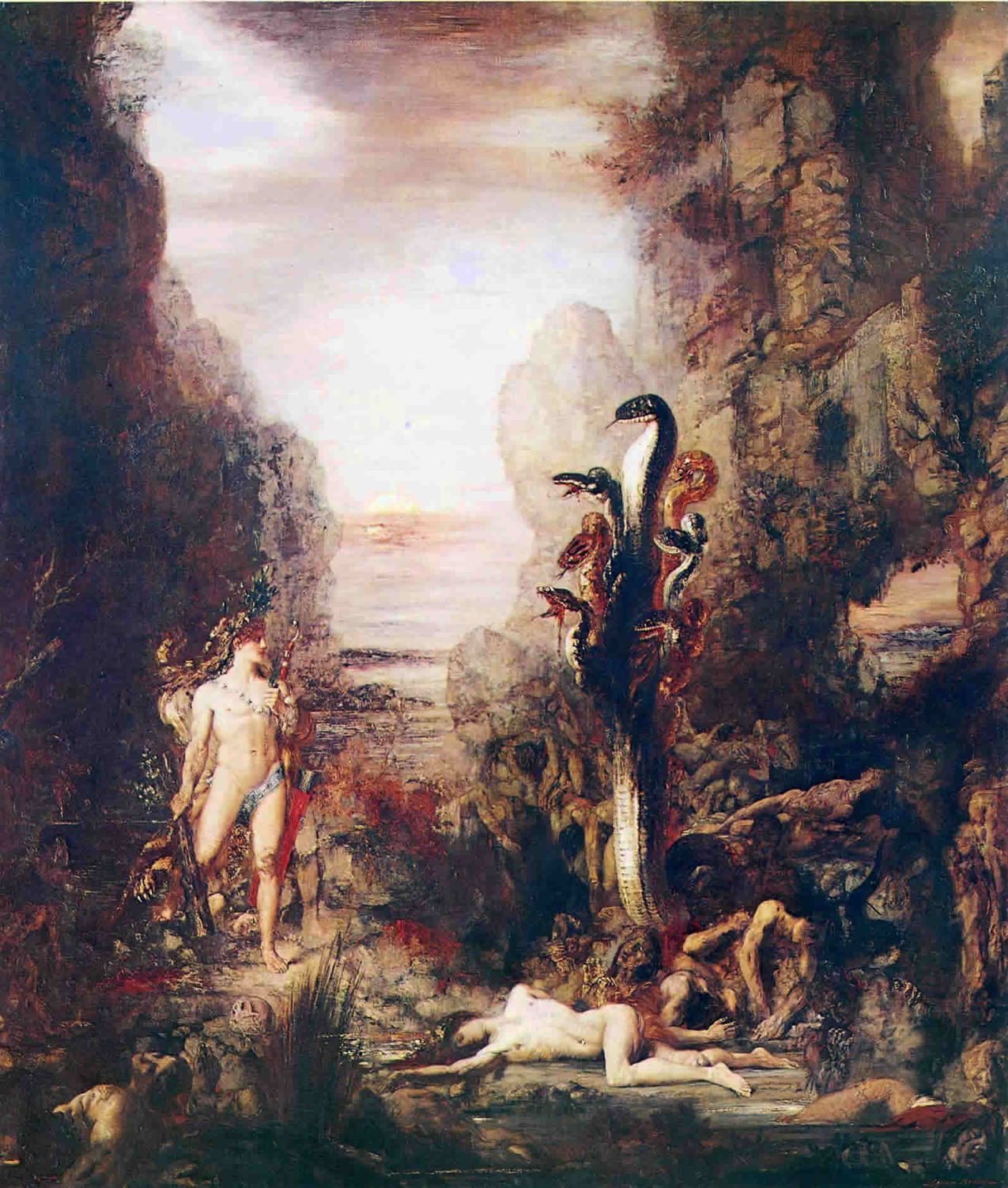
One of his four paintings exhibited at the Salon of 1876 told the second of Hercules’ twelve labours, his battle with the Lernean Hydra.
Gustave Moreau (1826–1898), Hercules and the Lernean Hydra (1876), oil on canvas, 175 × 153 cm, The Art Institute of Chicago, Chicago, IL. Wikimedia Commons.
The Hydra was a poisonous monster with the body of a dog and multiple serpent heads, whose breath alone could kill. According to surviving written accounts, Hercules covered his mouth and nose with a cloth for protection from the deadly fumes, fired flaming arrows into the Hydra’s lair to awaken it, then set about trying to kill it.
When he discovered that cutting off its heads with a sickle or sword only resulted in two more growing back, Hercules enlisted the help of his nephew Iolaus, who cauterised the wounds with a firebrand to prevent regrowth. Hercules then cut off the one immortal head using a golden sword given to him by Athena. He also took some of the Hydra’s blood, which was the poison used on the arrow with which he later killed Nessus.
Moreau puts his canvas into its portrait orientation to emphasise the Hydra towering over Hercules, who is fully armed, with club, bow and arrows, and more. The moment chosen is the initial confrontation, with Hercules staring steely-faced at the Hydra. This is consistent with Moreau’s aversion to a more theatrical treatment.
This was well-received and extensively debated, even generating a long-standing controversy over its possible political connotations. It was suggested at the time that the Hydra represented the forces of anarchy behind the insurgency of the Commune in 1871. Others preferred instead that the Hydra represented Bismarck and the German princes behind the Franco-Prussian War of 1870.
Two of his other paintings shown in 1876 were based on the story of Salome and the execution of Saint John the Baptist. Their underlying narrative is biblical, and straightforward. The unnamed daughter of Herodias (subsequently named as Salome) performed a dance at a birthday feast thrown by King Herod. The dance so pleased Herod that he offered her anything that she wanted, up to half his kingdom. She asked not for riches, but for the head of Saint John the Baptist, the earthly messenger sent to announce the birth and ministry of Jesus Christ. Reluctantly, Herod agreed, John was beheaded in prison, and his head brought to her on a plate; the dancer gave the head to her mother.
This has been a popular story for religious paintings, and by far the most common scene involves John’s head being brought on a plate, or variations around that. Moreau was clearly interested in other parts of the story, and in Salome herself. Moreau’s apparently sudden interest in Salome was sparked by the story, probably mythical, of a woman Communard known as the pétroleuse, who seemingly took delight in setting buildings alight. That suggests it wasn’t until the summer of 1871 that he started work on his paintings of Salome.
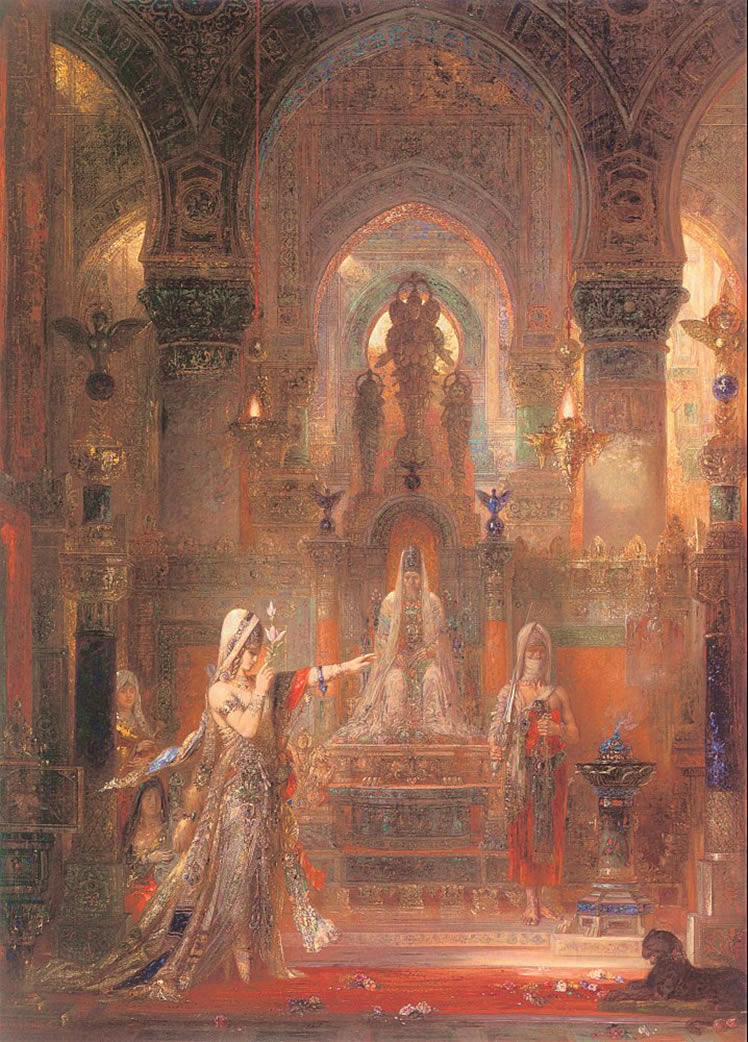
Gustave Moreau (1826–1898), Salome (1876), oil on wood, 144 x 103.5 cm, Armand Hammer Museum of Art, Los Angeles, CA. Wikimedia Commons.
The culmination of Moreau’s quest for the right scene to show the story of Salome the dancer is this extraordinary oil painting shown at the 1876 Salon.
The cadaveric King Herod sits on this throne while Salome is almost static on her points, and pointing towards the right. The executioner stands at the foot of the throne, and a couple of other women (including, perhaps, Salome’s mother) are at the left. Salome holds a lotus flower in her right hand, and other flowers are strewn on the floor. John’s head is nowhere to be seen, so we must presume that the moment selected by Moreau is when Salome chooses to receive that as her reward.
The rest of the painting consists of an unprecedented fusion of images, icons, and objects drawn from a diverse range of cultures. Detailed examination has shown these to be associated with the Hagia Sophia in Istanbul, the Alhambra in Granada, the Great Mosque of Cordoba, and several mediaeval cathedrals. Motifs have been identified from Etruscan, Roman, Egyptian, Indian, and Chinese art and culture.
But Moreau wasn’t content to show only that scene from the story. The other painting was to consider Salome with the head of John the Baptist as an apparition, and is now represented in three different versions.
Gustave Moreau (1826–1898), The Apparition (1875), oil on canvas, 142 × 103 cm , Musée National Gustave-Moreau, Paris. Wikimedia Commons.
The Apparition (1875) in the Musée National Gustave-Moreau is one of Moreau’s earliest attempts to express this. It takes the central part of Salome and adds the floating, severed head of John. Salome has now been transformed into the provocative, under-dressed femme fatale shown by subsequent artists. King Herod’s throne has been moved to the left of the painting, and he now looks in the direction of the apparition.
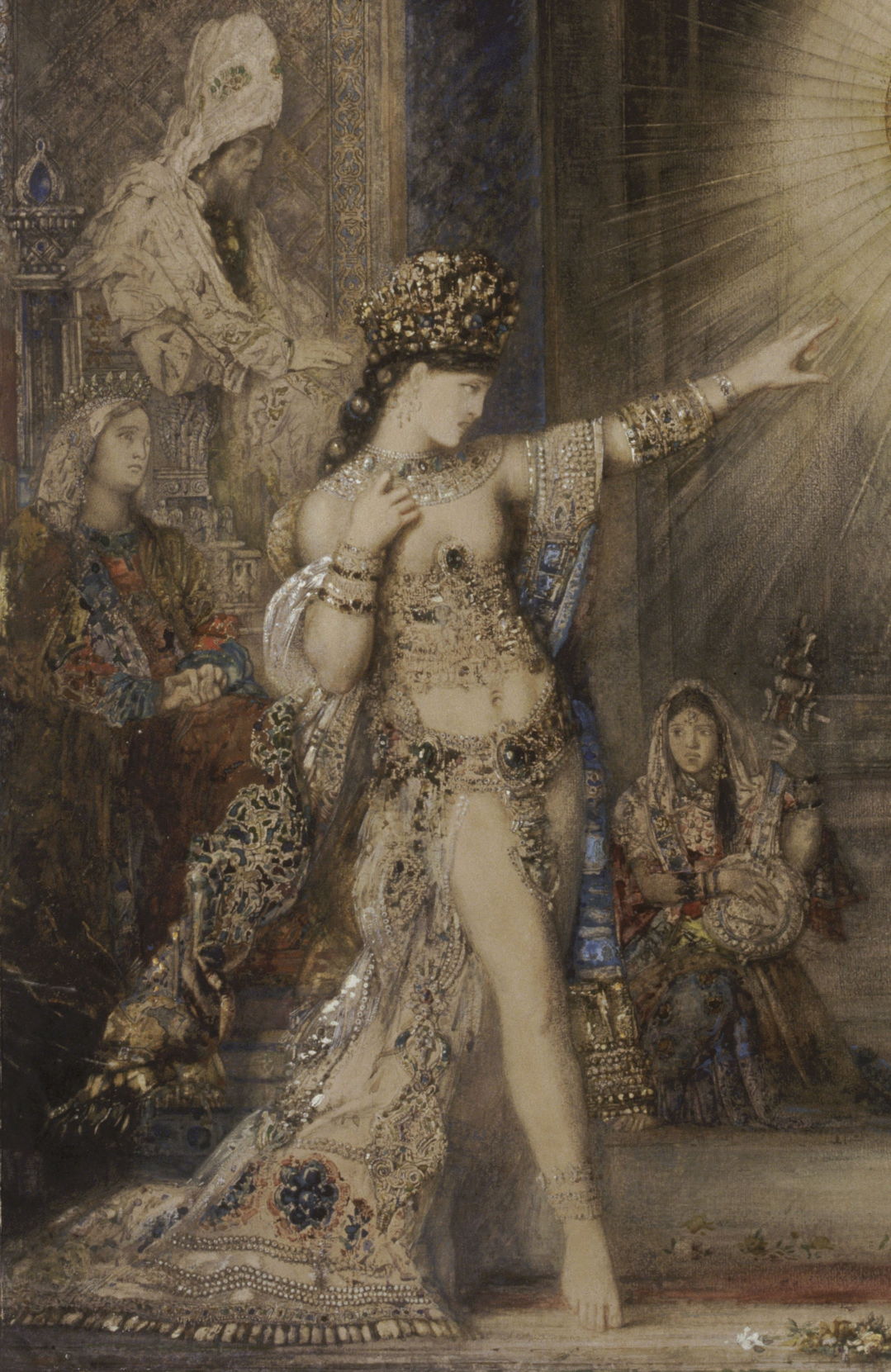
Gustave Moreau (1826–1898), The Apparition (c 1876), watercolour on paper, 106 x 72 cm, Musée d’Orsay, Paris. Wikimedia Commons.
This watercolour painting of The Apparition (c 1876), now in the Musée d’Orsay, was that shown at the Salon, although its colours are far weaker than when it was first exhibited. The cadaveric King Herod sit on his throne, overseeing the scene from the left edge. Herodias, presumably, sits by his feet, and a musician for Salome’s dance is shown further back. At the right edge is the executioner, John’s blood still on his sword.
Salome is now nearly nude, her body decorated with an abundance of strategically-placed jewellery and adornments. She points at the apparition with her left hand, trying to stare it out, her face as blank as everyone else’s. She stands on her points, but there is no sign of movement. The floor isn’t just strewn with flowers, but is now stained with the dripping blood from the severed head.
Gustave Moreau (1826–1898), The Apparition (detail) (c 1876), watercolour on paper, 106 x 72 cm, Musée d’Orsay, Paris. Wikimedia Commons.
Facial expressions are not theatrical as might have been expected in the work of a more conventional history painter of the day.
Gustave Moreau (1826–1898), The Apparition (1876-77), oil on canvas, 55.9 x 46.7 cm, Harvard Art Museums/Fogg Museum (Bequest of Grenville L. Winthrop), Cambridge, MA. Courtesy of Harvard Art Museums.
This slightly later oil version of The Apparition (1876-77), now in the Fogg Museum, gives a better idea of the original effect of Moreau’s watercolour, although the panther has moved across to replace the musician, and the background is quite different.
Moreau hadn’t painted Salome and The Apparition as a pair. Their compositions are individual, and mutually conflicting in details of the palace, the position of Herod’s throne, and more. Salome is one of the most iconographically rich paintings ever made, and it’s not surprising that some critics found it phantasmagoric. The Apparition is dominated by the same eye-to-eye contact that made Moreau’s Oedipus and the Sphinx so compelling, but here it’s between a notorious dancer and the severed head of the holiest man after Christ himself.
In 1877, the year after that Salon, Gustave Flaubert published three short stories, including an extended account of the traditional biblical narrative with Herodias at its centre. The British writer Oscar Wilde was introduced to that by Walter Pater (philosophical leader of Aestheticism), and in 1884 Joris-Karl Huysmans’ À rebours was published, a novel including a description of Moreau’s Salome paintings.
Wilde’s one-act play Salome was first published in French in 1891, and was soon translated into English and German. Banned from public performance in Britain, it received its premier in Paris in 1896, but wasn’t performed in public in England until 1931. At the centre of Wilde’s play is the perversion of lust and desire in Salome, best summarised in her words at the end of the play (he calls John the Baptist Jokanaan): But, wherefore dost thou not look at me Jokanaan? Thine eyes that were so terrible, so full of rage and scorn, are shut now. Wherefore are they shut? Open thine eyes! Lift up thine eyelids, Jokanaan! Wherefore dost thou not look at me? Art thou afraid of me, Jokanaan, that thou wilt not look at me? If thou hadst looked at me thou hadst loved me. Well I know that thou wouldst have loved me, and the mystery of love is greater that the mystery of death.
After seeing Wilde’s play performed in Berlin in 1902, Richard Strauss resolved to turn it into an opera. He started work on that in the summer of the following year, and Salome was completed and premiered in 1905. A year later, the dancer and choreographer Maud Allan produced a show called Vision of Salomé in Vienna, featuring a notorious version of the Dance of the Seven Veils, Wilde’s title for the dance of Salome before Herod, included in Strauss’s opera. The name quickly became a euphemism for a striptease, and the growing popularity of Salome as an erotic figurehead was named Salomania.
In around fifty years, from the appearance of Moreau’s The Apparition at the Salon in Paris, the traditional story of Herodias obtaining her vengeance by exploiting her daughter’s dance before Herod has been all but forgotten. The martyrdom of the second holiest figure in the gospels has been transformed into a perverse confusion of sex and death. The anonymous daughter of a woman who married her divorced husband’s brother has become the ultimate femme fatale: beautiful, sexy, and dangerous to know. Most unusually this change in story was largely triggered and driven by a painting: Moreau’s The Apparition.
Moreau was then concerned with the preparation of other paintings for the Exposition Universelle of 1878 in Paris.
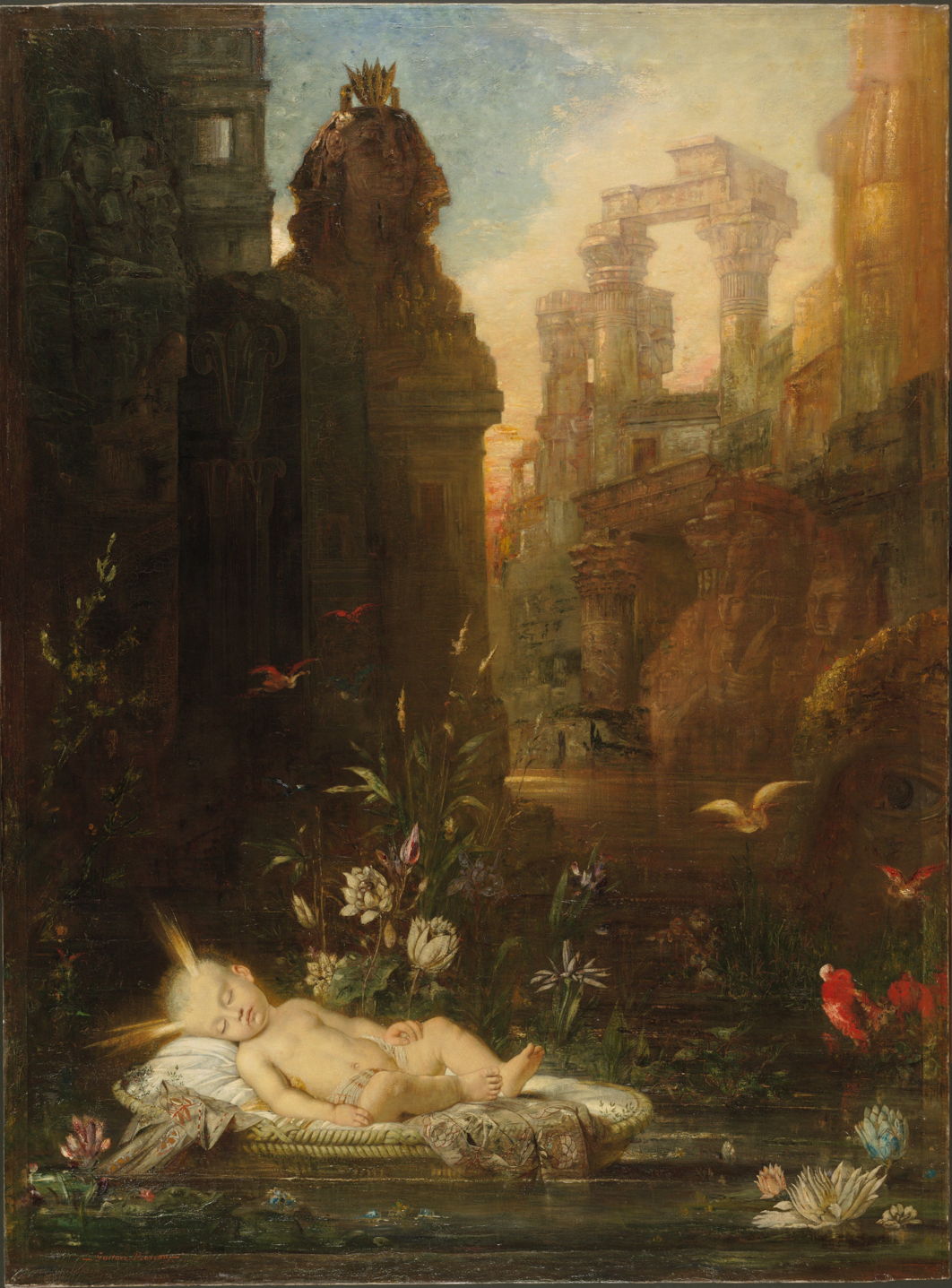
Gustave Moreau (1826–1898), Moïse Exposé sur le Nil (The Infant Moses) (c 1876-78), oil on canvas, 185 x 136.2 cm, Harvard Art Museums/Fogg Museum (Bequest of Grenville L. Winthrop), Cambridge, MA. Courtesy of Harvard Art Museums, via Wikimedia Commons.
Infancy and dawn are themes in Moïse Exposé sur le Nil (The Infant Moses) (c 1876-78), a radiantly beautiful depiction of the infant Moses asleep, prior to his discovery in the bullrushes. Moses is new life, new Judaeo-Christian beliefs, new law, and the new regime. Set against a background derived from photographs of Egyptian ruins symbolising the ancient, pre-Jewish, and decaying, it laid out Moreau’s hope for the French nation.
The baby Moses is marked out as being holy by the rays emanating from his temples, and surrounded by exotic flowers and birds. Most unusually, Moreau doesn’t show the traditional and popular moment of discovery of the infant in the bullrushes, but a static scene beforehand.
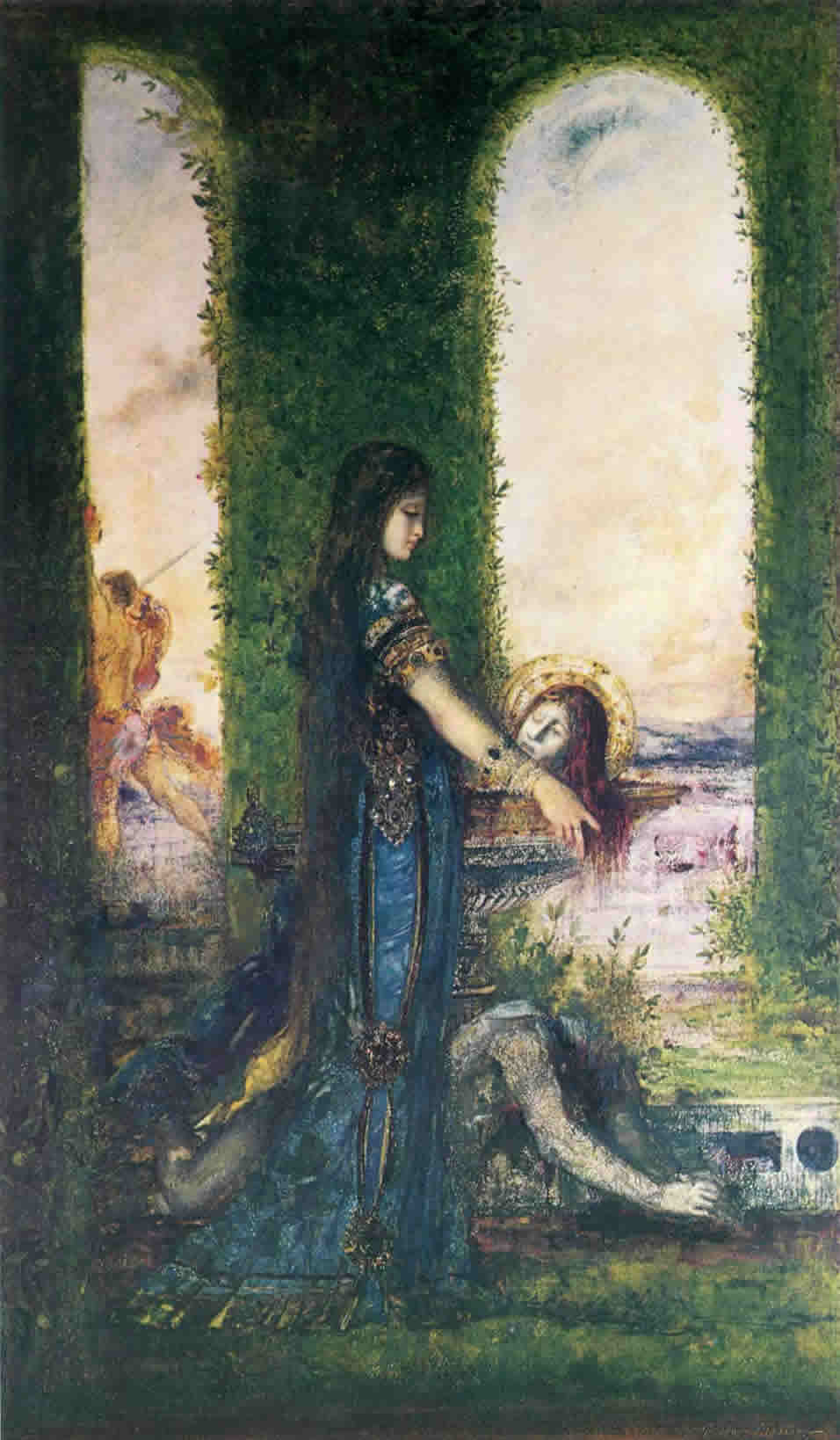
Gustave Moreau (1826–1898), Salome in the Garden (1878), watercolour on paper, dimensions not known, Private collection. Wikimedia Commons.
Moreau revisited his new myth of Salome and John the Baptist, in his strange watercolour of Salome in the Garden (1878). A beautiful and decorated figure of Salome is walking in an overgrown garden, carrying the severed head of John the Baptist on a large platter. Her eyes are closed, or perhaps looking down at the head, and John’s eyes are closed. Beside her is a headless statue of a man crawling, which could perhaps be the body of John, and outside is a man, possibly the executioner waving his sword.
References
Cooke P (2014) Gustave Moreau, History Painting, Spirituality and Symbolism, Yale UP. ISBN 978 0 300 20433 9.
Mathieu P-L (1998, 2010) Gustave Moreau, the Assembler of Dreams, PocheCouleur. ISBN 978 2 867 70194 8.
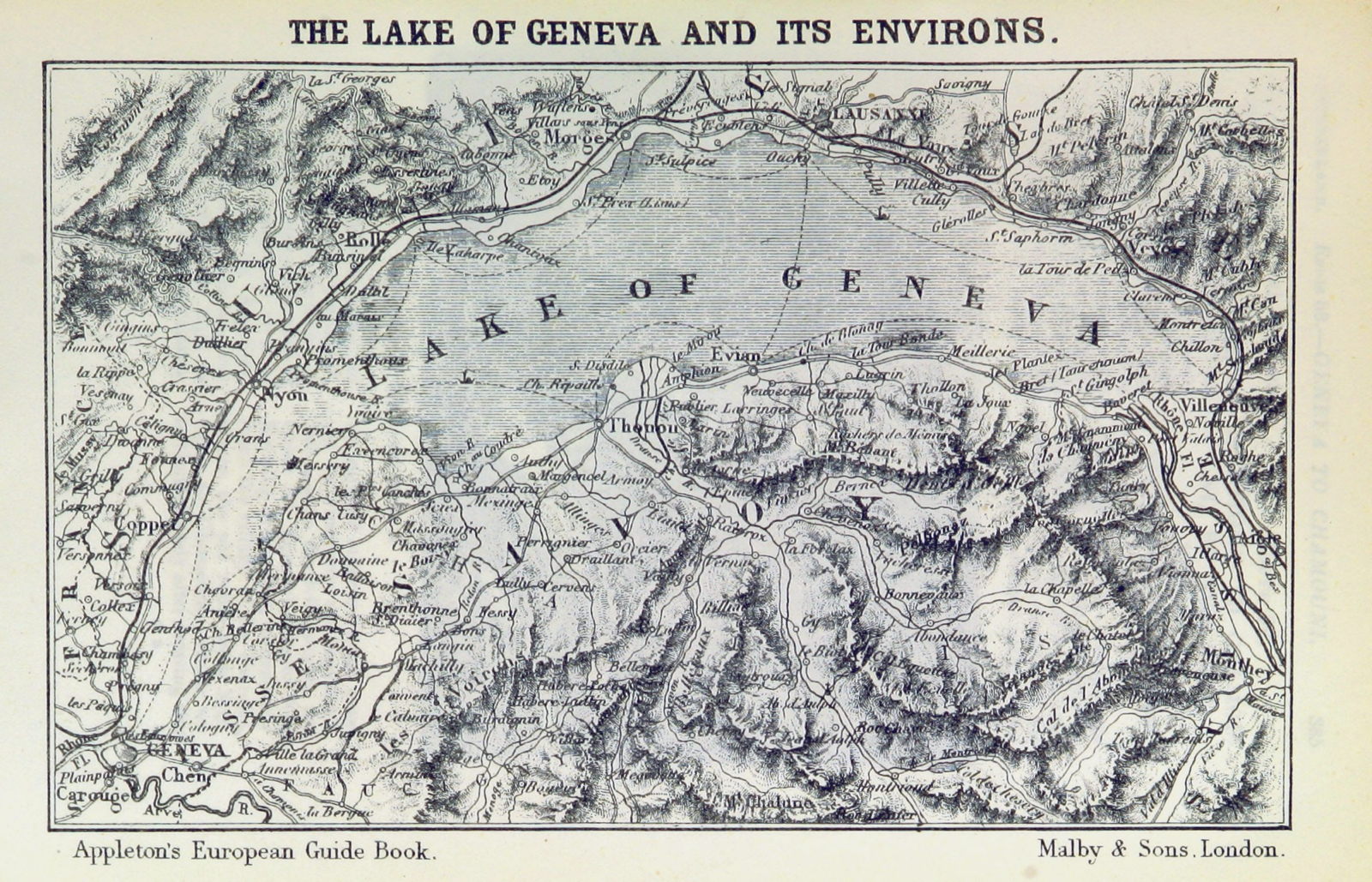
This weekend we’re off to visit Lake Geneva, also known by its French name of Lac Léman, the largest in Switzerland. It’s located in the far south-west of the country, where it forms much of its border with France. It makes a broad arc running north-east from the capital city of Geneva, with some of the highest peaks of the Alps to its south.
Daniel Appleton et al., Map of Lake Geneva (1877), p 521 in Appleton’s European Guide Book illustrated, 10th edition, D. Appleton & Co, New York. The British Library, London. Wikimedia Commons.
Today I start with a selection of paintings almost exclusively from the nineteenth century, when Switzerland was on the itinerary of the Grand Tour undertaken by aspiring young men of the upper class in both Europe and the Americas.
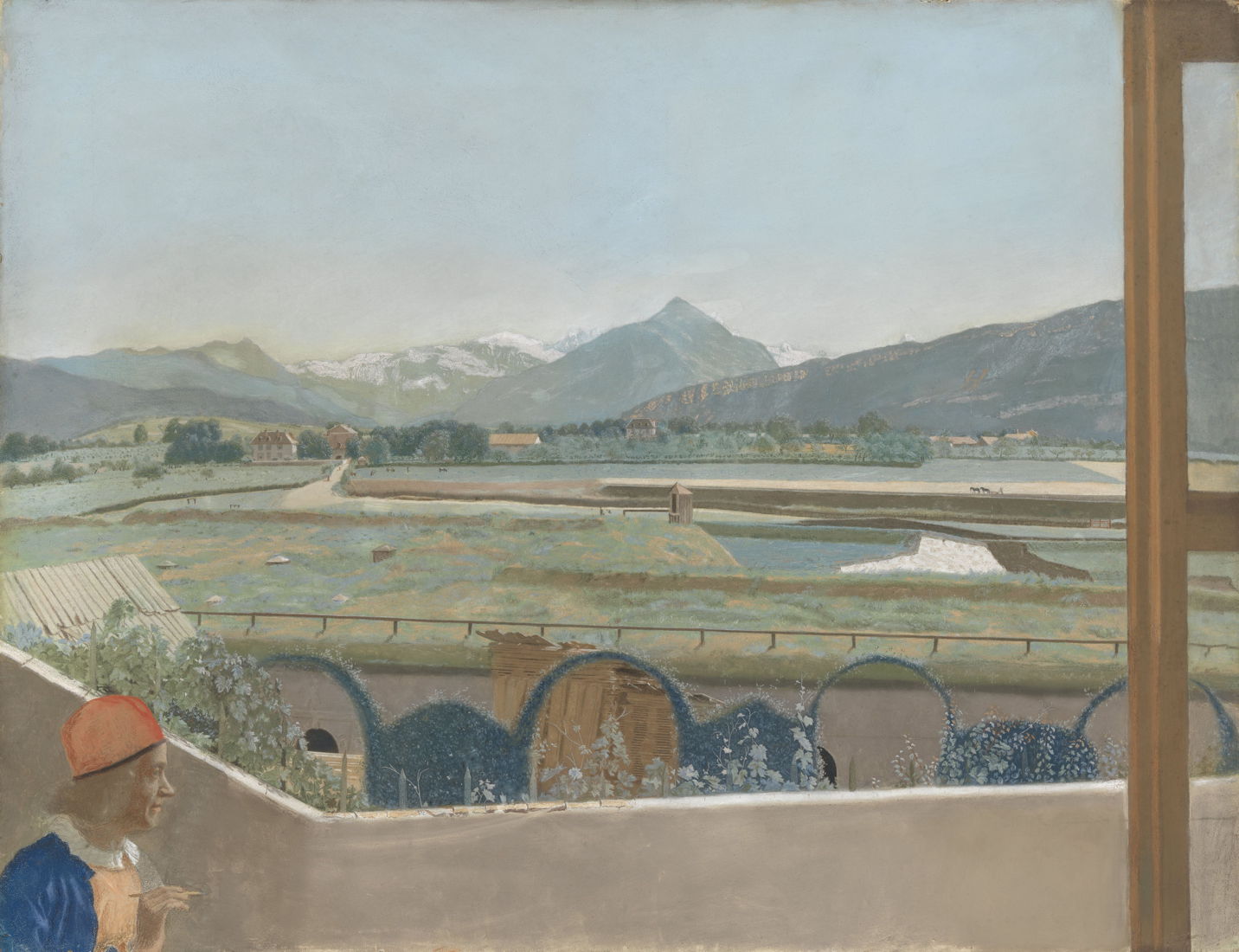
Jean-Étienne Liotard (1702-1789), View of the Mont Blanc Massif from the Artist’s Studio (1765-70), pastel on parchment, 46 x 59.7 cm, location not known. Wikimedia Commons.
The city of Geneva has long attracted artists, and it was here the eccentric pastellist Jean-Étienne Liotard was born and later kept his studio, and where he eventually retired. His View of the Mont Blanc Massif from the Artist’s Studio from 1765-70 reveals only a little of the southern extreme of the lake, with a cameo self-portrait.
Joseph Mallord William Turner (1775–1851), Lake Geneva and Mount Blanc (1802-05), watercolour, 90.5 x 128.6 cm, Yale Center for British Art, New Haven, CT. Wikimedia Commons.
JMW Turner was by no means the first to paint the lake, but his watercolour of Lake Geneva and Mount Blanc from 1802-05 is one of its earliest depictions by a major artist. This view looks south-east over the city of Geneva towards the Mont Blanc massif in the far distance.
Alexandre Calame (1810–1864), View of Bouveret (1833), oil on panel, 35 x 47.5 cm, location not known. Wikimedia Commons.
Alexandre Calame’s View of Bouveret from 1833 shows a grey heron fishing on the shore at the southern end of the lake, close to the border with France.
Alexandre Calame (1810–1864), View of Lake Geneva (Lac Léman) (1849), oil on wood, 67 x 86 cm, Villa Vauban, Musée d’art de la ville de Luxembourg, Luxembourg. Wikimedia Commons.
While Turner had toured the Alps once travel from England had become possible again in the early nineteenth century, Calame pioneered the painting of views like this of the lake, completed in his studio in 1849. It includes some of the distinctive sailing boats of the Swiss lakes, and a small bird in the shallows, but not a heron here.
John Ferguson Weir (1841-1926), Lake Leman (Lake Geneva), Switzerland (1869), oil on paper, 20.3 x 33 cm, Private collection. Wikimedia Commons.
In the middle of the nineteenth century, several major American artists visited Switzerland to develop their skills painting mountain views. Despite its finish, John Ferguson Weir’s Lake Leman (Lake Geneva), Switzerland may have been painted in front of the motif, on 11 June 1869.
Following Gustave Courbet’s release from prison for his involvement in the Paris Commune and destruction of the Vendôme Column in 1871, he was forced to flee to the safety of Switzerland, where he lived his remaining years there, unable to return to France.
Gustave Courbet (1819–1877), Sunset over Lac Leman (1874), oil on canvas, 55 x 65 cm, Musée Jenisch, Vevey, Switzerland. Image by Volpato, via Wikimedia Commons.
Courbet painted some of the finest landscapes of his career during his exile in Switzerland, like this Sunset over Lac Léman from 1874, the year of the First Impressionist Exhibition in Paris.
Gustave Courbet (1819–1877), Chillon Castle (1875), oil on canvas, dimensions not known, Private collection. Wikimedia Commons.
He became particularly obsessed with the island château at the extreme eastern end of Lake Geneva, Chillon Castle, here in 1875. This picturesque château dates back to a Roman outpost, and for much of its recorded history from about 1050 has controlled the road from Burgundy to the Great Saint Bernard Pass, a point of strategic significance. It has since been extensively restored, and is now one of the most visited mediaeval castles in Europe.
Gustave Courbet (1819–1877), Chillon Castle (1874-77), oil on canvas, 73 x 92 cm, location not known. Wikimedia Commons.
Chillon Castle from 1874-77 is another of the views he painted of the castle on the lake.
Gustave Courbet (1819–1877), Sunset on Lake Geneva (c 1876), oil on canvas, 74 x 100 cm, Kunstmuseum St. Gallen, St. Gallen, Switzerland. Wikimedia Commons.
Sunset on Lake Geneva from about 1876 is reminiscent of Courbet’s earlier seascapes with breaking waves, but now the water is calm once more.
In May 1877, the French government informed Courbet that the cost of rebuilding the Vendôme Column would be over 300,000 Francs, which he could pay in instalments of 10,000 Francs each year, starting on 1 January 1878. Courbet died in Switzerland the day before, on 31 December 1877, at the age of only 58.

 Login
Login

 (Abstract)《高桥名人之冒险岛四》是最后一个 FC 游戏,以庞大的迷宫而知名。但借助于地图的话还是挺好玩的。




 (Abstract)有大神开发出了可以在 macOS 上原生运行的版本。