The classical Greek hero Theseus had travelled overland to be reunited with his father Aegeus, King of Athens, where he narrowly escaped death by Medea’s poison. Following the example of his hero Heracles, he then killed the Marathonian Bull, in preparation for his most famous accomplishment, killing the half-bull, half-human Minotaur living at the centre of the Labyrinth on the island of Crete.
King Minos of Crete had been exacting a tribute of nine young men and nine maidens from Athens every nine years, who were taken to the Labyrinth to die. On the third such call for eighteen of Athens’ finest, its citizens accused Aegeus of being its cause. Although a matter of dispute as to how he accomplished it, Theseus went to Crete as one of those eighteen.
George Frederic Watts was apparently driven to paint The Minotaur in 1885 as a response to a series of articles in the press revealing the industry of child prostitution in late Victorian Britain. Those referred to the myth of the Minotaur, so early one morning he painted this image of human bestiality and lust. His Minotaur has crushed a small bird in its left hand, and gazes out to sea, awaiting the next shipment of young men and virgin women from Greece.
Because the Athenians knew that their young people weren’t going to return, the ship carrying them to Crete had black sails. On this occasion, though, Theseus gave its crew a white sail, telling Aegeus and the crew that when they returned, if he had been successful in killing the Minotaur, they would set that white sail as a sign.
Gustave Moreau (1826–1898), Athenians Being Delivered to the Minotaur (1855), oil, dimensions not known, Musée de Brou, Bourg-en-Bresse, France. Wikimedia Commons.
Gustave Moreau’s painting of Athenians Being Delivered to the Minotaur (1855) shows the victims as they were preparing to enter the Labyrinth. Wearing laurel wreaths to mark their distinction and sacrifice, the young men and women hold back while Theseus crouches, waiting to do battle with the beast, seen at the right.
Left to his own devices, Theseus’ chances were not good. However, Minos’ daughter Ariadne had fallen in love with him when she saw him compete in the funereal games preceding the act of sacrifice, and promised to assist in return for his hand in marriage afterwards. It was she who provided Theseus with a ball of thread which he deployed as he entered the Labyrinth, enabling him to retrace his steps once he had killed the Minotaur at its centre.
Henry Fuseli (1741–1825), Ariadne Watching the Struggle of Theseus with the Minotaur (1815-20), brown wash, oil, white gouache, white chalk, gum and graphite on moderately thick, moderately textured, beige wove paper, 61.6 x 50.2 cm, Yale Center for British Art, New Haven, CT. Wikimedia Commons.
In Henry Fuseli’s spirited mixed-media sketch of Ariadne Watching the Struggle of Theseus with the Minotaur (1815-20), Theseus appears almost skeletal as he tries to bring his dagger down to administer the fatal blow, and Ariadne resembles a wraith or spirit.
Charles-Édouard Chaise (1759-1798), Theseus, Victor over the Minotaur (c 1791), oil on canvas, dimensions not known, Musée des Beaux-Arts, Strasbourg, France. Image by Rama, via Wikimedia Commons.
Theseus, Victor over the Minotaur (c 1791) is one of only three paintings by Charles-Édouard Chaise known to survive. With its crisp neo-classical style, it shows Theseus standing in triumph over the lifeless corpse of the Minotaur. He is almost being mobbed by the young Athenian women whose lives he has saved. At the left, his thread rests on a wall by an urn, suggesting the young woman by it may be Ariadne; she is being helped by a young man.
There are conflicting stories as to what happened next, but Theseus and Ariadne departed from Crete, ending up on the island of Naxos, where Theseus abandoned her and sailed on. This has been depicted by many painters, although most have naturally concentrated on the jilted Ariadne rather than her betrayer Theseus.
John William Waterhouse (1849–1917), Ariadne (1898), oil on canvas, 151 x 91 cm, Private collection. Wikimedia Commons.
John William Waterhouse paints the moment that Ariadne (1898) starts to wake, as Theseus’ ship has just sailed. As she hasn’t yet realised she has been abandoned, she lies back at ease. On and under the couch are a couple of leopards, a clear reference to the imminent arrival of Dionysus.
Paulus Bor (circa 1601–1669), Ariadne (1630-35), oil on canvas, 149 x 106 cm, Muzeum Narodowe w Poznaniu, Poznań, Poland. Wikimedia Commons.
Paulus Bor’s portrait of Ariadne, painted in the period 1630-35, can only show her on Naxos, immediately after she has been abandoned, still clutching the thread by which she thought she had tethered him, now hanging at a loose end. On the wall above her are sketches she has made of her lover. She looks deeply lost in thought and gloom.
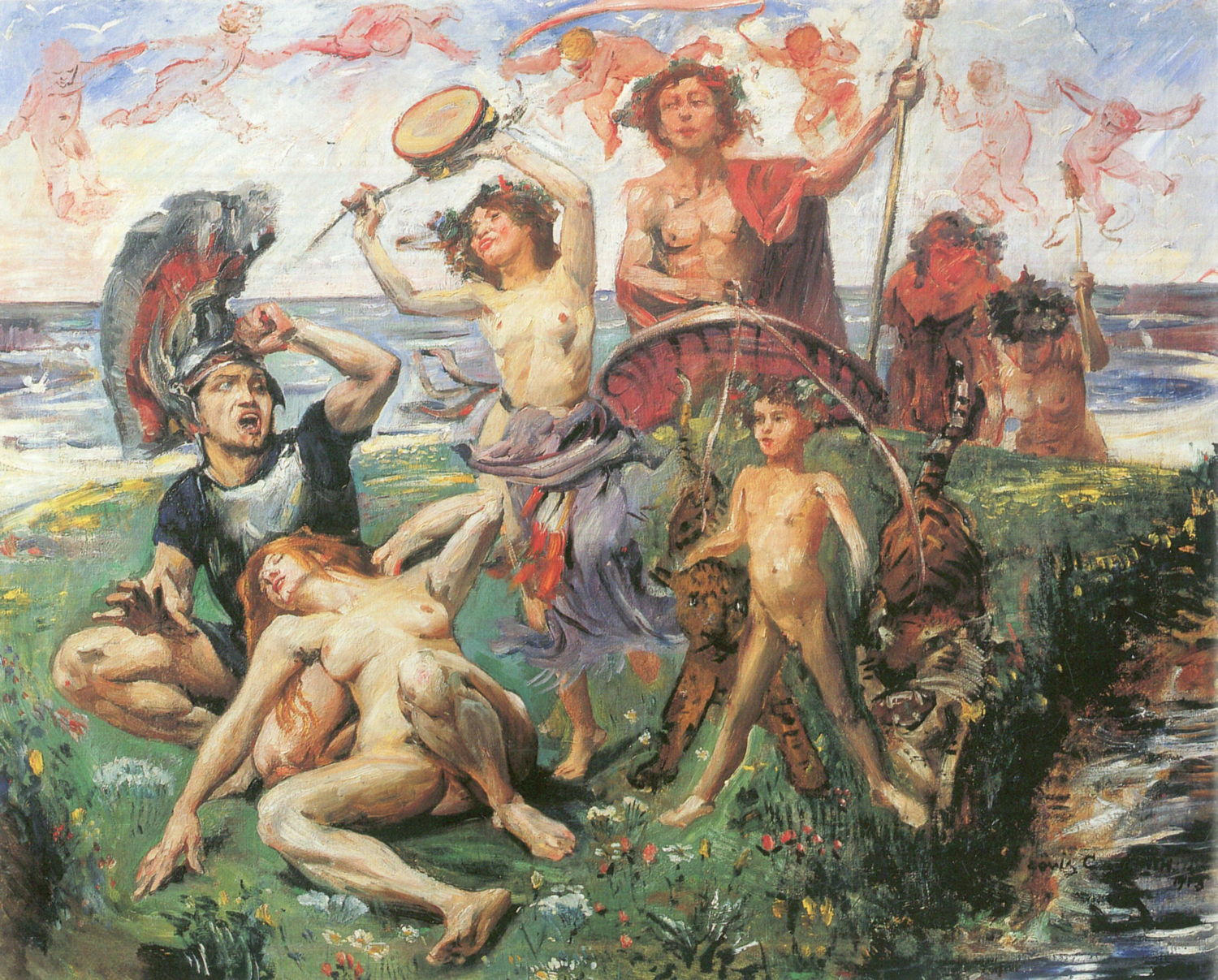
Lovis Corinth (1858–1925) Ariadne on Naxos (1913), oil on canvas, 116 × 147 cm, Private collection. Wikimedia Commons.
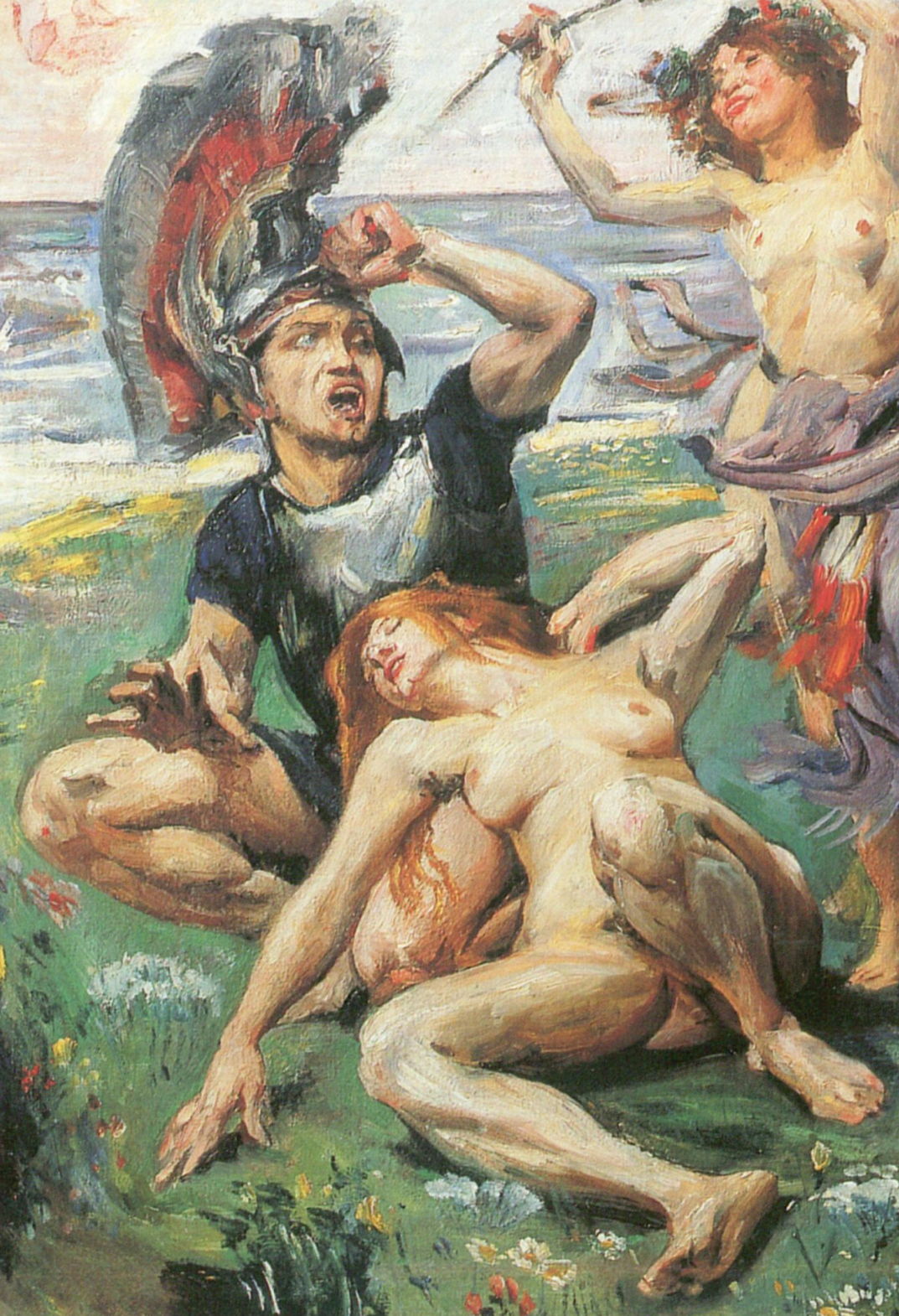
Lovis Corinth’s Ariadne on Naxos (1913) is one of his most sophisticated and masterly mythical paintings, inspired by the first version of Richard Strauss’s opera Ariadne auf Naxos (1912). The left third of the painting (detail below) shows Ariadne lying in erotic langour on Theseus’ left thigh. He wears an exuberant helmet, and appears to be shouting angrily and anxiously towards the other figures to the right.
Lovis Corinth (1858–1925) Ariadne on Naxos (detail) (1913), oil on canvas, 116 × 147 cm, Private collection. Wikimedia Commons.
Having called in briefly at Delos, Theseus and his ship returned to Athens. But in their delight and celebration, they forgot to hoist the white sail to indicate the success of their mission. Seeing their ship with its black sail still set, Theseus’ father King Aegeus threw himself from a cliff in despair, and died.
Theseus’ return to Athens thus brought an odd mixture of celebration at his success, and lamentation at the death of his father. Their ship was carefully preserved as a monument to Theseus’ accomplishment, and he set about transforming and growing the city by settling all the citizens of Attica in it. He promised government without a king, by means of democracy, making himself its commander in war and the guardian of its laws. He also had its currency struck into coins, and instituted the Isthmian (Olympic) Games.
Back on the island of Naxos, Ariadne went on to marry Dionysus, the couple had many children, and lived happily ever after.
Mythological worlds in classical Mediterranean civilisations often appear confusing and contradictory when stories and beliefs of many centuries and different cultures are merged, as happened in post-classical painting. What might appear to be a single distinctive attribute, such as a snake coiled along the length of a staff, then becomes a muddle.
There are two common combinations of snakes coiled around a rod or staff. Hermes (Roman Mercury) has a caduceus as his attribute, consisting of a rod or staff with a pair of entwined serpents along its length, and sometimes they are shown bearing small wings. This signifies his swiftness as a messenger. The rod of Asclepius (which has several alternative spellings) should have but a single serpent coiled around it, and is associated with healing and medicine, and remains so today long after its divine origins have been forgotten.
Although not known for his paintings of secular stories, William Blake’s Judgement of Paris (c 1806-17) was one of a pair made for Thomas Butts, the other being Philoctetes and Neoptolemus on Lemnos, a more obscure story leading to the death of Paris.
As with almost every artist before and since, Blake shows the three contestants naked in front of Paris, just at the moment that the golden apple is awarded to Aphrodite. Hera and Athena, standing either side of her, are visibly upset. Above them is the naked figure of Hermes, with his caduceus and its pair of intertwined serpents, and a winged helmet. The demonic figure at the top left is presumably a harbinger of the death and destruction to come in the Trojan War.
Pierre-Auguste Renoir (1841–1919), The Judgment of Paris (c 1908-10), oil on canvas, 73 x 92.5 cm, Hiroshima Museum of Art, Hiroshima, Japan. Wikimedia Commons.
Renoir’s account of The Judgment of Paris, from about 1908-10 is a carefully composed image of the same moment of peripeteia. Watching on is Hermes, complete with his winged helmet, sandals, and caduceus.
Abraham Bloemaert (1564–1651), Mercury, Argus and Io (c 1592), oil, 63.5 x 81.3 cm, Centraal Museum, Utrecht, The Netherlands. Wikimedia Commons.
The most popular scene in Ovid’s intertwined stories of the rape of Io and the murder of Argus is that of Hermes lulling Argus to sleep. However, hardly any painters depict Argus having the hundred eyes specified in the Metamorphoses. Abraham Bloemaert is an exception, in his carefully composed Mercury, Argus and Io (c 1592). Hermes is playing his flute at the left, his caduceus at his feet, as Argus falls asleep in front of him, his additional eyes visible over the surface of his head.
David Rijckaert (III) (1612–1661), Philemon and Baucis Giving Hospitality to Jupiter and Mercury (date not known), oil on panel, 54 x 80 cm, Private collection. Wikimedia Commons.
David Rijckaert’s undated Philemon and Baucis Giving Hospitality to Jupiter and Mercury gives the most popular account of the elderly couple entertaining the two gods. Hermes (left) and Zeus (left of centre) are seated at the table, with Philemon (behind the table) and Baucis (centre) waiting on their every need. Once again, Hermes is distinguished by his caduceus as well as a more contemporary winged hat.
Rod of Asclepius
Giovanni Battista Cipriani (1727–1785), Aesculapius Holding a Staff Encircled by a Snake (date not known), media and dimensions not known, Wellcome Library, London. Courtesy of Wellcome Images images@wellcome.ac.ukhttp://wellcomeimages.org, via Wikimedia Commons.
In the eighteenth century, Giovanni Battista Cipriani drew Aesculapius Holding a Staff Encircled by a Snake, following the classical tradition.
Johannes Zacharias Simon Prey (1749-1822), Aesculapius, Apollo and Hippocrates (1791), oil, dimensions not known, Wellcome Library, London. Courtesy of Wellcome Images images@wellcome.ac.ukhttp://wellcomeimages.org, via Wikimedia Commons.
Johannes Zacharias Simon Prey painted this group of Aesculapius, Apollo and Hippocrates in 1791. Asclepius, holding his distinctive rod, is shown in the centre of the trio, with Hippocrates, the less legendary ‘father of medicine’, to the right, clutching the basal half of a human skull, and Apollo, father of Asclepius, behind. They have entered a contemporary pharmacy, where an assistant uses a large mortar and pestle, and another works the bellows of a furnace.
Inevitably, the distinction between Hermes’ caduceus and the rod of Asclepius has been lost more recently, and many symbolic representations of medicine have erroneously used a caduceus.
Although legend held that Theseus was the founder of the city of Athens, it’s probably more accurate to attribute to him its early growth and development. Despite being ranked among the great heroes of classical Greece, he also displayed fundamental flaws. For a long time, the life of Theseus was as celebrated a series of myths as those of Heracles, Jason or Aeneas.
In about 1340-41, Giovanni Boccaccio wrote an epic poem of almost ten thousand lines Teseida, or The Theseid, which in turn inspired The Knight’s Tale in Chaucer’s Canterbury Tales.
Paolo da Visso (1431–1481) Scenes from Boccaccio’s Teseida (date not known), front of a cassone, further details not known. Wikimedia Commons.
Paolo da Visso painted these three scenes from Boccaccio’s epic on the front of a cassone, a visual equivalent of Plutarch’s account of the adventures of Theseus.
Like Perseus, Theseus had complicated origins. His mortal father, Aegeus the king of a far smaller Athens, had been childless, but following the prophecy of the oracle at Delphi, the King of Troezen got him drunk and packed him off to bed with his daughter Aethra. She was instructed in a dream to leave Aegeus asleep, and to go to a nearby island, where she was also impregnated by the god Poseidon. Theseus, who is presumed to have been conceived that night, was thus considered to have double paternity, by god and man, a qualification for the heroes of myth.
After he had buried his sword and sandals under a massive rock, Aegeus returned to Athens. He told Aethra that when his son grew up, she should tell him to move the rock, as a test. If he succeeded, then he should take the sandals and sword as evidence of his paternity.
When Theseus was old enough, his mother Aethra showed him the rock, and told him Aegeus’ instructions. Theseus moved the rock, found the sandals and sword, and then undertook an epic journey overland to his father in Athens.
Laurent de La Hyre (1606–1656), Theseus And His Mother Aethra (1635-36), oil on canvas, 141 × 118.5 cm, Szépművészeti Múzeum, Budapest, Hungary. Wikimedia Commons.
One of the earliest depictions of the young Theseus is Laurent de La Hyre’s Theseus And His Mother Aethra (1635-36). This shows the lad lifting a heavy pillar to reveal a pair of shoes and a sword.
Nicolas Poussin (1594–1665) and Jean Lemaire (1598–1659), Theseus Recovering his Father’s Sword (c 1638), oil on canvas, 98 x 134 cm, Musée Condé, Chantilly, France. Wikimedia Commons.
In one of his rare collaborative paintings, Nicolas Poussin worked with Jean Lemaire to tell this fragment of the story in Theseus Recovering his Father’s Sword, from about 1638. They draw a marked contrast between the two actors: Theseus, destined to be a great hero, looks rough and brutish, while his mother Aethra wouldn’t look out of place standing in for the Madonna.
Nicolas-Guy Brenet (1728–1792), Aethra Showing her Son Theseus the Place Where his Father had Hidden his Arms (1768), oil on canvas, 50.2 × 59.7 cm, Los Angeles County Museum of Art, Los Angeles, CA. Wikimedia Commons.
Nicolas-Guy Brenet’s more sketchy Aethra Showing her Son Theseus the Place Where his Father had Hidden his Arms (1768) adds a river god for good measure, and has Aethra giving Theseus marching orders to go find his father.
Antonio Balestra (1666–1740), Theseus Discovering his Father’s Sword (c 1725), oil on canvas, 287 x 159 cm, Private collection. Wikimedia Commons.
Antonio Balestra’s Theseus Discovering his Father’s Sword (c 1725) makes Theseus look less than enthusiastic to follow his mother’s directions.
Aethra told her son to travel by sea to take the sword and sandals to his father, but inspired by Heracles he chose to travel overland instead.
Like his hero, Theseus had a series of adventures on this journey. He first killed Periphetes, who had wielded a large club at him; impressed by this club, he took it and killed another opponent, Sinis, raped his daughter and made her pregnant. Theseus went out of his way to meet the fearsome Crommyonian Sow, which he also killed. Coming to the borders of Megara, Theseus met Sciron, whom he threw down a cliff to his death, and killed another two people before reaching the city.
Theseus found Athens, and his father’s court, in disarray, with the king cohabiting with the sorceress Medea, who had promised to cure his lack of children. Aegeus remained unaware of Theseus’ true identity, but invited him to a banquet, at which Medea, acting in conspiracy with the king, tried to get Theseus to drink from a goblet laced with the poison aconite.
Luckily for Theseus, just before he was going to drink from the goblet, he drew his father’s sword, making as if to carve the meat with it. Aegeus recognised the sword, realised that his guest who was just about to drink poison was his son, and knocked the goblet from Theseus’ hand to stop his lips from touching it.
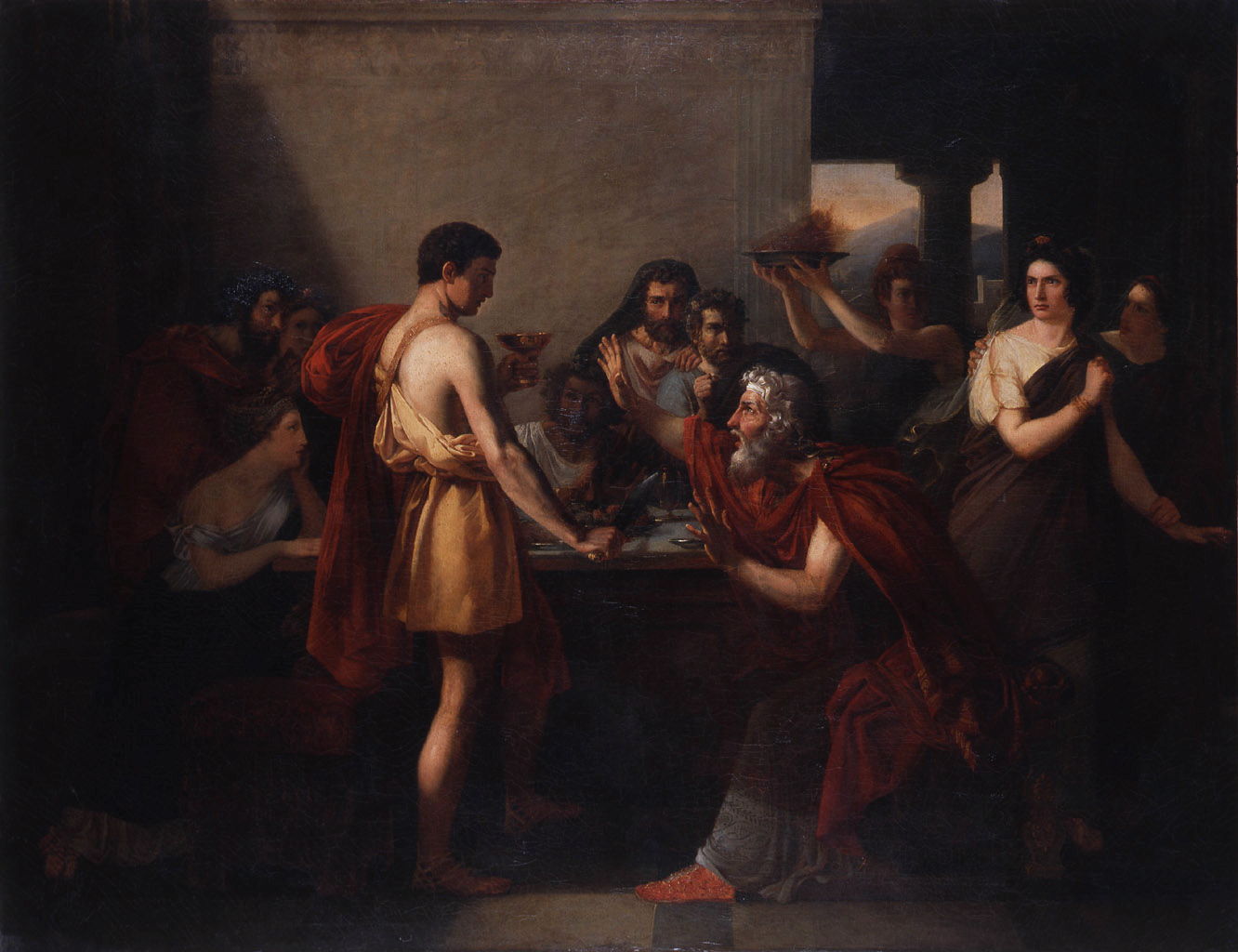
Antoine-Placide Gibert (1806-1875), Theseus Recognised by his Father (1832), oil, dimensions not known, Musée des Beaux-Arts, Bordeaux, France. Image by VladoubidoOo, via Wikimedia Commons.
In Antoine-Placide Gibert’s Theseus Recognised by his Father (1832), the three principal actors are arranged almost linearly across the canvas. Just left of centre, Theseus stands, his head in profile, the fateful cup in his left hand, and his father’s sword in his right. The king is just right of centre, looking Theseus in the eye, and appearing animated if not alarmed. At the far right is Medea, her face like thunder, sensing that her plot to kill Theseus is about to fall apart.
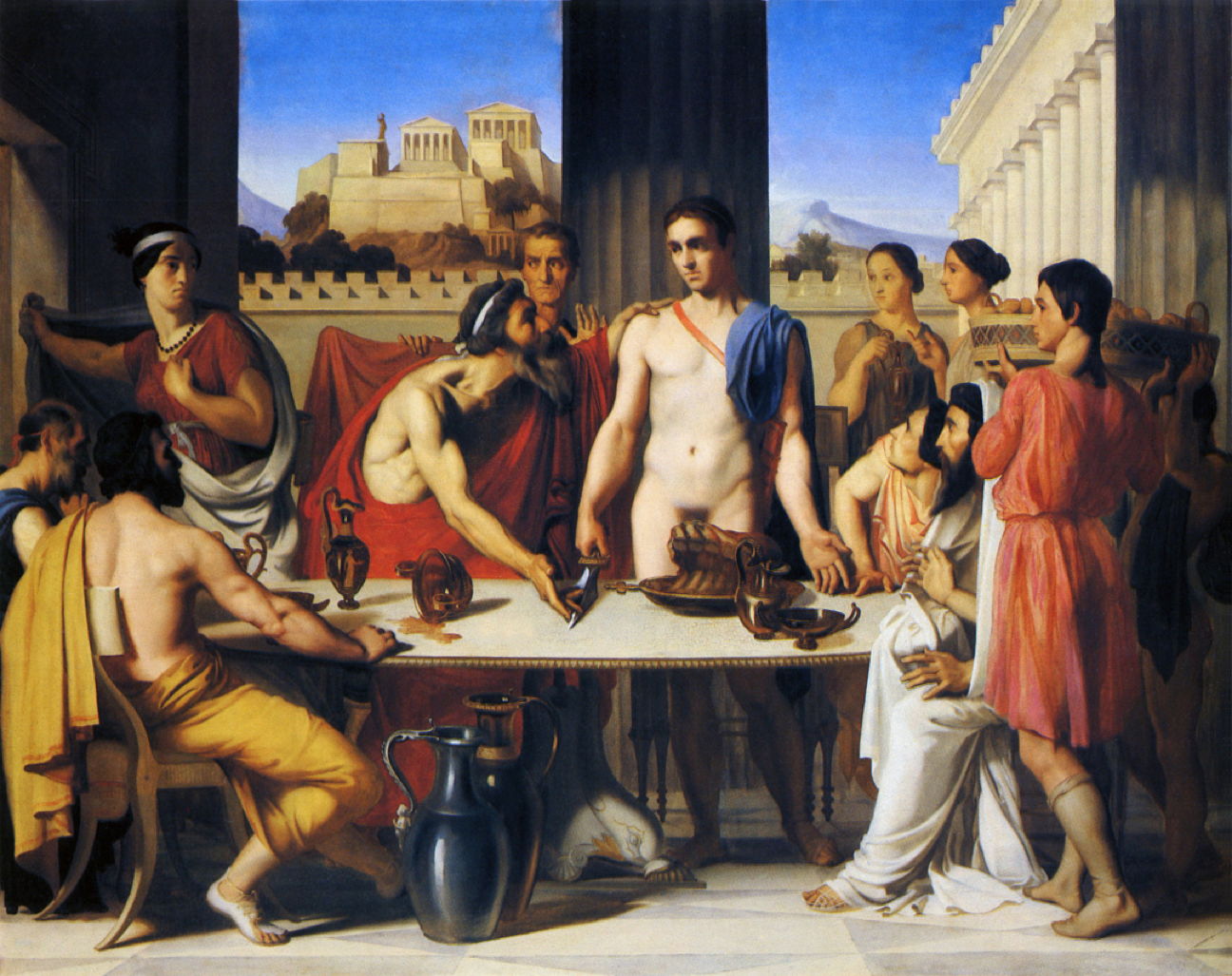
Hippolyte Flandrin (1809–1864), Theseus Recognized by his Father (1832), oil on canvas, 114.9 × 146.1 cm, École nationale supérieure des Beaux-Arts, Paris. Wikimedia Commons.
Hippolyte Flandrin’s Theseus Recognized by his Father beat Gibert’s painting for the Prix de Rome in 1832, and has a more neoclassical look, as if influenced by Jacques-Louis David. With a view of the Acropolis in the background, this shows the moment immediately after Aegeus has recognised his son, and the cup of aconite lies spilt on the table. Theseus, conspicuously naked, stands in the middle of the canvas, his father’s sword held rather limply in his right hand. Aegeus stands to the left of centre, talking emotionally to his son.
Of all the characters shown in this painting, it’s Medea who is the most fascinating. Stood at the far left, she appears to be on her way out. She is po-faced, and looks as if she has come not from Greece, but from central Asia.
Aegeus then declared Theseus to be his heir and successor as King of Athens. This was opposed by the sons of Pallas, who tried to attack the city. Theseus was tipped off by one of their men, surprised his opponents, and killed the lot of them. Like his hero Heracles, Theseus then set out to deal with the problem posed by the Marathonian Bull, captured it, and drove it through the city of Marathon before sacrificing it to Apollo. He then went on to battle with another bull, this time on the island of Crete.
The legendary hero Perseus was the son of Danaë, conceived when Zeus/Jupiter impregnated her in a shower of gold. He had been sent by Polydectes on a mission to bring him the head of Medusa, and on his return with that secured in a kibisis, he stopped off in Ethiopia, where the princess Andromeda was awaiting sacrifice to the sea monster Cetus.
Titian (Tiziano Vecelli) (1490–1576), Perseus and Andromeda (1553-9), oil on canvas, 179 × 197 cm, The Wallace Collection, London. Wikimedia Commons.
Titian’s Perseus and Andromeda (1553-59) shows the height of the action, remaining largely faithful to Ovid’s account of this story. All three actors are present, with Andromeda still shackled and Perseus attacking Cetus from the air using a sword with a curved blade.
Paolo Veronese (1528–1588), Perseus Rescuing Andromeda (1576-78), oil on canvas, 260 × 211 cm, Musée des Beaux-Arts, Rennes, France. Wikimedia Commons.
Paolo Veronese’s Perseus Rescuing Andromeda followed soon afterwards, in 1576-78. His composition is similar to Titian’s, and equally faithful to the text, but his additional attention to the details of Perseus and Cetus brings this to life.
Edward Burne-Jones (1833–1898), The Perseus Series: The Doom Fulfilled (1888), oil on canvas, 155 × 140.5 cm, Staatsgalerie Stuttgart, Stuttgart. Wikimedia Commons.
In the ninth painting in Edward Burne-Jones’ series, The Doom Fulfilled (1888), Perseus is swathed in Cetus’ coils with their almost calligraphic form, brandishing his sword and ready to slaughter the monster and bring its terror to an end.
Félix Edouard Vallotton (1865-1925), Perseus Killing the Dragon (1910), oil on canvas, 160 x 233 cm, Musée d’art et d’histoire de Genève, Geneva. By Codex, via Wikimedia Commons.
In the early twentieth century, the former Nabi artist Félix Edouard Vallotton painted a series of narrative works, including his Perseus Killing the Dragon, from 1910, a thoroughly contemporary interpretation that is exceptionally free with Ovid’s account.
As with most classical myths, several variants of the story have developed over time. All painted accounts that I have seen follow the action-packed version in which Perseus slays Cetus with his sword, but some literary versions report that the sea monster was turned to stone by Medusa’s face, which would have made far duller paintings.
A more recent variant has the hero flying to Andromeda’s aid not with his winged sandals, but on the back of the winged horse Pegasus.
Peter Paul Rubens (1577–1640), Perseus and Andromeda (c 1622), oil on canvas, 99.5 x 139 cm, Hermitage Museum, Saint Petersburg, Russia. Wikimedia Commons.
By the time that Rubens came to paint Perseus and Andromeda in about 1622, the newer revised version including Pegasus seems to have become popular. Andromeda is at the left, unchained from her rock where she had been placed as a delightful morsel for Cetus, which has just been killed by Perseus and now lies at the lower edge with its fearsome mouth wide open. Perseus is in the process of claiming Andromeda’s hand as his reward, for which he is being crowned with laurels. Although he clearly flew in on Pegasus, he is still wearing his winged sandals, and holds the polished shield reflecting Medusa’s face and snake hair.
Piero di Cosimo (1462–1521), Andromeda freed by Perseus (c 1510-15), oil on panel, 70 x 123 cm, Galleria degli Uffizi, Florence. Wikimedia Commons.
Piero di Cosimo uses multiplex narrative to show most of the story in his large Andromeda Freed by Perseus (c 1510-15). Centred on the great bulk of Cetus, Perseus stands on its back and is about to hack at its neck with his curved sword. At the upper right, Perseus is shown a few moments earlier, as he was flying past in his winged sandals. To the left of Cetus, Andromeda is still secured to the rock by red fabric bindings, not chains, and is bare only to her waist.
In the foreground in front of Cetus are Andromeda’s parents stricken in grief. Near them is a group of courtiers with ornate head-dress. But in the right foreground the wedding party is already in full swing, complete with musicians and dancers.
Perseus’ reward for rescuing Andromeda and saving the kingdom of Ethiopia was naturally the hand of the princess in marriage. There was only one obstacle, that she had already been promised to Phineus, who was clearly no match when it came to killing sea monsters. Whether or not Phineus was invited, he and his friends turned up at the wedding of Andromeda and Perseus, and trouble soon broke out. The punch-up turned lethal when the weapons came out, and Perseus decided it was time to show Medusa’s face to the unwelcome guests.
Sebastiano Ricci (1659–1734), Perseus Confronting Phineus with the Head of Medusa (c 1705-10), oil on canvas, 64.1 × 77.2 cm, The J. Paul Getty Museum, Los Angeles, CA. Courtesy of J. Paul Getty Museum.
Sebastiano Ricci’s Perseus Confronting Phineus with the Head of Medusa (c 1705-10) shows the final moments of the battle, as Phineus cowers next to two of his henchmen who have almost completed the process of changing into stone. Although not shown here, Athena herself turned up to make sure that no one got the better of Perseus.
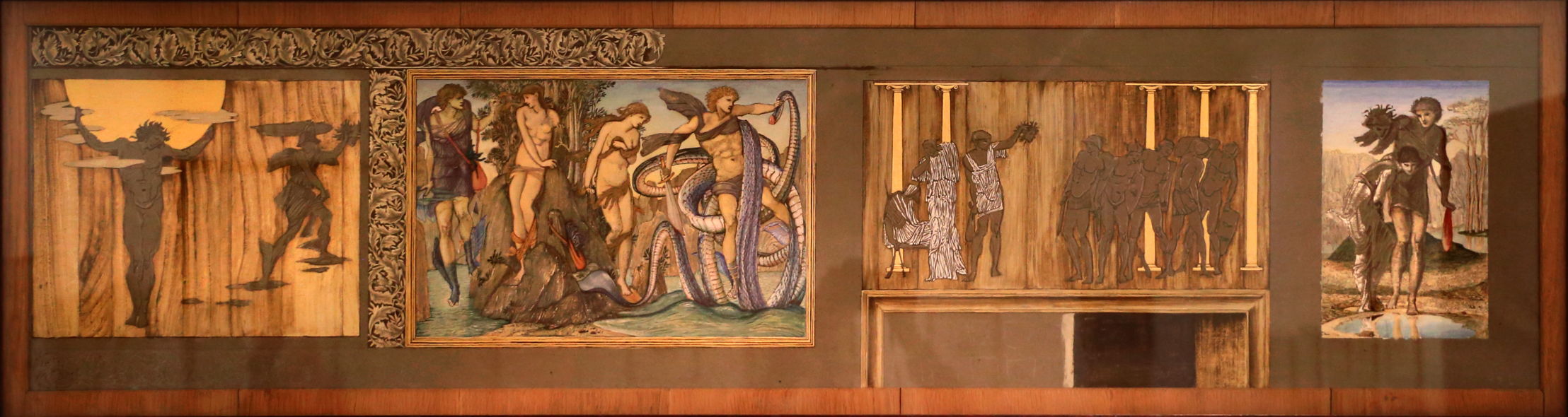
Edward Burne-Jones worked on many sketches and preliminary designs for his series, among which were gouache and gold layouts to show how his paintings would fit into their carved surrounds in his patron’s Music Room.
Edward Burne-Jones (1833–1898), Atlas Turned to Stone; The Rock of Doom and the Doom Fulfilled; The Court of Phineas; The Baleful Head (designs for The Story of Perseus) (1875-76), gouache, gold paint, graphite and chalk on paper, 36.7 x 148.7 cm, The Tate Gallery, London. Image by Sailko, via Wikimedia Commons.
This design shows an outline of the whole series, which had originally been intended to include Phineus and the wedding. The scenes shown are, from the left, Atlas Turned to Stone, The Rock of Doom and the Doom Fulfilled, The Court of Phineas, and The Baleful Head, shown below.
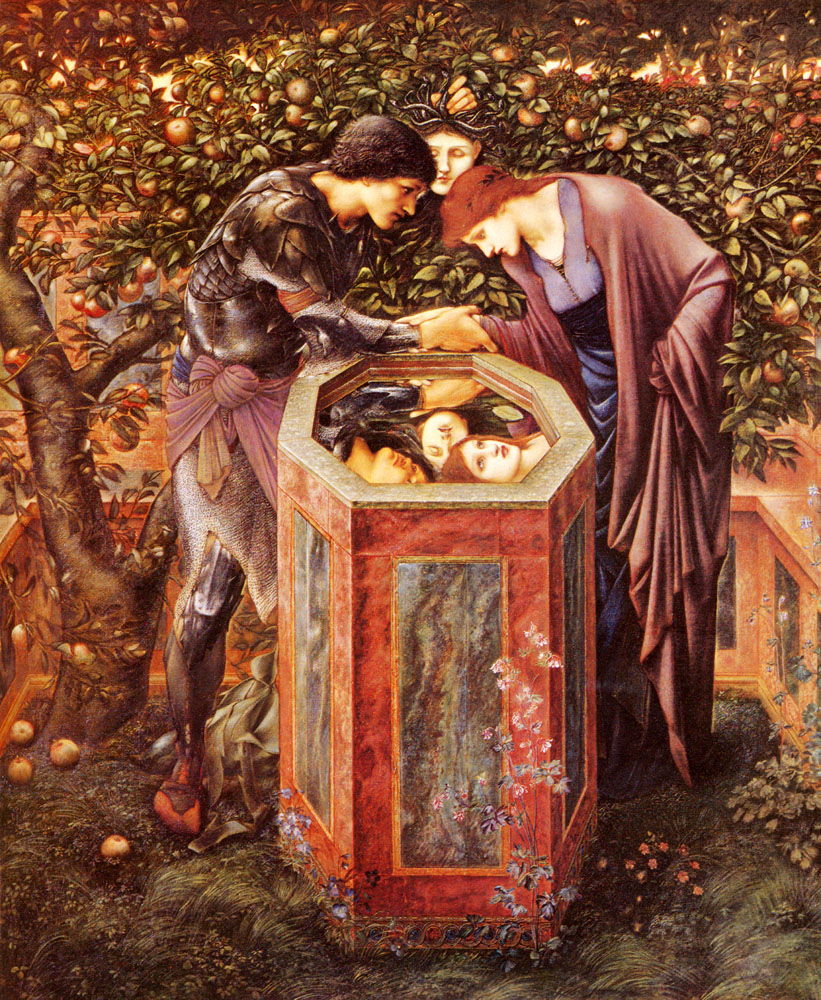
Edward Burne-Jones (1833–1898), The Perseus Series: The Baleful Head (1886-7), oil on canvas, 155 × 130 cm, Staatsgalerie Stuttgart, Stuttgart. Wikimedia Commons.
The tenth and final painting in Burne-Jones’ series, The Baleful Head (1885), shows Perseus and Andromeda, their right hands clenching one another’s wrists, looking at the image of Medusa’s face reflected in the surface of a well. This is set in a peaceful garden, with a fruit-laden apple tree behind, and flowers springing up from the grass beneath them.
Literary accounts take the couple on to live at Tiryns in Argos, from where Heracles/Hercules later undertook his Twelve Labours. They had seven sons and two daughters, and among their descendants were Heracles, Castor and Pollux, Clytemnestra, and the Achaemenid Persians.
When Perseus returned to Seriphos, he discovered Polydectes was still trying to seduce his mother Danaë. Perseus therefore used Medusa’s face to turn him to stone, and made Dictys king and his mother’s consort. His mission accomplished, Perseus returned the weapon and equipment loaned by the gods, and gave Athena the head of Medusa, which she then set in her shield as the Gorgoneion, more commonly referred to as the Aegis.
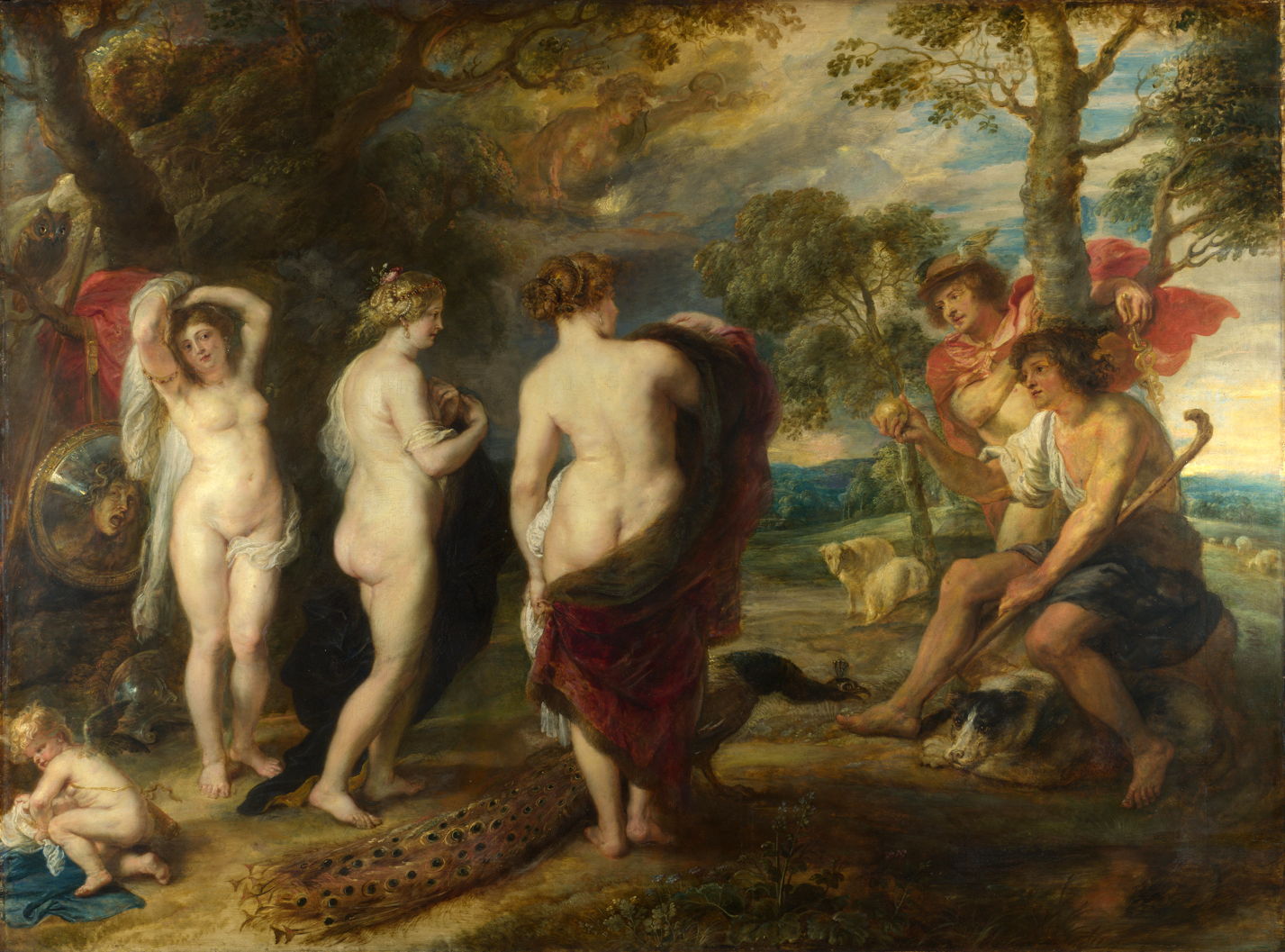
Peter Paul Rubens (1577–1640), The Judgement of Paris (1632-35), oil on oak, 144.8 x 193.7 cm, National Gallery, London. Wikimedia Commons.
Distinguishing the three goddesses taking part in The Judgement of Paris, shown in Rubens’ late account from 1632-35, often relies in part on the aegis. The three goddesses are, from the left, Athena with her shield, Aphrodite, and Hera with her peacock.
There was still one loose end to be tied, though: the prediction that Perseus would kill his father Acrisius. Various accounts are given of this, but consensus is that Perseus threw a quoit or discus that unintentionally struck Acrisius and killed him. Thereafter, he ruled a kingdom until he and Andromeda died. They were both catasterised into their own constellations, where they can still be seen today.
Many of the heroes of the classical world were deeply flawed. Theseus, founder of Athens, treated women appallingly, and Jason of the Argonauts was no better. This new series looks at paintings of the legendary lives of those who could have been villains or hooligans rather than the heroes they were held to be.
Perseus, the greatest slayer of monsters among them, seems to have been faithful to Andromeda, the princess he rescued from the jaws of Cetus, the sea monster. He even killed Polydectes, who was chasing his mother. Like several other classical heroes, Perseus was the result of divine union with a mortal, in this case Zeus/Jupiter with Danaë. She had been imprisoned in a bronze chamber to prevent her from becoming pregnant, as her father Acrisius, King of Argos, had been warned by an oracle that he would be killed by his daughter’s son.
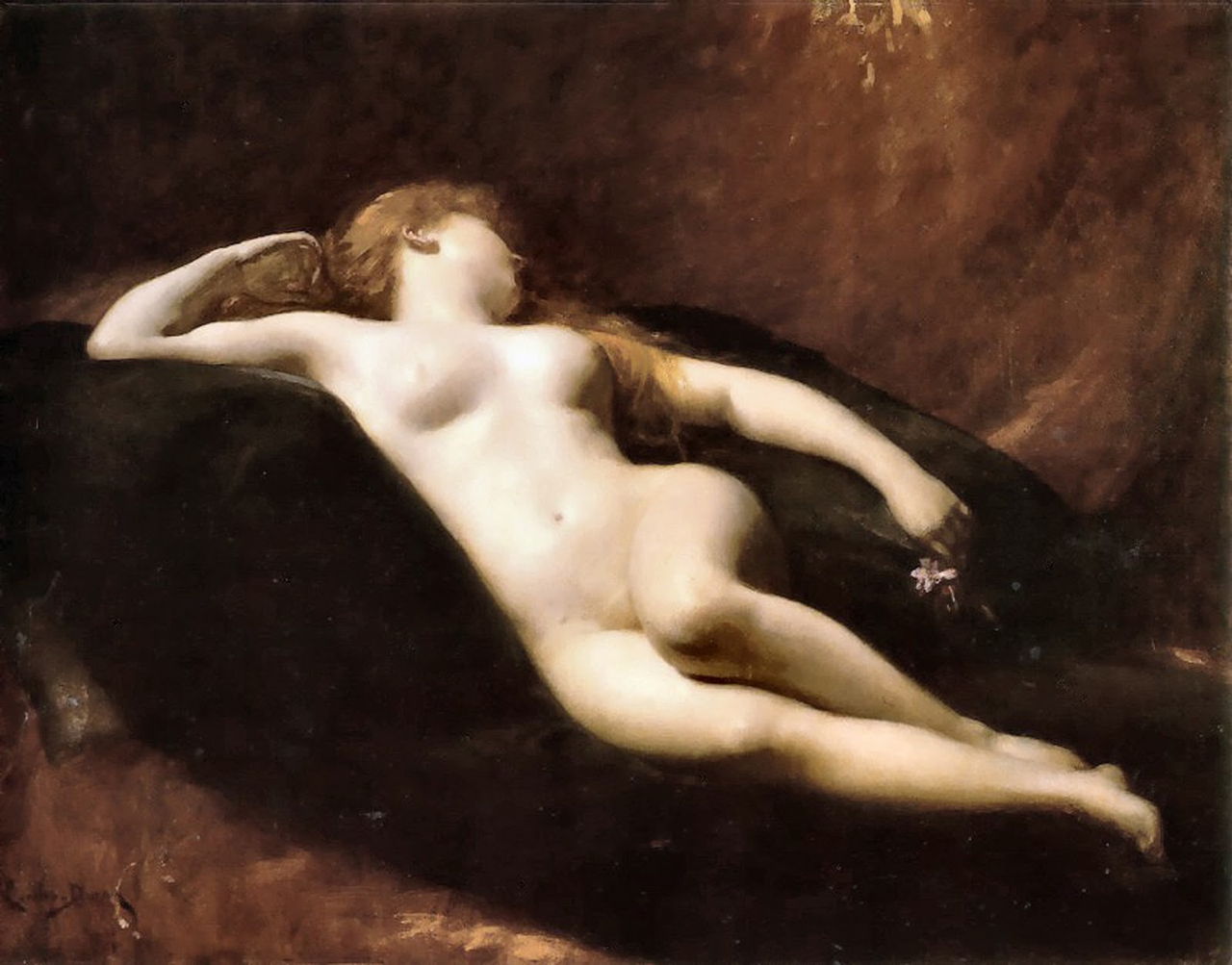
Carolus-Duran (1837–1917), Danae (c 1900), oil on canvas, 100 × 127 cm, Musée des Beaux-Arts, Bordeaux, France. Wikimedia Commons.
With a skylight as the chamber’s only source of light and air, Zeus descended on her in the form of golden rain. Danae (c 1900) is Carolus-Duran’s beautifully simple painting of this story, showing the shower of gold falling from its upper edge.
Gustav Klimt (1862–1918), Danae (1907), oil on canvas, 77 x 83 cm, Private collection. Wikimedia Commons.
Gustav Klimt’s Danaë is curled into a foetal ball, and is usually interpreted as showing arousal. She became pregnant, later giving birth to Perseus. Her father then tried to kill them both by putting them in a wooden chest and casting it into the sea, but they were washed up alive on the island of Seriphos, where Dictys, a fisherman and brother of King Polydectes, raised the boy.
As a young man, Perseus suspected the intentions of Polydectes towards his mother Danaë, and tried to protect her from him. In a bid to get Perseus out of his way, Polydectes called a large banquet for which each guest was expected to bring a gift of a horse. As Perseus had no horse to give, he asked the king to name a substitute, which was the head of the Gorgon Medusa, and the cue for Perseus’ major adventure.
Although the myths of Perseus have long been popular subjects for painters, none has devoted as much attention to them as Edward Burne-Jones, whose uncompleted Perseus series is one of the greatest visual accounts of any classical myth.
Edward Burne-Jones (1833–1898), The Perseus Series: The Call of Perseus (1877), bodycolour, 152.5 × 127 cm, Southampton City Art Gallery, Southampton, England. Wikimedia Commons.
This series starts with The Call of Perseus (1877), showing a double image of Perseus with Athena outside the city. At the left, Athena approaches the pensive Perseus, who is pondering how he can obtain the head of Medusa, staring into a stream. At the right, Athena has transformed herself into her regular and recognisable form, and is giving Perseus her advice, and providing him with the mirror with which he can view Medusa in safety. Although other artists have depicted this mirror as an impressive circular shield, throughout this series Burne-Jones shows it as a far smaller circular hand mirror.
The first call in Perseus’ mission were the sisters of the Gorgons, the Graiae (there are various spellings), who would in turn lead him to the Hesperides, who would provide him with a kibisis, a small bag into which he would put Medusa’s head.
Edward Burne-Jones (1833–1898), Perseus and the Graiae (1875-8), silver and gold leaf, gesso and oil on oak, 170.2 x 153.2 cm, National Museum of Wales, Cardiff, Wales. Wikimedia Commons.
Burne-Jones next shows Perseus with the three Graiae. He has just intercepted and seized their single, shared eye, which he is holding in his right hand, and only returns once they have led him to the Hesperides. The words in the inscription provide a potted summary, in translation: Pallas Athena spurred Perseus to action with her urging, and equipped him with arms. The Graiae revealed to him the remote home of the nymphs. From here he went with wings on his feet and with his head shrouded in darkness, and with his sword he struck the one mortal Gorgon, the others being immortal. Her two sisters arose and pursued him. Next he turned Atlas to stone. The sea serpent was slain and Andromeda rescued, and the comrades of Phineas became lumps of rock. Then Andromeda looked in a mirror with wonder at the dreadful Medusa.
(Modified from Anderson & Cassin.)
Perseus needed four more items for his mission: Zeus gave him an adamantine sword and the helm of darkness from Hades, enabling him to hide invisibly. Hermes lent out his winged sandals so that Perseus could fly like a god, and Athena provided him with a polished shield, so he could avoid looking directly at Medusa’s face, which would have turned him to stone.
Perseus then flew to the cave in which the Gorgons were asleep, and beheaded Medusa. From her severed neck sprung the winged horse Pegasus, and Chrysaor, a sword of gold.
Eugène Romain Thirion (1839–1910), Perseus Victorious Over Medusa (1867), oil, dimensions not known, Private collection. Wikimedia Commons.
Eugène Romain Thirion’s Perseus Victorious Over Medusa from 1867 respects convention, with the hero triumphantly holding Medusa’s head aloft, facing away from him. He shows Pegasus behind, but not Chrysaor, which is generally omitted from these paintings, and indeed from some verbal accounts.
The two surviving Gorgons tried to pursue Perseus, but he donned the helm of Hades and became invisible to them. He flew over North Africa, and sought rest and accommodation from Atlas there. However, Atlas refused him hospitality, for which Perseus showed him the face of Medusa, turning him to stone.
Edward Burne-Jones (1833–1898), The Perseus Series: Atlas Turned to Stone (1878), bodycolour, 152.5 × 190 cm, Southampton City Art Gallery, Southampton, England. Wikimedia Commons.
The seventh painting in Burne-Jones’ Perseus Series, his Atlas Turned to Stone (1878), shows the aftermath of Atlas’ failure to offer hospitality: he has been turned to stone by the residual power of Medusa’s face, and now stands bearing the cosmos on his shoulders as Perseus flies off to Ethiopia to rescue Andromeda.
Perseus stopped in Ethiopia, which was ruled by King Cepheus and Queen Cassiopeia. She had boasted of the beauty of her daughter Andromeda, and so incurred the wrath of Poseidon, bringing floods and a voracious sea monster named Cetus. The local oracle told the king and queen that the only way to save their people from Cetus was to sacrifice their daughter to the monster. Accordingly, and with great grief, they were forced to comply. Andromeda was therefore fastened to a rock at the edge of the sea to await Cetus.
Frederic, Lord Leighton (1830–1896), Perseus and Andromeda (1891), oil on canvas, 235 × 129.2 cm, Walker Art Gallery, Liverpool, England. Wikimedia Commons.
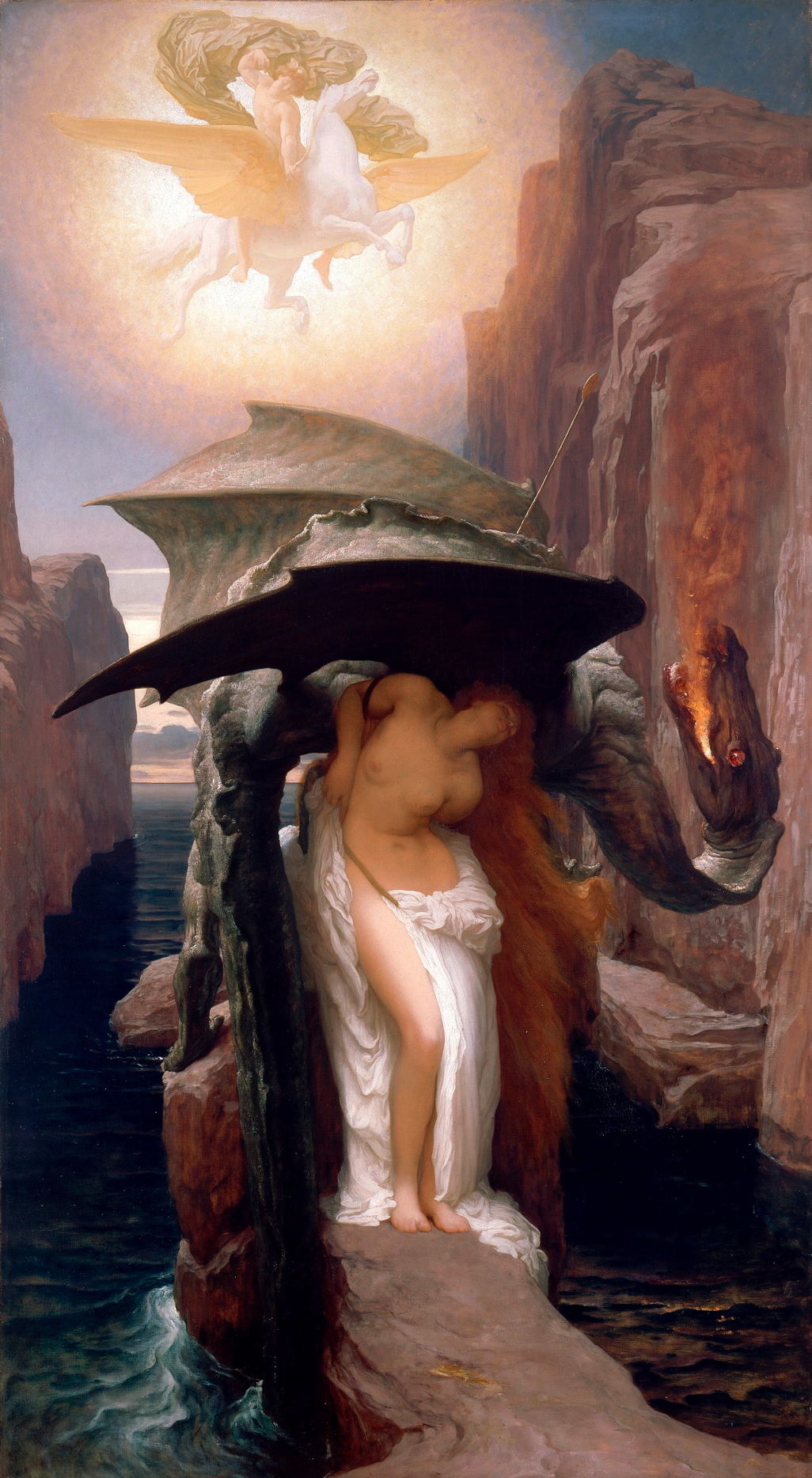
Frederic, Lord Leighton’s Perseus and Andromeda (1891) shows the ‘invisible’ Perseus astride Pegasus shooting arrows into Cetus, while the monster surrounds Andromeda. Cetus is here a conventional fire-breathing dragon, complete with stereotypical wings and a long tail. Andromeda is not naked, as her modesty is preserved by draping a white robe around her waist.
Unknown, Perseus Freeing Andromeda (c 50-75 CE), height 122 cm, Casa dei Dioscuri (VI, 9, 6), Pompeii, moved to Museo Archeologico Nazionale di Napoli, Naples. By WolfgangRieger, via Wikimedia Commons.
This Roman wall painting from the ruins of Pompeii, dated to about 50-75 CE, adopts the approach typical of many later artists, showing a close-up of the couple. Andromeda is still chained to the rock by her left wrist, and is partially clad, nakedness being reserved for the hero and half-god Perseus. He has Medusa’s head tucked behind him, its face shown for ease of recognition, wears his winged sandals, and carries a straight sword in his left hand. There is still no sign of any sea monster.
The ancient Greek myth of Pandora had been almost unknown in paintings until the nineteenth century. During the 1870s it suddenly became a popular theme for European paintings, but its narrative had altered from the original in showing the first woman in Greek mythology with a box containing the ills of the world, rather than a large earthenware storage pot, and only one artist had depicted its crux.
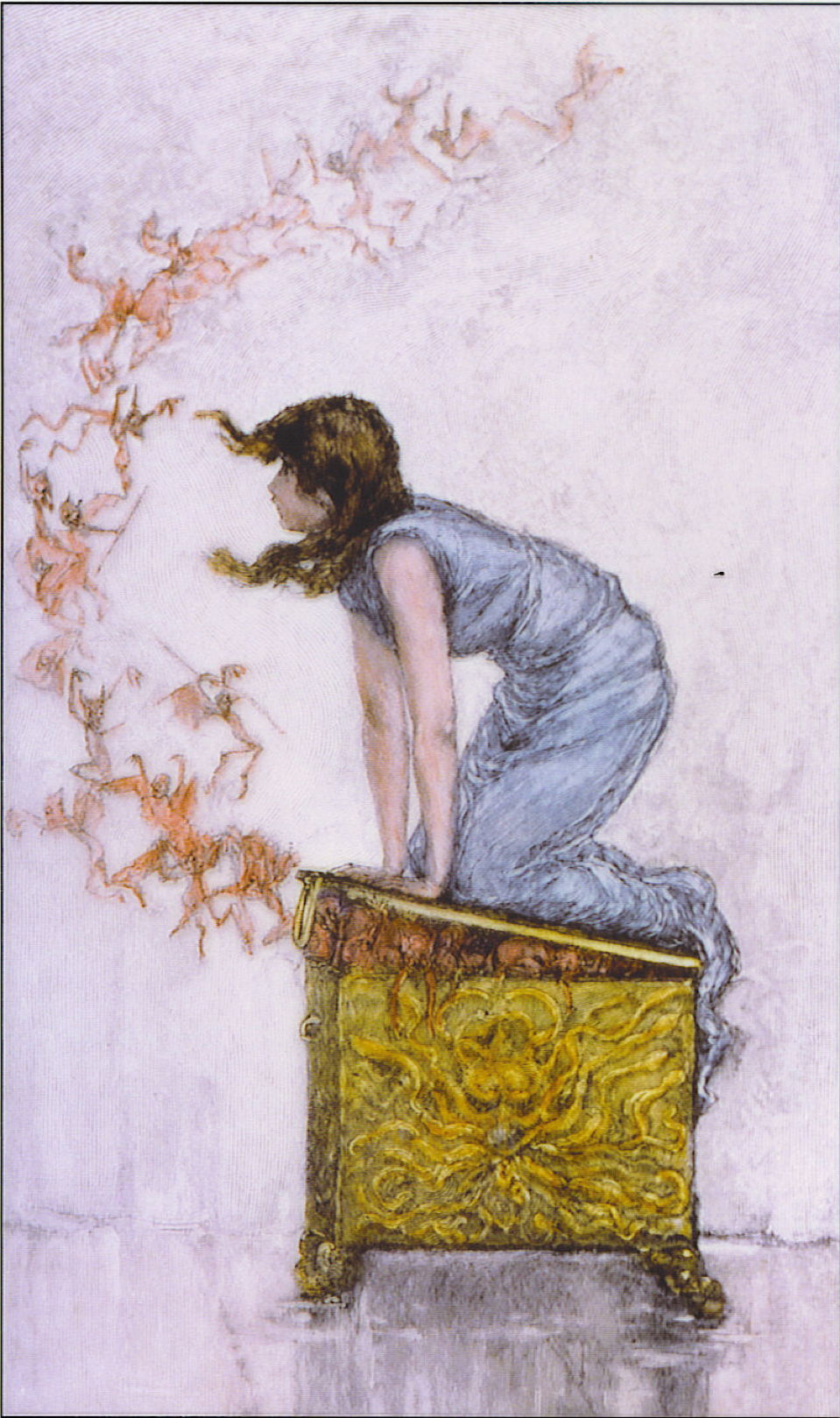
Frederick Stuart Church (1842–1924), Pandora (1883), pencil and ink wash on paper, 30.2 x 45.7 cm, Private collection. Wikimedia Commons.
The story broke out of Europe by 1883, when the American painter and illustrator Frederick Stuart Church painted his more illustrative Pandora. Dressed more modestly (presumably for a wider audience), she is shown as an innocent young woman kneeling on a large golden chest as she tries to close its lid and stop the emerging stream of red demons. I suspect this was intended as an illustration for a printed collection of classical myths.
Walter Crane (1845–1915), Pandora (1885), watercolour on paper, 53.3 x 73.6 cm, location not known. Wikimedia Commons.
The following year Walter Crane, a British painter and illustrator, painted Pandora in an unusual interpretation that’s only loosely connected with the original myth. She is here draped in grief over a substantial casket, and on its side panel are the figures of the three Fates. At the corners of the casket are guardian winged sphinxes, each clasping a sphere.
William-Adolphe Bouguereau (1825–1905), Pandora (1890), oil on canvas, 92.5 × 64.5 cm, location not known. Wikimedia Commons.
In his later years, William-Adolphe Bouguereau chose an oddly androgynous model for his depiction of Pandora in 1890, but has rather lost the narrative. Her neutral expression, body language, and the closed box tell little of what is imminent.
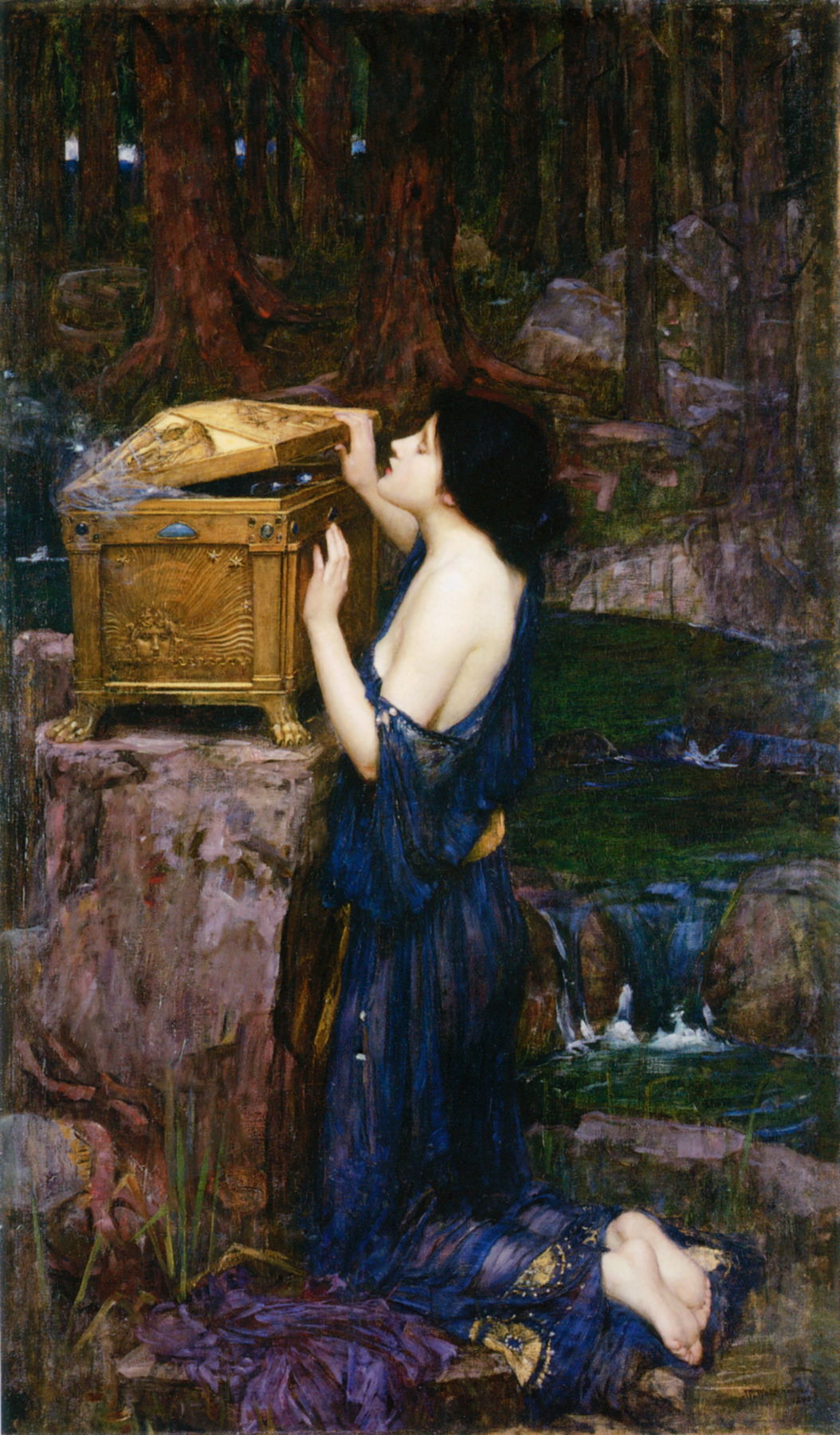
John William Waterhouse (1849–1917), Pandora (1896), oil on canvas, 152 × 91 cm, Private collection. Wikimedia Commons.
One of his lesser-known paintings, John William Waterhouse’s Pandora from 1896 is a major depiction of this myth, and one of the most complete. Set by a small brook in a dark, primeval forest, her box has become a large gold chest encrusted with precious stones and decorated with mythological motifs. Pandora kneels by its side, peeking inside as she carefully raises its lid, but even this tentative glimpse is sufficient to release its stream of ills, of which she appears unaware.
Ernest Normand (1857-1923), Pandora (1899), further details not known. The Athenaeum.
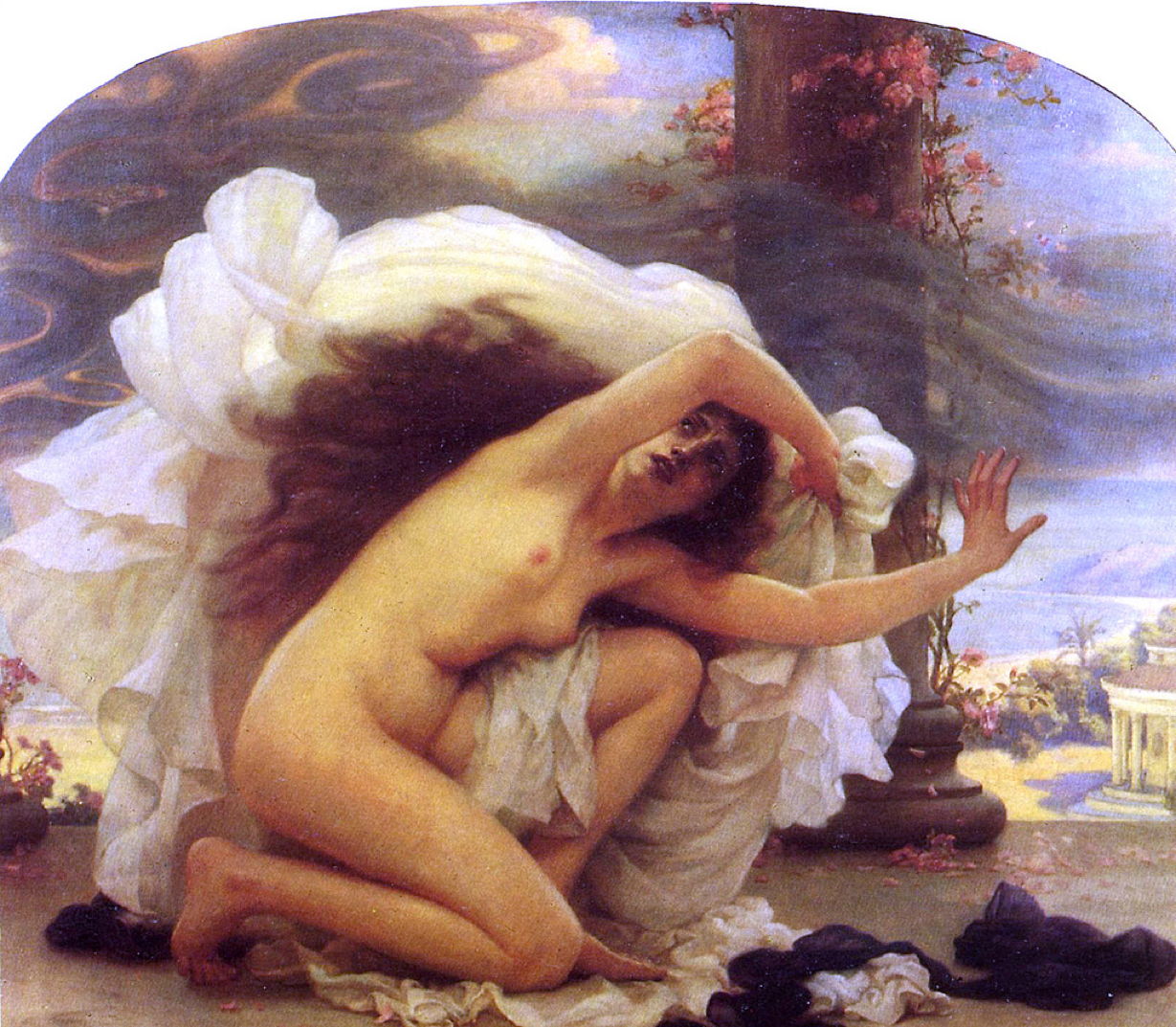
Ernest Normand is one of few painters to show a later moment, in which Pandora (1899) bends low to duck beneath the swirling grey clouds of evils as they spread out into the idyllic world beyond, causing blossom to fall as petals to the ground. Her jar is only hinted at, behind her billowing white robes, almost depriving the viewer of this vital clue to the original story.
Arthur Rackham (1867–1939), Pandora (date not known), further details not known. Wikimedia Commons.
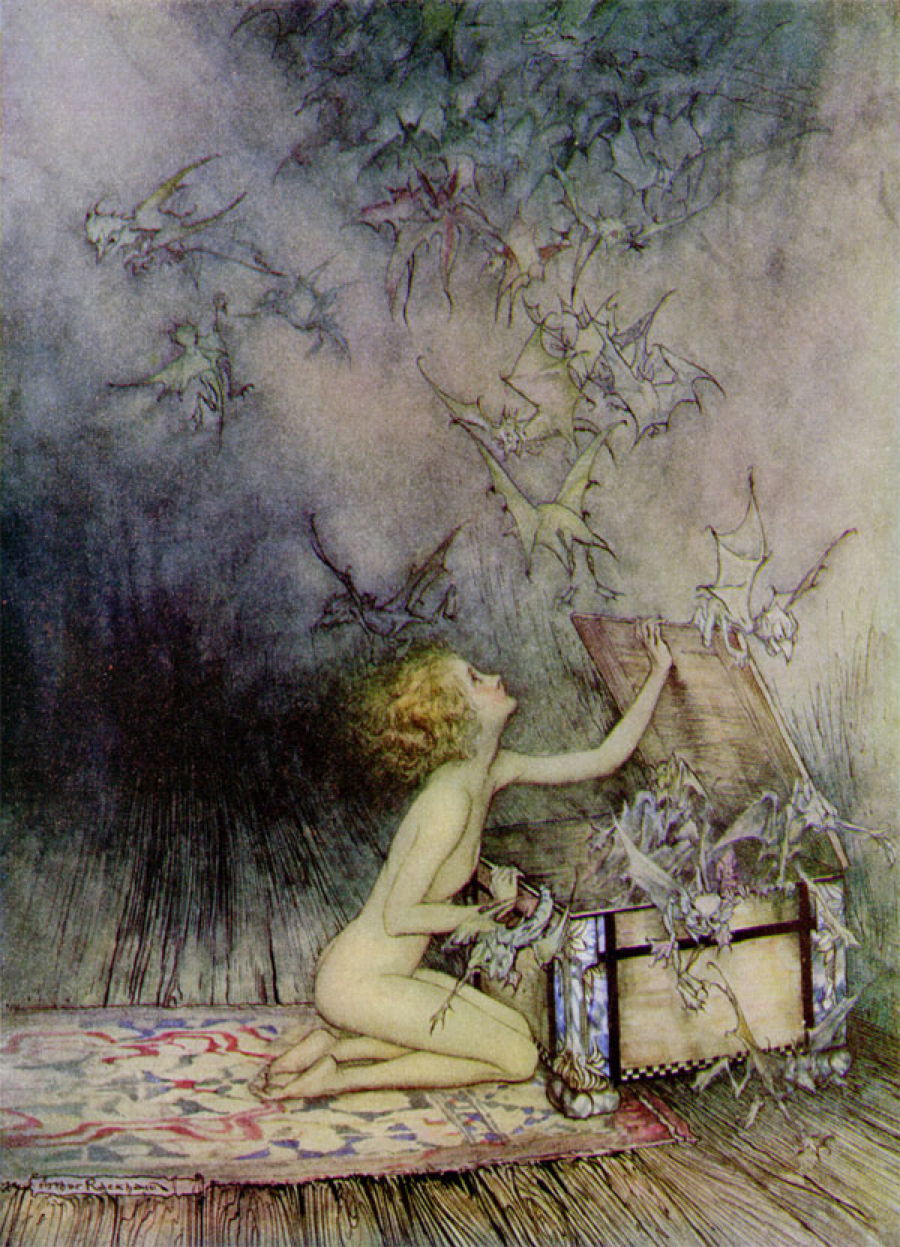
I have been unable to find a date for this presumed illustration by the great Arthur Rackham of Pandora, but suspect it was made around the turn of the twentieth century, and intended to accompany a British English retelling of this myth. As with Church before, Pandora is young and innocent in her nakedness. She gazes up in awe at the batlike demons as they escape from the open lid of her large wooden chest, seemingly unaware of what she is unleashing in her curiosity.
Thomas Benjamin Kennington (1856–1916), Pandora (1908), oil on canvas, 166.3 × 113 cm, Private collection. Wikimedia Commons.
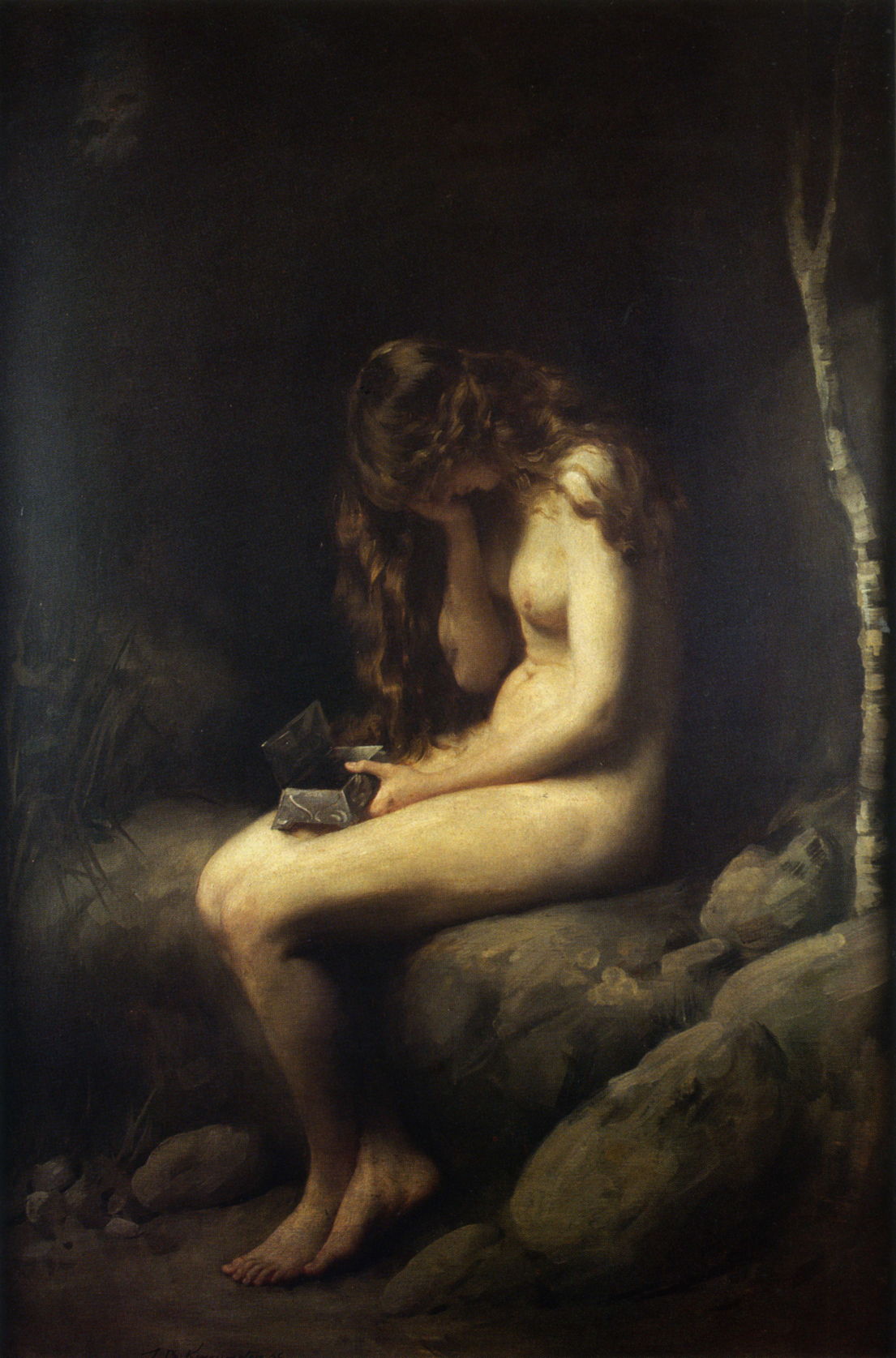
Thomas Benjamin Kennington shows Pandora (1908) in the final phase of regret and sorrow, after the evils have all been released. Her box, now empty, with no sign of the remaining Hope, rests on her thigh. She hangs her head in shame, resting it on her right hand as she weeps at what she has done. Unfortunately, the released demons shown at the left edge are so dark that they are hard to see.
Over this period, other artists had also been painting the story of the creation of Pandora, a theme I have avoided so far. I will, though, show one of its more unusual depictions, a painting lost for forty years.
John Dixon Batten (1860-1932), The Creation of Pandora (1913), tempera on fresco, 128 x 168 cm, Reading University, Reading, England. Wikimedia Commons.
John Dixon Batten’s The Creation of Pandora was painted anachronistically in egg tempera on a fresco ground by 1913. Batten was one of the late adherents of the Pre-Raphaelite movement, and now almost forgotten. It had been exhibited in a commercial gallery, and was acquired by the University of Reading, England, shortly before the First World War. Deemed unfashionable in 1949, it was put into storage and quietly forgotten until its rediscovery in 1990.
Pandora is at the centre, having just been fashioned out of earth by Hephaestus, who stands at the left, his foot on his anvil. Behind them, other blacksmiths work metal in his forge. At the right, Athena is about to place her gift of a robe about Pandora’s figure, and other gods queue behind her to offer their contributions.
Just before the start of the First World War, Odilon Redon made a series of studies leading to a radically different presentation of Pandora’s story.
Odilon Redon (1840–1916), Pandora (date not known), pastel and charcoal on board, 22.1 x 29.1 cm, Museum of Fine Arts, Houston, TX. Wikimedia Commons.
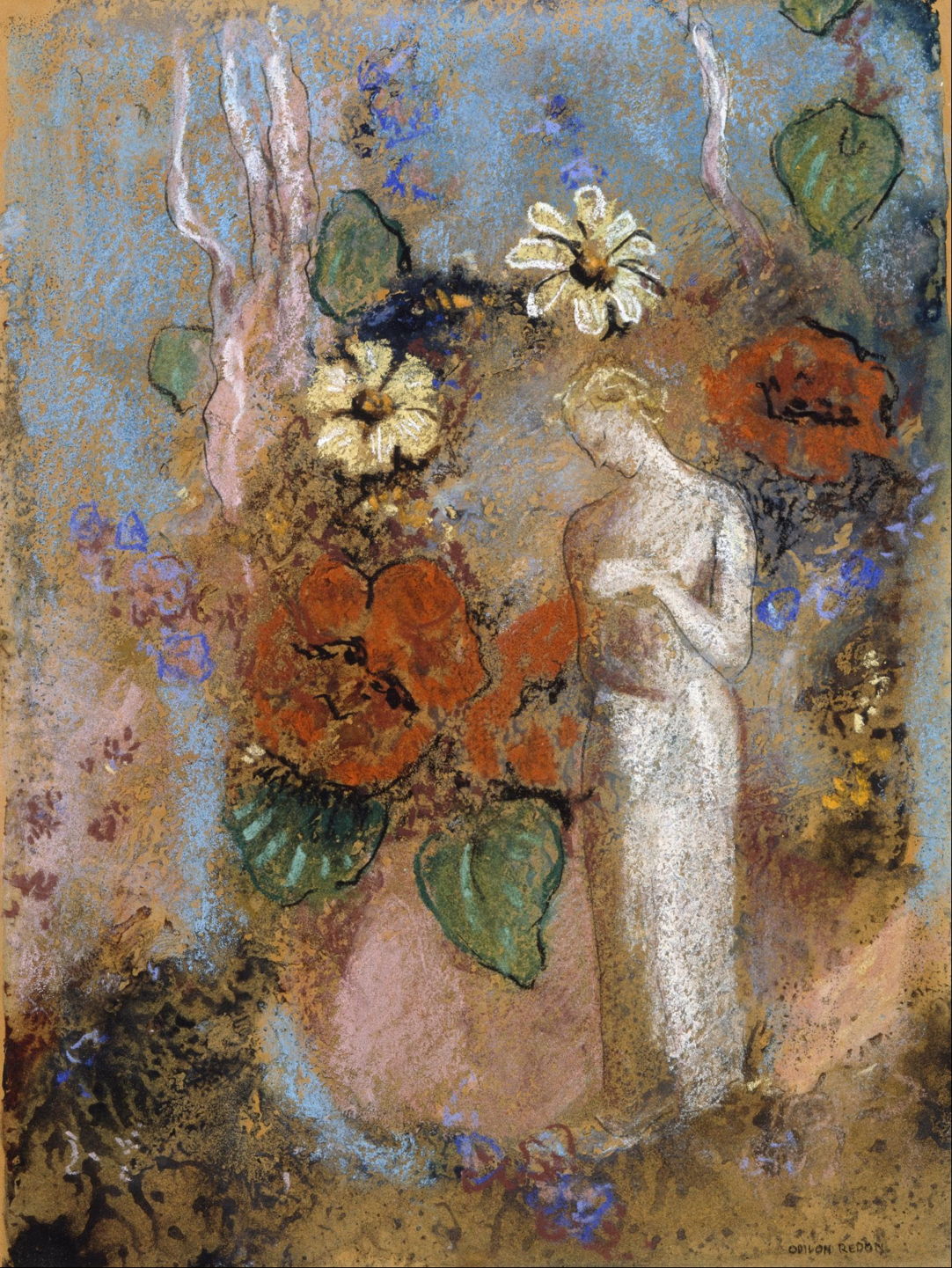
Redon’s undated pastel study of Pandora shows her clasping her box close in the midst of huge floral images.
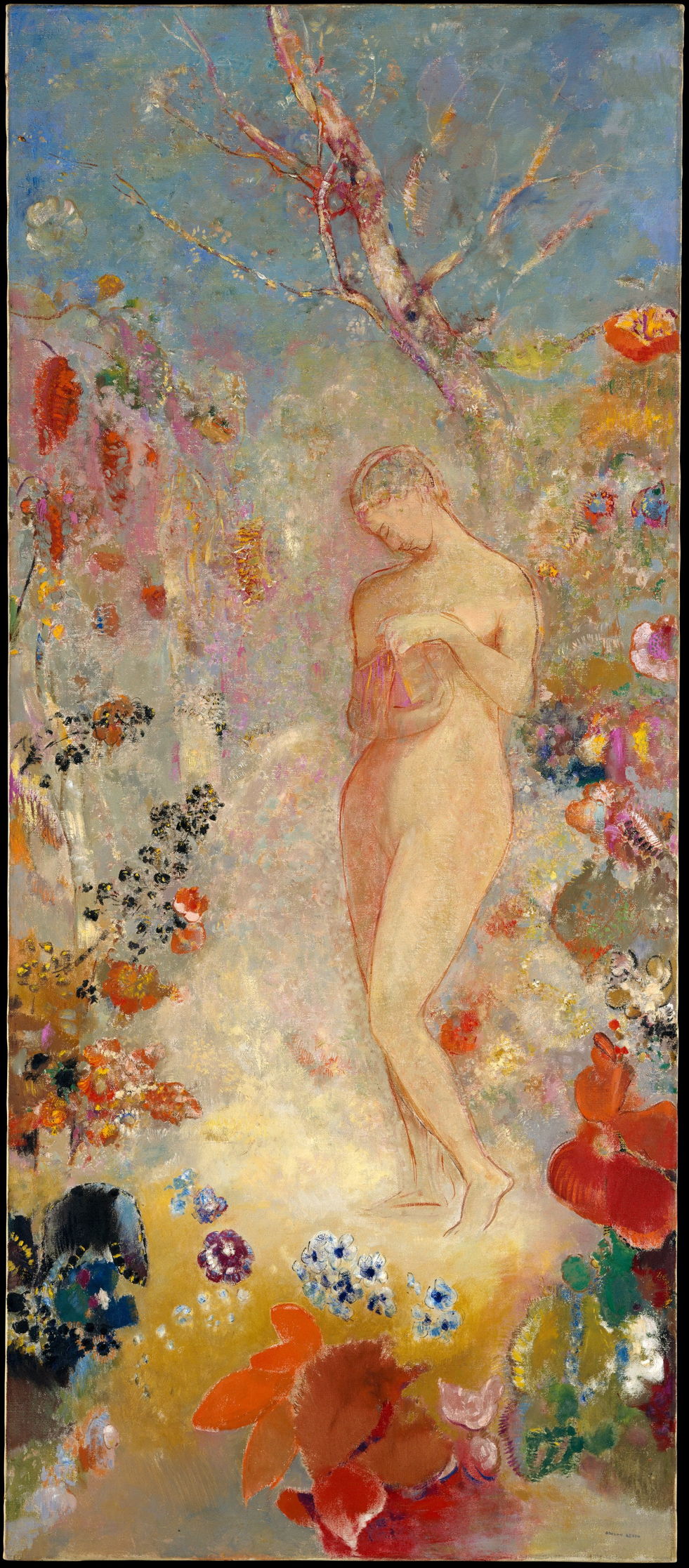
Odilon Redon (1840–1916), Pandora (c 1914), oil on canvas, 143.5 x 62.2 cm, The Metropolitan Museum of Art (Bequest of Alexander M. Bing, 1959), New York, NY. Courtesy of The Metropolitan Museum of Art.
Redon’s finished oil painting of Pandora from about 1914 shows her more clearly, surrounded by a garden of exquisite and exotic blooms, referring to Eve’s Paradise before the Fall. She holds her box to her bosom, as she succumbs to the temptation to open it, but Redon stops just short of showing its evils pouring out.
Yvonne Gregory (Park) (1889-1970), Pandora (1919), photograph, published in ‘Photograms of the Year’, 1919, further details not known. Wikimedia Commons.
My final representation of the myth of Pandora is a photograph from 1919 by the society portrait photographer Yvonne Gregory (who also worked under her married surname of Park): Pandora. The box lies wide open by her knees, as Pandora is bent double in distress over it, her left arm over her head to shelter her from the demons that have been released, and in grief at what she has done.
Given the disasters that had struck the world in the years immediately preceding this photograph – the mass carnage of the war, and the influenza pandemic which followed it – it must have had great impact when it was published in 1919. Much as these images have today. For despite the story’s underlying misogyny, I can’t help thinking that Pandora’s box has been opened yet again.
Stories are at the centre of our lives, and the focus of many of those is the origin of our species and societies. Ancient myths account for the first men and women, and how the world came to be as we know it. Whatever the scientific truth, we still tell stories about events long before historical records, among them the myth of Pandora and her box containing pain and evils.
Although earliest records of Pandora’s story stretch back to around 750 BCE, in one of the oldest Greek anthologies of myth, they weren’t included in the most popular compilations such as Ovid’s Metamorphoses, so seldom appeared in paintings, although it did enter English usage in the sixteenth century. It wasn’t until the late nineteenth century that Pandora’s box caught on and became a popular theme in images. This weekend I trace Pandora’s history in European paintings.
The story of Pandora and her ‘box’ is told most fully in Hesiod’s Works and Days, where she is the original woman, created by Hephaestus (Vulcan) for Zeus, as punishment for humans receiving the gift of fire that had been stolen by Prometheus. After she was formed from earth by Hephaestus, other gods gave her properties to determine her nature.
Athena dressed her in a silvery gown, and taught her needlecraft and weaving. Aphrodite shed grace on her head, together with cruel longing and cares. Hermes gave her a shameful mind and deceitful nature, together with the power of speech, including the ability to tell lies. Other gifts were provided by Persuasion, the Charities, and the Horae.
Pandora also carried with her a large earthenware jar (in Greek, pithos) containing toil and sickness that bring death to men, diseases, and a myriad of other pains. Zeus gave her as a gift to Epimetheus, brother of Prometheus. She then opened her jar, and released its evils into the earth and sea. The only thing remaining in the jar was Hope, who stayed under its lip.
This marked the beginning of Hesiod’s second age of mankind, its Silver Age, in which people knew birth and death, as humans had become subject to death, and Pandora brought birth too. In later accounts, Epimetheus married Pandora, and the couple had a daughter Pyrrha, who married Deucalion with whom she survived the flood.
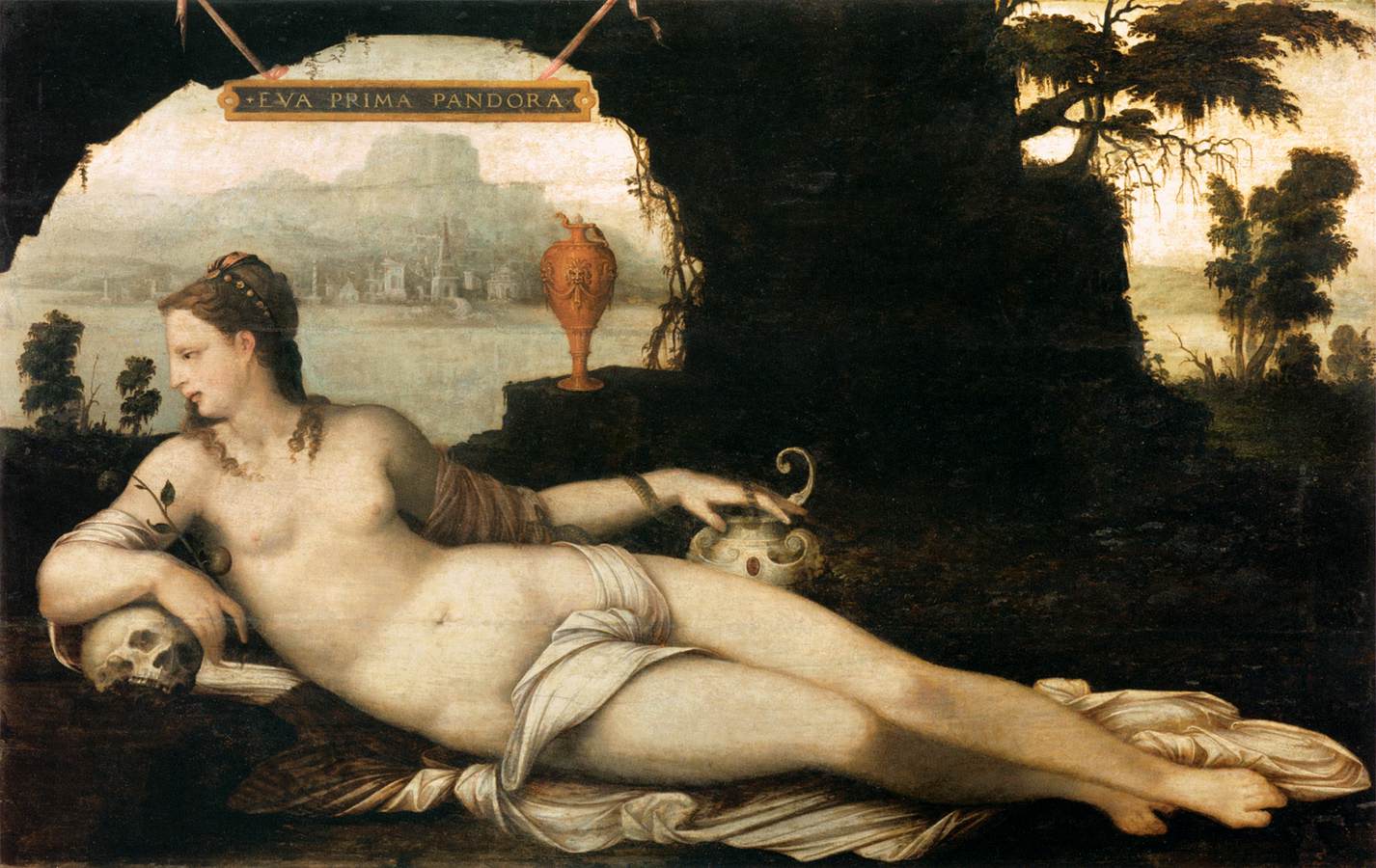
Jean Cousin (1500–1589), Eva Prima Pandora (c 1550), oil on panel, 97 x 150 cm, Musée du Louvre, Paris. Wikimedia Commons.
As with other classical myths, at the time that Jean Cousin painted Eva Prima Pandora, in about 1550, it had been mixed with Christian religious narrative, in this case of Eve and the Fall of Mankind. No longer clothed in Athena’s silvery gown, Eve/Pandora lies naked, propped against a human skull. Her left hand clutches the dreaded jar, which she hasn’t opened yet. Her right hand holds a fruiting sprig of the apple tree, an allusion to the traditional Biblical story of Eve. Coiled around her left arm is a serpent, another reference to the Fall of Mankind.
Pandora seems to have been very seldom if ever painted after that, until the nineteenth century.
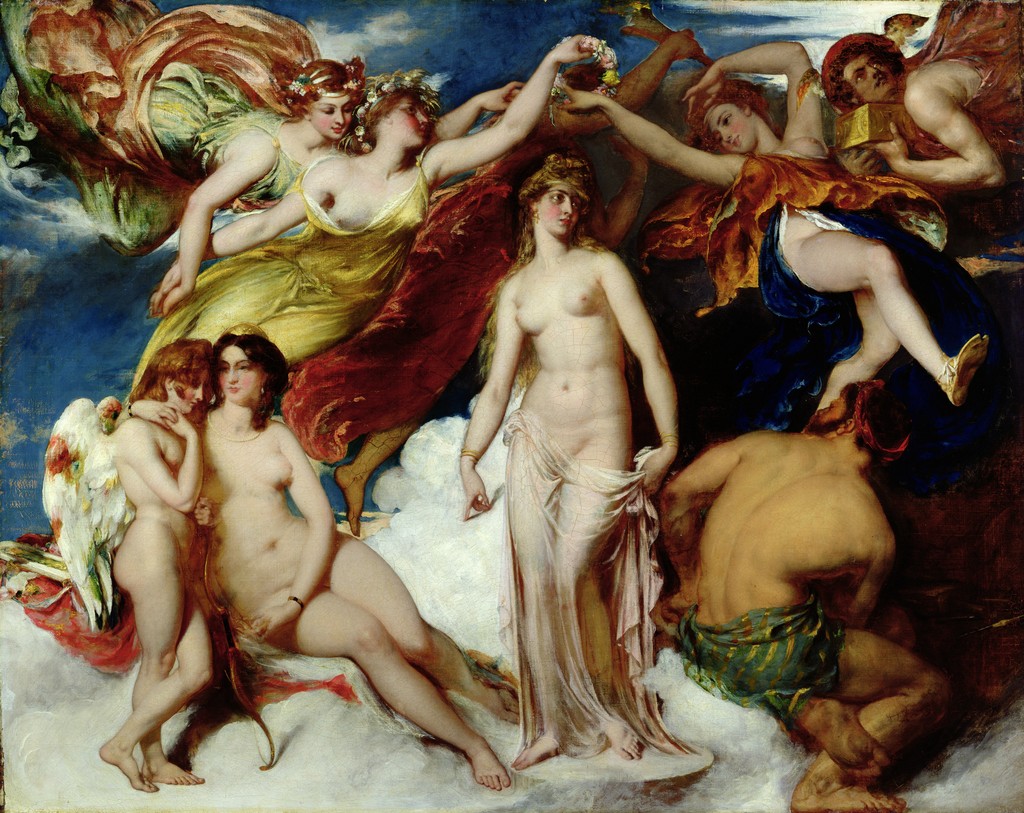
William Etty (1787–1849), Pandora Crowned by the Seasons (1824), oil on canvas, 87.6 × 111.8 cm, Leeds City Art Gallery, Leeds, England. Wikimedia Commons.
When William Etty painted her, in Pandora Crowned by the Seasons in 1824, the significance of the crux of the story, Pandora opening the jar, had become lost in the other detail, and she was just another opportunity to paint a statuesque and almost naked young woman.
Henry Howard (1769-1847), The Opening of Pandora’s Vase (1834), oil on panel, 76.6 x 166.5 cm, Sir John Soane’s Museum, London. The Athenaeum.
It was the now-forgotten Henry Howard who first painted The Opening of Pandora’s Vase in 1834. Pandora, more correctly dressed, crouches to duck the torrent of woe, evil and pain as it streams from the jar, as Epimetheus tries in vain to reseal its lid. This is the story as told by Hesiod in his Works and Days.
The literary story seems to have changed Pandora’s jar into a box as the result of a mistranslation in the sixteenth century, but that transition doesn’t appear to have occurred in paintings until between 1834 and 1860. It also seems more likely that it resulted from confounding of this story with that of Psyche, who had a box she couldn’t open.
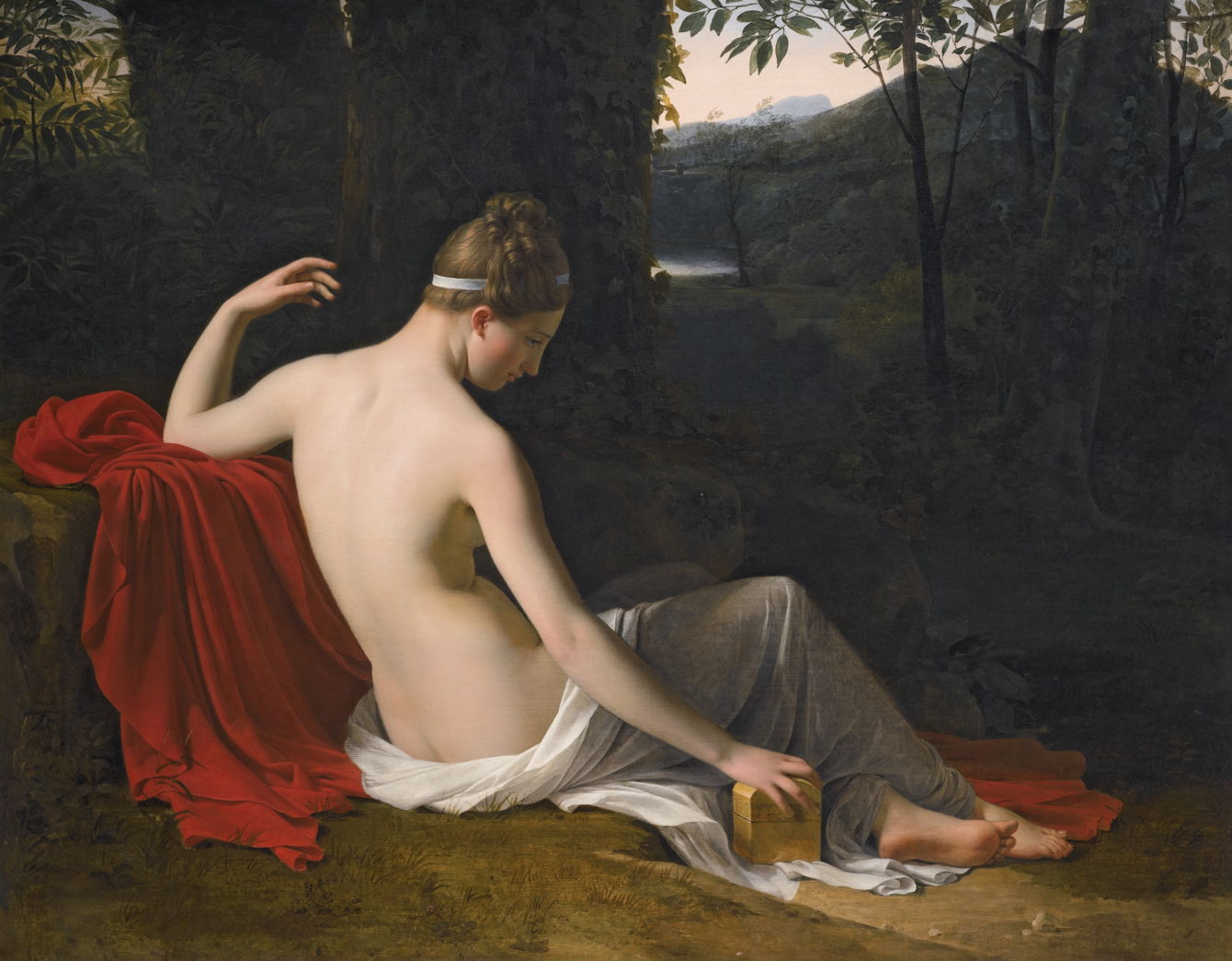
Louis Hersent (1777–1860) (attr), Pandora Reclining in a Wooded Landscape (date not known), oil on canvas, 138 x 173 cm, Private collection. Wikimedia Commons.
This undated painting attributed to Louis Hersent of Pandora Reclining in a Wooded Landscape gives the revised account, with the box firmly shut in Pandora’s right hand, and the motif an uncommitted combination of landscape, nude figure, and weak narrative.
In the 1870s, this suddenly became one of the most popular subjects for mythological paintings. This doesn’t appear to have been the result of it being told in another creative medium, though.
Dante Gabriel Rossetti (1828–1882), Pandora (1871), oil on canvas, 131 × 79 cm, Private collection. Wikimedia Commons.
Dante Gabriel Rossetti’s first painting of Pandora, completed in 1871, shows a moody, brooding Pandora, modelled by Jane Morris. She has just cracked open the lid of the jewelled casket in her left hand, and it’s emitting a stream of noxious red smoke. As this coils around her head, winged figures appear in the fumes. The inscription on the side of the jewel casket reads “Nascitur ignescitur”, meaning born of flames.
This was one of Rossetti’s earlier paintings of Jane Morris, wife of his friend William Morris, and later to be the subject of Rossetti’s passionate obsession. Rossetti’s source for the story was most probably Lemprière’s dictionary of classical mythology, which erroneously referred to Pandora’s box, not jar. It was commissioned by John Graham for 750 guineas, who was so pleased with the result that he exhibited it, against Rossetti’s wishes, in Glasgow the following year.
Jules Lefebvre (1834–1912), Pandora (1872), oil on canvas, 132 × 63 cm, Museo Nacional de Bellas Artes, Buenos Aires, Argentina. Wikimedia Commons.
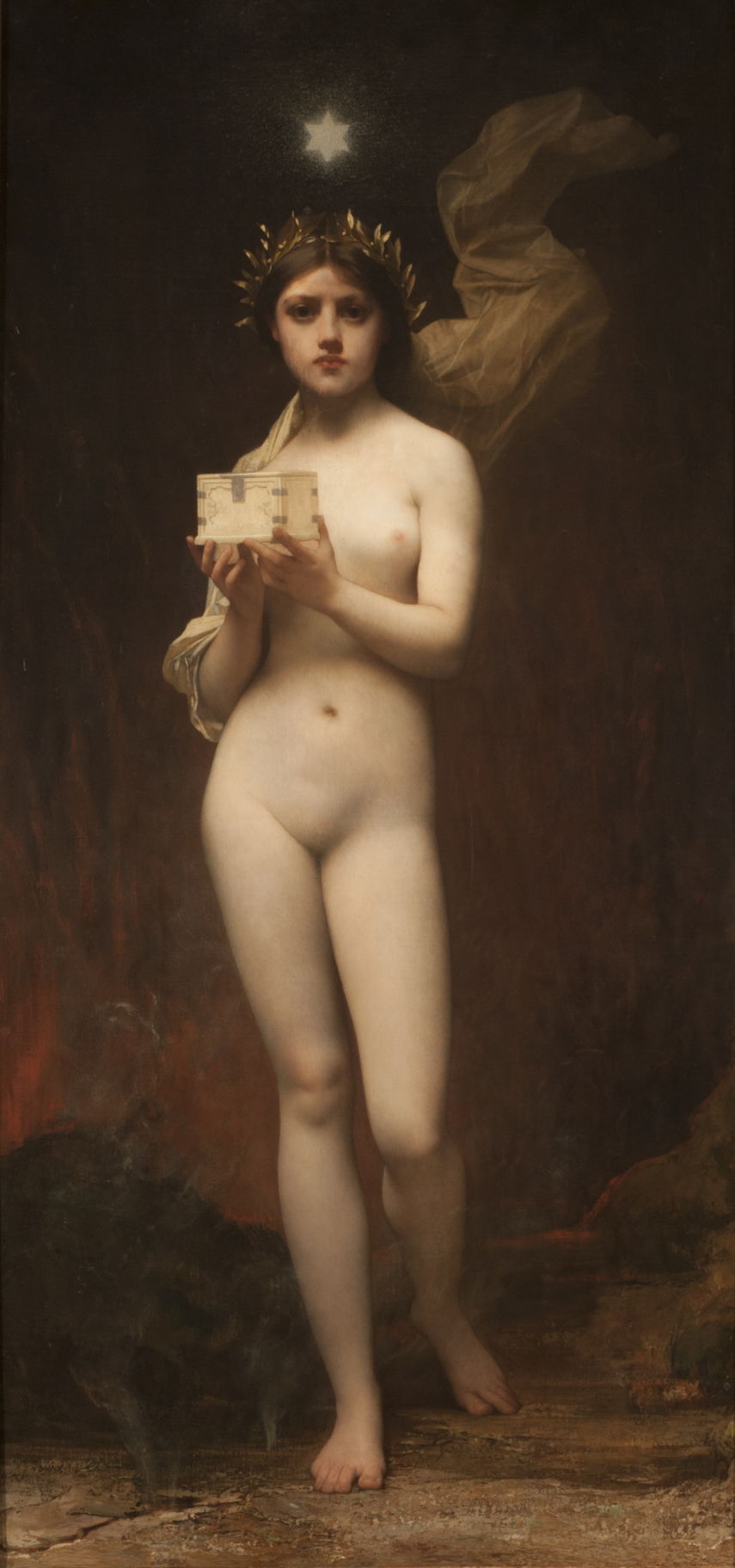
Jules Lefebvre was another artist who painted Pandora more than once. This initial version from 1872 shows her walking with the fateful box held in both hands, its lid firmly shut. Ominous smoke rises from a series of fumaroles in the ground around her. She is nude, wears an unusual coronet, and there is a six-pointed star above her head.
Alexandre Cabanel (1823–1889), Pandora (1873), oil on canvas, 70.2 x 49.2 cm, Walters Art Museum, Baltimore, MD. Wikimedia Commons.
Next was Alexandre Cabanel’s portrait of the Swedish soprano Christina Nilsson (1843-1921) as Pandora, from 1873. As a portrait rather than a faithful account of the myth, the box is closed, almost concealed, and its significance suppressed.
Paul Césaire Gariot (1811-1880), Pandora’s Box (1877), oil on panel, 81 × 56.2 cm, Private collection. Wikimedia Commons.
In 1877, the elderly Paul Césaire Gariot’s Pandora’s Box places her in a primeval world of rock, studying the closed box intently, wrestling internally with the desire to open it.
Dante Gabriel Rossetti (1828–1882), Pandora (1878), coloured chalks, 100.8 × 66.7 cm, Lady Lever Art Gallery, Liverpool, England. Wikimedia Commons.
The following year, Dante Gabriel Rossetti made this chalk study for a second painting of Pandora, again using Jane Morris as his model. Her face shows a faint agony this time, as a decorative golden stream emerges from a crack in the lid. Here the inscription reads “Ultima manet spes” – hope remains last, perhaps a candidate for Rossetti’s own epitaph.
Lawrence Alma-Tadema (1836–1912), Pandora (1881), media and dimensions not known, Private collection. Wikimedia Commons.
Lawrence Alma-Tadema sought a compromise in his Pandora of 1881, in which she holds not a box but a small pot, suitably decorated with a Sphinx. In what appears to be a skilfully painted watercolour, Pandora hasn’t yet given way to the temptation to open the pot.
Jules Lefebvre (1834–1912), Pandora (1882), oil on canvas, 96.5 × 74.9 cm, Private collection. Wikimedia Commons.
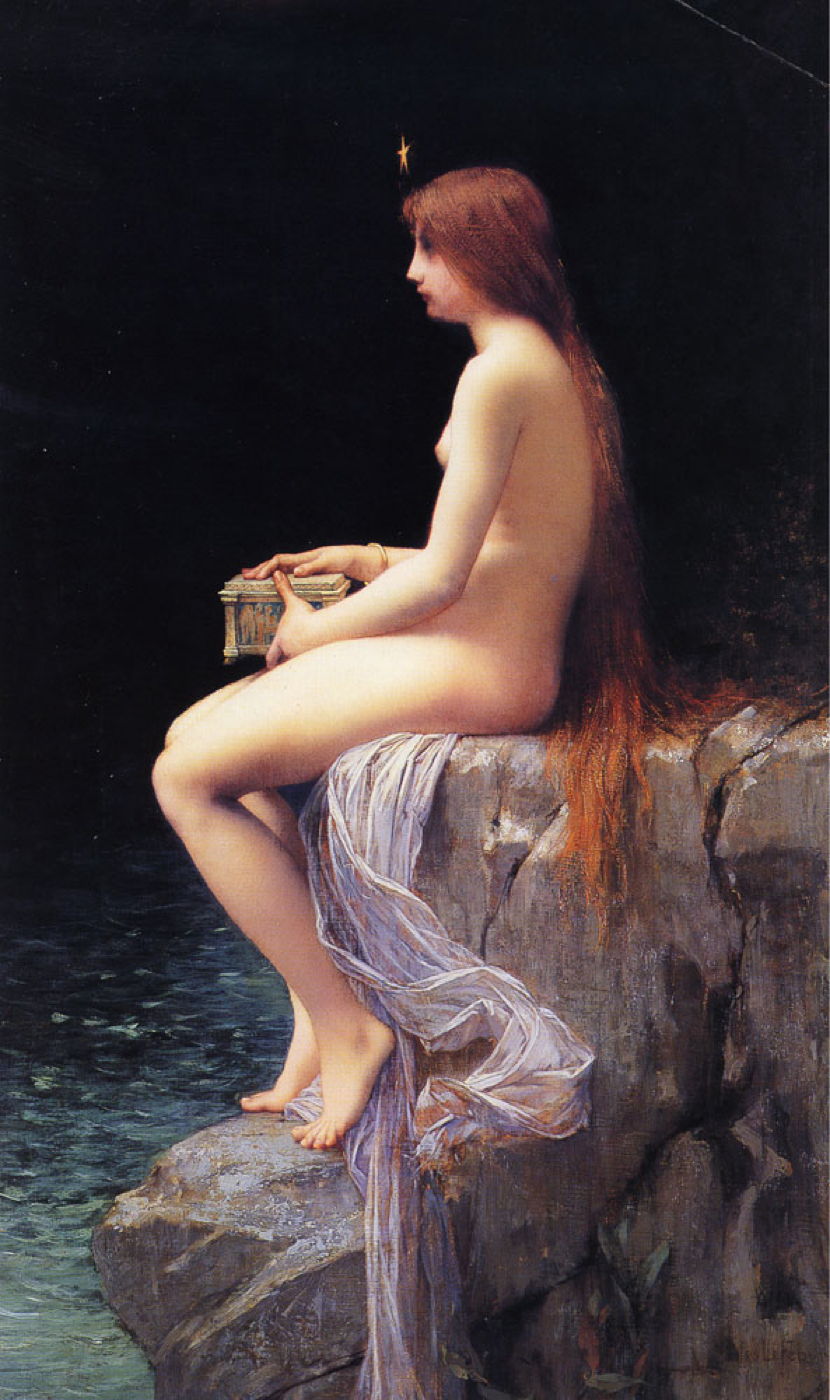
Jules Lefebvre’s second painting of Pandora made in 1882, a decade after his first, places her in profile next to the sea. She has a star just above her forehead, but that has become five-pointed rather than six, perhaps to dodge any Jewish connotations. His previous gentle narrative has all but vanished.
By this time only one artist had attempted to depict the crux of the story, and that had been Henry Howard almost fifty years earlier.
In addition to his account of the battle between Lapiths and centaurs at the wedding feast of Pirithous and Hippodame, Ovid tells the story of Nessus the centaur and his attempt to abduct Hercules’ wife.
Nessus had set himself up as the ferryman on the river Euenos, in western Greece. One day, Deianeira, the beautiful wife of Hercules, wanted to cross the river, so she mounted Nessus’ back and he took her across. As he was doing so, he decided to try to abduct and rape her. However, Hercules was on the bank they had just left, and heard her cries. He drew his bow and shot Nessus in the breast with an arrow whose tip was poisoned with the blood of the Lernean Hydra.
As Nessus lay dying, in an act of revenge he told Deianeira that his blood would act as a love charm to ensure that Hercules would be true to her forever, which she foolishly believed. She collected his blood, and kept it ready for use. Some years later, Hercules was having an affair with the young and beautiful Iole. When Deianeira discovered this, she spread Nessus’ blood on a shirt (chiton), which she gave to her husband to wear, in the hope that it would bring him back to her.
When Hercules was away, Deianeira accidentally spilt some of Nessus’ blood on the floor, where it lay smoking in the light of dawn. She realised that Nessus had tricked her, and that his blood would harm Hercules. She sent a messenger to warn him, but that was too late for Hercules, whose body had been horribly burned by the shirt. He took himself out to die a noble death on a pyre of oak branches, from where Zeus took him to Mount Olympus.
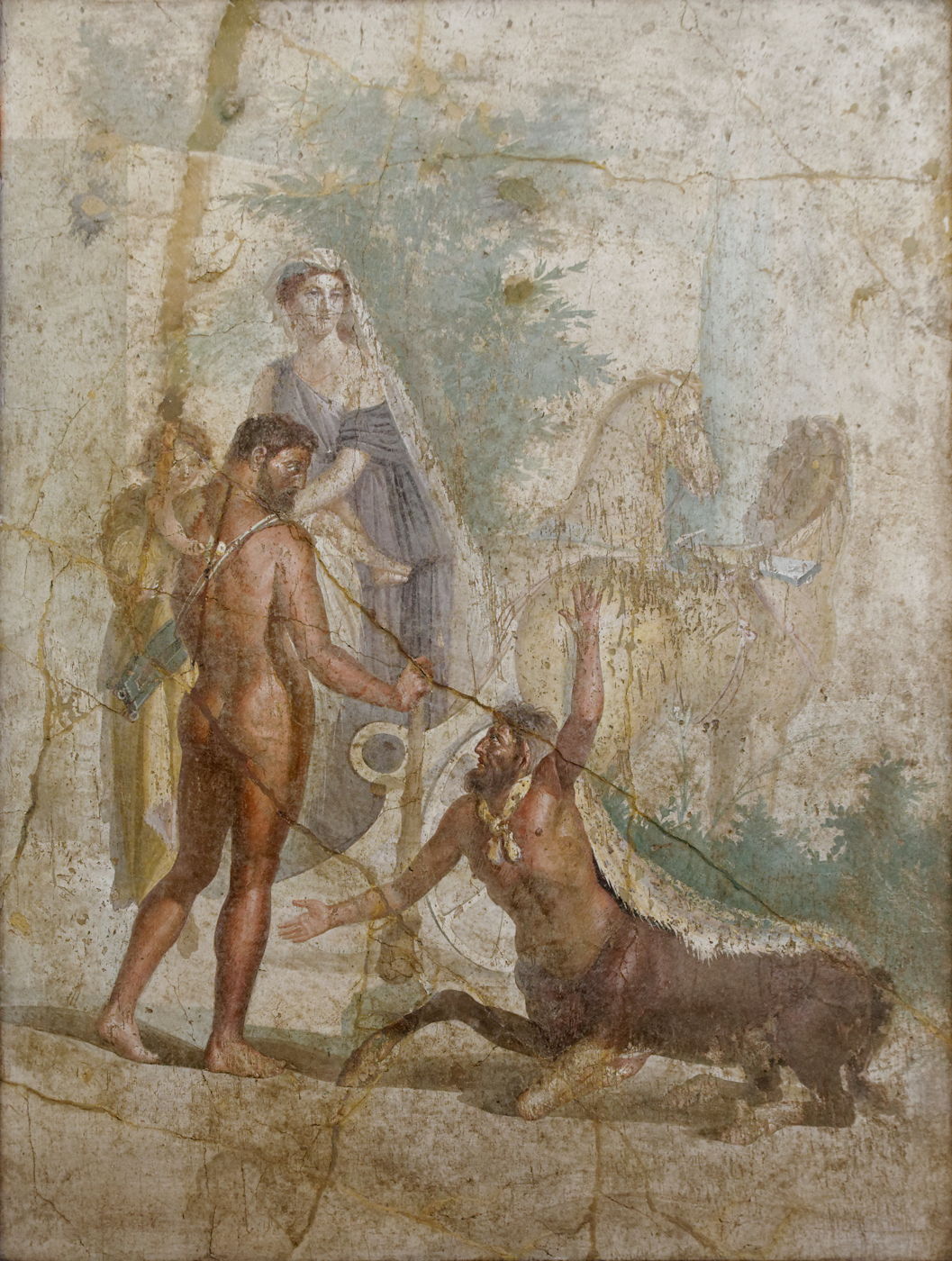
Unknown artist, Hercules carrying his son Hyllus looks at the centaur Nessus, who is about to carry Deianeira across the river on his back (c 50 CE), fresco, 152 x 124 cm, Museo Archeologico Nazionale di Napoli, Naples, Italy. Wikimedia Commons.
This story is shown on several Greek pots, and this Roman fresco from around 50 CE. Although an interesting painting, it seems to show a variant to the story involving Hercules’ son Hyllus and a chariot. The artist has also chosen to show the group before Nessus carries Deianeira across the river, thus before the attempted abduction, a puzzling choice.
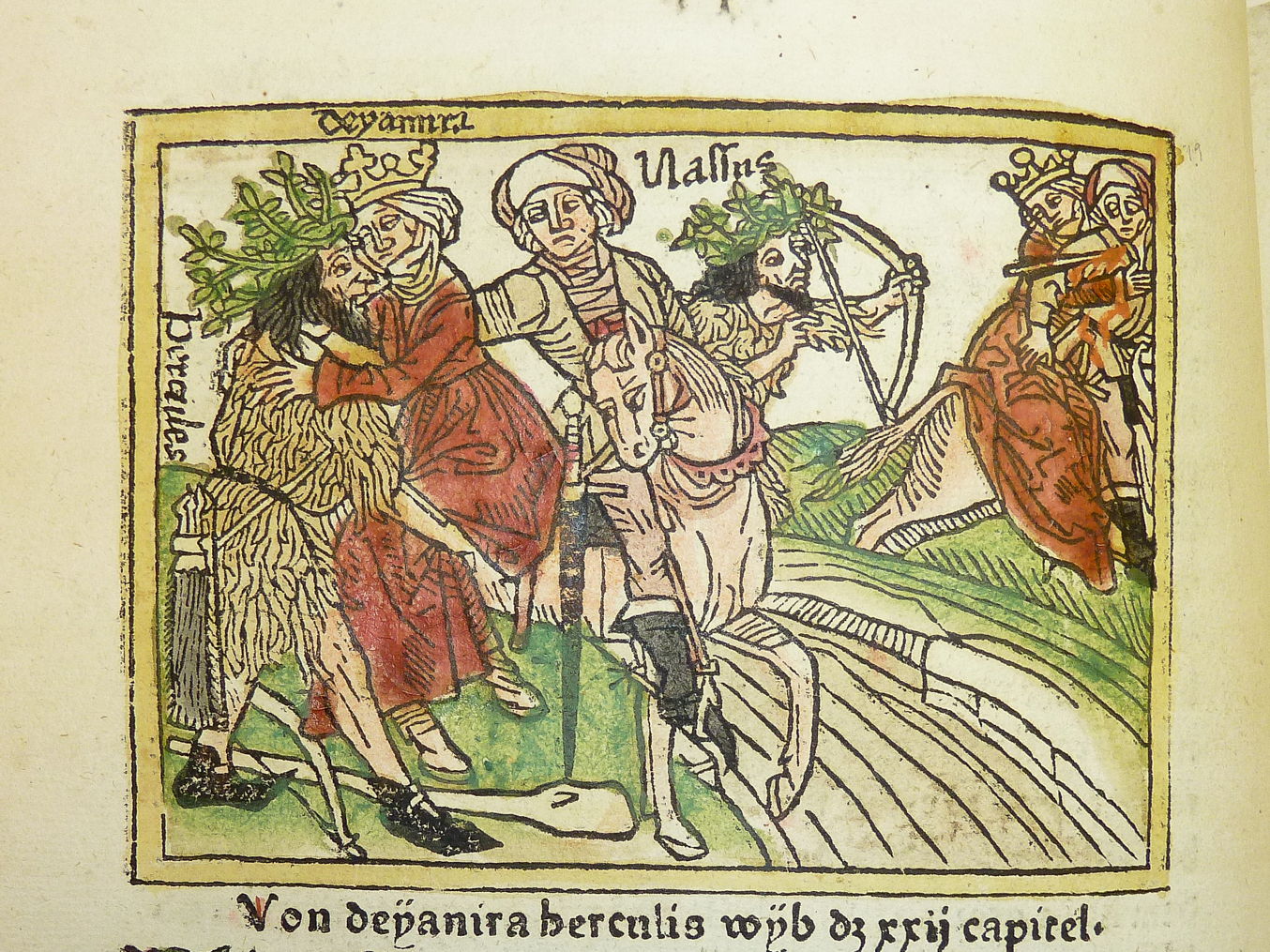
Unknown artist, Hercules, Deianira and Nessus (c 1474), hand-coloured woodcut print from German translation by Heinrich Steinhöwel of Giovanni Boccaccio’s ‘De mulieribus claris’, printed by Johannes Zainer, Ulm. Penn Libraries, Philadelphia, PA. Wikimedia Commons.
This wonderful woodcut from around 1474 may not have quite grasped what a centaur is, but includes two complete copies of the protagonists in its single frame. Hercules is first seen placing Deianeira onto a horse, then Hercules has shot the horseman. In trying to squeeze these two instants into the image, it runs out of space at the right.
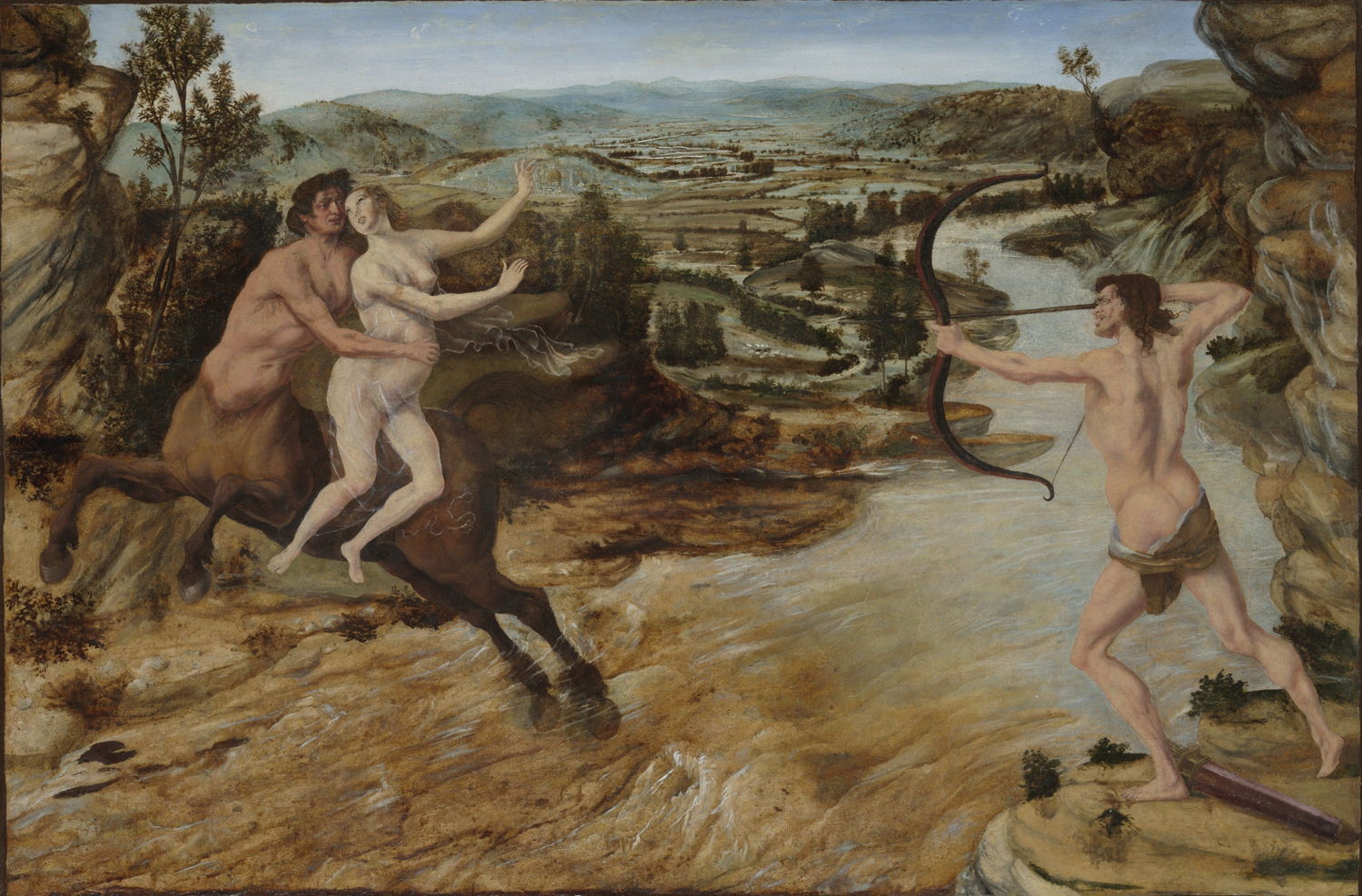
Antonio del Pollaiolo (1431–1498), Hercules and Deianira (c 1475–80), oil on panel transferred to canvas, 54.6 × 79.2 cm, Yale University Art Gallery, New Haven, CT. Wikimedia Commons.
Antonio del Pollaiolo’s painting from about 1475–80 tries a side-on view, requiring Nessus to be shot while still in the river, a slight adjustment to the original story. Deianeira appears precariously balanced, and must be grateful that Nessus’ muscular arms save her from being dropped into the river below. The artist also leaves it to the viewer to know that Hercules’ poisoned arrow strikes Nessus rather than Deianeira.
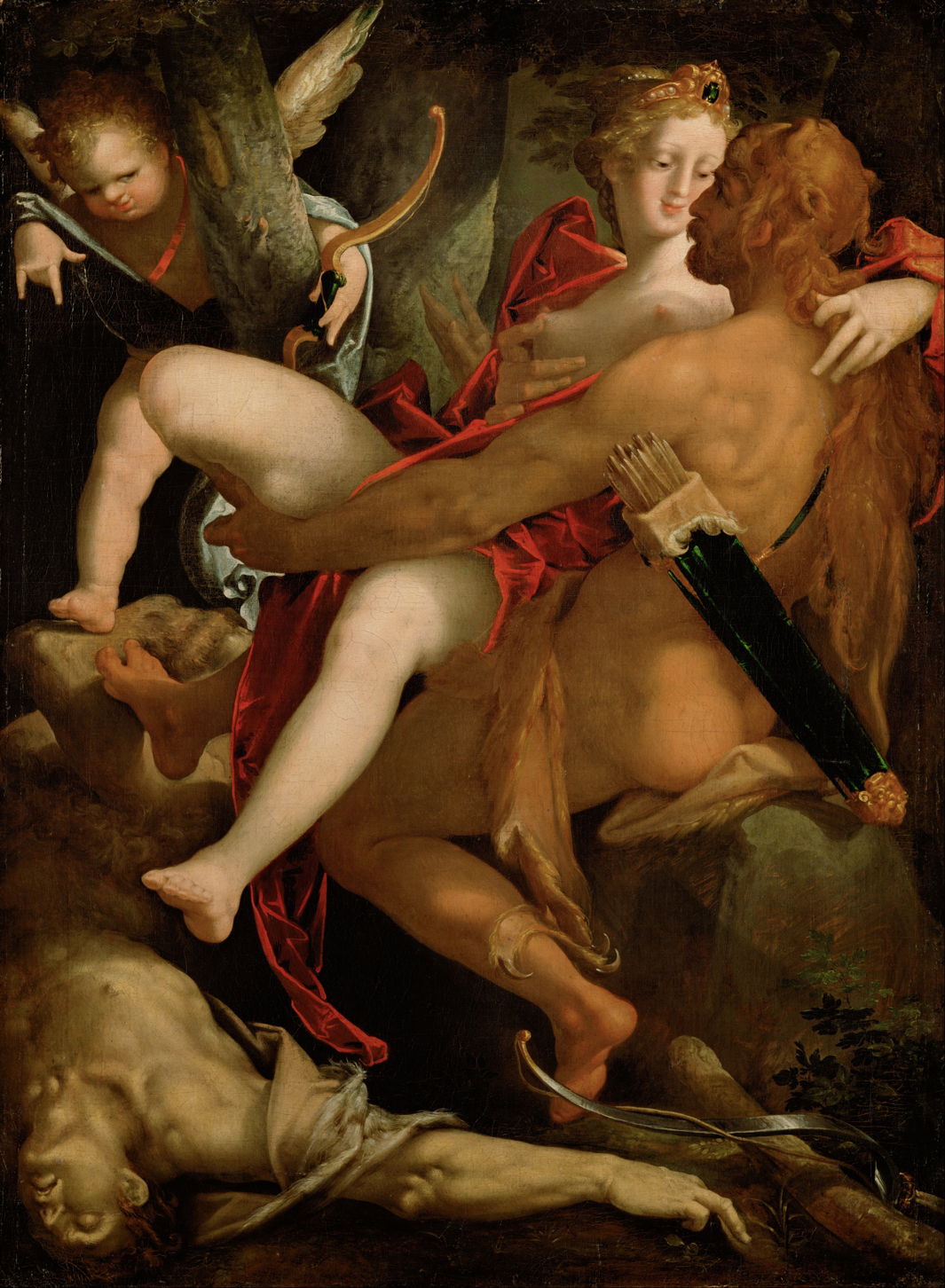
Bartholomeus Spranger (1546–1611), Hercules, Deianeira and the Centaur Nessus (1580-82), oil on canvas, 112 x 82 cm, Kunsthistorisches Museum, Vienna, Austria. Wikimedia Commons.
In about 1580, Bartholomeus Spranger painted one of the few accounts timed after the death of Nessus. Hercules has caught his wife up in his arms, and a winged Cupid looks a little puzzled from the top left, as if wondering how his arrow could have killed the centaur. The sequel story, relying on Nessus’ blood, appears to have been lost in the joy of reunion, leaving the viewer confused as to how this matches the literary narrative.
Paolo Veronese (1528–1588), Hercules, Deianira and the Centaur Nessus (c 1586), oil on canvas, 68.4 × 53.4 cm, Kunsthistorisches Museum, Vienna, Austria. Wikimedia Commons.
Paolo Veronese’s painting from about 1586 elects for a much earlier moment, as Hercules is readying his bow and arrow, with Nessus just reaching the opposite bank. He also shows the scene from Hercules’ position, but discovers the problems with that point of view: Nessus and Deianeira are now small, and Nessus is looking away (and his chest concealed), and even Hercules’ face is turned from the viewer.
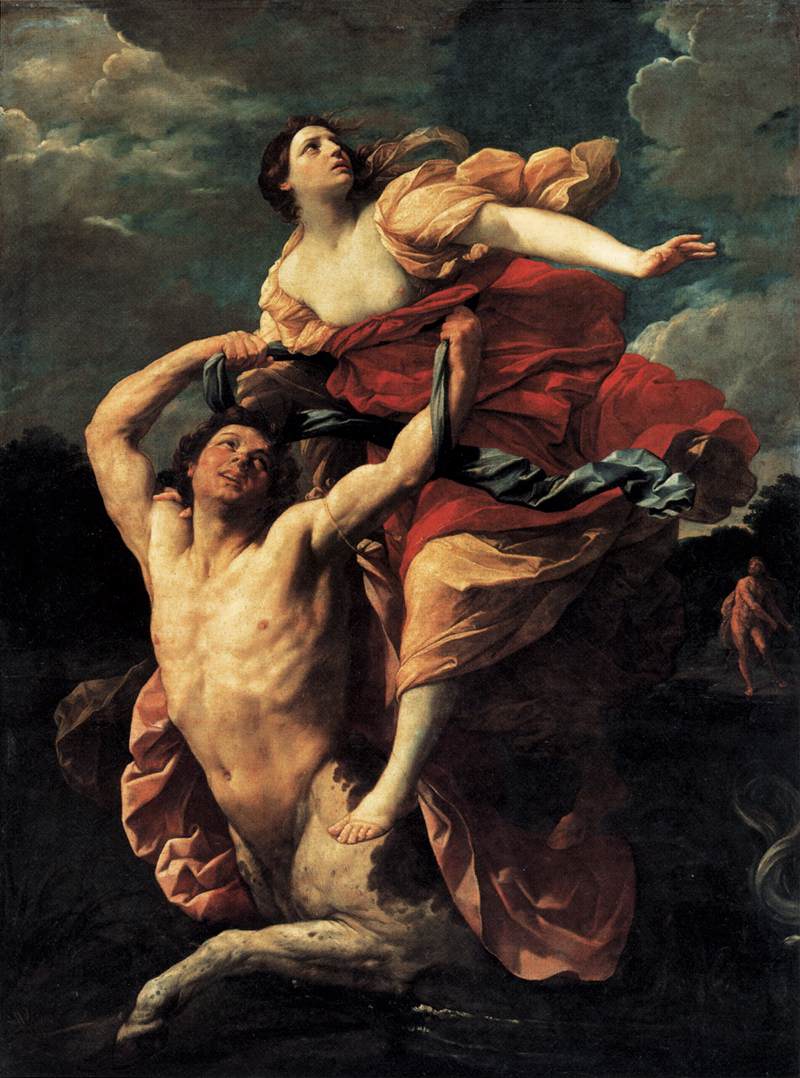
Guido Reni (1575–1642), The Abduction of Deianeira (1617-21), oil on canvas, 239 x 193 cm, Musée du Louvre, Paris. Wikimedia Commons.
Guido Reni’s masterly painting from around 1620, one of the finest of its period in the Louvre, almost fills the canvas with Nessus, who looks worryingly heroic, and Deianeira, who seems to be flying. The small figure of Hercules in the distance is well-lit, but loses the details of bow and arrow. In any case, the arrow could hardly strike Nessus in the chest.
Peter Paul Rubens (1577–1640) (workshop of), The Abduction of Deianeira by the Centaur Nessus (c 1640), media not known, dimensions not known, Niedersächsisches Landesmuseum Hannover, Hanover, Germany. Wikimedia Commons.
This painting is almost certainly not the work of Peter Paul Rubens, but was probably painted in his workshop around the time of Rubens’ death, in 1640. Like Veronese, the artist adopts the point of view from the bank on which Hercules is poised to shoot his arrow into Nessus. By turning the centaur round, to run across the width of the canvas, his face and chest are well exposed, and Hercules’ target is feasible. Even Deianeira appears more comfortable with the force of gravity.
They have added a winged Cupid, to make clear Nessus’ intentions, and Deianeira’s facial expression is marvellously clear in intent. The additional couple, in the right foreground, might be intended to be a river god and naiad, who would be superfluous apart from their role in achieving compositional balance.
Noël Coypel (1628-1707), Hercules and Deianeira (date not known), media and dimensions not known, Musée de Versailles, Versailles, France. Wikimedia Commons.
Noël Coypel’s painting from around 1680 includes more narrative elements than others, but in doing so I fear becomes confusing to read. Nessus has been struck, is bleeding, and holding out some cloth that is slightly blood-stained. An arrow lies on the ground in front of him, but none in his chest. Deianeira is still on his back, although his legs have buckled under him, and he looks distressed. Approaching them with a heavy club in his right hand is Hercules, perhaps coming to finish the centaur off.
To those Coypel adds three winged putti, who seem to be pointing out those clues to the story, and behind them is a river god, and another couple of figures, watching but not apparently part of this story.
Sebastiano Ricci (1659–1734), Hercules Fighting with the Centaur Nessus (1706-7), fresco, dimensions not known, Palazzo Marucelli-Fenzi, Florence. Wikimedia Commons.
In about 1706, Sebastiano Ricci embroidered the story further, showing Hercules, his left hand grasping Nessus’ mouth, about to club the centaur to death, while a slightly bedraggled Deianeira watches in the background. There is no arrow in Nessus’ chest, and Hercules’ quiver is trapped under Nessus’ right foreleg. Three other figures of uncertain roles are at the right, and a winged putto hovers overhead, covering its eyes with its right hand.
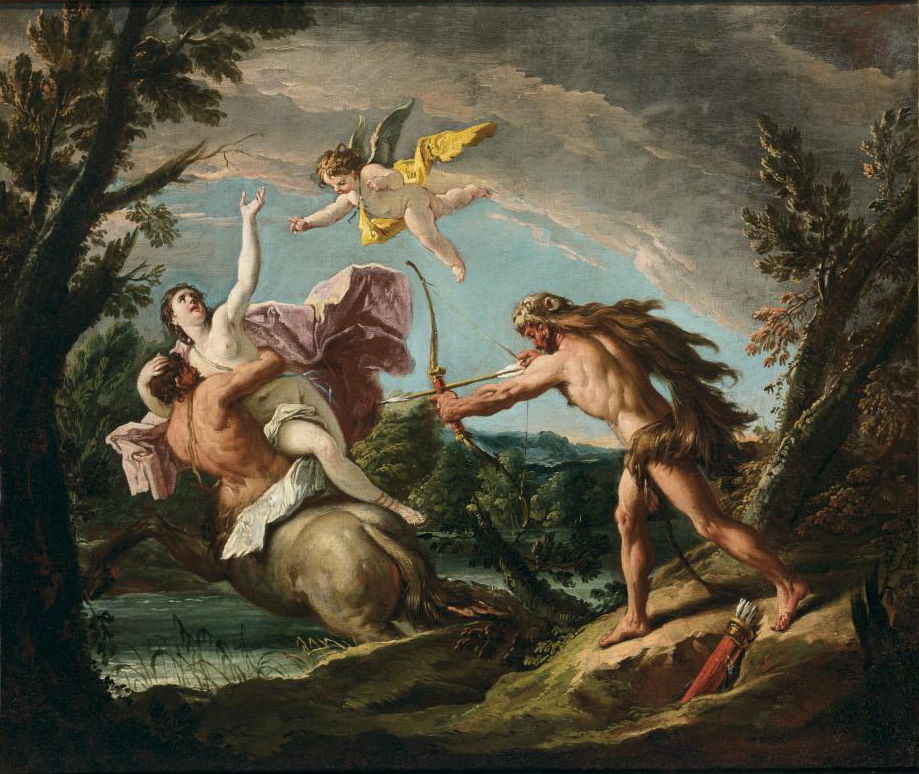
Gaspare Diziani (1689–1767), The Rape of Deianeira (date not known), oil on canvas, 62 x 74 cm, location not known. Wikimedia Commons.
Although Gaspare Diziani returned to the original story in his painting of about 1730, he fell foul of the same compositional problems as in earlier works. Nessus is making off with Deianeira as he is crossing the river. He clutches the woman in his arms, which at least allows us to see her face, and the hand calling for assistance, but his face and chest are almost occluded.
Hercules has to stand so close as to almost be able to touch him, so it is feasible for his arrow, when loosed, to enter the right side of the centaur’s chest, under the armpit. Hercules is looking down at his feet, although drawing back ready to shoot Nessus. Above them an incongruous winged putto forms the apex of a triangle with the other figures. Where will Hercules’ arrow strike?
Louis-Jean-François Lagrenée (1724–1805), The Abduction of Deianeira by the Centaur Nessus (1755), oil on canvas, 157 × 185 cm, Musée du Louvre, Paris. Wikimedia Commons.
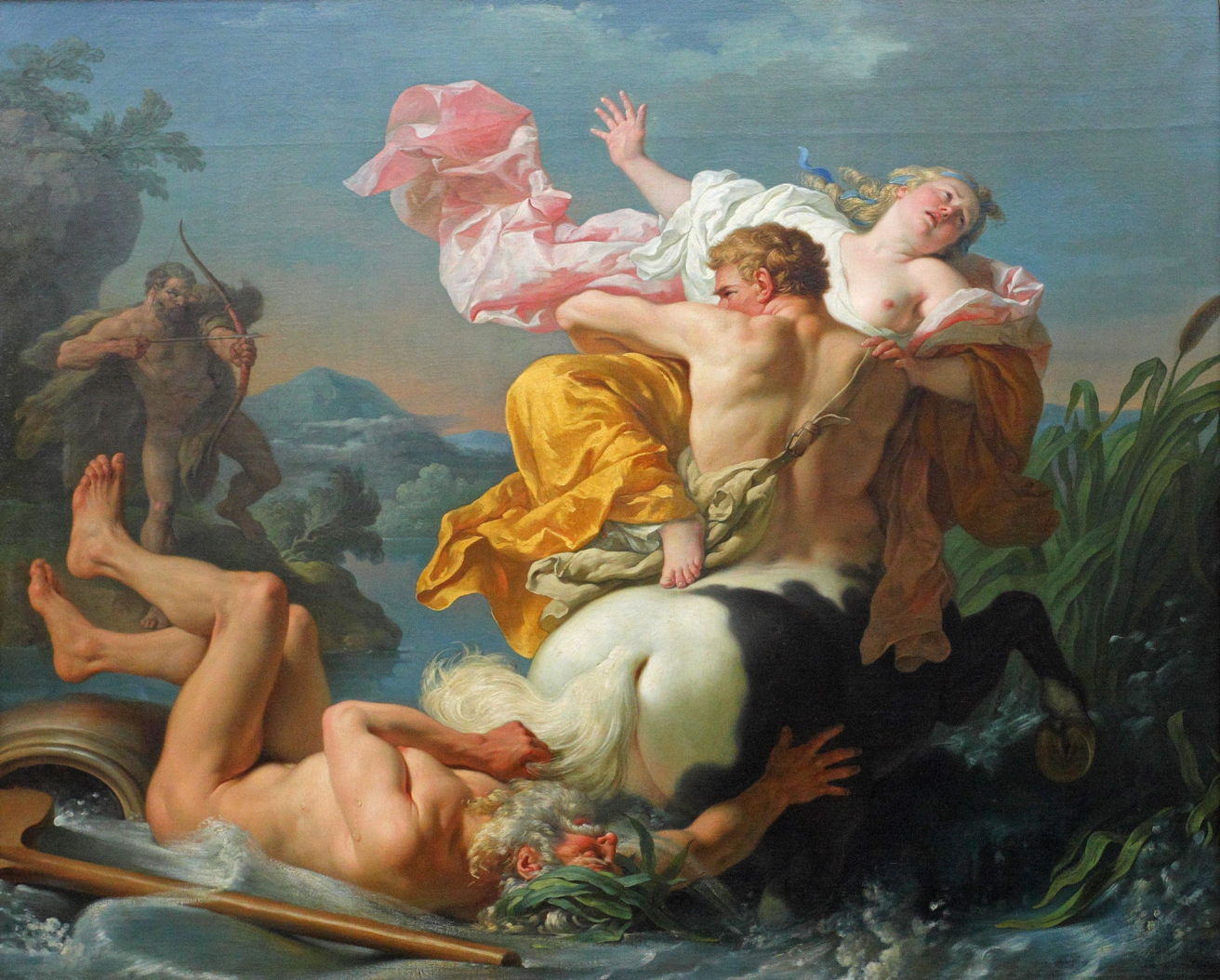
In 1755 Louis-Jean-François Lagrenée clearly understood the compositional problem. His solution is unfortunately no better, despite his beautiful painting. Nessus, bearing a distressed Deianeira in his arms, has just reached the opposite bank, in the foreground. Hercules is on the left in the distance, and we can at least see his face, bow and arrow. Unlike Reni, he has not lit Hercules to best effect, and there appears to be no way that Hercules’ arrow could impale Nessus’ chest, without first passing through some of the abundant Deianeira. He also adds a river god, who seems to have been knocked over in Nessus’ haste to make off with his captive.
Gustave Moreau (1826–1898), Enlèvement de Déjanire (Abduction of Deianeira) (c 1860), pen and brown ink wash on pencil on paper, 22.6 × 15.6 cm, Musée National Gustave-Moreau, Paris. Wikimedia Commons.
Gustave Moreau’s final drawing of about 1860, squared up and ready to transfer to canvas for painting, alters the story to make its composition feasible. He puts Nessus in the foreground, with the attendant risk of making him appear the hero, somehow supporting the upstretched body of Deianeira. In the right distance, Hercules has already loosed the fatal arrow, which is prominently embedded not the front of Nessus’ chest, but his back. The centaur’s legs have collapsed under him, and his head and neck are stretched up in the agony of death.
Gustave Moreau (1826–1898), Autumn (Deianeira) (1872), oil on panel, dimensions not known, J. Paul Getty Museum, Los Angeles, CA. Wikimedia Commons.
Moreau’s eventual painting of Nessus and Deianeira, in 1872, was titled Autumn (Deianeira), and quite different from that drawing. Deianeira and Nessus are in very similar postures, although reversed onto the opposite bank of the river, with Nessus still very much alive, and Deianeira apparently in a trance-like state. Hercules may be lurking in the dense wood around them, but for the moment I cannot see him.
Arnold Böcklin (1827–1901), Nessus and Deianira (1898), oil on panel, 104 x 150 cm, Museum Pfalzgalerie Kaiserslautern, Kaiserslautern, Germany.
My last example is also the most puzzling: Arnold Böcklin’s painting from 1898. Nessus is far from part-human, and Deianeira not the beauty that she was claimed to be. As those two wrestle grimly, Hercules has stolen up behind them, and is busy pushing a spear into Nessus’ bulging belly. Blood pours from the wound, but Deianeira seems to be in no position to collect it.
In Greek and Roman mythology centaurs were creatures with the upper body of a human, down to the waist, fused onto the body of a horse, with all its four legs. Although some tales about centaurs suggest otherwise, in general they represented the lower appetites and behaviours of humans, and were more like wild horses than people. They were known for their fights with Lapiths, an Aeolian tribe, against whom they wielded rocks and limbs of trees. Centaurs persisted in legends and stories well into the Middle Ages, and are the subject of this weekend’s two articles about paintings.
Piero di Cosimo (1462–1522), Tritons and Nereids, with Satyrs and Centaurs (c 1500-05), oil on panel, 37 x 158 cm, Private collection. Wikimedia Commons.
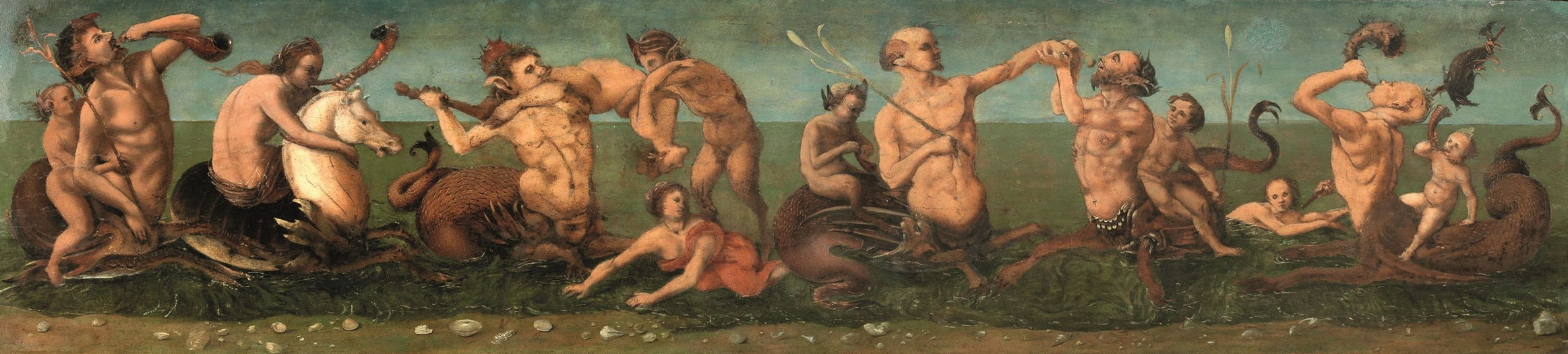
Piero di Cosimo’s assembly of Tritons and Nereids, with Satyrs and Centaurs painted in about 1500-05 shows an odd range of centaur-like creatures, and is believed to have been commissioned for the Palazzo Vespucci.
Arnold Böcklin (1827–1901), Fight of the Centaurs (1873), oil on canvas, 105 × 195 cm, Kunstmuseum Basel, Switzerland. Wikimedia Commons.
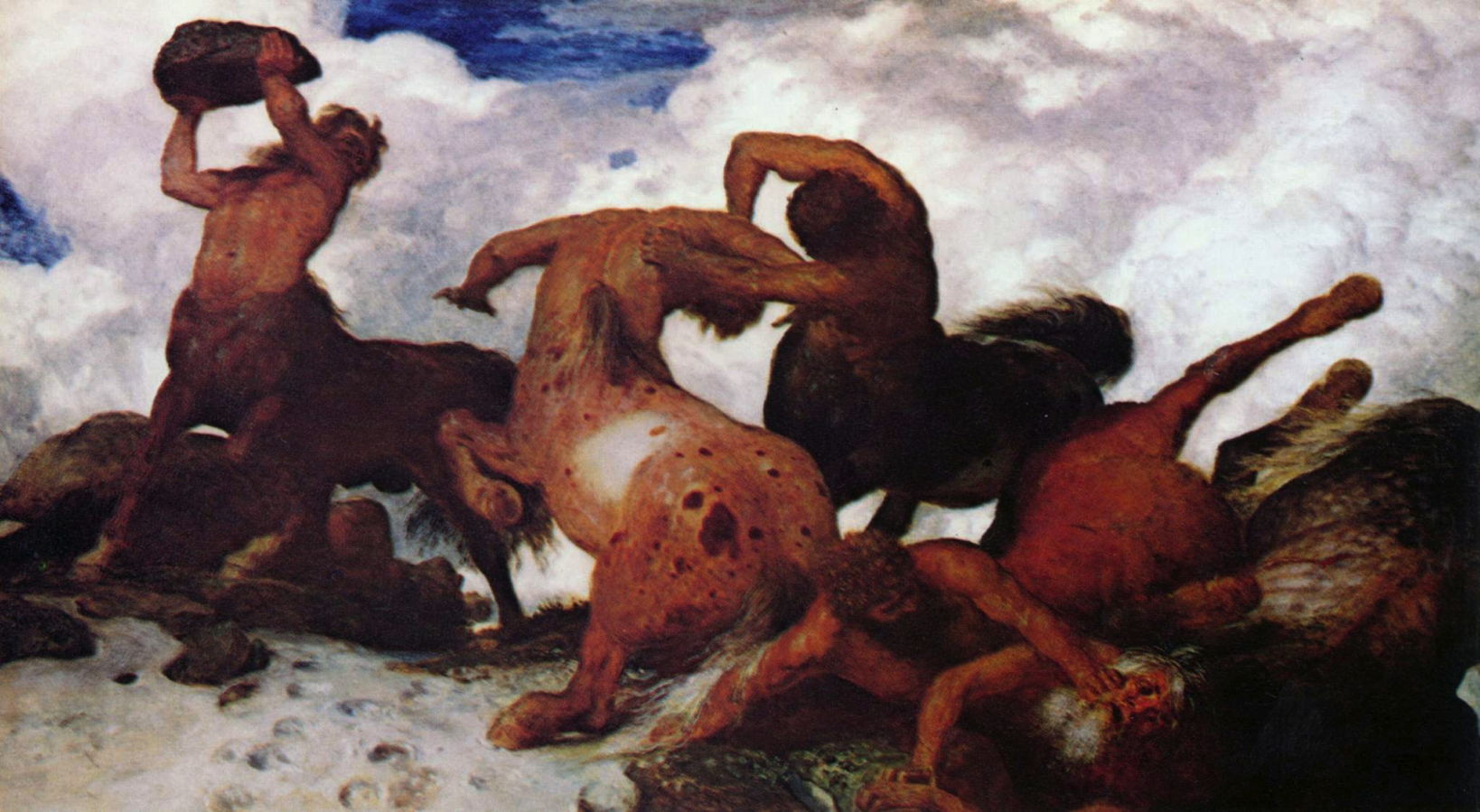
Those in Böcklin’s Fight of the Centaurs (1873) are behaving more in character, in hand-to-hand combat, and by wielding rocks.
But Eugène Delacroix had better to report.
Eugène Delacroix (1798–1863), Poetry: The Education of Achilles (1838-1847), oil on canvas, 221 x 292 cm, Bibliothèque de l’Assemblée nationale, Palais Bourbon, Paris. Wikimedia Commons.
In the Poetry cupola of the Library of the National Assembly in Paris, Delacroix painted The Education of Achilles. This shows the myth of the young Achilles with a bow and arrow, riding on the back of his tutor Chiron the centaur, on the steep slopes of Mount Pelion. This was to become one of Delacroix’s favourite motifs.
Eugène Delacroix (1798–1863), The Education of Achilles (c 1862), pastel on paper, 30.6 x 41.9 cm, Getty Center, Los Angeles, CA. Wikimedia Commons.
His last known pastel painting, and one of his finest, is The Education of Achilles, painted in about 1862, showing the same scene of the ‘wisest and justest of all the centaurs’ Chiron teaching Achilles to hunt. The artist gave this to his longstanding friend Aurore Dudevant, better known under her pen name of George Sand.
Achille Etna Michallon (1796–1822), Landscape: Theseus Pursuing the Centaurs (1821), oil on canvas, 218 x 273 cm, Musée du Louvre, Paris. Wikimedia Commons.
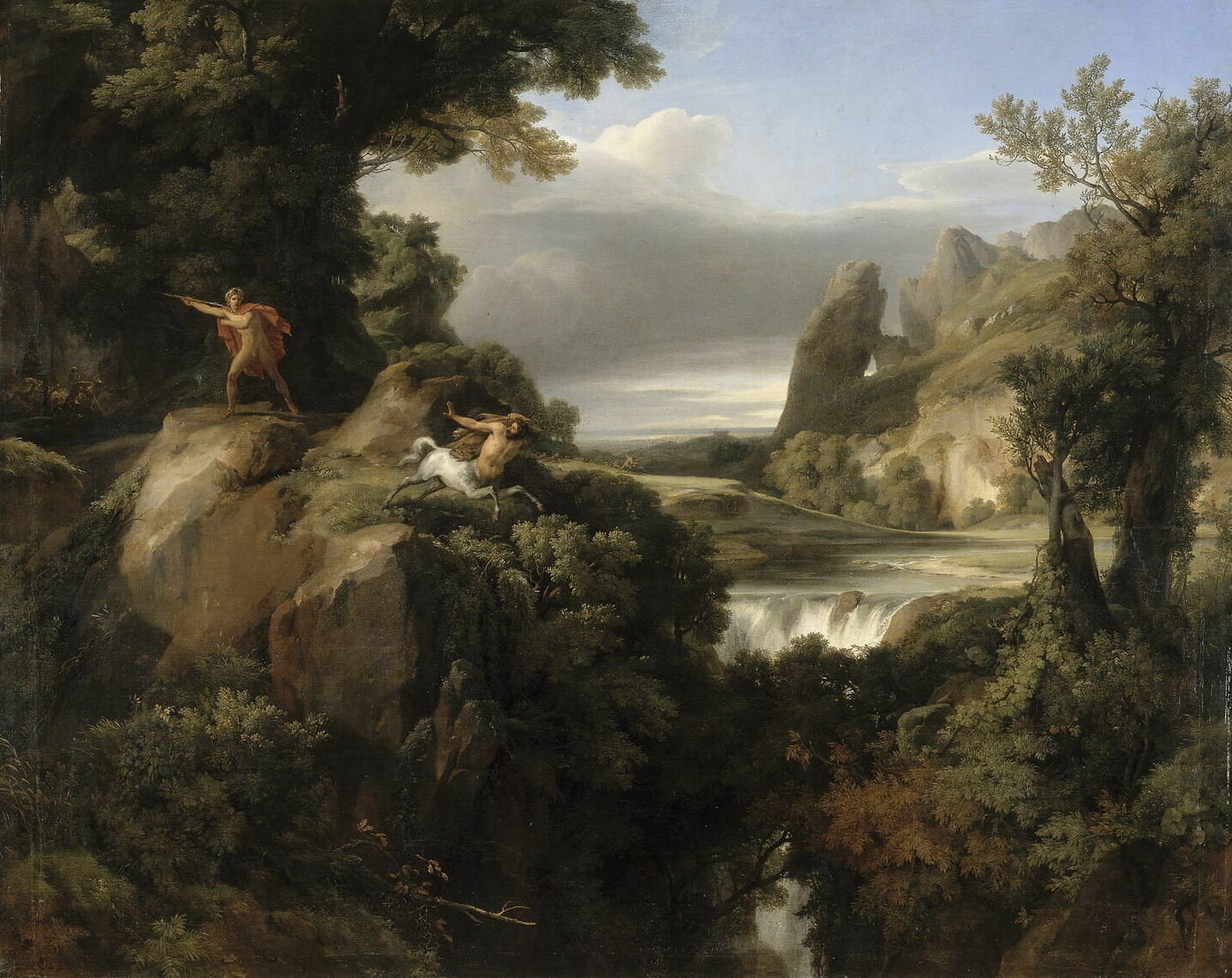
Following the tradition of Nicolas Poussin, Achille Etna Michallon (a namesake of Achilles) set mythological figures in some of his finished landscape paintings. His Landscape: Theseus Pursuing the Centaurs from 1821 shows the Greek hero about to throw his spear at a galloping centaur.
Franz von Stuck (1863–1928), Fantastic Hunt (1890), oil on canvas, dimensions not known, Museum Villa Stuck, Munich, Germany. Image by Yelkrokoyade, via Wikimedia Commons.
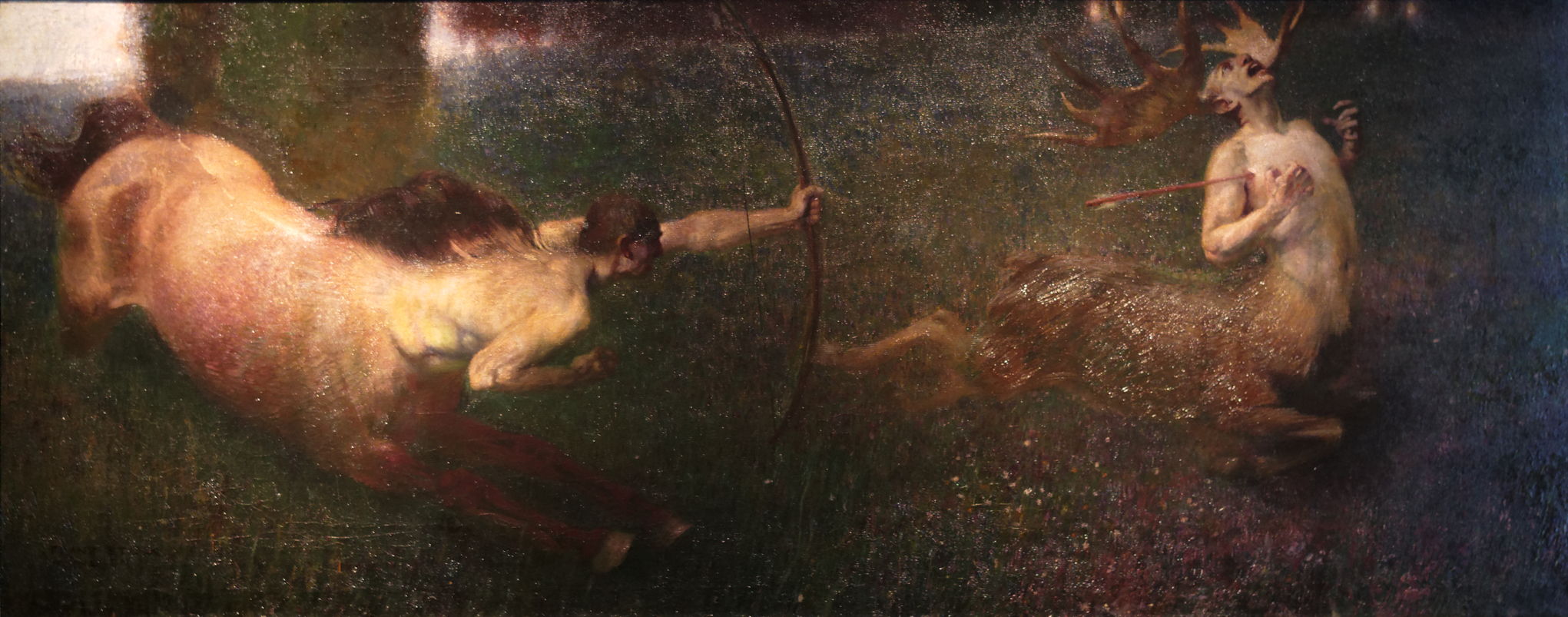
Franz von Stuck added centaurs to his repertoire of mythical beasts in his Fantastic Hunt (1890). Here an archer centaur has buried his arrow into the right axilla of a deer-like variant, perhaps resembling Actaeon after Diana’s vicious metamorphosis. The deer-centaur’s legs have already buckled under him, and his hands claw at the air in his agony.
There are two major myths involving centaurs that have been painted extensively, both picturing them at their worst, at a wedding feast that turned into a pitched battle, and the attempted abduction of the wife of Hercules.
The account of the former is given by Nestor in Ovid’s Metamorphoses, and is one of a pair of primaeval battles said to have established world order: that between the Titans and the Gods ended the heavenly Titanomachy, and that between the Lapiths and Centaurs ended the earthly Centauromachy.
When Pirithous married Hippodame, the couple invited centaurs to the feast. Unfortunately, passions of the centaur Eurytus became inflamed by drink and lust for the bride, and he carried Hippodame off by her hair. The other centaurs followed suit by each seizing a woman of their choice, turning the wedding feast into utter chaos, more like a city being sacked.
Theseus castigated Eurytus and rescued the bride, so the centaur attacked him. Theseus responded by throwing a huge wine krater at Eurytus, killing him. The centaurs then started throwing goblets and crockery, and the battle escalated from there. Nestor details a succession of grisly accounts of Lapiths and Centaurs killed. Gryneus the centaur ripped up the altar and crushed two Lapiths with its weight, only to have his eyeballs gouged out by a Lapith using the prongs of some antlers. Not content with using the objects around them as weapons, they started using their own lances and swords.
When the centaur Petraeus was trying to uproot a whole oak tree, the groom Pirithous pinned the centaur to the tree-trunk with his lance. Nestor also tells of the success of Caeneus, formerly Caenis, in killing five centaurs. The centaur Latreus taunted Caeneus, so the latter wounded the centaur with his spear. Latreus thrust his lance in Caeneus’ face, but was unable to hurt him, so he tried with his sword, which broke against the invulnerable Caeneus, leaving him to finish the centaur off with thrusts of his own sword.
The centaurs then united to try to overwhelm Caeneus by crushing him under their combined weight. Just as they thought they had succeeded, Caeneus was transformed into a bird and flew out from underneath them. With that the survivors dispersed, the Lapiths having won the day.
Piero di Cosimo (1462–1522), The Fight between Lapiths and Centaurs (1500-15), oil on wood, 71 x 260 cm, The National Gallery, London. Wikimedia Commons.
Piero di Cosimo’s The Fight between Lapiths and Centaurs (1500-15) is my favourite among the earlier paintings, and remains one of its best-structured and complete accounts. In the centre foreground, Hylonome embraces and kisses the dying Cyllarus, a huge arrow-like spear resting underneath them. Immediately behind them, on large carpets laid out for the wedding feast, centaurs are still abducting women. All around are scenes of pitched and bloody battles, with eyes being gouged out, Lapiths and Centaurs wielding clubs and other weapons at one another.
Peter Paul Rubens (1577–1640), The Rape of Hippodame (sketch) (c 1637-38), oil on panel, 26 × 40 cm, Koninklijke Musea voor Schone Kunsten van België / Musées Royaux des Beaux Arts de Belgique, Brussels, Belgium. Wikimedia Commons.
Towards the end of his life, Peter Paul Rubens painted this brilliant oil sketch of The Rape of Hippodame (c 1637-38). At the right, Eurytus is trying to carry off the bride, with Theseus just about to rescue her from the centaur’s back. At the left, Lapiths are attacking with their weapons, and behind them another centaur is trying to abduct a woman.
Peter Paul Rubens (1577–1640), The Rape of Hippodame (Lapiths and Centaurs) (1636-38), oil on canvas, 182 × 290 cm, Museo Nacional del Prado, Madrid, Spain. Wikimedia Commons.
That became the finished painting, The Rape of Hippodame (Lapiths and Centaurs) (1636-38), which remains faithful to Rubens’ sketch and its composition. Facial expressions, particularly that of the Lapith at the left bearing a sword, are particularly powerful.
Luca Giordano (1632–1705), Battle of Lapiths and Centaurs (1688), oil on canvas, 255 x 390 cm, State Hermitage Museum, Saint Petersburg, Russia. Image by Wayne77, via Wikimedia Commons.
Luca Giordano’s later painting of the Battle of Lapiths and Centaurs from 1688 lacks the narrative structure of Piero di Cosimo’s, and covers later action than Rubens’. As a result, its story has become a little lost in the mêlée of battle.
Sebastiano Ricci (1659–1734), The Battle of the Lapiths and Centaurs (c 1705), oil on canvas, 138.4 × 176.8 cm, The High Museum of Art, Atlanta, GA. Wikimedia Commons.
Sebastiano Ricci’s The Battle of the Lapiths and Centaurs from about 1705 has similar problems, although it does use multiplex narrative to help. In the left background, Hippodame is seen being carried away by Eurytus, and to the right there are further scenes of abduction.
Francesco Solimena (1657–1747), Battle between Lapiths and Centaurs (1735-40), oil on canvas, 104 x 130 cm, Private collection. Wikimedia Commons.
Francesco Solimena’s Battle between Lapiths and Centaurs (1735-40) puts multiple abductions in the foreground, with pitched battles taking place behind.
Tomorrow I’ll look at paintings of the fight between Nessus and Hercules, and how Nessus got his revenge.
The great Symbolist painter Gustave Moreau was born almost two centuries ago, on 6 April 1826. To mark his bicentenary early next month, this short series outlines his career in a small selection of his more important paintings. They are at once history, symbolic explorations, as phantasmagoric as the most radical of William Blake or Odilon Redon, and torrents of figures and forms drawn from all human cultures. They’re elaborate, complex, and appear to defy reading.
Moreau was a precocious artist who started copying in the Louvre, in his native Paris, when he was only seventeen. A year later he started attending a private studio run by François-Édouard Picot, to prepare him for the entrance exam for the École des Beaux-Arts. In Picot’s studio, he learned the methods to which he adhered for the rest of his career: each painting started with a series of drawings, which developed both composition and details. The final drawing was squared up on a grid, to enable its transfer to canvas, where he painted conventionally in oils, using layers.
He was admitted to the École des Beaux-Arts in 1846, and decided to be a history painter. He competed twice for the Prix de Rome, which would have taken him to continue his studies in Rome, but was unsuccessful on both occasions. He therefore left the École in 1849, and started making a precarious living with small commissioned works including favourite scenes from the plays of Shakespeare. His work changed markedly in 1851, the year that JMW Turner died, when he befriended Théodore Chassériau, a former pupil of JAD Ingres; Moreau set up his first studio near Chassériau’s, and started painting more ambitious works to submit to the Salon.
Gustave Moreau (1826–1898), The Judgement of Paris (1852), watercolor on paper, 40.7 × 48.3 cm, Private collection. Wikimedia Commons.
The Judgement of Paris (1852) is one of his early watercolours, showing great promise of things to come. At its heart is a fairly faithful representation of this classical myth, in which Paris (right of centre) is deciding which of Hera, Athena, and Aphrodite is the most fair, and should be awarded the golden apple given by Eris from the Garden of the Hesperides.
Gustave Moreau (1826–1898), Apollo and the Nine Muses (1856), oil on canvas, dimensions not known, Private collection. The Athenaeum.
Apollo and the Nine Muses (1856) is another significant step towards his mature work. Apollo, a young and surprisingly androgynous figure, sits in the foreground, his distinctive lyre part-hidden under his right foot. To the right of him is a wild rose, with both white flowers and red hips. The muses cluster on a small mound behind that, equipped for and engaged in their respective arts.
That year, his friend and mentor Chassériau died at the age of only 37. Moreau was devastated, and decided to travel to Italy to complete his education as a painter and resolve his future. From October 1857 to June 1858, he copied Renaissance paintings in Rome, then moved on to Florence, Milan, and Venice. He finally returned to Paris in September 1859, having made about a thousand copies in less than two years. He had also met and made friends with several other artists, including Edgar Degas and James Tissot.
Gustave Moreau (1826–1898), Hesiod and the Muses (1860), oil on canvas, 155 × 236 cm, Musée National Gustave-Moreau, Paris. Wikimedia Commons.
Hesiod and the Muses (1860) is probably the first of Moreau’s novel history paintings, and the first of a series of works showing Hesiod, generally considered to be the first written poet in the Western tradition to exist as a real person, and to play an active role in his poetry. Hesiod is the young man holding a laurel staff in his right hand, to the left of centre.
There are four swans on the ground, and one in flight above Hesiod, a winged Cupid sat on the left wing of Pegasus, and a brilliant white star directly above the winged horse. However, the Cupid and Pegasus were only added in about 1883, when the canvas was extended.
Moreau met his mistress and muse Alexandrine Dureux (whom he never married, both remaining single) that year, and set her up in a nearby flat, where she lived until her death in 1890.
By 1864, he had abandoned three attempts to produce a radical work for the Salon. However, he had been working on something different, that he completed during the winter of 1863-4: Oedipus and the Sphinx (1864)
Gustave Moreau (1826–1898), Oedipus and the Sphinx (1864), oil on canvas, 206.4 x 104.8 cm, The Metropolitan Museum of Art (Bequest of William H. Herriman, 1920), New York, NY. Courtesy of The Metropolitan Museum of Art, via Wikimedia Commons.
This was a bold move. Not only was this painting startlingly original and different, but it visited a motif that had recently resulted in Ingres’ success at the Salon, in 1827. Just as Oedipus is seen to be staring out the fearsome sphinx, so Moreau was visibly challenging his seniors.
This shows a key scene from Sophocles’ tragedy Oedipus the King. The sphinx had effectively put the ancient Greek city of Thebes under siege, by sitting outside and refusing to let anyone pass unless they answered a riddle correctly. Those who failed to do that it killed by strangulation. When Oedipus arrived, intending to enter Thebes, the sphinx asked him “Which creature has one voice and yet becomes four-footed, two-footed, and three-footed?” Oedipus solved this in his answer of humans, who crawl when a baby, walk on two feet as an adult, then walk with a stick when old. The defeated sphinx then threw itself into the sea below, Oedipus entered Thebes, was awarded the throne of Thebes in return for destroying the sphinx, and married its queen Jocasta, who turned out to be his mother.
Gustave Moreau (1826–1898), Oedipus and the Sphinx (detail) (1864), oil on canvas, 206.4 x 104.8 cm, The Metropolitan Museum of Art (Bequest of William H. Herriman, 1920), New York, NY. Courtesy of The Metropolitan Museum of Art, via Wikimedia Commons.
The apparently emotionless faces of Oedipus and the sphinx are not an attempt to reject facial expression as a narrative tool. In fact, they confirm its value. The pair are engaged in staring intently into one another’s eyes, in the way that poker players might, almost eyeball to eyeball. The most plausible moment to be shown here is the brief interval between the sphinx asking its riddle, and Oedipus answering it.
The sphinx has already latched onto the front of what it comfortably assumes is going to be another, rather delectable victim. Its forelegs are ready to reach up and strangle him once he guesses the wrong answer, and its hindlegs are ready to unsheath claws and walk up, burying them in his flesh. The sphinx is ready to prove itself a femme fatale for Oedipus.
Oedipus knows that he cannot falter. A false guess, even a slight quaver in his voice, and this beautiful but lethal beast will be at his throat. His left hand clenches his javelin, knowing that what he is about to say should save his life, and spare the Thebans. He will then no longer be pinned with his back to the rock, and the threat of the sphinx will be gone.
Gustave Moreau (1826–1898), Oedipus and the Sphinx (detail) (1864), oil on canvas, 206.4 x 104.8 cm, The Metropolitan Museum of Art (Bequest of William H. Herriman, 1920), New York, NY. Courtesy of The Metropolitan Museum of Art, via Wikimedia Commons.
Around this central narrative core, Moreau feeds us symbolic morsels to supplement that main course without supplanting it. Behind Oedipus is a bay tree, sacred to Apollo, representing man’s highest achievements; behind the sphinx is a fig tree, a traditional symbol of sin. The small polychrome column at the right is topped by a cinerary urn, symbolising death, and above it is a butterfly, representing the soul. Ascending the column is a snake, again associated with death, and through the biblical serpent, with sin.
Moreau’s bold move worked, as Oedipus and the Sphinx took the Salon of 1864 by storm, winning him a medal. The following year, he tried to consolidate that success with Jason.
Gustave Moreau (1826–1898), Jason (1865), oil on canvas, 204 × 115 cm, Musée d’Orsay, Paris. Wikimedia Commons.
The name Jason refers, of course, to Jason of Golden Fleece and Argonauts fame, a series of swashbuckling adventures offering ample opportunities for theatrical narrative painting. Moreau avoids them all, and shows us a static Jason, with Medea stood behind him, not a Golden Fleece in sight. Instead of providing narrative, the artist offers us symbols as clues to what might be going on.
The broad outline of Jason’s story is simple. When he reached Colchis, he underwent a series of trials imposed by King Aeëtes, culminating in his victory over the dragon guarding the Golden Fleece. These were accomplished with the help of Medea, the King’s daughter, in return for a promise of marriage.
The almost naked woman behind Jason is Medea, the sorceress who has fallen in love with the hero. The ram’s head at the top of the pillar on the left signifies the Golden Fleece, and the dragon which guarded it is shown as the eagle on which Jason is standing, with the broken tip of his javelin embedded in it. This is the more confusing, as in the original story the dragon was put to sleep by one of Medea’s potions, rather than being killed with a javelin.
Yet Medea holds a vial in her right hand, and her body is swathed with the poisonous hellebore plant, a standard tool of witchcraft. These may allude to Jason’s future rejection of Medea and her poisoning of his replacement bride, but there is a lot of story between this moment and that later episode, so that is speculative and hardly clarified by the painting.
Moreau provided some clues to his intentions in this painting, in the almost illegible inscriptions on the two phylacteries wound around the column. These bear the Latin: nempe tenens quod amo gremioque in Iasonis haerens
per freta longa ferar; nihil illum amplexa timebo
(Nay, holding that which I love, and resting in Jason’s arms, I shall travel over the long reaches of the sea; in his safe embrace I will fear nothing) et auro heros Aesonius potitur spolioque superbus
muneris auctorem secum spolia altera portans
(And the heroic son of Aeson [i.e. Jason] gained the Golden Fleece. Proud of this spoil and bearing with him the giver of his prize, another spoil)
(Cooke, pp 55-56.)
These could be interpreted as suggesting that the painting should be read in terms of the conflict between Jason and Medea: Medea expresses her subjugate trust in him, while Jason considers her to be just another spoil won alongside the Golden Fleece. More puzzling is the spattering of other details, of hummingbirds, the sphinx on top of the pillar, medals decorating the shaft of that pillar, and more. Some appear merely to be decorative, but drawing the line between the decorative and the symbolic is impossible.
The end result in Jason is almost the opposite of Oedipus and the Sphinx: the latter consists of a clear narrative lightly embellished with symbols, the former relies on the interpretation of symbols to construct any narrative; as those symbols conflict with the original narrative, the viewer can readily become bewildered.
The 1865 Salon didn’t provide the consolidation for which Moreau had hoped, although much of that was the result of an accident of history: dominating all discussion that year was another painting, Manet’s Olympia. He needed to do better in 1866 if he wasn’t going to slip back into obscurity.
Gustave Moreau (1826–1898), Orpheus (1865), oil on panel, 154 × 99.5 cm, Musée d’Orsay, Paris. Wikimedia Commons.
In Moreau’s Orpheus (1865) a sombrely-dressed Thracian woman holds Orpheus’ lyre, on which rests his head, blanched in death, as if affixed to the lyre like the head of a hunting trophy. Her eyes are closed in reverie.
One version of the legend of Orpheus’ death holds that his head and lyre were borne by the river Hebrus, which is shown in the background landscape to the right. Again, though, Moreau pursues his own adjusted version of the written narrative, as according to that account (in Ovid’s Metamorphoses, book 11), the head and lyre were washed up on the coast of Lesbos.
Orpheus adopts a unified tonality, colour, form, character, and style that could be viewed as a ‘mode’, as conceived by Nicolas Poussin. The gentle and natural beauty of the Thracian woman, her ornate clothes, flowers, and the strange beauty of Orpheus’ head on the lyre contrast with a harsh and barren landscape, which might have been more appropriate in a Renaissance painting, perhaps by Leonardo da Vinci.
Moreau has carefully avoided elaborate symbols and decoration, although he has left us two further puzzles at the painting’s corners: the three figures, apparently shepherds, on the rocks at the upper left, and a pair of tortoises at the lower right. The figures refer to music, which seems in keeping with Orpheus and his lyre, but the significance of the tortoises is open to speculation.
Gustave Moreau (1826–1898), Orpheus (detail) (1865), oil on panel, 154 × 99.5 cm, Musée d’Orsay, Paris. Wikimedia Commons.
What Moreau lost in the absence of narrative, this painting gained in its remarkable tranquillity. Two faces, eyes closed, (don’t) look at one another. The intricate decoration of the lyre seems unified with the Thracian woman’s clothing, even the coiled braids of her hair. Although one of his most profoundly beautiful and moving paintings, this failed to impress the Salon.
In 1868-9 he turned to one of the most frequently painted stories from Greek mythology, that of the abduction and rape of Europa. She was the mother of King Minos of Crete, and the story of Cretan origin; the bull was the main sacred animal in Crete. Zeus (Jupiter to the Romans), a notorious ravisher of women, lusted after the beautiful Europa. He therefore metamorphosed himself into a white bull, and hid among Europa’s father’s herd in Phoenicia. When Europa and other maidens came to gather flowers near this herd, she saw the white bull, caressed it, and climbed onto its back.
Zeus then ran to the sea and swam with Europa on his back until they reached the shores of Crete. There he revealed himself, and Europa became the first queen of the island. He gave her in return a necklace, Talos (a giant bronze automaton who protected Crete by circling its shores), Laelaps (an unfailing hunting dog), and a javelin that always struck its target.
Almost universally, previous depictions of this myth have shown the start of the abduction, from the pastures of Phoenicia to the bull heading off to sea. Moreau’s white bull, with Europa riding a precarious side-saddle, has just emerged from the sea, so is presumably now on the island of Crete.
Gustave Moreau (1826–1898), Jupiter and Europa (1868-9), oil on canvas, 175 x 130 cm, Musée National Gustave-Moreau, Paris. Wikimedia Commons.
The finished work, known as Jupiter and Europa (1868-9) (I apologise for the lack of sharpness in this image) but titled Europa, shows the bull with a human head, presumably as Zeus has revealed himself to Europa. The head of Zeus recalls those of sculptures of Assyrian kings.
It’s hard to see what Moreau brought in terms of originality to this well-worn motif, and the critics drew comparison with Veronese rather than Titian. Either way, this seems to be a painting in search of a reason, and the Salon agreed. As there was now a small but dedicated group of collectors who were prepared to purchase his paintings, Moreau decided to withdraw from exhibiting at the annual Salon.
In the Franco-Prussian War, Moreau joined the National Guard, and served in the defence of Paris in the autumn of 1870, besieged there with his mother. Over the winter his left shoulder and arm became immobile because of ‘rheumatism’, but he remained in the city. Finally, during the Commune in the spring of 1871, he defended the paintings he had amassed in his home, and watched his late friend Chassériau’s murals in the Cour des Comptes being destroyed by fire. He spent that summer recovering in the spa at Néris-les-Bains in the Auvergne.
References
Cooke P (2014) Gustave Moreau, History Painting, Spirituality and Symbolism, Yale UP. ISBN 978 0 300 20433 9.
Mathieu P-L (1998, 2010) Gustave Moreau, the Assembler of Dreams, PocheCouleur. ISBN 978 2 867 70194 8.

 Login
Login