Dragonflies have suffered a bad press for too long. Commonly known on both sides of the Atlantic as the devil’s darning needles, they’re more widely associated with evil, biting people, or even sewing their eyelids together, all categorically untrue. In reality they should be our friends, as they’re insectivorous, and amazingly effective at consuming biting flies.
Unfortunately, their associations in paintings are as bad as those old wives’ tales, and they have been depicted infrequently.
Ambrosius Bosschaert (1573–1621), Flower Still Life (1614), oil on copper, 30.5 x 38.9 cm, J. Paul Getty Museum, Los Angeles, CA. Wikimedia Commons.
Ambrosius Bosschaert (1573–1621) painted this Flower Still Life in oil on copper in 1614, during the early years of the Dutch Golden Age. At first its eclectic mixture of different flowers and flying insects appears haphazard, but they merit a deeper reading. The flowers include carnation, rose, tulip, forget-me-nots, lilies of the valley, cyclamen, violet and hyacinth, which could never, at that time, have bloomed at the same time. The butterflies, bee and dragonfly are as ephemeral as the flowers around them, confirming that it’s a vanitas painting.
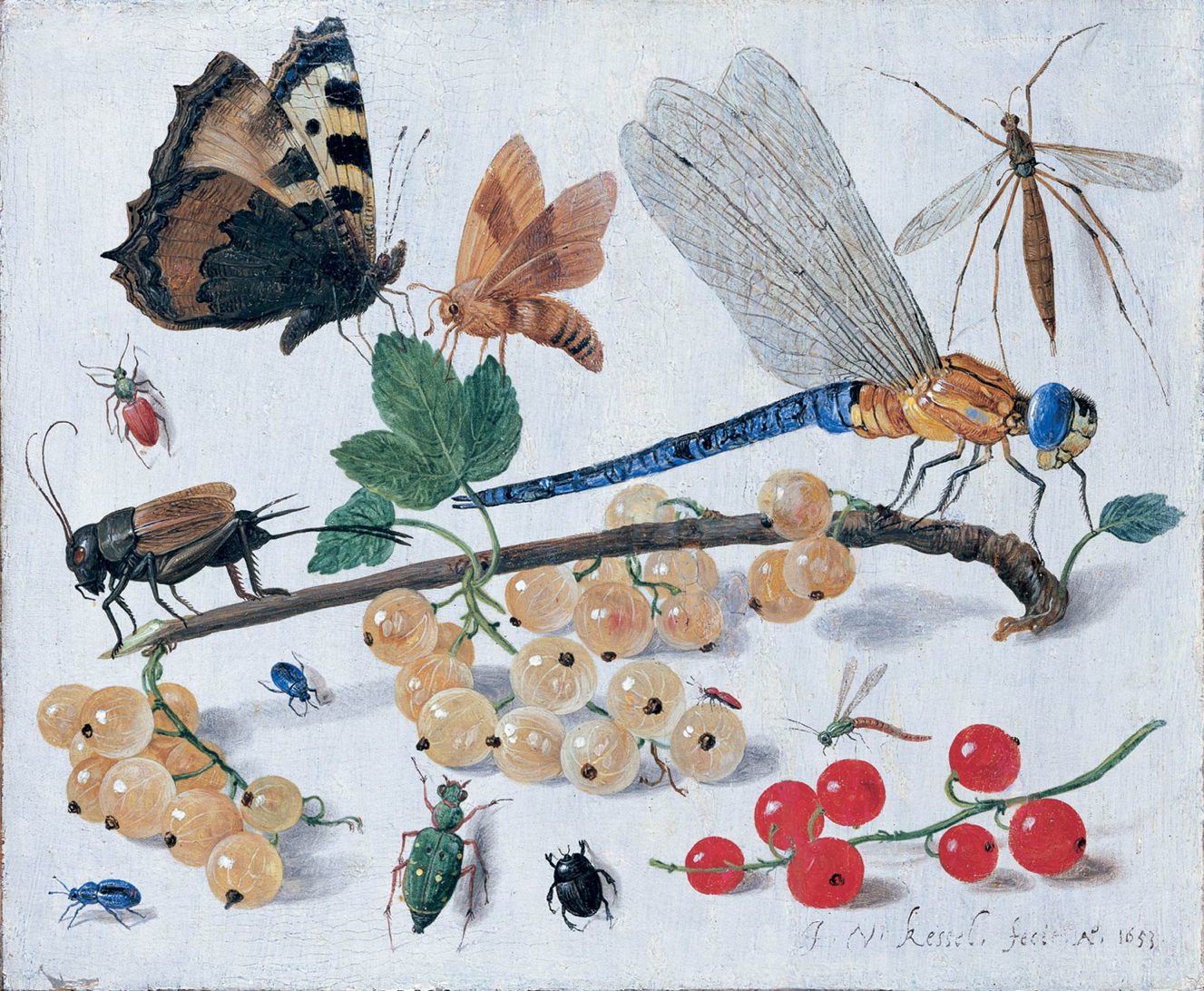
Jan van Kessel the Elder (1626–1679), (title not known) (1653), oil on copper, dimensions not known, Galerie Müllenmeister, Solingen, Germany. Wikimedia Commons.
In 1653, Jan van Kessel the Elder painted this collection of insects and berries in oil on copper. The dragonfly shown appears to be a southern hawker (Aeshna cyanea), one of the most common large species found throughout Europe, although its thorax is unusually pale, suggesting it might be a young adult (teneral), or had discoloured after death.
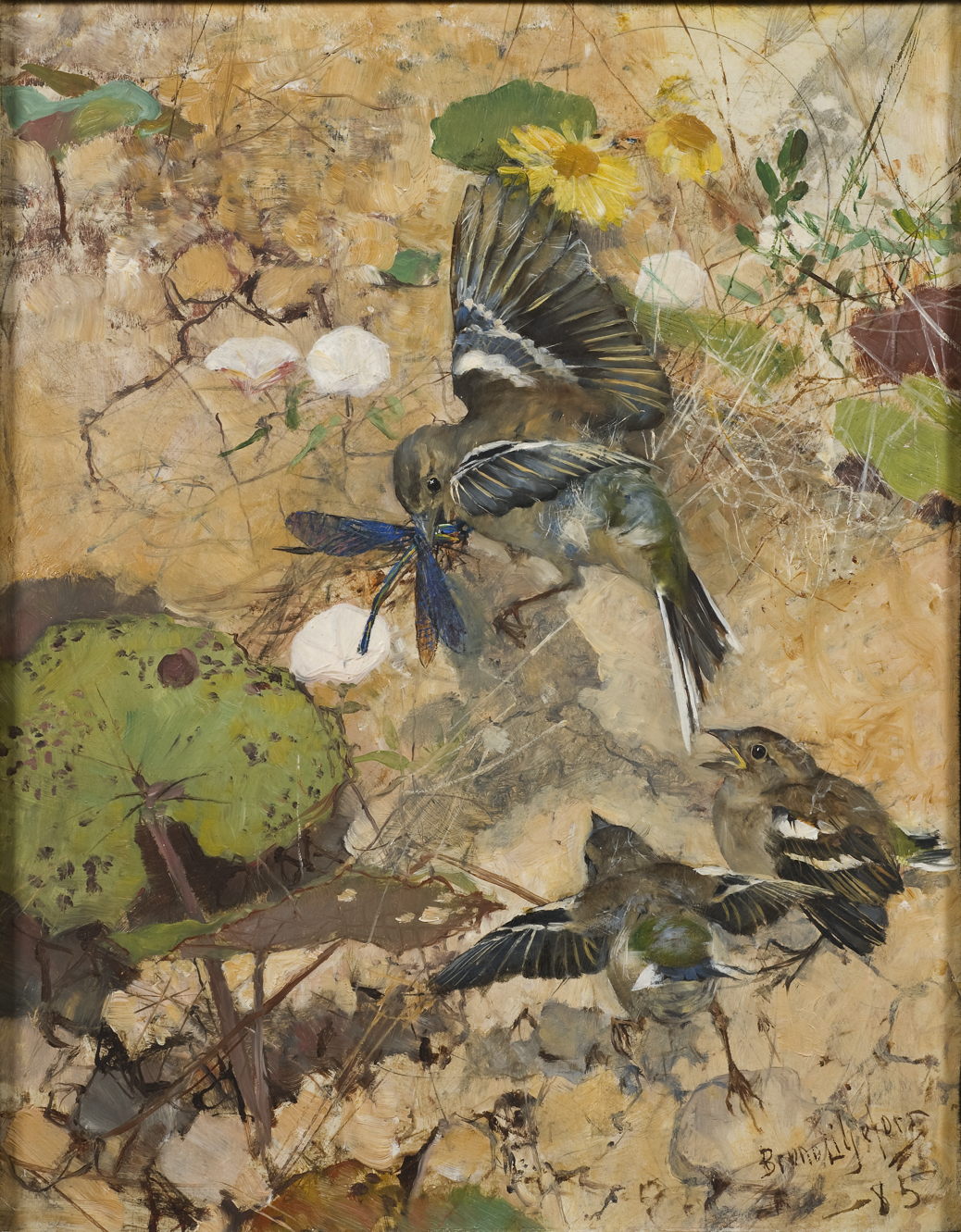
Bruno Liljefors (1860–1939), Chaffinches and Dragonflies. Five studies in one frame (1885), oil on panel, 33 x 25.5 cm, Nationalmuseum, Stockholm, Sweden. Wikimedia Commons.
The large meal seen in the centre of Bruno Liljefors’ Chaffinches and Dragonflies. Five studies in one frame (1885) is another common European species, the beautiful demoiselle (Calopteryx virgo). This is considerably smaller than the hawker seen above, and is more correctly termed a damselfly, as its pairs of wings are of equal length, and when resting are folded back against its body.
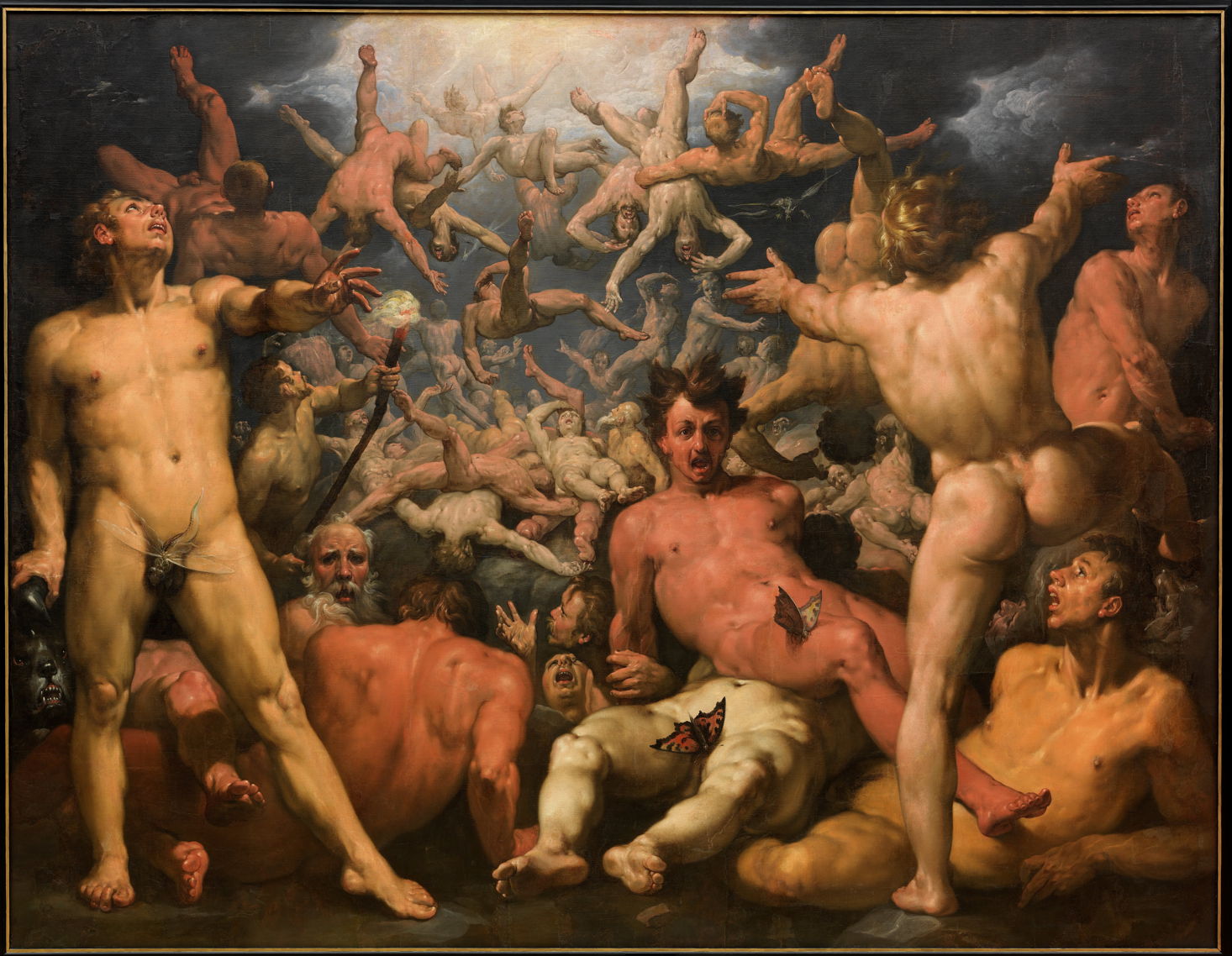
Cornelis van Haarlem (1562–1638), The Fall of the Titans (1588-90), oil on canvas, 239 x 307, Statens Museum for Kunst (Den Kongelige Malerisamling), Copenhagen, Denmark. Wikimedia Commons.
Cornelis van Haarlem’s The Fall of the Titans from 1588-90 might seem a strange painting in which to find flying insects. This shows the classical myth in which the gods have defeated the Titans who preceded them. As a result the Titans fell from the heavens and were imprisoned in Tartarus, or Hell, as shown here. It was claimed that flying insects were associated with the fire of the underworld, although the two butterflies and one dragonfly here appear quite incongruous.
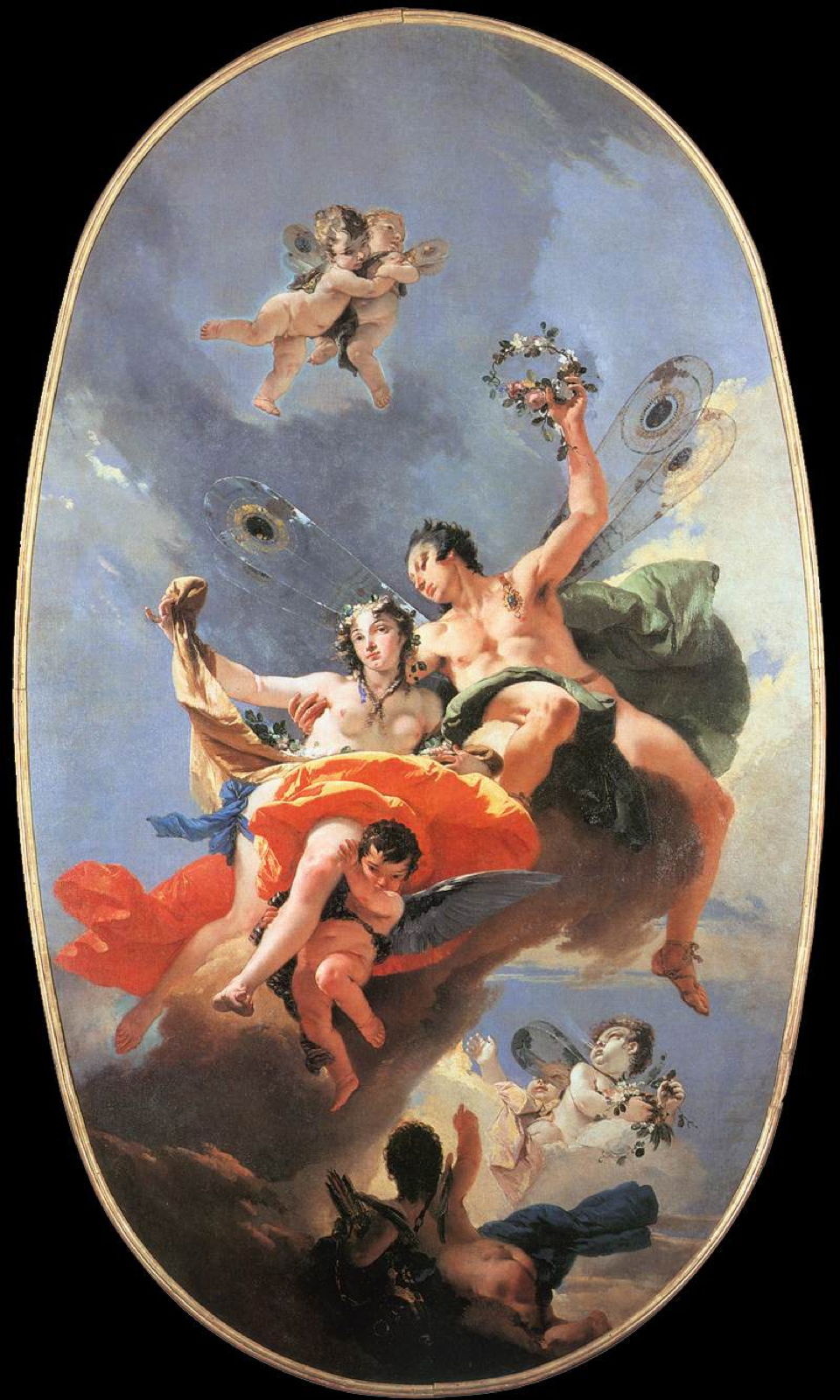
Giovanni Battista Tiepolo (1696–1770), The Triumph of Zephyr and Flora (1734-35), oil on canvas, dimensions not known, Ca’ Rezzonico, Venice, Italy. Wikimedia Commons.
Tiepolo’s The Triumph of Zephyr and Flora from 1734-35 refers to Ovid’s account in his Metamorphoses, and to Botticelli’s Primavera, with Zephyrus in flight with his arm around Flora, just about to crown her with a garland. Unusually, Zephyrus is given the wings of a dragonfly.
Elihu Vedder (1836–1923), Fortuna (date not known), oil on canvas, 55.9 x 40.6 cm, Private collection. The Athenaeum.
In the Roman religion, Fortuna (Greek equivalent Tyche) was the goddess of fortune and luck, both good and bad. More usually depicted as being veiled and/or blind, to indicate the chance involved, she was the embodiment of capriciousness. In this updated portrait of the goddess, Elihu Vedder shows her as a carefree, happy-go-lucky woman, with the wings of a dragonfly, sat next to a sack of gold coins. Vedder first visited Italy in 1858, and lived there from 1906 until his death seventeen years later, so he may well have been referring to Tiepolo’s Zephyrus, which was and remains in Venice.
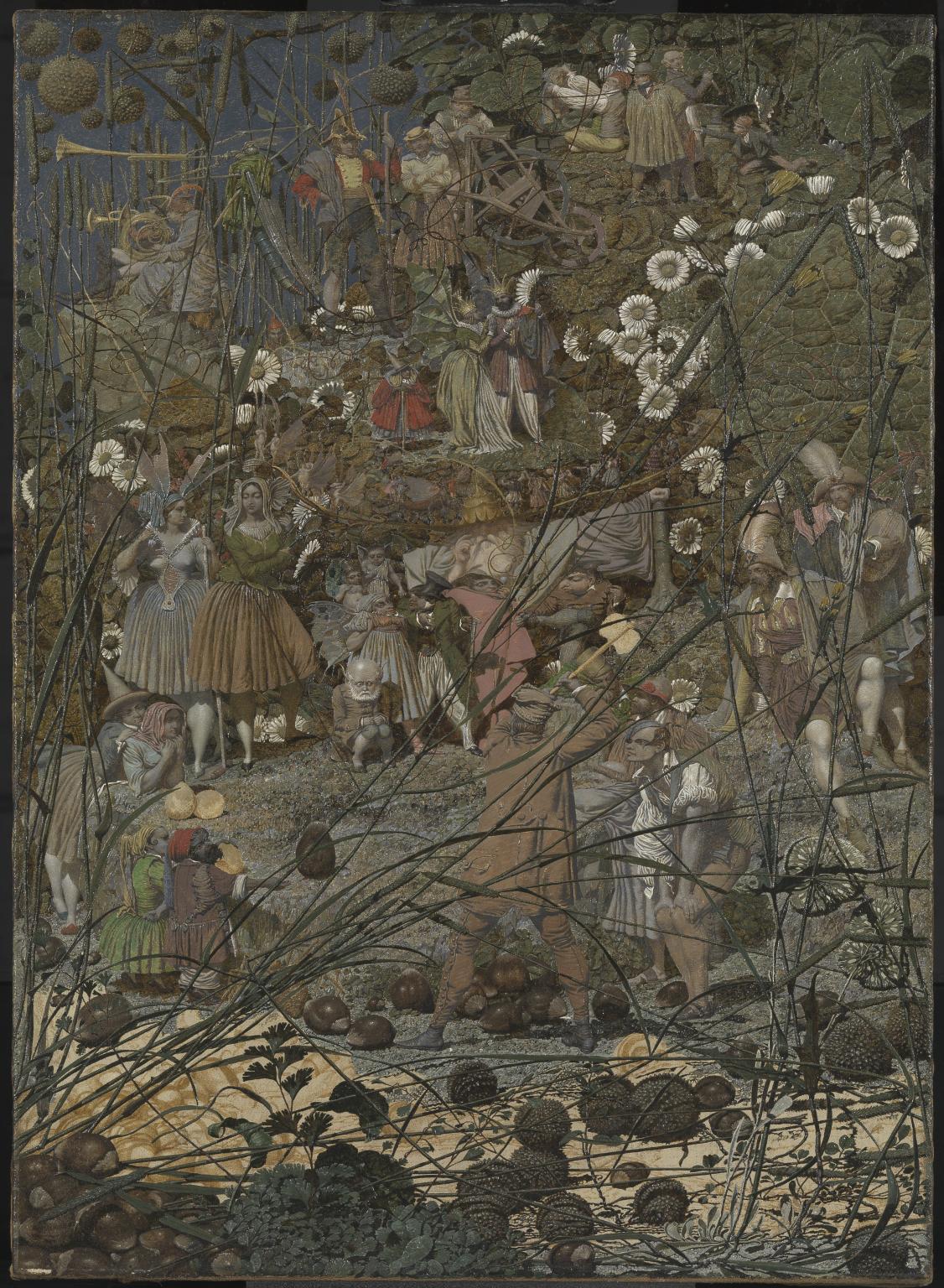
My last painting of a dragonfly is by far the most complex, and was made by Richard Dadd between 1855-64, when he was a patient in the Bethlem and Broadmoor psychiatric hospitals, after he had murdered his father.
Dadd’s The Fairy Feller’s Master-Stroke has its origins in Shakespeare’s plays, with its main content drawn from A Midsummer Night’s Dream. This looks through fine stalks of Timothy grass at a foreground of scattered hazelnuts and plane tree fruit. Although its perspective is flattened, the figures in the lower half of the painting are stood on a gently rising grassy sward, behind which is a steeper bank and stone walling. Those in the upper third of the painting appear to be on another level, which rises more steeply towards the top edge.
The scene is set in the night-time, although daisy flowers are still unnaturally open, and there is night sky visible at the upper left. The feller himself, a hewer or fellow, seen at the centre, is about to cleave a hazelnut with his axe to provide a new carriage for Queen Mab (pronounced Maeve, to rhyme with rave), who replaces Titania as the queen of fairyland.
Even the distant upper section of the painting is rich in its array of characters. Trumpeters at the left include two boys, given as a ‘tatterdemalion’ and a ‘junketer’, and an insect intended to be a dragonfly. To the right of them are the characters from the still-popular child’s counting saying, of tinker, tailor, soldier, sailor, rich man, poor man, beggar man, and thief, although not quite in that order. The dragonfly may have been based on another large species found throughout Europe, the emperor (Anax imperator).
Trees are prominent features of every continent apart from Antarctica, and even our more densely urban areas find room for a few of them. From our origins in East Africa to the city parks of New York, London and Tokyo, humans and trees have lived together. As a result, trees feature in a great many paintings. This series explores how they have been depicted in European and North American art from before the Renaissance to the early twentieth century.
Peter Paul Rubens (1577–1640), Landscape (c 1635-40), gouache, 24 × 45 cm, Hermitage Museum, Saint Petersburg, Russia. Wikimedia Commons.
Like many artists since, Peter Paul Rubens made studies of trees to support his studio paintings in oils. This one, known simply as Landscape, is a careful and quite detailed sketch in gouache (opaque watercolour) of a group of trees on the bank of a small river, painted during the last five years of his life. The evidence from the tree in the mid-right is that he constructed them anatomically, by putting in the structural curves and lines of the branches, then laying down areas of foliage, a method developed during the Renaissance and still widespread today.
This practice of painting studies from life was recommended by the great landscape artist and teacher Pierre Henri Valenciennes (1750-1819), who wrote in his book Elements of Practical Perspective for the Use of Artists: “Be sure to make several painted studies of beautiful trees, whether standing alone or in groups. Pay close attention to every detail of the bark, moss, roots, branches, and the ivy that surrounds and clings to them; above all, make good choices and study the variety of wood, bark, and foliage, which is of the utmost importance.” (Second edition, 1820.)
Landscape specialists like John Constable painted studies of trees throughout their career, to inform finished works.
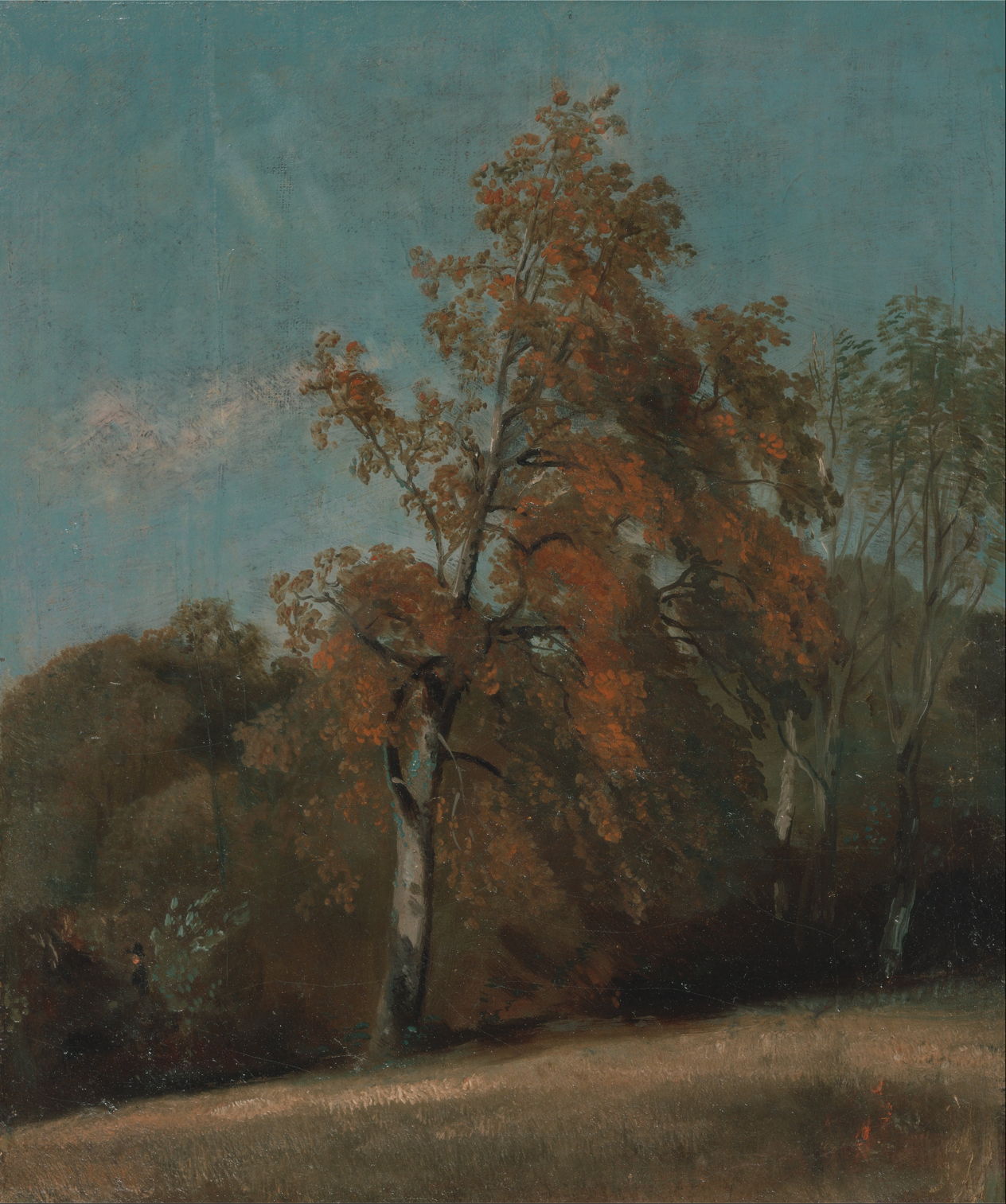
John Constable (1776–1837), Study of an Ash Tree (1801-3 or 1810-30), oil on canvas laid to artist’s board, 39.4 x 29.8 cm, Yale Center for British Art, New Haven, CT. Wikimedia Commons.
He learned to create plein air sketches in oils, which he used extensively for ‘skying’ particularly around Hampstead Heath near London, and for remarkable studies of trees, such as this ash, seen in its autumn colours. Here he too has taken the time to construct the tree anatomically, and to detail its foliage.
This continued through the middle of the nineteenth century, when landscape painting was evolving towards Impressionism.
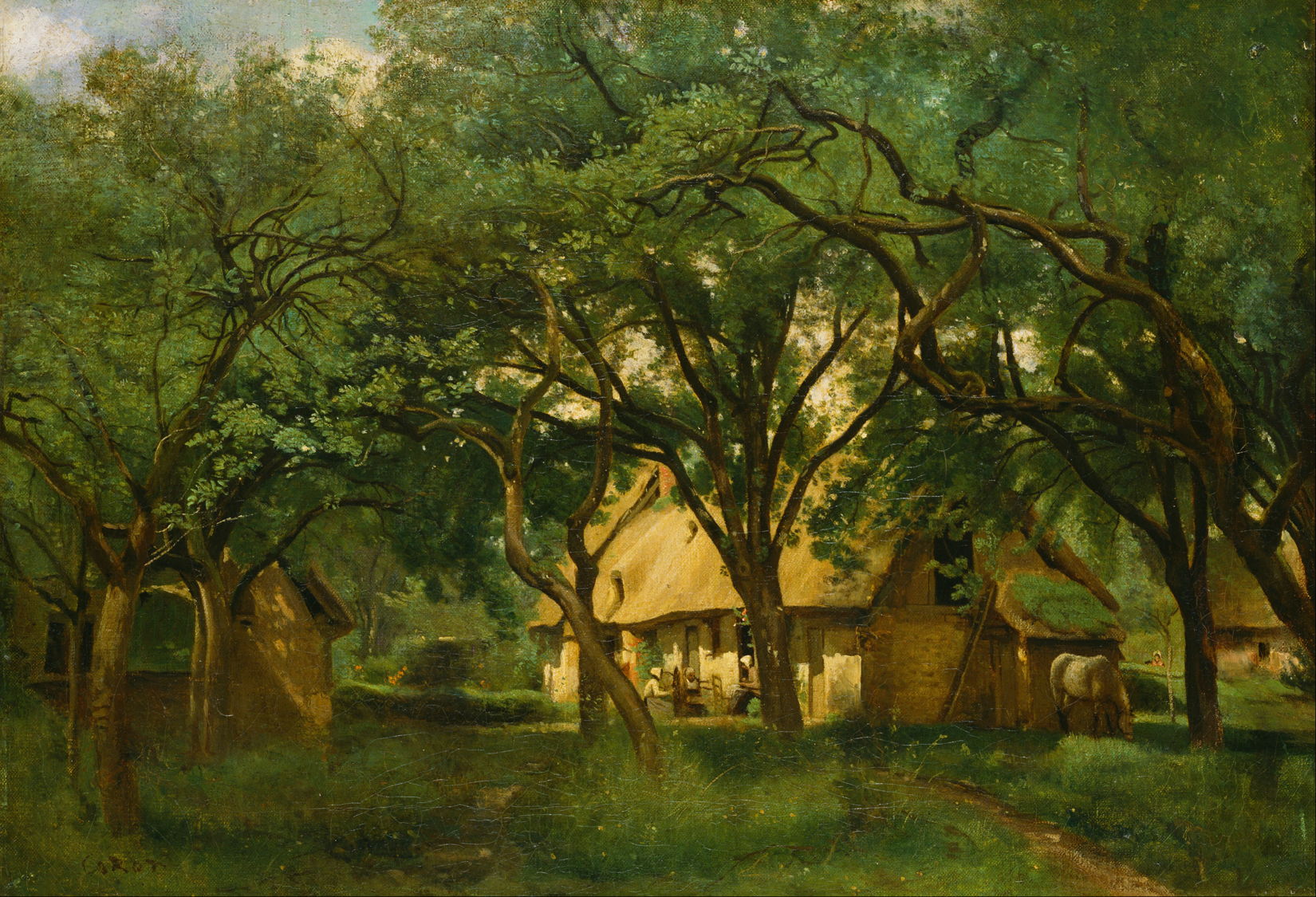
Jean-Baptiste-Camille Corot (1796–1875), The Toutain Farm, Honfleur (c 1845), oil on canvas, 44.4 × 63.8 cm, Bridgestone Museum of Art, Tokyo. Wikimedia Commons.
Camille Corot’s The Toutain Farm, Honfleur from about 1845 appears to be a finished studio painting, perhaps intended for the Salon. Its trees are marvellous and all but obscure and upstage the farmhouse beyond. Their sinuous limbs reflect his structured approach to painting their canopies with a catalogue of ways the trunk can give rise to branches. The canopy itself is shown in careful detail, although at the upper left it seems more vague and sketchy.
Europe has a rich and varied flora of tree species, and one of the challenges in painting its landscapes has been to capture their distinctive characteristics.
Jacob Isaakszoon van Ruisdael (1628/9–1682), Road through an Oak Forest (c 1646-7), oil on canvas, 65 x 85 cm, Statens Museum for Kunst, København, Denmark. Wikimedia Commons.
Jacob van Ruisdael gave insight into the stages in the life and looks of oak trees. In Road through an Oak Forest (c 1646-7) he captures the later life of a stag-headed oak on the left, which lost its crown long ago, a flush of new growth on a fallen trunk, and another still clinging onto life despite a great split at its base. Judging by the girth of their trunks, the oaks shown here are around 400 years old, making it likely they were saplings in the thirteenth century, possibly even earlier. They form a remarkable window in time back to the late Middle Ages.
Camille Pissarro (1830-1903), The Big Walnut Tree in Spring, Éragny (1894), oil on canvas, 60 x 73 cm, Private collection. Wikimedia Commons.
Camille Pissarro’s Big Walnut Tree in Spring, Éragny from 1894 celebrates a species that is a source of binder in oil paint, in walnut oil, although it’s used far less frequently than linseed. Its wood is also sought after, making this tree a long-term investment for the landowner’s heirs.
Vincent van Gogh (1853-1890), Cypresses (1889), oil on canvas, 93.4 x 74 cm, The Metropolitan Museum of Art, New York, NY. Wikimedia Commons.
Vincent van Gogh’s Cypresses (1889) are some of the best-remembered of all. As he moved style on beyond Impressionism, his swirling brushstrokes form solid but thoroughly living trees. These are most probably Italian cypresses, which are characteristic of the landscape around the Saint-Paul-de-Mausole asylum where he was living at that time, and throughout Provence.
Vincent van Gogh (1853-1890), Olive Grove (1889), oil on canvas, 72 x 92 cm, Kröller-Müller Museum, Otterlo. WikiArt.
In his Olive Grove (1889), those swirling strokes of foliage complement the tortuous curves of the branches and gnarled blue-grey trunks.
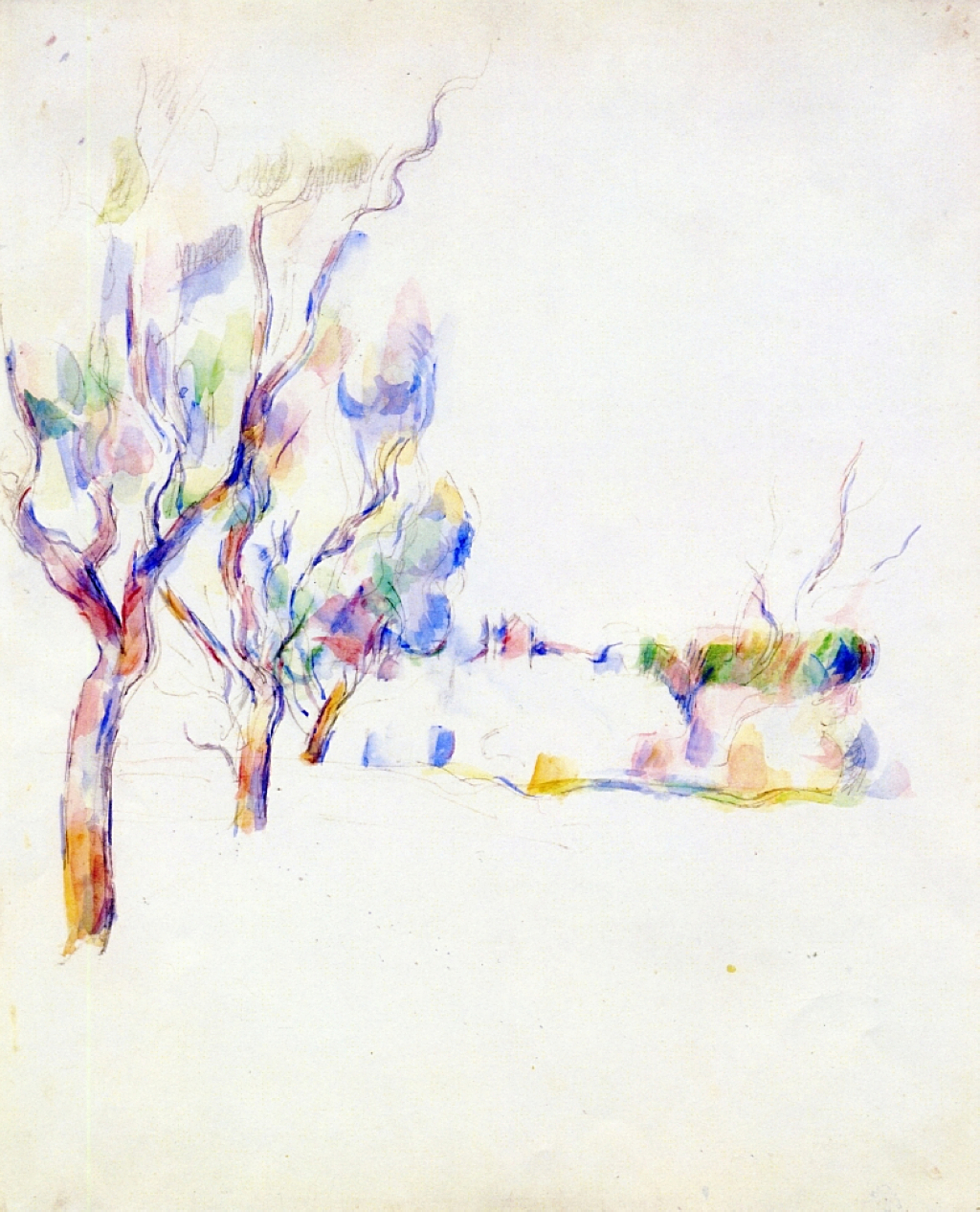
Paul Cézanne (1839–1906), Almond Trees in Provence (1900). Graphite and watercolour on paper, 58.5 x 47.5 cm, private collection (WikiArt).
Paul Cézanne’s oil paintings of trees, although abundant, show his emphasis on patterned brushstrokes in what is known as his constructive stroke. This isn’t true of his watercolours, as shown in Almond Trees in Provence (1900), where each tree rises in a flare of brilliant colours.
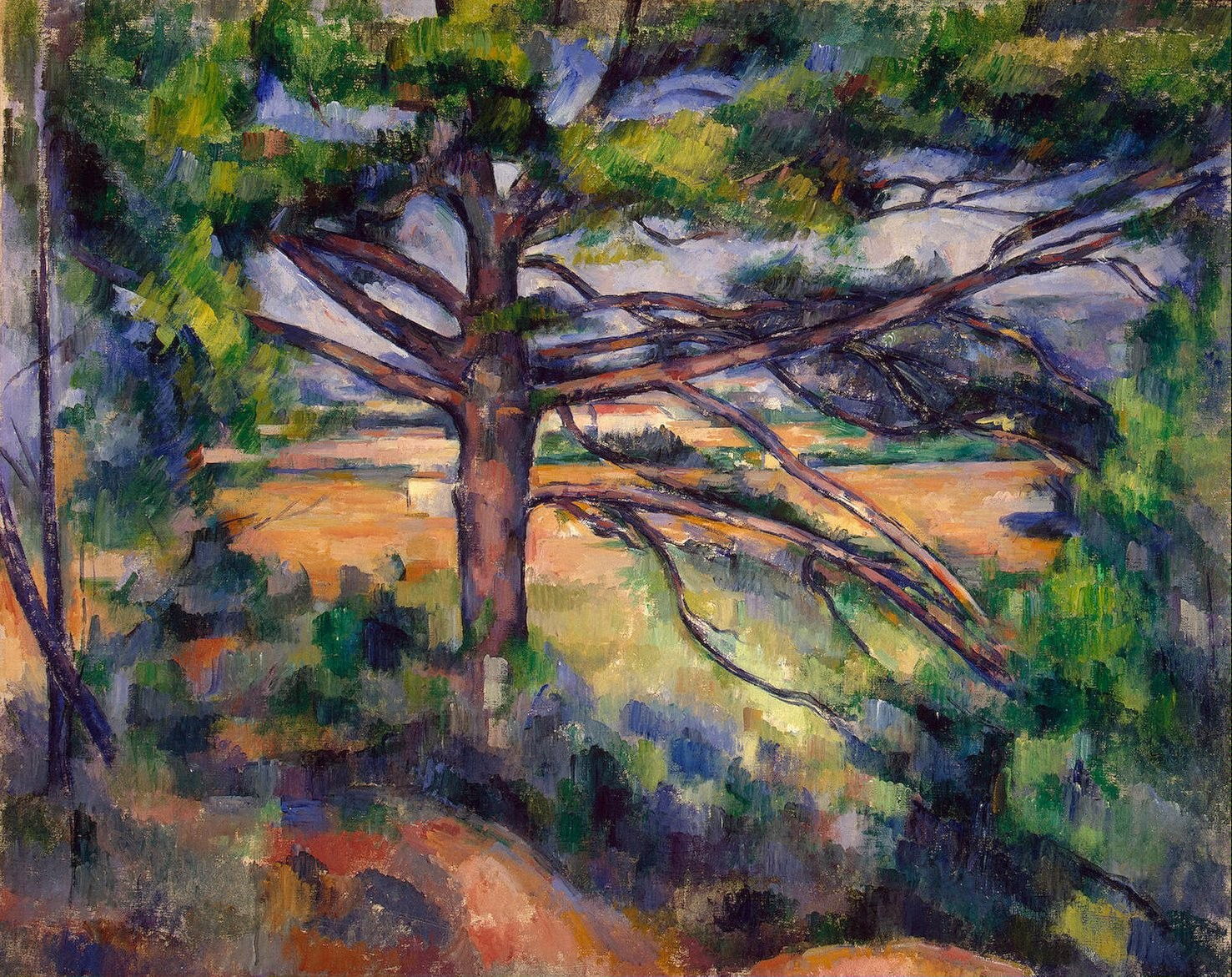
Paul Cézanne (1839–1906), Grand pin et terres rouges (Large Pine and Red Earth) (1890–95), oil on canvas, 72 x 91 cm, Hermitage Museum, St. Petersburg. Wikimedia Commons.
Cézanne’s constructive stroke became more prominent and started to dominate the structure of his oil paintings after 1890. In Large Pine and Red Earth (1890–5) it’s used throughout the foreground foliage and vegetation, and has even started to appear in some patches on the trunk.
Théo van Rysselberghe (1862-1926), Pine by the Mediterranean Sea (1916), oil on canvas, 81 x 199 cm, Centraal Museum, Utrecht. WikiArt.
Finally, Théo van Rysselberghe’s Pine by the Mediterranean Sea (1916) appears almost as substantial as the bleached rocks below it. Contrast between the lit segments and those in cast shadow behind is wide, as is seen on the shores of the Mediterranean.
I hope you will join me in exploring these and many other fine portraits of trees over the coming weeks.
This series looks at two contrasting groups of paintings featuring reflections: those of figures seen mostly in planar mirrors arranged vertically, such as that mounted on a dressing table, and those of landscapes seen reflected by a horizontal water surface like a lake. When intended to be faithful to nature, these should all adhere to the same optical principles.
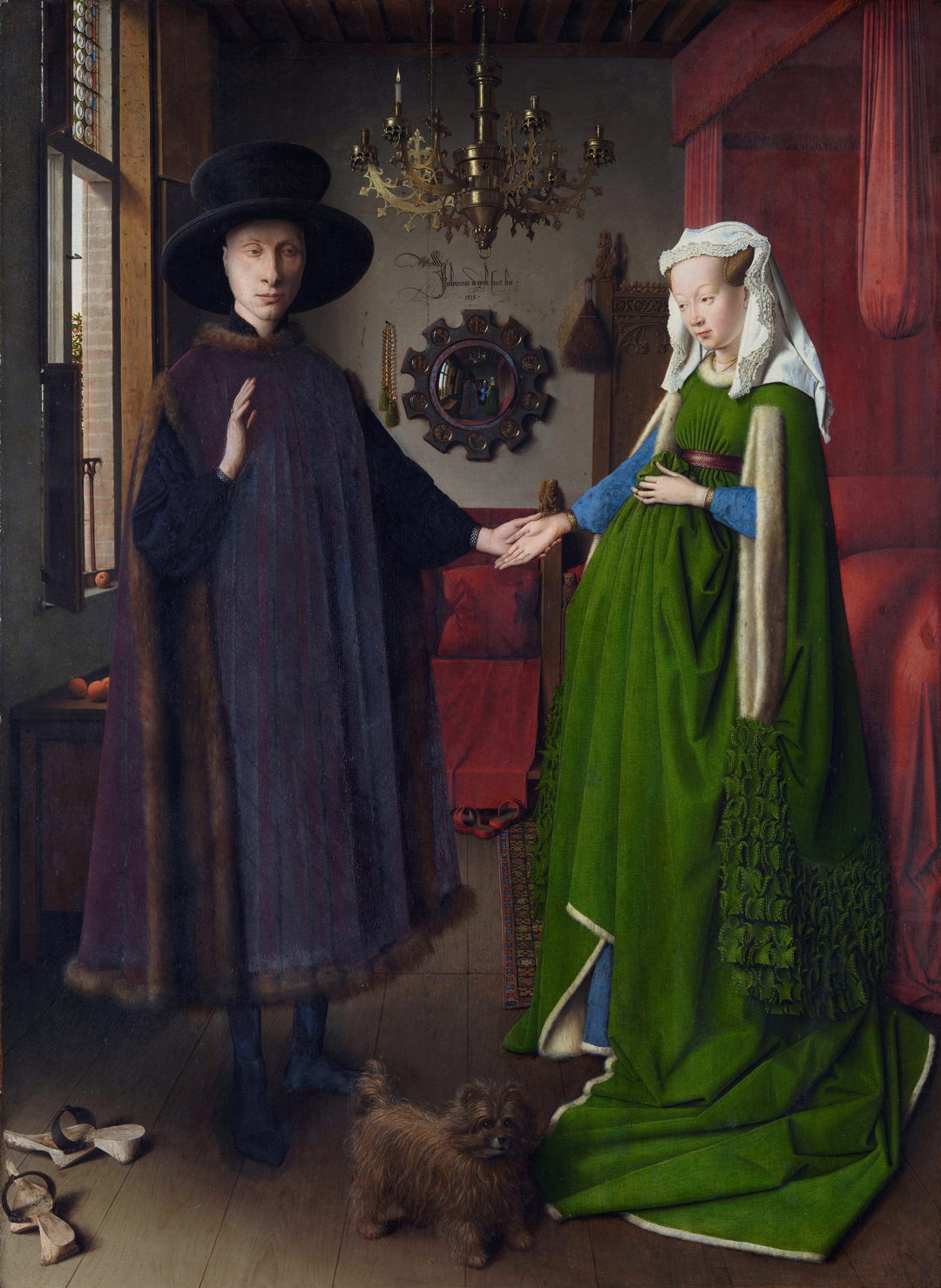
Jan van Eyck (c 1380-1441), Portrait of Giovanni(?) Arnolfini and his Wife (detail) (1434), oil on oak panel, 82.2 x 60 cm. National Gallery, London. WikiArt.
Optical effects as a theme in the Northern Renaissance, as seen in Jan van Eyck’s most famous painting The Arnolfini Wedding, completed in 1434 (above), and in the landscape behind his Madonna of Chancellor Rolin, probably painted the following year (below).
Jan van Eyck (c 1390–1441), The Madonna of Chancellor Rolin (detail) (c 1435) oil on panel, 66 x 62 cm. Musée du Louvre, Paris (WikiArt).
Any faithful depiction of reflections on water should show the following:
a line joining any point on the original with its equivalent on the reflection will be vertical;
an object behind another object in the original will also remain behind that object in the reflection, as reflections preserve depth order;
the further back that an original object is from the water’s edge, the more its reflection will be cropped vertically;
vertical cropping loses the lower section of the original from the reflection, and the upper section remains in the reflection;
the view of each part of the original seen in the reflection will be that as seen from the points of reflection, those being lower than the observer and closer to the original;
what is seen on the (observer’s) left of the original appears on the left of the reflection, and what is seen on the right remains on the right of the reflection;
because the reflection is vertically inverted, what is seen at the top of the original appears at the bottom of the reflection.
Analogous principles apply to reflections in a vertical mirror.
Self-portraits almost invariably rely on painting the reflection seen in a plane mirror.
Clara Peeters (fl 1607-1621), Still Life with Flowers and Gold Cups of Honour (detail) (1612), oil on oak, 59.5 x 49 cm, Staatliche Kunsthalle Karlsruhe, Karlsruhe, Germany. Wikimedia Commons.
Defined by Marco Bertamini, Richard Latto and Alice Spooner as occurring “every time the observer sees both an actor (eg Venus) and a mirror, not placed along the observer’s line of sight, and concludes that Venus is seeing her reflection at the same location in the mirror that the observer is seeing.” They were intrigued by “the situations in which we as observers read the scene in a certain way, but the mirror itself is used (deliberately or not) to lead us down the wrong path. More specifically, the mirror shows us something that we accept as the view available to the actor in the scene. However, the actor has a different vantage point from us and therefore the laws of optics imply that he/she cannot be seeing what we see in the mirror.”
Diego Velázquez (1599–1660), Venus at Her Mirror, The Toilet of Venus (Rokeby Venus) (1644-48) [101], oil on canvas, 122.5 x 177 cm, The National Gallery, London. Image by Diego Delso, via Wikimedia Commons.
Where the artist manipulates a reflected image for an effect, whether or not that image remains faithful to optical principles.
Diego Velázquez (1599–1660), Las Meninas (The Maids of Honour, Velázquez and the Royal Family) (c 1656-57) [119], oil on canvas, 318 x 276 cm, Museo Nacional del Prado, Madrid, Spain. Wikimedia Commons.
Paintings by:
Albrecht Dürer (1471-1528)
Aelbert Cuyp (1620–1691)
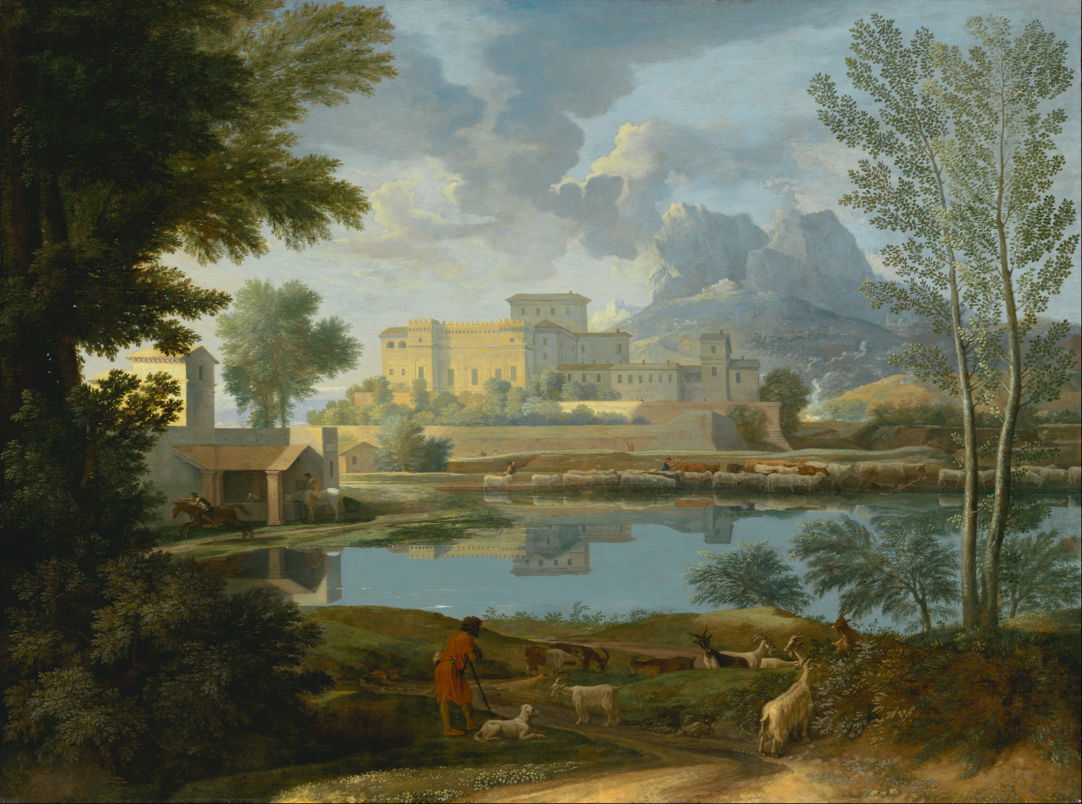
Nicolas Poussin (1694-1665), Landscape with a Calm (c 1651)
Claude Lorrain (1604/5–1682)
Canaletto (1697–1768)
Claude-Joseph Vernet (1714–1789)
Nicolas Poussin (1694-1665), Landscape with a Calm (c 1651), oil on canvas, 97 x 131 cm, J. Paul Getty Museum, Los Angeles. Digital image courtesy of the Getty’s Open Content Program.
Paintings by:
John Constable (1776–1837)
Joseph Mallord William Turner (1775–1851)
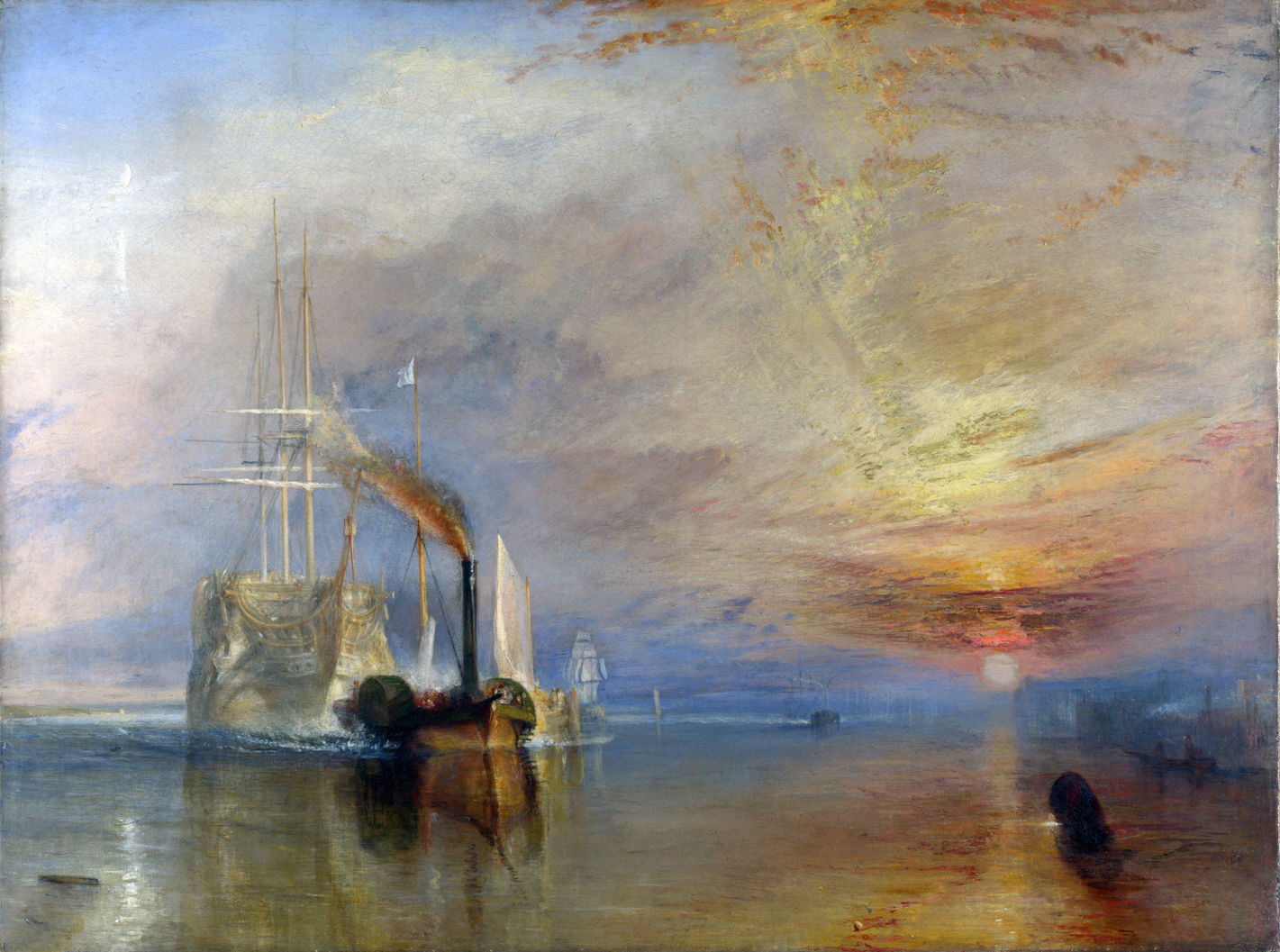
Joseph Mallord William Turner (1775–1851), The Fighting Temeraire tugged to her last Berth to be broken up (1839), oil on canvas, 90.7 × 121.6 cm, The National Gallery, London. Wikimedia Commons.
Paintings by:
Gustave Caillebotte (1848–1894)
Martín Rico y Ortega (1833–1908)
Eilert Adelsteen Normann (1848–1918)
Laurits Andersen Ring (1854–1933)
Frits Thaulow (1847–1906)
Kazimierz Sichulski (1879–1942)
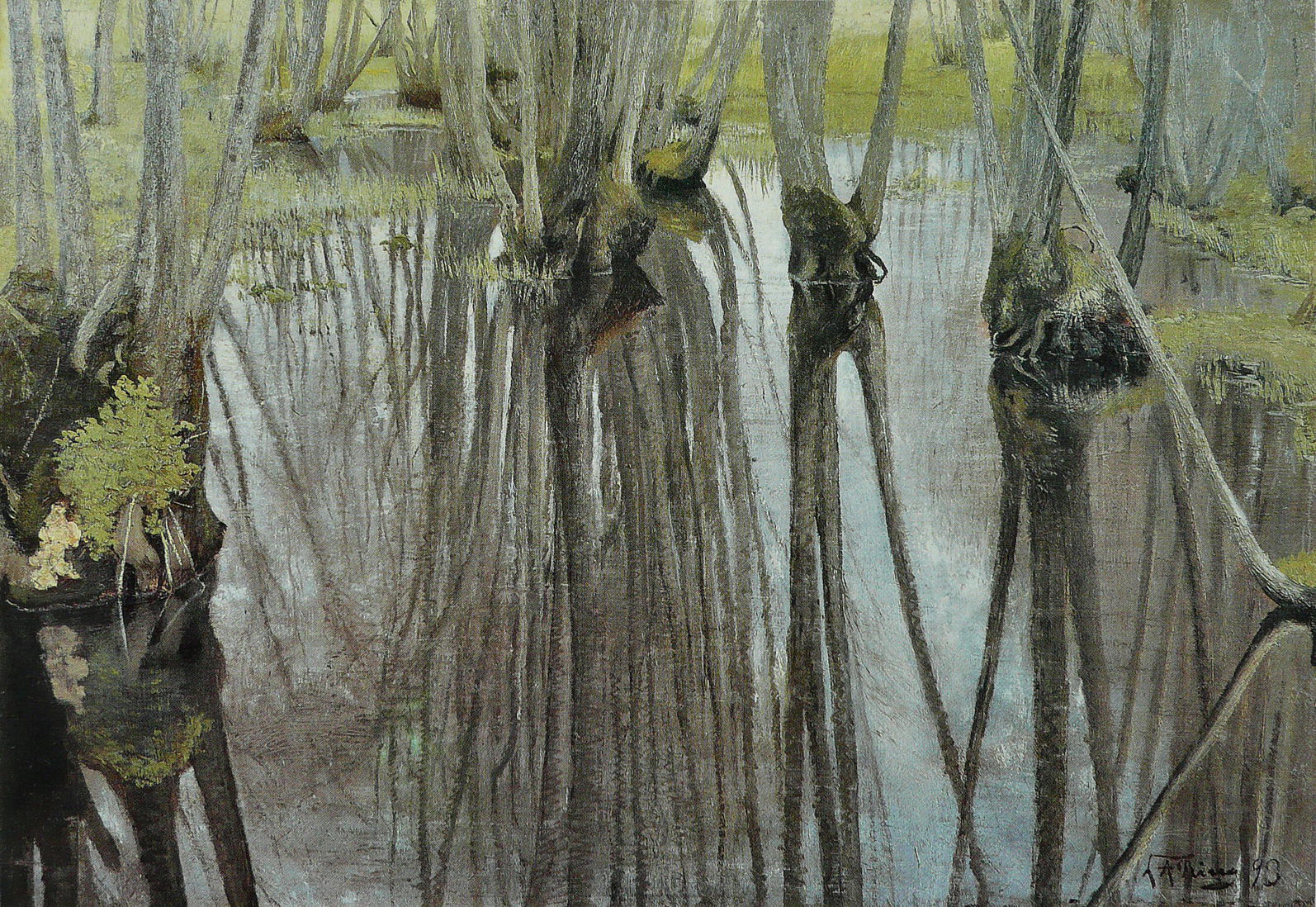
Laurits Andersen Ring (1854–1933), Alder Trunks (1893), oil on canvas, 52.9 x 73.5 cm, Collection of Her Majesty the Queen Margrethe II, Copenhagen, Denmark. Wikimedia Commons.
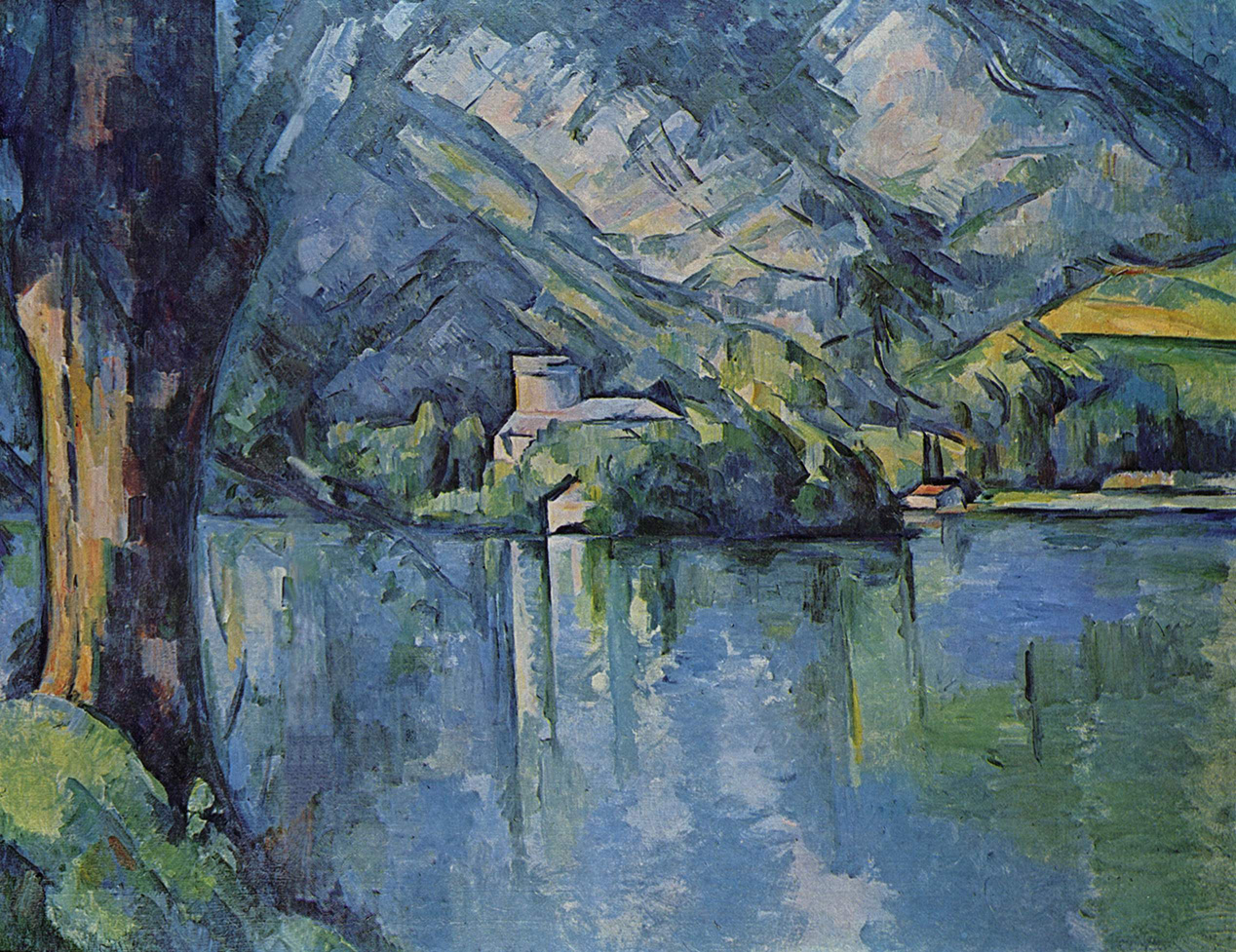
Paul Cézanne, Le Lac d’Annecy (Lake Annecy) (1896) (R805), oil on canvas, 65 x 81 cm, The Courtauld Gallery, London (Samuel Courtauld Trust) (P.1932.SC.60). Wikimedia Commons.
Paintings by:
Ferdinand Hodler (1853–1918)
Gustav Klimt (1862–1918)
Ferdinand Hodler (1853–1918), Rhythmic Landscape on Lake Geneva (1908), oil on canvas, 67 x 91 cm, Private collection. Wikimedia Commons.
References
Brook Taylor (1719) New Principles of Linear Perspective, or the Art of Designing on a Plane the Representations of All Sorts of Objects, in a more General and Simple Method than has been done before, London. (Not available online, and later editions omit much of the material on reflections.)
Cole, Rex Vicat (1921) Perspective, Seeley, Service and Co, London. (Available in various reprints, and Archive.org.)
de Piles, Roger (1708) Cours de Peinture par Principes, Paris. (Available at Archive.org.)
de Valenciennes P-H (1820) Élémens de Perspective Pratique à l’usage des artistes, 2nd edn., Paris.
Venice became an important part of the southern Renaissance with the paintings of the Bellini brothers in the latter half of the fifteenth century, and flourished in the sixteenth century with their successors Giorgione, Titian, Tintoretto and Veronese. Venetian painting distinguished itself by emphasising colour over line and form, but there were also important differences in media.
From long before the Renaissance, the largest paintings in Europe were made using fresco on the walls and ceilings of churches and other religious buildings. Because Venice had been built on marshy islands in a lagoon, the walls of its buildings remained damp and proved unsuitable for classical fresco technique. Supplies of wood were also limited, and the fabrication of large wooden panels was impractical. It was in Venice that the largest paintings were thus made in oil paints on stretched canvas.
In other circumstances, what are considered to be large canvases might attain five or six metres (16-20 feet) in their longer dimension. This article shows a selection where that exceeds ten metres (33 feet), and in one case twenty-two metres (72 feet), all but one created by Jacopo Tintoretto and his workshop.
In 1559-60, Tintoretto painted two commissions for the church of Madonna dell’Orto, where he was to be buried. Each nearly fifteen metres (50 feet) high, they’re among his most spectacular.
Jacopo Tintoretto (c 1518-1594), The Last Judgment (c 1559-60) (E&I 77), oil on canvas, 1450 x 590 cm, Madonna dell’Orto, Venice, Italy. Image by Didier Descouens, via Wikimedia Commons.
The Last Judgment was probably painted first, and shows apocalyptic scenes from Biblical eschatology, notably the book of Revelation. To some extent, paintings of the last judgement are inevitably chaotic, as that is part of the event, but Tintoretto’s overall composition here isn’t as well-conceived as in the second of the pair. The painting has several focal passages, in particular the horizontal winged angel wearing orange shorts just over half way up, and the figure of Christ at its apex.
Jacopo Tintoretto (c 1518-1594), The Last Judgment (detail) (c 1559-60) (E&I 77), oil on canvas, 1450 x 590 cm, Madonna dell’Orto, Venice, Italy. Image by Didier Descouens, via Wikimedia Commons.
The lower sections show a dark base filled with contorted bodies blending in with rock and water, an underworld without the usual fire. Above is a band of sea green, in which there is a reprise of the flood, and bodies are washed along in a great wave. The middle then takes to the air, where figures sit on clouds still bringing rain to those in the waters below. The central crucifix seen at the foot isn’t part of the painting.
Jacopo Tintoretto (c 1518-1594), The Last Judgment (detail) (c 1559-60) (E&I 77), oil on canvas, 1450 x 590 cm, Madonna dell’Orto, Venice, Italy. Image by Didier Descouens, via Wikimedia Commons.
In the upper section, above the angel in orange, rays of light are streaming down from Jesus at the apex. Individual figures are now more readily distinguished, and some of them recognisable. At each side are winged angels with long trumpets, and a double band of black clouds marking the threshold of heaven. On the right, a martyr wearing a deep blue loincloth sits with his crucifix against his shoulder: he could be Saint Andrew.
Higher still is the mother of twins, her back to the viewer, looking up towards the heaped black cloud on which Jesus Christ sits at the centre, with the Virgin Mary on one side and Saint John the Baptist on the other. Particularly in the upper section, many of the figures are foreshortened and distorted.
Jacopo Tintoretto (c 1518-1594), Making of the Golden Calf (c 1559-60) (E&I 78), oil on canvas, 1450 x 580 cm, Madonna dell’Orto, Venice, Italy. Image by Didier Descouens, via Wikimedia Commons.
The second, the Making of the Golden Calf, shows one of the more memorable stories of Moses, from the book of Exodus in the Old Testament. During that epic journey from bondage in Egypt to the Promised Land, Moses left the Israelites for a period of forty days and nights, when he ascended Mount Sinai to be given the Ten Commandments. While he was away, the people demanded that Moses’ brother and deputy Aaron made them a graven image to worship.
He gathered all their gold, which was melted down and cast into the form of a calf, which they then worshipped. God told Moses that they had already fallen from his ways, so Moses descended from Sinai. He was so angry with the Israelites that he broke the two tablets containing the commandments. He burnt the golden calf, ground it to powder, scattered it on water, and made the people drink it. The only people who didn’t worship the calf were the tribe of Levi, who became the first priestly class.
Tintoretto’s overall design of this simpler narrative is clearer and well-organised. The lower half of the painting shows the golden calf and the Israelites worshipping and feasting around it. Just over half way up is Moses on the summit of the mountain, being delivered the tablets with the commandments, and above that is heaven, with the Israelites’ God.
Jacopo Tintoretto (c 1518-1594), Making of the Golden Calf (detail) (c 1559-60) (E&I 78), oil on canvas, 1450 x 580 cm, Madonna dell’Orto, Venice, Italy. Image by Didier Descouens, via Wikimedia Commons.
The graven image of the golden calf is being carried with difficulty by four men. Piles of golden jewellery, coins, and chain are still apparently being melted down. Sitting on a rock bench above, under an ornamental awning, are several young women, who are being dressed and prepared for ceremonies to take place with the idol. More people are seen feasting on the grass over to the left.
Jacopo Tintoretto (c 1518-1594), Making of the Golden Calf (detail) (c 1559-60) (E&I 78), oil on canvas, 1450 x 580 cm, Madonna dell’Orto, Venice, Italy. Image by Didier Descouens, via Wikimedia Commons.
In the upper section of the painting, Moses is stood on the top of the mountain, his arms outstretched to the sky, ready to receive the tablets containing the commandments. God still holds those, immediately above Moses, and two winged angels are just taking the tablets from him, to pass down to Moses. Around them and above are several other figures, flying around the clouds.
One last remark about these two exceptionally tall paintings: recognising that viewers would have to look up sharply to see their upper sections, Tintoretto projected their figures and other details as if they were ceiling panels. The higher up each canvas you look, the more the figures appear to be above you. That is an ingenious projection to enhance their visual impact.
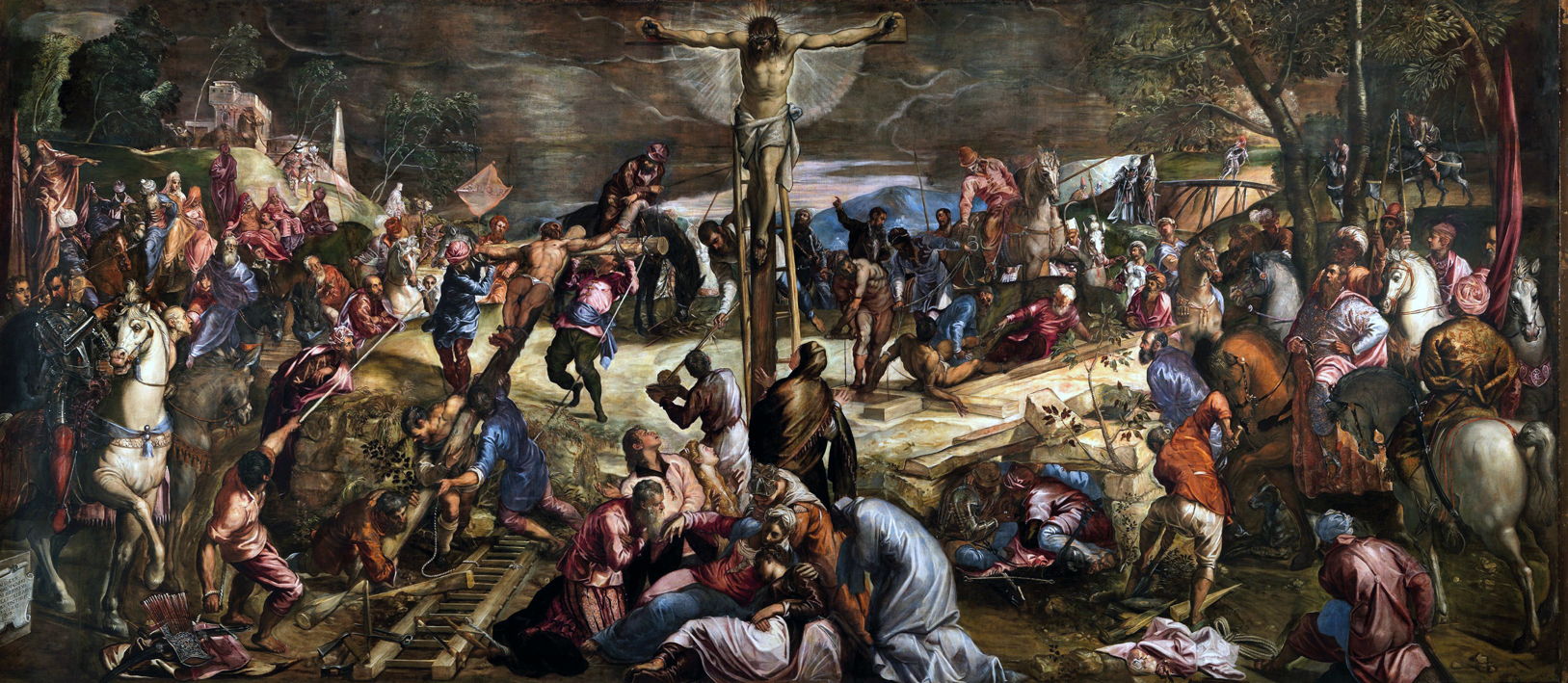
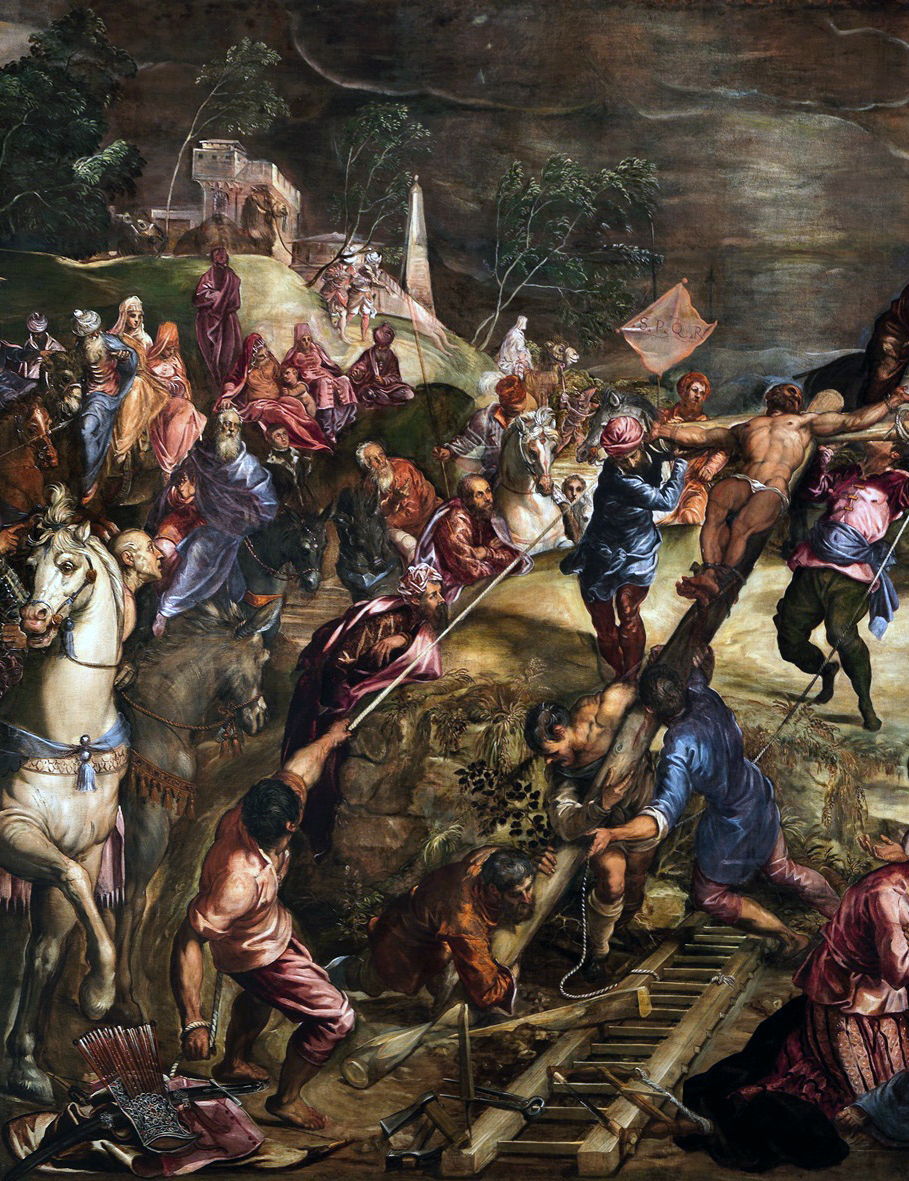
In 1565, commissioned by the Scuola Grande for its albergo, Tintoretto painted one of the major religious works of the century: his vast Crucifixion, more than 5 metres (17 feet) high, and 12 metres (40 feet) across.
Jacopo Tintoretto (c 1518-1594), The Crucifixion (E&I 123) (1565), oil on canvas, 536 x 1224 cm, Albergo, Scuola Grande di San Rocco, Venice, Italy. Wikimedia Commons.
He applied the lessons learned in his tall works for the Madonna dell’Orto. He makes use of space and uses a narrative technique based on the traditional ‘multiplex’ form popular during the Renaissance, in which its single image shows events at more than a single point in time, in an ingenious and modern manner. Naturally, the painting centres on Christ crucified, but the two thieves executed beside him are not shown, as would be traditional, already hanging from their crosses.
Jacopo Tintoretto (c 1518-1594), The Crucifixion (detail) (E&I 123) (1565), oil on canvas, 536 x 1224 cm, Albergo, Scuola Grande di San Rocco, Venice, Italy. Wikimedia Commons.
Instead, to the right of Christ, the ‘bad’ thief is still being attached to his cross, which rests on the ground. To the left of Christ, the ‘good’ thief is just being raised to the upright position. There is nothing in the well-known gospel accounts to make this anachronistic, but it’s most probable that the crucifixions were more simultaneous.
Spaced out around the canvas are relevant sub-stories from that whole. At the foot of Christ’s cross is his group of mourners, including the Marys. Each of the crosses has attendant workers, busy with the task of conducting the crucifixion, climbing ladders, hauling on lines, and fastening each victim to his cross. This mechanical and human detail brings the scene to life and adds to its credibility, and grim process.
Jacopo Tintoretto (c 1518-1594), The Crucifixion (detail) (E&I 123) (1565), oil on canvas, 536 x 1224 cm, Albergo, Scuola Grande di San Rocco, Venice, Italy. Wikimedia Commons.
The crowd on the left is more spread out than in an earlier version. In the distance is a flag bearing the letters SPQR representing the Roman Empire, and its link through Pilate. Most faces are turned towards Christ, with their eyes wide in awe.
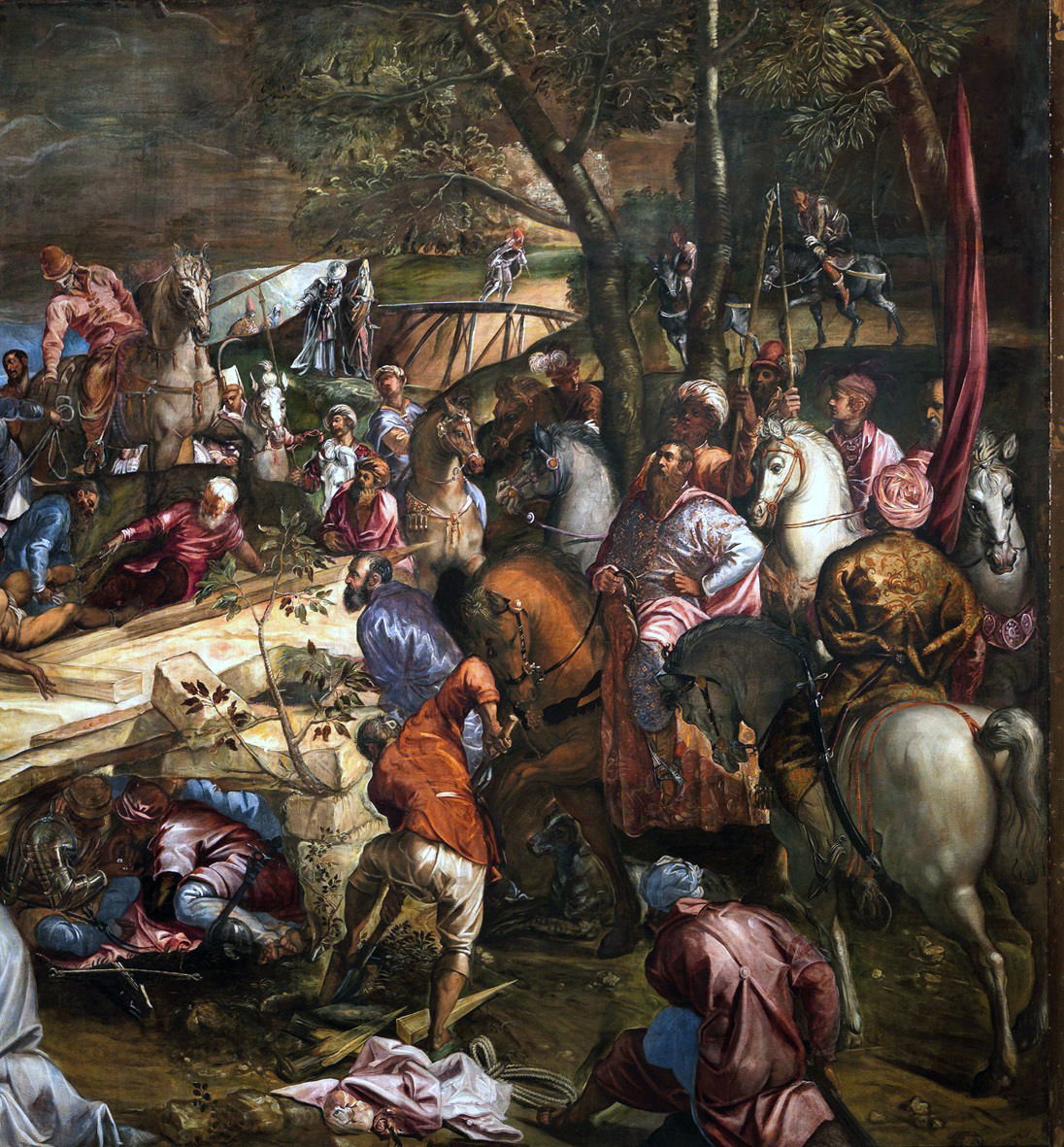
Jacopo Tintoretto (c 1518-1594), The Crucifixion (detail) (E&I 123) (1565), oil on canvas, 536 x 1224 cm, Albergo, Scuola Grande di San Rocco, Venice, Italy. Wikimedia Commons.
On the right, in a small rock shelter suggestive of a tomb, two men are gambling with dice. To the right of them, a gravedigger has just started his work with a spade. The ruling class, perhaps Herod himself, have turned up on horseback, and they too stare wide-eyed at Christ.
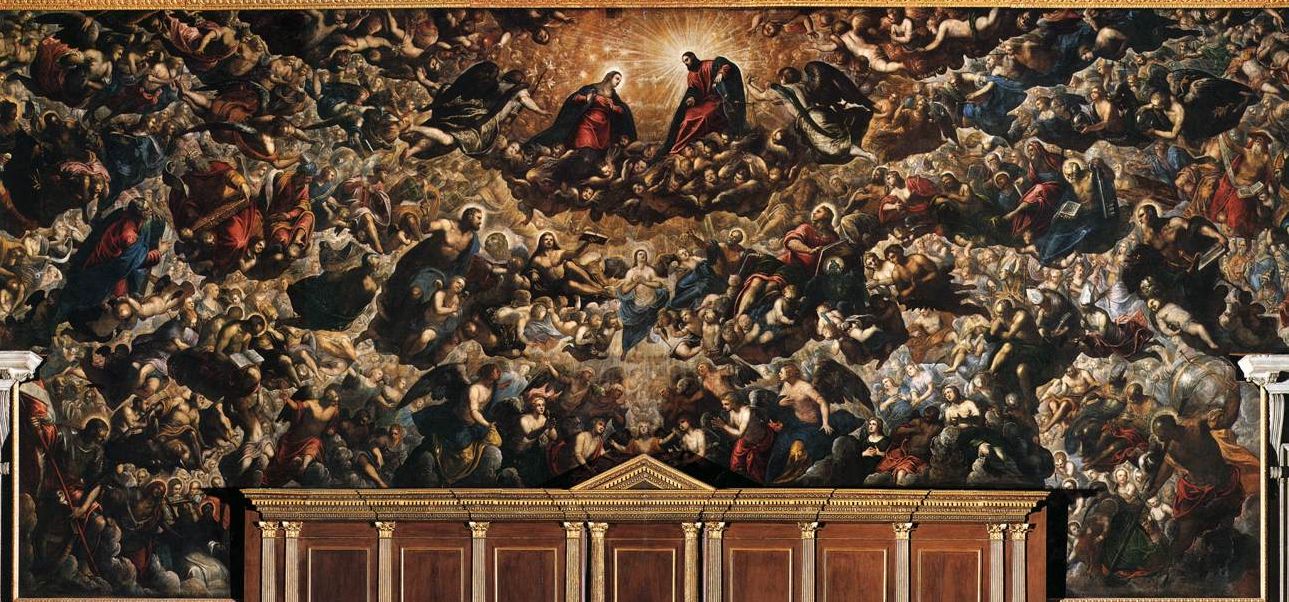
When the Doge’s Palace, or Palazzo Ducale, in Venice was destroyed by fire in 1577, it took with it a fresco from around 1365 by Guariento. Although initially unsuccessful in obtaining the commission to provide a replacement, with the death of Veronese in 1588, Tintoretto was invited to do so. By this time the artist was seventy, so much of the painting was performed by his son Domenico Robusti.
The room in which this painting was to be hung, the Sala del Maggior Consiglio, is one of the most majestic and imposing in the whole building, and was used for meetings of the Grand Council of Venice, at which it considered legislation and elected the city’s magistrates.
Jacopo Tintoretto (c 1518-1594) and Domenico Robusti, Paradise (E&I 298) (1588-1592), oil on canvas, 700 x 2200 cm, Sala del Maggior Consiglio, Palazzo Ducale, Venice. Wikimedia Commons.
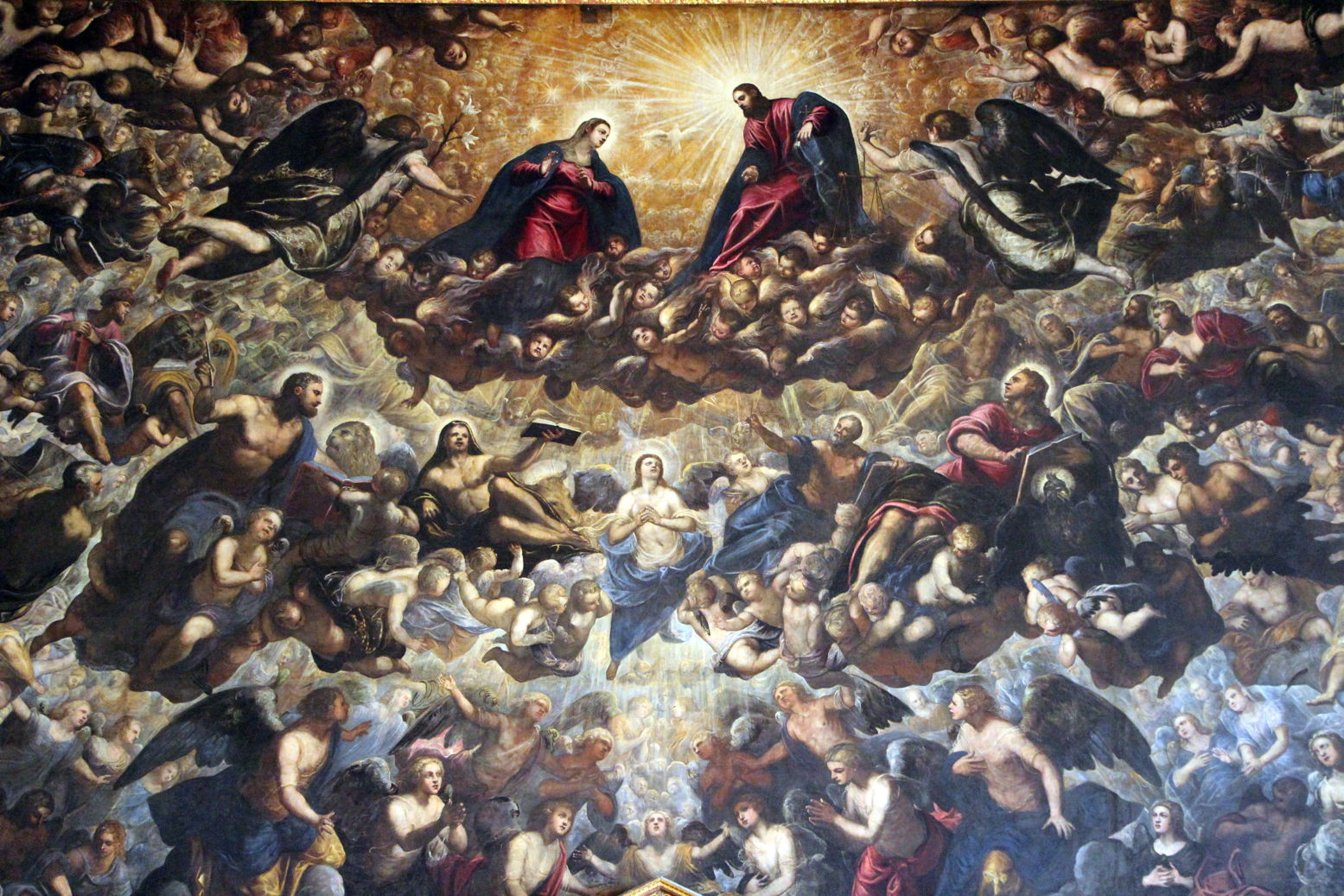
The resulting painting, which is seven metres (almost 23 feet) high and twenty-two metres (72 feet) across, was probably designed by Jacopo and largely entrusted to his son Domenico and the workshop to paint. In conformity with the rules of the commission, its composition focusses on the Coronation of the Virgin, inspired by Dante’s Paradise, as shown in the detail below.
Jacopo Tintoretto (c 1518-1594) and Domenico Robusti, Paradise (E&I 298) (detail) (1588-1592), oil on canvas, 700 x 2200 cm, Sala del Maggior Consiglio, Palazzo Ducale, Venice. Image by Sailko, via Wikimedia Commons.
At the top, the Virgin Mary, behind whom is her traditional symbol of the white lily, stands with Jesus Christ, in their matching red and blue robes. Between them is the white dove of the Holy Ghost, and all around are cherubic heads of infant angels. To the right are the scales of justice, also used for the weighing of souls.
Jacopo Tintoretto (c 1518-1594) and Domenico Robusti, Paradise (E&I 298) (detail) (1588-1592), oil on canvas, 700 x 2200 cm, Sala del Maggior Consiglio, Palazzo Ducale, Venice. Image by Sailko, via Wikimedia Commons.
Even at the height of his powers, and with his exceptionally fast brushwork, completing such a huge work would have been a major feat for Jacopo.
Jacopo Tintoretto (c 1518-1594) and Domenico Robusti, Paradise (E&I 298) (detail) (1588-1592), oil on canvas, 700 x 2200 cm, Sala del Maggior Consiglio, Palazzo Ducale, Venice. Image by Sailko, via Wikimedia Commons.
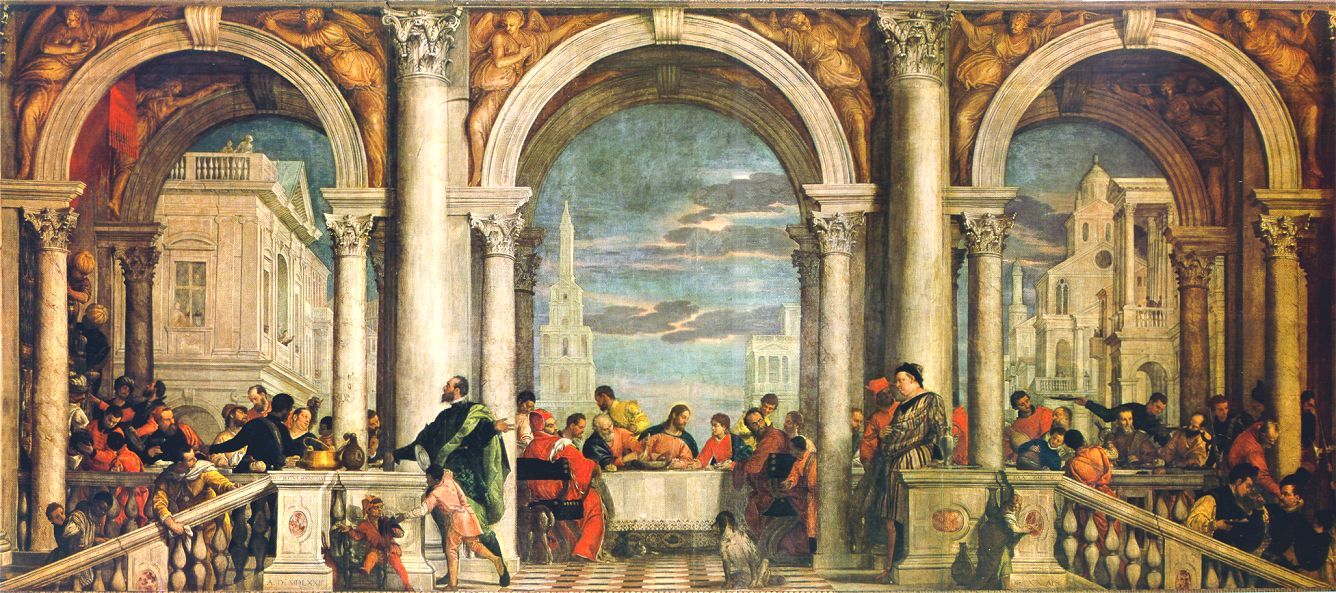
Paolo Veronese also made a name for himself with his earlier large canvases, but in 1573 exceeded them all in The Feast in the House of Levi, which wasn’t its original title.
Paolo Veronese (1528–1588), The Feast in the House of Levi (1573), oil on canvas, 555 × 1280 cm, Galleria dell’Accademia, Venice. Wikimedia Commons.
Veronese painted this thirteen metre-long (42 feet) scene for the refectory of the Dominican Friary of the Basilica di Santi Giovanni e Paolo, but it was intended to show the Last Supper, Christ’s last meal with his disciples before he was betrayed and crucified, at which he laid out the sacrament of Communion, a key part of Christian life ever since.
However, he over-reached himself, and the painting was deemed so offensive that he was brought before the Inquisition accused of blasphemy. Thankfully the Inquisition didn’t impose any penalty on Veronese himself, but required that he ‘correct’ the painting within a period of three months. This he did by changing its title, not its content, to The Feast in the House of Levi.
Christ is shown in the centre of the painting, further emphasised by his halo. In addition to the standard row of disciples, Veronese adds a rich collection of other figures, described by the Inquisition as “buffoons, drunken Germans, dwarfs and other such scurrilities”, more in the manner of a Venetian feast.
The classical Greek hero Theseus had travelled overland to be reunited with his father Aegeus, King of Athens, where he narrowly escaped death by Medea’s poison. Following the example of his hero Heracles, he then killed the Marathonian Bull, in preparation for his most famous accomplishment, killing the half-bull, half-human Minotaur living at the centre of the Labyrinth on the island of Crete.
King Minos of Crete had been exacting a tribute of nine young men and nine maidens from Athens every nine years, who were taken to the Labyrinth to die. On the third such call for eighteen of Athens’ finest, its citizens accused Aegeus of being its cause. Although a matter of dispute as to how he accomplished it, Theseus went to Crete as one of those eighteen.
George Frederic Watts was apparently driven to paint The Minotaur in 1885 as a response to a series of articles in the press revealing the industry of child prostitution in late Victorian Britain. Those referred to the myth of the Minotaur, so early one morning he painted this image of human bestiality and lust. His Minotaur has crushed a small bird in its left hand, and gazes out to sea, awaiting the next shipment of young men and virgin women from Greece.
Because the Athenians knew that their young people weren’t going to return, the ship carrying them to Crete had black sails. On this occasion, though, Theseus gave its crew a white sail, telling Aegeus and the crew that when they returned, if he had been successful in killing the Minotaur, they would set that white sail as a sign.
Gustave Moreau (1826–1898), Athenians Being Delivered to the Minotaur (1855), oil, dimensions not known, Musée de Brou, Bourg-en-Bresse, France. Wikimedia Commons.
Gustave Moreau’s painting of Athenians Being Delivered to the Minotaur (1855) shows the victims as they were preparing to enter the Labyrinth. Wearing laurel wreaths to mark their distinction and sacrifice, the young men and women hold back while Theseus crouches, waiting to do battle with the beast, seen at the right.
Left to his own devices, Theseus’ chances were not good. However, Minos’ daughter Ariadne had fallen in love with him when she saw him compete in the funereal games preceding the act of sacrifice, and promised to assist in return for his hand in marriage afterwards. It was she who provided Theseus with a ball of thread which he deployed as he entered the Labyrinth, enabling him to retrace his steps once he had killed the Minotaur at its centre.
Henry Fuseli (1741–1825), Ariadne Watching the Struggle of Theseus with the Minotaur (1815-20), brown wash, oil, white gouache, white chalk, gum and graphite on moderately thick, moderately textured, beige wove paper, 61.6 x 50.2 cm, Yale Center for British Art, New Haven, CT. Wikimedia Commons.
In Henry Fuseli’s spirited mixed-media sketch of Ariadne Watching the Struggle of Theseus with the Minotaur (1815-20), Theseus appears almost skeletal as he tries to bring his dagger down to administer the fatal blow, and Ariadne resembles a wraith or spirit.
Charles-Édouard Chaise (1759-1798), Theseus, Victor over the Minotaur (c 1791), oil on canvas, dimensions not known, Musée des Beaux-Arts, Strasbourg, France. Image by Rama, via Wikimedia Commons.
Theseus, Victor over the Minotaur (c 1791) is one of only three paintings by Charles-Édouard Chaise known to survive. With its crisp neo-classical style, it shows Theseus standing in triumph over the lifeless corpse of the Minotaur. He is almost being mobbed by the young Athenian women whose lives he has saved. At the left, his thread rests on a wall by an urn, suggesting the young woman by it may be Ariadne; she is being helped by a young man.
There are conflicting stories as to what happened next, but Theseus and Ariadne departed from Crete, ending up on the island of Naxos, where Theseus abandoned her and sailed on. This has been depicted by many painters, although most have naturally concentrated on the jilted Ariadne rather than her betrayer Theseus.
John William Waterhouse (1849–1917), Ariadne (1898), oil on canvas, 151 x 91 cm, Private collection. Wikimedia Commons.
John William Waterhouse paints the moment that Ariadne (1898) starts to wake, as Theseus’ ship has just sailed. As she hasn’t yet realised she has been abandoned, she lies back at ease. On and under the couch are a couple of leopards, a clear reference to the imminent arrival of Dionysus.
Paulus Bor (circa 1601–1669), Ariadne (1630-35), oil on canvas, 149 x 106 cm, Muzeum Narodowe w Poznaniu, Poznań, Poland. Wikimedia Commons.
Paulus Bor’s portrait of Ariadne, painted in the period 1630-35, can only show her on Naxos, immediately after she has been abandoned, still clutching the thread by which she thought she had tethered him, now hanging at a loose end. On the wall above her are sketches she has made of her lover. She looks deeply lost in thought and gloom.
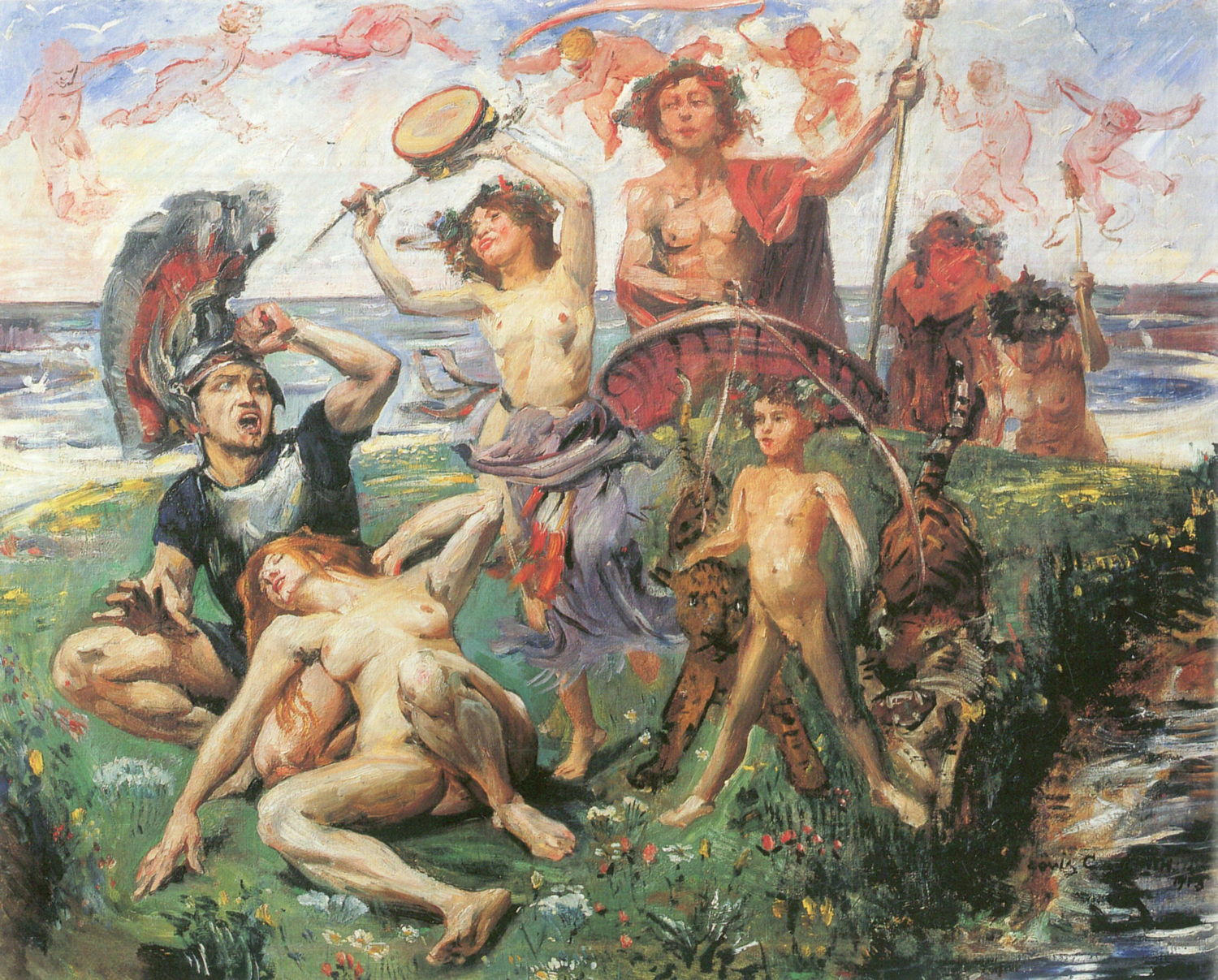
Lovis Corinth (1858–1925) Ariadne on Naxos (1913), oil on canvas, 116 × 147 cm, Private collection. Wikimedia Commons.
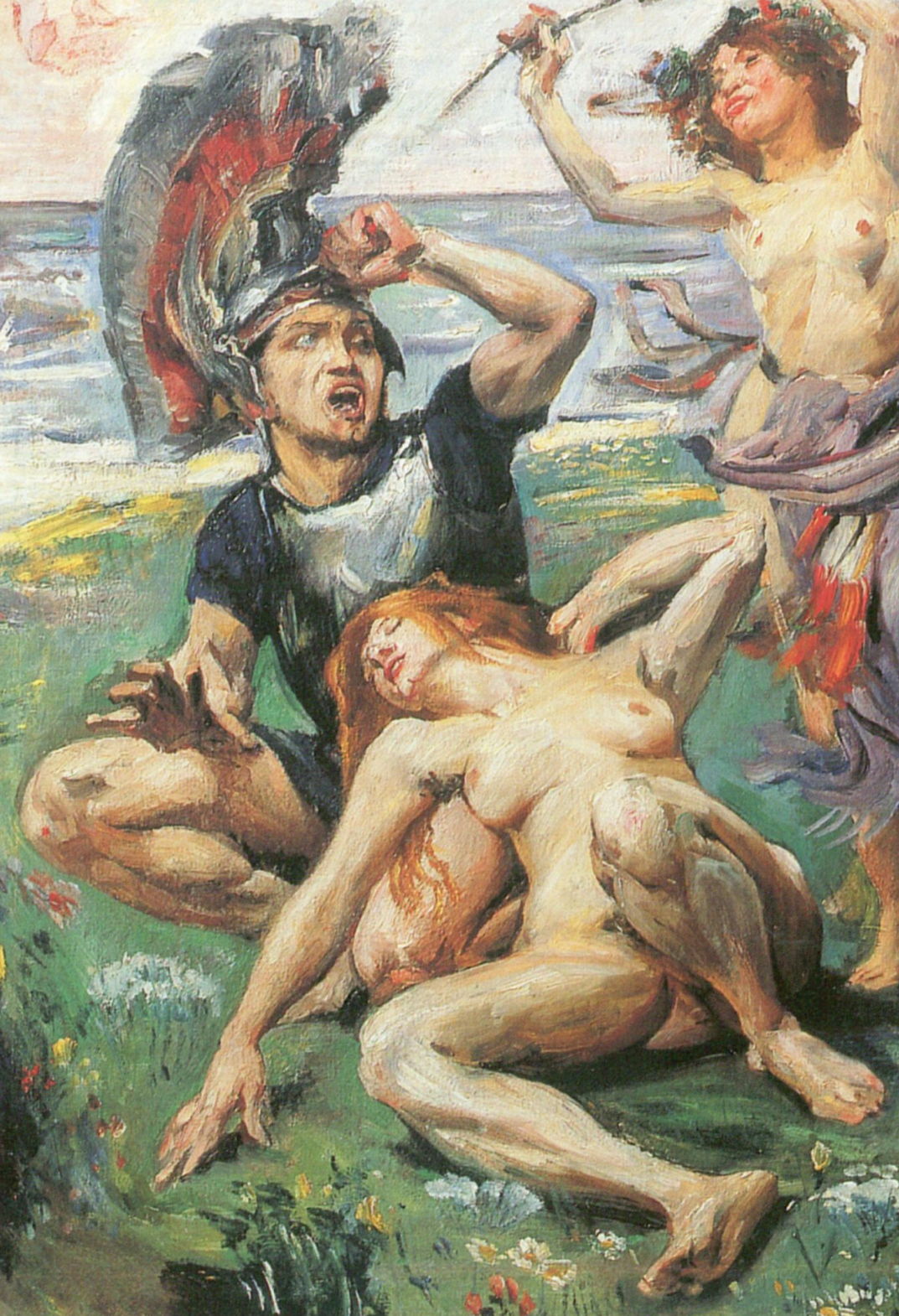
Lovis Corinth’s Ariadne on Naxos (1913) is one of his most sophisticated and masterly mythical paintings, inspired by the first version of Richard Strauss’s opera Ariadne auf Naxos (1912). The left third of the painting (detail below) shows Ariadne lying in erotic langour on Theseus’ left thigh. He wears an exuberant helmet, and appears to be shouting angrily and anxiously towards the other figures to the right.
Lovis Corinth (1858–1925) Ariadne on Naxos (detail) (1913), oil on canvas, 116 × 147 cm, Private collection. Wikimedia Commons.
Having called in briefly at Delos, Theseus and his ship returned to Athens. But in their delight and celebration, they forgot to hoist the white sail to indicate the success of their mission. Seeing their ship with its black sail still set, Theseus’ father King Aegeus threw himself from a cliff in despair, and died.
Theseus’ return to Athens thus brought an odd mixture of celebration at his success, and lamentation at the death of his father. Their ship was carefully preserved as a monument to Theseus’ accomplishment, and he set about transforming and growing the city by settling all the citizens of Attica in it. He promised government without a king, by means of democracy, making himself its commander in war and the guardian of its laws. He also had its currency struck into coins, and instituted the Isthmian (Olympic) Games.
Back on the island of Naxos, Ariadne went on to marry Dionysus, the couple had many children, and lived happily ever after.
Yesterday’s article examined Peter Paul Rubens’ masterwork Peace and War (1629-30), which he gave to King Charles I of England at the end of his diplomatic mission in London. Rubens returned to his busy workshop in Antwerp, and for the remaining decade of his life devoted himself to painting some of his greatest and most personal works.
His personal life changed greatly too: when he returned to Antwerp, he married the sixteen year-old Hélène Fourment, having lost his first wife four years earlier. In 1635, he bought a country estate near Antwerp, the Steen, which was to be his base until his death, and the subject of several of his finest landscape paintings over those years.
With Europe nearing the end of the Thirty Years’ War, Rubens was only too delighted to be commissioned to paint one of his final narrative masterpieces for Ferdinand de’ Medici, then the Grand Duke of Tuscany. Tuscany had been largely uninvolved in the war, and this time Rubens had no diplomatic mission to accomplish. He could afford to be frank in his story, and we are fortunate in having the artist’s own description of the painting as a reference.
Peter Paul Rubens (1577–1640), The Consequences of War (1637-38), oil on canvas, 206 x 342 cm, Palazzo Pitti, Florence, Italy. Wikimedia Commons.
The central figures in The Consequences of War (1637-38) are Venus and Mars. The god of war is advancing forcefully having just rushed from the temple of Janus, moving from left to right, with his sword bloodied and held low. His head is turned back to look at Venus, whose left arm is caught around his right, and who is clearly trying unsuccessfully to restrain him. Standing against the right thigh of Venus is a winged Cupid, child of Mars and Venus.
Drawing Mars forward is Alecto, her hair now looking more like that of a Fury but with few snakes visible, who bears a torch in her right hand. Monsters near her personify pestilence and famine, inseparable partners of war at that time. On the ground below Alecto is a woman with her back towards the viewer: she is Harmony, whose lute has been broken in the discord brought by war.
Nearby, also on the ground, is a mother with her child in her arms, symbolising the effect of war on families and their rearing. At the lower right corner is an architect clutching his instruments, indicating how fine buildings are thrown into ruin by war. Under the right foot of Mars is a book, showing how war tramples over the arts.
On the ground to the left of Cupid is a bundle of arrows or darts: these are not Cupid’s arrows of desire, but when bundled up would form the symbol of Concord; thus war breaks Concord. To their left is the caduceus and an olive branch, attributes of Peace, also cast aside.
The woman at the left in a black gown is the personification of Europe, whose globe, symbolising the Christian world, is carried by a putto behind her. Having endured the ravages of war for so long, her clothing is torn and she has been robbed of her jewels.
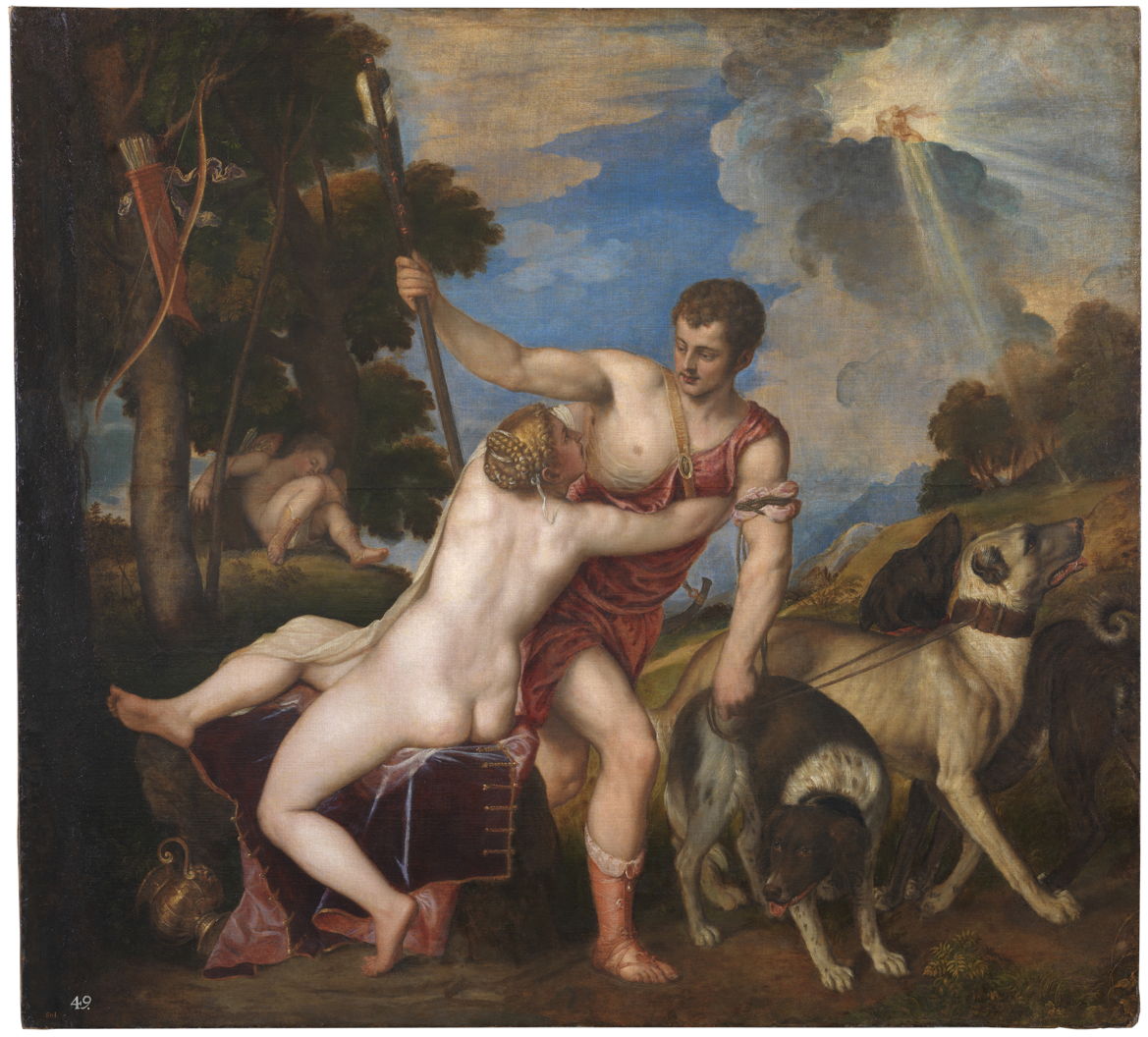
Venus and Mars are, in myth, well-known lovers. Venus is failing to restrain Mars from charging off to war, and in doing so, he is breaking their bond of love. This element of the composition had evolved over a long period, coming originally from Titian, and referring to another of Venus’ lovers, Adonis.
Titian (Tiziano Vecelli) (1490–1576), Venus and Adonis (1554), oil on canvas, 186 x 207 cm, Museo Nacional del Prado, Madrid. Wikimedia Commons.
Titian’s Venus and Adonis from 1554 shows Venus trying, again in vain, to prevent Adonis from going off to hunt, where he was to be killed by a wild boar. This was a favourite motif of Titian’s: no less than seven versions have been attributed to him from the period between 1553 and about 1560.
Peter Paul Rubens (1577–1640), Venus and Adonis (c 1610), oil on panel, 276 × 183 cm, Museum Kunstpalast, Düsseldorf, Germany. Wikimedia Commons.
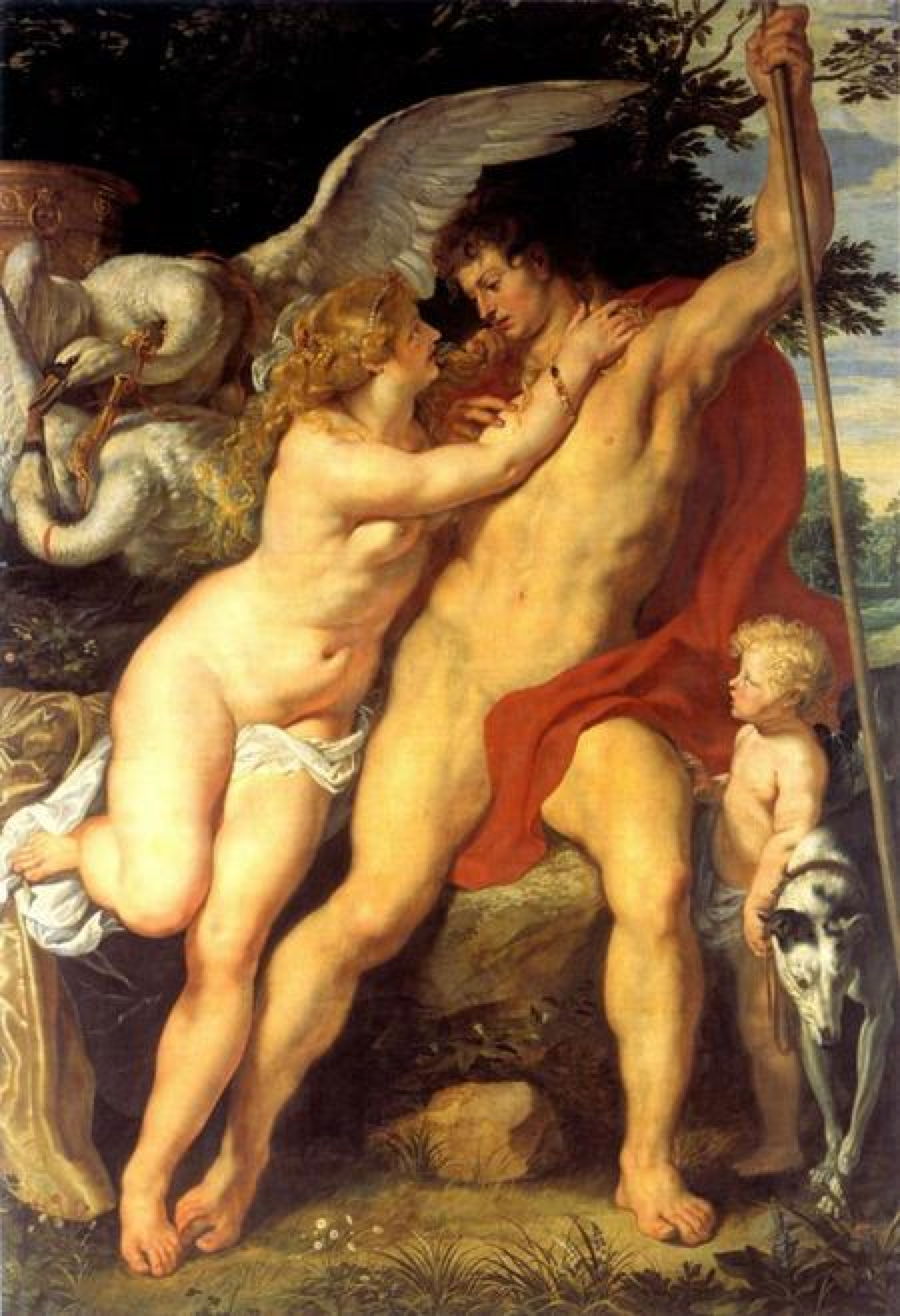
Rubens’ early painting of Venus and Adonis from about 1610, now in Düsseldorf, adopts a similar compositional approach, with Adonis facing the viewer and about to move to the right, but Rubens turns Venus’ body to face the viewer more.
Peter Paul Rubens (1577–1640), Venus and Adonis (c 1635), oil on canvas, 194 × 236 cm, The Metropolitan Museum of Art, New York, NY. Wikimedia Commons.
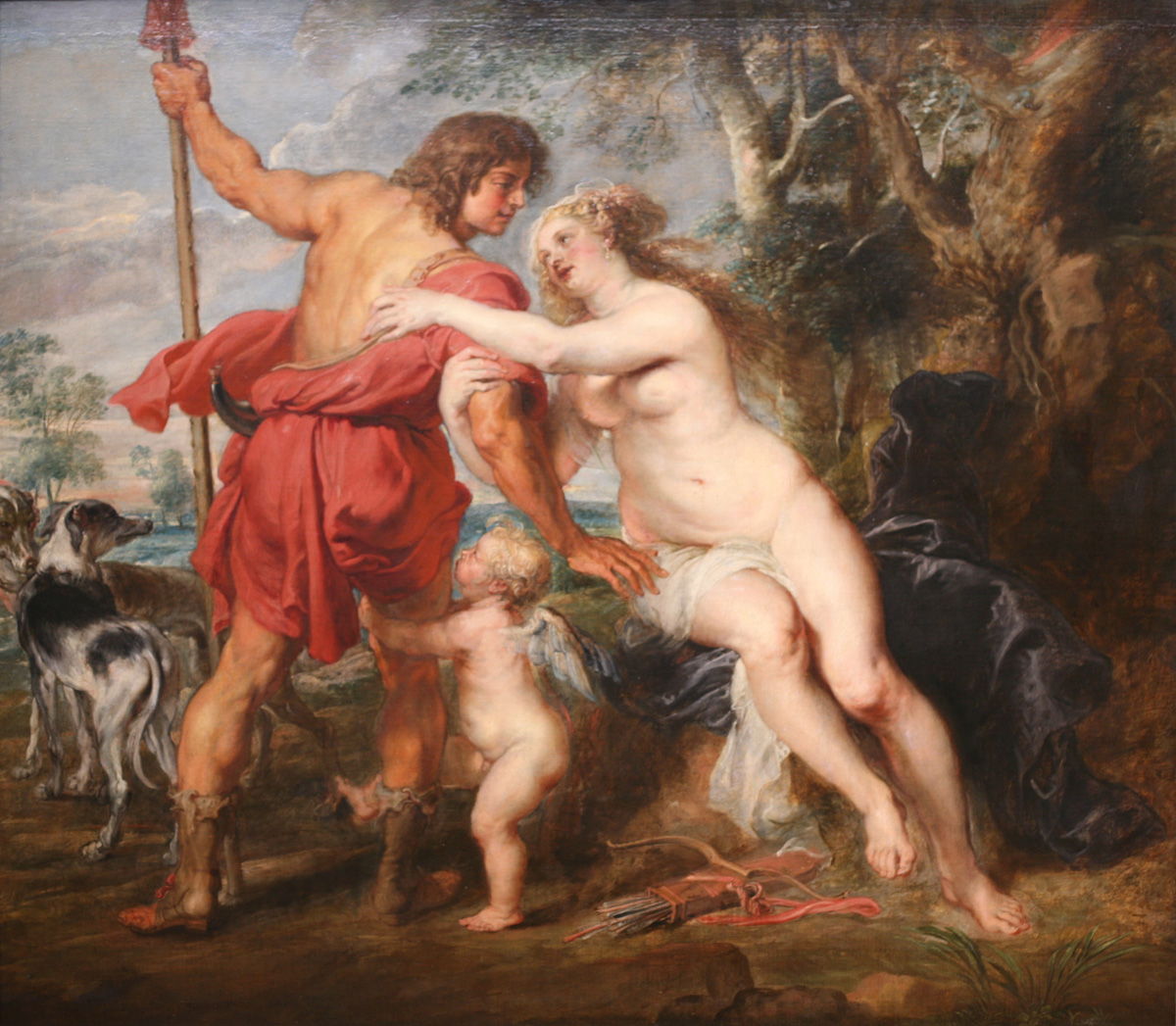
His much later Venus and Adonis from about 1635, now in the Met in New York, reverses the image as if it had been made from a print, and turns Adonis so that his back is towards the viewer. He is now about to move beyond the picture plane, away from the viewer. For The Consequences of War, Rubens keeps Venus in a similar position, but turns Mars to move straight along to the right in a more forceful and unconstrained action.
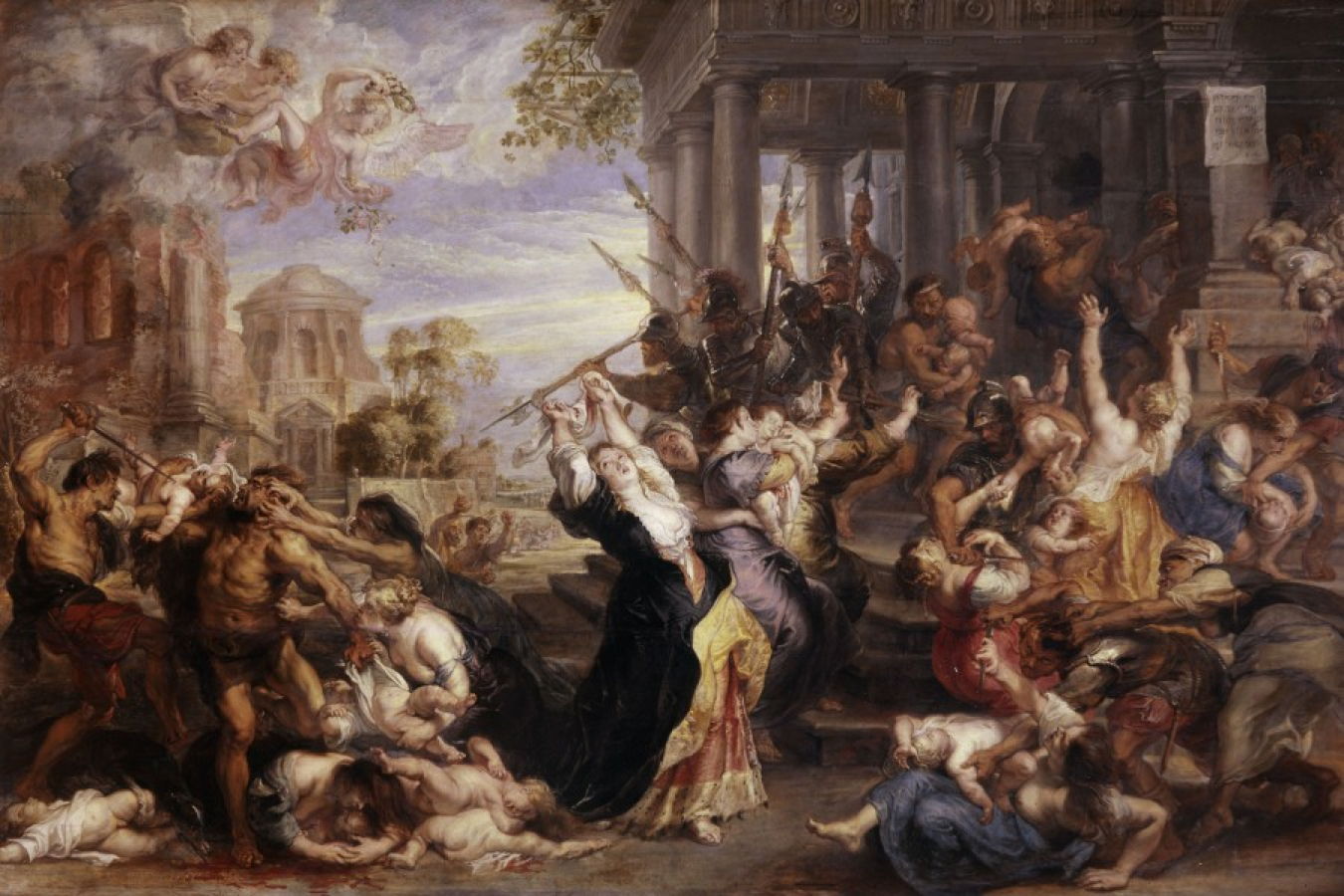
Peter Paul Rubens (1577–1640), The Massacre of the Innocents (c 1638), oil on oak, 198.5 x 302.2 cm, Alte Pinakothek, Munich, Germany. Wikimedia Commons.
The figure of Europe has an even more contemporary reference, to a nearly identical woman in the centre of Rubens’ The Massacre of the Innocents (c 1638). She too is in distress, although here she is not a personification in the way that she is in The Consequences of War.
Perhaps the most telling comparison is with Rubens’ The Triumph of Victory (c 1614), made when he was young and the finest painter in Flanders. The Treaty of Antwerp had been signed in 1609, and the city was flourishing in the Twelve Years’ Truce which ensued.
Peter Paul Rubens (1577–1640), The Triumph of Victory (c 1614), oil on oak panel, 161 x 236 cm, Gemäldegalerie Alte Meister, Kassel, Germany. Wikimedia Commons.
Painted for the Antwerp Guild of St George, its organisation of archers, Mars dominates, his bloody sword resting on the thigh of Victoria, personification of victory. She reaches over to place a wreath of either oak or laurel on Mars, and holds a staff in her left hand. At the right, Mars is being passed the bundle of crossbow bolts that make up the attribute of Concord.
Under the feet of Mars are the bodies of Rebellion, in the foreground, who still holds his torch, and Discord, on whose cheek a snake is crawling. The bound figure resting against the left knee of Mars is Barbarism.
Nearly a quarter of a century later, with the experience that his work as a diplomat had brought, Rubens had expressed a completely different view of war. His Peace and War (1629-30) and The Consequences of War (1637-38) should hang in the office of every head of state, from the White House, to the Kremlin Senate, to 10 Downing Street, and the Ryongsong Residence in North Korea.
Seventeenth century Europe was ravaged by war. Between 1618 and 1648, much of what is now Germany suffered the Thirty Years’ War, with widespread famines, epidemic disease, and the slaughter of battle. This spilled over to the Netherlands and Belgium, and beyond. Warfare at that time used weapons which individually had limited killing power, but wherever there was war, largely mercenary armies stripped the land of food and supplies, laying waste to large tracts of countryside, and bringing infectious diseases to kill many of the local population.
In the midst of that, some of the old Masters managed to flourish, among them Peter Paul Rubens (1577–1640), arguably the greatest narrative painter in Western art, and an accomplished international diplomat.
Rubens was no stranger to the consequences of religious persecution, conflict, and war. His Protestant parents had fled Antwerp for Cologne before his birth, he returned to Antwerp with his widowed mother in 1589 to be raised as a Catholic, and from 1600 he travelled throughout Europe, including Italy, Spain, France, England, and the Low Countries.
In 1629, he returned from a period in Madrid where he had worked with Diego Velázquez, then spent a little time back in his workshop in Antwerp before travelling to London, where he stayed until April the following year. A relatively peaceful country during the war on the European mainland, England’s stable period during Queen Elizabeth I’s reign had ended with her death in 1603; two years later Guy Fawkes and conspirators had tried to blow up the House of Parliament, and the Civil War broke out in 1642.
Rubens was now in his early fifties, internationally successful, and able to choose his own motifs. He had developed his sophisticated visual language of narrative over three decades of painting stories. Acting as envoy to King Philip IV of Spain, he was trying to agree peace between Spain and King Charles I of England. Among his tools was one of his greatest narrative paintings, Minerva Protects Pax from Mars or Peace and War, painted when he had been in England and left there as a gift to its king.
Rubens’ painting, now in the National Gallery in London, is crowded with more than a dozen figures drawn from classical myths. Until you have identified them and understood their roles and meaning, its reading remains elusive.
Its central figures are those of Ceres, here in the role of Pax, personification of peace, and Minerva behind her. In attendance are Mars, Hymen, Plutus, and Alecto, with sundry Bacchantes, a satyr, putti, and the attributes of Bacchus and Mercury. It’s like an away day from Olympus, or part of an index to Ovid.
Ceres and Minerva are at the heart of the painting. Rubens shows Ceres expressing milk from her left breast, which arcs into the mouth of her son Plutus, the god of wealth, who is grasping her left arm.
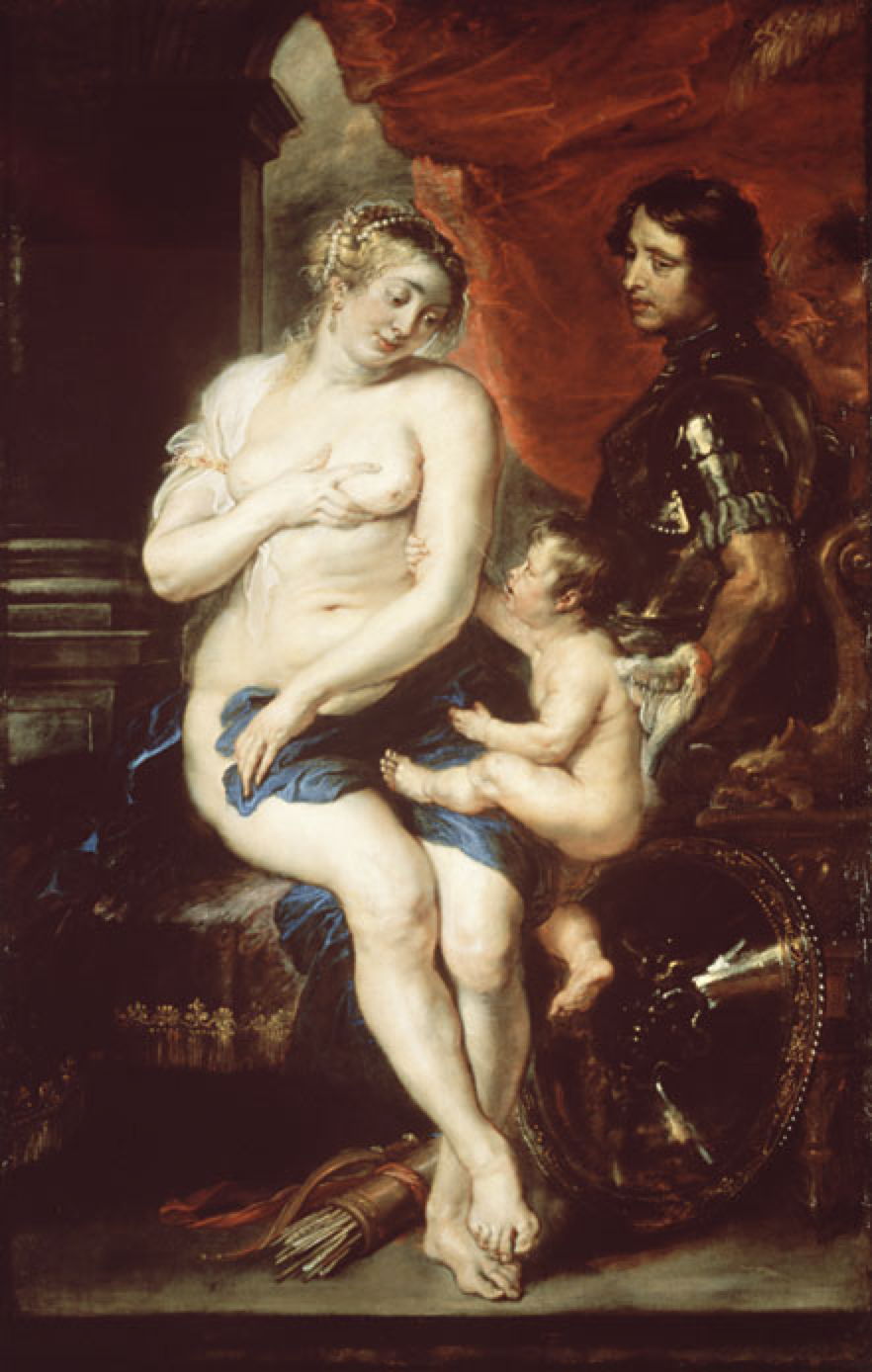
Peter Paul Rubens (1577–1640), Venus, Mars and Cupid, oil on canvas, 195.2 × 133 cm, Dulwich Picture Gallery, London. Wikimedia Commons.
The figures of Ceres and Plutus are almost identical to those of Venus and Cupid in Rubens’ earlier Venus, Mars and Cupid (c 1633), which introduces ambiguity to her figure. However, in this painting Cupid is shown with wings, and his traditional bow and arrows. In Peace and War, the infant is clearly not Cupid as he has neither wings nor bow and arrows: there he is Plutus.
Being the goddess of agriculture, grain crops (hence cereal), and maternal relationships, Ceres stands for values strongly associated with the benefits of peace: bread rather than starvation, fertility rather than barrenness and pestilence. Her son Plutus represents the growth of wealth in times of peace.
Although the figure immediately behind Ceres might be mistaken for a man (Mars, perhaps), her staff and helmet are characteristic of Minerva, the goddess with a curiously mixed portfolio of wisdom, industry, and war, a hangover from her part-Etruscan origins. Immediately above her is a winged putto carrying a caduceus, a short staff with wings at the top and entwined snakes, normally an attribute of Mercury, but also associated with commerce. That putto leans forward to place a laurel wreath, the crown of the victor and a symbol of peace, on Ceres’ head.
Minerva is pushing away the bearded figure of Mars, god of war, who is wearing his characteristic black armour. Rubens painted Mars not infrequently, and was flexible with his age and appearance, which vary according to context. With Venus and Cupid above, he is a young, clean-shaven man.
Peter Paul Rubens (1577–1640), Venus and Mars (1632-35), oil, 133 x 142 cm, Musei di Strada Nuova, Genoa, Italy. Wikimedia Commons.
In Venus and Mars (1632-35) he appears more like an ageing general than a warrior, and Venus is also past the beauty of her youth. Perhaps they had succumbed too often to the temptations of Bacchus, seen behind brandishing an empty glass.
At the far right of Peace and War is Alecto, the Fury responsible for dealing with the moral offences of humans, usually by driving them mad. Rubens refrains from giving her snakes in her hair, but emphasises madness, the madness of war.
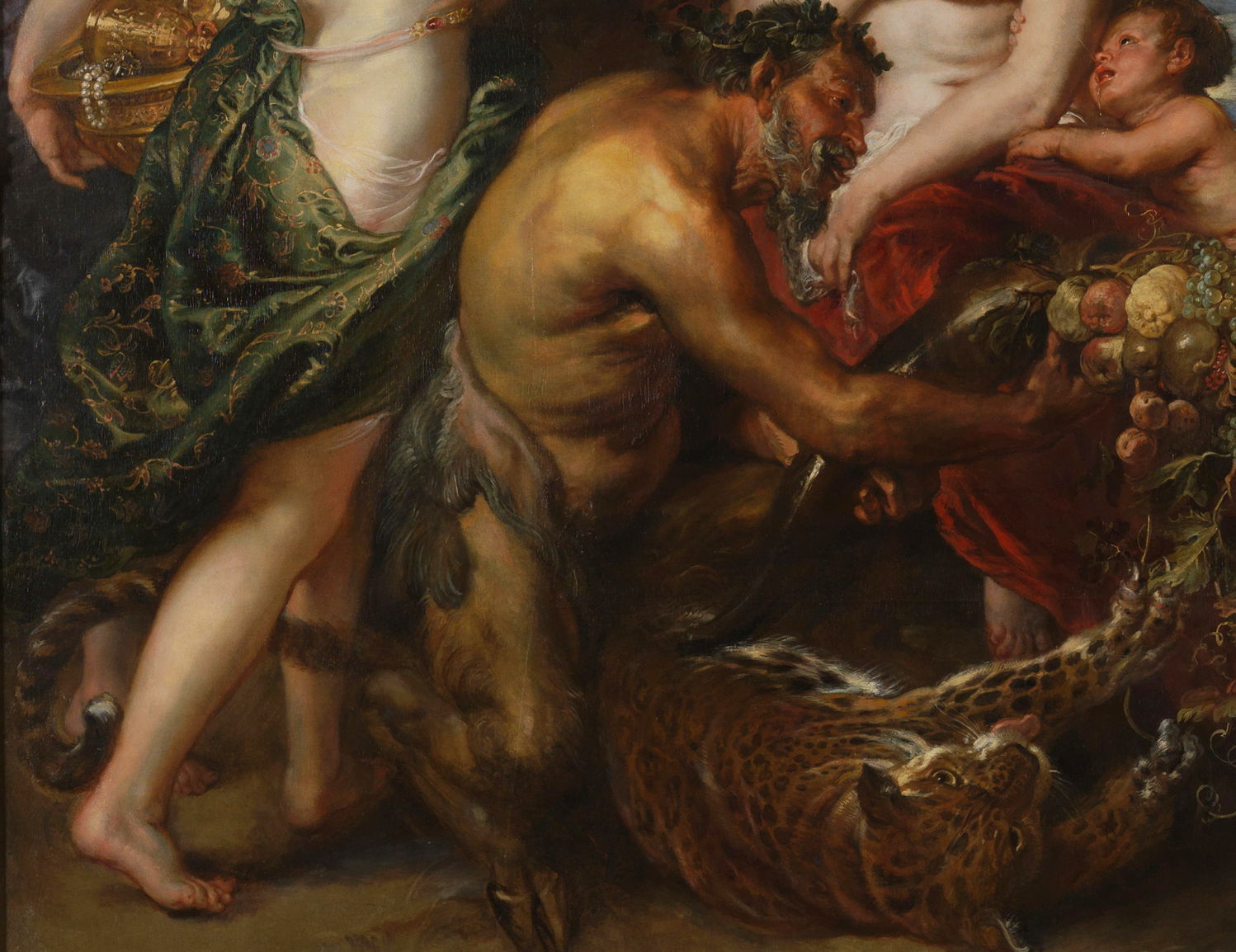
On the opposite (left) side of the painting is a Bacchante holding her tambourine (tympanum) aloft, and another bearing earthly riches at her left side. A satyr crouches low over a leopard, and proffers a cornucopia filled with fruit to the figures at the right.
This group is associated with Bacchus. Although he is not present, his chariot is normally drawn by leopards or similar big cats, and he is accompanied by Bacchantes. This is shown well in Lovis Corinth’s marvellous painting of Ariadne on Naxos (1913) below.
Lovis Corinth (1858–1925) Ariadne on Naxos (1913), oil on canvas, 116 × 147 cm, Private collection. Wikimedia Commons.
Bacchus’ age and appearance are remarkably variable. In Ruben’s later Bacchus (1638-40), he is old and grotesquely obese, but still accompanied by his big cats.
Peter Paul Rubens (1577–1640), Bacchus (1638-40), oil on canvas transferred from panel, 191 × 161.3 cm, Hermitage Museum Государственный Эрмитаж, Saint Petersburg, Russia. Wikimedia Commons.
This painting was completed not long before Rubens’ death from the consequences of gout, and may be the artist’s personal reflection on the result of sustained familiarity with Bacchus.
On the other side of the cornucopia from the Satyr is a small group of children, and a winged putto or Cupid, led by Hymen, who bears his characteristic torch. The god of marriage has led the products of marriage to the fruit of peace and plenty. These figures were painted from the children of one of King Charles’ diplomats, Sir Balthasar Gerbier, who was both an artist and Rubens’ host while he was in England.
Rubens’ story is clear: push war and its associated madness away, and you will enjoy peace, prosperity, and a thriving, well-nourished population.
King Charles made peace with France and Spain, but couldn’t get on with his own parliament; he therefore ruled England without a parliament for the “eleven years’ tyranny”. Collapse of power was inevitable after that: he faced Scottish and Irish rebellions, then in 1642 found himself in a civil war. He was executed on 30 January 1649.
Rubens returned to Antwerp in 1630, where he painted a second masterwork on the subject of peace and war, the centrepiece of tomorrow’s article.
Mythological worlds in classical Mediterranean civilisations often appear confusing and contradictory when stories and beliefs of many centuries and different cultures are merged, as happened in post-classical painting. What might appear to be a single distinctive attribute, such as a snake coiled along the length of a staff, then becomes a muddle.
There are two common combinations of snakes coiled around a rod or staff. Hermes (Roman Mercury) has a caduceus as his attribute, consisting of a rod or staff with a pair of entwined serpents along its length, and sometimes they are shown bearing small wings. This signifies his swiftness as a messenger. The rod of Asclepius (which has several alternative spellings) should have but a single serpent coiled around it, and is associated with healing and medicine, and remains so today long after its divine origins have been forgotten.
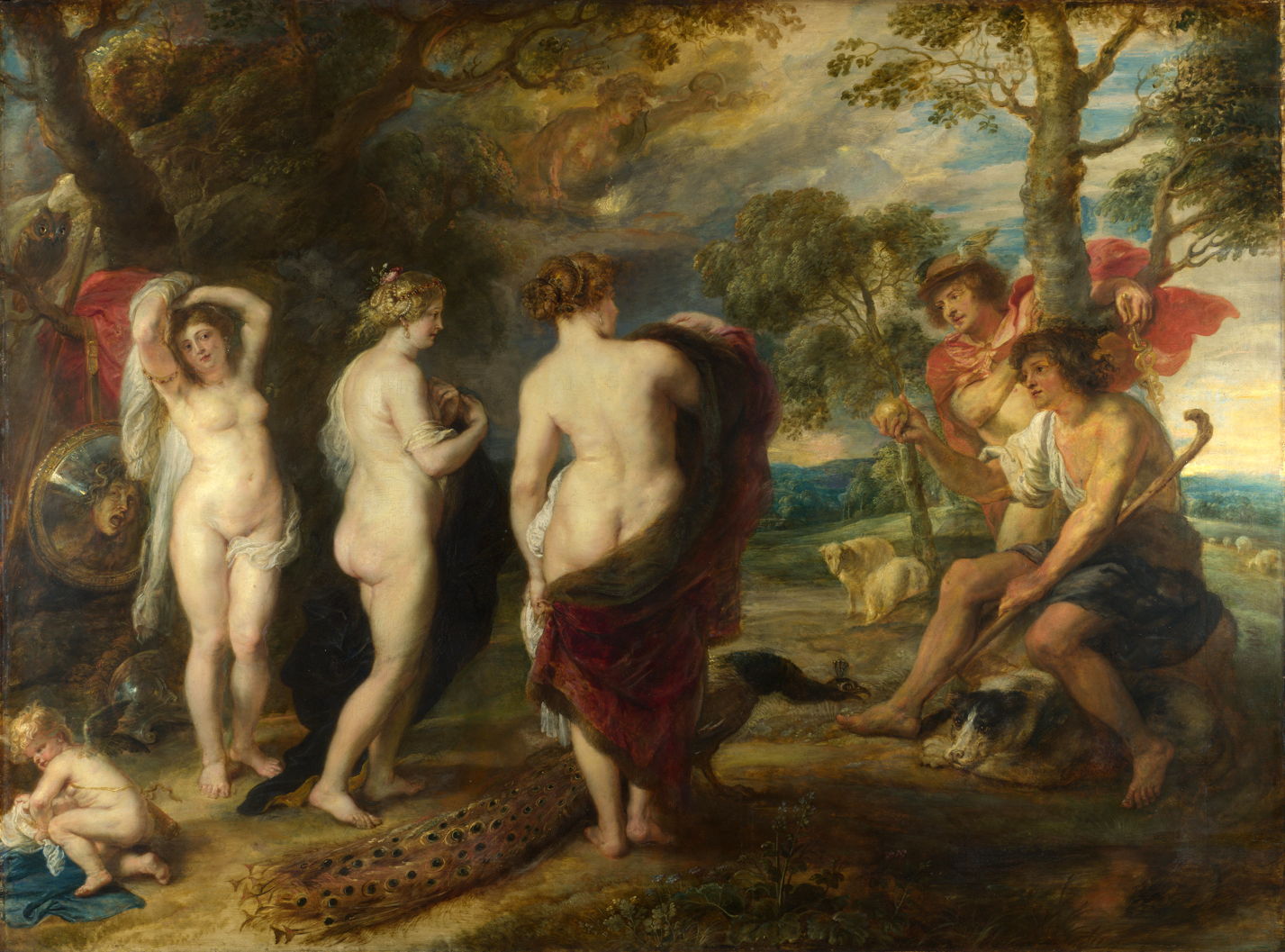
Although not known for his paintings of secular stories, William Blake’s Judgement of Paris (c 1806-17) was one of a pair made for Thomas Butts, the other being Philoctetes and Neoptolemus on Lemnos, a more obscure story leading to the death of Paris.
As with almost every artist before and since, Blake shows the three contestants naked in front of Paris, just at the moment that the golden apple is awarded to Aphrodite. Hera and Athena, standing either side of her, are visibly upset. Above them is the naked figure of Hermes, with his caduceus and its pair of intertwined serpents, and a winged helmet. The demonic figure at the top left is presumably a harbinger of the death and destruction to come in the Trojan War.
Pierre-Auguste Renoir (1841–1919), The Judgment of Paris (c 1908-10), oil on canvas, 73 x 92.5 cm, Hiroshima Museum of Art, Hiroshima, Japan. Wikimedia Commons.
Renoir’s account of The Judgment of Paris, from about 1908-10 is a carefully composed image of the same moment of peripeteia. Watching on is Hermes, complete with his winged helmet, sandals, and caduceus.
Abraham Bloemaert (1564–1651), Mercury, Argus and Io (c 1592), oil, 63.5 x 81.3 cm, Centraal Museum, Utrecht, The Netherlands. Wikimedia Commons.
The most popular scene in Ovid’s intertwined stories of the rape of Io and the murder of Argus is that of Hermes lulling Argus to sleep. However, hardly any painters depict Argus having the hundred eyes specified in the Metamorphoses. Abraham Bloemaert is an exception, in his carefully composed Mercury, Argus and Io (c 1592). Hermes is playing his flute at the left, his caduceus at his feet, as Argus falls asleep in front of him, his additional eyes visible over the surface of his head.
David Rijckaert (III) (1612–1661), Philemon and Baucis Giving Hospitality to Jupiter and Mercury (date not known), oil on panel, 54 x 80 cm, Private collection. Wikimedia Commons.
David Rijckaert’s undated Philemon and Baucis Giving Hospitality to Jupiter and Mercury gives the most popular account of the elderly couple entertaining the two gods. Hermes (left) and Zeus (left of centre) are seated at the table, with Philemon (behind the table) and Baucis (centre) waiting on their every need. Once again, Hermes is distinguished by his caduceus as well as a more contemporary winged hat.
Rod of Asclepius
Giovanni Battista Cipriani (1727–1785), Aesculapius Holding a Staff Encircled by a Snake (date not known), media and dimensions not known, Wellcome Library, London. Courtesy of Wellcome Images images@wellcome.ac.ukhttp://wellcomeimages.org, via Wikimedia Commons.
In the eighteenth century, Giovanni Battista Cipriani drew Aesculapius Holding a Staff Encircled by a Snake, following the classical tradition.
Johannes Zacharias Simon Prey (1749-1822), Aesculapius, Apollo and Hippocrates (1791), oil, dimensions not known, Wellcome Library, London. Courtesy of Wellcome Images images@wellcome.ac.ukhttp://wellcomeimages.org, via Wikimedia Commons.
Johannes Zacharias Simon Prey painted this group of Aesculapius, Apollo and Hippocrates in 1791. Asclepius, holding his distinctive rod, is shown in the centre of the trio, with Hippocrates, the less legendary ‘father of medicine’, to the right, clutching the basal half of a human skull, and Apollo, father of Asclepius, behind. They have entered a contemporary pharmacy, where an assistant uses a large mortar and pestle, and another works the bellows of a furnace.
Inevitably, the distinction between Hermes’ caduceus and the rod of Asclepius has been lost more recently, and many symbolic representations of medicine have erroneously used a caduceus.
Over the last months I have shown examples of the Naturalist painting that became popular in Europe during the late nineteenth century, although it is now neglected or glossed over in modern accounts of that period. This concluding article provides a table of contents, and an illustrated list of some of the better-known painters who were Naturalists for substantial periods in their careers.
Jules Bastien-Lepage (1848–1884), Les Foins (Haymakers) (1877), oil on canvas, 160 x 195 cm, Musée d’Orsay, Paris. Wikimedia Commons.
Most prominent of the Naturalist painters until his early death in 1884, his Haymakers (1877) is a pioneering composition, with its high horizon and fine detail in the foreground. Together these give the impression that the whole canvas is meticulously realist, although in fact much of its surface consists of visible brushstrokes and other painterly marks. At the same time its deep recession and broad inclusion of land gives it the illusion of a wide-angle panorama, enhancing the exhaustion and desolation of its figures.
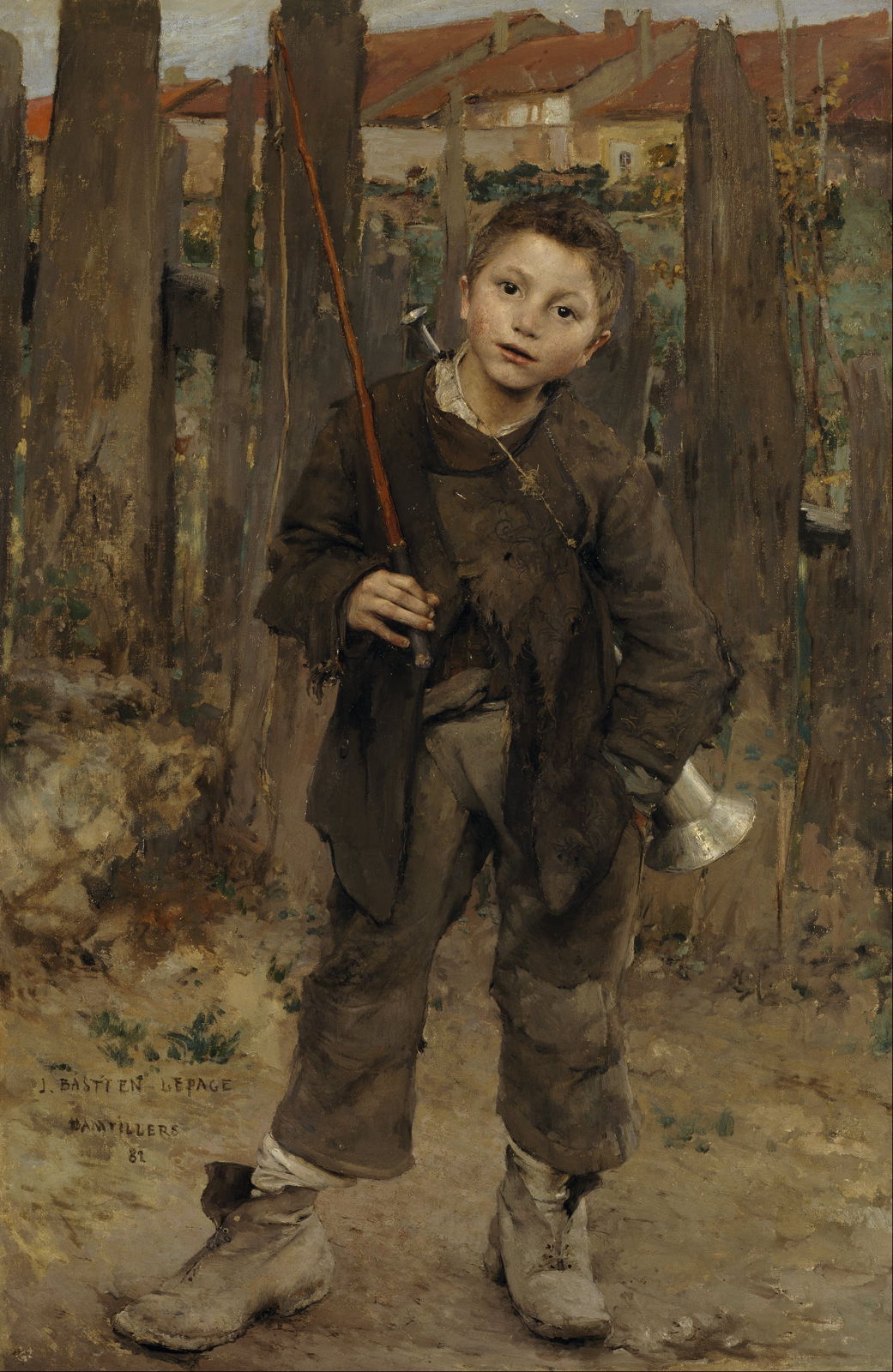
Jules Bastien-Lepage (1848–1884), Pas Mèche (Nothing Doing) (1882), oil on canvas, 132.1 x 89.5 cm, Scottish National Gallery, Edinburgh, Scotland. Wikimedia Commons.
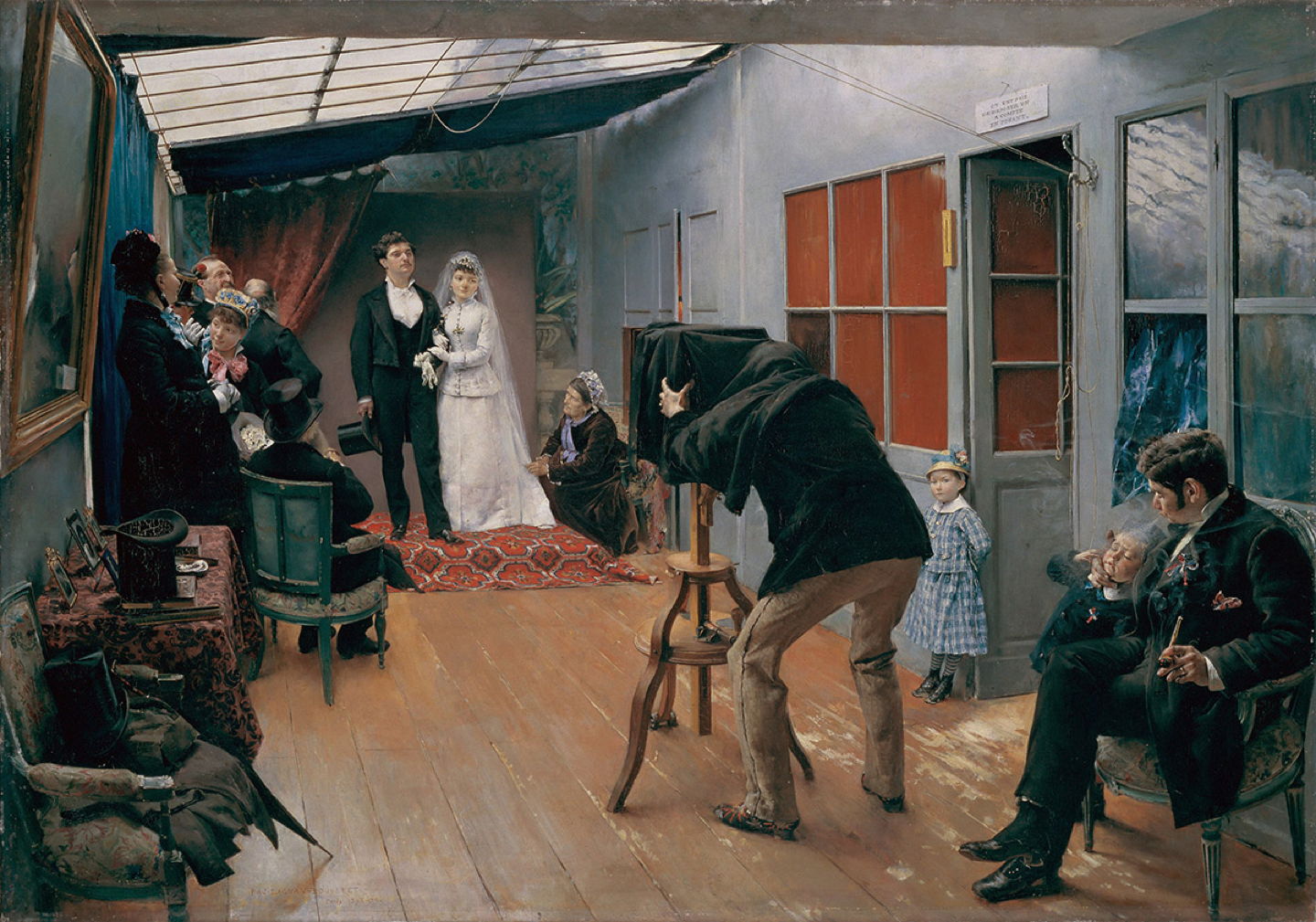
Pascal Dagnan-Bouveret (1852–1929), Une noce chez le photographe (A Wedding at the Photographer’s) (1879), oil on canvas, 120 x 81.9 cm, Musée des Beaux-Arts, Lyon, France. Wikimedia Commons.
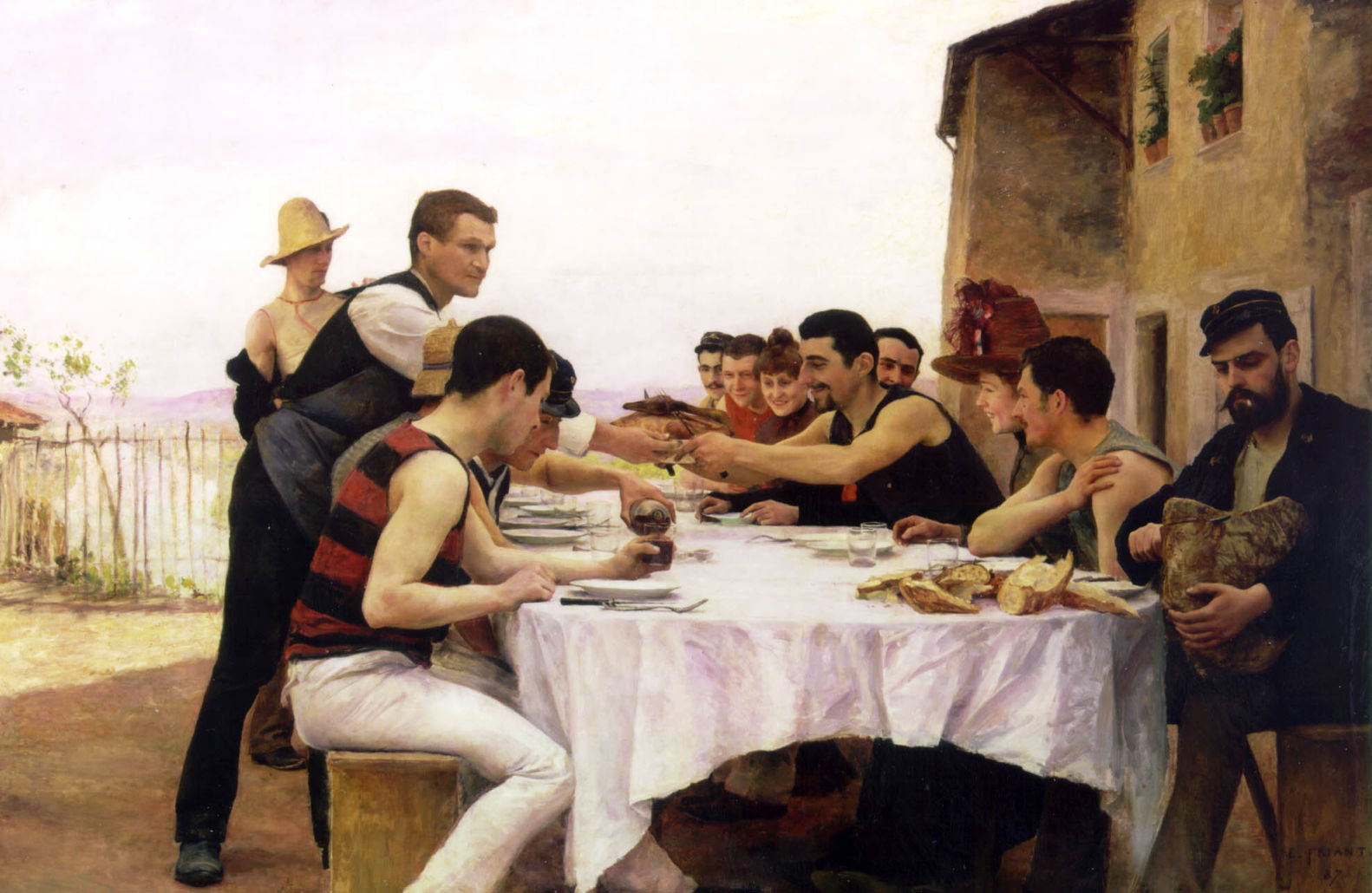
Émile Friant (1863–1932), The Meurthe Boating Party (Reunion of the Meurthe Boating Party) (1887), oil on canvas, 110 x 166 cm, Musée de l’École de Nancy, Nancy, France. Wikimedia Commons.
Gustave Caillebotte (1848–1894), Les Raboteurs de parquet (The Floor Scrapers) (1875), oil on canvas, 102 x 147 cm, Musée d’Orsay, Paris. Wikimedia Commons.
Although now known as an Impressionist, he also painted in Naturalist style.
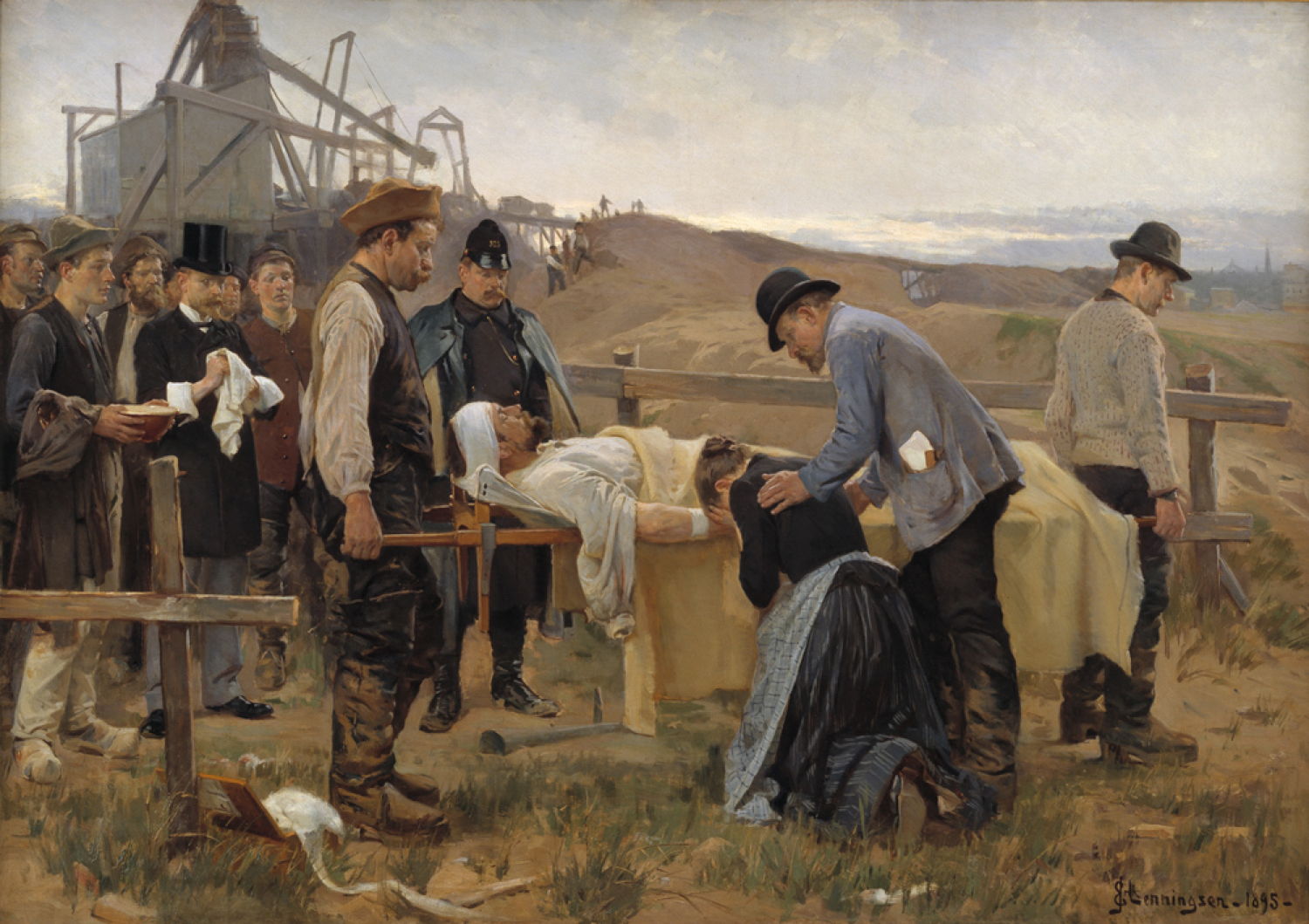
Erik Henningsen (1855–1930), Evicted (1892), oil on canvas, dimensions not known, Statens Museum for Kunst (Den Kongelige Malerisamling), Copenhagen, Denmark. Wikimedia Commons.
Charles Frederic Ulrich (1858–1908), The Glass Blowers (1883), oil on canvas, 47.8 × 58.4 cm, Museo de Arte de Ponce, Ponce, Puerto Rico. Wikimedia Commons.
Born in New York City, trained in the Royal Academy in Munich, Germany.
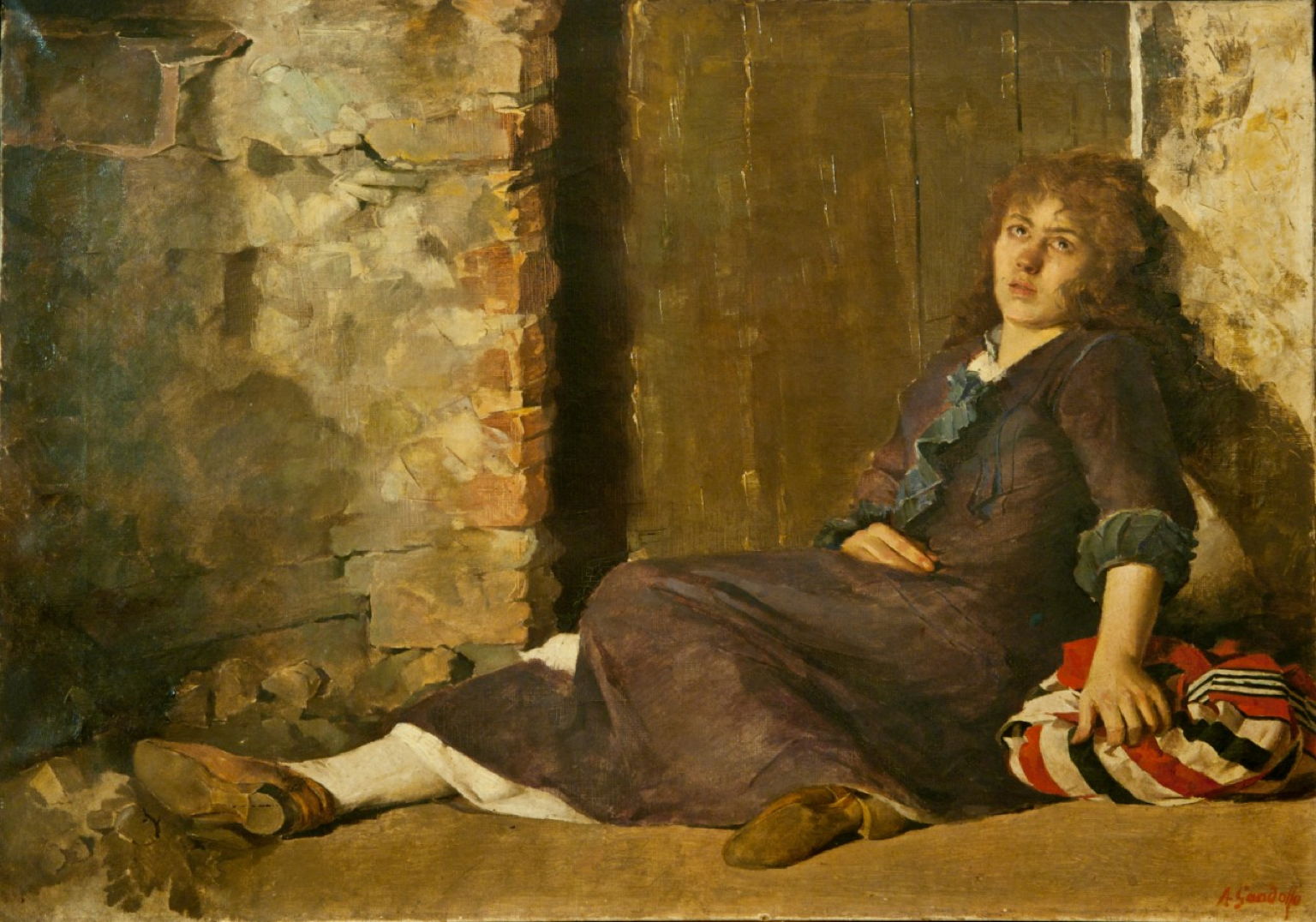
Antonino Gandolfo (1841–1910)
Antonino Gandolfo (1841–1910), Evicted (Let he who is without sin cast the first stone) (1880), oil on canvas, 88 x 63 cm, location not known. Image by Luigi Gandolfo, via Wikimedia Commons.
Jan van Eyck’s famous double-portrait of the Arnolfini Wedding (1434) introduced mirror-play, but didn’t quite demonstrate its use to extend the scene depicted because of the small size of its reflected image. Surprisingly it appears that four centuries were to pass before reflections became more widely adopted for this purpose, although I’m sure they had already been used for it in interior decoration.
One of the earliest of my examples refers back to the Arnolfini Wedding in its use of a circular and non-planar mirror.
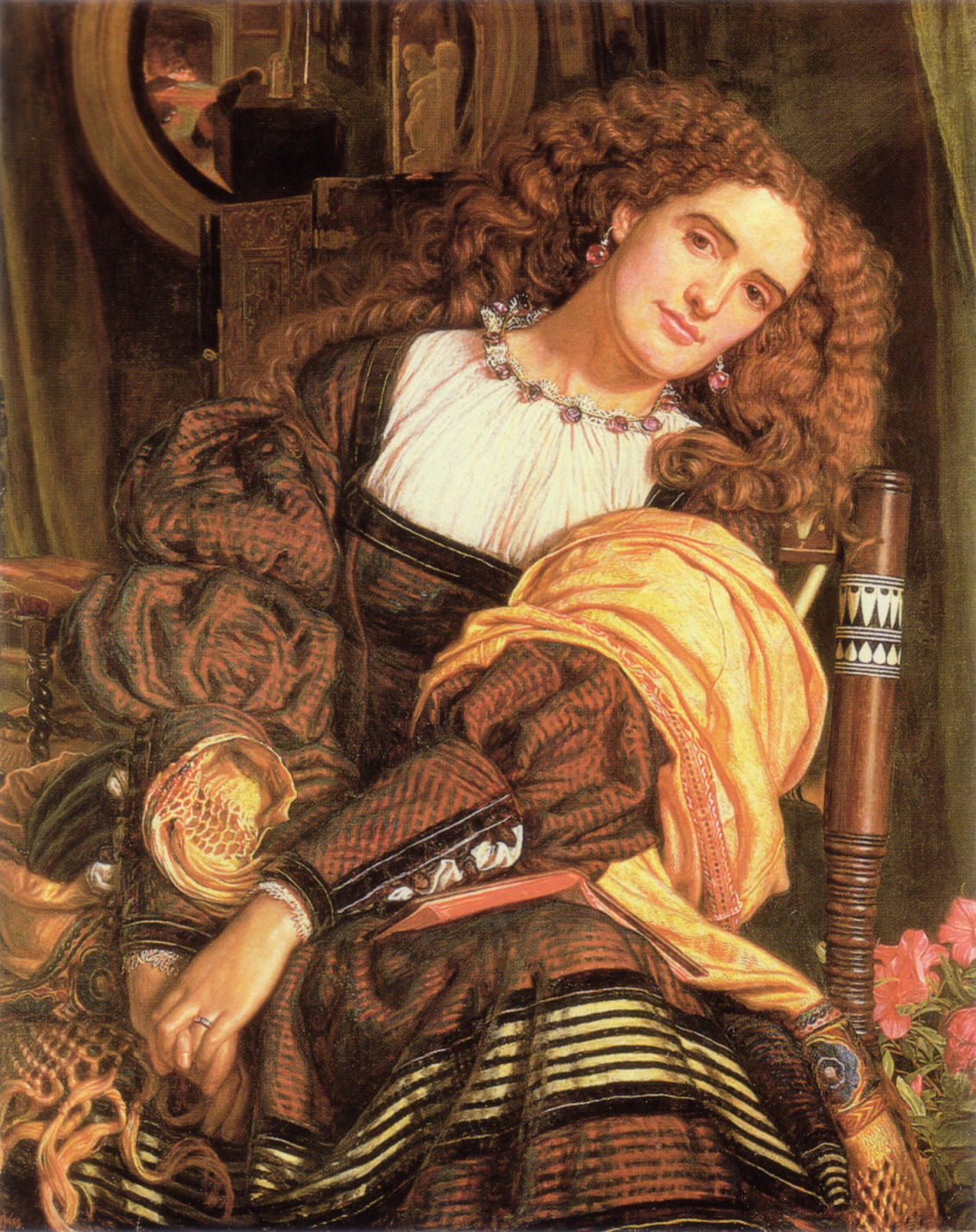
The dates and background to Ford Madox Brown’s unfinished painting Take your Son, Sir! remain unclear. It’s thought that Brown started work on this in 1851, although it shows his second wife Emma with their newborn son. Their first son, Oliver, wasn’t born until 1855, and their second, Arthur, in September 1856, suggesting that he didn’t start this until at least 1855. It’s generally held that this shows not Oliver, who lived until 1874, but Arthur, who died aged ten months in July 1857, at which time Brown abandoned the painting. The detail seen reflected in the mirror is of a contemporary living room and a man, presumably a self-portrait.
A few years before that, William Holman Hunt’s The Awakening Conscience, painted over the period 1851-53, employs the reflection seen in a much larger mirror to add substantial detail to its unresolved narrative. This places the scene in a small if not cramped house in the leafy suburbs of London, in reality Saint John’s Wood, where this couple are clearly in an extra-marital relationship.
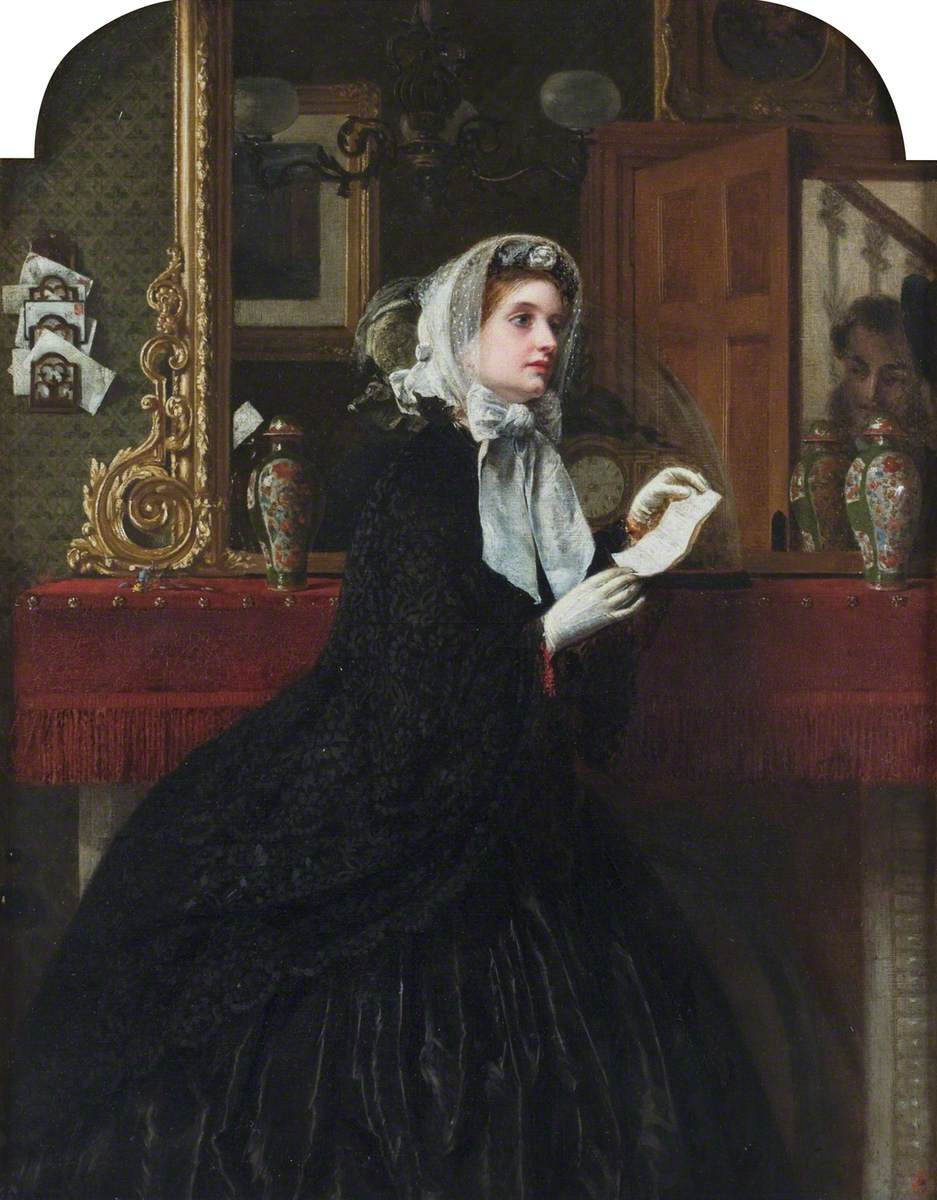
Rebecca Solomon (1832-1886), The Appointment (1861), media and dimensions not known, The Geffrye, Museum of the Home. Wikimedia Commons.
Rebecca Solomon’s Appointment (1861) is another early problem picture, with a deliberately open-ended narrative set in an interior. A beautiful woman stands in front of a mirror, and looks intently at a man, who is only seen in his reflection in the mirror, and stands in a doorway behind the viewer’s right shoulder. The woman is dressed to go out, and is holding a letter in her gloved hands.
Alfred Stevens (1823–1906), The Japanese Parisian (1872), oil on canvas, 105 × 150 cm, Musée d’art moderne et d’art contemporain, Liège. Wikimedia Commons.
In 1872 Alfred Stevens’ The Japanese Parisian filled its canvas with the reflection of the face of his model framed by floating flowers, which must be behind the viewer.
William Holman Hunt (1827–1910), Dolce Far Niente (1865-75), oil on canvas, 99 × 82.5 cm, Private collection. Wikimedia Commons.
Soon after William Holman Hunt had completed his Awakening Conscience above, he started work on another painting using a smaller circular mirror to extend the scene and its reading, Dolce Far Niente, which may have been started as early as 1859 but wasn’t completed until 1875. The reflection in the mirror above the woman’s head shows this to be a domestic scene, with another figure leaning over a large wooden bureau or a dressing-table, perhaps.
So far, these examples have all appeared to conform to optical principles. It was Édouard Manet who challenged those.
Édouard Manet (1832–1883), A Bar at the Folies-Bergère (1882), oil on canvas, 96 x 130 cm, The Courtauld Gallery, London. Wikimedia Commons.
His Bar at the Folies-Bergère from 1882 poses the problem of resolving the optically impossible, no matter how you try to read it. This forlorn young woman is serving at the bar in front of her, with what is presumed to be a large mirror behind showing a reflection that doesn’t match its original. Arranged on the bar are assorted bottles of beers and spirits, that on the far left bearing the artist’s signature. According to the reflection, the audience at the Folies-Bergère are watching the show under the light of a huge chandelier.
John William Waterhouse (1849–1917), Circe Offering the Cup to Odysseus (1891), oil on canvas, 149 x 92 cm, Gallery Oldham, Manchester, England. Wikimedia Commons.
John William Waterhouse’s Circe Offering the Cup to Odysseus from 1891 develops the circular mirror of the Arnolfini Wedding into a key narrative device. Circe sits on her throne, holding up a krater for Ulysses to drink, with her wand in the other hand. The viewer is Ulysses, seen preparing to draw his sword in the large mirror behind the sorceress. On the left side of the mirror is his ship.
In the closing years of his career, Waterhouse returned with an even larger mirror at the centre of his story.
John William Waterhouse (1849–1917), “I am Half Sick of Shadows” said the Lady of Shalott (1915), oil on canvas, 100 x 74 cm, Art Gallery of Ontario, Toronto, Canada. Wikimedia Commons.
His “I am Half Sick of Shadows” said the Lady of Shalott (1915) is the third and last of his paintings based on the poem The Lady of Shalott by Alfred Lord Tennyson (1809–1892), published in 1833 and 1842. This recounts part of the Arthurian legends, the tragedy of Elaine of Astolat, as retold in an Italian novella from the 1200s from which it draws its title.
The Lady of Shalott lives in a castle connected to Camelot by a river. She’s subject to a mysterious curse confining her to weaving images on her loom, and mustn’t look directly at the outside world, although she can view it using a mirror. Tennyson calls these reflected images ‘shadows of the world’, and this painting depicts the stanza from the poem:
But in her web she still delights
To weave the mirror’s magic sights,
For often thro’ the silent nights
A funeral, with plumes and lights,
And music, went to Camelot:
Or when the moon was overhead,
Came two young lovers lately wed;
‘I am half sick of shadows,’ said
The Lady of Shalott.
The circular image behind her isn’t a window, but a mirror revealing Camelot with its winding river. Although this includes her loom, the castle can’t be real, but one of “the mirror’s magic sights”.
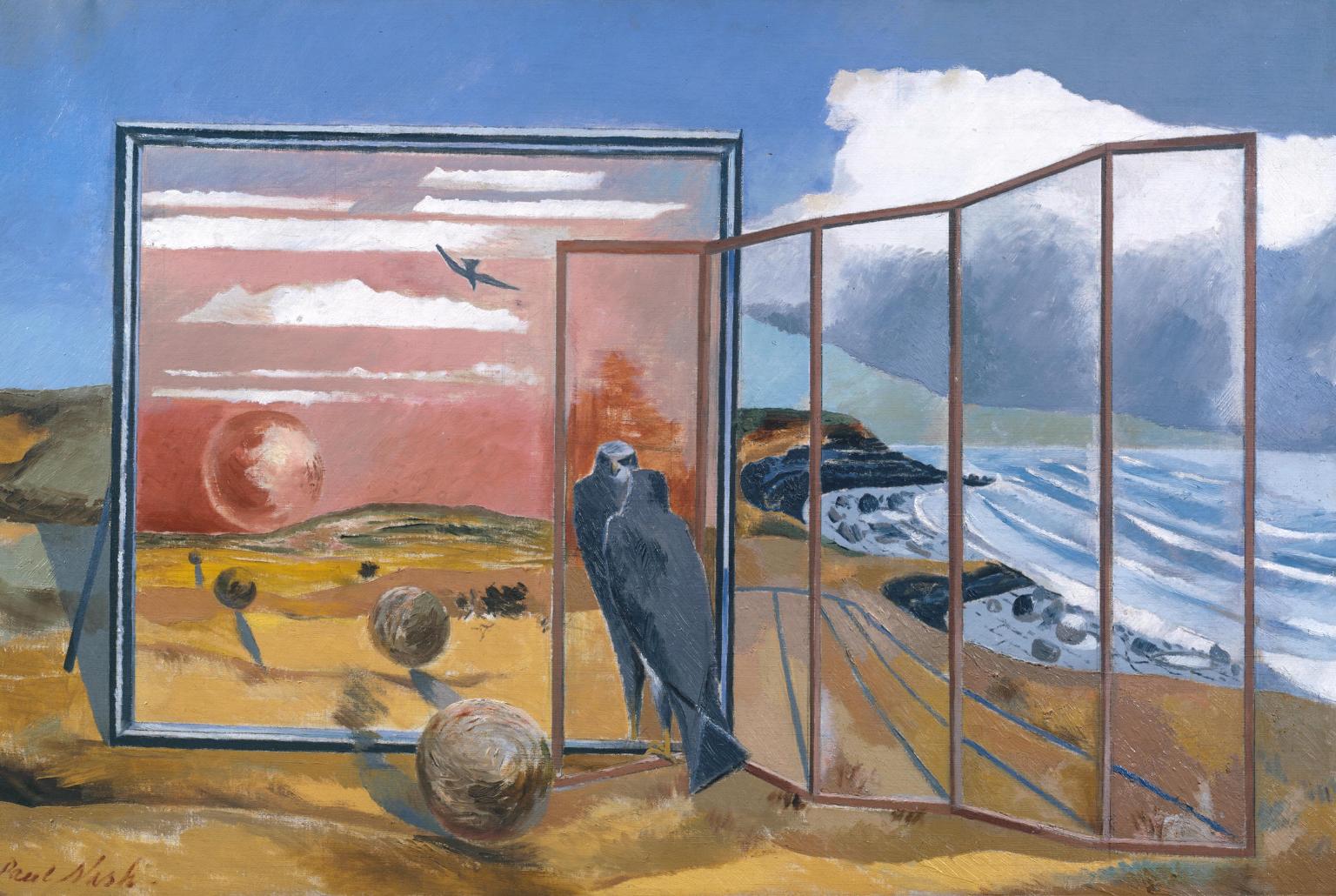
My last example, painted just before the Second World War by Paul Nash, extends this deeper into the unconscious.
Landscape from a Dream (1936-38) was inspired by Freud’s theories of the significance of dreams as reflections of the unconscious. Nash locates this collection of incongruous objects on the Dorset coast, a landscape he associated with the praeternatural. Dominating the scene is a large framed planar mirror, almost parallel with the picture plane.
Stood at the right end of the mirror is a hawk staring at its own reflection, which Nash explained is a symbol of the material world. To the left, the mirror reflects several floating spheres, referring to the soul. The reflection shows that behind the viewer is a red sun setting in a red sky, with another hawk flying high, away from the scene. To the right of the hawk is a five-panelled screen made of glass, through which the coastal landscape can be seen: it’s a screen which doesn’t screen.
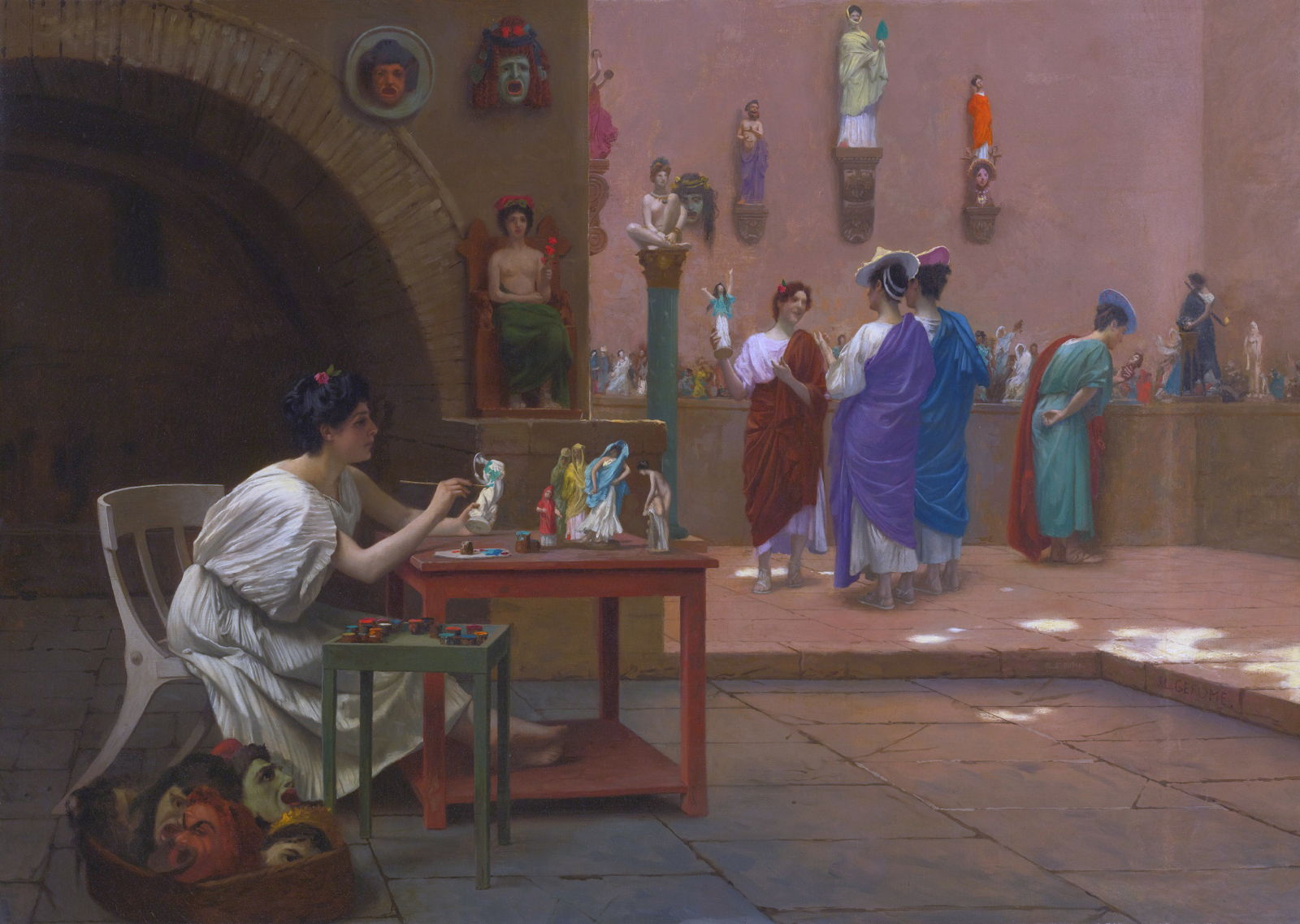
The other three-dimensional objects that are commonly painted more or less artistically are drinking vessels, pots and plates make from clay. With the total loss of paintings from classical Greece, those now form its only record of visual art, and those decorated pots are in many of the best collections of art.
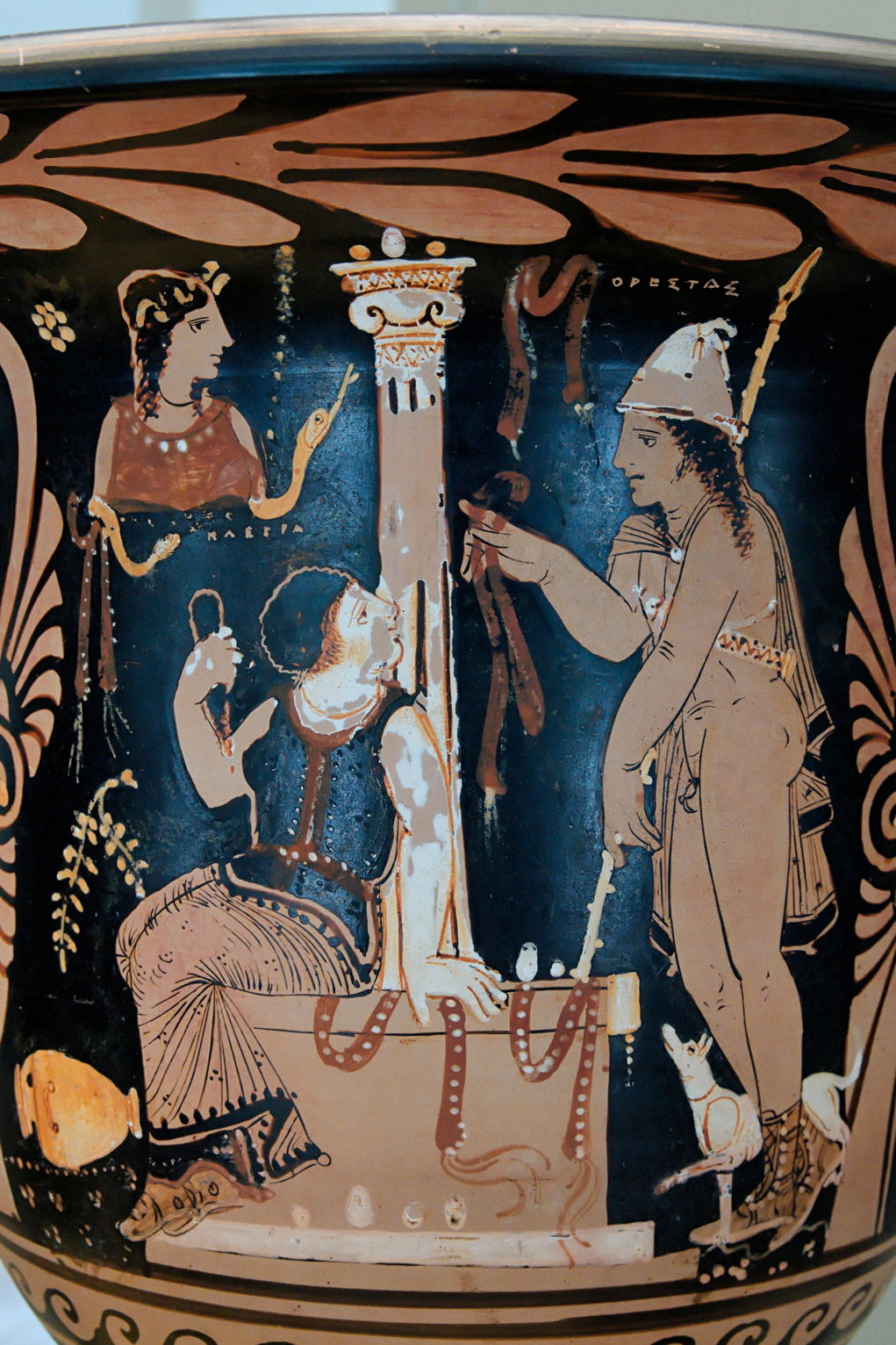
Unknown Artist, Meeting of Electra and Orestes at the Tomb of Agamemnon (340-330 BCE), Paestan red-figure bell-krater, Museo Arqueológico Nacional de España, Madrid. Image by Marie-Lan Nguyen, via Wikimedia Commons.
For example, this depiction of the Meeting of Electra and Orestes at the Tomb of Agamemnon from 340-330 BCE shows Orestes meeting his sister Electra at their father’s tomb, on a bell-krater. This type of vessel was used to mix water with wine, and was introduced in the early fifth century BCE. Although not obvious from this view, it has the form of a bell.
Greek pottery was painted using fine-grained clay slip, in either of two techniques. Earlier black-figure technique applied the slip to the areas of the figures, which turned black during three-phase firing. This krater is painted using the later red-figure technique, where the slip is used to turn the background black. Other colours including red and white were also used, as seen here.
During the Middle Ages, Arabic cultures developed a new technique based on glazing the surface of the pottery using tin compounds, to produce an opaque white surface that could be painted using a wide range of coloured glazes. When adopted in Europe, this became known as maiolica, and flourished in the Renaissance.
Francesco Xanto Avelli (c 1487–1542), Hypermnestra Watching Lynceus Take Her Father’s Crown (1537), earthenware plate with tin glaze (maiolica), 2.3 × 25.5 cm, Walters Art Museum, Baltimore, MD. Wikimedia Commons.
This maiolica plate painted by Francesco Xanto Avelli in 1537 shows Hypermnestra Watching Lynceus Take Her Father’s Crown. Lynceus (labelled here as ‘Lino’) has taken Danaus’ crown, and is about to put him to the sword. Hypermnestra stands at a window, most probably not that of a dungeon. Below its lintel is a Cupid bearing the famous saying omnia vincit amor, love conquers all, which actually comes from Virgil’s last Eclogue and is unrelated to the narrative.
Virgiliotto Calamelli (1531-1570), Cadmus and Harmonia (c 1560), Faenza maiolica ceramic, dimensions not known, Museo Internazionale delle Ceramiche, Faenza, Italy. Wikimedia Commons.
Virgiliotto Calamelli’s ceramic telling of Cadmus and Harmonia from around 1560 is a brilliant depiction of Ovid’s story. He chooses a late moment, in which Cadmus’ transformation into a snake is complete, and Harmonia’s has reached her abdomen.
This was followed by the painting of porcelain following existing conventional paintings.
Nicolas Lancret (1690–1743), Brother Philippe’s Geese (c 1736), oil on copper, 27..3 x 35.2 cm, The Metropolitan Museum of Art (Purchase, Walter and Leonore Annenberg and The Annenberg Foundation Gift, 2004), New York, NY. Courtesy of The Metropolitan Museum of Art.
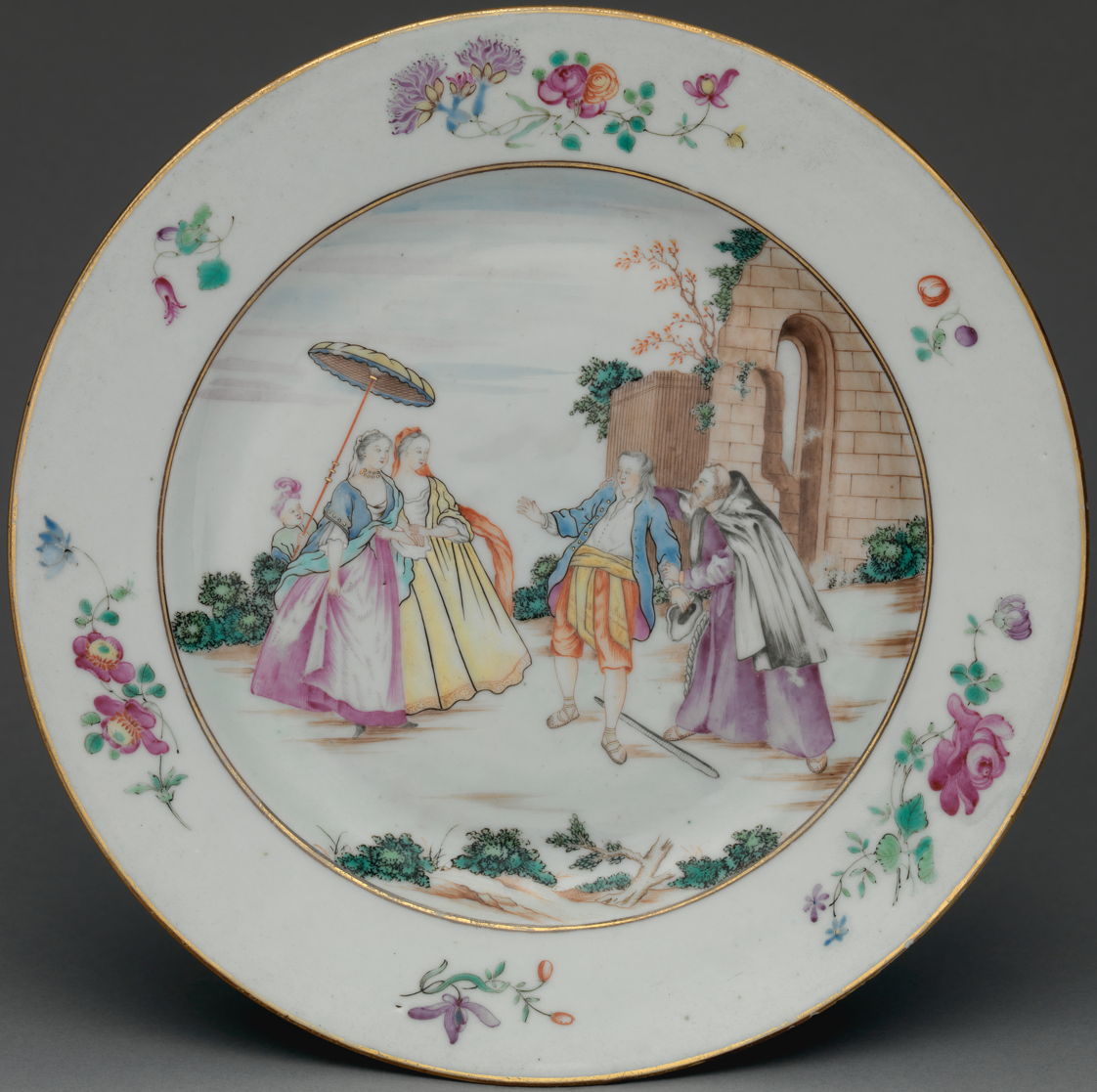
In about 1736, Nicolas Lancret painted the story of Brother Philippe’s Geese in oil on copper, as one of a pair, among a larger group of his paintings of La Fontaine’s fables.
Artist not known, Scene from Brother Philippe’s Geese (1745), Chinese painted porcelain plate, 22.9 cm diam, The Metropolitan Museum of Art (Friends of European Sculpture and Decorative Arts Gifts, 2016), New York, NY. Courtesy of The Metropolitan Museum of Art.
That became so popular that it was reproduced in prints, such as those by Nicolas de Larmessin (1684–1755) in which the image is naturally reversed, and here on a porcelain plate exported from China in 1745. This artist could only have worked from one of those prints.
During the eighteenth century, painted porcelain became popular for a wide range of objects.
Georg Kordenbusch (1731-1802), Scenes from the Life of Christ (1750), baptismal bowl, Kunstgewerbemuseum Berlin, Berlin. By User:FA2010, via Wikimedia Commons.
Georg Kordenbusch’s painted baptismal bowl shows four Scenes from the Life of Christ (1750). As these are intended for viewing from above the bowl, and normally by a group gathered around it, the layout of the scenes shouldn’t be orientated for viewing from a single position.
In his earlier years, the great British equestrian painter George Stubbs started painting on enamel, and during the 1770s produced some larger works for Josiah Wedgwood, the successful pottery entrepreneur.
George Stubbs (1724-1806), Reapers (1795), Enamel on Wedgwood biscuit earthenware, 76.8 x 102.9 cm, Yale Center for British Art, New Haven, CT. Wikimedia Commons.
Stubbs’ Reapers from 1795 is painted in enamel on Wedgwood biscuit earthenware, and is strongly reminiscent of early harvest paintings of the Brueghels.
Anonymous, Figure group Rinaldo and Armida (c 1791-95), moulded lead-glazed earthenware, enamelled in colours, Lakin & Poole, Staffordshire, Victoria and Albert Museum, London. Photo by Andreas Praefcke, via Wikimedia Commons.
Manufactured by Lakin & Poole in the Staffordshire pottery district in England around 1791-95, this moulded lead-glazed earthenware, enamelled in colours, celebrates a scene from Tasso’s epic Jerusalem Delivered, which was being revived at the time.
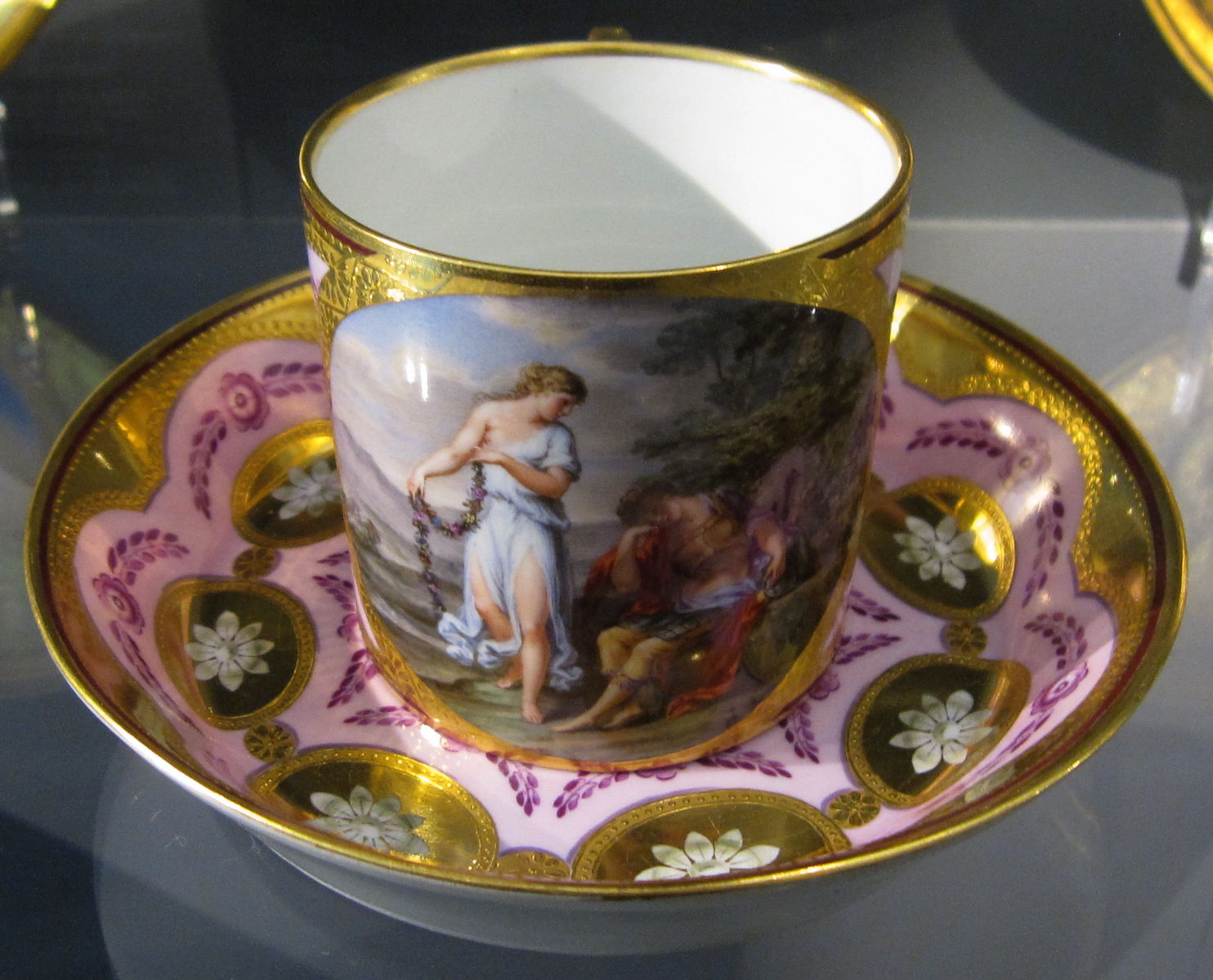
Anonymous, after Angelica Kauffmann, Rinaldo and Armida (c 1798), porcelain cup and saucer, Kaiserliche Porzellanmanufaktur, Wien. Collection of the Prince of Liechtenstein, Vaduz-Vienna. By Gryffindor, via Wikimedia Commons.
Here a painting of a similar theme by the enormously popular Angelica Kauffmann has been enamelled onto a porcelain cup and saucer by Kaiserliche Porzellanmanufaktur, Wien, in about 1798. The image of a Saracen witch entrancing, seducing, and abducting a warrior from the First Crusade may seem strange to accompany your cup of coffee.
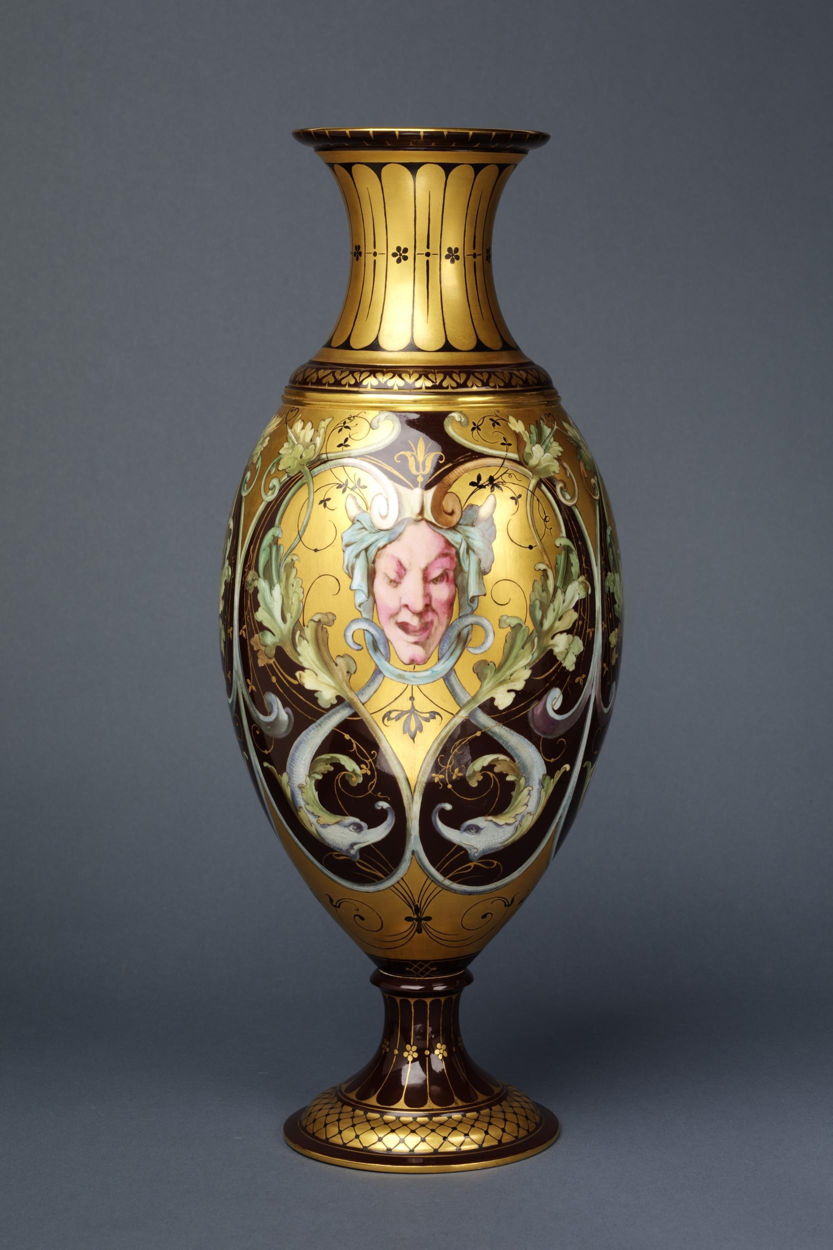
Among those who exhibited at the First Impressionist Exhibition in Paris in 1874 was the highly accomplished painter in enamel Alfred Meyer. He first exhibited in the Salon of 1864, and two years later was awarded a medal for his work shown there. He was an active member of the Impressionist’s company, and following its winding up he joined with Pissarro and others in establishing an alternative group, l’Union, in August 1875, which was structured as a trades union rather than a company.
He painted and gilded this on Sèvres porcelain in 1866. He was later appointed Professor at the École Bernard Palissy in Paris, where he rediscovered processes used by the ancient enamelers of the Limousin. He also worked for the Sèvres porcelain factory, the houses of Vever and Falize, as well as independently, and continued to exhibit his work at the Salon.
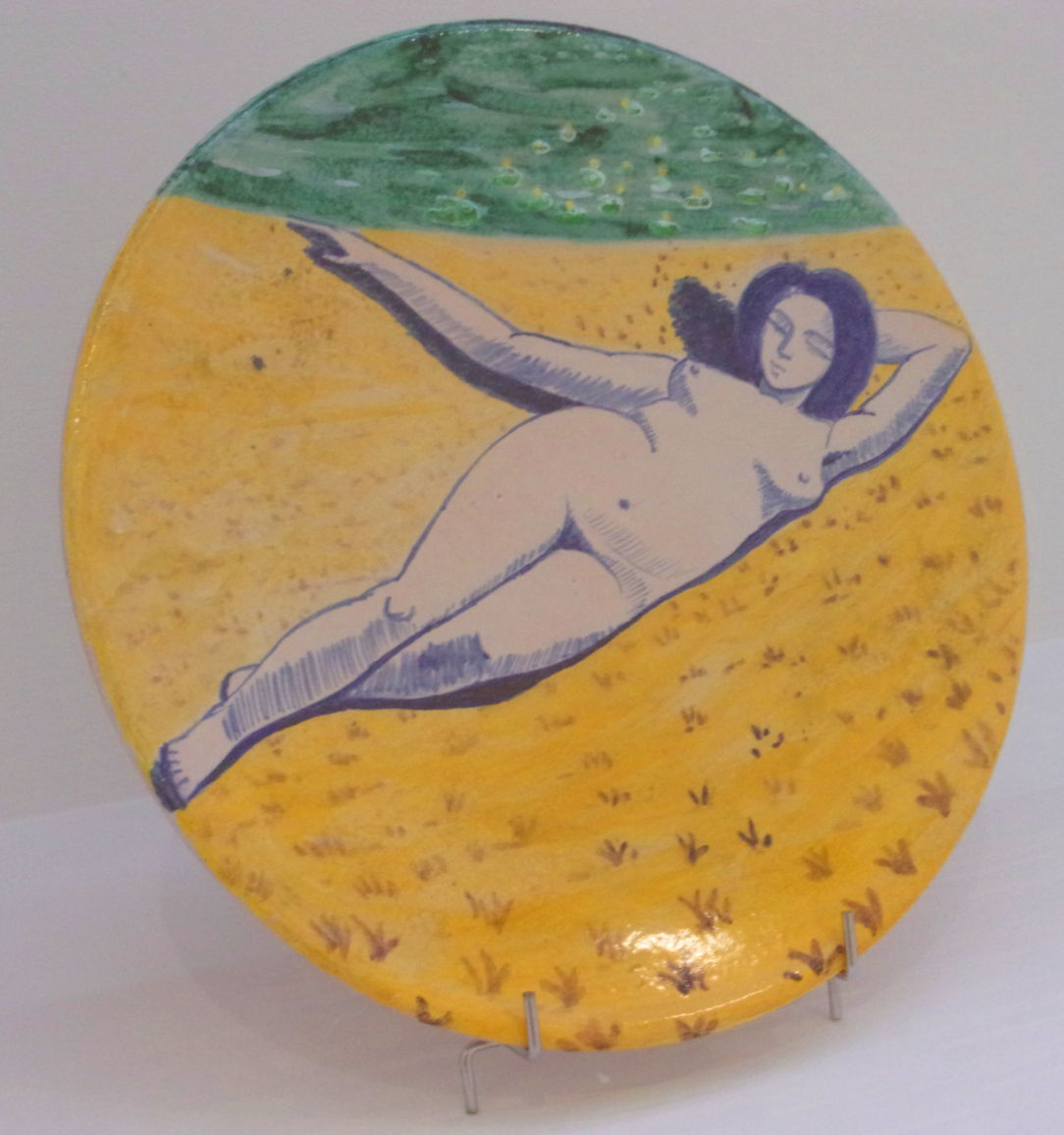
Georgette Agutte (1867–1922), Decorated Plate (1909), paint on pottery, dimensions not known, Musée de Grenoble, Grenoble, France. Image by Milky, via Wikimedia Commons.
Although never popular among painters, there have always been a few who have continued to paint pottery. This nude on a decorated plate was painted by Georgette Agutte in 1909.
Although legend held that Theseus was the founder of the city of Athens, it’s probably more accurate to attribute to him its early growth and development. Despite being ranked among the great heroes of classical Greece, he also displayed fundamental flaws. For a long time, the life of Theseus was as celebrated a series of myths as those of Heracles, Jason or Aeneas.
In about 1340-41, Giovanni Boccaccio wrote an epic poem of almost ten thousand lines Teseida, or The Theseid, which in turn inspired The Knight’s Tale in Chaucer’s Canterbury Tales.
Paolo da Visso (1431–1481) Scenes from Boccaccio’s Teseida (date not known), front of a cassone, further details not known. Wikimedia Commons.
Paolo da Visso painted these three scenes from Boccaccio’s epic on the front of a cassone, a visual equivalent of Plutarch’s account of the adventures of Theseus.
Like Perseus, Theseus had complicated origins. His mortal father, Aegeus the king of a far smaller Athens, had been childless, but following the prophecy of the oracle at Delphi, the King of Troezen got him drunk and packed him off to bed with his daughter Aethra. She was instructed in a dream to leave Aegeus asleep, and to go to a nearby island, where she was also impregnated by the god Poseidon. Theseus, who is presumed to have been conceived that night, was thus considered to have double paternity, by god and man, a qualification for the heroes of myth.
After he had buried his sword and sandals under a massive rock, Aegeus returned to Athens. He told Aethra that when his son grew up, she should tell him to move the rock, as a test. If he succeeded, then he should take the sandals and sword as evidence of his paternity.
When Theseus was old enough, his mother Aethra showed him the rock, and told him Aegeus’ instructions. Theseus moved the rock, found the sandals and sword, and then undertook an epic journey overland to his father in Athens.
Laurent de La Hyre (1606–1656), Theseus And His Mother Aethra (1635-36), oil on canvas, 141 × 118.5 cm, Szépművészeti Múzeum, Budapest, Hungary. Wikimedia Commons.
One of the earliest depictions of the young Theseus is Laurent de La Hyre’s Theseus And His Mother Aethra (1635-36). This shows the lad lifting a heavy pillar to reveal a pair of shoes and a sword.
Nicolas Poussin (1594–1665) and Jean Lemaire (1598–1659), Theseus Recovering his Father’s Sword (c 1638), oil on canvas, 98 x 134 cm, Musée Condé, Chantilly, France. Wikimedia Commons.
In one of his rare collaborative paintings, Nicolas Poussin worked with Jean Lemaire to tell this fragment of the story in Theseus Recovering his Father’s Sword, from about 1638. They draw a marked contrast between the two actors: Theseus, destined to be a great hero, looks rough and brutish, while his mother Aethra wouldn’t look out of place standing in for the Madonna.
Nicolas-Guy Brenet (1728–1792), Aethra Showing her Son Theseus the Place Where his Father had Hidden his Arms (1768), oil on canvas, 50.2 × 59.7 cm, Los Angeles County Museum of Art, Los Angeles, CA. Wikimedia Commons.
Nicolas-Guy Brenet’s more sketchy Aethra Showing her Son Theseus the Place Where his Father had Hidden his Arms (1768) adds a river god for good measure, and has Aethra giving Theseus marching orders to go find his father.
Antonio Balestra (1666–1740), Theseus Discovering his Father’s Sword (c 1725), oil on canvas, 287 x 159 cm, Private collection. Wikimedia Commons.
Antonio Balestra’s Theseus Discovering his Father’s Sword (c 1725) makes Theseus look less than enthusiastic to follow his mother’s directions.
Aethra told her son to travel by sea to take the sword and sandals to his father, but inspired by Heracles he chose to travel overland instead.
Like his hero, Theseus had a series of adventures on this journey. He first killed Periphetes, who had wielded a large club at him; impressed by this club, he took it and killed another opponent, Sinis, raped his daughter and made her pregnant. Theseus went out of his way to meet the fearsome Crommyonian Sow, which he also killed. Coming to the borders of Megara, Theseus met Sciron, whom he threw down a cliff to his death, and killed another two people before reaching the city.
Theseus found Athens, and his father’s court, in disarray, with the king cohabiting with the sorceress Medea, who had promised to cure his lack of children. Aegeus remained unaware of Theseus’ true identity, but invited him to a banquet, at which Medea, acting in conspiracy with the king, tried to get Theseus to drink from a goblet laced with the poison aconite.
Luckily for Theseus, just before he was going to drink from the goblet, he drew his father’s sword, making as if to carve the meat with it. Aegeus recognised the sword, realised that his guest who was just about to drink poison was his son, and knocked the goblet from Theseus’ hand to stop his lips from touching it.
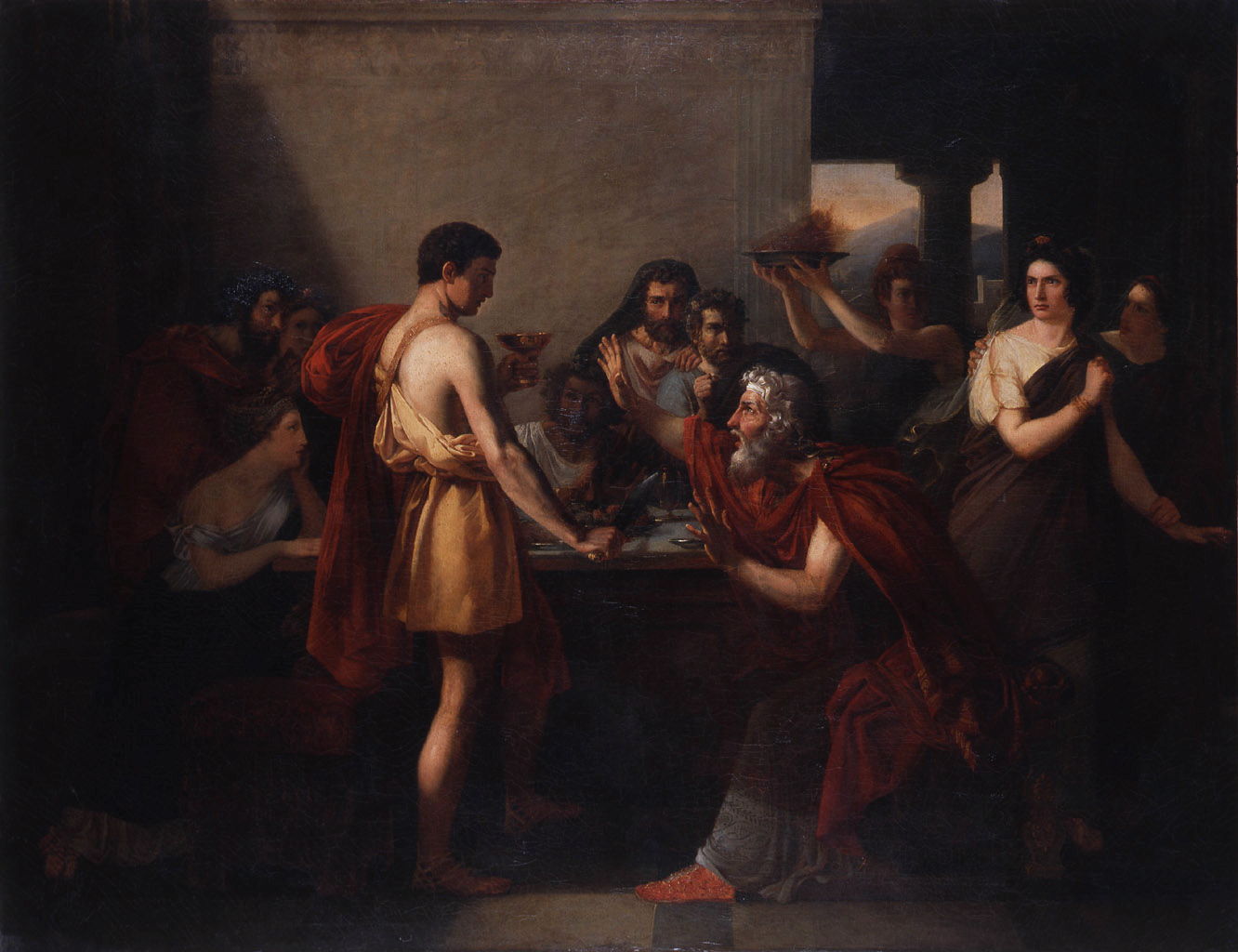
Antoine-Placide Gibert (1806-1875), Theseus Recognised by his Father (1832), oil, dimensions not known, Musée des Beaux-Arts, Bordeaux, France. Image by VladoubidoOo, via Wikimedia Commons.
In Antoine-Placide Gibert’s Theseus Recognised by his Father (1832), the three principal actors are arranged almost linearly across the canvas. Just left of centre, Theseus stands, his head in profile, the fateful cup in his left hand, and his father’s sword in his right. The king is just right of centre, looking Theseus in the eye, and appearing animated if not alarmed. At the far right is Medea, her face like thunder, sensing that her plot to kill Theseus is about to fall apart.
Hippolyte Flandrin (1809–1864), Theseus Recognized by his Father (1832), oil on canvas, 114.9 × 146.1 cm, École nationale supérieure des Beaux-Arts, Paris. Wikimedia Commons.
Hippolyte Flandrin’s Theseus Recognized by his Father beat Gibert’s painting for the Prix de Rome in 1832, and has a more neoclassical look, as if influenced by Jacques-Louis David. With a view of the Acropolis in the background, this shows the moment immediately after Aegeus has recognised his son, and the cup of aconite lies spilt on the table. Theseus, conspicuously naked, stands in the middle of the canvas, his father’s sword held rather limply in his right hand. Aegeus stands to the left of centre, talking emotionally to his son.
Of all the characters shown in this painting, it’s Medea who is the most fascinating. Stood at the far left, she appears to be on her way out. She is po-faced, and looks as if she has come not from Greece, but from central Asia.
Aegeus then declared Theseus to be his heir and successor as King of Athens. This was opposed by the sons of Pallas, who tried to attack the city. Theseus was tipped off by one of their men, surprised his opponents, and killed the lot of them. Like his hero Heracles, Theseus then set out to deal with the problem posed by the Marathonian Bull, captured it, and drove it through the city of Marathon before sacrificing it to Apollo. He then went on to battle with another bull, this time on the island of Crete.
Shortly after Edward Lear had returned from India, and at the end of Vasily Vereshchagin’s visit, the prolific traveller and botanical artist Marianne North (1830–1890) visited in 1877-79, as she was returning from a trip to south-east Asia and the Indonesian Archipelago.
Marianne North (1830–1890), Beypore, India (c 1877-79), oil on paper, dimensions not known, British Library, London. Wikimedia Commons.
When North visited India, she stayed for a while in the west coastal resort of Beypore, India (c 1877-79), in the state of Kerala. She rented a large room over the railway station, just a hundred yards from the water of the Indian Ocean. It appears idyllic.
Marianne North (1830–1890), Water Palace – Chitore. India (1878), oil, dimensions not known, British Library, London. Wikimedia Commons.
In the north-west, she visited the city of Chittaurgarh in Rajasthan, where she painted Water Palace – Chitore. India in December 1878. This city is centred on its major fort, which dates back to the seventh century CE, and has two major palaces, Rana Kumbha’s and Rani Padmini’s, the latter being shown here. Padmini was a legendary queen of the 13th to 14th centuries.
Marianne North (1830–1890), From Nahl Dehra near Simla (Shimla), Himachal Pradesh, India (1878), oil on board, dimensions not known, Marianne North Gallery, Kew, England. Wikimedia Commons.
North’s breathtaking mountain view From Nahl Dehra near Simla (Shimla), Himachal Pradesh, India (1878) shows the rugged hills near the capital city of Himachal Pradesh, in the Western Himalaya. From 1864, that city was the summer capital of British India because of its far more equitable climate.
Marianne North (1830–1890), Mount Everest or Deodunga from Sundukpho, North India (c 1878), oil, dimensions not known, Marianne North Gallery, Kew, England. Wikimedia Commons.
Mount Everest or Deodunga from Sundukpho, North India (c 1878) is another impressive view of the Himalaya. Deodunga has been used by several of the British in India as the name of the world’s highest mountain before it was renamed.
Valentine Cameron Prinsep (1838–1904) was born in Kolkata (then Calcutta), India, to a British colonial family. One of his aunts was Julia Margaret Cameron, the pioneer photographer who lived near Alfred, Lord Tennyson’s home on the Isle of Wight. Another was the grandmother of Virginia Woolf, the novelist, and Vanessa Bell, the Bloomsbury painter. The family home back in England was Little Holland House, the dower house to Holland House, in Kensington, London, and the focal point of a lively artistic social group.
Valentine Cameron Prinsep (1838–1904), Martaba, a Kashmiree Nautch Girl (c 1878), oil on canvas, 68.5 × 51.3 cm, Private collection. Wikimedia Commons.
In 1876 or 1877, Prinsep returned to India to research what was to become a huge painting of the Delhi Durbar, completed in 1880. The Durbar of 1877 was an official event marking the proclamation of Queen Victoria as Empress of India, although she didn’t attend in person, but was represented by her Viceroy. Unfortunately it coincided with the Great Famine, and came to mark the beginning of the campaign for a free India.
Among the other paintings he completed during that visit is Martaba, a Kashmiree Nautch Girl (c 1878), exhibited at the Royal Academy in 1878. Queen Victoria and her court had a particular fondness for portraits of ‘loyal subjects’ of the empire, and many are still on show at her former palace of Osborne House on the Isle of Wight, where she died.
Valentine Cameron Prinsep (1838–1904), View of the Lal Darwaza on the Matwa Road, between the Purana Qila and Old City, Delhi (date not known), oil on canvas, 26.8 × 29.3 cm, Private collection. Wikimedia Commons.
Prinsep’s View of the Lal Darwaza on the Matwa Road, between the Purana Qila and Old City, Delhi around 1878, is a remarkably loose oil sketch, probably completed en plein air.
He eventually presented his huge painting of the Delhi Durbar to Queen Victoria, and it was hung in Buckingham Palace.
In 1913, the year before the start of the First World War, the American painter of skyscrapers Colin Campbell Cooper (1856–1937) and his artist wife Emma Lampert Cooper (1855–1920) travelled to India, apparently on a commission for an affluent woman patron in the USA. They visited, and painted in, what are now India, Pakistan, Sri Lanka and Myanmar.
Colin Campbell Cooper (1856–1937), Taj Mahal, Afternoon (c 1913), oil on canvas, 73.7 x 91.4 cm, Private collection. Wikimedia Commons.
Taj Mahal, Afternoon (c 1913) is probably his best-known painting resulting from that trip, and on their return it was exhibited in Rochester, NY, in 1915. Shown here in warm low-angle light, Cooper deftly avoided the more usual perfectly symmetric view.
The last of my visitors also stayed the longest of them all. The Russian-American artist Nicholas Roerich (1874–1947) first took his family to Darjeeling in 1923 to start exploring the Himalaya. He met members of the 1924 British Everest Expedition there, before returning to the US later that year.
His first proper expedition to the Himalaya left New York in 1925 for Sikkim and Asia. Over the next 4-5 years, he, his family and six friends travelled through Punjab, Sikkim, the Karakoram Mountains, the Altai Mountains, Mongolia and Tibet. Their official mission was to act as the embassy of Western Buddhism to Tibet, but they also had scientific and artistic purposes. For a year, between 1927-28, the expedition was believed to have been lost, after it had been attacked in Tibet and detained there by the local government. They were confined for months in extreme conditions and with minimal rations, during which five members of his team died.
Nicholas Roerich (1874–1947), Himalayas, Sikkim (c 1928-29), tempera on canvas, 21 x 42 cm, location not known. Wikimedia Commons.
Himalayas, Sikkim (c 1928-29) appears to be a ‘tempera’ sketch made on canvas in the Himalaya. This is now an Indian state bordering on Tibet and Nepal, and includes Kangchenjunga.
Nicholas Roerich (1874–1947), Arjuna (Kulu series) (1929-30), tempera on canvas, 74.7 x 118.1 cm, N.K. Roerich International Centre, Moscow, Russia. Wikimedia Commons.
Roerich painted several series using mountain scenes which he may have derived from the many views he sketched during his expeditions. Arjuna, from his Kulu series, was painted in 1929-30, and shows the main protagonist from the Sanskrit epic Mahabharata with a bolt of lightning among Himalayan peaks.
Nicholas Roerich (1874–1947), Mount of Five Treasures (Two Worlds) (Holy Mountains series) (1933), tempera on canvas, 47 x 79 cm, location not known. Wikimedia Commons.
Mount of Five Treasures (Two Worlds), from his Holy Mountains series, was painted in 1933, and probably shows Kanchenjunga again.
Nicholas Roerich (1874–1947), Kanchenjunga (1944), tempera on canvas, 91.4 x 152 cm, Roerich Museum, Moscow, Russia. Wikimedia Commons.
Roerich painted this superb view of the distant mountain Kanchenjunga in 1944, when he was living in India. This view may have been painted in Darjeeling, and shows the mountain in the rich light of dusk.
Roerich died in Kullu, Himachal Pradesh, India, in 1947.
Of course the Indian sub-continent has a long and rich painting tradition of its own. To end with, here are two classical works to enjoy.
Unknown, The Prophet Ilyas Rescues a Prince (Mughal, c 1567-72), folio from The Hamzanama Manuscript, 67.4 x 51.3 cm, The British Museum, London. Wikimedia Commons.
This is a miniature from the Hamzanama Manuscript dated to about 1567-72, and shows The Prophet Ilyas Rescues a Prince.
Farrukh Beg, Ibrahim Adil Shah Hawking (Deccan, Bijapur, c 1590-95), opaque watercolour on paper, 28.7 x 15.6 cm, Russian Academy of Sciences, Saint Petersburg. Wikimedia Commons.
This watercolour by Farrukh Beg shows Ibrahim Adil Shah Hawking, and was painted in about 1590-95.
Trade between Europe and India had been established by the time of the Roman Empire, but it wasn’t until European trading companies, including the English East India Company, established outposts on the Indian coast in the early eighteenth century that many Europeans visited the sub-continent. Colonisation by Britain developed from the 1820s until the East India Company was disbanded in favour of direct colonial administration in 1858. From then until independence was achieved in 1947, a succession of predominantly British painters visited. This weekend I show a small selection of their work.
In 1778, William Hodges (1744–1797) travelled to India, where he painted under the patronage of the British statesman Warren Hastings. He stayed in the country for six years, visiting many locations ideal for landscape views. A selection were engraved for his book about his travels in India, published in 1793.
William Hodges (1744–1797), The Marmalong Bridge, with a Sepoy and Natives in the Foreground (c 1783), oil on canvas, 88.3 x 108.6 cm, Yale Center for British Art, New Haven, CT. Wikimedia Commons.
The Marmalong Bridge, with a Sepoy and Natives in the Foreground (c 1783) shows the oldest bridge across the Adyar River in Chennai (formerly Madras), Tamil Nadu, now known as the Maraimalai Adigal Bridge. This was originally constructed by an Armenian merchant in 1728, and wasn’t replaced until 1966.
William Hodges (1744–1797), The Taj Mahal (c 1788), oil on canvas, 89 x 149.5 cm, National Gallery of Modern Art, New Delhi, India. Wikimedia Commons.
Several years after his return to Britain, in about 1788, Hodges painted this curious view of the world-famous white marble mausoleum, The Taj Mahal. I suspect this image is slightly on the incline, and the artist set its horizontals more level. But most views of the Taj Mahal show its impressive formal garden; Hodges instead painted it from the opposite bank of the River Yamuna. The mausoleum had only been completed just over a century earlier, in 1648.
William Hodges (1744–1797), Storm on the Ganges, with Mrs. Hastings near the Col-gon Rocks (c 1790), oil on canvas, 127 x 182.9 cm, Yale Center for British Art, New Haven, CT. Wikimedia Commons.
Hodges painted this Storm on the Ganges, with Mrs. Hastings near the Col-gon Rocks in about 1790. The Mrs. Hastings of the title was his patron’s wife. She was formerly Mary Buchanan, the widow of one of the victims of the ‘Black Hole of Calcutta’ incident in 1756.
In 1872, the intrepid natural history painter Edward Lear (1812–1888) set off for India, but only got as far as Suez, where the canal had only been officially opened three years previously. He eventually undertook his tour of India and Sri Lanka in 1873-75, after which he returned to Britain. Although now known almost exclusively for his ‘nonsense’ poetry, Lear was an outstanding artist who survived a troubled childhood and overcame the combination of grand mal epilepsy, asthma, bronchitis, bouts of depression and failing eyesight.
Edward Lear (1812–1888), View of Gwalior, India (1840), oil on canvas, 23.5 × 46.3 cm, location not known. Wikimedia Commons.
This View of Gwalior, India is allegedly dated 1840, although Lear did not visit India until 1873. It is also painted in oils, which in any case makes it later than about 1852. Gwalior is a major city in northern central India, about 200 miles to the south of Delhi, with a particularly rich range of historic buildings, seen to the left of the large plateau.
Edward Lear (1812–1888), Benares (1873), watercolour with pen in brown ink over graphite and gouache on moderately thick, rough, beige wove paper, 34.3 x 50.8 cm, Yale Center for British Art, New Haven, CT. Wikimedia Commons.
Lear’s watercolour of Benares (1873) shows another city in northern central India, to the east of Gwalior, on the banks of the River Ganges. Now better known as Varanasi, it is a religious centre, being the holiest of seven sacred cities of the Hindu and Jain faiths, and an important location in the history of Buddhism as well.
Edward Lear (1812–1888), Coolies on the Road near Kalicut, Malabar (date not known), watercolour with body color and gum arabic on wove paper on medium, moderately textured, cream wove paper, 25.4 x 39.5 cm, Yale Center for British Art, New Haven, CT. Wikimedia Commons.
Although undated, I suspect that Lear’s watercolour of Coolies on the Road near Kalicut, Malabar was painted at around this time. Calicut or Kozhikode is a city in the state of Kerala, on the Malibar coast of south-west India, nearly two hundred miles to the west of Bangalore. The city is a major trade centre for locally-produced commodities like pepper, coconut, coffee, and rubber, and the labourers shown here were probably engaged in the production and transport of those products.
Edward Lear (1812–1888), Kangchenjunga from Darjeeling (1879), oil on canvas, 119.7 x 182.9 cm, Yale Center for British Art, New Haven, CT. Wikimedia Commons.
My final selection from Lear’s extensive landscape paintings is among his most spectacular, showing the great mountain Kangchenjunga from Darjeeling (1879).
Darjeeling is high in the Lesser Himalaya, at an elevation of just over two thousand metres (over 6,500 feet), in the far north of West Bengal. Famed for its tea plantations, it became a ‘hill station’ for British residents of India in the early nineteenth century, and just a couple of years after Lear painted this view, it was connected by the Darjeeling Himalayan Railway to New Jalpaiguri.
Kangchenjunga is now, and was then, ranked the third highest mountain in the world, with an elevation of 8,586 metres (28,169 feet). Its first successful ascent wasn’t made until 1955; because it is a sacred mountain, teams who attain the summit stop short to avoid its violation. The Kangchenjunga massif is best viewed from Darjeeling, which is about eighty miles away. Kangchenjunga itself is the obviously highest peak, to the left of the centre of the ice-covered massif seen here.
Vasily Vasilyevich Vereshchagin (1842–1904) was another seasoned traveller who was also an accomplished war artist for the Russian Empire. In late 1874 he started an extensive tour of the Himalaya and the Indian sub-continent.
Vasily Vasilyevich Vereshchagin (1842–1904), Rajnagar. Marble Embankment Decorated with Bas-Reliefs on a Lake in Udaipur (1874), media and dimensions not known, Tretyakov Gallery Государственная Третьяковская галерея, Moscow, Russia. Wikimedia Commons.
Rajnagar. Marble Embankment Decorated with Bas-Reliefs on a Lake in Udaipur (1874) shows one of the palaces in Udaipur, in Rajasthan. This city is surrounded by seven lakes, several of which have palaces on the shore.
Vasily Vasilyevich Vereshchagin (1842–1904), Taj Mahal Mausoleum, Agra (1874-76), oil on canvas, 38.7 x 54 cm, Tretyakov Gallery Государственная Третьяковская галерея, Moscow, Russia. Wikimedia Commons.
Taj Mahal Mausoleum, Agra (1874-76) is another view of this white marble mausoleum in the city of Agra, built to house the tomb of the Mughal emperor’s favourite wife, Mumtaz Mahal, between 1632-1653. It’s probably the most painted and photographed building in the whole of the sub-continent.
Vereshchagin returned to Europe in late 1876, where he turned some of his studies into more substantial finished paintings.
Vasily Vasilyevich Vereshchagin (1842–1904), Pearl Mosque, Delhi (1876-79), oil on canvas, 395 x 500 cm, Museum of Fine Arts Boston, Boston, MA. Wikimedia Commons.
Many of his travel paintings are surprisingly small, either completed in front of the motif or in an improvised local studio. This huge painting of the Pearl Mosque, Delhi must have been made entirely in his studio in Paris in 1876-79. The Moti Masjid is built from white marble, and is inside the Red Fort complex in Delhi. It was constructed by the Mughal emperor Aurangzeb for his second wife and the ladies of the household, in 1659-60.
Many Naturalist artists continued to paint in the style until late in their career, but two younger aspiring painters passed through a phase of Naturalism on their way to greatness in the early twentieth century, Joaquín Sorolla in Spain, and Anders Zorn in Sweden. Neither is now generally recognised as having been Naturalist at that time, though.
Joaquín Sorolla y Bastida (1863–1923), Another Marguerite! (1892), oil on canvas, 130.1 x 200 cm, Mildred Lane Kemper Art Museum, St. Louis, MO. Wikimedia Commons.
Sorolla had his first great success with a gold medal at the 1892 National Exhibition in Madrid, for Another Marguerite! which went on to win first prize at a Chicago International exhibition.
A young woman sits, hunched up and dejected, with chains around her wrists and her possessions tied up in a small bundle next to her. Sat behind her in the cattle-class compartment of the railway train are two armed National Guards, near-identical figures who are escorting her in custody to face trial. She appears already to be sitting in the cell which awaits at her destination.
Sorolla’s title explains, with its reference to Gounod’s opera Faust (1859), itself based on Goethe’s Faust. There, Marguerite was seduced by Faust, made pregnant, and then killed her baby. The artist was apparently inspired to paint this in the summer of 1892 in Valencia, by a real-life episode in which he had seen a woman being transported in custody to face a tribunal for an identical charge.
Joaquín Sorolla y Bastida (1863–1923), And They Still Say Fish is Expensive! (1894), oil on canvas, 151.5 x 204 cm, Museo Nacional del Prado, Madrid, Spain. Wikimedia Commons.
And They Still Say Fish is Expensive! (1894) is set in the hold of one of the larger Valencian fishing vessels, amid spare tackle, a large barrel, and some of its catch. Two older men are attending to a youth, who appears to have been wounded, presumably as the result of an accident at sea. Around the boy’s neck is a pendant good-luck charm; he is stripped to the waist and pale, and one of the men is pressing a dressing against his abdomen. Lit from an open hatch at the top left, the painting has the immediacy of a photographic ‘snap’ and looks documentary.
Sorolla’s title is incisive social comment about the values of a society which is happy to see young boys go to sea to fish, putting their lives at risk so that those ashore can enjoy cheap seafood. This was painted during the summer of 1894, again in Valencia, and went on to great acclaim in the Paris Salon the following year, where it was bought for the Museo del Prado in Madrid.
Joaquín Sorolla y Bastida (1863–1923), White Slave Trade (1895), oil on canvas, 166.5 x 194 cm, Museo Sorolla, Madrid, Spain. Wikimedia Commons.
Another painting that Sorolla exhibited successfully at the Salon in 1895 was White Slave Trade (1895), an epitome of the contemporary trade in prostitutes in Spain.
Set in a similarly bleak railway compartment to Another Marguerite, four young women are asleep while being transported in the care of a much older woman. In contrast to their guardian, who wears black, the young women are dressed in bright-coloured Valencian regional costumes, and wear fashionable shoes. Their few possessions are stacked on the bench at the right, and include a guitar. The ‘slave trade’ to which Sorolla’s title refers is, of course, the movement of prostitutes between brothels. This could have been from Valencia to the port of Cartagena, then over to Orán and Algeria, as suggested by Powell for example.
The theme of prostitution had been brought to the fore in Naturalism by the Norwegian painter and writer Christian Krohg, whose first novel published in 1886 had documented its problems in Oslo, and which he had depicted in Albertine in the Police Doctor’s Waiting Room (1885-87), a work Sorolla is unlikely to have seen, but may well have heard about.
Joaquín Sorolla y Bastida (1863–1923), Portrait of Dr. Simarro at the Microscope (1897), oil on canvas, 80 x 100 cm, Universidad Complutense de Madrid, Madrid, Spain. Courtesy of Legado Luis Simarro, via Wikimedia Commons.
Sorolla’s Portrait of Dr. Simarro at the Microscope from 1897 shows Doctor Luis Simarro Lacabra (1851-1921), who was an eminent psychiatrist in Madrid. He also undertook pioneering research looking at the fine structure of the brain. Among his many achievements was a modification of an established technique for staining microscopic sections of brain, which proved a major advance and an inspiration to the great Spanish neurohistologist Ramon y Cajal. This portrait was exhibited at the National Exhibition in Madrid in the same year.
Joaquín Sorolla y Bastida (1863–1923), Research (Una investigación o El Dr. Simarro en el Laboratorio) (1897), oil, 122 x 151 cm, Museo Sorolla, Madrid, Spain. Wikimedia Commons.
Research, or under its original Spanish title of Una investigación o El Dr. Simarro en el Laboratorio, from the same year, goes on to look at Dr. Simarro at work in the laboratory among colleagues and students. He is here preparing specimens for microscopy, presumably using his staining technique. The table is covered with bottles of chemicals used in that process, and the chunky metal object in the centre foreground is a microtome, used for cutting very thin sections of tissue embedded in paraffin wax, prior to their staining, for study under the microscope.
Anders Zorn’s Naturalism flourished when he was painting the realities of country life in the rural town of Mora, Sweden, where he had been born and brought up.
Anders Zorn (1860–1920), Baking Bread (1889), oil on canvas, dimensions not known, Private collection. WikiArt.
In Baking Bread, painted in Mora in 1889, Zorn captures each step in the process in documentary fashion, from kneading the dough, through rolling and preparing it, to its baking. There’s even an infant in the foreground who looks ready to consume it. This is painted in his characteristic limited palette derived from his transition to oils when he was in Saint Ives, Cornwall.
Anders Zorn (1860–1920), Mora Fair (1892), oil on canvas, 133 x 167.5 cm, Private collection. WikiArt.
My favourite painting from this period in his career is another showing country events near his family home, at Mora Fair, from 1892. Against a background of crowds and carts going to and leaving the fair, a young woman sits looking completely fed up. Not far from her feet, her partner is slumped face down amid the weeds, presumably from an excess of alcohol.
Anders Zorn (1860–1920), The Lace Makers (1894), oil on canvas, 92 x 65 cm, Private collection. Wikimedia Commons.
A couple of years later, he stole some time from painting the rich and famous when he was staying in Venice, for some more serious work, here showing The Lace Makers (1894).
By the end of the first decade of the twentieth century, Pierre Bonnard was painting several scenes involving mirror play each year.
Pierre Bonnard (1867-1947), Reflection (The Tub) (1909), media not known, 73 x 84.5 cm, Private collection. The Athenaeum.
Among his intimate domestic scenes, Reflection or The Tub (1909) is one of his best pieces of mirror play. He again opts for a view from an elevated position, looking down and into an angled plane mirror in the bathroom. The reflected view almost fills his canvas, with the nude Marthe (most probably) crouching slightly in the upper left corner, as she dries herself after a bath.
The angle of view plays some odd tricks. The washing bowl on the dressing table is brought to overlie the larger shallow bathtub on the floor, for example. Some of the objects on the dressing table are shown directly, others only in the reflected image. And over on the opposite side of the room is a chair, and a coffee tray.
Pierre Bonnard (1867-1947), The Dressing Table with a Bunch of Red and Yellow Flowers (1913), oil on canvas, 125 x 110 cm, Museum of Fine Arts, Houston, TX. The Athenaeum.
The Dressing Table with a Bunch of Red and Yellow Flowers (1913) presents us with another visual riddle that we struggle to resolve. Shown in the mirror above the dressing table is a reflection of what lies behind the artist. There’s a nearly-nude figure sat in the corner, and what appears to be a bath, or a bed on which there is a large black object, possibly a dog. As ever, the artist is nowhere to be seen, unless of course that headless figure is male rather than female.
Pierre Bonnard (1867-1947), The Bathroom Mirror (1914), oil on canvas, 72 x 88.5 cm, The Metropolitan Museum of Art, New York, NY. The Athenaeum.
The following year Bonnard moved back from the dressing table and its mirror, for The Bathroom Mirror (1914). Marthe’s reflection is now but a small image within the image, showing her sat on the side of the bed, with a bedspread matching the red floral pattern of the drapes around the dressing table. The artist has worked his usual vanishing trick for himself, and a vertical mirror at the right adds a curiously dark reflection of the room.
Pierre Bonnard (1867-1947), Nude before the Mirror (Bather) (c 1915), oil on canvas, 59.4 x 50.8 cm, Private collection. The Athenaeum.
In his Nude before the Mirror (Bather) of about 1915, Bonnard inverts his mirror play with a small mirror mounted at head height. Instead of using the reflection as a picture within the picture, to reveal figures behind the position of the painter, the artist is here set well back and his model is close to the mirror, so that it frames her face. This transforms the painting by giving the figure a face, an identity, and a character, rather than just the expanse of flesh of her back.
Pierre Bonnard (1867-1947), The Mantlepiece (1916), oil on canvas, 80.7 x 126.7 cm, Private collection. The Athenaeum.
The Mantlepiece (1916) is another complex piece of mirror play. Bonnard has viewed this from an unusually low position, level with the surface of the mantlepiece and looking slightly up. Behind him is his nude model, who appears slightly odd as she is both lit and viewed from below. On the wall behind them is a very long painting of a reclining nude (which certainly doesn’t look like one of Bonnard’s works), below which is a dressing table mirror. In this case, Bonnard appears to have used the reflections to bring together quite disjoint images into a single composite.
He then seems to have painted little if any mirror play for fifteen years.
Pierre Bonnard (1867-1947), The Toilette (Nude at the Mirror) (1931), oil on canvas, 154 x 104.5 cm, Galleria internazionale d’arte moderna di Ca’ Pesaro, Venice, Italy. The Athenaeum.
Of his surviving paintings from the 1930s I have been able to locate, intimate domestic scenes and nude figures again predominate. The Toilette (Nude at the Mirror) (1931) marks the return of mirror play different from his earlier practice: the nude stands in front of the mirror, but she isn’t seen in reflection at all, only directly. Instead, the mirror reinforces the verticals of the window and curtain off to the right.
Pierre Bonnard (1867-1947), Nude before a Mirror (c 1933), oil on canvas, 152.1 x 101.9 cm, Galleria internazionale d’arte moderna di Ca’ Pesaro, Venice, Italy. The Athenaeum.
At last, in about 1933, Bonnard returns to his earlier mirror play in his Nude before a Mirror. Marthe (presumably) stands slightly to one side of a full-length mirror, the yellow light catching her back, buttock, and thigh. Instead of her head being cast down, almost obscuring her face, she looks at the mirror, and her reflection looks back at the viewer in a Venus effect.
This is, of course, optically impossible: both Marthe and the viewer are to the right of the midline of the mirror. The viewer could only see Marthe on the left side of the mirror if that mirror were angled so that its plane was parallel to Marthe’s shoulders. What Bonnard shows is really Marthe’s doppelgänger, not her reflection.
Pierre Bonnard (1867-1947), Portrait of the Artist in the Bathroom Mirror (Self-Portrait) (1939-46), oil on canvas, 73 x 51 cm, Musée National d’Art Moderne de Paris, Paris. The Athenaeum.
Late in his life, after the death of Marthe, Bonnard painted some self-portraits in a mirror, including this Portrait of the Artist in the Bathroom Mirror from between 1939-46, as he is looking increasingly frail. And those appear to be his final reflections.
Mirror play in paintings isn’t uncommon, but there can be few major artists who have returned to it repeatedly over a period of more than forty years, as did Pierre Bonnard. In this article and its sequel tomorrow I show a selection of his work featuring reflections in plane mirrors.
Pierre Bonnard (1867-1947), The Lamp (c 1899), oil on board, 54 x 70.5 cm, Flint Institute of Arts (Michigan), Flint, MI. The Athenaeum.
The Lamp, from about 1899, is one of Bonnard’s earliest paintings featuring a reflection, here a complex world in miniature seen in a spherical glass part of a lamp. The reflection shows two of the lamp’s arms, one of the bottles of wine, and the bowl of fruit on the white tablecloth.
Pierre Bonnard (1867-1947), Ambroise Vollard (c 1904-05), oil on canvas, 74 x 93 cm, Kunsthaus Zurich, Zurich, Switzerland. The Athenaeum.
His portrait of Ambroise Vollard from about 1904-05 is perhaps his first use of a large planar mirror in a figurative painting. It shows some of the art dealer’s collection, including a painting on an easel. Here he uses the reflection to extend the field and scope of the painting.
Pierre Bonnard (1867-1947), Interior (c 1905), oil on canvas, 49.8 x 37.8 cm, Private collection. The Athenaeum.
In the early years of the twentieth century, Bonnard used mirrors and reflections in several paintings, including this Interior from about 1905. It is an unusual composition, with but a little of the woman’s back visible in the mirror; Bonnard instead shows the reflection of a chair placed in front of the mirror, and what appears to be the artist sat at a table.
His purpose in placing the chair in front of the mirror was, I think, to demonstrate that the artist’s eye is in line with the chair and with his own reflection, confirming that it is him who is sat at the table, although he doesn’t have an easel, neither is there any canvas or palette in sight.
Pierre Bonnard (1867-1947), Woman Getting Dressed (1906), oil on canvas, 42 x 58.7 cm, Private collection. The Athenaeum.
Woman Getting Dressed (1906) is a second example of Bonnard’s optical play with reflections. Dominating the centre of his canvas is a pile of women’s clothing on a low item of furniture, and a heater. A flat mirror at the left reveals the subject, who is sat beyond the right edge of the painting, getting dressed.
Pierre Bonnard (1867-1947), Nude Seated on a Red Sofa (1908), oil on canvas, 54 x 65 cm, Private collection. The Athenaeum.
Bonnard continued to paint figures from models. Nude Seated on a Red Sofa (1908) engages in gentle mirror-play without the sophisticated compositions of previous years.
Pierre Bonnard (1867-1947), El Tocador (The Dressing Table) (1908), oil on panel, 52 x 45 cm, Musée d’Orsay, Paris. The Athenaeum.
His intimate visual diary of Marthe’s life was becoming the focus of his development and innovation. In El Tocador, which means The Dressing Table (1908), Marthe’s headless torso is seen only in reflection. The direct view is of the large bowl and pitcher which she used to wash herself. This opens a new chapter of scenes shown in the mirror of a dressing table.
Pierre Bonnard (1867-1947), Mirror in the Dressing Room (1908), oil on panel, 120 x 97 cm, The Pushkin State Museum of Fine Arts, Moscow, Russia. The Athenaeum.
Mirror in the Dressing Room (1908) shows a similar dressing table and mirror, but in contrasting blue decor. A woman’s nude back and buttocks now appear in the mirror, as another woman sits at the left drinking a cup of coffee.
Pierre Bonnard (1867-1947), The Toilet (The Toilet in Pink) (c 1908), oil on canvas, 119 x 79 cm, Musée d’Orsay, Paris. The Athenaeum.
In The Toilet, alias The Toilet in Pink, from about 1908, a nude woman stands drying herself in front of a vertical mirror. This painting sets a trend for these intimate domestic scenes to be lighter.
Pierre Bonnard (1867-1947), The Bathroom (The Dressing Room with Pink Sofa) (1908), oil on canvas, 125 x 109 cm, Musées Royaux des Beaux-Arts de Belgique, Brussels, Belgium. The Athenaeum.
Of all these works painted in 1908, my favourite is The Bathroom, or The Dressing Room with Pink Sofa, which anticipates those from later in his career, when he was living in the south of France. Looking at a brightly-lit window from a slightly elevated position, Bonnard’s partner Marthe’s body is seen against that light, and the bright colours of the room. There is still some subtle mirror play, with her headless torso shown in the dressing table mirror, in which the artist is replaced by an empty chair. Its last reflection is that of the window frame in the residual water in the shallow metal bath at the left.
Many of the great buildings, their friezes and statues of classical times, and in the Middle Ages, were painted, a practice known as polychrome. This article looks at some more modern examples made by those who also painted flat surfaces.
Lawrence Alma-Tadema (1836–1912), Phidias Showing the Frieze of the Parthenon to his Friends (1868), oil on canvas, 72 × 110.5 cm, Birmingham Museum and Art Gallery, Birmingham, England. Wikimedia Commons.
Lawrence Alma-Tadema’s beautiful painting of Phidias Showing the Frieze of the Parthenon to his Friends from 1868 shows a group including Pericles (at the right), Aspasia, Alcibiades and Socrates, admiring this famous frieze in the glory of its original colours.
Master of the Biberach Holy Kinship (fl. 1520), Workshop of, The Last Judgement (c 1520), polychrome predella on limewood, 55 x 172 cm, Musée des Beaux-Arts, Lyon, France. Wikimedia Commons.
This magnificent polychrome limewood sculpture shows The Last Judgement (c 1520) as an outbreak of plague, and may be based on descriptions of the Black Death.
Much of the output from the workshops of Spanish painters during the seventeenth century wasn’t two-dimensional painting, but polychrome wood carvings destined for religious use.
Juan de Mesa (1583–1627), The Immaculate Conception (c 1610-15), polychrome wood carving, dimensions not known, Matthiesen Gallery, London. Wikimedia Commons.
Juan de Mesa (1583–1627) was a Cordoban sculptor who trained and worked in Seville from 1606 to his death there in 1627. He was responsible for many of the processional effigies which were – and some still are – featured in the celebrations of Holy Week in Seville. The Immaculate Conception is a fine example of his work from about 1610-15.
Many painters have also sculpted, but one specialised in polychrome figures, Jean-Léon Gérôme. Not only that, but he made paintings of him working on his sculptures, and of polychrome sculptures more generally.
Jean-Léon Gérôme (1824–1904), The End of the Pose (1886), oil on canvas, 48.3 x 40.6 cm, Private collection. Wikimedia Commons.
Gérôme’s The End of the Pose (1886) is the first of a series of unusual compound paintings, which are at once self-portraits of Gérôme as a sculptor, studies in the relationship between a model and their sculpted double, and forays into issues of what is seen, visual revelation, and truth.
Here, while Gérôme cleans up, his model is seen covering up her sculpted double with sheets, as she remains completely naked. Apart from various diversionary entertainments, including a couple of stuffed birds and a model boat, there is a single red rose on the wooden platform on which the model and statue stand.
It’s not far from here to the myth of the perfect sculptor, Pygmalion, whose creation was given life, turning statue into lover, which was Gérôme’s next step in 1890.
Jean-Léon Gérôme (1824–1904), Pygmalion and Galatea (c 1890), oil on canvas, 88.9 x 68.6 cm, Metropolitan Museum of Art, New York, NY. Wikimedia Commons.
Gérôme’s finished Pygmalion and Galatea (c 1890) just managed to stay on the right side of what in the day was deemed decent. His attention to detail is, as always, delightful, with two masks against the wall at the right, Cupid ready with his bow and arrow, an Aegis bearing the head of Medusa, and a couple of statues about looking and seeing.
Jean-Léon Gérôme (1824–1904), Sculpturae Vitam Insufflat Pictura (Painting Breathes Life into Sculpture) (1893), oil on canvas, 50.2 x 69.2 cm, Art Gallery of Ontario, Toronto. Wikimedia Commons.
In 1874, archaeologists discovered large numbers of polychrome cast terracotta figurines in the Boeotian town of Tanagra. These dated from Greek civilisations active there during the late fourth century BCE, and their quantity and quality impressed many, including Gérôme.
Having painted the story of Pygmalion and Galatea in 1890, Gérôme moved on to two works in which he built imaginary worlds around the Tanagra figurines. Sculpturae Vitam Insufflat Pictura (Painting Breathes Life into Sculpture) (1893) combines his own love of polychrome sculpture with a celebration of those archaeological discoveries.
In doing so, Gérôme progresses his long-running theme of visual revelation and truth, with these painted miniature humans, mimicking reality, and the wooden box of masks in the foreground. Several of the figurines refer to his own painting and sculpture.
Jean-Léon Gérôme (1824–1904), Atelier of Tanagra (1893), oil on canvas, 65.1 x 91.1 cm, Private collection. Wikimedia Commons.
As a painting, I don’t think that his Atelier of Tanagra (1893) is as effective and convincing as the previous work, but its wider range of figurines gives deeper insight into what Gérôme was thinking about. Several of the figurines shown here are his own polychrome sculptures, most obviously that of the naked woman sitting on the top of a blue pillar, in the centreline of the painting.
Jean-Léon Gérôme (1824–1904), The Artist’s Model (1895), oil on canvas, 50.8 x 39.6 cm, Dahesh Museum of Art, New York, NY. Wikimedia Commons.
In The Artist’s Model (1895), Gérôme paints himself at work on his marble figure Tanagra (1890), currently in the Musée d’Orsay, which he had already included among the figurines in his Sculpturae Vitam Insufflat Pictura. He thus painted himself making a sculpture which he had previously painted in a painting as a sculpture. Scattered in the image are reminders of gladiatoral armour and other props used for his paintings, one of his paintings of Pygmalion and Galatea, together with one of his polychrome sculptures of a woman with a hoop, at the right edge.
In 1894, Jean-Léon Gérôme started work on this polychrome marble head of the famous actor Sarah Bernhardt (1894-1901), which he completed in 1901. He bequeathed it to the French nation.
Jean-Léon Gérôme (1824–1904), Self-Portrait Painting The Ball Player (c 1902), oil on canvas, 61 x 50 cm, Musée Georges-Garret, Vesoul, France. The Athenaeum.
In about 1902 Gérôme returned to his series of paintings of himself as a sculptor. His Self-Portrait Painting The Ball Player is a fascinating variation of the traditional form of self-portrait, in that he is here applying the colour to one of his polychrome sculptures, a figure of a ball player, who closely resembles those seen earlier in his paintings of sculptures, including Pygmalion and Galatea.
Georges Lacombe was the sculptor among the Nabis, who painted Breton motifs and sculptures he created in wood.
Georges Lacombe (1868–1916), Isis (c 1895), mahogany wood sculpture, 111.5 x 62 cm, Musée d’Orsay, Paris. Wikimedia Commons.
Some of Lacombe’s sculptures are stunning: this wood carving in mahogany with added colour shows the goddess Isis, and was made in about 1895. It’s now in the Musée d’Orsay. Lacombe’s symbolism here may refer to the role of this Egyptian goddess in producing and protecting the heir to Osiris, Horus.
The legendary hero Perseus was the son of Danaë, conceived when Zeus/Jupiter impregnated her in a shower of gold. He had been sent by Polydectes on a mission to bring him the head of Medusa, and on his return with that secured in a kibisis, he stopped off in Ethiopia, where the princess Andromeda was awaiting sacrifice to the sea monster Cetus.
Titian (Tiziano Vecelli) (1490–1576), Perseus and Andromeda (1553-9), oil on canvas, 179 × 197 cm, The Wallace Collection, London. Wikimedia Commons.
Titian’s Perseus and Andromeda (1553-59) shows the height of the action, remaining largely faithful to Ovid’s account of this story. All three actors are present, with Andromeda still shackled and Perseus attacking Cetus from the air using a sword with a curved blade.
Paolo Veronese (1528–1588), Perseus Rescuing Andromeda (1576-78), oil on canvas, 260 × 211 cm, Musée des Beaux-Arts, Rennes, France. Wikimedia Commons.
Paolo Veronese’s Perseus Rescuing Andromeda followed soon afterwards, in 1576-78. His composition is similar to Titian’s, and equally faithful to the text, but his additional attention to the details of Perseus and Cetus brings this to life.
Edward Burne-Jones (1833–1898), The Perseus Series: The Doom Fulfilled (1888), oil on canvas, 155 × 140.5 cm, Staatsgalerie Stuttgart, Stuttgart. Wikimedia Commons.
In the ninth painting in Edward Burne-Jones’ series, The Doom Fulfilled (1888), Perseus is swathed in Cetus’ coils with their almost calligraphic form, brandishing his sword and ready to slaughter the monster and bring its terror to an end.
Félix Edouard Vallotton (1865-1925), Perseus Killing the Dragon (1910), oil on canvas, 160 x 233 cm, Musée d’art et d’histoire de Genève, Geneva. By Codex, via Wikimedia Commons.
In the early twentieth century, the former Nabi artist Félix Edouard Vallotton painted a series of narrative works, including his Perseus Killing the Dragon, from 1910, a thoroughly contemporary interpretation that is exceptionally free with Ovid’s account.
As with most classical myths, several variants of the story have developed over time. All painted accounts that I have seen follow the action-packed version in which Perseus slays Cetus with his sword, but some literary versions report that the sea monster was turned to stone by Medusa’s face, which would have made far duller paintings.
A more recent variant has the hero flying to Andromeda’s aid not with his winged sandals, but on the back of the winged horse Pegasus.
Peter Paul Rubens (1577–1640), Perseus and Andromeda (c 1622), oil on canvas, 99.5 x 139 cm, Hermitage Museum, Saint Petersburg, Russia. Wikimedia Commons.
By the time that Rubens came to paint Perseus and Andromeda in about 1622, the newer revised version including Pegasus seems to have become popular. Andromeda is at the left, unchained from her rock where she had been placed as a delightful morsel for Cetus, which has just been killed by Perseus and now lies at the lower edge with its fearsome mouth wide open. Perseus is in the process of claiming Andromeda’s hand as his reward, for which he is being crowned with laurels. Although he clearly flew in on Pegasus, he is still wearing his winged sandals, and holds the polished shield reflecting Medusa’s face and snake hair.
Piero di Cosimo (1462–1521), Andromeda freed by Perseus (c 1510-15), oil on panel, 70 x 123 cm, Galleria degli Uffizi, Florence. Wikimedia Commons.
Piero di Cosimo uses multiplex narrative to show most of the story in his large Andromeda Freed by Perseus (c 1510-15). Centred on the great bulk of Cetus, Perseus stands on its back and is about to hack at its neck with his curved sword. At the upper right, Perseus is shown a few moments earlier, as he was flying past in his winged sandals. To the left of Cetus, Andromeda is still secured to the rock by red fabric bindings, not chains, and is bare only to her waist.
In the foreground in front of Cetus are Andromeda’s parents stricken in grief. Near them is a group of courtiers with ornate head-dress. But in the right foreground the wedding party is already in full swing, complete with musicians and dancers.
Perseus’ reward for rescuing Andromeda and saving the kingdom of Ethiopia was naturally the hand of the princess in marriage. There was only one obstacle, that she had already been promised to Phineus, who was clearly no match when it came to killing sea monsters. Whether or not Phineus was invited, he and his friends turned up at the wedding of Andromeda and Perseus, and trouble soon broke out. The punch-up turned lethal when the weapons came out, and Perseus decided it was time to show Medusa’s face to the unwelcome guests.
Sebastiano Ricci (1659–1734), Perseus Confronting Phineus with the Head of Medusa (c 1705-10), oil on canvas, 64.1 × 77.2 cm, The J. Paul Getty Museum, Los Angeles, CA. Courtesy of J. Paul Getty Museum.
Sebastiano Ricci’s Perseus Confronting Phineus with the Head of Medusa (c 1705-10) shows the final moments of the battle, as Phineus cowers next to two of his henchmen who have almost completed the process of changing into stone. Although not shown here, Athena herself turned up to make sure that no one got the better of Perseus.
Edward Burne-Jones worked on many sketches and preliminary designs for his series, among which were gouache and gold layouts to show how his paintings would fit into their carved surrounds in his patron’s Music Room.
Edward Burne-Jones (1833–1898), Atlas Turned to Stone; The Rock of Doom and the Doom Fulfilled; The Court of Phineas; The Baleful Head (designs for The Story of Perseus) (1875-76), gouache, gold paint, graphite and chalk on paper, 36.7 x 148.7 cm, The Tate Gallery, London. Image by Sailko, via Wikimedia Commons.
This design shows an outline of the whole series, which had originally been intended to include Phineus and the wedding. The scenes shown are, from the left, Atlas Turned to Stone, The Rock of Doom and the Doom Fulfilled, The Court of Phineas, and The Baleful Head, shown below.
Edward Burne-Jones (1833–1898), The Perseus Series: The Baleful Head (1886-7), oil on canvas, 155 × 130 cm, Staatsgalerie Stuttgart, Stuttgart. Wikimedia Commons.
The tenth and final painting in Burne-Jones’ series, The Baleful Head (1885), shows Perseus and Andromeda, their right hands clenching one another’s wrists, looking at the image of Medusa’s face reflected in the surface of a well. This is set in a peaceful garden, with a fruit-laden apple tree behind, and flowers springing up from the grass beneath them.
Literary accounts take the couple on to live at Tiryns in Argos, from where Heracles/Hercules later undertook his Twelve Labours. They had seven sons and two daughters, and among their descendants were Heracles, Castor and Pollux, Clytemnestra, and the Achaemenid Persians.
When Perseus returned to Seriphos, he discovered Polydectes was still trying to seduce his mother Danaë. Perseus therefore used Medusa’s face to turn him to stone, and made Dictys king and his mother’s consort. His mission accomplished, Perseus returned the weapon and equipment loaned by the gods, and gave Athena the head of Medusa, which she then set in her shield as the Gorgoneion, more commonly referred to as the Aegis.
Peter Paul Rubens (1577–1640), The Judgement of Paris (1632-35), oil on oak, 144.8 x 193.7 cm, National Gallery, London. Wikimedia Commons.
Distinguishing the three goddesses taking part in The Judgement of Paris, shown in Rubens’ late account from 1632-35, often relies in part on the aegis. The three goddesses are, from the left, Athena with her shield, Aphrodite, and Hera with her peacock.
There was still one loose end to be tied, though: the prediction that Perseus would kill his father Acrisius. Various accounts are given of this, but consensus is that Perseus threw a quoit or discus that unintentionally struck Acrisius and killed him. Thereafter, he ruled a kingdom until he and Andromeda died. They were both catasterised into their own constellations, where they can still be seen today.
Beata Beatrix was Dante Gabriel Rossetti’s next step, started in earnest in 1864, two years after Lizzie’s death, and completed in 1870, although he had been making preliminary studies when she was still alive. The background sets this in Florence, with its distinctive Ponte Vecchio over the River Arno, and the sundial sets the time as nine o’clock in the morning, the time of Beatrice Portinari’s death.
Behind the ecstatic figure of Beatrice are Dante (right) with his cap, and the angelic figure of Love at the left. Beatrice is pale and her death is approaching. Her eyes are closed, waiting for release. A red bird with a halo has brought her a poppy flower, a direct association with sleep and laudanum. Beatrice is unmistakably Lizzie.
For once, we have the artist’s account of the reading of his own painting, in a letter Rossetti wrote to its first owner in 1871. He establishes that his literary reference is Vita Nuova, and the work embodies “symbolically the death of Beatrice as treated in that work.” But it doesn’t represent death as such, rather ‘renders’ it “under the semblance of a trance”, in which she is suddenly “rapt” from Earth to Heaven.
The red bird is the messenger of death, who drops a poppy flower into Beatrice’s hands, as she has closed her eyes to see the face of God. This could equally have referred to Lizzie rather than Beatrice.
Rossetti never worked this obsession out of his system. In 1871, he returned to the theme in what proved to be his largest painting ever, based on an original watercolour study, now in the Tate Gallery, he had made as early as 1856.
Dante Gabriel Rossetti (1828–1882), Dante’s Dream on the Day of the Death of Beatrice (1880), oil on canvas, 135.2 x 200.6 cm, Dundee Art Galleries and Museums Collection, Dundee, Scotland. Wikimedia Commons.
A decade after Lizzie’s death, Rossetti wove the more complex Dante’s Dream on the Day of the Death of Beatrice, of which this is the artist’s 1880 copy of his 1871 original. There are references to Beata Beatrix, in the red birds at the left and right edges, and his model for Beatrice was Jane Morris, wife of William Morris, designer and close friend. Jane Burden, as she was before her marriage to William Morris, had a similar background to Lizzie Siddall, from humble origins to artists’ model, then into the Pre-Raphaelite circle. Jane and Rossetti became lovers in around 1865 when he was still working on Beata Beatrix, but their relationship cooled later.
Rossetti casts the dream insert in red, for love, showing a red and winged angel of love kissing the dying Beatrice. He clutches not a flower – there are red roses strewn all over the floor – but an arrow of love. The model for the woman on the right was Marie Spartali Stillman, and her husband William James Stillman modelled for Dante’s face.
Dante Gabriel Rossetti (1828–1882), The Salutation of Beatrice (1880-82), oil on canvas, 154.3 x 91.4 cm, Toledo Museum of Art, Toledo, OH. Wikimedia Commons.
The finest among Rossetti’s last paintings of Beatrice is The Salutation of Beatrice (1880-82), painted in the last couple of years of his life. It is drawn in part from the figure of Beatrice in the left panel of his earlier Salutation of Beatrice, again using Jane Morris as his model. Sat on a well in the distance are the figures of Dante and the same red angel of Love, or maybe death after all.
In that couple of years before his death, as Rossetti was working on his last paintings of Dante’s beloved Beatrice, two other artists associated with the Pre-Raphaelites were also at work on their depictions of her. Henry Holiday was researching for his 1883 painting Dante meets Beatrice at Ponte Santa Trinita, and Marie Spartali Stillman painted the first of her several watercolours of Dante and Beatrice.
Henry Holiday (1839–1927), Dante meets Beatrice at Ponte Santa Trinita (1883), oil on canvas, 140 x 199 cm, Walker Art Gallery, Liverpool, England. Wikimedia Commons.
The year after Rossetti’s death, Henry Holiday completed his painting of the second occasion on which Dante claimed he had met with his beloved, in Dante meets Beatrice at Ponte Santa Trinita (1883). Holiday devoted great effort to making this view as authentic as possible. In 1881, the year before Rossetti’s death, he travelled to Florence to make studies, and researched the buildings at the time, which he turned into clay models for a 3D reference. He also got John Trivett Nettleship, a noted animal painter, to paint the pigeons so that they were faithful.
Marie Spartali, as she was before her marriage in 1871, was one of a trio of beautiful young women from Greek migrant families in London who had become known as the Three Graces. Her father, then a wealthy merchant, entertained Pre-Raphaelite painters including Rossetti, who referred to Marie as a “stunner”.
The Three Graces modelled for the artists of the day, and Marie appears as one of the figures in Rossetti’s painting of Dante’s Dream on the Day of the Death of Beatrice (1871, 1880). She learned to paint in private lessons from Ford Madox Brown, and was soon making her own images based on the writings of Dante, and Rossetti’s translations of them into English.
Marie Spartali Stillman (1844–1927), “Certain ladies of her companionship gathered themselves unto Beatrice…” (1880), watercolour and gouache over traces of graphite on paper on backing, 85.1 x 63.5 cm, Private collection. Wikimedia Commons.
The full title of her “Certain ladies of her companionship gathered themselves unto Beatrice…” (1880) actually quotes even more from Dante’s Vita Nuova: “Certain ladies of her companionship gathered themselves unto Beatrice where she kept alone in weeping. And as they passed in and out, I would hear them speak concerning her, how she wept.”
This refers to the ladies of Florence who paid their respects to Beatrice as she kept vigil following her father’s death. Dante is shown sat outside the house, wearing his customary chaperon hat, his head bowed, and being comforted by two of the women who had visited Beatrice inside.
Marie Spartali Stillman (1844–1927), Beatrice (1896), watercolour and gouache on paper mounted on board, 57.6 × 43.2 cm, Delaware Art Museum, Wilmington, DE. Wikimedia Commons.
In 1896, Marie Spartali Stillman revisited Dante’s Vita Nuova through Dante Gabriel Rossetti’s popular translation into English. Her earlier version of Beatrice (1896) shows Dante’s beloved Beatrice lost in contemplation while reading, an intimate insight set firmly in the Pre-Raphaelite mediaeval, also seen in detail below.
Marie Spartali Stillman (1844–1927), Beatrice (detail) (1896), watercolour and gouache on paper mounted on board, 57.6 × 43.2 cm, Delaware Art Museum, Wilmington, DE. Wikimedia Commons.Marie Spartali Stillman (1844–1927), Beatrice (1898), watercolour, gouache and graphite, 54.6 x 36.9 cm, Private collection. Wikimedia Commons.
Her second treatment of Beatrice (1898) employs similar floral language, perhaps emphasising innocence in its lilies, but is less contemplative and more sensual, in a manner perhaps more typical of Rossetti.
Marie Spartali Stillman (1844–1927), The Pilgrim Folk (1914), watercolor and gouache on paper, 56.8 × 70.3 cm, Delaware Art Museum, Wilmington, DE. Wikimedia Commons.
In the months before the outbreak of the First World War, she painted The Pilgrim Folk (1914), which may well have been a double valediction, as both her last major painting and her farewell to Italy. It again refers to Dante’s Vita Nuova via Rossetti, a quotation from which was shown with the painting. This passage contains Dante’s account of Beatrice’s death to a group of newly-arrived pilgrims.
Dante leans out from a window at the left, addressing three pilgrims below. At the lower left corner, the winged figure of Love crouches in grief, poppies scattered in front of him, a reference to Rossetti’s paintings. Pilgrims around the well are taking refreshment after their travels, and more are arriving through the alley beyond. Black crows fly in flocks above, symbolising death. The landscape behind is very Italian, and the whole has a fairy-tale unreality about its mediaeval details.
Stillman had used Rossetti’s symbols elsewhere too, including in one of her finest paintings, Love’s Messenger completed in 1885, three years after his death.
Marie Spartali Stillman (1844–1927), Love’s Messenger (1885), watercolor, tempera and gold paint on paper mounted on wood, 81.3 × 66 cm, Delaware Art Museum, Wilmington, DE. Wikimedia Commons.
A young woman stands by her embroidery at an outside window. On her right hand is a messenger dove/pigeon, to which a letter is attached. She clutches that letter to her breast with her left hand, implying that its contents relate to matters of the heart. The dove is being fed corn, which could either be its reward for having reached its destination (thus the woman is the recipient of the message), or preparation for its departure (she is the sender).
On balance, the presence of corn on the windowsill implies that it is more likely that the dove has just arrived, and the woman is the recipient. But look closely at the embroidery, and she is making an image of one of Rossetti’s angels of love, complete with red wings and a bow and arrow.
There’s another artist who is perhaps the most surprising of all those who painted Beatrice: Odilon Redon (1840–1916), a contemporary of Stillman, who is perhaps as different as you could get in terms of background and style.
Odilon Redon (1840–1916), Beatrice (1885), pastel on paper, dimensions not known, Private collection. Wikimedia Commons.
Redon’s pastel portrait of Beatrice from 1885 was turned into a print a decade or so later, and appears to have been laid down in pure gold. Like so many other portraits of her, it contains no literary references to indicate whether she is the possibly physical Beatrice from Vita Nuova, or the spiritual guide from the Divine Comedy.
Henri-Jean Guillaume Martin (1860–1943), Dante Meeting Beatrice (1898), colour lithograph, 25.5 x 31 cm, The British Museum, London. Wikimedia Commons.
Throughout his career, Henri-Jean Guillaume Martin painted scenes from Dante’s Divine Comedy. This colour lithograph refers to the end of the middle book Purgatory, in which Dante is reunited with his beloved Beatrice, who leads him through the final book, Paradise.
Odilon Redon (1840–1916), Dante and Beatrice (1914), oil on canvas, 50 x 65.3 cm, Fujikawa Galleries Inc., Tokyo, Japan. Wikimedia Commons.
At the same time that Stillman was painting her Pilgrim Folk above, Redon painted one of his relatively few works in oils, of Dante and Beatrice (1914). Their heads, with eyes closed so they can see their God, are among the clouds above the cliffs of a coastline suggestive of Purgatory.
So who was Beatrice Portinari?
Born in Florence in about 1265, making her about the same age as Dante, she was the daughter of a rich banker. By the time she was about 22, she had married another banker, Simone dei Bardi. She is mentioned in the will that her father made in 1287, and is thought to have died in Florence on 8 June 1290, at the age of about 25.
Beyond that, and Dante’s non-specific references to a Beatrice, who could quite easily be someone completely different, or a symbolic figure, there seems nothing to tell. But there are so many wonderful paintings of such an unknown woman.
On 11 February 1862, Lizzie, wife of the leading Pre-Raphaelite artist and writer Dante Gabriel Rossetti, died of an overdose of laudanum (tincture of opium) at the age of only 32. A couple of years later, Rossetti embarked on an unusual post-mortem portrait of her in the role of Dante’s beloved Beatrice. Although Dante never revealed her true identity, many have believed her to represent Beatrice di Folco Portinari, who had died even younger almost six hundred years earlier, at the age of only 25. Beata Beatrix is one of Rossetti’s major paintings.
The strangest thing about Rossetti’s Beata Beatrix (c 1864–70) is that it represents a woman who, beyond Dante’s writing, is almost unknown, yet she’s become one of the most painted women in history. This weekend’s two articles look at some of the better-known paintings of Beatrice, from before Rossetti’s image, and afterwards, spanning some of Europe’s most visionary artists, from William Blake to Odilon Redon.
Dante wrote about Beatrice in two of his most popular works: his youthful Vita Nuova, and in two of the three books in his Divine Comedy. Early commentators don’t appear to have made any association between his literary figure and a real person, let alone a married woman who, at best, only met Dante twice before her early death. Many scholars believe Dante’s figure is symbolic rather than physical, which is more likely in her role in the Divine Comedy. Nevertheless, she has proved a popular subject, particularly during the nineteenth century.
Washington Allston (1779–1843), Beatrice (1819), oil on canvas, 76.8 x 64.4 cm, Museum of Fine Arts Boston, Boston, MA. Wikimedia Commons.
The American Romantic artist and poet Washington Allston shows her in a straightforward portrait of Beatrice from 1819. He makes no literary allusions, although this is most likely to refer to Vita Nuova.
It was William Blake’s paintings for his unfinished illustrated edition of the Divine Comedy that started to explore her in the context of Dante’s narrative.
Beatrice on the Car, from 1824-27, shows her appearing in a chariot or ‘car’ in the midst of a religious procession, which takes place in the earthly paradise on the summit of the island-mountain of Purgatory.
Blake’s best-developed painting of her, Beatrice Addressing Dante from the Car, from the same few years prior to his death, shows her admonishing Dante for his recent straying from the path of righteousness. This is rich with symbols and graphic devices, such as its vortex of heads and eyes, and the marvellous gryphon pulling Beatrice’s chariot.
Dante’s works enjoyed a revival during the nineteenth century, bringing other artists to use them as themes for their paintings, with the Divine Comedy the more common.
Carl Wilhelm Friedrich Oesterley (1805–1891), Dante and Beatrice (1845), further details not known. Wikimedia Commons.
Carl Wilhelm Friedrich Oesterley’s conventional and Romantic view of Beatrice and her chariot follows Dante’s description literally, even down to the colours of her clothing.
Andrea Pierini (1798–1858), The Meeting of Dante and Beatrice in Purgatory (1853), oil on canvas, 141 x 179 cm, Galleria d’arte moderna, Florence, Italy. Wikimedia Commons.
Andrea Pierini’s curiously antiquated version from 1853 is also literal in its detail.
William Dyce (1806–1864), Beatrice (1859), oil on panel, 65.2 x 49.4 cm, Aberdeen Art Gallery & Museums, Aberdeen, Scotland. Wikimedia Commons.
William Dyce returned to portraiture style for his painting of Beatrice in 1859, when Rossetti was peaking in his obsession with her. Dyce had considerable exposure to paintings of the Divine Comedy: when he was in Rome in 1827-28, he is thought to have been friends with Friedrich Overbeck, the Nazarene artist who had just been painting frescoes of Tasso’s Jerusalem Delivered alongside others of the Divine Comedy, in the Casa Massimo. When he returned to London, Dyce was responsible for introducing the Pre-Raphaelites, including Rossetti, to the influential critic John Ruskin.
Others involved with the Pre-Raphaelites also adopted Beatrice as a theme. Simeon Solomon’s ink and watercolour painting of Dante’s First Meeting with Beatrice (1859–63) is taken from Vita Nuova, and its description of the two nine year-olds meeting in about 1274.
Dante Gabriel Rossetti had started to become obsessed with his name-sake and Beatrice soon after his early success as a Pre-Raphaelite painter. In December 1849, he wrote a short story titled Hand and Soul which was published the following month in the first issue of the Germ, the movement’s magazine, edited by Rossetti’s brother William Michael.
His story tells of courtly love, artistic and religious fervour of an imaginary mediaeval painter in the Italian city of Arezzo, who is in a strictly Platonic relationship with “his mystical lady, now hardly in her ninth year”, the same age as Beatrice was when Dante claimed to have met her.
Shortly afterwards, Rossetti started sketching for a painting of their meeting in Purgatory.
Dante Gabriel Rossetti (1828–1882), The Meeting of Dante and Beatrice in Purgatory – Figure Sketch (1852), pen and ink on laid paper, 11.3 x 14.8 cm, Birmingham Museum and Art Gallery, Birmingham, England. Wikimedia Commons.
In this figure sketch for The Meeting of Dante and Beatrice in Purgatory, made in 1852, Dante is on his knees as his beloved Beatrice admonishes him for straying from the path of righteousness.
Dante Gabriel Rossetti (1828–1882), Dante and Beatrice Meeting in Purgatory (1853-54), bodycolour, pen and ink on paper, 29.2 x 25.1 cm, The Fitzwilliam Museum, Cambridge, England. Wikimedia Commons.
Rossetti had second thoughts, and in 1853-54 painted this more conventional composition, showing Dante in full spate, and Beatrice flanked by angels carrying golden crosses. His details are at odds with Dante’s account, though.
Dante Gabriel Rossetti (1828–1882), Beatrice Meeting Dante at a Marriage Feast, Denies Him Her Salutation (1852), watercolour and gouache on paper, 35.1 x 42.5 cm, Art Gallery of New South Wales, Sydney, Australia. Wikimedia Commons.
At about the same time, Rossetti was working on a more narrative watercolour of another meeting between the two, this time based on the Vita Nuova, in Beatrice Meeting Dante at a Marriage Feast, Denies Him Her Salutation (1852). Dante, dressed in his traditional red, is here being ignored by his beloved, after they had bumped into one another at a wedding. This is thought to be Rossetti’s first painting in which Elizabeth ‘Lizzie’ Siddall is the model for Beatrice.
Lizzie was about 22 at that time. A working class woman, who initially worked at a milliner’s shop in London, she couldn’t have been further from the minor nobility and affluence of Beatrice Portinari. Neither was Lizzie noted for her beauty: she first modelled in around 1849 for Walter Deverell, who chose her for her plainness. Lizzie continued to model for Pre-Raphaelites, and in 1851-52 achieved fame as the model for John Everett Millais’ Ophelia.
Lizzie became an artist in her own right, although her paintings are now sadly neglected. In 1852, she moved in to live with Rossetti, but her health started to deteriorate, probably as a result of tuberculosis.
Dante Gabriel Rossetti (1828–1882), The First Anniversary of the Death of Beatrice (1853), watercolour, 41.9 x 60.9 cm, Ashmolean Museum, Oxford, United Kingdom. Wikimedia Commons.
Rossetti then went on to a more fictionalised watercolour of The First Anniversary of the Death of Beatrice (1853), showing Dante being comforted as he is drawing an angel on that day of remembrance for his beloved. This is situated in central Florence according to the view through the window at the right, but there’s an incongruous country garden seen through the door at the left.
Dante Gabriel Rossetti (1828–1882), The Salutation of Beatrice (1859-63), oil and gold leaf on conifer wood, frame designed and painted by the artist, panels each 74.9 x 80 cm, National Gallery of Canada Musée des beaux-arts du Canada, Ottawa, Canada. Wikimedia Commons.
As Lizzie’s health declined, Rossetti created more ornate and icon-like paintings of Beatrice. The Salutation of Beatrice from 1859-63 uses oil and gold leaf on conifer wood, set in a frame Rossetti designed and painted himself. It brings together the literary Beatrice from Vita Nuova on the left, with the spiritual Beatrice from the Divine Comedy at the right, where they meet in earthly paradise atop Purgatory. On the frame are inscriptions taken from the respective works, and in the middle is the date and time (on a sundial) of Beatrice Portinari’s death in 1290.
When the couple married in Hastings in 1860, she had to be carried around the corner to attend the church. She became depressed, and was addicted to laudanum (tincture of opium). In 1861, she had a stillborn daughter, and later that year became pregnant a second time. She died on 11 February 1862, as a result of what was almost certainly a deliberate overdose of laudanum.
Although Naturalism in literature continued well into the early twentieth century, in painting it was fading before 1900. This article shows some examples from those later years.
Erik Henningsen (1855–1930), Evicted (1892), oil on canvas, dimensions not known, Statens Museum for Kunst (Den Kongelige Malerisamling), Copenhagen, Denmark. Wikimedia Commons.
The Danish artist Erik Henningsen’s Evicted from 1892 returns to a theme perhaps more appropriate to ‘social realism’, as a family of four is evicted into the street in the winter snow. With them are their meagre possessions, including a saw suggesting the father may be a carpenter. In the background he is still arguing with a policeman.
Erik Henningsen (1855–1930), An Injured Worker (1895), oil on canvas, 131.5 x 187 cm, Statens Museum for Kunst (Den Kongelige Malerisamling), Copenhagen, Denmark. Wikimedia Commons.
In An Injured Worker from 1895, Henningsen tackles another major social issue. The scene is a gravel or sand pit outside a town (in the distance at the right). A worker has just been injured, and is being carried away on a stretcher. By his side is his wife, who is in tears and being comforted by one of her husband’s managers. Behind and to the left are a policeman, and a doctor who wears a top hat and is wiping his hands after dressing the man’s wounds.
Léon Augustin Lhermitte (1844–1925), Vegetable Market in St-Malo (1893), pastel, dimensions not known, Private collection. Wikimedia Commons.
In France, the veteran Léon Augustin Lhermitte painted this pastel of the Vegetable Market in St-Malo in 1893. It’s a good example of his balance between detail, as seen in the distant crowd and shop fronts, and a more painterly style.
Léon Augustin Lhermitte (1844–1925), Les Halles (1895), oil on canvas, dimensions not known, Petit Palais, Paris. Wikimedia Commons.
In 1889, Lhermitte was commissioned to paint Les Halles, the main and most central market in the city of Paris. He completed this, perhaps his last major work, in 1895, when it was exhibited at the Salon. The market’s origins were mediaeval, then during the nineteenth century it grew even busier, and was re-housed in iron and glass buildings erected during the 1850s. Lhermitte’s friend Émile Zola set his novel Le Ventre de Paris (1873) in this market.
Émile Friant (1863–1932), Sorrow (1898), oil on canvas, dimensions not known, Musée des beaux-arts de Nancy, Nancy, France. Wikimedia Commons.
Émile Friant’s Sorrow (1898) visits a municipal cemetery for a funeral, and an intimate study of the grief of a widow, who is being helped by two younger women. Their overt reactions contrast with the cluster of men, with their stern beards, at the left.
In the 1890s, Friant became a passionate aviation enthusiast. Together with a friend from Nancy, one of the oarsmen in his painting of 1887, he founded an aviation society, and flew in balloons and early aircraft.
Émile Friant (1863–1932), Journey to Infinity (1899), oil on canvas, 150 × 120 cm, location not known. Wikimedia Commons.
Journey to Infinity (1899) is an extraordinary flight of fancy in a balloon, which is soaring high above a bank of grey clouds (or possibly a rugged mountain ridge) containing the forms of five nude women, one of them apparently performing a handstand. I suspect this painting may have been made for Marie Marvingt (1875-1963), an athlete, mountaineer, and pioneer aviator, who had moved to Nancy in 1889.
Jean-Eugène Buland (1852–1926), Parental Happiness (1903), oil on canvas, 97.5 × 129 cm, location not known. Wikimedia Commons.
Jean-Eugène Buland returned to poor working families in his Parental Happiness from 1903. A young couple are nursing their first baby, and appear to be living in an agricultural outhouse. The floor is strewn with vegetables and their parings, and the husband is dressed as a labourer, with worn working shoes, his wife in wooden clogs.
Jean-Eugène Buland (1852–1926), The Tinker (1908), oil on canvas, 112.6 × 145 cm, Private collection. Wikimedia Commons.
Buland’s The Tinker (1908) is busy at his cottage industry, repairing damaged pots, pans, and domestic metal objects. The stone wall at the left glistens with the damp.
During this period two aspiring artists who were to achieve greatness in the early twentieth century went through a period of Naturalism, Joaquín Sorolla in Spain, and Anders Zorn in Sweden, the subject of the next article in this series.
These days, mirror play is something you do with babies and infants, but over the last six centuries or so it has also been a feature of many paintings. It all started in the Northern Renaissance, when leading Flemish painters including the van Eycks became fascinated in depicting optical phenomena including reflections in mirrors.
Jan van Eyck (c 1380/90-1441), Portrait of Giovanni Arnolfini (?) and his Wife (1434), oil on oak panel, 82 x 59.5 cm. The National Gallery, London. Wikimedia Commons.
Jan van Eyck’s most famous painting, known as The Arnolfini Wedding (or similar variations), is a remarkable exploration of optics, featuring distorted reflections in the mirror near the centre of the painting, completed in 1434. Between this newly-wed couple holding hands next to their marital bed, in the midline of the painting, is a prominent circular convex mirror. Its reflection shows a view of the room looking in the opposite direction, past the couple to another two figures, who could be the artist and another, as shown in the detail below.
Jan van Eyck (c 1380-1441), Portrait of Giovanni(?) Arnolfini and his Wife (detail) (1434), oil on oak panel, 82.2 x 60 cm. National Gallery, London. WikiArt.Jacopo Tintoretto (c 1518-1594), Venus and Mars Surprised by Vulcan (c 1545) (E&I 36), oil on canvas, 140 x 197 cm, Alte Pinakothek, Maxvorstadt, Germany. Wikimedia Commons.
Just over a century later, in about 1545, in Venice, Tintoretto painted Venus and Mars Surprised by Vulcan. In this unusual interpretation, Vulcan is inspecting his wife, as Mars cowers under the bed at the right. A small dog is drawing attention to Mars’ hiding place, and Venus’ child, Cupid, rests in a cradle behind them. The circular mirror behind the bed reflects an image of Vulcan leaning over Venus, seen in the detail below.
Jacopo Tintoretto (c 1518-1594), Venus and Mars Surprised by Vulcan (detail) (c 1545) (E&I 36), oil on canvas, 140 x 197 cm, Alte Pinakothek, Maxvorstadt, Germany. Wikimedia Commons.
For the pioneering still life painter Clara Peeters in the early years of the seventeenth century, reflections showed her self-portrait.
Clara Peeters (fl 1607-1621), Still Life with Flowers and Gold Cups of Honour (1612), oil on oak, 59.5 x 49 cm, Staatliche Kunsthalle Karlsruhe, Karlsruhe, Germany. Wikimedia Commons.
In her still life with Flowers and Gold Cups of Honour (1612) reflections in the gold cup at the right show her in the act of painting, as seen more clearly in the detail below.
Clara Peeters (fl 1607-1621), Still Life with Flowers and Gold Cups of Honour (detail) (1612), oil on oak, 59.5 x 49 cm, Staatliche Kunsthalle Karlsruhe, Karlsruhe, Germany. Wikimedia Commons.
In the middle of that century Diego Velázquez reversed the play in using a reflection to show the subjects of his painting, alongside his self-portrait.
Diego Velázquez (1599–1660), Las Meninas (The Maids of Honour, Velázquez and the Royal Family) (c 1656-57) [119], oil on canvas, 318 x 276 cm, Museo Nacional del Prado, Madrid, Spain. Wikimedia Commons.
Velázquez’ Las Meninas, translated as The Maids of Honour, from about 1656-57 is a well-known example of a group portrait with mirror play. In what is overtly a depiction of eleven people and a dog in a room in the Alcázar Palace, he uses composition and gaze to tell us more. Much depends on what we believe most of the figures are looking at. Reflected in the rectangular plane mirror on the far wall are King Philip IV and his wife Queen Mariana of Austria, shown in the detail below.
Diego Velázquez (1599–1660), Las Meninas (The Maids of Honour, Velázquez and the Royal Family) (detail) (c 1656-57) [119], oil on canvas, 318 x 276 cm, Museo Nacional del Prado, Madrid, Spain. Wikimedia Commons.
There has been dispute over whether the reflection shows the royal couple stood where the viewer is, or the mirror is reflecting their painted images on Velázquez’s canvas. How their images were generated is probably of secondary importance, as either way the gaze of most of the other figures is clearly directed not at the viewer, but at the King and Queen, who may be getting up to leave after sitting for Velázquez to paint them. In this reading, the most important people not in the painting only appear in reflection and the gaze of others.
Mirror play continued in a few more paintings up to the late nineteenth century.
Domenicus van Wijnen (1661–1698), The Witches’ Sabbath by Moonlight (date not known), oil on canvas, 73 x 57.5 cm, location not known. Wikimedia Commons.
Domenicus van Wijnen’s Witches’ Sabbath by Moonlight is set in a moonlit Italian landscape. This combines many of the now-classical symbols associated with ‘the dark arts’, and is taking place at an outdoor altar set up at the foot of the gallows, on which a dead body hangs. In front of the altar at the right is a soldier in armour, who is looking in a mirror at the image of another.
Alfred Stevens (1823–1906), The Psyché (My Studio) (c 1871), oil on panel, 73.7 x 59.1 cm, Princeton University Art Museum, Princeton, NJ. Wikimedia Commons.
In about 1871, Alfred Stevens introduced a large mirror into The Psyché (My Studio). The French word psyché refers to the full-length mirror seen in this apparently informal view of Stevens’ studio, the name deriving from the legend of Cupid and Psyche. For this painting, Stevens doesn’t actually use a proper psyché, but has mounted a large mirror on his easel, perhaps to suggest that art is a reflection of life. A Japanese silk garment is draped over the mirror to limit its view to the model, breaking up her form in an unnatural way.
In the late nineteenth century mirror play became more popular, particularly in the paintings of Pierre Bonnard.
Several civilisations have ancient histories of manuscript books with illustrations, initially limited to what is termed illumination. In Europe, these developed into what are formally known as miniatures by the fifth and sixth centuries CE. The word doesn’t refer to their size, although they are smaller than contemporary paintings, but is derived from the Latin verb meaning to colour with the red lead pigment minium, originally used to paint the box outlining the illustration.
Artist not known, Trojan Ships turned into Nymphs (c 400), Vergilius Vaticanus, Aeneid Book IX, illumination on parchment, 21.9 × 19.6 cm, Biblioteca Apostolica Vaticana, The Vatican. Wikimedia Commons.
This example from the Vergilius Vaticanus is very special, as one of the oldest surviving sources for the text of the Aeneid, and one of only three ancient illustrated manuscripts containing classical literary works. At one time it belonged to Pietro Bembo, an Italian scholar commemorated in the font name.
This shows the transformation of burning Trojan ships into nymphs during the war between Aeneas and Turnus. Three ships are seen already transformed into the head, arm, and body of nymphs at the far right, although there is no sign of any fire or hailstorm. The left and centre show Aeneas fighting Turnus.
Unknown, Rebecca and Eliezer, page in The Vienna Genesis (c 525 CE), tempera, gold, and silver paint on purple-dyed vellum, Österreichische Nationalbibliothek, Vienna. Wikimedia Commons.
This detail from the foot of a page in the Vienna Genesis dates from about a century later, around 525 CE, and tells the story of Rebecca and Eliezer at the well, from a Greek Septuagint translation of Genesis chapter 24. Like other miniatures, it’s painted using a water-based medium, here thought to use glue as its binder, on calfskin that has been dyed purple, hence the colour of its background. It’s thought the original contained about 192 such miniatures.
More and better-preserved examples come from across Europe in the thirteenth to sixteenth centuries.
Unknown, Saint Anthony and the Lobster Devil (c 1470), illustration in Jacobus de Voragine (1228-1298), La Légende Dorée (Legenda aurea), France, British Library, Yates Thompson 49 vol. 1, fol. 34, British Library, London. Wikimedia Commons.
This miniature of Saint Anthony and the Lobster Devil illustrates the source of many hagiographies, Jacobus de Voragine’s La Légende Dorée (Legenda aurea, Golden Legend), often used as a reference by artists. The devils shown tormenting the saint are imaginative in form, one being based on a lobster, while two have accessory faces in their abdomens.
Master of the English Chronicle (dates not known), The Death of Hercules (c 1470), in Histoires de Troyes, illuminated manuscript by Raoul Le Fèvre, Bruges folio, Folio 233v, location not known. Wikimedia Commons.
This miniature of The Death of Hercules is taken from Raoul Le Fèvre’s Histoires de Troyes from about 1470. This shows Hercules still wearing the tunic impregnated with poisoned blood from Nessus, as he throws himself onto his own funeral pyre as a result of the intense pain it caused him.
Jean Colombe (1430–1493), The Siege of Antioch (c 1474), miniature for Sébastien Mamerot’s ‘Les Passages d’Outremer’, Bibliothèque Nationale de France, Paris. Wikimedia Commons.
There are many miniatures showing scenes from the Crusades. Those of Jean Colombe are among the finest, and The Siege of Antioch from about 1474 is one of the very best. This was painted in Sébastien Mamerot’s Les Passages d’Outremer.
Jean Bourdichon (1457-1521), Bathsheba Bathing (1498-99), tempera and gold on parchment, 24.3 × 17 cm, The J. Paul Getty Museum, Los Angeles, CA. Wikimedia Commons.
Miniatures such as Jean Bourdichon’s Bathsheba Bathing, from 1498-99, led more private lives than contemporary paintings and could be considerably more explicit. This is the most frequently painted moment of the story of King David and Bathsheba, with a nude Bathsheba bathing in the foreground, and David in his crown and regal robes watching her from a window in the distance.
Artist not known, Deianira Sends her Husband Hercules the Tunic Impregnated with the Blood of the Centaur Nessus (c 1510), miniature in Octavien de Saint-Gelais’ translation of Ovid’s Heroides (1496-1498), Folio 108v, Bibliothèque nationale de France, Paris. Wikimedia Commons.
Another classical work featured in illustrated books of the period is Ovid’s Heroides. This beautiful miniature accompanies Octavien de Saint-Gelais’ translation from about 1510, and shows Hercules’ wife Deianira handing the fateful tunic to his servant.
Robinet Testard (fl. 1470-1531), Penelope, Laertes and Telemachus (c 1510), miniature in Héroïdes ou Epîtres, by Ovid, translated by Octavien de Saint-Gelais, Bibliothèque nationale de France (Français 874, Folio 8v), Paris. Wikimedia Commons.
Robinet Testard’s miniature showing those left at home – Penelope, Laertes and Telemachus (c 1510) – may seem a little quaint to modern eyes, but is a succinct summary. Penelope, as the wife of the now absent King of Ithaca, had to try to rule in his lieu. Odysseus’ aged father, Laertes, was unlikely to see his son’s return. The young Telemachus needed his father to guide him to adulthood, and to learn how to be a king in contemporary society.
Jean Pichore (fl 1502-1521), miniature in Héroïdes d’Ovide (c 1510), in BNF Fr874, Bibliothèque Nationale de France, Paris. Wikimedia Commons.
This is another fine miniature painted by Jean Pichore for the same edition of the Heroides.
Master of François de Rohan (fl 1525-1546), Flower of Virtue, Vice and Flattery: The Crow and the Fox (c 1530), illumination on parchment, dimensions not known, Bibliothèque Nationale de France, Paris. Wikimedia Commons.
Before the advent of woodcut prints, Aesop’s Fables were popular with those who painted miniatures, here the ‘Master of François de Rohan’, who painted the story of the Crow and the Fox in his Flower of Virtue, Vice and Flattery from about 1530.
Miniatures also flourished outside Europe over this period.
This exquisite watercolour miniature showing a Mongol Chieftain and Attendants from the Gulshan Album now in the Freer and Sackler Galleries is a good example, from around 1600. Its yellows and greens have lasted those four centuries very well, and careful testing by Elisabeth FitzHugh has shown them to be one of the few examples of the use of genuine Indian yellow pigment.
As printed books displaced manuscripts during the sixteenth century, miniatures vanished with them.
Many of the heroes of the classical world were deeply flawed. Theseus, founder of Athens, treated women appallingly, and Jason of the Argonauts was no better. This new series looks at paintings of the legendary lives of those who could have been villains or hooligans rather than the heroes they were held to be.
Perseus, the greatest slayer of monsters among them, seems to have been faithful to Andromeda, the princess he rescued from the jaws of Cetus, the sea monster. He even killed Polydectes, who was chasing his mother. Like several other classical heroes, Perseus was the result of divine union with a mortal, in this case Zeus/Jupiter with Danaë. She had been imprisoned in a bronze chamber to prevent her from becoming pregnant, as her father Acrisius, King of Argos, had been warned by an oracle that he would be killed by his daughter’s son.
Carolus-Duran (1837–1917), Danae (c 1900), oil on canvas, 100 × 127 cm, Musée des Beaux-Arts, Bordeaux, France. Wikimedia Commons.
With a skylight as the chamber’s only source of light and air, Zeus descended on her in the form of golden rain. Danae (c 1900) is Carolus-Duran’s beautifully simple painting of this story, showing the shower of gold falling from its upper edge.
Gustav Klimt (1862–1918), Danae (1907), oil on canvas, 77 x 83 cm, Private collection. Wikimedia Commons.
Gustav Klimt’s Danaë is curled into a foetal ball, and is usually interpreted as showing arousal. She became pregnant, later giving birth to Perseus. Her father then tried to kill them both by putting them in a wooden chest and casting it into the sea, but they were washed up alive on the island of Seriphos, where Dictys, a fisherman and brother of King Polydectes, raised the boy.
As a young man, Perseus suspected the intentions of Polydectes towards his mother Danaë, and tried to protect her from him. In a bid to get Perseus out of his way, Polydectes called a large banquet for which each guest was expected to bring a gift of a horse. As Perseus had no horse to give, he asked the king to name a substitute, which was the head of the Gorgon Medusa, and the cue for Perseus’ major adventure.
Although the myths of Perseus have long been popular subjects for painters, none has devoted as much attention to them as Edward Burne-Jones, whose uncompleted Perseus series is one of the greatest visual accounts of any classical myth.
Edward Burne-Jones (1833–1898), The Perseus Series: The Call of Perseus (1877), bodycolour, 152.5 × 127 cm, Southampton City Art Gallery, Southampton, England. Wikimedia Commons.
This series starts with The Call of Perseus (1877), showing a double image of Perseus with Athena outside the city. At the left, Athena approaches the pensive Perseus, who is pondering how he can obtain the head of Medusa, staring into a stream. At the right, Athena has transformed herself into her regular and recognisable form, and is giving Perseus her advice, and providing him with the mirror with which he can view Medusa in safety. Although other artists have depicted this mirror as an impressive circular shield, throughout this series Burne-Jones shows it as a far smaller circular hand mirror.
The first call in Perseus’ mission were the sisters of the Gorgons, the Graiae (there are various spellings), who would in turn lead him to the Hesperides, who would provide him with a kibisis, a small bag into which he would put Medusa’s head.
Edward Burne-Jones (1833–1898), Perseus and the Graiae (1875-8), silver and gold leaf, gesso and oil on oak, 170.2 x 153.2 cm, National Museum of Wales, Cardiff, Wales. Wikimedia Commons.
Burne-Jones next shows Perseus with the three Graiae. He has just intercepted and seized their single, shared eye, which he is holding in his right hand, and only returns once they have led him to the Hesperides. The words in the inscription provide a potted summary, in translation: Pallas Athena spurred Perseus to action with her urging, and equipped him with arms. The Graiae revealed to him the remote home of the nymphs. From here he went with wings on his feet and with his head shrouded in darkness, and with his sword he struck the one mortal Gorgon, the others being immortal. Her two sisters arose and pursued him. Next he turned Atlas to stone. The sea serpent was slain and Andromeda rescued, and the comrades of Phineas became lumps of rock. Then Andromeda looked in a mirror with wonder at the dreadful Medusa.
(Modified from Anderson & Cassin.)
Perseus needed four more items for his mission: Zeus gave him an adamantine sword and the helm of darkness from Hades, enabling him to hide invisibly. Hermes lent out his winged sandals so that Perseus could fly like a god, and Athena provided him with a polished shield, so he could avoid looking directly at Medusa’s face, which would have turned him to stone.
Perseus then flew to the cave in which the Gorgons were asleep, and beheaded Medusa. From her severed neck sprung the winged horse Pegasus, and Chrysaor, a sword of gold.
Eugène Romain Thirion (1839–1910), Perseus Victorious Over Medusa (1867), oil, dimensions not known, Private collection. Wikimedia Commons.
Eugène Romain Thirion’s Perseus Victorious Over Medusa from 1867 respects convention, with the hero triumphantly holding Medusa’s head aloft, facing away from him. He shows Pegasus behind, but not Chrysaor, which is generally omitted from these paintings, and indeed from some verbal accounts.
The two surviving Gorgons tried to pursue Perseus, but he donned the helm of Hades and became invisible to them. He flew over North Africa, and sought rest and accommodation from Atlas there. However, Atlas refused him hospitality, for which Perseus showed him the face of Medusa, turning him to stone.
Edward Burne-Jones (1833–1898), The Perseus Series: Atlas Turned to Stone (1878), bodycolour, 152.5 × 190 cm, Southampton City Art Gallery, Southampton, England. Wikimedia Commons.
The seventh painting in Burne-Jones’ Perseus Series, his Atlas Turned to Stone (1878), shows the aftermath of Atlas’ failure to offer hospitality: he has been turned to stone by the residual power of Medusa’s face, and now stands bearing the cosmos on his shoulders as Perseus flies off to Ethiopia to rescue Andromeda.
Perseus stopped in Ethiopia, which was ruled by King Cepheus and Queen Cassiopeia. She had boasted of the beauty of her daughter Andromeda, and so incurred the wrath of Poseidon, bringing floods and a voracious sea monster named Cetus. The local oracle told the king and queen that the only way to save their people from Cetus was to sacrifice their daughter to the monster. Accordingly, and with great grief, they were forced to comply. Andromeda was therefore fastened to a rock at the edge of the sea to await Cetus.
Frederic, Lord Leighton (1830–1896), Perseus and Andromeda (1891), oil on canvas, 235 × 129.2 cm, Walker Art Gallery, Liverpool, England. Wikimedia Commons.
Frederic, Lord Leighton’s Perseus and Andromeda (1891) shows the ‘invisible’ Perseus astride Pegasus shooting arrows into Cetus, while the monster surrounds Andromeda. Cetus is here a conventional fire-breathing dragon, complete with stereotypical wings and a long tail. Andromeda is not naked, as her modesty is preserved by draping a white robe around her waist.
Unknown, Perseus Freeing Andromeda (c 50-75 CE), height 122 cm, Casa dei Dioscuri (VI, 9, 6), Pompeii, moved to Museo Archeologico Nazionale di Napoli, Naples. By WolfgangRieger, via Wikimedia Commons.
This Roman wall painting from the ruins of Pompeii, dated to about 50-75 CE, adopts the approach typical of many later artists, showing a close-up of the couple. Andromeda is still chained to the rock by her left wrist, and is partially clad, nakedness being reserved for the hero and half-god Perseus. He has Medusa’s head tucked behind him, its face shown for ease of recognition, wears his winged sandals, and carries a straight sword in his left hand. There is still no sign of any sea monster.
Two centuries ago today, on 4 May 1826, Frederic Edwin Church was born in Hartford, CT. As one of the founding American masters, he has a pivotal place in the history of painting in North America, and is one of the great nineteenth century landscape painters. Inspired by Alexander von Humboldt’s account of central America, Church travelled to Columbia and Ecuador in 1853, and returned to depict their ‘physiognomy’ in grand landscape paintings. He went back to central America in 1857 to build on his earlier success.
Frederic Edwin Church (1826–1900), Cathedral, Chillo, Ecuador (24 June 1857), brush and oil paint on cardboard, 16.7 x 29.2 cm, Cooper Hewitt, Smithsonian Design Museum, New York, NY. Wikimedia Commons.
Church painted this oil sketch of the cathedral in Chillo, Ecuador, on 24 June 1857. As with most of his oil sketches, it’s small and made on cardboard, which was cheap and portable but not intended to last the years.
Frederic Edwin Church (1826–1900), Drawing, Mount Chimborazo, Ecuador (1857), brush and oil paint, traces of graphite on thin paperboard, 23 x 44.4 cm, Cooper Hewitt, Smithsonian Design Museum, New York, NY. Wikimedia Commons.
His larger oil sketch of Mount Chimborazo in Ecuador is rich in painstaking detail for a study never intended to be viewed by others. In comparison to his studio works, though, it’s full of fine gestural marks with some quite painterly passages.
Frederic Edwin Church (1826–1900), Drawing, Colombia or Ecuador, mountains, moonlight (1853/1857), brush and oil, pencil on cardboard with gray-brown background, 22.7 x 28.4 cm, Cooper Hewitt, Smithsonian Design Museum, New York, NY. Wikimedia Commons.
He may have painted this atmospheric view of mountains in the moonlight during either of his visits to Colombia and Ecuador.
On 29 April 1859, the first of more than twelve thousand people walked into the Studio Building on West 10th Street in New York City, to stand in awe and amazement in front of Church’s huge Heart of the Andes (1859). For many, its dramatic view of a densely-vegetated plain with its backdrop of snow-capped mountains wasn’t its most impressive feature: it was the painting’s meticulous, almost overwhelming detail.
Frederic Edwin Church (1826-1900), The Heart of the Andes (1859), oil on canvas, 168 x 302.9 cm, The Metropolitan Museum of Art, New York, NY. Wikimedia Commons.
Tucked away among the brightly-coloured birds and rich plant life, at the very heart of The Heart of the Andes, is a cross, with two figures by it. Dressed as locals, one sits, facing the cross, while the other stands just behind the seated figure and looking in the same direction. The cross is made simply of wood, and appears to have been decorated with a floral garland. It’s partly obscured by the luxuriant wayside plants.
Frederic Edwin Church (1826-1900), The Heart of the Andes (detail) (1859), oil on canvas, 168 x 302.9 cm, The Metropolitan Museum of Art, New York, NY. Wikimedia Commons.
Over its five square metres of canvas, these are the only visible humans.
Frederic Edwin Church (1826-1900), The Heart of the Andes (detail) (1859), oil on canvas, 168 x 302.9 cm, The Metropolitan Museum of Art, New York, NY. Wikimedia Commons.
They’re part of a complex passage. The cross stands just off a path winding its way past a dead tree-trunk, seen at the left here, on which the artist has ‘carved’ the year and his name. The path then curves to the left, along the bottom of a small gully, where it disappears into the trees and undergrowth.
On the other side of the river, to the right, is a small mission-like settlement. Facing the viewer is the tower and broad frontage of a church, with its large double wooden doors. Beyond and around is the enormity of nature: open plain with scattered trees, then rising ground to the first hills, and many miles distant the soaring white peaks of the Andes proper.
Viewers were recommended to bring opera glasses in order to see these details through the crowd. Jennifer Raab argues this is a different way of seeing, as demanded by the painting, and it evoked literary responses from the likes of Mark Twain and critics.
Church was friends with Isaac Israel Hayes, a noted Arctic explorer, and once the artist had enjoyed the success of The Heart of the Andes he travelled with another friend, Louis Legrand Noble, to Newfoundland and Labrador to build himself a library of drawings and sketches for his next spectacular painting.
Frederic Edwin Church (1826-1900), The Icebergs (1861), oil on canvas, 163.8 x 285.8 cm, Dallas Museum of Art, Dallas, TX. Wikimedia Commons.
Church’s The Icebergs (1861) was ill-fated, though. Its solo exhibition opened just twelve days after the start of the Civil War. Then titled The North, it lacks the human glimpses and intricate details of nature that made The Heart of the Andes such a success. The broken mast now seen in the foreground was a later addition made by Church in an attempt to improve its popular appeal.
Frederic Edwin Church, Our Banner in the Sky (1861), oil on paper, 19.1 x 28.6 cm, Smithsonian Institute, Washington DC. Wikimedia Commons.
With the Civil War in progress, Church’s more successful response was Our Banner in the Sky (1861), which was turned into a lithograph, with prints being sold to benefit the families of Union soldiers.
Frederic Edwin Church (1826–1900), Rainy Season in the Tropics (1866), oil on canvas, 142.9 x 214 cm, Fine Arts Museums of San Francisco, San Francisco, CA. Wikimedia Commons.
Church continued to paint finished works based on his earlier studies in front of the motif. Rainy Season in the Tropics from 1866 features a faithful depiction of a double rainbow, and again added human interest. Splashing through a rocky stream is a small train of pack animals with two drivers, who have paused for a moment to adjust a load, as shown in the detail below.
Frederic Edwin Church (1826–1900), Rainy Season in the Tropics (detail) (1866), oil on canvas, 142.9 x 214 cm, Fine Arts Museums of San Francisco, San Francisco, CA. Wikimedia Commons.Frederic Edwin Church (1826–1900), Pichincha (1867), oil on canvas, 78.8 x 122.5 cm,, Philadelphia Museum of Art, Philadelphia, PA. Wikimedia Commons.
Spanning much of the foreground of Church’s Pichincha (1867) is a suspended bridge, one end glowing in the early morning light. Just over half way across, a woman wearing a brilliant red blouse is riding side-saddle on a mule, which is picking its way slowly across the thin logs forming the walkway. At the left end is another mounted figure, who has just completed that terrifying crossing.
Frederic Edwin Church (1826–1900), Pichincha (detail) (1867), oil on canvas, 78.8 x 122.5 cm,, Philadelphia Museum of Art, Philadelphia, PA. Wikimedia Commons.
Late that year, Church and his family set off on his longest journey, although much of it was undertaken in less arduous conditions than he had experienced in Ecuador. They travelled to Europe, then on to Egypt, Jaffa and to stay in Beirut. In February 1868, Church visited Jerusalem and from there travelled to the city of Petra by camel. In the Spring they returned across the Aegean Sea, and spent the remainder of the year in Rome. They finally returned across the Atlantic in June 1869.
Frederic Edwin Church, Jerusalem from the Mount of Olives (1870), oil on canvas, 138 x 214.3 cm, Nelson-Atkins Museum of Art, Kansas City, MO. Wikimedia Commons.
In Church’s studio painting of Jerusalem from the Mount of Olives (1870), the Holy City is reminiscent of John Brett’s Florence from Bellosguardo (1863) in its projection and detail. But Church’s lower vantage point allowed him ample foreground, where there are four people and two camels making their way along the dry, stony track skirting the ancient olive trees and crossing the valley to the city. Although not as brightly lit by the late afternoon sun as the Dome of the Rock in the distance, Church draws attention to the figures in the foreground by silhouetting them against the light on the track.
Church provided a detailed key to the salient features, which was engraved and printed for the edification of the viewer. It was hailed a triumph when first displayed to the public in Goupil’s New York gallery in 1871, and at the end of the century Peter Bergheim made a photo-montage showing the same view.
Frederic Edwin Church (1826-1900), El Khasné, Petra (1874), oil on canvas, 153.7 x 127.6 cm, Olana State Historic Site, Hudson, NY. Courtesy of Olana State Historic Site, New York State Office of Parks, Recreation, and Historic Preservation, via Wikimedia Commons.
Church’s most famous studio painting of Petra, El Khasné, Petra from 1874, is an oddity in showing an unusual view lacking sky, and frames its strongly vertical format. It’s also short on detail, and what can be discerned from the murky depths of its framing appears mysterious and unresolved.
This painting was featured as the centrepiece of the Church family sitting room in his self-designed estate at Olana. He had started work on the design of his mansion there in 1870, engaging Calvert Vaux, co-designer of New York’s Central Park, to assist. They assembled a pastiche of forms and styles into what Church termed a “Feudal Castle”.
Frederic Edwin Church (1826–1900), The Aegean Sea (c 1877), oil on canvas, 137.2 x 160.7 cm, The Metropolitan Museum of Art, New York, NY. Wikimedia Commons.
By 1876, Church was finding painting increasingly difficult due to his advancing rheumatoid arthritis. This late studio work showing The Aegean Sea was completed in about 1877, following which he became almost unable to paint. He wintered in Mexico to alleviate his problems, and died in 1900, at the age of 73. By that time, Church’s finely detailed realist paintings had become reviled, and it wasn’t until the 1960s before his art was taken seriously again.
You can see more about exhibitions and publications to celebrate Church’s bicentenary on Olana’s site.
Reference
Raab, Jennifer (2015) Frederic Church, The Art and Science of Detail, Yale UP. ISBN 978 0 300 20837 5.
After yesterday’s visits to some of the city parks of London and Paris, today we resume our tour in the grounds of the Villa Borghese, in central Rome. This covers an area of just under 200 acres (80 hectares) that was originally landscaped in ‘English style’ from a former vineyard. It was bought by the city and made properly public in 1903, and has since hosted many events, including part of the 1960 Olympic Games.
Carl Eduard Ferdinand Blechen (1798-1840), Im Park der Villa Borghese (In the Park of the Villa Borghese) (1823), oil on canvas, 78 x 63 cm, Alte Nationalgalerie, Berlin. Wikimedia Commons.
In 1823, when public access to the park was still informal, the German painter Carl Eduard Ferdinand Blechen sketched this view In the Park of the Villa Borghese, showing one of its small fountains in an avenue of trees.
Hans Andersen Brendekilde (1857–1942), Summer Day in Villa Borghese in Rome (1922), oil on canvas, 51 x 41 cm, location not known. Wikimedia Commons.
Hans Andersen Brendekilde painted this Summer Day in Villa Borghese in Rome late in his career, in 1922, after it had been made a public park and was being well used by groups of children.
The Leopoldstadt district of Vienna is famous for the Prater, a huge park of about 1,500 acres (600 hectares), a favourite of the Austrian painter Tina Blau.
Tina Blau (1845–1916), Spring Day in the Prater (c 1881-2), oil on canvas, 73 × 94 cm, Private collection. Wikimedia Commons.
During the early 1880s, she concentrated on painting in the Prater. This area of meadows and woods had been given to the public by Emperor Joseph II in 1766. In 1873 it was used for the Vienna World Fair, but hunting continued in the area until 1920. Spring Day in the Prater (c 1881-2) is one of her studio paintings from this period, with its detailed realist style. It shows the unusual combination of a flock of sheep and the promenade of the fashionably dressed.
Tina Blau (1845–1916), Prater Gardens (date not known), oil on wood, 25.5 x 32 cm, Private collection. Wikimedia Commons.
In her undated Prater Gardens, its trees are just starting to change colour one autumn probably around 1890.
We end the weekend on the other shore of the North Atlantic, in New York, where we first visit Central Park in Manhattan. Designed by landscape architects Frederick Law Olmsted and Calvert Vaux, parts were first opened to the public in 1858, although it wasn’t fully completed until 1876. It now occupies a rectangular swathe of 843 acres (341 hectares) between Upper West Side and Upper East Side neighbourhoods.
William Merritt Chase (1849–1916), View from Central Park (1889), further details not known. Wikimedia Commons.
William Merritt Chase’s View from Central Park shows the park in 1889, and relegates the large buildings of Manhattan to its distant skyline.
Maurice Brazil Prendergast (1858–1924), Central Park, 1900 (1900), watercolour, pastel, and graphite pencil on paper, 38.7 x 56.1 cm, Whitney Museum of American Art, New York, NY. Wikimedia Commons.
Maurice Brazil Prendergast’s view of carriages in Central Park, 1900 (1900) shows how crowded it could become in fine weather.
George Bellows (1882–1925), Bethesda Fountain (Fountain in Central Park) (1905), oil on canvas, 51.4 × 61.8 cm, Hirshhorn Museum and Sculpture Garden, Washington, DC. Wikimedia Commons.
George Bellows painted Bethesda Fountain (Fountain in Central Park) in 1905, when still a student in New York. It shows, in rather sombre earth colours, this central feature of Bethesda Terrace in Central Park. This bronze statue was designed by Emma Stebbins, and in those days was still relatively new, having been unveiled in 1873. Its proper name is “The Angel of the Waters Fountain”, with the reference being made not to Bethesda, Maryland, but to the biblical location.
With Central Park under way, Olmsted and Vaux moved on to lay out what’s now an area of 526 acres (200 hectares) in Brooklyn’s Prospect Park. This first opened in part in 1867, but wasn’t complete until 1873. In the late 1880s it was a favourite haunt and source of motifs for William Merritt Chase when he lived in Brooklyn.
William Merritt Chase (1849–1916), Terrace, Prospect Park (c 1886), pastel on paper, 24 x 35 cm, Smithsonian American Art Museum, Washington, DC. WikiArt.
Chase’s Terrace, Prospect Park from about 1886 captures the fresh colours of early summer in pastels.
William Merritt Chase (1849–1916), Park in Brooklyn (Prospect Park) (c 1887), oil on panel, 41 x 61.3 cm, Parrish Art Museum, Southampton, NY. The Athenaeum.
The following year, his Park in Brooklyn shows housing at the park’s edge, beyond a section of informal garden.
William Merritt Chase (1849–1916), Boat House, Prospect Park (1887), oil on board, 26 x 40.6 cm, Private collection. Wikimedia Commons.
Chase’s Boat House, Prospect Park (1887) shows the park’s original and fairly spartan wooden boathouse. In 1905-07 it was supplanted by a far grander building on the Lullwater of the lake, which is now better known.
This weekend, as the season moves steadily towards summer, we’re on a whistle-stop tour of six famous parks in five great cities, that for many are the closest they’ll get to real countryside.
As cities grew during the nineteenth century, what had been countryside in and around them was swallowed up by housing and factories. In the first couple of decades, livestock grazed and cows were milked within a couple of miles of the centre of London.
Benjamin West (1738–1820), Milkmaids in St. James’s Park, Westminster Abbey beyond (c 1801), oil on panel, further details not known. Wikimedia Commons.
The American history painter Benjamin West painted this view of Milkmaids in St. James’s Park, Westminster Abbey beyond in about 1801. Two cows and attendant milkmaids are providing a supply of fresh milk for the crowds in this royal park with Buckingham Palace on its edge. This remains 57 acres (23 hectares) of grass, trees and lakes in central London.
John Linnell (1792–1882), Evening, Bayswater (1818), oil on panel, 38.3 x 58.1 cm, Yale Center for British Art, New Haven, CT. Wikimedia Commons.
John Linnell’s Evening, Bayswater from 1818, only two centuries ago, shows what was then a rural part of London, out to the west of what’s now Paddington Station, in more peaceful times before this area was assimilated into the growing city. Although it has retained some garden squares, this became a densely populated area during the nineteenth century.
Giuseppe De Nittis (1846–1884), The Serpentine, Hyde Park, London (1878), oil on panel, 26.7 x 35.6 cm, Private collection. Athenaeum.
The lake shown in Giuseppe De Nittis’ view of The Serpentine, Hyde Park, London from 1878 is the eastern section of a single body of water marking the boundary between Hyde Park and Kensington Gardens. Once fed from a small river, that became so polluted it has long been supplied by water from three boreholes. It hosts a swimming club, rowing boats, and a solar-powered ferry.
Alice Maud Fanner (1866-1930), Hyde Park (c 1900), further details not known. Image by Leonard Bentley, via Wikimedia Commons.
Alice Maud Fanner painted this view of the edge of Hyde Park, London, in about 1900. The London plane trees are leafless, indicating this is a fine day in the winter, although the figures look lightly dressed for that time of year. The view looks north-east towards the road encircling the park and mansions in Park Lane beyond. This park is, at 350 acres (140 hectares), the largest of a chain of Royal Parks running from Kensington Gardens in the west, past Buckingham Palace to St James’s Park to the southeast.
Kensington Gardens: Vicinity of the Pond, painted by Paul Fordyce Maitland in about 1907, shows the Oval Pond in the middle of these gardens, another of the Royal Parks in London, to the west of the Serpentine Lake in the adjacent Hyde Park.
Over the same period, central Paris was extensively rebuilt, but preserved some of its green spaces, including the gardens of the Tuileries Palace.
The Tuileries Garden in central Paris is the city’s best-known open space. It runs between the Louvre and the Place de la Concorde with its iconic Arc de Triomphe, an area of 63 acres (25.5 hectares). Shortly before painting his most famous scene in the Tuileries, Édouard Manet completed a smaller and less ambitious work set among its trees, Children in the Tuileries Garden (c 1861-2).
Édouard Manet (1832–1883), Children in the Tuileries Garden (c 1861-2), oil on canvas, 37.8 x 46 cm, RISD Museum, Rhode Island School of Design, RI. Wikimedia Commons.
Seen now as the work which gave him the idea for his second painting, this shows a small group of children apparently being directed by an older girl in black, with a blue bonnet. There’s an eery impersonality about the figures, though, as they’re either viewed from behind, or have little or no detail in their faces.
Édouard Manet (1832–1883), Music in the Tuileries (1862), oil on canvas, 76.2 × 118.1 cm, The National Gallery, London, and the Hugh Lane, Dublin. Courtesy of National Gallery (CC), via Wikimedia Commons.
Manet’s Music in the Tuileries from 1862 is one of ten paintings shared between the National Gallery in London, and the Hugh Lane in Dublin, as part of the Hugh Lane bequest. Packed into its rhythmic layout of trees are members of the fashionable Parisian crowd, who have come to listen to the music, socialise, and chat. Historians have identified many of Manet’s circle among them: the poet Baudelaire, novelist Gautier, composer Offenbach, Fantin-Latour the painter, and the artist’s brother Eugène, a painter who married Berthe Morisot, the Impressionist.
Adolph Menzel (1815–1905), Afternoon in the Tuileries Gardens (1867), oil on canvas, 49 x 70 cm, The National Gallery, London. Courtesy of National Gallery (CC), via Wikimedia Commons.
Adolph Menzel’s Afternoon in the Tuileries Gardens from 1867 is assumed to have been inspired by Manet’s Music in the Tuileries, and has compositional similarities. He includes some direct quotations of figures in homage to Manet’s work. However, Menzel remained a realist, as shown in finely detailed foliage, foreground shadows and the figures. He was known to have made several sketches in the Tuileries Gardens, but painted this work back in his Berlin studio. Conventionally this would have been based on those sketches, but when Menzel first showed the work he claimed it was executed from memory.
Maurice Brazil Prendergast (1861–1924), The Tuileries Gardens, Paris (1895). Wikimedia Commons.
The Tuileries Gardens, Paris (1895) may have been painted shortly before Maurice Brazil Prendergast left the city to return to Boston, MA. While he was in Paris he met Édouard Vuillard, whose influence appears to have extended to his use of colour here, and Pierre Bonnard, an addicted sketcher of street scenes in Paris.
Camille Pissarro (1830–1903), The Garden of the Tuileries on a Spring Morning (1899), oil on canvas, 73.3 × 92.1 cm, The Metropolitan Museum of Art, New York, NY. Wikimedia Commons.
Pissarro’s Garden of the Tuileries on a Spring Morning from the same year is an aerial view of the gardens when they’re well into Spring, with the trees in full leaf, in their brilliant fresh green foliage.
Few accounts of painting in the last decades of the nineteenth century consider the importance of photography at the time. Yet photography was enjoying remarkable technical advances: in 1884, George Eastman started replacing glass plates with light-sensitive film, and four years later he launched the first Kodak camera, the predecessor of the Kodak Brownie that was to follow in 1901. As Naturalist painting was taking the Salon by storm, its rival was becoming more widely available, and no longer required a private chemistry lab.
First responses to photography by painters were often hostile.
Philipp Sporrer (1829-1899), The Photo (1870), oil on canvas, 81.5 x 63.5 cm, location not known. Wikimedia Commons.
Philipp Sporrer’s The Photo (1870) is probably the most pointed painted propaganda. The young photographer is not the sort of man you would leave your wife or daughter with. He’s down at heel, unkempt, and his straw hat is abominably tatty. His studio is poorly-lit, probably an old shed, its floor littered with rubbish, and its window broken. His subject is manifestly poor and uncouth, sitting in ill-fitting clothes and picking his nose as he waits for the photographer to fiddle with his equipment.
Pascal Dagnan-Bouveret (1852–1929), Une noce chez le photographe (A Wedding at the Photographer’s) (1879), oil on canvas, 120 x 81.9 cm, Musée des Beaux-Arts, Lyon, France. Wikimedia Commons.
Pascal Dagnan-Bouveret’s A Wedding at the Photographer’s (1879) seems more calculated. Hugely successful at the Salon, this artist saw no threat from wedding photography, a market in which there was no competition between painting and photography. But he still takes the opportunity to show the photographer and his studio as being tatty and tawdry.
Gradually, painting started to become influenced by the nascent art of photography, most obviously in the use of views through the lens of a camera.
Gustave Caillebotte (1848–1894), Les Raboteurs de parquet (The Floor Scrapers) (1875), oil on canvas, 102 x 147 cm, Musée d’Orsay, Paris. Wikimedia Commons.
Gustave Caillebotte’s major painting of 1875 shows three workmen preparing a wooden floor in the artist’s studio at 77 rue de Miromesnil. It’s thoroughly detailed, Realist, and despite its innovative view and unusual subject, it conformed to the highest standards of the Salon at the time.
Caillebotte was hurt and angry when he was informed that this painting had been rejected by the Salon jury. The grounds given seem extraordinary now: apparently the jury was shocked at this depiction of the working class at work, and not even fully-clothed. It was deemed to have a ‘vulgar subject matter’ unsuitable for the public to view. Or was it really because of his wide-angle photographic effect?
Gustave Caillebotte (1848–1894), Paris Street, Rainy Day (1877), oil on canvas, 212.2 x 276.2 cm, Art Institute of Chicago, Chicago, IL. Wikimedia Commons.
Caillebotte was one of the first established painters to experiment with photography, as demonstrated in another wide-angle view of Paris Street, Rainy Day from 1877.
Jules Bastien-Lepage (1848–1884), Les Foins (Haymakers) (1877), oil on canvas, 160 x 195 cm, Musée d’Orsay, Paris. Wikimedia Commons.
During his development of Naturalism, Jules Bastien-Lepage arrived at a compositional formula that achieved similar effects, as seen in his Haymakers or Hay making in the same year, with its high horizon and fine detail in the foreground. Together these also give the visual impression that the whole canvas is meticulously realist, although in fact much of its surface consists of visible brushstrokes and other more painterly forms.
Eugène Burnand (1850–1921), Bull in the Alps (1884), oil, dimensions and location not known. Wikimedia Commons.
Eugène Burnand’s magnificent painting of Bull in the Alps from 1884 is fascinating for his use of both optical effects and extreme aerial perspective. Not only are there marked contrasts between the foreground and background in terms of chroma, hue and lightness, but Burnand has used defocussing in a photographic manner. The crisp edges of the bull stand proud of the softer edges and forms in the mountains behind. It’s worth noting that Burnand had been a pupil of Jean-Léon Gérôme.
Paul Louis Martin des Amoignes (1858–1925), In the Classroom (1886), oil on canvas, 68.5 × 110.5 cm, location not known. Wikimedia Commons.
Paul Louis Martin des Amoignes’ painted his wonderful In the Classroom two years later, in 1886. It bears unmistakeable evidence that it was either painted from photographs or strongly influenced by them. One boy, staring intently at the teacher in front of the class, is caught crisply, pencil poised in his hand. Beyond him the crowd of heads becomes more blurred.
By the 1890s, more painters were experimenting with photography.
Edgar Degas (1834–1917), Portrait of Henry Lerolle with two of his daughters, Yvonne and Christine and a mirror (1895-96), albumen print, 28 x 37 cm, Musée d’Orsay, Paris. Wikimedia Commons.
Among them was Edgar Degas. This is an albumen print of patron and amateur painter Henry Lerolle with two of his daughters, Yvonne and Christine, taken by Degas in 1895-96.
The realist painter Jean-Léon Gérôme not only experimented with photography for many years, but was an enthusiastic advocate for its recognition as an art in its own right.
Jean-Léon Gérôme (1824–1904), Truth Coming out of her Well to Shame Mankind (1896), oil on canvas, 91 x 72 cm, Musée Anne-de-Beaujeu, Moulins, France. Wikimedia Commons.
Gérôme’s Truth Coming out of her Well to Shame Mankind (1896) is based on a quotation attributed to Democritus, “Of a truth we know nothing, for truth is in a well” (or, more literally, ‘in an abyss’). Gérôme used the same allusion in his preface to Émile Bayard’s posthumous collection of collotype plates of photographs of nudes, Le Nu esthétique. L’Homme, la Femme, L’Enfant. Album de documents artistiques inédits d’après Nature, published in 1902, where he wrote: Photography is an art. It forces artists to discard their old routine and forget their old formulas. It has opened our eyes and forced us to see that which previously we have not seen; a great and inexpressible service for Art. It is thanks to photography that Truth has finally come out of her well. She will never go back.
The Naturalist painter Jules-Alexis Muenier became a photographer by the time he travelled to North Africa with Pascal Dagnan-Bouveret in 1888, armed with cameras.
Artist not known, Jules-Alexis Muenier painting ‘The Harpsichord Lesson’ (date not known), photograph, further details not known. Image by Rauzierd, via Wikimedia Commons.
Although I have been unable to find a suitable image of the painting, this photograph shows Muenier with his painting of The Harpsichord Lesson in about 1911, which became his most famous work during his lifetime. Muenier, Gérôme and Dagnan-Bouveret weren’t just happy snapper photographers, but believed in photography as fine art. All three were early members of local photographic clubs, and Muenier and Dagnan-Bouveret exhibited their photographs as seriously as their paintings.

 Login
Login