The American Federation of Teachers recommended “no screens” at all for those in second grade or younger, and no A.I. chatbots for students in elementary school.
Randi Weingarten, president of the American Federation of Teachers, said on Wednesday that teaching and learning in the earliest grades “should be done without A.I.”
The classical Greek hero Theseus had travelled overland to be reunited with his father Aegeus, King of Athens, where he narrowly escaped death by Medea’s poison. Following the example of his hero Heracles, he then killed the Marathonian Bull, in preparation for his most famous accomplishment, killing the half-bull, half-human Minotaur living at the centre of the Labyrinth on the island of Crete.
King Minos of Crete had been exacting a tribute of nine young men and nine maidens from Athens every nine years, who were taken to the Labyrinth to die. On the third such call for eighteen of Athens’ finest, its citizens accused Aegeus of being its cause. Although a matter of dispute as to how he accomplished it, Theseus went to Crete as one of those eighteen.
George Frederic Watts was apparently driven to paint The Minotaur in 1885 as a response to a series of articles in the press revealing the industry of child prostitution in late Victorian Britain. Those referred to the myth of the Minotaur, so early one morning he painted this image of human bestiality and lust. His Minotaur has crushed a small bird in its left hand, and gazes out to sea, awaiting the next shipment of young men and virgin women from Greece.
Because the Athenians knew that their young people weren’t going to return, the ship carrying them to Crete had black sails. On this occasion, though, Theseus gave its crew a white sail, telling Aegeus and the crew that when they returned, if he had been successful in killing the Minotaur, they would set that white sail as a sign.
Gustave Moreau (1826–1898), Athenians Being Delivered to the Minotaur (1855), oil, dimensions not known, Musée de Brou, Bourg-en-Bresse, France. Wikimedia Commons.
Gustave Moreau’s painting of Athenians Being Delivered to the Minotaur (1855) shows the victims as they were preparing to enter the Labyrinth. Wearing laurel wreaths to mark their distinction and sacrifice, the young men and women hold back while Theseus crouches, waiting to do battle with the beast, seen at the right.
Left to his own devices, Theseus’ chances were not good. However, Minos’ daughter Ariadne had fallen in love with him when she saw him compete in the funereal games preceding the act of sacrifice, and promised to assist in return for his hand in marriage afterwards. It was she who provided Theseus with a ball of thread which he deployed as he entered the Labyrinth, enabling him to retrace his steps once he had killed the Minotaur at its centre.
Henry Fuseli (1741–1825), Ariadne Watching the Struggle of Theseus with the Minotaur (1815-20), brown wash, oil, white gouache, white chalk, gum and graphite on moderately thick, moderately textured, beige wove paper, 61.6 x 50.2 cm, Yale Center for British Art, New Haven, CT. Wikimedia Commons.
In Henry Fuseli’s spirited mixed-media sketch of Ariadne Watching the Struggle of Theseus with the Minotaur (1815-20), Theseus appears almost skeletal as he tries to bring his dagger down to administer the fatal blow, and Ariadne resembles a wraith or spirit.
Charles-Édouard Chaise (1759-1798), Theseus, Victor over the Minotaur (c 1791), oil on canvas, dimensions not known, Musée des Beaux-Arts, Strasbourg, France. Image by Rama, via Wikimedia Commons.
Theseus, Victor over the Minotaur (c 1791) is one of only three paintings by Charles-Édouard Chaise known to survive. With its crisp neo-classical style, it shows Theseus standing in triumph over the lifeless corpse of the Minotaur. He is almost being mobbed by the young Athenian women whose lives he has saved. At the left, his thread rests on a wall by an urn, suggesting the young woman by it may be Ariadne; she is being helped by a young man.
There are conflicting stories as to what happened next, but Theseus and Ariadne departed from Crete, ending up on the island of Naxos, where Theseus abandoned her and sailed on. This has been depicted by many painters, although most have naturally concentrated on the jilted Ariadne rather than her betrayer Theseus.
John William Waterhouse (1849–1917), Ariadne (1898), oil on canvas, 151 x 91 cm, Private collection. Wikimedia Commons.
John William Waterhouse paints the moment that Ariadne (1898) starts to wake, as Theseus’ ship has just sailed. As she hasn’t yet realised she has been abandoned, she lies back at ease. On and under the couch are a couple of leopards, a clear reference to the imminent arrival of Dionysus.
Paulus Bor (circa 1601–1669), Ariadne (1630-35), oil on canvas, 149 x 106 cm, Muzeum Narodowe w Poznaniu, Poznań, Poland. Wikimedia Commons.
Paulus Bor’s portrait of Ariadne, painted in the period 1630-35, can only show her on Naxos, immediately after she has been abandoned, still clutching the thread by which she thought she had tethered him, now hanging at a loose end. On the wall above her are sketches she has made of her lover. She looks deeply lost in thought and gloom.
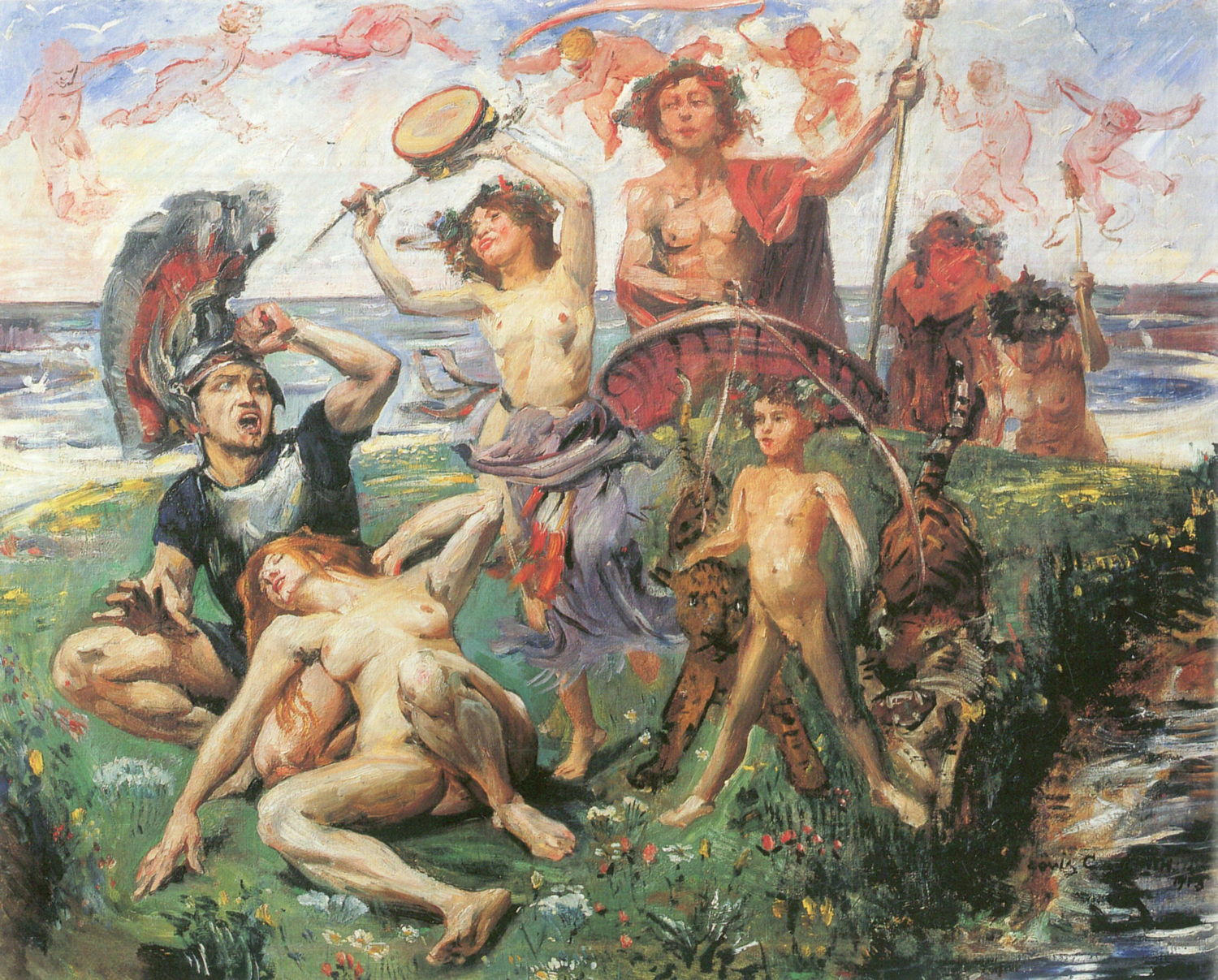
Lovis Corinth (1858–1925) Ariadne on Naxos (1913), oil on canvas, 116 × 147 cm, Private collection. Wikimedia Commons.
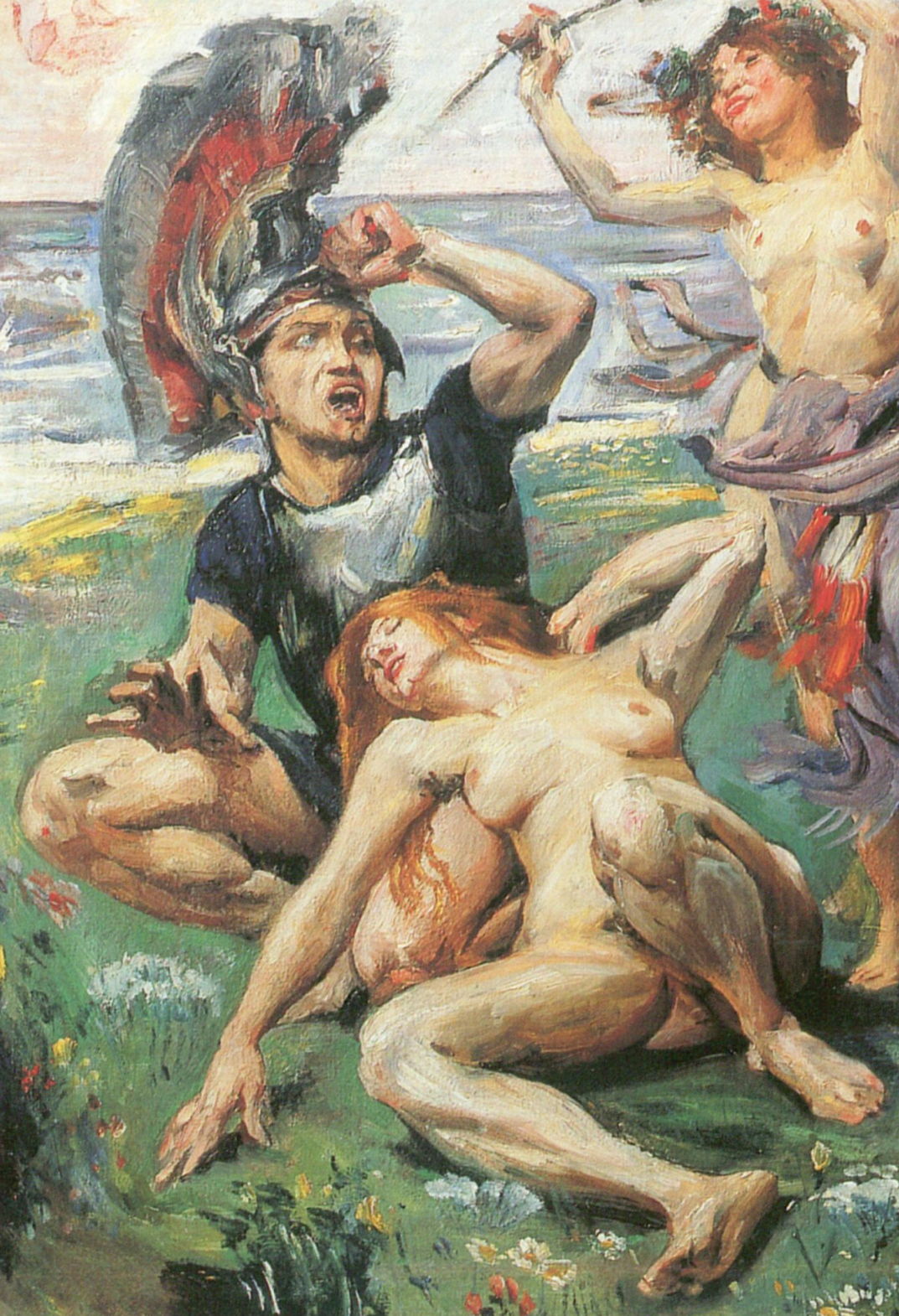
Lovis Corinth’s Ariadne on Naxos (1913) is one of his most sophisticated and masterly mythical paintings, inspired by the first version of Richard Strauss’s opera Ariadne auf Naxos (1912). The left third of the painting (detail below) shows Ariadne lying in erotic langour on Theseus’ left thigh. He wears an exuberant helmet, and appears to be shouting angrily and anxiously towards the other figures to the right.
Lovis Corinth (1858–1925) Ariadne on Naxos (detail) (1913), oil on canvas, 116 × 147 cm, Private collection. Wikimedia Commons.
Having called in briefly at Delos, Theseus and his ship returned to Athens. But in their delight and celebration, they forgot to hoist the white sail to indicate the success of their mission. Seeing their ship with its black sail still set, Theseus’ father King Aegeus threw himself from a cliff in despair, and died.
Theseus’ return to Athens thus brought an odd mixture of celebration at his success, and lamentation at the death of his father. Their ship was carefully preserved as a monument to Theseus’ accomplishment, and he set about transforming and growing the city by settling all the citizens of Attica in it. He promised government without a king, by means of democracy, making himself its commander in war and the guardian of its laws. He also had its currency struck into coins, and instituted the Isthmian (Olympic) Games.
Back on the island of Naxos, Ariadne went on to marry Dionysus, the couple had many children, and lived happily ever after.
Nonprofit groups have applauded an investigation on trade in goods made with forced labor but say that the Trump administration should go further to enforce its own laws

 Login
Login