
Normal view

There are new articles available, click to refresh the page.
Yesterday — 31 March 2026Main stream

Medium and Message: Paint to print

By: hoakley
31 March 2026 at 19:30

Over the many centuries before photography, the only way that most folk, including artists, could see paintings was by looking at prints or copies made of the originals. This was recognised early by some including Albrecht Dürer, who made woodcuts and engravings to reach a wider public, and some specialised in painting works that would generate additional income from their prints. Among those are some whose skills included both forms of visual art, including William Hogarth, William Frith, Gustave Doré, and later Mary Cassatt and Nikolai Astrup. This article looks at a few examples of their paintings that were turned into prints.

A largely self-taught painter, Hogarth entered the world of art as a copperplate engraver in 1720. He aspired to greater things, and became a pupil at an academy run by Thornhill in London, even marrying Thornhill’s daughter in 1729. His works in oil were usually strongly narrative, showing moments of climax and sometimes peripeteia in theatrical productions or everyday life in London. Many included social commentary, wit, and some overtly caricatured society. One of his reasons for painting was to provide a supply of original images for engraving, and all his series paintings were seen, from a commercial view at least, as a means to producing lucrative series of prints.

Following his successful narrative series of prints Industry and Idleness, Hogarth moralised again over one of his favourite issues: cruelty to animals. Victorian society was even harsher in its attitudes towards animals than it was towards the ‘lower classes’ of humans, and Hogarth saw the two as being linked.

As with Industry and Idleness, Hogarth wanted to reach the hearts of the ordinary people, and to make his prints as affordable as possible. He admitted to simplifying his drawings in order to put his points across as clearly and accessibly as possible. He stated that “neither minute accuracy of design, nor fine engraving, were deemed necessary”. In a further effort to cut costs, he commissioned them to be turned into woodcuts rather than engraved, but in the end only two of the plates were completed in wood, and Hogarth himself created conventional engravings.

hogarthcruelty1a
William Hogarth (1697–1764), The First Stage of Cruelty (sketch) (c 1750), graphite and red chalk on medium, slightly textured, cream laid paper, 39.4 x 33.3 cm, Yale Center for British Art, New Haven, CT (Paul Mellon Collection). Courtesy of Yale Center for British Art.

This early sketch in pencil and red chalk gives a good idea of his initial concept for the first in this series.

hogarthcruelty1b
William Hogarth (1697–1764), The First Stage of Cruelty (1751), red chalk on paper (monochrome image), 35.8 x 30 cm, Pierpont Morgan Library, New York, NY. Scanned from Ayrton & Denvir (1948).

That was progressed to a final drawing in red chalk (above) to be turned into the line engraving below, shown mirrored so that it matches the drawings.

hogarthcruelty1c
William Hogarth (1697–1764), The First Stage of Cruelty: Children Torturing Animals (mirrored) (1751), line engraving on thick, white, smooth wove paper, 35.6 x 29.8 cm, Yale Center for British Art, New Haven, CT (Gift of Patricia Cornwell). Courtesy of Yale Center for British Art.
hogarthcruelty1d
William Hogarth (1697–1764), The First Stage of Cruelty: Children Torturing Animals (1751), line engraving on thick, white, smooth wove paper, 35.6 x 29.8 cm, Yale Center for British Art, New Haven, CT (Gift of Patricia Cornwell). Courtesy of Yale Center for British Art.

This is the same print as seen by the viewer. Hogarth’s schoolboy Tom Nero is seen, together with many of his peers, in a street in the slum district of St Giles in London. He’s shown in a ragged white coat just below the centre of the image, inserting an arrow into a dog which is plainly in agony. The dog’s owner pleads for mercy, offering Tom a pie, but others help hold the dog for Tom. Just to his left, someone has drawn a hanged man with Tom’s name below, a grim prediction of what is to come.

All around there are vicious acts of cruelty taking place to animals. A cat and dog are fighting, cockfighting is in progress, another dog has a bone tied to its tail, two boys are burning a bird’s eyes out, two cats are suspended by their tails from a vintner’s sign, and a cat has been thrown out of a high window with balloons attached to it.

For some of his series, Hogarth worked up a set of full oil paintings in addition to prints. My example is taken from A Rake’s Progress, painted between 1732-5, the successful successor to his A Harlot’s Progress.

hogarthrake2
William Hogarth (1697–1764), A Rake’s Progress: Surrounded by Artists and Professors (1732-5), oil on canvas, 62.5 × 75 cm, Sir John Soane’s Museum, London. Wikimedia Commons.

In Hogarth’s oil painting, Tom sets out to make a new man of himself with the aid of many tutors and hangers-on. The composer Handel plays the harpsichord, then there is a fencing master, a quarterstaff instructor, a dancing master with violin, Charles Bridgeman, a famous landscape gardener, Tom himself, an ex-soldier acting as bodyguard, a bugler from a foxhunt, and a jockey. In the background are others who are busy spending Tom’s inheritance on worthy causes no doubt.
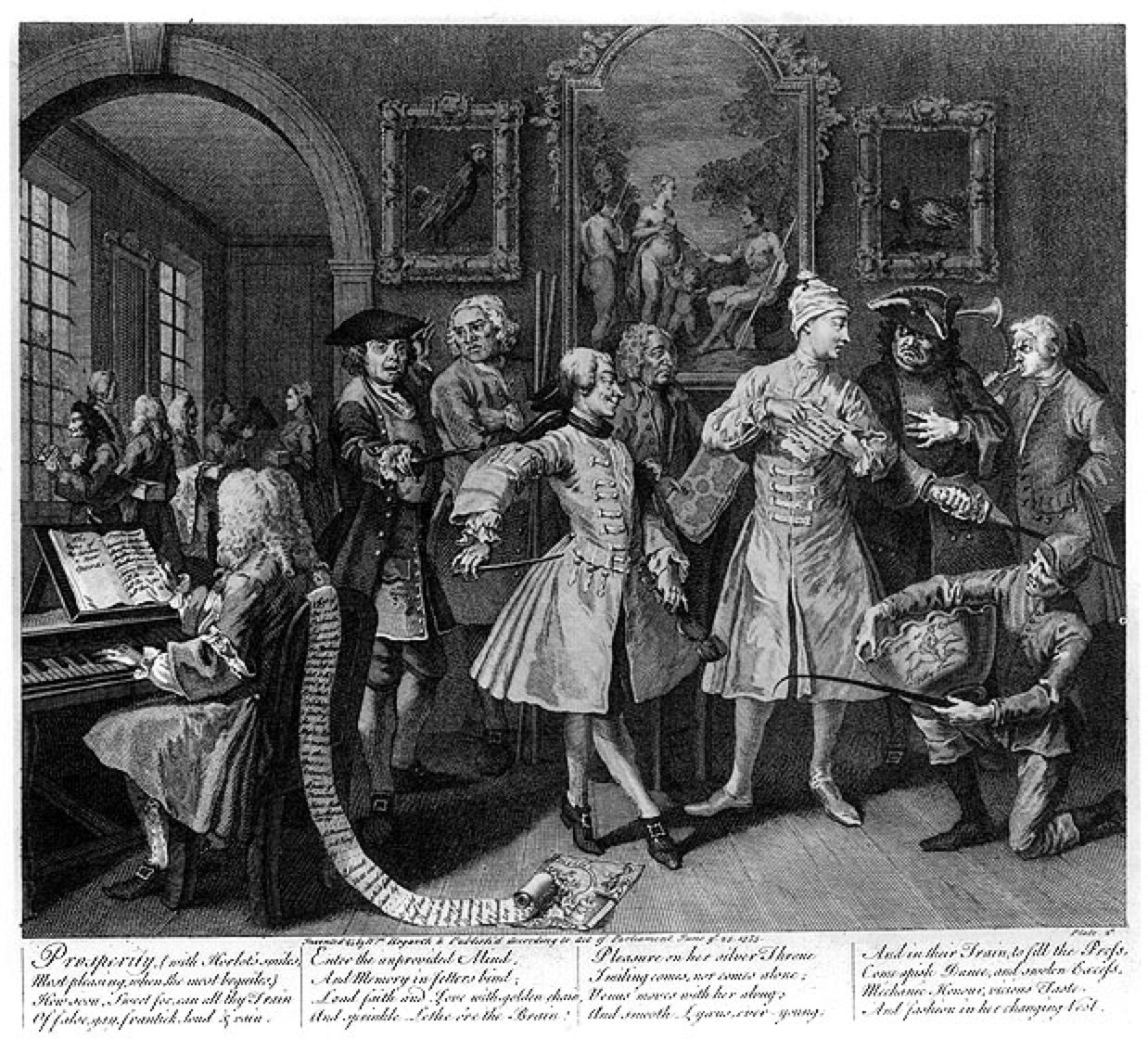
William Hogarth (1697–1764), A Rake’s Progress, Plate 2: Surrounded by Artists and Professors (1735), engraving, 35.5 × 41 cm, further details not known. Wikimedia Commons.

The print is different in many respects, as if the artist forked the painting and print from a late sketch. Details on the music being played at the left are different, and there’s a long scroll running down from the back of the chair in the print. Some of the facial expressions are altered and exaggerated in the print. Details, including those of clothing and frames of the paintings on the wall, also differ.

Artists like Edgar Degas and his protégé Mary Cassatt made prints for different reasons.
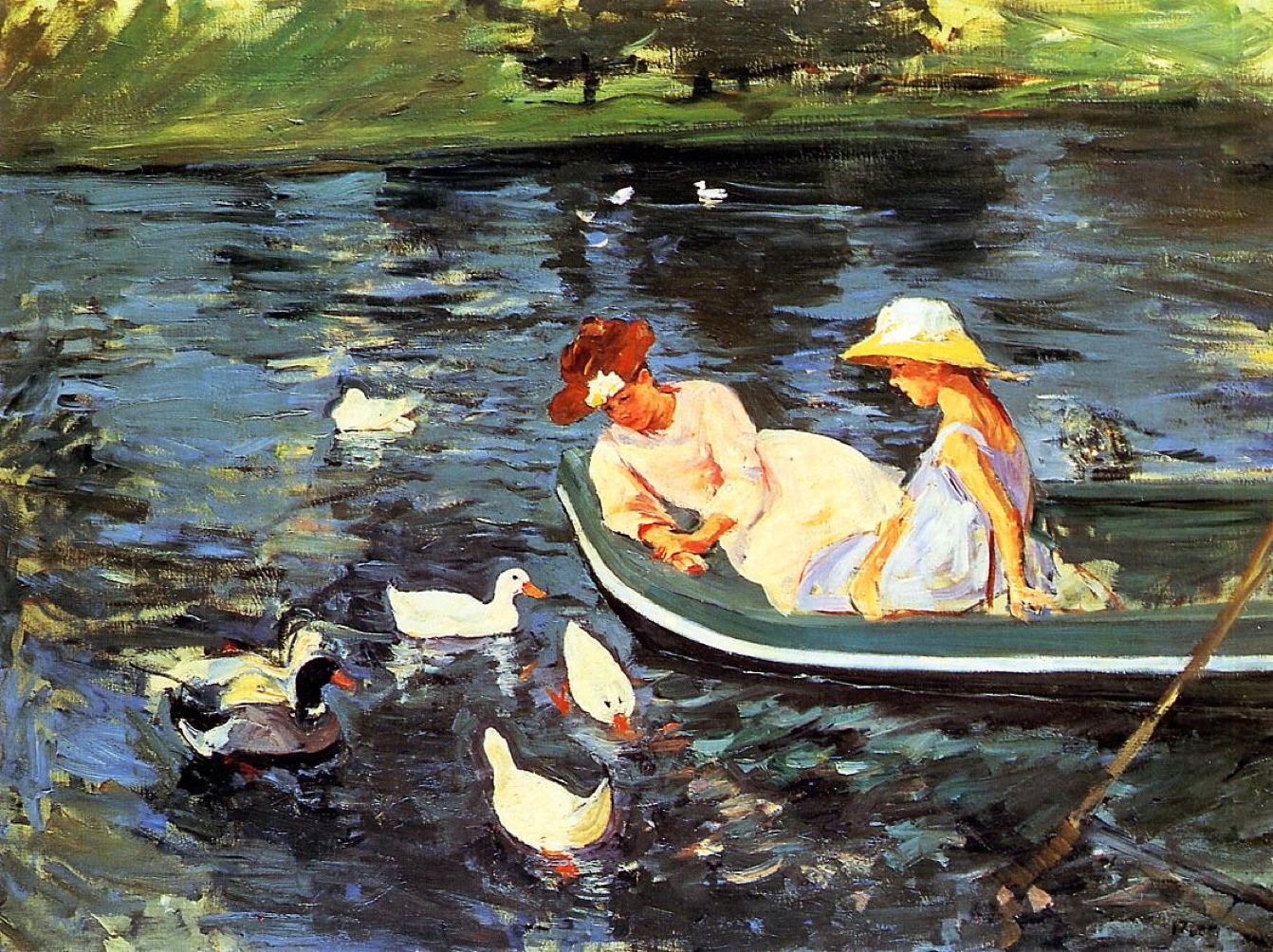
cassattsummertime
Mary Cassatt (1844–1926), Summertime (1894), oil on canvas, 73.6 x 96.5 cm, Armand Hammer Museum of Art, Los Angeles, CA. The Athenaeum.

Towards the end of the nineteenth century, Cassatt made this very loose painting of a mother and daughter feeding ducks from a boat in Summertime (1894). I believe this was the source for the sophisticated print, called more appropriately Feeding the Ducks (c 1894), below.
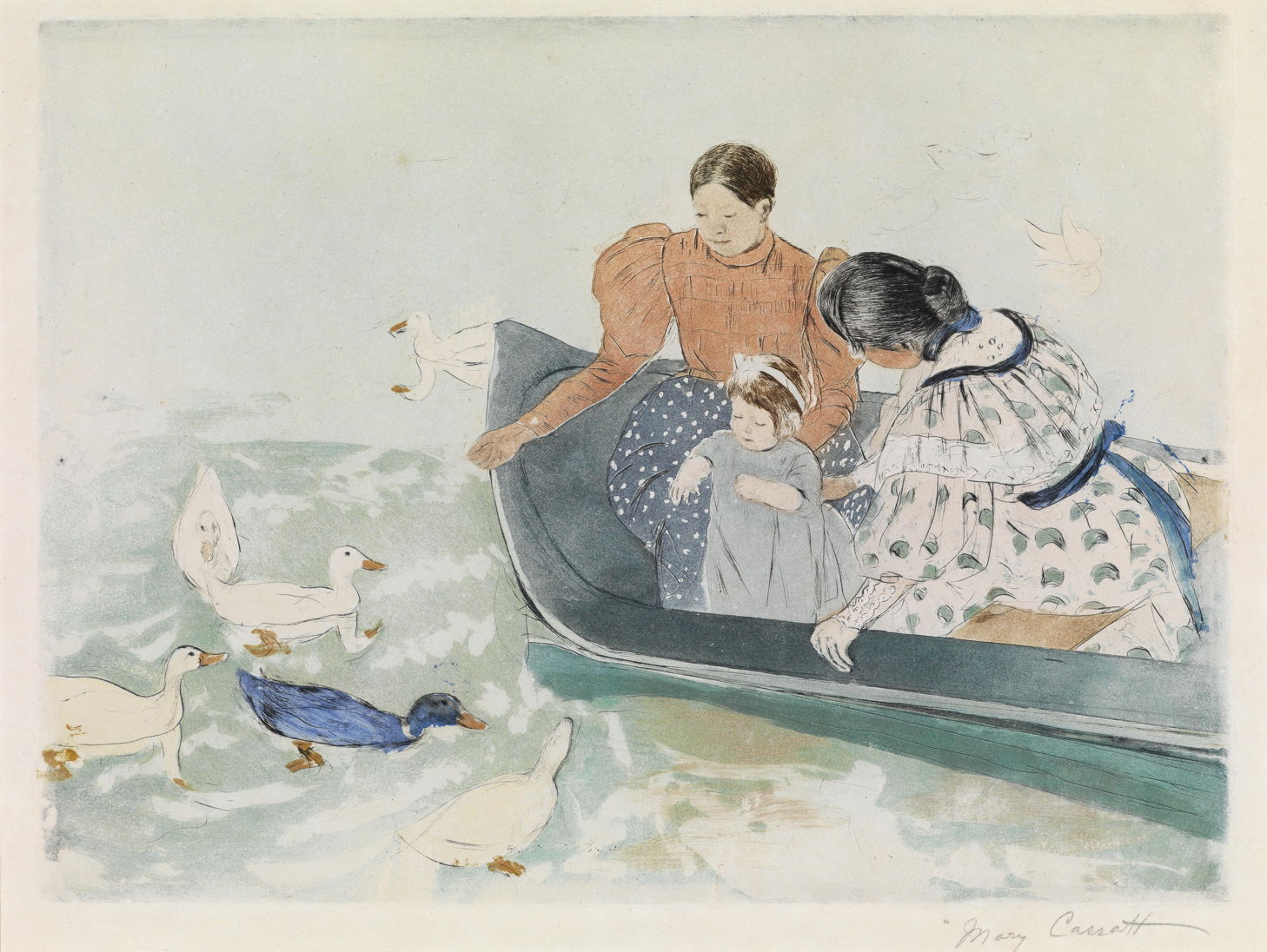
cassattfeedingducks
Mary Cassatt (1844–1926), Feeding the Ducks (c 1894), drypoint and aquatint with monotype on handmade paper, 29.5 x 39.5 cm, location not known. Wikimedia Commons.

For this she combined her mature drypoint technique with aquatint, to which she added monotype. In monotype, the artist lays down an image on a plate using printing inks, then makes a single impression of that on the paper. This demands meticulous technique, and usually results in one completed print for each image made in ink. Although second prints can sometimes be made, they’re usually of low quality.

The Norwegian artist Nikolai Astrup was a prolific painter and printmaker, whose paintings informed his prints, and prints informed his paintings.
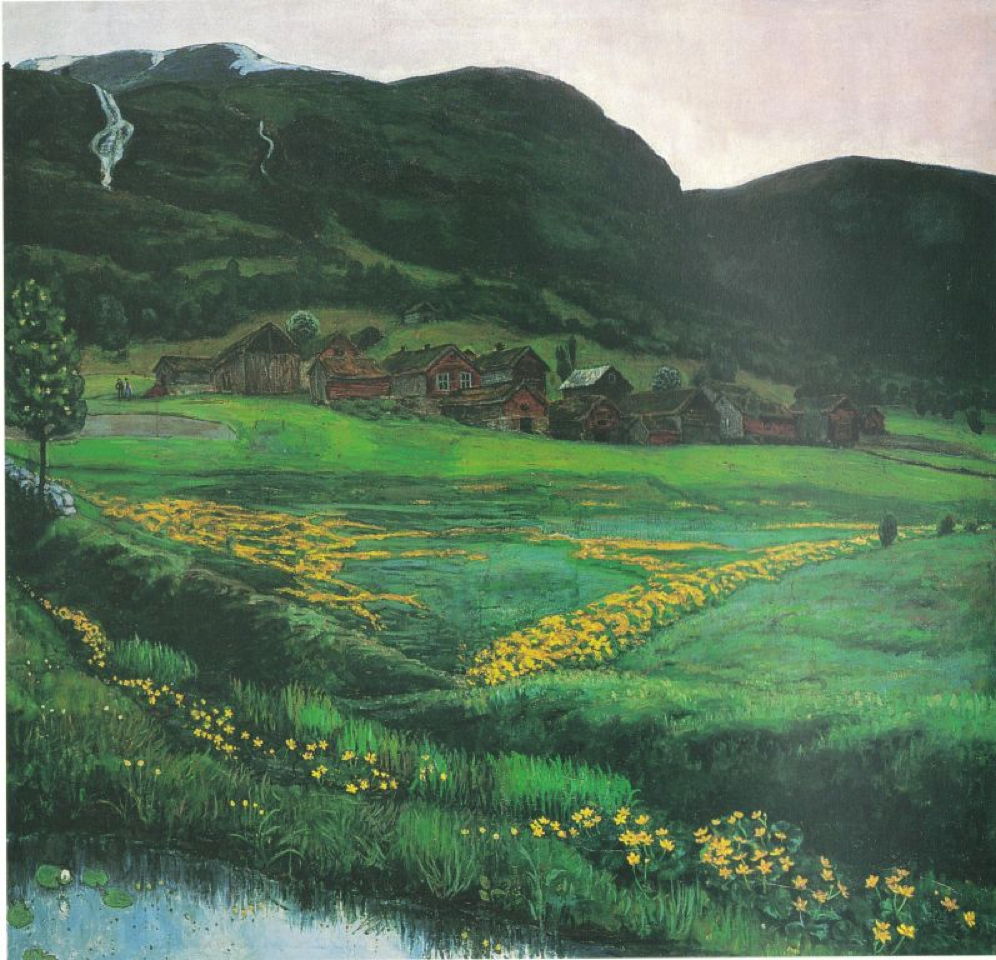
astrupclearjunenight
Nikolai Astrup (1880–1928), A Clear Night in June (1905-07), oil on canvas, 148 x 152 cm, Bergen Kunstmuseum, KODE, Bergen, Norway. Wikimedia Commons.

A Clear Night in June (1905-07), above, and A June Night and Old Jølster Farm (before 1911), below, are two of more than a dozen paintings Astrup made of this farm after about 1902. These were painted early each summer, when in some years there were still the remains of the winter’s snow on the rugged hills behind. The waterfalls cascading down the scarps are still in spate from the melting snow.

Astrup painted this view when the blossom was on the trees, and the meadows were a patchwork of yellow with the first of the summer flowers. Comparing these two paintings reveals a few differences in detail, such as the low fence in the foreground in the lower painting which is omitted in the upper, but by and large Astrup seems to have been consistent, suggesting his paintings were true to nature.

astrupjunenightoldjolsterfarm
Nikolai Astrup (1880–1928), A June Night and Old Jølster Farm (before 1911), oil on canvas, 88 x 105 cm, Private collection. The Athenaeum.
astrupmarshmarigoldsnight
Nikolai Astrup (1880–1928), Marsh Marigold Night (c 1915), colour woodcut on paper, 40.7 x 47 cm, Bergen Kunstmuseum, KODE, Bergen, Norway. Wikimedia Commons.

A few years later, he turned those into prints such as this Marsh Marigold Night (c 1915). By this time his printmaking technique had come a long way, and many of his later prints were extremely painterly, to the point where it can be difficult to distinguish his woodcuts from their painted originals.

Reference

Ayrton M & Denvir B (1948) Hogarth’s Drawings, London Life in the 18th Century, Avalon Press. No ISBN. [This has been my source for images of many of the scans above. The book bears no information about copyright, the press has long since vanished as far as I can tell, and I assume ‘fair use’ of these orphaned images. If you know any different, please contact me.]

Before yesterdayMain stream

Medium and Message: Monotypes

By: hoakley
27 January 2026 at 20:30

Many notable painters have also made their own prints, and the two arts have informed one another. We’ve seen this most recently in the paintings of Félix Vallotton, where his late works have become simplified in the way that’s often used when making successful prints. A few artists have gone one step further and produced images that combine both techniques, where their work consists of a painted print.

Most forms of printmaking involve the production of a plate of metal or wood in which cuts or marks are made. The surface is then covered in printing ink, and the paper (or other medium) is then pressed against that to transfer patterns of ink onto it. Monotypes are different in that the plate remains intact, and the image to be printed is formed on its surface before making a single impression from it. As with most types of printmaking, there are many variations.

In 1794, William Blake had perfected his colour illuminated printing process, in publishing a series of illuminated books, and the following year he used it to produce a limited run of twelve large colour paintings. These formed the first major collection of paintings he offered for sale: one mark of the importance that he accorded them was his use of the term fresco to describe their medium.

In fact, they weren’t made using a technique that resembled fresco painting at all. Although there remains some debate as to exactly what he did, the process was probably:

  1. Develop the work using sketches, etc., until a design was ready to print. In some cases, these large prints were derived from earlier work, in others he made fresh sketches.
  2. Draw the finished work onto a sheet of thick millboard, ready to colour.
  3. Produce a wet watercolour, using pigment, binder, and a honey additive, on the millboard.
  4. Print approximately three copies from the millboard ‘plate’.
  5. Touch up each print by hand using pen and ink and watercolour to produce the finished painting.

Although it’s possible he may have used oil-based inks or paints on some, Blake’s lifelong aversion to the use of oil paints suggests that he used water-based media throughout, and analyses support that. These ‘large prints’ (also known as his Lambeth Prints, as that is where they were made) are therefore watercolour monotypes then individually retouched and painted further. Given the variation between the different ‘pulls’ or impressions made of each, they are less prints and more print-based paintings.

Neither were they illustrations in the way that the images within his illuminated books may be. They were supplied as individual sheets for mounting and framing as paintings. We don’t know whether Blake intended them to be viewed in pairs, groups, or as a complete set of twelve, and there’s uncertainty as to his own title for several. Indeed, some of them appear to have been mistitled following Blake’s death, and that has led to confusion as to what they actually depict.

blakesatanexultingovereve
William Blake (1757–1827), Satan Exulting over Eve (c 1795), graphite, pen and black ink, and watercolour over colour print, 42 x 53 cm, J. Paul Getty Museum, Los Angeles, CA. The Athenaeum.

Satan Exulting over Eve (c 1795) is thought to be the first impression of this work, with roots in the story of the Fall in Genesis, and in Milton’s Paradise Lost. In book 5 (lines 28-92), Milton writes a more detailed account of the Fall, in which Eve has a dream of Satan giving her the fateful apple, sweeping her up into the cloud before she sinks down and falls asleep. Blake shows Satan flying low over the sleeping body of Eve; he carries a shield and spear. The serpent has already coiled itself around Eve’s legs and body, and there is an apple by her right hand.

Newton 1795-c. 1805 by William Blake 1757-1827
William Blake (1757–1827), Newton (1795–c 1805), colour print, ink and watercolour on paper, 46 x 60 cm, The Tate Gallery (Presented by W. Graham Robertson 1939), London. © The Tate Gallery and Photographic Rights © Tate (2016), CC-BY-NC-ND 3.0 (Unported), http://www.tate.org.uk/art/artworks/blake-newton-n05058

Newton (1795–c 1805), another first impression, is one of Blake’s most famous images. It shows the brilliant mathematician and physicist completely absorbed in a geometrical problem, oblivious to the wondrous rock on which he sits. Its standard interpretation is that Newton’s scientific rationalism was inadequate without imagination and the creativity of the artist, a surprisingly negative view of the man who is still considered a towering genius.

The Night of Enitharmon's Joy (formerly called 'Hecate') c.1795 by William Blake 1757-1827
William Blake (1757–1827), The Night of Enitharmon’s Joy (formerly called ‘Hecate’) (c 1795), colour print, ink, tempera and watercolour on paper, 43.9 x 58.1 cm, The Tate Gallery (Presented by W. Graham Robertson 1939), London. © The Tate Gallery and Photographic Rights © Tate (2016), CC-BY-NC-ND 3.0 (Unported), http://www.tate.org.uk/art/artworks/blake-the-night-of-enitharmons-joy-formerly-called-hecate-n05056

The Night of Enitharmon’s Joy (c 1795) has proved the most enigmatic of all the dozen paintings to read. For a long time, it was believed to show Hecate, as proposed by Dante Gabriel Rossetti. It’s more likely that the woman seen at the front of the figures is from Blake’s own mythology, Enitharmon: partner, twin, and inspiration to Los (and mother of Orc). She represents spiritual beauty, and was modelled on Blake’s wife, Catherine (who may have been the model for her figure here too). In her ‘night of joy’, she establishes her Woman’s World, with a false religion of chastity and vengeance – which was Blake’s view of the 1800 year history of the ‘official’ Christian church.

R-20100127-0019.jpg
William Blake (1757–1827), Christ Appearing to His Disciples After the Resurrection (c 1795), color print (monotype), hand-colored with watercolor and tempera, 43.2 x 57.5 cm, The National Gallery of Art (Rosenwald Collection), Washington, DC. Courtesy of The National Gallery of Art.

Blake’s Christ Appearing to His Disciples/Apostles After the Resurrection refers to the gospel of Luke, chapter 24 verses 36-40:
And as they thus spake, Jesus himself stood in the midst of them, and saith unto them, “Peace be unto you.” But they were terrified and affrighted, and supposed that they had seen a spirit. And he said unto them, “Why are ye troubled? and why do thoughts arise in your hearts? Behold my hands and my feet, that it is I myself: handle me, and see; for a spirit hath not flesh and bones, as ye see me have.” And when he had thus spoken, he shewed them his hands and his feet.

Edgar Degas’ monotypes are thought to have been more conventional, made on a lightweight aluminium sheet using oil-based printing ink, then extensively retouched and painted, often using soft pastels.

degasintimacy
Edgar Degas (1834–1917), Intimacy (c 1877), monotype, 30.2 × 40.9 cm, Statens Museum for Kunst (Den Kongelige Malerisamling), Copenhagen, Denmark. Wikimedia Commons.

During the late 1870s, Degas devoted series of monotypes to women’s ‘toilet’ preparations, of which Intimacy from about 1877 is an example. He appears to have been fascinated at the craft and care used to prepare a woman for public viewing, something a single man who had no known amorous relationships would find quite strange. This print appears to have undergone retouching and modification, but hasn’t been painted using pigment or colours.

degasballetatparisopera
Edgar Degas (1834–1917), Ballet at the Paris Opéra (1877), pastel over monotype on cream laid paper, 35.2 x 70.6 cm, Art Institute of Chicago, Chicago, IL. Wikimedia Commons.

The same year Degas applied soft pastel to the print, in the Ballet at the Paris Opéra (1877), which more closely resembles a true painting.

degaswomandryingherselfafterbath
Edgar Degas (1834–1917), Woman Drying Herself after the Bath (c 1885, or 1876-77), pastel over monotype, 43 × 58 cm, Norton Simon Museum, Pasadena, CA. Wikimedia Commons.

Also dating from 1876-77 is his Woman Drying Herself after the Bath, one his first works showing a woman bathing. It’s also one of the few in this series setting the woman in a broader context, here a plain and simple bedroom with a single bed. The woman, wearing only bright red ‘mule’ slippers, stands just behind the shallow metal tub, watching herself in the mirror of her dressing table, as she dries her body with a towel. On its shelf is a small range of cosmetics, with the mandatory mirror behind. This too is the result of applying pastels to a monotype.

degaslandscapemet
Edgar Degas (1834–1917), Landscape (1892), monotype in oil colours, heightened with pastel, 25.4 x 34 cm, Metropolitan Museum of Art, New York, NY. Wikimedia Commons.

Degas’ late landscapes are based on the same combination of media, as shown in his Landscape above, and Wheat Field and Green Hill below, both from the early 1890s.

degaswheatfield
Edgar Degas (1834–1917), Wheat Field and Green Hill (c 1890-92), pastel over monotype in oil colours on paper, dimensions not known, Norton Simon Museum, Pasadena, CA. Wikimedia Commons.

The American Impressionist Mary Cassatt learned her printmaking techniques with Degas, so it’s not surprising to see some of her monotypes forming the basis of paintings.

cassattfeedingducks
Mary Cassatt (1844–1926), Feeding the Ducks (c 1894), drypoint and aquatint with monotype on handmade paper, 29.5 x 39.5 cm, location not known. Wikimedia Commons.

For her Feeding the Ducks from about 1894 she combined a mature use of drypoint with aquatint, to which she added monotype using oil-based inks. In drypoint, the plate is scratched to form lines with the raised burrs that result. This was most probably produced by applying a fine acid-resistant powder such as rosin to form the ‘ground’, etching it in acid, then applying drypoint lines before printing using oil-based ink.

These techniques were developed further and became more popular in the twentieth century, in the work of artists such as Marc Chagall from the 1960s.

❌
❌