 Login
Login
Pope Leo’s A.I. Vision Might Not Be Strange Enough
28 May 2026 at 05:39
He is both a critic and a normalizer of artificial intelligence.

Two centuries ago today, on 4 May 1826, Frederic Edwin Church was born in Hartford, CT. As one of the founding American masters, he has a pivotal place in the history of painting in North America, and is one of the great nineteenth century landscape painters. Inspired by Alexander von Humboldt’s account of central America, Church travelled to Columbia and Ecuador in 1853, and returned to depict their ‘physiognomy’ in grand landscape paintings. He went back to central America in 1857 to build on his earlier success.
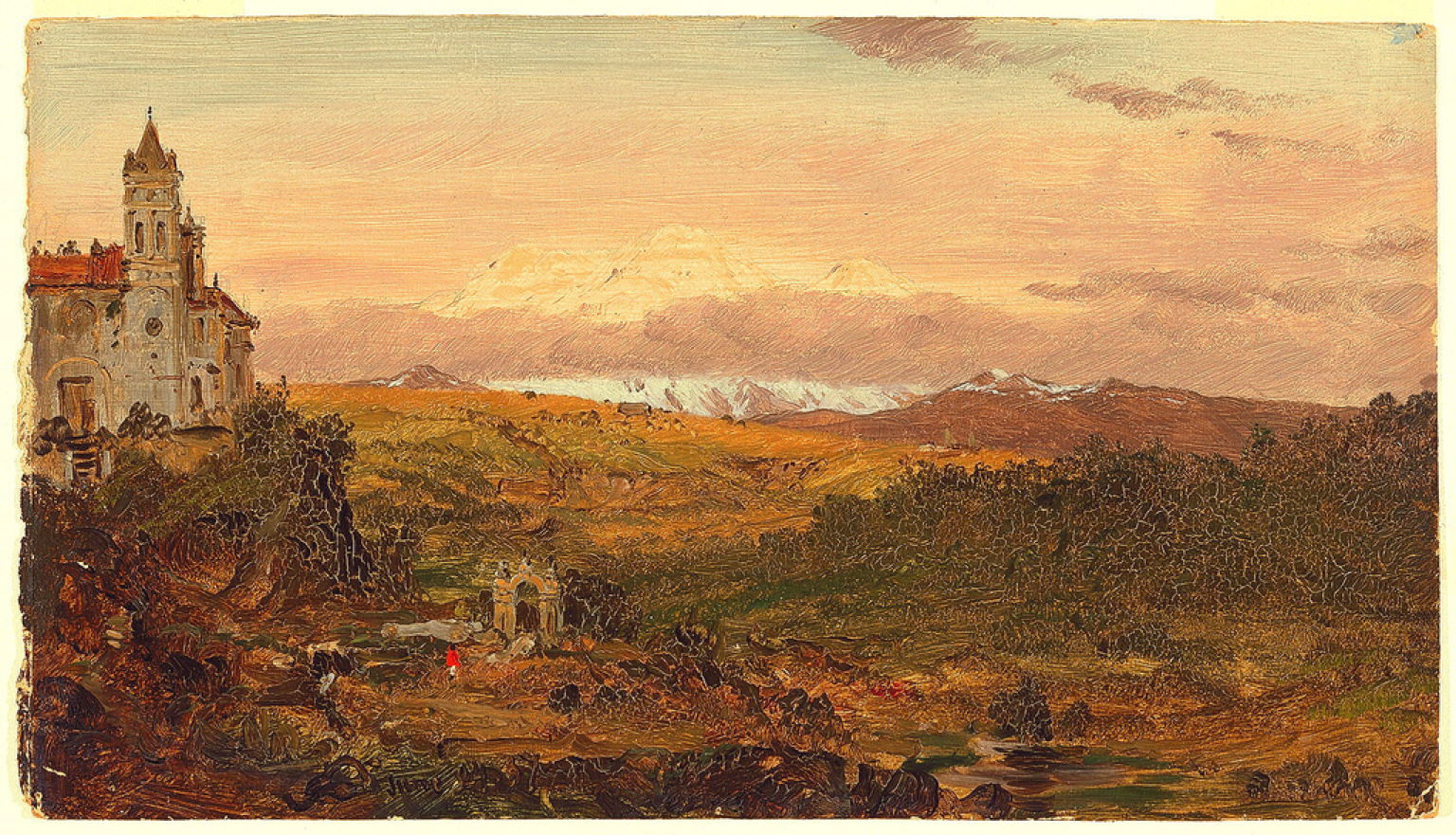
Church painted this oil sketch of the cathedral in Chillo, Ecuador, on 24 June 1857. As with most of his oil sketches, it’s small and made on cardboard, which was cheap and portable but not intended to last the years.
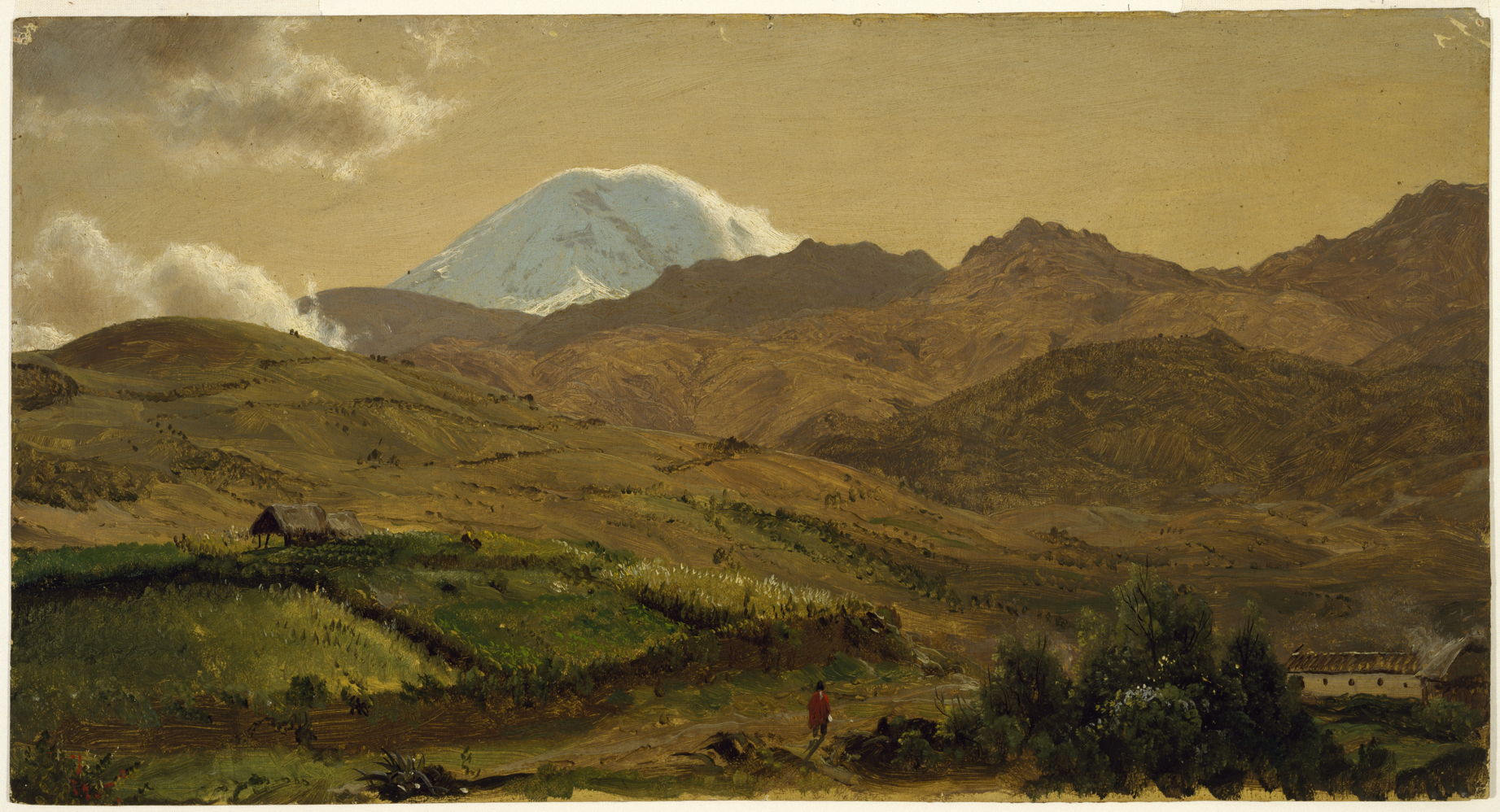
His larger oil sketch of Mount Chimborazo in Ecuador is rich in painstaking detail for a study never intended to be viewed by others. In comparison to his studio works, though, it’s full of fine gestural marks with some quite painterly passages.
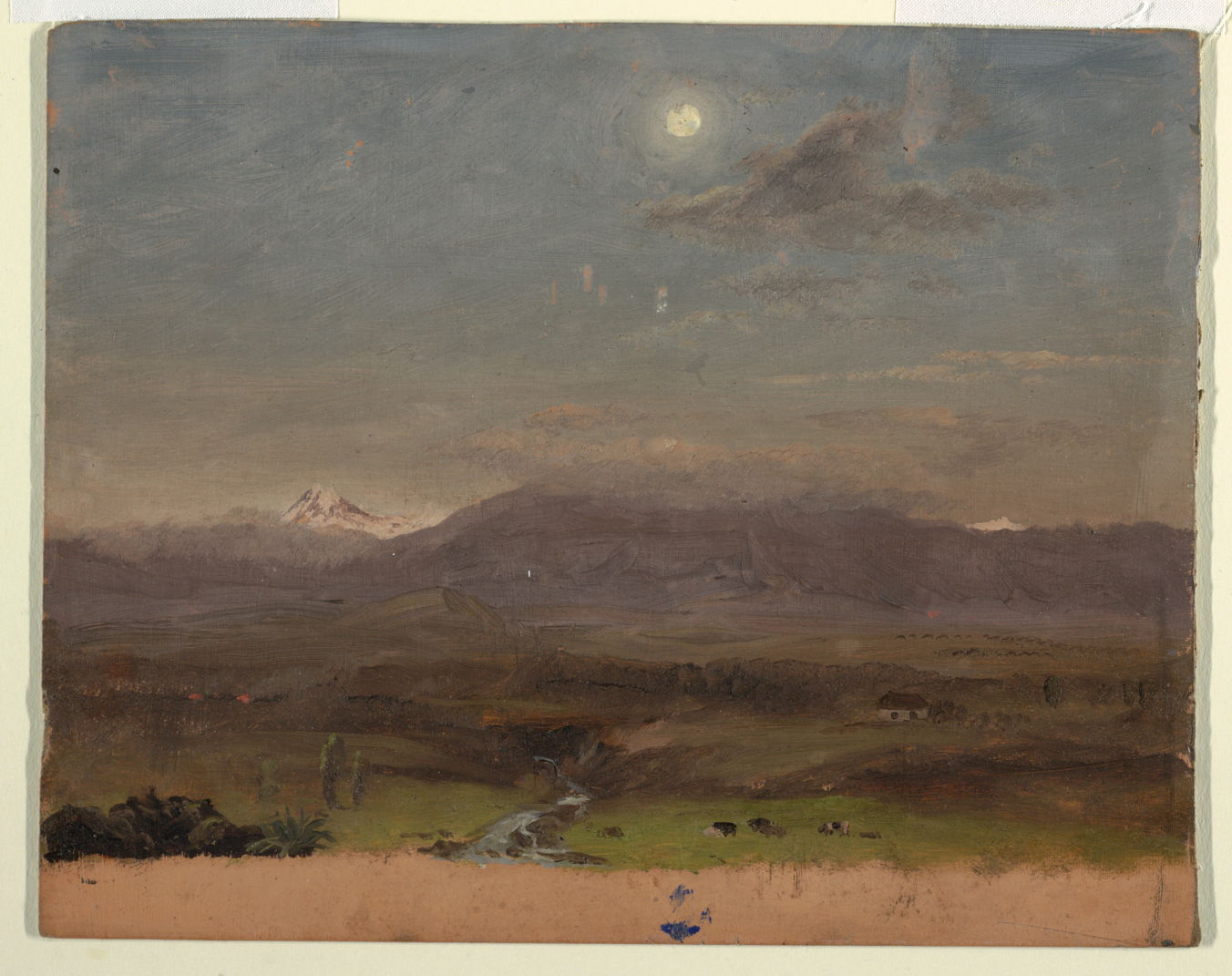
He may have painted this atmospheric view of mountains in the moonlight during either of his visits to Colombia and Ecuador.
On 29 April 1859, the first of more than twelve thousand people walked into the Studio Building on West 10th Street in New York City, to stand in awe and amazement in front of Church’s huge Heart of the Andes (1859). For many, its dramatic view of a densely-vegetated plain with its backdrop of snow-capped mountains wasn’t its most impressive feature: it was the painting’s meticulous, almost overwhelming detail.
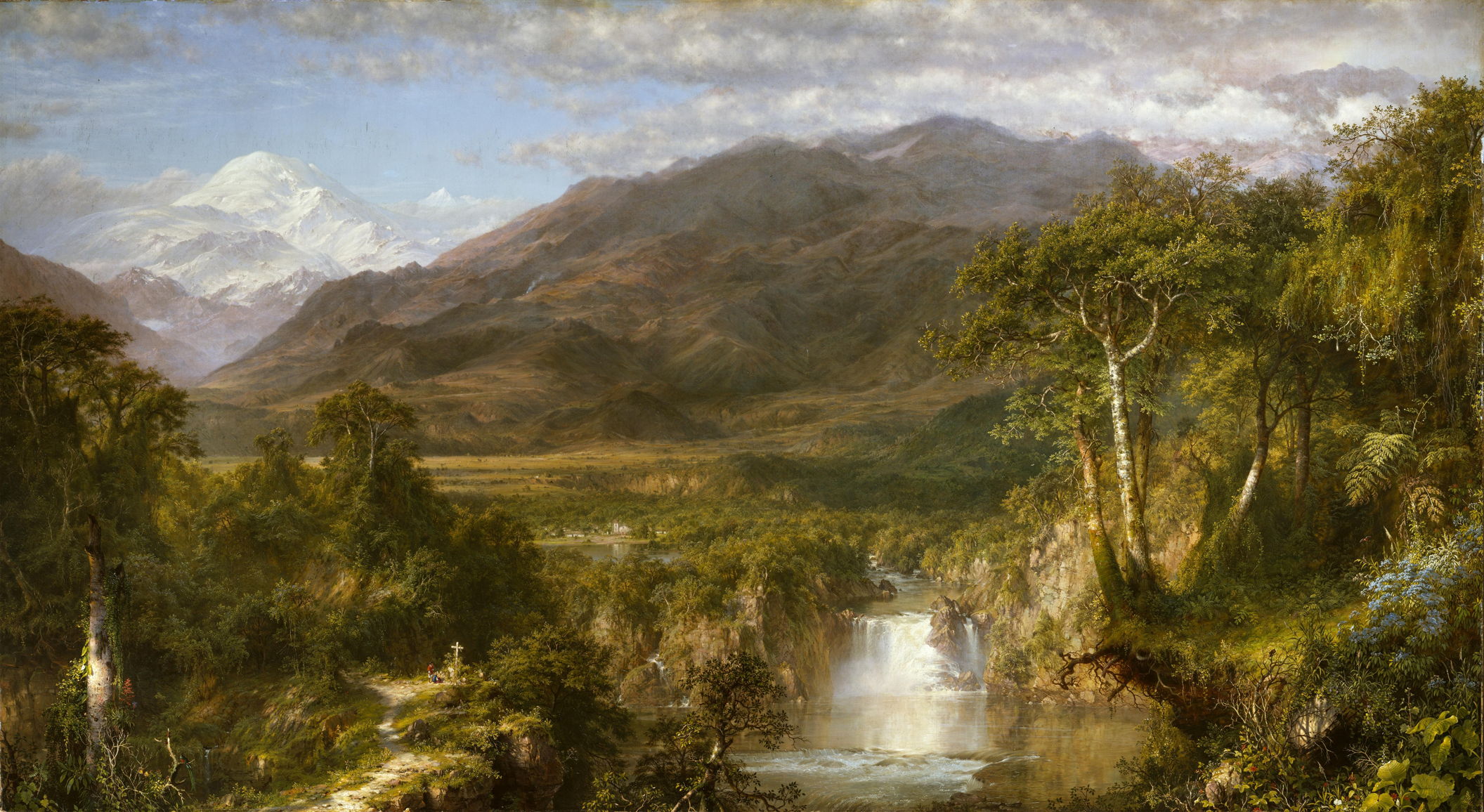
Tucked away among the brightly-coloured birds and rich plant life, at the very heart of The Heart of the Andes, is a cross, with two figures by it. Dressed as locals, one sits, facing the cross, while the other stands just behind the seated figure and looking in the same direction. The cross is made simply of wood, and appears to have been decorated with a floral garland. It’s partly obscured by the luxuriant wayside plants.

Over its five square metres of canvas, these are the only visible humans.
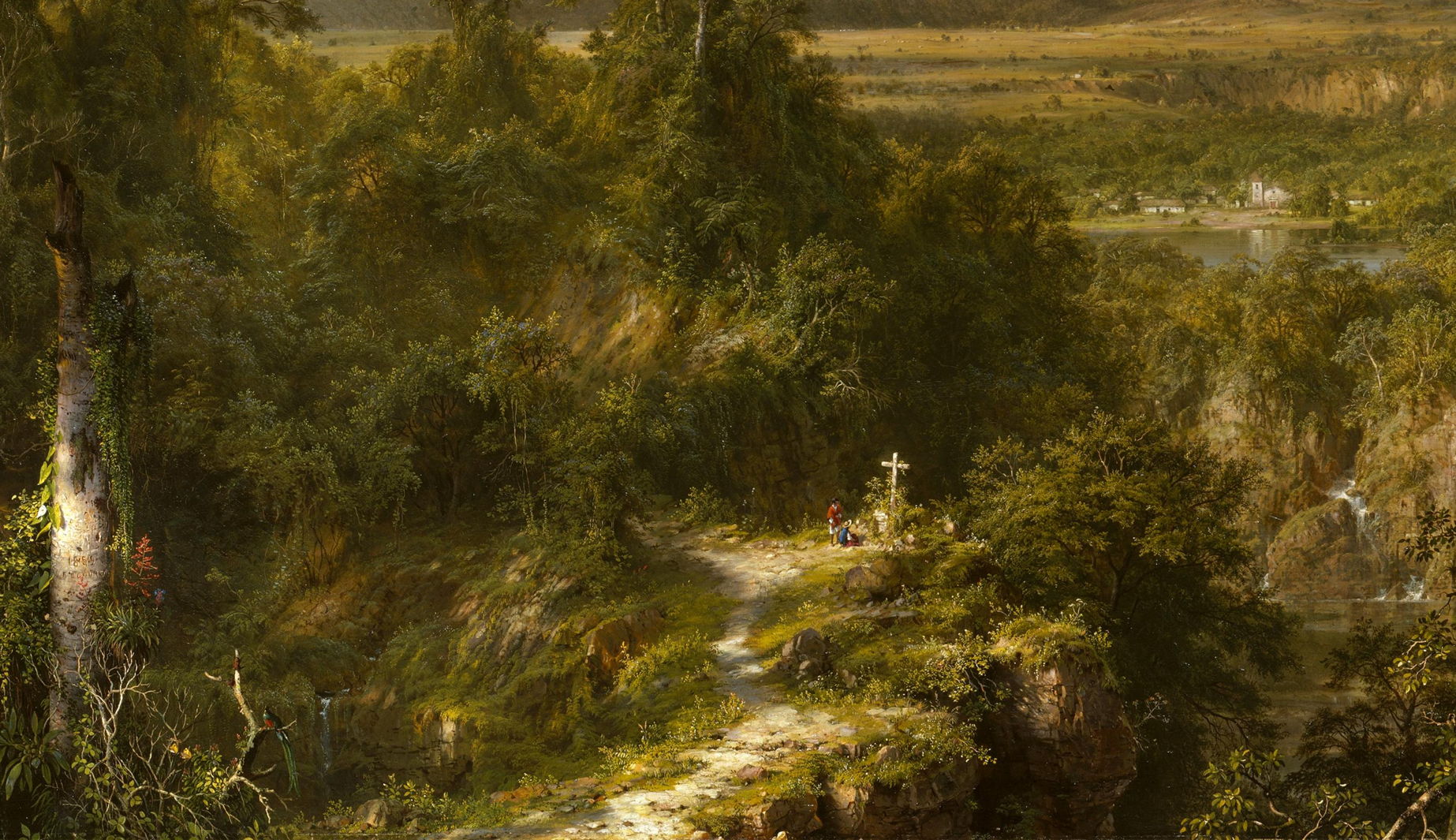
They’re part of a complex passage. The cross stands just off a path winding its way past a dead tree-trunk, seen at the left here, on which the artist has ‘carved’ the year and his name. The path then curves to the left, along the bottom of a small gully, where it disappears into the trees and undergrowth.
On the other side of the river, to the right, is a small mission-like settlement. Facing the viewer is the tower and broad frontage of a church, with its large double wooden doors. Beyond and around is the enormity of nature: open plain with scattered trees, then rising ground to the first hills, and many miles distant the soaring white peaks of the Andes proper.
Viewers were recommended to bring opera glasses in order to see these details through the crowd. Jennifer Raab argues this is a different way of seeing, as demanded by the painting, and it evoked literary responses from the likes of Mark Twain and critics.
Church was friends with Isaac Israel Hayes, a noted Arctic explorer, and once the artist had enjoyed the success of The Heart of the Andes he travelled with another friend, Louis Legrand Noble, to Newfoundland and Labrador to build himself a library of drawings and sketches for his next spectacular painting.
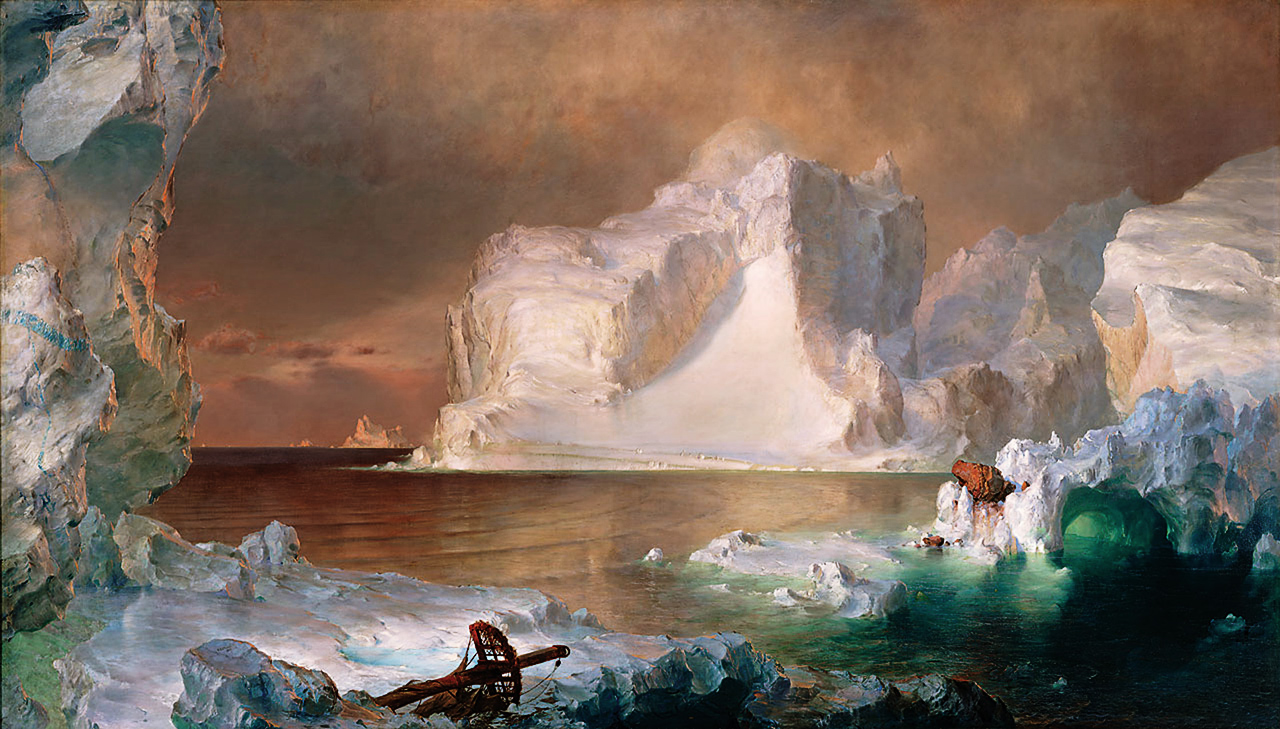
Church’s The Icebergs (1861) was ill-fated, though. Its solo exhibition opened just twelve days after the start of the Civil War. Then titled The North, it lacks the human glimpses and intricate details of nature that made The Heart of the Andes such a success. The broken mast now seen in the foreground was a later addition made by Church in an attempt to improve its popular appeal.
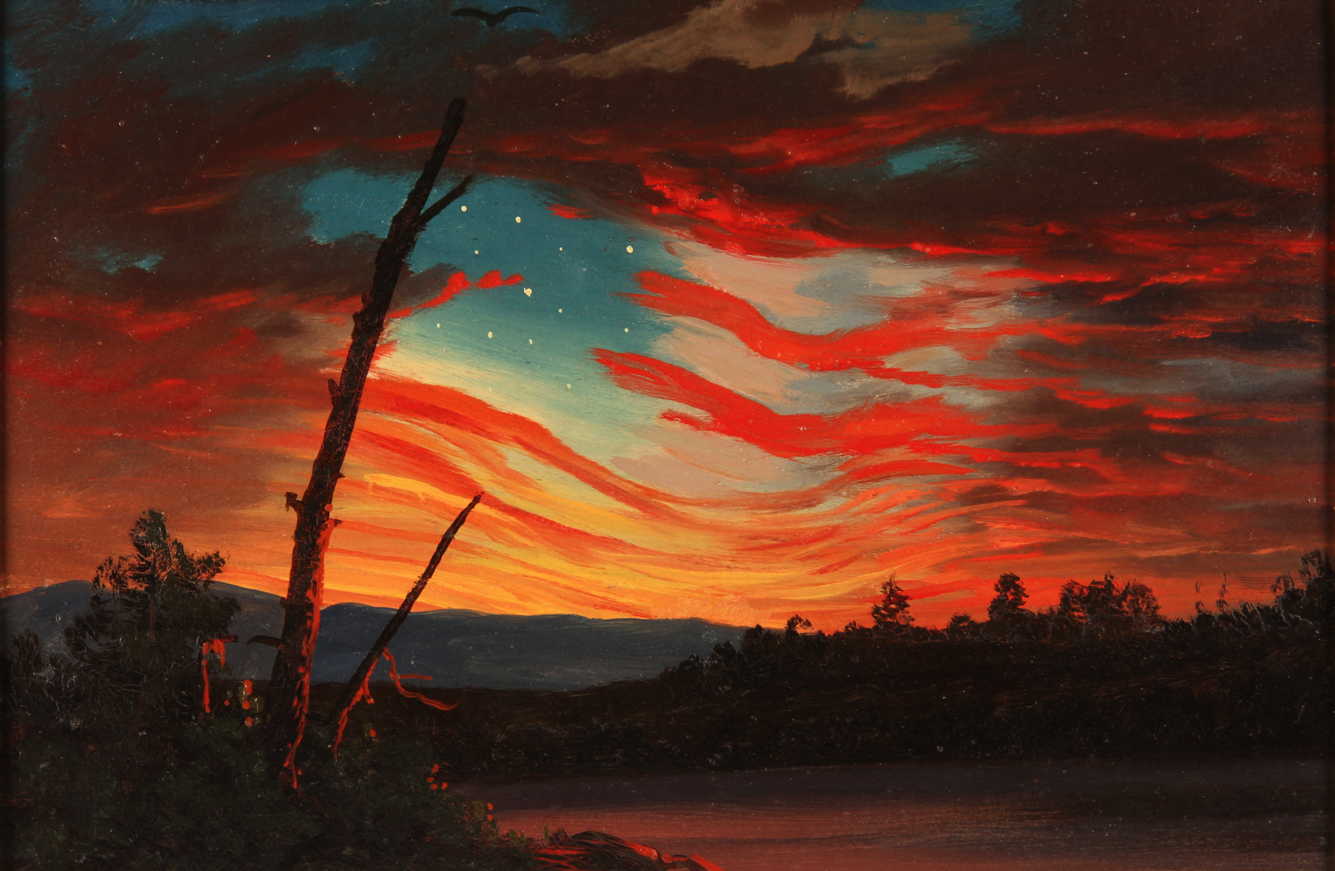
With the Civil War in progress, Church’s more successful response was Our Banner in the Sky (1861), which was turned into a lithograph, with prints being sold to benefit the families of Union soldiers.
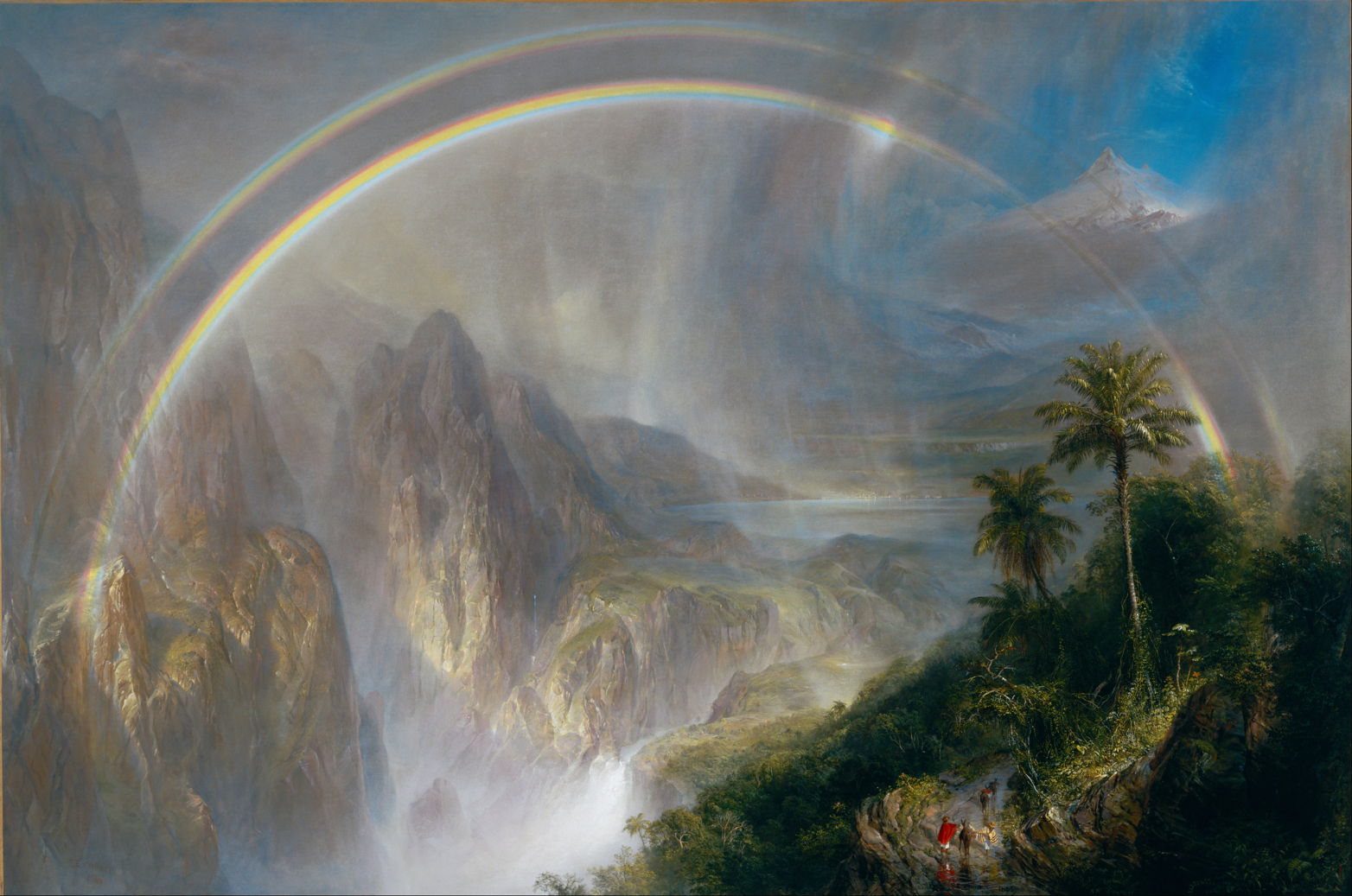
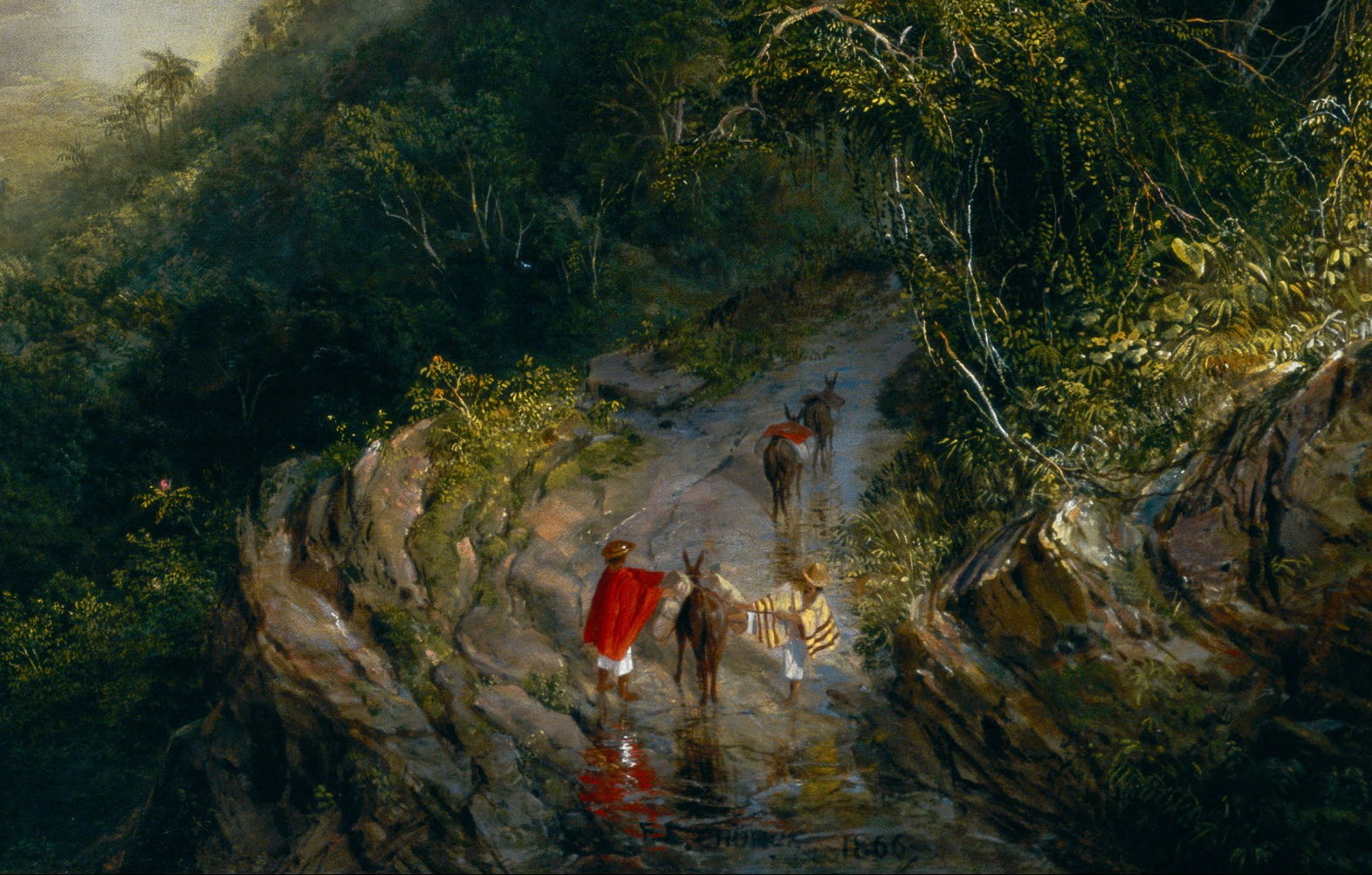
Church continued to paint finished works based on his earlier studies in front of the motif. Rainy Season in the Tropics from 1866 features a faithful depiction of a double rainbow, and again added human interest. Splashing through a rocky stream is a small train of pack animals with two drivers, who have paused for a moment to adjust a load, as shown in the detail below.

Spanning much of the foreground of Church’s Pichincha (1867) is a suspended bridge, one end glowing in the early morning light. Just over half way across, a woman wearing a brilliant red blouse is riding side-saddle on a mule, which is picking its way slowly across the thin logs forming the walkway. At the left end is another mounted figure, who has just completed that terrifying crossing.

Late that year, Church and his family set off on his longest journey, although much of it was undertaken in less arduous conditions than he had experienced in Ecuador. They travelled to Europe, then on to Egypt, Jaffa and to stay in Beirut. In February 1868, Church visited Jerusalem and from there travelled to the city of Petra by camel. In the Spring they returned across the Aegean Sea, and spent the remainder of the year in Rome. They finally returned across the Atlantic in June 1869.

In Church’s studio painting of Jerusalem from the Mount of Olives (1870), the Holy City is reminiscent of John Brett’s Florence from Bellosguardo (1863) in its projection and detail. But Church’s lower vantage point allowed him ample foreground, where there are four people and two camels making their way along the dry, stony track skirting the ancient olive trees and crossing the valley to the city. Although not as brightly lit by the late afternoon sun as the Dome of the Rock in the distance, Church draws attention to the figures in the foreground by silhouetting them against the light on the track.
Church provided a detailed key to the salient features, which was engraved and printed for the edification of the viewer. It was hailed a triumph when first displayed to the public in Goupil’s New York gallery in 1871, and at the end of the century Peter Bergheim made a photo-montage showing the same view.
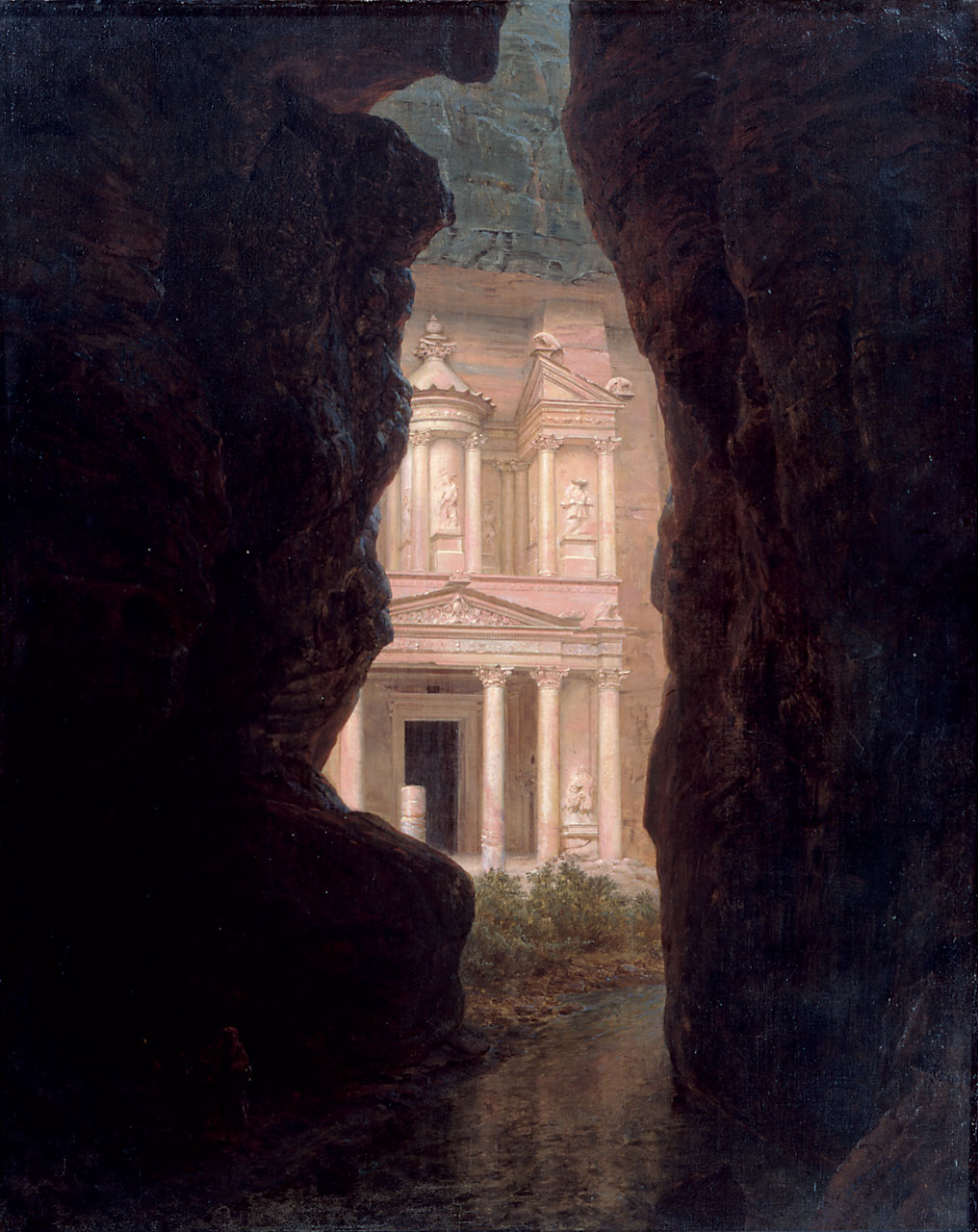
Church’s most famous studio painting of Petra, El Khasné, Petra from 1874, is an oddity in showing an unusual view lacking sky, and frames its strongly vertical format. It’s also short on detail, and what can be discerned from the murky depths of its framing appears mysterious and unresolved.
This painting was featured as the centrepiece of the Church family sitting room in his self-designed estate at Olana. He had started work on the design of his mansion there in 1870, engaging Calvert Vaux, co-designer of New York’s Central Park, to assist. They assembled a pastiche of forms and styles into what Church termed a “Feudal Castle”.
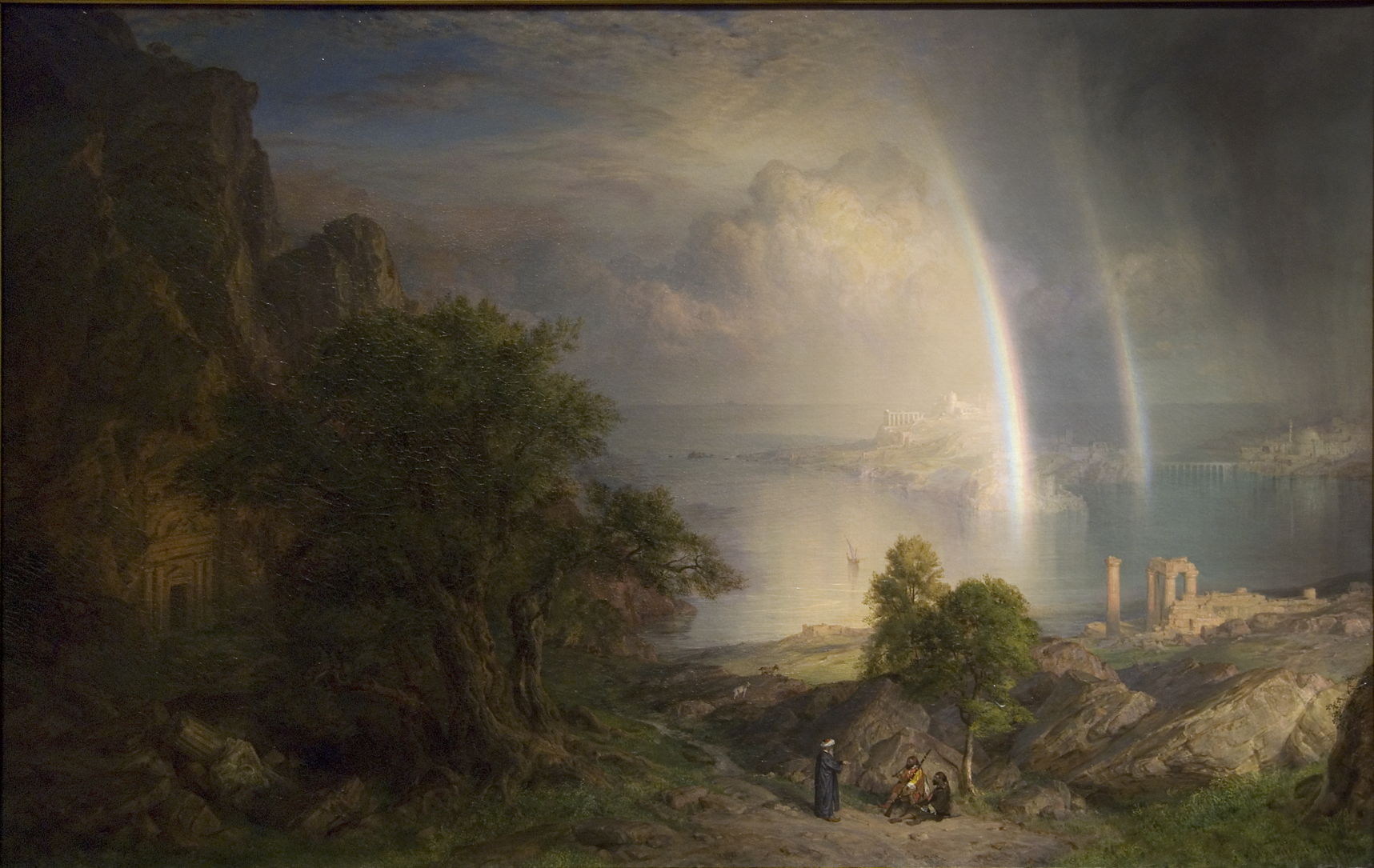
By 1876, Church was finding painting increasingly difficult due to his advancing rheumatoid arthritis. This late studio work showing The Aegean Sea was completed in about 1877, following which he became almost unable to paint. He wintered in Mexico to alleviate his problems, and died in 1900, at the age of 73. By that time, Church’s finely detailed realist paintings had become reviled, and it wasn’t until the 1960s before his art was taken seriously again.
You can see more about exhibitions and publications to celebrate Church’s bicentenary on Olana’s site.
Reference
Raab, Jennifer (2015) Frederic Church, The Art and Science of Detail, Yale UP. ISBN 978 0 300 20837 5.

Frederic Edwin Church, who was born two centuries ago on 4 May 1826, is one of the founding American masters, and one of the world’s great nineteenth century landscape painters. As the only pupil of Thomas Cole, who founded the Hudson River School, Church has a pivotal place in the history of American painting.
His career started at the time of the Barbizon School, and continued into the height of Impressionism in France, and its arrival in North America. Unlike those, and subsequent US landscape painters, Church was a devout realist who produced huge canvases with meticulous, almost obsessive, detail. He was thus a rival to his contemporary, Albert Bierstadt (1830-1902), who worked largely within his unchallenged territory to the west of the Mississippi.
Church was a precocious artist, and by the time he started his training with Cole in 1844 he seems to have been a fine draftsman and a competent landscape painter. During his two years with Cole, the pair travelled around New England and New York State. Church sold his first painting to his neighbour Daniel Wadsworth, who founded the Wadsworth Athenaeum in Hartford, CT.
From these early days Church’s working methods were traditional, and similar to those of John Constable. He drew in pencil and sketched in oils in front of his motif, then assembled those into highly detailed and finished oil paintings in his studio. Church was an obsessive sketcher in oils, and thousands of his drawings and oil sketches survive in collections such as those of the Cooper Hewitt, Smithsonian Design Museum in New York.
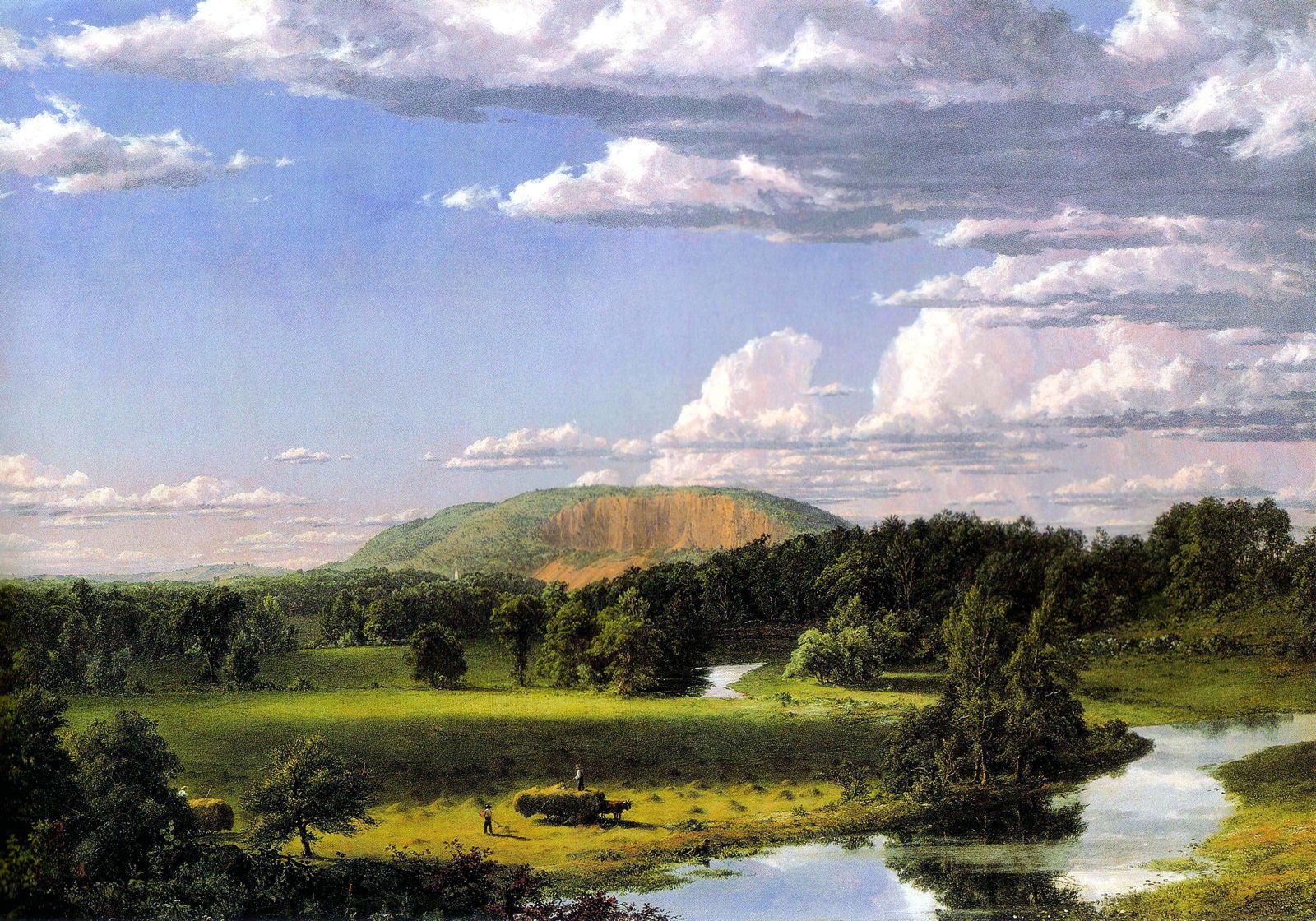
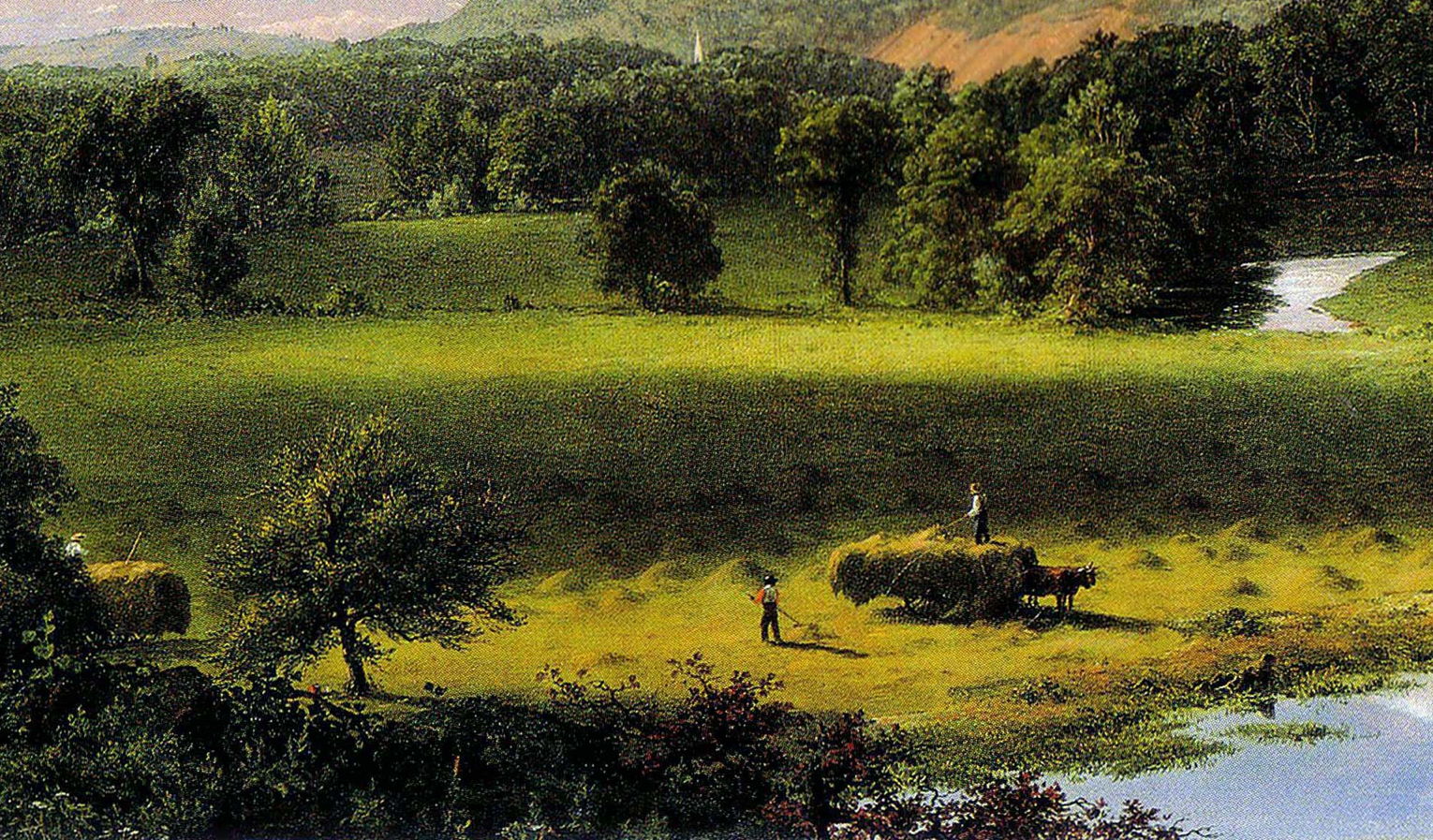
Church’s early landscape painting of West Rock, New Haven (1849) is a good example of his attention to detail in finished paintings. As shown in the detail below, its foreground features three figures making hay, which they’re stacking onto carts drawn by oxen. Down at the river bank, a dog is enjoying a paddle. Just peeking proud of the distant treetops is the white tip of a church spire.

He had settled in New York by 1850, and from then went on trips most summers to the wilds of Maine to paint en plein air in oils. He made this rather sparse view of Mt. Desert Island, Maine Coast in oils on paper in 1850.

The following year Church painted this rich twilight seascape of a Beacon, off Mount Desert Island (1851). Judging from its size and canvas support, this was intended as a finished work rather than a study.

Schoodic Peninsula from Mount Desert at Sunrise (1850–55) is one of many oil sketches which he made during a summer visit to Maine during this period.

Eagle Lake Viewed from Cadillac Mountain, Mount Desert Island, Maine (1850–60) is another oil sketch featuring a considerably more complex motif. Cadillac Mountain is relatively low at 466 metres (1,530 feet), but the highest point of Mount Desert Island, so affords such spectacular views.
In 1852, Church read Alexander von Humboldt’s account of his travels in central America, and decided to rise to Humboldt’s challenge to depict the ‘physiognomy’ of the Andes mountains. The following year he travelled to Columbia and Ecuador with the businessman Cyrus West Field, who bankrolled their trip in the hope that he could use Church’s paintings to promote his own local business ventures. They based themselves in Quito, travelling from there to awe-inspiring views of mountains and volcanoes.
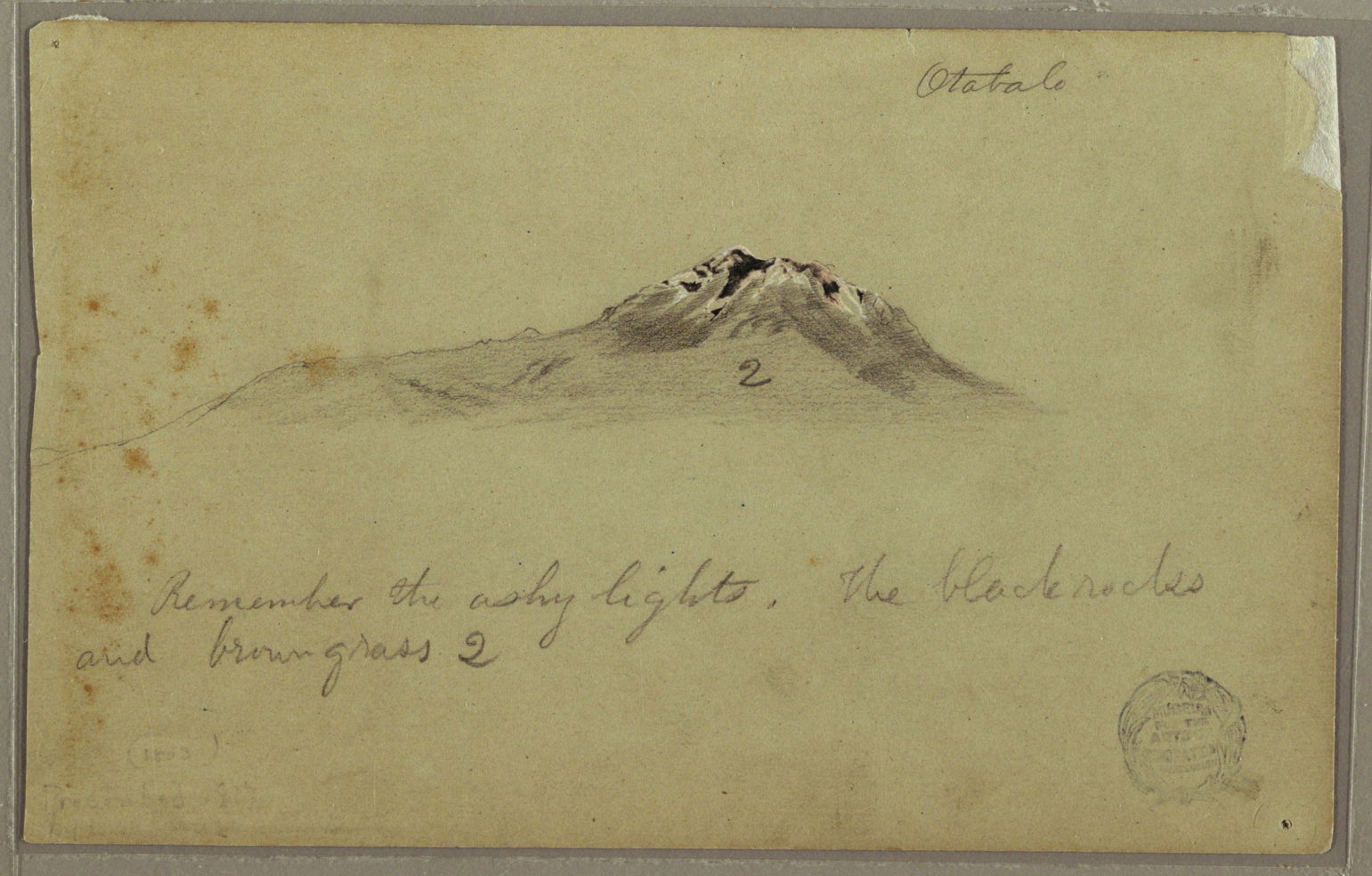
Church painted this view of what’s thought to be Cayambe in Ecuador in August or September 1853. This isn’t an oil sketch, though, but was made in pencil and gouache.
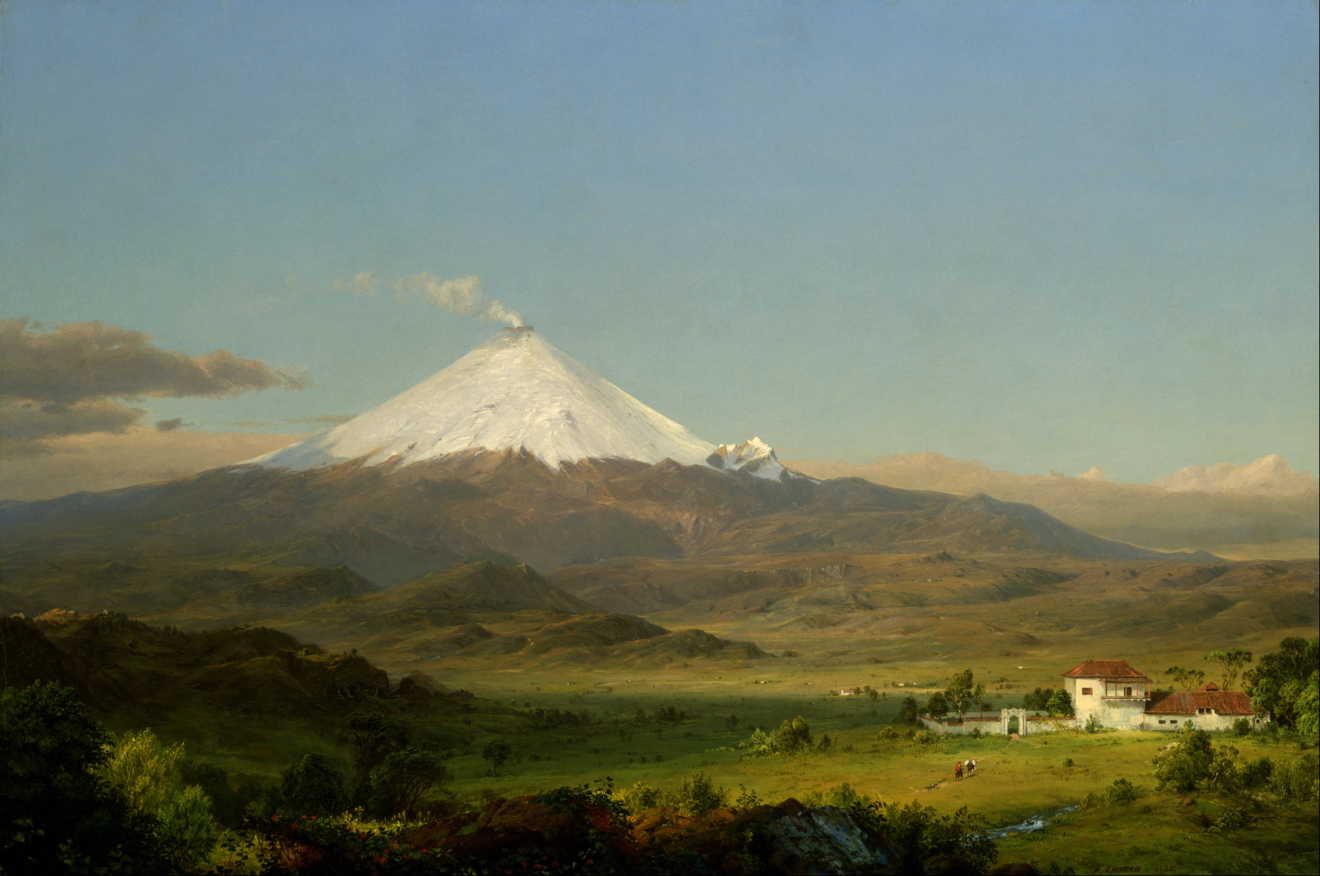
On his return to his studio in New York, Church turned those hundreds of sketches and drawings into larger finished paintings, in this case one of his many views of Cotopaxi (1855) in Ecuador. As was conventional at the time, these are highly finished, with no evidence of brushwork and a smooth paint surface.
His other versions of this motif weren’t as peaceful: that of 1862, commissioned by James Lenox, shows rugged waterfalls in the foreground, a barren rocky plain, and the volcano itself ejecting a high plume of smoke and ash. All this is lit by a blood-red sun, sitting low in the sky. This was to enable Church’s painting to serve as a pendant to one of Lenox’s other paintings, Turner’s dramatic Staffa, Fingal’s Cave (1832).

Church was among the many landscape painters who visited Niagara (1857). Jennifer Raab has set this painting in its historical context, at a time when secession of Southern states seemed imminent. The Niagara Falls became associated with union and the unity of its details.
He returned to central America in 1857 with the artist Louis Rémy Mignot and added hundreds more drawings and sketches to his collection.

Cross in the Wilderness, painted later that year, is one of the earlier works to result from his second visit. This wilderness is unpopulated, devoid of figures or other signs of human presence. It was another two years before Church painted his masterpiece that drew the crowds and established his popularity.
Reference
Raab, Jennifer (2015) Frederic Church, The Art and Science of Detail, Yale UP. ISBN 978 0 300 20837 5.
The ancient Greek myth of Pandora had been almost unknown in paintings until the nineteenth century. During the 1870s it suddenly became a popular theme for European paintings, but its narrative had altered from the original in showing the first woman in Greek mythology with a box containing the ills of the world, rather than a large earthenware storage pot, and only one artist had depicted its crux.
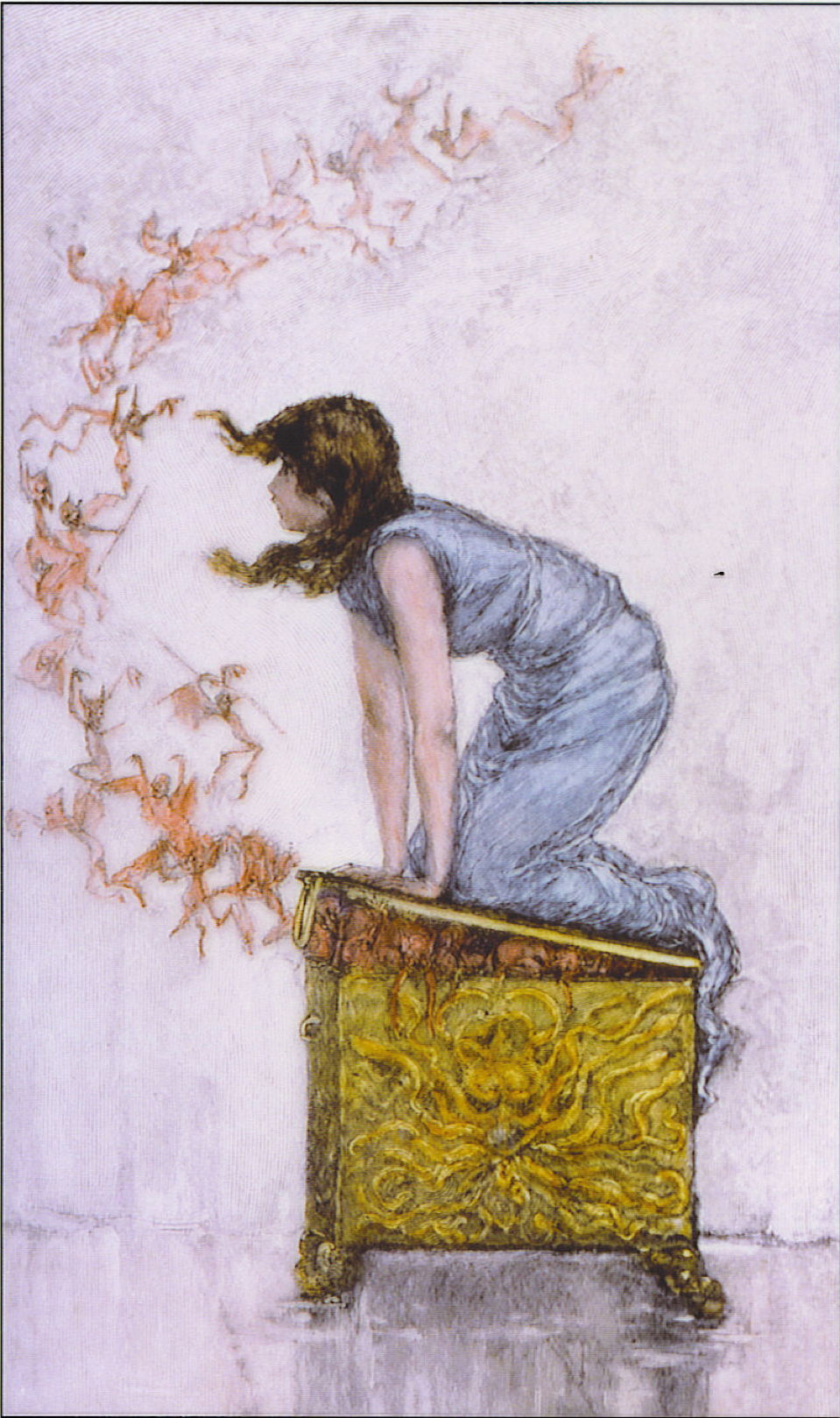
The story broke out of Europe by 1883, when the American painter and illustrator Frederick Stuart Church painted his more illustrative Pandora. Dressed more modestly (presumably for a wider audience), she is shown as an innocent young woman kneeling on a large golden chest as she tries to close its lid and stop the emerging stream of red demons. I suspect this was intended as an illustration for a printed collection of classical myths.

The following year Walter Crane, a British painter and illustrator, painted Pandora in an unusual interpretation that’s only loosely connected with the original myth. She is here draped in grief over a substantial casket, and on its side panel are the figures of the three Fates. At the corners of the casket are guardian winged sphinxes, each clasping a sphere.

In his later years, William-Adolphe Bouguereau chose an oddly androgynous model for his depiction of Pandora in 1890, but has rather lost the narrative. Her neutral expression, body language, and the closed box tell little of what is imminent.
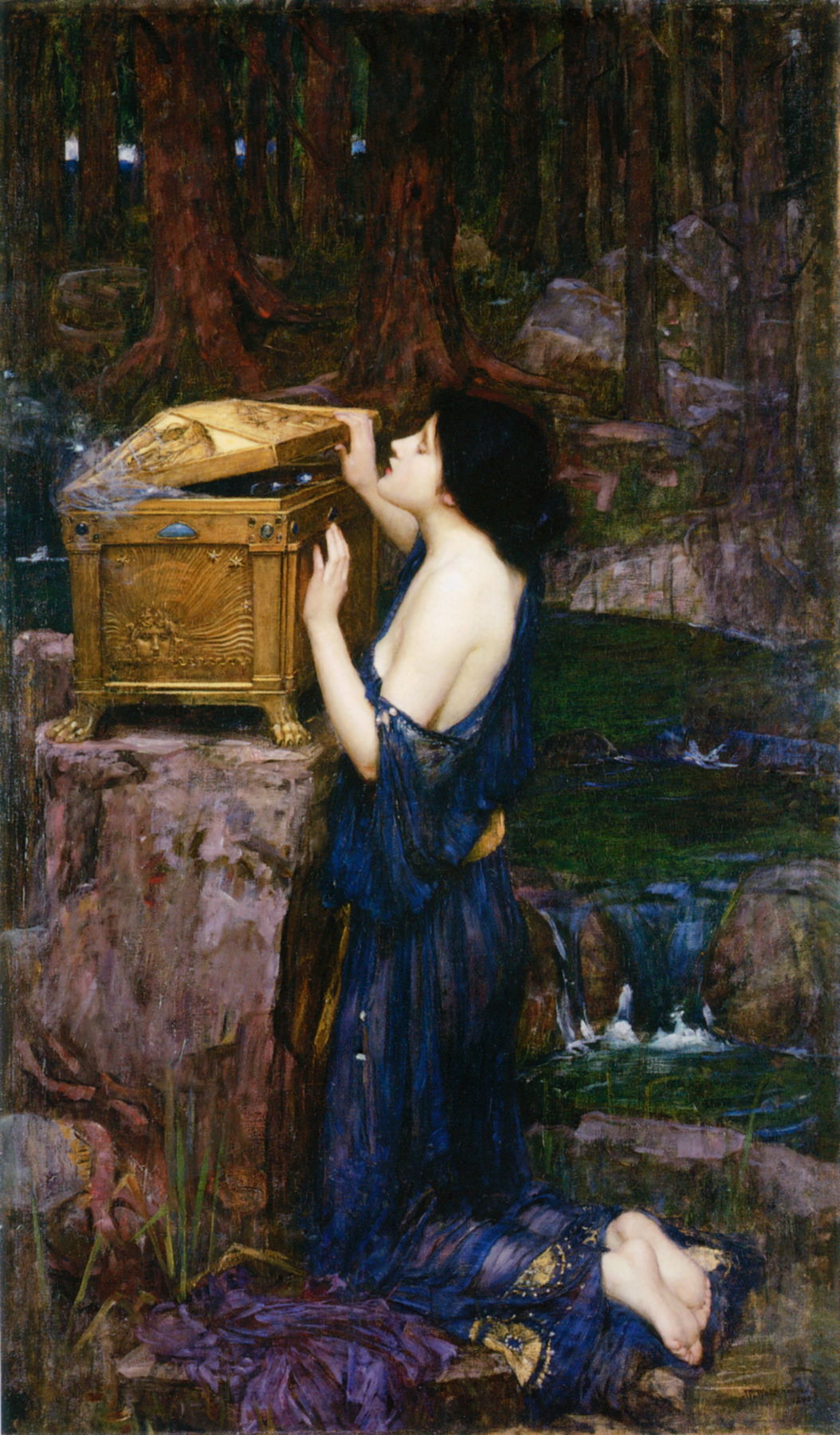
One of his lesser-known paintings, John William Waterhouse’s Pandora from 1896 is a major depiction of this myth, and one of the most complete. Set by a small brook in a dark, primeval forest, her box has become a large gold chest encrusted with precious stones and decorated with mythological motifs. Pandora kneels by its side, peeking inside as she carefully raises its lid, but even this tentative glimpse is sufficient to release its stream of ills, of which she appears unaware.
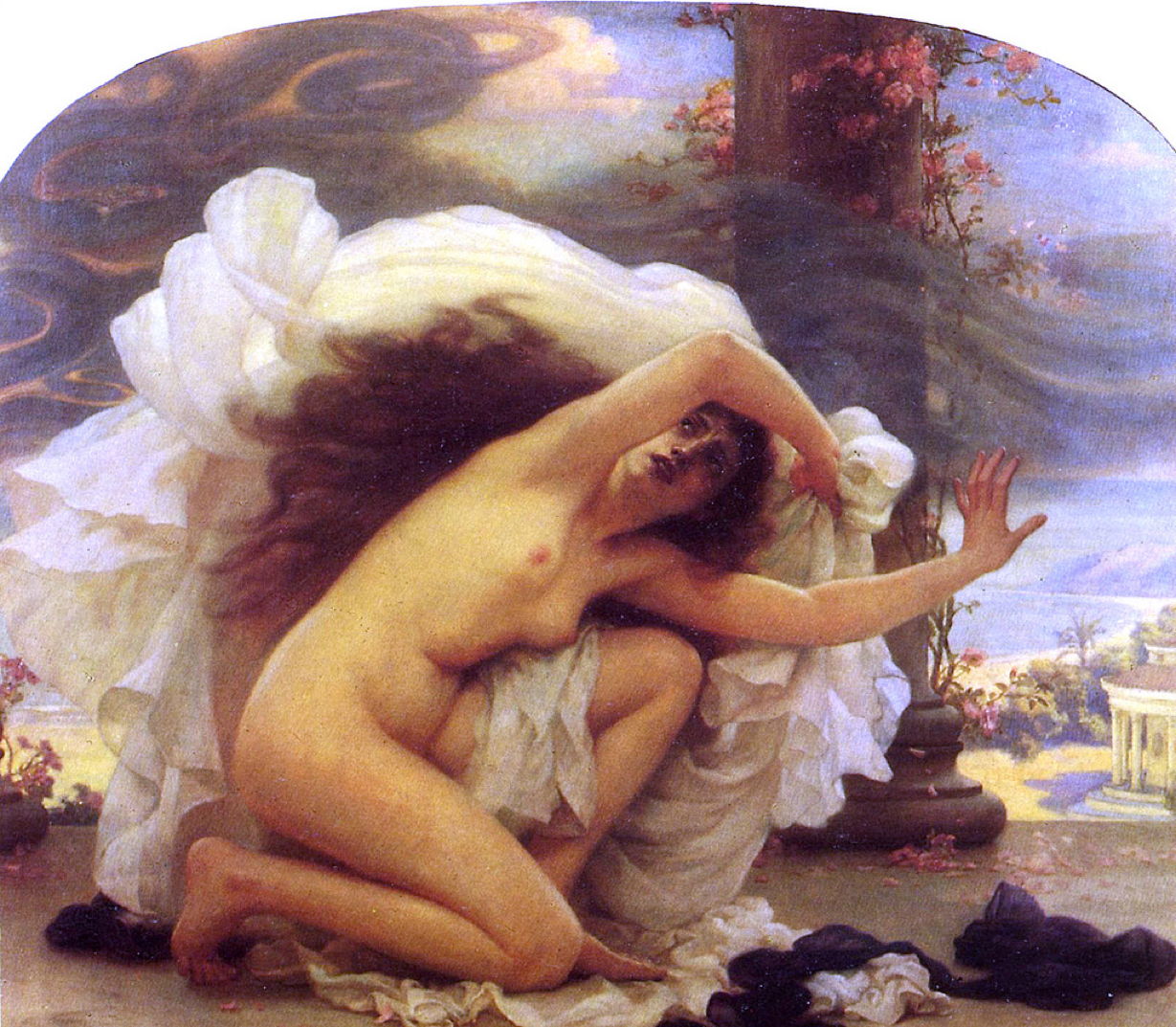
Ernest Normand is one of few painters to show a later moment, in which Pandora (1899) bends low to duck beneath the swirling grey clouds of evils as they spread out into the idyllic world beyond, causing blossom to fall as petals to the ground. Her jar is only hinted at, behind her billowing white robes, almost depriving the viewer of this vital clue to the original story.
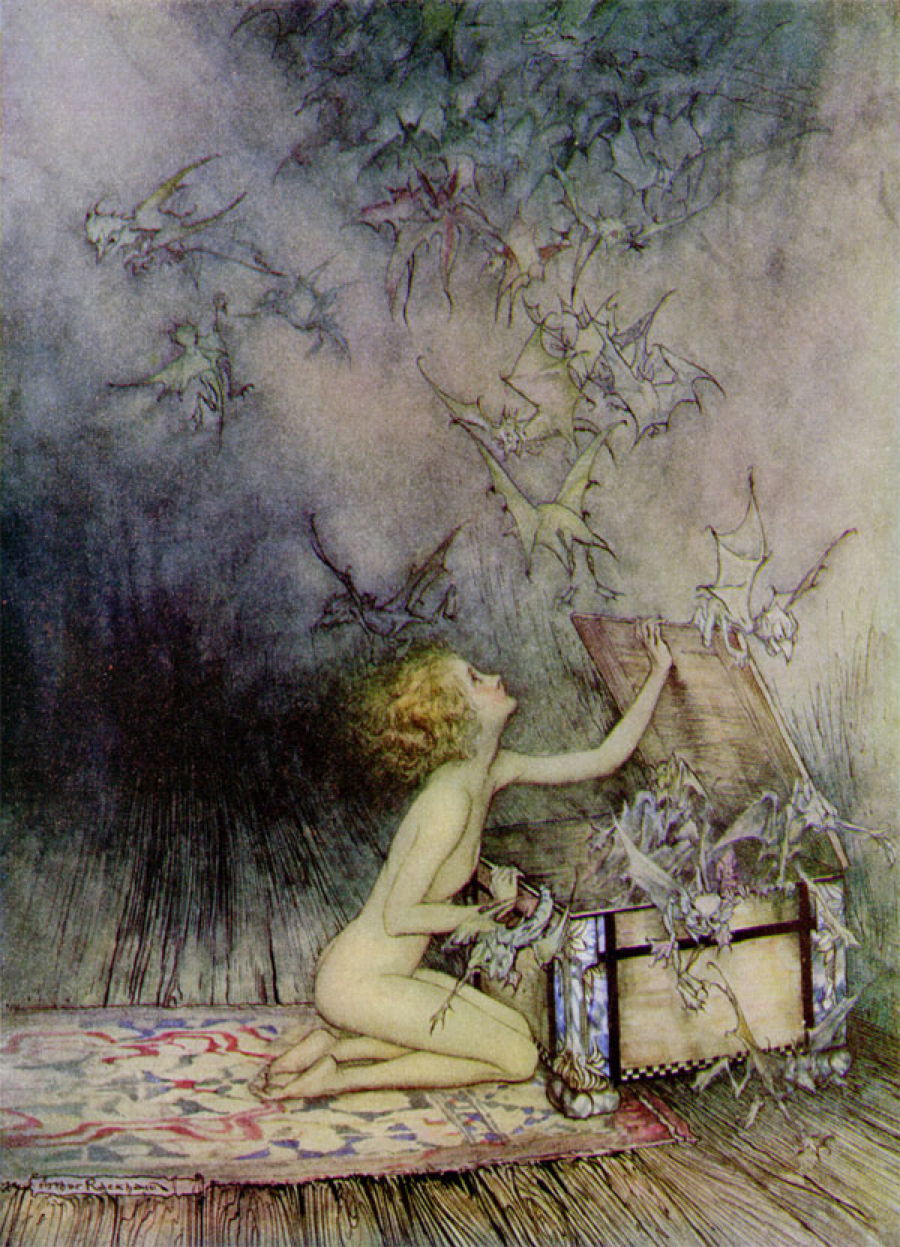
I have been unable to find a date for this presumed illustration by the great Arthur Rackham of Pandora, but suspect it was made around the turn of the twentieth century, and intended to accompany a British English retelling of this myth. As with Church before, Pandora is young and innocent in her nakedness. She gazes up in awe at the batlike demons as they escape from the open lid of her large wooden chest, seemingly unaware of what she is unleashing in her curiosity.
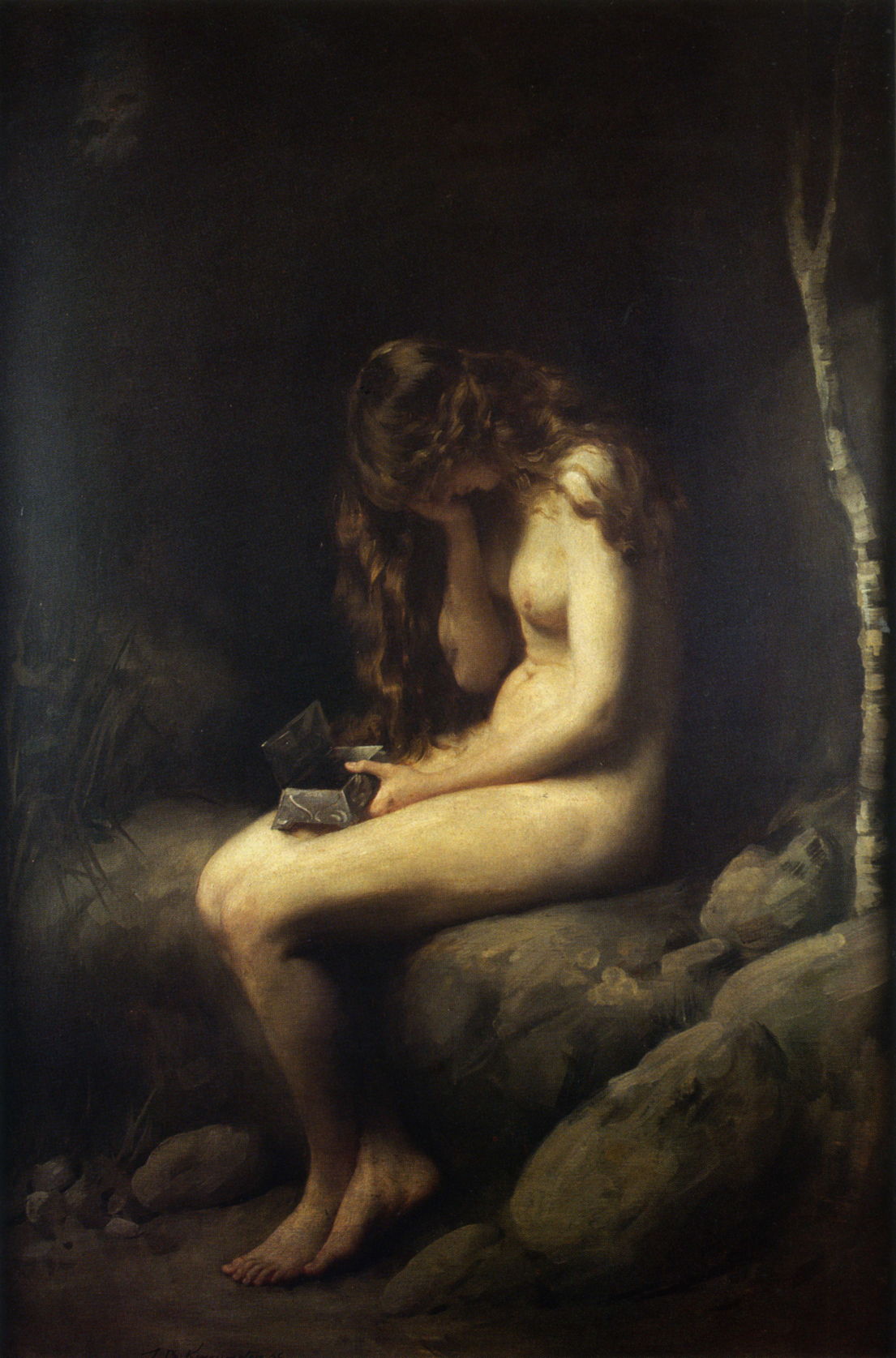
Thomas Benjamin Kennington shows Pandora (1908) in the final phase of regret and sorrow, after the evils have all been released. Her box, now empty, with no sign of the remaining Hope, rests on her thigh. She hangs her head in shame, resting it on her right hand as she weeps at what she has done. Unfortunately, the released demons shown at the left edge are so dark that they are hard to see.
Over this period, other artists had also been painting the story of the creation of Pandora, a theme I have avoided so far. I will, though, show one of its more unusual depictions, a painting lost for forty years.

John Dixon Batten’s The Creation of Pandora was painted anachronistically in egg tempera on a fresco ground by 1913. Batten was one of the late adherents of the Pre-Raphaelite movement, and now almost forgotten. It had been exhibited in a commercial gallery, and was acquired by the University of Reading, England, shortly before the First World War. Deemed unfashionable in 1949, it was put into storage and quietly forgotten until its rediscovery in 1990.
Pandora is at the centre, having just been fashioned out of earth by Hephaestus, who stands at the left, his foot on his anvil. Behind them, other blacksmiths work metal in his forge. At the right, Athena is about to place her gift of a robe about Pandora’s figure, and other gods queue behind her to offer their contributions.
Just before the start of the First World War, Odilon Redon made a series of studies leading to a radically different presentation of Pandora’s story.
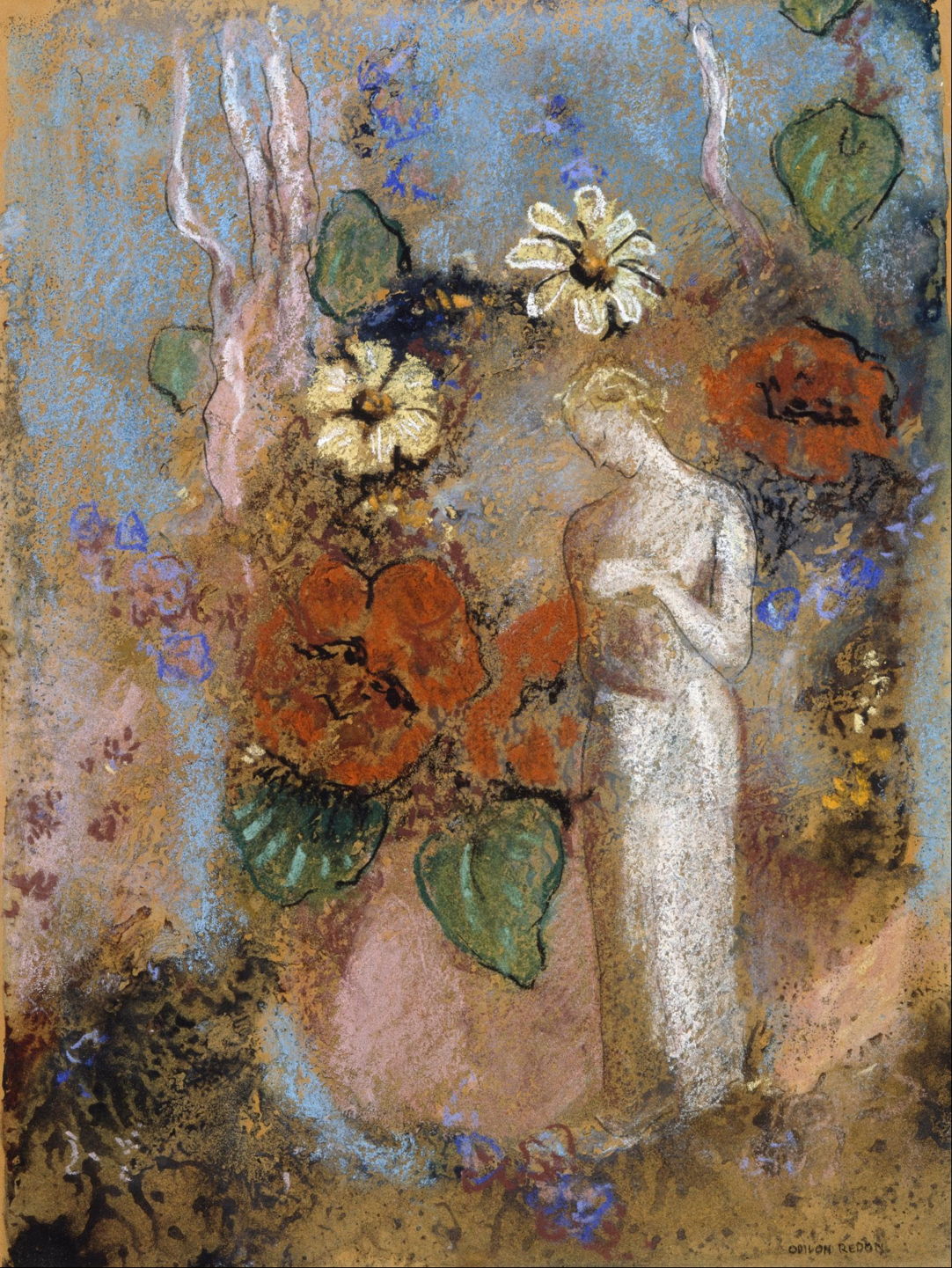
Redon’s undated pastel study of Pandora shows her clasping her box close in the midst of huge floral images.
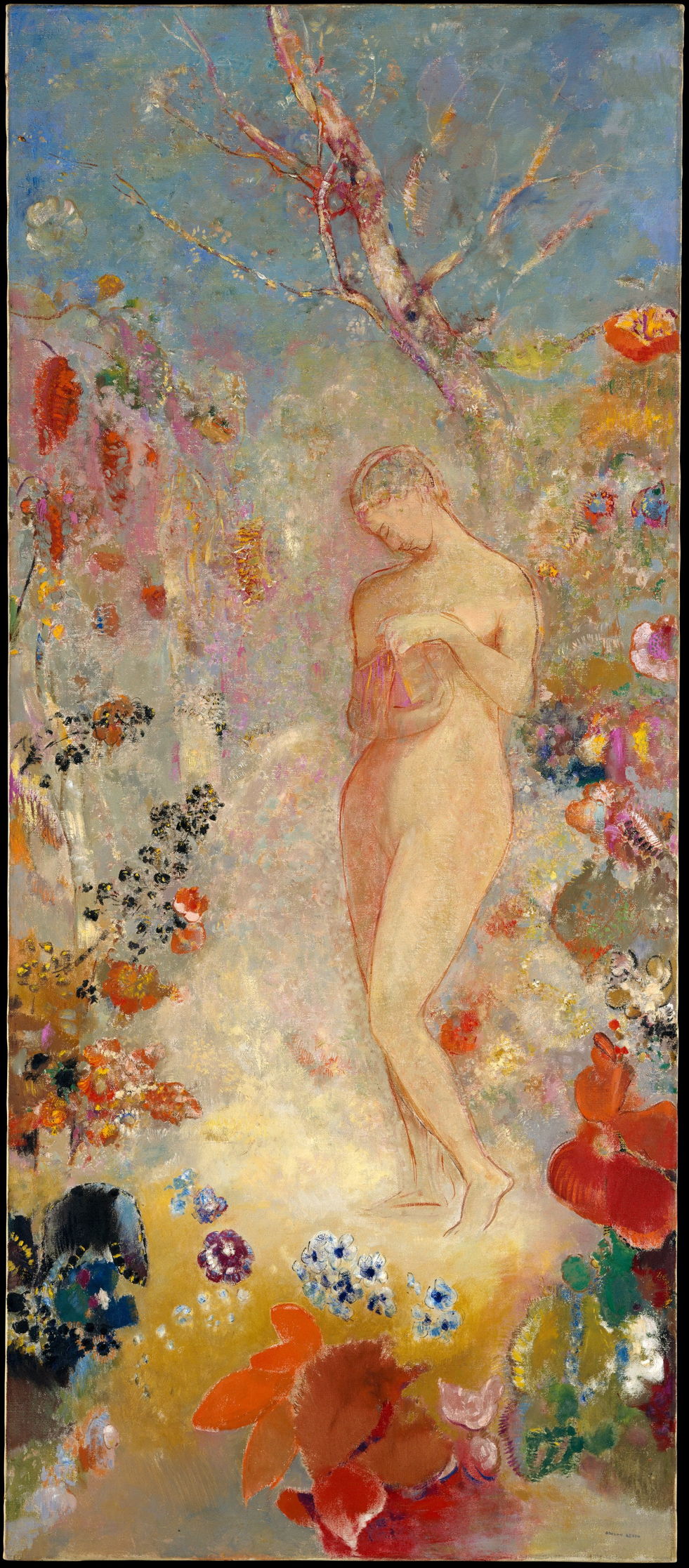
Redon’s finished oil painting of Pandora from about 1914 shows her more clearly, surrounded by a garden of exquisite and exotic blooms, referring to Eve’s Paradise before the Fall. She holds her box to her bosom, as she succumbs to the temptation to open it, but Redon stops just short of showing its evils pouring out.

My final representation of the myth of Pandora is a photograph from 1919 by the society portrait photographer Yvonne Gregory (who also worked under her married surname of Park): Pandora. The box lies wide open by her knees, as Pandora is bent double in distress over it, her left arm over her head to shelter her from the demons that have been released, and in grief at what she has done.
Given the disasters that had struck the world in the years immediately preceding this photograph – the mass carnage of the war, and the influenza pandemic which followed it – it must have had great impact when it was published in 1919. Much as these images have today. For despite the story’s underlying misogyny, I can’t help thinking that Pandora’s box has been opened yet again.
Reference
Wikipedia on the myth of Pandora.
