Normal view

There are new articles available, click to refresh the page.
Before yesterdayMain stream

Jerusalem Delivered: 6 Erminia flees

By: hoakley
2 March 2026 at 20:30

The seductive ‘pagan’ sorceress Armida has just told Godfrey of Bouillon, leader of the First Crusade’s siege on the city of Jerusalem, a long sob story, leading to her request for ten of his best knights to go and sort her problems out.

Godfrey predictably turns her down, in view of his mission to deliver the city. Armida plays on emotion, and weeps. She has won over the young knight Eustace, who asserts that helping all ladies is chief among the duties of a knight. The others around Godfrey concur, and their leader is forced to acquiesce. Armida then plays the field with great skill and success, winning over the hearts of all the knights, in her bid to take away more than just the ten that she asked for.

Canto five continues in the camp of the crusaders, with Armida’s influence eating away at their resolve to fight. Godfrey’s next problem is to select a knight to replace the dead Dudon, who in turn can choose the ten to go with Armida. This sows dissent, with Prince Gernando wanting to lead the army of ‘Adventurers’. This brings him into direct conflict with Rinaldo, who accuses Gernando of being a liar.

The two knights must settle this immediately in combat, and Rinaldo quickly kills Gernando. Godfrey goes straight there, and on hearing what happened, condemns Rinaldo to death for breaking the crusaders’ laws. Tancred speaks in favour of Rinaldo, then Raymond too. Tancred rides off to Rinaldo’s tent, where the latter makes clear that he has no intention of staying around in prison awaiting his trial. Rinaldo dons his armour and rides off.

Guelph goes to Godfrey to plead Rinaldo’s case, but the leader stands firm. Next, Godfrey has to face Armida, who goes to him with two of her ladies and two knights in attendance. With Godfrey’s single-minded determination for his mission, she finds him much less malleable than his knights. Armida finally gets her way, and is allowed to take her ten knights.

With dozens of knights clamouring to accompany Armida, it’s decided to draw names from an urn. Tasso lists: Count of Pembroke Artemidorus, Gerard, Wenceslaus, Guasco, Rudolph, Olderic, William of Roncillon, Bavarian Eberard, French Henri, and Rambaldo. Those who were unsuccessful are left seething in envy, and many leave the following night to follow Armida as she leads her squad of ten away. This further divides the crusaders.

Back in camp, Godfrey hears that an Egyptian navy is at sea to prevent supply ships from reaching the coast, and that a convoy of supplies en route to the crusaders from one of the ports has been ambushed and lost. The leader has to comfort his men by affirming that God will look after them, but inwardly worries how he will feed his army.

The sixth canto opens inside the besieged city of Jerusalem, where its occupants are better-fed than those laying siege to it, because they have been able to bring in supplies by night. Work had been undertaken to strengthen its fortifications, particularly on the north, where there were also war machines stationed.

Argante urges Aladine to fight the enemy rather than sit waiting for starvation, but the ruler reveals that Soliman of Nicaea, who seeks vengeance for his own loss earlier in the Crusade, is gathering a force to attack by night. This angers Argante, who is an old rival of Soliman, and he asks permission to go out to meet a crusader in combat. Aladine gives his consent.

Argante then issues a challenge to Godfrey for one-to-one combat, which the latter cannot refuse.

Inside the city, Aladine instructs Clorinda to take a force of a thousand to ensure Argante’s safe passage. Godfrey feels unable to choose Argante’s opponent, but the consensus calls on Tancred, who is approved by Godfrey.

As Tancred makes his way to the field where they will fight, he sees Clorinda, who is sitting on her horse with her visor raised. This delays him, and Otto has already rushed forward to take on the Circassian in the arena. Otto is in full charge before Tancred realises what is happening. Otto and Argante make contact: although Otto strikes the Circassian’s helmet, the latter knocks Otto from his horse, cleaving his shield and breastplate.

Argante tells Otto to concede, but the crusader refuses. Argante charges at Otto, who manages to wound his enemy and draw blood, but insufficient to do anything more than anger him further. Argante then turns his horse, fells Otto, and his horse tramples him, in a cowardly act breaching the code of chivalry.

At this, Tancred calls out Argante’s cowardice and the two charge at one another. Their lances shatter, making their horses collapse from under them. They draw their swords to fight on foot. Tancred is the first to draw blood, and Argante is so stunned that he is too slow to return the strike, and takes another heavy blow to his shoulder. Argante’s rage then overcomes his injuries, and he rains blows on Tancred. Both are now wounded, their armour pierced in many places. At this point, heralds are put in to bring the vicious fight to a halt for the night.

Erminia, in Jerusalem behind them, has suffered this battle badly. When Antioch fell, it was Prince Tancred who had protected her, and honoured her as a queen. For this, she had fallen in love with him. As she had watched Tancred in combat, she felt every blow that Argante had laid on him. With her skills in preparing healing potions, she is torn between using them to nurse her love, or Argante who would surely then be able to finish the crusader off.

She had spent long hours with Clorinda, and decides to dress up in her armour so she can leave the city and give aid to Tancred in the crusaders’ camp. She engages the help of a trusty squire and her maid, although she doesn’t tell them where she is going. Erminia then plays the part of Clorinda, and commands the city gate is opened on the authority of its king.

Once near the camp, she realises her plan has one problem: being recognised as Clorinda, woman warrior of Aladine’s forces, probably won’t give her a good reception among those laying siege to the city. She therefore sends her squire on to locate the injured Tancred. As she waits for his return, she is spotted by a platoon who are there to intercept attempts to smuggle supplies into the city. The father of one of its leaders, Polyphernes, had been killed by Clorinda, so throws his spear at her, and misses.

Erminia and her maid flee in panic, followed later by her squire. When Tancred hears of this, he rides off in pursuit of the woman warrior identified to him as Clorinda.

At the start of the seventh canto, it’s still night as Erminia enters dark woods and continues her flight, even though those pursuing her have now given up and returned to camp. The following day, she continues to wander, lost until she reaches the River Jordan, where she is completely exhausted, so lies down to sleep.

When she wakes at the next dawn, she sees a small shepherds’ hut, and weeps, only to hear the sound of shepherds singing and playing their pipes. She gets up and walks towards the group consisting of a grey-bearded man and three youths. As she is still wearing Clorinda’s armour, they are fearful of her at first, but she explains what’s going on nearby, and asks how they can remain there in peace.

The old man explains that he had been the keeper of the grounds and member of the royal court at Memphis, but had left for a more peaceful life with his three sons in the country. He consoles her, and takes her to his elderly wife, who dresses her in country clothes.
domenichinoerminiashepherds
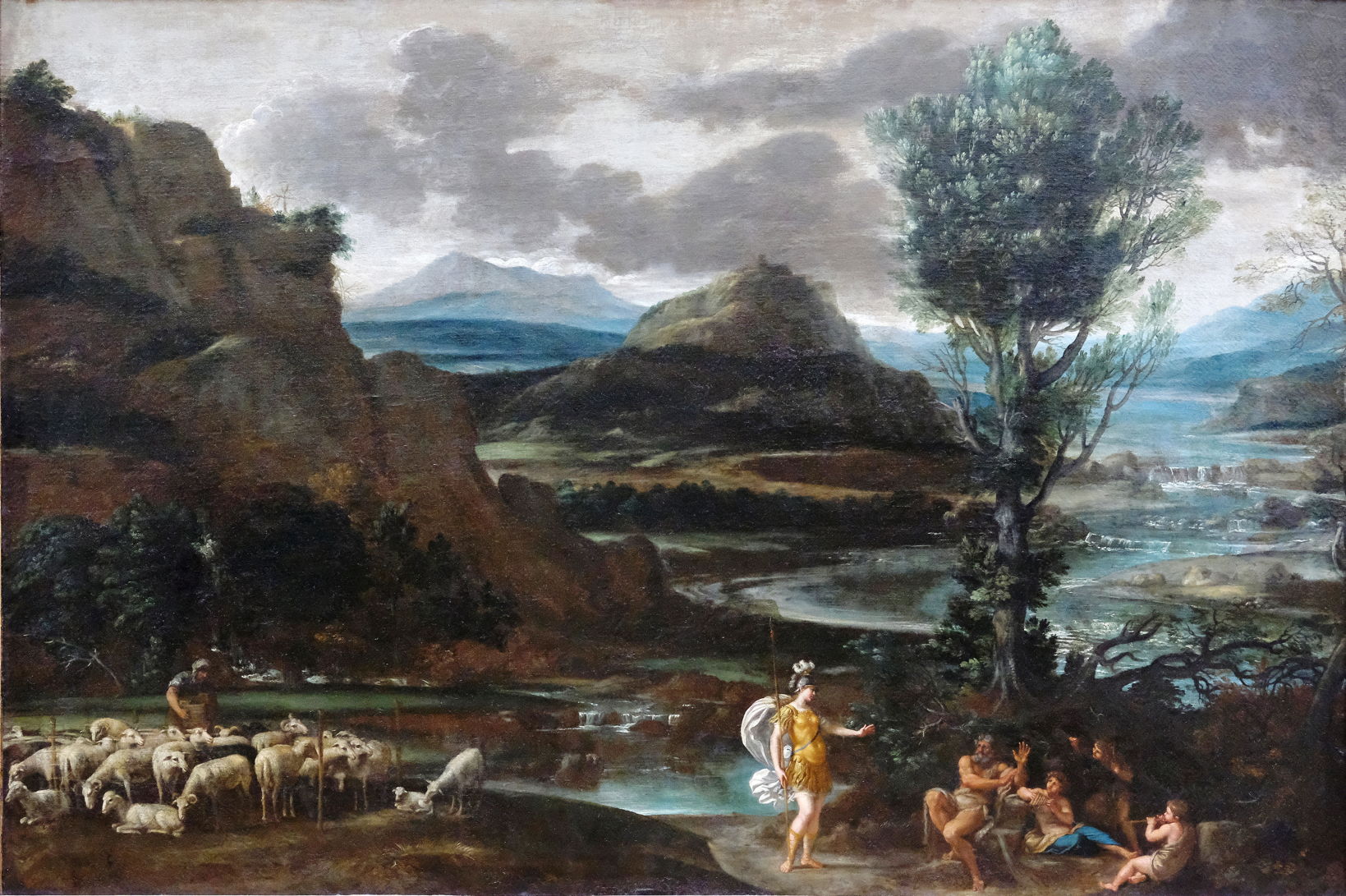
Domenichino (1581–1641), Erminia and the Shepherds (1622-25), oil on canvas, 124 x 181 cm, Musée du Louvre, Paris. Image by Mbzt, via Wikimedia Commons.

Domenichino appears to have been one of the earliest major painters to capture this scene, in his Erminia and the Shepherds, painted between 1622-25. He recasts the story in classical times, with Erminia appearing more Roman than Syrian, and the shepherds are straight out of an Ovidian myth (detail below). This is all set in a wonderfully imaginative riparian landscape.

domenichinoerminiashepherdsd1
Domenichino (1581–1641), Erminia and the Shepherds (detail) (1622-25), oil on canvas, 124 x 181 cm, Musée du Louvre, Paris. Image by Mbzt, via Wikimedia Commons.
guardierminiashepherds
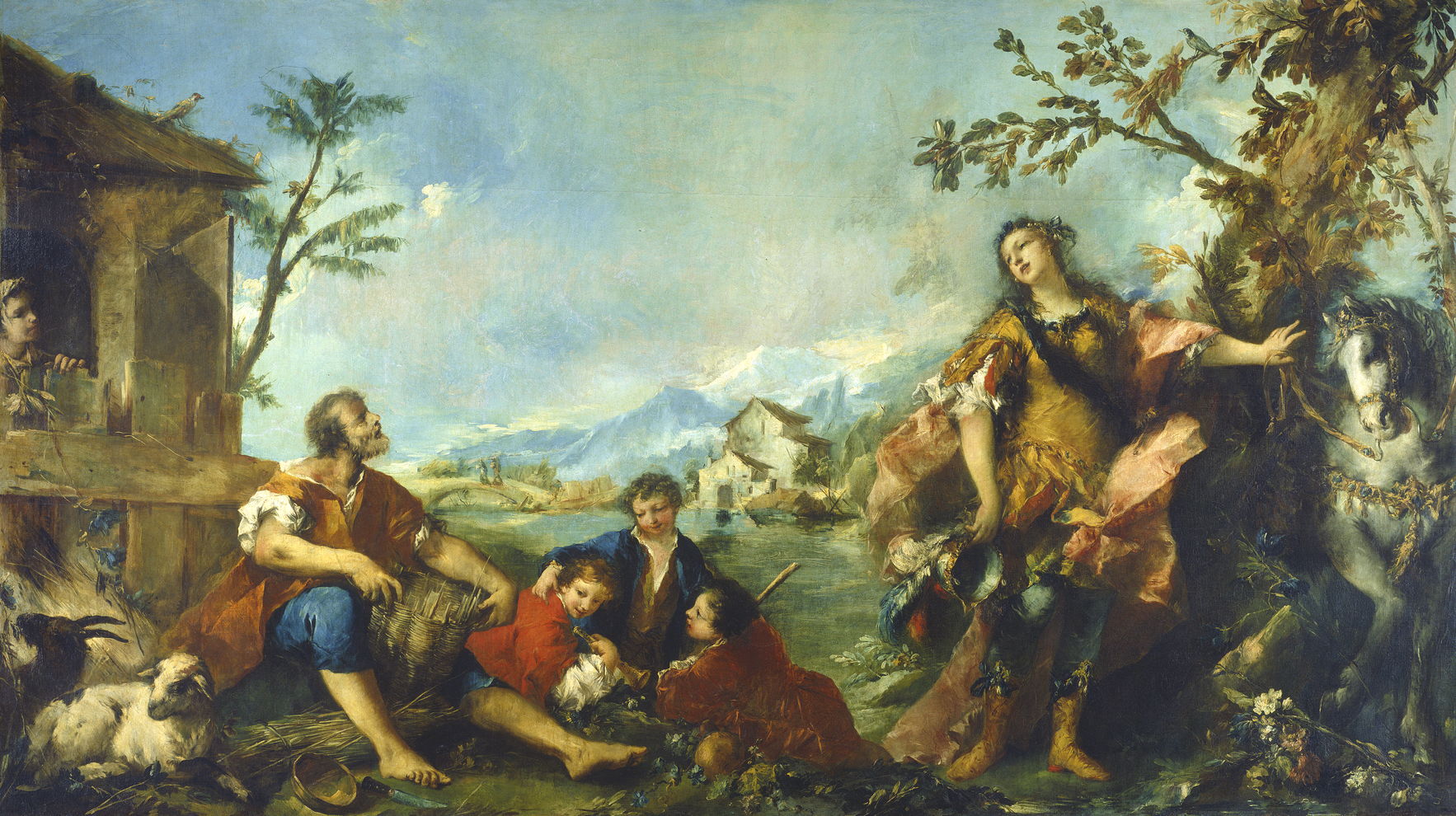
Giovanni Antonio Guardi (1699–1760), Erminia and the Shepherds (1750-55), oil on canvas, 251.5 x 442.2 cm, The National Gallery of Art, Washington, DC. Wikimedia Commons.

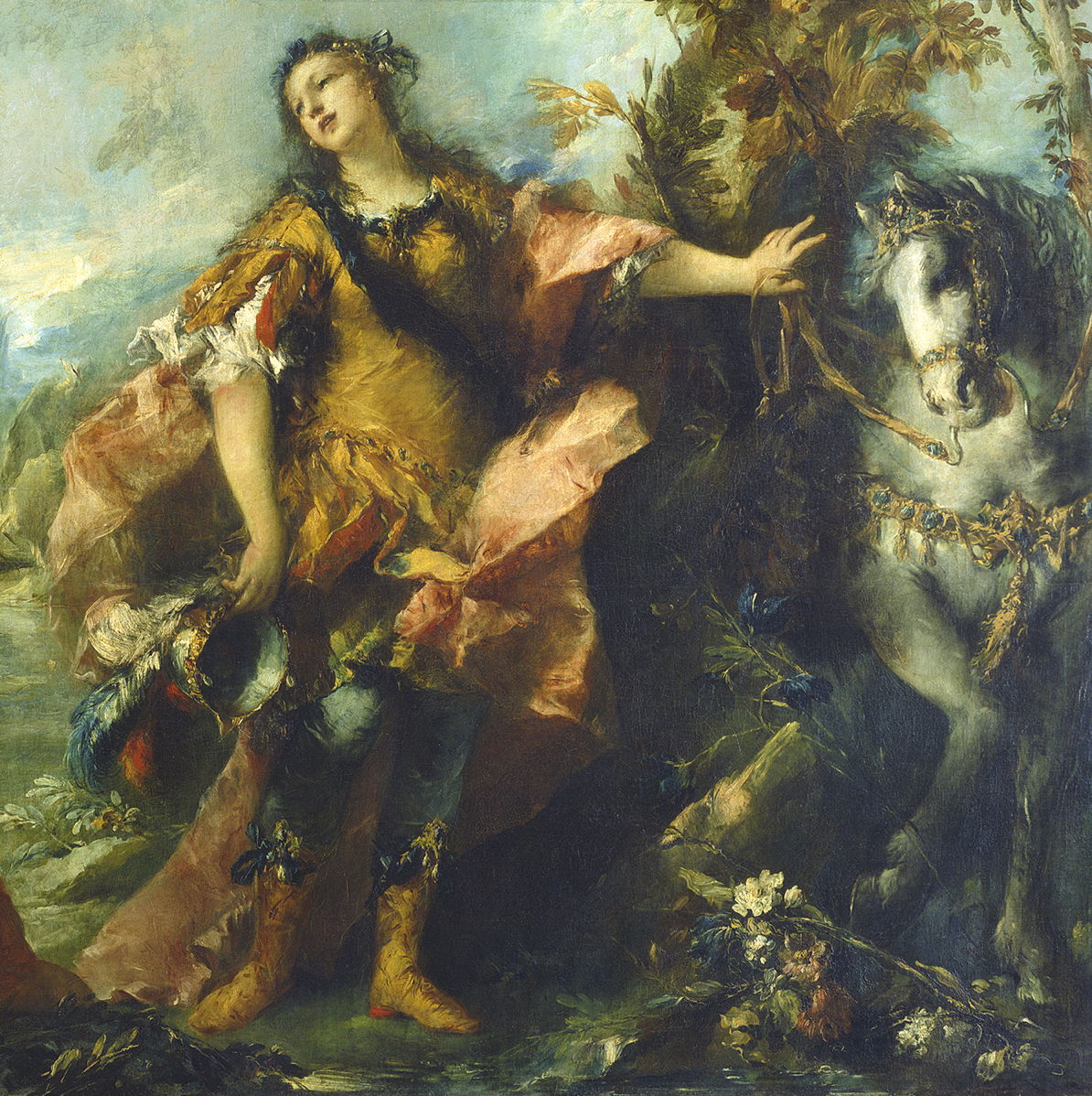
This sub-plot remained popular through the eighteenth century, when Giovanni Antonio Guardi painted his interpretation of Erminia and the Shepherds (1750-55). Erminia has by now changed out of Clorinda’s armour into the fetching outfit of an Alpine shepherdess. She stands holding the reins of her white horse, and Clorinda’s helmet (below).
guardierminiashepherdsd1
Giovanni Antonio Guardi (1699–1760), Erminia and the Shepherds (detail) (1750-55), oil on canvas, 251.5 x 442.2 cm, The National Gallery of Art, Washington, DC. Wikimedia Commons.
suveeerminiashepherds
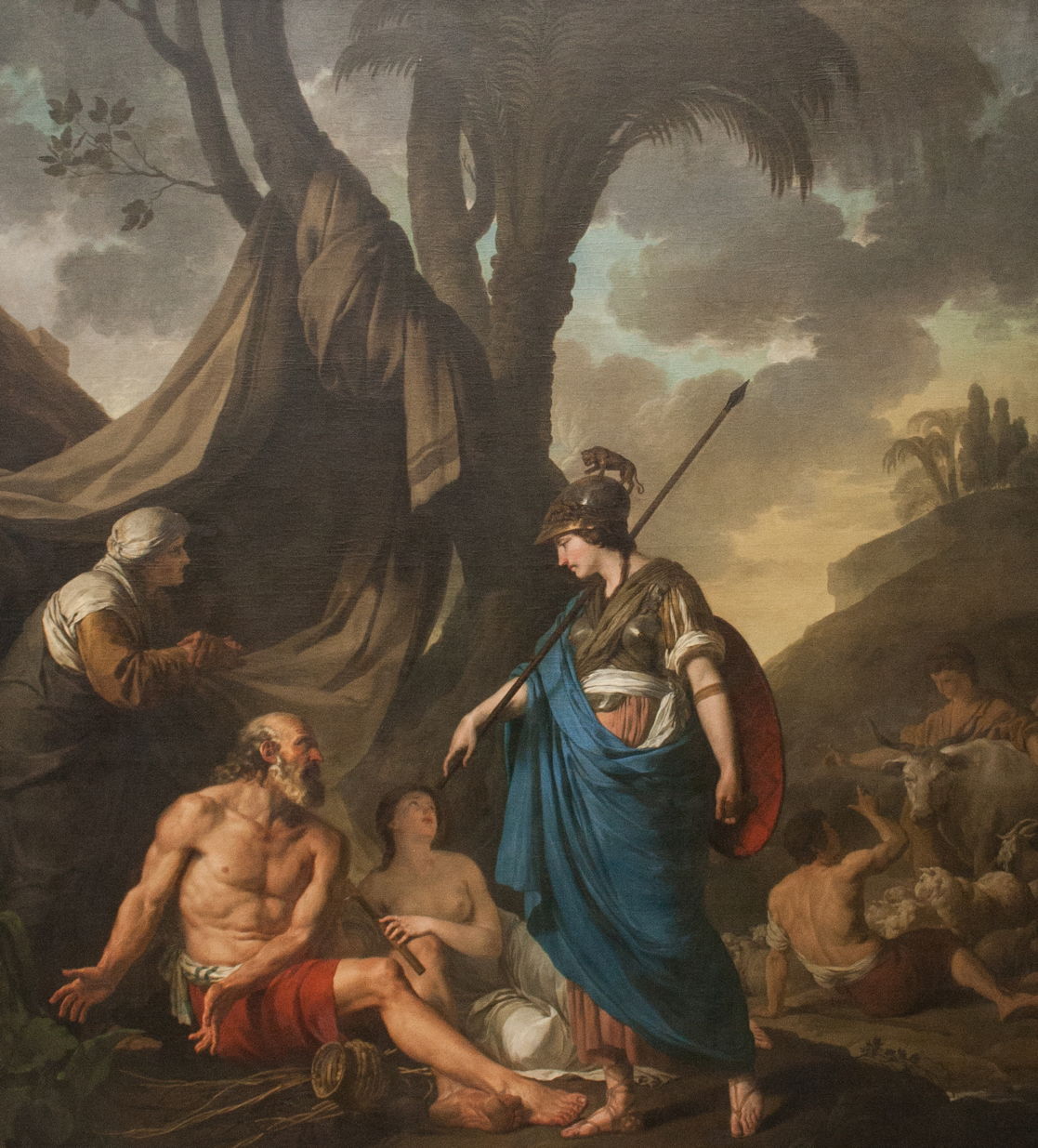
Joseph-Benoît Suvée (1743–1807), Erminia and the Shepherds (1776), oil on canvas, dimensions not known, Museum voor Schone Kunsten, Ghent, Belgium. Wikimedia Commons.

Joseph-Benoît Suvée’s Erminia and the Shepherds from 1776 is more basic and a little less literal. Her horse is nowhere to be seen, and the semi-naked young woman sat next to the old shepherd is a bit of a surprise. The setting is more Palestinian, though, with some palm trees.
delacroixerminiashepherds
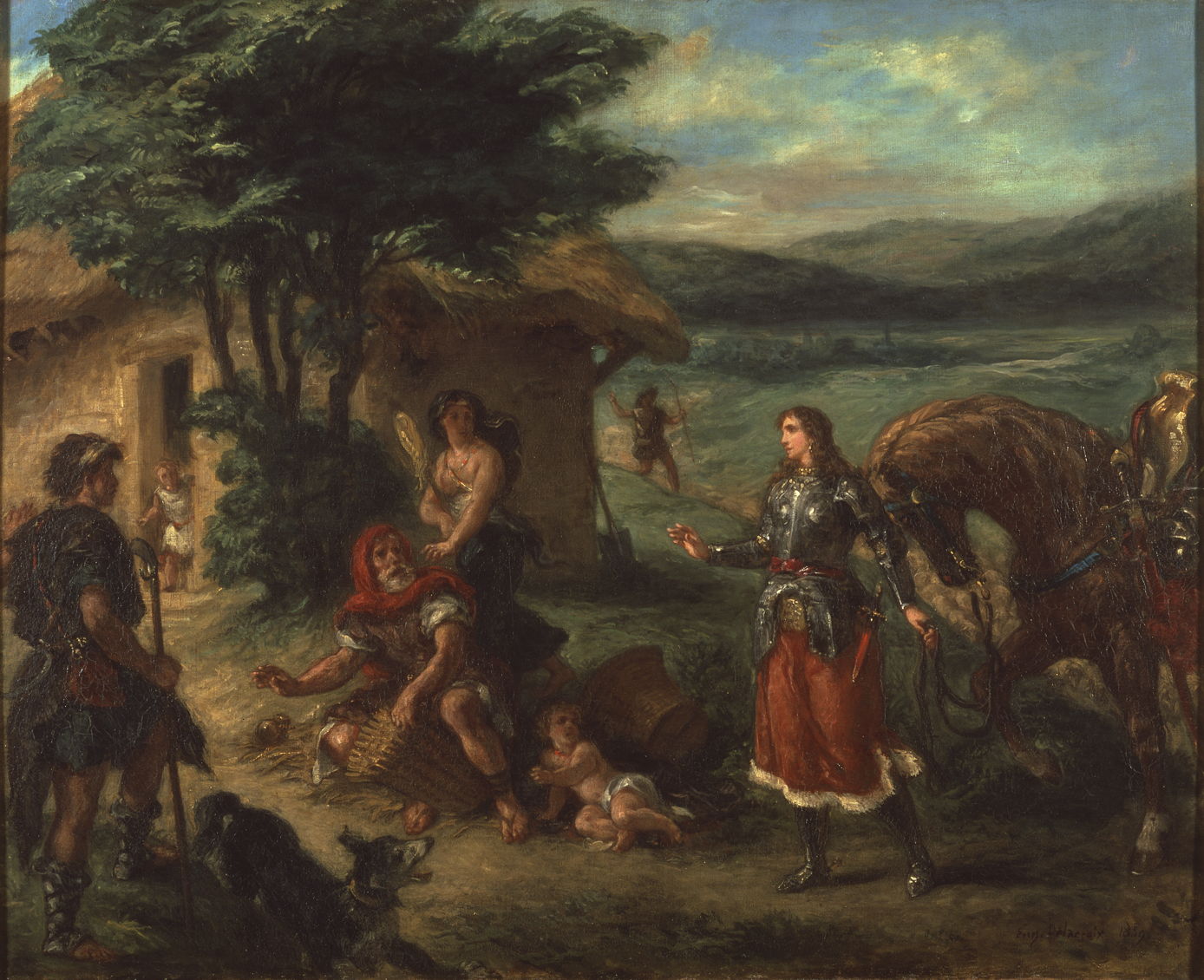
Eugène Delacroix (1798–1863), Erminia and the Shepherds (1859), oil on canvas, 82 x 104.5 cm, Nationalmuseum, Stockholm, Sweden. Wikimedia Commons.

It’s Eugène Delacroix who renders this most faithfully, in his Erminia and the Shepherds of 1859. Erminia is still dressed as the warrior Clorinda, and her charger is convincing too (below). The farming family are taken aback, and their dog has rushed out to bark at the visitor. In the distance, behind the small farmhouse, is a figure who might be pursuing Erminia.

delacroixerminiashepherdsd1
Eugène Delacroix (1798–1863), Erminia and the Shepherds (detail) (1859), oil on canvas, 82 x 104.5 cm, Nationalmuseum, Stockholm, Sweden. Wikimedia Commons.

Although Tancred had also strayed, he’s still in pursuit of the warrior he mistakenly thinks is Clorinda.

References

Wikipedia on Jerusalem Delivered.
Wikipedia on Torquato Tasso.

Project Gutenberg (free) English translation (Fairfax 1600).

Librivox audiobook of the Fairfax (1600) English translation (free).

Thomas Asbridge (2004) The First Crusade, A New History, Free Press, ISBN 978 0 7432 2084 2.
Anthony M Esolen, translator (2000) Torquato Tasso, Jerusalem Delivered, Gerusalemme Liberata, Johns Hopkins UP. ISBN 978 0 801 863233. A superb modern translation into English verse.
John France (1994) Victory in the East, a Military History of the First Crusade, Cambridge UP. ISBN 978 0 521 589871.
Joanthan Riley-Smith, ed (1995) The Oxford Illustrated History of the Crusades, Oxford UP. ISBN 978 0 192 854285.
Jonathan Riley-Smith (2014) The Crusades, A History, 3rd edn., Bloomsbury. ISBN 978 1 4725 1351 9.
Johathan Unglaub (2006) Poussin and the Poetics of Painting, Pictorial Narrative and the Legacy of Tasso, Cambridge UP. ISBN 978 0 521 833677.

Reading Visual Art: 244 Axe

By: hoakley
6 February 2026 at 20:30

The axe is one of the oldest hand tools used by humans, with stone axes dating back to the dawn of the species and those made from metal being prominent relics of the ancient past. Most consist of a heavy wedged blade mounted at the end of a wooden haft used to swing the blade to cleave wood, or wielded as a weapon. Hafts vary in length from short in compact hatchets to over two metres (six feet) in halberds used to attack cavalry.

Although uncommon in paintings, as in real life, an axe can’t be ignored.

domenicinosacrificeiphigenia
Domenichino (1581–1641), The Sacrifice of Iphigenia (c 1609), fresco, dimensions not known, Palazzo Giustiniani-Odescalchi, Viterbo, Italy. Wikimedia Commons.

Most more recent paintings of the sacrifice of Agamemnon’s daughter Iphigenia at the start of the war against Troy show the use of a ceremonial knife. A notable exception is Domenichino’s fresco in Viterbo, Italy, from about 1609, one of its earliest post-classical depictions. The princess kneels, her wrists bound together, as an axe is about to be swung at her neck. Onlookers at the left are distraught, as her father Agamemnon at the right watches impassively.

anonhoratiuscoclesdefends
Unknown follower of Giovanni Battista Tiepolo, Horatius Cocles Defending Rome Against the Etruscans (date not known), oil on canvas, 137.2 x 208.3 cm, Private collection. Wikimedia Commons.

Much later in the history of classical Rome, an axe is seen being used to demolish the Sublicius bridge as it was defended by the Roman hero, in Horatius Cocles Defending Rome Against the Etruscans, painted by a follower of Giovanni Battista Tiepolo. This bridge is made to look quite flimsy and ad hoc, when in fact it was more substantial at the time.

In Roman times, axes became incorporated in symbols of authority, notably those borne by lictors, bodyguards and attendants to magistrates and all with imperial powers, including the emperor himself.

siemiradzkichristiandirce
Henryk Siemiradzki (1843–1902), Christian Dirce (1897), oil on canvas, 263 x 530 cm, Muzeum Narodowe w Warszawie, Warsaw, Poland. Wikimedia Commons.

Henryk Siemiradzki’s Christian Dirce of 1897 is an account of the killing of a Christian woman in a re-enactment of the death of Dirce, in which a woman’s near-naked body is draped over the body of a bull. This shows the emperor and his entourage, including two lictors holding their fasces, symbolic rods and axes, gazing at the grim aftermath. The word Fascism is derived from those fasces, which are themselves often symbolic of Fascist groups.

sciutiproclamationrepublic
Giuseppe Sciuti (1834–1911), Proclamation of the Republic of Sassari (The Council of the Republic of Sassari) (1880), fresco, dimensions not known, Palazzo della Provincia, Sassari, Italy. Wikimedia Commons.

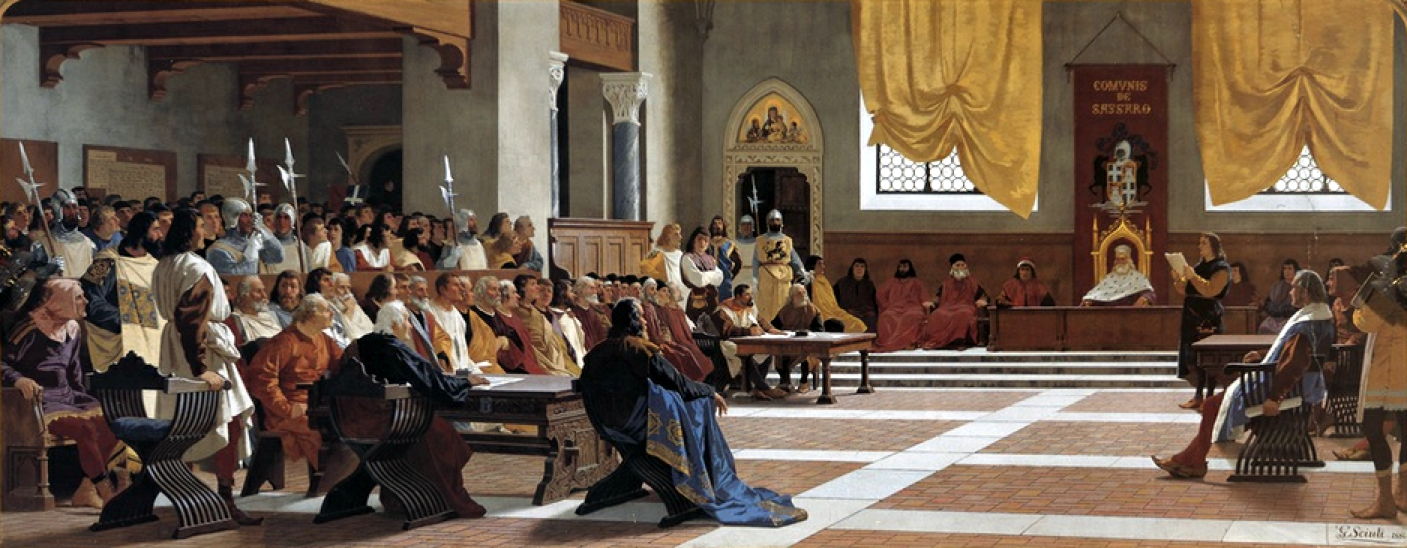
In 1284, the city of Sassari became the first and only independent city-state of Sardinia, joining more famous city-states such as Florence on the mainland. Proclamation of the Republic of Sassari (The Council of the Republic of Sassari) (1880) is Giuseppe Sciuti’s fresco in the Palazzo della Provincia, Sassari, showing his re-imagining of the moment of creation of that city-state, complete with knights in armour bearing long-hafted halberds.

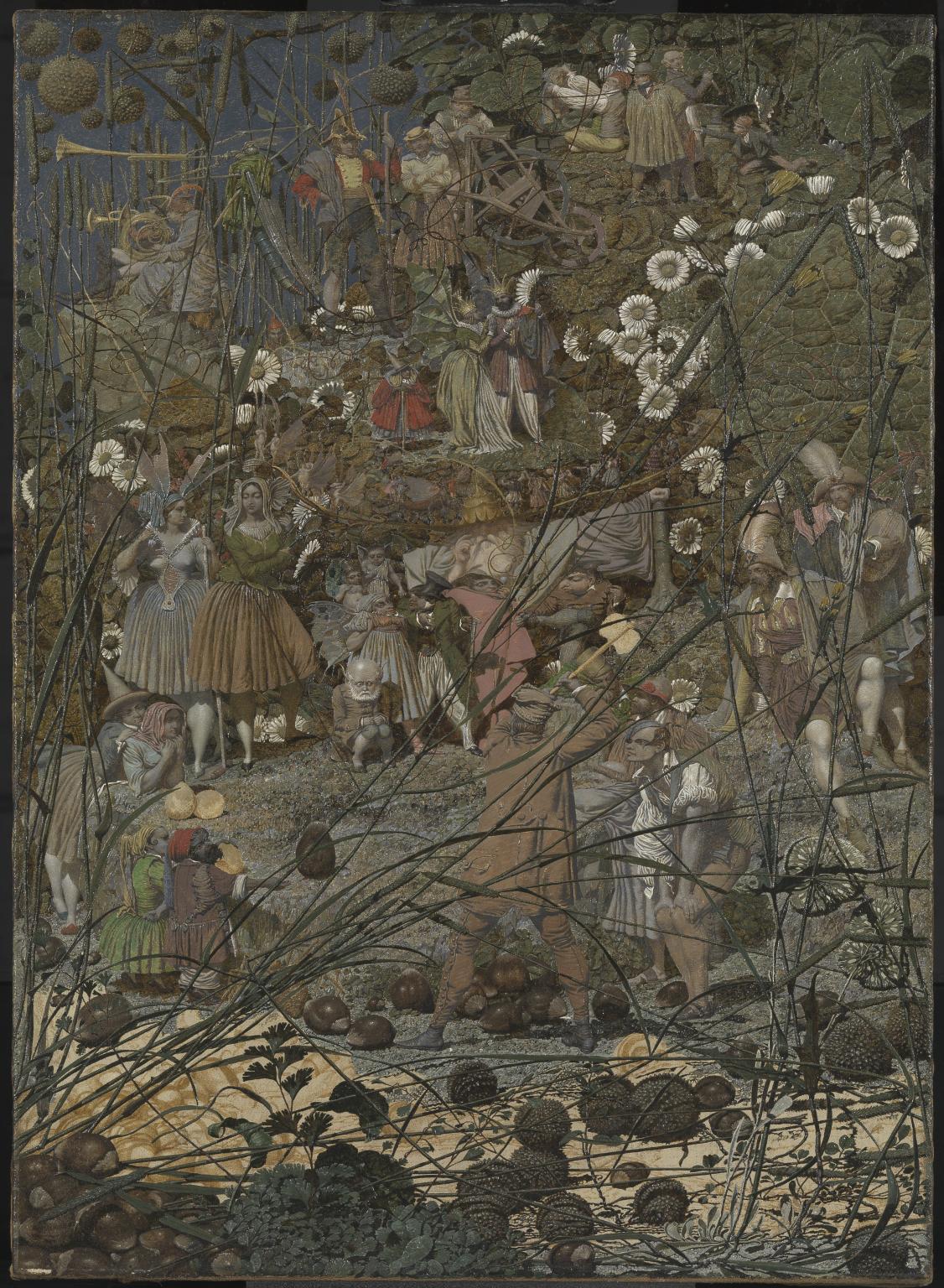
One of the most unusual paintings of an axe being swung is Richard Dadd’s phantasmagoric Fairy Feller’s Master-Stroke, completed over the period 1855-64 during his stay in Bethlem psychiatric hospital.

The Fairy Feller's Master-Stroke 1855-64 by Richard Dadd 1817-1886
Richard Dadd (1817–1886), The Fairy Feller’s Master-Stroke (1855-64), oil on canvas, 54 x 39.4 cm, The Tate Gallery, London (Presented by Siegfried Sassoon in memory of his friend and fellow officer Julian Dadd, a great-nephew of the artist, and of his two brothers who gave their lives in the First World War 1963). Photographic Rights © Tate 2016, CC-BY-NC-ND 3.0 (Unported), http://www.tate.org.uk/art/artworks/dadd-the-fairy-fellers-master-stroke-t00598

This has its origins in Shakespeare’s plays, with inspiration from Mercutio in Romeo and Juliet, and its main content drawn from A Midsummer Night’s Dream. We see Dadd’s scene through fine stalks of Timothy grass, the foreground with scattered hazelnuts and plane tree fruit. Although its perspective is flattened, the figures in the lower half of the painting are stood on a gently rising grassy sward, behind which is a steeper bank and stone walling (prominent at the right). Those in the upper third of the painting appear to be on another level, which rises more steeply towards the top edge.

The scene is set in the night-time, although daisy flowers are still unnaturally open, and there is night sky visible at the upper left. The feller himself, a hewer or fellow, seen at the centre (in the detail below), is about to cleave a hazelnut with his axe to provide a new carriage for Queen Mab (pronounced Maeve, to rhyme with rave), the queen of fairyland.

daddfairyfellersmaster-stroked1
Richard Dadd (1817–1886), The Fairy Feller’s Master-Stroke (detail) (1855-64), oil on canvas, 54 x 39.4 cm, The Tate Gallery, London (Presented by Siegfried Sassoon in memory of his friend and fellow officer Julian Dadd, a great-nephew of the artist, and of his two brothers who gave their lives in the First World War 1963). Photographic Rights © Tate 2016, CC-BY-NC-ND 3.0 (Unported), http://www.tate.org.uk/art/artworks/dadd-the-fairy-fellers-master-stroke-t00598
almatademaeducationchildrenclovis
Lawrence Alma-Tadema (1836–1912), The Education of the Children of Clovis (School of Vengeance, Training of Clotilde’s Sons) (1861), oil on canvas, 127 × 176.8 cm, Private Collection. Wikimedia Commons.

Lawrence Alma-Tadema’s The Education of the Children of Clovis (also known as The School of Vengeance, or The Training of Clotilde’s Sons) (1861) is a scene from Merovingian history, showing Saint Clotilde watching her young sons being taught the royal art of axe-throwing. It’s no wonder that later one of them was to murder two of her grandchildren.

Axe-throwing has recently been revived as a sport, although axes have a more sinister history in their use for executions.

bonnatmartyrdomstdenis
Léon Bonnat (1833–1922), The Martyrdom of Saint Denis (1874-88), oil on canvas marouflée, dimensions not known, The Panthéon, Paris. Wikimedia Commons.

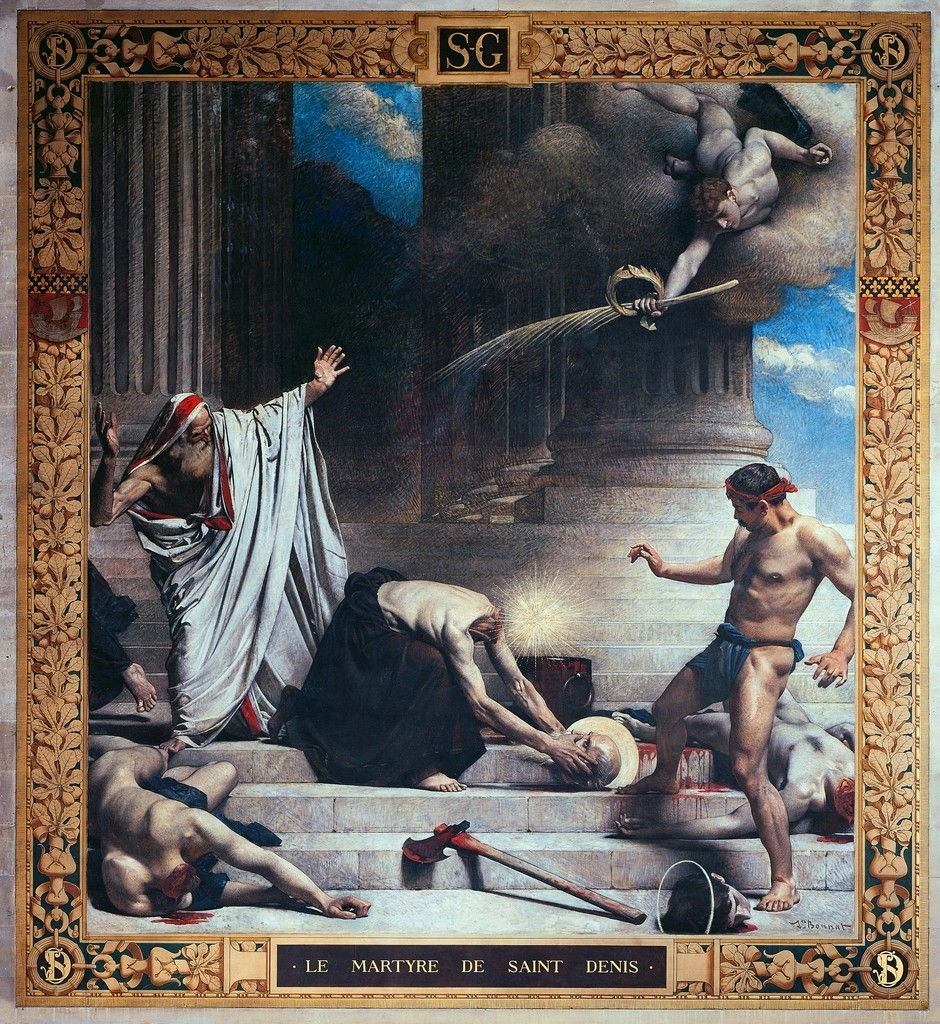
Léon Bonnat’s ornate showpiece in the Panthéon of The Martyrdom of Saint Denis (1874-88) tells this celebrated legend. Saint Denis, patron saint of Paris, was martyred by beheading on Montmartre hill at the edge of the city. It’s claimed that after his head had been cut off, Denis picked it up and walked around preaching a sermon. The legendary location became a place of veneration, then the Saint Denis Basilica, and the burial place for the kings of France.

IF
Paul Delaroche (1797–1856), The Execution of Lady Jane Grey (1833), oil on canvas, 246 x 297 cm, The National Gallery, London. Courtesy of The National Gallery, bequeathed by the Second Lord Cheylesmore, 1902.

Paul Delaroche’s convincing painting of The Execution of Lady Jane Grey (1833) shows the fate of a contender for the crown of England following the early death of King Edward VI at the age of just 15 in 1553. As he had no natural successor, he had drawn up a plan for a cousin, Lady Jane Grey, to become Queen. Her rule started on 10 July 1553, but King Edward’s half sister Mary deposed her on 19 July. She was committed to the Tower of London, convicted of high treason in November 1553, and executed on Tower Green by beheading on 12 February 1554 at the age of just 16 (or 17).

Lady Jane Grey and the Lieutenant of the Tower, Sir John Bridges, take the centre of the canvas. She is blindfolded, the rest of her face almost expressionless. As she can no longer see, the Lieutenant is guiding her towards the executioner’s block, in front of her. Her arms are outstretched, hands with fingers spread in their quest for the block. Under the block, straw has been placed to take up her blood.

At the right, the executioner stands high and coldly detached, his left hand holding the haft of the axe he will shortly use to kill the young woman. Coils of rope hang from his waist, ready to tie his victim down if necessary. At the left, two of Lady Jane Grey’s attendants or family are resigned in their grief.

binhamadryad
Émile Bin (1825–1897), The Hamadryad (1870), oil on canvas, Musée Thomas-Henry, Cherbourg-Octeville, France. Wikimedia Commons.

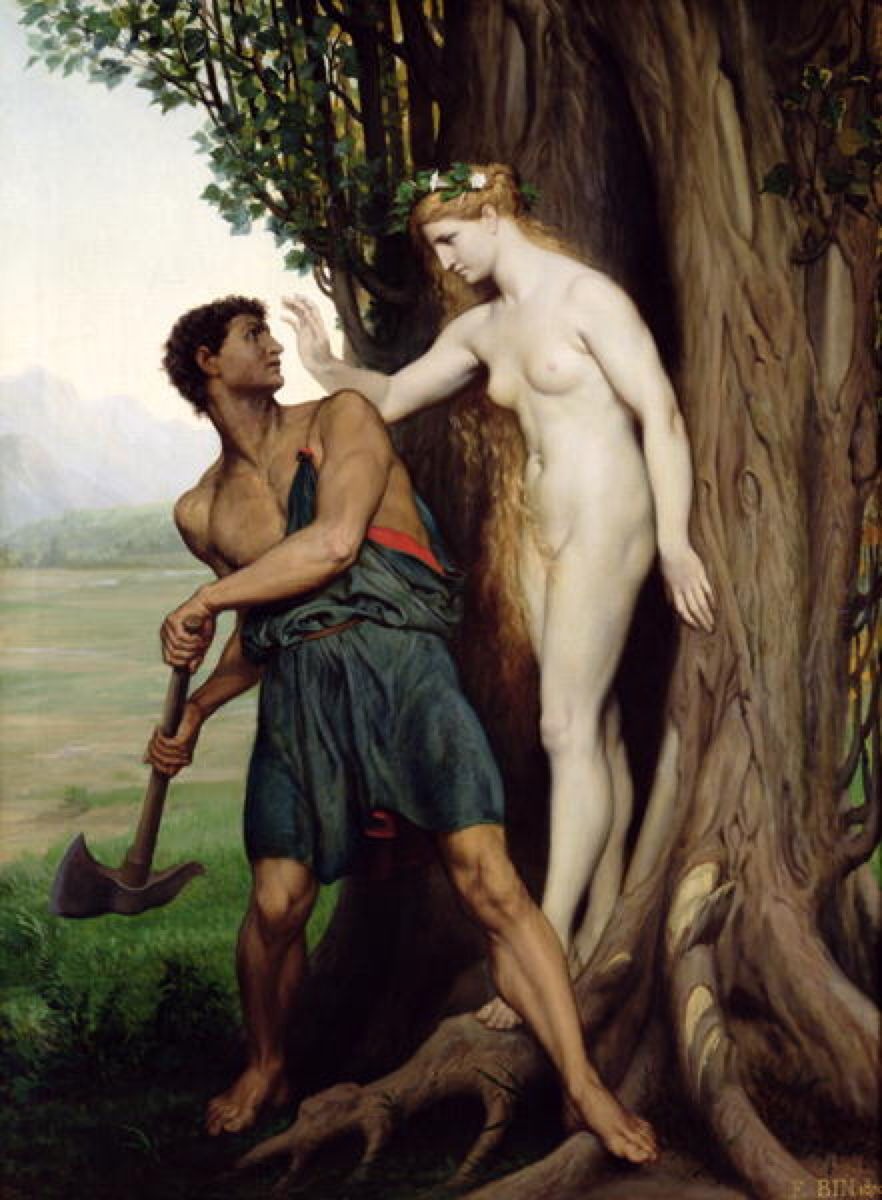
Axes are sometimes shown in their primary role for felling trees, as seen in Émile Bin’s The Hamadryad from 1870, shown in yesterday’s article.

biardmountainrefuge
François-Auguste Biard (1799–1882), In a Mountain Hut (date not known), oil on paper mounted on canvas, 31 × 37 cm, location not known. Wikimedia Commons.

They also make an occasional appearance as a commonplace tool of those who live in wilder surroundings. François-Auguste Biard’s sketchy view In a Mountain Hut may have been made in front of the motif. This has a strong vein of social realism, showing the abject poverty and spartan conditions of many who lived in the more remote areas of France, with an axe beside a well-worn besom in the left foreground.

❌
❌