Normal view

There are new articles available, click to refresh the page.
Before yesterdayMain stream

Painted stories of the Decameron: Nastagio degli Onesti’s breakfast

By: hoakley
24 November 2025 at 20:30

The stories told each day in Boccaccio’s Decameron follow a theme appointed by the ‘ruler’ of that day, as they decree when they are crowned with laurels at the end of the previous day’s storytelling. The theme chosen by the queen of the fifth day, Fiammetta, was the adventures of lovers who survived calamities or misfortunes and reached a state of happiness.

The eighth such story concerns the misfortunes of Nastagio degli Onesti, as told by Filomena. This appears to have been instantly successful, and by the early sixteenth century had been painted by both Botticelli and Ghirlandaio.

Nastagio degli Onesti was a young man from an old and noble family in Ravenna, who inherited a huge fortune, then fell in love with the daughter of a more noble family. His love for her wasn’t returned, though, and she was persistently cruel towards him. This caused the young Nastagio so much grief that he even contemplated suicide.

He continued to try to win her over, and in the course of that spent much of his inheritance. Friends and relatives feared for him and his future, and tried to persuade him to leave the city for a while. He was very reluctant, but finally travelled to Classe, three miles away, in May when the weather was fine.

Once there he wandered off into the local pine woods, thinking as he always did about his cruel love. As he walked in the wood, he heard the screams of a woman in distress. He then caught sight of her running naked towards him. In hot pursuit was a pair of large mastiff dogs, and behind them was a mounted knight brandishing a sword and threatening to kill her.

Nastagio took up a tree branch in her defence, but the knight ordered him by name to keep out, and let him and his dogs give the sinful woman what she deserved. Nastagio challenged the knight, who dismounted and introduced himself as Guido degli Anastagi. He then explained that he had fallen deeply in love with this woman many years ago, but she too had rejected him cruelly. As a result, Guido had killed himself, and was condemned to eternal punishment for that sin. The woman had died shortly afterwards, without repenting her cruelty, and she too was condemned to eternal punishment for her sin.

Their punishment consisted of Guido having to hunt her down in the woods, kill her using the same sword with which he had committed suicide, then cut her back open and remove her stone cold heart. That and her other organs he then has to feed to his dogs. After a short break, she is magically restored, and he has to resume hunting her as before.

Nastagio was horrified by this, stepped back, and watched the dead Guido kill the dead woman with his rapier, and go through the sequence of cutting out her heart and organs. A few moments later, after the ghostly dogs had eaten her organs, the dead woman jumped up and the hunt started all over again.

When he had recovered from the shock, Nastagio came up with a plan to deal with his own predicament. He summoned his friends and relatives, and agreed to stop trying to woo the woman that he loved on one condition, that she and her family should join him in the same place in the pine wood exactly one week later, for a magnificent breakfast banquet.

A week later all her family were present at the meal in the wood, and Nastagio carefully seated the woman he loved so she would get a grandstand view of the proceedings. No sooner had the last course been served, than they heard the dead woman’s screams, and she ran right in front of them.

Many of the guests tried to stop Guido from carrying out this punishment, so he explained to them what he had told Nastagio the week before. Eventually the ghostly couple rushed off again, and the guests talked avidly about what they had witnessed. But the person who was most affected by the spectacle was the cruel woman who Nastagio loved, who had perhaps already put herself in the position of the dead woman.

Nastagio’s plan paid off: the woman he loved soon sent him a servant to inform him that she would do anything he desired. She quickly consented to marriage, and they were wedded the following Sunday.

One perhaps unintended consequence of Nastagio’s breakfast demonstration was that, for some time to come, the women of Ravenna were so frightened of what could happen to them that they responded more favourably to the approaches of men.

anonnastagiostart
Artist not known, The Story of Nastagio degli Onesti (c 1450), manuscript copy, BNF MS Italien 63, fol. 186v, Boccaccio’s Decameron, Bibliothèque nationale de France, Paris. Wikimedia Commons.

The title page of this story in this illustrated manuscript copy of the Decameron from the fifteenth century features a small reminder of the grim human hunt scene at its head.

This gruesome story and ingenious reversal of conventional Christian values became popular and well-known through the fifteenth century, sufficient for it to be depicted in four tempera panels given on the occasion of the arranged marriage of Gianozzo Pucci and Lucretia Bini in 1483. The couple were particularly fortunate in that one of those who made the arrangement, and who had this gift made for them, was Lorenzo de’ Medici, ‘the Magnificent’, who was also Botticelli’s patron at the time, and the ruler of the Florentine Republic.

botticellinastagliodeglionesti1
Sandro Botticelli (1445–1510), The Story of Nastagio Degli Onesti I (1482-83), tempera on panel, 83 x 138 cm, Museo Nacional del Prado, Madrid, Spain. Wikimedia Commons.

The first panel shows the two figures of Nastagio, at the left, in the pine wood, with the naked woman running towards him, a mastiff sinking its teeth into her buttock. Behind them at the right is Guido, his sword ready to kill the woman when he catches her. In the distance is a coastal landscape intended to locate this near Ravenna, which is close to the Adriatic, although that’s idealised not representative.

botticellinastagiodeglionesti2
Sandro Botticelli (1445–1510), The Story of Nastagio Degli Onesti II (1482-83), tempera on panel, 82 x 138 cm, Museo Nacional del Prado, Madrid, Spain. Wikimedia Commons.

Botticelli continues to tell the story using multiplex (‘continuous’) narrative in the second painting. The dead Guido has now caught the dead woman, killed her with his rapier, and with her lying on her face, he is cutting her back open to remove her cold heart. His dogs are already eating her organs at the right, and Nastagio is visibly distressed at the left.

Behind that composite scene is an earlier scene of Guido and his dogs still in pursuit of the woman, preceding the image of the first painting in the series.

botticellinastagiodeglionesti3
Sandro Botticelli (1445–1510), The Story of Nastagio Degli Onesti III (1482-83), tempera on panel, 84 x 142 cm, Museo Nacional del Prado, Madrid, Spain. Wikimedia Commons.

In the third painting, Botticelli shows the breakfast banquet a week later, with the dead woman being attacked by Guido’s dogs, and Guido himself about to catch and kill her, in front of Nastagio’s guests.

Nastagio’s love is sitting at the table on the left, from which all the women have risen in distress at the sight, spilling their food in front of them.

botticellinastagiodeglionesti4
Sandro Botticelli (1445–1510), The Story of Nastagio Degli Onesti IV (1482-83), tempera on panel, 83 x 142 cm, Private collection. Wikimedia Commons.

The fourth and final panel shows Nastagio’s wedding, the bride and her women sitting to the left, and the men to the right, in formal symmetry. The groom is sat on the other side of the same table as the bride.

Botticelli’s series seems to have been celebrated at the time, and shortly afterwards Ghirlandaio, another Florentine master, was asked to make not copies, but paintings in the manner of Botticelli’s series. Two have survived, and are now both in the US.

ghirlandaionastagiony
Davide Ghirlandaio (David Bigordi) (1452–1525), Forest Scene from the Tale of Nastagio degli Onesti (after 1483), tempera on wood panel, 69.9 x 134.6 cm, Brooklyn Museum (A. Augustus Healy Fund and Carll H. de Silver Fund), New York, NY. Courtesy of Brooklyn Museum.

Ghirlandaio’s first panel, now in the Brooklyn Museum, is based on Botticelli’s first, with the addition of an extra scene to its multiplex narrative. Up in the right, he adds the scene from Botticelli’s second panel, showing Guido cutting out the dead woman’s heart through her back.

ghirlandaionastagiopa
Davide Ghirlandaio (David Bigordi) (1452–1525), Banquet Scene from the Tale of Nastagio degli Onesti (after 1483), tempera on wood panel, 70.2 x 135.9 cm, The Philadelphia Museum of Art (John G. Johnson Collection, 1917), Philadelphia, PA. Courtesy of The Philadelphia Museum of Art.

Ghirlandaio’s second panel shows an almost identical breakfast banquet to that in Botticelli’s third panel. This is now in the Philadelphia Museum of Art. I don’t know whether Ghirlandaio’s series extended to a third, completing the story with the marriage feast of Nastagio.

Boccaccio’s strange tale, twisted from source material by Dante, resulted in even more curious paintings. Today we might be only too happy to watch it in a horror movie, but seeing it come to life in a series of panels as a wedding gift? That’s surely typical of the late Middle Ages.

Botticelli’s studio

By: hoakley
7 November 2025 at 20:30

Artists seldom painted the interior of their studio until the nineteenth century, and it was unheard of in the Renaissance. So when you’re offered a glimpse into that of Sandro Botticelli in the 1480s you’d be justifiably suspicious, particularly when it wasn’t painted until 1922, over half a millennium later.

Nevertheless, almost exactly eleven years ago, on the fifth of November 2014, a remarkable painting claiming to depict Botticelli’s studio at that time was auctioned in New York. Captured on its canvas were the faces of those long dead, those of the artist and members of the Medici family.

fortescuebrickdalebotticellisstudio
Eleanor Fortescue-Brickdale (1872–1945), Botticelli’s studio: The first visit of Simonetta presented by Giulio and Lorenzo de Medici (1922), oil on canvas, 74.9 × 126.4 cm, Private collection. Wikimedia Commons.

The painting’s title reveals its key figures: Botticelli’s studio: The first visit of Simonetta presented by Giulio and Lorenzo de Medici (1922). The artist stands at the left in front of an exquisite tondo he is working on. Bowing to him at the centre is Giuliano de’ Medici, who is accompanied by Simonetta Vespucci, wearing the green dress. Behind her is Lorenzo de’ Medici, also known as Lorenzo the Magnificent, and behind him are Giovanna Tornabuoni and her attendants. The view through the window is of the Palazzo Vecchio in the centre of Florence.

Painted by the British artist Eleanor Fortescue-Brickdale, those figures weren’t based on models or imagination, but on contemporary sources.

ghirlandaiogiovannatornabuoni
Domenico Ghirlandaio (1449–1494), Giovanna Tornabuoni and attendants, detail of The Visitation (c 1488), fresco, dimensions not known, Tornabuoni Chapel, Santa Maria Novella Church, Florence. Wikimedia Commons.

Giovanna Tornabuoni comes from a detail of Domenico Ghirlandaio’s painting The Visitation (c 1488) in the Tornabuoni Chapel of the Church of Santa Maria Novella in Florence. Giovanna was born as Giovanna degli Albizzi in 1468, married Lorenzo Tornabuoni in 1486 when she was about eighteen, and died in childbirth two years later in 1488. She is here accompanied by her maid and nurse.

macchiettilorenzodemedici
Girolamo Macchietti (1535–1592), Lorenzo the Magnificent (Lorenzo de’ Medici (1449-1492)) (date not known), oil, dimensions not known, location not known. Wikimedia Commons.

Lorenzo de’ Medici (1449-1492) hails from Girolamo Macchietti’s undated portrait of Lorenzo the Magnificent. Lorenzo was born in 1449 into the banking family, the grandson of Cosimo de’ Medici, at the time one of the wealthiest and most powerful people in Europe. Lorenzo was groomed for power, and became de facto ruler of the Florentine Republic when his father died in 1469.

He survived an attempted assassination in the Cathedral of Santa Maria del Fiore on Easter Sunday 1478, in which his brother Giuliano was stabbed to death. This led to his excommunication, and invasion by forces of the King of Naples. He resolved that, and died in 1492, when he was forty-three.

botticelligiulianodemedici
Sandro Botticelli (1445–1510), Portrait of Giuliano de’ Medici (c 1475), tempera on panel, 54 x 36 cm, Accademia Carrara, Bergamo, Italy. Wikimedia Commons.

Botticelli also painted this Portrait of Giuliano de’ Medici in about 1475. Giuliano was born in 1453, younger brother and co-ruler of the Florentine Republic with Lorenzo. He was brutally murdered in that attack in the cathedral on Easter Sunday 1478, dying at the age of twenty-five. Although he never married, an illegitimate son of his became Pope Clement VII.

botticellimagnificatmadonna
Sandro Botticelli (1445–1510), Madonna of the Magnificat (1483), tempera on panel, diameter 118 cm, Galleria degli Uffizi, Florence. Wikimedia Commons.

The painting shown in progress is Botticelli’s Madonna of the Magnificat, thought to have been completed in 1483. It shows the Virgin Mary being crowned by a pair of angels, writing down the start of the Magnificat in a book, and holding a pomegranate in her left hand. It has also been interpreted as a family portrait of the de’ Medicis, in which the Virgin is Lucrezia Tornabuoni, the mother of Lorenzo and Giuliano de’ Medici, who are the angels. I believe that Lucrezia was one of Giovanna Tornabuoni’s aunts by marriage.

botticelliadorationmagidet
Sandro Botticelli (1445–1510), The Adoration of the Magi (detail) (c 1475), tempera on wood, dimensions not known, Galleria degli Uffizi, Florence. Wikimedia Commons.

The source of the likeness of Botticelli is more of a problem, as he isn’t known to have painted a formal self-portrait. It’s generally believed, though, that he revealed himself in cameo in this detail from his The Adoration of the Magi from about 1475.

lippifcrucifixionstpeter
Filippino Lippi (1457–1504), Disputation with Simon Magus and Crucifixion of St Peter (detail) (1424-28), fresco, dimensions not known, Cappella Brancacci, Santa Maria del Carmine, Florence. Image by Marie-Lan Nguyen, via Wikimedia Commons.

It’s also thought that Filippino Lippi included his portrait in this section he painted in 1483-84 of Massaccio’s incomplete fresco in the Cappella Brancacci, Santa Maria del Carmine, Florence, in Disputation with Simon Magus and Crucifixion of St Peter.

But of all the figures shown in this painting, Simonetta Vespucci is the most fascinating. She was born Simonetta Cattaneo in 1453, and when she was only fifteen or sixteen, she married Marco Vespucci, cousin of Amerigo Vespucci, the first to demonstrate that the New World of the West Indies and Brazil wasn’t part of Asia.

Once married, she lived with her husband in Florence, where she was a great favourite at the court of the de’ Medicis. Giuliano de’ Medici entered a jousting tournament in 1475 bearing a banner with an image of Simonetta as Pallas Athene, painted by Botticelli. She had the reputation of being the most beautiful woman in the whole of northern Italy, but that beauty was fleeting as she died of tuberculosis in 1476, when she was only twenty-two.

pierodicosimosimonettavespucci
Piero di Cosimo (1462–1521), Portrait of Simonetta Vespucci (1490), media not known, 57 x 42 cm, Musée Condé, Chantilly, France. Wikimedia Commons.

Many paintings have been claimed to be portraits of her, but perhaps the most credible is Piero di Cosimo’s Portrait of Simonetta Vespucci from 1490.

botticelliportraitlady
Sandro Botticelli (1445–1510), Idealized Portrait of a Lady (Portrait of Simonetta Vespucci as Nymph) (1480), media not known, 81.8 x 54 cm, Städelsches Kunstinstitut und Städtische Galerie, Frankfurt, Germany. Wikimedia Commons.

Several of Botticelli’s works have been claimed to feature figures for which Simonetta modelled, even the naked Venus in his famous The Birth of Venus (1484-86). The least unlikely might be his Idealized Portrait of a Lady, also known as Portrait of Simonetta Vespucci as Nymph, thought to have been painted in 1480, four years after her death. Such portraits were commonly not true to life, but idealisations intended to flatter rather than identify, so we will never know if she was its subject.

Inevitably, time in Botticelli’s studio is slightly out of joint. The figures might have been able to gather together in this way in about 1475, before the deaths of Simonetta and Giuliano de’ Medici, but that is well before Botticelli might have painted Madonna of the Magnificat, and when Giovanna Tornabuoni was still a child.

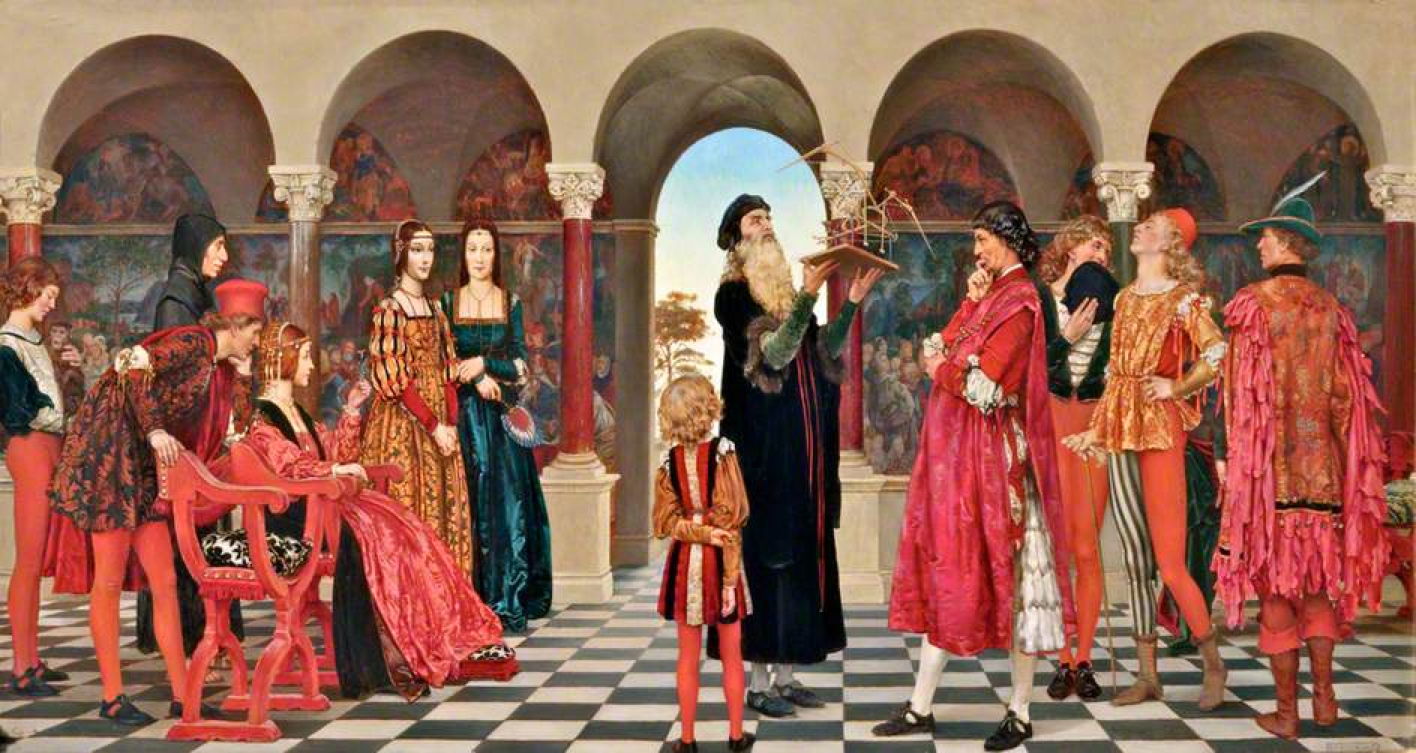
This remarkable painting was the second of its kind by Eleanor Fortescue-Brickdale.

fortescuebrickdaleforerunner
Eleanor Fortescue-Brickdale (1872–1945), The Forerunner (1920), oil on canvas, 59.6 × 122 cm, Lady Lever Art Gallery, Liverpool, England. Wikimedia Commons.

Two years previously, in 1920, she had painted The Forerunner, showing Leonardo da Vinci trying to convince the Milanese court of his idea for flying machines. Notable figures included here are (from the left) Savonarola (from Fra Bartolomeo’s portrait), Beatrice d’Este (Duchess of Milan), Cecilia Gallerani, Elisabetta Gonzaga, Leonardo da Vinci, and Ludovico Sforza (Duke of Milan, and Leonardo’s patron).

Eleanor Fortescue-Brickdale sold The Forerunner to Lord Leverhulme, and it is now on view in the Lady Lever Art Gallery. She was subsequently commissioned to paint Botticelli’s Studio in 1922 for Montague Rendell. That was shown at the Royal Academy later that year, and has been in a succession of private collections since.

❌
❌