
Normal view

There are new articles available, click to refresh the page.
Before yesterdayMain stream

Painted stories of the Decameron: Griselda’s suffering

By: hoakley
5 January 2026 at 20:30

The last story in Boccaccio’s Decameron is the tenth of the tenth day, told by Dioneo. For the modern reader, it’s a strange conclusion praising submission and obedience in marriage. It’s a re-telling of the folk story of Griselda, which was taken up by Chaucer in the Clerk’s Tale, by Charles Perrault in his stories in the seventeenth century, and by many others even into the twentieth century, and seems to have been told exclusively by men. Although Dioneo does condemn Griselda’s husband for his “senseless brutality”, the persistence of this folk tale is disturbing.

Gualtieri inherited the title of Marquis of Saluzzo, and was soon being urged to marry so that he would have an heir. He resisted, but had recently noticed a beautiful young girl from a neighbouring village, so decided to marry her. His friends were delighted, and arranged a splendid wedding for the couple.

steimergriselda
Henry Steimer (fl 1900-1920), Griselda (date not known), illustration in ‘Contes de Perrault’, Jules Rouff et Cie, Paris, further details not known. Wikimedia Commons.

Henry Steimer’s illustration for an edition of the stories of Charles Perrault from the early twentieth century shows Griselda spinning by hand at the side of a river, as Gualtieri watches from his horse. Steimer was also an early cartoonist.

Early on the day of the wedding, Gualtieri rode forth with all those friends to fetch his bride Griselda. When he had met her father and confirmed with his bride that she would always try to please him, would never be upset by anything he said or did, and would obey him, Gualtieri proceeded with the ceremony. He then took Griselda outside, stripped her naked, and had her dressed in her new clothes and shoes, with a crown upon her head. Gualtieri and Griselda were married there, and went back to celebrate and feast in his house.

pesellinostorygriselda
Francesco Pesellino (1422–1457), Episode from the Story of Griselda (1445-50), tempera on panel, 44 x 110 cm, Accademia Carrara, Bergamo, Italy. Wikimedia Commons.

Between 1445-50, Francesco Pesellino painted panels telling the story of Griselda. This is a composite, using multiplex narrative, in which Gualtieri prepares to leave his house, at the left, rides to Griselda’s (centre), where he strips her naked prior to dressing her in fine clothes and marrying her (right).

haweisgriseldasmarriage
Mary Eliza Haweis (1848-1898), Griselda’s Marriage (1882), illustration in ‘Chaucer for Children’, further details not known. Wikimedia Commons.

Mary Eliza Haweis’ illustration of Griselda’s Marriage from 1882 was made for her book Chaucer for Children, so avoids its full detail.

Griselda was transformed by her marriage, and proved a dutiful and obedient wife, winning the hearts of all those who knew her. She soon became pregnant, and was duly delivered of a daughter. Following this, her husband started to make her life a misery. He first pretended to be angry, and accused her of falling to a lowly condition now she had a child. She accepted his rebukes, and told him that she would be content with whatever he decided to do to her.

Gualtieri then instructed one of his servants to go to his wife and take their daughter away and murder her. Griselda was again entirely compliant, accepting her husband’s will. In fact he didn’t have the infant killed, but spirited her away to be brought up by relatives elsewhere.

haweisgriseldassorrow
Mary Eliza Haweis (1848-1898), Griselda’s Sorrow (1882), illustration in ‘Chaucer for Children’, further details not known. Wikimedia Commons.

Mary Eliza Haweis’ illustration shows Griselda’s Sorrow (1882) in stoical terms.

Griselda again fell pregnant, this time giving birth to a boy. Her husband repeated his verbal abuse of her afterwards, then had the baby taken away to be ‘killed’, as far as she was told, when in fact the child was sent away to the same relatives.

Some years later, Gualtieri decided to put Griselda to a final test. He told others that he could no longer stand his wife, and would obtain Papal dispensation to divorce her so he could marry another. Griselda was filled with despair, as she would have to return to her father and work for him as a shepherdess again, but she didn’t voice those thoughts, only prepared herself for what seemed inevitable.

Gualtieri arranged for forged letters from Rome to support his claim that he had been granted dispensation for a divorce. Griselda accepted her distressing situation, returned her wedding ring, and was cast out of Gualtieri’s house barefoot, wearing nothing but a shift.

Gualtieri then announced that he would be marrying the daughter of a Count. He sent for Griselda, and told her to put his house in order ready for her to arrive for their wedding. She did so wearing her coarse woollen clothes from the country, cleaning all the rooms and making them ready. She then sent invitations to all the ladies in the area to the marriage feast, and on the appointed day of the wedding welcomed them all.

Gualtieri arranged for Griselda’s children, then flourishing at the ages of twelve and six, to be brought to his house. As Griselda was welcoming guests to the wedding, Gualtieri decided that the time had come to reveal the truth to her, and to stop making her suffer. He told her what he had done, introduced their children to her, embraced and kissed Griselda, who was weeping with joy.

The ladies who had been invited to the sham wedding took Griselda away and dressed her up as the queen she deserved to be. Gualtieri ensured his father-in-law was set up in comfort. And Gualtieri and Griselda lived happily ever after.

The finest series of paintings telling this story are the Spalliera Panels in London’s National Gallery, painted in 1494.

anonstorygriselda1
Master of the Griselda Legend (fl 1490-1500), The Story of Griselda, Part I: Marriage (1494), oil and tempera on wood, 61.6 x 154.3 cm, The National Gallery, London. Wikimedia Commons.

The first appears to have been inspired by Pesellino’s earlier panels, and tells of Gualtieri and Griselda’s wedding using multiplex narrative. At the far left, Gualtieri is hunting prior to his decision to marry. He then sets out on horseback to ride to Griselda’s house. At the right, Griselda is shown naked, as she’s just about to be dressed in her fine clothing. In the centre the couple are married.
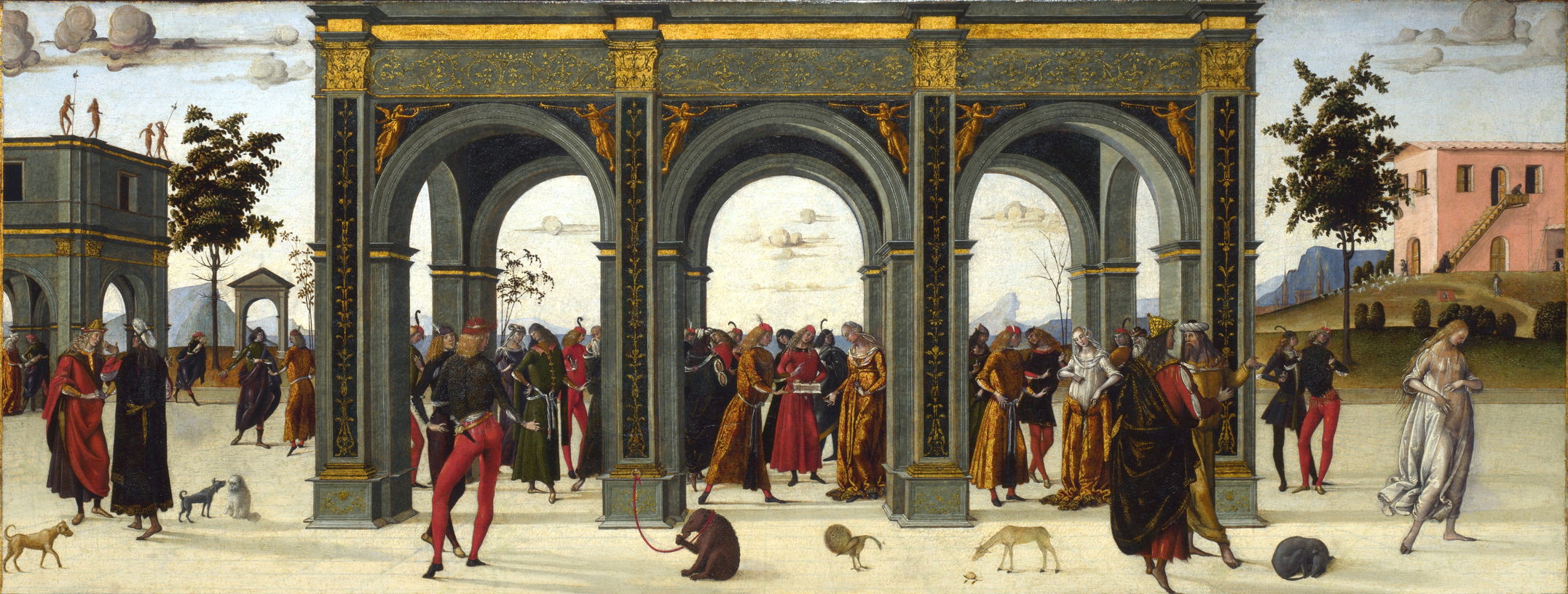
anonstorygriselda2
Master of the Griselda Legend (fl 1490-1500), The Story of Griselda, Part 2: Exile (1494), oil and tempera on wood, 61.6 x 154.3 cm, The National Gallery, London. Wikimedia Commons.

The second panel is set in the grander surroundings of Gualtieri’s house. At the left edge, Griselda’s infant is taken from her apparently to be killed. In the centre, she is shown the forged Papal dispensation dissolving her marriage, then to the right she is removing her fine clothes prior to leaving Gualtieri’s house (detail below). At the far right she is barefoot, wearing just her shift, with her father’s house in the background.

anonstorygriselda2d1
Master of the Griselda Legend (fl 1490-1500), The Story of Griselda, Part 2: Exile (detail) (1494), oil and tempera on wood, 61.6 x 154.3 cm, The National Gallery, London. Wikimedia Commons.
anonstorygriselda3
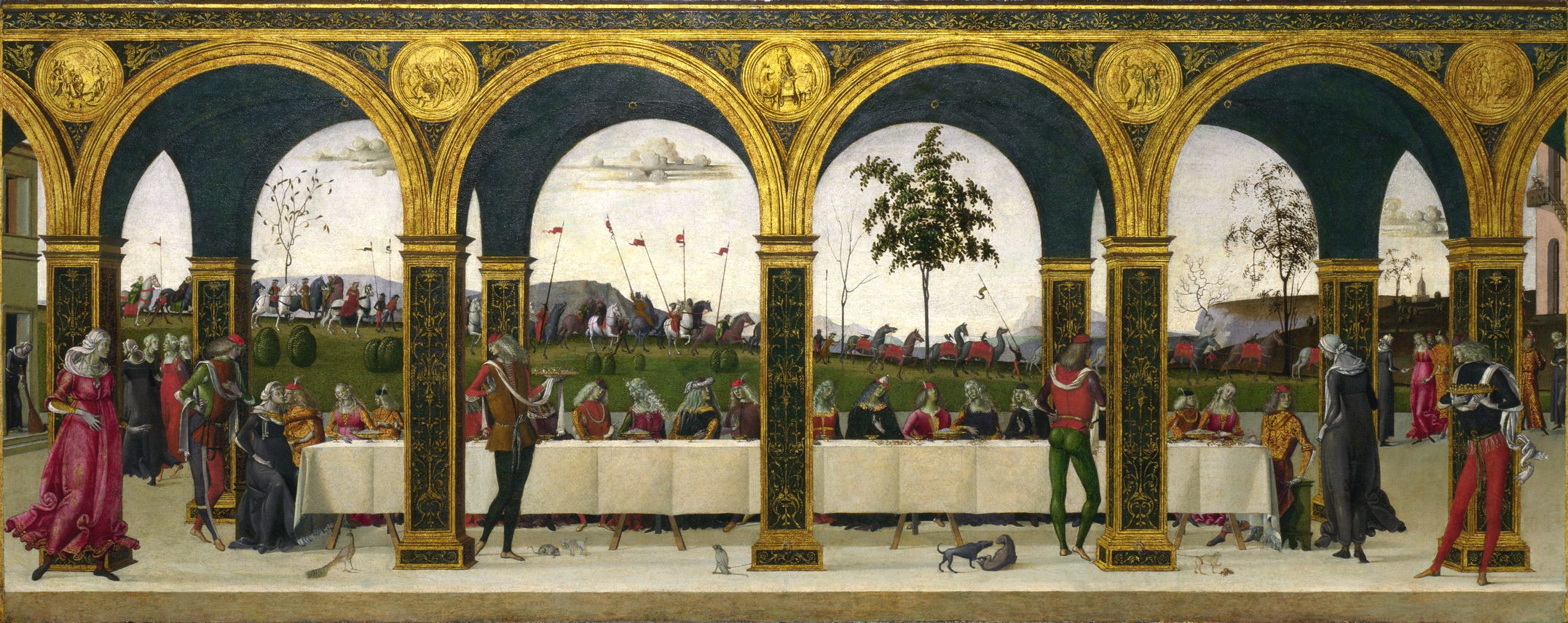
Master of the Griselda Legend (fl 1490-1500), The Story of Griselda, Part 3: Reunion (1494), oil and tempera on wood, 61.6 x 154.3 cm, The National Gallery, London. Wikimedia Commons.

The final panel shows scenes from the end of the story. At the right edge, Gualtieri tells Griselda (now dressed in black) to prepare his house for the wedding, which she does by sweeping it, at the left edge. Between those is the wedding feast: at the right, Griselda, still in black, talks with Gualtieri as he sits at the table. At the left end of the table, Griselda and Gualtieri embrace and kiss in reconciliation.

On the eleventh day, the ten young fugitives from the plague in Florence returned to the city, and Boccaccio’s Decameron comes to an end. But I still have one more story, the one hundred and first, that I’ll tell next week.

Painted stories of the Decameron: Introduction

By: hoakley
17 November 2025 at 20:30

Many great literary works are compilations of shorter tales, set in a framing story. Among the best known are One Thousand and One Nights and Sanskrit epics including Mahabharata. Among the most enduring in post-classical Europe is Boccaccio’s Decameron, whose stories have also proved popular with painters. Over the next couple of months I’m going to summarise those that have been well depicted in this new series, and show those paintings.

Despite the number of scholars who have researched Giovanni Boccaccio’s life over the last seven hundred years, much of it remains vague. He was either born in Florence, or perhaps near the village of Certaldo to the south-west of the city. His father worked for the Bardi bank, but he is thought to have been illegitimate and his mother hasn’t been identified.

We do know that he was born on 16 June 1313, and while still a child his father married a woman from a rich family, then moved to Naples. At the time, that was a major cultural centre, and as a young man Boccaccio immersed himself in that. His father expected him to become a banker, and Giovanni started work as an apprentice in his father’s bank in the city.

Boccaccio had no interest in banking though, and persuaded his father to let him study canon (ecclesiastical) law at the city’s university. When he was in his twenties, his father introduced him to the Neapolitan court and cultural circles around Robert the Wise, King of Naples. Among Boccaccio’s most important influences at this time was the scholar Paolo da Perugia, who had amassed much information about classical myths. Boccaccio became a scholar, particularly of the classical world, a writer rather than an ecclesiastical lawyer, and his future started to crystallise when he wrote his first poetry.

His early works became sources for Chaucer’s Troilus and Criseyde (Troilus and Cressida), and the Knight’s Tale.

Boccaccio left Naples in 1341, as tensions were growing between its king and the city-state of Florence, and returned to live mainly in Florence, although he also spent time in Ravenna. He developed great admiration for the work of Dante Alighieri, who had died in Ravenna twenty years earlier, and the great poet Francesco Petrarca (Petrarch) (1304-1374), whom he regarded as his teacher.

vasarisixtuscanpoets
Giorgio Vasari (1511–1578), Six Tuscan Poets (1544), oil on panel, 132 x 131.1 cm, Minneapolis Institute of Arts, Minneapolis, MN. Wikimedia Commons.

Giorgio Vasari is now more famous for his biographies of the important painters of the Renaissance and earlier, but was also an accomplished artist himself. His tribute to some of the greatest writers of the period is Six Tuscan Poets from 1544. From left to right, I believe these to be Dante Alighieri, Francesco Petrarca (Petrarch), Guido Cavalcanti, Giovanni Boccaccio, Cino da Pistoia, and Guittone d’Arezzo.

scottboccacciotodantesdaughter
William Bell Scott (1811–1890), Boccaccio’s Visit to Dante’s Daughter (date not known), oil on canvas, further details not known. Wikimedia Commons.

William Bell Scott’s undated painting of Boccaccio’s Visit to Dante’s Daughter shows the writer paying indirect homage to his illustrious predecessor. Boccaccio wrote the first biography of Dante, at about the same time he was writing the Decameron.

During the 1340s Boccaccio appears to have been developing the idea of a book in which seven characters take it in turns to tell stories. When the Black Death struck Florence in 1348, killing Boccaccio’s stepmother, this provided him with its framing story. He was already building his collection of tales to form the bulk of the book, and it’s thought he started its writing shortly after the Black Death. What is more doubtful is whether Boccaccio was living in Florence when the epidemic struck. However, as it raged through the whole of Tuscany in that year, hardly sparing a village, it’s most unlikely that he didn’t observe its effects somewhere, perhaps in Ravenna.

In 1349, Boccaccio’s father died, leaving Giovanni as the head of the household. In spite of that, he pressed on and had largely completed the first version in 1352. He revised it in 1370-71, and ever since it has been widely read, translated into all major languages, and its stories have inspired many works of art.

wappersboccaccioreading
Egide Charles Gustave Wappers (1803–1874), Boccaccio Reading from the Decameron to Queen Johanna of Naples (1849), oil on canvas, 171 x 228 cm, Koninklijke Musea voor Schone Kunsten van België / Musées Royaux des Beaux Arts de Belgique, Brussels, Belgium. Image by Georges Jansoone, via Wikimedia Commons.

Egide Charles Gustave Wappers painted Boccaccio Reading from the Decameron to Queen Johanna of Naples in 1849. Queen Joanna I of Naples (1328-1382) had a reputation that was more than controversial, but Boccaccio was a supporter, and wrote a complementary account in his collection of biographies of famous women, De Mulieribus Claris (On Famous Women).

master1482boccaccioflorentines
Master of 1482 and Follower (fl 1485), Giovanni Boccaccio and Florentines who have Fled from the Plague (c 1485), miniature on vellum, in The Decameron, translated by Laurent de Premierfait, Koninklijke Bibliotheek, The Hague, The Netherlands. Wikimedia Commons.

This miniature by the Master of 1482 and Follower conflates Boccaccio, the Black Death in Florence, and the framing story of the Decameron: Giovanni Boccaccio and Florentines who have Fled from the Plague was painted in about 1485 on vellum, in what must have been one of its first illustrated editions.

The Decameron opens with a description of the horrific conditions and events that overwhelmed Florence when the Black Death struck, then takes us to a group of seven young women who are sheltering in one of its great churches. They decide to leave the city rather than waiting amid its rising pile of corpses, to spend some time in the country nearby. They take some servants and three young men to accompany them there.

Once settled in an abandoned mansion, the ten decide that one of the means they will use to pass their self-imposed exile is to tell one another stories. Over the next two weeks, each tells one story on every weekday, delivering a total of one hundred, hence the title of the book.

sorbidecameron
Raffaello Sorbi (1844–1931), The Decameron (1876), oil on canvas, 45.5 x 88.7 cm, Private collection. Wikimedia Commons.

Raffaello Sorbi show the group of ten during one of the story-telling sessions in The Decameron from 1876, with the city of Florence in the distance.

postiglionedecameron
Salvatore Postiglione (1861–1906), Scene of the Narration of the Decameron (date not known), oil on canvas, 100 x 151 cm, location not known. Wikimedia Commons.

Salvatore Postiglione’s undated, ornate and almost illustrative Scene of the Narration of the Decameron is unusual for omitting one of the seven young women, but links visually to their other musical and craft activities.

Relatively few of the hundred tales in the Decameron have been committed to paint. Some are little more than brief fables, or what used to be known as shaggy dog stories. Others are more lengthy novellas with intricate twisting plots. But many have been painted from the Renaissance until well into the twentieth century, and were particularly popular with the Pre-Raphaelites.

pesellinolifegriseldis
Francesco Pesellino (1422–1457), Scene from the Life of the Griseldis (c 1450), tempera on panel, 42 × 47 cm, Accademia Carrara, Bergamo, Italy. Wikimedia Commons.

The tale of Griselda has cropped up in folk stories across Europe before it was told as the final tale (Day 10, Story 10) of the Decameron. It was then taken up by Chaucer in the Clerk’s Tale, and by Charles Perrault. Francesco Pesellino painted it in this Scene from the Life of the Griseldis from around 1450.

botticellinastagliodeglionesti1
Sandro Botticelli (1445–1510), The Story of Nastagio Degli Onesti I (1482-83), tempera on panel, 83 x 138 cm, Museo Nacional del Prado, Madrid, Spain. Wikimedia Commons.

One of the most significant series of paintings of the Decameron is Sandro Botticelli’s Story of Nastagio Degli Onesti, of which this is the first. Boccaccio includes this horrific tale as the eighth story on Day 5, shown by Botticelli in four panels that were commissioned as a wedding gift for a couple whose marriage was partly arranged by Lorenzo the Magnificent (Lorenzo de’ Medici), ruler of the Florentine Republic in the late fifteenth century, and Botticelli’s patron.

millaisisabella
John Everett Millais (1829–1896), Isabella (Lorenzo and Isabella) (1848-49), oil on canvas, 103 x 142.8 cm, Walker Art Gallery, Liverpool, England. Wikimedia Commons.

One of the earliest and greatest examples of Pre-Raphaelite painting is John Everett Millais’ Isabella (Lorenzo and Isabella) from 1848-49. When exhibited at the Royal Academy in 1849, it was accompanied by lines from John Keats’ poem Isabella or the Pot of Basil, referring to the story of the ill-fated love of Lisabetta for Lorenzo, the fifth told on Day 4.

stillmanenchantedgardenmesseransaldo
Marie Spartali Stillman (1844–1927), The Enchanted Garden of Messer Ansaldo (1889), watercolour and gouache on paper mounted on panel, 72.4 × 102.9 cm, Private collection. Image courtesy of Julian Hartnoll, Pre‑Raphaelite Inc., via Wikimedia Commons.

Later in the nineteenth century, Marie Spartali Stillman painted The Enchanted Garden of Messer Ansaldo (1889), showing a scene from the fifth story of Day Ten. This was also painted by John William Waterhouse in 1916-17.

leightoncymoniphigenia
Frederic, Lord Leighton (1830-1896), Cymon and Iphigenia (1884), oil on canvas, 218.4 x 390 cm, Art Gallery of New South Wales, Sydney, Australia. Wikimedia Commons.

Perhaps the most popular of all the stories in the Decameron with visual artists has been the romance of Cymon and Iphigenia, here shown in Frederic, Lord Leighton’s luscious and languid painting from 1884.

I hope that you will join me in looking at many more wonderful paintings exploring Boccaccio’s stories from the Decameron in the coming weeks.

❌
❌