Normal view

There are new articles available, click to refresh the page.
Before yesterdayMain stream

In memoriam Carlos Schwabe: 2 1898-1908

By: hoakley
22 January 2026 at 20:30

One hundred years ago today, on 22 January 1925, Carlos Schwabe (1866–1926) died in the town of Avon, in Fontainebleau Forest, France, at the age of only 59. In last week’s article, I outlined his career and showed examples of his art up to 1896, when he completed a set of illustrations for an edition of Baudelaire’s poems Les Fleurs du Mal (Flowers of Evil) published in 1900.

In February 1896, Schwabe was among those who exhibited with les artistes de l’âme (Artists of the Soul) in the lobby of Théâtre de la Bodinière in Paris. Other noted Symbolists who had formed this breakaway movement included Edmond Aman-Jean, Alphonse Osbert and Lucien Lévy-Dhurmer. Although it attracted the attention of the critics of the day, its impact was less than that of the earlier Salon de la Rose+Croix.

schwabefervaal
Carlos Schwabe (1866–1926), Poster for ‘Fervaal’ (1898), design for a poster for a performance of Vincent d’Indy’s opera ‘Fervaal’ on 10 May 1898 at the Théâtre de l’Opéra-Comique, Paris. Location not known, restored by Adam Cuerden. Wikimedia Commons.

In 1898, Schwabe designed and painted this poster for the French première performance of his friend Vincent d’Indy’s opera Fervaal, staged on 10 May 1898 at the Théâtre de l’Opéra-Comique, Paris. Based in part on an obscure Swedish poem, it centres on Celtic battles with Saracens, with a good deal of Norse mythology and sorcery added. This painting shows the closing moments, when the Gaulish hero of the title carries the lifeless body of his lover, daughter of the Saracen emir and a sorceress, up a mountain just as the reign of a ‘new God’ is about to start. Sadly, the opera wasn’t a success, and has seldom been performed since.
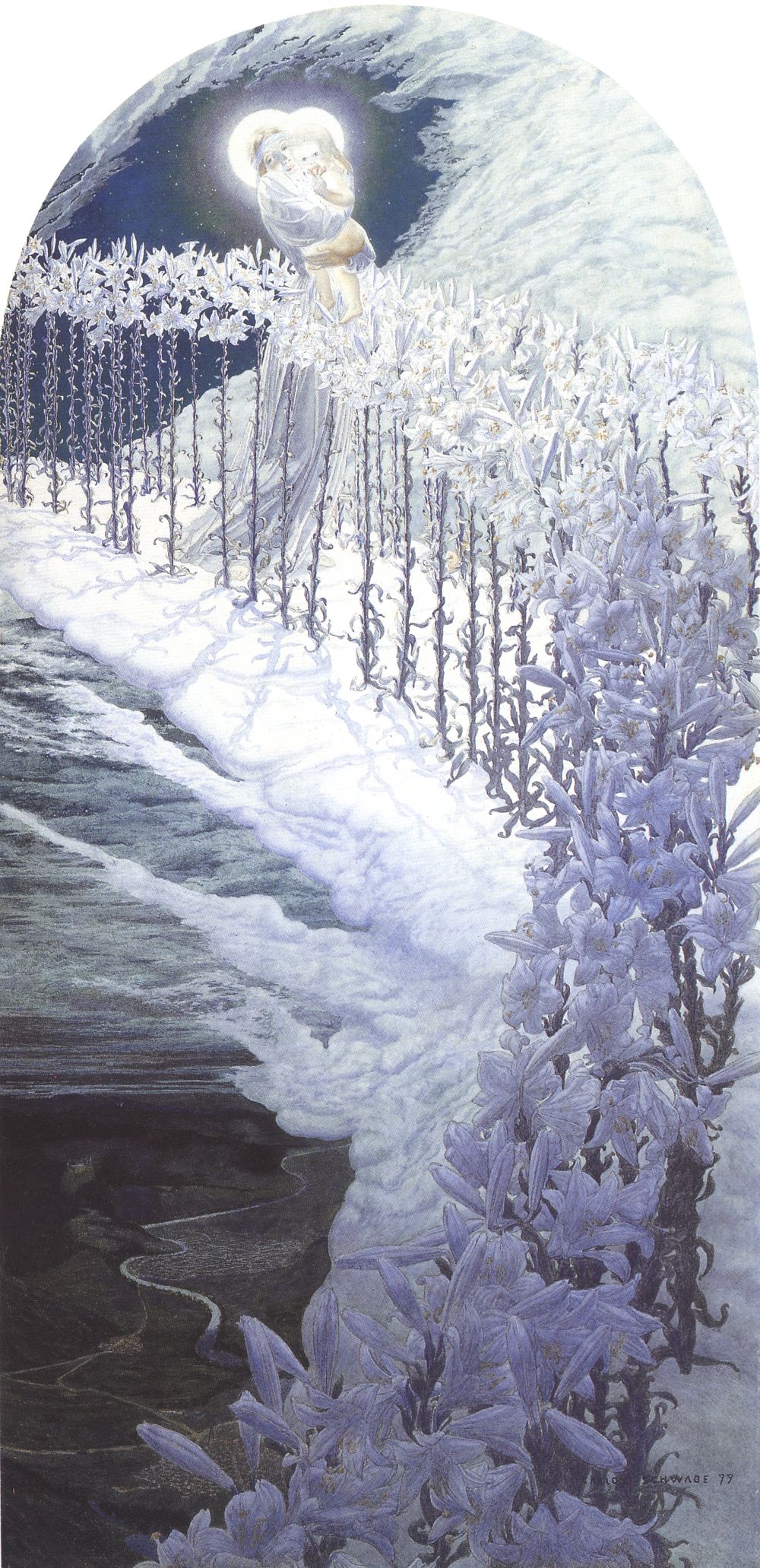
schwabevirginlilies1899
Carlos Schwabe (1866–1926), The Virgin with Lilies (1899), further details not known. Wikimedia Commons.

The following year, Schwabe painted one of at least two versions of a more conventional Christian motif, The Virgin with Lilies (1899) (above), dominated by the sweeping curve of its rhythmic flowers. Below is another version with the same title, but no date, on a tondo. This lacks the same rhythm, instead emphasising the rays of heavenly light.
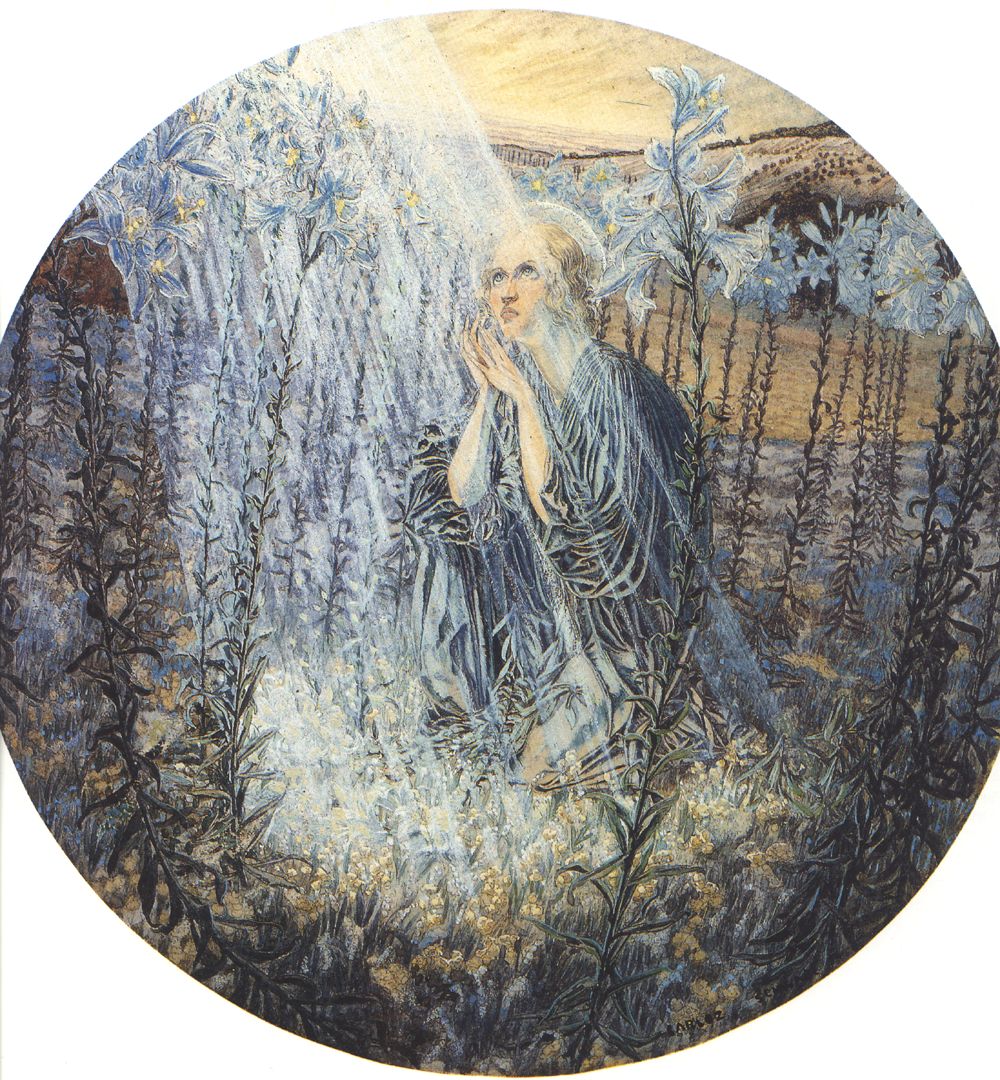
schwabevirginliliesud
Carlos Schwabe (1866–1926), The Virgin with Lilies (date not known), further details not known. Wikimedia Commons.
schwabedeathgravedigger
Carlos Schwabe (1866–1926), Death and the Gravedigger (1900), watercolour, gouache and pencil on paper, 75 x 55.5 cm, Musée d’Orsay, Paris. Wikimedia Commons.

Schwabe developed the theme of the Grim Reaper further in his watercolour of Death of the Gravedigger from 1900. An old gravedigger is seen deep in his own work on a snowy winter’s day. Squatting beside that grave is the female figure of Death, holding in her right hand a small oil lamp emitting an unnatural green light. She looks languidly down at the gravedigger, and he looks up at her in fear. The long barren twigs of a weeping willow form a curtain that echoes the curves of her wings.
schwabewomancradle
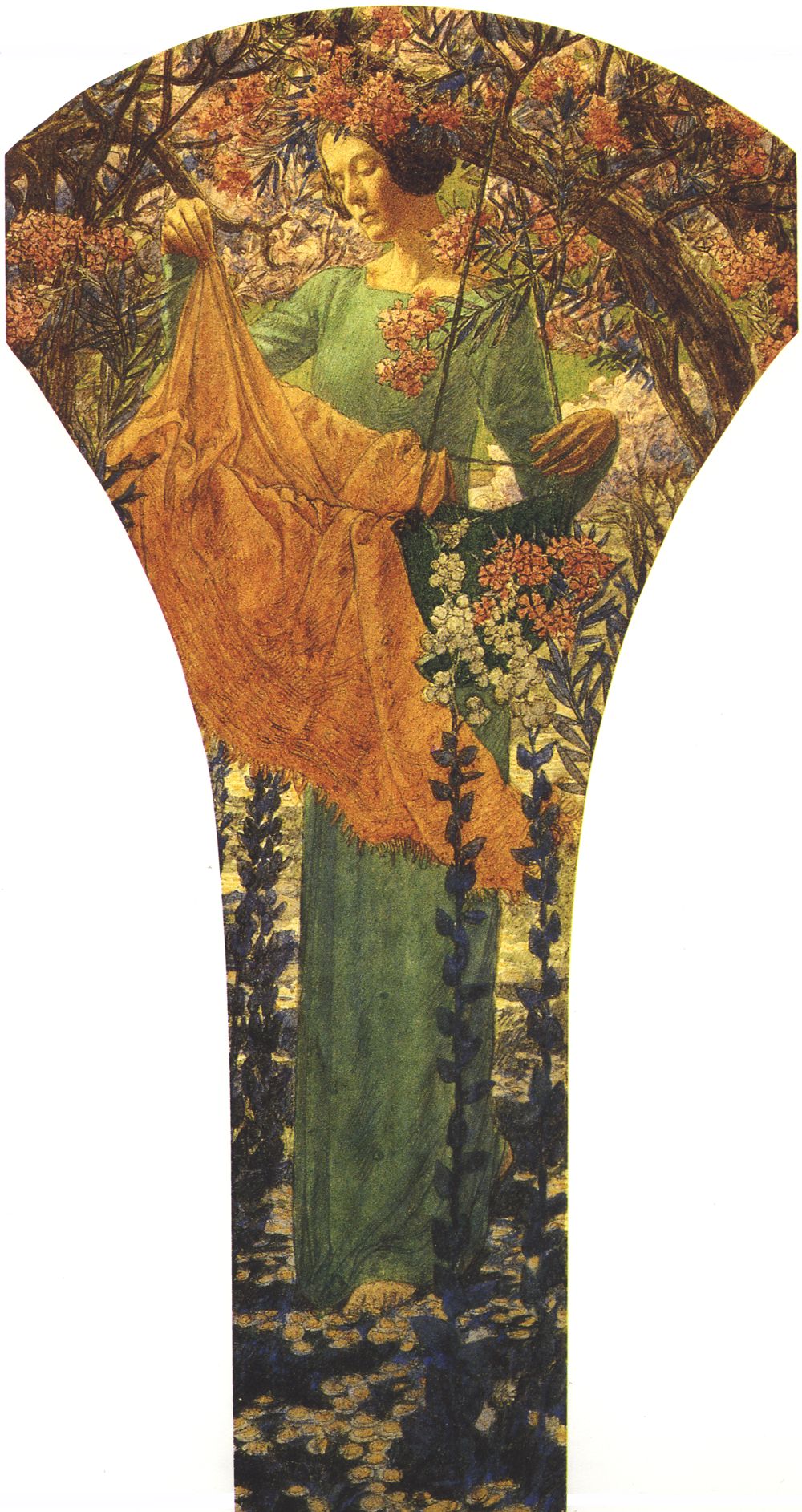
Carlos Schwabe (1866–1926), Woman with a Cradle Among Flowers, or Fate (1900), media not known, 37 x 19 cm, Private collection. Wikimedia Commons.

Woman with a Cradle Among Flowers, or Fate, from 1900 appears to be a decorative work, showing a mother tending to an infant’s cradle suspended among rich blossom. She looks down at the baby, but exceptionally it’s not revealed to the viewer. This is also one of Schwabe’s few works that may depict a real-life motif.
schwabewomanlyre
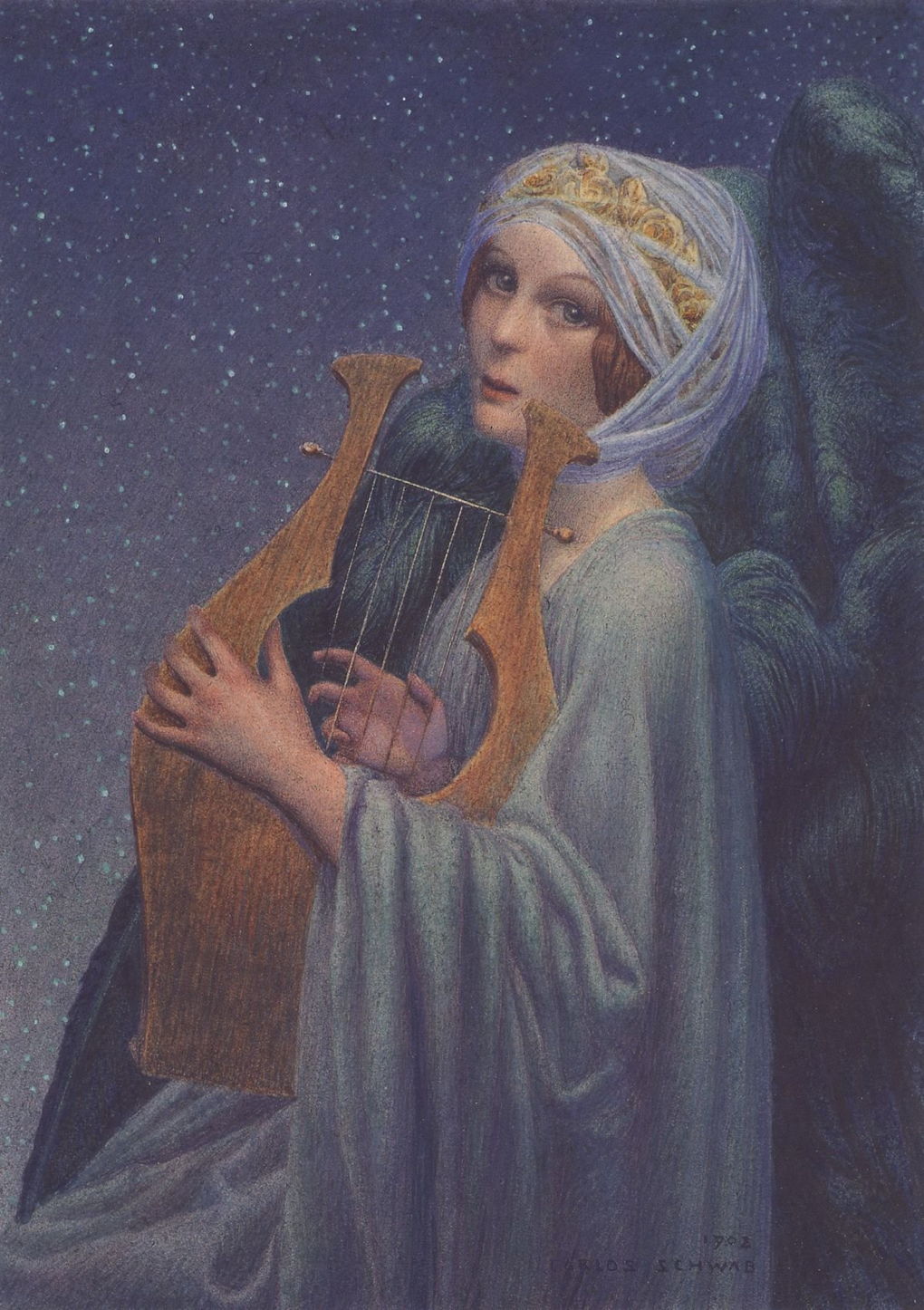
Carlos Schwabe (1866–1926), Woman with a Lyre (1902), further details not known. Wikimedia Commons.

Schwabe painted this romantic portrait of a Woman with a Lyre in 1902. She has the dark wings typical of so many of his angels, but is more wide-eyed as she sings against the backdrop of a starry night.
schwabechampselysees
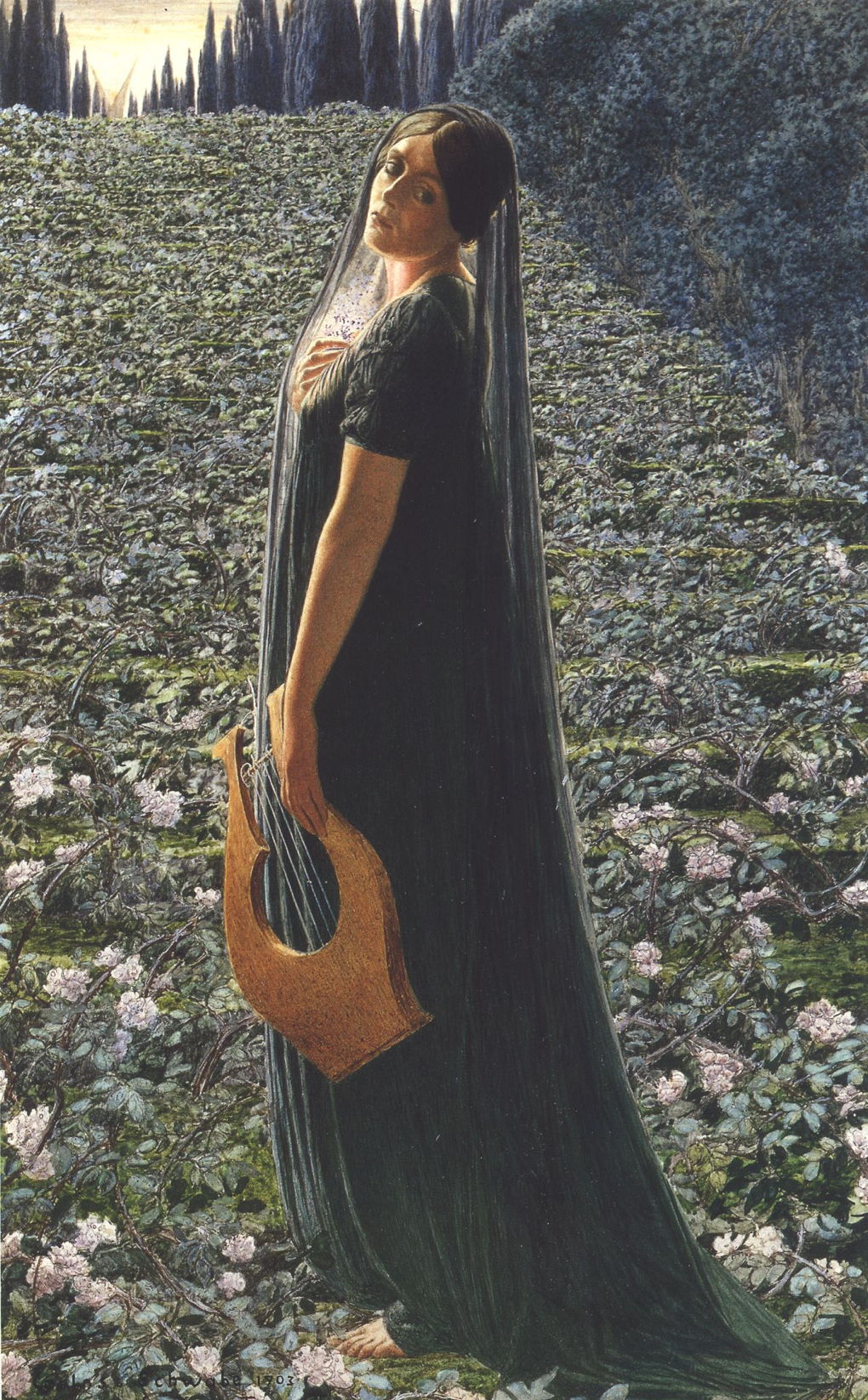
Carlos Schwabe (1866–1926), Elysian Fields (1903), watercolour, 46 x 29.5 cm, location not known. Wikimedia Commons.

His watercolour of Elysian Fields from 1903 is ambiguously titled, as it could refer to the famous avenue of the Champs Élysées in Paris. A woman looks languidly at the viewer as she strolls over a floral carpet on overgrown steps, leading up to an avenue of cypress trees, long associated with graveyards and death. She is dressed in black, with a long black mantilla, and carries a classical lyre in her left hand, indicating she is a poet. In classical Greek mythology, the Elysian Fields were the final resting place of the souls of heroes.
schwabewave
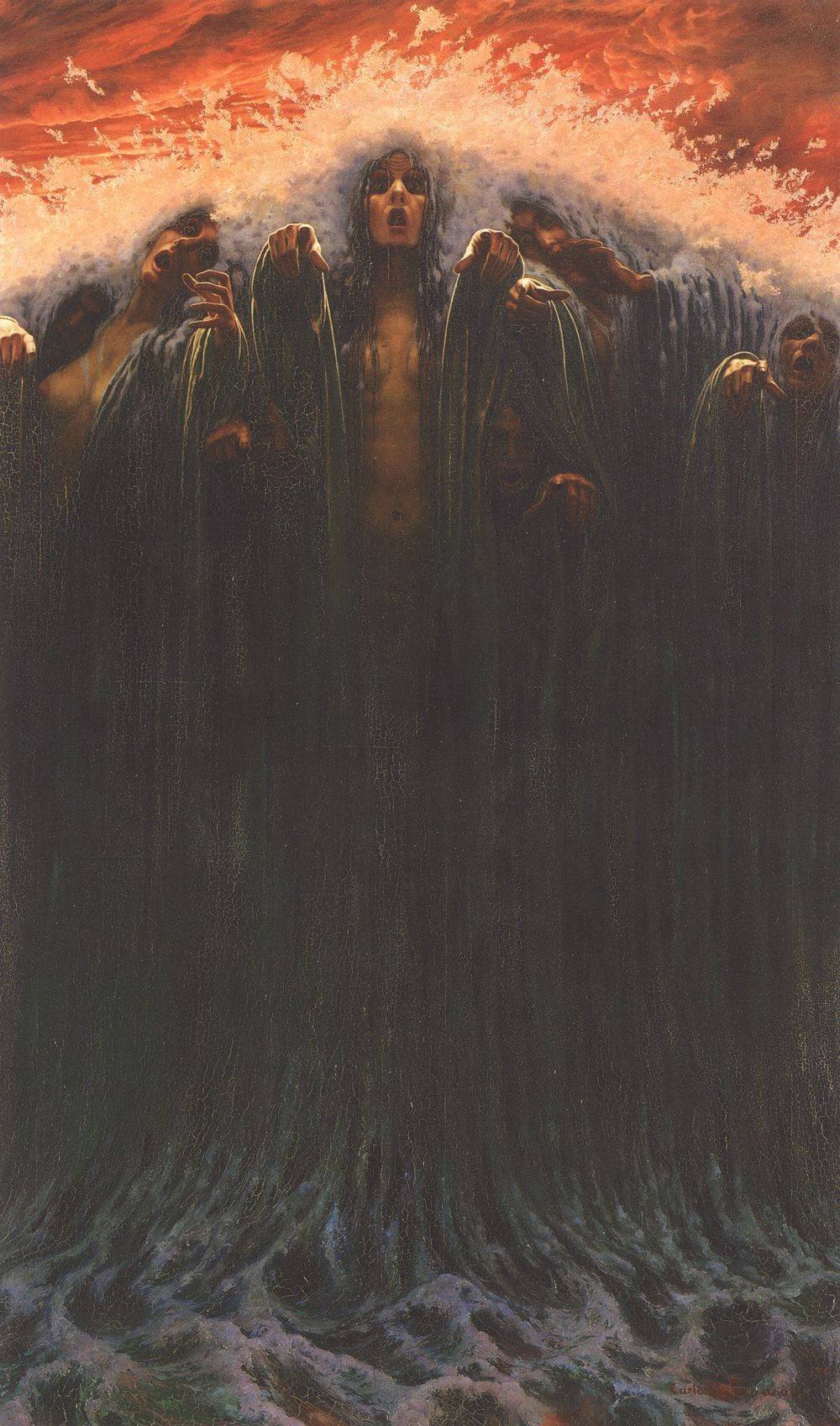
Carlos Schwabe (1866–1926), The Wave (1907), oil on canvas, 196 x 116 cm, Musée d’art et d’histoire, Geneva, Switzerland. Wikimedia Commons.

Schwabe appears to have painted mainly in watercolour during much of his career, but a few of his accessible works used oils. One of these is this dramatic Wave from 1907, in which the bodies of angry accusative women, possibly the Furies, are embedded in the wall of a wave as it rushes towards the viewer.
schwabespleenideal
Carlos Schwabe (1866–1926), Spleen and Ideal (1907), oil on canvas, 146 x 97 cm, location not known. Wikimedia Commons.

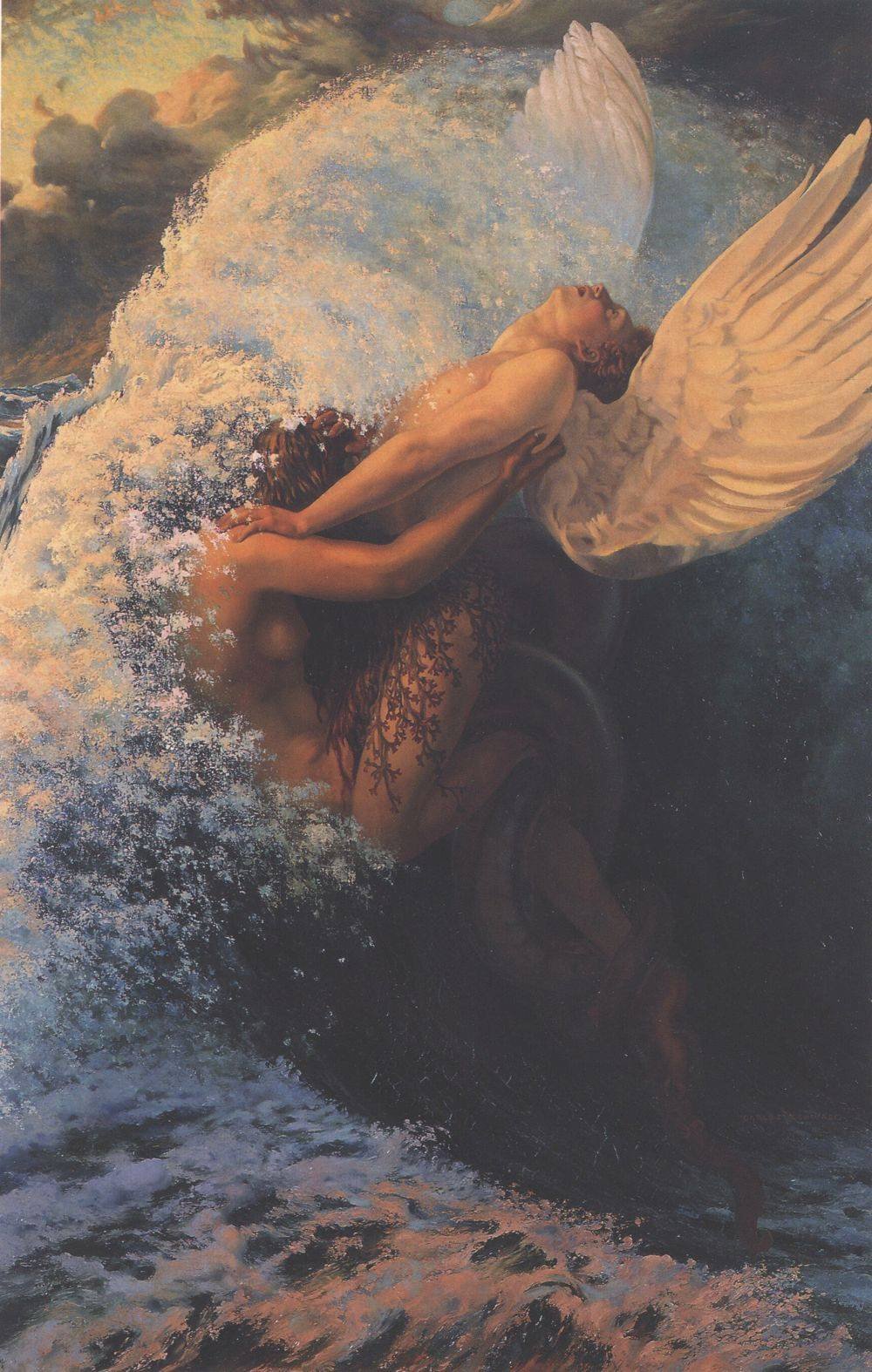
He also revisited some of the paintings he had made to illustrate Les Fleurs du Mal a decade earlier. Schwabe’s oil painting of Spleen and Ideal from 1907 is a fairly explicit depiction of two figures making love in a breaking wave, presumably indicating the moment of climax. The figure ‘on top’ is an angel with white wings, and appears to be male, while that ‘below’ has the breasts of a woman, although her face is obscured by her long hair. Writhing in among their interlocked bodies are the coils of a serpent, adding a dark twist to the composition.
schwabelotte
Carlos Schwabe (1866–1926), Lotte, the Artist’s Daughter (1908), chalk, 58 x 47 cm, location not known. Wikimedia Commons.

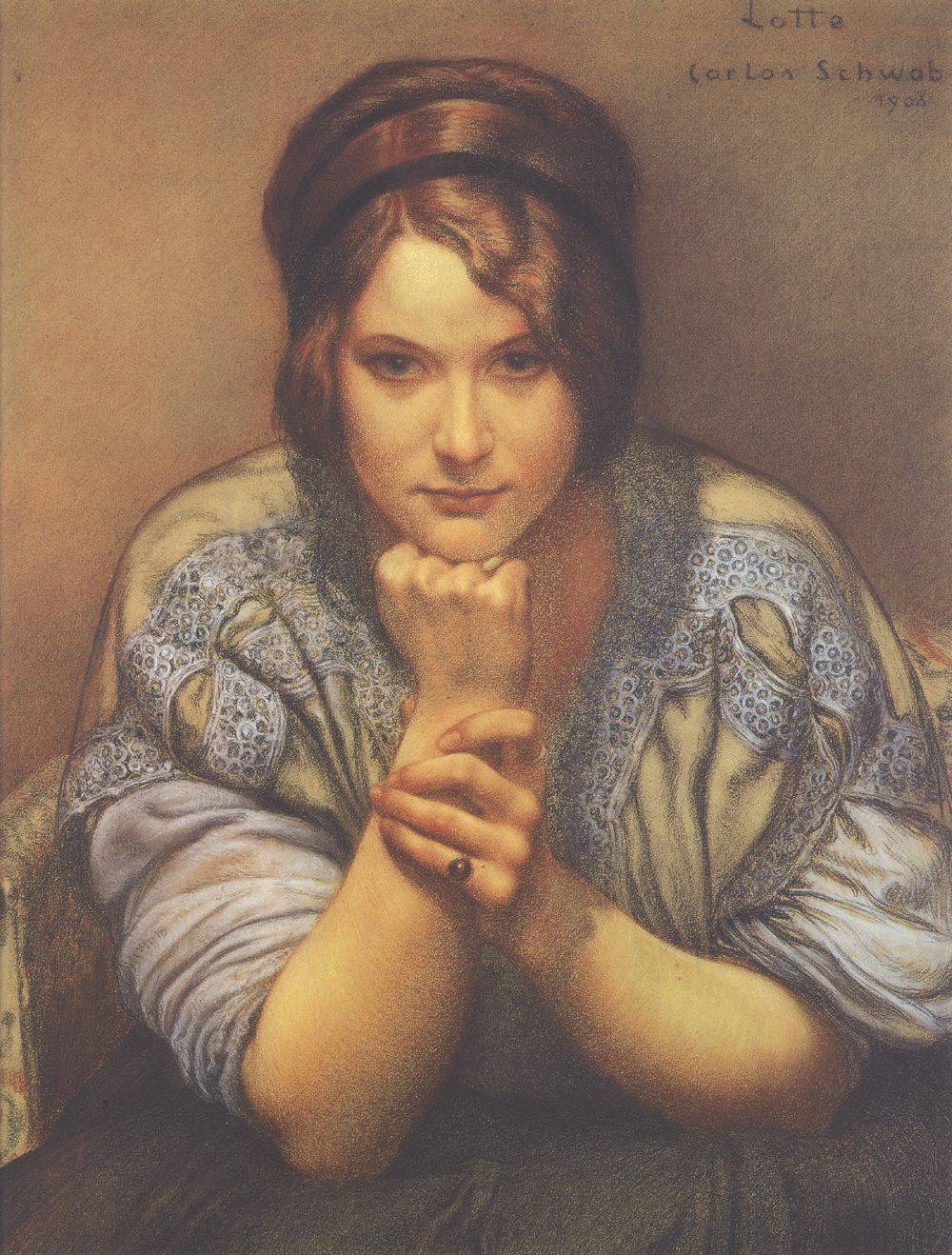
The last dated painting I have been able to find is this superb portrait of his daughter Lotte, painted in chalk in 1908. She comes across as a resolute young woman with a distinct air of mystery.

Although Schwabe didn’t die until 1926, I have been unable to locate any usable images of his paintings during the final eighteen years of his life, from the age of only forty-two. He seems to have retired to live in the small town of Avon in the Fontainebleau Forest, and the few paintings of his dated after 1910 appear to be more conventional depictions of classical myths.

Medium and Message: Tondo

By: hoakley
20 January 2026 at 20:30

The great majority of paintings are made on rectangular supports, but since ancient times some artists have opted for circular or elliptical shapes instead. These are known as tondo, from the Italian rotondo meaning “round”, with the plural of tondi, or tondos if you really must.

anontriptolemoskore
“Aberdeen Painter”, Triptolemus and Korē (c 470-460 BCE), tondo of a red-figure Attic cup discovered at Vulci, 36 cm diameter, Musée du Louvre, Paris. Image by Jastrow, via Wikimedia Commons.

This tondo of a red-figure Attic cup, now in the Louvre, is typical of classical depictions of Triptolemus and Ceres, and dates from 470-460 BCE. The young deity is sat in Ceres’ special winged chariot, as she provides him with seed to be distributed to the lands around the world.

Fabricating a perfect tondo using wooden panels has remained relatively unusual, probably for practical reasons. The increasing use of fabric stretched on a wooden frame enabled them to become more popular, as they did during the Renaissance.

frabartolomeoadoration1499
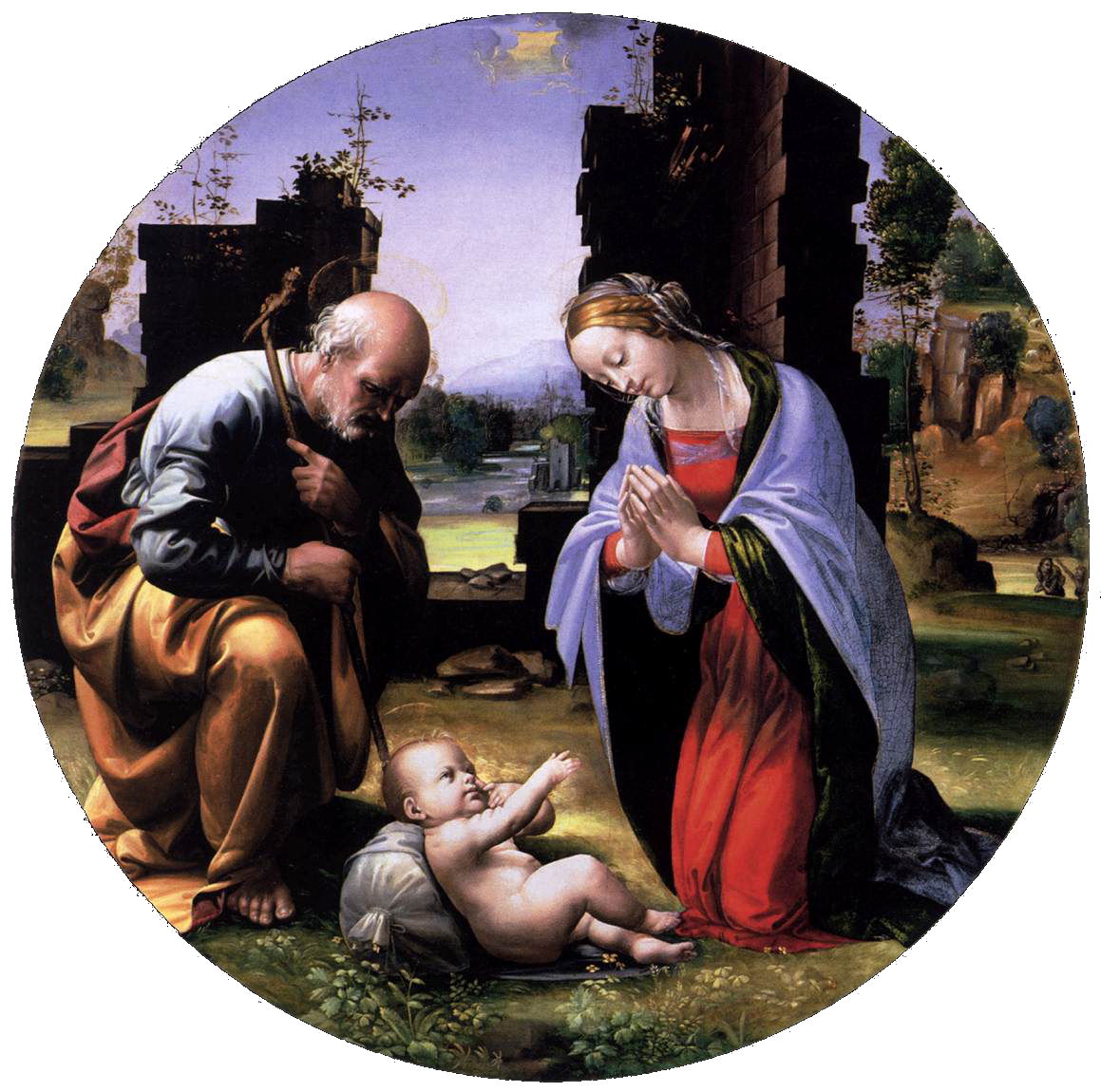
Fra Bartolomeo (1472–1517), Adoration of the Child (c 1499), oil on canvas, dimensions not known, Galleria Borghese, Rome. Wikimedia Commons.

Far Bartolomeo’s tondo of the Adoration of the Child (c 1499) is a fine painting of an enormously popular Christian scene, with Jesus’ parents paying their respects to the baby.

The softer geometry of circles and ellipses makes tondi ideally suited to portraits of the Madonna and child, and for portraits of women more generally. Their use has proved particularly successful in the paintings of Raphael.

raphaelalbamadonna
Raphael (Rafael Sanzio de Urbino) (1483–1520), The Alba Madonna (c 1510), oil on panel mounted on canvas, diameter 94.5 cm, National Gallery of Art, Washington, DC. Wikimedia Commons.

Raphael’s Alba Madonna was probably painted around 1510, and has spawned many replicas. It was commissioned by a bishop for the church of the Olivetans in Nocera dei Pagani, a town on the coastal plain of the south-west of Italy, in the province of Salerno. Its landscape background is also notable.

raphaelmadonnaseggiola
Raphael (Rafael Sanzio de Urbino) (1483–1520), Madonna della Sedia (Seated Madonna with the Child on her Lap and the Young Saint John) (1513-14), oil on panel, diameter 71 cm, Palazzo Pitti, Florence, Italy. Wikimedia Commons.

Of all Raphael’s tondo Madonnas, it’s his Madonna della Sedia (Madonna of the Chair) from 1513-14 which is my favourite. It shows a thoroughly real and natural mother with two infants, every surface texture rendered as in life, in a close-cropped composition matched to its shape.

Tondi have also proved ideal for self-portraits.

anguissolaselfportraittondo
Sofonisba Anguissola (1530–1625), Self-portrait (date not known), oil on panel, diameter 13.2 cm, Private collection. Wikimedia Commons.

This small undated Self-portrait shows Sofonisba Anguissola, the first great female master.

poussintimetruthenvydiscord
Nicolas Poussin (1594–1665), Time Defending Truth against the Attacks of Envy and Discord (1641), oil on canvas, diam 297 cm, Musée du Louvre, Paris. Wikimedia Commons.

Although his best-known paintings were all rectangular, Nicolas Poussin’s later tondo Time Defending Truth against the Attacks of Envy and Discord (1641) puts Father Time at its centre, with a firm grip around Truth’s waist, while Envy and Discord sit below them. On this occasion Time doesn’t have a hand free for an hour-glass. This appears to have been projected for placement in a round ceiling, another good reason for his choice of format.

tiepolodiscoverytruecross
Giovanni Battista Tiepolo (1696–1770), Discovery of the True Cross and Saint Helena (c 1743), oil on canvas, 490 cm diam, Gallerie dell’Accademia, Venice. Wikimedia Commons.

Although Tiepolo’s Discovery of the True Cross and Saint Helena (c 1743) is painted on a flat tondo, it was intended for display from the ceiling of the Capuchin church in Castello, as demonstrated in its projection.

kauffmancymonIphigenia
Angelica Kauffman (1741–1807), Cymon and Iphigenia (c 1780), oil on canvas, diam 62.2 cm, Gibbes Museum of Art, Charleston, SC. Wikimedia Commons.

In about 1780, Angelica Kauffman painted this delightful tondo of Cymon and Iphigenia, a variation on a popular theme.

girodetmllelangedanae
Anne-Louis Girodet de Roussy-Trioson (1767–1824), Portrait of Mlle. Lange as Danae (1799), oil on canvas, 60.3 x 48.6 cm, Minneapolis Institute of Arts, Minneapolis, MN. Wikimedia Commons.

Girodet chose a large elliptical tondo for his ‘revenge’ portrait of Mlle Lange, who had refused his previous portrait of her. As a motif in painting, Danaë had come to be represented as a reclining, beautiful, nude woman, on whom a stream of golden coins was falling, and it was that stream Girodet wanted to exploit. It could have only one reading in this context: that Mlle Lange sold her body in return for money, and Girodet was happy to be even more explicit.

Tondi were also imitated on occasion. Ford Madox Brown’s first painting to establish his interest in more complex storytelling was The Last of England, which he started as his response to the emigration to Australia of the only Pre-Raphaelite sculptor, Thomas Woolner, in 1852.

brownlastofenglandoil
Ford Madox Brown (1821–1893), The Last of England (1852/55), oil on panel, 82.5 x 75 cm, Birmingham Museum and Art Gallery, Birmingham, England. Wikimedia Commons.

Brown’s original oil version is one of his most subtle compositions. Central to its imitation of a circular tondo is a middle-class couple who are not enjoying the fact that their migrant ship is ‘all one class’. They both stare with grim determination at the prospect of sharing the next few weeks with the rowdy working class passengers behind them, eating the same increasingly stale vegetables which are now slung from cords around the ship’s rail in front of them.

This isn’t just a couple, though: look closely at their hands, and the woman’s left hand is clutching the tiny hand of her baby, who is safely swaddled inside her weatherproof hooded travelling cape. Her right hand, wearing a black leather glove, grasps that of her husband, whose left hand is tucked under his heavy coat. Splashes of brilliant colour are supplied by the wind blowing the woman’s ribbons.

daddcontradictionoberontitania
Richard Dadd (1817–1886), Contradiction: Oberon and Titania (1854-8), oil on canvas, 61 x 75.5 cm, Private collection. Wikimedia Commons.

Richard Dadd’s Contradiction: Oberon and Titania from 1854-8 develops his early faerie paintings into a new and unique style, and was painted for the hospital’s first resident Physician-Superintendent, William Charles Hood.

Dadd takes its theme from Shakespeare’s Midsummer Night’s Dream, and there’s hardly a square millimetre of canvas into which he hasn’t squeezed yet another curious detail. Like other great imaginative painters such as Bosch before, his dense details dart about in scale: there are tiny figures next to huge leaves and butterflies, and towards the top these distortions of scale generate an exaggerated feeling of perspective, which his choice of format may have enhanced.

schwabemedusa
Carlos Schwabe (1866–1926), Medusa (1895), watercolour on paper, dimensions not known, Private collection. Wikimedia Commons.

Carlos Schwabe’s watercolour tondo portrait of Medusa from 1895 is one of the most startling paintings in the round.

All good art suppliers continue to do a steady trade in tondi.

In memoriam Carlos Schwabe: 1 1890-96

By: hoakley
16 January 2026 at 20:30

Carlos Schwabe (1866–1926) died a century ago, on 22 January 1926, and this is the first of two articles to mark his death with a brief account of his career and art. Like others strongly associated with Symbolism at the end of the nineteenth and early twentieth centuries, his paintings have largely been forgotten in the enthusiasm for Post-Impressionism that swept Europe and North America in the following decades.

Schwabe was born in Altona, Germany, now absorbed into the western part of the city of Hamburg, but moved with his family to Geneva in Switzerland, where he studied art at the academy. When he completed that training, he moved to Paris and designed wallpaper. He seems to have continued to work in decorative art for much of his career, adopting an Art Nouveau style, and became a leading book illustrator.

One of his first major sets of illustrations accompanied an edition of Émile Zola’s Le Rêve (The Dream), the sixteenth in his Rougon-Macquart cycle, first published in book form in 1888. I suspect the first two paintings of his shown below are from that set. Zola was a Naturalist, and the Symbolists of the day expressed strong opposition to his Naturalist art; this makes Schwabe’s illustrations of particular interest.

Jour de mort
Carlos Schwabe (1866–1926), Day of Death (1890-92), watercolour, dimensions not known, Museu Nacional de Belas Artes (MNBA), Rio de Janeiro, Brazil. Wikimedia Commons.

His watercolour of Day of Death from 1890-92, sets a trend in his paintings for overlaying decorative elements on his figures, here a curtain of long tendrils dissecting the dark figure standing behind. Various mystical symbols include a triangle set in light rays at the top, and the artist signs his name as an inscription on a stone plinth at the lower left.

Les Cloches du soir
Carlos Schwabe (1866–1926), Evening Bells (1891), watercolour, dimensions not known, Museu Nacional de Belas Artes (MNBA), Rio de Janeiro, Brazil. Wikimedia Commons.

Evening Bells, a watercolour from 1891, may also have been destined for this set of illustrations. It’s an unusual composite of three views: dominating the right and lower areas is a view of a bell-tower, with a rhythmic series of angels emerging from one of the windows and flying downwards. At the lower left is an aerial view of a contemporary French town, and at the upper left a coastal view with water lapping on a flat shore.

schwabesalonrosecroix
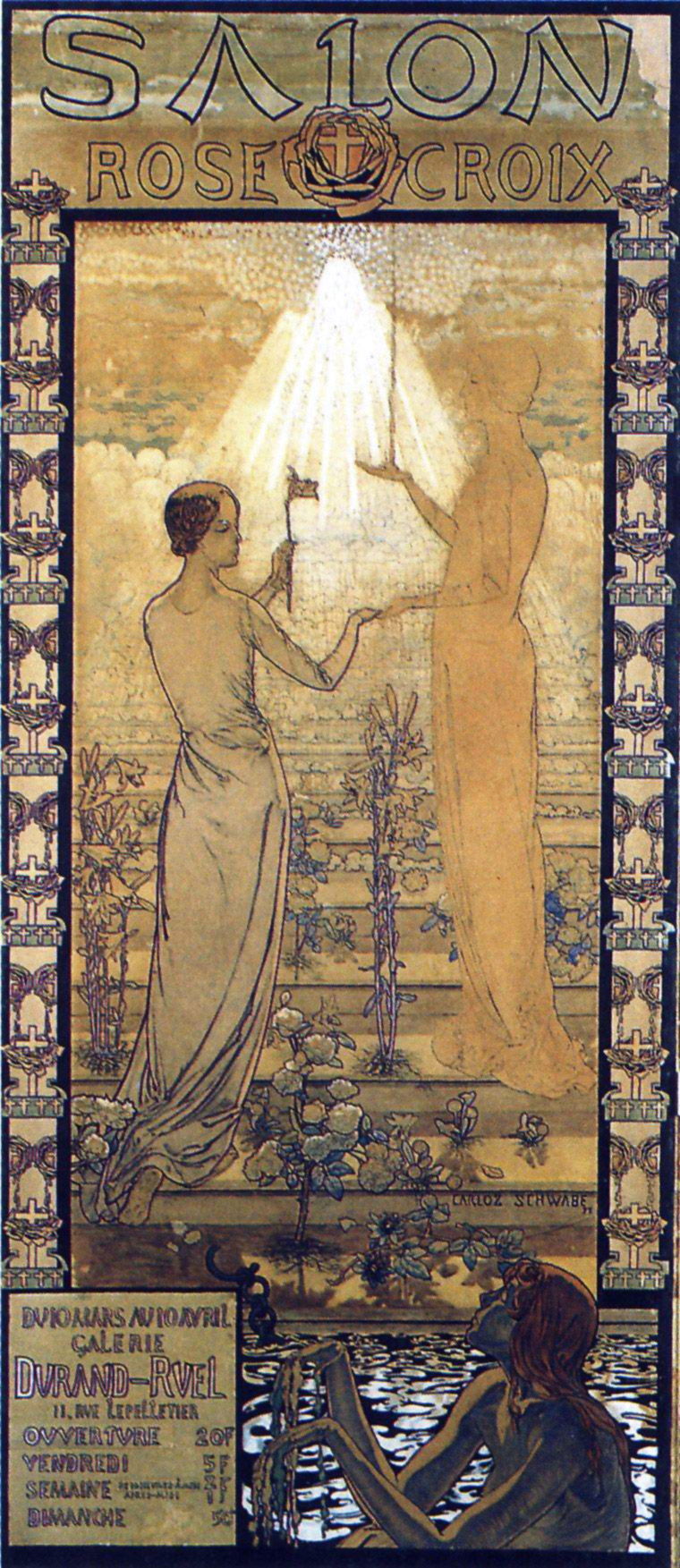
Carlos Schwabe (1866–1926), Design for Poster for the Salon de la Rose+Croix (1892), mixed media, 177 x 81 cm, Museu Nacional de Belas Artes (MNBA), Rio de Janeiro, Brazil. Wikimedia Commons.

By the time that Schwabe made this famous design for a poster for the Salon de la Rose+Croix in 1892, he had moved away from any early Naturalism and was an active member of the Rosicrucian and Symbolist group founded by Joséphin Péladan, the avant garde of Symbolist art. Schwabe had probably been introduced to its ranks as a result of his friendship with other members of the movement including the composer Vincent d’Indy. This was the first of a total of six of these Salons, led regally by Péladan, a controversial figure who wanted to revive a mediaeval secret society, the Rosicrucians, and named himself its new high priest, employing the suspicious title of Sâr.

Although supported by the Durand-Ruel Gallery, Péladan’s invitations to selected artists weren’t well received, and their Salon of 1897 proved to be the last.

schwabeangelhope
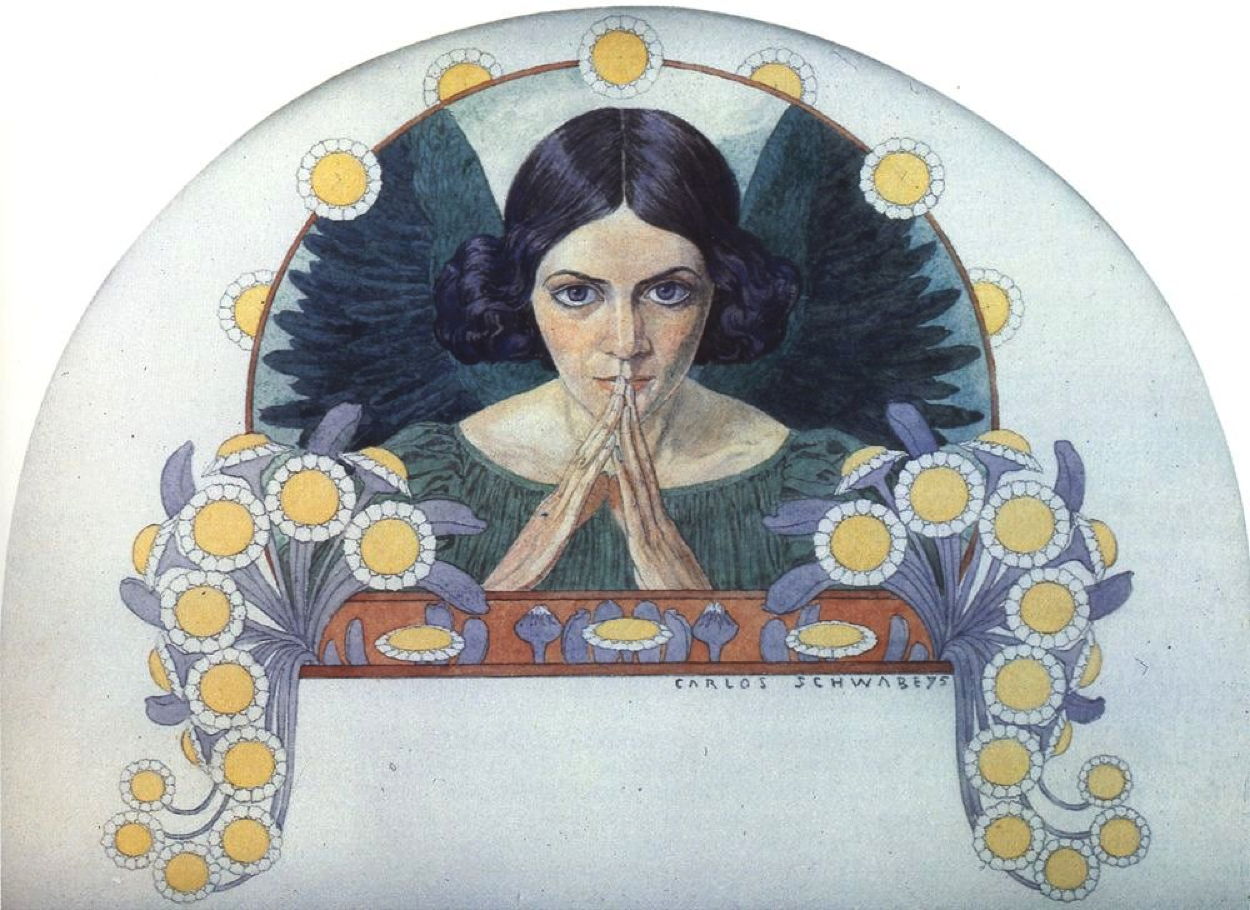
Carlos Schwabe (1866–1926), Angel of Hope (1895), media not known, 18 x 23 cm, Private collection. Wikimedia Commons.

This painting of an Angel of Hope from 1895 also appears to have been intended for use in print. As with many of Schwabe’s angelic figures, it is unmistakably female and has black wings.

schwabemedusa
Carlos Schwabe (1866–1926), Medusa (1895), watercolour on paper, dimensions not known, Private collection. Wikimedia Commons.

His watercolour tondo portrait of Medusa from the same year has startlingly feline eyes and that characteristic wide-mouthed look of utter horror. This is unusual for being one of the few close portraits of Medusa before her beheading by Perseus.

Around 1895, Schwabe started work on a set of colour illustrations for a new edition of Charles Baudelaire’s notorious poems Les Fleurs du Mal (Flowers of Evil), to be published in 1900. These had first been published in 1857, but their author and publisher were prosecuted for offending public decency and six poems were removed, and weren’t restored in full until 1949. Themes range through decadence and sex, with explicit references to practices that the affluent of the day considered should be kept in the brothels they frequented, for instance. These poems became a touchstone for more ‘progressive’ movements in art, including Symbolism.

schwabebenediction
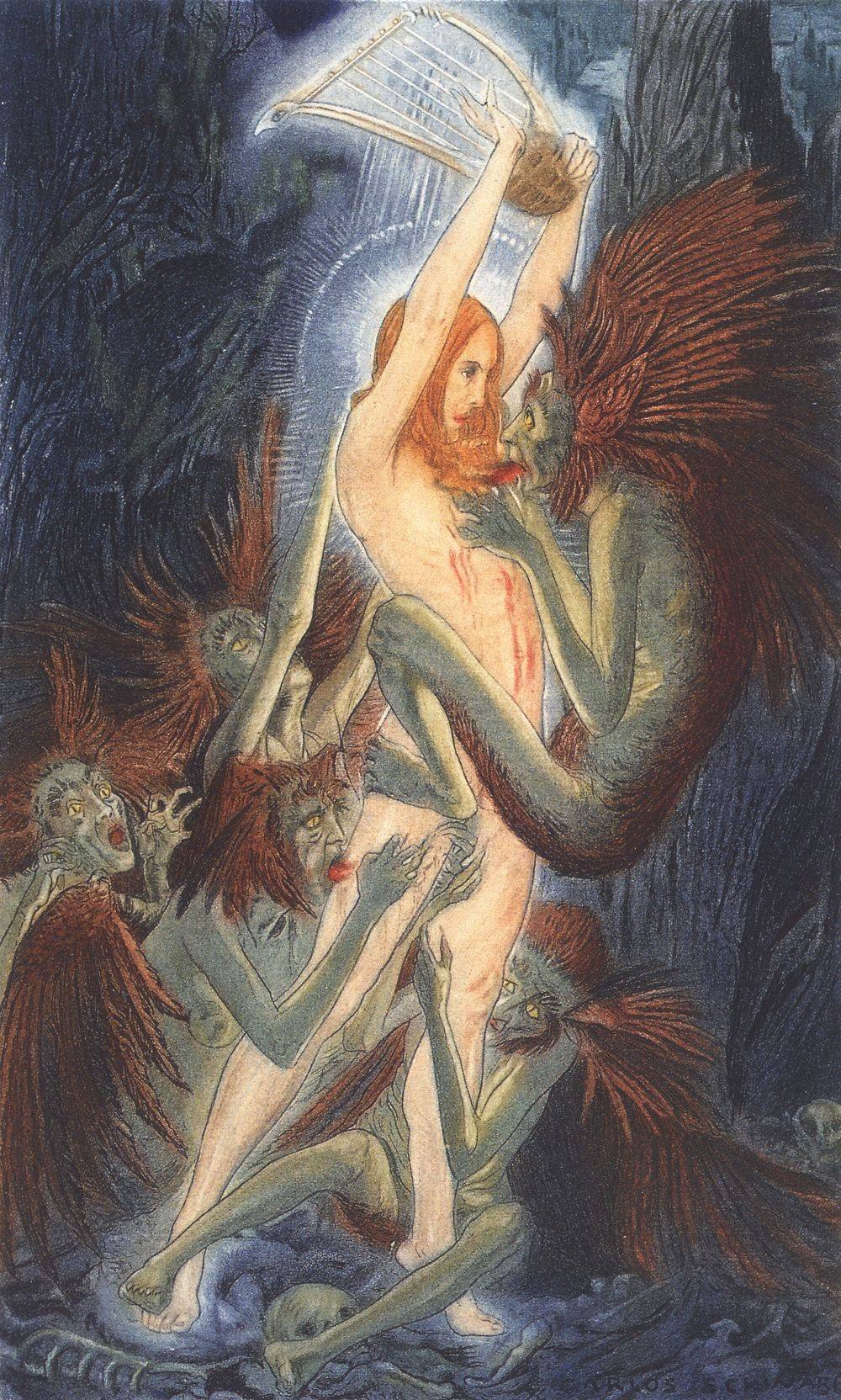
Carlos Schwabe (1866–1926), Benediction (1895-1900), illustration for ‘Les Fleurs du Mal’ (Flowers of Evil) by Charles Baudelaire, Paris, 1900, location not known. Wikimedia Commons.

Benediction accompanies the poem of that name, whose text is available in the original French and English translations here. A haggard devil is extracting the heart from a beautiful young woman, while apparently copulating with her. She is identified as a poet by the lyre she wields above her head. Other devils are trying to lick and suck parts of her legs.

schwabedusk
Carlos Schwabe (1866–1926), Dusk (1895-1900), illustration for ‘Les Fleurs du Mal’ (Flowers of Evil) by Charles Baudelaire, Paris, 1900, location not known. Wikimedia Commons.

This painting is titled Crépuscule in the original, which is here more likely to refer to Dawn rather than dusk, as it seems a better fit with the text. This giant female figure of “dawn, shivering in her green and rose garment, was moving slowly along the deserted Seine”. Hanging from each hand is a column of the citizens she is awakening.

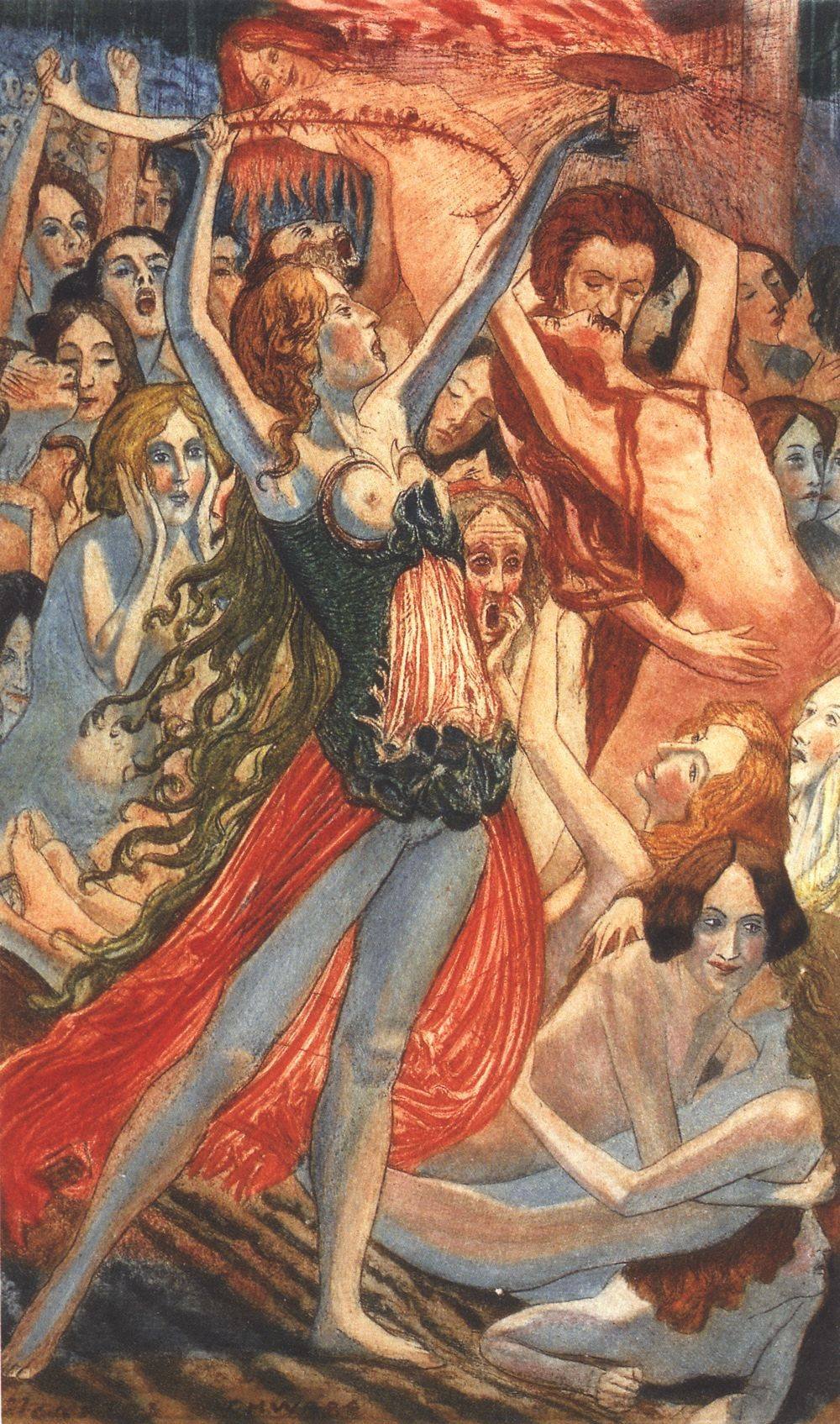
schwabedamnedwomen
Carlos Schwabe (1866–1926), Damned Women (1895-1900), illustration for ‘Les Fleurs du Mal’ (Flowers of Evil) by Charles Baudelaire, Paris, 1900, location not known. Wikimedia Commons.

Doomed or Damned Women most probably refers to the shorter post-censor version of the text. This celebrates lesbian practices including flagellation.

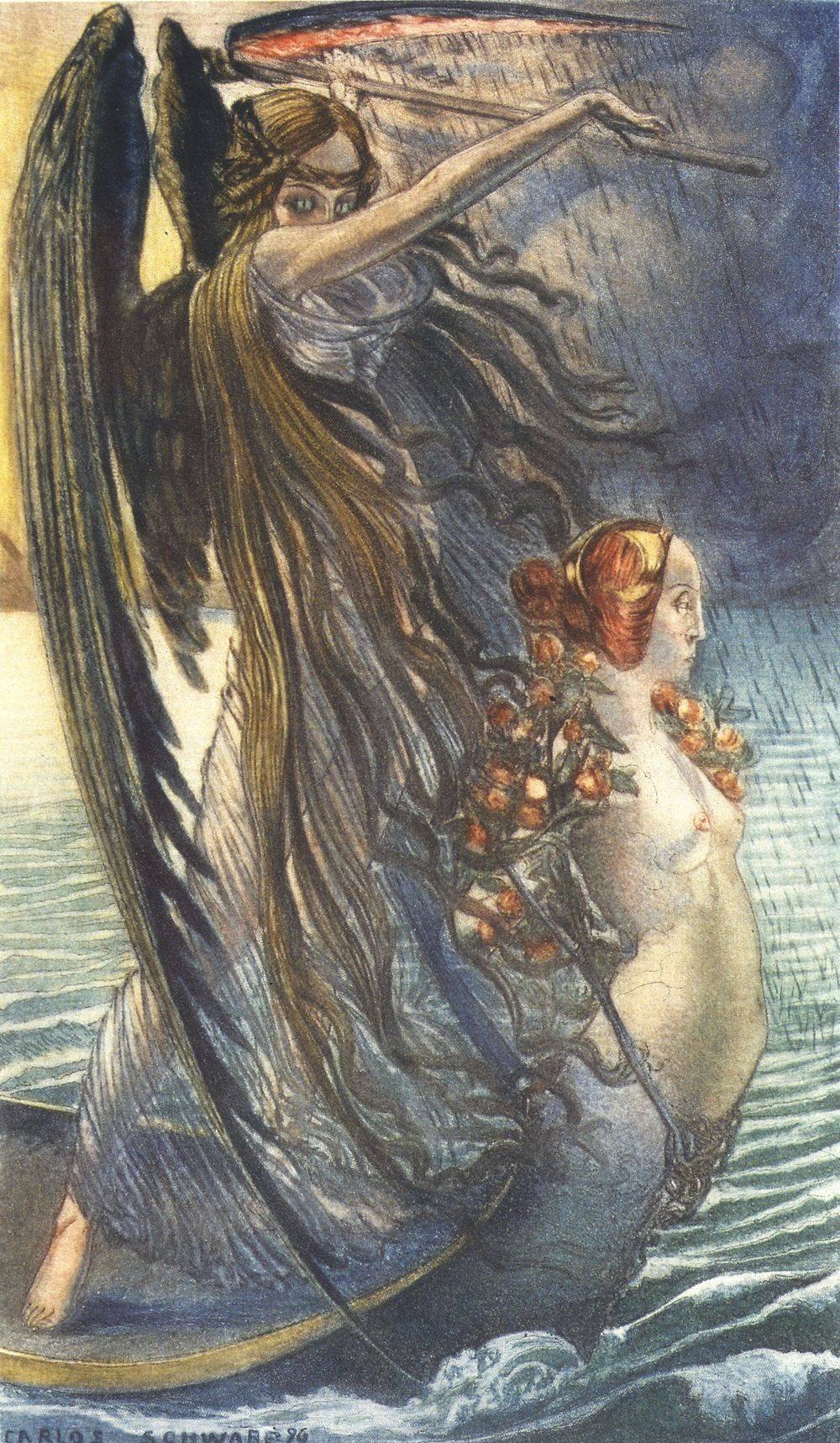
schwabedeath
Carlos Schwabe (1866–1926), Death (1896), illustration for ‘Les Fleurs du Mal’ (Flowers of Evil) by Charles Baudelaire, Paris, 1900, location not known. Wikimedia Commons.

Death, dated 1896, was probably intended as the frontispiece for the final group of poems. It shows a vengeful female version of the Grim Reaper figure well known through the history of modern painting, with feline eyes. She swings her scythe high above her head as she stands at the prow of a boat with an elaborate figurehead adorned with red roses.

❌
❌